EP0348564A1 - Orally active antiandrogens - Google Patents
Orally active antiandrogens Download PDFInfo
- Publication number
- EP0348564A1 EP0348564A1 EP88305904A EP88305904A EP0348564A1 EP 0348564 A1 EP0348564 A1 EP 0348564A1 EP 88305904 A EP88305904 A EP 88305904A EP 88305904 A EP88305904 A EP 88305904A EP 0348564 A1 EP0348564 A1 EP 0348564A1
- Authority
- EP
- European Patent Office
- Prior art keywords
- compound
- methyl
- glycyl
- phenyl
- trifluoromethyl
- Prior art date
- Legal status (The legal status is an assumption and is not a legal conclusion. Google has not performed a legal analysis and makes no representation as to the accuracy of the status listed.)
- Withdrawn
Links
- 0 *c(c(*)c1)ccc1N(*)C*=* Chemical compound *c(c(*)c1)ccc1N(*)C*=* 0.000 description 1
Classifications
-
- C—CHEMISTRY; METALLURGY
- C07—ORGANIC CHEMISTRY
- C07K—PEPTIDES
- C07K5/00—Peptides containing up to four amino acids in a fully defined sequence; Derivatives thereof
- C07K5/04—Peptides containing up to four amino acids in a fully defined sequence; Derivatives thereof containing only normal peptide links
- C07K5/08—Tripeptides
- C07K5/0827—Tripeptides containing heteroatoms different from O, S, or N
-
- C—CHEMISTRY; METALLURGY
- C07—ORGANIC CHEMISTRY
- C07K—PEPTIDES
- C07K5/00—Peptides containing up to four amino acids in a fully defined sequence; Derivatives thereof
- C07K5/04—Peptides containing up to four amino acids in a fully defined sequence; Derivatives thereof containing only normal peptide links
- C07K5/08—Tripeptides
- C07K5/0815—Tripeptides with the first amino acid being basic
-
- Y—GENERAL TAGGING OF NEW TECHNOLOGICAL DEVELOPMENTS; GENERAL TAGGING OF CROSS-SECTIONAL TECHNOLOGIES SPANNING OVER SEVERAL SECTIONS OF THE IPC; TECHNICAL SUBJECTS COVERED BY FORMER USPC CROSS-REFERENCE ART COLLECTIONS [XRACs] AND DIGESTS
- Y10—TECHNICAL SUBJECTS COVERED BY FORMER USPC
- Y10S—TECHNICAL SUBJECTS COVERED BY FORMER USPC CROSS-REFERENCE ART COLLECTIONS [XRACs] AND DIGESTS
- Y10S530/00—Chemistry: natural resins or derivatives; peptides or proteins; lignins or reaction products thereof
- Y10S530/827—Proteins from mammals or birds
- Y10S530/828—Cancer
Definitions
- Flutamide, 2-methyl-N-[4-nitro-3-(trifluoromethyl)phenyl]propanamide (previously known as 4′-nitro-3′-trifluoromethylisobutyranilide), and related substituted N-phenylamides are known antiandrogens, effective in the treatment of prostatic carcinoma, benign prostatic hypertrophy, acne and hirsutism. See U.S. Patents 4,329,364; 3,995,060; 4,139,638; and 4,161,540, all to Neri et al.
- antiandrogens are hydroxy- and alkanoyloxy-substituted N-phenylamides such as 2-hydroxy-2-methyl-N-[(4-substituted and 3,4-disubstituted)phenyl]propanamides.
- hydroxy- and alkanoyloxy-substituted N-phenylamides such as 2-hydroxy-2-methyl-N-[(4-substituted and 3,4-disubstituted)phenyl]propanamides.
- Said compound has been identified as the major active metabolite of flutamide. See Katchen et al, J. Clin. Endocrin. and Metab., 41 (1975), p. 373-9.
- N-phenylalkanamides containing a cyano substituent on the phenyl ring see U.S. Patent 4,239,776 to Glen et al
- N-phenyl)phenylalkanamides see U.S. Patent 4,386,080 to Cressley et al
- N-phenyl)heterocyclylalkanamides see U.S. Patent 4,535,092 to Hughes
- (N-phenyl)phenylsulfonylalkanamides see U.S. Patent 4,636,505 to Tucker.
- the compounds of this invention are represented by the formula wherein X is CN, NO2, CF3, Cl, Br or I; Y is F, Cl, Br, I, NO2, NH2, CF3 or CN; R is H or lower alkyl; R1 and R2 are independently straight or branched alkyl radicals having up to eight carbon atoms, or R1 and R2 together with the carbon to which they are attached form a cyclopropyl or cyclobutyl ring, or one of R1 and R2 is alkyl as defined above and the other is aryl, arylalkyl or aryl-S(O)0 ⁇ 2alkyl, wherein the aryl group may be substituted by 1-3 substituents selected from the group consisting of H, halogen, NO2, CO2H, CONH2, CN, lower alkyl, alkoxy, alkanoyl, lower alkylthio, lower alkylsulfinyl, lower alkylsulfonyl, perflu
- R3 is a poly-peptide group, which peptidyl group is joined to the molecule by a C-terminal amino acid residue; and the isomers and pharmaceutically acceptable salts thereof.
- the present invention relates to novel peptidyl esters of 2-hydroxy-N-phenylalkanamide derivatives useful as antiandrogenic agents for the treatment of prostatic carcinoma, benign prostatic hypertrophy, hirsutism, acne and related disorders.
- the invention also relates to a method of treating androgen-dependent disease conditions comprising administering to a mammal, in particular to a human, in need of such treatment an antiandrogenic effective amount of a peptidyl ester of a 2-hydroxy-N-phenylalkanamide derivative.
- compositions comprising the compound of formula I and a pharmaceutically acceptable carrier.
- the present invention also relates to a method of producing a compound of formula I wherein X, Y, R, R1, R2 and R3 are as defined above, characterized by contacting a compound of formula II wherein Z is OH or a C-terminal amino acid residue, with a peptidyl group of the formula R3H, optionally including amino protecting groups on the compound of formula II and/or the peptidyl group R3H, followed by removal of the protecting groups if necessary.
- the invention relates to tri-peptidyl esters of 2-hydroxy-N-phenylalkanamide derivatives, wherein the preferred derivative is 2-hydroxy-2-methyl-N-[4-nitro-3-(trifluoromethyl)phenyl] propanamide.
- polypeptidyl refers to a peptide moiety comprising at least two amino acid groups.
- R3 preferably is a di-, tri- or tetrapeptidyl group consisting of 2, 3 or 4 amino acids, which acids are preferably selected from naturally occurring amino acids.
- C-terminal amino acid residue refers to an amino acid radical ending in a COO ⁇ group.
- Lower alkyl refers to straight or branched chain alkyl groups having 1 to 4 carbon atoms.
- alkoxy and “alkanoyl” refer to groups having chain lengths of 1-4 carbon atoms.
- perfluoro lower alkyl refers to alkyl groups in which at least one of the carbon atoms is totally fluorinated, e.g. trifluoromethyl, ⁇ , ⁇ -difluoroethyl and ⁇ , ⁇ , ⁇ -trifluoroethyl.
- Aryl refers to phenyl or naphthyl rings.
- the di-,tri- or tetra-peptidyl groups are comprised of naturally occurring amino acids joined to each other by conventional peptide (i.e., -CONH-) bonds and joined to the rest of the molecule through a C-terminal amino acid residue, i.e. a -COO- group.
- Naturally occurring amino acids are proline, sarcosine (N-methylglycine), alanine, arginine, asparagine, aspartic acid, cysteine, glutamine, glutamic acid, glycine, histidine, isoleucine, leucine, lysine, methionine, phenylalanine, serine, threonine, tryptophan, tyrosine and valine.
- Preferred compounds of formula I are those wherein Y is trifluoromethyl and X is nitro, iodo, bromo, chloro or cyano, with nitro and cyano being more preferred. Another group of preferred compounds are those wherein X is nitro and Y is bromo or chloro. A third group of preferred compounds are those wherein R is hydrogen. Still another group of preferred compounds are those wherein R1 and R2 are each methyl. A further group of preferred compounds are those wherein R1 is methyl and R2 is aryl-S(O)0 ⁇ 2alkyl, especially wherein R2 is 4-fluorophenylsulfonylmethyl.
- R is hydrogen, X is nitro, Y is trifluoromethyl, and R1 and R2 are each methyl. Also, especially preferred are compounds wherein R is hydrogen, X is cyano, Y is trifluoromethyl, R1 is methyl and R2 is 4-fluorophenylsulfonylmethyl.
- tri-peptidyl esters are preferred.
- Preferred amino acids are lysine, glycine, proline, alanine and sarcosine.
- Preferred tri-peptide groups are alanyl-glycyl-sarcosyl, lysyl-glycyl-sarcosyl, and lysyl-glycyl-prolyl, with the first being more preferred.
- Preferred compounds of the invention are: L -lysyl-glycyl-N-methylglycine, [1-methyl-[[4-nitro-3-(trifluoromethyl)phenyl]aminocarbonyl]ethyl] ester; L -alanyl-glycyl-N-methylglycine, [1-methyl-[[4-nitro-3-(trifluoromethyl)phenyl]aminocarbonyl]ethyl]ester; and L -lysyl-glycyl- L -proline, [1-methyl-[[4-nitro-3-(trifluoromethyl)phenyl]aminocarbonyl]ethyl]ester.
- L -lysyl-glycyl-N-methylglycine [1-(4-fluorophenylsulfonylmethyl)-1-methyl-[[4-cyano-3-trifluoromethyl)phenyl]aminocarbonyl]ethyl]ester
- L -alanyl-glycyl-N-methylglycine [1-(4-fluorophenylsulfonylmethyl)-1-methyl-[[4-cyano-3-trifluoromethyl)phenyl]aminocarbonyl]ethyl]ester
- L -lysyl-glycyl- L -proline [1-(4-fluorophenylsulphonyl)-N-[4-cyano-3-(trifluoromethyl)phenyl]propanamide
- Compounds of this invention may form acid addition salts with pharmaceutically acceptable acids such as hydrochloric, hydrobromic, methane sulfonic, toluenesulfonic and sulfuric acids.
- pharmaceutically acceptable acids such as hydrochloric, hydrobromic, methane sulfonic, toluenesulfonic and sulfuric acids.
- Compounds of this invention may possess one or more asymmetric carbon atoms, e.g. in compounds wherein R1 and R2 are different, and in compounds wherein one or more of the amino acids comprising R3 contain a chiral center.
- the stereoisomers can be separated by methods known in the art. Preferably, when specific isomerism is desired in the product, stereospecific starting materials are used. All stereoisomers are contemplated as a part of this invention.
- Preferred for R3 are amino acids in the L -configuation.
- a preferred starting material is a compound of formula II wherein X, Y, R, R1 and R2 are as defined above and Z is OH or a C-terminal amino acid residue.
- Z is OH
- the compound of formula II is reacted with the carboxy group of an N-protected amino acid, then one or more amino acids are added by conventional peptide condensation reactions to obtain the peptidyl ester.
- Z is an amino acid residue, additional amino acids or peptides are similarly added by condensation reactions.
- the C-terminal group of a di-, tri- or tetra-peptidyl group may be directly reacted with a compound of formula II wherein Z is OH.
- reaction of a compound of formula II wherein Z is OH with the carboxy group of an N-protected amino acid is carried out at 0-25°C in an inert solvent such as dichloromethane in the presence of a base such as 4-N,N-dimethylaminopyridine and a condensing agent such as 1-(3-dimethylaminopropyl)-3-ethylcarbodiimide (DEC).
- DEC 1-(3-dimethylaminopropyl)-3-ethylcarbodiimide
- the subsequent addition of an amino acid or a peptide is similarly carried out at 0-25°C in an inert solvent such as dimethylformamide in the presence of a base such as triethylamine and condensing agents such as DEC and 1-hydroxybenzotriazole (HOBT).
- a base such as 4-N,N-dimethylaminopyridine
- DEC 1-(3-dimethylamino
- the known coupling methods include amino group protection during the coupling reaction, for example with a protecting group such as N-t-butoxycarbonyl (BOC), followed by removal of the protecting group to yield compounds of formula I.
- a protecting group such as N-t-butoxycarbonyl (BOC)
- acetyl flutamide The antiandrogenic activity of flutamide and its active metabolite are well documented. However, we have surprisingly found that the peptidyl esters of this invention demonstrate superior bioavailability compared to flutamide, its active metabolite, or to simple esters of the active metabolite, e.g. 2-hydroxy-2-methyl-N-[4-nitro-3-(trifluoromethyl)phenyl]propanamide acetate (hereinafter acetyl flutamide).
- Table 1 shows that all amino acid esters tested, especially the tri-peptidyl esters, delivered the active metabolite of flutamide more efficiently than either the active metabolite itself or simple esters of the active metabolite.
- Plasma concentrations of the flutamide active metabolite in 300-350 gram male Sprague Dawley rats following single oral 5 mg/kg doses of the compounds listed were determined by gas-liquid chromatography. Areas under the 0-4 hour plasma level curves were calculated for each compound and compared to the area obtained for flutamide active metabolite as shown in the last column of the table.
- compounds of this invention should be administered at a rate which provides a quantity of flutamide active metabolite equivalent to a dose of about 1 to 30 mg per kg of body weight per day, preferably about 2 to about 20 mg per kg of body weight per day.
- the aforementioned doses may be divided into two or more portions for administration over the course of the day, for example, one-third of the daily dose administered three times per day.
- compositions for a 70 kilogram mammal should provide a daily dose of flutamide active metabolite of about 100 mg to about 2000 mg, preferably about 250 mg to about 1500 mg, and more preferably about 500 mg to about 1000 mg, and should be continued until symptomatic relief is obtained, as ascertained by the attending diagnostician.
- the pharmaceutical preparations of this invention include such oral dosage forms as tablets, capsules and elixirs as well as parenteral dosage forms, e.g. ampuls and vials. Additionally, they may be in the form of suppositories (both rectal and urethral).
- a compound of this invention is compounded with an inert pharmaceutical carrier which may contain a suitable binder, such as gums, starches, and sugars.
- the ingredients may also be incorporated into gelatin capsules or formulated into elixirs which have the advantage of being susceptible to manipulations in flavor by the addition of standard natural or synthetic flavoring agents. Highly satisfactory administration may also be achieved in the form of aqueous parenteral suspension.
- the aforementioned formulations are so proportioned as to afford a unit dose of about 125 or about 250 mg of flutamide active metabolite.
- a preferred dosage of 750 mg per day could thus be administered as one 250 mg tablet or capsule three times per day or two 125 mg tablets or capsules three times per day.
- Milligrams/Capsule Ingredients Drug 125 mg 250 mg 200 mg Lactose, hydrous, USP 360.5 235.5 185 Sodium Lauryl Sulfate, NF 12 12 12 Povidone, USP (Polyvinylpyrrolidone) 25 25 25 Water, Purified, USP (evap.) or S.D. Alcohol, 3-A (evap.)* Corn Starch (Food Grade) 77 77 77 Magnesium Stearate, NF 0.5 0.5 1.0 Full Weight (mg.) 600 600 500 *Approximately 75 ml. 3-A alcohol/100 capsules, or 60 ml. water/1000 capsules.
Landscapes
- Chemical & Material Sciences (AREA)
- Organic Chemistry (AREA)
- Genetics & Genomics (AREA)
- Biochemistry (AREA)
- Biophysics (AREA)
- General Health & Medical Sciences (AREA)
- Health & Medical Sciences (AREA)
- Medicinal Chemistry (AREA)
- Molecular Biology (AREA)
- Proteomics, Peptides & Aminoacids (AREA)
- Life Sciences & Earth Sciences (AREA)
- Medicines That Contain Protein Lipid Enzymes And Other Medicines (AREA)
- Peptides Or Proteins (AREA)
Abstract
Antiandrogenic poly-peptidyl esters, represented by the formula
pharmaceutical compositions comprising same, methods of manufacture, uses and intermediates are disclosed.
Description
- Flutamide, 2-methyl-N-[4-nitro-3-(trifluoromethyl)phenyl]propanamide (previously known as 4′-nitro-3′-trifluoromethylisobutyranilide), and related substituted N-phenylamides are known antiandrogens, effective in the treatment of prostatic carcinoma, benign prostatic hypertrophy, acne and hirsutism. See U.S. Patents 4,329,364; 3,995,060; 4,139,638; and 4,161,540, all to Neri et al.
- Also known as antiandrogens are hydroxy- and alkanoyloxy-substituted N-phenylamides such as 2-hydroxy-2-methyl-N-[(4-substituted and 3,4-disubstituted)phenyl]propanamides. See Gold, U.S. Patent 3,875,229, wherein 2-hydroxy-2-methyl-N-[4-nitro-3-(trifluoromethyl)phenyl]- propanamide is indicated to be a preferred species. Said compound has been identified as the major active metabolite of flutamide. See Katchen et al, J. Clin. Endocrin. and Metab., 41 (1975), p. 373-9.
- Other related antiandrogens include N-phenylalkanamides containing a cyano substituent on the phenyl ring (see U.S. Patent 4,239,776 to Glen et al), (N-phenyl)phenylalkanamides (see U.S. Patent 4,386,080 to Cressley et al), (N-phenyl)heterocyclylalkanamides (see U.S. Patent 4,535,092 to Hughes), and (N-phenyl)phenylsulfonylalkanamides (see U.S. Patent 4,636,505 to Tucker).
- The compounds of this invention are represented by the formula
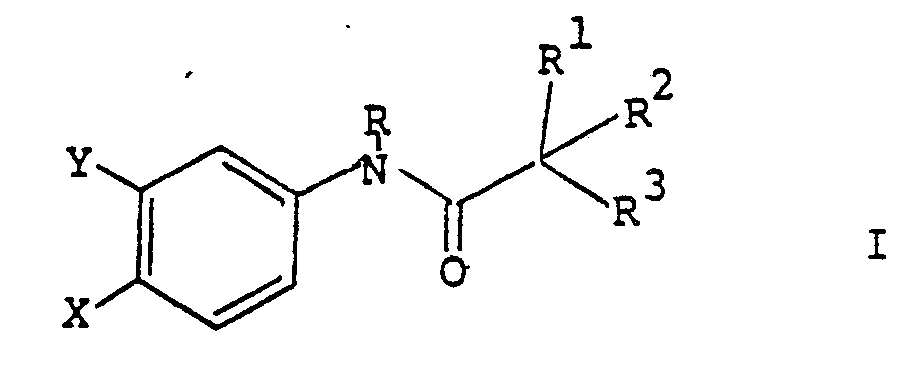
X is CN, NO₂, CF₃, Cl, Br or I;
Y is F, Cl, Br, I, NO₂, NH₂, CF₃ or CN;
R is H or lower alkyl;
R¹ and R² are independently straight or branched alkyl radicals having up to eight carbon atoms, or R¹ and R² together with the carbon to which they are attached form a cyclopropyl or cyclobutyl ring, or one of R¹ and R² is alkyl as defined above and the other is aryl, arylalkyl or aryl-S(O)₀₋₂alkyl, wherein the aryl group may be substituted by 1-3 substituents selected from the group consisting of H, halogen, NO₂, CO₂H, CONH₂, CN, lower alkyl, alkoxy, alkanoyl, lower alkylthio, lower alkylsulfinyl, lower alkylsulfonyl, perfluoro lower alkylsulfinyl, perfluoro lower alkylsulfonyl, alkoxycarbonyl, phenyl, phenylthio, phenylsulfinyl and phenylsulfonyl; - R³ is a poly-peptide group, which peptidyl group is joined to the molecule by a C-terminal amino acid residue; and the isomers and pharmaceutically acceptable salts thereof.
- The present invention relates to novel peptidyl esters of 2-hydroxy-N-phenylalkanamide derivatives useful as antiandrogenic agents for the treatment of prostatic carcinoma, benign prostatic hypertrophy, hirsutism, acne and related disorders.
- The invention also relates to a method of treating androgen-dependent disease conditions comprising administering to a mammal, in particular to a human, in need of such treatment an antiandrogenic effective amount of a peptidyl ester of a 2-hydroxy-N-phenylalkanamide derivative.
- Another aspect of the invention relates to pharmaceutical compositions comprising the compound of formula I and a pharmaceutically acceptable carrier.
- The present invention also relates to a method of producing a compound of formula I wherein X, Y, R, R¹, R² and R³ are as defined above, characterized by contacting a compound of formula II

- In particular, the invention relates to tri-peptidyl esters of 2-hydroxy-N-phenylalkanamide derivatives, wherein the preferred derivative is 2-hydroxy-2-methyl-N-[4-nitro-3-(trifluoromethyl)phenyl] propanamide.
- As used herein, the term "polypeptidyl" refers to a peptide moiety comprising at least two amino acid groups. R³ preferably is a di-, tri- or tetrapeptidyl group consisting of 2, 3 or 4 amino acids, which acids are preferably selected from naturally occurring amino acids. As used herein the term "C-terminal amino acid residue" refers to an amino acid radical ending in a COO⁻ group. "Lower alkyl" refers to straight or branched chain alkyl groups having 1 to 4 carbon atoms. Similarly, the term "alkoxy" and "alkanoyl" refer to groups having chain lengths of 1-4 carbon atoms. The term "perfluoro lower alkyl" refers to alkyl groups in which at least one of the carbon atoms is totally fluorinated, e.g. trifluoromethyl, α,α-difluoroethyl and β,β,β-trifluoroethyl. "Aryl" refers to phenyl or naphthyl rings.
- The di-,tri- or tetra-peptidyl groups are comprised of naturally occurring amino acids joined to each other by conventional peptide (i.e., -CONH-) bonds and joined to the rest of the molecule through a C-terminal amino acid residue, i.e. a -COO- group. Examples of naturally occurring amino acids are proline, sarcosine (N-methylglycine), alanine, arginine, asparagine, aspartic acid, cysteine, glutamine, glutamic acid, glycine, histidine, isoleucine, leucine, lysine, methionine, phenylalanine, serine, threonine, tryptophan, tyrosine and valine.
- Preferred compounds of formula I are those wherein Y is trifluoromethyl and X is nitro, iodo, bromo, chloro or cyano, with nitro and cyano being more preferred. Another group of preferred compounds are those wherein X is nitro and Y is bromo or chloro. A third group of preferred compounds are those wherein R is hydrogen. Still another group of preferred compounds are those wherein R¹ and R² are each methyl. A further group of preferred compounds are those wherein R¹ is methyl and R² is aryl-S(O)₀₋₂alkyl, especially wherein R² is 4-fluorophenylsulfonylmethyl. Especially preferred are compounds of formula I wherein R is hydrogen, X is nitro, Y is trifluoromethyl, and R¹ and R² are each methyl. Also, especially preferred are compounds wherein R is hydrogen, X is cyano, Y is trifluoromethyl, R¹ is methyl and R² is 4-fluorophenylsulfonylmethyl.
- For R³, tri-peptidyl esters are preferred. Preferred amino acids are lysine, glycine, proline, alanine and sarcosine. Preferred tri-peptide groups are alanyl-glycyl-sarcosyl, lysyl-glycyl-sarcosyl, and lysyl-glycyl-prolyl, with the first being more preferred.
- Preferred compounds of the invention are:
L-lysyl-glycyl-N-methylglycine, [1-methyl-[[4-nitro-3-(trifluoromethyl)phenyl]aminocarbonyl]ethyl] ester;
L-alanyl-glycyl-N-methylglycine, [1-methyl-[[4-nitro-3-(trifluoromethyl)phenyl]aminocarbonyl]ethyl]ester; and
L-lysyl-glycyl-L-proline, [1-methyl-[[4-nitro-3-(trifluoromethyl)phenyl]aminocarbonyl]ethyl]ester.
Also preferred are the corresponding peptidyl esters of 2-hydroxy-2-methyl-3-(4-fluorophenylsulphonyl)-N-[4-cyano-3-(trifluoromethyl)phenyl]propanamide, i.e.;
L-lysyl-glycyl-N-methylglycine, [1-(4-fluorophenylsulfonylmethyl)-1-methyl-[[4-cyano-3-trifluoromethyl)phenyl]aminocarbonyl]ethyl]ester;
L-alanyl-glycyl-N-methylglycine, [1-(4-fluorophenylsulfonylmethyl)-1-methyl-[[4-cyano-3-trifluoromethyl)phenyl]aminocarbonyl]ethyl]ester; and
L-lysyl-glycyl-L-proline, [1-(4-fluorophenylsulfonylmethyl)-1-methyl-[[4-cyano-3-trifluoromethyl)phenyl]aminocarbonyl]ethyl]ester. - Compounds of this invention may form acid addition salts with pharmaceutically acceptable acids such as hydrochloric, hydrobromic, methane sulfonic, toluenesulfonic and sulfuric acids.
- Compounds of this invention may possess one or more asymmetric carbon atoms, e.g. in compounds wherein R¹ and R² are different, and in compounds wherein one or more of the amino acids comprising R³ contain a chiral center. The stereoisomers can be separated by methods known in the art. Preferably, when specific isomerism is desired in the product, stereospecific starting materials are used. All stereoisomers are contemplated as a part of this invention. Preferred for R³ are amino acids in the L-configuation.
- Compounds of the invention are prepared by methods well known in the art. A preferred starting material is a compound of formula II

- The known coupling methods include amino group protection during the coupling reaction, for example with a protecting group such as N-t-butoxycarbonyl (BOC), followed by removal of the protecting group to yield compounds of formula I.
- Starting materials of formula II are known (See U.S. 3,875,229 and U.S. 4,636,505 cited above). Amino acids and di-, tri- and tetra- peptides are known or may be prepared by well known methods.
- Following is an example of a preparation of a tri-peptidyl ester of formula I. Those skilled in the art will recognize that by modifying this procedure, e.g. by using different amino acids or by increasing or decreasing the number of amino acids, other compounds of formula I may be prepared.
- Dissolve bis-N α,Nε-t-BOC-L-lysine (6.2g), N-hydroxysuccinimide (2.8g) and N,N-dicyclohexylcarbodiimide (5.1g) in 1,2 dimethoxyethane (20ml) and stir at 0°C for 12 hr. Filter the reaction mixture and evaporate the filtrate to dryness. Stir residual oil at 0° with ether and filter to obtain the title compound as a crystalline product (8.2g).
- Dissolve the product of Step A (4.4g) in dimethylformamide (DMF)(32ml) and add to a solution of glycine (0.75g) and sodium bicarbonate (1.7g) in water (24 ml). Stir at 0°C for 2 hours and then at room temperature for 12 hours. Remove the solvent in vacuo and dissolve the residue in water. Adjust the pH to 3.5 using aqueous hydrochloric acid and extract the resultant solution with ethyl acetate. Wash the ethyl acetate with water and satuated brine solution and dry with sodium sulfate. Evaporate the ethyl acetate to obtain the title compound (3.5 g). Calculated for C₁₈H₃₃N₃O₇: C=53.53%; H=8.17%; N=10.41%. Found: C=53.16%; H=8.43%; N=10.70%.
- Dissolve 1-methyl-[(4-nitro-3-trifluoromethyl)phenyl]aminocarbonyl]ethanol (3.5g), N-t-BOC-L-proline (2.6g), 4-dimethylaminopyridine (0.70 g) and DEC (2.1 g) in dichloromethane (120 ml). Stir at 0°C for 2 hours, then for 5 days at room temperature. Evaporate the solvent, dissolve the resultant residue in ethyl acetate and wash the ethyl acetate successively with saturated sodium bicarborate, water, and saturated brine solution. Dry the ethyl acetate with sodium sulfate and evaporate to a syrup. Chromatograph the product on silica gel, eluting with dichloromethane:ethyl acetate (99:1) to obtain the title compound (4.2 g). Calculated for C₂₁H₂₆N₃O₇F₃: C=51.53%; H=5.35%; N=8.58%. Found: C=51.63%; H=5.28%; N=8.31%.
- Dissolve the product of Step C (3.6 g) in dioxane (10 ml), cool to 0° and add 35 ml of saturated HCl in dioxane. Stir at 0° for 1 hour and then at room temperature for 1 hour. Evaporate the solvent, add ethyl ether and stir at 0° for 12 hours. Filter the solid to obtain the title compound (2.8 g). Calculated for C₁₆H₁₉N₃O₅ClF₃: C=45.13%; H=4.49%; N=9.87%. Found: C=45.56%; H=4.80%; N=9.41%.
- Dissolve the product of Step B (1.6 g) and the product of Step D (1.5 g) in DMF (35 ml), add HOBT (0.65 g), DEC (1.2 g) and triethylamine (1.3 ml). Stir at 0° for 12 hours. Evaporate the solvent in vacuo and dissolve the resultant residue in ethyl acetate. Wash the ethyl acetate successively with 10% aqueous citric acid, water, saturated sodium bicarbonate solution, water and saturated brine solution. Dry the ethyl acetate with sodium sulfate and evaporate the solvent to obtain the title compound (2.4 g). Calculated for C₃₄H₄₉N₆O₁₁F₃: C=52.70%; H=6.37%; N=10.84%. Found: C=52.66%; H=6.43%; N=10.43%.
- F. Dissolve the product of Step E (2.1 g) in dioxane (5 ml) at 0°C and add saturated HCl in dioxane (45 ml). Stir for 1 hour at 0°C, add. additional saturated HCl in dioxane (20 ml) and stir for 1 hour at room temperature. Evaporate the dioxane in vacuo and triturate the resultant residue with ether. Filter the solid to obtain the title compound (1.6 g). Calculated for C₂₄H₃₅N₆O₇Cl₂F₃: C=44.51%; H=5.44%; N=12.98%. Found: C=44.90%; H=5.75%; N=12.49%.
- The antiandrogenic activity of flutamide and its active metabolite are well documented. However, we have surprisingly found that the peptidyl esters of this invention demonstrate superior bioavailability compared to flutamide, its active metabolite, or to simple esters of the active metabolite, e.g. 2-hydroxy-2-methyl-N-[4-nitro-3-(trifluoromethyl)phenyl]propanamide acetate (hereinafter acetyl flutamide).
- The following Table 1 shows that all amino acid esters tested, especially the tri-peptidyl esters, delivered the active metabolite of flutamide more efficiently than either the active metabolite itself or simple esters of the active metabolite.
- Plasma concentrations of the flutamide active metabolite in 300-350 gram male Sprague Dawley rats following single oral 5 mg/kg doses of the compounds listed were determined by gas-liquid chromatography. Areas under the 0-4 hour plasma level curves were calculated for each compound and compared to the area obtained for flutamide active metabolite as shown in the last column of the table.

- Using a similar method, the plasma concentrations of flutamide active metabolite after administration of the two most active peptidyl esters from Table 1 and flutamide itself were determined over a period of sixteen hours, as shown in Table 2.
Table 2 Plasma Concentrations (ng/ml)a of Flutamide Active Metabolite for up to 16 Hours Ester 0.5 hr 1 hr 2 hr 4 hr 8 hr 16 hr 0-16 hr Relative Rank - (flutamide) 210 322 614 722 649 236 8272 1.00 ala-gly-sar 1079 2029 1365 1803 1005 423 17240 2.08 lys-gly-pro 1392 1907 1751 1170 1054 256 15611 1.89 a All concentrations are average of 3 animals and normalized to a 5 mg/kg dose of flutamide active metabolite. - For the treatment, i.e., the reduction or elimination of androgenic conditions in humans, in particular prostatic carcinoma, compounds of this invention should be administered at a rate which provides a quantity of flutamide active metabolite equivalent to a dose of about 1 to 30 mg per kg of body weight per day, preferably about 2 to about 20 mg per kg of body weight per day. The aforementioned doses may be divided into two or more portions for administration over the course of the day, for example, one-third of the daily dose administered three times per day. Pharmaceutical preparations for a 70 kilogram mammal should provide a daily dose of flutamide active metabolite of about 100 mg to about 2000 mg, preferably about 250 mg to about 1500 mg, and more preferably about 500 mg to about 1000 mg, and should be continued until symptomatic relief is obtained, as ascertained by the attending diagnostician.
- The pharmaceutical preparations of this invention include such oral dosage forms as tablets, capsules and elixirs as well as parenteral dosage forms, e.g. ampuls and vials. Additionally, they may be in the form of suppositories (both rectal and urethral). In tablet form, a compound of this invention is compounded with an inert pharmaceutical carrier which may contain a suitable binder, such as gums, starches, and sugars. The ingredients may also be incorporated into gelatin capsules or formulated into elixirs which have the advantage of being susceptible to manipulations in flavor by the addition of standard natural or synthetic flavoring agents. Highly satisfactory administration may also be achieved in the form of aqueous parenteral suspension.
- Preferably, the aforementioned formulations are so proportioned as to afford a unit dose of about 125 or about 250 mg of flutamide active metabolite. Thus, for example, a preferred dosage of 750 mg per day could thus be administered as one 250 mg tablet or capsule three times per day or two 125 mg tablets or capsules three times per day.
- Representative formulations for compounds of this invention are as follows, wherein "Drug" refers to a peptide ester of flutamide active metabolite:
-
Ingredients Milligrams per Tablet Drug 250.00 Lactose, anhydrous 221.70 Sodium lauryl sulfate 15.00 Microcrystalline cellulose 100.00 Starch 162.50 Water 0.29* Silica Gel (Syloid 244) 0.40 Magnesium stearate 0.40 Tablet Weight 750.00 *evaporates. - Blend the above ingredients using a wet granulation method and compress into tablets using standard techniques.
-
Ingredients Milligrams per Milliliter Drug 250.00 Methyl Cellulose 15 cps. U.S.P. 0.25 Sodium Citrate, Dihydrate 30.00 Benzyl Alcohol, NF 9.00 Methylparaben, U.S.P. 1.80 Propylparaben, U.S.P. 1.20 Water for Injection, U.S.P. q.s.a.d. 1.00 - Using standard techniques, combine the above ingredients to prepare a parenteral suspension.
-
Milligrams/Capsule Ingredients Drug 125 mg 250 mg 200 mg Lactose, hydrous, USP 360.5 235.5 185 Sodium Lauryl Sulfate, NF 12 12 12 Povidone, USP (Polyvinylpyrrolidone) 25 25 25 Water, Purified, USP (evap.) or S.D. Alcohol, 3-A (evap.)* Corn Starch (Food Grade) 77 77 77 Magnesium Stearate, NF 0.5 0.5 1.0 Full Weight (mg.) 600 600 500 *Approximately 75 ml. 3-A alcohol/100 capsules, or 60 ml. water/1000 capsules. - Blend the above ingredients and fill capsules using standard techniques.
Claims (15)
1. A compound represented by the formula

wherein
X is CN, NO₂, CF₃, Cl, Br or I;
Y is F, Cl, Br, I, NO₂, NH₂, CF₃ or CN;
R is H or lower alkyl;
R¹ and R² are independently straight or branched alkyl radicals having up to eight carbon atoms, or R¹ and R² together with the carbon to which they are attached form a cyclopropyl or cyclobutyl ring, or one of R¹ and R² is alkyl as defined above and the other is aryl, arylalkyl or aryl-S(O)₀₋₂alkyl, wherein the aryl group may be substituted by 1-3 substituents selected from the group consisting of H, halogen, NO₂, CO₂H, CONH₂, CN, lower alkyl, alkoxy, alkanoyl, lower alkylthio, lower alkylsulfinyl, lower alkylsulfonyl, perfluoro lower alkylsulfinyl, perfluoro lower alkylsulfonyl, alkoxycarbonyl, phenyl, phenylthio, phenylsulfinyl and phenylsulfonyl;
R³ is a poly-peptidyl group, which peptidyl group is joined to the molecule by a C-terminal amino acid residue; and the isomers and pharmaceutically acceptable salts thereof.
X is CN, NO₂, CF₃, Cl, Br or I;
Y is F, Cl, Br, I, NO₂, NH₂, CF₃ or CN;
R is H or lower alkyl;
R¹ and R² are independently straight or branched alkyl radicals having up to eight carbon atoms, or R¹ and R² together with the carbon to which they are attached form a cyclopropyl or cyclobutyl ring, or one of R¹ and R² is alkyl as defined above and the other is aryl, arylalkyl or aryl-S(O)₀₋₂alkyl, wherein the aryl group may be substituted by 1-3 substituents selected from the group consisting of H, halogen, NO₂, CO₂H, CONH₂, CN, lower alkyl, alkoxy, alkanoyl, lower alkylthio, lower alkylsulfinyl, lower alkylsulfonyl, perfluoro lower alkylsulfinyl, perfluoro lower alkylsulfonyl, alkoxycarbonyl, phenyl, phenylthio, phenylsulfinyl and phenylsulfonyl;
R³ is a poly-peptidyl group, which peptidyl group is joined to the molecule by a C-terminal amino acid residue; and the isomers and pharmaceutically acceptable salts thereof.
2. A compound as defined in claim 1 wherein R³ is a di-, tri-, or tetra-peptidyl group wherein the amino acids present in the peptidyl group are naturally occurring amino acids.
3. A compound as defined in claim 1 or claim 2 wherein R is hydrogen.
4. A compound as defined in any of claims 1-3 wherein X is nitro, iodo, bromo, chloro or cyano.
5. A compound as defined in any of claims 1-4 above wherein Y is trifluoromethyl.
6. A compound as defined in any of claims 1-5 above wherein R³ is a tri-peptidyl group.
7. A compound as defined in any of claims 1-6 above wherein R¹ and R² are each methyl.
8. A compound as defined in any of claims 1-6 above wherein R¹ is methyl and R² is 4-fluorophenylsulfonylmethyl.
9. A compound as defined in any of claims 1-8 above wherein the tri-peptidyl group is selected from alanyl-glycyl-sarcosyl, lysyl-glycyl-sarcosyl and lysyl-glycyl-prolyl.
10. A compound of claim 1 which is:
L-lysyl-glycyl-N-methylglycine, [1-methyl-[[4-nitro-3-(trifluoromethyl)phenyl]aminocarbonyl]ethyl] ester;
L-alanyl-glycyl-N-methylglycine, [1-methyl-[[4-nitro-3-(trifluoromethyl)phenyl]aminocarbonyl]ethyl] ester;
L-lysyl-glycyl-L-proline, [1-methyl-[[4-nitro-3-(trifluoromethyl)phenyl]aminocarbonyl]ethyl]ester;
L-lysyl-glycyl-N-methylglycine, [1-(4-fluorophenylsulfonylmethyl)-1-methyl-[[4-cyano-3-trifluoromethyl)phenyl]aminocarbonyl]ethyl]ester;
L-alanyl-glycyl-N-methylglycine, [1-(4-fluorophenylsulfonylmethyl)-1-methyl-[[4-cyano-3-trifluoromethyl)phenyl]aminocarbonyl]ethyl]ester; or
L-lysyl-glycyl-L-proline, [1-(4-fluorophenylsulfonylmethyl)-1-methyl-[[4-cyano-3-trifluoromethyl)phenyl]aminocarbonyl]ethyl]ester.
L-lysyl-glycyl-N-methylglycine, [1-methyl-[[4-nitro-3-(trifluoromethyl)phenyl]aminocarbonyl]ethyl] ester;
L-alanyl-glycyl-N-methylglycine, [1-methyl-[[4-nitro-3-(trifluoromethyl)phenyl]aminocarbonyl]ethyl] ester;
L-lysyl-glycyl-L-proline, [1-methyl-[[4-nitro-3-(trifluoromethyl)phenyl]aminocarbonyl]ethyl]ester;
L-lysyl-glycyl-N-methylglycine, [1-(4-fluorophenylsulfonylmethyl)-1-methyl-[[4-cyano-3-trifluoromethyl)phenyl]aminocarbonyl]ethyl]ester;
L-alanyl-glycyl-N-methylglycine, [1-(4-fluorophenylsulfonylmethyl)-1-methyl-[[4-cyano-3-trifluoromethyl)phenyl]aminocarbonyl]ethyl]ester; or
L-lysyl-glycyl-L-proline, [1-(4-fluorophenylsulfonylmethyl)-1-methyl-[[4-cyano-3-trifluoromethyl)phenyl]aminocarbonyl]ethyl]ester.
11. The use of a composition as defined in any one of claims 1-10 for the preparation of a pharmaceutical composition useful in the treatment of androgen dependent disease.
12. The use of claim 11 wherein the androgen dependent disease state is prostatic carcinoma.
13. A pharmaceutical composition comprising a compound as defined in any one of claims 1-10 in combination with a pharmaceutically acceptable carrier.
14. A method of producing a compound of claim 1 wherein X, Y, R, R¹, R² and R³ are as defined in claim 1 characterized by contacting a compound of formula II

wherein Z is OH or a C-terminal amino acid residue with a peptidyl group of the formula R³H, optionally including amino protecting groups on the compound of formula II and/or the peptidyl group R³H, followed by removal of the protecting groups if necessary.
15. A method for making a pharmaceutical composition comprising mixing a compound of claim 1 with a pharmaceutically acceptable carrier.
Applications Claiming Priority (2)
| Application Number | Priority Date | Filing Date | Title |
|---|---|---|---|
| US07/068,509 US4921941A (en) | 1987-07-01 | 1987-07-01 | Orally active antiandrogens |
| US68509 | 2007-10-15 |
Publications (1)
| Publication Number | Publication Date |
|---|---|
| EP0348564A1 true EP0348564A1 (en) | 1990-01-03 |
Family
ID=22083037
Family Applications (1)
| Application Number | Title | Priority Date | Filing Date |
|---|---|---|---|
| EP88305904A Withdrawn EP0348564A1 (en) | 1987-07-01 | 1988-06-29 | Orally active antiandrogens |
Country Status (4)
| Country | Link |
|---|---|
| US (1) | US4921941A (en) |
| EP (1) | EP0348564A1 (en) |
| AU (1) | AU1968688A (en) |
| WO (1) | WO1989000165A1 (en) |
Cited By (1)
| Publication number | Priority date | Publication date | Assignee | Title |
|---|---|---|---|---|
| WO2005089711A3 (en) * | 2004-03-22 | 2006-11-09 | Hexal Ag | Pharmaceutical formulation containing unmilled flutamide |
Families Citing this family (7)
| Publication number | Priority date | Publication date | Assignee | Title |
|---|---|---|---|---|
| ATE232743T1 (en) * | 1994-06-27 | 2003-03-15 | Neutron Therapies Inc | BORON CONTAINING HORMONE ANALOGS AND METHODS FOR THE USE THEREOF TO IMAGE OR KILL CELLS POSSESSING HORMONE RECEPTORS |
| WO1999015168A1 (en) * | 1997-09-23 | 1999-04-01 | Board Of Trustees Of The University Of Arkansas | Method for reducing radiation toxicity |
| WO2008013791A2 (en) * | 2006-07-24 | 2008-01-31 | University Of Delaware | Pan-antagonists for the androgen receptor and androgen receptor mutants associated with anti-androgen withdrawal |
| US9623021B2 (en) | 2007-01-22 | 2017-04-18 | Gtx, Inc. | Nuclear receptor binding agents |
| US9604931B2 (en) | 2007-01-22 | 2017-03-28 | Gtx, Inc. | Nuclear receptor binding agents |
| KR101638035B1 (en) | 2007-01-22 | 2016-07-11 | 지티엑스, 인코포레이티드 | Nuclear receptor binding agents |
| WO2011008543A2 (en) * | 2009-06-29 | 2011-01-20 | University Of Delaware | Pan-antagonists for the androgen receptor and androgen receptor mutants associated with anti-androgen withdrawal |
Citations (3)
| Publication number | Priority date | Publication date | Assignee | Title |
|---|---|---|---|---|
| US4154727A (en) * | 1974-08-06 | 1979-05-15 | Shionogi & Co., Ltd. | Dipeptide derivatives and their production |
| EP0056210A2 (en) * | 1981-01-09 | 1982-07-21 | Centre National De La Recherche Scientifique (Cnrs) | Method for the fluorimetric determination of endotoxins, peptides containing a fluorophore used in the said method and their method of preparation |
| CH641761A5 (en) * | 1977-05-19 | 1984-03-15 | Pentapharm Ag | Tripeptide derivatives for the determination of plasminogen activators and trypsin |
Family Cites Families (12)
| Publication number | Priority date | Publication date | Assignee | Title |
|---|---|---|---|---|
| US3995060A (en) * | 1972-06-20 | 1976-11-30 | Schering Corporation | Antiandrogenic agents and method for the treatment of androgen dependent disease states |
| US4161540A (en) * | 1966-08-22 | 1979-07-17 | Schering Corporation | Antiandrogenic agents and methods for the treatment of androgen dependent disease states |
| US3875229A (en) * | 1972-11-24 | 1975-04-01 | Schering Corp | Substituted carboxanilides |
| US4329364A (en) * | 1974-09-11 | 1982-05-11 | Schering Corporation | Antiandrogenic agents and methods for the treatment of androgen dependent disease states |
| US4139638A (en) * | 1976-09-23 | 1979-02-13 | Schering Corporation | Methods for the treatment of hirsutism |
| DE2862100D1 (en) * | 1977-10-12 | 1983-01-05 | Ici Plc | Acylanilides, process for their manufacture and pharmaceutical and veterinary compositions containing them |
| IT1134503B (en) * | 1980-11-28 | 1986-08-13 | Proter Spa | COMPOUNDS OF DICHLORODIETILAMINOFENILALANINA WITH ANTI-TUMORAL ACTION |
| JPS6041287B2 (en) * | 1979-07-25 | 1985-09-14 | 旭電化工業株式会社 | Small angle measurement method |
| WO1981001145A1 (en) * | 1979-10-18 | 1981-04-30 | Univ Illinois | Hydrolytic enzyme-activatible pro-drugs |
| NZ197008A (en) * | 1980-05-22 | 1984-10-19 | Ici Ltd | Acylanilide derivatives and pharmaceutical compositions |
| AU8961382A (en) * | 1981-11-06 | 1983-05-12 | Imperial Chemical Industries Plc | Amide derivatives |
| DE3372965D1 (en) * | 1982-07-23 | 1987-09-17 | Ici Plc | Amide derivatives |
-
1987
- 1987-07-01 US US07/068,509 patent/US4921941A/en not_active Expired - Fee Related
-
1988
- 1988-06-29 WO PCT/US1988/002138 patent/WO1989000165A1/en not_active Ceased
- 1988-06-29 AU AU19686/88A patent/AU1968688A/en not_active Abandoned
- 1988-06-29 EP EP88305904A patent/EP0348564A1/en not_active Withdrawn
Patent Citations (3)
| Publication number | Priority date | Publication date | Assignee | Title |
|---|---|---|---|---|
| US4154727A (en) * | 1974-08-06 | 1979-05-15 | Shionogi & Co., Ltd. | Dipeptide derivatives and their production |
| CH641761A5 (en) * | 1977-05-19 | 1984-03-15 | Pentapharm Ag | Tripeptide derivatives for the determination of plasminogen activators and trypsin |
| EP0056210A2 (en) * | 1981-01-09 | 1982-07-21 | Centre National De La Recherche Scientifique (Cnrs) | Method for the fluorimetric determination of endotoxins, peptides containing a fluorophore used in the said method and their method of preparation |
Cited By (1)
| Publication number | Priority date | Publication date | Assignee | Title |
|---|---|---|---|---|
| WO2005089711A3 (en) * | 2004-03-22 | 2006-11-09 | Hexal Ag | Pharmaceutical formulation containing unmilled flutamide |
Also Published As
| Publication number | Publication date |
|---|---|
| AU1968688A (en) | 1989-01-30 |
| US4921941A (en) | 1990-05-01 |
| WO1989000165A1 (en) | 1989-01-12 |
Similar Documents
| Publication | Publication Date | Title |
|---|---|---|
| CA1288547C (en) | 1-(3-mercapto-2-methylpropanoyl) prolyl amino acid derivatives and salts thereof, processes for their preparation and pharmaceutical compositions containing such compounds | |
| EP0517589B1 (en) | Tachykinin derivatives, their preparation and pharmaceutical compositions containing them | |
| US4714708A (en) | Derivatives of cis, endo-2-azabicyclo[5.3.0]decane-3-carboxylic acid, and their use for treating hypertension | |
| US4591598A (en) | Derivatives of 2-azabicyclo[3.1.0]hexane-3-carboxylic acid, and hypotensive use thereof | |
| US4619916A (en) | Tripeptide compounds containing pyroglutamic acid and tryptophan, process for their production and therapeutic applications | |
| JPH02104526A (en) | Hypertensive disease treatment composition | |
| GB2095682A (en) | Compounds of the formula | |
| EP0331921A1 (en) | Renin inhibitors containing alpha-heteroatom amino acids | |
| JPH0471920B2 (en) | ||
| JPH0449545B2 (en) | ||
| JPS6210519B2 (en) | ||
| US4921941A (en) | Orally active antiandrogens | |
| JPH07500604A (en) | Ethylalanine aminodiol compound for hypertension treatment | |
| JPH0559105B2 (en) | ||
| US4108855A (en) | Compounds of ergolene and ergoline structure and method for the preparation thereof | |
| KR910001438B1 (en) | Method for Splitting Optically Active Bicyclic Imino-α-carboxylic Acid Ester Racemates | |
| JPH0570495A (en) | Cyclic hexapeptide compound | |
| DE3850818T2 (en) | Fluorine-containing renin inhibitors. | |
| AU592122B2 (en) | Difluorocyclostatine containing polypeptides | |
| KR0167084B1 (en) | Epoxy succinic acid derivatives | |
| US4920144A (en) | Derivatives of bicyclic amino acids, agents containing them and their use as hypotensives | |
| US4386075A (en) | Renally active tetrapeptides | |
| JPH05105627A (en) | Novel pharmaceutical composition used for treatment of intestinal dysfunction, preparation method thereof, and preparation method of therapeutic drug | |
| JPH0379339B2 (en) | ||
| US4442038A (en) | Converting enzyme inhibitors |
Legal Events
| Date | Code | Title | Description |
|---|---|---|---|
| PUAI | Public reference made under article 153(3) epc to a published international application that has entered the european phase |
Free format text: ORIGINAL CODE: 0009012 |
|
| AK | Designated contracting states |
Kind code of ref document: A1 Designated state(s): ES GR |
|
| STAA | Information on the status of an ep patent application or granted ep patent |
Free format text: STATUS: THE APPLICATION IS DEEMED TO BE WITHDRAWN |
|
| 18D | Application deemed to be withdrawn |
Effective date: 19900704 |