EP0346956B1 - A cleaning resin composition - Google Patents
A cleaning resin composition Download PDFInfo
- Publication number
- EP0346956B1 EP0346956B1 EP89201168A EP89201168A EP0346956B1 EP 0346956 B1 EP0346956 B1 EP 0346956B1 EP 89201168 A EP89201168 A EP 89201168A EP 89201168 A EP89201168 A EP 89201168A EP 0346956 B1 EP0346956 B1 EP 0346956B1
- Authority
- EP
- European Patent Office
- Prior art keywords
- cleaning
- resin
- resin composition
- weight
- molding machine
- Prior art date
- Legal status (The legal status is an assumption and is not a legal conclusion. Google has not performed a legal analysis and makes no representation as to the accuracy of the status listed.)
- Expired - Lifetime
Links
Classifications
-
- C—CHEMISTRY; METALLURGY
- C11—ANIMAL OR VEGETABLE OILS, FATS, FATTY SUBSTANCES OR WAXES; FATTY ACIDS THEREFROM; DETERGENTS; CANDLES
- C11D—DETERGENT COMPOSITIONS; USE OF SINGLE SUBSTANCES AS DETERGENTS; SOAP OR SOAP-MAKING; RESIN SOAPS; RECOVERY OF GLYCEROL
- C11D1/00—Detergent compositions based essentially on surface-active compounds; Use of these compounds as a detergent
- C11D1/02—Anionic compounds
- C11D1/12—Sulfonic acids or sulfuric acid esters; Salts thereof
-
- C—CHEMISTRY; METALLURGY
- C11—ANIMAL OR VEGETABLE OILS, FATS, FATTY SUBSTANCES OR WAXES; FATTY ACIDS THEREFROM; DETERGENTS; CANDLES
- C11D—DETERGENT COMPOSITIONS; USE OF SINGLE SUBSTANCES AS DETERGENTS; SOAP OR SOAP-MAKING; RESIN SOAPS; RECOVERY OF GLYCEROL
- C11D1/00—Detergent compositions based essentially on surface-active compounds; Use of these compounds as a detergent
- C11D1/02—Anionic compounds
- C11D1/12—Sulfonic acids or sulfuric acid esters; Salts thereof
- C11D1/22—Sulfonic acids or sulfuric acid esters; Salts thereof derived from aromatic compounds
-
- C—CHEMISTRY; METALLURGY
- C11—ANIMAL OR VEGETABLE OILS, FATS, FATTY SUBSTANCES OR WAXES; FATTY ACIDS THEREFROM; DETERGENTS; CANDLES
- C11D—DETERGENT COMPOSITIONS; USE OF SINGLE SUBSTANCES AS DETERGENTS; SOAP OR SOAP-MAKING; RESIN SOAPS; RECOVERY OF GLYCEROL
- C11D3/00—Other compounding ingredients of detergent compositions covered in group C11D1/00
- C11D3/16—Organic compounds
- C11D3/37—Polymers
- C11D3/3746—Macromolecular compounds obtained by reactions only involving carbon-to-carbon unsaturated bonds
- C11D3/3749—Polyolefins; Halogenated polyolefins; Natural or synthetic rubber; Polyarylolefins or halogenated polyarylolefins
Definitions
- This invention relates to a cleaning resin composition used for cleaning the inside of various molding machines. More particularly it relates to a cleaning resin composition obtained by blending a neutral salt of an alkylbenzenesulfonic acid, an inorganic filler and a water-repellent compound with a polyolefin resin.
- thermoplastic resins has been more and more diversified and production of more grades in smaller quantities has been intended. Further, due to appearance of engineering plastics, color exchange or resin exchange inside molding machines has been carried out within a broad temperature region, and the frequency of the color exchange or resin exchange has also been increasing.
- a cleaning agent composed mainly of a hard resin such as acrylic resins, a cleaning agent obtained by blending a nonionic surfactant with a thermoplastic resin or a cleaning agent obtained by blending a lubricant such as stearic acid with a thermoplastic resin have been developed.
- the cleaning agent obtained by blending stearic acid or the like with a thermoplastic resin is insufficient in the cleaning effect inside the molding machine, and in the case of the cleaning agent obtained by blending a nonionic surfactant with a thermoplastic resin, if the service temperature of the cleaning agent exceeds 250°C, vigorous evolution of decomposition gas occurs and also a characteristic odor occurs to have a bad influence upon the operational environment, and further the cleaning effect is insufficient.
- EP-A-0234529 discloses a thermoplastic resin composition for cleaning a shaping apparatus comprising a sodium salt of sulfonic acid, a water-repellent compound, a thermoplastic resin and optionally an inorganic compound like silicon dioxide.
- the present inventors have made extensive research in order to obtain a cleaning resin composition by the use of which it is possible to effect color exchange inside various molding machines by exchanging the composition for the preceding colored resin or to clean the inside of the machines or to effect resin exchange for the preceding resin inside the machines, in a small quantity of the composition, in a simple operation and in a short time.
- the present invention consists in a cleaning resin composition
- a cleaning resin composition comprising a polyolefin resin, a neutral salt of an alkylbenzenesulfonic acid, an inorganic filler and a water-repellent compound blended with said polyolefin resin, characterized in that said inorganic filler is talc or calcium carbonate and the proportions of said neutral salt of an alkylbenzenesulfonic acid, said inorganic filler of talc or calcium carbonate and said water-repellent compound are 1 to 20%, 1 to 30% and 0.5 to 10% each respectively, by weight, based on the weight of said composition.
- polyethylene resins such as high density polyethylene, linear low density polyethylene, low density polyethylene, polypropylene resins such as crystalline propylene homopolymer, crystalline propylene-ethylene copolymer, crystalline propylene-ethylene-butene-1 terpolymer or crystalline propylene-butene-1 copolymer each containing 70% by weight or more of propylene component, polybutene-1, non-crystalline ethylene-propylene copolymer (EPR), non-crystalline ethylene-propylene-diene terpolymer (EPDM) and mixtures of the foregoing.
- polyethylene resins such as high density polyethylene, linear low density polyethylene, low density polyethylene
- polypropylene resins such as crystalline propylene homopolymer, crystalline propylene-ethylene copolymer, crystalline propylene-ethylene-butene-1 terpolymer or crystalline propylene-butene-1 copolymer each containing 70% by weight or more of propylene component, polybut
- preferred resins are high density polyethylene, linear low density polyethylene, crystalline propylene homopolymer, crystalline propylene-ethylene copolymer, crystalline propylene-ethylene-butene-1 terpolymer and mixtures of the foregoing.
- the sodium salt of an alkylbenzenesulfonic acid used in the present invention is preferably used.
- This sodium salt of an alkylbenzenesulfonic acid is an anionic surfactant and its decomposition-initiation temperature is as high as 300°C.
- suitable alkyl groups for the neutral salt of an alkyl benzenesulfonic acid include linear or branched alkyl groups of C8 to C20.
- the surfactant displays a powerful effect upon cleaning of the inside molding machines even within a high temperature region; thus a superior cleaning effect is exhibited over from a low temperature region to a high temperature region.
- the quantity of the neutral salt of an alkylbenzenesulfonic acid blended is 1 to 20% by weight, preferably 5 to 15% by weight based on the weight of the composition. If the quantity thereof blended is less than 1% by weight, the cleaning effect is small when the inside of molding machines is cleaned with the resulting composition, while if it exceeds 20% by weight, notable foaming occurs when the resulting composition is granulated.
- the inorganic fillers used in the present invention are calcium carbonate or talc.
- the inorganic filler exerts a function of rubbing off through a mechanical force dirties in the molding machine and the preceding resin adhered thereto.
- the quantity thereof blended is 1 to 30% by weight, preferably 5 to 20% by weight based on the weight of the composition. If the blended quantity is less than 1% by weight, the cleaning effect is insufficient, while if it exceeds 30% by weight, the melt-fluidity of the resulting cleaning resin composition is reduced and too a large load is applied onto the molding machine at the time of cleaning.
- Examples of the water-repellent compound used in the present invention are synthetic waxes such as polyethylene wax, silicones, natural waxes, metal salts of higher fatty acids and mixtures of the foregoing.
- the quantity of the water-repellent compound blended is 0.5 to 10% by weight, preferably 2 to 10% by weight.
- the water-repellent compound exerts a lubricating function. If the quantity of the water-repellent compound blended is less than 0.5% by weight, the lubricating effect is small, while if it exceeds 10% by weight, the lubricating properties are so strong that the mechanical force of the coexistent inorganic filler inside the molding machine is reduced.
- Phenolic antioxidants, thioic antioxidants or phosphorus antioxidants usually blended with polyolefin resins may be added to the composition of the invention.
- the composition of the present invention may be obtained by introducing a polyolefin and definite quantities of a neutral salt of an alkylbenzenesulfonic acid, the inorganic filler and a water-repellent compound and further at least one member of the above-mentioned antioxidants into an agitating and mixing device such as Henschel mixer (tradename) or super mixer and agitating and mixing these materials for one to 5 minutes. Further, the resulting mixture may be subjected to melt-kneading and extruding at a melt-kneading temperature of 180° to 220°C, preferably 190° to 210°C, by means of a single screw extruder or a twin-screw extruder into pellet form.
- an agitating and mixing device such as Henschel mixer (tradename) or super mixer and agitating and mixing these materials for one to 5 minutes.
- the resulting mixture may be subjected to melt-kneading and extruding
- Black resin pellets of any of ABS resin, PPS resin and modified PPO resin, difficult in color exchange, were injection-molded by means of a 35 tons injection molding machine in 50 shots, followed by cleaning the inside of the molding machine with cleaning resin compositions obtained in Examples 1-5 and Comparative examples 1-4, each in 100 g, by injection molding and repeating injection molding with a colorless polypropylene resin as a cleaning resin by the injection molding machine until the resulting molded products were not colored, to obtain the total quantity of the cleaning resin required therefor.
- Black resin pellets of either one of ABS resin or polyethylene resin difficult in color exchange were extruded in 10 parisons (one parison: ca. 200g) by means of a blow molding machine having a die diameter of 21 mm and a core diameter of 19 mm, followed by cleaning the resulting blow molding machine with the cleaning resin compositions obtained in Examples 1-5 and Comparative example 1-4, each in 2,000 g, and then molding the parisons with a colorless polyethylene resin as a cleaning resin until the weld line of the resulting parisons where color exchange was most difficult was not colored to obtain the total quantity of the cleaning resin required therefor.
- parisons were molded with the ABS resin under the same conditions, followed by molding the parisons with the colorless polyethylene resin as a cleaning resin without using the cleaning resin compositions until the weld line of the resulting parisons was not colored, to obtain the total quantity of the cleaning resin required therefor.
- the cleaning resin composition of the present invention has a notably excellent cleaning effect at the time of color exchange of the preceding colored resin in various molding machines and also at the time of cleaning for exchange of the preceding resin.
- the cleaning resin composition of the present invention in a small quantity or by using the composition in a small quantity together with a cleaning resin, it is possible to far reduce the quantity of cleaning resins consumed and also notably shorten the cleaning period of time, as compared with the case where the inside of molding machines has so far been cleaned by exchange with cleaning resins each color exchange.
- the cleaning resin composition of the present invention displays a notably excellent effect at the time of color exchange and also at the time of resin exchange even in the case where engineering plastics such as modified PPO resin or polyphenylene sulfide resin as the preceding resin are molded at high temperatures.
Landscapes
- Chemical & Material Sciences (AREA)
- Life Sciences & Earth Sciences (AREA)
- Engineering & Computer Science (AREA)
- Chemical Kinetics & Catalysis (AREA)
- Oil, Petroleum & Natural Gas (AREA)
- Wood Science & Technology (AREA)
- Organic Chemistry (AREA)
- Compositions Of Macromolecular Compounds (AREA)
- Detergent Compositions (AREA)
- Moulds For Moulding Plastics Or The Like (AREA)
Description
- This invention relates to a cleaning resin composition used for cleaning the inside of various molding machines. More particularly it relates to a cleaning resin composition obtained by blending a neutral salt of an alkylbenzenesulfonic acid, an inorganic filler and a water-repellent compound with a polyolefin resin.
- Recent molding of thermoplastic resins has been more and more diversified and production of more grades in smaller quantities has been intended. Further, due to appearance of engineering plastics, color exchange or resin exchange inside molding machines has been carried out within a broad temperature region, and the frequency of the color exchange or resin exchange has also been increasing.
- Heretofore, at the time of such color exchange or resin exchange, in order to remove contaminants caused by the preceding resin inside the molding machine, i.e. in order to clean the inside of the molding machine, the following processes have been employed:
a process of drawing out the contaminated screw inside the molding machine, followed by scraping off the contaminants on the screw or the inner wall of the cylinder by means of a brush or the like, i.e. the so-called hand sweeping, or a process of flowing a colorless resin (hereinafter abbreviated to cleaning resin) through the inside of the cylinder to clean the screw together with the cylinder (hereinafter referred to as co-cleaning) without drawing out the screw. - However, such processes require a long time for completely cleaning the screw and the inside of the cylinder, and in the case of the co-cleaning, a large quantity of cleaning resins is used to cause a large loss in the economical aspect.
- Thus, in order to solve such problems, a cleaning agent composed mainly of a hard resin such as acrylic resins, a cleaning agent obtained by blending a nonionic surfactant with a thermoplastic resin or a cleaning agent obtained by blending a lubricant such as stearic acid with a thermoplastic resin have been developed.
- However, in the former case, since the acrylic resins have high melt viscosity, a high load is applied at the time of cleaning the inside of the molding machine and also it is necessary to raise the temperature of the molding machine up to a considerably high temperature, so that the resins are susceptible to thermal decomposition.
- Further, there are drawbacks that operations are troublesome and require a considerably long time, for example, before the cleaning agent is used, the die screen pack of the molding machine should be removed, and further if the cleaning agent remains inside the molding machine after completion of the cleaning, the remaining cleaning agent mixes in the molded product of the succeeding resin so that the agent in the form of a foreign matter deteriorates the appearance or the physical properties of the molded product.
- On the other hand, in the latter case, the cleaning agent obtained by blending stearic acid or the like with a thermoplastic resin is insufficient in the cleaning effect inside the molding machine, and in the case of the cleaning agent obtained by blending a nonionic surfactant with a thermoplastic resin, if the service temperature of the cleaning agent exceeds 250°C, vigorous evolution of decomposition gas occurs and also a characteristic odor occurs to have a bad influence upon the operational environment, and further the cleaning effect is insufficient.
- EP-A-0234529 discloses a thermoplastic resin composition for cleaning a shaping apparatus comprising a sodium salt of sulfonic acid, a water-repellent compound, a thermoplastic resin and optionally an inorganic compound like silicon dioxide.
- The present inventors have made extensive research in order to obtain a cleaning resin composition by the use of which it is possible to effect color exchange inside various molding machines by exchanging the composition for the preceding colored resin or to clean the inside of the machines or to effect resin exchange for the preceding resin inside the machines, in a small quantity of the composition, in a simple operation and in a short time.
- The present invention consists in a cleaning resin composition comprising a polyolefin resin, a neutral salt of an alkylbenzenesulfonic acid, an inorganic filler and a water-repellent compound blended with said polyolefin resin, characterized in that said inorganic filler is talc or calcium carbonate and the proportions of said neutral salt of an alkylbenzenesulfonic acid, said inorganic filler of talc or calcium carbonate and said water-repellent compound are 1 to 20%, 1 to 30% and 0.5 to 10% each respectively, by weight, based on the weight of said composition.
- Examples of the polyolefin resin used in the present invention are polyethylene resins such as high density polyethylene, linear low density polyethylene, low density polyethylene, polypropylene resins such as crystalline propylene homopolymer, crystalline propylene-ethylene copolymer, crystalline propylene-ethylene-butene-1 terpolymer or crystalline propylene-butene-1 copolymer each containing 70% by weight or more of propylene component, polybutene-1, non-crystalline ethylene-propylene copolymer (EPR), non-crystalline ethylene-propylene-diene terpolymer (EPDM) and mixtures of the foregoing. Among these, preferred resins are high density polyethylene, linear low density polyethylene, crystalline propylene homopolymer, crystalline propylene-ethylene copolymer, crystalline propylene-ethylene-butene-1 terpolymer and mixtures of the foregoing.
- As the neutral salt of an alkylbenzenesulfonic acid used in the present invention, the sodium salt of an alkylbenzenesulfonic acid is preferably used. This sodium salt of an alkylbenzenesulfonic acid is an anionic surfactant and its decomposition-initiation temperature is as high as 300°C. Examples of suitable alkyl groups for the neutral salt of an alkyl benzenesulfonic acid include linear or branched alkyl groups of C₈ to C₂₀.
- Thus, the surfactant displays a powerful effect upon cleaning of the inside molding machines even within a high temperature region; thus a superior cleaning effect is exhibited over from a low temperature region to a high temperature region.
- The quantity of the neutral salt of an alkylbenzenesulfonic acid blended is 1 to 20% by weight, preferably 5 to 15% by weight based on the weight of the composition. If the quantity thereof blended is less than 1% by weight, the cleaning effect is small when the inside of molding machines is cleaned with the resulting composition, while if it exceeds 20% by weight, notable foaming occurs when the resulting composition is granulated.
- The inorganic fillers used in the present invention are calcium carbonate or talc.
- In the cleaning composition, the inorganic filler exerts a function of rubbing off through a mechanical force dirties in the molding machine and the preceding resin adhered thereto. The quantity thereof blended is 1 to 30% by weight, preferably 5 to 20% by weight based on the weight of the composition. If the blended quantity is less than 1% by weight, the cleaning effect is insufficient, while if it exceeds 30% by weight, the melt-fluidity of the resulting cleaning resin composition is reduced and too a large load is applied onto the molding machine at the time of cleaning.
- Examples of the water-repellent compound used in the present invention are synthetic waxes such as polyethylene wax, silicones, natural waxes, metal salts of higher fatty acids and mixtures of the foregoing. The quantity of the water-repellent compound blended is 0.5 to 10% by weight, preferably 2 to 10% by weight. In the cleaning resin composition of the present invention, the water-repellent compound exerts a lubricating function. If the quantity of the water-repellent compound blended is less than 0.5% by weight, the lubricating effect is small, while if it exceeds 10% by weight, the lubricating properties are so strong that the mechanical force of the coexistent inorganic filler inside the molding machine is reduced.
- Phenolic antioxidants, thioic antioxidants or phosphorus antioxidants usually blended with polyolefin resins may be added to the composition of the invention.
- The composition of the present invention may be obtained by introducing a polyolefin and definite quantities of a neutral salt of an alkylbenzenesulfonic acid, the inorganic filler and a water-repellent compound and further at least one member of the above-mentioned antioxidants into an agitating and mixing device such as Henschel mixer (tradename) or super mixer and agitating and mixing these materials for one to 5 minutes. Further, the resulting mixture may be subjected to melt-kneading and extruding at a melt-kneading temperature of 180° to 220°C, preferably 190° to 210°C, by means of a single screw extruder or a twin-screw extruder into pellet form.
- The present invention will be described in more detail by way of Examples and Comparative examples, but it should not be construed to be limited thereto. In addition, the proportions therein refer to % by weight.
- The respective blending components described in Table 1 mentioned later were introduced into a Henschel mixer (tradename), followed by agitating and mixing them for 3 minutes, melt-extruding the resulting mixture at a melt-kneading temperature of 210°C by means of an extruder having a bore diameter of 35 mm and provided with a vent and extruding the resulting material into pellet form to obtain a cleaning resin composition of the present invention. Further, in Comparative examples 1 - 4, the respective blending components described in Table 1 mentioned later were agitated and mixed and melt-kneaded in the same manner as in Examples 1 - 5 to obtain pellets. With the cleaning resin compositions obtained in these Examples and Comparative examples, 1) cleaning of an injection molding machine and 2) cleaning of a blow molding machine were carried out in a manner of the gist described below, respectively.

- Black resin pellets of any of ABS resin, PPS resin and modified PPO resin, difficult in color exchange, were injection-molded by means of a 35 tons injection molding machine in 50 shots, followed by cleaning the inside of the molding machine with cleaning resin compositions obtained in Examples 1-5 and Comparative examples 1-4, each in 100 g, by injection molding and repeating injection molding with a colorless polypropylene resin as a cleaning resin by the injection molding machine until the resulting molded products were not colored, to obtain the total quantity of the cleaning resin required therefor.
- Further, the black ABS resin was injection-molded under the same conditions and repeating injection-molding with the colorless polypropylene resin as a cleaning resin without using the above-mentioned cleaning resin compositions until the resulting molded product was not colored, to obtain the total quantity of the cleaning resin required therefor. These results are collectively shown in Table 2.


- Black resin pellets of either one of ABS resin or polyethylene resin difficult in color exchange were extruded in 10 parisons (one parison: ca. 200g) by means of a blow molding machine having a die diameter of 21 mm and a core diameter of 19 mm, followed by cleaning the resulting blow molding machine with the cleaning resin compositions obtained in Examples 1-5 and Comparative example 1-4, each in 2,000 g, and then molding the parisons with a colorless polyethylene resin as a cleaning resin until the weld line of the resulting parisons where color exchange was most difficult was not colored to obtain the total quantity of the cleaning resin required therefor.
- Further, parisons were molded with the ABS resin under the same conditions, followed by molding the parisons with the colorless polyethylene resin as a cleaning resin without using the cleaning resin compositions until the weld line of the resulting parisons was not colored, to obtain the total quantity of the cleaning resin required therefor. These results are collectively shown in Table 3.
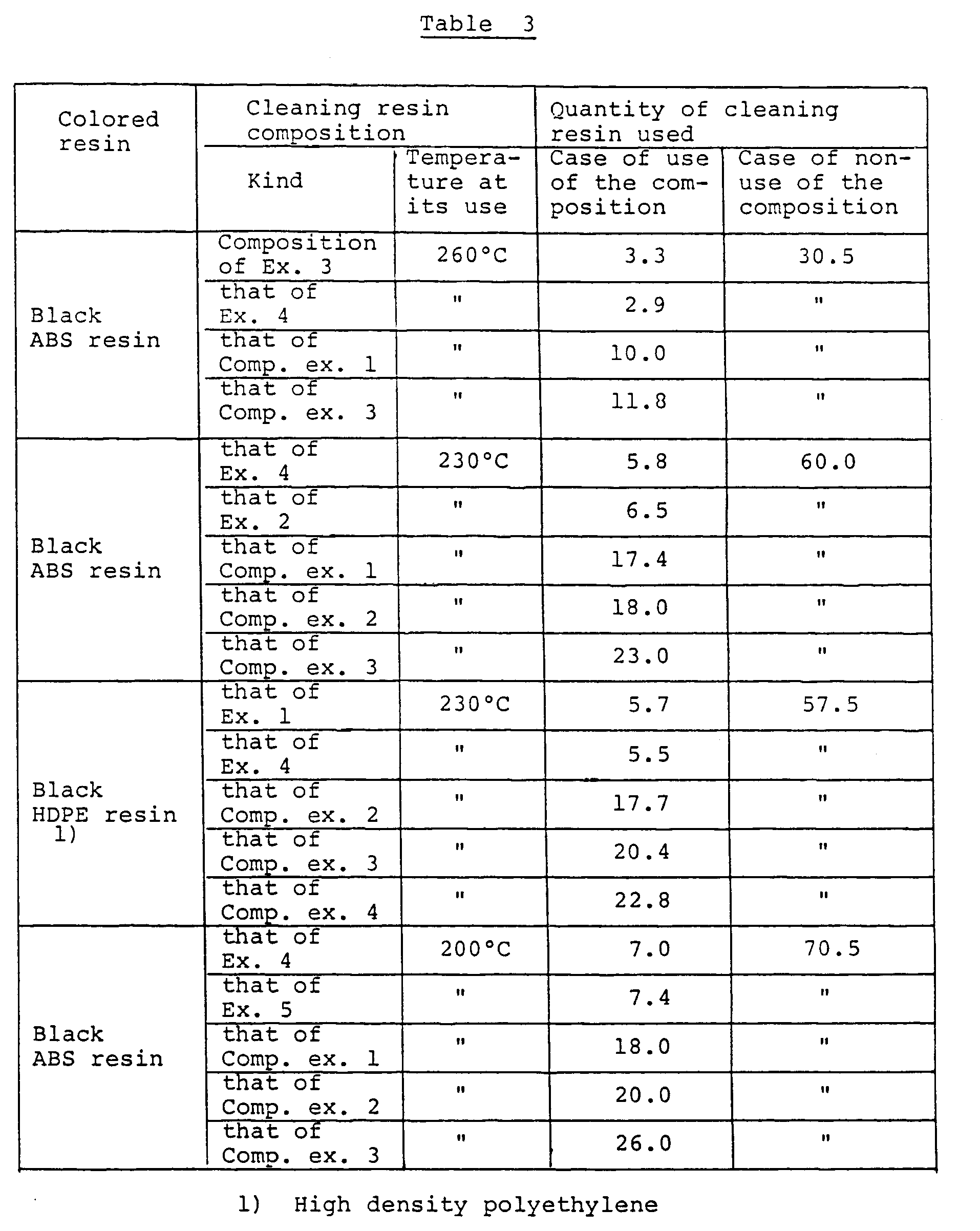
- According to the present invention, as seen from Tables 2 and 3, when the respective cleaning resin compositions shown in Examples 1-5 are used each in a small quantity, it is possible to far reduce the quantities of the cleaning resin used as compared with those shown in Comparative example 1-4. and display a notably excellent cleaning effect.
- The cleaning resin composition of the present invention has a notably excellent cleaning effect at the time of color exchange of the preceding colored resin in various molding machines and also at the time of cleaning for exchange of the preceding resin.
- Namely, by using the cleaning resin composition of the present invention in a small quantity or by using the composition in a small quantity together with a cleaning resin, it is possible to far reduce the quantity of cleaning resins consumed and also notably shorten the cleaning period of time, as compared with the case where the inside of molding machines has so far been cleaned by exchange with cleaning resins each color exchange.
- Such effect will be illustrated by cleaning of the inside of an injection molding machine. As seen from comparison of use of the cleaning resin composition of the present invention with use of cleaning resins alone, it is possible to reduce the quantity of the cleaning resins required down to about ¹/₅ - ¹/₁₀ and also to shorten the cleaning period of time down to about ¹/₅ - ¹/₁₀.
- Further, the cleaning resin composition of the present invention displays a notably excellent effect at the time of color exchange and also at the time of resin exchange even in the case where engineering plastics such as modified PPO resin or polyphenylene sulfide resin as the preceding resin are molded at high temperatures.
Claims (4)
- A cleaning resin composition comprising a polyolefin resin, a neutral salt of an alkylbenzenesulfonic acid, an inorganic filler and a water-repellent compound blended with said polyolefin resin, characterized in that said inorganic filler is talc or calcium carbonate and the proportions of said neutral salt of an alkylbenzenesulfonic acid, said inorganic filler of talc or calcium carbonate and said water-repellent compound are 1 to 20%, 1 to 30% and 0.5 to 10% each respectively, by weight, based on the weight of said composition.
- A cleaning resin composition according to claim 1 wherein said polyolefin resin is polyethylene or polypropylene.
- A cleaning resin composition according to claim 1, which is in the form of pellets obtained by melt-kneading.
- Use of a cleaning resin composition according to any of the preceding claims for cleaning the inside of molding machines.
Applications Claiming Priority (2)
| Application Number | Priority Date | Filing Date | Title |
|---|---|---|---|
| JP58688/88 | 1988-03-12 | ||
| JP63058688A JPH01234445A (en) | 1988-03-12 | 1988-03-12 | Resin composition for cleaning |
Publications (3)
| Publication Number | Publication Date |
|---|---|
| EP0346956A2 EP0346956A2 (en) | 1989-12-20 |
| EP0346956A3 EP0346956A3 (en) | 1990-06-20 |
| EP0346956B1 true EP0346956B1 (en) | 1995-06-14 |
Family
ID=13091488
Family Applications (1)
| Application Number | Title | Priority Date | Filing Date |
|---|---|---|---|
| EP89201168A Expired - Lifetime EP0346956B1 (en) | 1988-03-12 | 1989-03-13 | A cleaning resin composition |
Country Status (7)
| Country | Link |
|---|---|
| EP (1) | EP0346956B1 (en) |
| JP (1) | JPH01234445A (en) |
| KR (1) | KR910005009B1 (en) |
| CN (1) | CN1040881C (en) |
| AU (1) | AU631115B2 (en) |
| CA (1) | CA1336487C (en) |
| DE (1) | DE68923037T2 (en) |
Cited By (1)
| Publication number | Priority date | Publication date | Assignee | Title |
|---|---|---|---|---|
| DE10334293A1 (en) * | 2003-07-25 | 2005-03-03 | Lieberum, Evelyne | Cleaning composition for plastics processing machinery comprises anionic and nonionic surfactants, water, a polymer and other additives |
Families Citing this family (12)
| Publication number | Priority date | Publication date | Assignee | Title |
|---|---|---|---|---|
| CA2016368A1 (en) * | 1989-05-22 | 1990-11-23 | Hiroshi Takasu | A cleaning resin composition |
| JPH0321653A (en) * | 1989-06-20 | 1991-01-30 | Chisso Corp | Cleaning resin composition |
| JPH0768552B2 (en) * | 1989-12-12 | 1995-07-26 | チッソ株式会社 | Cleaning resin composition |
| JP2526167B2 (en) * | 1990-08-06 | 1996-08-21 | チッソ株式会社 | Method for processing detergent composition for rubber processing machine |
| GB2282607A (en) * | 1993-10-06 | 1995-04-12 | Itac Limited | Stripping compositions comprising sulphonic acid and thickener |
| DE10329122B4 (en) * | 2003-06-27 | 2006-07-13 | Franz Hartmann | Process for cleaning food-processing machines with perforated discs and cleaning mass for use |
| JP2006335913A (en) * | 2005-06-03 | 2006-12-14 | Daicel Polymer Ltd | Cleaning resin composition |
| CN101679925B (en) * | 2007-05-29 | 2012-02-29 | 旭化成化学株式会社 | Cleaning agent and method for cleaning resin molding machine using same |
| JP5667754B2 (en) * | 2009-08-26 | 2015-02-12 | ダイセルポリマー株式会社 | Thermoplastic resin composition for cleaning |
| JP6660589B2 (en) | 2014-12-17 | 2020-03-11 | 三菱ケミカル株式会社 | Purging agent |
| CN104974870A (en) * | 2015-06-16 | 2015-10-14 | 郑州億润电缆材料有限公司 | Novel cleaning material for extruder screw and preparation method therefor |
| CN114480026B (en) * | 2020-10-23 | 2024-04-09 | 中国石油化工股份有限公司 | Screw cleaning agent with excellent performance and preparation method thereof |
Family Cites Families (4)
| Publication number | Priority date | Publication date | Assignee | Title |
|---|---|---|---|---|
| GB2019422B (en) * | 1978-04-20 | 1982-07-14 | Gen Electric | Flame retardant crystalline polycarbonate compositions |
| KR940009003B1 (en) * | 1986-02-20 | 1994-09-28 | 짓소 가부시끼가이샤 | Thermoplastic resin composition for washing |
| JPH0624724B2 (en) * | 1986-02-20 | 1994-04-06 | チッソ株式会社 | Thermoplastic resin composition for cleaning melt-kneading device |
| JPH0788520B2 (en) * | 1986-09-08 | 1995-09-27 | チッソ株式会社 | Thermoplastic resin composition |
-
1988
- 1988-03-12 JP JP63058688A patent/JPH01234445A/en active Pending
-
1989
- 1989-02-27 KR KR1019890002283A patent/KR910005009B1/en not_active Expired
- 1989-03-08 CA CA000593120A patent/CA1336487C/en not_active Expired - Fee Related
- 1989-03-10 CN CN89101345A patent/CN1040881C/en not_active Expired - Fee Related
- 1989-03-10 AU AU31219/89A patent/AU631115B2/en not_active Ceased
- 1989-03-13 DE DE68923037T patent/DE68923037T2/en not_active Expired - Fee Related
- 1989-03-13 EP EP89201168A patent/EP0346956B1/en not_active Expired - Lifetime
Cited By (1)
| Publication number | Priority date | Publication date | Assignee | Title |
|---|---|---|---|---|
| DE10334293A1 (en) * | 2003-07-25 | 2005-03-03 | Lieberum, Evelyne | Cleaning composition for plastics processing machinery comprises anionic and nonionic surfactants, water, a polymer and other additives |
Also Published As
| Publication number | Publication date |
|---|---|
| JPH01234445A (en) | 1989-09-19 |
| KR890014721A (en) | 1989-10-25 |
| KR910005009B1 (en) | 1991-07-20 |
| DE68923037T2 (en) | 1995-11-30 |
| DE68923037D1 (en) | 1995-07-20 |
| EP0346956A2 (en) | 1989-12-20 |
| EP0346956A3 (en) | 1990-06-20 |
| CN1035834A (en) | 1989-09-27 |
| CA1336487C (en) | 1995-08-01 |
| AU631115B2 (en) | 1992-11-19 |
| CN1040881C (en) | 1998-11-25 |
| AU3121989A (en) | 1989-09-14 |
Similar Documents
| Publication | Publication Date | Title |
|---|---|---|
| EP0399445B1 (en) | A cleaning resin composition | |
| KR100201746B1 (en) | Cleaning composition | |
| CA1336487C (en) | Cleaning resin composition | |
| EP2151490B1 (en) | Purging agent and process for purging a resin molding machine with the same | |
| US5108645A (en) | Detergent resin composition | |
| JP2019218566A (en) | Molding machine detergent | |
| CN101189297A (en) | cleaning resin composition | |
| JPH0624724B2 (en) | Thermoplastic resin composition for cleaning melt-kneading device | |
| JPH0655865B2 (en) | Cleaning resin composition | |
| JP2774922B2 (en) | Cleaning composition for plastic processing machines | |
| TWI656209B (en) | Cleaning agent and cleaning method for resin processing machine | |
| JP7425881B2 (en) | Cleaning agent for resin processing machinery | |
| JPH09208754A (en) | Resin composition for purging | |
| JP2000119458A (en) | Cleaning resin composition | |
| JP2018114640A (en) | Extruder cleaning and cleaning method | |
| JP4073469B2 (en) | Resin composition for cleaning plastic molding machines | |
| JPH03207734A (en) | Resin composition for cleaning | |
| JP2823488B2 (en) | Resin composition for cleaning flame-retardant resins | |
| JPH0598072A (en) | Thermoplastic resin composition for cleaning | |
| JP2000159928A (en) | Cleaning thermoplastic resin composition | |
| JPH0741658B2 (en) | Cleaning resin composition | |
| JP2001348600A (en) | Cleaning agent for molding machines | |
| JP2001279035A (en) | Cleaning resin composition |
Legal Events
| Date | Code | Title | Description |
|---|---|---|---|
| PUAI | Public reference made under article 153(3) epc to a published international application that has entered the european phase |
Free format text: ORIGINAL CODE: 0009012 |
|
| 17P | Request for examination filed |
Effective date: 19890512 |
|
| AK | Designated contracting states |
Kind code of ref document: A2 Designated state(s): BE DE FR GB IT NL |
|
| PUAL | Search report despatched |
Free format text: ORIGINAL CODE: 0009013 |
|
| AK | Designated contracting states |
Kind code of ref document: A3 Designated state(s): BE DE FR GB IT NL |
|
| 17Q | First examination report despatched |
Effective date: 19930603 |
|
| GRAA | (expected) grant |
Free format text: ORIGINAL CODE: 0009210 |
|
| ITF | It: translation for a ep patent filed | ||
| AK | Designated contracting states |
Kind code of ref document: B1 Designated state(s): BE DE FR GB IT NL |
|
| ET | Fr: translation filed | ||
| REF | Corresponds to: |
Ref document number: 68923037 Country of ref document: DE Date of ref document: 19950720 |
|
| PLBE | No opposition filed within time limit |
Free format text: ORIGINAL CODE: 0009261 |
|
| 26N | No opposition filed | ||
| PGFP | Annual fee paid to national office [announced via postgrant information from national office to epo] |
Ref country code: FR Payment date: 19990309 Year of fee payment: 11 |
|
| PGFP | Annual fee paid to national office [announced via postgrant information from national office to epo] |
Ref country code: GB Payment date: 19990318 Year of fee payment: 11 |
|
| PGFP | Annual fee paid to national office [announced via postgrant information from national office to epo] |
Ref country code: NL Payment date: 19990329 Year of fee payment: 11 |
|
| PGFP | Annual fee paid to national office [announced via postgrant information from national office to epo] |
Ref country code: BE Payment date: 19990517 Year of fee payment: 11 |
|
| PG25 | Lapsed in a contracting state [announced via postgrant information from national office to epo] |
Ref country code: GB Free format text: LAPSE BECAUSE OF NON-PAYMENT OF DUE FEES Effective date: 20000313 |
|
| PG25 | Lapsed in a contracting state [announced via postgrant information from national office to epo] |
Ref country code: BE Free format text: LAPSE BECAUSE OF NON-PAYMENT OF DUE FEES Effective date: 20000331 |
|
| BERE | Be: lapsed |
Owner name: CHISSO CORP. Effective date: 20000331 |
|
| PG25 | Lapsed in a contracting state [announced via postgrant information from national office to epo] |
Ref country code: NL Free format text: LAPSE BECAUSE OF NON-PAYMENT OF DUE FEES Effective date: 20001001 |
|
| GBPC | Gb: european patent ceased through non-payment of renewal fee |
Effective date: 20000313 |
|
| PG25 | Lapsed in a contracting state [announced via postgrant information from national office to epo] |
Ref country code: FR Free format text: LAPSE BECAUSE OF NON-PAYMENT OF DUE FEES Effective date: 20001130 |
|
| NLV4 | Nl: lapsed or anulled due to non-payment of the annual fee |
Effective date: 20001001 |
|
| REG | Reference to a national code |
Ref country code: FR Ref legal event code: ST |
|
| PGFP | Annual fee paid to national office [announced via postgrant information from national office to epo] |
Ref country code: DE Payment date: 20020327 Year of fee payment: 14 |
|
| PG25 | Lapsed in a contracting state [announced via postgrant information from national office to epo] |
Ref country code: DE Free format text: LAPSE BECAUSE OF NON-PAYMENT OF DUE FEES Effective date: 20031001 |
|
| PG25 | Lapsed in a contracting state [announced via postgrant information from national office to epo] |
Ref country code: IT Free format text: LAPSE BECAUSE OF NON-PAYMENT OF DUE FEES;WARNING: LAPSES OF ITALIAN PATENTS WITH EFFECTIVE DATE BEFORE 2007 MAY HAVE OCCURRED AT ANY TIME BEFORE 2007. THE CORRECT EFFECTIVE DATE MAY BE DIFFERENT FROM THE ONE RECORDED. Effective date: 20050313 |