EP0346875B1 - Siliciumcarbidfaser und Verfahren zu ihrer Herstellung - Google Patents
Siliciumcarbidfaser und Verfahren zu ihrer Herstellung Download PDFInfo
- Publication number
- EP0346875B1 EP0346875B1 EP19890110813 EP89110813A EP0346875B1 EP 0346875 B1 EP0346875 B1 EP 0346875B1 EP 19890110813 EP19890110813 EP 19890110813 EP 89110813 A EP89110813 A EP 89110813A EP 0346875 B1 EP0346875 B1 EP 0346875B1
- Authority
- EP
- European Patent Office
- Prior art keywords
- silicon carbide
- fiber
- carbide fiber
- tensile strength
- electric resistance
- Prior art date
- Legal status (The legal status is an assumption and is not a legal conclusion. Google has not performed a legal analysis and makes no representation as to the accuracy of the status listed.)
- Expired - Lifetime
Links
Images
Classifications
-
- C—CHEMISTRY; METALLURGY
- C04—CEMENTS; CONCRETE; ARTIFICIAL STONE; CERAMICS; REFRACTORIES
- C04B—LIME, MAGNESIA; SLAG; CEMENTS; COMPOSITIONS THEREOF, e.g. MORTARS, CONCRETE OR LIKE BUILDING MATERIALS; ARTIFICIAL STONE; CERAMICS; REFRACTORIES; TREATMENT OF NATURAL STONE
- C04B41/00—After-treatment of mortars, concrete, artificial stone or ceramics; Treatment of natural stone
- C04B41/009—After-treatment of mortars, concrete, artificial stone or ceramics; Treatment of natural stone characterised by the material treated
-
- C—CHEMISTRY; METALLURGY
- C04—CEMENTS; CONCRETE; ARTIFICIAL STONE; CERAMICS; REFRACTORIES
- C04B—LIME, MAGNESIA; SLAG; CEMENTS; COMPOSITIONS THEREOF, e.g. MORTARS, CONCRETE OR LIKE BUILDING MATERIALS; ARTIFICIAL STONE; CERAMICS; REFRACTORIES; TREATMENT OF NATURAL STONE
- C04B35/00—Shaped ceramic products characterised by their composition; Ceramics compositions; Processing powders of inorganic compounds preparatory to the manufacturing of ceramic products
- C04B35/515—Shaped ceramic products characterised by their composition; Ceramics compositions; Processing powders of inorganic compounds preparatory to the manufacturing of ceramic products based on non-oxide ceramics
- C04B35/56—Shaped ceramic products characterised by their composition; Ceramics compositions; Processing powders of inorganic compounds preparatory to the manufacturing of ceramic products based on non-oxide ceramics based on carbides or oxycarbides
- C04B35/565—Shaped ceramic products characterised by their composition; Ceramics compositions; Processing powders of inorganic compounds preparatory to the manufacturing of ceramic products based on non-oxide ceramics based on carbides or oxycarbides based on silicon carbide
- C04B35/571—Shaped ceramic products characterised by their composition; Ceramics compositions; Processing powders of inorganic compounds preparatory to the manufacturing of ceramic products based on non-oxide ceramics based on carbides or oxycarbides based on silicon carbide obtained from Si-containing polymer precursors or organosilicon monomers
-
- C—CHEMISTRY; METALLURGY
- C04—CEMENTS; CONCRETE; ARTIFICIAL STONE; CERAMICS; REFRACTORIES
- C04B—LIME, MAGNESIA; SLAG; CEMENTS; COMPOSITIONS THEREOF, e.g. MORTARS, CONCRETE OR LIKE BUILDING MATERIALS; ARTIFICIAL STONE; CERAMICS; REFRACTORIES; TREATMENT OF NATURAL STONE
- C04B41/00—After-treatment of mortars, concrete, artificial stone or ceramics; Treatment of natural stone
- C04B41/45—Coating or impregnating, e.g. injection in masonry, partial coating of green or fired ceramics, organic coating compositions for adhering together two concrete elements
- C04B41/4584—Coating or impregnating of particulate or fibrous ceramic material
Definitions
- the present invention relates to a silicon carbide fiber having a low specific electric resistance value and excellent mechanical properties including high tensile strength and tensile modulus, and to a method of manufacturing the same.
- a method of manufacturing a silicon carbide fiber comprising, for example, steps of spinning a polycarbosilane material into threads or yarns, heating the spun yarns at a temperature ranging between 50°C and and 400°C in an oxidizing gas atmosphere to produce antimelt-treated fibers and heating said antimelt-treated fibers at a temperature of above 1000°C and up to 1500°C in an atmosphere of inert gas such as a nitrogen gas.
- the silicon carbide fiber obtained as above can be made to have various specific electric resistance values by changing the heating condition in which the antimelt-treated fibers are further heated in an inert gas atmosphere.
- This silicon carbide fiber manufactured as above has excellent mechanical properties including high tensile strength of 200-350 kg/mm2 and high tensile modulus of 18-25 t/mm2 in its specific electric resistance range of 102-108 ( ⁇ cm).
- a silicon carbide fiber so manufactured according to the foregoing method as to have a low specific electric resistance value such as 10 ⁇ 1 - 102 ( ⁇ cm) has such a problem that its tensile strength is lowered to 50 - 100 kg/mm2 and its tensile modulus also lowered to 5 - 10 t/mm2.
- a silicon carbide fiber manufactured according to the present invention is characterized in that an amorphous film is formed on the surface thereof.
- an antimelt-treated polycarbosilane fiber is heated at a temperature not exceeding 1000°C in an atmosphere of inert gas and thereafter heated at a temperature of above 1000°C and up to 1500°C in an atmosphere of the mixture of hydrocarbon and inert gas.
- a silicon carbide fiber according to the present invention comprises silicon for 55-60% by weight and carbon for 28-33% by weight, having the same internal composition as another silicon carbide fiber manufactured by Nippon Carbon K.K. and known under the registered trademark name of "NICALON", said NICALON fiber being chiefly composed of fine crystals of ⁇ -SiC.
- the silicon carbide fiber of the present invention has an amorphous carbon film formed on the surface thereof and measures generally 8-20 ⁇ m in diameter.
- Thickness of the amorphous film formed on the surface of the fiber ranges approximately from 1 nm (nanometer) to 1 ⁇ m (micrometer).
- the antimelt-treated polycarbosilane fibers are heated for 1 to 10 hours in an atmosphere of inert gas such as nitrogen gas, for example.
- the hydrocarbon gas in the mixture gas used in the subsequent high-temperature heating treatment of said antimelt-treated fiber having been heated as above can be, for example, a propane gas, butane gas, ethane gas, etc. while the inert gas may be nitrogen gas and argon gas, for example.
- the hydrocarbon content of the mixture gas may be varied according to desired thickness to be obtained of the amorphous carbon film to be formed on the surface of the fiber, said hydrocarbon content being generally in the range of 0.01 to 50 vol.%.
- the heating time length during which the antimelt-treated fiber is heated in the mixture gas atmosphere can be also varied according to desired thickness of the film to be formed on the fiber and is generally 5 seconds to 6 hours.
- the silicon carbide fiber of the present invention has an amorphous carbon film formed on the surface thereof, it has a lower specific electric resistance and yet maintains good mechanical properties including high tensile strength and high tensile modulus substantially equal to those of the conventional silicon carbide fiber mentioned in the foregoing.
- an amorphous carbon film is formed on the surface of the fiber by heating an antimelt-treated polycarbosilane fiber at a temperature not exceeding 1000°C in an atmosphere of inert gas and then at a temperature of above 1000°C and up to 1500°C in an atmosphere of the mixture gas of hydrocarbon gas and inert gas.
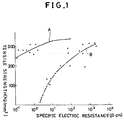
- Figure 1 is a characteristic diagram showing relationships between specific electric resistance and tensile strength, of silicon carbide fibers.
- Polycarbosilane (having an average molecular weight of 2000 and the melting point of 220°C) was melted and spun, and then heated at 180°C for one hour in atmospheric air for an antimelt treatment to obtain an antimelt-treated polycarbosilane fiber measuring 20 ⁇ m in diameter.
- This antimelt-treated polycarbosilane fiber was further heated at 1000°C for 8 hours in a nitrogen gas atmosphere.
- the antimelt-treated polycarbosilane fiber so heated is then further heated at 1200°C for 2 hours in the atmosphere of mixture gas containing propane gas for 0.5 vol.% and nitrogen gas for 99.5 vol.%, thereby obtaining a silicon carbide fiber of the present invention.
- the silicon carbide fiber manufactured according to the foregoing method was measured of its specific electric resistance, tensile strength, and tensile modulus. The results obtained are as shown in Table 1.
- a silicon carbide fiber was manufactured in the same manner as in the EMBODIMENT EXAMPLE 1 above except for the final high-temperature heating treatment in which the mixture gas contained propane gas for 10 vol.% and nitrogen gas for 90 vol.% and the heating time length was 3 hours.
- Polycarbosilane having an average molecular weight of 2000 and the melting point of 220°C
- Polycarbosilane having an average molecular weight of 2000 and the melting point of 220°C
- This antimelt-treated polycarbosilane fiber was further heated at 1200°C in nitrogen atmosphere for 8 hours to obtain a silicon carbide fiber.
- the silicon carbide fiber manufactured according to either of the EMBODIMENT EXAMPLES 1 and 2 of the present invention has the tensile strength and tensile modulus substantially equivalent to those of the silicon carbide fiber manufactured according to the conventional COMPARATIVE EXAMPLE 1 and yet has a lower specific electric resistance as compared with that of the latter.
- each of the silicon carbide fibers manufactured according to the EMBODIMENT EXAMPLE 3 has a lower specific electric resistance and yet possesses a high tensile strength, whereas the tensile strength of a conventional silicon carbide fiber sharply decreased with a decrease in its specific electric resistance.
- the silicon carbide fiber manufactured according to the EMBODIMENT EXAMPLE 1 above was combined with an epoxy resin to manufacure a fiber-reinforced plastic having the 55% fiber content by volume and reinforced in two directions, 0°/90°. This fiber-reinforced plastic was then measured of this relative dielectric constant, dielectric loss and tensile strength to produce the results as shown in Table 2.
- a two-layer electric wave absorber was prepared, which comprised an absorption layer made of this fiber-reinforced plastic and a surface layer made of a glass fiber-reinforced plastic composed of glass fiber and an epoxy resin.
- This two-layer wave absorber was measured of its wave absorption characteristic. The results thereof are as shown in Table 2.
- the silicon carbide fiber manufactured according to the COMPARATIVE EXAMPLE 1 above was combined with an epoxy resin to manufacture a fiber-reinforced plastic having the 55% fiber content by volume and reinforced in two directions, 0°/90°.
- This fiber-reinforced plastic was measured of its relative dielectric constant, dielectric loss and tensile strength in the same manner as in the EMBODIMENT EXAMPLE 4 above to obtain the results as shown in Table 2.
- a two-layer electric wave absorber was then prepared, which comprised an absorption layer made of this fiber-reinforced plastic and a surface layer made of a glass fiber-reinforced plastic composed of glass fibers and an epoxy resin.
- the two-layer wave absorber was then measured of its wave absorption characteristic. The results obtained are as shown in Table 2.
- the fiber-reinforced plastic using a silicon carbide fiber of the present invention can provide a superb tensile strength even when its relative dielectric constant and dielectric loss are 35 and 1.2 respectively.
- the two-layer wave absorber having an absorption layer composed of the silicon carbide fiber of the present invention has an excellent wave absorption characteristic. Compared with the above-mentioned wave absorber, another two-layer wave absorber using an absorption layer composed of the conventional silicon carbide fiber showed a very poor wave absorption characteristic.
- the silicon carbide fiber according to the present invention can find a wider field of industrial application including use as a fiber material for a fiber-reinforced plastic and for a wave absorption layer in a two-layer wave absorber.
- the silicon carbide fiber manufactured according to the EMBODIMENT EXAMPLE 1 above was combined with borosilicate glass to manufacture a fiber-reinforced glass ceramic having the 45% fiber content by volume and reinforced in one direction.
- the fiber-reinforced glass ceramic so obtained was measured of its tensile strength and fracture toughness. The results obtained are as shown in Table 3.
- the silicon carbide fiber manufactured according to the COMPARATIVE EXAMPLE 1 was combined with borosilicate glass to manufacture a fiber-reinforced glass ceramic having the 45% fiber content by volume and reinforced in one direction.
- the silicon carbide fiber according to the present invention has an amorphous carbon film formed on the surface thereof, so that it has not only the lower specific electric resistance but also the higher tensile strength and tensile modulus.
- an antimelt-treated polycarbosilane fiber is heated at a temperature not exceeding 1000°C in an atmosphere of inert gas and thereafter heated at a temperature of above 1000°C and up to 1500°C in an atmosphere of mixture of hydrocarbon gas and inert gas so that a silicon carbide fiber having an amorphous carbon film formed on the surface thereof and possessing lower specific electric resistance and superb mechanical strength can be manufactured easily.
- a fiber-reinforced plastic using the silicon carbide fiber of the present invention can make an electric wave absorber featuring a higher wave absorption characteristic and excellent mechanical strength.
- a ceramic When combined with a ceramic, it never chemically reacts with the ceramic, so that there can be obtained a fiber-reinforced ceramic having greater strength and fracture toughness.
Landscapes
- Chemical & Material Sciences (AREA)
- Engineering & Computer Science (AREA)
- Ceramic Engineering (AREA)
- Materials Engineering (AREA)
- Structural Engineering (AREA)
- Organic Chemistry (AREA)
- Manufacturing & Machinery (AREA)
- Inorganic Fibers (AREA)
- Carbon And Carbon Compounds (AREA)
Claims (2)
- Siliziumcarbidfaser mit einem auf deren Oberfläche gebildeten Film aus amorphem Kohlenstoff, erhältlich durch
Erhitzen eines schmelzfest ausgerüsteten Carbosilan-Fadens bei einer 1000°C nicht überschreitenden Temperatur in einer inerten Gasatmosphäre und
anschließendes Erhitzen des Fadens auf eine Temperatur oberhalb von 1000°C bis zu 1500°C in einer Atmosphäre aus einem Kohlenwasserstoffgas und einem inerten Gas,
wobei der Gehalt an dem Kohlenwasserstoffgas im Bereich von 0,01 bis 50 Vol-% liegt, die Siliziumcarbidfaser einen spezifischen elektrischen Widerstand von 10⁻¹ bis 10²Ω·cm, eine Zugfestigkeit von 200 bis 350 kg/mm² und einen Spannungsmodul von 18 bis 25 t/mm² aufweist. - Siliziumcarbidfaser gemäß Anspruch 1, wobei die Dicke des amorphen Kohlenstoffilms 1 nm bis 1 µm beträgt.
Applications Claiming Priority (2)
| Application Number | Priority Date | Filing Date | Title |
|---|---|---|---|
| JP63147545A JP2852748B2 (ja) | 1988-06-15 | 1988-06-15 | 低電気比抵抗値を有する炭化ケイ素繊維の製造方法 |
| JP147545/88 | 1988-06-15 |
Publications (3)
| Publication Number | Publication Date |
|---|---|
| EP0346875A2 EP0346875A2 (de) | 1989-12-20 |
| EP0346875A3 EP0346875A3 (de) | 1991-11-21 |
| EP0346875B1 true EP0346875B1 (de) | 1994-09-07 |
Family
ID=15432746
Family Applications (1)
| Application Number | Title | Priority Date | Filing Date |
|---|---|---|---|
| EP19890110813 Expired - Lifetime EP0346875B1 (de) | 1988-06-15 | 1989-06-14 | Siliciumcarbidfaser und Verfahren zu ihrer Herstellung |
Country Status (3)
| Country | Link |
|---|---|
| EP (1) | EP0346875B1 (de) |
| JP (1) | JP2852748B2 (de) |
| DE (1) | DE68918002T2 (de) |
Families Citing this family (3)
| Publication number | Priority date | Publication date | Assignee | Title |
|---|---|---|---|---|
| DE69229007T2 (de) * | 1991-01-16 | 1999-10-21 | Sgl Carbon Composites, Inc. | Verbundwerkstoffe aus siliciumcarbidfaserarmiertem Kohlenstoff |
| JP2012201566A (ja) * | 2011-03-28 | 2012-10-22 | Ube Industries Ltd | 無機繊維結合セラミックス部品及びその製造方法 |
| JP7240132B2 (ja) * | 2018-10-23 | 2023-03-15 | 日本特殊陶業株式会社 | 複合繊維 |
Family Cites Families (6)
| Publication number | Priority date | Publication date | Assignee | Title |
|---|---|---|---|---|
| JPS4893588A (de) * | 1972-03-10 | 1973-12-04 | ||
| JPS5299319A (en) * | 1976-02-14 | 1977-08-20 | Kanebo Ltd | Production of continuous silicon carbide fiber |
| EP0269284B1 (de) * | 1986-11-06 | 1993-08-04 | Nippon Carbon Co., Ltd. | Verfahren zur Herstellung von Organosiliconpolymeren |
| JPS62182180A (ja) * | 1986-11-29 | 1987-08-10 | 株式会社 半導体エネルギ−研究所 | 炭素 |
| FR2640258B1 (fr) * | 1988-05-10 | 1991-06-07 | Europ Propulsion | Procede de fabrication de materiaux composites a renfort en fibres de carbure de silicium et a matrice ceramique |
| FR2635771B1 (fr) * | 1988-08-26 | 1991-05-10 | Aerospatiale | Procede de traitement thermique de fibres ceramiques a base de silicium et de carbone et fibres de meme nature a structure stratifiee |
-
1988
- 1988-06-15 JP JP63147545A patent/JP2852748B2/ja not_active Expired - Lifetime
-
1989
- 1989-06-14 DE DE1989618002 patent/DE68918002T2/de not_active Expired - Fee Related
- 1989-06-14 EP EP19890110813 patent/EP0346875B1/de not_active Expired - Lifetime
Also Published As
| Publication number | Publication date |
|---|---|
| DE68918002T2 (de) | 1995-04-20 |
| JP2852748B2 (ja) | 1999-02-03 |
| EP0346875A2 (de) | 1989-12-20 |
| EP0346875A3 (de) | 1991-11-21 |
| JPH01314730A (ja) | 1989-12-19 |
| DE68918002D1 (de) | 1994-10-13 |
Similar Documents
| Publication | Publication Date | Title |
|---|---|---|
| Ishikawa | Recent developments of the SiC fiber Nicalon and its composites, including properties of the SiC fiber Hi-Nicalon for ultra-high temperature | |
| CA1225667A (en) | Inorganic fiber-reinforced ceramic composite material | |
| US5707471A (en) | Method for making ceramic matrix composites | |
| US4778722A (en) | Reinforcing fibers and composite materials reinforced with said fibers | |
| EP0299774B1 (de) | Gesinterte keramische Nichtoxidfasern | |
| US5231059A (en) | Process for preparing black glass using cyclosiloxane precursors | |
| EP0268721B2 (de) | Zusammensetzung von pulverigem Siliziumnitrid, verstärkt mit Siliziumcarbid-Whiskern, und Verwendung derselben zur Herstellung von Sinterkörpern | |
| CA2133979A1 (en) | Silicon oxycarbonitride by pyrolysis of polycylosiloxanes in ammonia | |
| EP0629593A2 (de) | Kohlenstoff und Graphitkörper mit hohem Elastizitätsmodul und Verfahren zur Herstellung | |
| US5344709A (en) | Silicon carbide fiber and method of manufacturing the same | |
| US5167881A (en) | Preparation of substantially polycrystalline silicon carbide fibers from polyorganosiloxanes | |
| US6303096B1 (en) | Pitch based carbon fibers | |
| EP0346875A2 (de) | Siliciumcarbidfaser und Verfahren zu ihrer Herstellung | |
| US4929472A (en) | Surface-coated SiC whiskers, processes for preparing the same, ceramic reinforced with the same, and process for preparing said reinforced ceramic | |
| US4524100A (en) | Inorganic composite and the preparation thereof | |
| US5043045A (en) | Ceramic fibers having improved surface properties/rupture strength | |
| US4832771A (en) | Method for bonding ceramics | |
| US3993738A (en) | High strength graphite and method for preparing same | |
| US4075276A (en) | Boron nitride-boron nitride composites | |
| Diefendorf | Comparison of the Various New High Modulus Fibers for Reinforcement of Advanced Composites with Polymers, Metals and Ceramics as Matrix | |
| Zhao et al. | Fabrication, structure and properties of quasi-carbon fibres | |
| EP0405544B1 (de) | Verfahren zur Herstellung eines gesinterten Körpers aus Siliciumcarbid | |
| CN85104097A (zh) | 氮化硼纤维补强反应烧结氮化硅陶瓷 | |
| DiCarlo | High performance fibers for structurally reliable metal and ceramic composites | |
| KR0143615B1 (ko) | 고열전도도 탄소/탄소 복합재료의 제조방법 |
Legal Events
| Date | Code | Title | Description |
|---|---|---|---|
| PUAI | Public reference made under article 153(3) epc to a published international application that has entered the european phase |
Free format text: ORIGINAL CODE: 0009012 |
|
| AK | Designated contracting states |
Kind code of ref document: A2 Designated state(s): DE FR GB |
|
| PUAL | Search report despatched |
Free format text: ORIGINAL CODE: 0009013 |
|
| AK | Designated contracting states |
Kind code of ref document: A3 Designated state(s): DE FR GB |
|
| 17P | Request for examination filed |
Effective date: 19920205 |
|
| 17Q | First examination report despatched |
Effective date: 19920428 |
|
| GRAA | (expected) grant |
Free format text: ORIGINAL CODE: 0009210 |
|
| AK | Designated contracting states |
Kind code of ref document: B1 Designated state(s): DE FR GB |
|
| REF | Corresponds to: |
Ref document number: 68918002 Country of ref document: DE Date of ref document: 19941013 |
|
| ET | Fr: translation filed | ||
| PLBE | No opposition filed within time limit |
Free format text: ORIGINAL CODE: 0009261 |
|
| STAA | Information on the status of an ep patent application or granted ep patent |
Free format text: STATUS: NO OPPOSITION FILED WITHIN TIME LIMIT |
|
| 26N | No opposition filed | ||
| REG | Reference to a national code |
Ref country code: GB Ref legal event code: IF02 |
|
| PGFP | Annual fee paid to national office [announced via postgrant information from national office to epo] |
Ref country code: GB Payment date: 20020315 Year of fee payment: 14 |
|
| PGFP | Annual fee paid to national office [announced via postgrant information from national office to epo] |
Ref country code: FR Payment date: 20020625 Year of fee payment: 14 |
|
| PGFP | Annual fee paid to national office [announced via postgrant information from national office to epo] |
Ref country code: DE Payment date: 20020830 Year of fee payment: 14 |
|
| PG25 | Lapsed in a contracting state [announced via postgrant information from national office to epo] |
Ref country code: GB Free format text: LAPSE BECAUSE OF NON-PAYMENT OF DUE FEES Effective date: 20030614 |
|
| PG25 | Lapsed in a contracting state [announced via postgrant information from national office to epo] |
Ref country code: DE Free format text: LAPSE BECAUSE OF NON-PAYMENT OF DUE FEES Effective date: 20040101 |
|
| GBPC | Gb: european patent ceased through non-payment of renewal fee |
Effective date: 20030614 |
|
| PG25 | Lapsed in a contracting state [announced via postgrant information from national office to epo] |
Ref country code: FR Free format text: LAPSE BECAUSE OF NON-PAYMENT OF DUE FEES Effective date: 20040227 |
|
| REG | Reference to a national code |
Ref country code: FR Ref legal event code: ST |