EP0346436B1 - System for monitoring vapor concentration - Google Patents
System for monitoring vapor concentration Download PDFInfo
- Publication number
- EP0346436B1 EP0346436B1 EP89901032A EP89901032A EP0346436B1 EP 0346436 B1 EP0346436 B1 EP 0346436B1 EP 89901032 A EP89901032 A EP 89901032A EP 89901032 A EP89901032 A EP 89901032A EP 0346436 B1 EP0346436 B1 EP 0346436B1
- Authority
- EP
- European Patent Office
- Prior art keywords
- vapour
- vapor
- concentration
- component
- hydrogen peroxide
- Prior art date
- Legal status (The legal status is an assumption and is not a legal conclusion. Google has not performed a legal analysis and makes no representation as to the accuracy of the status listed.)
- Expired - Lifetime
Links
Images

Classifications
-
- A—HUMAN NECESSITIES
- A61—MEDICAL OR VETERINARY SCIENCE; HYGIENE
- A61L—METHODS OR APPARATUS FOR STERILISING MATERIALS OR OBJECTS IN GENERAL; DISINFECTION, STERILISATION OR DEODORISATION OF AIR; CHEMICAL ASPECTS OF BANDAGES, DRESSINGS, ABSORBENT PADS OR SURGICAL ARTICLES; MATERIALS FOR BANDAGES, DRESSINGS, ABSORBENT PADS OR SURGICAL ARTICLES
- A61L2/00—Disinfection or sterilisation of materials or objects, in general; Accessories therefor
- A61L2/24—Apparatus using programmed or automatic operation
-
- A—HUMAN NECESSITIES
- A61—MEDICAL OR VETERINARY SCIENCE; HYGIENE
- A61L—METHODS OR APPARATUS FOR STERILISING MATERIALS OR OBJECTS IN GENERAL; DISINFECTION, STERILISATION OR DEODORISATION OF AIR; CHEMICAL ASPECTS OF BANDAGES, DRESSINGS, ABSORBENT PADS OR SURGICAL ARTICLES; MATERIALS FOR BANDAGES, DRESSINGS, ABSORBENT PADS OR SURGICAL ARTICLES
- A61L2/00—Disinfection or sterilisation of materials or objects, in general; Accessories therefor
- A61L2/16—Disinfection or sterilisation of materials or objects, in general; Accessories therefor using chemical substances
- A61L2/20—Gaseous substances, e.g. vapours
-
- G—PHYSICS
- G01—MEASURING; TESTING
- G01N—INVESTIGATING OR ANALYSING MATERIALS BY DETERMINING THEIR CHEMICAL OR PHYSICAL PROPERTIES
- G01N25/00—Investigating or analyzing materials by the use of thermal means
- G01N25/56—Investigating or analyzing materials by the use of thermal means by investigating moisture content
- G01N25/66—Investigating or analyzing materials by the use of thermal means by investigating moisture content by investigating dew-point
-
- Y—GENERAL TAGGING OF NEW TECHNOLOGICAL DEVELOPMENTS; GENERAL TAGGING OF CROSS-SECTIONAL TECHNOLOGIES SPANNING OVER SEVERAL SECTIONS OF THE IPC; TECHNICAL SUBJECTS COVERED BY FORMER USPC CROSS-REFERENCE ART COLLECTIONS [XRACs] AND DIGESTS
- Y10—TECHNICAL SUBJECTS COVERED BY FORMER USPC
- Y10S—TECHNICAL SUBJECTS COVERED BY FORMER USPC CROSS-REFERENCE ART COLLECTIONS [XRACs] AND DIGESTS
- Y10S203/00—Distillation: processes, separatory
- Y10S203/19—Sidestream
Definitions
- the present invention relates to systems for monitoring vapour concentration and more particularly, to a system for monitoring a condensable vapour in the presence of another condensable vapour.
- US-A- 4 169 123 discloses a method of sterilizing with hydrogen peroxide vapour.
- US-A- 4 169 124 disclosed a similar method wherein the concentration of the hydrogen peroxide vapour is less than 75 mg/L.
- US-A- 4 642,165 discloses a method of vapourizing multicomponent liquids, such as hydrogen peroxide and water, and passing the vapour into a sterilization chamber.
- no simple, unambiguous means of measuring hydrogen peroxide vapour concentration in the sterilization chamber has been available.
- Hydrogen peroxide is rarely, if ever, used in a pure form. It is typically mixed with water. Hydrogen peroxide vapour, like water vapour, is a condensable gas, but is less volatile than water. When injected into a sterilizer along with water vapour, the hydrogen peroxide vapour may readily decompose into water and oxygen or condense into liquid. General physical properties, such as pressure, temperature and mass are therefore, not alone sufficient to provide an unambiguous measure of instantaneous hydrogen peroxide concentration in a sterilizer. Because of the potential for degradation of the sterilant, monitoring the hydrogen peroxide of the sterilant, monitoring the hydrogen peroxide concentration is important to ascertain whether a sufficient sterilant concentration is maintained long enough to effect sterilization.
- US-A- 4 363 635 discloses a system for monitoring the concentration of a vapour in a multi-component vapour comprising at least two component vapours, said system being of the kind comprising a chamber, means for injecting a predetermined quantity of said multi-component vapour into said chamber, means for measuring primary and secondary properties of said multi-component vapour, and means for fitting the primary and secondary property measurements into a modelled construct representative of the relationship between said two component vapours at a plurality of concentrations of each of said two component vapours and at a plurality of said primary property measurements corresponding to each concentration of component vapour.
- the system of US-A- 4 363 635 is used to measure the concentration of alcohol in a breath sample which may contain acetone as a second component vapour.
- the primary parameter is infra-red absorption and the secondary parameter is the electrical conductivity of a Taguci cell or its equivalent.
- US-A- 2 971 368 discloses apparatus for measuring the concentrations of ethylene oxide and water vapours in a multi-component vapour which also includes carbon dioxide.
- the same parameter namely the dew point
- the dew point is measured twice, the upper and lower dew points being of the ethylene oxide and of the water vapour.
- the dew points are ascertained visually, reference is made to an experimentally determined graph to ascertain the concentrations of interest.
- a system of the kind described in US-A- 4 363 635 is characterised in that said two component vapours are hydrogen peroxide vapour and water vapour and in that said means for measuring the primary and secondary property are means for measuring the dew point of the multi-component vapour as the primary property and total vapour pressure or total vapour mass or thermal conductivity or relative humidity of water vapour as the secondary property.
- the means for fitting the measurements into a modelled construct is preferably a microprocessor having means for storing the modelled construct and means for communicating data from the primary and secondary measuring means to the microprocessor.
- the principal components of the preferred embodiment of the system 10 of the present invention are illustrated in Fig.1.
- the system includes a sterilization chamber 20, a microprocessor 30 having an input interface 31 for communicating data to the microprocessor 30 via a data bus 32.
- the microprocessor 30 outputs data at a data display 34 through the data bus 32 and an output interface 33.
- the system also includes a source 40 of a multicomponent liquid, a vapourizer 42 for vapourizing the multicomponent liquid into a multicomponent vapour, an injection valve 44 for injecting the liquid into the vapourizer 42 for passage of the vapour into the sterilization chamber 20, a dew point sensor 22 and an additional sensor 24 for measuring a secondary property of one of the components of the multicomponent vapour.
- a pressure gauge 26 and thermometer 28 should also be provided.
- the sterilization chamber 20 may be any suitable known chamber and need not be a pressure/vacuum vessel. Any closed (or closable) space having a defined volume which is compatible with the particular sterilant vapour will suffice.
- the chamber 20 may be a clean room, a glove box, an incubator, or any more conventional sterilizer equipped for vapour sterilization.
- Microprocessor 30, input interface 31 and output interface 33 may similarly be any suitable known components or computer system which includes means for receiving, storing and analyzing data and for reporting such data and the results of such analyses.
- Vapourizer 42 should be constructed of materials which are compatible to the components of the multicomponent liquid/vapour.
- vapourizer 42 may be constructed of passivated stainless steel, aluminium or alloys of aluminium which are compatible with hydrogen peroxide.
- the vapourizer 42 must have a heated surface 46 structured to ensure contact with the injected liquid to vapourize it for passage into chamber 20.
- the heated surface 46 may be heated by any suitable known means.
- Injector 44 may be any suitable valve, such as a three-way ball valve, which can inject predetermined quantities of the multicomponent liquid into the vapourizer 42 at the desired time and rate.
- the invention pertains to the monitoring of hydrogen peroxide vapour in the presence of at least water vapour.
- the system of the invention utilizes the measurement of the dew point of the combined vapours and the measurement of at least one secondary property of the vapours, or one of them, to determine therefrom the concentration of the sterilant vapour.
- the primary property namely the dew point
- the secondary property may be specific to the water vapour, equi-sensitive to both the components of the vapour, or unequally sensitive to both.
- Pressure, mass and thermal conductivity are essentially equi-sensitive properties which are suitable as secondary properties in the system of the present invention.
- Humidity is an example of a secondary property which is specific to water vapour, the non-sterilant vapour component of the multicomponent vapour.
- the system for monitoring the concentration of a sterilant vapour will be described by reference to such a system wherein a binary composition of hydrogen peroxide (H2O2) vapour as a sterilant vapour of interest and water (H2O) vapour as the other, non-sterilant vapour is used.
- H2O2 hydrogen peroxide
- H2O water
- the monitoring system disclosed herein can be adapted for use with multi-component vapours comprised of more than two condensable vapours.
- Dew point is the saturation temperature of a given concentration of condensable vapours. A decrease of the temperature of the gas below the dew point results in condensation of some of the vapour to liquid. Heating the vapour above the dew point may not change the vapour concentration significantly, but does increase the saturation level. The heated vapor is thus, no longer saturated. A higher concentration of gas will have a higher dew point.
- Dew point has been used to determine water vapor concentration in a single vapor system. When a multicomponent vapor is present, dew point alone provides an ambiguous measure of the vapor mixture. Hydrogen peroxide and water vapors are known to co-condense. The concentration of one, particularly in a closed system, affects the saturation level of the other. For example, referring to Figure 2, there is a smooth relationship between hydrogen peroxide vapor concentration and dew point as long as the water vapor concentration remains constant. When the water vapor concentration changes, however, the relationship between the hydrogen peroxide concentration and dew point changes also. The problem is compounded in sterilization systems because hydrogen peroxide vapor can decompose into water vapor. Thus, the relative concentrations of the two vapors are subject to constant change. Dew point measurements, therefore, or any similar composite property of water and hydrogen peroxide vapors are not a readily apparent means of measuring hydrogen peroxide vapor concentrations.
- the water vapor concentration can be determined.
- Knowledge of the water vapor concentration can be used to deduce the instantaneous hydrogen peroxide concentration from the dew point measurements. Note from Figure 2, for example, that in the area of the graph near 18°C dew point and 1.1 mg/L hydrogen peroxide concentration, the dew point changes 0.8°C for a 0.1 mg/L change in hydrogen peroxide concentration, but varies only 0.2°C for a similar change in water vapor concentration. On a mass basis, the dew point is about four times as sensitive to hydrogen peroxide vapor as to water vapor. On a molecular basis, the factor is eight. Thus, variations in hydrogen peroxide concentration can be sensitively detected by dew point measurements.
- the preferred embodiment of the system of the present invention utilizes the relationship between the hydrogen peroxide vapor concentration, the water vapor concentration and the dew point to provide a simple and accurate system for monitoring sterilant vapor concentration throughout a sterilization cycle.
- Microprocessor 30 is used to store a modeled construct of the aforementioned relationship.
- Input interface 31 communicates data generated by dew point sensor 22, secondary property sensor 24, pressure gauge 26 and thermometer 28 via data bus 32 in a known manner.
- the microprocessor must be programmed by suitable known means to convert the relative humidity measurement to a corresponding water vapor concentration which is then fit, along with the dew point measurement into the stored construct for comparison. The corresponding hydrogen peroxide concentration is then displayed on display 34.
- the modeled construct is developed according to the method set forth below. The calculations are based on known properties of hydrogen peroxide and water mixtures1. Table I set forth the total vapour pressure over a liquid solution of hydrogen peroxide and water. 1 W.C. Schumb et al. "Hydrogen Peroxide", pp. 221-227 (Reinhold pub. 1955).
- Table II sets forth the vapor composition over a liquid solution of hydrogen peroxide and water in a closed system.
- the vapor concentrations at saturation temperatures can be determined by combining vapor composition data from Table II with vapor pressure data from Table I.
- Table II at 20°C, a saturated vapor composed of 0.138 mole fraction hydrogen peroxide (and thus, 0.862 mole fraction water) is in equilibrium with its liquid counterpart composed of 0.6 mole fraction hydrogen peroxide (and 0.4 mole fraction water).
- Table I at 20°C, the vapor pressure over a solution composed of 0.6 mole fraction hydrogen peroxide (and 0.4 mole fraction water) is 5.00 mm Hg.
- Table III Selected Dew Point and Vapor Composition Examples Dewpoint °C H2O2 Vapor Water Vapor Total Vapor Pressure mm Hg Mole Fraction mg/L Mole Fraction mg/L 1 0.12 0.3 0.88 1.3 1.4 4 0.01 0.09 0.99 4.6 4.5 4 0.18 0.5 0.82 1.2 1.4 4 0.35 0.6 0.65 0.6 0.9 10 0.18 0.7 0.82 1.8 2.1 20 0.14 1.3 0.86 4.2 5.0 20 0.22 1.6 0.78 3.0 4.6 80 0.03 10.7 0.97 203.2 256.0 80 0.18 38.0 0.82 88.0 131.0
- the calculations can be repeated for many combinations of temperature, water vapor concentration and hydrogen peroxide vapor concentration.
- the variables in the above exemplary calculations are the mole fractions of the water and hydrogen peroxide vapors, the total pressure of the two vapors and the temperature.
- the molecular weights of the vapor components for a particular multicomponent vapor, the universal gas constant, 0.082 liter-atm/mole-°K, and the conversion factor, 760 mm Hg/atm are known.
- the modeled construct can be used to calculate concentrations of the vapor components from measurements of physical properties of the vapor.
- Display 34 may be equipped with a suitable recording device to record the changing concentrations to provide a permanent record of the sterilant vapor concentration throughout the sterilization cycle.
- the general method of calculating hydrogen peroxide vapor concentration from measurement of two properties requires knowledge (e.g., through prior calibration) of the functional dependence of the properties on the concentrations of hydrogen peroxide, water, and any other sensible conditions.
- the measured responses to mixtures of unknown composition can be used in simultaneous solution of the response functions to provide quantitation of hydrogen peroxide and water vapor concentrations.
- Total vapor concentration may also be determined directly from measurement of the mass of liquid vaporized into a chamber of known volume. Pressure measurements can also provide total vapor concentration in vacuum conditions, where the water and hydrogen peroxide vapor constitute a significant portion of total pressure. Thermal conductivity measurements relate to total vapor concentration if thermal conditions and background gas concentrations are stable. Thus, the secondary property measured need not be relative humidity. Sensor 24 can be a thermal conductivity sensor or a pressure gauge.
- Dew point sensors which measure the temperature of condensate formation are commercially available. Relative humidity sensors, thermal conductivity sensors and pressure gauges are also commercially available.
- Predetermined calculations according to the previously described methods can be made for a wide range of hydrogen peroxide vapor concentrations, water vapor concentrations, dew point temperatures, vapor temperatures and relative humidity values to develop the modeled construct for use within a particular sterilization system.
- the modeled construct can then be stored by suitable known means in a microprocessor for use in conjunction with subsequent sterilization cycles to monitor hydrogen peroxide vapor concentrations throughout such sterilization cycles.
Landscapes
- Health & Medical Sciences (AREA)
- Life Sciences & Earth Sciences (AREA)
- General Health & Medical Sciences (AREA)
- Epidemiology (AREA)
- Chemical & Material Sciences (AREA)
- Veterinary Medicine (AREA)
- Public Health (AREA)
- Animal Behavior & Ethology (AREA)
- Analytical Chemistry (AREA)
- Pathology (AREA)
- Immunology (AREA)
- General Physics & Mathematics (AREA)
- Biochemistry (AREA)
- Physics & Mathematics (AREA)
- Chemical Kinetics & Catalysis (AREA)
- General Chemical & Material Sciences (AREA)
- Apparatus For Disinfection Or Sterilisation (AREA)
- Investigating Or Analyzing Materials Using Thermal Means (AREA)
Abstract
Description
- The present invention relates to systems for monitoring vapour concentration and more particularly, to a system for monitoring a condensable vapour in the presence of another condensable vapour.
- US-A- 4 169 123 discloses a method of sterilizing with hydrogen peroxide vapour. US-A- 4 169 124 disclosed a similar method wherein the concentration of the hydrogen peroxide vapour is less than 75 mg/L. US-A- 4 642,165 discloses a method of vapourizing multicomponent liquids, such as hydrogen peroxide and water, and passing the vapour into a sterilization chamber. Heretofore, no simple, unambiguous means of measuring hydrogen peroxide vapour concentration in the sterilization chamber has been available.
- Hydrogen peroxide is rarely, if ever, used in a pure form. It is typically mixed with water. Hydrogen peroxide vapour, like water vapour, is a condensable gas, but is less volatile than water. When injected into a sterilizer along with water vapour, the hydrogen peroxide vapour may readily decompose into water and oxygen or condense into liquid. General physical properties, such as pressure, temperature and mass are therefore, not alone sufficient to provide an unambiguous measure of instantaneous hydrogen peroxide concentration in a sterilizer. Because of the potential for degradation of the sterilant, monitoring the hydrogen peroxide of the sterilant, monitoring the hydrogen peroxide concentration is important to ascertain whether a sufficient sterilant concentration is maintained long enough to effect sterilization.
- Known methods for determining hydrogen peroxide concentrations are not convenient for vapour phase hydrogen peroxide (VPHP) in a sterilizer because of sampling difficulties. Withdrawing a representative sample from a sterilizer is fraught with uncertainty because of the potential for degradation on surfaces (such as syringe needles), condensation, and, in the case of a vacuum sterilizer, because of a negative pressure gradient of up to 14 psi or more (1 psi = 6894,76 Pa). A sample of vapour may be trapped in liquid water and subsequently analyzed for hydrogen peroxide by one of many known chemical or instrumental methods. Direct measurement of the VPHP may be accomplished by spectroscopic means with a very long (e.g. 30 metres) cell and appropriate signal enhancement. Again, sampling the vapour is a problem. To overcome the vapour sampling difficulties, the spectroscopic cell might be mounted within the sterilizer chamber and means provided to transmit radiation through the chamber wall. These methods are cumbersome, expensive, and slow.
- There is a need for a simple system to determine the vapour concentration of hydrogen peroxide vapour. There is a further need for a system that will consistently provide such determinations quickly and accurately throughout the course of a sterilization cycle.
- US-A- 4 363 635 discloses a system for monitoring the concentration of a vapour in a multi-component vapour comprising at least two component vapours, said system being of the kind comprising a chamber, means for injecting a predetermined quantity of said multi-component vapour into said chamber, means for measuring primary and secondary properties of said multi-component vapour, and means for fitting the primary and secondary property measurements into a modelled construct representative of the relationship between said two component vapours at a plurality of concentrations of each of said two component vapours and at a plurality of said primary property measurements corresponding to each concentration of component vapour.
- The system of US-A- 4 363 635 is used to measure the concentration of alcohol in a breath sample which may contain acetone as a second component vapour. The primary parameter is infra-red absorption and the secondary parameter is the electrical conductivity of a Taguci cell or its equivalent.
- US-A- 2 971 368 discloses apparatus for measuring the concentrations of ethylene oxide and water vapours in a multi-component vapour which also includes carbon dioxide. In this case, the same parameter, namely the dew point, is measured twice, the upper and lower dew points being of the ethylene oxide and of the water vapour. As the dew points are ascertained visually, reference is made to an experimentally determined graph to ascertain the concentrations of interest.
- According to the present invention, a system of the kind described in US-A- 4 363 635 is characterised in that said two component vapours are hydrogen peroxide vapour and water vapour and in that said means for measuring the primary and secondary property are means for measuring the dew point of the multi-component vapour as the primary property and total vapour pressure or total vapour mass or thermal conductivity or relative humidity of water vapour as the secondary property.
- The means for fitting the measurements into a modelled construct is preferably a microprocessor having means for storing the modelled construct and means for communicating data from the primary and secondary measuring means to the microprocessor.
- The present invention is further described with reference to the drawings, in which:
- Fig.1 is a diagram of the system of the present invention; and
- Fig.2 is a graph of predetermined information concerning the relationship between hydrogen peroxide concentration, water concentration and the corresponding dew point temperature.
- The principal components of the preferred embodiment of the
system 10 of the present invention are illustrated in Fig.1. The system includes asterilization chamber 20, amicroprocessor 30 having aninput interface 31 for communicating data to themicroprocessor 30 via adata bus 32. Themicroprocessor 30 outputs data at adata display 34 through thedata bus 32 and anoutput interface 33. The system also includes asource 40 of a multicomponent liquid, avapourizer 42 for vapourizing the multicomponent liquid into a multicomponent vapour, aninjection valve 44 for injecting the liquid into thevapourizer 42 for passage of the vapour into thesterilization chamber 20, adew point sensor 22 and anadditional sensor 24 for measuring a secondary property of one of the components of the multicomponent vapour. Apressure gauge 26 and thermometer 28 should also be provided. - The
sterilization chamber 20 may be any suitable known chamber and need not be a pressure/vacuum vessel. Any closed (or closable) space having a defined volume which is compatible with the particular sterilant vapour will suffice. For example, thechamber 20 may be a clean room, a glove box, an incubator, or any more conventional sterilizer equipped for vapour sterilization. -
Microprocessor 30,input interface 31 andoutput interface 33 may similarly be any suitable known components or computer system which includes means for receiving, storing and analyzing data and for reporting such data and the results of such analyses. - Vapourizer 42 should be constructed of materials which are compatible to the components of the multicomponent liquid/vapour. As the vapour is a hydrogen peroxide/water mixture,
vapourizer 42 may be constructed of passivated stainless steel, aluminium or alloys of aluminium which are compatible with hydrogen peroxide. Thevapourizer 42 must have a heatedsurface 46 structured to ensure contact with the injected liquid to vapourize it for passage intochamber 20. The heatedsurface 46 may be heated by any suitable known means. -
Injector 44 may be any suitable valve, such as a three-way ball valve, which can inject predetermined quantities of the multicomponent liquid into thevapourizer 42 at the desired time and rate. - Broadly, the invention pertains to the monitoring of hydrogen peroxide vapour in the presence of at least water vapour. The system of the invention utilizes the measurement of the dew point of the combined vapours and the measurement of at least one secondary property of the vapours, or one of them, to determine therefrom the concentration of the sterilant vapour.
- The primary property, namely the dew point, is more strongly dependent on the concentration of the hydrogen peroxide than on the water vapour. The secondary property may be specific to the water vapour, equi-sensitive to both the components of the vapour, or unequally sensitive to both. Pressure, mass and thermal conductivity are essentially equi-sensitive properties which are suitable as secondary properties in the system of the present invention. Humidity is an example of a secondary property which is specific to water vapour, the non-sterilant vapour component of the multicomponent vapour.
- For purposes of the detailed description, the system for monitoring the concentration of a sterilant vapour will be described by reference to such a system wherein a binary composition of hydrogen peroxide (H₂O₂) vapour as a sterilant vapour of interest and water (H₂O) vapour as the other, non-sterilant vapour is used. The monitoring system disclosed herein can be adapted for use with multi-component vapours comprised of more than two condensable vapours.
- Dew point is the saturation temperature of a given concentration of condensable vapours. A decrease of the temperature of the gas below the dew point results in condensation of some of the vapour to liquid. Heating the vapour above the dew point may not change the vapour concentration significantly, but does increase the saturation level. The heated vapor is thus, no longer saturated. A higher concentration of gas will have a higher dew point.
- Dew point has been used to determine water vapor concentration in a single vapor system. When a multicomponent vapor is present, dew point alone provides an ambiguous measure of the vapor mixture. Hydrogen peroxide and water vapors are known to co-condense. The concentration of one, particularly in a closed system, affects the saturation level of the other. For example, referring to Figure 2, there is a smooth relationship between hydrogen peroxide vapor concentration and dew point as long as the water vapor concentration remains constant. When the water vapor concentration changes, however, the relationship between the hydrogen peroxide concentration and dew point changes also. The problem is compounded in sterilization systems because hydrogen peroxide vapor can decompose into water vapor. Thus, the relative concentrations of the two vapors are subject to constant change. Dew point measurements, therefore, or any similar composite property of water and hydrogen peroxide vapors are not a readily apparent means of measuring hydrogen peroxide vapor concentrations.
- However, when the admittedly ambiguous and unstable dew point measurement is combined with the measurement of a secondary property, such as the relative humidity of the water vapor, then the water vapor concentration can be determined. Knowledge of the water vapor concentration can be used to deduce the instantaneous hydrogen peroxide concentration from the dew point measurements. Note from Figure 2, for example, that in the area of the graph near 18°C dew point and 1.1 mg/L hydrogen peroxide concentration, the dew point changes 0.8°C for a 0.1 mg/L change in hydrogen peroxide concentration, but varies only 0.2°C for a similar change in water vapor concentration. On a mass basis, the dew point is about four times as sensitive to hydrogen peroxide vapor as to water vapor. On a molecular basis, the factor is eight. Thus, variations in hydrogen peroxide concentration can be sensitively detected by dew point measurements.
- The preferred embodiment of the system of the present invention utilizes the relationship between the hydrogen peroxide vapor concentration, the water vapor concentration and the dew point to provide a simple and accurate system for monitoring sterilant vapor concentration throughout a sterilization cycle.
-
Microprocessor 30 is used to store a modeled construct of the aforementioned relationship.Input interface 31 communicates data generated bydew point sensor 22,secondary property sensor 24,pressure gauge 26 and thermometer 28 viadata bus 32 in a known manner. The microprocessor must be programmed by suitable known means to convert the relative humidity measurement to a corresponding water vapor concentration which is then fit, along with the dew point measurement into the stored construct for comparison. The corresponding hydrogen peroxide concentration is then displayed ondisplay 34. - The modeled construct is developed according to the method set forth below. The calculations are based on known properties of hydrogen peroxide and water mixtures¹. Table I set forth the total vapour pressure over a liquid solution of hydrogen peroxide and water.

¹ W.C. Schumb et al. "Hydrogen Peroxide", pp. 221-227 (Reinhold pub. 1955). - Table II sets forth the vapor composition over a liquid solution of hydrogen peroxide and water in a closed system.
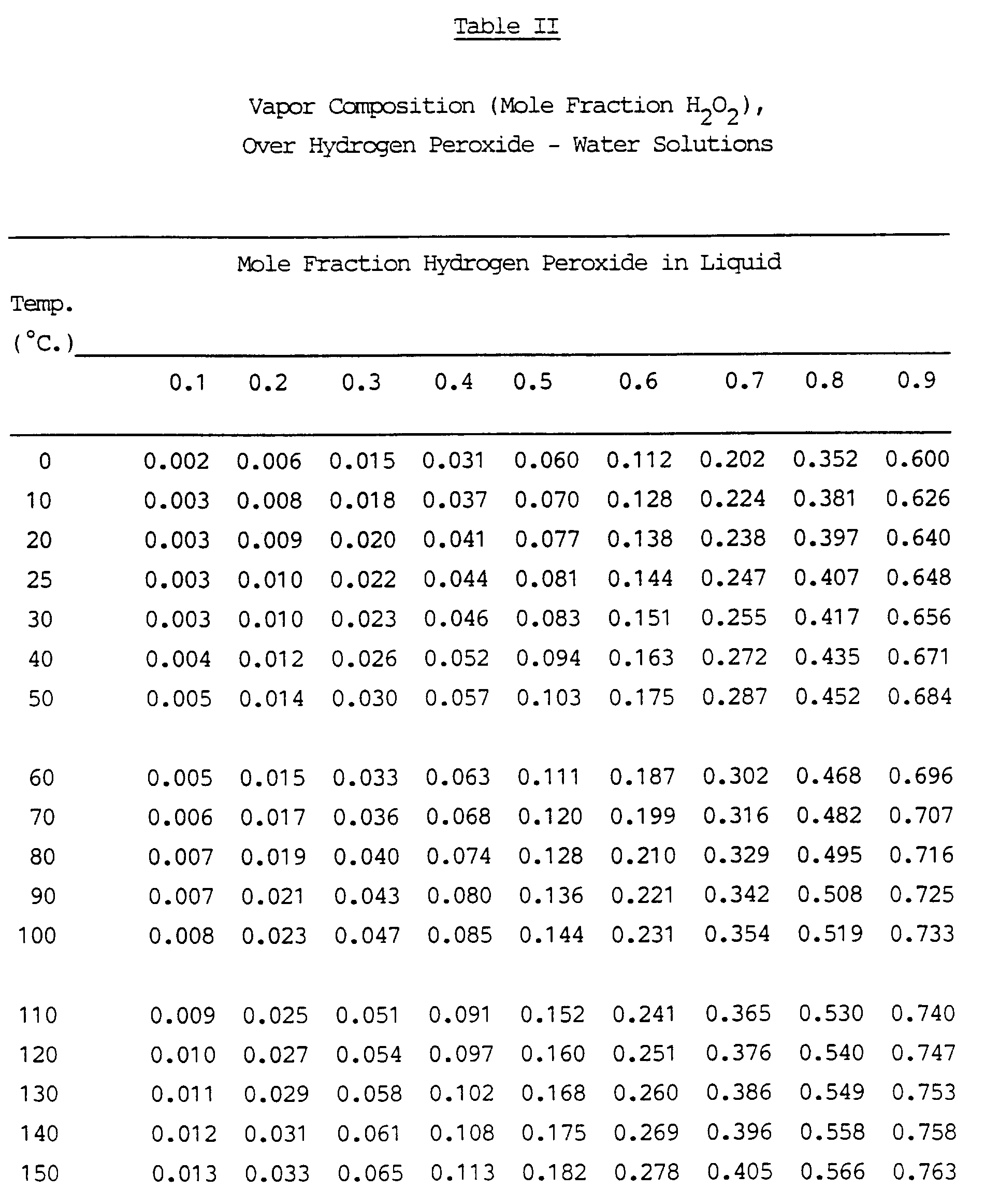
- The vapor concentrations at saturation temperatures (dew point) can be determined by combining vapor composition data from Table II with vapor pressure data from Table I. For example, referring to Table II, at 20°C, a saturated vapor composed of 0.138 mole fraction hydrogen peroxide (and thus, 0.862 mole fraction water) is in equilibrium with its liquid counterpart composed of 0.6 mole fraction hydrogen peroxide (and 0.4 mole fraction water). Referring to Table I, at 20°C, the vapor pressure over a solution composed of 0.6 mole fraction hydrogen peroxide (and 0.4 mole fraction water) is 5.00 mm Hg.
- The ideal gas law (PV=nRT) together with the respective molecular weights of the vapors can now be used to calculate the concentration of each component in the multicomponent vapor mixture according to the following relationships:

where - C =
- the concentration of vapor, eg., mg/L
- w =
- mass
- V =
- Volume
- M =
- molecular weight
- n =
- moles of vapor
- p =
- partial pressure of vapor
- R =
- universal gas constant, and
- T =
- temperature of vapor (and liquid); and
- p =
- YP
where - Y =
- vapor mole fraction, and
- P =
- total vapor pressure.
- In the example expressed above, at 20°C the saturated hydrogen peroxide vapor concentration is determined by the relationship MYP/RT, or

The saturated water vapor concentration is similarly determined.
Thus, a vapor mixture comprised of 1.3 mg hydrogen peroxide per liter and 4.2 mg water per liter has a dew point of 20°C. This point is indicated by a dot in a circle, in Figure 2. Other examples, typical of sterilization conditions, are summarized in Table III.Table III Selected Dew Point and Vapor Composition Examples Dewpoint °C H₂O₂ Vapor Water Vapor Total Vapor Pressure mm Hg Mole Fraction mg/L Mole Fraction mg/L 1 0.12 0.3 0.88 1.3 1.4 4 0.01 0.09 0.99 4.6 4.5 4 0.18 0.5 0.82 1.2 1.4 4 0.35 0.6 0.65 0.6 0.9 10 0.18 0.7 0.82 1.8 2.1 20 0.14 1.3 0.86 4.2 5.0 20 0.22 1.6 0.78 3.0 4.6 80 0.03 10.7 0.97 203.2 256.0 80 0.18 38.0 0.82 88.0 131.0 - To complete the modeled construct, the calculations can be repeated for many combinations of temperature, water vapor concentration and hydrogen peroxide vapor concentration. As can be observed, the variables in the above exemplary calculations are the mole fractions of the water and hydrogen peroxide vapors, the total pressure of the two vapors and the temperature. The molecular weights of the vapor components for a particular multicomponent vapor, the universal gas constant, 0.082 liter-atm/mole-°K, and the conversion factor, 760 mm Hg/atm are known.
- For conditions which do not specifically appear in Tables I and II, one may interpolate between entries. Alternatively, equations may be used, which describe the vapor pressure and composition over liquid solutions of the components of interest. For hydrogen peroxide and water mixtures, such equations, based on experimental data, are available in the known literature, for example, in Schumb, et al. pp. 225-227 referenced in footnote 1 above.
- The modeled construct can be used to calculate concentrations of the vapor components from measurements of physical properties of the vapor.
- The measurement of dew point alone, as stated above, is not sufficient to unambiguously determine the hydrogen peroxide vapor concentration. However, humidity measurements provide sufficient information, when combined with dew point temperature, to specify the hydrogen peroxide vapor concentration. Absolute humidity data (water per unit volume) is required for the calculations. A
relative humidity sensor 24 can be used and, by known relationships between relative humidity, vapor temperature and absolute humidity as set forth below, the water vapor concentration can be determined.

where - RH =
- relative humidity, %
- c =
- concentration of water vapor, eg., mg/L
- c0 =
- concentration of water vapor if saturated
- e =
- the natural base, 2.718
- f =
- constant = 19.89 for T = 278 to 323
- g =
- constant = 4993 for T = 278 to 323
- T =
- temperature, degrees Kelvin
-
Display 34 may be equipped with a suitable recording device to record the changing concentrations to provide a permanent record of the sterilant vapor concentration throughout the sterilization cycle. - The general method of calculating hydrogen peroxide vapor concentration from measurement of two properties requires knowledge (e.g., through prior calibration) of the functional dependence of the properties on the concentrations of hydrogen peroxide, water, and any other sensible conditions. The measured responses to mixtures of unknown composition can be used in simultaneous solution of the response functions to provide quantitation of hydrogen peroxide and water vapor concentrations.
- For example, suppose the response functions of sensor Y and sensor Z are both linear, e.g.,


where - Y =
- magnitude of response of sensor Y
- Z =
- magnitude of response of sensor Z
- a0, a1, a2 =
- constants determined by calibration
- b0, b1, b2 =
- constants determined by calibration
- [H] =
- concentration of hydrogen peroxide vapor
- [W] =
- concentration of water vapor
- Total vapor concentration may also be determined directly from measurement of the mass of liquid vaporized into a chamber of known volume. Pressure measurements can also provide total vapor concentration in vacuum conditions, where the water and hydrogen peroxide vapor constitute a significant portion of total pressure. Thermal conductivity measurements relate to total vapor concentration if thermal conditions and background gas concentrations are stable. Thus, the secondary property measured need not be relative humidity.
Sensor 24 can be a thermal conductivity sensor or a pressure gauge. - Dew point sensors which measure the temperature of condensate formation are commercially available. Relative humidity sensors, thermal conductivity sensors and pressure gauges are also commercially available.
- Predetermined calculations according to the previously described methods can be made for a wide range of hydrogen peroxide vapor concentrations, water vapor concentrations, dew point temperatures, vapor temperatures and relative humidity values to develop the modeled construct for use within a particular sterilization system. The modeled construct can then be stored by suitable known means in a microprocessor for use in conjunction with subsequent sterilization cycles to monitor hydrogen peroxide vapor concentrations throughout such sterilization cycles.

where


For example, mass and pressure are linear functions of vapor concentrations. The concentration of each component of a two-component vapor can be calculated from measurements of the mass of liquid vaporized into a known volume and the associated pressure rise. Let Y be the mass injected, in grams, and Z be the pressure rise, in mm Hg. If the sterilizer volume is 50 L and the temperature is 55°C, then
| a0 = 0 | b0 = 0 |
| a1 = 0.05 | bl = 0.601 |
| a2 = 0.05 | b2 = 1.134 |
and the following concentrations would result from application of the equations to the following measurements of Y and Z:
| Y grams | Z mm Hg | [H] mg/L | [W] mg/L |
| 0.5 | 9.74 | 3.00 | 7.00 |
| 1.0 | 19.48 | 6.00 | 14.00 |
| 1.83 | 35.66 | 10.96 | 25.63 |
| 1.83 | 38.00 | 6.57 | 30.02 |
Claims (4)
- A system for monitoring the concentration of a vapour in a multi-component vapour comprising at least two component vapours, said system comprising a chamber (20), means (44) for injecting predetermined quantity of said multi-component vapour into said chamber (20), means (22,24) for measuring primary and secondary properties of said multi-component vapour, and means (30) for fitting the primary and secondary property measurements into a modelled construct representative of the relationship between said two component vapours at a plurality of concentrations of each of said two component vapours and at a plurality of said primary property measurements corresponding to each concentration of component vapour, characterised in that said two component vapours are hydrogen peroxide vapour and water vapour and in that said means for measuring the primary and secondary property are means for measuring the dew point of the multi-component vapour as the primary property and total vapour pressure or total vapour mass or thermal conductivity or relative humidity of water vapour as the secondary property
- The system as claimed in claim 1, wherein said at least one additional property is determined from the relationship between the predetermined volume of said chamber (20) and the mass of said predetermined quantity of said multi-component vapour injected into said chamber.
- The system as claimed in claim 1 or 2, wherein said means for fitting the measurements into a modelled construct is a microprocessor (30) having means for storing said modelled construct and means for communicating data from said dew point measuring means (22) and said additional property measuring means (24) to said microprocessor.
- The system as claimed in claim 3, wherein said modelled construct is represented by a plurality of relationships between the concentrations of hydrogen peroxide and dew point temperature of the multi-component vapour, each relationship being constructed for a different respective constant water vapour concentration.
Applications Claiming Priority (2)
| Application Number | Priority Date | Filing Date | Title |
|---|---|---|---|
| US139991 | 1987-12-30 | ||
| US07/139,991 US4843867A (en) | 1987-12-30 | 1987-12-30 | System for monitoring sterilant vapor concentration |
Publications (2)
| Publication Number | Publication Date |
|---|---|
| EP0346436A1 EP0346436A1 (en) | 1989-12-20 |
| EP0346436B1 true EP0346436B1 (en) | 1993-08-18 |
Family
ID=22489227
Family Applications (1)
| Application Number | Title | Priority Date | Filing Date |
|---|---|---|---|
| EP89901032A Expired - Lifetime EP0346436B1 (en) | 1987-12-30 | 1988-12-16 | System for monitoring vapor concentration |
Country Status (7)
| Country | Link |
|---|---|
| US (1) | US4843867A (en) |
| EP (1) | EP0346436B1 (en) |
| JP (1) | JP2924912B2 (en) |
| CN (1) | CN1034809A (en) |
| CA (1) | CA1319839C (en) |
| DE (1) | DE3883380T2 (en) |
| WO (1) | WO1989006358A1 (en) |
Families Citing this family (64)
| Publication number | Priority date | Publication date | Assignee | Title |
|---|---|---|---|---|
| JP2932072B2 (en) * | 1989-02-22 | 1999-08-09 | 四国化工機株式会社 | Hydrogen peroxide gas concentration adjustment device for sterilization |
| JP2646788B2 (en) * | 1990-03-13 | 1997-08-27 | 三菱電機株式会社 | Steam flow rate measuring device |
| US5114670A (en) * | 1990-08-30 | 1992-05-19 | Liqui-Box/B-Bar-B Corporation | Process for sterilizing surfaces |
| US5317896A (en) * | 1992-03-13 | 1994-06-07 | American Sterilizer Company | Method of detecting liquid in a sterilization system |
| WO1993017726A1 (en) * | 1992-03-13 | 1993-09-16 | American Sterilizer Company | Sterilization apparatus and method for multicomponent sterilant |
| US5445792A (en) * | 1992-03-13 | 1995-08-29 | American Sterilizer Company | Optimum hydrogen peroxide vapor sterlization method |
| CA2102903C (en) * | 1992-03-13 | 1998-11-10 | H. William Hillebrenner | Device and system for sterilizing objects |
| US5484510A (en) * | 1993-10-26 | 1996-01-16 | Dew Enterprises, Inc. | Water distilling apparatus |
| US5600142A (en) * | 1995-05-26 | 1997-02-04 | Uop | Measurement of vaporized hydrogen peroxide |
| US5906794A (en) * | 1995-06-15 | 1999-05-25 | American Sterilizer Company | Continuous-operation, closed loop decontamination system and method |
| US5872359A (en) * | 1995-07-27 | 1999-02-16 | American Sterilizer Company | Real-time monitor and control system and method for hydrogen peroxide vapor decontamination |
| US5876664A (en) * | 1996-06-14 | 1999-03-02 | American Sterilizer Company | Continuous-operation, closed loop decontamination system and method |
| US5809826A (en) * | 1996-07-29 | 1998-09-22 | Baker, Jr.; Hugh M. | Inferential condensation sensor |
| US20010012700A1 (en) * | 1998-12-15 | 2001-08-09 | Klaus F. Schuegraf | Semiconductor processing methods of chemical vapor depositing sio2 on a substrate |
| AU753047B2 (en) | 1997-11-14 | 2002-10-03 | Ethicon Inc. | Method for measuring the concentration of hydrogen peroxide vapor |
| DE19853368A1 (en) * | 1998-11-19 | 2000-06-08 | Weick Hans Joachim | Measuring water quantity and leakage in containers, e.g. of motor vehicle air conditioning system; involves determining partial pressure of water vapor |
| GB2351664A (en) * | 1999-06-04 | 2001-01-10 | Microflow Ltd | Sterilizing enclosures |
| US6318151B1 (en) * | 1999-07-26 | 2001-11-20 | Abbott Laboratories | Self-contained sterilant monitoring assembly and method of using same |
| CA2382045A1 (en) * | 1999-08-20 | 2001-03-01 | Board Of Regents, The University Of Texas System | Hdac4 and hdac5 in the regulation of cardiac gene expression |
| GB2354443A (en) * | 1999-09-21 | 2001-03-28 | Microflow Ltd | Vapour phase sterilisation |
| US20020122744A1 (en) * | 1999-12-21 | 2002-09-05 | Hui Henry K. | Apparatus and method for monitoring of oxidative gas or vapor |
| US20020081228A1 (en) * | 1999-12-21 | 2002-06-27 | Hui Henry K. | Monitoring sterilant concentration in diffusion-restricted regions as a basis for parametric release |
| US6451272B1 (en) | 1999-12-21 | 2002-09-17 | Ethicon, Inc. | Monitoring of sterilant apparatus and method for monitoring sterilant |
| GB2360454A (en) * | 2000-03-21 | 2001-09-26 | Microflow Ltd | Control of gaseous sterilisation |
| GB2360583A (en) * | 2000-03-21 | 2001-09-26 | Microflow Ltd | Optical condensation monitor |
| US6528016B1 (en) | 2000-06-27 | 2003-03-04 | Ethicon, Inc. | Method for rapidly determining the acceptability of loads to be sterilized |
| JP4491831B2 (en) * | 2000-11-27 | 2010-06-30 | 三浦工業株式会社 | Sterilization method for food equipment |
| EP1385558B1 (en) | 2001-05-11 | 2004-12-22 | Steris Inc. | Non-dispersive mid-infrared sensor for vaporized hydrogen peroxide |
| US7090808B2 (en) * | 2001-07-09 | 2006-08-15 | Pharmaceutical Systems, Inc. | Apparatus for testing sterilization methods and materials |
| US6794649B2 (en) | 2001-07-09 | 2004-09-21 | Pharmaceutical Systems, Inc. | Spectrophotometric determination of gas phase compositions |
| JP3883847B2 (en) * | 2001-11-19 | 2007-02-21 | 株式会社日立製作所 | In-vehicle signal processor |
| DE10161106A1 (en) * | 2001-12-12 | 2003-06-26 | Bht Hygiene Technik Gmbh | Cleaning and disinfection machine |
| US7186372B2 (en) * | 2002-03-29 | 2007-03-06 | Ethicon, Inc. | Method for determining lumen penetration of a vapor phase sterilant |
| US6953549B2 (en) * | 2003-07-15 | 2005-10-11 | Steris Inc. | System and method for determining concentration of sterilant |
| US7186373B2 (en) * | 2003-07-22 | 2007-03-06 | Steris Inc. | Visual detector for vaporized hydrogen peroxide |
| JP4510480B2 (en) * | 2004-02-04 | 2010-07-21 | 株式会社エアレックス | Decontamination apparatus and decontamination method |
| US20050276721A1 (en) * | 2004-05-25 | 2005-12-15 | Steris Inc. | Method and apparatus for controlling the concentration of a sterilant chemical in a fluid |
| US7900374B2 (en) * | 2004-08-18 | 2011-03-08 | Lg Electronics Inc. | Apparatus for automatically drying and method for controlling the same |
| GB2419415A (en) * | 2004-09-20 | 2006-04-26 | Bioquell Uk Ltd | Sterilisation sensor |
| US20060088441A1 (en) * | 2004-10-21 | 2006-04-27 | Steris Inc. | Vaporized hydrogen peroxide concentration detector |
| GB2428578B (en) * | 2005-07-28 | 2010-06-09 | Bioquell | Determining bacterial kill by vaporised sterilants |
| US20070098592A1 (en) * | 2005-11-01 | 2007-05-03 | Steris Inc. | Parallel flow VHP decontamination system |
| ATE489973T1 (en) * | 2006-05-01 | 2010-12-15 | American Sterilizer Co | HYDROGEN PEROXIDE ATOMIZER |
| DE102006033252B4 (en) * | 2006-07-18 | 2010-01-14 | Testo Ag | Method and device for measuring humidity and dew point in a hydrogen peroxide-laden environment |
| DE102006036785A1 (en) * | 2006-08-07 | 2008-02-14 | Robert Bosch Gmbh | Process for detecting contaminants in a gas tank |
| US7700056B2 (en) * | 2006-08-10 | 2010-04-20 | American Sterilizer Company | Modular decontamination system |
| US7919059B2 (en) * | 2007-04-27 | 2011-04-05 | American Sterilizer Company | Vaporized hydrogen peroxide decontamination system with concentration adjustment mode |
| US7640782B2 (en) * | 2007-04-27 | 2010-01-05 | American Sterilizer Company | Vaporized hydrogen peroxide probe calibration rig |
| US7850925B2 (en) * | 2007-06-15 | 2010-12-14 | American Sterilizer Company | Apparatus for removal of vaporized hydrogen peroxide from a region |
| US8007717B2 (en) * | 2007-08-14 | 2011-08-30 | American Sterilizer Company | Method and apparatus for decontaminating a region without dehumidification |
| US20090087921A1 (en) * | 2007-10-02 | 2009-04-02 | Steris Inc. | Vaporized hydrogen peroxide concentration detector |
| US8889081B2 (en) * | 2009-10-15 | 2014-11-18 | Medivators Inc. | Room fogging disinfection system |
| AU2010325926B2 (en) | 2009-12-03 | 2014-01-09 | Minntech Corporation | Container and system for decontaminating a medical device with a fog |
| US8808631B2 (en) * | 2010-11-30 | 2014-08-19 | American Sterilizer Company | Centralized, time-shared vapor sterilization system |
| CN103702689B (en) | 2011-05-27 | 2016-08-17 | 马尔科尔净化装置公司 | Cleaning system including the environmental Kuznets Curves using cleaning of substances |
| CN103272249B (en) * | 2013-06-14 | 2015-06-17 | 山东新华医疗器械股份有限公司 | Sterilization cabinet provided with multicore temperature probe |
| WO2015094879A1 (en) * | 2013-12-16 | 2015-06-25 | 3M Innovative Properties Company | Systems and methods for controlling humidity |
| EP3227457B1 (en) | 2014-12-03 | 2021-06-30 | TSO3 Inc. | Method for establishing resistance characteristics of a biological indicator |
| JP5955998B1 (en) * | 2015-02-13 | 2016-07-20 | 大和製罐株式会社 | Sterilizer, sterilization method, and feed production method |
| KR101967811B1 (en) * | 2016-11-11 | 2019-04-11 | 한국과학기술연구원 | A simplicity sterilization equipment using hydrogen peroxide vapor and method for sterilization using the same |
| CN109307685B (en) * | 2018-08-30 | 2020-03-17 | 西安交通大学 | Method for estimating gas concentration based on temperature |
| JP7161978B2 (en) * | 2019-07-11 | 2022-10-27 | 株式会社日立プラントサービス | Decontamination system and decontamination method |
| US20240157386A1 (en) * | 2022-11-11 | 2024-05-16 | Aadi GANNAVARAM | Moisture control apparatus |
| CN118526617B (en) * | 2024-07-26 | 2024-10-22 | 浙江泰林分析仪器有限公司 | Control method of VHP vaporizing device and sterilizing equipment |
Family Cites Families (20)
| Publication number | Priority date | Publication date | Assignee | Title |
|---|---|---|---|---|
| US2369900A (en) * | 1944-03-31 | 1945-02-20 | Burgess H Jennings | Method and apparatus for sterilizing air |
| US2971368A (en) * | 1956-04-12 | 1961-02-14 | Mine Safety Appliances Co | Determination of concentration of components of a gaseous mixture |
| US3598516A (en) * | 1969-01-02 | 1971-08-10 | James J Shull | Method of sterilizing |
| US3687612A (en) * | 1970-10-12 | 1972-08-29 | Sybron Corp | Method of controlling relative humidity in gaseous sterilizers |
| US3936270A (en) * | 1972-06-13 | 1976-02-03 | American Sterilizer Company | Portable gas sterilizer system |
| US3910761A (en) * | 1973-11-28 | 1975-10-07 | Sybron Corp | Control system for a sterilizer |
| US4169123A (en) * | 1975-12-11 | 1979-09-25 | Moore-Perk Corporation | Hydrogen peroxide vapor sterilization method |
| US4067691A (en) * | 1976-04-16 | 1978-01-10 | Mercy Hospital And Medical Center | Sterilizing system and automatic control therefor |
| US4169124A (en) * | 1977-09-26 | 1979-09-25 | Moore-Perk Corporation | Cold gas sterilization process |
| US4261950A (en) * | 1979-02-06 | 1981-04-14 | American Sterilizer Company | Sterilizing apparatus and integrated sterilizer control |
| US4294804A (en) * | 1979-02-06 | 1981-10-13 | American Sterilizer Company | Pressure responsive conditioning control gas sterilization |
| NZ193067A (en) * | 1979-06-05 | 1983-05-31 | American Sterilizer Co | Programmable sterilising apparatus |
| US4309381A (en) * | 1979-11-06 | 1982-01-05 | American Sterilizer Company | Establishing and ascertaining desired air removal in steam sterilization |
| IT1209821B (en) * | 1980-07-21 | 1989-08-30 | Salvador Pierantonio | PROCEDURE FOR THE CONTROL OF THE DISOMOGENIZATION WITHIN STERILIZATION CHAMBER AND DEVICE SUITABLE TO CARRY OUT SUCH PROCEDURE |
| US4363635A (en) * | 1981-01-26 | 1982-12-14 | Cal Detect, Inc. | Method and apparatus for measuring breath alcohol |
| US4637916A (en) * | 1983-01-28 | 1987-01-20 | Universite Catholique De Louvain | Sterilization method employing a circulating gaseous sterilant |
| US4642165A (en) * | 1984-12-21 | 1987-02-10 | American Sterilizer Company | Method of vaporizing multicomponent liquids |
| BR8605135A (en) * | 1985-02-05 | 1987-05-05 | Scopas Technology Co Inc | STERILIZING GAS SYSTEM |
| US4616501A (en) * | 1985-04-23 | 1986-10-14 | American Sterilizer Company | System for determining gas concentration |
| US4730479A (en) * | 1986-06-23 | 1988-03-15 | The Standard Oil Company | Temperature and humidity compensation for gas detection apparatus |
-
1987
- 1987-12-30 US US07/139,991 patent/US4843867A/en not_active Expired - Lifetime
-
1988
- 1988-12-16 DE DE89901032T patent/DE3883380T2/en not_active Expired - Fee Related
- 1988-12-16 JP JP1500914A patent/JP2924912B2/en not_active Expired - Lifetime
- 1988-12-16 WO PCT/US1988/004505 patent/WO1989006358A1/en not_active Ceased
- 1988-12-16 EP EP89901032A patent/EP0346436B1/en not_active Expired - Lifetime
- 1988-12-21 CA CA000586654A patent/CA1319839C/en not_active Expired - Fee Related
- 1988-12-30 CN CN88109173A patent/CN1034809A/en active Pending
Also Published As
| Publication number | Publication date |
|---|---|
| DE3883380D1 (en) | 1993-09-23 |
| JP2924912B2 (en) | 1999-07-26 |
| CN1034809A (en) | 1989-08-16 |
| EP0346436A1 (en) | 1989-12-20 |
| DE3883380T2 (en) | 1993-12-09 |
| WO1989006358A1 (en) | 1989-07-13 |
| JPH02502943A (en) | 1990-09-13 |
| US4843867A (en) | 1989-07-04 |
| CA1319839C (en) | 1993-07-06 |
Similar Documents
| Publication | Publication Date | Title |
|---|---|---|
| US4843867A (en) | System for monitoring sterilant vapor concentration | |
| Jones | The air density equation and the transfer of the mass unit | |
| Pool et al. | Some excess thermodynamic functions for the liquid systems argon+ oxygen, argon+ nitrogen, nitrogen+ oxygen, nitrogen+ carbon monoxide, and argon+ carbon monoxide | |
| Owen et al. | The conductance of hydrochloric acid in aqueous solutions from 5 to 65 | |
| Parrish et al. | Liquid-vapor equilibria in the nitrogen-methane system between 95 and 120 K | |
| Sun et al. | Measurements of the densities of liquid benzene, cyclohexane, methanol, and ethanol as functions of temperature at 0.1 MPa | |
| Astrov et al. | Precision gas thermometry between 2.5 K and 308 K | |
| Harris-Lowe et al. | Thermal expansion of liquid helium ii | |
| Birch et al. | The effect of variations in the refractive index of industrial air upon the uncertainty of precision length measurement | |
| GB2191585A (en) | Sensor indicating and controlling substance concentration | |
| EP1097356B1 (en) | Method and equipment for measuring vapour flux from surfaces | |
| Bell | The beginner's guide to humidity measurement. | |
| GB2165948A (en) | Gas or vapour monitor | |
| Tang et al. | Vapor-liquid equilibrium measurements for dilute nitric acid solutions | |
| Paul et al. | Measurements of VLE, hE and vE for binary mixtures of n-alkanes with n-alkylbenzenes | |
| Compton et al. | Realization of the boiling and triple points of oxygen | |
| Vold | A Calorimetric Test of the Solubility Equation for Regular Solutions1 | |
| Abraham et al. | The compressibility of carbon dioxide‐argon mixtures | |
| Richards et al. | The specific heats of five organic liquids from their adiabatic temperature-pressure coefficients | |
| Kunze Jr et al. | The temperature dependence of the diamagnetism of liquids | |
| Atag et al. | A Primary-Level Evolved Water Vapor System for Simultaneous Measurement of Soil Water and Moisture Content | |
| Miles et al. | Certain Physical Properties of Divinyl Ether. | |
| Zauder et al. | Applications of gas chromatography to anaesthesiology 1. Gases and vapours | |
| Allison et al. | The evaluation of interactions between anaesthetic agent vapours and carrier gases by laser refractometry | |
| Enoch et al. | An improved membrane system for oxygen probes |
Legal Events
| Date | Code | Title | Description |
|---|---|---|---|
| PUAI | Public reference made under article 153(3) epc to a published international application that has entered the european phase |
Free format text: ORIGINAL CODE: 0009012 |
|
| 17P | Request for examination filed |
Effective date: 19890912 |
|
| AK | Designated contracting states |
Kind code of ref document: A1 Designated state(s): DE FR GB IT |
|
| 17Q | First examination report despatched |
Effective date: 19910719 |
|
| GRAA | (expected) grant |
Free format text: ORIGINAL CODE: 0009210 |
|
| AK | Designated contracting states |
Kind code of ref document: B1 Designated state(s): DE FR GB IT |
|
| ET | Fr: translation filed | ||
| ITF | It: translation for a ep patent filed | ||
| REF | Corresponds to: |
Ref document number: 3883380 Country of ref document: DE Date of ref document: 19930923 |
|
| PLBE | No opposition filed within time limit |
Free format text: ORIGINAL CODE: 0009261 |
|
| STAA | Information on the status of an ep patent application or granted ep patent |
Free format text: STATUS: NO OPPOSITION FILED WITHIN TIME LIMIT |
|
| 26N | No opposition filed | ||
| REG | Reference to a national code |
Ref country code: GB Ref legal event code: IF02 |
|
| PGFP | Annual fee paid to national office [announced via postgrant information from national office to epo] |
Ref country code: GB Payment date: 20051207 Year of fee payment: 18 |
|
| PGFP | Annual fee paid to national office [announced via postgrant information from national office to epo] |
Ref country code: FR Payment date: 20051216 Year of fee payment: 18 |
|
| PGFP | Annual fee paid to national office [announced via postgrant information from national office to epo] |
Ref country code: DE Payment date: 20060131 Year of fee payment: 18 |
|
| PGFP | Annual fee paid to national office [announced via postgrant information from national office to epo] |
Ref country code: IT Payment date: 20061231 Year of fee payment: 19 |
|
| PG25 | Lapsed in a contracting state [announced via postgrant information from national office to epo] |
Ref country code: DE Free format text: LAPSE BECAUSE OF NON-PAYMENT OF DUE FEES Effective date: 20070703 |
|
| GBPC | Gb: european patent ceased through non-payment of renewal fee |
Effective date: 20061216 |
|
| REG | Reference to a national code |
Ref country code: FR Ref legal event code: ST Effective date: 20070831 |
|
| PG25 | Lapsed in a contracting state [announced via postgrant information from national office to epo] |
Ref country code: GB Free format text: LAPSE BECAUSE OF NON-PAYMENT OF DUE FEES Effective date: 20061216 |
|
| PG25 | Lapsed in a contracting state [announced via postgrant information from national office to epo] |
Ref country code: FR Free format text: LAPSE BECAUSE OF NON-PAYMENT OF DUE FEES Effective date: 20070102 |
|
| PG25 | Lapsed in a contracting state [announced via postgrant information from national office to epo] |
Ref country code: IT Free format text: LAPSE BECAUSE OF NON-PAYMENT OF DUE FEES Effective date: 20071216 |