EP0342698B1 - Method for the controlled retraction of a sinking electrode in an electroerosion machine - Google Patents
Method for the controlled retraction of a sinking electrode in an electroerosion machine Download PDFInfo
- Publication number
- EP0342698B1 EP0342698B1 EP89109068A EP89109068A EP0342698B1 EP 0342698 B1 EP0342698 B1 EP 0342698B1 EP 89109068 A EP89109068 A EP 89109068A EP 89109068 A EP89109068 A EP 89109068A EP 0342698 B1 EP0342698 B1 EP 0342698B1
- Authority
- EP
- European Patent Office
- Prior art keywords
- retraction
- movement
- path
- point
- short circuit
- Prior art date
- Legal status (The legal status is an assumption and is not a legal conclusion. Google has not performed a legal analysis and makes no representation as to the accuracy of the status listed.)
- Expired - Lifetime
Links
Images

Classifications
-
- B—PERFORMING OPERATIONS; TRANSPORTING
- B23—MACHINE TOOLS; METAL-WORKING NOT OTHERWISE PROVIDED FOR
- B23H—WORKING OF METAL BY THE ACTION OF A HIGH CONCENTRATION OF ELECTRIC CURRENT ON A WORKPIECE USING AN ELECTRODE WHICH TAKES THE PLACE OF A TOOL; SUCH WORKING COMBINED WITH OTHER FORMS OF WORKING OF METAL
- B23H7/00—Processes or apparatus applicable to both electrical discharge machining and electrochemical machining
- B23H7/02—Wire-cutting
- B23H7/08—Wire electrodes
- B23H7/10—Supporting, winding or electrical connection of wire-electrode
-
- B—PERFORMING OPERATIONS; TRANSPORTING
- B23—MACHINE TOOLS; METAL-WORKING NOT OTHERWISE PROVIDED FOR
- B23H—WORKING OF METAL BY THE ACTION OF A HIGH CONCENTRATION OF ELECTRIC CURRENT ON A WORKPIECE USING AN ELECTRODE WHICH TAKES THE PLACE OF A TOOL; SUCH WORKING COMBINED WITH OTHER FORMS OF WORKING OF METAL
- B23H7/00—Processes or apparatus applicable to both electrical discharge machining and electrochemical machining
- B23H7/14—Electric circuits specially adapted therefor, e.g. power supply
- B23H7/16—Electric circuits specially adapted therefor, e.g. power supply for preventing short circuits or other abnormal discharges by altering machining parameters using adaptive control
Definitions
- the invention relates to a method for the controlled retraction movement of a lowering electrode in an electroerosion machine, in which the lowering electrode is first moved back a predetermined path length along the previously traversed path from the short-circuit point to an intermediate point in the presence of a short circuit, and in which the lowering electrode is on the predetermined retraction path from the Intermediate point is moved away if there is still a short circuit when the intermediate point is reached.
- US Pat. No. 4,608,476 describes a method for the controlled retraction movement of a lowering electrode in an electrical discharge machining machine, in which, when a short circuit occurs, the workpiece and the lowering electrode are moved in translation relative to one another. This is done in such a way that a movement by a first predetermined distance in a first predetermined direction transversely to the path section of the lowering electrode just in front of the short-circuit point and at the same time by a second distance in a second predetermined direction, with the result that the end point of the Lower electrode along a sloping straight line a predetermined distance from the machining surface. This end point is thus moved along a vector.
- a method for the controlled retraction movement of a lowering electrode in an electrical discharge machining machine is known from DE-A-35 25 683. Accordingly, one occurs when it occurs Short-circuit the lowering electrode initially along the previously driven path back by a predetermined, short distance in the already eroded path.
- the electrode is moved further on from the short circuit point on a second straight path.
- This second path is described by a retraction vector which is flexible in its direction and which is subject to the requirement to remove the electrode from the short-circuit point as quickly as possible.
- variable retraction vector has the disadvantage, in particular in the case of long eroded tracks of small width, such as for the production of sealing rings, that its angle with respect to the side wall becomes smaller and smaller depending on the path length already eroded; the retracting movement of the lowering electrode can only be "grinding".
- an electrode return control system for an electric arc device in which, when a short circuit condition occurs, an electrode is moved away from a position in a workpiece along a path that moves the electrode for processing.
- a system in which an object point, to which the electrode is moved immediately after the short-circuit condition has occurred, is updated as processing continues. This means that the deeper the electrode erodes into the workpiece, the deeper is the location on the axis of the workpiece, towards which the electrode's escape movement takes place.
- the disadvantage here is in particular that when the short circuit occurs, the electrode has produced such an erosion in the workpiece that due to the rounding of the electrode, a corresponding rounding is cut into the workpiece. This creates a small edge in the workpiece, which is damaged when the lowering electrode is withdrawn.
- the object of the invention is therefore to improve the method of the type mentioned in such a way that on the one hand unnecessarily large withdrawal movements are avoided and on the other hand short circuits are eliminated as quickly as possible.
- the course of the retraction movement should be able to be adapted as flexibly as possible to the geometry of the workpiece to be eroded and the path eroded therein.
- the retraction path is determined by a vector which is defined in terms of magnitude and direction, with the short-circuit still present at the tip of the vector, the further movement of the lowering electrode parallel to the eroded path and in the opposite direction Direction to the direction that the sinking electrode describes in the eroded path during the eroding.
- the vector determining the retraction path is fixed in relation to an absolute coordinate system. This has the particular advantage that the retraction path can be compared more clearly with the contours of the workpiece that limit it.
- At least two vectors which are fixedly defined in terms of magnitude and direction determine the retraction path as a function of the geometry of the workpiece, and when changing from one vector to the other vector, only the tips of the vectors move in the path for the retraction electrode retraction path to be traversed are connected to each other and the further movement is otherwise parallel to the eroded path.
- the lowering electrode is fed back to the location on the workpiece at which the short circuit first occurred.
- the particles formed during the eroding process sediment in the eroded path. If the movement of the lowering electrode again runs along this eroded path curve, there is a risk that these particles will be rubbed into the flanks or into the bottom of the path curve and thereby destroy their eroded surfaces.
- a withdrawal movement “point” (the individual withdrawal movements are explained in more detail with reference to the description below) with the withdrawal movement Default, and in a further advantageous embodiment of the method the withdrawal movement "point” is connected with a further withdrawal movement "point”.
- the retraction movement "point” is combined with the retraction movement "vector” and in another advantageous embodiment of the method a retraction movement "point” is connected with a retraction movement "planetary”.
- the retraction movement "vector” is combined with the retraction movement "default”, in a further advantageous embodiment of the method the retraction movement "vector” is connected with the retraction movement "vector”.
- the withdrawal movement “vector” is connected to the withdrawal movement “planetary”.
- an additional double timer movement is superimposed on a customary simple timer movement of the lowering electrode along the respective retraction path, with the double timer movement taking longer than the simple timer movement in an advantageous embodiment.
- a so-called double timer movement is explained in more detail in DE-A1- 36 44 042.6 by the applicant.
- These are one or more short-stroke lifting / lowering movements of the tool electrode relative to the workpiece, which in turn are carried out in the dielectric relative to first lifting / lowering movements (simple timer movements).
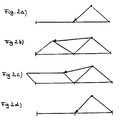
- Fig. 2a - 2d the connection of common withdrawal movements with the withdrawal movement "point”.
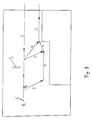
- FIG. 1 shows the movement path of a lowering electrode S along a path 1 in a workpiece.
- the shape to be eroded is generated directly by the movement of the lowering electrode S in the path 1.
- This type of eroding is particularly advantageous for molded parts such as sealing rings.
- the lowering electrode S Since the lowering electrode S erodes small particles from the workpiece during the eroding process and these particles are still in the dielectric in which the entire eroding process takes place, it is also possible for these particles to be arranged so unfavorably between the workpiece and the electrode and on one A short circuit occurs at point P k , the resistance in the dielectric falling to zero. In order to be able to reduce this short circuit, a retraction movement of the lowering electrode S must take place, which can be divided into several sections according to the invention.
- the lowering electrode S is retracted along a short distance along the previously traveled path 1 in order to prevent the rounding eroded into the workpiece from obstructing the movement of the lowering electrode during its retracting movement in order to reduce the short circuit.
- This vector can be determined beforehand by the operating personnel and, in terms of its amount and direction, is subject in particular to the environment of the workpiece which limits the movement.
- the short circuit should advantageously be eliminated as quickly as possible; this requires that the lowering electrode S be removed from the workpiece surfaces in the shortest possible time.
- the lowering electrode S is moved along a second section 3 of the retraction path.
- This section 3 runs parallel to the eroded path 1 and in the opposite direction to the direction described by the lowering electrode in the eroded path 1 during the eroding.
- Vector 5 corresponds to the return path vector 2 in terms of length and amount, but is only offset parallel to this.
- Such a transition movement can occur in particular when the obstacle K of the workpiece makes this necessary due to its geometry, such as the edge of the body K shown in FIG. 1.
- the lowering electrode S When the lowering electrode S has reached the end of the vector 6 and the short-circuit condition is still not reduced, the lowering electrode S continues to move along a fourth section 7, which again runs parallel to the eroded path 1.
- the operating personnel can determine the vectors 2 (5) and 6 before the eroding process depending on the obstacle K in terms of amount and direction. Errors can be almost completely ruled out in this determination, since the vectors each span parallelograms, the surfaces of which must not be brought into contact with the obstacle K in a clear manner in order to ensure a short-circuit-free retraction movement of the lowering electrode.
- the first section 2 is the length of the path to be traversed during the erosion respective vector determining the retreat path with respect to the absolute coordinate system.
- the lowering electrode S is not returned directly to the eroded path 1, but instead moves back along the previously retracted path from the point of the retreat path towards the point P R at which the lower electrode S was when the short-circuit condition was released. From there it moves a short distance along the eroded path back to the short-circuit point P k .
- a point is initially determined, with a linear movement to this point occurring from every location of the short circuit after each triggering of the withdrawal movement.
- the retraction movement is assigned an incremental vector; the further movement parallel to the previously traveled path has already been described in more detail for FIG. 1.
- This retraction movement is only suitable for systems in which planetary erosion occurs.
- a point is usually defined on the axis of a cylinder or similar hollow body to be eroded, as well as a certain length L as the distance from it Point from the bottom of the hollow body. If a short circuit occurs, the retraction movement takes place automatically in the direction of the previously defined point of the axis at a distance L from the bottom of the hollow body and then, if the short circuit has not yet been eliminated, along the axis out of the hollow body.
- FIGS. 3a, 3b, 3c and 3d show the connection of the known and previously explained withdrawal movements with the withdrawal movement "vector".
- a timer movement can be coupled with these retraction movements.
- the lowering electrode S is switched off in a known manner at predetermined time intervals pulled out of the workpiece and that by a small path length, so that the particles occurring during the eroding process can be washed away.
- the speed of the timer movement is significantly higher than the speed of the lowering electrode S when retracting.
Landscapes
- Chemical & Material Sciences (AREA)
- Chemical Kinetics & Catalysis (AREA)
- Electrochemistry (AREA)
- Engineering & Computer Science (AREA)
- Mechanical Engineering (AREA)
- Electrical Discharge Machining, Electrochemical Machining, And Combined Machining (AREA)
Description
Die Erfindung betrifft ein Verfahren zur gesteuerten Rückzugsbewegung einer Senkelektrode bei einer Elektroerosionsmaschine, bei dem die Senkelektrode bei vorhandenem Kurzschluß zunächst eine vorgegebene Weglänge längs der zuvor durchlaufenenen Bahn von dem Kurzschlußpunkt zu einem Zwischenpunkt zurückbewegt wird, und bei dem die Senkelektrode auf der vorgegebenen Rückzugsbahn von dem Zwischenpukt wegbewegt wird, wenn bei Erreichen des Zwischenpunktes noch ein Kurzschluß vorhanden ist.The invention relates to a method for the controlled retraction movement of a lowering electrode in an electroerosion machine, in which the lowering electrode is first moved back a predetermined path length along the previously traversed path from the short-circuit point to an intermediate point in the presence of a short circuit, and in which the lowering electrode is on the predetermined retraction path from the Intermediate point is moved away if there is still a short circuit when the intermediate point is reached.
In der US-A-4 608 476 ist ein Verfahren zur gesteuerten Rückzugsbewegung einer Senkelektrode bei einer Elektroerosionsmaschine beschrieben, bei dem beim Auftreten eines Kurzschlusses das Werkstück und die Senkelektrode relativ zu einander translatorisch bewegt werden. Dies erfolgt derart, daß eine Bewegung um eine erste vorbestimmte Strecke in einer ersten vorgegebenen Richtung quer zu dem gerade vor der Kurzschlußstelle liegenden Bahnabschnitt der Senkelektrode und gleichzeitig um eine zweite Strecke in einer zweiten vorbestimmten Richtung erfolgt, mit dem Ergebnis, daß sich der Endpunkt der Senkelektrode längs einer schräg verlaufenden Geraden um eine vorbestimmte Strecke von der Bearbeitungsfläche entfernt. Dieser Endpunkt wird also entlang eines Vektors verschoben.US Pat. No. 4,608,476 describes a method for the controlled retraction movement of a lowering electrode in an electrical discharge machining machine, in which, when a short circuit occurs, the workpiece and the lowering electrode are moved in translation relative to one another. This is done in such a way that a movement by a first predetermined distance in a first predetermined direction transversely to the path section of the lowering electrode just in front of the short-circuit point and at the same time by a second distance in a second predetermined direction, with the result that the end point of the Lower electrode along a sloping straight line a predetermined distance from the machining surface. This end point is thus moved along a vector.
Ein Verfahren zur gesteuerten Rückzugsbewegung einer Senkelektrode bei einer Elektroerosionsmaschine ist aus der DE-A-35 25 683 bekannt. Demgemäß fährt bei Auftreten einnes Kurzschlusses die Senkelektrode zunächst entlang der bisher gefahrenen Bahn um eine vorgegebene, kurze Wegstrecke in der bereits erodierten Bahn zurück.A method for the controlled retraction movement of a lowering electrode in an electrical discharge machining machine is known from DE-A-35 25 683. Accordingly, one occurs when it occurs Short-circuit the lowering electrode initially along the previously driven path back by a predetermined, short distance in the already eroded path.
Ist am Ende dieser ersten Rückzugsbahn der Kurzschluß noch nicht beseitigt, so wird die Elektrode auf einer zweiten, geradlinigen Bahn weiter von dem Kurzschlußpunkt fortbewegt. Diese zweite Bahn wird durch einen Rückzugsvektor beschrieben, der in seiner Richtung flexibel ist und der der Anforderung unterliegt, die Elektrode möglichst schnell vom Kurzschlußpunkt zu entfernen.If the short circuit has not yet been eliminated at the end of this first retraction path, the electrode is moved further on from the short circuit point on a second straight path. This second path is described by a retraction vector which is flexible in its direction and which is subject to the requirement to remove the electrode from the short-circuit point as quickly as possible.
Der variable Rückzugsvektor hat insbesondere bei langen erodierten Bahnen geringer Breite, wie beispielsweise zur Herstellung von Dichtungsringen den Nachteil, daß sein Winkel gegenüber der Seitenwandung in Abhängigkeit von der schon erodierten Weglänge immer kleiner wird; die Rückzugsbewegung der Senkelektrode kann dabei nur "schleifend" erfolgen.The variable retraction vector has the disadvantage, in particular in the case of long eroded tracks of small width, such as for the production of sealing rings, that its angle with respect to the side wall becomes smaller and smaller depending on the path length already eroded; the retracting movement of the lowering electrode can only be "grinding".
Dies bedeutet folglich, daß der Kurzschluß nicht, bzw. nur sehr langsam abgebaut wird.This means that the short circuit is not, or only very slowly, reduced.
Aus der der DE-A-37 05 475 ist ein Elektrodenrückführsteuerungssystem für eine elektrische Lichtbogenvorrichtung bekannt, bei der, wenn ein Kurzschlußzustand auftritt, eine Elektrode von einer Stellung in einem Werkstück längs einer Bahn wegbewegt wird, die die Elektrode zur Bearbeitung fortbewegt. Ebenfalls durch diese Druckschrift ist ein System bekannt, bei dem ein Objektpunkt, zu dem die Elektrode direkt nach dem Auftreten des Kurzschlußzustandes bewegt wird, mit Fortschreiten der Bearbeitung fortgeschrieben wird. Dies bedeutet, daß, je tiefer die Elektrode in das Werkstück hineinerodiert, desto tiefer liegt auch der Ort auf der Achse des Werkstückes, zu dem hin sich die Fluchtbewegung der Elektrode vollzieht.From DE-A-37 05 475 an electrode return control system for an electric arc device is known, in which, when a short circuit condition occurs, an electrode is moved away from a position in a workpiece along a path that moves the electrode for processing. Also known from this document is a system in which an object point, to which the electrode is moved immediately after the short-circuit condition has occurred, is updated as processing continues. This means that the deeper the electrode erodes into the workpiece, the deeper is the location on the axis of the workpiece, towards which the electrode's escape movement takes place.
Durch die planetäre Erodierbewegung der Senkelektrode wird eine Bahn im Prinzip nur aufgeweitet; die Senkelektrode erzeugt auf diese Weise nicht direkt die gewünschte Bahn.In principle, a path is only widened by the planetary eroding movement of the lowering electrode; the lowering electrode does not directly produce the desired path in this way.
Nachteil ist dabei insbesondere, daß die Elektrode bei Auftreten des Kurzschlusses einen derartigen Abtrag im Werkstück erzeugt hat, daß aufgrund der Rundung der Elektrode eine formentsprechende Rundung in dem Werkstück eingeschnitten ist. Dadurch entsteht in dem Werkstück eine kleine Kante, welche beim Rückzug der Senkelektrode jeweils beschädigt wird.The disadvantage here is in particular that when the short circuit occurs, the electrode has produced such an erosion in the workpiece that due to the rounding of the electrode, a corresponding rounding is cut into the workpiece. This creates a small edge in the workpiece, which is damaged when the lowering electrode is withdrawn.
Aufgabe der Erfindung ist es daher, das Verfahren der eingangs genannten Art dahingehend zu verbessern, daß einerseits unnötig große Rückzugsbewegungen vermieden werden und andererseits Kurzschlüsse möglichst schnell beseitigt werden.The object of the invention is therefore to improve the method of the type mentioned in such a way that on the one hand unnecessarily large withdrawal movements are avoided and on the other hand short circuits are eliminated as quickly as possible.
Des weiteren soll der Bahnverlauf der Rückzugsbewegung möglichst flexibel der Geometrie des jeweils zu erodierenden Werkstückes und der darin erodierten Bahn angepaßt werden können.Furthermore, the course of the retraction movement should be able to be adapted as flexibly as possible to the geometry of the workpiece to be eroded and the path eroded therein.
Diese Aufgabe wird bei einem gattungsgemäßen Verfahren erfindungsgemäß dadurch gelöst, daß die Rückzugsbahn durch einen in Betrag und Richtung fest definierten Vektor bestimmt wird, wobei bei noch vorhandenem Kurzschluß an der Spitze des Vektors die weitere Bewegung der Senkelektrode parallel zur erodierten Bahn und in entgegengesetzter Richtung zu der Richtung, die die Senkelektrode in der erodierten Bahn beim Erodieren beschreibt, geführt wird.This object is achieved according to the invention in a generic method in that the retraction path is determined by a vector which is defined in terms of magnitude and direction, with the short-circuit still present at the tip of the vector, the further movement of the lowering electrode parallel to the eroded path and in the opposite direction Direction to the direction that the sinking electrode describes in the eroded path during the eroding.
Dies hat insbesondere den Vorteil, daß bei einer Bahnerosion die Senkelektrode nach Auftreten des Kurzschlusses so schnell wie möglich die erodierte Bahn verlassen kann, wobei gleichzeitig leicht festgestellt werden kann, in wieweit die Fluchtrichtung durch andere Werkstücksformen begrenzt wird. Dies ist insbesondere dann nötig, wenn der Rückzug der Senkelektrode in relativ komplizierteren geometrischen Gebilden vollführt werden muß, beispielsweise in Werkstücken bei der Herstellung von Dichtringen, wo die Richtung der Bahnerosion starken Änderungen unterworfen sein kann.This has the particular advantage that, in the event of path erosion, the sinking electrode can leave the eroded path as quickly as possible after the short circuit has occurred, and at the same time it can easily be determined to what extent the escape direction is limited by other workpiece shapes. This is particularly necessary if the retraction of the lowering electrode has to be carried out in relatively complicated geometrical structures, for example in workpieces in the production of sealing rings, where the direction of the rail erosion can be subject to strong changes.
Die Aufgabe wird bei einem gattungsgemäßen Verfahren aber auch durch die im Kennzeichen des Anspruches 6 angegebenen Merkmale gelöst.The object is also achieved in a generic method by the features specified in the characterizing part of claim 6.
Dies hat insbesondere den Vorteil, daß unregelmäßig auftretende Hindernisse beispielsweise aufgrund der Form des Werkstücks bei Beschreibung eines Weges der Senkelektrode auf der Rückzugsbahn bei optimaler Bahnausnutzung umgangen werden können.This has the particular advantage that irregular obstacles, for example due to the shape of the workpiece when describing a path of the lowering electrode on the retraction path, can be avoided with optimum path utilization.
Bei einem vorteilhaften Verfahren gemäß der Erfindung ist der die Rückzugsbahn bestimmende Vektor in Bezug auf ein absolutes Koordinatensystem fix. Dies hat insbesondere den Vorteil, daß die Rückzugsbahn übersichtlicher mit den jeweils sie begrenzenden Konturen des Werkstücks verglichen werden kann.In an advantageous method according to the invention, the vector determining the retraction path is fixed in relation to an absolute coordinate system. This has the particular advantage that the retraction path can be compared more clearly with the contours of the workpiece that limit it.
Bei einer Ausführungsform des erfindungsgemäßen Verfahrens bestimmen wenigstens zwei nach Betrag und Richtung fest definierte Vektoren die Rückzugsbahn in Abhängigkeit von der Geometrie des Werkstückes, wobei beim Wechsel von dem einen Vektor auf den anderen Vektor bahnmäßig für die zu durchlaufende Rückzugsbahn der Senkelektrode nur die Spitzen der Vektoren miteinander verbunden werden und die weitere Bewegung ansonsten wieder parallel zur erodierten Bahn erfolgt.In one embodiment of the method according to the invention, at least two vectors which are fixedly defined in terms of magnitude and direction determine the retraction path as a function of the geometry of the workpiece, and when changing from one vector to the other vector, only the tips of the vectors move in the path for the retraction electrode retraction path to be traversed are connected to each other and the further movement is otherwise parallel to the eroded path.
Dies hat insbesondere den Vorteil, daß der Rückzugsbahn entgegenstehende Hindernisse nur durch Verkürzung eines übersichtichen Vektors umgangen werden können.This has the particular advantage that obstacles to the retreat path can only be avoided by shortening a clear vector.
Bei einer vorteilhaften Ausführungsform des erfindungsgemäßen Verfahrens wird die Senkelektrode nach Aufhebung des Kurzschlusses auf der Rückzugsbahn dem Ort am Werkstück wieder zugeführt, an dem der Kurzschluß zuerst aufgetreten ist.In an advantageous embodiment of the method according to the invention, after the short circuit has been eliminated on the retraction path, the lowering electrode is fed back to the location on the workpiece at which the short circuit first occurred.
In der erodierten Bahn sedimentieren die beim Erodiervorgang entstandenen Partikel. Verläuft die Bewegung der Senkelektrode nochmalig längs dieser erodierten Bahnkurve, so besteht die Gefahr, daß diese Partikel in die Flanken oder in den Boden der Bahnkurve eingerieben werden und deren erodierten Flächen dadurch zerstören.The particles formed during the eroding process sediment in the eroded path. If the movement of the lowering electrode again runs along this eroded path curve, there is a risk that these particles will be rubbed into the flanks or into the bottom of the path curve and thereby destroy their eroded surfaces.
Durch die erfindungsgemäße Rückführung wird eine derartige Zerstörung der Oberflächen vermieden.Such a destruction of the surfaces is avoided by the return according to the invention.
In einer weiteren vorteilhaften Ausführungsform des Verfarens wird eine Rückzugsbewegung "Punkt" (die einzelnen Rückzugsbewegungen werden anhand der Beschreibung im folgenden näher erläutert) mit der Rückzugsbewegung Default, und in einer weiteren vorteilhaften Ausführungsform des Verfahrens wird die Rückzugsbewegung "Punkt" mit einer weiteren Rückzugsbewegung "Punkt" verbunden.In a further advantageous embodiment of the process, a withdrawal movement “point” (the individual withdrawal movements are explained in more detail with reference to the description below) with the withdrawal movement Default, and in a further advantageous embodiment of the method the withdrawal movement "point" is connected with a further withdrawal movement "point".
Bei einer anderen vorteilhaften Ausführungsform des erfindungsgemäßen Verfahrens wird die Rückzugsbewegung "Punkt" mit der Rückzugsbewegung "Vektor" und bei einer anderen vorteilhaften Ausführungsform des Verfahrens wird eine Rückzugsbewegung "Punkt" mit einer Rückzugsbewegung "Planetär" verbunden.In another advantageous embodiment of the method according to the invention, the retraction movement "point" is combined with the retraction movement "vector" and in another advantageous embodiment of the method a retraction movement "point" is connected with a retraction movement "planetary".
Bei einer anderen vorteilhaften Ausführungsform des Verfahrens wird die Rückzugsbewegung "Vektor" mit der Rückzugsbewegung "Default", bei einer weiteren vorteilhaften Ausführungsform des Verfahrens wird die Rückzugsbewegung "Vektor" mit der Rückzugsbewegung "Vektor" verbunden.In another advantageous embodiment of the method, the retraction movement "vector" is combined with the retraction movement "default", in a further advantageous embodiment of the method the retraction movement "vector" is connected with the retraction movement "vector".
Bei einer weiteren vorteilhaften Ausführungsform des Verfahrens wird die Rückzugsbewegung "Vektor" mit der Rückzugsbewegung "Planetär" verbunden.In a further advantageous embodiment of the method, the withdrawal movement “vector” is connected to the withdrawal movement “planetary”.
In vorteilhafter Weise werden bei einer weiteren Ausführungsform des erfindungsgemäßen Verfahrens miteinander verbundene Rückzugsbewegungen miteinander verbunden.Advantageously, in a further embodiment of the method according to the invention, interconnected withdrawal movements are interconnected.
Bei einer besonders vorteilhaften Ausführungsform des erfindungsgemäßen Verfahrens wird einer üblichen einfachen Timerbewegung der Senkelektrode entlang der jeweiligen Rückzugsbahn eine zusätzliche Doppeltimerbewegung überlagert, wobei in vorteilhafter Ausführungsform die Doppeltimerbewegung länger dauert als die einfache Timerbewegung.In a particularly advantageous embodiment of the method according to the invention, an additional double timer movement is superimposed on a customary simple timer movement of the lowering electrode along the respective retraction path, with the double timer movement taking longer than the simple timer movement in an advantageous embodiment.
Eine sogenannte Doppeltimerbewegung wird in der DE-A1- 36 44 042.6 der Anmelderin näher erläutert. Dabei handelt es sich um eine oder mehrere kurzhubige Hub-/Senkbewegungen der Werkzeugelektrode relativ zum Werkstück, die im Dielektrikum wiederum relativ zu ersten Hub-/Senkbewegungen (einfachen Timerbewegungen) durchgeführt werden.A so-called double timer movement is explained in more detail in DE-A1- 36 44 042.6 by the applicant. These are one or more short-stroke lifting / lowering movements of the tool electrode relative to the workpiece, which in turn are carried out in the dielectric relative to first lifting / lowering movements (simple timer movements).
Im folgenden wird die Erfindung anhand von Ausführungsbeispielen im Zusammenhang mit den Zeichnungen ausführlicher erläutert.The invention is explained in more detail below on the basis of exemplary embodiments in conjunction with the drawings.
Es zeigt:It shows:
Fig. 1: die Bahn einer Senkelektrode längs einer erfindungsgemäßen Rückzugsbahn nach Auftreten eines Kurzschlusses, wobei unterschiedliche Vektoren Verwendung finden.1: the path of a lowering electrode along a retraction path according to the invention after a short circuit has occurred, different vectors being used.
Fig. 2a - 2d: die Verbindung gängiger Rückzugsbewegungen mit der Rückzugsbewegung "Punkt".Fig. 2a - 2d: the connection of common withdrawal movements with the withdrawal movement "point".
Fig. 3a - 3d: die Verbindung gängiger Rückzugsbewegungen mit der Rückzugsbewegung "Vektor".3a - 3d: the connection of common withdrawal movements with the withdrawal movement "vector".
Fig. 1 zeigt die Bewegungsbahn einer Senkelektrode S längs einer Bahn 1 in einem Werkstück. Im Gegensatz zum planetären Erodieren wird die zu erodierende Form direkt durch die Bewegung der Senkelektrode S in der Bahn 1 erzeugt.1 shows the movement path of a lowering electrode S along a path 1 in a workpiece. In contrast to planetary eroding, the shape to be eroded is generated directly by the movement of the lowering electrode S in the path 1.
Diese Art des Erodierens ist insbesondere vorteilhaft bei Formteilen wie beispielsweise Dichtringen.This type of eroding is particularly advantageous for molded parts such as sealing rings.
Dabei kann aber ein Kurzschluß auftreten, falls die Senkelektrode S direkt das Werkstück berührt.However, a short circuit can occur if the lowering electrode S touches the workpiece directly.
Da die Senkelektrode S beim Erodiervorgang kleine Partikel aus dem Werkstück herauserodiert und sich diese Partikel weiterhin in dem Dielektrikum befinden, in dem sich der gesamte Erodiervorgang abspielt, ist es aber auch möglich, daß sich diese Partikel zwischen Werkstück und Elektrode so ungünstig anordnen und an einer Stelle Pk ein Kurzschluß auftritt, wobei der Widerstand im Dielektrikum gegen Null fällt. Um nun diesen Kurzschluß abbauen zu können, muß eine Rückzugsbewegung der Senkelektrode S erfolgen, die sich gemäß der Erfindung in mehrere Abschnitte aufteilen läßt.Since the lowering electrode S erodes small particles from the workpiece during the eroding process and these particles are still in the dielectric in which the entire eroding process takes place, it is also possible for these particles to be arranged so unfavorably between the workpiece and the electrode and on one A short circuit occurs at point P k , the resistance in the dielectric falling to zero. In order to be able to reduce this short circuit, a retraction movement of the lowering electrode S must take place, which can be divided into several sections according to the invention.
Zunächst erfolgt der Rückzug der Senkelektrode S entlang einer kurzen Strecke längs der zuvor gefahrenene Bahn 1 zurück, um zu vermeiden, daß die in das Werkstück erodierte Rundung die Bewegung der Senkelektrode bei ihrer Rückzugsbewegung zum Abbau des Kurzschlusses behindert.First, the lowering electrode S is retracted along a short distance along the previously traveled path 1 in order to prevent the rounding eroded into the workpiece from obstructing the movement of the lowering electrode during its retracting movement in order to reduce the short circuit.
Diese Rundung entsteht dadurch, daß die Senkelektrode eine ihre eigene Form in das Werkstück erodiert. Es wird in diesem Werkstück daher eine Art Kante ausgebildet, die bei einer seitlichen Rückzugsbewegung der Senkelektrode S in jedem Fall verletzt würde. Bei der hohen Präzision der herzustellenden Teile ist dies in keinem Fall gewünscht.This rounding arises from the fact that the lowering electrode erodes its own shape into the workpiece. A kind of edge is therefore formed in this workpiece, which would be injured in any case if the lowering electrode S were to pull back laterally. Given the high precision of the parts to be manufactured, this is in no way desirable.
Sollte der Kurzschluß am Punkte PR der Rückzugsbewegung noch nicht abgebaut sein, so schließt sich eine weitere Bewegung entlang einem ersten Teilstück (2) der Rückzugsbahn entlang eines in Länge und Richtung im Raum vorbestimmten Vektors an.If the short circuit at point P R of the retraction movement has not yet been eliminated, then a further movement follows along a first section (2) of the retraction path along a vector which is predetermined in space in length and direction.
Dieser Vektor kann von dem Bedienungspersonal zuvor bestimmt werden, und unterliegt in seinen Anforderungen an Betrag und Richtung insbesondere der die Bewegung begrenzenden Umgebung des Werkstücks.This vector can be determined beforehand by the operating personnel and, in terms of its amount and direction, is subject in particular to the environment of the workpiece which limits the movement.
Wie bei allen Rückzugsbewegungen soll in vorteilhafter Weise der Kurzschluß so schnell wie möglich abgebaut werden; hierzu ist es erforderlich, daß die Senkelektrode S in kürzester Zeit von den Werkstückflächen entfernt wird.As with all withdrawal movements, the short circuit should advantageously be eliminated as quickly as possible; this requires that the lowering electrode S be removed from the workpiece surfaces in the shortest possible time.
Wird jedoch die weitere Rückzugsbewegung durch die Geometrie eines Hindernisses K, das im vorliegenden Fall ein Teil des Werkstückes ist, begrenzt, so ist es nicht möglich die Bewegung der Senkelektrode S in der Richtung des Vektors für das erste Teilstück 2 der Rückzugsbahn über den vordefinierten Betrag der Länge hinauszuführen; ansonsten würde möglicherweise wieder ein Kurzschluß auftreten.However, if the further retraction movement is limited by the geometry of an obstacle K, which in the present case is part of the workpiece, it is not possible for the lowering electrode S to move in the direction of the vector for the
Daher schließt sich bei noch vorliegendem Kurzschluß an der Spitze des Vektors für das erste Teilstück 2 der Rückzugsbahn eine Bewegung der Senkelektrode S entlang eines zweiten Teilstücks 3 der Rückzugsbahn an. Dieses Teilstück 3 verläuft parallel zur erodierten Bahn 1 und in entgegengesetzter Richtung zu der Richtung, die die Senkelektrode in der erodierten Bahn 1 beim Erodieren beschrieb.Therefore, if there is still a short circuit at the tip of the vector for the
Ist es nun aufgrund der Geometrie des Hindernisses K des Werkstückes erforderlich, daß der zuvor beschriebene Vektor 2 eine Änderung erfährt, so verläuft die weitere Bewegung der Senkelektrode S entlang eines dritten Teilstücks 4 der Rückzugsbahn, das durch die Spitzen der beiden vorbestimmten Vektoren 5 und 6 festgelegt wird.If it is now necessary, due to the geometry of the obstacle K of the workpiece, that the
Vektor 5 enspricht dabei nach Länge und Betrag dem Rückzugsbahnvektor 2, ist jedoch nur zu diesem parallel versetzt.
Eine derartige Übergangsbewegung kann sich insbesondere dann ergeben, wenn das Hindernis K des Werkstückes dies aufgrund seiner Geometrie, wie zum Beispiel der in Figur 1 dargestellten Kante des Körpers K, erforderlich macht.Such a transition movement can occur in particular when the obstacle K of the workpiece makes this necessary due to its geometry, such as the edge of the body K shown in FIG. 1.
Ist die Senkelektrode S am Ende des Vektors 6 angelangt und ist der Kurzschlußzustand immer noch nicht abgebaut, so erfolgt die weitere Bewegung der Senkelektrode S entlang eines vierten Teilstücks 7, das wieder parallel zur erodierten Bahn 1 verläuft.When the lowering electrode S has reached the end of the vector 6 and the short-circuit condition is still not reduced, the lowering electrode S continues to move along a
Das Bedienungspersonal kann die Vektoren 2 (5) und 6 jeweils vor dem Erodiervorgang in jeweiliger Abhängigkeit von dem Hindernis K nach Betrag und Richtung bestimmen. Fehler sind bei dieser Bestimmung nahezu völlig auszuschließen, da durch die Vektoren jeweils Parallelogramme aufgespannt werden, deren Flächen in übersichtlicher Weise nicht mit dem Hindernis K in Berührung gebracht werden dürfen, um eine kurzschlußfreie Rückzugsbewegung der Senkelektrode zu gewährleisten.The operating personnel can determine the vectors 2 (5) and 6 before the eroding process depending on the obstacle K in terms of amount and direction. Errors can be almost completely ruled out in this determination, since the vectors each span parallelograms, the surfaces of which must not be brought into contact with the obstacle K in a clear manner in order to ensure a short-circuit-free retraction movement of the lowering electrode.
Sollte sich die Richtung der zu erodierenden Bahn um einen Winkel von etwa 90° ändern, so erkennt das Bedienungspersonal sofort, bei gleichbleibendem Betrag und gleichbleibender Richtung des Vektors im Raum, ob ein Rückzugsvektor anders gewählt werden muß, damit eine mögliche Rückzugsbahn erhalten werden kann.Should the direction of the path to be eroded change by an angle of approximately 90 °, the operating personnel immediately recognize, with the same amount and the same direction of the vector in the room, whether a retraction vector must be selected differently so that a possible retraction path can be obtained.
Dabei ist längs vorgegebener Wegstrecken der beim Erodieren zu durchlaufenden Bahn der das erste Teilstück 2 der jeweiligen Rückzugsbahn bestimmende Vektor in Bezug auf das absolute Koordinatensystem fix.In this case, the
Erläuternd muß an dieser Stelle festgehalten werden, daß das weitere Bestehen des Kurzschlusses während der gesamten Rückzugsbewegungen ständig überprüft wird, d. h. nicht nur an den Stellen, an denen die Änderung der Bewegung erfolgt.It must be stated at this point that the continuation of the short circuit is continuously checked during the entire retraction movements, i. H. not just where the movement changes.
Ist nun der Kurzschluß im Punkt Pk abgebaut, so wird die Senkelektrode S nicht wieder direkt auf die erodierte Bahn 1 zurückgeführt, sondern bewegt sich entlang der zuvor gefahrenen Rückzugsbahn von dem Punkt der Rückzugsbahn aus in Richtung auf den Punkt PR zurück, an dem sich die Senkelektrode S befand, als der Kurzschlußzustand aufgehoben wurde. Von dort aus bewegt sie sich ein kurzes Stück entlang der erodierten Bahn wieder zum Kurzschlußpunkt P k hin.If the short circuit at point P k is now eliminated, the lowering electrode S is not returned directly to the eroded path 1, but instead moves back along the previously retracted path from the point of the retreat path towards the point P R at which the lower electrode S was when the short-circuit condition was released. From there it moves a short distance along the eroded path back to the short-circuit point P k .
Würde man die Senkelektrode entlang der erodierten Bahn 1 zurückführen, so ergäben sich große Probleme mit den schon erodierten Partikeln. Diese sind nach dem Erodiervorgang in der erodierten Bahn 1 im Dielektrikum sedimentiert und nicht weggespült. Verläuft nun die Elektrode wieder auf der schon gefahrenen Bahn 1, so können diese Partikel durch Anlagerung an den Werkstückflächen deren Flächen verkratzen.If the lowering electrode were to be returned along the eroded path 1, there would be great problems with the already eroded particles. After the eroding process, these are sedimented in the dielectric in the eroded path 1 and are not washed away. If the electrode now runs again on the path 1 that has already been traveled, these particles can scratch their surfaces by being deposited on the workpiece surfaces.
Dies wird bei einer Bewegung der Senkelektrode entlang der Rückzugsbahn zum Kurzschlußpunkt hin ausgeschlossen.This is excluded when the lowering electrode moves along the retraction path towards the short-circuit point.
Bei komplizierten geometrischen Werkstücken kann es sich ebenfalls auch anbieten, mehrere Rückzugsbewegungen miteinander zu verbinden, um den schnellstmöglichen Kurzschlußabbau zu erzielen.In the case of complicated geometric workpieces, it can also be advisable to use several retraction movements to connect to each other in order to achieve the fastest possible short circuit breakdown.
Um die möglichen Verbindungen näher zu erläutern, werden die momentan gängigsten Fluchtmethoden näher erläutert:In order to explain the possible connections in more detail, the currently most common escape methods are explained in more detail:
Dies ist die übliche Rückzugsbewegung einer Senkelektrode entlang der zuvor erodierten Bahn und vom Kurzschlußpunkt P k weg.This is the usual withdrawal movement of a sink electrode along the previously eroded path and away from the short-circuit point P k .
Hier wird zunächst ein Punkt bestimmt, wobei nach jedem Auslösen der Rückzugsbewegung von jedem Ort des Kurzschlusses aus eine lineare Bewegung auf diesen Punkt zu erfolgt.Here, a point is initially determined, with a linear movement to this point occurring from every location of the short circuit after each triggering of the withdrawal movement.
Bei dieser Methode ordnet man der Rückzugsbewegung einen inkrementalen Vektor zu; die weitere Bewegung parallel zur zuvor gefahrenen Bahn wurde für Figur 1 schon näher beschrieben.In this method, the retraction movement is assigned an incremental vector; the further movement parallel to the previously traveled path has already been described in more detail for FIG. 1.
Diese Rückzugsbewegung eignet sich nur bei Systemen, bei denen planetär erodiert wird.This retraction movement is only suitable for systems in which planetary erosion occurs.
Hier wird zunächst ein Punkt meist auf der Achse eines zu erodierenden Zylinders oder ähnlichen Hohlkörpers festgelegt, sowie eine bestimmte Länge L als Abstand dieses Punktes vom Boden des Hohlkörpers. Tritt ein Kurzschluß auf, so erfolgt die Rückzugsbewegung automatisch in Richtung des zuvor festgelegten Punktes der Achse im Abstand L vom Boden des Hohlkörpers und dann, sollte der Kurzschluß bis dahin noch nicht abgebaut sein, längs der Achse aus dem Hohlkörper heraus.First, a point is usually defined on the axis of a cylinder or similar hollow body to be eroded, as well as a certain length L as the distance from it Point from the bottom of the hollow body. If a short circuit occurs, the retraction movement takes place automatically in the direction of the previously defined point of the axis at a distance L from the bottom of the hollow body and then, if the short circuit has not yet been eliminated, along the axis out of the hollow body.
Es bestehen nun vielerlei Möglichkeiten die einzelnen Rückzugsbewegungen miteinander zu verbinden. Selbstverständlich können die im folgenden beschriebenen Verbindungen auch wiederum untereinander miteinander verbunden werden.There are now many ways to combine the individual withdrawals. Of course, the connections described below can also be interconnected.
In den Figuren 2a, 2b, 2c, 2d sind die Verbindungen der einzelnen Rückzugsbewegungen mit der Rückzugsbewegung "Punkt" näher dargestellt.In Figures 2a, 2b, 2c, 2d, the connections of the individual retraction movements with the retraction movement "point" are shown in more detail.
Bei der Verbindung der Rückzugsbewegung "Punkt" mit der Rückzugsbewegung "Default" erfolgt eine lineare Bewegung zum Ende des letzten Rückzugspunktes mit welchem die Rückzugsbewegung "Default" begann (Fig. 2a).When the "point" retraction movement is combined with the "default" retraction movement, there is a linear movement to the end of the last retreat point at which the "default" retraction movement began (FIG. 2a).
Bei der Verbindung der Rückzugsbewegung "Punkt" mit einer weiteren Rückzugsbewegung "Punkt" erfolgt eine lineare Bewegung zum Punkt, der in der vorhergehenden Rückzugsbewegung zunächst vorbestimmt wurde (Fig 2b).When the retraction movement "point" is combined with a further retraction movement "point", there is a linear movement to the point which was initially predetermined in the previous retraction movement (FIG. 2b).
Bei der Verbindung der Rückzugsbewegung "Punkt" mit der Rückzugsbewegung "Vektor" erfolgt die lineare Rückzugsbewegung zu der Stelle hin, die durch das Ende des letzten Rückzugspunktes bestimmt ist, versetzt um den bestimmten Vektor (Fig 2c).When the "point" retraction movement is combined with the "vector" retraction movement, the linear retraction movement takes place toward the point which is determined by the end of the last retraction point, offset by the determined vector (FIG. 2c).
Bei der Verbindung der Rückzugsbewegung "Punkt" mit der Rückzugsbewegung "Planetär" erfolgt eine lineare Bewegung zum Ende des letzten Rückzugspunktes, dem die Rückzugsbewegung "Planetär" galt (Fig 2d).When the "point" retraction movement is combined with the "planetary" retraction movement, there is a linear movement to the end of the last retraction point to which the "planetary" retraction movement applied (FIG. 2d).
Die Figuren 3a, 3b, 3c und 3d zeigen die Verbindung der bekannten und zuvor erläuterten Rückzugsbewegungen mit der Rückzugsbewegung "Vektor".FIGS. 3a, 3b, 3c and 3d show the connection of the known and previously explained withdrawal movements with the withdrawal movement "vector".
Bei der Verbindung der Rückzugsbewegung "Vektor" mit der Rückzugsbewegung "Default" erfolgt eine lineare Bewegung zum Ende des letzten Rückzugspunktes, für welchen die Rückzugsbewegung "Default" galt (Fig. 3a).When the "vector" retraction movement is combined with the "default" retraction movement, there is a linear movement to the end of the last retraction point for which the "default" retraction movement applied (FIG. 3a).
Für die Verbindung der Rückzugsbewegung "Vektor" mit der Rückzugsbewegung "Punkt" erfolgt die lineare Bewegung zum in der letzten Rückzugsbewegung vorbestimmten Punkt hin (Fig. 3b).For the connection of the retraction movement "vector" with the retraction movement "point", the linear movement takes place towards the point predetermined in the last retraction movement (FIG. 3b).
Für die Verbindung der Rückzugsbewegung "Vektor" mit der Rückzugsbewegung "Vektor" erfolgt die lineare Bewegung zum in der letzten vorhergehenden Rückzugsbewegung bestimmten Punkt hin, versetzt um den Vektor (Fig. 3c).For the connection of the withdrawal movement "vector" with the withdrawal movement "vector", the linear movement takes place towards the point determined in the last previous withdrawal movement, offset by the vector (FIG. 3c).
Für die Verbindung der Rückzugsbewegung "Vektor" mit der Rückzugsbewegung "Planetär" erfolgt die lineare Bewegung zum Ende des letzten Rückzugspunktes für welchen die Rückzugsbewegung "Planetär" galt (Fig. 3d).For the connection of the withdrawal movement "vector" with the withdrawal movement "planetary", the linear movement takes place at the end of the last withdrawal point for which the withdrawal movement "planetary" applied (FIG. 3d).
Gleichzeitig mit den Rückzugsbewegungen kann eine Timerbewegung mit diesen Rückzugsbewegungen gekoppelt sein.Simultaneously with the retraction movements, a timer movement can be coupled with these retraction movements.
Bei einem einfachen Timer wird in bekannter Weise in vorbestimmten zeitlichen Abständen die Senkelektrode S aus dem Werkstück herausgezogen und zwar um eine geringe Weglänge, damit die beim Erodiervorgang aufgetretenen Partikel weggespült werden können. Die Geschwindigkeit bei der Timerbewegung ist dabei wesentlich höher als die Geschwindigkeit der Senkelektrode S beim Rückzug.In the case of a simple timer, the lowering electrode S is switched off in a known manner at predetermined time intervals pulled out of the workpiece and that by a small path length, so that the particles occurring during the eroding process can be washed away. The speed of the timer movement is significantly higher than the speed of the lowering electrode S when retracting.
Da die einfachen Timerbewegungen relativ kurz sind und daher der Abstand zwischen Werkstück und Senkelektrode S nur relativ gering und damit die Spülung der erodierten Partikel nur sehr schwach ist, mußte eine längere Rückzugsbewegung geschaffen werden. Diese wird durch einen sogenannten "Doppel-Timer" möglich, der eine wesentlich längere Wegstrecke durchläuft und dadurch den Abstand zwischen Werkstück und Senkelektrode S derart vergrößert, daß das Dielektrikum einwandfrei gespült werden kann. Die Art der Programmierung des DoppelTimers ermöglicht dabei die Ausführung und Timerbewegungen mit verschiedener Länge nach n ausgeführten Timern.Since the simple timer movements are relatively short and therefore the distance between the workpiece and the lowering electrode S is only relatively small and therefore the flushing of the eroded particles is only very weak, a longer retraction movement had to be created. This is made possible by a so-called "double timer" which travels a considerably longer distance and thereby increases the distance between the workpiece and the lowering electrode S in such a way that the dielectric can be rinsed properly. The type of programming of the double timer enables execution and timer movements with different lengths according to n executed timers.
Claims (8)
characterised
in that a first section (2) of the retraction path is determined by a vector in the space which is fixedly defined with respect to absolute value and direction, the further movement (second section (3) of the retraction path) of the sinking electrode (S) being guided, if the short circuit is still present at the apex of the vector, so as to be transposed parallel to the eroded path (1) and in the opposite direction to the direction described by the sinking electrode (S) in the eroded path (1) during the erosion process (antiparallel movement).
characterised
in that along predetermined distances of the path to be covered during the erosion process, the vector determining the first section (2) of the retraction path is fixed in relation to an absolute system of coordinates.
characterised
in that the retraction path consists of at least two vectors (2, 6), fixedly defined according to absolute value and direction, and the second section (3), in dependence on the geometry of the workpiece.
characterised
in that a path movement along the third section (4) towards the vector apex of a further fixedly defined vector (6) follows the end of the movement, limited by the geometry of the workpiece, along the second section (3), wherein, if the short circuit is still present, if the sinking electrode (S) has arrived at the location of the apex of the vector (6), the further movement of the sinking electrode (S) along a fourth section (7) is continued, again transposed parallel to the eroded path (1) and in the opposite direction to the direction described by the sinking electrode (S) in the eroded path (1) during the erosion process.
characterised
in that after the short circuit has been cleared, the sinking electrode (S) is again conveyed to the location (Pk) at which the short circuit first occurred, namely on the combined retraction path which it covered.
characterised
in that the sinking electrode (S) is retracted along the retraction path with at least two retraction movements one following immediately after another,
wherein a "point" retraction movement or a "vector" retraction movement is combined with a "default", "point" or "planetary" retraction movement, and
the "default" retraction movement signifies the usual retraction movement of a sinking electrode along the previously eroded path and away from the short circuit point (Pk),
in the "point" retraction movement, a point is first determined, a linear movement towards this point taking place after each initiation of the retraction movement from each point of the short circuit,
in the "vector" retraction movement, an incremental vector is assigned to the retraction movement and following this, the further movement parallel to the previously travelled erosion path takes place,
in the "planetary" retraction movement, a point within a hollow body to be eroded is first established at a distance of a specific length L from the base of the hollow body, and the retraction movement towards this point and then in the axial direction of the hollow body takes place.
characterised
in that an additional double timer movement is superimposed on a standard single timer movement of the sinking electrode (S) along the respective retraction path.
characterised
in that the duration of the double timer movement is longer than that of the single timer movement.
Applications Claiming Priority (2)
| Application Number | Priority Date | Filing Date | Title |
|---|---|---|---|
| DE3817302 | 1988-05-20 | ||
| DE3817302A DE3817302C1 (en) | 1988-05-20 | 1988-05-20 |
Publications (2)
| Publication Number | Publication Date |
|---|---|
| EP0342698A1 EP0342698A1 (en) | 1989-11-23 |
| EP0342698B1 true EP0342698B1 (en) | 1992-08-12 |
Family
ID=6354839
Family Applications (1)
| Application Number | Title | Priority Date | Filing Date |
|---|---|---|---|
| EP89109068A Expired - Lifetime EP0342698B1 (en) | 1988-05-20 | 1989-05-19 | Method for the controlled retraction of a sinking electrode in an electroerosion machine |
Country Status (6)
| Country | Link |
|---|---|
| US (1) | US4939334A (en) |
| EP (1) | EP0342698B1 (en) |
| JP (1) | JP3086224B2 (en) |
| KR (1) | KR970008470B1 (en) |
| CN (1) | CN1018531B (en) |
| DE (2) | DE3817302C1 (en) |
Families Citing this family (7)
| Publication number | Priority date | Publication date | Assignee | Title |
|---|---|---|---|---|
| US5064985A (en) * | 1989-12-29 | 1991-11-12 | Hitachi Seiko, Ltd. | Method for controlling withdrawal of electrode in electric-discharge machine |
| JP2698718B2 (en) * | 1991-09-19 | 1998-01-19 | ファナック株式会社 | How to remove short circuit in wire cut electric discharge machine |
| DE19516990C2 (en) * | 1995-05-09 | 1998-09-17 | Agie Ag Ind Elektronik | Process for EDM cutting by means of a wire-shaped electrode and EDM machine designed for this |
| DE19600538A1 (en) * | 1996-01-09 | 1997-07-10 | Agie Ag Ind Elektronik | Method and device for controlling a spark erosion machine |
| DE19614128C2 (en) * | 1996-04-10 | 2001-03-01 | Agie Sa | Method and device for controlling a machine tool, in particular a spark erosion machine |
| DE19856099A1 (en) | 1998-12-04 | 2000-07-06 | Agie Sa | Controlled erosion machining electrode retraction, e.g. when a short-circuit occurs, comprises simultaneous retraction along the machining path and a vector of direction conforming to each point of the machining path |
| CN103752962B (en) * | 2013-12-13 | 2016-04-06 | 南京航空航天大学 | For the reciprocal gradual self adaptation feed control method of electric spark machine tool |
Family Cites Families (5)
| Publication number | Priority date | Publication date | Assignee | Title |
|---|---|---|---|---|
| US4608476A (en) * | 1983-09-22 | 1986-08-26 | Japax Incorporated | Retraction control for 3D-path controlled generic electrode electroerosion |
| JPS61236435A (en) * | 1985-04-10 | 1986-10-21 | Mitsubishi Electric Corp | Electric discharge machining equipment |
| DE3525683A1 (en) * | 1985-07-18 | 1987-01-29 | Agie Ag Ind Elektronik | METHOD FOR CONTROLLED RETREAT MOVEMENT OF A LOWER ELECTRODE IN AN ELECTRIC EDM MACHINE |
| JPS62193723A (en) * | 1986-02-21 | 1987-08-25 | Mitsubishi Electric Corp | Retraction control system for electric discharge machine |
| DE3644042A1 (en) * | 1986-12-22 | 1988-06-30 | Agie Ag Ind Elektronik | METHOD AND DEVICE FOR RINSING THE ERODING ZONE AT ELECTROEROSIVE LOWERING |
-
1988
- 1988-05-20 DE DE3817302A patent/DE3817302C1/de not_active Expired
-
1989
- 1989-05-18 JP JP01122999A patent/JP3086224B2/en not_active Expired - Lifetime
- 1989-05-19 US US07/355,007 patent/US4939334A/en not_active Expired - Lifetime
- 1989-05-19 EP EP89109068A patent/EP0342698B1/en not_active Expired - Lifetime
- 1989-05-19 DE DE8989109068T patent/DE58902028D1/en not_active Expired - Lifetime
- 1989-05-20 KR KR1019890006803A patent/KR970008470B1/en not_active Expired - Fee Related
- 1989-05-20 CN CN89103445A patent/CN1018531B/en not_active Expired
Also Published As
| Publication number | Publication date |
|---|---|
| DE3817302C1 (en) | 1989-10-26 |
| KR970008470B1 (en) | 1997-05-24 |
| EP0342698A1 (en) | 1989-11-23 |
| DE58902028D1 (en) | 1992-09-17 |
| US4939334A (en) | 1990-07-03 |
| JPH0215916A (en) | 1990-01-19 |
| KR900017707A (en) | 1990-12-19 |
| CN1018531B (en) | 1992-10-07 |
| CN1037673A (en) | 1989-12-06 |
| JP3086224B2 (en) | 2000-09-11 |
Similar Documents
| Publication | Publication Date | Title |
|---|---|---|
| EP0384925B1 (en) | Control method for a digital machine tool or a robot | |
| DE2231631C2 (en) | ||
| DE68927261T2 (en) | PLASMA CUTTING DEVICE AND THEIR CONTROL | |
| DE3347491C2 (en) | ||
| EP0209792B1 (en) | Process for controlled return traverse motion of a lowering electrode in an electroerosion machine | |
| DE4019516C2 (en) | Method for operating an industrial robot device and industrial robot device | |
| DE2942202C2 (en) | ||
| DE102018205681B4 (en) | Method of manufacturing a cutting tool and cutting tool | |
| EP1317974B1 (en) | Method and machine for multiple travel slitting of plate-shaped workpieces, in particular of metal sheets | |
| EP0342698B1 (en) | Method for the controlled retraction of a sinking electrode in an electroerosion machine | |
| DE4024731C2 (en) | Electric discharge machine | |
| DE2052123A1 (en) | Digital circuit arrangement for an erosion machine | |
| DE3204693A1 (en) | Cutting-off tool | |
| DE3135934C2 (en) | ||
| DE4422820C2 (en) | Electric spark erosion machine | |
| DE2111982A1 (en) | Method and device for electrochemical machining | |
| DE19856099A1 (en) | Controlled erosion machining electrode retraction, e.g. when a short-circuit occurs, comprises simultaneous retraction along the machining path and a vector of direction conforming to each point of the machining path | |
| WO1998016340A1 (en) | Machining method for three-dimensional connecting surfaces | |
| DE3036134C2 (en) | ||
| EP3793920A1 (en) | Diverter device | |
| EP0712679A2 (en) | Method and apparatus for discharge machining control | |
| DE2830486A1 (en) | CURRENT CONNECTOR FOR A BUMPER WELDING DEVICE | |
| DE3935905C2 (en) | A process for electroerosive machining of a workpiece | |
| DE2644331B2 (en) | Device for manufacturing or machining spur gears | |
| EP0536436B1 (en) | Automatic control method for electro erosion machining of metals and alloys |
Legal Events
| Date | Code | Title | Description |
|---|---|---|---|
| PUAI | Public reference made under article 153(3) epc to a published international application that has entered the european phase |
Free format text: ORIGINAL CODE: 0009012 |
|
| AK | Designated contracting states |
Kind code of ref document: A1 Designated state(s): CH DE FR GB IT LI LU SE |
|
| 17P | Request for examination filed |
Effective date: 19891108 |
|
| 17Q | First examination report despatched |
Effective date: 19901211 |
|
| GRAA | (expected) grant |
Free format text: ORIGINAL CODE: 0009210 |
|
| AK | Designated contracting states |
Kind code of ref document: B1 Designated state(s): CH DE FR GB IT LI LU SE |
|
| ET | Fr: translation filed | ||
| REF | Corresponds to: |
Ref document number: 58902028 Country of ref document: DE Date of ref document: 19920917 |
|
| GBT | Gb: translation of ep patent filed (gb section 77(6)(a)/1977) | ||
| ITF | It: translation for a ep patent filed | ||
| PG25 | Lapsed in a contracting state [announced via postgrant information from national office to epo] |
Ref country code: SE Effective date: 19930520 |
|
| PG25 | Lapsed in a contracting state [announced via postgrant information from national office to epo] |
Ref country code: LU Free format text: LAPSE BECAUSE OF NON-PAYMENT OF DUE FEES Effective date: 19930531 |
|
| PLBE | No opposition filed within time limit |
Free format text: ORIGINAL CODE: 0009261 |
|
| 26N | No opposition filed | ||
| EUG | Se: european patent has lapsed |
Ref document number: 89109068.0 Effective date: 19931210 |
|
| REG | Reference to a national code |
Ref country code: GB Ref legal event code: IF02 |
|
| PGFP | Annual fee paid to national office [announced via postgrant information from national office to epo] |
Ref country code: CH Payment date: 20080515 Year of fee payment: 20 Ref country code: DE Payment date: 20080523 Year of fee payment: 20 |
|
| PGFP | Annual fee paid to national office [announced via postgrant information from national office to epo] |
Ref country code: IT Payment date: 20080527 Year of fee payment: 20 |
|
| PGFP | Annual fee paid to national office [announced via postgrant information from national office to epo] |
Ref country code: GB Payment date: 20080522 Year of fee payment: 20 |
|
| REG | Reference to a national code |
Ref country code: CH Ref legal event code: PL |
|
| REG | Reference to a national code |
Ref country code: GB Ref legal event code: PE20 Expiry date: 20090518 |
|
| PG25 | Lapsed in a contracting state [announced via postgrant information from national office to epo] |
Ref country code: GB Free format text: LAPSE BECAUSE OF EXPIRATION OF PROTECTION Effective date: 20090518 |
|
| PGFP | Annual fee paid to national office [announced via postgrant information from national office to epo] |
Ref country code: FR Payment date: 20080425 Year of fee payment: 20 |