EP0342635B1 - Azacyclic carboxylic acid derivatives, their preparation and use - Google Patents
Azacyclic carboxylic acid derivatives, their preparation and use Download PDFInfo
- Publication number
- EP0342635B1 EP0342635B1 EP89108850A EP89108850A EP0342635B1 EP 0342635 B1 EP0342635 B1 EP 0342635B1 EP 89108850 A EP89108850 A EP 89108850A EP 89108850 A EP89108850 A EP 89108850A EP 0342635 B1 EP0342635 B1 EP 0342635B1
- Authority
- EP
- European Patent Office
- Prior art keywords
- hydroxy
- formula
- group
- compounds according
- hydrogen
- Prior art date
- Legal status (The legal status is an assumption and is not a legal conclusion. Google has not performed a legal analysis and makes no representation as to the accuracy of the status listed.)
- Expired - Lifetime
Links
- 238000002360 preparation method Methods 0.000 title description 7
- 150000001732 carboxylic acid derivatives Chemical class 0.000 title 1
- 229910052739 hydrogen Inorganic materials 0.000 claims abstract description 23
- 239000001257 hydrogen Substances 0.000 claims abstract description 23
- 150000002923 oximes Chemical class 0.000 claims abstract description 23
- 125000003118 aryl group Chemical group 0.000 claims abstract description 4
- 150000001875 compounds Chemical class 0.000 claims description 53
- -1 nitro , mercapto Chemical class 0.000 claims description 29
- 125000004435 hydrogen atom Chemical group [H]* 0.000 claims description 24
- 125000002887 hydroxy group Chemical group [H]O* 0.000 claims description 23
- 238000000034 method Methods 0.000 claims description 21
- 238000010992 reflux Methods 0.000 claims description 18
- 125000004178 (C1-C4) alkyl group Chemical group 0.000 claims description 13
- 150000003839 salts Chemical class 0.000 claims description 12
- 125000002496 methyl group Chemical group [H]C([H])([H])* 0.000 claims description 10
- 239000002904 solvent Substances 0.000 claims description 10
- 125000003545 alkoxy group Chemical group 0.000 claims description 9
- 125000001495 ethyl group Chemical group [H]C([H])([H])C([H])([H])* 0.000 claims description 9
- 229910052736 halogen Inorganic materials 0.000 claims description 9
- 150000002367 halogens Chemical class 0.000 claims description 9
- 125000001997 phenyl group Chemical group [H]C1=C([H])C([H])=C(*)C([H])=C1[H] 0.000 claims description 8
- 239000012442 inert solvent Substances 0.000 claims description 7
- 125000002924 primary amino group Chemical group [H]N([H])* 0.000 claims description 7
- 239000002253 acid Substances 0.000 claims description 6
- 125000000168 pyrrolyl group Chemical group 0.000 claims description 6
- 125000000335 thiazolyl group Chemical group 0.000 claims description 6
- 125000001544 thienyl group Chemical group 0.000 claims description 6
- 125000001376 1,2,4-triazolyl group Chemical group N1N=C(N=C1)* 0.000 claims description 5
- 238000006243 chemical reaction Methods 0.000 claims description 5
- 125000002541 furyl group Chemical group 0.000 claims description 5
- 125000002971 oxazolyl group Chemical group 0.000 claims description 5
- 125000003373 pyrazinyl group Chemical group 0.000 claims description 5
- 125000003226 pyrazolyl group Chemical group 0.000 claims description 5
- 125000002098 pyridazinyl group Chemical group 0.000 claims description 5
- 125000000714 pyrimidinyl group Chemical group 0.000 claims description 5
- 125000001424 substituent group Chemical group 0.000 claims description 5
- 125000000229 (C1-C4)alkoxy group Chemical group 0.000 claims description 4
- 239000000460 chlorine Substances 0.000 claims description 4
- 125000004093 cyano group Chemical group *C#N 0.000 claims description 4
- 206010015037 epilepsy Diseases 0.000 claims description 4
- 229910052751 metal Inorganic materials 0.000 claims description 4
- 239000002184 metal Substances 0.000 claims description 4
- 239000008194 pharmaceutical composition Substances 0.000 claims description 4
- 208000019901 Anxiety disease Diseases 0.000 claims description 3
- 208000016285 Movement disease Diseases 0.000 claims description 3
- 208000021642 Muscular disease Diseases 0.000 claims description 3
- 208000002193 Pain Diseases 0.000 claims description 3
- 238000005804 alkylation reaction Methods 0.000 claims description 3
- 150000003863 ammonium salts Chemical class 0.000 claims description 3
- 230000036506 anxiety Effects 0.000 claims description 3
- 125000000852 azido group Chemical group *N=[N+]=[N-] 0.000 claims description 3
- 239000003814 drug Substances 0.000 claims description 3
- 239000003937 drug carrier Substances 0.000 claims description 3
- 125000002883 imidazolyl group Chemical group 0.000 claims description 3
- 150000002576 ketones Chemical class 0.000 claims description 3
- 230000003387 muscular Effects 0.000 claims description 3
- 125000004076 pyridyl group Chemical group 0.000 claims description 3
- 125000002023 trifluoromethyl group Chemical group FC(F)(F)* 0.000 claims description 3
- ZAMOUSCENKQFHK-UHFFFAOYSA-N Chlorine atom Chemical compound [Cl] ZAMOUSCENKQFHK-UHFFFAOYSA-N 0.000 claims description 2
- 239000003054 catalyst Substances 0.000 claims description 2
- 229910052801 chlorine Inorganic materials 0.000 claims description 2
- 239000008024 pharmaceutical diluent Substances 0.000 claims description 2
- 230000002152 alkylating effect Effects 0.000 claims 1
- 125000000217 alkyl group Chemical group 0.000 abstract description 7
- 239000003112 inhibitor Substances 0.000 abstract description 6
- 230000028579 gamma-aminobutyric acid uptake involved in synaptic transmission Effects 0.000 abstract description 5
- 230000000946 synaptic effect Effects 0.000 abstract description 3
- 125000003277 amino group Chemical group 0.000 abstract description 2
- QJGQUHMNIGDVPM-UHFFFAOYSA-N nitrogen group Chemical group [N] QJGQUHMNIGDVPM-UHFFFAOYSA-N 0.000 abstract description 2
- 230000003389 potentiating effect Effects 0.000 abstract description 2
- UFHFLCQGNIYNRP-UHFFFAOYSA-N Hydrogen Chemical compound [H][H] UFHFLCQGNIYNRP-UHFFFAOYSA-N 0.000 abstract 1
- 125000001072 heteroaryl group Chemical group 0.000 abstract 1
- OKKJLVBELUTLKV-UHFFFAOYSA-N Methanol Chemical compound OC OKKJLVBELUTLKV-UHFFFAOYSA-N 0.000 description 126
- YMWUJEATGCHHMB-UHFFFAOYSA-N Dichloromethane Chemical compound ClCCl YMWUJEATGCHHMB-UHFFFAOYSA-N 0.000 description 99
- VYPSYNLAJGMNEJ-UHFFFAOYSA-N Silicium dioxide Chemical compound O=[Si]=O VYPSYNLAJGMNEJ-UHFFFAOYSA-N 0.000 description 83
- 229910052681 coesite Inorganic materials 0.000 description 40
- 229910052906 cristobalite Inorganic materials 0.000 description 40
- 239000000377 silicon dioxide Substances 0.000 description 40
- 235000012239 silicon dioxide Nutrition 0.000 description 40
- 229910052682 stishovite Inorganic materials 0.000 description 40
- 229910052905 tridymite Inorganic materials 0.000 description 40
- XEKOWRVHYACXOJ-UHFFFAOYSA-N Ethyl acetate Chemical compound CCOC(C)=O XEKOWRVHYACXOJ-UHFFFAOYSA-N 0.000 description 36
- CSCPPACGZOOCGX-UHFFFAOYSA-N Acetone Chemical compound CC(C)=O CSCPPACGZOOCGX-UHFFFAOYSA-N 0.000 description 30
- LFQSCWFLJHTTHZ-UHFFFAOYSA-N Ethanol Chemical compound CCO LFQSCWFLJHTTHZ-UHFFFAOYSA-N 0.000 description 29
- BWHMMNNQKKPAPP-UHFFFAOYSA-L potassium carbonate Chemical compound [K+].[K+].[O-]C([O-])=O BWHMMNNQKKPAPP-UHFFFAOYSA-L 0.000 description 16
- YXFVVABEGXRONW-UHFFFAOYSA-N Toluene Chemical compound CC1=CC=CC=C1 YXFVVABEGXRONW-UHFFFAOYSA-N 0.000 description 15
- ZMXDDKWLCZADIW-UHFFFAOYSA-N N,N-Dimethylformamide Chemical compound CN(C)C=O ZMXDDKWLCZADIW-UHFFFAOYSA-N 0.000 description 14
- 229960003692 gamma aminobutyric acid Drugs 0.000 description 13
- BTCSSZJGUNDROE-UHFFFAOYSA-N gamma-aminobutyric acid Chemical compound NCCCC(O)=O BTCSSZJGUNDROE-UHFFFAOYSA-N 0.000 description 13
- 229940093499 ethyl acetate Drugs 0.000 description 12
- 235000019439 ethyl acetate Nutrition 0.000 description 12
- XLYOFNOQVPJJNP-UHFFFAOYSA-N water Substances O XLYOFNOQVPJJNP-UHFFFAOYSA-N 0.000 description 12
- VEXZGXHMUGYJMC-UHFFFAOYSA-N Hydrochloric acid Chemical compound Cl VEXZGXHMUGYJMC-UHFFFAOYSA-N 0.000 description 10
- CSNNHWWHGAXBCP-UHFFFAOYSA-L Magnesium sulfate Chemical compound [Mg+2].[O-][S+2]([O-])([O-])[O-] CSNNHWWHGAXBCP-UHFFFAOYSA-L 0.000 description 10
- 0 C[C@]1*C2(CC2)CC1 Chemical compound C[C@]1*C2(CC2)CC1 0.000 description 9
- XDTMQSROBMDMFD-UHFFFAOYSA-N Cyclohexane Chemical compound C1CCCCC1 XDTMQSROBMDMFD-UHFFFAOYSA-N 0.000 description 9
- 239000000203 mixture Substances 0.000 description 8
- 229910000027 potassium carbonate Inorganic materials 0.000 description 8
- 239000000243 solution Substances 0.000 description 8
- 239000003921 oil Substances 0.000 description 7
- 235000019198 oils Nutrition 0.000 description 7
- 239000007787 solid Substances 0.000 description 7
- IMNFDUFMRHMDMM-UHFFFAOYSA-N N-Heptane Chemical compound CCCCCCC IMNFDUFMRHMDMM-UHFFFAOYSA-N 0.000 description 6
- JUJWROOIHBZHMG-UHFFFAOYSA-N Pyridine Chemical compound C1=CC=NC=C1 JUJWROOIHBZHMG-UHFFFAOYSA-N 0.000 description 6
- HEMHJVSKTPXQMS-UHFFFAOYSA-M Sodium hydroxide Chemical compound [OH-].[Na+] HEMHJVSKTPXQMS-UHFFFAOYSA-M 0.000 description 6
- WYURNTSHIVDZCO-UHFFFAOYSA-N Tetrahydrofuran Chemical compound C1CCOC1 WYURNTSHIVDZCO-UHFFFAOYSA-N 0.000 description 6
- 239000002585 base Substances 0.000 description 6
- HQKMJHAJHXVSDF-UHFFFAOYSA-L magnesium stearate Chemical compound [Mg+2].CCCCCCCCCCCCCCCCCC([O-])=O.CCCCCCCCCCCCCCCCCC([O-])=O HQKMJHAJHXVSDF-UHFFFAOYSA-L 0.000 description 6
- NLKNQRATVPKPDG-UHFFFAOYSA-M potassium iodide Chemical compound [K+].[I-] NLKNQRATVPKPDG-UHFFFAOYSA-M 0.000 description 6
- 125000003282 alkyl amino group Chemical group 0.000 description 5
- 239000002775 capsule Substances 0.000 description 5
- 239000000706 filtrate Substances 0.000 description 5
- 239000004615 ingredient Substances 0.000 description 5
- 239000007788 liquid Substances 0.000 description 5
- 229910052943 magnesium sulfate Inorganic materials 0.000 description 5
- 235000019341 magnesium sulphate Nutrition 0.000 description 5
- 230000000144 pharmacologic effect Effects 0.000 description 5
- 239000011541 reaction mixture Substances 0.000 description 5
- 239000003826 tablet Substances 0.000 description 5
- CZIAWXYEFQFNKZ-UNTBIKODSA-N Cl.C1=CSC(C(=NOCCN2C[C@@H](CCC2)C(O)=O)C=2C(=CC=CC=2)C)=C1C Chemical compound Cl.C1=CSC(C(=NOCCN2C[C@@H](CCC2)C(O)=O)C=2C(=CC=CC=2)C)=C1C CZIAWXYEFQFNKZ-UNTBIKODSA-N 0.000 description 4
- 238000004587 chromatography analysis Methods 0.000 description 4
- 230000000694 effects Effects 0.000 description 4
- 238000001704 evaporation Methods 0.000 description 4
- 230000008020 evaporation Effects 0.000 description 4
- QTDZOWFRBNTPQR-UHFFFAOYSA-N guvacine Chemical compound OC(=O)C1=CCCNC1 QTDZOWFRBNTPQR-UHFFFAOYSA-N 0.000 description 4
- 230000005764 inhibitory process Effects 0.000 description 4
- 229910052757 nitrogen Inorganic materials 0.000 description 4
- 125000004433 nitrogen atom Chemical group N* 0.000 description 4
- FYSNRJHAOHDILO-UHFFFAOYSA-N thionyl chloride Chemical compound ClS(Cl)=O FYSNRJHAOHDILO-UHFFFAOYSA-N 0.000 description 4
- DCGOJWYRBNDGMQ-GMUIIQOCSA-N (3r)-1-[2-[[(2-ethylphenyl)-(3-methylthiophen-2-yl)methylidene]amino]oxyethyl]piperidine-3-carboxylic acid;hydrochloride Chemical compound Cl.CCC1=CC=CC=C1C(C1=C(C=CS1)C)=NOCCN1C[C@H](C(O)=O)CCC1 DCGOJWYRBNDGMQ-GMUIIQOCSA-N 0.000 description 3
- MKTBEDWVRUJECW-CQSZACIVSA-N (3r)-1-[2-[[(3-methylthiophen-2-yl)-thiophen-2-ylmethylidene]amino]oxyethyl]piperidine-3-carboxylic acid Chemical compound C1=CSC(C(=NOCCN2C[C@@H](CCC2)C(O)=O)C=2SC=CC=2)=C1C MKTBEDWVRUJECW-CQSZACIVSA-N 0.000 description 3
- VLELULRXBDLFPJ-XFULWGLBSA-N (3r)-1-[2-[bis(3-methylthiophen-2-yl)methylideneamino]oxyethyl]piperidine-3-carboxylic acid;hydrochloride Chemical compound Cl.C1=CSC(C(=NOCCN2C[C@@H](CCC2)C(O)=O)C2=C(C=CS2)C)=C1C VLELULRXBDLFPJ-XFULWGLBSA-N 0.000 description 3
- MKDJEJQEZYSAIN-UNTBIKODSA-N (3r)-1-[2-[bis(4-fluoro-2-methylphenyl)methylideneamino]oxyethyl]piperidine-3-carboxylic acid;hydrochloride Chemical compound Cl.CC1=CC(F)=CC=C1C(C=1C(=CC(F)=CC=1)C)=NOCCN1C[C@H](C(O)=O)CCC1 MKDJEJQEZYSAIN-UNTBIKODSA-N 0.000 description 3
- RPWCLFUNNRFLDQ-UHFFFAOYSA-N 1-[2-(benzhydrylideneamino)oxyethyl]piperidin-1-ium-3-carboxylic acid;chloride Chemical compound Cl.C1C(C(=O)O)CCCN1CCON=C(C=1C=CC=CC=1)C1=CC=CC=C1 RPWCLFUNNRFLDQ-UHFFFAOYSA-N 0.000 description 3
- NGNALWDRPKNJGR-UHFFFAOYSA-N 1-[2-[(diphenylmethylene)amino]oxyethyl]-3,6-dihydro-2H-pyridine-5-carboxylic acid Chemical compound C1C(C(=O)O)=CCCN1CCON=C(C=1C=CC=CC=1)C1=CC=CC=C1 NGNALWDRPKNJGR-UHFFFAOYSA-N 0.000 description 3
- XUPMZJGQZUFUMH-UHFFFAOYSA-N 1-[2-[[(2,4-dichlorophenyl)-(3-methylthiophen-2-yl)methylidene]amino]oxyethyl]-3,6-dihydro-2h-pyridine-5-carboxylic acid;hydrochloride Chemical compound Cl.C1=CSC(C(=NOCCN2CC(=CCC2)C(O)=O)C=2C(=CC(Cl)=CC=2)Cl)=C1C XUPMZJGQZUFUMH-UHFFFAOYSA-N 0.000 description 3
- YQSHYQYCPOHGIR-UHFFFAOYSA-N 1-[2-[[(2-methylphenyl)-phenylmethylidene]amino]oxyethyl]-3,6-dihydro-2h-pyridine-5-carboxylic acid;hydrochloride Chemical compound Cl.CC1=CC=CC=C1C(C=1C=CC=CC=1)=NOCCN1CC(C(O)=O)=CCC1 YQSHYQYCPOHGIR-UHFFFAOYSA-N 0.000 description 3
- JKJIXCWIPRTBLJ-UHFFFAOYSA-N 1-[2-[[(3-fluorophenyl)-(2-methylphenyl)methylidene]amino]oxyethyl]-3,6-dihydro-2h-pyridine-5-carboxylic acid;hydrochloride Chemical compound Cl.CC1=CC=CC=C1C(C=1C=C(F)C=CC=1)=NOCCN1CC(C(O)=O)=CCC1 JKJIXCWIPRTBLJ-UHFFFAOYSA-N 0.000 description 3
- OKWIEDLUSNRHRY-UHFFFAOYSA-N 1-[2-[bis(2-methylphenyl)methylideneamino]oxyethyl]-3,6-dihydro-2h-pyridine-5-carboxylic acid;hydrochloride Chemical compound Cl.CC1=CC=CC=C1C(C=1C(=CC=CC=1)C)=NOCCN1CC(C(O)=O)=CCC1 OKWIEDLUSNRHRY-UHFFFAOYSA-N 0.000 description 3
- ZWEHNKRNPOVVGH-UHFFFAOYSA-N 2-Butanone Chemical compound CCC(C)=O ZWEHNKRNPOVVGH-UHFFFAOYSA-N 0.000 description 3
- UHOVQNZJYSORNB-UHFFFAOYSA-N Benzene Chemical compound C1=CC=CC=C1 UHOVQNZJYSORNB-UHFFFAOYSA-N 0.000 description 3
- KFZMGEQAYNKOFK-UHFFFAOYSA-N Isopropanol Chemical compound CC(C)O KFZMGEQAYNKOFK-UHFFFAOYSA-N 0.000 description 3
- ZMANZCXQSJIPKH-UHFFFAOYSA-N Triethylamine Chemical compound CCN(CC)CC ZMANZCXQSJIPKH-UHFFFAOYSA-N 0.000 description 3
- 150000001413 amino acids Chemical class 0.000 description 3
- 125000001309 chloro group Chemical group Cl* 0.000 description 3
- 238000007796 conventional method Methods 0.000 description 3
- 150000002148 esters Chemical class 0.000 description 3
- FACCHUVAUXAMKI-UHFFFAOYSA-N ethyl 1-[2-[[(2-chlorophenyl)-phenylmethylidene]amino]oxyethyl]-3,6-dihydro-2h-pyridine-5-carboxylate;hydrochloride Chemical compound Cl.C1C(C(=O)OCC)=CCCN1CCON=C(C=1C(=CC=CC=1)Cl)C1=CC=CC=C1 FACCHUVAUXAMKI-UHFFFAOYSA-N 0.000 description 3
- 239000000284 extract Substances 0.000 description 3
- 238000001914 filtration Methods 0.000 description 3
- 125000001153 fluoro group Chemical group F* 0.000 description 3
- 239000007903 gelatin capsule Substances 0.000 description 3
- 230000002401 inhibitory effect Effects 0.000 description 3
- 235000019359 magnesium stearate Nutrition 0.000 description 3
- DNYZBFWKVMKMRM-UHFFFAOYSA-N n-benzhydrylidenehydroxylamine Chemical compound C=1C=CC=CC=1C(=NO)C1=CC=CC=C1 DNYZBFWKVMKMRM-UHFFFAOYSA-N 0.000 description 3
- UMJSCPRVCHMLSP-UHFFFAOYSA-N pyridine Natural products COC1=CC=CN=C1 UMJSCPRVCHMLSP-UHFFFAOYSA-N 0.000 description 3
- 239000007858 starting material Substances 0.000 description 3
- OGNSCSPNOLGXSM-UHFFFAOYSA-N (+/-)-DABA Natural products NCCC(N)C(O)=O OGNSCSPNOLGXSM-UHFFFAOYSA-N 0.000 description 2
- PIZTUXYVFZXAFQ-LJQANCHMSA-N (3r)-1-[2-(benzhydrylideneamino)oxyethyl]piperidine-3-carboxylic acid Chemical compound C1[C@H](C(=O)O)CCCN1CCON=C(C=1C=CC=CC=1)C1=CC=CC=C1 PIZTUXYVFZXAFQ-LJQANCHMSA-N 0.000 description 2
- NNHFTYXKYCVPFN-UHFFFAOYSA-N 1-(4,4-diphenylbut-3-enyl)-3,6-dihydro-2h-pyridine-5-carboxylic acid Chemical compound C1C(C(=O)O)=CCCN1CCC=C(C=1C=CC=CC=1)C1=CC=CC=C1 NNHFTYXKYCVPFN-UHFFFAOYSA-N 0.000 description 2
- TXQKSMSLZVKQBI-UHFFFAOYSA-N 1-(4,4-diphenylbut-3-enyl)-3-piperidinecarboxylic acid Chemical compound C1C(C(=O)O)CCCN1CCC=C(C=1C=CC=CC=1)C1=CC=CC=C1 TXQKSMSLZVKQBI-UHFFFAOYSA-N 0.000 description 2
- IBYHHJPAARCAIE-UHFFFAOYSA-N 1-bromo-2-chloroethane Chemical compound ClCCBr IBYHHJPAARCAIE-UHFFFAOYSA-N 0.000 description 2
- VBICKXHEKHSIBG-UHFFFAOYSA-N 1-monostearoylglycerol Chemical compound CCCCCCCCCCCCCCCCCC(=O)OCC(O)CO VBICKXHEKHSIBG-UHFFFAOYSA-N 0.000 description 2
- OUENRUZPZZFMCA-YFKPBYRVSA-N 2-[(3s)-pyrrolidin-1-ium-3-yl]acetate Chemical compound OC(=O)C[C@@H]1CCNC1 OUENRUZPZZFMCA-YFKPBYRVSA-N 0.000 description 2
- LDLCZOVUSADOIV-UHFFFAOYSA-N 2-bromoethanol Chemical compound OCCBr LDLCZOVUSADOIV-UHFFFAOYSA-N 0.000 description 2
- IZHVBANLECCAGF-UHFFFAOYSA-N 2-hydroxy-3-(octadecanoyloxy)propyl octadecanoate Chemical compound CCCCCCCCCCCCCCCCCC(=O)OCC(O)COC(=O)CCCCCCCCCCCCCCCCC IZHVBANLECCAGF-UHFFFAOYSA-N 0.000 description 2
- QTBSBXVTEAMEQO-UHFFFAOYSA-N Acetic acid Natural products CC(O)=O QTBSBXVTEAMEQO-UHFFFAOYSA-N 0.000 description 2
- 229920002261 Corn starch Polymers 0.000 description 2
- RTZKZFJDLAIYFH-UHFFFAOYSA-N Diethyl ether Chemical compound CCOCC RTZKZFJDLAIYFH-UHFFFAOYSA-N 0.000 description 2
- VZCYOOQTPOCHFL-OWOJBTEDSA-N Fumaric acid Chemical compound OC(=O)\C=C\C(O)=O VZCYOOQTPOCHFL-OWOJBTEDSA-N 0.000 description 2
- JVTAAEKCZFNVCJ-UHFFFAOYSA-N Lactic Acid Natural products CC(O)C(O)=O JVTAAEKCZFNVCJ-UHFFFAOYSA-N 0.000 description 2
- GUBGYTABKSRVRQ-QKKXKWKRSA-N Lactose Natural products OC[C@H]1O[C@@H](O[C@H]2[C@H](O)[C@@H](O)C(O)O[C@@H]2CO)[C@H](O)[C@@H](O)[C@H]1O GUBGYTABKSRVRQ-QKKXKWKRSA-N 0.000 description 2
- KEAYESYHFKHZAL-UHFFFAOYSA-N Sodium Chemical compound [Na] KEAYESYHFKHZAL-UHFFFAOYSA-N 0.000 description 2
- FAPWRFPIFSIZLT-UHFFFAOYSA-M Sodium chloride Chemical compound [Na+].[Cl-] FAPWRFPIFSIZLT-UHFFFAOYSA-M 0.000 description 2
- 229930006000 Sucrose Natural products 0.000 description 2
- CZMRCDWAGMRECN-UGDNZRGBSA-N Sucrose Chemical compound O[C@H]1[C@H](O)[C@@H](CO)O[C@@]1(CO)O[C@@H]1[C@H](O)[C@@H](O)[C@H](O)[C@@H](CO)O1 CZMRCDWAGMRECN-UGDNZRGBSA-N 0.000 description 2
- 230000010933 acylation Effects 0.000 description 2
- 238000005917 acylation reaction Methods 0.000 description 2
- 229910000288 alkali metal carbonate Inorganic materials 0.000 description 2
- 150000008041 alkali metal carbonates Chemical class 0.000 description 2
- 125000005236 alkanoylamino group Chemical group 0.000 description 2
- 125000004414 alkyl thio group Chemical group 0.000 description 2
- 125000002947 alkylene group Chemical group 0.000 description 2
- 125000001246 bromo group Chemical group Br* 0.000 description 2
- 125000004432 carbon atom Chemical group C* 0.000 description 2
- 239000000969 carrier Substances 0.000 description 2
- 210000003169 central nervous system Anatomy 0.000 description 2
- 239000003795 chemical substances by application Substances 0.000 description 2
- 238000001816 cooling Methods 0.000 description 2
- 239000008120 corn starch Substances 0.000 description 2
- 125000001559 cyclopropyl group Chemical group [H]C1([H])C([H])([H])C1([H])* 0.000 description 2
- 239000003085 diluting agent Substances 0.000 description 2
- HYMOUMXFUKZVRZ-UHFFFAOYSA-N ethyl 1-(3-bromopropyl)piperidine-3-carboxylate Chemical compound CCOC(=O)C1CCCN(CCCBr)C1 HYMOUMXFUKZVRZ-UHFFFAOYSA-N 0.000 description 2
- 230000002140 halogenating effect Effects 0.000 description 2
- 230000007062 hydrolysis Effects 0.000 description 2
- 238000006460 hydrolysis reaction Methods 0.000 description 2
- 238000000338 in vitro Methods 0.000 description 2
- 239000008101 lactose Substances 0.000 description 2
- 239000000463 material Substances 0.000 description 2
- 238000002844 melting Methods 0.000 description 2
- 230000008018 melting Effects 0.000 description 2
- 238000002156 mixing Methods 0.000 description 2
- 239000001788 mono and diglycerides of fatty acids Substances 0.000 description 2
- 239000002858 neurotransmitter agent Substances 0.000 description 2
- XJLSEXAGTJCILF-UHFFFAOYSA-N nipecotic acid Chemical compound OC(=O)C1CCCNC1 XJLSEXAGTJCILF-UHFFFAOYSA-N 0.000 description 2
- 239000000047 product Substances 0.000 description 2
- 125000006239 protecting group Chemical group 0.000 description 2
- 239000000741 silica gel Substances 0.000 description 2
- 229910002027 silica gel Inorganic materials 0.000 description 2
- 239000012312 sodium hydride Substances 0.000 description 2
- 229910000104 sodium hydride Inorganic materials 0.000 description 2
- 239000005720 sucrose Substances 0.000 description 2
- 239000006188 syrup Substances 0.000 description 2
- 235000020357 syrup Nutrition 0.000 description 2
- YLQBMQCUIZJEEH-UHFFFAOYSA-N tetrahydrofuran Natural products C=1C=COC=1 YLQBMQCUIZJEEH-UHFFFAOYSA-N 0.000 description 2
- JOXIMZWYDAKGHI-UHFFFAOYSA-M toluene-4-sulfonate Chemical compound CC1=CC=C(S([O-])(=O)=O)C=C1 JOXIMZWYDAKGHI-UHFFFAOYSA-M 0.000 description 2
- VZCYOOQTPOCHFL-UHFFFAOYSA-N trans-butenedioic acid Natural products OC(=O)C=CC(O)=O VZCYOOQTPOCHFL-UHFFFAOYSA-N 0.000 description 2
- MHZJWHBLWIWKAW-UHFFFAOYSA-N (2-methylphenyl)-(3-methylthiophen-2-yl)methanone Chemical compound C1=CSC(C(=O)C=2C(=CC=CC=2)C)=C1C MHZJWHBLWIWKAW-UHFFFAOYSA-N 0.000 description 1
- 125000004769 (C1-C4) alkylsulfonyl group Chemical group 0.000 description 1
- 125000005913 (C3-C6) cycloalkyl group Chemical group 0.000 description 1
- XJLSEXAGTJCILF-RXMQYKEDSA-N (R)-nipecotic acid zwitterion Chemical compound OC(=O)[C@@H]1CCCNC1 XJLSEXAGTJCILF-RXMQYKEDSA-N 0.000 description 1
- 125000001305 1,2,4-triazol-3-yl group Chemical group [H]N1N=C([*])N=C1[H] 0.000 description 1
- 125000001414 1,2,4-triazol-5-yl group Chemical group [H]N1N=C([H])N=C1[*] 0.000 description 1
- ZASZCKQEHQQNHY-UHFFFAOYSA-N 1-(4-phenyl-4-thiophen-2-ylbut-3-enyl)piperidine-3-carboxylic acid Chemical compound C1C(C(=O)O)CCCN1CCC=C(C=1C=CC=CC=1)C1=CC=CS1 ZASZCKQEHQQNHY-UHFFFAOYSA-N 0.000 description 1
- QKNYBSVHEMOAJP-UHFFFAOYSA-N 2-amino-2-(hydroxymethyl)propane-1,3-diol;hydron;chloride Chemical compound Cl.OCC(N)(CO)CO QKNYBSVHEMOAJP-UHFFFAOYSA-N 0.000 description 1
- 125000002941 2-furyl group Chemical group O1C([*])=C([H])C([H])=C1[H] 0.000 description 1
- 125000004105 2-pyridyl group Chemical group N1=C([*])C([H])=C([H])C([H])=C1[H] 0.000 description 1
- OUENRUZPZZFMCA-UHFFFAOYSA-N 2-pyrrolidin-1-ium-3-ylacetate Chemical group OC(=O)CC1CCNC1 OUENRUZPZZFMCA-UHFFFAOYSA-N 0.000 description 1
- 125000000389 2-pyrrolyl group Chemical group [H]N1C([*])=C([H])C([H])=C1[H] 0.000 description 1
- 125000000175 2-thienyl group Chemical group S1C([*])=C([H])C([H])=C1[H] 0.000 description 1
- RQFUZUMFPRMVDX-UHFFFAOYSA-N 3-Bromo-1-propanol Chemical compound OCCCBr RQFUZUMFPRMVDX-UHFFFAOYSA-N 0.000 description 1
- BMYNFMYTOJXKLE-UHFFFAOYSA-N 3-azaniumyl-2-hydroxypropanoate Chemical compound NCC(O)C(O)=O BMYNFMYTOJXKLE-UHFFFAOYSA-N 0.000 description 1
- 125000004179 3-chlorophenyl group Chemical group [H]C1=C([H])C(*)=C([H])C(Cl)=C1[H] 0.000 description 1
- 125000003682 3-furyl group Chemical group O1C([H])=C([*])C([H])=C1[H] 0.000 description 1
- 125000003349 3-pyridyl group Chemical group N1=C([H])C([*])=C([H])C([H])=C1[H] 0.000 description 1
- 125000001541 3-thienyl group Chemical group S1C([H])=C([*])C([H])=C1[H] 0.000 description 1
- 125000000339 4-pyridyl group Chemical group N1=C([H])C([H])=C([*])C([H])=C1[H] 0.000 description 1
- KDDQRKBRJSGMQE-UHFFFAOYSA-N 4-thiazolyl Chemical group [C]1=CSC=N1 KDDQRKBRJSGMQE-UHFFFAOYSA-N 0.000 description 1
- CWDWFSXUQODZGW-UHFFFAOYSA-N 5-thiazolyl Chemical group [C]1=CN=CS1 CWDWFSXUQODZGW-UHFFFAOYSA-N 0.000 description 1
- 229920001817 Agar Polymers 0.000 description 1
- GUBGYTABKSRVRQ-XLOQQCSPSA-N Alpha-Lactose Chemical compound O[C@@H]1[C@@H](O)[C@@H](O)[C@@H](CO)O[C@H]1O[C@@H]1[C@@H](CO)O[C@H](O)[C@H](O)[C@H]1O GUBGYTABKSRVRQ-XLOQQCSPSA-N 0.000 description 1
- WKBOTKDWSSQWDR-UHFFFAOYSA-N Bromine atom Chemical compound [Br] WKBOTKDWSSQWDR-UHFFFAOYSA-N 0.000 description 1
- UXVMQQNJUSDDNG-UHFFFAOYSA-L Calcium chloride Chemical compound [Cl-].[Cl-].[Ca+2] UXVMQQNJUSDDNG-UHFFFAOYSA-L 0.000 description 1
- 108010010803 Gelatin Proteins 0.000 description 1
- WQZGKKKJIJFFOK-GASJEMHNSA-N Glucose Natural products OC[C@H]1OC(O)[C@H](O)[C@@H](O)[C@@H]1O WQZGKKKJIJFFOK-GASJEMHNSA-N 0.000 description 1
- AVXURJPOCDRRFD-UHFFFAOYSA-N Hydroxylamine Chemical compound ON AVXURJPOCDRRFD-UHFFFAOYSA-N 0.000 description 1
- 206010022998 Irritability Diseases 0.000 description 1
- 240000007472 Leucaena leucocephala Species 0.000 description 1
- 235000010643 Leucaena leucocephala Nutrition 0.000 description 1
- 238000005481 NMR spectroscopy Methods 0.000 description 1
- 206010067482 No adverse event Diseases 0.000 description 1
- 235000019483 Peanut oil Nutrition 0.000 description 1
- NBIIXXVUZAFLBC-UHFFFAOYSA-N Phosphoric acid Chemical compound OP(O)(O)=O NBIIXXVUZAFLBC-UHFFFAOYSA-N 0.000 description 1
- OFOBLEOULBTSOW-UHFFFAOYSA-N Propanedioic acid Natural products OC(=O)CC(O)=O OFOBLEOULBTSOW-UHFFFAOYSA-N 0.000 description 1
- 241000700157 Rattus norvegicus Species 0.000 description 1
- UIIMBOGNXHQVGW-UHFFFAOYSA-M Sodium bicarbonate Chemical class [Na+].OC([O-])=O UIIMBOGNXHQVGW-UHFFFAOYSA-M 0.000 description 1
- 235000021355 Stearic acid Nutrition 0.000 description 1
- QAOWNCQODCNURD-UHFFFAOYSA-N Sulfuric acid Chemical compound OS(O)(=O)=O QAOWNCQODCNURD-UHFFFAOYSA-N 0.000 description 1
- 239000004809 Teflon Substances 0.000 description 1
- 229920006362 Teflon® Polymers 0.000 description 1
- 241000906446 Theraps Species 0.000 description 1
- 230000002159 abnormal effect Effects 0.000 description 1
- PXAJQJMDEXJWFB-UHFFFAOYSA-N acetone oxime Chemical compound CC(C)=NO PXAJQJMDEXJWFB-UHFFFAOYSA-N 0.000 description 1
- 230000002378 acidificating effect Effects 0.000 description 1
- 150000007513 acids Chemical class 0.000 description 1
- 239000008272 agar Substances 0.000 description 1
- 235000010419 agar Nutrition 0.000 description 1
- 150000001299 aldehydes Chemical class 0.000 description 1
- 150000008044 alkali metal hydroxides Chemical class 0.000 description 1
- 229910001516 alkali metal iodide Inorganic materials 0.000 description 1
- 125000005210 alkyl ammonium group Chemical group 0.000 description 1
- 150000003862 amino acid derivatives Chemical group 0.000 description 1
- 230000002082 anti-convulsion Effects 0.000 description 1
- 230000001430 anti-depressive effect Effects 0.000 description 1
- 230000000141 anti-hypoxic effect Effects 0.000 description 1
- RWCCWEUUXYIKHB-UHFFFAOYSA-N benzophenone Chemical compound C=1C=CC=CC=1C(=O)C1=CC=CC=C1 RWCCWEUUXYIKHB-UHFFFAOYSA-N 0.000 description 1
- 230000015572 biosynthetic process Effects 0.000 description 1
- 230000008499 blood brain barrier function Effects 0.000 description 1
- 210000001218 blood-brain barrier Anatomy 0.000 description 1
- 210000004556 brain Anatomy 0.000 description 1
- GDTBXPJZTBHREO-UHFFFAOYSA-N bromine Substances BrBr GDTBXPJZTBHREO-UHFFFAOYSA-N 0.000 description 1
- 229910052794 bromium Inorganic materials 0.000 description 1
- 239000000872 buffer Substances 0.000 description 1
- 239000001110 calcium chloride Substances 0.000 description 1
- 235000011148 calcium chloride Nutrition 0.000 description 1
- 229910001628 calcium chloride Inorganic materials 0.000 description 1
- OSGAYBCDTDRGGQ-UHFFFAOYSA-L calcium sulfate Chemical compound [Ca+2].[O-]S([O-])(=O)=O OSGAYBCDTDRGGQ-UHFFFAOYSA-L 0.000 description 1
- 125000003178 carboxy group Chemical group [H]OC(*)=O 0.000 description 1
- 125000002843 carboxylic acid group Chemical group 0.000 description 1
- 150000001735 carboxylic acids Chemical class 0.000 description 1
- 230000002490 cerebral effect Effects 0.000 description 1
- 239000007795 chemical reaction product Substances 0.000 description 1
- 238000004440 column chromatography Methods 0.000 description 1
- 210000005257 cortical tissue Anatomy 0.000 description 1
- 238000004821 distillation Methods 0.000 description 1
- 239000002552 dosage form Substances 0.000 description 1
- 229940079593 drug Drugs 0.000 description 1
- 238000001035 drying Methods 0.000 description 1
- 238000000921 elemental analysis Methods 0.000 description 1
- 238000010828 elution Methods 0.000 description 1
- 239000000839 emulsion Substances 0.000 description 1
- 125000004185 ester group Chemical group 0.000 description 1
- 125000001301 ethoxy group Chemical group [H]C([H])([H])C([H])([H])O* 0.000 description 1
- PEXSOXBGHMFXCQ-SBSPUUFOSA-N ethyl (3r)-1-(2-bromoethyl)piperidine-3-carboxylate;hydrobromide Chemical compound Br.CCOC(=O)[C@@H]1CCCN(CCBr)C1 PEXSOXBGHMFXCQ-SBSPUUFOSA-N 0.000 description 1
- CIFLYEYXFRPDHU-SECBINFHSA-N ethyl (3r)-1-(2-chloroethyl)piperidine-3-carboxylate Chemical compound CCOC(=O)[C@@H]1CCCN(CCCl)C1 CIFLYEYXFRPDHU-SECBINFHSA-N 0.000 description 1
- MNGHDLMVLNQNAB-OAQYLSRUSA-N ethyl (3r)-1-[2-(benzhydrylideneamino)oxyethyl]piperidine-3-carboxylate Chemical compound C1[C@H](C(=O)OCC)CCCN1CCON=C(C=1C=CC=CC=1)C1=CC=CC=C1 MNGHDLMVLNQNAB-OAQYLSRUSA-N 0.000 description 1
- 125000004494 ethyl ester group Chemical group 0.000 description 1
- XIWBSOUNZWSFKU-UHFFFAOYSA-N ethyl piperidine-3-carboxylate Chemical compound CCOC(=O)C1CCCNC1 XIWBSOUNZWSFKU-UHFFFAOYSA-N 0.000 description 1
- 125000000031 ethylamino group Chemical group [H]C([H])([H])C([H])([H])N([H])[*] 0.000 description 1
- 238000000605 extraction Methods 0.000 description 1
- 238000003818 flash chromatography Methods 0.000 description 1
- 238000001640 fractional crystallisation Methods 0.000 description 1
- 239000012458 free base Substances 0.000 description 1
- 239000001530 fumaric acid Substances 0.000 description 1
- 239000008273 gelatin Substances 0.000 description 1
- 229920000159 gelatin Polymers 0.000 description 1
- 235000019322 gelatine Nutrition 0.000 description 1
- 235000011852 gelatine desserts Nutrition 0.000 description 1
- 239000011521 glass Substances 0.000 description 1
- 239000008103 glucose Substances 0.000 description 1
- 229940074045 glyceryl distearate Drugs 0.000 description 1
- 229940075507 glyceryl monostearate Drugs 0.000 description 1
- 239000008187 granular material Substances 0.000 description 1
- 230000026030 halogenation Effects 0.000 description 1
- 238000005658 halogenation reaction Methods 0.000 description 1
- 125000005842 heteroatom Chemical group 0.000 description 1
- 125000000623 heterocyclic group Chemical group 0.000 description 1
- 239000005554 hypnotics and sedatives Substances 0.000 description 1
- 238000011534 incubation Methods 0.000 description 1
- 239000000543 intermediate Substances 0.000 description 1
- 125000002346 iodo group Chemical group I* 0.000 description 1
- 125000001449 isopropyl group Chemical group [H]C([H])([H])C([H])(*)C([H])([H])[H] 0.000 description 1
- 239000003446 ligand Substances 0.000 description 1
- 239000006194 liquid suspension Substances 0.000 description 1
- 239000007937 lozenge Substances 0.000 description 1
- VZCYOOQTPOCHFL-UPHRSURJSA-N maleic acid Chemical compound OC(=O)\C=C/C(O)=O VZCYOOQTPOCHFL-UPHRSURJSA-N 0.000 description 1
- 238000004519 manufacturing process Methods 0.000 description 1
- CKJNUZNMWOVDFN-UHFFFAOYSA-N methanone Chemical compound O=[CH-] CKJNUZNMWOVDFN-UHFFFAOYSA-N 0.000 description 1
- ZWALOEQHJRUTKM-UHFFFAOYSA-N methyl 1,2,3,6-tetrahydropyridine-5-carboxylate;hydrochloride Chemical compound Cl.COC(=O)C1=CCCNC1 ZWALOEQHJRUTKM-UHFFFAOYSA-N 0.000 description 1
- ZVOGETBAXCNUML-UHFFFAOYSA-N methyl 1-[2-(benzhydrylideneamino)oxyethyl]-3,6-dihydro-2h-pyridine-5-carboxylate Chemical compound C1C(C(=O)OC)=CCCN1CCON=C(C=1C=CC=CC=1)C1=CC=CC=C1 ZVOGETBAXCNUML-UHFFFAOYSA-N 0.000 description 1
- 150000004702 methyl esters Chemical class 0.000 description 1
- 150000007522 mineralic acids Chemical class 0.000 description 1
- DLQPOZVMYHDIBA-UHFFFAOYSA-N n-(2-chloroethoxy)-1,1-diphenylmethanimine Chemical compound C=1C=CC=CC=1C(=NOCCCl)C1=CC=CC=C1 DLQPOZVMYHDIBA-UHFFFAOYSA-N 0.000 description 1
- SQDFHQJTAWCFIB-UHFFFAOYSA-N n-methylidenehydroxylamine Chemical class ON=C SQDFHQJTAWCFIB-UHFFFAOYSA-N 0.000 description 1
- 210000005036 nerve Anatomy 0.000 description 1
- 210000004498 neuroglial cell Anatomy 0.000 description 1
- 125000000449 nitro group Chemical group [O-][N+](*)=O 0.000 description 1
- 231100000252 nontoxic Toxicity 0.000 description 1
- XNGIFLGASWRNHJ-UHFFFAOYSA-N o-dicarboxybenzene Natural products OC(=O)C1=CC=CC=C1C(O)=O XNGIFLGASWRNHJ-UHFFFAOYSA-N 0.000 description 1
- QIQXTHQIDYTFRH-UHFFFAOYSA-N octadecanoic acid Chemical compound CCCCCCCCCCCCCCCCCC(O)=O QIQXTHQIDYTFRH-UHFFFAOYSA-N 0.000 description 1
- OQCDKBAXFALNLD-UHFFFAOYSA-N octadecanoic acid Natural products CCCCCCCC(C)CCCCCCCCC(O)=O OQCDKBAXFALNLD-UHFFFAOYSA-N 0.000 description 1
- 239000004006 olive oil Substances 0.000 description 1
- 235000008390 olive oil Nutrition 0.000 description 1
- 230000003287 optical effect Effects 0.000 description 1
- 150000007524 organic acids Chemical class 0.000 description 1
- 235000005985 organic acids Nutrition 0.000 description 1
- 229910052760 oxygen Inorganic materials 0.000 description 1
- 125000004430 oxygen atom Chemical group O* 0.000 description 1
- 125000003854 p-chlorophenyl group Chemical group [H]C1=C([H])C(*)=C([H])C([H])=C1Cl 0.000 description 1
- 239000000312 peanut oil Substances 0.000 description 1
- 239000001814 pectin Substances 0.000 description 1
- 235000010987 pectin Nutrition 0.000 description 1
- 229920001277 pectin Polymers 0.000 description 1
- 239000008188 pellet Substances 0.000 description 1
- IPNPIHIZVLFAFP-UHFFFAOYSA-N phosphorus tribromide Chemical compound BrP(Br)Br IPNPIHIZVLFAFP-UHFFFAOYSA-N 0.000 description 1
- ZFACJPAPCXRZMQ-UHFFFAOYSA-N phthalic acid Chemical compound OC(=O)C1=CC=CC=C1C(O)=O.OC(=O)C1=CC=CC=C1C(O)=O ZFACJPAPCXRZMQ-UHFFFAOYSA-N 0.000 description 1
- 229920006316 polyvinylpyrrolidine Polymers 0.000 description 1
- 239000000843 powder Substances 0.000 description 1
- 230000003518 presynaptic effect Effects 0.000 description 1
- 125000001436 propyl group Chemical group [H]C([*])([H])C([H])([H])C([H])([H])[H] 0.000 description 1
- 125000004307 pyrazin-2-yl group Chemical group [H]C1=C([H])N=C(*)C([H])=N1 0.000 description 1
- 125000004944 pyrazin-3-yl group Chemical group [H]C1=C([H])N=C(*)C([H])=N1 0.000 description 1
- 125000002206 pyridazin-3-yl group Chemical group [H]C1=C([H])C([H])=C(*)N=N1 0.000 description 1
- 125000004940 pyridazin-4-yl group Chemical group N1=NC=C(C=C1)* 0.000 description 1
- 125000004941 pyridazin-5-yl group Chemical group N1=NC=CC(=C1)* 0.000 description 1
- 125000004942 pyridazin-6-yl group Chemical group N1=NC=CC=C1* 0.000 description 1
- 239000000932 sedative agent Substances 0.000 description 1
- 230000001624 sedative effect Effects 0.000 description 1
- 239000011780 sodium chloride Substances 0.000 description 1
- 238000010561 standard procedure Methods 0.000 description 1
- 239000008117 stearic acid Substances 0.000 description 1
- 229910052717 sulfur Inorganic materials 0.000 description 1
- 239000000725 suspension Substances 0.000 description 1
- 239000012730 sustained-release form Substances 0.000 description 1
- 230000005062 synaptic transmission Effects 0.000 description 1
- 239000000454 talc Substances 0.000 description 1
- 229910052623 talc Inorganic materials 0.000 description 1
- 235000012222 talc Nutrition 0.000 description 1
- 125000000999 tert-butyl group Chemical group [H]C([H])([H])C(*)(C([H])([H])[H])C([H])([H])[H] 0.000 description 1
- 238000002560 therapeutic procedure Methods 0.000 description 1
- 238000004809 thin layer chromatography Methods 0.000 description 1
- 230000032258 transport Effects 0.000 description 1
- 125000003258 trimethylene group Chemical group [H]C([H])([*:2])C([H])([H])C([H])([H])[*:1] 0.000 description 1
- 230000000304 vasodilatating effect Effects 0.000 description 1
Classifications
-
- C—CHEMISTRY; METALLURGY
- C07—ORGANIC CHEMISTRY
- C07D—HETEROCYCLIC COMPOUNDS
- C07D295/00—Heterocyclic compounds containing polymethylene-imine rings with at least five ring members, 3-azabicyclo [3.2.2] nonane, piperazine, morpholine or thiomorpholine rings, having only hydrogen atoms directly attached to the ring carbon atoms
- C07D295/04—Heterocyclic compounds containing polymethylene-imine rings with at least five ring members, 3-azabicyclo [3.2.2] nonane, piperazine, morpholine or thiomorpholine rings, having only hydrogen atoms directly attached to the ring carbon atoms with substituted hydrocarbon radicals attached to ring nitrogen atoms
-
- C—CHEMISTRY; METALLURGY
- C07—ORGANIC CHEMISTRY
- C07D—HETEROCYCLIC COMPOUNDS
- C07D401/00—Heterocyclic compounds containing two or more hetero rings, having nitrogen atoms as the only ring hetero atoms, at least one ring being a six-membered ring with only one nitrogen atom
- C07D401/02—Heterocyclic compounds containing two or more hetero rings, having nitrogen atoms as the only ring hetero atoms, at least one ring being a six-membered ring with only one nitrogen atom containing two hetero rings
- C07D401/12—Heterocyclic compounds containing two or more hetero rings, having nitrogen atoms as the only ring hetero atoms, at least one ring being a six-membered ring with only one nitrogen atom containing two hetero rings linked by a chain containing hetero atoms as chain links
-
- A—HUMAN NECESSITIES
- A61—MEDICAL OR VETERINARY SCIENCE; HYGIENE
- A61P—SPECIFIC THERAPEUTIC ACTIVITY OF CHEMICAL COMPOUNDS OR MEDICINAL PREPARATIONS
- A61P25/00—Drugs for disorders of the nervous system
-
- A—HUMAN NECESSITIES
- A61—MEDICAL OR VETERINARY SCIENCE; HYGIENE
- A61P—SPECIFIC THERAPEUTIC ACTIVITY OF CHEMICAL COMPOUNDS OR MEDICINAL PREPARATIONS
- A61P25/00—Drugs for disorders of the nervous system
- A61P25/04—Centrally acting analgesics, e.g. opioids
-
- A—HUMAN NECESSITIES
- A61—MEDICAL OR VETERINARY SCIENCE; HYGIENE
- A61P—SPECIFIC THERAPEUTIC ACTIVITY OF CHEMICAL COMPOUNDS OR MEDICINAL PREPARATIONS
- A61P25/00—Drugs for disorders of the nervous system
- A61P25/20—Hypnotics; Sedatives
-
- C—CHEMISTRY; METALLURGY
- C07—ORGANIC CHEMISTRY
- C07D—HETEROCYCLIC COMPOUNDS
- C07D211/00—Heterocyclic compounds containing hydrogenated pyridine rings, not condensed with other rings
- C07D211/04—Heterocyclic compounds containing hydrogenated pyridine rings, not condensed with other rings with only hydrogen or carbon atoms directly attached to the ring nitrogen atom
- C07D211/06—Heterocyclic compounds containing hydrogenated pyridine rings, not condensed with other rings with only hydrogen or carbon atoms directly attached to the ring nitrogen atom having no double bonds between ring members or between ring members and non-ring members
- C07D211/36—Heterocyclic compounds containing hydrogenated pyridine rings, not condensed with other rings with only hydrogen or carbon atoms directly attached to the ring nitrogen atom having no double bonds between ring members or between ring members and non-ring members with hetero atoms or with carbon atoms having three bonds to hetero atoms with at the most one bond to halogen, e.g. ester or nitrile radicals, directly attached to ring carbon atoms
- C07D211/60—Carbon atoms having three bonds to hetero atoms with at the most one bond to halogen, e.g. ester or nitrile radicals
-
- C—CHEMISTRY; METALLURGY
- C07—ORGANIC CHEMISTRY
- C07D—HETEROCYCLIC COMPOUNDS
- C07D211/00—Heterocyclic compounds containing hydrogenated pyridine rings, not condensed with other rings
- C07D211/04—Heterocyclic compounds containing hydrogenated pyridine rings, not condensed with other rings with only hydrogen or carbon atoms directly attached to the ring nitrogen atom
- C07D211/68—Heterocyclic compounds containing hydrogenated pyridine rings, not condensed with other rings with only hydrogen or carbon atoms directly attached to the ring nitrogen atom having one double bond between ring members or between a ring member and a non-ring member
- C07D211/72—Heterocyclic compounds containing hydrogenated pyridine rings, not condensed with other rings with only hydrogen or carbon atoms directly attached to the ring nitrogen atom having one double bond between ring members or between a ring member and a non-ring member with hetero atoms or with carbon atoms having three bonds to hetero atoms, with at the most one bond to halogen, directly attached to ring carbon atoms
- C07D211/78—Carbon atoms having three bonds to hetero atoms with at the most one bond to halogen
-
- C—CHEMISTRY; METALLURGY
- C07—ORGANIC CHEMISTRY
- C07D—HETEROCYCLIC COMPOUNDS
- C07D409/00—Heterocyclic compounds containing two or more hetero rings, at least one ring having sulfur atoms as the only ring hetero atoms
- C07D409/02—Heterocyclic compounds containing two or more hetero rings, at least one ring having sulfur atoms as the only ring hetero atoms containing two hetero rings
- C07D409/12—Heterocyclic compounds containing two or more hetero rings, at least one ring having sulfur atoms as the only ring hetero atoms containing two hetero rings linked by a chain containing hetero atoms as chain links
-
- C—CHEMISTRY; METALLURGY
- C07—ORGANIC CHEMISTRY
- C07D—HETEROCYCLIC COMPOUNDS
- C07D409/00—Heterocyclic compounds containing two or more hetero rings, at least one ring having sulfur atoms as the only ring hetero atoms
- C07D409/14—Heterocyclic compounds containing two or more hetero rings, at least one ring having sulfur atoms as the only ring hetero atoms containing three or more hetero rings
Definitions
- the present invention relates to novel O -substituted oximes and salts thereof, to methods for their preparation, to compositions containing them, and to their use for preparing a medicament for the clinical treatment of abnormal functioning of the ⁇ -aminobutyric acid neurotransmission system.
- GABA ⁇ -aminobutyric acid
- GABA'ergic activity can be useful in the treatment, for example, of anxiety, pain and epilepsy as well as muscular and movement disorders (see, for example, Progress in Medicinal Chemistry 22 (1985) 68-112 (edited by G.P. Ellis and G.B. West, Elsevier Science Publishers, B.V.).
- a well-known and potent inhibitor of GABA re-uptake from the synaptic cleft into presynaptic nerve terminals and glial cells is, for example, piperidine-3-carboxylic acid (nipecotic acid).
- piperidine-3-carboxylic acid itself has found no practical utility as a drug.
- N -(4,4-diphenyl-3-buten-1-yl)nipecotic acid designated SK&F 89976A
- N -(4,4-diphenyl-3-buten-1-yl)guvacine designated SK&F 100330A
- N -(4,4-diphenyl-3-buten-1-yl)homo- ⁇ -proline designated SK&F 100561
- N -(4-phenyl-4-(2-thienyl)-3-buten-1-yl)nipecotic acid designated SK&F 100604J
- Guvacine is 1,2,5,6-tetrahydro-pyridine-3-carboxylic acid and homo- ⁇ -proline is pyrrolidine-3-acetic acid.
- DE-A-1 935 301 discloses compounds of the general formula wherein A and B together form a benzenering when R1 is H or CH3, R is H or C1 ⁇ 5 -alkyl and X is O, NH or S; or each of A and B represents H, CH3 or halogen when X is S, R1 is H, halogen or CH3 and R is H, C1 ⁇ 5 -alkyl, C3 ⁇ 6 cycloalkyl, phenyl, m- or p-chlorophenyl, m,p- dichlorophenyl, thienyl-2 or 5-chlorothienyl-2; or A and B each is H, X is S, R and R1 together form an ortho phenyl group or trimethylene group, wherein R1 is bonded in the 2- position, or a thienylene-2,3-group, wherein R1 is bonded in 3-position. It is stated that these compounds exhibit anti-depressive sedative and anti-convul
- EP-A-0017217 relates to diphenylalkanoether and diphenylalkanone oximeether derivatives having cerebral vasodilating activity and antihypoxic activity represented by the formula: wherein R1 and R2 are each independently an aryl group optionally substituted with 1 to 3 substituents selected from the group consisting of halogen, C1-C4 alkyl, C1-C4 alkoxy, nitro, cyano, di(C1-C4) alkylamino, amino, benzyloxy, hydroxyl, C1-C4 alkylthio C1-C4 alkylsulfinyl, C1-C4 alkylsulfonyl, C1-C4 alkanoylamino, C1-C4 alkylamino and N-(C1-C4)alkyl-N-(C1-C4)alkanoylamino, Z1 is a group of the formula: (wherein R3 and R4 are each independently a
- the present invention relates to novel O -substituted oximes in which the O -substituent contains either a derivatve of piperidine-3-carboxylic acid (nipecotic acid) or of another GABA-mimetic, cyclic amino acid moiety of the general formula II. III or IV.
- the present invention relates to O -substituted oximes of the general formula (I) wherein A is wherein R1 and R2 independently represents an aromatic moiety selected from the group consisting of furanyl, imidazolyl, oxazolyl, phenyl, pyrazolyl, pyrazinyl, pyridazinyl, pyridinyl, pyrimidinyl, pyrrolyl, thiazolyl, thienyl or 1,2,4-triazolyl, each ring optionally being substituted by one, two or three substituents selected from the group consisting of C1-C4-alkylamino, C1-C4-alkylthio, C1-C4-alkoxy, amino, azido, cyano, halogen, hydroxy, C1-C4-alkyl, nitro , mercapto and trifluoromethyl; R3 represents hydrogen or C1-C4-alkyl; n and
- the compounds of formula I have a greater lipophilicity - and thus a greater availability to the brain - as well as a far higher affinity to the GABA uptake sites compared to the parent amino acids, and they therefore possess interesting and useful pharmacological properties.
- novel compounds of the general formula I exhibit GABA re-uptake inhibitory properties and possess useful pharmacological properties on the central nervous system, i.e. that they cause a selective enhancement of GABA'ergic activity.
- Compounds of formula I may be used to treat, for example, pain, anxiety, epilepsy and certain muscular and movement disorders. They may also find use as sedatives and hypnotics.
- At least one of the nuclei R1 and R2 which are the same or different, and which may be optionally substituted, is preferably selected from the group consisting of furanyl, oxazolyl, phenyl, pyrazolyl, pyrazinyl, pyridazinyl, pyrimidinyl, pyrrolyl, thiazolyl, thienyl or 1,2,4-triazolyl, more preferably from the group consisting of phenyl, pyrrolyl, thiazolyl or thienyl.
- furanyl is 2-furanyl or 3-furanyl; imidazolyl is 2-imidazolyl, 4-imidazolyl or 5-imidazolyl; oxazolyl is 2-oxazolyl, 4-oxazolyl or 5-oxazolyl; pyrazolyl is 3-pyrazolyl, 4-pyrazolyl or 5-pyrazolyl; pyrazinyl is 2-pyrazinyl or 3-pyrazinyl; pyridazinyl is 3-pyridazinyl, 4-pyridazinyl, 5-pyridazinyl or 6-pyridazinyl; pyridyl is 2-pyridyl, 3-pyridyl or 4-pyridyl; pyrimidyl is 2-pyrimidyl, 4-pyrimidyl or 5-pyrimidyl; pyrrolyl is 2-pyrrolyl; thiazolyl is 2-thiazolyl, 4-thiazolyl or 5-
- the substituents optionally chosen for the nuclei R1 and/or R2 are preferably lower alkylamino, lower alkylthio, lower alkoxy, amino, azido, cyano, halogen, hydroxy, lower alkyl or trifluoromethyl, more preferably lower alkylamino, lower alkoxy, amino, halogen or lower alkyl.
- halogen in this connection designates fluoro, chloro, bromo and iodo, preferably fluoro, chloro and bromo, and more preferred fluoro and chloro.
- R3 is hydrogen, methyl or ethyl, more preferably R3 is hydrogen.
- n and m each are 0, 1 or 2.
- R4 preferably has a structure corresponding to formula II.
- R5 is preferably hydrogen or together with R6 represents an additional bond.
- R6 is hydrogen or together with R5 represents an additional bond.
- R7 is preferably hydrogen, methyl or ethyl, more preferably methyl.
- R8 is preferably hydrogen.
- X is preferably R9.
- R9 is hydroxy or alkoxy, preferably R9 is hydroxy, methoxy or ethoxy; more preferably R9 is hydroxy.
- lower alkyl when used alone - unless otherwise indicated - designates an alkyl group with not more than 4 carbon atoms, for example methyl, ethyl, propyl, isopropyl, cyclopropyl or tert-butyl, the preferred groups being methyl, ethyl and cyclopropyl.
- lower alkyl When used in combinations like alkoxy, alkylthio and alkylamino the term "lower alkyl” similarly designates an alkyl group with not more than 4 carbon atoms, preferably methyl and ethyl, so that the preferred combinations are methoxy, ethoxy, methylthio, ethylthio, methylamino and ethylamino respectively.
- the compounds of formula I may exist as geometric and optical isomers and all isomers and mixtures thereof are included herein. Isomers may be separated by means of standard methods such as chromatographic techniques or fractional crystallization of salts with optically active acids or bases.
- Pharmaceutically acceptable acid addition salts of compounds of formula I include those derived from inorganic or organic acids such as hydrochloric, hydrobromic, sulfuric, phosphoric, acetic, lactic, maleic, phthalic and fumaric acid.
- the compounds having the general formula I may be prepared by the following conventional methods: An oxime of formula V, wherein A is as defined above is reacted with a compound of formula VI, wherein R3, R4, n and m are as defined above, and Y is a suitable leaving group such as halogen or p -toluene-sulphonate.
- This reaction may be carried out in a polar, inert solvent, e.g. acetone, ethanol or N , N -dimethylformamide in the presence of a base, e.g. potassium carbonate or sodium hydride at a temperature up to reflux temperature for 1 to 72 h.
- An oxime of formula V wherein A is as defined above, is alkylated with a compound of formula VII, where Y is a suitable reactive leaving group, such as bromine or p -toluenesulphonate, and Z is chlorine (or alternatively a group such as hydroxy which may be converted into a reactive leaving group), and R3, n and m are as defined above.
- This reaction may be carried out in a suitable solvent, e.g. acetone, ethanol or N , N -dimethylformamide in the presence of a base, e.g. potassium carbonate or sodium hydride at a temperature up to reflux temperature for 1 to 72 h.
- R4H is reacted with R4H, wherein R4 is an amino acid or an amino acid derivative as specified above.
- This alkylation reaction may be carried out in an inert solvent, such as acetone, in the presence of a base e.g. potassium carbonate and a catalyst, e.g. an alkali metal iodide at a temperature up to reflux temperature for 1 to 96 h.
- a ketone of formula IX, wherein A is as defined above, is reacted with an alkyl hydroxylamine of formula X, wherein R3, R4, n and m are as defined above in an inert solvent, e.g. ethanol or pyridine or a combination of solvents at a temperature up to reflux temperature for 0.5-12 h.
- esters have been prepared in methods A-C, compounds of formula I where X is OH may be prepared by hydrolysis of the ester group, preferably at room temperature in a mixture of an aqueous alkali metal hydroxide solution and an alcohol such as methanol or ethanol, for about 0.5 to 6 h.
- Compounds of formula V may be prepared by reacting the appropriate ketone or aldehyde with hydroxylamine (or its hydrochloride) in a solvent such as ethanol or pyridine (see e.g. W.E. Bachmann, Org.Syn ., (1967) 70; W.G. Honey et al ., J.Pharm.Sci ., 66 (1977) 1602-1606; S. Rossi et al ., Farm. Ed.Sci ., 24 (1969) 685-703 or P.L. Huerta et al ., J.Pharm. Sci. 66 (1977) 1120-4.
- a solvent such as ethanol or pyridine
- Compounds of formula VI may be prepared by reaction of the appropriate amino acid (R4H) protected for example as the ethyl ester with a 2-haloethanol e.g. 2-bromoethanol in the presence of a base, e.g. triethylamine or an alkali metal carbonate.
- the solvent may conveniently be ethanol, acetone, methyl ethyl ketone or N , N -dimethylformamide. This is followed by halogenation with a suitable halogenating agent in an inert solvent at reflux temperature for 0.5 to 24 h.
- the solvent may conveniently be toluene and the halogenating agent may for example be thionyl chloride.
- Compounds of formula X may be prepared by O -alkylating e.g. acetone oxime with compound VI in a suitable solvent, such as benzene, pyridine or ethanol in the presence of a base, e.g. an alkali metal carbonate at for example reflux temperature for 0.5-24 h. This is followed by hydrolysis of the product under acidic conditions for example using 10% hydrochloric acid as solvent at reflux temperature for 0.5 to 24 h (see F.J. Villiani et al ., J.Pharm.Sci ., 58 (1969) 138-141; G. Aichinger et al ., Arznem.Forsch ., 19 (1969) 838-845).
- a suitable solvent such as benzene, pyridine or ethanol
- a base e.g. an alkali metal carbonate at for example reflux temperature for 0.5-24 h.
- Compounds of formula I are useful because they possess pharmacological activity in man.
- the compounds of formula I are useful as inhibitors of GABA uptake.
- dosages suitable for oral administration comprise from about 0.5 mg to about 1000 mg, preferably from about 1 mg to about 500 mg of the compounds of formula I admixed with a pharmaceutical carrier or diluent. No toxic effects have been observed.
- the compounds of formula I may be administered in pharmaceutically acceptable acid addition salt form or where possible as a metal or a lower alkylammonium salt. Such salt forms exhibit approximately the same order of activity as the free base forms.
- compositions comprising a compound of formula I or a pharmaceutically acceptable salt thereof and, usually, such compositions also contain a pharmacaeutical carrier or diluent.
- compositions of this invention may be prepared by conventional techniques or appear in conventional forms, for example capsules or tablets.
- the pharmaceutical carrier employed may be a conventional solid or liquid carrier.
- solid carriers are lactose, terra alba, sucrose, talc, gelatin, agar, pectin, acacia, magnesium stearate and stearic acid.
- liquid carriers are syrup, peanut oil, olive oil and water.
- the carrier or diluent may include any time delay material known in the art, such as glyceryl monostearate or glyceryl distearate, alone or mixed with a wax.
- the preparation can be tabletted, placed in a hard gelatin capsule in powder or pellet form or in the form of a troche or lozenge.
- the amount of solid carrier will vary widely but will usually be from about 25 mg to about 1 g.
- a liquid carrier is used, the preparation may appear in the form of a syrup, emulsion, soft gelatin capsule or sterile injectable liquid such as an aqueous or non-aqueous liquid suspension.
- compositions of this invention can be made following the conventional techniques of the pharmaceutical industry involving mixing, granulating and compressing or variously mixing and dissolving the ingredients as appropriate to give the desired end product.
- the route of administration may be any route which effectively transports the active compound to the appropriate or desired place, such as oral or parenteral, the oral route being preferred.
- tlc is thin layer chromatography
- THF is tetrahydrofuran
- DMF is N
- m.p. is melting point.
- the structures of the compounds are confirmed by NMR and elemental analysis. Where melting points are given, these are uncorrected. All temperatures are in o C.
- Compounds used as starting materials are either known compounds or compounds which can readily be prepared by methods known per se . Column chromatography was carried out using the technique described by W.C. Still et al ., J.Org.Chem. , 43 (1978) 2923-2925 on Merck kieselgel 60 (Art. 9385) silica gel.
- the ( R )-enantiomer of ethyl nipecotate (100 g , 0.64 mol) (A.M. Akkerman et al ., Rec.Trav.Chim ., 70 (1951), 899; G. Bettoni et al ., Gazz.Chim.Ital ., 102 (1972) 189) was mixed in dry acetone (300 ml) with 2-bromoethanol (84.98 g, 0.68 mol), dried, powdered potassium carbonate (176.91 g, 1.28 mol) and potassium iodide (21.58 g, 0.13 mol). The reaction mixture was stirred at room temperature for 18 h and at reflux for 24 h.
- This oil was purified by "flash” chromatography eluting with cyclohexane/ethyl acetate (5/1) to provide the ( R )-diphenylmethanone O -[2-(3-ethoxycarbonylpiperidin-1-yl)ethyl]oxime (2.66 g, 70%) as a gum, tlc rf 0.067 (SiO2, cyclohexane/ethyl acetate 5/1).
- Benzophenone oxime (3.94 g, 20 mmol), 1-bromo-2-chloroethane (28.7 g, 200 mmol) and dried, powdered potassium carbonate (5.53 g, 80 mmol) in acetone (60 ml) were heated at reflux for 72 h.
- reaction mixture was cooled and filtered and the filtrate was evaporated to an oily residue which was purified by "flash” chromatography (eluting with heptane/ethyl acetate 19/1) to provide diphenylmethanone O -(2-chloroethyl)oxime (3.82 g, 73%) as an oil, tlc rf 0.36 (SiO2, heptane/ethyl acetate 9/1).
- Tlc rf 0.8 reversed phase, Whatman KCl8F, methanol/water (4/1).
- the oxime is thoroughly mixed with two thirds of the corn starch and granulated.
- the granules obtained are dried, mixed with the remaining ingredients and compressed into tablets.
- the capsules or tablets thus prepared are administered orally.
- other oximes of formula I can be used.
Landscapes
- Chemical & Material Sciences (AREA)
- Organic Chemistry (AREA)
- Health & Medical Sciences (AREA)
- Life Sciences & Earth Sciences (AREA)
- General Health & Medical Sciences (AREA)
- Neurology (AREA)
- Neurosurgery (AREA)
- Bioinformatics & Cheminformatics (AREA)
- Chemical Kinetics & Catalysis (AREA)
- General Chemical & Material Sciences (AREA)
- Medicinal Chemistry (AREA)
- Nuclear Medicine, Radiotherapy & Molecular Imaging (AREA)
- Engineering & Computer Science (AREA)
- Pharmacology & Pharmacy (AREA)
- Veterinary Medicine (AREA)
- Animal Behavior & Ethology (AREA)
- Biomedical Technology (AREA)
- Public Health (AREA)
- Pain & Pain Management (AREA)
- Anesthesiology (AREA)
- Pharmaceuticals Containing Other Organic And Inorganic Compounds (AREA)
- Hydrogenated Pyridines (AREA)
- Plural Heterocyclic Compounds (AREA)
- Organic Low-Molecular-Weight Compounds And Preparation Thereof (AREA)
- Cephalosporin Compounds (AREA)
- Medicines Containing Antibodies Or Antigens For Use As Internal Diagnostic Agents (AREA)
- Nitrogen And Oxygen Or Sulfur-Condensed Heterocyclic Ring Systems (AREA)
- Luminescent Compositions (AREA)
- Agricultural Chemicals And Associated Chemicals (AREA)
- Saccharide Compounds (AREA)
Abstract
Description
- The present invention relates to novel O-substituted oximes and salts thereof, to methods for their preparation, to compositions containing them, and to their use for preparing a medicament for the clinical treatment of abnormal functioning of the γ-aminobutyric acid neurotransmission system.
- In recent years much pharmacological research concerning γ-aminobutyric acid (hereinafter designated GABA), which is an inhibitory neurotransmitter in the mammalian central nervous system, has been carried out.
- The inhibition of GABA re-uptake results in the enhancement of availability of this inhibitory neurotransmitter in the synaptic cleft leading to increased GABA'ergic activity. Increased GABA'ergic activity can be useful in the treatment, for example, of anxiety, pain and epilepsy as well as muscular and movement disorders (see, for example, Progress in Medicinal Chemistry 22 (1985) 68-112 (edited by G.P. Ellis and G.B. West, Elsevier Science Publishers, B.V.).
- A well-known and potent inhibitor of GABA re-uptake from the synaptic cleft into presynaptic nerve terminals and glial cells is, for example, piperidine-3-carboxylic acid (nipecotic acid). However, being a relatively polar compound and therefore unable to cross the blood-brain barrier, piperidine-3-carboxylic acid itself has found no practical utility as a drug.
- In US-A-4,383,999 and US-A-4,514,414 (SmithKline Beckman Corporation) and EP-A-0 228 392 and EP-A-0 231 996 (Novo Industri A/S) some derivatives of N-(4,4-disubstituted-3-buten-1-yl)-azaheterocyclic carboxylic acids are claimed as inhibitors of GABA uptake. Furthermore, EP-A-0 221 572 (Warner-Lambert Company) claims that 1-aryloxyalkylpyridine-3-carboxylic acids are also inhibitors of GABA re-uptake.
- According to J.Pharm.Exp.Therap. 228 (1984) 109, N-(4,4-diphenyl-3-buten-1-yl)nipecotic acid (designated SK&F 89976A), N-(4,4-diphenyl-3-buten-1-yl)guvacine (designated SK&F 100330A), N-(4,4-diphenyl-3-buten-1-yl)homo-β-proline (designated SK&F 100561) and N-(4-phenyl-4-(2-thienyl)-3-buten-1-yl)nipecotic acid (designated SK&F 100604J) are oral inhibitors of GABA uptake. These data are summarized in Epilepsy Res. 1 (1987) 77-93.
- Guvacine is 1,2,5,6-tetrahydro-pyridine-3-carboxylic acid and homo-β-proline is pyrrolidine-3-acetic acid.
- DE-A-1 935 301 discloses compounds of the general formula
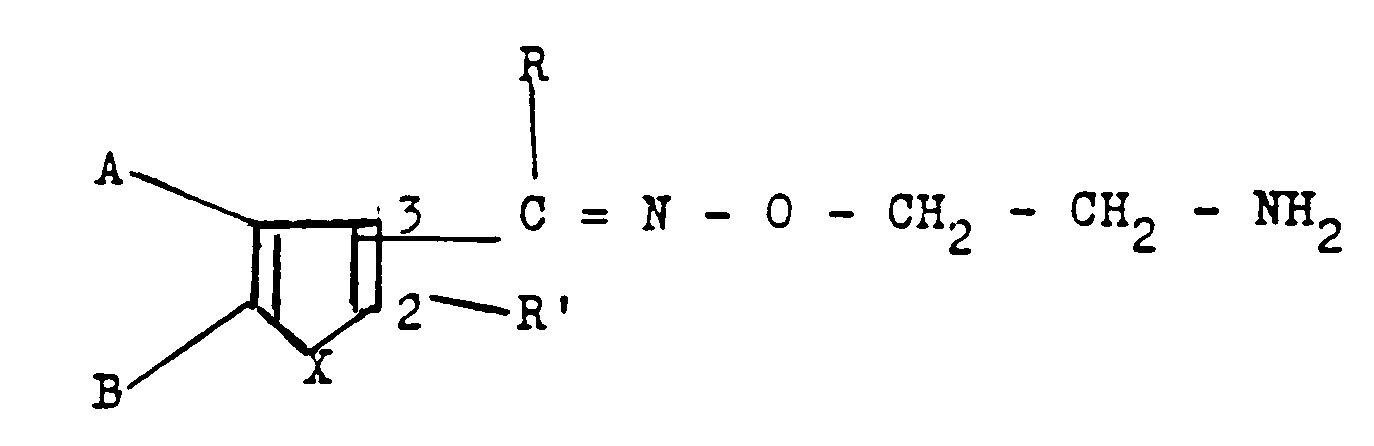
wherein A and B together form a benzenering when R¹ is H or CH₃, R is H or C₁₋₅ -alkyl and X is O, NH or S; or each of A and B represents H, CH₃ or halogen when X is S, R¹ is H, halogen or CH₃ and R is H, C₁₋₅ -alkyl, C₃₋₆ cycloalkyl, phenyl, m- or p-chlorophenyl, m,p- dichlorophenyl, thienyl-2 or 5-chlorothienyl-2; or A and B each is H, X is S, R and R¹ together form an ortho phenyl group or trimethylene group, wherein R¹ is bonded in the 2- position, or a thienylene-2,3-group, wherein R¹ is bonded in 3-position. It is stated that these compounds exhibit anti-depressive sedative and anti-convulsive activity due to their ability to inhibit monoaminoxydase. - EP-A-0017217 relates to diphenylalkanoether and diphenylalkanone oximeether derivatives having cerebral vasodilating activity and antihypoxic activity represented by the formula:

wherein R¹ and R² are each independently an aryl group optionally substituted with 1 to 3 substituents selected from the group consisting of halogen, C₁-C₄ alkyl, C₁-C₄ alkoxy, nitro, cyano, di(C₁-C₄) alkylamino, amino, benzyloxy, hydroxyl, C₁-C₄ alkylthio C₁-C₄ alkylsulfinyl, C₁-C₄ alkylsulfonyl, C₁-C₄ alkanoylamino, C₁-C₄ alkylamino and N-(C₁-C₄)alkyl-N-(C₁-C₄)alkanoylamino, Z¹ is a group of the formula:
(wherein R³ and R⁴ are each independently a hydrogen atom, a C₁-C₄ alkyl group or an ar(C₁-C₄)alkyl group or, when taken together with the adjacent nitrogen atom to which they are attached, represent a nitrogen-containing 5 to 7-membered saturated heterocyclic group optionally having an oxygen atom or an additional nitrogen atom as the hetero atom in addition to the said nitrogen atom and, if having the additional nitrogen atom, bearing a hydrogen atom, a C₁-C₄ alkyl group, an ar(C₁-C₄)alkyl group or a phenyl group thereon),
is a group of the formula:
or the formula:
A¹ is a C₂-C₆ alkylene group and A² is a C₂-C₄ alkylene group. - The present invention relates to novel O-substituted oximes in which the O-substituent contains either a derivatve of piperidine-3-carboxylic acid (nipecotic acid) or of another GABA-mimetic, cyclic amino acid moiety of the general formula II. III or IV. That is, the present invention relates to O-substituted oximes of the general formula (I)

wherein
A is
wherein R¹ and R² independently represents an aromatic moiety selected from the group consisting of furanyl, imidazolyl, oxazolyl, phenyl, pyrazolyl, pyrazinyl, pyridazinyl, pyridinyl, pyrimidinyl, pyrrolyl, thiazolyl, thienyl or 1,2,4-triazolyl, each ring optionally being substituted by one, two or three substituents selected from the group consisting of C₁-C₄-alkylamino, C₁-C₄-alkylthio, C₁-C₄-alkoxy, amino, azido, cyano, halogen, hydroxy, C₁-C₄-alkyl, nitro , mercapto and trifluoromethyl; R³ represents hydrogen or C₁-C₄-alkyl; n and m are integers from 0 to 2; R⁴ represents a cyclic amino acid moiety of general formula (II), (III) or (IV)
wherein p in formula (III) is 1 or 2; R⁵ represents hydrogen or hydroxy; R⁶ represents hydrogen, or R⁵ together with R⁶ represents an additional bond; R⁷ represents hydrogen or C₁-C₄-alkyl; R⁸ represents hydrogen or hydroxy, and X represents NH₂ or R⁹, in which R⁹ represents hydroxy or alkoxy, or the pharmaceutically acceptable acid addition salts, and, when R⁹ represents hydroxy, the pharmaceutically acceptable metal salts and the optionally substituted ammonium salts thereof. - The compounds of formula I have a greater lipophilicity - and thus a greater availability to the brain - as well as a far higher affinity to the GABA uptake sites compared to the parent amino acids, and they therefore possess interesting and useful pharmacological properties.
- It has been demonstrated that the novel compounds of the general formula I exhibit GABA re-uptake inhibitory properties and possess useful pharmacological properties on the central nervous system, i.e. that they cause a selective enhancement of GABA'ergic activity. Compounds of formula I may be used to treat, for example, pain, anxiety, epilepsy and certain muscular and movement disorders. They may also find use as sedatives and hypnotics.
- In formula I at least one of the nuclei R¹ and R² which are the same or different, and which may be optionally substituted, is preferably selected from the group consisting of furanyl, oxazolyl, phenyl, pyrazolyl, pyrazinyl, pyridazinyl, pyrimidinyl, pyrrolyl, thiazolyl, thienyl or 1,2,4-triazolyl, more preferably from the group consisting of phenyl, pyrrolyl, thiazolyl or thienyl.
- In the definition of R¹ and R² furanyl is 2-furanyl or 3-furanyl; imidazolyl is 2-imidazolyl, 4-imidazolyl or 5-imidazolyl; oxazolyl is 2-oxazolyl, 4-oxazolyl or 5-oxazolyl; pyrazolyl is 3-pyrazolyl, 4-pyrazolyl or 5-pyrazolyl; pyrazinyl is 2-pyrazinyl or 3-pyrazinyl; pyridazinyl is 3-pyridazinyl, 4-pyridazinyl, 5-pyridazinyl or 6-pyridazinyl; pyridyl is 2-pyridyl, 3-pyridyl or 4-pyridyl; pyrimidyl is 2-pyrimidyl, 4-pyrimidyl or 5-pyrimidyl; pyrrolyl is 2-pyrrolyl; thiazolyl is 2-thiazolyl, 4-thiazolyl or 5-thiazolyl; thienyl is 2-thienyl or 3-thienyl and 1,2,4-triazolyl is 1,2,4-triazol-3-yl or 1,2,4-triazol-5-yl.
- The substituents optionally chosen for the nuclei R¹ and/or R² are preferably lower alkylamino, lower alkylthio, lower alkoxy, amino, azido, cyano, halogen, hydroxy, lower alkyl or trifluoromethyl, more preferably lower alkylamino, lower alkoxy, amino, halogen or lower alkyl. The term halogen in this connection designates fluoro, chloro, bromo and iodo, preferably fluoro, chloro and bromo, and more preferred fluoro and chloro.
- Preferably R³ is hydrogen, methyl or ethyl, more preferably R³ is hydrogen.
- Preferably n and m each are 0, 1 or 2.
- Preferably n + m = 0, 1 or 2, more preferably n + m = 1.
- R⁴ preferably has a structure corresponding to formula II.
- R⁵ is preferably hydrogen or together with R⁶ represents an additional bond.
- R⁶ is hydrogen or together with R⁵ represents an additional bond.
- R⁷ is preferably hydrogen, methyl or ethyl, more preferably methyl.
- R⁸ is preferably hydrogen.
- X is preferably R⁹.
- R⁹ is hydroxy or alkoxy, preferably R⁹ is hydroxy, methoxy or ethoxy; more preferably R⁹ is hydroxy.
- In the definition of the compounds of formula I the term lower alkyl when used alone - unless otherwise indicated - designates an alkyl group with not more than 4 carbon atoms, for example methyl, ethyl, propyl, isopropyl, cyclopropyl or tert-butyl, the preferred groups being methyl, ethyl and cyclopropyl. When used in combinations like alkoxy, alkylthio and alkylamino the term "lower alkyl" similarly designates an alkyl group with not more than 4 carbon atoms, preferably methyl and ethyl, so that the preferred combinations are methoxy, ethoxy, methylthio, ethylthio, methylamino and ethylamino respectively.
- Examples of specific and preferred compounds of formula I are as follows:
(R)-Diphenylmethanone O[2-(3-carboxypiperidin-1-yl)ethyl]oxime (1)
(R)-(2-Methylphenyl)-(3-methyl-2-thienyl)methanone O[2-(3-carboxypiperidin-1-yl)ethyl]oxime hydrochloride (2)
(R)-Bis(3-methyl-2-thienyl)methanone O-[2-(3-carboxypiperidin-1-yl)ethyl]oxime hydrochloride (3)
(R)-(2-Ethylphenyl)-(3-methyl-2-thienyl)methanone O-[2-(3-carboxypiperidin-1-yl)ethyl]oxime hydrochloride (4)
(R)-(3-Methyl-2-thienyl)-(2-thienyl)methanone O-[2-(3-carboxypiperidin-1-yl)ethyl]oxime (5)
(R)-(2-Methylphenyl)-(3-methyl-2-thienyl)methanone O-[2-(3-carboxypiperidin-1-yl)ethyl]oxime hydrochloride (10)
Diphenylmethanone O-[2-(3-carboxypiperidin-1-yl)ethyl]oxime hydrochloride (25)
(2-Methylphenyl)-(3-methyl-2-thienyl)methanone O-[2-(3-carboxypiperidin-1-y1)ethyl]oxime hydrochloride (26)
Diphenylmethanone O-[2-(3-carboxy-1,2,5,6-tetrahydropyridin-1-yl)ethyl]oxime (45)
(2-Methylphenyl)phenylmethanone O-[2-(3-carboxy-1,2,5,6-tetrahydropyridin-1-yl)ethyl]oxime hydrochloride (50)
(3-Fluorophenyl)-(2-methylphenyl)methanone O-[2-(3-carboxy-1,2,5,6-tetrahydropyridin-1-yl)ethyl]oxime hydrochloride (51)
(R)-Bis(4-fluoro-2-methylphenyl)methanone O-[2-(3-carboxypiperidin-1-yl)ethyl]oxime hydrochloride (53)
(2,4-Dichlorophenyl)-(3-methyl-2-thienyl)methanone O-[2-(3-carboxy-1,2,5,6-tetrahydropyridin-1-yl)ethyl]oxime hydrochloride (58)
Bis(2-methylphenyl)methanone O-[2-(3-carboxy-1,2,5,6-tetrahydropyridin-1-yl)ethyl]oxime hydrochloride (64)
(2-Chlorophenyl)phenyl-methanone O-[2-(3-ethoxycarbonyl-1,2,5,6-tetrahydropyridin-1-yl)ethyl]oxime hydrochloride (76)
and pharmaceutically acceptable acid addition salts and metal salts and optionally alkylated ammonium salts thereof. - The compounds of formula I may exist as geometric and optical isomers and all isomers and mixtures thereof are included herein. Isomers may be separated by means of standard methods such as chromatographic techniques or fractional crystallization of salts with optically active acids or bases.
- Pharmaceutically acceptable acid addition salts of compounds of formula I include those derived from inorganic or organic acids such as hydrochloric, hydrobromic, sulfuric, phosphoric, acetic, lactic, maleic, phthalic and fumaric acid.
- The compounds having the general formula I may be prepared by the following conventional methods:

An oxime of formula V, wherein A is as defined above is reacted with a compound of formula VI, wherein R³, R⁴, n and m are as defined above, and Y is a suitable leaving group such as halogen or p-toluene-sulphonate. This reaction may be carried out in a polar, inert solvent, e.g. acetone, ethanol or N,N-dimethylformamide in the presence of a base, e.g. potassium carbonate or sodium hydride at a temperature up to reflux temperature for 1 to 72 h.
An oxime of formula V, wherein A is as defined above, is alkylated with a compound of formula VII, where Y is a suitable reactive leaving group, such as bromine or p-toluenesulphonate, and Z is chlorine (or alternatively a group such as hydroxy which may be converted into a reactive leaving group), and R³, n and m are as defined above. This reaction may be carried out in a suitable solvent, e.g. acetone, ethanol or N,N-dimethylformamide in the presence of a base, e.g. potassium carbonate or sodium hydride at a temperature up to reflux temperature for 1 to 72 h. - The product VIII of this reaction wherein A, R³, n, m and Z are as defined above, is reacted with R⁴H, wherein R⁴ is an amino acid or an amino acid derivative as specified above. This alkylation reaction may be carried out in an inert solvent, such as acetone, in the presence of a base e.g. potassium carbonate and a catalyst, e.g. an alkali metal iodide at a temperature up to reflux temperature for 1 to 96 h.

A ketone of formula IX, wherein A is as defined above, is reacted with an alkyl hydroxylamine of formula X, wherein R³, R⁴, n and m are as defined above in an inert solvent, e.g. ethanol or pyridine or a combination of solvents at a temperature up to reflux temperature for 0.5-12 h. - Under certain circumstances it may be necessary to protect e.g. the carboxy groups in the intermediates used in the above methods (e.g. R⁴H, V or VI) with suitable protecting groups. In cases where A contains an amino group, this may be protected by acylation, and in the cases where A and/or R⁴ contain a hydroxy group, this may be protected for example by acylation or by ether formation. The carboxylic acid group in R⁴ can for example be esterified. Introduction and removal of such groups is described in "Protective Groups in Organic Chemistry" J.F.W. McOrnie ed. (New York, 1973).
- If esters have been prepared in methods A-C, compounds of formula I where X is OH may be prepared by hydrolysis of the ester group, preferably at room temperature in a mixture of an aqueous alkali metal hydroxide solution and an alcohol such as methanol or ethanol, for about 0.5 to 6 h.
- Compounds of formula V may be prepared by reacting the appropriate ketone or aldehyde with hydroxylamine (or its hydrochloride) in a solvent such as ethanol or pyridine (see e.g. W.E. Bachmann, Org.Syn., (1967) 70; W.G. Honey et al., J.Pharm.Sci., 66 (1977) 1602-1606; S. Rossi et al., Farm. Ed.Sci., 24 (1969) 685-703 or P.L. Huerta et al., J.Pharm. Sci. 66 (1977) 1120-4.
- Compounds of formula VI may be prepared by reaction of the appropriate amino acid (R⁴H) protected for example as the ethyl ester with a 2-haloethanol e.g. 2-bromoethanol in the presence of a base, e.g. triethylamine or an alkali metal carbonate. The solvent may conveniently be ethanol, acetone, methyl ethyl ketone or N,N-dimethylformamide. This is followed by halogenation with a suitable halogenating agent in an inert solvent at reflux temperature for 0.5 to 24 h. The solvent may conveniently be toluene and the halogenating agent may for example be thionyl chloride.
- Compounds of formula X may be prepared by O-alkylating e.g. acetone oxime with compound VI in a suitable solvent, such as benzene, pyridine or ethanol in the presence of a base, e.g. an alkali metal carbonate at for example reflux temperature for 0.5-24 h. This is followed by hydrolysis of the product under acidic conditions for example using 10% hydrochloric acid as solvent at reflux temperature for 0.5 to 24 h (see F.J. Villiani et al., J.Pharm.Sci., 58 (1969) 138-141; G. Aichinger et al., Arznem.Forsch., 19 (1969) 838-845).
- The in vitro inhibition of [³H]-GABA uptake was assessed essentially by the method of Fjalland (Acta Pharmacol. Toxicol. 42 (1978) 73-76).
- Male Wistar rat cortical tissue was gently homogenized by hand using a glass teflon homogenizer in 10 volumes of 0.32 M sucrose. Incubation was performed in a 40 mM tris HCl buffer (pH 7.5 at 30oC) containing 120 nM NaCl, 9.2 nM KCl, 4 mM MgSO₄, 2.3 mM CaCl₂ and 10 mM glucose, for 60 min. at 30oC. Ligand concentration was 0.2 nM.
- Values for inhibition of GABA uptake for some compounds of the invention are recorded below.
- Results obtained - inhibition of [³H]-GABA uptake
Example IC₅₀ (nm) in vitro 1 82 2 44 3 30 4 52 5 64 25 138 26 58 45 48 46 59 47 51 83 217 - Compounds of formula I are useful because they possess pharmacological activity in man. In particular the compounds of formula I are useful as inhibitors of GABA uptake.
- For the above indications the dosage will vary depending on the compound of formula I employed, on the mode of administration and on the therapy desired. However, in general, satisfactory results are obtained with a dosage of from about 0.5 mg to about 1000 mg, preferably from about 1 mg to about 500 mg of compounds of formula I, conveniently given from 1 to 5 times daily, optionally in sustained release form. Usually, dosage forms suitable for oral administration comprise from about 0.5 mg to about 1000 mg, preferably from about 1 mg to about 500 mg of the compounds of formula I admixed with a pharmaceutical carrier or diluent. No toxic effects have been observed.
- The compounds of formula I may be administered in pharmaceutically acceptable acid addition salt form or where possible as a metal or a lower alkylammonium salt. Such salt forms exhibit approximately the same order of activity as the free base forms.
- This invention also relates to pharmaceutical compositions comprising a compound of formula I or a pharmaceutically acceptable salt thereof and, usually, such compositions also contain a pharmacaeutical carrier or diluent. The compositions of this invention may be prepared by conventional techniques or appear in conventional forms, for example capsules or tablets.
- The pharmaceutical carrier employed may be a conventional solid or liquid carrier. Examples of solid carriers are lactose, terra alba, sucrose, talc, gelatin, agar, pectin, acacia, magnesium stearate and stearic acid. Examples of liquid carriers are syrup, peanut oil, olive oil and water.
- Similarly, the carrier or diluent may include any time delay material known in the art, such as glyceryl monostearate or glyceryl distearate, alone or mixed with a wax.
- If a solid carrier for oral administration is used, the preparation can be tabletted, placed in a hard gelatin capsule in powder or pellet form or in the form of a troche or lozenge. The amount of solid carrier will vary widely but will usually be from about 25 mg to about 1 g. If a liquid carrier is used, the preparation may appear in the form of a syrup, emulsion, soft gelatin capsule or sterile injectable liquid such as an aqueous or non-aqueous liquid suspension.
- The pharmaceutical compositions of this invention can be made following the conventional techniques of the pharmaceutical industry involving mixing, granulating and compressing or variously mixing and dissolving the ingredients as appropriate to give the desired end product.
- The route of administration may be any route which effectively transports the active compound to the appropriate or desired place, such as oral or parenteral, the oral route being preferred.
- The features disclosed in the above specification and in the following examples and claims may, both separately and in any combination thereof, be material for realizing this invention in diverse forms thereof.
- The process for preparing compounds of formula I and preparations containing them is further illustrated in the following examples. The examples illustrate some preferred embodiments.
- Hereinafter, tlc is thin layer chromatography, THF is tetrahydrofuran, DMF is N,N-dimethylformamide, and m.p. is melting point.The structures of the compounds are confirmed by NMR and elemental analysis. Where melting points are given, these are uncorrected. All temperatures are in oC. Compounds used as starting materials are either known compounds or compounds which can readily be prepared by methods known per se. Column chromatography was carried out using the technique described by W.C. Still et al., J.Org.Chem., 43 (1978) 2923-2925 on Merck kieselgel 60 (Art. 9385) silica gel.
-

The (R)-enantiomer of ethyl nipecotate (100 g , 0.64 mol) (A.M. Akkerman et al., Rec.Trav.Chim., 70 (1951), 899; G. Bettoni et al., Gazz.Chim.Ital., 102 (1972) 189) was mixed in dry acetone (300 ml) with 2-bromoethanol (84.98 g, 0.68 mol), dried, powdered potassium carbonate (176.91 g, 1.28 mol) and potassium iodide (21.58 g, 0.13 mol). The reaction mixture was stirred at room temperature for 18 h and at reflux for 24 h. Filtration and evaporation of the filtrate gave an oil which was purified by distillation in vacuo (110-115oC, 0.1 mmHg), yield 72.17 g (56%). Tlc rf 0.20 (SiO₂; dichloromethane/methanol 19/1). - The above alcohol (19.86 g, 0.099 mol) was dissolved in toluene (125 ml). A solution of thionyl chloride (14.16 g, 0.119 mol) in toluene (50 ml) was added dropwise and the reaction mixture was stirred at room temperature for 2 h. Cooling in an icebath followed by filtration provided the (R)-N-(2-chloroethyl)nipecotic acid ethyl ester as a solid. A sample was recrystallized from 2-propanol, m.p. 187.5-194.5oC.
- To the above ester hydrochloride (2.56 g, 10 mmol), dried, powdered potassium carbonate (5.53 g, 40 mmol), acetone (200 ml) and benzophenone oxime (3.94 g, 20 mmol) was added. The suspension was heated at reflux for 96 h, cooled and filtered. The solvent was removed from the filtrate in vacuo to give a residue. Water (100 ml) and ethyl acetate (100 ml) were introduced. The aqueous layer was separated and further extracted with ethyl acetate (2 x 100 ml). The combined organic extracts were dried (MgSO₄) and evaporated to give a brown oil (6.2 g). This oil was purified by "flash" chromatography eluting with cyclohexane/ethyl acetate (5/1) to provide the (R)-diphenylmethanone O-[2-(3-ethoxycarbonylpiperidin-1-yl)ethyl]oxime (2.66 g, 70%) as a gum, tlc rf 0.067 (SiO₂, cyclohexane/ethyl acetate 5/1).
- The above ester (2.66 g, 6.99 mmol) was dissolved in ethanol (100 ml) and 10 N sodium hydroxide solution (6.99 ml) was introduced. After 2 h at room temperature the solution was cooled in an ice bath and the pH was adjusted to 3 with 4 N hydrochloric acid. Extraction with dichloromethane (3 x 50 ml), drying (MgSO₄) of the combined fractions and evaporation provided the title compound as a hydrochloride, hydrate (1.3 g, 53%) m.p. 241-242oC.
- By the above general procedure the following oxime derivatives were prepared:
-

Tlc rf 0.30 (SiO₂, dichloromethane/methanol 1/1). -

M.p. 45oC. -

M.p. 202-203oC (acetone). -

M.p. 210-216oC. -

Tlc rf 0.3 (SiO₂, dichloromethane/methanol 1/1) -

Tlc rf 0.29 (SiO₂, dichloromethane/methanol 1/1). -

M.p. 221.5-225oC. -

Tlc, rf 0.31 (SiO₂, dichloromethane/methanol 1/1). -

Tlc, rf 0.32 (SiO₂, dichloromethane/methanol 1/1). -

Tlc, rf 0.90 (reversed phase, Whatman KCl 8F, methanol/water 4/1). -

Tlc, rf 0.90 (reversed phase, Whatman KCl 8F, methanol/water 4/1). -

Tlc, rf 0.20 (SiO₂, methanol). -

Tlc, rf 0.35 (SiO₂, cyclohexane/ethylacetate 1/1). -
Tlc, rf 0.14 (SiO₂, dichloromethane/methanol 1/1). -

Tlc, rf 0.38 (SiO₂, dichloromethane/methanol 1/1). -

Tlc, rf 0.30 (SiO₂, dichloromethane/methanol 1/1). -

Tlc, rf 0.52 (SiO₂, dichloromethane/methanol 1/1). -

Mp 180-185oC. -

Mp 185-190oC. -

Mp 230-232oC. -

Mp 124-125.5oC. -

Mp 170-175oC. -

Tlc, rf. 0.49 (SiO₂, dichloromethane/methanol 1/1). - Using (R,S)-N-(2-chloroethyl)nipecotic acid ethyl ester as a starting material the following (R,S)-enantiomeric mixtures were prepared (according to method A, Example 1):
-

M.p. 234-235oC. -

Tlc rf. 0.30 (SiO₂, dichloromethane/methanol 1/1). -

Tlc rf 0.07 (SiO₂; methanol/dichloromethane 1/1). -

M.p. 61-63oC. -

M.p. 172.5-176oC. -

Tlc rf 0.25 (SiO₂, dichloromethane/methanol 1/1). -

Tlc, rf. 0.30 (SiO₂, methanol). -

Tlc, rf. 0.35 (SiO₂, dichloromethane/methanol 1/1). -

Tlc, rf. 0.35 (SiO₂, dichloromethane/methanol 1/1). -

Tlc, rf. 0.33 (SiO₂, dichloromethane/methanol 1/1). -

Tlc, rf. 0.30 (SiO₂, methanol). -

Tlc, rf. 0.30 (SiO₂, methanol). -

Mp 215-220oC (not recrystallised). -

Tlc, rf. 0.31 (SiO₂, dichloromethane/methanol 1/1). -

Tlc, rf. 0.30 (SiO₂, dichloromethane/methanol 1/1). -

Tlc, rf. 0.57 (SiO₂, dichloromethane/methanol 1/1). -

Mp 174-176oC. -

Mp 209-211oC. -

Tlc, rf. 0.40 (SiO₂, methanol). -

Tlc, rf. 0.52 (reversed phase, Whatman KCl 8F, methanol/water 4/1). -

Benzophenone oxime (3.94 g, 20 mmol), 1-bromo-2-chloroethane (28.7 g, 200 mmol) and dried, powdered potassium carbonate (5.53 g, 80 mmol) in acetone (60 ml) were heated at reflux for 72 h. The reaction mixture was cooled and filtered and the filtrate was evaporated to an oily residue which was purified by "flash" chromatography (eluting with heptane/ethyl acetate 19/1) to provide diphenylmethanone O-(2-chloroethyl)oxime (3.82 g, 73%) as an oil, tlc rf 0.36 (SiO₂, heptane/ethyl acetate 9/1). - The above chloroethyloxime (1.309 g, 5 mmol) was dissolved in acetone (25 ml) and guvacine methyl ester hydrochloride (1.776 g, 1o mmol) powdered, dried potassium carbonate (2.073 g, 15 mmol) and potassium iodide (0.75 g, 5 mmol) were introduced. The reaction mixture was heated at reflux for 18 h and cooled. Filtration and evaporation of the filtrate provided an oil which was purified by flash chromatography on silica gel, eluting with cyclohexane/ethyl acetate (2/1) to provide diphenylmethanone O-[2-(3-methoxycarbonyl-1,2,5,6-tetrahydropyridin-1-yl)ethyl]oxime (0.87 g, 48%) as a gum, tlc rf 0.30 (SiO₂, heptane/ethyl acetate 1/1). Starting diphenylmethanone, O-(2-haloethyl)oxime (0.66 g, 50%) was also isolated.
- The above methyl ester (0.81 g, 2.39 mmol) was dissolved in ethanol (25 ml) and 10 N sodium hydroxide solution (2.39 ml) was added. The solution was stirred at room temperature for 4 h and acidified to pH 2 with 2 N hydrochloric acid. The liquid was extracted with dichloromethane (3 x 50 ml) and the combined organic extracts were dried (MgSO₄). Evaporation of the solvent gave a gum which was freeze-dried to give the title compound (0.825 g, 89%) as a hemi hydrochloride. Tlc rf 0.40 (SiO₂, dichloromethane/methanol 1/1). Found: C, 65.6; H, 6.3; N, 7.05; Cl, 4.9. C₂₁H₂₂N₂O₃. 1/2HCl.H₂O requires C, 65.2; H, 6.4; N, 7.2; Cl, 4.6%.
- By the above general procedure (Example 45, Method B) the following oxime derivatives were prepared:
-

M.p. 79-80oC. -

M.p. 168-169oC. -

Tlc rf 0.30 (SiO₂, dichloromethane/methanol 1/1). -

Tlc rf 0.8 (reversed phase, Whatman KCl8F, methanol/water (4/1). -

Tlc, rf. 0.49 (SiO₂, dichloromethane/methanol 1/1). -

M.p. 219-223oC. -

M.p. 102-103oC. -

M.p. 181-182oC. -

M.p. 116-117oC. -

M.p. 204-207oC. -

M.p. 157-159oC. -

M.p. 241-244oC. -

Tlc, rf. 0.76 (reversed phase, Whatman KCl 8F, methanol/water 4/1). -

M.p. 152-155oC. -

M.p. 205-207oC. -

M.p. 156-158oC. -

M.p. 195-200oC. -

Tlc, rf. 0.35 (SiO₂, cyclohexane/ethylacetate 1/1). -

M.p. 214-218.5oC. -

Tlc, rf. 0.39 (SiO₂, dichloromethane/methanol 1/1). -

Tlc, rf. 0.41 (SiO₂, dichloromethane/methanol 9/1). -

Tlc, rf. 0.45 (SiO₂, dichloromethane/methanol 1/1). -

M.p. 198.5-200oC. -

Tlc, rf. 0.63 (SiO₂, dichloromethane/methanol 1/1). -

M.p. 223oC (dec). -

M.p. 140-145oC. -

M.p. 190-195oC. -

M.p. 205-213oC. -

M.p. 110-116oC (toluene/cyclohexane). -

M.p. 195-196oC (dec). -

Tlc, rf. 0.25 (SiO₂, cyclohexane/ethylacetate 1/1). -

M.p. 163-164.5oC (toluene/cyclohexane). -

M.p. 213-216oC. -

M.p. 165-169oC. -

M.p. 258-260oC. -

M.p. 130-135oC. -

(R,S)-ethyl nipecotate (15.72 g, 100 mmol) was mixed in dry acetone (120 ml) with 3-bromo-1-propanol (20.85 g, 150 mmol) and dried, powdered potassium carbonate (20.73 g, 150 mmol). The reaction mixture was heated at reflux for 3 h, cooled and filtered. The filtrate was evaporated to an oil (32.8 g) which was dissolved in dichloromethane. To this solution phosphorous tribromide (30.45 g, 112.5 mmol) was introduced dropwise maintaining reflux during addition, and when this was complete reflux was continued for 2.5 h. After cooling dry methanol (30 ml) was added and the mixture was poured into a mixture of saturated sodium bicarbonate solution (250 ml) and water (250 ml). The dichloromethane layer was separated and the aqueous layer was extracted with ethyl acetate (2 x 150 ml). The combined organic extracts were dried (MgSO₄) and evaporated to an oil which was purified by "flash" chromatography. Elution with cyclohexane/tetrahydrofuran 3/1 provided N-(3-bromopropyl)nipecotic acid ethyl ester (7.85 g, 28%) as a waxy solid. Found C, 47.3; H, 7.9; N, 4.7. C₁₁H₂₀BrNO₂.0.2 H₂O required C, 46.9; H, 7.2; N, 4.95%. - This compound was used to alkylate benzophenone oxime, as outlined in Example 1, and the subsequent ester was hydrolysed to provide the title compound as a gummy solid (0.5 g, 52% from N-(3-bromopropyl)nipecotic acid ethyl ester). Tlc rf 0.70 (reversed phase, Whatman KC 18F, methanol/water 8/2).
- Using (R)-N-(2-bromoethyl)nipecotic acid ethyl ester hydrobromide and an 2,2-diarylacetaldehyde oxime as starting materials the following compounds were prepared (according to method A, Example 1).
-

rf. 0.34 (SiO₂, dichloromethane/methanol 1/1) -

rf. 0.40 (SiO₂, dichloromethane/methanol 1/1). -

M.p. 190-200oC. -
Preparation of Capsules Ingredients mg per capsule (R)-diphenylmethanone O-[2-(3-carboxypiperidin-1-yl)ethyl]oxime 10 Magnesium stearate 0.15 Lactose 15 - The above ingredients are thoroughly mixed and placed in hard gelatin capsules. Such capsules are administered orally to subjects in need of treatment from 1-5 times daily.
-
Preparation of Tablets Ingredients mg per tablet (R)-diphenylmethanone O-[2-(3-carboxypiperidin-1-yl)ethyl]oxime 200 Corn starch 50 Polyvinyl pyrrolidine 15 Magnesium stearate 1 - The oxime is thoroughly mixed with two thirds of the corn starch and granulated. The granules obtained are dried, mixed with the remaining ingredients and compressed into tablets.
- The capsules or tablets thus prepared are administered orally. Similarly, other oximes of formula I can be used.
Claims (20)
- O-substituted oximes of the general formula (I)

A is

- The compounds according to claim 1, wherein R¹ and R² independently are furanyl, oxazolyl, phenyl, pyrazolyl, pyrazinyl, pyridazinyl, pyrimidinyl, pyrrolyl, thiazolyl, thienyl or 1,2,4-triazolyl, each ring optionally being substituted with one, two or three substituents selected from the group consisting of C₁-C₄-alkylamino, C₁-C₄-alkylthio, C₁-C₄-alkoxy, amino, azido, cyano, fluoro, chloro, bromo, iodo, hydroxy or C₁-C₄-alkyl.
- The compounds according to claim 1 or claim 2, wherein R³ represents hydrogen, methyl or ethyl.
- The compounds according to any of the preceding claims, wherein n is 0, 1 or 2.
- The compounds according to any of the preceding claims, wherein m is 0, 1 or 2.
- The compounds according to any of the preceding claims, wherein R⁴ is a group of the general formula (II)

- The compounds according to claim 6, wherein R⁹ is hydroxy.
- The compounds according to any of claims 1 to 5, wherein R⁴ is a group of the general formula (III)

- The compounds according to claim 8, wherein R⁷ is hydrogen and R⁹ is hydroxy.
- The compounds according to any of claims 1 to 5, wherein R⁴ is a group of the general formula (IV)

- The compounds according to claim 10, wherein R⁹ is hydroxy.
- A method for preparing O-substituted oximes of the general formula (I) according to claim 1, which comprises reacting an oxime of formula (V)

Y(CH₂)nCH(R³)(CH₂)mR⁴ (VI)
wherein R³, R⁴, n and m are as defined in claim 1, and Y is a leaving group. - The method according to claim 12, wherein the reaction is carried out in a polar, inert solvent, in the presence of a base at a temperature up to reflux temperature for 1 to 72 h.
- A method for preparing O-substituted oximes of the general formula (I) according to claim 1, which comprises alkylating an oxime of formula (V)

Y(CH₂)nCH(R³)(CH₂)mZ (VII)
wherein Y is a leaving group, Z is chlorine or a group which may be converted into a leaving group and R³, n and m are as defined in claim 1, to obtain a product of formula (VIII)
R⁴H
wherein R⁴ is as defined in claim 1. - The method according to claim 14, wherein the alkylation reaction with the compound of formula (VII) is carried out in a solvent in the presence of a base at a temperature up to reflux temperature for 1 to 72 h.
- The method according to claims 14 and 15, wherein the alkylation reaction with R⁴H is carried out in an inert solvent in the presence of a base and a catalyst at a temperature up to reflux temperature for 1 to 96 h.
- A method for preparing O-substituted oximes of the general formula (I) according to claim 1, which comprises reacting a ketone of formula (IX)

wherein A is as defined in claim 1, with an alkyl hydroxylamine of formula (X)
- A pharmaceutical composition comprising at least one compound according to claims 1 to 11 and a pharmaceutical carrier or diluent.
- The pharmaceutical composition according to claim 18 containing from 1 mg to 500 mg of a compound according to claims 1 to 11 per unit dose.
- The use of a compound according to claims 1 to 11 for preparing a medicament for the treatment of anxiety, pain and epilepsy as well as muscular and movement disorders.
Applications Claiming Priority (2)
| Application Number | Priority Date | Filing Date | Title |
|---|---|---|---|
| DK2704/88 | 1988-05-18 | ||
| DK270488A DK270488D0 (en) | 1988-05-18 | 1988-05-18 | Hitherto unknown O-SUBSTITUTED KETOXIMES |
Publications (2)
| Publication Number | Publication Date |
|---|---|
| EP0342635A1 EP0342635A1 (en) | 1989-11-23 |
| EP0342635B1 true EP0342635B1 (en) | 1994-08-17 |
Family
ID=8114842
Family Applications (1)
| Application Number | Title | Priority Date | Filing Date |
|---|---|---|---|
| EP89108850A Expired - Lifetime EP0342635B1 (en) | 1988-05-18 | 1989-05-17 | Azacyclic carboxylic acid derivatives, their preparation and use |
Country Status (18)
| Country | Link |
|---|---|
| US (1) | US5039685A (en) |
| EP (1) | EP0342635B1 (en) |
| JP (1) | JP2824661B2 (en) |
| KR (1) | KR900018058A (en) |
| AT (1) | ATE110064T1 (en) |
| AU (1) | AU622178B2 (en) |
| CA (1) | CA1337123C (en) |
| DE (1) | DE68917517T2 (en) |
| DK (1) | DK270488D0 (en) |
| ES (1) | ES2058383T3 (en) |
| FI (1) | FI93955C (en) |
| IE (1) | IE66016B1 (en) |
| IL (1) | IL90313A0 (en) |
| NO (1) | NO177262C (en) |
| NZ (1) | NZ229136A (en) |
| PH (1) | PH26373A (en) |
| PT (1) | PT90607B (en) |
| ZA (1) | ZA893733B (en) |
Families Citing this family (11)
| Publication number | Priority date | Publication date | Assignee | Title |
|---|---|---|---|---|
| DK704488D0 (en) * | 1988-12-19 | 1988-12-19 | Novo Industri As | NEW N-SUBSTITUTED AZAHETEROCYCLIC CARBOXYLIC ACIDS |
| JP2765876B2 (en) * | 1988-10-24 | 1998-06-18 | 科研製薬株式会社 | Pyridyl ketoxime ether derivatives |
| DK93791D0 (en) * | 1991-05-17 | 1991-05-17 | Novo Nordisk As | NEW HETEROCYCLIC CARBOXYLIC ACIDS |
| EP0767174A1 (en) * | 1991-11-21 | 1997-04-09 | Ciba-Geigy Ag | Novel aminoalkanephosphinic acids and their salts |
| TW266206B (en) * | 1993-04-28 | 1995-12-21 | Takeda Pharm Industry Co Ltd | |
| DK74393D0 (en) * | 1993-06-23 | 1993-06-23 | Novo Nordisk As | NOVEL HETEROCYCLIC CHEMISTRY |
| DK74493D0 (en) * | 1993-06-23 | 1993-06-23 | Novo Nordisk As | NOVEL HETEROCYCLIC CHEMISTRY |
| US5962449A (en) | 1995-04-07 | 1999-10-05 | Novo Nordisk A/S | Tricyclic compounds in treating hyperalgesic conditions and NIDDM |
| DE69701298T2 (en) * | 1996-04-15 | 2000-10-05 | Takeda Chemical Industries, Ltd. | Hydroxypyridine derivatives, their preparation and their pharmaceutical use |
| WO1997049403A1 (en) * | 1996-06-27 | 1997-12-31 | University College Dublin | Use of nipecotic acid or guvacine derivatives for the manufacture of a medicament for the treatment of postischemic neurodegenerative disorders |
| CA2361924A1 (en) * | 1999-01-12 | 2000-07-20 | Izumi Kamo | Compositions for treating frequent urination and urinary incontinence |
Family Cites Families (12)
| Publication number | Priority date | Publication date | Assignee | Title |
|---|---|---|---|---|
| US4235931A (en) * | 1967-04-05 | 1980-11-25 | Duphar International Research B.V. | Compounds having pharmacological properties |
| FR2162312B1 (en) * | 1971-12-10 | 1975-02-07 | Buzas Andre | |
| FR2248033B1 (en) | 1973-10-19 | 1977-03-11 | Cerpha | |
| US4207319A (en) * | 1973-10-19 | 1980-06-10 | Albert Rolland S.A. | Thienyl or furyl phenyl O-hetero amino alkyl oximes and use thereof |
| US4148911A (en) * | 1977-07-08 | 1979-04-10 | Societe Anonyme Dite Albert Rolland S.A. | Method of treating respiratory disorders |
| DE2851387A1 (en) * | 1977-11-28 | 1979-06-07 | Degussa | O-aminoalkyl thienyl ketone oxime derivs. - improve peripheral and cerebral blood flow and have analgesic activity |
| JPS5626863A (en) * | 1979-08-13 | 1981-03-16 | Sumitomo Chem Co Ltd | Novel diphenylalkanone oxime derivative |
| AU532700B2 (en) * | 1979-04-02 | 1983-10-13 | Sumitomo Chemical Company, Limited | Diphenylalkanoether |
| US4722930A (en) * | 1980-03-01 | 1988-02-02 | John Wyeth And Brother Limited | 3-benzoyl-1-[(oxo or thioheteroaryl-ylalkyl)-piperid-4-yl]ureas and derivatives |
| US4514414A (en) * | 1982-10-25 | 1985-04-30 | Smithkline Beckman Corporation | N-Substituted pyrrolidineacetic acids and their esters |
| FI864246A7 (en) * | 1985-11-08 | 1987-05-09 | Warner Lambert Co | N-SUBSTITUERADE 3-PIPERIDINE- ELLER 3-PYRIDINE CARBOXYLSYROR SAMT DERAS DERIVATS. |
| NO170976C (en) * | 1986-01-07 | 1993-01-06 | Novo Nordisk As | ANALOGY PROCEDURE FOR THE PREPARATION OF THERAPEUTIC ACTIVE PHENYLBUTEN ACID DERIVATIVES |
-
1988
- 1988-05-18 DK DK270488A patent/DK270488D0/en not_active Application Discontinuation
-
1989
- 1989-05-05 PH PH38628A patent/PH26373A/en unknown
- 1989-05-10 US US07/350,151 patent/US5039685A/en not_active Expired - Fee Related
- 1989-05-11 IE IE153389A patent/IE66016B1/en not_active IP Right Cessation
- 1989-05-16 NO NO891970A patent/NO177262C/en not_active IP Right Cessation
- 1989-05-16 IL IL90313A patent/IL90313A0/en not_active IP Right Cessation
- 1989-05-16 NZ NZ229136A patent/NZ229136A/en unknown
- 1989-05-16 AU AU34845/89A patent/AU622178B2/en not_active Ceased
- 1989-05-17 EP EP89108850A patent/EP0342635B1/en not_active Expired - Lifetime
- 1989-05-17 AT AT89108850T patent/ATE110064T1/en not_active IP Right Cessation
- 1989-05-17 CA CA000599974A patent/CA1337123C/en not_active Expired - Fee Related
- 1989-05-17 ES ES89108850T patent/ES2058383T3/en not_active Expired - Lifetime
- 1989-05-17 DE DE68917517T patent/DE68917517T2/en not_active Expired - Fee Related
- 1989-05-18 PT PT90607A patent/PT90607B/en not_active IP Right Cessation
- 1989-05-18 KR KR1019890006609A patent/KR900018058A/en not_active Withdrawn
- 1989-05-18 JP JP1123007A patent/JP2824661B2/en not_active Expired - Lifetime
- 1989-05-18 ZA ZA893733A patent/ZA893733B/en unknown
- 1989-05-18 FI FI892388A patent/FI93955C/en not_active IP Right Cessation
Non-Patent Citations (1)
| Title |
|---|
| CHEMICAL ABSTRACTS vol.,77, no. 21, 20 November 1972, page 400, abstract no. 139518h, Columbus, Ohio, USA; A. BUZAS et al.: "Synthesis and pharmacological properties of oxime esters and ethers. 3. New m-(trifluoromethyl)benzyl methyl ketone derivatives" & Chim. Ther, 1972, vol. 7, no. 2, pages 140-142. * |
Also Published As
| Publication number | Publication date |
|---|---|
| KR900018058A (en) | 1990-12-20 |
| AU622178B2 (en) | 1992-04-02 |
| JP2824661B2 (en) | 1998-11-11 |
| NZ229136A (en) | 1992-01-29 |
| FI892388A7 (en) | 1989-11-19 |
| FI93955C (en) | 1995-06-26 |
| DE68917517T2 (en) | 1994-12-15 |
| NO891970L (en) | 1989-11-20 |
| ZA893733B (en) | 1990-02-28 |
| AU3484589A (en) | 1989-11-23 |
| FI892388A0 (en) | 1989-05-18 |
| FI93955B (en) | 1995-03-15 |
| EP0342635A1 (en) | 1989-11-23 |
| NO177262B (en) | 1995-05-08 |
| IE891533L (en) | 1989-11-18 |
| US5039685A (en) | 1991-08-13 |
| PH26373A (en) | 1992-06-01 |
| ES2058383T3 (en) | 1994-11-01 |
| NO891970D0 (en) | 1989-05-16 |
| PT90607B (en) | 1995-03-01 |
| IL90313A0 (en) | 1989-12-15 |
| NO177262C (en) | 1995-08-16 |
| CA1337123C (en) | 1995-09-26 |
| IE66016B1 (en) | 1995-11-29 |
| JPH0217158A (en) | 1990-01-22 |
| PT90607A (en) | 1989-11-30 |
| DK270488D0 (en) | 1988-05-18 |
| DE68917517D1 (en) | 1994-09-22 |
| ATE110064T1 (en) | 1994-09-15 |
Similar Documents
| Publication | Publication Date | Title |
|---|---|---|
| KR100360633B1 (en) | 6-Phenylpyridyl-2-amine Derivatives Useful as NOS Inhibitors | |
| EP0946546B1 (en) | Pyridin-2-yl-methylamine derivatives, method of preparing and application as medicine | |
| EP1131290B1 (en) | Piperidine ccr-3 receptor antagonists | |
| FR2785902A1 (en) | 4-AROYLPIPERIDINES ANTAGONISTS OF THE CCR-3 RECEPTOR, PHARMACEUTICAL COMPOSITIONS CONTAINING THEM, METHOD FOR USING AND PREPARING THEM | |
| SK277923B6 (en) | 3-imidazolymethyl-1,2,3,9-tetrahydro-4h-carbazole-4-on derivatives, method of their preparation and pharmaceutical agents containing this agents | |
| EP0342635B1 (en) | Azacyclic carboxylic acid derivatives, their preparation and use | |
| EP0374801A2 (en) | Novel N-sustituted azaheterocyclic carboxylic acids | |
| US5231106A (en) | Azacyclic carboxylic acid derivatives and their preparation and use | |
| IE862636L (en) | Diphenyl piperidines | |
| JPH05194359A (en) | New urea derivative, and its preparation and therapeutical use | |
| US5834482A (en) | Heterocyclic chemistry | |
| EP0144853A2 (en) | Semicarbazide derivatives, processes for preparation thereof and pharmaceutical composition comprising the same | |
| US5789425A (en) | Imidazolidinone derivatives, their acid adducts and therapeutic drugs for senile dementia | |
| US5229404A (en) | Azacyclic carboxylic acid derivatives and their preparation and use | |
| US5214054A (en) | Azacyclic carboxylic acid derivatives and their preparation and use | |
| EP0502031B1 (en) | N-substituted azaheterocyclic carboxylic acids and a pharmaceutical composition | |
| EP1383761B1 (en) | Phenyl- and pyridyl-piperidines with tnf activity | |
| CA2117075A1 (en) | Quinazoline derivatives and their preparation | |
| JPS6212757A (en) | Cinnamic acid amide derivative | |
| JPS63101382A (en) | Imidazo(4,5 b)pyridine-2-one derivative, manufacture and application of same to drug | |
| EP0378357B1 (en) | Anti-inflammatory 1-heteroaryloxindole-3-carboxamides | |
| JPH0525140A (en) | Benzimidazole derivative | |
| JPS62267269A (en) | Pyrazole-3-amines | |
| DK165292B (en) | 3-Piperidinecarboxylic acids and 3- tetrahydropyridinecarboxylic acids which are N- substituted by alkyl ethers of oximes, and pharmaceutical preparations which comprise the compounds | |
| JP2002234874A (en) | 5-Phenylbenzylamine derivative, its production method and its synthetic intermediate |
Legal Events
| Date | Code | Title | Description |
|---|---|---|---|
| PUAI | Public reference made under article 153(3) epc to a published international application that has entered the european phase |
Free format text: ORIGINAL CODE: 0009012 |
|
| AK | Designated contracting states |
Kind code of ref document: A1 Designated state(s): AT BE CH DE ES FR GB GR IT LI LU NL SE |
|
| 17P | Request for examination filed |
Effective date: 19900213 |
|
| RAP1 | Party data changed (applicant data changed or rights of an application transferred) |
Owner name: NOVO-NORDISK A/S |
|
| RAP1 | Party data changed (applicant data changed or rights of an application transferred) |
Owner name: NOVO NORDISK A/S |
|
| 17Q | First examination report despatched |
Effective date: 19920217 |
|
| GRAA | (expected) grant |
Free format text: ORIGINAL CODE: 0009210 |
|
| AK | Designated contracting states |
Kind code of ref document: B1 Designated state(s): AT BE CH DE ES FR GB GR IT LI LU NL SE |
|
| REF | Corresponds to: |
Ref document number: 110064 Country of ref document: AT Date of ref document: 19940915 Kind code of ref document: T |
|
| REF | Corresponds to: |
Ref document number: 68917517 Country of ref document: DE Date of ref document: 19940922 |
|
| ITF | It: translation for a ep patent filed | ||
| REG | Reference to a national code |
Ref country code: ES Ref legal event code: FG2A Ref document number: 2058383 Country of ref document: ES Kind code of ref document: T3 |
|
| ET | Fr: translation filed | ||
| EAL | Se: european patent in force in sweden |
Ref document number: 89108850.2 |
|
| REG | Reference to a national code |
Ref country code: GR Ref legal event code: FG4A Free format text: 3013910 |
|
| PLBE | No opposition filed within time limit |
Free format text: ORIGINAL CODE: 0009261 |
|
| STAA | Information on the status of an ep patent application or granted ep patent |
Free format text: STATUS: NO OPPOSITION FILED WITHIN TIME LIMIT |
|
| 26N | No opposition filed | ||
| PGFP | Annual fee paid to national office [announced via postgrant information from national office to epo] |
Ref country code: GB Payment date: 19990428 Year of fee payment: 11 |
|
| PGFP | Annual fee paid to national office [announced via postgrant information from national office to epo] |
Ref country code: GR Payment date: 19990430 Year of fee payment: 11 |
|
| PGFP | Annual fee paid to national office [announced via postgrant information from national office to epo] |
Ref country code: ES Payment date: 19990511 Year of fee payment: 11 |
|
| PGFP | Annual fee paid to national office [announced via postgrant information from national office to epo] |
Ref country code: FR Payment date: 19990518 Year of fee payment: 11 |
|
| PGFP | Annual fee paid to national office [announced via postgrant information from national office to epo] |
Ref country code: LU Payment date: 19990520 Year of fee payment: 11 |
|
| PGFP | Annual fee paid to national office [announced via postgrant information from national office to epo] |
Ref country code: BE Payment date: 19990526 Year of fee payment: 11 Ref country code: AT Payment date: 19990526 Year of fee payment: 11 |
|
| PGFP | Annual fee paid to national office [announced via postgrant information from national office to epo] |
Ref country code: SE Payment date: 19990527 Year of fee payment: 11 |
|
| PGFP | Annual fee paid to national office [announced via postgrant information from national office to epo] |
Ref country code: NL Payment date: 19990531 Year of fee payment: 11 |
|
| PGFP | Annual fee paid to national office [announced via postgrant information from national office to epo] |
Ref country code: CH Payment date: 19990616 Year of fee payment: 11 |
|
| PGFP | Annual fee paid to national office [announced via postgrant information from national office to epo] |
Ref country code: DE Payment date: 19990629 Year of fee payment: 11 |
|
| PG25 | Lapsed in a contracting state [announced via postgrant information from national office to epo] |
Ref country code: LU Free format text: LAPSE BECAUSE OF NON-PAYMENT OF DUE FEES Effective date: 20000517 Ref country code: GB Free format text: LAPSE BECAUSE OF NON-PAYMENT OF DUE FEES Effective date: 20000517 Ref country code: AT Free format text: LAPSE BECAUSE OF NON-PAYMENT OF DUE FEES Effective date: 20000517 |
|
| PG25 | Lapsed in a contracting state [announced via postgrant information from national office to epo] |
Ref country code: SE Free format text: LAPSE BECAUSE OF NON-PAYMENT OF DUE FEES Effective date: 20000518 Ref country code: ES Free format text: THE PATENT HAS BEEN ANNULLED BY A DECISION OF A NATIONAL AUTHORITY Effective date: 20000518 |
|
| PG25 | Lapsed in a contracting state [announced via postgrant information from national office to epo] |
Ref country code: LI Free format text: LAPSE BECAUSE OF NON-PAYMENT OF DUE FEES Effective date: 20000531 Ref country code: GR Free format text: LAPSE BECAUSE OF NON-PAYMENT OF DUE FEES Effective date: 20000531 Ref country code: CH Free format text: LAPSE BECAUSE OF NON-PAYMENT OF DUE FEES Effective date: 20000531 Ref country code: BE Free format text: LAPSE BECAUSE OF NON-PAYMENT OF DUE FEES Effective date: 20000531 |
|
| BERE | Be: lapsed |
Owner name: NOVO NORDISK A/S Effective date: 20000531 |
|
| PG25 | Lapsed in a contracting state [announced via postgrant information from national office to epo] |
Ref country code: NL Free format text: LAPSE BECAUSE OF NON-PAYMENT OF DUE FEES Effective date: 20001201 |
|
| GBPC | Gb: european patent ceased through non-payment of renewal fee |
Effective date: 20000517 |
|
| REG | Reference to a national code |
Ref country code: CH Ref legal event code: PL |
|
| EUG | Se: european patent has lapsed |
Ref document number: 89108850.2 |
|
| PG25 | Lapsed in a contracting state [announced via postgrant information from national office to epo] |
Ref country code: FR Free format text: LAPSE BECAUSE OF NON-PAYMENT OF DUE FEES Effective date: 20010131 |
|
| NLV4 | Nl: lapsed or anulled due to non-payment of the annual fee |
Effective date: 20001201 |
|
| PG25 | Lapsed in a contracting state [announced via postgrant information from national office to epo] |
Ref country code: DE Free format text: LAPSE BECAUSE OF NON-PAYMENT OF DUE FEES Effective date: 20010301 |
|
| REG | Reference to a national code |
Ref country code: FR Ref legal event code: ST |
|
| REG | Reference to a national code |
Ref country code: ES Ref legal event code: FD2A Effective date: 20020204 |
|
| PG25 | Lapsed in a contracting state [announced via postgrant information from national office to epo] |
Ref country code: IT Free format text: LAPSE BECAUSE OF NON-PAYMENT OF DUE FEES Effective date: 20050517 |