EP0342411A2 - Moulding and sealant composition - Google Patents
Moulding and sealant composition Download PDFInfo
- Publication number
- EP0342411A2 EP0342411A2 EP89107718A EP89107718A EP0342411A2 EP 0342411 A2 EP0342411 A2 EP 0342411A2 EP 89107718 A EP89107718 A EP 89107718A EP 89107718 A EP89107718 A EP 89107718A EP 0342411 A2 EP0342411 A2 EP 0342411A2
- Authority
- EP
- European Patent Office
- Prior art keywords
- dibutyltin
- composition according
- stabilizer
- isocyanate
- organometallic tin
- Prior art date
- Legal status (The legal status is an assumption and is not a legal conclusion. Google has not performed a legal analysis and makes no representation as to the accuracy of the status listed.)
- Granted
Links
- 238000000465 moulding Methods 0.000 title claims abstract description 7
- 239000000203 mixture Substances 0.000 title claims description 21
- 239000000565 sealant Substances 0.000 title description 11
- -1 organometallic tin compounds Chemical class 0.000 claims abstract description 17
- 150000001875 compounds Chemical class 0.000 claims abstract description 8
- 238000007789 sealing Methods 0.000 claims abstract description 7
- 239000011256 inorganic filler Substances 0.000 claims abstract description 6
- 229910003475 inorganic filler Inorganic materials 0.000 claims abstract description 6
- 239000012948 isocyanate Substances 0.000 claims abstract description 6
- 150000002513 isocyanates Chemical class 0.000 claims abstract description 6
- 239000003381 stabilizer Substances 0.000 claims abstract description 6
- 239000003054 catalyst Substances 0.000 claims abstract description 5
- 150000001732 carboxylic acid derivatives Chemical class 0.000 claims abstract description 3
- 125000001424 substituent group Chemical group 0.000 claims abstract description 3
- 125000001181 organosilyl group Chemical group [SiH3]* 0.000 claims abstract 2
- MQIUGAXCHLFZKX-UHFFFAOYSA-N Di-n-octyl phthalate Natural products CCCCCCCCOC(=O)C1=CC=CC=C1C(=O)OCCCCCCCC MQIUGAXCHLFZKX-UHFFFAOYSA-N 0.000 claims description 9
- BJQHLKABXJIVAM-UHFFFAOYSA-N bis(2-ethylhexyl) phthalate Chemical compound CCCCC(CC)COC(=O)C1=CC=CC=C1C(=O)OCC(CC)CCCC BJQHLKABXJIVAM-UHFFFAOYSA-N 0.000 claims description 9
- AYOHIQLKSOJJQH-UHFFFAOYSA-N dibutyltin Chemical compound CCCC[Sn]CCCC AYOHIQLKSOJJQH-UHFFFAOYSA-N 0.000 claims description 7
- VYPSYNLAJGMNEJ-UHFFFAOYSA-N Silicium dioxide Chemical compound O=[Si]=O VYPSYNLAJGMNEJ-UHFFFAOYSA-N 0.000 claims description 6
- VLJQDHDVZJXNQL-UHFFFAOYSA-N 4-methyl-n-(oxomethylidene)benzenesulfonamide Chemical compound CC1=CC=C(S(=O)(=O)N=C=O)C=C1 VLJQDHDVZJXNQL-UHFFFAOYSA-N 0.000 claims description 4
- 239000007795 chemical reaction product Substances 0.000 claims description 3
- JGFBRKRYDCGYKD-UHFFFAOYSA-N dibutyl(oxo)tin Chemical compound CCCC[Sn](=O)CCCC JGFBRKRYDCGYKD-UHFFFAOYSA-N 0.000 claims description 3
- 239000000377 silicon dioxide Substances 0.000 claims description 3
- JJLKTTCRRLHVGL-UHFFFAOYSA-L [acetyloxy(dibutyl)stannyl] acetate Chemical compound CC([O-])=O.CC([O-])=O.CCCC[Sn+2]CCCC JJLKTTCRRLHVGL-UHFFFAOYSA-L 0.000 claims description 2
- 239000000470 constituent Substances 0.000 claims description 2
- 238000000034 method Methods 0.000 claims 1
- 239000004526 silane-modified polyether Substances 0.000 claims 1
- GWEVSGVZZGPLCZ-UHFFFAOYSA-N Titan oxide Chemical compound O=[Ti]=O GWEVSGVZZGPLCZ-UHFFFAOYSA-N 0.000 description 6
- 230000009974 thixotropic effect Effects 0.000 description 6
- 229920000570 polyether Polymers 0.000 description 5
- 239000003795 chemical substances by application Substances 0.000 description 4
- SJECZPVISLOESU-UHFFFAOYSA-N 3-trimethoxysilylpropan-1-amine Chemical compound CO[Si](OC)(OC)CCCN SJECZPVISLOESU-UHFFFAOYSA-N 0.000 description 3
- 230000003712 anti-aging effect Effects 0.000 description 3
- 230000002035 prolonged effect Effects 0.000 description 3
- 125000003808 silyl group Chemical group [H][Si]([H])([H])[*] 0.000 description 3
- XLYOFNOQVPJJNP-UHFFFAOYSA-N water Substances O XLYOFNOQVPJJNP-UHFFFAOYSA-N 0.000 description 3
- ZXHZWRZAWJVPIC-UHFFFAOYSA-N 1,2-diisocyanatonaphthalene Chemical compound C1=CC=CC2=C(N=C=O)C(N=C=O)=CC=C21 ZXHZWRZAWJVPIC-UHFFFAOYSA-N 0.000 description 2
- UPMLOUAZCHDJJD-UHFFFAOYSA-N 4,4'-Diphenylmethane Diisocyanate Chemical compound C1=CC(N=C=O)=CC=C1CC1=CC=C(N=C=O)C=C1 UPMLOUAZCHDJJD-UHFFFAOYSA-N 0.000 description 2
- IRIAEXORFWYRCZ-UHFFFAOYSA-N Butylbenzyl phthalate Chemical compound CCCCOC(=O)C1=CC=CC=C1C(=O)OCC1=CC=CC=C1 IRIAEXORFWYRCZ-UHFFFAOYSA-N 0.000 description 2
- VTYYLEPIZMXCLO-UHFFFAOYSA-L Calcium carbonate Chemical compound [Ca+2].[O-]C([O-])=O VTYYLEPIZMXCLO-UHFFFAOYSA-L 0.000 description 2
- 239000005057 Hexamethylene diisocyanate Substances 0.000 description 2
- 230000006750 UV protection Effects 0.000 description 2
- 125000003545 alkoxy group Chemical group 0.000 description 2
- 230000015572 biosynthetic process Effects 0.000 description 2
- 125000004432 carbon atom Chemical group C* 0.000 description 2
- 230000015556 catabolic process Effects 0.000 description 2
- 239000000945 filler Substances 0.000 description 2
- 239000011521 glass Substances 0.000 description 2
- RRAMGCGOFNQTLD-UHFFFAOYSA-N hexamethylene diisocyanate Chemical compound O=C=NCCCCCCN=C=O RRAMGCGOFNQTLD-UHFFFAOYSA-N 0.000 description 2
- 238000013008 moisture curing Methods 0.000 description 2
- 229920000642 polymer Polymers 0.000 description 2
- 239000011814 protection agent Substances 0.000 description 2
- 239000004408 titanium dioxide Substances 0.000 description 2
- DVKJHBMWWAPEIU-UHFFFAOYSA-N toluene 2,4-diisocyanate Chemical compound CC1=CC=C(N=C=O)C=C1N=C=O DVKJHBMWWAPEIU-UHFFFAOYSA-N 0.000 description 2
- ZBBLRPRYYSJUCZ-GRHBHMESSA-L (z)-but-2-enedioate;dibutyltin(2+) Chemical compound [O-]C(=O)\C=C/C([O-])=O.CCCC[Sn+2]CCCC ZBBLRPRYYSJUCZ-GRHBHMESSA-L 0.000 description 1
- NGNBDVOYPDDBFK-UHFFFAOYSA-N 2-[2,4-di(pentan-2-yl)phenoxy]acetyl chloride Chemical compound CCCC(C)C1=CC=C(OCC(Cl)=O)C(C(C)CCC)=C1 NGNBDVOYPDDBFK-UHFFFAOYSA-N 0.000 description 1
- NNOHXABAQAGKRZ-UHFFFAOYSA-N 3,5-dinitrobenzoyl chloride Chemical compound [O-][N+](=O)C1=CC(C(Cl)=O)=CC([N+]([O-])=O)=C1 NNOHXABAQAGKRZ-UHFFFAOYSA-N 0.000 description 1
- 239000004698 Polyethylene Substances 0.000 description 1
- 239000004721 Polyphenylene oxide Substances 0.000 description 1
- BLRPTPMANUNPDV-UHFFFAOYSA-N Silane Chemical compound [SiH4] BLRPTPMANUNPDV-UHFFFAOYSA-N 0.000 description 1
- YSMRWXYRXBRSND-UHFFFAOYSA-N TOTP Chemical compound CC1=CC=CC=C1OP(=O)(OC=1C(=CC=CC=1)C)OC1=CC=CC=C1C YSMRWXYRXBRSND-UHFFFAOYSA-N 0.000 description 1
- 239000012963 UV stabilizer Substances 0.000 description 1
- UKLDJPRMSDWDSL-UHFFFAOYSA-L [dibutyl(dodecanoyloxy)stannyl] dodecanoate Chemical compound CCCCCCCCCCCC(=O)O[Sn](CCCC)(CCCC)OC(=O)CCCCCCCCCCC UKLDJPRMSDWDSL-UHFFFAOYSA-L 0.000 description 1
- 239000002253 acid Substances 0.000 description 1
- 125000004423 acyloxy group Chemical group 0.000 description 1
- 239000000654 additive Substances 0.000 description 1
- 230000000996 additive effect Effects 0.000 description 1
- 150000001298 alcohols Chemical class 0.000 description 1
- 125000000217 alkyl group Chemical group 0.000 description 1
- 150000001408 amides Chemical class 0.000 description 1
- 125000003118 aryl group Chemical group 0.000 description 1
- 125000004429 atom Chemical group 0.000 description 1
- PASDCCFISLVPSO-UHFFFAOYSA-N benzoyl chloride Chemical compound ClC(=O)C1=CC=CC=C1 PASDCCFISLVPSO-UHFFFAOYSA-N 0.000 description 1
- 229920001400 block copolymer Polymers 0.000 description 1
- 229910000019 calcium carbonate Inorganic materials 0.000 description 1
- 239000006229 carbon black Substances 0.000 description 1
- 239000004359 castor oil Substances 0.000 description 1
- 235000019438 castor oil Nutrition 0.000 description 1
- 230000003197 catalytic effect Effects 0.000 description 1
- 150000001805 chlorine compounds Chemical class 0.000 description 1
- 239000003426 co-catalyst Substances 0.000 description 1
- 229920001577 copolymer Polymers 0.000 description 1
- JQZRVMZHTADUSY-UHFFFAOYSA-L di(octanoyloxy)tin Chemical compound [Sn+2].CCCCCCCC([O-])=O.CCCCCCCC([O-])=O JQZRVMZHTADUSY-UHFFFAOYSA-L 0.000 description 1
- 229920001971 elastomer Polymers 0.000 description 1
- 239000000806 elastomer Substances 0.000 description 1
- NKSJNEHGWDZZQF-UHFFFAOYSA-N ethenyl(trimethoxy)silane Chemical compound CO[Si](OC)(OC)C=C NKSJNEHGWDZZQF-UHFFFAOYSA-N 0.000 description 1
- 230000007717 exclusion Effects 0.000 description 1
- 238000009472 formulation Methods 0.000 description 1
- ZEMPKEQAKRGZGQ-XOQCFJPHSA-N glycerol triricinoleate Natural products CCCCCC[C@@H](O)CC=CCCCCCCCC(=O)OC[C@@H](COC(=O)CCCCCCCC=CC[C@@H](O)CCCCCC)OC(=O)CCCCCCCC=CC[C@H](O)CCCCCC ZEMPKEQAKRGZGQ-XOQCFJPHSA-N 0.000 description 1
- 125000005843 halogen group Chemical group 0.000 description 1
- 125000004435 hydrogen atom Chemical group [H]* 0.000 description 1
- UQSXHKLRYXJYBZ-UHFFFAOYSA-N iron oxide Inorganic materials [Fe]=O UQSXHKLRYXJYBZ-UHFFFAOYSA-N 0.000 description 1
- 235000013980 iron oxide Nutrition 0.000 description 1
- VBMVTYDPPZVILR-UHFFFAOYSA-N iron(2+);oxygen(2-) Chemical class [O-2].[Fe+2] VBMVTYDPPZVILR-UHFFFAOYSA-N 0.000 description 1
- NIMLQBUJDJZYEJ-UHFFFAOYSA-N isophorone diisocyanate Chemical compound CC1(C)CC(N=C=O)CC(C)(CN=C=O)C1 NIMLQBUJDJZYEJ-UHFFFAOYSA-N 0.000 description 1
- 229910052751 metal Inorganic materials 0.000 description 1
- 239000002184 metal Substances 0.000 description 1
- 150000002739 metals Chemical class 0.000 description 1
- BLEJWUIEUACHKH-UHFFFAOYSA-N n-[[benzoyl(methyl)amino]-ethoxy-methylsilyl]-n-methylbenzamide Chemical compound C=1C=CC=CC=1C(=O)N(C)[Si](C)(OCC)N(C)C(=O)C1=CC=CC=C1 BLEJWUIEUACHKH-UHFFFAOYSA-N 0.000 description 1
- 150000003014 phosphoric acid esters Chemical class 0.000 description 1
- 150000003021 phthalic acid derivatives Chemical class 0.000 description 1
- 239000004014 plasticizer Substances 0.000 description 1
- 229920000728 polyester Polymers 0.000 description 1
- 229920000573 polyethylene Polymers 0.000 description 1
- 229920001451 polypropylene glycol Polymers 0.000 description 1
- 239000004814 polyurethane Substances 0.000 description 1
- 229920002635 polyurethane Polymers 0.000 description 1
- 238000002360 preparation method Methods 0.000 description 1
- 125000001436 propyl group Chemical group [H]C([*])([H])C([H])([H])C([H])([H])[H] 0.000 description 1
- 230000001698 pyrogenic effect Effects 0.000 description 1
- 230000000717 retained effect Effects 0.000 description 1
- FZHAPNGMFPVSLP-UHFFFAOYSA-N silanamine Chemical class [SiH3]N FZHAPNGMFPVSLP-UHFFFAOYSA-N 0.000 description 1
- 229910000077 silane Inorganic materials 0.000 description 1
- 239000003707 silyl modified polymer Substances 0.000 description 1
- 239000000758 substrate Substances 0.000 description 1
- PXQLVRUNWNTZOS-UHFFFAOYSA-N sulfanyl Chemical class [SH] PXQLVRUNWNTZOS-UHFFFAOYSA-N 0.000 description 1
- 125000005309 thioalkoxy group Chemical group 0.000 description 1
- 150000003606 tin compounds Chemical class 0.000 description 1
- BPSIOYPQMFLKFR-UHFFFAOYSA-N trimethoxy-[3-(oxiran-2-ylmethoxy)propyl]silane Chemical compound CO[Si](OC)(OC)CCCOCC1CO1 BPSIOYPQMFLKFR-UHFFFAOYSA-N 0.000 description 1
- 229920002554 vinyl polymer Polymers 0.000 description 1
Classifications
-
- C—CHEMISTRY; METALLURGY
- C08—ORGANIC MACROMOLECULAR COMPOUNDS; THEIR PREPARATION OR CHEMICAL WORKING-UP; COMPOSITIONS BASED THEREON
- C08K—Use of inorganic or non-macromolecular organic substances as compounding ingredients
- C08K5/00—Use of organic ingredients
- C08K5/04—Oxygen-containing compounds
- C08K5/09—Carboxylic acids; Metal salts thereof; Anhydrides thereof
-
- C—CHEMISTRY; METALLURGY
- C08—ORGANIC MACROMOLECULAR COMPOUNDS; THEIR PREPARATION OR CHEMICAL WORKING-UP; COMPOSITIONS BASED THEREON
- C08G—MACROMOLECULAR COMPOUNDS OBTAINED OTHERWISE THAN BY REACTIONS ONLY INVOLVING UNSATURATED CARBON-TO-CARBON BONDS
- C08G18/00—Polymeric products of isocyanates or isothiocyanates
- C08G18/06—Polymeric products of isocyanates or isothiocyanates with compounds having active hydrogen
- C08G18/28—Polymeric products of isocyanates or isothiocyanates with compounds having active hydrogen characterised by the compounds used containing active hydrogen
- C08G18/40—High-molecular-weight compounds
- C08G18/48—Polyethers
- C08G18/50—Polyethers having heteroatoms other than oxygen
- C08G18/5096—Polyethers having heteroatoms other than oxygen containing silicon
-
- C—CHEMISTRY; METALLURGY
- C08—ORGANIC MACROMOLECULAR COMPOUNDS; THEIR PREPARATION OR CHEMICAL WORKING-UP; COMPOSITIONS BASED THEREON
- C08G—MACROMOLECULAR COMPOUNDS OBTAINED OTHERWISE THAN BY REACTIONS ONLY INVOLVING UNSATURATED CARBON-TO-CARBON BONDS
- C08G18/00—Polymeric products of isocyanates or isothiocyanates
- C08G18/06—Polymeric products of isocyanates or isothiocyanates with compounds having active hydrogen
- C08G18/70—Polymeric products of isocyanates or isothiocyanates with compounds having active hydrogen characterised by the isocyanates or isothiocyanates used
- C08G18/71—Monoisocyanates or monoisothiocyanates
- C08G18/715—Monoisocyanates or monoisothiocyanates containing sulfur in addition to isothiocyanate sulfur
-
- C—CHEMISTRY; METALLURGY
- C08—ORGANIC MACROMOLECULAR COMPOUNDS; THEIR PREPARATION OR CHEMICAL WORKING-UP; COMPOSITIONS BASED THEREON
- C08K—Use of inorganic or non-macromolecular organic substances as compounding ingredients
- C08K5/00—Use of organic ingredients
- C08K5/16—Nitrogen-containing compounds
- C08K5/29—Compounds containing one or more carbon-to-nitrogen double bonds
-
- C—CHEMISTRY; METALLURGY
- C08—ORGANIC MACROMOLECULAR COMPOUNDS; THEIR PREPARATION OR CHEMICAL WORKING-UP; COMPOSITIONS BASED THEREON
- C08K—Use of inorganic or non-macromolecular organic substances as compounding ingredients
- C08K5/00—Use of organic ingredients
- C08K5/36—Sulfur-, selenium-, or tellurium-containing compounds
- C08K5/43—Compounds containing sulfur bound to nitrogen
-
- C—CHEMISTRY; METALLURGY
- C08—ORGANIC MACROMOLECULAR COMPOUNDS; THEIR PREPARATION OR CHEMICAL WORKING-UP; COMPOSITIONS BASED THEREON
- C08K—Use of inorganic or non-macromolecular organic substances as compounding ingredients
- C08K5/00—Use of organic ingredients
- C08K5/56—Organo-metallic compounds, i.e. organic compounds containing a metal-to-carbon bond
- C08K5/57—Organo-tin compounds
-
- C—CHEMISTRY; METALLURGY
- C08—ORGANIC MACROMOLECULAR COMPOUNDS; THEIR PREPARATION OR CHEMICAL WORKING-UP; COMPOSITIONS BASED THEREON
- C08L—COMPOSITIONS OF MACROMOLECULAR COMPOUNDS
- C08L101/00—Compositions of unspecified macromolecular compounds
- C08L101/02—Compositions of unspecified macromolecular compounds characterised by the presence of specified groups, e.g. terminal or pendant functional groups
- C08L101/10—Compositions of unspecified macromolecular compounds characterised by the presence of specified groups, e.g. terminal or pendant functional groups containing hydrolysable silane groups
-
- C—CHEMISTRY; METALLURGY
- C09—DYES; PAINTS; POLISHES; NATURAL RESINS; ADHESIVES; COMPOSITIONS NOT OTHERWISE PROVIDED FOR; APPLICATIONS OF MATERIALS NOT OTHERWISE PROVIDED FOR
- C09K—MATERIALS FOR MISCELLANEOUS APPLICATIONS, NOT PROVIDED FOR ELSEWHERE
- C09K3/00—Materials not provided for elsewhere
- C09K3/10—Materials in mouldable or extrudable form for sealing or packing joints or covers
- C09K3/1006—Materials in mouldable or extrudable form for sealing or packing joints or covers characterised by the chemical nature of one of its constituents
- C09K3/1018—Macromolecular compounds having one or more carbon-to-silicon linkages
-
- C—CHEMISTRY; METALLURGY
- C09—DYES; PAINTS; POLISHES; NATURAL RESINS; ADHESIVES; COMPOSITIONS NOT OTHERWISE PROVIDED FOR; APPLICATIONS OF MATERIALS NOT OTHERWISE PROVIDED FOR
- C09K—MATERIALS FOR MISCELLANEOUS APPLICATIONS, NOT PROVIDED FOR ELSEWHERE
- C09K2200/00—Chemical nature of materials in mouldable or extrudable form for sealing or packing joints or covers
- C09K2200/02—Inorganic compounds
- C09K2200/0239—Oxides, hydroxides, carbonates
-
- C—CHEMISTRY; METALLURGY
- C09—DYES; PAINTS; POLISHES; NATURAL RESINS; ADHESIVES; COMPOSITIONS NOT OTHERWISE PROVIDED FOR; APPLICATIONS OF MATERIALS NOT OTHERWISE PROVIDED FOR
- C09K—MATERIALS FOR MISCELLANEOUS APPLICATIONS, NOT PROVIDED FOR ELSEWHERE
- C09K2200/00—Chemical nature of materials in mouldable or extrudable form for sealing or packing joints or covers
- C09K2200/02—Inorganic compounds
- C09K2200/0243—Silica-rich compounds, e.g. silicates, cement, glass
- C09K2200/0247—Silica
-
- C—CHEMISTRY; METALLURGY
- C09—DYES; PAINTS; POLISHES; NATURAL RESINS; ADHESIVES; COMPOSITIONS NOT OTHERWISE PROVIDED FOR; APPLICATIONS OF MATERIALS NOT OTHERWISE PROVIDED FOR
- C09K—MATERIALS FOR MISCELLANEOUS APPLICATIONS, NOT PROVIDED FOR ELSEWHERE
- C09K2200/00—Chemical nature of materials in mouldable or extrudable form for sealing or packing joints or covers
- C09K2200/04—Non-macromolecular organic compounds
-
- C—CHEMISTRY; METALLURGY
- C09—DYES; PAINTS; POLISHES; NATURAL RESINS; ADHESIVES; COMPOSITIONS NOT OTHERWISE PROVIDED FOR; APPLICATIONS OF MATERIALS NOT OTHERWISE PROVIDED FOR
- C09K—MATERIALS FOR MISCELLANEOUS APPLICATIONS, NOT PROVIDED FOR ELSEWHERE
- C09K2200/00—Chemical nature of materials in mouldable or extrudable form for sealing or packing joints or covers
- C09K2200/04—Non-macromolecular organic compounds
- C09K2200/0458—Nitrogen-containing compounds
- C09K2200/0464—Isocyanates
-
- C—CHEMISTRY; METALLURGY
- C09—DYES; PAINTS; POLISHES; NATURAL RESINS; ADHESIVES; COMPOSITIONS NOT OTHERWISE PROVIDED FOR; APPLICATIONS OF MATERIALS NOT OTHERWISE PROVIDED FOR
- C09K—MATERIALS FOR MISCELLANEOUS APPLICATIONS, NOT PROVIDED FOR ELSEWHERE
- C09K2200/00—Chemical nature of materials in mouldable or extrudable form for sealing or packing joints or covers
- C09K2200/06—Macromolecular organic compounds, e.g. prepolymers
- C09K2200/0645—Macromolecular organic compounds, e.g. prepolymers obtained otherwise than by reactions involving carbon-to-carbon unsaturated bonds
- C09K2200/0657—Polyethers
Definitions
- the invention relates to a one-component molding and sealing compound which can be stored under exclusion of water, but which can be crosslinked to form elastomers when exposed to water, and which has improved stability.
- Moisture-curing one-component molding and sealing compounds are already known per se.
- a known group of such compositions contains, as prepolymers which can be crosslinked by atmospheric humidity, compounds having silyl end groups with at least one hydrolyzable substituent on the Si atom.
- prepolymers and sealing masks produced therefrom are known, for example, from US Pat. No. 3,971,751 and EP-A 217,289.
- P-Toluylsulfonyl isocyanate of the formula I is particularly preferred however, other isocyanates such as tolylene diisocyanate (TDI), diphenylmethane-4,4-diisocyanate (MDI), naphthalene diisocyanate (NDI), isophorone diisocyanate (IPDI), hexamethylene diisocyanate (HDI) and others can be used.
- Preferred acid chlorides are benzoyl chloride and 3,5-dinitrobenzoyl chloride.
- the silyl-modified prepolymers are polyethers, polyesters, ether-ester block copolymers, vinyl polymers, diallyl phthalates and their prepolymers and diallyl phthalates copolymers, each of which contains at least one silyl group of the following formula II in the molecule in which R1 and R2 independently of one another represent hydrogen atoms or alkyl, aryl or aralkyl radicals having up to 10 carbon atoms, X represents a hydrolyzable group and a can be 0, 1 or 2.
- X can be a halogen atom or an alkoxy, aminoxy, phenoxy, thioalkoxy, acyloxy, acid amide, mercapto or ketoximato group. It is preferably an alkoxy group with 1 to 5 carbon atoms in the alkyl radical.
- a particularly preferred silyl end group is the dimethoxymethylsilyl group.
- the molecular weight of the prepolymers can be between 500 and 20,000, preferably between 500 and 15,000.
- the molecular weight is very particularly preferably from 3000 to 12000.
- Particularly preferred prepolymers are silyl-modified polyethers, which can be obtained by hydrosilylating polyethers having olefinically unsaturated end groups, see US Pat. No. 3,971,751. Suitable silyl-modified polyethers correspond, for example, to formula III
- organometallic tin compounds are added to the known silyl-modified polymers as catalysts, for example tin (II) octoate or dibutyltin laurate and dibutyltin maleate (US Pat. No. 3,971,751).
- tin (II) octoate or dibutyltin laurate and dibutyltin maleate US Pat. No. 3,971,751.
- the application properties of the compositions according to the invention are also influenced by the selection of the organometallic tin compound.
- the reaction product of dibutyltin oxide with dioctylphthalate and dibutyltin acetate obtained at about 150 ° C. has proven to be particularly suitable catalysts.
- dibutyltin dialkylates of C3 to C6 alcohols, especially dibutyltin dibutylate are also particularly suitable.
- inorganic fillers such as carbon black, calcium carbonate, titanium dioxide and the like as well as plasticizers, in particular phthalic acid esters such as dioctyl phthalate and butylbenzyl phthalate or phosphoric acid esters such as tricresyl phosphate are added.
- compositions according to the invention can contain conventional UV stabilizers and anti-aging agents.
- Aminosilanes such as ⁇ -Glycidyloxypropyl- or ⁇ -Aminopropyl-trimethoxysilane serve primarily to improve the adhesion to glass, metals etc. At the same time they trap any moisture in the fillers, thereby ensuring good storage stability and acting to a certain extent as a co-catalyst.
- organometallic tin compounds are added together with the stabilizer after the other constituents have been mixed into the composition. A breakdown of the thixotropy which otherwise occurs frequently when the tin compounds are added is thereby avoided.
- a basic mixture was made from the following components: 30.0% by weight of a polyether prepolymer with dimethoxymethylsilyl end groups (viscosity 100-260 P), 6.34% dioctyl phthalate, 11.83% titanium dioxide paste (52% TiO2 in dioctyl phthalate) 0.30% anti-aging agent, 0.30% UV protection agent, 45.39% chalk, 4.34% hydrogenated castor oil.
- Sealants A to D were produced, which essentially differ from one another in that sealants B to D additionally contain an isocyanate or acid chloride:
- sealants showed a very short skin formation time of 10 to 15 minutes as well as good adhesion to different substrates. However, the formulations differed remarkably in their stability. While sealants B to D showed excellent stability even after prolonged storage, sealant A was not stable; despite the addition of the thixotropic, highly disperse silica, the thixotropic properties were no longer present after a short time, so that the sealant A ran on a smooth surface, i.e. tended to level.
Landscapes
- Chemical & Material Sciences (AREA)
- Organic Chemistry (AREA)
- Health & Medical Sciences (AREA)
- Chemical Kinetics & Catalysis (AREA)
- Medicinal Chemistry (AREA)
- Polymers & Plastics (AREA)
- Engineering & Computer Science (AREA)
- Materials Engineering (AREA)
- Sealing Material Composition (AREA)
- Compositions Of Macromolecular Compounds (AREA)
- Addition Polymer Or Copolymer, Post-Treatments, Or Chemical Modifications (AREA)
- Silicon Polymers (AREA)
- Polyurethanes Or Polyureas (AREA)
Abstract
Eine Ein-Komponenten-Form- und Dichtungsmasse auf Basis von Prepolymeren mit Silyl-Endgruppen mit mindestens einem hydrolysierbaren Substituenten am Si-Atom, metallorganischen Zinnverbindungen als Katalysator sowie anorganischen Füllstoffen enthält als Stabilisator ein Isocyanat und/oder ein Carbonsäurechlorid. A one-component molding and sealing compound based on prepolymers with silyl end groups with at least one hydrolyzable substituent on the Si atom, organometallic tin compounds as catalyst and inorganic fillers contains an isocyanate and / or a carboxylic acid chloride as stabilizer.
Description
Die Erfindung betrifft eine Ein-Komponenten-Form- und Dichtungsmasse, welche unter Wasserausschluß lagerfähig, bei Wasserzutritt aber zu Elastomeren vernetzbar ist, und welche eine verbesserte Standfestigkeit aufweist.The invention relates to a one-component molding and sealing compound which can be stored under exclusion of water, but which can be crosslinked to form elastomers when exposed to water, and which has improved stability.
Feuchtigkeitshärtende Ein-Komponenten -Form- und Dichtungsmassen sind an sich bereits bekannt. Eine bekannte Gruppe derartiger Massen enthält als Prepolymere, welche durch Luftfeuchtigkeit vernetzbar sind, Verbindungen mit Silylendgruppen mit mindestens einem hydrolysierbaren Substituenten am Si-Atom. Derartige Prepolymere sowie daraus hergestellte Dichtungsmasen sind beispielsweise aus der US-A-3 971 751 sowie der EP-A 217 289 bekannt.Moisture-curing one-component molding and sealing compounds are already known per se. A known group of such compositions contains, as prepolymers which can be crosslinked by atmospheric humidity, compounds having silyl end groups with at least one hydrolyzable substituent on the Si atom. Such prepolymers and sealing masks produced therefrom are known, for example, from US Pat. No. 3,971,751 and EP-A 217,289.
Insbesondere beim Einarbeiten größerer Mengen von anorganischen Füllstoffen, vor allem von thixotropierend wirkenden Füllstoffen wie hochdispersen Kieselsäuren treten jedoch Probleme auf. Insbesondere zeigen die Massen bei längerer Lagerung eine ungenügende Standfestigkeit, welche bis zum vollständigen Zusammenbruch der thixotropen Eigenschaften führen kann. Für die praktische Anwendung wird jedoch unbedingt ein standfester Dichtstoff benötigt, welcher keine Neigung zum Verlaufen (Nivellieren) zeigt.However, problems arise in particular when incorporating large amounts of inorganic fillers, especially thixotropic fillers such as highly disperse silicas. In particular, the masses show inadequate stability with prolonged storage, which can lead to the complete breakdown of the thixotropic properties. For practical use, however, a stable sealant is absolutely necessary, which shows no tendency to run (level).
Völlig überraschend wurde gefunden, daß die Standfestigkeit der vorbekannten Dichtungsmassen entscheidend verbessert werden kann, wenn man als Stabilisator ein Isocyanat oder ein Carbonsäurechlorid zusetzt. Besonders bevorzugt ist p-Toluylsulfonylisocyanat der Formel I

Es handelt sich bei den silylmodifizierten Prepolymeren um Polyether, Polyester, Ether-Ester-Blockcopolymere, Vinylpolymere, Phthalsäurediallylester und deren Prepolymere sowie Phthalsäurediallylestercopolymere, welche jeweils mindestens eine Silylgruppe der folgenden Formel II im Molekül enthalten
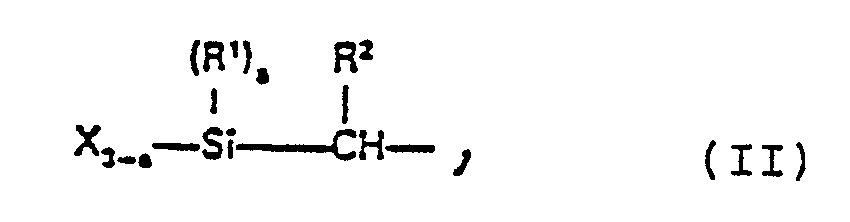
Das Molekulargewicht der Prepolymeren kann zwischen 500 und 20000, vorzugsweise zwischen 500 und 15000 liegen. Ganz besonders bevorzugt liegt das Molekulargewicht bei 3000 bis 12000. Besonders bevorzugte Prepolymere sind silylmodifizierte Polyether, welche durch Hydrosilylierung von Polyethern mit olefinisch ungesättigten Endgruppen erhalten werden können, vergl. die US-A-3 971 751. Geeignete silylmodifizierte Polyether entsprechen z.B. der Formel III

Zur Herstellung von feuchtigkeitshärtenden Form- und Dichtungsmassen werden den bekannten silylmodifizierten Polymeren metallorganische Zinnverbindungen als Katalysator zugesetzt, beispielsweise Zinn(II)octoat oder Dibutylzinnlaurat und Dibutylzinnmaleat (US-A-3 971 751). Die Anwendungseigenschaften der erfindungsgemäßen Massen werden jedoch auch durch die Auswahl der metallorganischen Zinnverbindung beeinflußt. Als besonders geeignete Katalysatoren haben sich das bei ca. 150oC erhaltene Reaktionsprodukt von Dibutylzinnoxid mit Dioctylphthalat und Dibutylzinnacetat erwiesen. Überraschenderweise sind ferner Dibutylzinndialkylate von C₃- bis C₆-Alkoholen, insbesondere Dibutylzinndibutylat besonders geeignet.To produce moisture-curing molding and sealing compounds, organometallic tin compounds are added to the known silyl-modified polymers as catalysts, for example tin (II) octoate or dibutyltin laurate and dibutyltin maleate (US Pat. No. 3,971,751). However, the application properties of the compositions according to the invention are also influenced by the selection of the organometallic tin compound. The reaction product of dibutyltin oxide with dioctylphthalate and dibutyltin acetate obtained at about 150 ° C. has proven to be particularly suitable catalysts. Surprisingly, dibutyltin dialkylates of C₃ to C₆ alcohols, especially dibutyltin dibutylate, are also particularly suitable.
Ferner werden anorganische Füllstoffe wie Ruß, Calciumcarbonat, Titandioxid und dergleichen sowie Weichmacher, insbesondere Phthalsäureester wie Dioctylphthalat und Butylbenzylphthalat oder Phosphorsäureester wie Tricresylphosphat zugesetzt.Furthermore, inorganic fillers such as carbon black, calcium carbonate, titanium dioxide and the like as well as plasticizers, in particular phthalic acid esters such as dioctyl phthalate and butylbenzyl phthalate or phosphoric acid esters such as tricresyl phosphate are added.
Als anorganische Füllstoffe finden erfindungsgemäß vorzugsweise hochdisperse Kieselsäuren, vor allem pyrogene Kieselsäuren oder Fällungskieselsäuren Verwendung, welche thixotropierend wirken und deren thixotropierende Eigenschaften in den erfindungsgemäßen Massen auch nach längerer Lagerung erhalten bleibt. Schließlich können die Massen übliche UV-Stabilisierungsmittel und Alterungsschutzmittel enthalten. Aminosilane wie z.B. γ-Glycidyloxypropyl- oder γ-Aminopropyl-trimethoxysilan dienen vor allem der Verbesserung der Haftung auf Glas, Metallen etc. Gleichzeitig fangen sie eventuelle Feuchtigkeit in den Füllstoffen ab, stellen dadurch eine gute Lagerstabilität sicher und wirken in gewissem Umfang als Co-Katalysator.According to the invention, preference is given to using, as inorganic fillers, highly disperse silicas, especially pyrogenic silicas or precipitated silicas, which have a thixotropic action and whose thixotropic properties are retained in the compositions according to the invention even after prolonged storage. Finally, the compositions can contain conventional UV stabilizers and anti-aging agents. Aminosilanes such as γ-Glycidyloxypropyl- or γ-Aminopropyl-trimethoxysilane serve primarily to improve the adhesion to glass, metals etc. At the same time they trap any moisture in the fillers, thereby ensuring good storage stability and acting to a certain extent as a co-catalyst.
Bei der Herstellung der erfindungsgemäßen Massen hat es sich als besonders günstig erwiesen, wenn man die metallorganischen Zinnverbindungen mit dem Stabilisator gemeinsam nach dem Vermischen der übrigen Bestandteile der Masse zufügt. Ein sonst bei Zusatz der Zinnverbindungen häufig auftretendes Zusammenbrechen der Thixotropie wird dadurch vermieden.In the preparation of the compositions according to the invention, it has proven to be particularly advantageous if the organometallic tin compounds are added together with the stabilizer after the other constituents have been mixed into the composition. A breakdown of the thixotropy which otherwise occurs frequently when the tin compounds are added is thereby avoided.
Zur näheren Erläuterung der Erfindung sollen die nachfolgenden Beispiele dienen, auf welche die Erfindung jedoch nicht beschränkt ist.The following examples are intended to explain the invention in more detail, but the invention is not restricted to these.
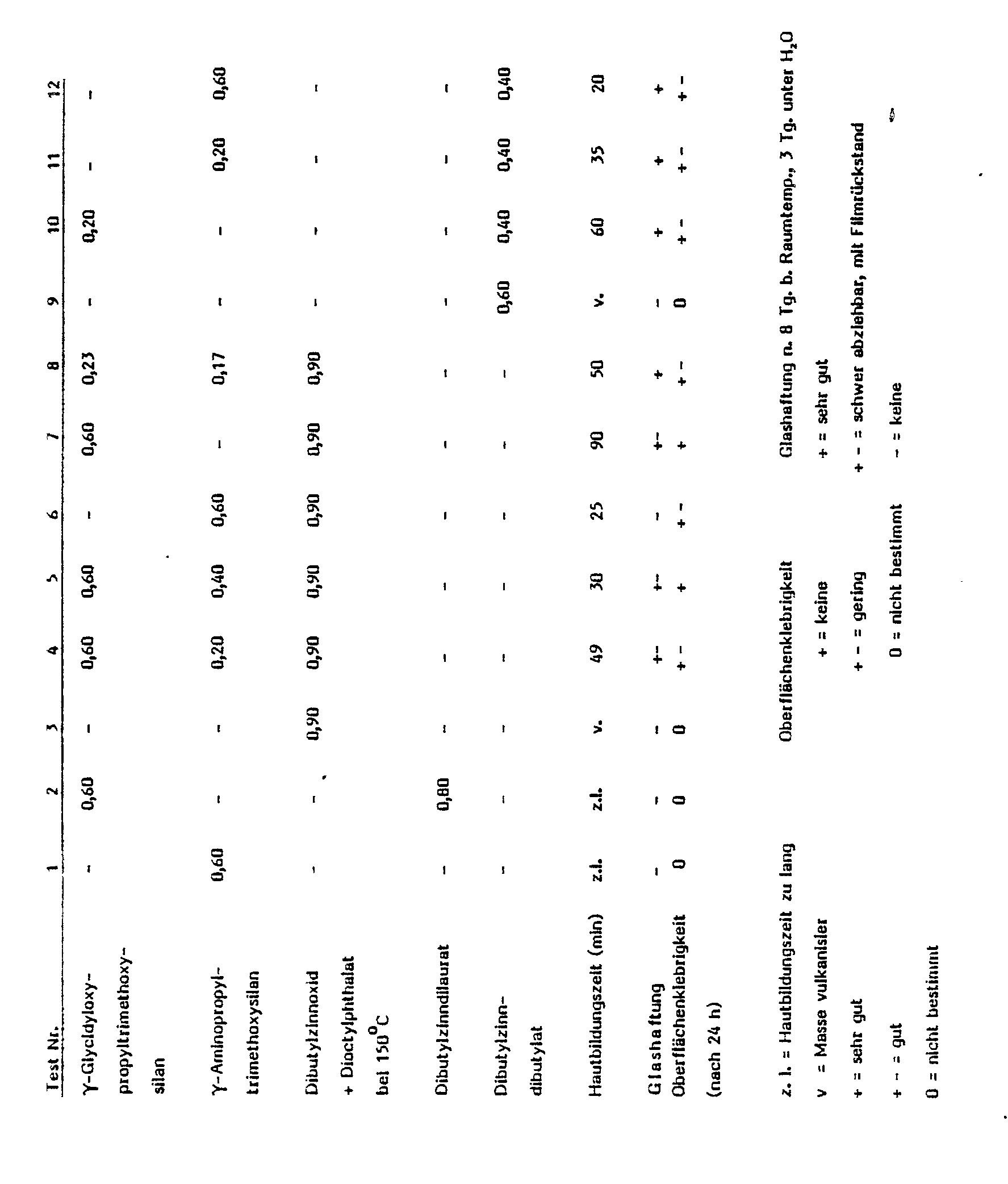
Im Rahmen dieses Beispiels wurden verschiedene metallorganische Zinnverbindungen hinsichtlich ihrer katalytischen Wirksamkeit überprüft. Zu diesem Zweck wurde eine Basismischung aus folgenden Komponenten hergestellt:
30,0 Gew.% eines Polyetherprepolymeren mit Dimethoxymethylsilyl-Endgruppen (Viskosität 100-260 P),
6,34% Dioctylphthalat,11,83% Titandioxid-Paste (52% TiO₂ in Dioctylphthalat)
0,30% Alterungsschutzmittel,
0,30% UV-Schutzmittel,
45,39% Kreide,
4,34% hydriertes Rizinusöl.In this example, various organometallic tin compounds were checked for their catalytic activity. For this purpose, a basic mixture was made from the following components:
30.0% by weight of a polyether prepolymer with dimethoxymethylsilyl end groups (viscosity 100-260 P),
6.34% dioctyl phthalate, 11.83% titanium dioxide paste (52% TiO₂ in dioctyl phthalate)
0.30% anti-aging agent,
0.30% UV protection agent,
45.39% chalk,
4.34% hydrogenated castor oil.
In eine 310 ml Kartusche wurden jeweils 200 g der obigen Basismischung eingefüllt und mit 0,2 bis 0,8 g der jeweils zu testenden Katalysatorzusammensetzung versetzt. Anschließend wurde die Mischung ca. 2 Minuten lang unter Vakuum in einem Kartuschenmischgerät gerührt.200 g of the above base mixture were introduced into each 310 ml cartridge and 0.2 to 0.8 g of the catalyst composition to be tested were added. The mixture was then stirred under vacuum in a cartridge mixer for about 2 minutes.
Danach erfolgte der Auftrag der Dichtstoffe auf Glasplatten bzw. mit Polyethylenfolie bespannte Bretter zur Bestimmung der Hautbildungszeit (in Minuten) und der Oberflächenklebrigkeit (nach 24 Stunden). Die erhaltenen Ergebnisse sind in der nachfolgenden Tabelle 1 zusammengestellt. Neben dem Reaktionsprodukt aus Dibutylzinnoxid mit Dioctylphthalat (bei 150oC) erwies sich überraschenderweise Dibutylzinndibutylat als gut wirksam. Darüber hinaus zeigte sich bei den Versuchen, daß neben der metallorganischen Zinnverbindung ein Silan wie γ-Glycidyloxypropyltrimethoxysilan oder γ-Aminopropyltrimethoxysilan vor allem zur Erzielung guter Haftungseigenschaften, aber auch für die Lagerstabilität wichtig ist.
Es wurden die Dichtstoffe A bis D hergestellt, welche sich im wesentlichen dadurch voneinander unterscheiden, daß die Dichtstoffe B bis D zusätzlich ein Isocyanat oder Säurechlorid enthalten:
Alle Dichtstoffe zeigten einen sehr kurze Hautbildungszeit von 10 bis 15 Minuten sowie gute Haftung auf verschiedenem Untergrund. Die Formulierungen unterschieden sich jedoch auffällig in ihrer Standfestigkeit. Während die Dichtstoffe B bis D auch nach längerer Lagerung ausgezeichnete Standfestigkeit zeigten, erwies sich der Dichtstoff A als nicht standfest; trotz Zusatz der thixotropierend wirkenden hochdispersen Kieselsäure waren die thixotropen Eigenschaften bereits nach kurzer Zeit nicht mehr vorhanden, so daß der Dichtstoff A auf glattem Untergrund verlief, d.h. zum Nivellieren neigte.All sealants showed a very short skin formation time of 10 to 15 minutes as well as good adhesion to different substrates. However, the formulations differed remarkably in their stability. While sealants B to D showed excellent stability even after prolonged storage, sealant A was not stable; despite the addition of the thixotropic, highly disperse silica, the thixotropic properties were no longer present after a short time, so that the sealant A ran on a smooth surface, i.e. tended to level.
Claims (7)
Applications Claiming Priority (2)
| Application Number | Priority Date | Filing Date | Title |
|---|---|---|---|
| DE3816808 | 1988-05-14 | ||
| DE3816808A DE3816808C1 (en) | 1988-05-14 | 1988-05-14 |
Publications (3)
| Publication Number | Publication Date |
|---|---|
| EP0342411A2 true EP0342411A2 (en) | 1989-11-23 |
| EP0342411A3 EP0342411A3 (en) | 1990-10-17 |
| EP0342411B1 EP0342411B1 (en) | 1994-11-02 |
Family
ID=6354557
Family Applications (1)
| Application Number | Title | Priority Date | Filing Date |
|---|---|---|---|
| EP89107718A Expired - Lifetime EP0342411B1 (en) | 1988-05-14 | 1989-04-28 | Moulding and sealant composition |
Country Status (6)
| Country | Link |
|---|---|
| EP (1) | EP0342411B1 (en) |
| JP (1) | JPH0224363A (en) |
| AT (1) | ATE113640T1 (en) |
| CA (1) | CA1336215C (en) |
| DE (2) | DE3816808C1 (en) |
| ES (1) | ES2063069T3 (en) |
Cited By (12)
| Publication number | Priority date | Publication date | Assignee | Title |
|---|---|---|---|---|
| EP0473792A4 (en) * | 1990-03-09 | 1992-08-26 | Kanegafuchi Chemical Industry Co., Ltd. | Curable composition |
| DE4119484A1 (en) * | 1991-06-13 | 1992-12-17 | Teroson Gmbh | SEALANTS AND ADHESIVES BASED ON SILANE-MODIFIED PRE-POLYMERS |
| EP0532048A1 (en) * | 1991-09-12 | 1993-03-17 | Kanegafuchi Kagaku Kogyo Kabushiki Kaisha | Curable composition |
| EP0579232A1 (en) * | 1992-07-16 | 1994-01-19 | Wacker-Chemie GmbH | Method for increasing the flash point of SiOC-bound organic group containing polysiloxanes |
| US5703146A (en) * | 1991-09-12 | 1997-12-30 | Kanegafuchi Kagaku Kogyo Kabushiki Kaisha | Curable composition containing an oxypropylene polymer and calcium carbonate which has been surface treated with a fatty acid |
| EP0893482A1 (en) * | 1997-07-21 | 1999-01-27 | Dow Corning Corporation | Dendrimer-based networks having lyophilic organosilicon and hydrophilic polyamidoamine nanoscopic domains |
| EP0928813A1 (en) * | 1998-01-13 | 1999-07-14 | Dow Corning Corporation | Dendrimer-based nanoscopic sponges and metal composites |
| WO2007093381A1 (en) * | 2006-02-14 | 2007-08-23 | Bostik S.A. | One-component, solvent free contact adhesive |
| DE102006006973A1 (en) * | 2006-02-14 | 2007-08-23 | Bostik Gmbh | Single-component, water-free coating mass based on silane-modified polyether, useful for building sealing, comprises e.g. a mixture of silane-terminated polyoxyalkylene, chalk powder, desiccant, hardening catalyst and adhesion mediator |
| DE102006006974A1 (en) * | 2006-02-14 | 2007-08-30 | Bostik Gmbh | Coating composition based on modified silane polymer useful to seal built structures, is composed of mixture of silane-terminated polyoxyalkylenes of different viscosities, chalk powder, drying agent, curing catalyst and adhesion promoter |
| RU2420554C2 (en) * | 2006-02-14 | 2011-06-10 | Бостик С.А. | Single-component anhydrous coating composition for sealing building structures and flat roofs |
| WO2024017969A1 (en) | 2022-07-22 | 2024-01-25 | Merz + Benteli Ag | Silane-terminated polymers |
Families Citing this family (2)
| Publication number | Priority date | Publication date | Assignee | Title |
|---|---|---|---|---|
| DE4019074C1 (en) * | 1990-06-15 | 1991-07-18 | Teroson Gmbh, 6900 Heidelberg, De | |
| EP1672161B1 (en) | 2004-12-20 | 2009-04-01 | Gabriel Pichler | Joint sealing and method of producing the same |
Family Cites Families (3)
| Publication number | Priority date | Publication date | Assignee | Title |
|---|---|---|---|---|
| US3971751A (en) * | 1975-06-09 | 1976-07-27 | Kanegafuchi Kagaku Kogyo Kabushiki Kaisha | Vulcanizable silylether terminated polymer |
| JPS60206812A (en) * | 1984-03-31 | 1985-10-18 | Dainippon Ink & Chem Inc | Room temperature-setting resin composition containing vinyl polymer having silyl group of improved hydrolyzability |
| JPS6274959A (en) * | 1985-09-30 | 1987-04-06 | Kanegafuchi Chem Ind Co Ltd | Curable composition |
-
1988
- 1988-05-14 DE DE3816808A patent/DE3816808C1/de not_active Expired
-
1989
- 1989-04-28 EP EP89107718A patent/EP0342411B1/en not_active Expired - Lifetime
- 1989-04-28 ES ES89107718T patent/ES2063069T3/en not_active Expired - Lifetime
- 1989-04-28 DE DE58908579T patent/DE58908579D1/en not_active Expired - Lifetime
- 1989-04-28 AT AT89107718T patent/ATE113640T1/en not_active IP Right Cessation
- 1989-05-10 CA CA000599240A patent/CA1336215C/en not_active Expired - Fee Related
- 1989-05-12 JP JP1117633A patent/JPH0224363A/en active Pending
Cited By (15)
| Publication number | Priority date | Publication date | Assignee | Title |
|---|---|---|---|---|
| EP0473792A4 (en) * | 1990-03-09 | 1992-08-26 | Kanegafuchi Chemical Industry Co., Ltd. | Curable composition |
| DE4119484A1 (en) * | 1991-06-13 | 1992-12-17 | Teroson Gmbh | SEALANTS AND ADHESIVES BASED ON SILANE-MODIFIED PRE-POLYMERS |
| EP0532048A1 (en) * | 1991-09-12 | 1993-03-17 | Kanegafuchi Kagaku Kogyo Kabushiki Kaisha | Curable composition |
| US5703146A (en) * | 1991-09-12 | 1997-12-30 | Kanegafuchi Kagaku Kogyo Kabushiki Kaisha | Curable composition containing an oxypropylene polymer and calcium carbonate which has been surface treated with a fatty acid |
| EP0579232A1 (en) * | 1992-07-16 | 1994-01-19 | Wacker-Chemie GmbH | Method for increasing the flash point of SiOC-bound organic group containing polysiloxanes |
| EP0893482A1 (en) * | 1997-07-21 | 1999-01-27 | Dow Corning Corporation | Dendrimer-based networks having lyophilic organosilicon and hydrophilic polyamidoamine nanoscopic domains |
| EP0928813A1 (en) * | 1998-01-13 | 1999-07-14 | Dow Corning Corporation | Dendrimer-based nanoscopic sponges and metal composites |
| WO2007093381A1 (en) * | 2006-02-14 | 2007-08-23 | Bostik S.A. | One-component, solvent free contact adhesive |
| DE102006006973A1 (en) * | 2006-02-14 | 2007-08-23 | Bostik Gmbh | Single-component, water-free coating mass based on silane-modified polyether, useful for building sealing, comprises e.g. a mixture of silane-terminated polyoxyalkylene, chalk powder, desiccant, hardening catalyst and adhesion mediator |
| DE102006006975A1 (en) * | 2006-02-14 | 2007-08-30 | Bostik Gmbh | One-component, solvent-free contact adhesive |
| DE102006006974A1 (en) * | 2006-02-14 | 2007-08-30 | Bostik Gmbh | Coating composition based on modified silane polymer useful to seal built structures, is composed of mixture of silane-terminated polyoxyalkylenes of different viscosities, chalk powder, drying agent, curing catalyst and adhesion promoter |
| DE102006006973B4 (en) * | 2006-02-14 | 2010-04-22 | Bostik Gmbh | One-component, water-free coating material for building waterproofing |
| RU2420554C2 (en) * | 2006-02-14 | 2011-06-10 | Бостик С.А. | Single-component anhydrous coating composition for sealing building structures and flat roofs |
| DE102006006973C5 (en) * | 2006-02-14 | 2014-10-23 | Bostik Gmbh | One-component, water-free coating material for building waterproofing |
| WO2024017969A1 (en) | 2022-07-22 | 2024-01-25 | Merz + Benteli Ag | Silane-terminated polymers |
Also Published As
| Publication number | Publication date |
|---|---|
| EP0342411B1 (en) | 1994-11-02 |
| JPH0224363A (en) | 1990-01-26 |
| DE3816808C1 (en) | 1989-10-26 |
| ES2063069T3 (en) | 1995-01-01 |
| ATE113640T1 (en) | 1994-11-15 |
| DE58908579D1 (en) | 1994-12-08 |
| EP0342411A3 (en) | 1990-10-17 |
| CA1336215C (en) | 1995-07-04 |
Similar Documents
| Publication | Publication Date | Title |
|---|---|---|
| DE3816808C1 (en) | ||
| DE69625441T2 (en) | Aliphatic silylated polyurethane mixtures with reduced viscosities | |
| EP1196469B1 (en) | Condensation cross-linking polyurethane materials containing special aminosilanes, a method for the production thereof and their use | |
| DE3782226T2 (en) | MOISTURE-RESISTANT SEAL COMPOSITION. | |
| DE69029457T2 (en) | CURABLE POLYURETHANE PREPARATION WITH EXCELLENT FLEXIBILITY | |
| EP0549627B1 (en) | Sealing and adhesive compounds with special plasticizers | |
| DE69204022T2 (en) | Moisture-curing urethane-based sealant. | |
| DE4029505A1 (en) | MOISTURIZING, ALKOXYSILANE-TERMINATED POLYURETHANE | |
| EP3715397A1 (en) | Composition and method for producing moisture-crosslinking polymers and use thereof | |
| EP0791613A1 (en) | Flame-retardant polyurethane systems | |
| EP0461737B1 (en) | Moulding and caulking composition | |
| DE2927807A1 (en) | LOCKABLE DIMENSIONS | |
| EP1185572B1 (en) | Phosphate-stabilised polyurethane materials, cross-linked by condensation, method for their production and use thereof | |
| EP1397406A1 (en) | Adhesive filled with surface-treated chalk and soot | |
| EP0507789B1 (en) | Improved, moisture-curing polyurethane sealing compounds | |
| EP0367012B1 (en) | One-package rtv compositions which are storage-stable under anhydrous conditions and form paintable elastomers | |
| DE69226582T2 (en) | Curable composition | |
| DE2721492C2 (en) | ||
| DE19929011A1 (en) | Polyurethane composition, useful as sealant, comprises alkoxysilane functionalized polyurethane, product of aminosilane with maleic or fumaric acid ester and organometallic compound. | |
| DE4016911A1 (en) | MOISTURE-RESISTANT SEALING MATERIAL | |
| EP0136396A2 (en) | Use of selected polyetherols and polyisocyanates for preparing adhesives on a polyurethane basis | |
| EP0746577B1 (en) | single-component polyurethane adhesives | |
| EP0603626B1 (en) | Method for the conditioning and the stabilisation of polyols | |
| EP0300304A2 (en) | Reduction of bubble formation in moisture curable isocyanate group-containing prepolymers | |
| EP0369291A2 (en) | One-component compositions storable in the absence of moisture and valcanizable at room temperature |
Legal Events
| Date | Code | Title | Description |
|---|---|---|---|
| PUAI | Public reference made under article 153(3) epc to a published international application that has entered the european phase |
Free format text: ORIGINAL CODE: 0009012 |
|
| AK | Designated contracting states |
Kind code of ref document: A2 Designated state(s): AT BE CH DE ES FR GB GR IT LI LU NL SE |
|
| PUAL | Search report despatched |
Free format text: ORIGINAL CODE: 0009013 |
|
| AK | Designated contracting states |
Kind code of ref document: A3 Designated state(s): AT BE CH DE ES FR GB GR IT LI LU NL SE |
|
| 17P | Request for examination filed |
Effective date: 19901221 |
|
| 17Q | First examination report despatched |
Effective date: 19920805 |
|
| GRAA | (expected) grant |
Free format text: ORIGINAL CODE: 0009210 |
|
| AK | Designated contracting states |
Kind code of ref document: B1 Designated state(s): AT BE CH DE ES FR GB GR IT LI LU NL SE |
|
| PG25 | Lapsed in a contracting state [announced via postgrant information from national office to epo] |
Ref country code: IT Free format text: LAPSE BECAUSE OF FAILURE TO SUBMIT A TRANSLATION OF THE DESCRIPTION OR TO PAY THE FEE WITHIN THE PRE;WARNING: LAPSES OF ITALIAN PATENTS WITH EFFECTIVE DATE BEFORE 2007 MAY HAVE OCCURRED AT ANY TIME BEFORE 2007. THE CORRECT EFFECTIVE DATE MAY BE DIFFERENT FROM THE ONE RECORDED.SCRIBED TIME-LIMIT Effective date: 19941102 Ref country code: GR Free format text: LAPSE BECAUSE OF FAILURE TO SUBMIT A TRANSLATION OF THE DESCRIPTION OR TO PAY THE FEE WITHIN THE PRESCRIBED TIME-LIMIT Effective date: 19941102 |
|
| REF | Corresponds to: |
Ref document number: 113640 Country of ref document: AT Date of ref document: 19941115 Kind code of ref document: T |
|
| ET | Fr: translation filed | ||
| REF | Corresponds to: |
Ref document number: 58908579 Country of ref document: DE Date of ref document: 19941208 |
|
| REG | Reference to a national code |
Ref country code: ES Ref legal event code: FG2A Ref document number: 2063069 Country of ref document: ES Kind code of ref document: T3 |
|
| PG25 | Lapsed in a contracting state [announced via postgrant information from national office to epo] |
Ref country code: SE Effective date: 19950202 |
|
| GBT | Gb: translation of ep patent filed (gb section 77(6)(a)/1977) |
Effective date: 19950206 |
|
| PG25 | Lapsed in a contracting state [announced via postgrant information from national office to epo] |
Ref country code: LU Free format text: LAPSE BECAUSE OF NON-PAYMENT OF DUE FEES Effective date: 19950430 |
|
| PLBE | No opposition filed within time limit |
Free format text: ORIGINAL CODE: 0009261 |
|
| STAA | Information on the status of an ep patent application or granted ep patent |
Free format text: STATUS: NO OPPOSITION FILED WITHIN TIME LIMIT |
|
| 26N | No opposition filed | ||
| REG | Reference to a national code |
Ref country code: GB Ref legal event code: IF02 |
|
| PGFP | Annual fee paid to national office [announced via postgrant information from national office to epo] |
Ref country code: AT Payment date: 20050413 Year of fee payment: 17 |
|
| PG25 | Lapsed in a contracting state [announced via postgrant information from national office to epo] |
Ref country code: AT Free format text: LAPSE BECAUSE OF NON-PAYMENT OF DUE FEES Effective date: 20060428 |
|
| PGFP | Annual fee paid to national office [announced via postgrant information from national office to epo] |
Ref country code: CH Payment date: 20080502 Year of fee payment: 20 Ref country code: DE Payment date: 20080502 Year of fee payment: 20 Ref country code: FR Payment date: 20080312 Year of fee payment: 20 Ref country code: ES Payment date: 20080520 Year of fee payment: 20 |
|
| PGFP | Annual fee paid to national office [announced via postgrant information from national office to epo] |
Ref country code: BE Payment date: 20080616 Year of fee payment: 20 |
|
| PGFP | Annual fee paid to national office [announced via postgrant information from national office to epo] |
Ref country code: NL Payment date: 20080303 Year of fee payment: 20 |
|
| PGFP | Annual fee paid to national office [announced via postgrant information from national office to epo] |
Ref country code: GB Payment date: 20080430 Year of fee payment: 20 |
|
| BE20 | Be: patent expired |
Owner name: *TEROSON G.M.B.H. Effective date: 20090428 |
|
| REG | Reference to a national code |
Ref country code: CH Ref legal event code: PL |
|
| REG | Reference to a national code |
Ref country code: GB Ref legal event code: PE20 Expiry date: 20090427 |
|
| PG25 | Lapsed in a contracting state [announced via postgrant information from national office to epo] |
Ref country code: NL Free format text: LAPSE BECAUSE OF EXPIRATION OF PROTECTION Effective date: 20090428 |
|
| REG | Reference to a national code |
Ref country code: ES Ref legal event code: FD2A Effective date: 20090429 |
|
| NLV7 | Nl: ceased due to reaching the maximum lifetime of a patent |
Effective date: 20090428 |
|
| PG25 | Lapsed in a contracting state [announced via postgrant information from national office to epo] |
Ref country code: ES Free format text: LAPSE BECAUSE OF EXPIRATION OF PROTECTION Effective date: 20090429 |
|
| PG25 | Lapsed in a contracting state [announced via postgrant information from national office to epo] |
Ref country code: GB Free format text: LAPSE BECAUSE OF EXPIRATION OF PROTECTION Effective date: 20090427 |