EP0341965A2 - An optical card and a recording/reproduction apparatus for the same - Google Patents
An optical card and a recording/reproduction apparatus for the same Download PDFInfo
- Publication number
- EP0341965A2 EP0341965A2 EP89304649A EP89304649A EP0341965A2 EP 0341965 A2 EP0341965 A2 EP 0341965A2 EP 89304649 A EP89304649 A EP 89304649A EP 89304649 A EP89304649 A EP 89304649A EP 0341965 A2 EP0341965 A2 EP 0341965A2
- Authority
- EP
- European Patent Office
- Prior art keywords
- optical
- optical head
- card
- recording
- information
- Prior art date
- Legal status (The legal status is an assumption and is not a legal conclusion. Google has not performed a legal analysis and makes no representation as to the accuracy of the status listed.)
- Ceased
Links
Images


Classifications
-
- G—PHYSICS
- G11—INFORMATION STORAGE
- G11B—INFORMATION STORAGE BASED ON RELATIVE MOVEMENT BETWEEN RECORD CARRIER AND TRANSDUCER
- G11B7/00—Recording or reproducing by optical means, e.g. recording using a thermal beam of optical radiation by modifying optical properties or the physical structure, reproducing using an optical beam at lower power by sensing optical properties; Record carriers therefor
- G11B7/08—Disposition or mounting of heads or light sources relatively to record carriers
- G11B7/09—Disposition or mounting of heads or light sources relatively to record carriers with provision for moving the light beam or focus plane for the purpose of maintaining alignment of the light beam relative to the record carrier during transducing operation, e.g. to compensate for surface irregularities of the latter or for track following
-
- G—PHYSICS
- G11—INFORMATION STORAGE
- G11B—INFORMATION STORAGE BASED ON RELATIVE MOVEMENT BETWEEN RECORD CARRIER AND TRANSDUCER
- G11B7/00—Recording or reproducing by optical means, e.g. recording using a thermal beam of optical radiation by modifying optical properties or the physical structure, reproducing using an optical beam at lower power by sensing optical properties; Record carriers therefor
- G11B7/002—Recording, reproducing or erasing systems characterised by the shape or form of the carrier
- G11B7/0033—Recording, reproducing or erasing systems characterised by the shape or form of the carrier with cards or other card-like flat carriers, e.g. flat sheets of optical film
-
- G—PHYSICS
- G11—INFORMATION STORAGE
- G11B—INFORMATION STORAGE BASED ON RELATIVE MOVEMENT BETWEEN RECORD CARRIER AND TRANSDUCER
- G11B7/00—Recording or reproducing by optical means, e.g. recording using a thermal beam of optical radiation by modifying optical properties or the physical structure, reproducing using an optical beam at lower power by sensing optical properties; Record carriers therefor
- G11B7/24—Record carriers characterised by shape, structure or physical properties, or by the selection of the material
Definitions
- This invention relates to an optical card on which information can be recorded, and an apparatus for recording information on and/or reproducing information from the optical card.
- optical card has advantages in that it has a large memory capacity in spite of its small size, and that it can be easily carried, and, therefore, is expected to be widely used in various information processing fields.
- Such optical cards include those of the read only type and the so-called write once type.
- information is recorded when manufacturing the card so that the additional recording of information on the card is impossible.
- information can be recorded once by the holder of the card.
- an optical card of the write once type will be described to illustrate the prior art and the present invention.
- FIG. 5 A typical example of optical cards is shown in Fig. 5.
- the optical card 50 of Fig. 5 has a plate-like body 51, and a rectangular memory region 52 which is made of a magnetooptical material so that information can be optically recorded.
- Figure 6 shows the structure of the memory region 52 in more detail.
- a plurality of guide tracks 61 are disposed in a parallel manner at fixed intervals.
- the guide tracks 61 are used in controlling an optical head of a recording and reproducing apparatus for the card which will be described below.
- a pit train 62 is formed so that a stripe portion (record track) 63 having a fixed width is formed between the guide track 61 and the pit train 62.
- Each pit train 62 consists of a plurality of circular pits 62a arranged in a row. Information is recorded as dot patterns 64 formed in the record tracks 63.
- the pit train 62 is used for obtaining synchronizing signals.
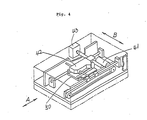
- a recording and reproducing apparatus for the optical card 50 is shown in Fig. 4.
- the optical card 50 When information is recorded on or reproduced from the optical card 50, the optical card 50 is inserted through a slot (not shown) of the apparatus of Fig. 4, and then immovably rested on a carrying means (not shown) which, as shown by a bidirectional arrow A, is moved reciprocally by a card-carrying motor 41.
- An optical head 42 is movably disposed above the moving path of the optical card 50. As shown by a bidirectional arrow B, the optical head 42 is reciprocally moved by a motor 43 in directions perpendicular to the moving direction of the card 50.
- the optical head 42 When information is recorded on or reproduced from the card 50, the optical head 42 is moved so that it is positioned above the stripe portion 63 in which information is to be recorded or from which information is to be reproduced. While changing the relative positional relation between the optical card 50 and the optical head 42, a tracking signal is obtained from the guide track 61, and the synchronizing signal from the pit train 62. The fine adjustment of the light beam of the optical head 42 is conducted on the basis of the obtained tracking signal. The recording and reproduction of information is performed in accordance with the synchronizing signal.
- the guide track 61 and the pit train 62 must be formed for each record track 63.
- the memory region 52 contains the portions 61 and 62 which are useless in the storage of information, resulting in that the prior art optical card has a reduced capacity of storing information.
- the optical card of this invention which overcomes the above-discussed and numerous other disadvantages and deficiencies of the prior art, comprises a memory region for storing information, said memory region comprises: a first section; and a second section in which information can be optically stored, said first section being juxtaposed to said second section, and a train of pits is formed in said first section.
- the memory region has a rectangular shape, and said train of pits is formed along one of the sides of said rectangular memory region.
- the pits are arranged at predetermined intervals.
- the recording and/or reproducing apparatus of this invention comprises a supporting means for supporting the above-mentioned card; an optical means; and a moving means for changing the relative positional relationship along one direction between said supporting means and said optical means, said optical means comprises a first optical head for obtaining signals from said train of pits, a second optical head for recording information on and reproducing information from said second section, and another moving means for reciprocally moving said second optical head in the direction perpendicular to said one direction.
- the optical means further comprises an adjustment means for finely adjusting the optical operation of said second optical head.
- the adjustment means adjusts the position of an object lens of said second optical head, in the direction perpendicular to said one direction and in the focusing direction.
- the adjustment means operates on the basis of the signals obtained from said first optical head.
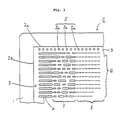
- FIG. 3 illustrates the structure of an optical card according to the invention.
- the optical card C shown in Fig. 3 comprises a plate-like plastic body 1, and a rectangular memory region 2.
- the memory region 2 has a first section 3 which elongates along one long side 2a of the memory region 2, and a second section 4 which occupies the portion of the region 2 other than the first section 3.
- a pit train 5 which consists of a plurality of circular pits 5a is formed in the first section 3.
- the pits 5a have a diameter of 2 to 5 ⁇ m and are arranged in a row at intervals of less than 10 ⁇ m.
- a plurality of tracks 8 in which information is to be stored are provided so that they extend in parallel with the pit train 5 at intervals of 2 to 5 ⁇ m.
- a long pit 6 and address pit portions 7 are formed between one short side 2b of the memory region 2 and the tracks 8.
- the long pits 6 are used for facilitating the track count control.
- Each of the address pit portions 7 indicates the address of the corresponding track 8.
- the optical card C of Fig. 3 information can be stored in the area other than those used for the pit train 5, the long pits 6 and the address pit portions 7. Namely, the optical card C of Fig. 3 comprises a large area for storing information compared to a prior art optical card.
- Figure 1 illustrates a recording and reproducing apparatus for the optical card of Fig. 3.
- the apparatus of Fig. 1 has a tray 11 on which the optical card C is rested immovably.
- the tray 11 is driven by a driving means (not shown) to move the optical card C reciprocally in the directions indicated by the bidirectional arrow A.
- an optical means D which comprises a first optical head 12 and a second optical head 13.
- the first optical head 12 is fixed to a pedestal (not shown) so that pits 5a of the pit train 5 of the card C move sequentially directly under the first optical head 12.
- the second optical head 13 is movably mounted on the pedestal.
- a stepping motor 14 is provided to move the second optical head 13 along the directions indicated by the bidirectional arrow B.
- the first optical head 12 scans the pit train 5.
- the second optical head 13 is moved by the stepping motor 14 to be positioned above one of the tracks 8 into which information is to be recorded or from which information is to be reproduced, and then scans the long pit 6 and the pit portion 7 to read the address of the track 8. Thereafter, the second optical head 13 conducts the process of recording or reproduction of information.
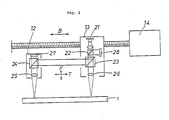
- the operation of the optical heads 12 and 13 will be described in more detail with reference to Figs. 1 and 2.
- the second optical head 13 comprises a semiconductor laser device 21, beam splitters 22 and 23, an object lens 26, and an optical detector 28.
- the first optical head 12 comprises a beam splitter 24, an object lens 25, and an optical detector 27.
- the light beam emitted from the laser device 21 is split so that one portion of the light beam is directed to the beam splitter 24 of the first optical head 12, thereby the laser beam is impinged on the pit train 5.
- the light beam reflected from the pit train 5 enters through the splitter 24 into the detector 27 to be converted into an electric signal (control signal).
- the object lens 25 is controlled by a known control means (not shown) in the focusing direction F and the transverse direction T, thereby adequately focusing the laser spot of the optical head 12 on the pit train 5.
- the control signal is also supplied to a control means (not shown) for the second optical head 13.
- the control signal is used as a track servo signal to control the object lens 26 in the focusing direction F and the transverse direction T.
- the control signal is used also as a synchronizing signal, thereby controlling the recording and/or reproducing operation of the second optical head 13.
- the laser beam of the second optical head 13 which is controlled in accordance with the control signal scans the second section 4 of the card C.
- the light beam reflected from the second section 4 enters into the optical detector 28 through beam splitters 23 and 22, and is converted into an electric signal which will be processed to obtain information.
- the laser device 21 is mounted in the second optical head 13. Conversely, the laser device 21 may be mounted in the first optical head 12.
- the present invention can be applied to a wide variety of optical cards irrespective of the structures of the pits and the material for the memory region.
Landscapes
- Optical Recording Or Reproduction (AREA)
Abstract
Description
- This invention relates to an optical card on which information can be recorded, and an apparatus for recording information on and/or reproducing information from the optical card.
- An optical card has advantages in that it has a large memory capacity in spite of its small size, and that it can be easily carried, and, therefore, is expected to be widely used in various information processing fields. Such optical cards include those of the read only type and the so-called write once type. In an optical card of the read only type, information is recorded when manufacturing the card so that the additional recording of information on the card is impossible. By contrast, in an optical card of the write once type, information can be recorded once by the holder of the card. In this specification, an optical card of the write once type will be described to illustrate the prior art and the present invention.
- A typical example of optical cards is shown in Fig. 5. The
optical card 50 of Fig. 5 has a plate-like body 51, and arectangular memory region 52 which is made of a magnetooptical material so that information can be optically recorded. Figure 6 shows the structure of thememory region 52 in more detail. In thememory region 52, a plurality ofguide tracks 61 are disposed in a parallel manner at fixed intervals. Theguide tracks 61 are used in controlling an optical head of a recording and reproducing apparatus for the card which will be described below. Along each of theguide tracks 61, apit train 62 is formed so that a stripe portion (record track) 63 having a fixed width is formed between theguide track 61 and thepit train 62. Eachpit train 62 consists of a plurality ofcircular pits 62a arranged in a row. Information is recorded asdot patterns 64 formed in therecord tracks 63. Thepit train 62 is used for obtaining synchronizing signals. - A recording and reproducing apparatus for the
optical card 50 is shown in Fig. 4. When information is recorded on or reproduced from theoptical card 50, theoptical card 50 is inserted through a slot (not shown) of the apparatus of Fig. 4, and then immovably rested on a carrying means (not shown) which, as shown by a bidirectional arrow A, is moved reciprocally by a card-carryingmotor 41. Anoptical head 42 is movably disposed above the moving path of theoptical card 50. As shown by a bidirectional arrow B, theoptical head 42 is reciprocally moved by amotor 43 in directions perpendicular to the moving direction of thecard 50. - When information is recorded on or reproduced from the
card 50, theoptical head 42 is moved so that it is positioned above thestripe portion 63 in which information is to be recorded or from which information is to be reproduced. While changing the relative positional relation between theoptical card 50 and theoptical head 42, a tracking signal is obtained from theguide track 61, and the synchronizing signal from thepit train 62. The fine adjustment of the light beam of theoptical head 42 is conducted on the basis of the obtained tracking signal. The recording and reproduction of information is performed in accordance with the synchronizing signal. - In the prior art
optical card 50, theguide track 61 and thepit train 62 must be formed for eachrecord track 63. Namely, thememory region 52 contains theportions - The optical card of this invention, which overcomes the above-discussed and numerous other disadvantages and deficiencies of the prior art, comprises a memory region for storing information, said memory region comprises: a first section; and a second section in which information can be optically stored, said first section being juxtaposed to said second section, and a train of pits is formed in said first section.
- In a preferred embodiment, the memory region has a rectangular shape, and said train of pits is formed along one of the sides of said rectangular memory region.
- In a preferred embodiment, the pits are arranged at predetermined intervals.
- The recording and/or reproducing apparatus of this invention comprises a supporting means for supporting the above-mentioned card; an optical means; and a moving means for changing the relative positional relationship along one direction between said supporting means and said optical means, said optical means comprises a first optical head for obtaining signals from said train of pits, a second optical head for recording information on and reproducing information from said second section, and another moving means for reciprocally moving said second optical head in the direction perpendicular to said one direction.
- In a preferred embodiment, the optical means further comprises an adjustment means for finely adjusting the optical operation of said second optical head.
- In a preferred embodiment, the adjustment means adjusts the position of an object lens of said second optical head, in the direction perpendicular to said one direction and in the focusing direction.
- In a preferred embodiment, the adjustment means operates on the basis of the signals obtained from said first optical head.
- Thus, the invention described herein makes possible the objectives of:
- (1) providing an optical card which has a large memory capacity;
- (2) providing an optical card in which guide tracks are unnecessary;
- (3) providing an optical card which requires only one pit train;
- (4) providing an apparatus for recording information on and reproducing information from an optical card having a large memory capacity; and
- (5) providing an apparatus for reproducing information from an optical card having a large memory capacity.
- This invention may be better understood and its numerous objects and advantages will become apparent to those skilled in the art by reference to the accompanying drawings as follows:
- Figure 1 is a perspective view diagrammatically illustrating an apparatus according to the invention.
- Figure 2 is a side elevation view illustrating two optical heads of the apparatus of Fig. 1.
- Figure 3 illustrates the structure of an optical card according to the invention.
- Figure 4 is a perspective view illustrating the structure of a prior art recording and reproducing apparatus for an optical card.
- Figure 5 shows a prior art optical card.
- Figure 6 illustrates the structure of the memory region of the optical card of Fig. 5.
- Figure 3 illustrates the structure of an optical card according to the invention. The optical card C shown in Fig. 3 comprises a plate-like plastic body 1, and a
rectangular memory region 2. In the optical card C, thememory region 2 has afirst section 3 which elongates along onelong side 2a of thememory region 2, and a second section 4 which occupies the portion of theregion 2 other than thefirst section 3. Apit train 5 which consists of a plurality ofcircular pits 5a is formed in thefirst section 3. Thepits 5a have a diameter of 2 to 5 µm and are arranged in a row at intervals of less than 10 µm. - In the second section 4, a plurality of
tracks 8 in which information is to be stored are provided so that they extend in parallel with thepit train 5 at intervals of 2 to 5 µm. For each of thetracks 8, a long pit 6 andaddress pit portions 7 are formed between oneshort side 2b of thememory region 2 and thetracks 8. The long pits 6 are used for facilitating the track count control. Each of theaddress pit portions 7 indicates the address of thecorresponding track 8. In the optical card C of Fig. 3, information can be stored in the area other than those used for thepit train 5, the long pits 6 and theaddress pit portions 7. Namely, the optical card C of Fig. 3 comprises a large area for storing information compared to a prior art optical card. - Figure 1 illustrates a recording and reproducing apparatus for the optical card of Fig. 3. The apparatus of Fig. 1 has a
tray 11 on which the optical card C is rested immovably. Thetray 11 is driven by a driving means (not shown) to move the optical card C reciprocally in the directions indicated by the bidirectional arrow A. Above the moving path of the card C, disposed is an optical means D which comprises a firstoptical head 12 and a secondoptical head 13. The firstoptical head 12 is fixed to a pedestal (not shown) so thatpits 5a of thepit train 5 of the card C move sequentially directly under the firstoptical head 12. The secondoptical head 13 is movably mounted on the pedestal. A steppingmotor 14 is provided to move the secondoptical head 13 along the directions indicated by the bidirectional arrow B. The firstoptical head 12 scans thepit train 5. The secondoptical head 13 is moved by the steppingmotor 14 to be positioned above one of thetracks 8 into which information is to be recorded or from which information is to be reproduced, and then scans the long pit 6 and thepit portion 7 to read the address of thetrack 8. Thereafter, the secondoptical head 13 conducts the process of recording or reproduction of information. The operation of theoptical heads - As shown in Fig. 2, the second
optical head 13 comprises asemiconductor laser device 21,beam splitters object lens 26, and anoptical detector 28. The firstoptical head 12 comprises abeam splitter 24, anobject lens 25, and anoptical detector 27. The light beam emitted from thelaser device 21 is split so that one portion of the light beam is directed to thebeam splitter 24 of the firstoptical head 12, thereby the laser beam is impinged on thepit train 5. - The light beam reflected from the
pit train 5 enters through thesplitter 24 into thedetector 27 to be converted into an electric signal (control signal). In accordance with the control signal, theobject lens 25 is controlled by a known control means (not shown) in the focusing direction F and the transverse direction T, thereby adequately focusing the laser spot of theoptical head 12 on thepit train 5. The control signal is also supplied to a control means (not shown) for the secondoptical head 13. In the control means for the secondoptical head 13, the control signal is used as a track servo signal to control theobject lens 26 in the focusing direction F and the transverse direction T. The control signal is used also as a synchronizing signal, thereby controlling the recording and/or reproducing operation of the secondoptical head 13. - When information is to be reproduced from the optical card C, for example, the laser beam of the second
optical head 13 which is controlled in accordance with the control signal scans the second section 4 of the card C. The light beam reflected from the second section 4 enters into theoptical detector 28 throughbeam splitters - In the example described above, the
laser device 21 is mounted in the secondoptical head 13. Conversely, thelaser device 21 may be mounted in the firstoptical head 12. - The present invention can be applied to a wide variety of optical cards irrespective of the structures of the pits and the material for the memory region.
- It is understood that various other modifications will be apparent to and can be readily made by those skilled in the art without departing from the scope and spirit of this invention. Accordingly, it is not intended that the scope of the claims appended hereto be limited to the description as set forth herein, but rather that the claims be construed as encompassing all the features of patentable novelty that reside in the present invention, including all features that would be treated as equivalents thereof by those skilled in the art to which this invention pertains.
Claims (8)
said optical means comprises a first optical head for obtaining signals from said train of pits, a second optical head for recording information on and reproducing information from said second section, and another moving means for reciprocally moving said second optical head in the direction perpendicular to said one direction.
Applications Claiming Priority (2)
| Application Number | Priority Date | Filing Date | Title |
|---|---|---|---|
| JP63111289A JPH01282730A (en) | 1988-05-07 | 1988-05-07 | Optical recording and reproducing device |
| JP111289/88 | 1988-05-07 |
Publications (2)
| Publication Number | Publication Date |
|---|---|
| EP0341965A2 true EP0341965A2 (en) | 1989-11-15 |
| EP0341965A3 EP0341965A3 (en) | 1991-07-31 |
Family
ID=14557449
Family Applications (1)
| Application Number | Title | Priority Date | Filing Date |
|---|---|---|---|
| EP19890304649 Ceased EP0341965A3 (en) | 1988-05-07 | 1989-05-08 | An optical card and a recording/reproduction apparatus for the same |
Country Status (4)
| Country | Link |
|---|---|
| US (1) | US5111031A (en) |
| EP (1) | EP0341965A3 (en) |
| JP (1) | JPH01282730A (en) |
| CA (1) | CA1328692C (en) |
Cited By (1)
| Publication number | Priority date | Publication date | Assignee | Title |
|---|---|---|---|---|
| EP0874366A4 (en) * | 1996-11-11 | 2006-05-24 | Nippon Conlux Co Ltd | Data recording method and apparatus for optical memory cards |
Family Cites Families (7)
| Publication number | Priority date | Publication date | Assignee | Title |
|---|---|---|---|---|
| JPS5534340A (en) * | 1978-08-31 | 1980-03-10 | Nippon Hoso Kyokai <Nhk> | Recording reproducing system by light beam |
| JPS61216246A (en) * | 1985-03-20 | 1986-09-25 | Hitachi Maxell Ltd | Manufacture of button type battery |
| JPS6273316U (en) * | 1985-10-29 | 1987-05-11 | ||
| JPS62143231A (en) * | 1985-12-18 | 1987-06-26 | Csk Corp | Optical recording medium |
| US4817067A (en) * | 1986-01-27 | 1989-03-28 | Csk Corporation | Optical recording medium |
| US4918415A (en) * | 1986-05-23 | 1990-04-17 | Olympus Optical Co., Ltd. | Data reading and/or writing apparatus for use with an optical card |
| JPS63285785A (en) * | 1987-05-19 | 1988-11-22 | Toshiba Corp | Optical recording medium and its recording and reproducing device |
-
1988
- 1988-05-07 JP JP63111289A patent/JPH01282730A/en active Pending
-
1989
- 1989-05-03 US US07/346,804 patent/US5111031A/en not_active Expired - Lifetime
- 1989-05-04 CA CA000598746A patent/CA1328692C/en not_active Expired - Fee Related
- 1989-05-08 EP EP19890304649 patent/EP0341965A3/en not_active Ceased
Cited By (1)
| Publication number | Priority date | Publication date | Assignee | Title |
|---|---|---|---|---|
| EP0874366A4 (en) * | 1996-11-11 | 2006-05-24 | Nippon Conlux Co Ltd | Data recording method and apparatus for optical memory cards |
Also Published As
| Publication number | Publication date |
|---|---|
| CA1328692C (en) | 1994-04-19 |
| EP0341965A3 (en) | 1991-07-31 |
| US5111031A (en) | 1992-05-05 |
| JPH01282730A (en) | 1989-11-14 |
Similar Documents
| Publication | Publication Date | Title |
|---|---|---|
| EP0097035A1 (en) | Optical disk scanning system | |
| CA1267974A (en) | Optical information recording and reproducing apparatus | |
| US5042019A (en) | Method of and apparatus for seeking a desired track by counting track crossing signals which are detected within a predetermined time interval | |
| US5808981A (en) | Information recording/reproducing apparatus capable of movement in two directions of a card-like information recording medium | |
| US5038332A (en) | Optical information recording medium including an optically detectable mark representing a boundary between the recording and non-recording areas | |
| US5111031A (en) | Optical card and a recording/reproduction apparatus for the same | |
| JPS59104730A (en) | Optical memory device | |
| US5136574A (en) | Optical card and a recording/reproduction apparatus for the same | |
| KR0150264B1 (en) | Optical record carrier and record playback system | |
| EP0678860B1 (en) | Method of and apparatus for recording and reproducing optical information | |
| US4831243A (en) | Information memory apparatus for reading out information from a moving recording medium | |
| CA1316599C (en) | Recording and reproducing device for magneto-optical card | |
| JPH04176025A (en) | Optical head | |
| JPH0582659B2 (en) | ||
| JPH0583981B2 (en) | ||
| JP2710961B2 (en) | Optical information recording / reproducing device | |
| EP0383562B1 (en) | Optical information recording and/or reproducing apparatus with device for prohibiting movement of optical head | |
| JP2536875B2 (en) | Information recording / reproducing device | |
| JPS61242373A (en) | Data recording and playback method | |
| JPH0727639B2 (en) | Optical information recording / reproducing method | |
| JP2608651B2 (en) | Optical recording / reproducing device | |
| JPS61283043A (en) | Optical information recording and reproducing device | |
| JPH08338904A (en) | Optical element and optical information recording / reproducing apparatus | |
| JPH0689481A (en) | Optical pickup device | |
| JPS61242336A (en) | Data recording method |
Legal Events
| Date | Code | Title | Description |
|---|---|---|---|
| PUAI | Public reference made under article 153(3) epc to a published international application that has entered the european phase |
Free format text: ORIGINAL CODE: 0009012 |
|
| AK | Designated contracting states |
Kind code of ref document: A2 Designated state(s): DE FR GB NL |
|
| 17P | Request for examination filed |
Effective date: 19901228 |
|
| PUAL | Search report despatched |
Free format text: ORIGINAL CODE: 0009013 |
|
| AK | Designated contracting states |
Kind code of ref document: A3 Designated state(s): DE FR GB NL |
|
| 17Q | First examination report despatched |
Effective date: 19921019 |
|
| STAA | Information on the status of an ep patent application or granted ep patent |
Free format text: STATUS: THE APPLICATION HAS BEEN REFUSED |
|
| 18R | Application refused |
Effective date: 19961222 |