EP0341925B1 - An inorganic filler containing polyolefin composition - Google Patents
An inorganic filler containing polyolefin composition Download PDFInfo
- Publication number
- EP0341925B1 EP0341925B1 EP89304568A EP89304568A EP0341925B1 EP 0341925 B1 EP0341925 B1 EP 0341925B1 EP 89304568 A EP89304568 A EP 89304568A EP 89304568 A EP89304568 A EP 89304568A EP 0341925 B1 EP0341925 B1 EP 0341925B1
- Authority
- EP
- European Patent Office
- Prior art keywords
- weight
- parts
- inorganic filler
- carbon atoms
- alkyl group
- Prior art date
- Legal status (The legal status is an assumption and is not a legal conclusion. Google has not performed a legal analysis and makes no representation as to the accuracy of the status listed.)
- Expired - Lifetime
Links
- 0 *C(*1)=C*C=C1I Chemical compound *C(*1)=C*C=C1I 0.000 description 1
- OQTACKFYTYDWKQ-UHFFFAOYSA-N CCC(C(C12)C1I)=CC(C)=C2O Chemical compound CCC(C(C12)C1I)=CC(C)=C2O OQTACKFYTYDWKQ-UHFFFAOYSA-N 0.000 description 1
Classifications
-
- C—CHEMISTRY; METALLURGY
- C08—ORGANIC MACROMOLECULAR COMPOUNDS; THEIR PREPARATION OR CHEMICAL WORKING-UP; COMPOSITIONS BASED THEREON
- C08K—Use of inorganic or non-macromolecular organic substances as compounding ingredients
- C08K5/00—Use of organic ingredients
- C08K5/04—Oxygen-containing compounds
- C08K5/15—Heterocyclic compounds having oxygen in the ring
- C08K5/156—Heterocyclic compounds having oxygen in the ring having two oxygen atoms in the ring
- C08K5/1575—Six-membered rings
-
- C—CHEMISTRY; METALLURGY
- C08—ORGANIC MACROMOLECULAR COMPOUNDS; THEIR PREPARATION OR CHEMICAL WORKING-UP; COMPOSITIONS BASED THEREON
- C08K—Use of inorganic or non-macromolecular organic substances as compounding ingredients
- C08K5/00—Use of organic ingredients
- C08K5/16—Nitrogen-containing compounds
- C08K5/20—Carboxylic acid amides
Definitions
- the present invention relates to a polyolefin composition containing inorganic fillers, which is excellent in thermal-oxidation stability and light stability.
- Inorganic fillers are widely used in order to improve polyolefins in mechanical properties such as stiffness, impact resistance, dimension stability and heat resistance.
- inorganic fillers inactivate thermal-oxidation stabilizers and light stabilizers so that they cannot effectively function.
- the present invention provides an inorganic filler-containing polyolefin composition which comprises 100 parts by weight of a polyolefin, 1-100 parts by weight of an inorganic filler which is talc, mica, wollastonite, calcium carbonate, barium sulfate or glass fibres, 0.01-1.0 parts by weight of a phenolic antioxidant represented by the general formula (I) shown below, and 0.01-1.0 parts by weight of at least one compound selected from the group consisting of the compounds represented by the general formulas (II) to (IV) shown below.
- R1 represents an alkyl group of 1-3 carbon atoms
- R4 represents an alkyl group, an alkenyl group or an acyl group (R'-CO) of 8-18 carbon atoms
- R' represents an aliphatic hydrocarbon chain which may be saturated or unsaturated
- R5 represents an alkyl group or an alkenyl group of 7-17 carbon atoms.
- This composition is excellent in thermal-oxidation stability.
- the present invention also provides an inorganic filler-containing polyolefin composition which comprises 0.01-1.0 part by weight of a sulfur antioxidant in addition to the above-mentioned composition.
- This composition is also excellent in thermal-oxidation stability.
- the present invention further provides an inorganic filler-containing polyolefin composition which comprises 0.01-2.0 parts by weight of a light stabilizer in addition to one of the above-mentioned composition.
- This composition is excellent in light stability as well as thermal-oxidation stability.
- the polyolefin used in the present invention includes homopolymers of an ⁇ -olefin such as ethylene, propylene, butene-1, hexene-1 or 4-methyl-pentene-1, and random or block copolymers comprising two or more of such ⁇ -olefins as listed above.
- ⁇ -olefin such as ethylene, propylene, butene-1, hexene-1 or 4-methyl-pentene-1
- polystyrene resin examples include polyethylene, polypropylene, polybutene-1, polyisobutene, poly-3-methyl-butene-1, poly-4-methyl-pentene-1, ethylene-propylene copolymer, ethylene-butene-1 copolymer, propylene-4-methyl-pentene-1 copolymer, propylene-butene-1 copolymer, decene-1-4-methyl-pentene-1 copolymer, ethylene-propylene butene-1 copolymer.
- the comonomer may be a multiunsaturated compound such as conjugated or non-conjugated dienes or acrylic acid, methacrylic acid or vinyl acetate.
- These polymers further include modified ones with acid, for example, polymers graft-modified with ⁇ , ⁇ -unsaturated aliphatic acid, cycloaliphatic carboxylic acid or derivatives thereof and also include rubbery, fatty and waxy polymers.
- the polyolefin may be a mixture obtained by adding to an above-mentioned polyolefin a synthetic rubber, depending upon the application.
- the synthetic rubber which may be used in the present invention is preferably ethylene- ⁇ -olefin copolymer rubber, for example, copolymer rubbers of ethylene and ⁇ -olefin, e.g., propylene, butene-1 or hexene-1; or ternary copolymer rubber (hereinafter referred to as EPDM) in which non-conjugated dienes, for example, ethylidene norbornene or cycloperitadiene is copolymerized as the third component with the ethylene-propylene copolymer.
- EPDM ternary copolymer rubber
- non-conjugated dienes for example, ethylidene norbornene or cycloperitadiene is copolymerized as the third component with the ethylene-propylene copoly
- inorganic fillers talc, mica, glass fibers and wollastonite are preferred for improving impact resistance at low temperature, moldability and paintability.
- the amount of inorganic fillers to be added is 1-100 parts by weight, preferably 5-80 parts by weight, based on 100 parts by weight of polyolefin. If the amount is more than 100 parts by weight, moldability deteriorates when a molded article is produced, or appearance of the molded article is degraded even though it can be molded. If the amount is less than 1 part by weight, mechanical properties such as stiffness, dimension stability and heat stability of molded articles are not sufficiently improved.
- the phenolic antioxidant represented by the general formula (I): includes, for example, compounds shown by the following formulas: These phenolic antioxidants impart thermal-oxidation stability to inorganic filler-containing polyolefins more effectively than other phenolic antioxidants.
- the sulfur antioxidant which may be used in the present invention includes dilauryl-thio-dipropionate, dimyristyl-thio-dipropionate, distearyl-thio-dipropionate and pentaerythritol tetrakis( ⁇ -laurylthiopropionate). Among them, pentaerythritol tetrakis( ⁇ -laurylthiopropionate) is preferred.
- the amount each of the phenolic antioxidant represented by the formula (I) and the sulfur antioxidant is each 0.01-1.0 part by weight, preferably 0.05-0.8 part by weight, based on 100 parts by weight of polyolefin. If it is more than 1.0 part by weight, fuming sometimes occurs during the molding process or bleed out may appear on the surface of molded articles, and also it is economically inadvisable. If it is less than 0.01 part by weight, the effect of the present invention cannot be sufficiently attained.
- the light stabilizer used in the present invention includes salicylate compounds, benzophenone compounds, benzotriazole compounds, nickel chelate compounds and hindered amine compounds. These compounds may be used alone or in combination thereof.
- Examples of these compounds are 2,4-di-t-butylphenyl-3,5-di-t-butyl-4-hydroxybenzoate, 4-octylphenyl-3,5-di-t-butyl-4-hydroxybenzoate, 2-hydroxy-4-methoxybenzophenone, 2-hydroxy-4-octoxybenzophenone, 2(2'-hydroxy-3'-t-butyl-5'-methylphenyl)-5-chlorobenzotriazole, 2(2'-hydroxy-3',5'-di-t-butylphenyl)-5-chlorobenzotriazole, bis(2,2,6,6-tetramethyl-4-piperidyl)sebacate, polycondensate of succinic acid and dimethyl-1-(2-hydroxyethyl)-4-hydroxy-2,2,6,6-tetramethylpiperidine, poly[ ⁇ 6-(1,1,3,3-tetramethylbutyl)imino-1,1,3,5-triazine
- the amount of light stabilizer to be added is 0.01-2.0 parts by weight, preferably 0.05-1.5 parts by weight, based on 100 parts by weight of polyolefin. If it is more than 2.0 parts by weight, fuming sometimes occurs upon molding process or bleed out may appear on the surface of molded articles, and also it is economically inadvisable. If it is less than 0.01 part by weight, the light stabilizing effect cannot be achieved sufficiently.
- Examples of the compounds represented by the general formula (II): R2-CO-NH-(CH2) n -HN-CO-R2, which are used in the present invention, include methylenebisstearamide, ethylenebisstearamide, ethylenebisoleamide and hexamethylenebisstearamide.
- Examples of the compounds represented by the general formula (IV): which is used in the present invention, include compounds shown by the following formulas:
- Addition amount of the compounds represented by the general formulas (II) to (IV) is respectively 0.01-1.0 part by weight, preferably 0.05-0.8 part by weight, based on 100 parts by weight of polyolefin. If it is more than 1.0 parts by weight, fuming sometimes occurs upon molding process or bleed out may appear on the surface of shaped articles, and also it is economically inadvisable. If it is less than 0.01 part by weight, the effect of the present invention cannot be achieved sufficiently.
- a phosphorus antioxidant is added to the present composition since it further improves thermal-oxidation stability and light stability.
- Examples of the phosphorus antioxidant are distearylpentaerythritol diphosphite, tris(2,4-di-t-butylphenyl)phosphite, bis(2,4-di-t-butylphenyl)pentaerythritol diphosphite, tetrakis(2,4-di-t-butylphenyl)4,4'-biphenylene diphosphonite and trinonylphenyl phosphite.
- composition of the present invention may contain other additives, for example, process oils, plasticizers, lubricating oils, neutralizing agents, antioxidants, heavy metal inactivating agents, lubricants, nucleating agents, antistatic agents, release agents, pigments and antifungal agents, so long as they do not harm any of the properties of the composition.
- additives for example, process oils, plasticizers, lubricating oils, neutralizing agents, antioxidants, heavy metal inactivating agents, lubricants, nucleating agents, antistatic agents, release agents, pigments and antifungal agents, so long as they do not harm any of the properties of the composition.
- composition according to the present invention is obtained by kneading in a heat-molten state using an ordinary kneading machine such as a uniaxial extruder, a biaxial extruder, a banbury mixer, a roll and a kneader.
- an ordinary kneading machine such as a uniaxial extruder, a biaxial extruder, a banbury mixer, a roll and a kneader.
- Products obtained from the inorganic filler-containing polyolefin composition according to the present invention as described above have extremely excellent thermal-oxidation stability and light stability.
- thermoplastics thermoplastics
- the accelerated light-resistance test was carried out using a Sunshine Super Long Life Weatherometer (model : WEL-SUN-DC) manufactured by Suga Tester Kabushiki Kaisha. Then, a time period in which any external abnormality such as crackings appears on the surface of the test specimen, was determined.
- the test conditions were as follows: (1) Size of test specimen Pressed sheet of 70 mm x 25 mm x 1 mm (thick) (2) Black panel temperature 83°C (3) Spray/dry cycle 18 min/120 min (4) Humidity in a tester vessel 50 %RH (5) Observation for the external abnormality such as crackings microscopic observation (x 50)
- the obtained pellets were shaped at 230°C into a pressed sheet having a thickness of 1mm.
- a disc test specimen having a diameter of 25 mm was punched out of the sheet, and its GO life at 150 °C was measured. The result is shown in Table 1.
- Test specimens were prepared in the same manner as in Examples 1-12 except that the formulations shown in Table 2 were employed.
- the obtained pellets were shaped at 230°C into a pressed sheet having a thickness of 1mm.
- a test specimen having a dimension of 70 mm x 25 mm was punched out of the sheet, and subjected to the accelerated light-resistance test.
- a time period in which external abnormality such as crackings occurs was measured. The result is shown in Table 3.
- Test specimens were prepared in the same manner as in Examples 13-16 except that the formulations shown in Table 3 were employed.
- test specimens were subjected to the accelerated light-resistance test. And, time periods in which external abnormality such as crackings occurs were measured.
- the obtained pellets were shaped at 230°C into a pressed sheet having a thickness of 1mm.
- a disc test specimen having a diameter of 25 mm was punched out of the sheet, and its GO life at 150 °C was measured.
- Another specimen having a dimension of 70 mm x 25 mm was also punched out of the above sheet and subjected to the accelerated light-resistance test. And, a time period in which external abnormality such as crackings occurs was measured.
- Test specimens were prepared in the same manner as in Examples 17-19 except that the formulations shown in Table 4 were employed.
- Polyolefin has a disadvantage that its thermal-oxidation stability and light stability were considerably lowered by the addition of inorganic fillers.
Landscapes
- Chemical & Material Sciences (AREA)
- Health & Medical Sciences (AREA)
- Chemical Kinetics & Catalysis (AREA)
- Medicinal Chemistry (AREA)
- Polymers & Plastics (AREA)
- Organic Chemistry (AREA)
- Compositions Of Macromolecular Compounds (AREA)
Description
- The present invention relates to a polyolefin composition containing inorganic fillers, which is excellent in thermal-oxidation stability and light stability.
- Inorganic fillers are widely used in order to improve polyolefins in mechanical properties such as stiffness, impact resistance, dimension stability and heat resistance.
- However, inorganic fillers considerably deteriorate thermal-oxidation stability and light stability of polyolefins. Thus, there is a need to improve such defect.
- In order to improve the deterioration of thermal-oxidation stability and light stability, various methods have been proposed as disclosed in Japanese Patent Publication (Kokai) Nos. 52-49254, 52-80345, 53-79938, 56-90844, 56-118437, 56-141339 and 62-273239. However, these methods are still insufficient.
- The reason why the system containing inorganic fillers is low in thermal-oxidation stability and light stability is considered to be that inorganic fillers inactivate thermal-oxidation stabilizers and light stabilizers so that they cannot effectively function.
- Under such circumstances, it is an object of the present invention to provide a polyolefin composition containing inorganic fillers, which overcomes the conventional defects in thermal-oxidation stability and light stability.
- The present invention provides an inorganic filler-containing polyolefin composition which comprises 100 parts by weight of a polyolefin, 1-100 parts by weight of an inorganic filler which is talc, mica, wollastonite, calcium carbonate, barium sulfate or glass fibres, 0.01-1.0 parts by weight of a phenolic antioxidant represented by the general formula (I) shown below, and 0.01-1.0 parts by weight of at least one compound selected from the group consisting of the compounds represented by the general formulas (II) to (IV) shown below.

wherein R₁ represents an alkyl group of 1-3 carbon atoms,
(II): R₂-CO-NH-(CH₂)n-HN-CO-R₂
wherein R₂ represents an alkyl group or an alkenyl group of 5-21 carbon atoms, and n is an integer of 1 to 6,
(III): R₃-CONH₂
wherein R₃ represents an alkyl group or an alkenyl group of 5-21 carbon atoms,
wherein R₄ represents an alkyl group, an alkenyl group or an acyl group (R'-CO) of 8-18 carbon atoms, m and n are integers which meet
- This composition is excellent in thermal-oxidation stability.
- The present invention also provides an inorganic filler-containing polyolefin composition which comprises 0.01-1.0 part by weight of a sulfur antioxidant in addition to the above-mentioned composition. This composition is also excellent in thermal-oxidation stability.
- The present invention further provides an inorganic filler-containing polyolefin composition which comprises 0.01-2.0 parts by weight of a light stabilizer in addition to one of the above-mentioned composition. This composition is excellent in light stability as well as thermal-oxidation stability.
- The polyolefin used in the present invention includes homopolymers of an α-olefin such as ethylene, propylene, butene-1, hexene-1 or 4-methyl-pentene-1, and random or block copolymers comprising two or more of such α-olefins as listed above. Examples of the polyolefin are polyethylene, polypropylene, polybutene-1, polyisobutene, poly-3-methyl-butene-1, poly-4-methyl-pentene-1, ethylene-propylene copolymer, ethylene-butene-1 copolymer, propylene-4-methyl-pentene-1 copolymer, propylene-butene-1 copolymer, decene-1-4-methyl-pentene-1 copolymer, ethylene-propylene butene-1 copolymer. The comonomer may be a multiunsaturated compound such as conjugated or non-conjugated dienes or acrylic acid, methacrylic acid or vinyl acetate. These polymers further include modified ones with acid, for example, polymers graft-modified with α,β-unsaturated aliphatic acid, cycloaliphatic carboxylic acid or derivatives thereof and also include rubbery, fatty and waxy polymers.
- In the present invention, the polyolefin may be a mixture obtained by adding to an above-mentioned polyolefin a synthetic rubber, depending upon the application. The synthetic rubber which may be used in the present invention is preferably ethylene-α-olefin copolymer rubber, for example, copolymer rubbers of ethylene and α-olefin, e.g., propylene, butene-1 or hexene-1; or ternary copolymer rubber (hereinafter referred to as EPDM) in which non-conjugated dienes, for example, ethylidene norbornene or cycloperitadiene is copolymerized as the third component with the ethylene-propylene copolymer. Among them, ethylene-propylene copolymer rubber and EPDM are most preferred.
- Among the inorganic fillers talc, mica, glass fibers and wollastonite are preferred for improving impact resistance at low temperature, moldability and paintability.
- The amount of inorganic fillers to be added is 1-100 parts by weight, preferably 5-80 parts by weight, based on 100 parts by weight of polyolefin. If the amount is more than 100 parts by weight, moldability deteriorates when a molded article is produced, or appearance of the molded article is degraded even though it can be molded. If the amount is less than 1 part by weight, mechanical properties such as stiffness, dimension stability and heat stability of molded articles are not sufficiently improved.
- The phenolic antioxidant represented by the general formula (I):

includes, for example, compounds shown by the following formulas:
These phenolic antioxidants impart thermal-oxidation stability to inorganic filler-containing polyolefins more effectively than other phenolic antioxidants. - The sulfur antioxidant which may be used in the present invention includes dilauryl-thio-dipropionate, dimyristyl-thio-dipropionate, distearyl-thio-dipropionate and pentaerythritol tetrakis(β-laurylthiopropionate). Among them, pentaerythritol tetrakis(β-laurylthiopropionate) is preferred.
- When the sulfur antioxidant is used together with the phenolic antioxidant in a ratio of the latter to the former of 1:3-4, the most significant effect is obtained.
- The amount each of the phenolic antioxidant represented by the formula (I) and the sulfur antioxidant is each 0.01-1.0 part by weight, preferably 0.05-0.8 part by weight, based on 100 parts by weight of polyolefin. If it is more than 1.0 part by weight, fuming sometimes occurs during the molding process or bleed out may appear on the surface of molded articles, and also it is economically inadvisable. If it is less than 0.01 part by weight, the effect of the present invention cannot be sufficiently attained.
- The light stabilizer used in the present invention includes salicylate compounds, benzophenone compounds, benzotriazole compounds, nickel chelate compounds and hindered amine compounds. These compounds may be used alone or in combination thereof.
- Examples of these compounds are 2,4-di-t-butylphenyl-3,5-di-t-butyl-4-hydroxybenzoate, 4-octylphenyl-3,5-di-t-butyl-4-hydroxybenzoate, 2-hydroxy-4-methoxybenzophenone, 2-hydroxy-4-octoxybenzophenone, 2(2'-hydroxy-3'-t-butyl-5'-methylphenyl)-5-chlorobenzotriazole, 2(2'-hydroxy-3',5'-di-t-butylphenyl)-5-chlorobenzotriazole, bis(2,2,6,6-tetramethyl-4-piperidyl)sebacate, polycondensate of succinic acid and dimethyl-1-(2-hydroxyethyl)-4-hydroxy-2,2,6,6-tetramethylpiperidine, poly[{6-(1,1,3,3-tetramethylbutyl)imino-1,1,3,5-triazine-2,4-diyl}{2,2,6,6-tetramethyl-4-piperidyl)imino}hexamethylene{(2,2,6,6-tetramethyl-4-piperidyl)imino}], nickel-bis(3,5-di-t-butyl-4-hydroxybenzyl)-2-n-butylmalonato and [2,2'-thiobis(4-t-octylphenolate)]-n-butylaminenickel II.
- In the present invention, the amount of light stabilizer to be added is 0.01-2.0 parts by weight, preferably 0.05-1.5 parts by weight, based on 100 parts by weight of polyolefin. If it is more than 2.0 parts by weight, fuming sometimes occurs upon molding process or bleed out may appear on the surface of molded articles, and also it is economically inadvisable. If it is less than 0.01 part by weight, the light stabilizing effect cannot be achieved sufficiently.
- It is needless to say that both the light stabilizer and the sulfur antioxidant may be used in the present invention.
- Examples of the compounds represented by the general formula (II): R₂-CO-NH-(CH₂)n-HN-CO-R₂, which are used in the present invention, include methylenebisstearamide, ethylenebisstearamide, ethylenebisoleamide and hexamethylenebisstearamide.
- Examples of the compounds represented by the general formula (III): R₃-CONH₂, which is used in the present invention, include lauramide, stearamide, oleamide, behenamide and erucamide.
- Examples of the compounds represented by the general formula (IV):

which is used in the present invention, include compounds shown by the following formulas:
- Addition amount of the compounds represented by the general formulas (II) to (IV) is respectively 0.01-1.0 part by weight, preferably 0.05-0.8 part by weight, based on 100 parts by weight of polyolefin. If it is more than 1.0 parts by weight, fuming sometimes occurs upon molding process or bleed out may appear on the surface of shaped articles, and also it is economically inadvisable. If it is less than 0.01 part by weight, the effect of the present invention cannot be achieved sufficiently.
- It is preferred that a phosphorus antioxidant is added to the present composition since it further improves thermal-oxidation stability and light stability.
- Examples of the phosphorus antioxidant are distearylpentaerythritol diphosphite, tris(2,4-di-t-butylphenyl)phosphite, bis(2,4-di-t-butylphenyl)pentaerythritol diphosphite, tetrakis(2,4-di-t-butylphenyl)4,4'-biphenylene diphosphonite and trinonylphenyl phosphite.
- The composition of the present invention may contain other additives, for example, process oils, plasticizers, lubricating oils, neutralizing agents, antioxidants, heavy metal inactivating agents, lubricants, nucleating agents, antistatic agents, release agents, pigments and antifungal agents, so long as they do not harm any of the properties of the composition.
- The composition according to the present invention is obtained by kneading in a heat-molten state using an ordinary kneading machine such as a uniaxial extruder, a biaxial extruder, a banbury mixer, a roll and a kneader.
- Products obtained from the inorganic filler-containing polyolefin composition according to the present invention as described above have extremely excellent thermal-oxidation stability and light stability.
- The present invention is further described in the following Examples.
- Test methods of thermal-oxidation stability and light stability in the Examples were as follows:
- The thermal-oxidation stability was evaluated in accordance with test method for thermal degradation of thermoplastics (oven method), general rule, prescribed in JIS K 7212. Namely, a time period (GO life) in which the test specimen of a pressed sheet having a thickness of 1mm is completely degraded, or, in other words, in which its pull strength becomes zero, was determined at 150°C using a gear oven manufactured by Toyo Seiki Seisakusho Kabushiki Kaisha.
- The accelerated light-resistance test was carried out using a Sunshine Super Long Life Weatherometer (model : WEL-SUN-DC) manufactured by Suga Tester Kabushiki Kaisha. Then, a time period in which any external abnormality such as crackings appears on the surface of the test specimen, was determined. The test conditions were as follows:
(1) Size of test specimen Pressed sheet of 70 mm x 25 mm x 1 mm (thick) (2) Black panel temperature 83°C (3) Spray/dry cycle 18 min/120 min (4) Humidity in a tester vessel 50 %RH (5) Observation for the external abnormality such as crackings microscopic observation (x 50) - One hundred parts by weight of powder of crystalline ethylene-propylene block copolymer (ethylene content : 7.2 wt%, melt index : 3.0 g/10 min) and the other components shown by the formulation of Table 1 were melt-kneaded in a banbury mixer at 180 °C for 10 minutes. Then, the resultant mixture was made into a sheet having a thickness of 5 mm by use of a roll and hardened by cooling, and then was pelletized by cutting.
- The obtained pellets were shaped at 230°C into a pressed sheet having a thickness of 1mm. A disc test specimen having a diameter of 25 mm was punched out of the sheet, and its GO life at 150 °C was measured. The result is shown in Table 1.
- Test specimens were prepared in the same manner as in Examples 1-12 except that the formulations shown in Table 2 were employed.
- Their GO lives at 150 °C were measured. The result is shown in Table 2.
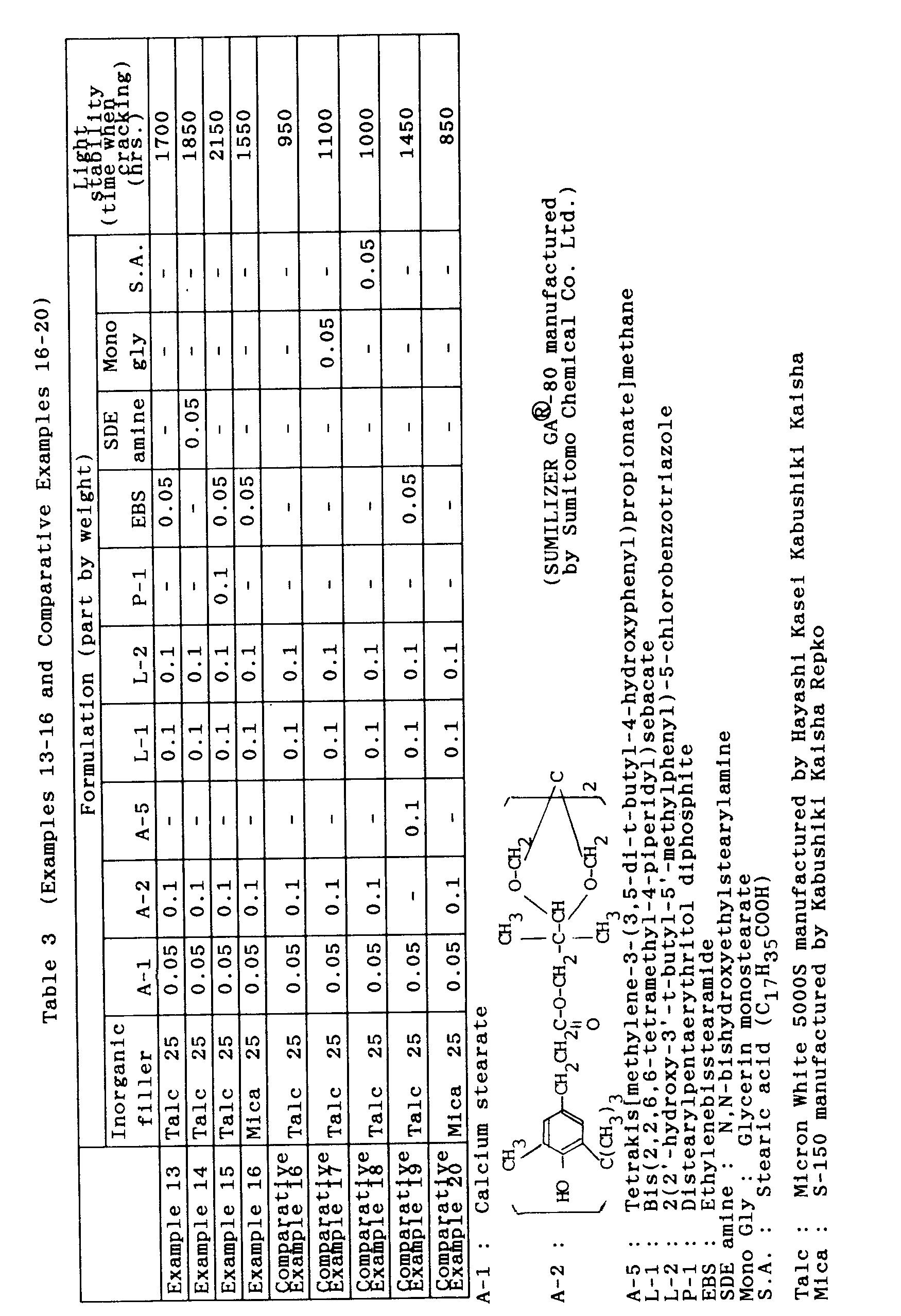
- One hundred parts by weight of powder of crystalline ethylene-propylene block copolymer (ethylene content : 7.2 wt%, melt index : 3.0 g/10 min) and the other components shown by the formulation of Table 3 were melt-kneaded in a banbury mixer at 180 °C for 10 minutes. Then, the resultant mixture was made into a sheet having a thickness of 5 mm by use of a roll and hardened by cooling, and then was pelletized by cutting.
- The obtained pellets were shaped at 230°C into a pressed sheet having a thickness of 1mm. A test specimen having a dimension of 70 mm x 25 mm was punched out of the sheet, and subjected to the accelerated light-resistance test. A time period in which external abnormality such as crackings occurs was measured. The result is shown in Table 3.
- Test specimens were prepared in the same manner as in Examples 13-16 except that the formulations shown in Table 3 were employed.
- The test specimens were subjected to the accelerated light-resistance test. And, time periods in which external abnormality such as crackings occurs were measured.


- One hundred parts by weight of powder of crystalline ethylene-propylene block copolymer (ethylene content : 7.2 wt%, melt index : 3.0 g/10 min) and the other components shown by the formulation of Table 4 were melt-kneaded in a banbury mixer at 180 °C for 10 minutes. Then, the resultant mixture was made into a sheet having a thickness of 5 mm by use of a roll and hardened by cooling, and then was pelletized by cutting.
- The obtained pellets were shaped at 230°C into a pressed sheet having a thickness of 1mm. A disc test specimen having a diameter of 25 mm was punched out of the sheet, and its GO life at 150 °C was measured.
- Another specimen having a dimension of 70 mm x 25 mm was also punched out of the above sheet and subjected to the accelerated light-resistance test. And, a time period in which external abnormality such as crackings occurs was measured.
- The results are shown in Table 4.
- Test specimens were prepared in the same manner as in Examples 17-19 except that the formulations shown in Table 4 were employed.
- Their GO lives at 150 °C were measured. Also, the test specimens were subjected to the accelerated light-resistance test. And, time periods in which external abnormality such as crackings occurs were measured. The results are shown in Table 4.

- Polyolefin has a disadvantage that its thermal-oxidation stability and light stability were considerably lowered by the addition of inorganic fillers.
- However, in accordance with the present invention, such defects have been markedly improved by adding a specific phenolic antioxidant, a specific type of compound, a sulfur antioxidant and a light stabilizer to inorganic-filler containing polyolefins.
Claims (3)
- An inorganic filler-containing polyolefin composition which comprises
100 parts by weight of a polyolefin,
1-100 parts by weight of an inorganic filler which is talc, mica, wollastonite, calcium carbonate, barium sulfate or glass fibres,
0.01-1.0 parts by weight of a phenolic antioxidant represented by the general formula (I) shown below, and
0.01-1.0 parts by weight of at least one compound selected from the group consisting of the compounds represented by the general formulas (II) to (IV) shown below.
(II): R₂-CO-NH-(CH₂)n-HN-CO-R₂
wherein R₂ represents an alkyl group or an alkenyl group of 5-21 carbon atoms, and n is an integer of 1 to 6.
(III): R₃-CONH₂
wherein R₃ represents an alkyl group or an alkenyl group of 5-21 carbon atoms,

- An inorganic filler-containing polyolefin composition of claim 1, which further comprises 0.01-1.0 part by weight of a sulfur antioxidant.
- An inorganic filler-containing polyolefin composition of any of claim 1 and 2, which further comprises 0.01-2.0 parts by weight of a light stabilizer.
Applications Claiming Priority (2)
| Application Number | Priority Date | Filing Date | Title |
|---|---|---|---|
| JP11339088 | 1988-05-09 | ||
| JP113390/88 | 1988-05-09 |
Publications (3)
| Publication Number | Publication Date |
|---|---|
| EP0341925A2 EP0341925A2 (en) | 1989-11-15 |
| EP0341925A3 EP0341925A3 (en) | 1991-10-02 |
| EP0341925B1 true EP0341925B1 (en) | 1994-07-13 |
Family
ID=14611099
Family Applications (1)
| Application Number | Title | Priority Date | Filing Date |
|---|---|---|---|
| EP89304568A Expired - Lifetime EP0341925B1 (en) | 1988-05-09 | 1989-05-05 | An inorganic filler containing polyolefin composition |
Country Status (4)
| Country | Link |
|---|---|
| US (3) | US4985480A (en) |
| EP (1) | EP0341925B1 (en) |
| CA (1) | CA1277078C (en) |
| DE (1) | DE68916701T2 (en) |
Cited By (1)
| Publication number | Priority date | Publication date | Assignee | Title |
|---|---|---|---|---|
| US7259198B2 (en) | 2002-07-18 | 2007-08-21 | Exxonmobil Chemical Patents Inc. | Ultraviolet radiation stabilized polyolefins |
Families Citing this family (14)
| Publication number | Priority date | Publication date | Assignee | Title |
|---|---|---|---|---|
| CA2019884A1 (en) * | 1989-07-07 | 1991-01-07 | Yoshiharu Fukui | Food container |
| JP2831779B2 (en) * | 1990-02-01 | 1998-12-02 | 旭電化工業株式会社 | Polyolefin resin composition |
| US5246777A (en) * | 1990-04-25 | 1993-09-21 | Sumitomo Chemical Company, Limited | Fiber or film formed from a stabilized polyolefin composition |
| JP2803318B2 (en) * | 1990-04-25 | 1998-09-24 | 住友化学工業株式会社 | Stabilized polyolefin composition |
| EP0492463B1 (en) * | 1990-12-21 | 1995-09-27 | Sumitomo Chemical Company Limited | Polyolefin resin composition |
| JP3082333B2 (en) * | 1991-09-03 | 2000-08-28 | 住友化学工業株式会社 | Stabilized polyolefin composition |
| JP3885174B2 (en) * | 1992-09-25 | 2007-02-21 | チバ スペシャルティ ケミカルズ ホールディング インコーポレーテッド | Method for stabilizing single-material recycled plastic and stabilizer mixture therefor |
| JPH06172592A (en) * | 1992-12-09 | 1994-06-21 | Sumitomo Chem Co Ltd | Carbon black-containing polyolefin resin composition |
| US5773503A (en) * | 1996-12-11 | 1998-06-30 | Luzenac America, Inc. | Compacted mineral filler pellet and method for making the same |
| JP3399289B2 (en) * | 1997-04-18 | 2003-04-21 | 住友化学工業株式会社 | Polypropylene resin composition |
| DE19804910A1 (en) * | 1998-02-07 | 1999-08-12 | Clariant Gmbh | Polyolefin molding compound for the production of calendered films / sheets |
| US6538056B1 (en) | 2000-10-10 | 2003-03-25 | Clariant International Ltd. | Polyolefin articles with long-term elevated temperature stability |
| AU2002232477A1 (en) * | 2000-11-02 | 2002-05-15 | Alphagary Corporation | Non-wax drip closure sealant and shell |
| JP4543690B2 (en) * | 2004-02-03 | 2010-09-15 | 住友化学株式会社 | Antioxidants for organic materials |
Family Cites Families (15)
| Publication number | Priority date | Publication date | Assignee | Title |
|---|---|---|---|---|
| US3553158A (en) * | 1968-08-30 | 1971-01-05 | Shell Oil Co | Polymer compositions containing talc filler, polar organic compound and antioxidant |
| JPS5142617B2 (en) * | 1971-11-12 | 1976-11-17 | ||
| NZ186352A (en) * | 1977-02-07 | 1979-06-08 | Ici Ltd | Propylene polymer containing isocyanurate anti oxidant |
| GB1565745A (en) * | 1977-02-07 | 1980-04-23 | Ici Ltd | Stabilisation of propylene polymers containing inorganic additives |
| JPS5474842A (en) * | 1977-11-28 | 1979-06-15 | Oji Yuka Goseishi Kk | Resin composition and synthetic paper containing colorrimproved filler |
| JPS5487745A (en) * | 1977-12-26 | 1979-07-12 | Idemitsu Petrochemical Co | Method of making polypropylene composition |
| JPS55142039A (en) * | 1979-04-23 | 1980-11-06 | Tokuyama Soda Co Ltd | Polypropylene composition |
| JPS5650942A (en) * | 1979-10-03 | 1981-05-08 | Mitsui Toatsu Chem Inc | Antistatic resin composition |
| JPS5690844A (en) * | 1979-12-24 | 1981-07-23 | Toa Nenryo Kogyo Kk | Heat-stable polyolefin composition |
| US4410649A (en) * | 1982-03-31 | 1983-10-18 | Union Carbide Corporation | Ethylene polymer compositions having improved transparency |
| JPS58215436A (en) * | 1982-06-07 | 1983-12-14 | Chisso Corp | Polyethylene composition for thin-walled reinforcing film, said film and production of said film |
| LU85156A1 (en) * | 1983-12-22 | 1985-09-12 | Labofina Sa | ANTISTATIC COMPOSITION FOR SYNTHETIC FIBERS |
| JPS60197747A (en) * | 1984-03-19 | 1985-10-07 | Sumitomo Chem Co Ltd | Stabilizer for synthetic resin |
| JPH0759652B2 (en) * | 1985-08-07 | 1995-06-28 | 住友化学工業株式会社 | Polyolefin resin composition |
| JPS62273239A (en) * | 1986-05-20 | 1987-11-27 | Adeka Argus Chem Co Ltd | Stabilized polyolefin resin composition |
-
1989
- 1989-05-04 CA CA000598766A patent/CA1277078C/en not_active Expired - Lifetime
- 1989-05-05 DE DE68916701T patent/DE68916701T2/en not_active Expired - Lifetime
- 1989-05-05 EP EP89304568A patent/EP0341925B1/en not_active Expired - Lifetime
- 1989-05-08 US US07/348,418 patent/US4985480A/en not_active Expired - Lifetime
-
1990
- 1990-10-31 US US07/606,936 patent/US5086100A/en not_active Expired - Lifetime
- 1990-10-31 US US07/606,940 patent/US5086099A/en not_active Expired - Lifetime
Cited By (1)
| Publication number | Priority date | Publication date | Assignee | Title |
|---|---|---|---|---|
| US7259198B2 (en) | 2002-07-18 | 2007-08-21 | Exxonmobil Chemical Patents Inc. | Ultraviolet radiation stabilized polyolefins |
Also Published As
| Publication number | Publication date |
|---|---|
| DE68916701T2 (en) | 1994-11-03 |
| DE68916701D1 (en) | 1994-08-18 |
| US5086100A (en) | 1992-02-04 |
| US4985480A (en) | 1991-01-15 |
| US5086099A (en) | 1992-02-04 |
| CA1277078C (en) | 1990-11-27 |
| EP0341925A3 (en) | 1991-10-02 |
| EP0341925A2 (en) | 1989-11-15 |
Similar Documents
| Publication | Publication Date | Title |
|---|---|---|
| US5086100A (en) | Inorganic filler containing polyolefin composition | |
| EP0875530B1 (en) | Olefin polymer composition having low smoke generation and fiber and film prepared therefrom | |
| EP0407198B1 (en) | Food container | |
| AU716557B2 (en) | Polymer compositions containing amine oxide stabiliser compositions | |
| US6277907B1 (en) | Thermoplastic resins stabilized by blends of sterically hindered phenols, secondary amines, and thioethers | |
| EP0449685A1 (en) | Stabilized polypropylene resin composition | |
| US4985479A (en) | Stabilized polyolefin composition | |
| US5077328A (en) | Polyolefin resin composition | |
| CA2074870A1 (en) | Stabilized polyolefin composition | |
| EP0226453B2 (en) | Polyolefin composition | |
| CA1262984A (en) | Uv stabilizer system and uv stabilized polyolefins | |
| EP3081589B1 (en) | Base to be coated having improved coating properties | |
| US6777470B2 (en) | Polyolefin additive packages for producing articles with enhanced stain resistance | |
| CA2109663A1 (en) | Polyolefin resin composition containing carbon black | |
| EP0454378B1 (en) | Stabilized polyolefin composition | |
| JP2730165B2 (en) | Inorganic filler-containing polyolefin composition | |
| JP2813891B2 (en) | Food containers | |
| JP2661164B2 (en) | Inorganic filler-containing polyolefin composition | |
| JP2002012720A (en) | Polypropylene resin composition with excellent mold contamination | |
| JPH04185659A (en) | Polypropylene resin bumper material | |
| JP2615829B2 (en) | Thermo-oxidatively stable polyolefin composition | |
| JPH01282233A (en) | Polyolefin composition | |
| JPS62205141A (en) | Stabilizer for use in synthetic polymeric material | |
| JP2000198885A (en) | Olefin-based thermoplastic elastomer composition with excellent molding processability | |
| JPH06271715A (en) | Crystalline polyolefin composition |
Legal Events
| Date | Code | Title | Description |
|---|---|---|---|
| PUAI | Public reference made under article 153(3) epc to a published international application that has entered the european phase |
Free format text: ORIGINAL CODE: 0009012 |
|
| AK | Designated contracting states |
Kind code of ref document: A2 Designated state(s): BE DE FR GB IT NL |
|
| 17P | Request for examination filed |
Effective date: 19901217 |
|
| PUAL | Search report despatched |
Free format text: ORIGINAL CODE: 0009013 |
|
| AK | Designated contracting states |
Kind code of ref document: A3 Designated state(s): BE DE FR GB IT NL |
|
| 17Q | First examination report despatched |
Effective date: 19930212 |
|
| GRAA | (expected) grant |
Free format text: ORIGINAL CODE: 0009210 |
|
| ITF | It: translation for a ep patent filed | ||
| AK | Designated contracting states |
Kind code of ref document: B1 Designated state(s): BE DE FR GB IT NL |
|
| REF | Corresponds to: |
Ref document number: 68916701 Country of ref document: DE Date of ref document: 19940818 |
|
| ET | Fr: translation filed | ||
| PLBE | No opposition filed within time limit |
Free format text: ORIGINAL CODE: 0009261 |
|
| STAA | Information on the status of an ep patent application or granted ep patent |
Free format text: STATUS: NO OPPOSITION FILED WITHIN TIME LIMIT |
|
| 26N | No opposition filed | ||
| PGFP | Annual fee paid to national office [announced via postgrant information from national office to epo] |
Ref country code: GB Payment date: 20010502 Year of fee payment: 13 |
|
| PGFP | Annual fee paid to national office [announced via postgrant information from national office to epo] |
Ref country code: FR Payment date: 20010518 Year of fee payment: 13 |
|
| PGFP | Annual fee paid to national office [announced via postgrant information from national office to epo] |
Ref country code: NL Payment date: 20010531 Year of fee payment: 13 |
|
| PGFP | Annual fee paid to national office [announced via postgrant information from national office to epo] |
Ref country code: BE Payment date: 20010625 Year of fee payment: 13 |
|
| REG | Reference to a national code |
Ref country code: GB Ref legal event code: IF02 |
|
| PG25 | Lapsed in a contracting state [announced via postgrant information from national office to epo] |
Ref country code: GB Free format text: LAPSE BECAUSE OF NON-PAYMENT OF DUE FEES Effective date: 20020505 |
|
| PG25 | Lapsed in a contracting state [announced via postgrant information from national office to epo] |
Ref country code: BE Free format text: LAPSE BECAUSE OF NON-PAYMENT OF DUE FEES Effective date: 20020531 |
|
| PG25 | Lapsed in a contracting state [announced via postgrant information from national office to epo] |
Ref country code: NL Free format text: LAPSE BECAUSE OF NON-PAYMENT OF DUE FEES Effective date: 20021201 |
|
| GBPC | Gb: european patent ceased through non-payment of renewal fee |
Effective date: 20020505 |
|
| PG25 | Lapsed in a contracting state [announced via postgrant information from national office to epo] |
Ref country code: FR Free format text: LAPSE BECAUSE OF NON-PAYMENT OF DUE FEES Effective date: 20030131 |
|
| NLV4 | Nl: lapsed or anulled due to non-payment of the annual fee |
Effective date: 20021201 |
|
| REG | Reference to a national code |
Ref country code: FR Ref legal event code: ST |
|
| PG25 | Lapsed in a contracting state [announced via postgrant information from national office to epo] |
Ref country code: IT Free format text: LAPSE BECAUSE OF NON-PAYMENT OF DUE FEES Effective date: 20050505 |
|
| PGFP | Annual fee paid to national office [announced via postgrant information from national office to epo] |
Ref country code: DE Payment date: 20080508 Year of fee payment: 20 |