EP0341874B1 - Elastisches Filtermaterial - Google Patents
Elastisches Filtermaterial Download PDFInfo
- Publication number
- EP0341874B1 EP0341874B1 EP89304320A EP89304320A EP0341874B1 EP 0341874 B1 EP0341874 B1 EP 0341874B1 EP 89304320 A EP89304320 A EP 89304320A EP 89304320 A EP89304320 A EP 89304320A EP 0341874 B1 EP0341874 B1 EP 0341874B1
- Authority
- EP
- European Patent Office
- Prior art keywords
- filter media
- fibers
- elastomeric
- filter
- basis weight
- Prior art date
- Legal status (The legal status is an assumption and is not a legal conclusion. Google has not performed a legal analysis and makes no representation as to the accuracy of the status listed.)
- Expired - Lifetime
Links
- 238000001914 filtration Methods 0.000 title claims description 23
- 239000000463 material Substances 0.000 title description 15
- 239000000835 fiber Substances 0.000 claims description 78
- 238000011045 prefiltration Methods 0.000 claims description 20
- 229920000728 polyester Polymers 0.000 claims description 11
- 229920001169 thermoplastic Polymers 0.000 claims description 10
- 239000004416 thermosoftening plastic Substances 0.000 claims description 10
- 239000012530 fluid Substances 0.000 claims description 9
- 229920002635 polyurethane Polymers 0.000 claims description 8
- 239000004814 polyurethane Substances 0.000 claims description 8
- 239000000356 contaminant Substances 0.000 claims description 4
- 239000004677 Nylon Substances 0.000 claims description 3
- 229920001778 nylon Polymers 0.000 claims description 3
- 239000004952 Polyamide Substances 0.000 claims description 2
- NIXOWILDQLNWCW-UHFFFAOYSA-N acrylic acid group Chemical group C(C=C)(=O)O NIXOWILDQLNWCW-UHFFFAOYSA-N 0.000 claims description 2
- 229920001400 block copolymer Polymers 0.000 claims description 2
- 229920002647 polyamide Polymers 0.000 claims description 2
- 229920000098 polyolefin Polymers 0.000 claims description 2
- 238000012360 testing method Methods 0.000 description 14
- 239000003973 paint Substances 0.000 description 10
- 239000004743 Polypropylene Substances 0.000 description 9
- VYPSYNLAJGMNEJ-UHFFFAOYSA-N Silicium dioxide Chemical compound O=[Si]=O VYPSYNLAJGMNEJ-UHFFFAOYSA-N 0.000 description 9
- 239000011347 resin Substances 0.000 description 9
- 229920005989 resin Polymers 0.000 description 9
- MQIUGAXCHLFZKX-UHFFFAOYSA-N Di-n-octyl phthalate Natural products CCCCCCCCOC(=O)C1=CC=CC=C1C(=O)OCCCCCCCC MQIUGAXCHLFZKX-UHFFFAOYSA-N 0.000 description 8
- 239000000443 aerosol Substances 0.000 description 8
- BJQHLKABXJIVAM-UHFFFAOYSA-N bis(2-ethylhexyl) phthalate Chemical compound CCCCC(CC)COC(=O)C1=CC=CC=C1C(=O)OCC(CC)CCCC BJQHLKABXJIVAM-UHFFFAOYSA-N 0.000 description 8
- -1 for example Substances 0.000 description 8
- 239000004922 lacquer Substances 0.000 description 8
- 238000000034 method Methods 0.000 description 8
- 239000002245 particle Substances 0.000 description 8
- 239000007921 spray Substances 0.000 description 8
- 229920001155 polypropylene Polymers 0.000 description 7
- XAGFODPZIPBFFR-UHFFFAOYSA-N aluminium Chemical compound [Al] XAGFODPZIPBFFR-UHFFFAOYSA-N 0.000 description 6
- 229910052782 aluminium Inorganic materials 0.000 description 6
- 239000004744 fabric Substances 0.000 description 6
- 239000003517 fume Substances 0.000 description 6
- 230000035515 penetration Effects 0.000 description 6
- 230000000052 comparative effect Effects 0.000 description 5
- 239000004593 Epoxy Substances 0.000 description 4
- 239000011152 fibreglass Substances 0.000 description 4
- 238000007711 solidification Methods 0.000 description 4
- 230000008023 solidification Effects 0.000 description 4
- 238000010276 construction Methods 0.000 description 3
- 210000003298 dental enamel Anatomy 0.000 description 3
- 238000004519 manufacturing process Methods 0.000 description 3
- 238000011160 research Methods 0.000 description 3
- 238000007664 blowing Methods 0.000 description 2
- 230000001427 coherent effect Effects 0.000 description 2
- 229920001971 elastomer Polymers 0.000 description 2
- 239000002320 enamel (paints) Substances 0.000 description 2
- 239000011236 particulate material Substances 0.000 description 2
- 229920000515 polycarbonate Polymers 0.000 description 2
- 239000004417 polycarbonate Substances 0.000 description 2
- 229920000379 polypropylene carbonate Polymers 0.000 description 2
- 239000007787 solid Substances 0.000 description 2
- 231100000331 toxic Toxicity 0.000 description 2
- 230000002588 toxic effect Effects 0.000 description 2
- 230000004584 weight gain Effects 0.000 description 2
- 235000019786 weight gain Nutrition 0.000 description 2
- 229920002972 Acrylic fiber Polymers 0.000 description 1
- JOYRKODLDBILNP-UHFFFAOYSA-N Ethyl urethane Chemical compound CCOC(N)=O JOYRKODLDBILNP-UHFFFAOYSA-N 0.000 description 1
- 239000004433 Thermoplastic polyurethane Substances 0.000 description 1
- 230000002745 absorbent Effects 0.000 description 1
- 239000002250 absorbent Substances 0.000 description 1
- 239000011358 absorbing material Substances 0.000 description 1
- 238000004026 adhesive bonding Methods 0.000 description 1
- 239000010425 asbestos Substances 0.000 description 1
- 239000011230 binding agent Substances 0.000 description 1
- 230000003247 decreasing effect Effects 0.000 description 1
- 238000013461 design Methods 0.000 description 1
- 238000011161 development Methods 0.000 description 1
- 238000009826 distribution Methods 0.000 description 1
- 239000000428 dust Substances 0.000 description 1
- 230000000694 effects Effects 0.000 description 1
- 239000000806 elastomer Substances 0.000 description 1
- 238000011156 evaluation Methods 0.000 description 1
- 239000002657 fibrous material Substances 0.000 description 1
- 230000009931 harmful effect Effects 0.000 description 1
- 238000010438 heat treatment Methods 0.000 description 1
- 238000010348 incorporation Methods 0.000 description 1
- 238000009434 installation Methods 0.000 description 1
- 230000003993 interaction Effects 0.000 description 1
- WABPQHHGFIMREM-UHFFFAOYSA-N lead(0) Chemical compound [Pb] WABPQHHGFIMREM-UHFFFAOYSA-N 0.000 description 1
- 239000011159 matrix material Substances 0.000 description 1
- 239000000155 melt Substances 0.000 description 1
- 239000000203 mixture Substances 0.000 description 1
- 239000004745 nonwoven fabric Substances 0.000 description 1
- 239000013618 particulate matter Substances 0.000 description 1
- 230000035699 permeability Effects 0.000 description 1
- 230000002085 persistent effect Effects 0.000 description 1
- 229920000642 polymer Polymers 0.000 description 1
- 229920006306 polyurethane fiber Polymers 0.000 description 1
- 239000011148 porous material Substances 0.000 description 1
- 230000000717 retained effect Effects 0.000 description 1
- 229910052895 riebeckite Inorganic materials 0.000 description 1
- 239000000377 silicon dioxide Substances 0.000 description 1
- 239000002594 sorbent Substances 0.000 description 1
- 238000010998 test method Methods 0.000 description 1
- 239000012815 thermoplastic material Substances 0.000 description 1
- 229920002803 thermoplastic polyurethane Polymers 0.000 description 1
- 239000002341 toxic gas Substances 0.000 description 1
- 238000003466 welding Methods 0.000 description 1
Images

Classifications
-
- B—PERFORMING OPERATIONS; TRANSPORTING
- B01—PHYSICAL OR CHEMICAL PROCESSES OR APPARATUS IN GENERAL
- B01D—SEPARATION
- B01D39/00—Filtering material for liquid or gaseous fluids
- B01D39/14—Other self-supporting filtering material ; Other filtering material
- B01D39/16—Other self-supporting filtering material ; Other filtering material of organic material, e.g. synthetic fibres
- B01D39/1607—Other self-supporting filtering material ; Other filtering material of organic material, e.g. synthetic fibres the material being fibrous
- B01D39/1623—Other self-supporting filtering material ; Other filtering material of organic material, e.g. synthetic fibres the material being fibrous of synthetic origin
-
- A—HUMAN NECESSITIES
- A62—LIFE-SAVING; FIRE-FIGHTING
- A62B—DEVICES, APPARATUS OR METHODS FOR LIFE-SAVING
- A62B23/00—Filters for breathing-protection purposes
- A62B23/02—Filters for breathing-protection purposes for respirators
- A62B23/025—Filters for breathing-protection purposes for respirators the filter having substantially the shape of a mask
-
- D—TEXTILES; PAPER
- D04—BRAIDING; LACE-MAKING; KNITTING; TRIMMINGS; NON-WOVEN FABRICS
- D04H—MAKING TEXTILE FABRICS, e.g. FROM FIBRES OR FILAMENTARY MATERIAL; FABRICS MADE BY SUCH PROCESSES OR APPARATUS, e.g. FELTS, NON-WOVEN FABRICS; COTTON-WOOL; WADDING ; NON-WOVEN FABRICS FROM STAPLE FIBRES, FILAMENTS OR YARNS, BONDED WITH AT LEAST ONE WEB-LIKE MATERIAL DURING THEIR CONSOLIDATION
- D04H1/00—Non-woven fabrics formed wholly or mainly of staple fibres or like relatively short fibres
- D04H1/40—Non-woven fabrics formed wholly or mainly of staple fibres or like relatively short fibres from fleeces or layers composed of fibres without existing or potential cohesive properties
- D04H1/54—Non-woven fabrics formed wholly or mainly of staple fibres or like relatively short fibres from fleeces or layers composed of fibres without existing or potential cohesive properties by welding together the fibres, e.g. by partially melting or dissolving
- D04H1/56—Non-woven fabrics formed wholly or mainly of staple fibres or like relatively short fibres from fleeces or layers composed of fibres without existing or potential cohesive properties by welding together the fibres, e.g. by partially melting or dissolving in association with fibre formation, e.g. immediately following extrusion of staple fibres
Definitions
- the present invention relates to nonwoven fibrous filter media which are particularly useful as prefilters on respirators.
- U.S. Patent No. 3,971,373 discloses a particle-loaded small diameter fiber sheet product and respirators made therefrom.
- the sheet product comprises a uniform three-dimensional arrangement of discrete solid particles uniformly dispersed in a web of melt-blown small diameter fibers. The particles are physically held in the web, even though there is only point contact between the small diameter fibers and the particles, whereby the full surface of the particles is available for interaction with a medium to which the sheet product is exposed.
- U.S. Patent No. 4,215,682 discloses a fibrous web electret which comprises melt-blown fibers prepared by extruding molten fiber-forming material through orifices into a high-velocity gaseous stream where the extruded material is drawn out into fiber and solidified in the fibrous form, the fibers having electrically charged particles and a persistent electric charge that is useful to enhance filtering properties of the web, the charge having a half-life of at least one week in a room-temperature, 100-percent-relative-humidity environment.
- U.S. Patent No. 4,294,599 discloses an aerosol filter cartridge employing a prefilter having the form of a closely spiraled Fiberglas mat functioning to distribute captured aerosol particles substantially uniformly therethrough.
- the Fiberglas mat is placed edgewise against the final filtering components of the cartridge.
- U.S. Patent No. 4,334,901 discloses a respirator cartridge which is designed to eliminate the traditional screen between the perforated cartridge bottom and its adjacent filter component, substitute Fiberglas for one of the usual two wool-felt components and minimize filter component-to-shell cementing operations along with reshaping of the initial aerosol contacting filter component for effecting greater than usual distribution of aerosol loading and lower inhalation resistance.
- U.S. Patent No. 4,600,002 discloses a multiple ply, fold-flat, disposable respirator having, as one ply, a layer of a toxic gas or vapor absorbing material, and as another ply, an aerosol filter.
- the respirator has an inturned vertical seam covered with a strip of foamed elastomer.
- U.S. Patent No. 4,662,005 discloses a pouch-like conformable face mask which includes a generally rectangular body portion formed from a filtration medium and having top and bottom edge portions and a pair of opposed side portions. An elastically extendible material is located at the periphery of the side and bottom edge portions of the generally rectangular body portion,mask to gather into a pouch or cup-like configuration.
- U.S. Patent No. Re. 32,171 discloses an electret fibrous web which is prepared by continuously feeding a film of highly molecular non-polar material; heating the film; stretching the film along the longitudinal axis thereof as defined by the path of movement of the film; homopolarly electrically charging at lease one aide of the film; fibrillating the charged film into fober material; and collecting the fiber material.
- the present invention provides elastomeric nonwoven fibrous fluid filter media for removal of particulate contaminants from the fluid comprising thermoplastic elastomeric melt-blown small diameter fibers of specific diameter, the small diameter fibers being randomly arrayed, the filter media having a specific basis weight and having substantially uniform stretch properties in all directions, whose filtration properties are independent of filter media elongations sufficient to increase the filter media surface area at least 10 percent, preferably at least 25 percent, more preferably at least 40 percent.
- the elastomeric filter media of the present invention have utility as low pressure drop filter and prefilter materials or as tubular fluid filters.
- the filter media may further comprise a variety of mixtures of fibers and/or particulate material such as, for example, absorbent particulate, staple fibers, or electrically charged fibrils.
- the present invention further provides a respirator having as a low pressure drop prefilter thereon for removal of particulate fluid contaminants elastomeric nonwoven fibrous fluid filter media comprising thermoplastic elastomeric melt-blown small diameter fibers of specific diameter, the small diameter fibers being randomly arrayed, the filter media having a specific basis weight and having substantially uniform stretch properties in all directions, whose filtration properties are independent of filter media elongations sufficient to increase the filter media surface area at least 10 percent.
- the filtration performance of the filter media of the present invention remains substantially constant when the media is subjected to mechanical stresses which increased their area. This is particularly surprising in that the filter media becomes thinner when stretched and the geometry of the open area of the media is significantly altered as the filter media is stretched.
- the comparatively constant filtration performance might be expected with minor extensions which produce increases of 3 or 4 percent in the total area of the filter, but such comparatively constant filtration performance is totally unexpected with extensions that produced increases in excess of 40 percent in the area of the filter.
- Filtration performance which is substantially independent of the degree of elongation of the filter media coupled with a low pressure drop on loading enables the elastomeric filter media of the present invention to function very effectively as prefilter materials.
- the inherent elasticity and conformability of the filter media and the ability to seal against a range of complex filter holders without elaborate adapters makes the elastomeric filter media of the present invention a very versatile and economic prefilter material.
- the filter media of the present invention are elastic, and hence are not subject to catastrophic failure on experiencing comparatively small mechanical stresses, i.e., 5 percent or less increase in area, as are nonwoven filter media prepared from polypropylene and polycarbonate materials. Also, because of their elastic properties and associated toughness as compared to the inelastic polypropylene and polycarbonate media, they require little, if any, additional support or protection, such as, for example, as occur in laminated structures.
- the elastic properties of the filter media also enable the filter media to seal against a filtration fixture simply by stretching the filter media over a smooth edge of the filtration fixture.
- FIG. 1 is a single-piece prefilter element based on the elastomeric filter media of the present invention.
- FIG. 2 is a cross-sectional view of the prefilter element of FIG. 1 taken along line 1-1 of FIG. 1.
- FIG. 3 is the prefilter illustrated in Figure 1 installed on a respirator.
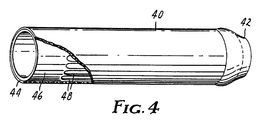
- FIG. 4 tubular elastic filter mounted on a filter tube.
- the nonwoven elastomeric filter media of the present invention are based on melt blown webs of thermoplastic elastomeric small diameter fibers.
- Elastomeric thermoplastic materials from which the small diameter fiber webs can be prepared include, for example, elastomeric polyurethanes, elastomeric polyesters, elastomeric polyamides and elastomeric A-B-A′ block copolymers wherein A and A′ are styrenic moieties and B is an elastomeric midblock.
- Filtration properties of the elastomeric filter media of the present invention can be tailored over a wide range through selection of the appropriate melt blown fiber size or by uniform incorporation of crimped spacing staple fibers, or electrically charged or chargeable fibers or fibrous clusters into the web matrix. Sorbent particulate material may also be incorporated in the web.
- Crimped spacing staple fibers are preferably included in the filter media to reduce the pressure drop during use and to decrease caking of the filter media by the material being filtered as well as to provide filtration.
- Useful crimped spacing fibers include, for example, acrylic, polyester, nylon and polyolefin fibers. Polyester and acrylic fibers are particularly preferred.
- the crimped spacing fibers are preferably incorporated at loading levels of from 10 to 60 weight percent, more preferably 25 to 35 weight percent of the filter media.
- the crimped spacing fibers preferably are 1.5 to 15 , more preferably 4 to 6, denier in size and have an average staple length sufficient to include at least one complete crimp, more preferably at least three or four crimps.
- the crimped spacing fibers should average 2 to 15 centimeters in length.
- the crimped spacing fibers are less than 5 centimeters in length.
- the ability of the elastomeric filter media to remove small particulate matter from an air stream can be dramatically improved by incorporating into the filter media charged fibers, i.e., fibrillated polypropylene fibers such as those described in U.S. Patent No. 4,588,537 (Klasse et al.).
- charged fibers i.e., fibrillated polypropylene fibers such as those described in U.S. Patent No. 4,588,537 (Klasse et al.).
- Such charged fibers also can serve as spacing fibers to reduce pressure drops during particulate filtration.
- the amount of charged fibers incorporated in the filter media is in the range of 10 to 60 weight percent, more preferably in the range of 25 to 35 weight percent.
- Elastic properties of the filter media are controlled by the size of the fiber making up the filter media, the amounts of various types of fibers in the filter media and the basis weight of the web.
- the elastomeric small diameter fibers have diameters of from 1 »m to 50 »m, more preferably from 5 »m to 30 »m. When the diameter of the small diameter fibers is less than 1 »m, the web may lack sufficient tensile strength. When the diameter of the small diameter fibers is greater than 50 »m, filtration properties may be reduced.
- the basis weight of the web is also a major factor in controlling the elastic properties of the filter media. Higher basis weight webs are typically used for applications requiring higher tensions or higher filtration properties while lower basis weight webs are utilized for applications requiring low tensions. Web basis weights are in the range of from 15 to about 300 grams/m2, preferably in the range of from 100 to 200 gm/m2. As was the case with the fiber diameter, the specific application will determine the optimum web basis weight.
- the filter media of the invention preferably has a tensile strength of at least 0.5 g/2.5 cm width/g/m2 basis weight, more preferably at least 2 g/2.5 cm width/g/m2 basis weight.
- the filter media may tear during attachment to a fixture or respirator.
- the filter media of the invention preferably has an elongation at break of at least 50%, more preferably at least 100%.
- the filter media may rupture during use, e.g., when being stretched over a respirator as a prefilter.
- the filter media of the present invention can be prepared by a process similar to that taught in Wente, Van A., "Superfine Thermoplastic Fibers” in Industrial Engineering Chemistry, Vol. 48, pages 1342 et seq (1956), or in Report No. 4364 of the Naval Research Laboratories, published May 25, 1954 entitled “Manufacture of Superfine Organic Fibers” by Wente, Van A., Boone, C.D. and Fluharty, E.L. except that a circular orifice die is preferably used.
- the thermoplastic elastomeric materials are extruded through the die into a high velocity stream of heated air which draws out and attenuates the fibers prior to their solidification and collection.
- Loading of the elastomeric melt blown webs with crimped spacing staple fibers or fibrous clusters can be achieved by gently introducing a secondary air stream containing the staple fibers or fibrous clusters into the primary air stream carrying the extruded fibers in a manner similar to that described in U.S. Patent No. 4,118,531 (Hauser), at a point where the fibers are still in a tacky condition.
- the secondary air stream which typically has a velocity of from 10 to 50 m/sec, intersects the primary air stream, which typically has a velocity of from 100 to 180 m/sec, in a substantially perpendicular manner.
- the thus-loaded fiber stream can then be collected in a random fashion such as, for example, on a perforated screen cylinder, prior to complete fiber solidification so that the fibers can form a coherent web which does not require additional binders. It is suspected that some adhesive bonding between fibers at points of contact may occur between fibers when they contact each other prior to complete solidification.
- FIG. 1 is an illustration of a single piece prefilter element 10 utilizing the elastomeric filter media of the present invention.
- the element 10 which is slightly undersized for the filter area it is intended to protect as a prefilter, can be shaped to accommodate exhalation valves or other critical elements of a respirator.
- the element is retained over the filter area of the respirator in a stretched condition by means of the attachment eyelets 12 which fit over mounting posts on the respirator body.
- the eyelets typically are reinforced by densifying the filter media in the area immediately around the eyelet by means of heat and pressure.
- a cross-sectional view of the prefilter element is shown in FIG. 2.
- FIG. 3 illustrates installation of the prefilter element shown in FIG. 1 on a respirator which involves a number of complex design elements.
- the respirator 20 has a substantially spherical shape which would typically require a complex adapter arrangement to seal a non-elastic prefilter element against the respirator.
- the prefilter element 10 based on the elastomeric filter media of the present invention is readily sealed against this complex structure by means of a four point attachment to the respirator.
- the attachment eyelets 12 are simply slipped over the attachment posts 22 which cause the prefilter element to be stretched and tightly conform to the contours of the respirator, thereby effecting a seal between the prefilter element and the respirator.
- a further useful application for the filter media of the invention is as a tubular elastic filter for a filter tube as shown in FIG. 4.
- Tubular elastic filter 40 which has a sealed end 42 and an open end 44 is slightly smaller in diameter than filter tube 46 which has openings or perforations 48.
- the tubular elastic filter is merely stretched over the filter tube and is form-fitted due to its smaller diameter.
- Model Q127 DOP PenetrometerTM set at a flow rate of 32 liters/minute and generating an aerosol of 0.3 micron DOP particles at a mass concentration of 100 mg/m3. The initial filter weight, area stretch, DOP penetration, pressure drop are reported.
- Lead Fume Removal (30 C.F.R. Part 11, Subpart M, NIOSH Regulations): A sample of filter media is mounted on an aluminum cylinder (9.28 cm diameter, 5 cm high) hermetically mounted on a 0.64 cm thick fiber glass/resin board which had a 29/42 standard taper epoxy fitting centrally positioned below the cylinder and hermetically sealed to the Fiberglas/resin board.
- Spray Paint Removal (30 C.F.R. Part 11, Subpart L, NIOSH Regulations): Enamel paint: A sample of filter media is mounted on an aluminum cylinder (9.28 cm diameter, 5 cm high) hermetically mounted on a 0.64 cm thick fiber glass/resin board which had a 29/42 standard taper epoxy fitting centrally positioned below the cylinder and hermetically sealed to the Fiberglas/resin board.
- Lacquer-based paint A sample of filter media is mounted on an aluminum cylinder (9.28 cm diameter, 5 cm high) hermetically mounted on a 0.64 cm thick fiber glass/resin board which had a 29/42 standard taper epoxy fitting centrally positioned below the cylinder and hermetically sealed to the Fiberglas/resin board. The sample was exposed to a lacquer-based paint challenge of 95-125 mg/m3 at a flow of 16 liters/minute for 156 minutes. The area stretch, amount filtered, initial pressure drop, and final pressure drop are reported.
- Filter media having multi-directional elastic properties were prepared by melt blowing PS-455-200, a polyesterurethane thermoplastic elastomeric resin available from K.J. Quinn Co., Malden, MA, using a process similar to that described in Wente, Van A., "Superfine Thermoplastic Fibers” in Industrial Engineering Chemistry, Vol. 48, pages 1342 et seq (1965) or in Report No. 4364 of the Naval Research Laboratories, published May 25, 1964 entitled “Manufacture of Superfine Organic Fibers” by Wente, Van A., Boone, C.D., and Fluharty, E.L.
- melt-blowing die had smooth surfaced circular orifices (10/cm) with a 5:1 length-to-diameter ratio.
- the die temperature was maintained at 220°C
- the primary air temperature and pressure were, respectively, 230°C and 150 kPa, (0.63 cm gap width)
- the polymer throughput rate was about 150 gm/hr/cm.
- Secondary fibers were loaded into the polyurethane web by dispersing polyester staple fibers (5.5 denier, 3.75 cm in length) in a secondary air stream and impinging that air stream into the primary air stream carrying the polyurethane fiber stream in a process similar to that described in U.S. Patent No. 4,118,531 (Hauser), at a point where the fibers were still in a tacky condition.
- the secondary air stream intersected the primary air stream in a substantially perpendicular manner.
- the thus-loaded fiber stream was collected in a random manner on a perforated screen cylinder prior to complete fiber solidification so that the fibers were able to bond to one another and form a coherent web.
- the basis weight of the polyurethane web was 100 gm/m2 and the polyester staple fiber was added to the polyurethane web at a rate of 40 gm/m2 to produce a filter media having a basis weight of about 140 gm/m2.
- Circular test samples (14.6 cm in diameter) were die cut from both the polyurethane based filter media and the control polypropylene media and marked with three concentric circles having diameters of 7.72, 8.44 and 9.28 cm respectively using a stencil as a guide.
- the outer circle coincided with the diameter of the test holder and the middle and inner circles corresponded to indicia for 10 and 20 percent diametrical (21 and 44 percent area) extension, respectively, as the filter media was stretched over the filter holder until the circle coincided with the edge of the holder.
- the basis weight of the filter media decreased to 82.6 percent of the original value, or 115.6 gm/m2 with the 10 percent extension and to 69.5 percent of the original value, or 97.3 gm/m2 with the 20 percent extension.
- the thickness of the filter media was also measured on an unstretched sample and on samples at 10% extension and 20% extension.
- the samples were mounted as described above except that a solid polished nylon surface was placed beneath the sample and a controlled surface pressure of 0.69 kPa (0.1 psi) was applied to the filter media surface.
- the thickness was measured using a Mitutoyo No. 192-116 depth gauge and a Starrett No. 711 dial indicator. The initial thickness was 0.23 cm; the thickness at 10% extension (21% area increase) was 0.19 cm; and the thickness at 20% extension (44% area increase) was 0.15 cm.
- Example 1 A commercially available elastomeric polyurethane web KaneboTM type ES25, available from Kanebo Company, Japan, having a basis weight of 20 g/m2 was tested for spray paint removal. Seven layers of web were used to achieve a basis weight comparable to the the filter media of Example 1. The results are reported in Table IV.
- Table I Example 1
- Example 2 Example 3
- the lead fume removal data presented in Table II shows similar filtration performance for all degrees of elongation of the filter media and also a low pressure drop increase during the test. This data suggests that the filter media constructions tested would have utility as prefilters to remove a portion of lead particulate from air without a significant increase in pressure drop.
- Example 7 Example 8 Example 9 Initial filter weight (g): 2.7144 2.6378 2.6059 Area stretch (%): 0 21 44 Filter weight gain1 (mg): 50.4 50.15 51.10 Silica penetration1 (mg): 51.82 53.68 56.12 Initial pressure drop2 (mm H2O): 1.55 1.45 1.20 Final pressure drop2 (mm H2O): 3.15 3.10 2.85 1 Determined at a flow rate of 16 lpm 2 Determined at a flow rate of 42.5 lpm
- the silica dust removal data presented in Table III shows similar performance for all degrees of elongation of the filter media and a low pressure drop increase during the test. This data suggests, as did the lead fume removal data, that the filter media constructions tested would have utility as prefilters to remove a portion of a particulate from air without a significant increase in pressure drop.
- Table IV Enamel test Example Area stretch (%) Amount filtered (%) Initial pressure drop (mm H2O) Final pressure drop (mm H2O) 10 0 46 0.6 0.7 11 21 49 0.9 1.0 12 44 51 0.8 1.0 Comp.
- Filter media was prepared as in Examples 1-15 except the polyester fiber was replaced with 50 g/m2 of a fibrillated, charged polypropylene film (FiltreteTM, available from Filtrete Company) to produce filter media with a basis weight of 150 g/m2.
- the filter media was subjected to a lacquer paint spray test. The results are set forth in Table V.
- Table V Example Area stretch (%) Amount filtered (%) Initial pressure drop (mm H2O) Final pressure drop (mm H2O) 16 0 99 1 17 17 21 98 1 58
- elastomeric filter media was prepared as in Examples 1-15 except, in Example 18, the amount of polyester staple fiber was increased to 45 g/m2 to produce a filter media basis weight of 145 g/m2 and, in Example 19, the polyester staple fiber was replaced with 50 g/m2 of a fibrillated, charged polypropylene film (FiltreteTM, available from Filtrete Company) to produce filter media with a basis weight of 150 g/m2.
- FiltreteTM fibrillated, charged polypropylene film
- Each filter media was tested for lacquer paint spray removal using 30 C.F.R. 11, Subpart L. The test results are set forth in Table VI. Table VI Example Area stretch (%) Amount filtered (%) Initial pressure drop (mm H2O) Final pressure drop (mm H2O) 18 0 64 12 57 19 0 98 12 58
Landscapes
- Chemical & Material Sciences (AREA)
- Chemical Kinetics & Catalysis (AREA)
- Engineering & Computer Science (AREA)
- Textile Engineering (AREA)
- Health & Medical Sciences (AREA)
- General Health & Medical Sciences (AREA)
- Business, Economics & Management (AREA)
- Emergency Management (AREA)
- Filtering Materials (AREA)
- Respiratory Apparatuses And Protective Means (AREA)
- Nonwoven Fabrics (AREA)
Claims (18)
- Elastomeres, nichtgewebtes faseriges Fluidfiltermittel zur Entfernung von partikulären Kontaminanten aus dem Fluid, umfassend thermoplastische, elastomere, aus der Schmelze geblasene Fasern mit kleinem Durchmesser, deren Durchmesser von 1 Mikrometer bis 50 Mikrometer beträgt, wobei die Fasern mit kleinem Durchmesser wahllos angeordnet sind, das Filtermittel ein Flächengewicht im Bereich von 15 ... 300 g/m² aufweist, mit im wesentlichen in allen Richtungen gleichförmigen Streckeigenschaften, und dessen Filtriereigenschaften unabhängig sind von Filtermitteldehnungen, ausreichend, um die Filtermitteloberfläche um mindestens 10 Prozent zu vergrößern.
- Filtermittel nach Anspruch 1, bei welchem die thermoplastischen, elastomeren, aus der Schmelze geblasenen Fasern mit kleinen Durchmessern elastomere Polyurethane, elastomere Polyester, elastomere Polyamide und elastomere A-B-A'-Block-Copolymere umfassen, bei denen A und A' Styrolgruppen sind und B ein elastomerer Mittelblock ist.
- Filtermittel nach einem der vorgenannten Ansprüche, bei welchem die Fasern mit kleinem Durchmesser Durchmesser von 5 Mikrometer bis 30 Mikrometer aufweisen.
- Filtermittel nach einem der vorgenannten Ansprüche, bei welchem das Filtermittel ein Flächengewicht im Bereich von 100 ... 200 g/m² aufweist.
- Filtermittel nach einem der vorgenannten Ansprüche, bei welchem das Filtermittel eine Zugfestigkeit von mindestens 0,5 g/2,5 cm Breite / g/m² Flächengewicht aufweist.
- Filtermittel nach einem der Ansprüche 1 bis 5, bei welchem das Filtermittel eine Zugfestigkeit von mindestens 2 g/2,5 cm Breite / g/m² Flächengewicht aufweist.
- Filtermittel nach einem der vorgenannten Ansprüche, bei welchem das Filtermittel eine Bruchdehnung von mindestens 50 % hat.
- Filtermittel nach einem Ansprüche 1 bis 6, bei welchem das Filtermittel eine Bruchdehnung von mindestens 100 % hat.
- Filtermittel nach einem der vorgenannten Ansprüche, bei welchem das Filtermittel ferner beabstandende Kräuselstapelfasern aufweist.
- Filtermittel nach Anspruch 9, bei welchem die beabstandenden Kräuselstapelfasern Fasern aus Polyacryl, Polyester, Nylon oder Polyolefin umfassen.
- Filtermittel nach einem der Ansprüche 9 bis 10, bei welchem die beabstandenden Kräuselfasern 10 % bis 60 Gewichtsprozent des Filtermittels umfassen.
- Filtermittel nach einem der Ansprüche 9 bis 11, bei welchem die beabstandenden Kräuselfasern eine Größe von 1,5 bis 15 Denier haben.
- Filtermittel nach einem der Ansprüche 9 bis 12, bei welchem die beabstandenden Kräuselfasern eine mittlere Stapellänge aufweisen, die zum Einbeziehen von mindestens einer vollständigen Kräuselung ausreichend ist.
- Filtermittel nach einem der Ansprüche 9 bis 13, bei welchem die beabstandenden Kräuselstapelfasern mindestens drei oder vier Kräuselungen aufweisen.
- Filtermittel nach einem der Ansprüche 9 bis 14, bei welchem die beabstandenden Kräuselfasern eine mittlere Länge von 2 bis 15 cm haben.
- Filtermittel nach einem der vorgenannten Ansprüche, bei welchem das Filtermittel ferner geladene Fasern aufweist.
- Filtermittel nach Anspruch 16, bei welchem die geladenen Fasern 10 % bis 60 Gewichtsprozent des Filtermittels umfassen.
- Atemschutzmaske, die das elastomere, nichtgewebte faserige Fluidfiltermittel nach einem der vorgenannten Ansprüche als ein darauf befindliches Vorfilter mit geringem Druckabfall zur Entfernung von partikulären Fluidkontaminanten aufweist.
Applications Claiming Priority (2)
| Application Number | Priority Date | Filing Date | Title |
|---|---|---|---|
| US19380988A | 1988-05-13 | 1988-05-13 | |
| US193809 | 1988-05-13 |
Publications (3)
| Publication Number | Publication Date |
|---|---|
| EP0341874A2 EP0341874A2 (de) | 1989-11-15 |
| EP0341874A3 EP0341874A3 (de) | 1991-11-21 |
| EP0341874B1 true EP0341874B1 (de) | 1994-06-15 |
Family
ID=22715092
Family Applications (1)
| Application Number | Title | Priority Date | Filing Date |
|---|---|---|---|
| EP89304320A Expired - Lifetime EP0341874B1 (de) | 1988-05-13 | 1989-04-28 | Elastisches Filtermaterial |
Country Status (4)
| Country | Link |
|---|---|
| EP (1) | EP0341874B1 (de) |
| JP (1) | JP2984279B2 (de) |
| CA (1) | CA1327945C (de) |
| DE (1) | DE68916109T2 (de) |
Families Citing this family (6)
| Publication number | Priority date | Publication date | Assignee | Title |
|---|---|---|---|---|
| DE19727369A1 (de) * | 1997-06-27 | 1999-01-07 | Knecht Filterwerke Gmbh | Rohrförmiges Filterelement |
| US6644314B1 (en) | 2000-11-17 | 2003-11-11 | Kimberly-Clark Worldwide, Inc. | Extensible and retractable face mask |
| DE102011111738A1 (de) * | 2011-08-26 | 2013-02-28 | Neenah Gessner Gmbh | Mehrlagiges Filtermaterial und daraus hergestelltes Filterelement |
| RU2492912C2 (ru) * | 2011-12-20 | 2013-09-20 | Федеральное государственное унитарное предприятие "Научно-исследовательский физико-химический институт им. Л.Я. Карпова" (ФГУП "НИФХИ им. Л.Я. Карпова") | Способ получения фильтрующего полимерного материала и фильтрующий материал |
| DE102012203784A1 (de) * | 2012-03-12 | 2013-09-12 | BSH Bosch und Siemens Hausgeräte GmbH | Wasserführendes Haushaltsgerät mit einem einstellbaren Filter |
| DE102024001235A1 (de) * | 2024-04-18 | 2025-10-23 | Axel Nickel | Elastischer einlagiger Meltblown-Vliesstoff sowie daraus bestehende Gesichtsmaske |
Family Cites Families (4)
| Publication number | Priority date | Publication date | Assignee | Title |
|---|---|---|---|---|
| US4354901A (en) * | 1979-10-05 | 1982-10-19 | Personal Products Company | Flexible absorbent boards |
| US4620932A (en) * | 1983-06-06 | 1986-11-04 | Howery Kenneth A | Submicronic hydrophilic filter media |
| US4600002A (en) * | 1984-10-24 | 1986-07-15 | American Optical Corporation | Disposable respirator |
| GB8612070D0 (en) * | 1986-05-19 | 1986-06-25 | Brown R C | Blended-fibre filter material |
-
1989
- 1989-04-13 CA CA000596571A patent/CA1327945C/en not_active Expired - Fee Related
- 1989-04-28 DE DE68916109T patent/DE68916109T2/de not_active Expired - Fee Related
- 1989-04-28 EP EP89304320A patent/EP0341874B1/de not_active Expired - Lifetime
- 1989-05-09 JP JP1115927A patent/JP2984279B2/ja not_active Expired - Fee Related
Also Published As
| Publication number | Publication date |
|---|---|
| CA1327945C (en) | 1994-03-22 |
| JP2984279B2 (ja) | 1999-11-29 |
| JPH01317514A (ja) | 1989-12-22 |
| EP0341874A3 (de) | 1991-11-21 |
| DE68916109D1 (de) | 1994-07-21 |
| DE68916109T2 (de) | 1994-12-01 |
| EP0341874A2 (de) | 1989-11-15 |
Similar Documents
| Publication | Publication Date | Title |
|---|---|---|
| US5035240A (en) | Elastomeric filtration materials | |
| EP2049226B1 (de) | SCHMELZGEBLASENEs Vlies aus einer Komponente und Verfahren | |
| EP1551528B1 (de) | Geformtes filterelement, welches thermisch gebundene stapelfasern und elektrisch geladene mikrofasern enthält | |
| US4433024A (en) | Reduced-stress vapor-sorptive garments | |
| KR100697161B1 (ko) | 효율이 저하되지 않는 유성 미스트 저항성 필터 | |
| JP2634224B2 (ja) | 繊維質エレクトレットフィルター | |
| US6783574B1 (en) | Electret filter media and filtering masks that contain electret filter media | |
| EP2049720B1 (de) | Verfahren zur herstellung geformter filtrierungsartikel | |
| DE69729383T2 (de) | Feuerhemmendes filtermedium und luftfiltereinheit | |
| KR20070107109A (ko) | 차량 객실부 공기 필터 장치 | |
| WO2020261034A1 (en) | Filter assembly, prefilter assembly, and respirator including the same | |
| EP0715536B1 (de) | Filtermaterial mit einer wellenförmigen oberfläche | |
| US8029723B2 (en) | Method for making shaped filtration articles | |
| EP3990685A1 (de) | Kern-mantel-fasern, schleiffaservlies und atemschutzgerät damit | |
| EP0341874A2 (de) | Elastisches Filtermaterial | |
| EP0521033A1 (de) | Filter |
Legal Events
| Date | Code | Title | Description |
|---|---|---|---|
| PUAI | Public reference made under article 153(3) epc to a published international application that has entered the european phase |
Free format text: ORIGINAL CODE: 0009012 |
|
| AK | Designated contracting states |
Kind code of ref document: A2 Designated state(s): DE FR GB IT |
|
| 17P | Request for examination filed |
Effective date: 19901207 |
|
| PUAL | Search report despatched |
Free format text: ORIGINAL CODE: 0009013 |
|
| AK | Designated contracting states |
Kind code of ref document: A3 Designated state(s): DE FR GB IT |
|
| 17Q | First examination report despatched |
Effective date: 19921204 |
|
| ITF | It: translation for a ep patent filed | ||
| GRAA | (expected) grant |
Free format text: ORIGINAL CODE: 0009210 |
|
| RAP1 | Party data changed (applicant data changed or rights of an application transferred) |
Owner name: MINNESOTA MINING AND MANUFACTURING COMPANY |
|
| AK | Designated contracting states |
Kind code of ref document: B1 Designated state(s): DE FR GB IT |
|
| REF | Corresponds to: |
Ref document number: 68916109 Country of ref document: DE Date of ref document: 19940721 |
|
| ET | Fr: translation filed | ||
| PLBE | No opposition filed within time limit |
Free format text: ORIGINAL CODE: 0009261 |
|
| STAA | Information on the status of an ep patent application or granted ep patent |
Free format text: STATUS: NO OPPOSITION FILED WITHIN TIME LIMIT |
|
| 26N | No opposition filed | ||
| REG | Reference to a national code |
Ref country code: GB Ref legal event code: IF02 |
|
| PGFP | Annual fee paid to national office [announced via postgrant information from national office to epo] |
Ref country code: FR Payment date: 20050418 Year of fee payment: 17 |
|
| PGFP | Annual fee paid to national office [announced via postgrant information from national office to epo] |
Ref country code: GB Payment date: 20050420 Year of fee payment: 17 |
|
| PGFP | Annual fee paid to national office [announced via postgrant information from national office to epo] |
Ref country code: DE Payment date: 20050531 Year of fee payment: 17 |
|
| PG25 | Lapsed in a contracting state [announced via postgrant information from national office to epo] |
Ref country code: GB Free format text: LAPSE BECAUSE OF NON-PAYMENT OF DUE FEES Effective date: 20060428 |
|
| PGFP | Annual fee paid to national office [announced via postgrant information from national office to epo] |
Ref country code: IT Payment date: 20060430 Year of fee payment: 18 |
|
| PG25 | Lapsed in a contracting state [announced via postgrant information from national office to epo] |
Ref country code: DE Free format text: LAPSE BECAUSE OF NON-PAYMENT OF DUE FEES Effective date: 20061101 |
|
| GBPC | Gb: european patent ceased through non-payment of renewal fee |
Effective date: 20060428 |
|
| REG | Reference to a national code |
Ref country code: FR Ref legal event code: ST Effective date: 20061230 |
|
| PG25 | Lapsed in a contracting state [announced via postgrant information from national office to epo] |
Ref country code: FR Free format text: LAPSE BECAUSE OF NON-PAYMENT OF DUE FEES Effective date: 20060502 |
|
| PG25 | Lapsed in a contracting state [announced via postgrant information from national office to epo] |
Ref country code: IT Free format text: LAPSE BECAUSE OF NON-PAYMENT OF DUE FEES Effective date: 20070428 |