EP0341701A2 - Image processing method - Google Patents
Image processing method Download PDFInfo
- Publication number
- EP0341701A2 EP0341701A2 EP19890108437 EP89108437A EP0341701A2 EP 0341701 A2 EP0341701 A2 EP 0341701A2 EP 19890108437 EP19890108437 EP 19890108437 EP 89108437 A EP89108437 A EP 89108437A EP 0341701 A2 EP0341701 A2 EP 0341701A2
- Authority
- EP
- European Patent Office
- Prior art keywords
- boundary pixels
- concavity
- image processing
- processing method
- configuration
- Prior art date
- Legal status (The legal status is an assumption and is not a legal conclusion. Google has not performed a legal analysis and makes no representation as to the accuracy of the status listed.)
- Granted
Links
Images


Classifications
-
- G—PHYSICS
- G06—COMPUTING OR CALCULATING; COUNTING
- G06V—IMAGE OR VIDEO RECOGNITION OR UNDERSTANDING
- G06V10/00—Arrangements for image or video recognition or understanding
- G06V10/40—Extraction of image or video features
- G06V10/46—Descriptors for shape, contour or point-related descriptors, e.g. scale invariant feature transform [SIFT] or bags of words [BoW]; Salient regional features
Definitions
- the present invention relates to an image processing method for calculating characteristics parameters of a concavity.
- concavities 1 and 2 and a hole are important characteristics. Therefore, convexity and concavity are important characteristics of a configuration.
- the smallest convex configuration including a configuration to be processed (original configuration hereinafter) is called convex hull. By subtracting the original configuration from the convex hull, concavities and holes are extracted, for characterizing the original configuration.
- the convex hull cannot easily generated in the strict meaning, in the conventional method. In the conventional method, top points of convex hull are successively connected by straight lines.
- a straight line is different from a line in the mathematical meaning, because a digital image consists of dispersed pixels and mathematical continuous line cannot always be drawn.
- the digital line may be an approximation and pixels outside of the convex hull may be took as pixels on the line.
- the configurations generated by the above subtraction represent other characteristics than the characteristics to be extracted.
- a graphic processor is used for drawing lines, so lines are drawn according to the algorithm of the processor. It is not guaranteed that a suitable convex hull for recognition is always generated.
- chord length of a concavity For evaluating a concavity, several characteristic parameters are proposed; chord length of a concavity, inner peripheral length of a concavity, concavity ratio etc. Unless concavities are exactly extracted, calculation of these parameters become in vain.
- the present invention has an object to provide an image processing method for extracting exact concavities.
- each border pixel has or from the distance between each pixels and a line connecting the top points so as to found the boundary pixels defines concavity or not.
- Fig. 1 shows a configuration including concavities A, B, C, D and E, hatched.
- a horizontal rectangle R circumscribed about the configuration is shown, as well.
- the configuration is divided into quadrants from first to fourth by the rectangle R.
- boundary pixels from upper side left contact point to left side lower contact point belong to the first quadrant
- boundary pixels from left side lower contact point to lower side right contact point belong to the second quadrant
- boundary pixels from lower side right contact point to right side upper contact point belong to the third quadrant
- boundary pixels from right side upper contact point to upper side left contact point belong to the fourth quadrant.
- the number of first to fourth may be changed as far as they are defined according to predetermined rule.
- the information concerning quadrant is important for the processing below.
- a table in Fig. 2 is generated, which includes informations of boundary pixels arranged in chain code order; whether they are top points on convex hull; x- and y-coordinates thereof; to which quadrant the points belong.
- top points on convex hull are indicated by Y or N, Y means to points and N means not.
- Figs. from 3(a) to 3(d) show the relationship between the quadrant and the chain code.
- Fig. 3(a) shows chain codes of boundary pixels in the first quadrant but not in a concavity.
- Fig. 3(b) shows chain codes of boundary pixels in the second quadrant but not in a concavity.
- Fig. 3(c) shows chain codes of boundary pixels in the third quadrant but not in a concavity.
- Fig. 3(d) shows chain codes of boundary pixels in the fourth quadrant but not in a concavity.
- chain code other than from 4 to 6 in the first quadrant indicates a concavity
- chain code other than from 6 to 0 in the second quadrant indicates a concavity
- chain code other than from 0 to 2 in the third quadrant indicates a concavity
- chain code other than from 2 to 4 in the fourth quadrant indicates a concavity.
- top points P1 and P2 on the convex hull are found.
- the inclination of the line l connecting P1 and P2 is calculated.
- boundary pixels are traced from P1 to P2.
- the distances between the line l and the boundary pixels are evaluated.
- a relationship between the chain code and distance increment ⁇ d is calculated in advance.
- the distance increment ⁇ d of boundary pixels traced are integrated so as to calculate a distance between the line l and the boundary pixel just traced.
- ⁇ d is defined as positive when it has inward direction from the line l.
- boundary pixels between adjacent top points defines a concavity when one or more boundary pixels have distance not less than "1" from the line connecting the top points.
- the pixel Pb6 has distance of "1.135". On tracing boundary pixels from Pb1 toward Pb7, it is found first on the point Pb6 that the boundary pixels define concavity.
- the inner peripheral length of a concavity is calculated. If it is found that the boundary pixels do not define a concavity, the counted value is canceled.
- chord length of a concavity is calculated by calculating distance between top points P1 and P2.
- the distance is calculated by the x- and y-coordinates of P1 and P2.
- Fig. 5 shows another configuration to be processed.
- the configuration has boundary pixels from Pb1 to Pb9 between top points P1 and P2.
- the distances of each boundary pixel from the line l connecting P1 and P2 are shown in Table 3.
- Table 3 Boundary pixel Distance Pb1 0.640 Pb2 1.280 Pb3 0.512 Pb4 1.152 Pb5 1.792 Pb6 2.432 Pb7 1.664 Pb8 0.896 Pb9 0.128
- concavity may be defined in two manners. In the first manner, one concavity is defined by the boundary pixels from Pb1 to Pb9. In the second manner, two concavities are defined, that is, one concavity is defined by the boundary pixels from Pb1 to Pb3 and the other concavity is defined by the boundary pixels from Pb4 to Pb9.
- Table 1 shows distance increment in the first quadrant.
- Table 4 shows distance increment in the quadrants from the second to the fourth.
- the inclination angle ⁇ is defined for each quadrant as shown in Fig. 6.
- Table 4 Quadrant Chain code ⁇ d II 6 cos ⁇ 7 sin ⁇ +cos ⁇ 0 sin ⁇ III 0 -sin ⁇ 1 cos ⁇ -sin ⁇ 2 cos ⁇ IV 2 cos ⁇ 3 -sin ⁇ -cos ⁇ 4 sin ⁇
- a concavity is defined when one or more boundary pixels has distance not less than "1". Such distance may be another value, for example "2" considering noises.
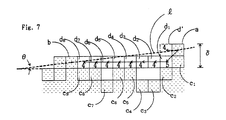
- Fig. 7 shows two adjacent top points a and b on convex hull as well as boundary pixels C1 to C9 therebetween.
- Top points a and b are connected with a line l for defining an inclination from a to b.
- continuous pixel train is generated from a to b.
- Each pixel of the train is inside of the line as well as the nearest pixel among pixels continuous to the previous pixel on the train. In this case, the pixel train is generated anticlockwisely. Clockwise pixel train may also be applied.
- the chain code of each pixel of the chain code train is limited to be "4" or "5".
- the pixel d′ of chain code "4" next to a is nearer than the pixel d1 of chain code "5". However the pixel of chain code "4" is outside of the line l. Then the pixel d1 is selected. Thereafter, pixels inside of the line l as well as nearest to the line l among the pixels continuous to the previous pixel on the pixel train. The pixels from d2 to d8 are to be selected.
- the convex hull is exactly generated by the method above.
- chord length is defined by the number of indexed pixels.
- the number of boundary pixels without index defines the inner peripheral length of concavity.
Landscapes
- Engineering & Computer Science (AREA)
- Computer Vision & Pattern Recognition (AREA)
- Physics & Mathematics (AREA)
- General Physics & Mathematics (AREA)
- Multimedia (AREA)
- Theoretical Computer Science (AREA)
- Image Analysis (AREA)
- Image Processing (AREA)
Abstract
arranging boundary pixels of the configuration according to chain order with indicating top points on convex hull of the configuration; and
determining that a concavity is defined by the boundary pixels when a boundary pixel of a chain code is found, which chain code indicates a concavity.
Description
- The present invention relates to an image processing method for calculating characteristics parameters of a concavity.
- For recognizing a handwritten character such as "R" in Fig. 1,
concavities - For evaluating a concavity, several characteristic parameters are proposed; chord length of a concavity, inner peripheral length of a concavity, concavity ratio etc. Unless concavities are exactly extracted, calculation of these parameters become in vain.
- The present invention has an object to provide an image processing method for extracting exact concavities.
- According to the present invention, between adjacent two top points of a convex hull, border pixels between the top points are successively evaluated from the chain code each border pixel has or from the distance between each pixels and a line connecting the top points so as to found the boundary pixels defines concavity or not.
-
- Fig. 1 shows a configuration having concavities;
- Fig. 2 shows a table of data of boundary pixels of a configuration to be processed;
- Fig. 3 shows a rule of chain code;
- Fig. 4 shows a portion including boundary pixels of a configuration;
- Fig. 5 shows another configuration including concavities;
- Fig. 6 shows an inclined line connecting adjacent two top points on convex hull;
- Fig. 7 shows steps of generating convex hull.
- Exemplary preferred embodiments of the image processing method according to the present invention will be described in detail hereinafter.
- Fig. 1 shows a configuration including concavities A, B, C, D and E, hatched. A horizontal rectangle R circumscribed about the configuration is shown, as well. The configuration is divided into quadrants from first to fourth by the rectangle R. On tracing boundary pixels of the configuration, boundary pixels from upper side left contact point to left side lower contact point belong to the first quadrant, boundary pixels from left side lower contact point to lower side right contact point belong to the second quadrant, boundary pixels from lower side right contact point to right side upper contact point belong to the third quadrant, and boundary pixels from right side upper contact point to upper side left contact point belong to the fourth quadrant. The number of first to fourth may be changed as far as they are defined according to predetermined rule. Anyway, the information concerning quadrant is important for the processing below.
- A table in Fig. 2 is generated, which includes informations of boundary pixels arranged in chain code order; whether they are top points on convex hull; x- and y-coordinates thereof; to which quadrant the points belong. In Fig. 2, top points on convex hull are indicated by Y or N, Y means to points and N means not.
- Figs. from 3(a) to 3(d) show the relationship between the quadrant and the chain code. Fig. 3(a) shows chain codes of boundary pixels in the first quadrant but not in a concavity. Fig. 3(b) shows chain codes of boundary pixels in the second quadrant but not in a concavity. Fig. 3(c) shows chain codes of boundary pixels in the third quadrant but not in a concavity. Fig. 3(d) shows chain codes of boundary pixels in the fourth quadrant but not in a concavity. It will be understood from Figs 3(a) to 3(d) that chain code other than from 4 to 6 in the first quadrant indicates a concavity, chain code other than from 6 to 0 in the second quadrant indicates a concavity, chain code other than from 0 to 2 in the third quadrant indicates a concavity, and chain code other than from 2 to 4 in the fourth quadrant indicates a concavity.
- In the case that no chain code indicating concavity can be found, the following processing is necessary.
- In Fig. 4, top points P1 and P2 on the convex hull are found. The inclination of the line l connecting P1 and P2 is calculated. The inclination is 5/7=0.714 and the inclination angle ϑ is 35.5 deg. Then boundary pixels are traced from P1 to P2. The distances between the line l and the boundary pixels are evaluated. For calculating the distance, a relationship between the chain code and distance increment Δd is calculated in advance. The distance increment Δd of boundary pixels traced are integrated so as to calculate a distance between the line l and the boundary pixel just traced.
- As for the configuration in Fig. 4, the relationship is shown in the following Table 1.
Table 1 Chain code Δd 4 -sinϑ=-0.581 5 cosϑ-sinϑ=0.233 6 cosϑ=0.814 - In Table 1, Δd is defined as positive when it has inward direction from the line l.
- The boundary pixels from Pb1 to Pb7 between P1 and P2 have distances from the line l, as shown in Table 2. The distances are calculated by the integration of Δd as described above.
Table 2 Boundary pixel Distance Pb1 0.233 Pb2 0.466 Pb3 -0.115 Pb4 0.699 Pb5 0.902 Pb6 1.135 Pb7 0.554 - Here, a rule is applied that boundary pixels between adjacent top points defines a concavity when one or more boundary pixels have distance not less than "1" from the line connecting the top points.
- In Table 2, the pixel Pb6 has distance of "1.135". On tracing boundary pixels from Pb1 toward Pb7, it is found first on the point Pb6 that the boundary pixels define concavity.
- By counting number of boundary pixels from Pb1 to Pb7 on tracing them, the inner peripheral length of a concavity is calculated. If it is found that the boundary pixels do not define a concavity, the counted value is canceled.
- The chord length of a concavity is calculated by calculating distance between top points P1 and P2. The distance is calculated by the x- and y-coordinates of P1 and P2.
- Concavity ratio is calculated from the inner peripheral length, chord length of a concavity and peripheral length of the configuration, as follows.
Concavity ratio=(inner peripheral length)/{(peripheral length)x(chord length)} - Fig. 5 shows another configuration to be processed. The configuration has boundary pixels from Pb1 to Pb9 between top points P1 and P2. The distances of each boundary pixel from the line l connecting P1 and P2 are shown in Table 3. The inclination of line l is 6/5=1.20, and the inclination angle ϑ is 50.2 deg.
Table 3 Boundary pixel Distance Pb1 0.640 Pb2 1.280 Pb3 0.512 Pb4 1.152 Pb5 1.792 Pb6 2.432 Pb7 1.664 Pb8 0.896 Pb9 0.128 - In Table 3, Pb2 has a distance more than "1", Pb3 has a distance less than "1", and Pb4 has a distance more than "1" again. In this case, concavity may be defined in two manners. In the first manner, one concavity is defined by the boundary pixels from Pb1 to Pb9. In the second manner, two concavities are defined, that is, one concavity is defined by the boundary pixels from Pb1 to Pb3 and the other concavity is defined by the boundary pixels from Pb4 to Pb9.
- Table 1 shows distance increment in the first quadrant. The following Table 4 shows distance increment in the quadrants from the second to the fourth. The inclination angle ϑ is defined for each quadrant as shown in Fig. 6.
Table 4 Quadrant Chain code Δ d II 6 cosϑ 7 sinϑ+ cosϑ 0 sinϑ III 0 - sinϑ 1 cosϑ- sinϑ 2 cosϑ IV 2 cosϑ 3 -sinϑ- cosϑ 4 sinϑ - In the above rule, a concavity is defined when one or more boundary pixels has distance not less than "1". Such distance may be another value, for example "2" considering noises.
- In a practical processing of concavities, data in Table 2 is successively read out, distances are calculated with integrating distance increment, simultaneously the chain codes are evaluated according to the rule shown in Fig. 3. When the integrated value reaches predetermined value or the chain code becomes a value other than the value shown in Fig. 3, a concavity is found. By counting boundary pixels on tracing, inner peripheral length is simultaneously calculated. The chord length is obtained by calculating distance between top points.
- As for generating an exact convex hull, the inventor invented the following image processing method, which is filed with the European Patent Office with the application No. 89101572.9.
- Fig. 7 shows two adjacent top points a and b on convex hull as well as boundary pixels C1 to C9 therebetween. Top points a and b are connected with a line l for defining an inclination from a to b. For generating convex hull, continuous pixel train is generated from a to b. Each pixel of the train is inside of the line as well as the nearest pixel among pixels continuous to the previous pixel on the train. In this case, the pixel train is generated anticlockwisely. Clockwise pixel train may also be applied.
- The chain code of each pixel of the chain code train is limited to be "4" or "5". The pixel d′ of chain code "4" next to a is nearer than the pixel d1 of chain code "5". However the pixel of chain code "4" is outside of the line l. Then the pixel d1 is selected. Thereafter, pixels inside of the line l as well as nearest to the line l among the pixels continuous to the previous pixel on the pixel train. The pixels from d2 to d8 are to be selected. The convex hull is exactly generated by the method above.
- When each pixel of the pixel train generated are indexed by a specified density or any other index, the chord length is defined by the number of indexed pixels. In the configurations generated by subtraction of the original image from the convex hull, the number of boundary pixels without index defines the inner peripheral length of concavity.
- Although only a few exemplary embodiments of this invention have been described in detail above, those skilled in the art will readily appreciate that many modifications are possible in the exemplary embodiments without materially departing from the novel teachings and advantages of this invention.
- Accordingly, all such modification are intended to be included within the scope of this invention as defined in the following claims.
Claims (8)
arranging boundary pixels of said configuration according to chain order with indicating top points on convex hull of said configuration; and
determining that a concavity is defined by said boundary pixels when a boundary pixel of a chain code is found, which chain code indicates a concavity.
Defining a line connecting two adjacent top points on convex hull of said configuration;
calculating distances from boundary pixels between said top points to said line; and
determining that a concavity is defined by said boundary pixels according to said distances.
between most upper and most leftward boundary pixels: chain code= 1, 5 or 6
between most left and most lower boundary pixels: chain code=6, 7 or 0
between most lower and most rightward boundary pixels: chain code=0, 1 or 2
between most rightward and most upper boundary pixels: chain code 2, 3 or 4.
Applications Claiming Priority (2)
| Application Number | Priority Date | Filing Date | Title |
|---|---|---|---|
| JP63115757A JP2739130B2 (en) | 1988-05-12 | 1988-05-12 | Image processing method |
| JP115757/88 | 1988-05-12 |
Publications (3)
| Publication Number | Publication Date |
|---|---|
| EP0341701A2 true EP0341701A2 (en) | 1989-11-15 |
| EP0341701A3 EP0341701A3 (en) | 1991-10-09 |
| EP0341701B1 EP0341701B1 (en) | 1995-08-02 |
Family
ID=14670297
Family Applications (1)
| Application Number | Title | Priority Date | Filing Date |
|---|---|---|---|
| EP89108437A Expired - Lifetime EP0341701B1 (en) | 1988-05-12 | 1989-05-10 | Image processing method |
Country Status (4)
| Country | Link |
|---|---|
| US (1) | US5159645A (en) |
| EP (1) | EP0341701B1 (en) |
| JP (1) | JP2739130B2 (en) |
| DE (1) | DE68923650T2 (en) |
Families Citing this family (37)
| Publication number | Priority date | Publication date | Assignee | Title |
|---|---|---|---|---|
| US6067379A (en) * | 1988-12-09 | 2000-05-23 | Cognex Corporation | Method and apparatus for locating patterns in an optical image |
| US5553196A (en) * | 1989-04-05 | 1996-09-03 | Yozan, Inc. | Method for processing data using a neural network having a number of layers equal to an abstraction degree of the pattern to be processed |
| US5754701A (en) * | 1992-08-11 | 1998-05-19 | Nec Corporation | Image signal coding method |
| US5590220A (en) * | 1992-08-12 | 1996-12-31 | International Business Machines Corporation | Bending point extraction method for optical character recognition system |
| JP2710202B2 (en) * | 1993-03-24 | 1998-02-10 | インターナショナル・ビジネス・マシーンズ・コーポレイション | Method and data processor for bordering closed contour image with convex polygon |
| US5649024A (en) * | 1994-11-17 | 1997-07-15 | Xerox Corporation | Method for color highlighting of black and white fonts |
| US5668891A (en) * | 1995-01-06 | 1997-09-16 | Xerox Corporation | Methods for determining font attributes of characters |
| US5801966A (en) * | 1995-07-24 | 1998-09-01 | Cognex Corporation | Machine vision methods and articles of manufacture for determination of convex hull and convex hull angle |
| US6026176A (en) | 1995-07-25 | 2000-02-15 | Cognex Corporation | Machine vision methods and articles of manufacture for ball grid array inspection |
| US5872870A (en) * | 1996-02-16 | 1999-02-16 | Cognex Corporation | Machine vision methods for identifying extrema of objects in rotated reference frames |
| US5909504A (en) * | 1996-03-15 | 1999-06-01 | Cognex Corporation | Method of testing a machine vision inspection system |
| US6259827B1 (en) | 1996-03-21 | 2001-07-10 | Cognex Corporation | Machine vision methods for enhancing the contrast between an object and its background using multiple on-axis images |
| US6298149B1 (en) | 1996-03-21 | 2001-10-02 | Cognex Corporation | Semiconductor device image inspection with contrast enhancement |
| US5978502A (en) * | 1996-04-01 | 1999-11-02 | Cognex Corporation | Machine vision methods for determining characteristics of three-dimensional objects |
| US6137893A (en) * | 1996-10-07 | 2000-10-24 | Cognex Corporation | Machine vision calibration targets and methods of determining their location and orientation in an image |
| US5960125A (en) | 1996-11-21 | 1999-09-28 | Cognex Corporation | Nonfeedback-based machine vision method for determining a calibration relationship between a camera and a moveable object |
| US5953130A (en) * | 1997-01-06 | 1999-09-14 | Cognex Corporation | Machine vision methods and apparatus for machine vision illumination of an object |
| US6075881A (en) * | 1997-03-18 | 2000-06-13 | Cognex Corporation | Machine vision methods for identifying collinear sets of points from an image |
| US5974169A (en) * | 1997-03-20 | 1999-10-26 | Cognex Corporation | Machine vision methods for determining characteristics of an object using boundary points and bounding regions |
| US6141033A (en) * | 1997-05-15 | 2000-10-31 | Cognex Corporation | Bandwidth reduction of multichannel images for machine vision |
| US6608647B1 (en) | 1997-06-24 | 2003-08-19 | Cognex Corporation | Methods and apparatus for charge coupled device image acquisition with independent integration and readout |
| US5978080A (en) * | 1997-09-25 | 1999-11-02 | Cognex Corporation | Machine vision methods using feedback to determine an orientation, pixel width and pixel height of a field of view |
| US6025854A (en) * | 1997-12-31 | 2000-02-15 | Cognex Corporation | Method and apparatus for high speed image acquisition |
| US6236769B1 (en) | 1998-01-28 | 2001-05-22 | Cognex Corporation | Machine vision systems and methods for morphological transformation of an image with zero or other uniform offsets |
| US6282328B1 (en) | 1998-01-28 | 2001-08-28 | Cognex Corporation | Machine vision systems and methods for morphological transformation of an image with non-uniform offsets |
| US6215915B1 (en) | 1998-02-20 | 2001-04-10 | Cognex Corporation | Image processing methods and apparatus for separable, general affine transformation of an image |
| US6381375B1 (en) | 1998-02-20 | 2002-04-30 | Cognex Corporation | Methods and apparatus for generating a projection of an image |
| US6381366B1 (en) | 1998-12-18 | 2002-04-30 | Cognex Corporation | Machine vision methods and system for boundary point-based comparison of patterns and images |
| US6687402B1 (en) | 1998-12-18 | 2004-02-03 | Cognex Corporation | Machine vision methods and systems for boundary feature comparison of patterns and images |
| US6684402B1 (en) | 1999-12-01 | 2004-01-27 | Cognex Technology And Investment Corporation | Control methods and apparatus for coupling multiple image acquisition devices to a digital data processor |
| US6748104B1 (en) | 2000-03-24 | 2004-06-08 | Cognex Corporation | Methods and apparatus for machine vision inspection using single and multiple templates or patterns |
| US7006669B1 (en) | 2000-12-31 | 2006-02-28 | Cognex Corporation | Machine vision method and apparatus for thresholding images of non-uniform materials |
| US7639861B2 (en) | 2005-09-14 | 2009-12-29 | Cognex Technology And Investment Corporation | Method and apparatus for backlighting a wafer during alignment |
| US8111904B2 (en) | 2005-10-07 | 2012-02-07 | Cognex Technology And Investment Corp. | Methods and apparatus for practical 3D vision system |
| US8162584B2 (en) | 2006-08-23 | 2012-04-24 | Cognex Corporation | Method and apparatus for semiconductor wafer alignment |
| JP5192315B2 (en) * | 2008-07-18 | 2013-05-08 | 一夫 相坂 | Indentation detection method for dividing a binary image into regions |
| JP5708305B2 (en) * | 2011-06-30 | 2015-04-30 | 富士通株式会社 | Image recognition apparatus, image recognition method, and computer program for image recognition |
Family Cites Families (12)
| Publication number | Priority date | Publication date | Assignee | Title |
|---|---|---|---|---|
| US3755780A (en) * | 1971-06-28 | 1973-08-28 | Pattern Analysis & Recognition | Method for recognizing characters |
| US4183013A (en) * | 1976-11-29 | 1980-01-08 | Coulter Electronics, Inc. | System for extracting shape features from an image |
| JPS594382A (en) * | 1982-06-30 | 1984-01-11 | Nippon Telegr & Teleph Corp <Ntt> | Encoding system of drawn picture |
| JPS60136892A (en) * | 1983-12-26 | 1985-07-20 | Hitachi Ltd | On-line recognition device of hand written graphic |
| US4876728A (en) * | 1985-06-04 | 1989-10-24 | Adept Technology, Inc. | Vision system for distinguishing touching parts |
| CA1270953C (en) * | 1986-05-23 | 1990-06-26 | Method of curve approximation | |
| US4791482A (en) * | 1987-02-06 | 1988-12-13 | Westinghouse Electric Corp. | Object locating system |
| US4949281A (en) * | 1987-04-23 | 1990-08-14 | H. Berthold Ag | Method and apparatus for generating and producing two-dimensional graphic object by polynominal parametric curves |
| US4982342A (en) * | 1987-11-05 | 1991-01-01 | Kabushiki Kaisha Toyota Chuo Kenkyusho | Image processor system having multifunction look-up table units |
| US5018211A (en) * | 1988-10-31 | 1991-05-21 | International Business Machines Corp. | System for detecting and analyzing rounded objects |
| US5086482A (en) * | 1989-01-25 | 1992-02-04 | Ezel, Inc. | Image processing method |
| US5050222A (en) * | 1990-05-21 | 1991-09-17 | Eastman Kodak Company | Polygon-based technique for the automatic classification of text and graphics components from digitized paper-based forms |
-
1988
- 1988-05-12 JP JP63115757A patent/JP2739130B2/en not_active Expired - Fee Related
-
1989
- 1989-05-10 DE DE68923650T patent/DE68923650T2/en not_active Expired - Lifetime
- 1989-05-10 EP EP89108437A patent/EP0341701B1/en not_active Expired - Lifetime
-
1991
- 1991-10-29 US US07/784,126 patent/US5159645A/en not_active Expired - Lifetime
Also Published As
| Publication number | Publication date |
|---|---|
| DE68923650T2 (en) | 1996-01-18 |
| US5159645A (en) | 1992-10-27 |
| DE68923650D1 (en) | 1995-09-07 |
| JP2739130B2 (en) | 1998-04-08 |
| JPH01284984A (en) | 1989-11-16 |
| EP0341701A3 (en) | 1991-10-09 |
| EP0341701B1 (en) | 1995-08-02 |
Similar Documents
| Publication | Publication Date | Title |
|---|---|---|
| EP0341701A2 (en) | Image processing method | |
| US4408342A (en) | Method for recognizing a machine encoded character | |
| US6990235B2 (en) | Color image processing apparatus and pattern extracting apparatus | |
| US4961231A (en) | Pattern recognition method | |
| US5841905A (en) | Business form image identification using projected profiles of graphical lines and text string lines | |
| JPH1021389A (en) | Template matching method and apparatus | |
| EP0380721A1 (en) | Image processing method | |
| CN111914847B (en) | OCR (optical character recognition) method and system based on template matching | |
| CN115050015B (en) | Accurate segmentation method for character area of financial bill account | |
| JPH08305795A (en) | Character recognition method | |
| CN113888747A (en) | Image texture feature extraction method based on annular local ternary mode | |
| CN118097676B (en) | Downhole tool label monitoring system based on image processing | |
| JP3096481B2 (en) | How to determine the type of form | |
| JP2872768B2 (en) | Character extraction device | |
| JP2902097B2 (en) | Information processing device and character recognition device | |
| JP3104355B2 (en) | Feature extraction device | |
| JP2965165B2 (en) | Pattern recognition method and recognition dictionary creation method | |
| CN116468742B (en) | Method and device for segmenting serial numbers containing fractional forms | |
| CN113781509A (en) | Method for calculating paper money boundary | |
| JP3705216B2 (en) | Character entry frame detection method, character entry frame detection device and program | |
| JPH031712B2 (en) | ||
| JPH07120392B2 (en) | Character pattern cutting device | |
| JPH1125213A (en) | Method and device for judging row direction | |
| JP2918363B2 (en) | Character classification method and character recognition device | |
| JP3127413B2 (en) | Character recognition device |
Legal Events
| Date | Code | Title | Description |
|---|---|---|---|
| PUAI | Public reference made under article 153(3) epc to a published international application that has entered the european phase |
Free format text: ORIGINAL CODE: 0009012 |
|
| AK | Designated contracting states |
Kind code of ref document: A2 Designated state(s): BE DE FR GB IT NL SE |
|
| ITCL | It: translation for ep claims filed |
Representative=s name: SOCIETA' ITALIANA BREVETTI S.P.A. |
|
| EL | Fr: translation of claims filed | ||
| TCNL | Nl: translation of patent claims filed | ||
| PUAL | Search report despatched |
Free format text: ORIGINAL CODE: 0009013 |
|
| AK | Designated contracting states |
Kind code of ref document: A3 Designated state(s): BE DE FR GB IT NL SE |
|
| 17P | Request for examination filed |
Effective date: 19911111 |
|
| 17Q | First examination report despatched |
Effective date: 19921014 |
|
| RAP1 | Party data changed (applicant data changed or rights of an application transferred) |
Owner name: EZEL INC. Owner name: SHARP KABUSHIKI KAISHA |
|
| RAP1 | Party data changed (applicant data changed or rights of an application transferred) |
Owner name: EZEL INC. Owner name: SHARP KABUSHIKI KAISHA |
|
| RAP3 | Party data changed (applicant data changed or rights of an application transferred) |
Owner name: SHARP KABUSHIKI KAISHA Owner name: EZEL INC. |
|
| GRAA | (expected) grant |
Free format text: ORIGINAL CODE: 0009210 |
|
| AK | Designated contracting states |
Kind code of ref document: B1 Designated state(s): BE DE FR GB IT NL SE |
|
| PG25 | Lapsed in a contracting state [announced via postgrant information from national office to epo] |
Ref country code: IT Free format text: LAPSE BECAUSE OF FAILURE TO SUBMIT A TRANSLATION OF THE DESCRIPTION OR TO PAY THE FEE WITHIN THE PRE;WARNING: LAPSES OF ITALIAN PATENTS WITH EFFECTIVE DATE BEFORE 2007 MAY HAVE OCCURRED AT ANY TIME BEFORE 2007. THE CORRECT EFFECTIVE DATE MAY BE DIFFERENT FROM THE ONE RECORDED.SCRIBED TIME-LIMIT Effective date: 19950802 Ref country code: NL Free format text: LAPSE BECAUSE OF FAILURE TO SUBMIT A TRANSLATION OF THE DESCRIPTION OR TO PAY THE FEE WITHIN THE PRESCRIBED TIME-LIMIT Effective date: 19950802 Ref country code: BE Effective date: 19950802 |
|
| REF | Corresponds to: |
Ref document number: 68923650 Country of ref document: DE Date of ref document: 19950907 |
|
| PG25 | Lapsed in a contracting state [announced via postgrant information from national office to epo] |
Ref country code: SE Effective date: 19951102 |
|
| ET | Fr: translation filed | ||
| NLV1 | Nl: lapsed or annulled due to failure to fulfill the requirements of art. 29p and 29m of the patents act | ||
| RAP2 | Party data changed (patent owner data changed or rights of a patent transferred) |
Owner name: YOZAN INC. Owner name: SHARP KABUSHIKI KAISHA |
|
| REG | Reference to a national code |
Ref country code: FR Ref legal event code: TP |
|
| PLBE | No opposition filed within time limit |
Free format text: ORIGINAL CODE: 0009261 |
|
| STAA | Information on the status of an ep patent application or granted ep patent |
Free format text: STATUS: NO OPPOSITION FILED WITHIN TIME LIMIT |
|
| REG | Reference to a national code |
Ref country code: GB Ref legal event code: 732E |
|
| 26N | No opposition filed | ||
| REG | Reference to a national code |
Ref country code: GB Ref legal event code: IF02 |
|
| PGFP | Annual fee paid to national office [announced via postgrant information from national office to epo] |
Ref country code: DE Payment date: 20080515 Year of fee payment: 20 |
|
| PGFP | Annual fee paid to national office [announced via postgrant information from national office to epo] |
Ref country code: GB Payment date: 20080514 Year of fee payment: 20 |
|
| REG | Reference to a national code |
Ref country code: GB Ref legal event code: PE20 Expiry date: 20090509 |
|
| PG25 | Lapsed in a contracting state [announced via postgrant information from national office to epo] |
Ref country code: GB Free format text: LAPSE BECAUSE OF EXPIRATION OF PROTECTION Effective date: 20090509 |
|
| PGFP | Annual fee paid to national office [announced via postgrant information from national office to epo] |
Ref country code: FR Payment date: 20080514 Year of fee payment: 20 |