EP0341298B1 - Fluoreszierende poly(arylpyridin)-seltenerd-chelate - Google Patents
Fluoreszierende poly(arylpyridin)-seltenerd-chelate Download PDFInfo
- Publication number
- EP0341298B1 EP0341298B1 EP89900456A EP89900456A EP0341298B1 EP 0341298 B1 EP0341298 B1 EP 0341298B1 EP 89900456 A EP89900456 A EP 89900456A EP 89900456 A EP89900456 A EP 89900456A EP 0341298 B1 EP0341298 B1 EP 0341298B1
- Authority
- EP
- European Patent Office
- Prior art keywords
- rare earth
- ligand
- arylpyridine
- fluorescent
- fluorescent rare
- Prior art date
- Legal status (The legal status is an assumption and is not a legal conclusion. Google has not performed a legal analysis and makes no representation as to the accuracy of the status listed.)
- Expired - Lifetime
Links
- 0 CNC*c1cc2cc(NC)c(*)cc2cc1NC Chemical compound CNC*c1cc2cc(NC)c(*)cc2cc1NC 0.000 description 15
- XDTMQSROBMDMFD-UHFFFAOYSA-N C1CCCCC1 Chemical compound C1CCCCC1 XDTMQSROBMDMFD-UHFFFAOYSA-N 0.000 description 4
- GACWEJCTLJWEHA-UHFFFAOYSA-N CCc1cc(CBr)cc(CC)c1 Chemical compound CCc1cc(CBr)cc(CC)c1 GACWEJCTLJWEHA-UHFFFAOYSA-N 0.000 description 1
- YCYDKVYJESGYDY-UHFFFAOYSA-N CNc1cc(NC)cc(NC)c1 Chemical compound CNc1cc(NC)cc(NC)c1 YCYDKVYJESGYDY-UHFFFAOYSA-N 0.000 description 1
- VCFWATQJXJABHK-UHFFFAOYSA-N [O-][N+](c1c(CI)cc(CBr)cc1CBr)=O Chemical compound [O-][N+](c1c(CI)cc(CBr)cc1CBr)=O VCFWATQJXJABHK-UHFFFAOYSA-N 0.000 description 1
Images


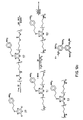

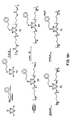
Classifications
-
- C—CHEMISTRY; METALLURGY
- C07—ORGANIC CHEMISTRY
- C07D—HETEROCYCLIC COMPOUNDS
- C07D213/00—Heterocyclic compounds containing six-membered rings, not condensed with other rings, with one nitrogen atom as the only ring hetero atom and three or more double bonds between ring members or between ring members and non-ring members
- C07D213/02—Heterocyclic compounds containing six-membered rings, not condensed with other rings, with one nitrogen atom as the only ring hetero atom and three or more double bonds between ring members or between ring members and non-ring members having three double bonds between ring members or between ring members and non-ring members
- C07D213/04—Heterocyclic compounds containing six-membered rings, not condensed with other rings, with one nitrogen atom as the only ring hetero atom and three or more double bonds between ring members or between ring members and non-ring members having three double bonds between ring members or between ring members and non-ring members having no bond between the ring nitrogen atom and a non-ring member or having only hydrogen or carbon atoms directly attached to the ring nitrogen atom
- C07D213/60—Heterocyclic compounds containing six-membered rings, not condensed with other rings, with one nitrogen atom as the only ring hetero atom and three or more double bonds between ring members or between ring members and non-ring members having three double bonds between ring members or between ring members and non-ring members having no bond between the ring nitrogen atom and a non-ring member or having only hydrogen or carbon atoms directly attached to the ring nitrogen atom with hetero atoms or with carbon atoms having three bonds to hetero atoms with at the most one bond to halogen, e.g. ester or nitrile radicals, directly attached to ring carbon atoms
- C07D213/78—Carbon atoms having three bonds to hetero atoms, with at the most one bond to halogen, e.g. ester or nitrile radicals
- C07D213/79—Acids; Esters
-
- C—CHEMISTRY; METALLURGY
- C07—ORGANIC CHEMISTRY
- C07D—HETEROCYCLIC COMPOUNDS
- C07D213/00—Heterocyclic compounds containing six-membered rings, not condensed with other rings, with one nitrogen atom as the only ring hetero atom and three or more double bonds between ring members or between ring members and non-ring members
- C07D213/02—Heterocyclic compounds containing six-membered rings, not condensed with other rings, with one nitrogen atom as the only ring hetero atom and three or more double bonds between ring members or between ring members and non-ring members having three double bonds between ring members or between ring members and non-ring members
- C07D213/04—Heterocyclic compounds containing six-membered rings, not condensed with other rings, with one nitrogen atom as the only ring hetero atom and three or more double bonds between ring members or between ring members and non-ring members having three double bonds between ring members or between ring members and non-ring members having no bond between the ring nitrogen atom and a non-ring member or having only hydrogen or carbon atoms directly attached to the ring nitrogen atom
- C07D213/60—Heterocyclic compounds containing six-membered rings, not condensed with other rings, with one nitrogen atom as the only ring hetero atom and three or more double bonds between ring members or between ring members and non-ring members having three double bonds between ring members or between ring members and non-ring members having no bond between the ring nitrogen atom and a non-ring member or having only hydrogen or carbon atoms directly attached to the ring nitrogen atom with hetero atoms or with carbon atoms having three bonds to hetero atoms with at the most one bond to halogen, e.g. ester or nitrile radicals, directly attached to ring carbon atoms
- C07D213/78—Carbon atoms having three bonds to hetero atoms, with at the most one bond to halogen, e.g. ester or nitrile radicals
- C07D213/81—Amides; Imides
-
- C—CHEMISTRY; METALLURGY
- C07—ORGANIC CHEMISTRY
- C07D—HETEROCYCLIC COMPOUNDS
- C07D401/00—Heterocyclic compounds containing two or more hetero rings, having nitrogen atoms as the only ring hetero atoms, at least one ring being a six-membered ring with only one nitrogen atom
- C07D401/14—Heterocyclic compounds containing two or more hetero rings, having nitrogen atoms as the only ring hetero atoms, at least one ring being a six-membered ring with only one nitrogen atom containing three or more hetero rings
-
- Y—GENERAL TAGGING OF NEW TECHNOLOGICAL DEVELOPMENTS; GENERAL TAGGING OF CROSS-SECTIONAL TECHNOLOGIES SPANNING OVER SEVERAL SECTIONS OF THE IPC; TECHNICAL SUBJECTS COVERED BY FORMER USPC CROSS-REFERENCE ART COLLECTIONS [XRACs] AND DIGESTS
- Y10—TECHNICAL SUBJECTS COVERED BY FORMER USPC
- Y10S—TECHNICAL SUBJECTS COVERED BY FORMER USPC CROSS-REFERENCE ART COLLECTIONS [XRACs] AND DIGESTS
- Y10S436/00—Chemistry: analytical and immunological testing
- Y10S436/80—Fluorescent dyes, e.g. rhodamine
Definitions
- This invention concerns compounds having a plurality of aryl substituted pyridine groups and their use as components of fluorescent chelate labels for fluoroassay techniques.
- Fluoroassay techniques are finding increasing application in chemical, biochemical and medical analyses. Fluorescence measurement methods are intrinsically extremely sensitive. However, the sensitivity of fluorescence assays, in practice, is limited by the presence of background fluorescence.
- Rare earth chelates have been identified by the art as materials having long-lived fluorescence. Such materials include a rare earth metal ion such as terbium or europium chelated by one or more ligands such as amine polyacids (See, USP 4,352,751 of Wieder and Wollenberg), "heteroatom-containing groups” including iminodiacetate substituted phenols, coumarins and phenanthrolines (See, Eastman Kodak European Patent Application 0068875) and aromatic diketones (See, German OLS 2,628,158), to point out a number of representative disclosures.
- ligands such as amine polyacids (See, USP 4,352,751 of Wieder and Wollenberg), "heteroatom-containing groups” including iminodiacetate substituted phenols, coumarins and phenanthrolines (See, Eastman Kodak European Patent Application 0068875) and aromatic diketones (See, German OLS 2,628,158), to point out a
- the present invention concerns a family of aryl pyridine derivatives which may be incorporated into long-lived fluorescent species with rare earth metals.
- the individual aryl pyridine units which are incorporated in the present compounds are disclosed in our copending European Patent Application 195413 filed March 18, 1986.
- References to the general class of substituted pyridine derivatives include United States Patent 4,008,239, 3,970,662 and 3,907,808 as well as Carbeteas and Williams, J. Heterocycl. Chem. , 11(5) , 819 (1974); Weller and Luellen, Tetrahedron Letters , Vol. 22, No. 44, pp 4381-84 (1981) and Weller, Luellen and Weller J. Org. Chem. , 47 , 4803-06 (1982).
- the above-noted European Patent Application 0068875 is also of interest.
- Another reference of interest is WO/84/04970 which discloses a polymer with multiple units of visualization monomer.
- the present fluorescent chelates contain 2 to 6 aryl-substituted pyridines arranged structurally within a single molecule such that each optimally binds to a single metal ion.
- Each pyridine group is structurally insulated from the others so that, in the unchelated form, each retains to some degree the properties of the single pyridine.
- changes and improvements are observed in the properties of the chelates. For example, a diacid having a given substitution pattern and a certain sensitivity of detection for terbium and europium will generally become a better fluorophore for europium when incorporated as a part of a polymer compound. Improvements include increased molar absorptivity and longer excitation wavelengths. To the extent that these changes result in increased fluorescence emission, the result is increased sensitivity of detection of analytes tagged with these labels.
- the ligands of this invention can be represented as a multi-site attachment molecule or "template molecule" (TM) to which are covalently attached a plurality (2 to 6 inclusive) of aryl-substituted pyridine diacids of the structure shown in General Formula I. This covalent coupling results in the ligand shown generally in General Formula II. This ligand can, in turn, give rise to the chelate shown generally in General Formula III.
- template TM template molecule
- Ar is an aryl
- TM is the multi-site attachment or template molecule
- n is an integer from 2 to 6 inclusive, preferably 3 to 5 inclusive and more preferably 3 or 4
- n′ is an integer equal to the number of available bonding sites on Ar
- M is a rare earth metal, generally in the form of its ion
- R, R′ and R ⁇ are independently selected from hydrogen and electron-releasing groups including lower alkoxy, lower alkyl amino, di lower alkyl amino, aryl and aryloxy.
- R, R′ and R ⁇ are independently selected from hydrogen and electron-releasing groups including lower alkoxy, lower alkyl amino, di lower alkyl amino, aryl and aryloxy.
- This definition of these various R groups is subject to the proviso that preferably at least one of the R substituents on the Ar group is electron-releasing.
- the point of attachment of the TM molecule to the arylpyridine group can be directly to the Ar or to one of the n′ R groups.
- this invention provides fluorescently detectable tagged molecules and especially fluorescently tagged bioactive molecules. These molecules are fluorescently detectable because they covalently incorporate a poly(arylpyridine) chelate of General Formula III. This covalent incorporation can be carried out in several manners. In one case the covalent bond is effected through a bondable site on one of the various Rs, R′s and R ⁇ s. In an alternative, the bondable site is located directly on the template molecule such that the link is provided directly from the template molecule.
- the covalent bonding can take the form of a simple single covalent bond such as a carbon-carbon bond, a carbon-nitrogen amine, amide or sulfonamide bond or the like between the chelate tag and the molecule to be tagged. It can also take the form of a specifically-added spacer- or linking moiety which contains the desired bonding site. These spacer moieties will at times be separately described to set forth in more detail their structures and properties. However, for simplicity, when presenting structural formulae such as Formula III they will not be separately shown and are to be considered part of the various Rs and/or Ar groups.
- the molecules labelled with the poly(arylpyridine) groups of this invention may include a biologically active material, that is, one half of a biospecific (e.g. immunologic) pair so as to permit biospecific assays to be conducted by observing the fate, position or amount of the fluorescence imparted to the biospecific reaction by the present chelates.
- a biospecific e.g. immunologic
- the ligands of the invention include a multi-site attachment or "template” group (TM) which provides 3, 4, 5 or 6 covalent attachment sites for attaching the plurality of arylpyridine diacid units. These sites can be arranged symmetrically about or along the template or can be arranged asymmetrically.
- template multi-site attachment or "template” group (TM) which provides 3, 4, 5 or 6 covalent attachment sites for attaching the plurality of arylpyridine diacid units. These sites can be arranged symmetrically about or along the template or can be arranged asymmetrically.
- the template is a covalently bonded organic molecule. It can be aliphatic or aromatic. Most commonly it provides at least 3 and up to about 20 atom chains between adjacent arylpyridine units.
- the template can present its n sites directly off of a core groups such as the 1, 3, and 5 positions on a central phenyl ring or it can present its n sites as several groups of sites on several subcore units -- for example two sites on each of two chains pendant from a aromatic central core.
- the template molecules can be hydrocarbon or they can contain heteroatoms such as sulfur, oxygen and/or nitrogen.
- the template molecule provides n aliphatic amines as attachment sites.
- the template molecule also may provide at least one additional bondable site to permit coupling of the polymeric ligand to active species, biologic materials and/or targets.
- the template may also carry additional groups to alter the chemical or physical properties (for example, solubility, ionic character or the like) of the ligand or the chelates it produces.
- Representative templates include aliphatic materials such as 1,5,9-triaminononane with the three amine groups serving as attachment sites; tri(3-aminopropyl)methylene again with amine attachment sites; 1,3,5,7-tetra(2-aminoethyl)cyclooctane; and alkylene diamine-type material such as
- Aromatic based templates generally contain a benzene or naphthalene unit, a triazine unit or the like. With these groups the attachment point can be on the aromatic ring(s) or on groups attached to the aromatic ring(s).
- Typical materials include simple aromatics such as as well as more complex materials such as
- the ligands include a plurality (e.g. 2 to 6) of arylpyridine dicarboxylic acid units. In these units, the aryl substituents are themselves substituted with at least one electron-releasing group. These diacid units are depicted in General Formula I. As shown in Formula I, the pyridine carries substituents R′, R ⁇ and -Ar-(R) n′ .
- the R′ and R ⁇ substituents may be hydrogens; electron-releasing groups such as lower alkoxies, that is 1 to 4 carbon alkoxies, especially methoxy or ethoxy; lower alkyls, that is 1 to 4 carbon alkyls such as methyls, ethyls, n and iso propyls and the like; aminos; alkyl, i.e., mono and di, and especially dialkylamino, for example, dialkylaminos wherein each of the alkyls is from 1 to 4 carbons such as dimethylamino; aryls of six carbons and aralkyls of up to about 9 carbons such as phenyls or benzyls and the like, subject to the limitation that such aryls are pendant from and not fused to the pyridine ring and aryloxies or aralkyloxies of up to about 9 carbons such as phenyloxy or benzyloxy structures; and a linking group including a
- the Ar-(R) n′ substituent on the pyridine ring is an aryl, itself containing n′ R substituents.
- the aryl is either a phenyl or a naphthyl ring.
- the number n′ is an integer corresponding to the number of covalent bonding sites available on the Ar substituent, i.e., 5 in the case of a phenyl or 7 in the case of a naphthyl.
- the R substituents on the Ar group can be selected from the same groups as the R′ and R ⁇ substituents.
- the Ar-R n′ substituents can be represented structurally by the General Formulae Ia and Ib. wherein is a covalent bond to the pyridine ring depending upon whether the Ar unit is a phenyl or naphthyl. Phenyl is the preferred Ar unit.
- pyridine diacids are coupled to the template molecule to give the desired poly(arylpyridine) ligand.
- the ligand itself in turn may be joined either directly from the template or through one of the pyridine diacid moieties to other groups such as a biospecific group, a target, or the like. Either of these couplings can be accomplished by a simple covalent bond or can be carried out through another linking functionality.
- This covalent bond or coupling functionality can constitute one of the positions denominated R′, R ⁇ or R, and especially is one of the Rs. This coupling permits the fluorescent pyridine moieties to "tag" a biologically active biospecific group.
- this group should present an active or bondable site such as an amine, a hydroxyl, a carboxyl, an ester or the like to facilitate coupling of the biospecific group.
- bondable R groups are the amino group (-NH2) primary and secondary amine-terminated alkyls such as -CH2-CH2-NH2 or primary and secondary amine terminated aryls and aryloxies such as and the isomers thereof and the like; hydroxyl-containing alkyls such as -CH2-CH2-OH, etc., and hydroxyl-containing aryls and aryloxies such as
- Suitable functionalities for forming a bond to the biospecific group or to the template include amides, amidines, thioamides, ureas, thioureas, guanidines, diazos, thioethers, carboxy and phosphate esters, thiocyanates, thioesters and other covalent linkages such as are known in the art.
- a preferred linking group is the simple amino group.
- Such linking groups are representative and can alter and influence interactions between the fluorescent ligands and the biospecific groups.
- biospecific group i.e., biospecific group is linked to the ligand.
- biologically active group and “biologically active group” are used in a broad sense to encompass all molecular structures which will “specifically recognize” or “specifically react” or “specifically interact” with another molecular species.
- groups can include immunologically specific groups such as antibodies and their respective antigens or haptens, hormones and their receptors, binding pairs such as the biotin/avidin pair and the like. They can also include nucleic acid sequences which will specifically hybridize with their complimentary sequences.
- the biospecific groups can be selected to bind with or otherwise associate with a target molecule or can be selected to mimic or to include the target molecule so as to compete with the target in the biospecific reaction.
- a biospecific group When a biospecific group is present in the chelate its target molecule or analyte may be a monoepitopic or polyepitopic material. It may be selected without limitation from materials such as drugs, metabolites, natural products, pesticides and contaminants of air and water.
- drugs including digoxin, digitoxin, phenytoin, theophylline, gentamicin, and tobramycin; alkaloids such as morphine, heroin, cocaine, ergot alkaloids, and the like; steroids such as the steroid hormones including estrogens and androgens, for example estradiol and anti-inflammatory steroids for example cortisol; lactams such as barbituates including phenobarbital; aminoalkylbenzenes such as the amphetamines; vitamins; prostaglandins such as F2alpha and E; antibiotics and the like; and short peptide sequences or amino acids such as thyroxine, triiodothyronine and oxytocin.
- Representative pollutants and pesticides include PCB, dioxin, halogenated biphenyls, carbamates, thiophosphites, phosphate esters and their metabolites. Such materials can range in molecular weight from about 50 to about
- the target molecule can also be a polymeric material such as a protein or other poly(amino acid), a polynucleic acid or a polysaccharide.
- protein materials can be taken from any of the classes of proteins including without limitation globulins, albumins, lipoproteins, glycoproteins, histones and the like, hypersensitive proteins including albumin, the immunoglobulins such as IgE, fibrinogen, transferrin, the various complement factors, the tumor markers like CEA (carcinoembrionic antigen) and PAP, the various blood clotting factors and protein hormones including beta-hCG, FSH, gastrin, LH and prolactin; insulin, thyrotropin, gonadotropin and the like.
- proteins including without limitation globulins, albumins, lipoproteins, glycoproteins, histones and the like, hypersensitive proteins including albumin, the immunoglobulins such as IgE, fibrinogen, transferrin, the various complement factors, the tumor markers
- biospecific polysaccharides are those derived from microorganisms such as those associated with various species of Salmonella , Streptococcus , and Klebsiella .
- Other targets include materials responsive to infectious disease conditions such as infection with hepatitis or rubella.
- this invention also provides other materials of the same general structure which do not contain a link to a biospecific material, that is where all of the R, R' and R''s are hydrogens or electron-releasing groups.
- Such materials are useful as chelating agents for metals and when chelated to rare earth metals give a fluorescent species which can serve as an indicator for quantitative or qualitative fluorescent measurement of rare earth metal ions in solutions.
- one of the carboxylic acid groups can provide the link to the bioactive molecule.
- the poly(arylpyridine) ligands of this invention form long-lived fluorescent chelate complexes with rare earth metals including terbium, dysprosium, europium, samarium, and neodymium, in the form of their ions.
- rare earth metals including terbium, dysprosium, europium, samarium, and neodymium, in the form of their ions.
- Terbium and europium (Tb+++ and Eu+++) are preferred rare earth metal ions.
- the materials of this invention can be prepared as follows: First, two intermediates are prepared--one providing the n diacid units and the other the template molecule. Then these two materials are coupled.
- trimers 14 and 16 are formed in the first two preparations.
- half-acid chlorides 12 and 15 are representative diacid precursors and triamine 11 is a representative template molecule.
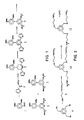
- the half-acid chloride 12 2,4-dimethoxybenzaldehyde 1 and two equivalents of 2-acetylfuran are condensed with base to afford the dione 3 .
- the dione is in turn reacted with hydroxylamine hydrochloride and the resulting difuryl pyridine 4 oxidized to the diacid 5 (Scheme I).
- the diacid is converted into the half acid-ester 6 to allow for the formation of the desired acid chloride 12 which will be used for coupling. This can be carried out by the slow addition of one equivalent of methanol to the diacid chloride of 5 . This produces the mixture of the diester 7 and the half acid-ester 6 .
- This mixture is easily separated by employing classical methods of separation such as by adding base to the reaction mixture and extracting followed by acidification of the aqueous layer regenerating the acid 6 , and again extracting with organic solvent. There is minimal contamination by the diacid 5 in this workup.
- Acid 6 is converted into the acid chloride by treatment with oxalyl chloride (Scheme III).
- the synthesis of the acid chloride analog 15 can be performed in the same manner starting with 2,4,6-trimethoxybenzaldehyde.
- the second intermediate in the synthesis of the materials of this invention is the template molecule, such as triamine 11 .
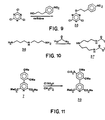
- a typical preparation starts with 1,3,5-trisbromomethyl benzene 8 and condenses it with N-tritylethanolamine 9 in the presence of sodium hydride to give protected triamine 10 .
- Deprotection of the amine with refluxing hydrochloric acid in ethanol produced the triamine hydrochloride 11 (Scheme II).
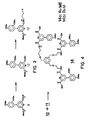
- the acid chloride 12 is added to a solution of the triamine hydrochloride 11 with an excess of triethylamine (Scheme IV).
- the resulting compound is next saponified to form the triacid 14b .
- Both of the triacid trimers showed moderate to strong intensity emission spectra when converted into chelates with terbium and europium.
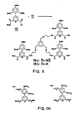
- trimer 32 involves, as in the first two cases, the formation of two intermediates, in this example, the acid 26 and the tetraamine 29 (Schemes VI and VII).
- the initial steps in the synthesis of the acid 26 are exactly analogous to those used to produce the diacid 5 in Scheme I.
- the resulting diacid 22 is next esterified by sequential treatment with oxalyl chloride followed by methanol to afford the diester 23 .
- Hydrogenation of the ester 23 followed by "0" alkylation of the phenol 24 with benzyl bromoacetate yields the triester 25 .
- After hydrogenation of the benzyl ester the desired acid 26 is obtained.
- the second intermediate 29 is also generated from the tribromide 8 , as starting material, as was the triamine 11 in Scheme II. Nitration of 8 with nitronium tetrafluoroborate followed by treatment with sodium azide produces the triazide 27 . Catalytic reduction of the nitro and azide group affords the tetraamine 29.
- the o-nitrophenyl ester of the acid is generated first. This is accomplished by treating 26 with p-nitrophenol in the presence of dicyclohexylcarbodiimide. The activiated ester 30 is then allowed to react with the tetraamine to produce the trimeric compound 31 .
- the amine 31 was treated with thiophosgene in the presence of triethylamine (Scheme VIII). This material can be formed into chelates with Eu or Tb or the like.
- the crude mixture of esters 6 and 7 (831mg) was taken up into a small volume of ethyl acetate (20ml) and washed with pH 12 aqueous NaOH solution (75ml) and the aqueous layer separated. After acidification with 50% aqueous H2SO4 the aqueous solution was extracted twice with CH2Cl2 to remove the acid-ester 6 . Both the ethyl acetate and the CH2Cl2 solutions were dried (Na2SO4) and the solvent removed yielding 265mg of 6 and 330mg of 7 .
- This preparation was carried out in the same manner as that of the formation of the mono and dimethyl esters of 6 and 7 , employing 178mg (0.561mmole) of the acid 6 and 0.05ml (0.618mmole) of oxalyl chloride. Yield was 179mg of crude acid chloride 12 .
- This preparation was carried out in the same manner as that of the synthesis of the dimethoxytrimer 14 , employing 158mg (0.39mmole) of the triamine hydrochloride 11 and 427mg (1.17mmole) of the acid chloride 15 , which was constructed in the same fashion as the dimethoxy analog 12 using the aldehyde, 2,4,6-trimethoxybenzaldehyde as the starting material.
- the yield was 87mg (17%) of the desired trimer 16 after chromatography of the crude material on silica with 7% methanol/ethyl acetate.
- the crude diester (15g) was purified via plug filtration with SiO2/EtOAc/CH2Cl2 (20:80) yielding 7.0g (65%) of the diester (23):NMR (CDCl3) 3.85 (s,3,OCH3), 4.05 (s,6,CO2Me), 5.1 (s,2,OCH2O), 6.7 and 7.4 (m,3,-C6H3O2R2) 7.35 (s,5,-C6H5), 8.5 (s,2,-C5H2N′ .
- the ligands so formed in these examples are then coupled to targets as described and comingled with an excess of rare earth metal.
- the chelates which result are irradiated with a burst of laser light they fluoresce identifying their presence. The fluorescence can be quantitated to identify and locate the coupled targets.
Landscapes
- Chemical & Material Sciences (AREA)
- Organic Chemistry (AREA)
- Pyridine Compounds (AREA)
Claims (19)
- Fluoreszierendes Seltenerden-Chelat, umfassend ein Seltenerden-Metallion in Komplexkombination mit einem Poly(arylpyridin)-Liganden, wobei der Ligand kovalent mit einer zentralen Templat-Struktur verknüpft ist und die folgende Strukturformel aufweist:

- Fluoreszierendes Seltenerden-Chelat nach Anspruch 1, wobei n einen Wert von 3 bis 5 einschließlich hat.
- Fluoreszierendes Seltenerden-Chelat nach Anspruch 1, wobei n einen Wert von 3 bis 4 einschließlich hat.
- Fluoreszierendes Seltenerden-Chelat nach Anspruch 1, worin es sich bei dem Seltenerdenmetall um Europium handelt.
- Fluoreszierendes Seltenerden-Chelat nach Anspruch 1, worin es sich bei dem Seltenerdenmetall um Terbium handelt.
- Fluoreszierendes Seltenerden-Chelat nach Anspruch 1, worin es sich bei mindestens einem der Substituenten R an Ar um eine Elektronen abgebende Gruppe handelt.
- Fluoreszierendes Seltenerden-Chelat nach Anspruch 6, worin es sich bei mindestens einem der Substituenten R an Ar um eine Alkoxygruppe handelt.
- Fluoreszierendes Seltenerden-Chelat nach Anspruch 7, worin es sich mindestens einem der Substituenten R an Ar um Methoxy handelt.
- Fluoreszierendes Seltenerden-Chelat nach einem der Ansprüche 2 bis 8, worin es sich bei Ar um eine Phenylgruppe handelt.
- Fluoreszierendes Seltenerden-Chelat nach Anspruch 1, worin der Poly-(arylpyridin)-Ligand die folgende Strukturformel aufweist:

- Fluoreszierendes Seltenerden-Chelat nach Anspruch 1, worin der Poly-(arylpyridin)-Ligand die folgende Strukturformel aufweist:

- Fluoreszierendes Seltenerden-Chelat nach Anspruch 1, worin der Poly-(arylpyridin)-Ligand die folgende Strukturformel aufweist:

- Fluoreszierendes Seltenerden-Chelat nach Anspruch 1, worin der Poly-(arylpyridin)-Ligand die folgende Strukturformel aufweist:

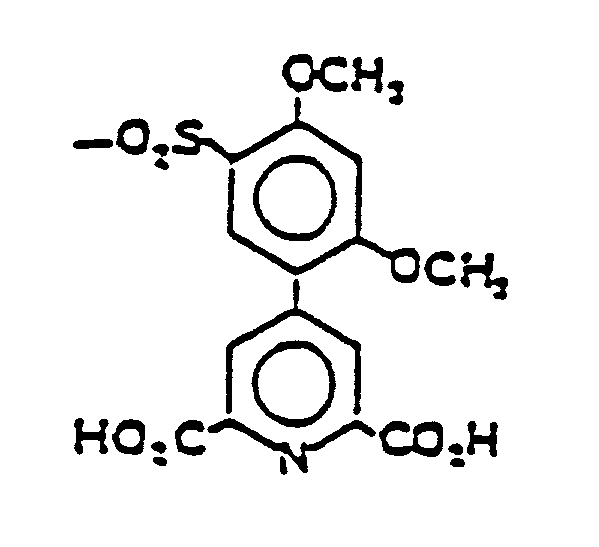
- Fluoreszierendes Seltenerden-Chelat nach Anspruch 1, worin der Poly-(arylpyridin)-Ligand die folgende Strukturformel aufweist:
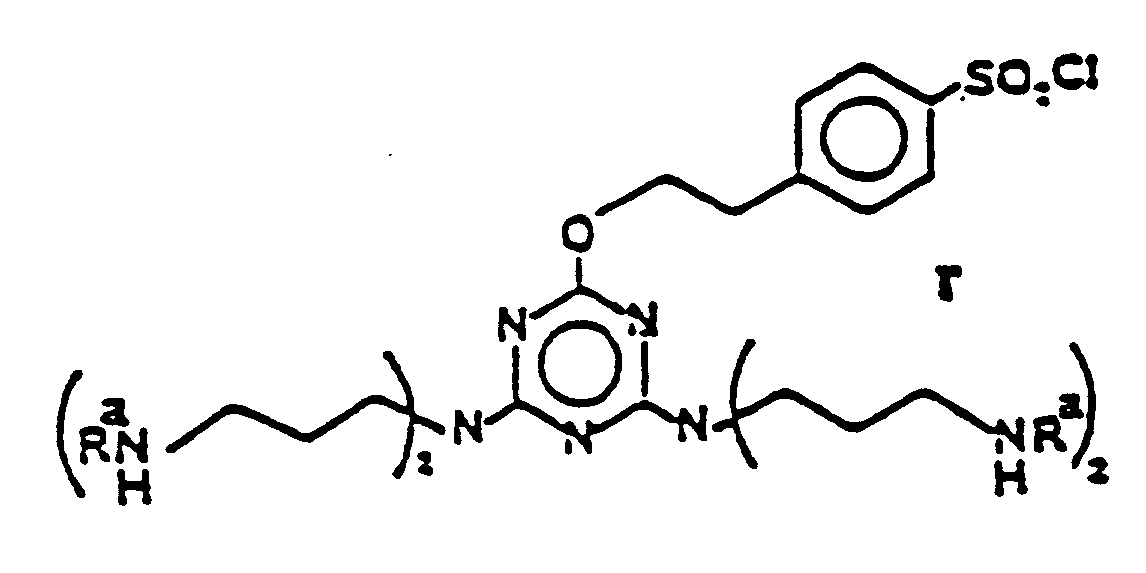
- Markiertes Ziel, umfassend ein Ziel, das kovalent mit dem Chelat nach einem der Ansprüche 1 bis 14 verknüpft ist.
- Poly-(arylpyridin)-Ligand mit der Strukturformel, wie sie in Anspruch 1 definiert ist, wobei der Ligand kovalent mit einer zentralen Templat-Struktur verknüpft ist.
- Ligand nach Anspruch 16 mit einer Struktur, wie sie in einem der Ansprüche 2 bis 3 und 6 bis 14 definiert ist.
- Ligandestervorstufe mit der Strukturformel:

- Ligandestervorstufe nach Anspruch 18 mit einer Formel, die unter den nachstehenden Formeln (1) bis (5) ausgewählt ist:


Applications Claiming Priority (3)
| Application Number | Priority Date | Filing Date | Title |
|---|---|---|---|
| US07/118,292 US5032677A (en) | 1987-11-06 | 1987-11-06 | Fluorescent poly(arylpyridine) rare earth chelates |
| US118292 | 1987-11-06 | ||
| PCT/US1988/003890 WO1989004826A1 (en) | 1987-11-06 | 1988-11-01 | Fluorescent poly(arylpyridine) rare earth chelates |
Publications (3)
| Publication Number | Publication Date |
|---|---|
| EP0341298A1 EP0341298A1 (de) | 1989-11-15 |
| EP0341298A4 EP0341298A4 (de) | 1990-02-20 |
| EP0341298B1 true EP0341298B1 (de) | 1994-06-22 |
Family
ID=22377696
Family Applications (1)
| Application Number | Title | Priority Date | Filing Date |
|---|---|---|---|
| EP89900456A Expired - Lifetime EP0341298B1 (de) | 1987-11-06 | 1988-11-01 | Fluoreszierende poly(arylpyridin)-seltenerd-chelate |
Country Status (5)
| Country | Link |
|---|---|
| US (1) | US5032677A (de) |
| EP (1) | EP0341298B1 (de) |
| CA (1) | CA1339746C (de) |
| DE (1) | DE3850385T2 (de) |
| WO (1) | WO1989004826A1 (de) |
Families Citing this family (36)
| Publication number | Priority date | Publication date | Assignee | Title |
|---|---|---|---|---|
| US5106957A (en) * | 1987-11-06 | 1992-04-21 | Baxter Diagnostics Inc. | Fluorescent poly(arylpyridine) rare earth chelates |
| US5367080A (en) * | 1990-11-08 | 1994-11-22 | Sterling Winthrop Inc. | Complexing agents and targeting radioactive immunoreagents useful in therapeutic and diagnostic imaging compositions and methods |
| WO1992014841A1 (en) * | 1991-02-14 | 1992-09-03 | Baxter Diagnostics Inc. | Novel lanthanide chelate-conjugated oligonucleotides |
| US5571897A (en) * | 1991-12-05 | 1996-11-05 | Wallac Oy | Luminescent lanthanide chelates |
| US7070921B2 (en) | 2000-04-28 | 2006-07-04 | Molecular Devices Corporation | Molecular modification assays |
| US7632651B2 (en) | 1997-09-15 | 2009-12-15 | Mds Analytical Technologies (Us) Inc. | Molecular modification assays |
| US7745142B2 (en) | 1997-09-15 | 2010-06-29 | Molecular Devices Corporation | Molecular modification assays |
| US7018851B2 (en) * | 2003-02-13 | 2006-03-28 | Innotrac Diagnostics Oy | Biospecific binding reactants labeled with new luminescent lanthanide chelates and their use |
| US8071626B2 (en) * | 2003-12-18 | 2011-12-06 | Wallac Oy | Chelating agents and highly luminescent and stable chelates and their use |
| CA2550074A1 (en) * | 2003-12-18 | 2005-06-30 | Wallac Oy | Novel chelating agents and highly luminescent and stable chelates and their use |
| DE102004022628A1 (de) * | 2004-05-07 | 2005-12-15 | Sensient Imaging Technologies Gmbh | FRET-Bioassay |
| AU2005269819A1 (en) * | 2004-07-23 | 2006-02-09 | Amgen Inc. | Generic probes for the detection of phosphorylated sequences |
| EP1805188A4 (de) * | 2004-09-30 | 2010-03-03 | Mds Analytical Technologies Us | Lumineszente lanthanidkomplexe |
| FR2890174B1 (fr) * | 2005-08-30 | 2009-04-24 | Cis Bio Internat Sa | Procede pour la mise en evidence d'un processus biologique par mesure d'un fret |
| FR2890446B1 (fr) * | 2005-09-05 | 2008-04-18 | Cis Bio Internat Sa | Methode de detection d'interaction intracellulaire entre bio-molecules |
| US7482444B2 (en) * | 2006-03-13 | 2009-01-27 | Wallac Oy | Terminating substrates for DNA polymerases |
| EP2052252B1 (de) | 2006-08-18 | 2010-11-10 | Abacus Diagnostica OY | Lumineszierende lanthanid-markierungsreagentien und deren verwendung |
| JP5606435B2 (ja) * | 2008-07-16 | 2014-10-15 | ラジオメーター・メディカル・アー・ペー・エス | トロンビン基質およびサンプル中の生体活性トロンビンのレベルを測定するためのアッセイ |
| FR2934684B1 (fr) | 2008-07-31 | 2012-11-16 | Cis Bio Int | Methode de detection de l'internalisation de proteines membranaires. |
| FR2936245B1 (fr) | 2008-09-23 | 2012-07-06 | Cis Bio Int | Nouveaux substrats d'o6-alkylguanine-adn alkyltransferase et ses mutants. |
| US8697380B2 (en) | 2009-04-30 | 2014-04-15 | Cis Bio International | Method for detecting compounds modulating dimers of VFT domain membrane proteins |
| FR2949156B1 (fr) | 2009-08-13 | 2016-04-15 | Cis-Bio Int | Methode de determination de la liaison d'un compose donne a un recepteur membranaire |
| DE102011001368B4 (de) | 2011-03-17 | 2013-01-31 | Bundesanstalt für Materialforschung und -Prüfung (BAM) | Lanthanoid-Chelate enthaltende Partikel, deren Herstellung sowie deren Verwendung in der Bioanalytik |
| FR2977674B1 (fr) | 2011-07-06 | 2015-08-14 | Cisbio Bioassays | Methode amelioree de detection et/ou de quantification d'un analyte present a la surface d'une cellule |
| FR2980271B1 (fr) | 2011-09-16 | 2013-10-11 | Cisbio Bioassays | Procede de determination de la glycosylation d'un anticorps |
| US20150185150A1 (en) | 2012-02-22 | 2015-07-02 | Cisbio Bioassays | Method for normalizing the luminescence emitted by a measuring medium |
| FR2988174B1 (fr) | 2012-03-19 | 2014-04-25 | Cisbio Bioassays | Procede de determination de la capacite d'un anticorps a maintenir des cellules a proximite l'une de l'autre |
| CA2881841A1 (en) | 2012-08-23 | 2014-02-27 | The Regents Of The University Of California | Spectrally encoded microbeads and methods and devices for making and using same |
| WO2014147288A1 (en) | 2013-01-31 | 2014-09-25 | Kaivogen Oy | Luminescent triazacyclononane-based lanthanide chelate complexes as labelling reagents |
| FR3032797B1 (fr) | 2015-02-13 | 2017-03-03 | Cisbio Bioassays | Procede de quantification d'une proteine d'interet presente dans un echantillon biologique |
| CN105439897A (zh) * | 2015-11-18 | 2016-03-30 | 西南科技大学 | 2,6-二硝基对二叠氮甲基苯的合成方法 |
| EP3559666A1 (de) | 2016-12-21 | 2019-10-30 | H. Hoffnabb-La Roche Ag | Assay zur bestimmung der antikörper- oder ligandenbindung und -funktion |
| FR3067712B1 (fr) | 2017-06-14 | 2019-08-02 | Cisbio Bioassays | Nouveaux agents complexants de type trimethoxyphenyl pyridine hydrosolubles et complexes de lanthanide correspondants |
| FR3069644B1 (fr) | 2017-07-28 | 2024-07-12 | Cisbio Bioassays | Methode pour mesurer la modulation de l'activation d'un recepteur couple a une proteine g |
| FR3084365B1 (fr) | 2018-07-27 | 2020-10-23 | Cisbio Bioassays | Anticorps a domaine unique qui se lient a la proteine g alpha |
| FR3092172B1 (fr) | 2019-01-30 | 2021-02-12 | Cisbio Bioassays | Méthode pour mesurer la modulation de l’activation d’un récepteur couplé à une protéine G avec des analogues du GTP |
Family Cites Families (12)
| Publication number | Priority date | Publication date | Assignee | Title |
|---|---|---|---|---|
| US3907808A (en) * | 1971-05-17 | 1975-09-23 | Sterling Drug Inc | 1,4-Dihydro-4-oxo-7-pyridyl-3-quinolinecarboxylic acid derivatives |
| US3970662A (en) * | 1975-06-19 | 1976-07-20 | Sterling Drug Inc. | 4-(3-Nitrophenyl)-2,3,5,6-pyridinetetracarboxylic acid and intermediates |
| US4008239A (en) * | 1975-06-19 | 1977-02-15 | Sterling Drug Inc. | Preparation of 4-(3-nitrophenyl)pyridine |
| US4058732A (en) * | 1975-06-30 | 1977-11-15 | Analytical Radiation Corporation | Method and apparatus for improved analytical fluorescent spectroscopy |
| US4150295A (en) * | 1978-01-05 | 1979-04-17 | Analytical Radiation Corporation | Method and apparatus for background correction in photoluminescent analysis |
| US4352751A (en) * | 1979-09-10 | 1982-10-05 | Analytical Radiation Corporation | Species-linked diamine triacetic acids and their chelates |
| CA1205028A (en) * | 1981-07-01 | 1986-05-27 | Jerald C. Hinshaw | Fluorescent chelates and labeled specific binding reagents prepared therefrom |
| US4637988A (en) * | 1981-07-01 | 1987-01-20 | Eastman Kodak Company | Fluorescent labels for immunoassay |
| EP0155224A3 (de) * | 1984-03-15 | 1987-05-06 | CHROMAGENICS, Inc. | Chromogen-reagierende Funktion tragender Festphasenkomplex zum Nachweis eines Antikörpers, eines Antigens, eines Rezeptors oder eines Haptens |
| DE3580420D1 (de) * | 1984-08-13 | 1990-12-13 | Hsc Res Dev Corp | 1,10-phenanthrolin-2,9-dicarbonsaeure-derivate und deren verwendung fuer fluoreszens-immunoassay. |
| GB8420521D0 (en) * | 1984-08-13 | 1984-09-19 | Hsc Res Dev Corp | Fluorescent label |
| US4761481A (en) * | 1985-03-18 | 1988-08-02 | Baxter Travenol Laboratories, Inc. | Substituted pyridine derivatives |
-
1987
- 1987-11-06 US US07/118,292 patent/US5032677A/en not_active Expired - Lifetime
-
1988
- 1988-11-01 EP EP89900456A patent/EP0341298B1/de not_active Expired - Lifetime
- 1988-11-01 DE DE3850385T patent/DE3850385T2/de not_active Expired - Fee Related
- 1988-11-01 WO PCT/US1988/003890 patent/WO1989004826A1/en not_active Ceased
- 1988-11-04 CA CA000582293A patent/CA1339746C/en not_active Expired - Fee Related
Also Published As
| Publication number | Publication date |
|---|---|
| EP0341298A1 (de) | 1989-11-15 |
| EP0341298A4 (de) | 1990-02-20 |
| WO1989004826A1 (en) | 1989-06-01 |
| US5032677A (en) | 1991-07-16 |
| DE3850385T2 (de) | 1994-10-20 |
| CA1339746C (en) | 1998-03-17 |
| DE3850385D1 (de) | 1994-07-28 |
Similar Documents
| Publication | Publication Date | Title |
|---|---|---|
| EP0341298B1 (de) | Fluoreszierende poly(arylpyridin)-seltenerd-chelate | |
| US5055578A (en) | Fluorescent poly(arylpyridine) rare earth chelates | |
| US5116989A (en) | Fluorescent poly(arylpyridine) rare earth chelates | |
| US5106957A (en) | Fluorescent poly(arylpyridine) rare earth chelates | |
| EP0195413B1 (de) | Substituierte Pyridinderivate | |
| US5252740A (en) | Fluorescent poly(arylpyridine) rare earth chelates | |
| DE3851216T2 (de) | Akridinium-Verbindungen als chemilumineszierende Bezeichnungen. | |
| US5534622A (en) | Rare earth cryptates, processes for their preparation, synthesis intermediates and application as fluorescent tracers | |
| US5245038A (en) | Fluorescent poly(arylpyridine) rare earth chelates | |
| CA1292710C (en) | Fluorescent labels | |
| US5290936A (en) | Nitro substituted chemiluminescent labels and their conjugates, and assays therefrom | |
| EP0322926B1 (de) | Für Tests verwendbare chemilumineszierende Ester, Thioester und Amide | |
| CA1137975A (en) | Chemiluminescent phthalhydrazide-labeled conjugates | |
| US4363759A (en) | Chemiluminescent-labeled haptens and antigens | |
| US5830769A (en) | Homogeneous fluorassay methods employing fluorescent background rejection and water-soluble rare earth metal chelates | |
| US4886744A (en) | Fluorescent conjugates and biological diagnostic assay system | |
| EP0647628A1 (de) | Acridiniumderivate und ihre Verwendung in Lumineszenzimmunoassays | |
| US4226993A (en) | Amino-functionalized phthalhydrazides | |
| CA1137974A (en) | Chemiluminescent naphthalene-1,2-dicarboxylic acid hydrazide-labeled conjugates | |
| US5321136A (en) | Peri substituted fused ring chemiluminescent labels and their conjugates, and assays therefrom | |
| US4297273A (en) | Chemiluminescent phthalhydrazide-labeled protein and polypeptide conjugates | |
| CA2074014A1 (en) | Chemiluminescent compounds | |
| US4212805A (en) | Bis-phthalimides | |
| CA1147737A (en) | Chemiluminescent phthalhydrazide-labeled conjugates | |
| CA1147336A (en) | Chemiluminescent phthalhydrazide-labeled conjugates |
Legal Events
| Date | Code | Title | Description |
|---|---|---|---|
| PUAI | Public reference made under article 153(3) epc to a published international application that has entered the european phase |
Free format text: ORIGINAL CODE: 0009012 |
|
| 17P | Request for examination filed |
Effective date: 19890703 |
|
| AK | Designated contracting states |
Kind code of ref document: A1 Designated state(s): CH DE FR GB LI |
|
| A4 | Supplementary search report drawn up and despatched |
Effective date: 19900220 |
|
| RHK1 | Main classification (correction) |
Ipc: C07D213/81 |
|
| RAP1 | Party data changed (applicant data changed or rights of an application transferred) |
Owner name: BAXTER DIAGNOSTICS INC. |
|
| 17Q | First examination report despatched |
Effective date: 19920408 |
|
| GRAA | (expected) grant |
Free format text: ORIGINAL CODE: 0009210 |
|
| AK | Designated contracting states |
Kind code of ref document: B1 Designated state(s): CH DE FR GB LI |
|
| REF | Corresponds to: |
Ref document number: 3850385 Country of ref document: DE Date of ref document: 19940728 |
|
| ET | Fr: translation filed | ||
| PLBE | No opposition filed within time limit |
Free format text: ORIGINAL CODE: 0009261 |
|
| STAA | Information on the status of an ep patent application or granted ep patent |
Free format text: STATUS: NO OPPOSITION FILED WITHIN TIME LIMIT |
|
| 26N | No opposition filed | ||
| REG | Reference to a national code |
Ref country code: GB Ref legal event code: 732E |
|
| REG | Reference to a national code |
Ref country code: GB Ref legal event code: IF02 |
|
| PGFP | Annual fee paid to national office [announced via postgrant information from national office to epo] |
Ref country code: CH Payment date: 20061027 Year of fee payment: 19 |
|
| PGFP | Annual fee paid to national office [announced via postgrant information from national office to epo] |
Ref country code: GB Payment date: 20061101 Year of fee payment: 19 |
|
| PGFP | Annual fee paid to national office [announced via postgrant information from national office to epo] |
Ref country code: FR Payment date: 20061108 Year of fee payment: 19 |
|
| PGFP | Annual fee paid to national office [announced via postgrant information from national office to epo] |
Ref country code: DE Payment date: 20061109 Year of fee payment: 19 |
|
| GBPC | Gb: european patent ceased through non-payment of renewal fee |
Effective date: 20071101 |
|
| PG25 | Lapsed in a contracting state [announced via postgrant information from national office to epo] |
Ref country code: LI Free format text: LAPSE BECAUSE OF NON-PAYMENT OF DUE FEES Effective date: 20071130 Ref country code: CH Free format text: LAPSE BECAUSE OF NON-PAYMENT OF DUE FEES Effective date: 20071130 |
|
| REG | Reference to a national code |
Ref country code: CH Ref legal event code: PL |
|
| PG25 | Lapsed in a contracting state [announced via postgrant information from national office to epo] |
Ref country code: DE Free format text: LAPSE BECAUSE OF NON-PAYMENT OF DUE FEES Effective date: 20080603 |
|
| REG | Reference to a national code |
Ref country code: FR Ref legal event code: ST Effective date: 20080930 |
|
| PG25 | Lapsed in a contracting state [announced via postgrant information from national office to epo] |
Ref country code: GB Free format text: LAPSE BECAUSE OF NON-PAYMENT OF DUE FEES Effective date: 20071101 |
|
| PG25 | Lapsed in a contracting state [announced via postgrant information from national office to epo] |
Ref country code: FR Free format text: LAPSE BECAUSE OF NON-PAYMENT OF DUE FEES Effective date: 20071130 |