EP0339040B1 - Impfstoff gegen schweinedysenterie - Google Patents
Impfstoff gegen schweinedysenterie Download PDFInfo
- Publication number
- EP0339040B1 EP0339040B1 EP88900562A EP88900562A EP0339040B1 EP 0339040 B1 EP0339040 B1 EP 0339040B1 EP 88900562 A EP88900562 A EP 88900562A EP 88900562 A EP88900562 A EP 88900562A EP 0339040 B1 EP0339040 B1 EP 0339040B1
- Authority
- EP
- European Patent Office
- Prior art keywords
- hyodysenteriae
- strain
- pigs
- lane
- atcc
- Prior art date
- Legal status (The legal status is an assumption and is not a legal conclusion. Google has not performed a legal analysis and makes no representation as to the accuracy of the status listed.)
- Expired - Lifetime
Links
Images




Classifications
-
- A—HUMAN NECESSITIES
- A61—MEDICAL OR VETERINARY SCIENCE; HYGIENE
- A61K—PREPARATIONS FOR MEDICAL, DENTAL OR TOILETRY PURPOSES
- A61K39/00—Medicinal preparations containing antigens or antibodies
- A61K39/02—Bacterial antigens
- A61K39/0225—Spirochetes, e.g. Treponema, Leptospira, Borrelia
-
- A—HUMAN NECESSITIES
- A61—MEDICAL OR VETERINARY SCIENCE; HYGIENE
- A61P—SPECIFIC THERAPEUTIC ACTIVITY OF CHEMICAL COMPOUNDS OR MEDICINAL PREPARATIONS
- A61P31/00—Antiinfectives, i.e. antibiotics, antiseptics, chemotherapeutics
- A61P31/04—Antibacterial agents
Definitions
- This invention relates to the immunisation of pigs against swine dysentery, and in particular it relates to a vaccine for the control of this disease.
- An anaerobic spirocheate, Treponema hyodysenteriae has been isolated and identified as the primary aetiological agent of swine dysentery, a mucoid, haemorrhagic diarrhoea of swine that is worldwide in distribution.
- the organism has a predeliction for the large intestine (colon) of swine where it proliferates, in the presence of other anaerobic bacteria, and produces a mucoid, haemorrhagic to necrotic degeneration of large portions of the large intestine.
- colon large intestine
- U.S. Patent 4,100,272 describes a vaccine comprising chemically killed cells of a virulent (pathogenic) isolate of Treponema hyodysenteriae for parenteral administration, whilst U.S. Patent 4,152,413 describes a similar vaccine comprising killed cells of a virulent isolate for oral administration.
- U.S. Patent Nos. 4,152,415 and 4,469,672 describe modification of the oral vaccination procedure which include the step of parenterally administering the vaccine prior to the oral administration thereof.
- killed virulent strains of T.hyodysenteriae have been used and the cells have been treated with fixative chemicals such as formaldehyde.
- the killed vaccine has been administered either alone by injection or orally, or by injection in conjunction with oral administration of a killed virulent strain or a live avirulent strain.
- the rationale of the oral administration of the avirulent strain is to stimulate the local immunity of the large intestine, and presumably to stimulate an IgA response.
- strains which may be used in accordance with the present invention include both virulent and attenuated strains.
- the present invention provides a parenteral vaccine composition for the immunisation of pigs against Treponema hyodysenteriae infection, preferably by intramuscular, administration, which comprises an oxygen-treated, non-viable strain of T.hyodysenteriae , optionally with an adjuvant, in an acceptable carrier therefor adapted for parenteral administration.
- a virulent or attenuated strain of T.hyodysenteriae may be used in this method, and as described below, representative strains which may be used in accordance with the present invention include reference virulent strains deposited at the American Type Culture Collection under ATCC Nos. 31287 and 31212, and the reference avirulent strain deposited under ATCC No. 27164 (see U.S. Patent Specification No. 4,100,272).
- the strains which can be used for parenteral, particularly intramuscular, administration in accordance with the present invention include any isolate of T.hyodysenteriae with a protein profile similar to the profiles of virulent strain 5380 or attenuated strain 70A including reference strains ATCC 31287, 31212 and 27164 as previously described. As described in greater detail below, minor differences in the protein profile do not appear to have a major influence on the immunogenicity of various virulent or attenuated strains, and the use of virulent strain 5380 and attenuated 70A has been described in detail herein as representative of the isolates of virulent and attenuated strains which can be used in accordance with the present invention.
- the T.hyodysenteriae isolates used for preparation of the vaccine of this invention can be grown using trypticase soy broth incubated at 37-38°C under an anaerobic atmosphere such as 50% H2/tp% CO2, or 10% CO2 in N2.
- Cysteine or other reducing compounds are added to the medium to maintain anaerobiosis and, when cultures are first being grown in liquid medium, it may be necessary to supplement the medium with fetal calf serum (up to 10%), glucose, citrate, pyruvate, and iron (at 2 ⁇ g/ml of medium, crucial concentration).
- the liquid medium may be supplemented with spectinomycin at 400 ⁇ g/ml to suppress possible contamination without changing the protein composition of the isolated cells. If desired, the cells may then be rendered non-viable by treatment with oxygen as described below.
- T.hyodysenteriae cells may be grown on blood agar plates under anaerobic conditions. When the cells are prepared in this manner, they must be washed in phosphated buffered saline or other isotonic solutions to remove impurities in the agar before use and then, if desired, held in oxygen saturated solution to render them non-viable.
- the cultures of T.hyodysenteriae can be grown in the temperature range 35°C to 42°C and there is no difference in the protein composition of strains grown over this temperature range.
- T.hyodysenteriae cells After T.hyodysenteriae cells have been grown in a fermenter they can be harvested by centrifugation and suspended in phosphate buffered saline (0.1M) or normal saline (0.1M) pH 7.0-7.4 and stored at either -70°C or -20°C in the concentrated form. Alternatively the cells can be aliquoted into smaller volumes and freeze dried.
- phosphate buffered saline 0.1M
- normal saline 0.1M pH 7.0-7.4
- T.hyodysenteriae cells that have been grown in a fermentor, they are preferably oxygenated by bubbling 02 gas through the medium to saturate the medium with 02.
- the oxygenation procedure is preferably maintained for at least 3-4 hours, more preferably up to 6 hours, to render all T.hyodysenteriae in the medium non-viable.
- the cells can be used directly after oxygenation by combining with adjuvant or alternatively they can be harvested by centrifugation, and suspended, and stored in the concentrated form as previously described. Alternatively the cells can be aliquoted into smaller volumes and freeze dried.
- the cell density for vaccination should be approximately 109 organisms/ml.
- the vaccine preferably comprises 1ml of 1 x 10⁹ organisms mixed with 1ml of a suitable adjuvant, such as Freunds incomplete adjuvant (CSL).
- a suitable adjuvant such as Freunds incomplete adjuvant (CSL).
- CSL Freunds incomplete adjuvant
- the vaccine may also include a preservative such as thimerosal. It is recommended that the vaccine be administered by deep intramuscular injection as this procedure provides the greatest immunological response, however, other accepted methods for parenteral administration of vaccines such as subcutaneous injection may be employed, but are not preferred.
- the vaccine As two (2) doses of approximately 1 x 10⁹ T.hyodysenteriae administered 7-14 days apart. If the degree of immune response does not reach a level of greater than 1.0 OD Unit at a 1/800 dilution of serum as determined by an ELISA assay or equivalent serological assay after the second dose, a third dose of vaccine may be administered.
- Type strain ATCC 27164 (Fig.1, lane 8) illustrated an identical polypeptide profile to strain ATCC 31287 but did not express the 39kDa protein doublet (also designated group A).
- a distinct 40kDa protein was expressed in isolates 9690, 8841 and 8441 (Fig.1, lanes 11, 12 and 13, respectively) and these isolates were designated group B.
- T.hyodysenteriae Cell envelope fractions from the clinical isolates and type strains of T.hyodysenteriae and the two isolates of T.innocens were extracted with Sarkosyl and Sarkosyl-insoluble, OMP-enriched preparatins resolved by SDS-PAGE (Fig.2A).
- the major OM proteins present in T.hyodysenteriae strains corresponded to the major abundant proteins migrating in the Mr range 30kDa to 40kDa in the cellular protein preparations (Refer to fig.1).
- the OMP profiles revealed that all group A and most group B isolates expressed common 36kDa, 34kDa, 33kDa, 31.5kDa and 30kDa OM proteins.
- Samples of treponemal whole-cell lysates were separated by SDS-PAGE and then transferred to zetaprobe for immuno-detection.
- Porcine hyperimmune serum against whole T.hyodysenteriae strain 5380 cells (Group A) recognised at least 20 proteins with apparent molecular masses above 24kDa, with some strain variability (Fig.3). No proteins were recognised by the pre-immune control serum.
- the hyper-immune porcine serum reacted strongly with a number of proteins in the molecular mass range 30kDa to 47kDa that were common in almost all isolates (Groups A and B) but different to the immunoreactive proteins recognised in the T.innocens isolates.
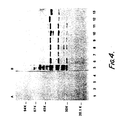
- the 39kDa band present in group A isolates (Fig.4, lanes 6 to 11), the major 40kDa in group B isolate 8841 (Fig.4, lane 12) and the 38KDa and 38.5kDa proteins bands in the T.innocens isolate 9510 (Fig.4 lane 13) were also immunoreactive.
- a similar antibody response was observed when OM proteins were probed with rabbit anti-T.hyodysenteriae hyperimmune serum (data not shown).
- OM proteins from other gram-negative organisms were immunoprobed with the same porcine anti-T.hyodysenteriae hyperimmune serum there was no detectable antibody cross-reactivity (data not shown).
- T.hyodysenteriae antigens important in the immunological response
- the OM proteins recognised in the Western blots were correlated with proteins located on the surface of the T.hyodysenteriae .
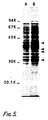
- Intact T.hyodysenteriae strain 5380 whole cells were treated with trypsin and the proteolysis stopped with PMSF. Both protease-treated and control T.hyodysenteriae 5380 cells were solubilised in SDS sample buffer and subjected to SDS-PAGE (Fig. 5).
- Trypsin proteolysis caused selective loss of the protein bands at Mr values of 39kDa, 36kDa, 34kDa (doublet), and 30kDa indicating that these proteins extend out through the OM to the treponemal cell surface.
- the same pattern of proteolysis was observed when proteinase K treatment of the T.hyodysenteriae 5380 cells was used rather than trypsin (data not shown).
- Vaccine preparation Cultures of T.hyodysenteriae , strains 5380 or 70A were grown for 48 hours in an anaerobically prepared Trypticase soy broth medium supplemented with cysteine, glucose, sodium citrate, sodium pyruvate, and iron, adjusted to pH 6.8, sterilized and gassed with a mixture of 10% CO2 in N2. Up to 10%, preferably 1%, fetal calf serum may be added to enhance growth. Cultures were harvested, and resuspended in phosphate buffered saline. The organisms were diluted to a concentration of approximately 1 x 10⁹/ml before use. C. Challenge Inoculum .
- Challenge inoculum consisted of the same T.hyodysenteriae organisms grown in liquid culture, (as above) or a single blood agar plate of the organism which had been incubated for 48 hours at 37°C.
- the challenge inoculum was fed in a homogenate of 200ml of reconstituted milk powder to pigs which had been deprived access to food for 24 hours prior to inoculation.
- D. Virulence Trials Trial 1 Four pigs were incolulated orally with the growth from 1 blood agar culture of T.hyodysenteriae strain 5380. The pigs were maintained on an antibiotic free diet and were monitored daily for signs and symptoms of dysentery.
- T.hyodysenteriae 5380 The clinical response of these pigs inoculated with T.hyodysenteriae 5380 was as follows: Diarrhoea 4/4 Dysentery 4/4 Av.Day of onset 10 days Av.Duration 3 days Deaths 4/4 This trial showed that strain 5380 is virulent for pigs, and T.hyodysenteriae was isolated from all pigs with dysentery. Trials 2 and 3 These were repeats of Trial 1 using six 3-week-old pigs. All pigs showed diarrhoea and dysentery 11 days post inoculation. In trial 2, two pigs died from dysentery on day 12 and the remainder, with classical signs of swine dysentery were treated with antibiotics to control the dysentery. Trial 3 results were similar.
- strain 5380 is a virulent strain of T.hyodysenteriae
- Trial 4 Eight pigs were challenged with cultures of 70A rather than 5380 using the same inoculation protocol as an trials 1, 2 and 3. No pigs succumbed to swine dysentery.
- Trial 5 Six 4-week-old pigs were inoculated with either strain 5380 (4 pigs) or strain 70A (2 pigs) by oral inoculation of a concentrated inoculum (1 x 10¹¹) of the T.hyodysenteriae strains orally and the freshly harvested surface growth from 1 agar plate intrarectecally. The pigs were housed in separate crates in the same shed and fed the same ration.
- mice from the 5380 group showed evidence of clinical swine dysentery within 10 days of challenge and 1/4 died at 12 days. The remainder of the 5380 group were treated with antibiotics to control the dysentery. Neither of the pigs challenged with strain 70A showed any signs of dysentery up to 30 days post challenge, when the experiment was terminated.
- Trial 6 Eight pigs were challenged with cultures of 70A by inoculation of 1 agar plate of actively growing T.hyodysenteriae 70A in milk orally and the surface growth of actively growing T.hyodysenteriae 70A, resuspended in 1ml of T.hyodysenteriae culture broth and inoculated intrarectally. None of the pigs showed any signs of swine dysentery.
- T.hyodysenteriae could be isolated from the pig faeces in the 24 hours post inoculation. However, T.hyodysenteriae could not be isolated from faeces from 5 days after challenge.
- E. Vaccination Trials Trial 7 Six pigs were vaccinated intramuscularly with 2 x 10⁹ T.hyodysenteriae 5380 in adjuvant at day 0 and revaccinated on day 11. A control group of 6 pigs, kept separately, were untreated. All pigs were challenged at day 22 with strain 5380 challenge fed in milk as per Trial 1.
- T.hyodysenteriae was isolated from all infected pigs which died but was not isolated from vaccinated pigs 12 days after challenge.
- the clinical response of pigs in Trial 8 was as follows: Unvaccinated Vaccinated Diarrhoea 5/5 0/6 Dysentery 5/5 0/6 Death 5/5 1/6 * (* 1 pig died of E.coli peritonitis. There was no evidence of T.hyodysenteriae infection in the intestine and no T.hyodysenteriae was isolated from the intestinal tissue.) Blood was collected from all pigs in the trial and the serological titres (IgG levels) are shown in the accompanying figure (Fig.4).
- T.hyodysenteriae isolates 5380 and 70A did not reveal any significant differences in their protein composition or antigenicity as determined by a Western blot analysis (see Figures 1, 2 and 3) seven pigs were vaccinated with 2 x 10⁹ T.hyodysenteriae 70A at day 0 and revaccinated with 2 x 10⁹ T.hyodysenteriae 70A on day 17. Six pigs were kept separately as controls. All pigs were challenged on day 24 (9 days after the second vaccination) with T.hyodysenteriae 5380.
- Serological responses of vaccinated and unvaccinated pigs revealed marked differences in the IgG titres to T.hyodysenteriae in infected and uninfected pigs In all vaccinated pigs the serological titre (IgG) to T.hyodysenteriae was greater than 1.0 OD unit at a 1/800 dilution of serum.
- These vaccination trials demonstrate in pigs vaccinated with the virulent (5380) or avirulent (70A) strains of T.hyodysenteriae that an antibody titre (in excess of 1.0 at 1/800) can be obtained that will protect against challenge with a virulent strain (5380) of T.hyodysenteriae .
- Vaccination Trial One hundred and ten pigs were vaccinated with oxygen-treated, non-viable, adjuvanted T.hyodysenteriae vaccine at day 0 and day 10, and 110 pigs were kept as control pigs. The pigs were all housed in a commercial piggery with endemic swine dysentery. Unvaccinated pigs began to show signs of acute dysentery within 7 days of the vaccine trial starting.
- the clinical response of pigs in this vaccination trial was as follows: Unvaccinated Vaccinated Diarrohoea 110/110 2/110 Dysentery *96/110 1/110 Deaths * 6/110 1/110+ * All pigs showing evidence of acute dysentery were treated with 10mg/kg Tiamulin hydrochloride once swine dysentery was detected and confirmed to reduce the deaths that would have inevitably occurred without treatment. + One pig in the vaccinated group showed evidence of acute dysentery only 3 days after vaccination and this pig died within a few hours of the onset of the disease. It was considered that 3 days post vaccination was insufficent time to allow for the development of an adequate immune response.
- Serological responses of vaccinated and unvaccinated pigs revealed marked differences in the IgG titres to T.hyodysenteriae in infected and uninfected pigs In all vaccinated pigs the serological titre (IgG) to T.hyodysenteriae was greater than 1.0 OD unit at a 1/800 dilution of serum.
- These vaccination trials demonstrate in pigs vaccinated with oxygen-treated, non-viable strains of T.hyodysenteriae (70A) that an antibody titre (in excess of 1.0 at 1/800) can be obtained that will protect against challenge with a virulent strain of T.hyodysenteriae .
- D. Comparison of Immunogenicity .
Landscapes
- Health & Medical Sciences (AREA)
- Life Sciences & Earth Sciences (AREA)
- Pharmacology & Pharmacy (AREA)
- Veterinary Medicine (AREA)
- Public Health (AREA)
- Chemical & Material Sciences (AREA)
- General Health & Medical Sciences (AREA)
- Medicinal Chemistry (AREA)
- Animal Behavior & Ethology (AREA)
- General Chemical & Material Sciences (AREA)
- Organic Chemistry (AREA)
- Nuclear Medicine, Radiotherapy & Molecular Imaging (AREA)
- Chemical Kinetics & Catalysis (AREA)
- Oncology (AREA)
- Communicable Diseases (AREA)
- Immunology (AREA)
- Microbiology (AREA)
- Mycology (AREA)
- Epidemiology (AREA)
- Medicines Containing Antibodies Or Antigens For Use As Internal Diagnostic Agents (AREA)
- Micro-Organisms Or Cultivation Processes Thereof (AREA)
- Peptides Or Proteins (AREA)
Claims (10)
- Parenterale Vakzinzusammensetzung zur Immunisierung von Schweinen gegen Treponema hyodysenteriae, dadurch gekennzeichnet, daß sie einen Sauerstoff-behandelten, lebensunfähigen T. hyodysenteriae-Stamm zusammen mit einem dafür geeigneten Träger, der an eine parenterale Verabreichung angepaßt ist, umfaßt.
- Zusammensetzung gemäß Anspruch 1, wobei der T. hyodysenteriae-Stamm ein virulenter Stamm ist.
- Zusammensetzung gemäß Anspruch 1, wobei der T. hyodysenteriae-Stamm ein attenuierter Stamm ist.
- Zusammensetzung gemäß Anspruch 1 oder Anspruch 2, wobei T. hyodysenteriae in einer Sauerstoff-gesättigten Lösung gehalten werden, um sie lebensunfähig zu machen.
- Zusammensetzung gemäß einem der Ansprüche 1 bis 4, wobei der T. hyodysenteriae-Stamm ein Stamm ist, der ausgewählt ist unter ATCC 31212, ATCC 31287, ATCC 27164 und anderen T. hyodysenteriae-Stämmen, die hauptsächlich vorherrschende Proteine mit 36 und 37 kDa oder 36, 37 und 39 kDa aufweisen, was durch SDS-PAGE-Gelelektrophorese eines Gesamtzellysates bestimmt wird.
- Zusammensetzung gemäß einem der Ansprüche 1 bis 5, die außerdem ein Adjuvans umfaßt.
- Zusammensetzung gemäß Anspruch 6, wobei das Adjuvans inkomplettes Freund'sches Adjuvans ist.
- Zusammensetzung gemäß einem der Ansprüche 1 bis 7 zur Verwendung bei der Immunisierung von Schweinen gegen T. hyodysenteriae durch parenterale Verabreichung.
- Zusammensetzung gemäß Anspruch 8 zur Verwendung bei der Immunisierung von Schweinen gegen T. hyodysenteriae durch intramuskuläre Verabreichung.
- Verfahren zur Herstellung einer Vakzinzusammensetzung zur Immunisierung von Schweinen gegen T. hyodysenteriae, wobei man in einer Stufe davon T. hyodysenteriae-Zellen einer Sauerstoffbehandlung unterzieht, um diese lebensunfähig zu machen.
Applications Claiming Priority (5)
| Application Number | Priority Date | Filing Date | Title |
|---|---|---|---|
| AU9632/86 | 1986-12-23 | ||
| AUPH963286 | 1986-12-23 | ||
| AUPI394087 | 1987-08-24 | ||
| AU3940/87 | 1987-08-24 | ||
| PCT/AU1987/000440 WO1988004555A1 (en) | 1986-12-23 | 1987-12-23 | Swine dysentery vaccine |
Publications (3)
| Publication Number | Publication Date |
|---|---|
| EP0339040A1 EP0339040A1 (de) | 1989-11-02 |
| EP0339040A4 EP0339040A4 (de) | 1990-01-08 |
| EP0339040B1 true EP0339040B1 (de) | 1994-09-14 |
Family
ID=25643215
Family Applications (1)
| Application Number | Title | Priority Date | Filing Date |
|---|---|---|---|
| EP88900562A Expired - Lifetime EP0339040B1 (de) | 1986-12-23 | 1987-12-23 | Impfstoff gegen schweinedysenterie |
Country Status (9)
| Country | Link |
|---|---|
| EP (1) | EP0339040B1 (de) |
| JP (1) | JP2721218B2 (de) |
| AT (1) | ATE111356T1 (de) |
| AU (1) | AU610118B2 (de) |
| CA (1) | CA1324076C (de) |
| DE (1) | DE3750549T2 (de) |
| MY (1) | MY103043A (de) |
| NZ (1) | NZ223042A (de) |
| WO (1) | WO1988004555A1 (de) |
Families Citing this family (4)
| Publication number | Priority date | Publication date | Assignee | Title |
|---|---|---|---|---|
| US5110589A (en) * | 1988-09-14 | 1992-05-05 | Arizona Technology Development Corporation | Swine dysentery subunit vaccine and method |
| US5236708A (en) * | 1989-11-03 | 1993-08-17 | Iowa State University Research Foundation, Inc. | Reduced-protein subunit vaccine for swine dysentery |
| FR2707168B1 (fr) * | 1993-07-08 | 1995-08-18 | Rhone Merieux | Vaccin contre la dysenterie hémorragique du porc et ensemble de vaccination y relatif. |
| BR112020007448A2 (pt) * | 2017-10-24 | 2020-12-08 | Aquilón Cyl S.L. | Vacina para disenteria de cepa única |
Citations (1)
| Publication number | Priority date | Publication date | Assignee | Title |
|---|---|---|---|---|
| JPH06214797A (ja) * | 1993-01-18 | 1994-08-05 | Fujitsu Sooshiaru Sci Raboratori:Kk | データ処理装置 |
Family Cites Families (5)
| Publication number | Priority date | Publication date | Assignee | Title |
|---|---|---|---|---|
| US4100272A (en) * | 1977-05-31 | 1978-07-11 | Iowa State University Research Foundation, Inc. | Method of increasing the resistance of swine to swine dysentery infection |
| US4152415A (en) * | 1978-08-18 | 1979-05-01 | Iowa State University Research Foundation, Inc. | Method of increasing the effectiveness of oral vaccination for swine dysentery |
| US4203968A (en) * | 1978-08-18 | 1980-05-20 | Iowa State University Research Foundation, Inc. | Combination vaccine for swine dysentery and method of use |
| US4469672A (en) * | 1983-04-07 | 1984-09-04 | Iowa State University Research Foundation | Method of combined parenteral and oral vaccination for swine dysentery |
| GB8405530D0 (en) * | 1984-03-02 | 1984-04-04 | Lysons R J | Vaccine for swine dysentery |
-
1987
- 1987-12-22 CA CA000555116A patent/CA1324076C/en not_active Expired - Fee Related
- 1987-12-22 NZ NZ223042A patent/NZ223042A/en unknown
- 1987-12-23 AT AT88900562T patent/ATE111356T1/de not_active IP Right Cessation
- 1987-12-23 EP EP88900562A patent/EP0339040B1/de not_active Expired - Lifetime
- 1987-12-23 MY MYPI87003244A patent/MY103043A/en unknown
- 1987-12-23 DE DE3750549T patent/DE3750549T2/de not_active Expired - Fee Related
- 1987-12-23 AU AU11023/88A patent/AU610118B2/en not_active Ceased
- 1987-12-23 JP JP63500863A patent/JP2721218B2/ja not_active Expired - Fee Related
- 1987-12-23 WO PCT/AU1987/000440 patent/WO1988004555A1/en not_active Ceased
Patent Citations (1)
| Publication number | Priority date | Publication date | Assignee | Title |
|---|---|---|---|---|
| JPH06214797A (ja) * | 1993-01-18 | 1994-08-05 | Fujitsu Sooshiaru Sci Raboratori:Kk | データ処理装置 |
Non-Patent Citations (2)
| Title |
|---|
| Can. J. Biochem and Physiology, Vol. 40, Page 1129, (1962), Hagen, J.H. and Hagen, P.B.. * |
| Maruo Fumiharu, Tamiya Nobuo, Asakura Kunizo Kanshu (Koso Handbook)1 December 1982 (01.12.82) Asakura Shoten p. 134-135, 259 * |
Also Published As
| Publication number | Publication date |
|---|---|
| JPH02501732A (ja) | 1990-06-14 |
| AU610118B2 (en) | 1991-05-16 |
| EP0339040A1 (de) | 1989-11-02 |
| DE3750549T2 (de) | 1995-02-09 |
| ATE111356T1 (de) | 1994-09-15 |
| AU1102388A (en) | 1988-07-15 |
| DE3750549D1 (de) | 1994-10-20 |
| MY103043A (en) | 1993-04-30 |
| WO1988004555A1 (en) | 1988-06-30 |
| CA1324076C (en) | 1993-11-09 |
| NZ223042A (en) | 1991-03-26 |
| JP2721218B2 (ja) | 1998-03-04 |
| EP0339040A4 (de) | 1990-01-08 |
Similar Documents
| Publication | Publication Date | Title |
|---|---|---|
| Jayappa et al. | Role of Escherichia coli type 1 pilus in colonization of porcine ileum and its protective nature as a vaccine antigen in controlling colibacillosis | |
| US6022728A (en) | Method for producing a bacterial vaccine and novel vaccines produced thereby | |
| EP0155790A1 (de) | Impfstoff gegen Schweinedysenterie | |
| KITAJIMA et al. | Protective effect of NaOH-extracted Erysipelothrix rhusiopathiae vaccine in pigs | |
| Tamura et al. | Effect of antiflagellar serum in the protection of mice against Clostridium chauvoei | |
| HU213924B (en) | Method for producing vaccine against enteric infection caused by enterotoxigenic e.coli bacteria in humans, containing formalin-killed e.coli strain having the ability of expressing colonization factor antigens | |
| US5281416A (en) | Swine dysentery vaccine | |
| AU685569B2 (en) | Pasteurella multocida toxoid vaccines | |
| AU610118B2 (en) | Swine dysentery vaccine | |
| US12383610B2 (en) | Vaccine for protection against Streptococcus suis serotype 9, sequence type 16 | |
| RU2043771C1 (ru) | Вакцина против эшерихиоза животных | |
| Srivastava | Immunogenicity of Pasteurella multocida grown in iron-restricted medium | |
| Smith et al. | Biochemical and immunochemical characterisation of strains of Treponema hyodysenteriae | |
| US6790446B2 (en) | Campylobacter vaccine | |
| EP0502100B1 (de) | Impfstoff gegen schweinedysenterie mit vermindertem gehalt an proteinuntereinheit | |
| CN1031039C (zh) | “猪痢疾疫苗” | |
| US20240325514A1 (en) | A vaccine for protection against streptococcus suis of various serotypes | |
| Zarkasie et al. | Growth ability and immunological properties of Erysipelothrix rhusiopathiae serotype 2 | |
| WO2006113782A2 (en) | Lawsonia protein useful as a component in subunit vaccine and methods of making and using thereof | |
| ARIMITSU et al. | Cross antigenicities of Leptospira interrogans serovar copenhageni Shibaura strain for preparing biological products in Japan | |
| EP0694560A2 (de) | Herstellung von Pasteurella-Antigenen | |
| US20240335520A1 (en) | A vaccine for protection against streptococcus suis of various serotypes | |
| EP4380611A1 (de) | Impfstoff zum schutz gegen streptococcus suis verschiedener serotypen | |
| Traub et al. | Humoral antibody response of rabbits against experimental Serratia marcescens septicemia | |
| Greene | Infectious bovine keratoconjunctvitis: the identification of sahred antigenic determinants in pili from divergent strains of Moraxella bovis |
Legal Events
| Date | Code | Title | Description |
|---|---|---|---|
| PUAI | Public reference made under article 153(3) epc to a published international application that has entered the european phase |
Free format text: ORIGINAL CODE: 0009012 |
|
| 17P | Request for examination filed |
Effective date: 19890619 |
|
| AK | Designated contracting states |
Kind code of ref document: A1 Designated state(s): AT BE CH DE FR GB IT LI LU NL SE |
|
| A4 | Supplementary search report drawn up and despatched |
Effective date: 19900108 |
|
| 17Q | First examination report despatched |
Effective date: 19920228 |
|
| GRAA | (expected) grant |
Free format text: ORIGINAL CODE: 0009210 |
|
| AK | Designated contracting states |
Kind code of ref document: B1 Designated state(s): AT BE CH DE FR GB IT LI LU NL SE |
|
| REF | Corresponds to: |
Ref document number: 111356 Country of ref document: AT Date of ref document: 19940915 Kind code of ref document: T |
|
| REF | Corresponds to: |
Ref document number: 3750549 Country of ref document: DE Date of ref document: 19941020 |
|
| ET | Fr: translation filed | ||
| ITF | It: translation for a ep patent filed | ||
| ITTA | It: last paid annual fee | ||
| EAL | Se: european patent in force in sweden |
Ref document number: 88900562.5 |
|
| PLBE | No opposition filed within time limit |
Free format text: ORIGINAL CODE: 0009261 |
|
| STAA | Information on the status of an ep patent application or granted ep patent |
Free format text: STATUS: NO OPPOSITION FILED WITHIN TIME LIMIT |
|
| 26N | No opposition filed | ||
| REG | Reference to a national code |
Ref country code: GB Ref legal event code: IF02 |
|
| PGFP | Annual fee paid to national office [announced via postgrant information from national office to epo] |
Ref country code: AT Payment date: 20051104 Year of fee payment: 19 Ref country code: GB Payment date: 20051104 Year of fee payment: 19 |
|
| PGFP | Annual fee paid to national office [announced via postgrant information from national office to epo] |
Ref country code: NL Payment date: 20051109 Year of fee payment: 19 |
|
| PGFP | Annual fee paid to national office [announced via postgrant information from national office to epo] |
Ref country code: FR Payment date: 20051201 Year of fee payment: 19 |
|
| PGFP | Annual fee paid to national office [announced via postgrant information from national office to epo] |
Ref country code: SE Payment date: 20051202 Year of fee payment: 19 |
|
| PGFP | Annual fee paid to national office [announced via postgrant information from national office to epo] |
Ref country code: DE Payment date: 20051230 Year of fee payment: 19 |
|
| PGFP | Annual fee paid to national office [announced via postgrant information from national office to epo] |
Ref country code: BE Payment date: 20060113 Year of fee payment: 19 |
|
| PGFP | Annual fee paid to national office [announced via postgrant information from national office to epo] |
Ref country code: LU Payment date: 20060927 Year of fee payment: 20 |
|
| PGFP | Annual fee paid to national office [announced via postgrant information from national office to epo] |
Ref country code: CH Payment date: 20061026 Year of fee payment: 20 |
|
| PG25 | Lapsed in a contracting state [announced via postgrant information from national office to epo] |
Ref country code: SE Free format text: LAPSE BECAUSE OF NON-PAYMENT OF DUE FEES Effective date: 20061224 |
|
| PG25 | Lapsed in a contracting state [announced via postgrant information from national office to epo] |
Ref country code: BE Free format text: LAPSE BECAUSE OF NON-PAYMENT OF DUE FEES Effective date: 20061231 |
|
| PGFP | Annual fee paid to national office [announced via postgrant information from national office to epo] |
Ref country code: IT Payment date: 20061231 Year of fee payment: 20 |
|
| PG25 | Lapsed in a contracting state [announced via postgrant information from national office to epo] |
Ref country code: NL Free format text: LAPSE BECAUSE OF NON-PAYMENT OF DUE FEES Effective date: 20070701 |
|
| PG25 | Lapsed in a contracting state [announced via postgrant information from national office to epo] |
Ref country code: DE Free format text: LAPSE BECAUSE OF NON-PAYMENT OF DUE FEES Effective date: 20070703 |
|
| EUG | Se: european patent has lapsed | ||
| GBPC | Gb: european patent ceased through non-payment of renewal fee |
Effective date: 20061223 |
|
| NLV4 | Nl: lapsed or anulled due to non-payment of the annual fee |
Effective date: 20070701 |
|
| REG | Reference to a national code |
Ref country code: FR Ref legal event code: ST Effective date: 20070831 |
|
| PG25 | Lapsed in a contracting state [announced via postgrant information from national office to epo] |
Ref country code: GB Free format text: LAPSE BECAUSE OF NON-PAYMENT OF DUE FEES Effective date: 20061223 Ref country code: AT Free format text: LAPSE BECAUSE OF NON-PAYMENT OF DUE FEES Effective date: 20061223 |
|
| BERE | Be: lapsed |
Owner name: *ROYAL MELBOURNE INSTITUTE OF TECHNOLOGY LTD Effective date: 20061231 |
|
| REG | Reference to a national code |
Ref country code: CH Ref legal event code: PL |
|
| PG25 | Lapsed in a contracting state [announced via postgrant information from national office to epo] |
Ref country code: FR Free format text: LAPSE BECAUSE OF NON-PAYMENT OF DUE FEES Effective date: 20070102 |