EP0337801A2 - Adjustment device for rotary printing press - Google Patents
Adjustment device for rotary printing press Download PDFInfo
- Publication number
- EP0337801A2 EP0337801A2 EP89303716A EP89303716A EP0337801A2 EP 0337801 A2 EP0337801 A2 EP 0337801A2 EP 89303716 A EP89303716 A EP 89303716A EP 89303716 A EP89303716 A EP 89303716A EP 0337801 A2 EP0337801 A2 EP 0337801A2
- Authority
- EP
- European Patent Office
- Prior art keywords
- cylinder
- shaft
- printing
- bushings
- printing cylinder
- Prior art date
- Legal status (The legal status is an assumption and is not a legal conclusion. Google has not performed a legal analysis and makes no representation as to the accuracy of the status listed.)
- Withdrawn
Links
Images
Classifications
-
- B—PERFORMING OPERATIONS; TRANSPORTING
- B41—PRINTING; LINING MACHINES; TYPEWRITERS; STAMPS
- B41F—PRINTING MACHINES OR PRESSES
- B41F13/00—Common details of rotary presses or machines
- B41F13/08—Cylinders
- B41F13/24—Cylinder-tripping devices; Cylinder-impression adjustments
- B41F13/26—Arrangement of cylinder bearings
- B41F13/28—Bearings mounted eccentrically of the cylinder axis
Definitions
- This invention relates to printing presses of the type in which a printing cylinder is rotated in juxtaposition to a blanket cylinder, and, a substrate to be printed is passed through the nip between the printing cylinder and the blanket cylinder, and an image is impressed thereon by an inked printing plate attached to the printing cylinder.
- the pressure exerted at the pinch of the printing cylinder and the blanket cylinder is sufficient to accommodate the pressures required for accurate printing on a relatively smooth substrate, such as a calendered paper, the pressure is insufficient to accommodate accurate and drop-out free printing onto a heavily textured paper, such as a heavy weight cotton or linen textured paper.
- the task addressed, by the inventor is the provision of adjustment device for a printing cylinder which readily can be adjusted by the press operator in order to provide optimum pressure at the nip of the printing.
- cylinder and the blanket cylinder to accommodate any selected type of substrate, including heavy weight cotton or linen textured paper, in the total absence of "cylinder bounce".
- the use of a spring biasing force to bias the printing cylinder towards the blanket cylinder is eliminated in its entirety, and in its place, the printing cylinder is supported by fixed but adjustable bearings, which can be adjusted by an operator adjustable control, in order to provide a positive pressure at the printing plate which in no way relies upon a spring biasing force, but which instead is produced by the extent of compression of the blanket of the blanket cylinder, and, the extent of compression of the substrate to be printed.
- the operator adjustable control can be operated by the operator to produce an optimum printed image on the substrate throughout the subsequent production run of the printing press, as related to the specific substrate that is being printed.
- the objective of the present invention is accomplished by journaling the support shaft of the printing cylinder in eccentric bushings, which themselves are supported in stationary frame members of the printing press, the bushings being rotatable in unison under the control of an operator actuable mechanism positioned externally of the press.
- a linkage is provided between the operator actuable mechanism and the respective eccentric bushings, in order that a determined angular rotation of a control of the operator actuable mechanism will produce a corresponding angular rotation of each of the respective bushings, and, by virtue of the eccentricity of the mounting of the cylinder support shaft within those bushings, result in a closely controllable adjustment of the printing cylinder towards or away from the blanket cylinder.
- the printing cylinder is adjustable up to the point of direct engagement with the blanket cylinder, but in the absence of compressive engagement therewith, such as would produce "cylinder bounce". Then, in dependence on the thickness of the substrate to be printed, the printing pressure as derived directly from the resistance to compression of the blanket of the blanket cylinder, as opposed to being determined by a spring bias of fixed magnitude as in prior art mechanisms.
- the printing cylinder and its support shaft can be moved towards or away from the blanket cylinder by any amount determined by the operator, either prior to or during a production run, in order to provide optimum pressure at the nip of the printing cylinder and blanket cylinder to produce drop-out free printing of any selected substrate of any particular gauge and of any particular texture, intermediate that of a polished calendered paper and that of coarsely textured cotton or linen textured paper and the like.
- a printing cylinder indicated generally at 10 is positioned in juxtaposition with a blanket cylinder 12, the blanket cylinder having a resilient coating or blanket 14.
- the respective cylinders are journaled for rotation in parallelism with each other within parallel frames 16 of the printing press, only one of which is shown in Figure 1.
- the printing cylinder 10 is supported for rotation by a shaft 18 which extends through an aperture 20 in the adjacent end frame 16, and projects outwardly of the end frame 16.
- the outwardly extending end of the shaft 18 is received and journaled within a bearing 22 located at one end of a bell crank 24, the bell crank being pivotally connected to the frame member 16 by a stud 26.
- the other arm of the bell crank lever 24 is provided with a laterally extending pin 28, which cooperates with a cam 30, the cam 30 being rotatable under the manual control of an adjustment knob or dial 32.
- a shaft 34 Forwardly of the pin type cam follower 28, that arm of the bell crank lever is connected to a shaft 34 by a connector 36 which permits angular movement of the shaft 34 relative to the end of the bell crank lever 24.
- the shaft 34 extends upwardly through and is slidable within a fixed stop member 38, movement of the shaft 34 being constrained by a compression spring 40 reacting between the fixed stop member 38 and a collar 42 fast with the shaft 34.
- the shaft 34 is threaded, and, lock nuts 44 are threaded thereon for limiting downward movement of the shaft 34.
- the cam 30 is caused to rotate, and, will cause the bell crank 24 to move angularly to raise or lower the longitudinal axis of the shaft 18 in the directions of the arrows 46.
- stop nuts 44 are so set that the cylinder 10 is in sufficiently close proximity to the blanket 14 of the blanket cylinder 12 that a relatively thin substrate, when passed through the nip of the rollers 10 and 14, is sufficiently compressed to assure a drop-out free printing of the substrate by inked printing plates carried on the surface of the printing cylinder 10.
- the pressure exerted on the substrate is determined primarily by the closeness of spacing of the printing cylinder 10 and the blanket cylinder 12, and, will vary in dependence of the gauge or thickness of the substrate fed between the respective cylinders.
- the adjustment of the stop nuts 44 is arranged such that drop-out free printing on the smallest gauge substrate is accomplished, while at the same time the pressure at the nip of cylinders is maintained at an absolute minimum in order to avoid the problem of "cylinder bounce" during rotation of the respective cylinders relative to each other.
- a further consideration is that arising when a heavily textured substrate is to be printed, such is when a heavily textured paper or card is to be printed in a satisfactory manner free of drop-outs.
- the rate of the springs 40 be very considerably increased in order to provide a increased pressure at the nip of the printing and blanket cylinders.
- the spring rate of the springs 40 must be changed in order to secure a change in the pressure exerted at the nip of the cylinders 10 and 14. Without regard to the thickness of the substrate, the pressure at the nip of the cylinders 10 and 14 remains constant, or substantially constant without regard to the extent to which the printing cylinder 10 moves away from the blanket cylinder 14.
- FIG. 2 there is illustrated a structure embodying the invention by means of which the pressure at the nip of the printing cylinder 10 and blanket cylinder 14 can be adjusted at will under the control of the operator of the press.
- the longitudinal axis of the bearing 50 and which is indicated at 56, is arranged displaced radially of the longitudinal axis of the bushing, and which is indicated at 54, such that the bearing 50 is eccentrically arranged relative to the axis of rotation of the bushing.
- a lug 58 Extending radially of the bushing 52 is a lug 58, to which one end of a push-pull rod 60 is attached, the opposite end of the push-pull rod 60 being connected to a lever 62, the lever 62 being fast with a control shaft 64 rotatable by the control knob 32.
- a simple linkage arrangement has been illustrated for imparting rotational movement to the bushing 52 upon that rotation of the control knob 32, various other drive arrangements could be provided.
- the circumference of the bushing 52 could be in the form of a spur gear, which is meshed with a reciprocatable toothed rack, the toothed rack being movable longitudinally by a spur gear fact with the control shaft 64.
- any convenient drive arrangement could be provided for translating rotational movement of the control knob 32 into a corresponding rotation of the bushing 52.
- a reduction gearing could be provided between the shaft of the control knob 32 and the lever 62 in order to provide a micrometer adjustment of the bushing 52.
- the biassing of the printing cylinder 10 by means of springs has been eliminated in its entirety. Instead, the printing cylinder 10 is movable positively towards or away from the blanket cylinder 12 by a determined extent.
- the blanket 14 of the blanket cylinder 12 itself is formed of a hard but resiliently compressible material, which will provide a cushion for the force exerted by the now fixedly located printed cylinder 10.
- the printing cylinder 10 can be set in an attitude for it to provide drop-out free printing on a substrate of extremely light gauge and having a polished or calendered surface, the extent of the adjustment being readily determinable by the operator during an initial run of the press, i.e., it is simply a matter of adjusting the control 32 to produce the desired quality of printing.
- the extent which the pressure is to be increased will, of course, vary widely in dependence on the extent of texture of the substrate, and, the amount of "give" in the fibers of the substrate. If the substrate is one having a little "give” in the fibers, then, the pressure will have to be increased to an extent greater than that required for a substrate having substantial "give". The amount of "give” will, of course, vary widely between different runs of substrates to be printed, and, there is no accurate way of determining the extent of "give” in any particular substrate.
- the construction embodying the invention provides for an increase in the pressure at the nip of the printing cylinder 10 and blanket cylinder 12 of any desired magnitude, the magnitude of that pressure being under the direct control of the operator of the press.
Landscapes
- Engineering & Computer Science (AREA)
- Mechanical Engineering (AREA)
- Rotary Presses (AREA)
Abstract
The mounting of a printing cylinder (10) in a printing press includes sleeve bushings (52) mounted for angular rotation in opposed end frames (16) of the press with their longitudinal axes coincident. Each bushing (52) incorporates a bearing (50) for the support of a shaft (18) of the printing cylinder, the longitudinal axes of the shaft bearings (50) being coincident one with the other but spaced laterally from the longitudinal axes of the bushings. A rotary control shaft and linkage causes rotation of the bushings (52) by a determined angular extent producing movement of the printing cylinder (10) towards or away from a blanket cylinder (12) by an amount determined by the extent of angular rotation of the sleeves.
Description
- This invention relates to printing presses of the type in which a printing cylinder is rotated in juxtaposition to a blanket cylinder, and, a substrate to be printed is passed through the nip between the printing cylinder and the blanket cylinder, and an image is impressed thereon by an inked printing plate attached to the printing cylinder.
- Conventional practice requires that the printing cylinder be supported for movement towards and away from the blanket cylinder in order to accommodate substrates of different gauge or thickness, typically sheets of paper or paper board.
- Typically, this is accommodated by supporting the central support shaft of the printing cylinder on one of the arms of a pair bell cranker levers respectively mounted on opposite frame members of the printing press. The other arms of the bell crank levers are spring biased in a direction to move the printing cylinder towards the blanket cylinder, and a positive stop is provided limiting the extent to which the printing cylinder can move towards the blanket cylinder. A cam is provided for adjusting the extent to which the printing cylinder can move towards the blanket cylinder, thus providing accommodation for a substrate of any particular gauge.
- However, such an arrangement limits the pressure that can be exerted between the printing cylinder and the blanket cylinder to that provided by the spring bias, and, it is not possible to increase that pressure other than by replacing the springs by ones of a greater force, or by torquing down the springs to increase the available spring bias. Both such operations require down time of the press and the use of a highly skilled technician in resetting the press, because such adjustment cannot be made externally of the press by the press operator.
- Invariably, while the pressure exerted at the pinch of the printing cylinder and the blanket cylinder is sufficient to accommodate the pressures required for accurate printing on a relatively smooth substrate, such as a calendered paper, the pressure is insufficient to accommodate accurate and drop-out free printing onto a heavily textured paper, such as a heavy weight cotton or linen textured paper.
- An additional problem that emerges in the printing of heavy weight textured papers results as a consequence of the clearance between the printing cylinder and the blanket cylinder having been reduced to less than zero clearance in an attempt to increase the pressure at the printing plate. If this condition arises, then, the major problem and one of distastrous consequences occurs, that problem being caused by "cylinder bounce". Such "cylinder bounce" occurs as a result of the discontinuous periphery of the printing cylinder having been brought into compressive relationship with the blanket cylinder in an attempt to increase the plate pressure. Each time a discontinuity in the periphery of the printing cylinder is sensed by the blanket cylinder, then, the compressive force acting between the cylinders temporarily disappears, only to be restored after a very short interval of time, this producing spurious vibrations in the respective cylinders that result in the said cylinder bounce.
- The task addressed, by the inventor is the provision of adjustment device for a printing cylinder which readily can be adjusted by the press operator in order to provide optimum pressure at the nip of the printing. cylinder and the blanket cylinder to accommodate any selected type of substrate, including heavy weight cotton or linen textured paper, in the total absence of "cylinder bounce".
- According to the present invention, the use of a spring biasing force to bias the printing cylinder towards the blanket cylinder is eliminated in its entirety, and in its place, the printing cylinder is supported by fixed but adjustable bearings, which can be adjusted by an operator adjustable control, in order to provide a positive pressure at the printing plate which in no way relies upon a spring biasing force, but which instead is produced by the extent of compression of the blanket of the blanket cylinder, and, the extent of compression of the substrate to be printed.
- Thus, during an initial trial run of the printing press, the operator adjustable control can be operated by the operator to produce an optimum printed image on the substrate throughout the subsequent production run of the printing press, as related to the specific substrate that is being printed.
- The objective of the present invention is accomplished by journaling the support shaft of the printing cylinder in eccentric bushings, which themselves are supported in stationary frame members of the printing press, the bushings being rotatable in unison under the control of an operator actuable mechanism positioned externally of the press. A linkage is provided between the operator actuable mechanism and the respective eccentric bushings, in order that a determined angular rotation of a control of the operator actuable mechanism will produce a corresponding angular rotation of each of the respective bushings, and, by virtue of the eccentricity of the mounting of the cylinder support shaft within those bushings, result in a closely controllable adjustment of the printing cylinder towards or away from the blanket cylinder.
- In this manner, the printing cylinder is adjustable up to the point of direct engagement with the blanket cylinder, but in the absence of compressive engagement therewith, such as would produce "cylinder bounce". Then, in dependence on the thickness of the substrate to be printed, the printing pressure as derived directly from the resistance to compression of the blanket of the blanket cylinder, as opposed to being determined by a spring bias of fixed magnitude as in prior art mechanisms.
- Thus, according to the present invention, the printing cylinder and its support shaft can be moved towards or away from the blanket cylinder by any amount determined by the operator, either prior to or during a production run, in order to provide optimum pressure at the nip of the printing cylinder and blanket cylinder to produce drop-out free printing of any selected substrate of any particular gauge and of any particular texture, intermediate that of a polished calendered paper and that of coarsely textured cotton or linen textured paper and the like.
- By way of example, an embodiment of the invention will now be described with reference to the accompanying drawings in which:
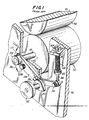
- Figure 1 is a fragmentary perspective view of the prior art device referred to above; and
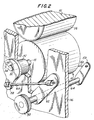
- Figure 2 is a fragmentary perspective view of a device embodying the present invention.
- Referring to Figure 1, a printing cylinder indicated generally at 10 is positioned in juxtaposition with a
blanket cylinder 12, the blanket cylinder having a resilient coating orblanket 14. The respective cylinders are journaled for rotation in parallelism with each other withinparallel frames 16 of the printing press, only one of which is shown in Figure 1. - The
printing cylinder 10 is supported for rotation by ashaft 18 which extends through anaperture 20 in theadjacent end frame 16, and projects outwardly of theend frame 16. - The outwardly extending end of the
shaft 18 is received and journaled within abearing 22 located at one end of abell crank 24, the bell crank being pivotally connected to theframe member 16 by a stud 26. - The other arm of the
bell crank lever 24 is provided with a laterally extendingpin 28, which cooperates with acam 30, thecam 30 being rotatable under the manual control of an adjustment knob ordial 32. - Forwardly of the pin
type cam follower 28, that arm of the bell crank lever is connected to a shaft 34 by aconnector 36 which permits angular movement of the shaft 34 relative to the end of thebell crank lever 24. The shaft 34 extends upwardly through and is slidable within a fixedstop member 38, movement of the shaft 34 being constrained by a compression spring 40 reacting between the fixedstop member 38 and acollar 42 fast with the shaft 34. At its upper end, the shaft 34 is threaded, and,lock nuts 44 are threaded thereon for limiting downward movement of the shaft 34. - Thus, upon rotation of the
dial knob 32, thecam 30 is caused to rotate, and, will cause thebell crank 24 to move angularly to raise or lower the longitudinal axis of theshaft 18 in the directions of thearrows 46. - However, if the
shaft 18 is in its uppermost position of adjustment, further upward adjustment of theshaft 18 is precluded by thestop nuts 44, which prevent any such further upward movement of theshaft 18 by preventing rotation of thebell crank 24 in a clockwise direction. Thestop nuts 44 are so set that thecylinder 10 is in sufficiently close proximity to theblanket 14 of theblanket cylinder 12 that a relatively thin substrate, when passed through the nip of therollers printing cylinder 10. - The pressure exerted on the substrate is determined primarily by the closeness of spacing of the
printing cylinder 10 and theblanket cylinder 12, and, will vary in dependence of the gauge or thickness of the substrate fed between the respective cylinders. Thus, the adjustment of thestop nuts 44 is arranged such that drop-out free printing on the smallest gauge substrate is accomplished, while at the same time the pressure at the nip of cylinders is maintained at an absolute minimum in order to avoid the problem of "cylinder bounce" during rotation of the respective cylinders relative to each other. - If now a heavier gauge of substrate is passed through the nip of the cylinders, then, a force will be exerted on the
printing cylinder 10 forcing it downwardly, downward movement of theprinting cylinder 10 and its supportingshaft 18 being accommodated by the rotational movement of thebell cranks 24 in a counter clockwise direction, this in turn resulting in upward movement of the shaft 34 and of thestop nuts 44, this upward movement being against the compression of the spring 40. - Thus, the pressure at the nip of the printing and
blanket cylinder - It would be possible to increase the spring rate by raising the
stop member 42 on the shaft 34, but, to do so would entail removal of the end housings of the printing press in order to gain access to thecollars 42 with consequent down time of the press, and then, would require the services of a highly skilled technician to readjust the compressive force exerted by the springs 40, it being required that both of the springs 40 at the respective opposite ends of theprinting cylinder 10 be adjusted to identical amounts, for otherwise, the pressure at the nip of the printing cylinder would vary across the axial length of the cylinder. - Clearly, such an adjustment not only is time consuming requiring downtime of the press, but also, it must be meticulously made in order to secure proper operation of the printing press, and, such an adjustment would have to be made each time a different gauge of substrate is to be printed. Clearly, on short runs, for example of 100 pieces or less, adjustments such as discussed above totally impractical.
- A further consideration is that arising when a heavily textured substrate is to be printed, such is when a heavily textured paper or card is to be printed in a satisfactory manner free of drop-outs. In order to satisfactorily print such a textured substrate, it is necessary that the rate of the springs 40 be very considerably increased in order to provide a increased pressure at the nip of the printing and blanket cylinders.
- However, such an adjustment is impractical for exactly the same reasons as those discussed above, it here be noted that the spring rate of the springs 40 must be changed in order to secure a change in the pressure exerted at the nip of the
cylinders cylinders printing cylinder 10 moves away from theblanket cylinder 14. - Referring to Figure 2, there is illustrated a structure embodying the invention by means of which the pressure at the nip of the
printing cylinder 10 andblanket cylinder 14 can be adjusted at will under the control of the operator of the press. - In Figure 2, the respective opposite ends of the
shaft 18 supporting theprinting cylinder 10 are journaled inbearings 50 arranged eccentrically ofbushings 52. While only thebushing 52 at one end of theshaft 18 is visible in Figure 2, it will be understood that at the opposite end of theshaft 18 is identically supported. - The longitudinal axis of the
bearing 50, and which is indicated at 56, is arranged displaced radially of the longitudinal axis of the bushing, and which is indicated at 54, such that thebearing 50 is eccentrically arranged relative to the axis of rotation of the bushing. - Extending radially of the
bushing 52 is alug 58, to which one end of a push-pull rod 60 is attached, the opposite end of the push-pull rod 60 being connected to alever 62, thelever 62 being fast with acontrol shaft 64 rotatable by thecontrol knob 32. While a simple linkage arrangement has been illustrated for imparting rotational movement to thebushing 52 upon that rotation of thecontrol knob 32, various other drive arrangements could be provided. For example, the circumference of thebushing 52 could be in the form of a spur gear, which is meshed with a reciprocatable toothed rack, the toothed rack being movable longitudinally by a spur gear fact with thecontrol shaft 64. In short, any convenient drive arrangement could be provided for translating rotational movement of thecontrol knob 32 into a corresponding rotation of thebushing 52. A reduction gearing could be provided between the shaft of thecontrol knob 32 and thelever 62 in order to provide a micrometer adjustment of thebushing 52. Such modifications are believed to be within the skill of persons skilled in the art, and are not specifically illustrated herein. - In Figure 2, the eccentricity of the
bearing 50 has been exaggerated for clarity of illustration. In actual practice, the offsetting of its longitudinal axis relative to the longitudinal axis of thebushing 52 will of a minor order of a few thousandth of an inch. It has been found that an offsetting of the respective axes by 0.41mm (0.016") is adequate in accommodating the various gauges of substrate commonly employed in a printing operation. - As will readily be apparent from comparison of Figures 1 and 2, the biassing of the
printing cylinder 10 by means of springs has been eliminated in its entirety. Instead, theprinting cylinder 10 is movable positively towards or away from theblanket cylinder 12 by a determined extent. - The
blanket 14 of theblanket cylinder 12 itself is formed of a hard but resiliently compressible material, which will provide a cushion for the force exerted by the now fixedly located printedcylinder 10. Thus, by operation of themanual control 32, theprinting cylinder 10 can be set in an attitude for it to provide drop-out free printing on a substrate of extremely light gauge and having a polished or calendered surface, the extent of the adjustment being readily determinable by the operator during an initial run of the press, i.e., it is simply a matter of adjusting thecontrol 32 to produce the desired quality of printing. - If now, after a production run on a substrate of the first type, it is now desired to effect a production run on a substrate of totally different characteristics, for example, a heavy gauge, cotton or linen textured paper, then, it is merely necessary for the operator to adjust the printing cylinder downwardly to accommodate the increased thickness in gauge.
- However, adjustment to the thickness in gauge is only a partial requirement in the satisfactory accomplishment of drop-out free printing on such a substrate. In addition, the pressure exerted on the heavily textured substrate must be increased, for otherwise, only the high points of the heavily textured substrate will be satisfactorily printed, and drop outs will occur at the thinner sections, or low points.
- Having set the position of the
printing cylinder 10 to accommodate the heavy gauge of substrate, it is then a simple matter of adjusting the pressure at the nip of theprinting cylinder 10 and theblanket cylinder 12 in order to produce drop-out free printing of the substrate throughout the high points and low points of that substrate. - The necessary increase in pressure is easily determinable by the operator during the initiation of the printing run, the only requirement on the part of the operator being to appropriately increase or decrease the pressure by rotation of the
control knob 32 in an appropriate direction. - The extent which the pressure is to be increased will, of course, vary widely in dependence on the extent of texture of the substrate, and, the amount of "give" in the fibers of the substrate. If the substrate is one having a little "give" in the fibers, then, the pressure will have to be increased to an extent greater than that required for a substrate having substantial "give". The amount of "give" will, of course, vary widely between different runs of substrates to be printed, and, there is no accurate way of determining the extent of "give" in any particular substrate.
- However, during initiation of the run of any particular substrate, it is merely a matter of the operator visually inspecting the quality of the print effected, and then, if either drop-outs or over inking of the image is apparent, then adjusting the
control knob 32 in an appropriate direction. - In contradistinction to the prior art construction, instead of employing printing pressure to determine the pressure at the nip of the
spring cylinder 10 and theblanket cylinder 12, and which can not be increased during a production run in that the rate the springs is fixed, the construction embodying the invention provides for an increase in the pressure at the nip of theprinting cylinder 10 andblanket cylinder 12 of any desired magnitude, the magnitude of that pressure being under the direct control of the operator of the press.
Claims (7)
1. An adjustment mechanism for controlling the nip spacing between a printing cylinder and a blanket cylinder in a rotary printing press, with coaxial shaft bearings (50) for mounting the printing cylinder shaft (18) rotatably in a frame (16) characterised in that the shaft bearings (50) are eccentrically disposed in bushings (52) mounted rotatably in the frame (16), and control means (32,62,60) are connected to the bushings (52) for adjusting their rotational orientation in the frame (16) and hence the spacing of the cylinders.
2. An adjustment mechanism according to claim 1 wherein the bushings (52) have fixed radial projections (58) on which the control means act.
3. An adjustment mechanism according to claim 2 wherein the control means comprise a manually rotatable control shaft (64) with a connecting linkage (62,60) to each of said bushings (52), whereby rotation of the control shaft (64) adjusts the orientation of each bushing to the same extent.
4. An adjustment mechanism according to claim 3 wherein the connecting linkage comprises a radial extension (62) from the control shaft (64) and a connecting rod (60) from said radial extension (62) to the radial projection on the respective bushing (52).
5. An adjustment mechanism according to any one of the preceding claims wherein each bushing (52) is in the form of a sleeve in which the shaft bearing (50) is formed, with a cylindrical outer surface, the axes of the shaft bearing (50) and the cylindrical outer surface being parallel and spaced from one another to provide the eccentricity.
6. A rotary printing press incorporating an adjustment mechanism according to any one of the preceding claims.
7. A rotary printing press according to claim 6 wherein there is no spring biasing force urging the printing cylinder (10) and blanket cylinder (12) together.
Applications Claiming Priority (2)
| Application Number | Priority Date | Filing Date | Title |
|---|---|---|---|
| US18202988A | 1988-04-15 | 1988-04-15 | |
| US182029 | 1988-04-15 |
Publications (2)
| Publication Number | Publication Date |
|---|---|
| EP0337801A2 true EP0337801A2 (en) | 1989-10-18 |
| EP0337801A3 EP0337801A3 (en) | 1990-06-20 |
Family
ID=22666808
Family Applications (1)
| Application Number | Title | Priority Date | Filing Date |
|---|---|---|---|
| EP89303716A Withdrawn EP0337801A3 (en) | 1988-04-15 | 1989-04-14 | Adjustment device for rotary printing press |
Country Status (2)
| Country | Link |
|---|---|
| EP (1) | EP0337801A3 (en) |
| JP (1) | JPH0222059A (en) |
Cited By (1)
| Publication number | Priority date | Publication date | Assignee | Title |
|---|---|---|---|---|
| US12168342B2 (en) * | 2021-06-24 | 2024-12-17 | Stolle Machinery Company, Llc | Printing plate pressure adjustment system and can decorator employing same |
Families Citing this family (1)
| Publication number | Priority date | Publication date | Assignee | Title |
|---|---|---|---|---|
| DE19962705A1 (en) | 1998-12-24 | 2000-07-06 | Asmo Co Ltd | Carrier structure for pump motor brush e.g. for automobile windscreen washer pump, has base part attached to motor housing cover and retaining part fitted with spring providing contact force for brush |
Family Cites Families (4)
| Publication number | Priority date | Publication date | Assignee | Title |
|---|---|---|---|---|
| GB351859A (en) * | 1930-01-16 | 1931-07-02 | Rockstroh Werke Ag | Improvements in and relating to rotary offset printing machines |
| US2160613A (en) * | 1936-11-19 | 1939-05-30 | Goss Printing Press Co Ltd | Rotary printing press |
| DE1113220B (en) * | 1960-04-09 | 1961-08-31 | Roland Offsetmaschf | On and off device for printing machine cylinders |
| US3527165A (en) * | 1967-01-03 | 1970-09-08 | Harris Intertype Corp | Cylinder throw mechanism for printing presses |
-
1989
- 1989-04-14 EP EP89303716A patent/EP0337801A3/en not_active Withdrawn
- 1989-04-14 JP JP1093262A patent/JPH0222059A/en active Pending
Cited By (1)
| Publication number | Priority date | Publication date | Assignee | Title |
|---|---|---|---|---|
| US12168342B2 (en) * | 2021-06-24 | 2024-12-17 | Stolle Machinery Company, Llc | Printing plate pressure adjustment system and can decorator employing same |
Also Published As
| Publication number | Publication date |
|---|---|
| EP0337801A3 (en) | 1990-06-20 |
| JPH0222059A (en) | 1990-01-24 |
Similar Documents
| Publication | Publication Date | Title |
|---|---|---|
| EP0105476B1 (en) | Rotary printing press | |
| US5301609A (en) | Printing unit with skew and throw-off mechanisms | |
| GB2061459A (en) | Bending rollers | |
| US4676158A (en) | Plate pressure and printing pressure adjusting mechanism for offset printing machine | |
| US5119727A (en) | Inking apparatus for printing press | |
| US2474160A (en) | Ductor roller adjustment and method | |
| US3272122A (en) | Method of adjusting a foreshortened impression roller | |
| US5230284A (en) | Mechanism for adjusting forme rollers at the plate cylinder of a rotary printing machine | |
| US3563173A (en) | Liquid-handling mechanism | |
| US5465663A (en) | Sheet-guiding drum for printing machines | |
| US3888173A (en) | Temperature responsive inking apparatus for a printing machine | |
| US2233895A (en) | Duplicating machine | |
| US5235910A (en) | Blanket cylinder impression throw-off | |
| US3442121A (en) | Device for supervising the ink supply of a printing press | |
| EP0337801A2 (en) | Adjustment device for rotary printing press | |
| US3368399A (en) | Arrangement for measuring the ink pulling power on lithographic printing machines | |
| US2619901A (en) | Impression length varying means for rotary offset printing machines | |
| US3561359A (en) | Roller adjusting apparatus for a proof press | |
| US5009159A (en) | Printing unit | |
| US5272974A (en) | Offset printing apparatus with printing plate cylinder adjustment | |
| US4488484A (en) | Control device for offset printing cylinders having adjustably mounted eccentric shaft | |
| US5546860A (en) | Device for adjusting distances between axes of cylinders in a printing machine | |
| EP0546029B1 (en) | Offset printing machine | |
| JPH0259772B2 (en) | ||
| US2778303A (en) | Rotary offset printing press roll support |
Legal Events
| Date | Code | Title | Description |
|---|---|---|---|
| PUAI | Public reference made under article 153(3) epc to a published international application that has entered the european phase |
Free format text: ORIGINAL CODE: 0009012 |
|
| AK | Designated contracting states |
Kind code of ref document: A2 Designated state(s): AT BE CH DE ES FR GB GR IT LI LU NL SE |
|
| PUAL | Search report despatched |
Free format text: ORIGINAL CODE: 0009013 |
|
| AK | Designated contracting states |
Kind code of ref document: A3 Designated state(s): AT BE CH DE ES FR GB GR IT LI LU NL SE |
|
| 17P | Request for examination filed |
Effective date: 19901219 |
|
| STAA | Information on the status of an ep patent application or granted ep patent |
Free format text: STATUS: THE APPLICATION IS DEEMED TO BE WITHDRAWN |
|
| 18D | Application deemed to be withdrawn |
Effective date: 19911105 |