EP0337488A2 - Suspension system - Google Patents
Suspension system Download PDFInfo
- Publication number
- EP0337488A2 EP0337488A2 EP89106739A EP89106739A EP0337488A2 EP 0337488 A2 EP0337488 A2 EP 0337488A2 EP 89106739 A EP89106739 A EP 89106739A EP 89106739 A EP89106739 A EP 89106739A EP 0337488 A2 EP0337488 A2 EP 0337488A2
- Authority
- EP
- European Patent Office
- Prior art keywords
- leaf spring
- vehicle body
- suspension system
- suspension
- motor vehicle
- Prior art date
- Legal status (The legal status is an assumption and is not a legal conclusion. Google has not performed a legal analysis and makes no representation as to the accuracy of the status listed.)
- Granted
Links
- 239000000725 suspension Substances 0.000 title claims abstract description 95
- 230000008859 change Effects 0.000 claims abstract description 23
- 230000008093 supporting effect Effects 0.000 claims abstract description 23
- 239000006096 absorbing agent Substances 0.000 claims description 12
- 230000035939 shock Effects 0.000 claims description 12
- 238000005452 bending Methods 0.000 claims description 11
- 238000006073 displacement reaction Methods 0.000 claims description 11
- 239000012530 fluid Substances 0.000 claims description 7
- 239000000543 intermediate Substances 0.000 description 11
- 230000008901 benefit Effects 0.000 description 3
- 230000001419 dependent effect Effects 0.000 description 3
- 238000000034 method Methods 0.000 description 3
- 230000008569 process Effects 0.000 description 3
- 230000001276 controlling effect Effects 0.000 description 2
- 239000000463 material Substances 0.000 description 2
- 230000008602 contraction Effects 0.000 description 1
- 238000010586 diagram Methods 0.000 description 1
- 238000004519 manufacturing process Methods 0.000 description 1
- 230000004044 response Effects 0.000 description 1
- 239000003381 stabilizer Substances 0.000 description 1
Images


Classifications
-
- B—PERFORMING OPERATIONS; TRANSPORTING
- B60—VEHICLES IN GENERAL
- B60G—VEHICLE SUSPENSION ARRANGEMENTS
- B60G17/00—Resilient suspensions having means for adjusting the spring or vibration-damper characteristics, for regulating the distance between a supporting surface and a sprung part of vehicle or for locking suspension during use to meet varying vehicular or surface conditions, e.g. due to speed or load
- B60G17/02—Spring characteristics, e.g. mechanical springs and mechanical adjusting means
- B60G17/027—Mechanical springs regulated by fluid means
- B60G17/0275—Mechanical springs regulated by fluid means the mechanical spring being a leaf spring
-
- B—PERFORMING OPERATIONS; TRANSPORTING
- B60—VEHICLES IN GENERAL
- B60G—VEHICLE SUSPENSION ARRANGEMENTS
- B60G11/00—Resilient suspensions characterised by arrangement, location or kind of springs
- B60G11/02—Resilient suspensions characterised by arrangement, location or kind of springs having leaf springs only
- B60G11/08—Resilient suspensions characterised by arrangement, location or kind of springs having leaf springs only arranged substantially transverse to the longitudinal axis of the vehicle
-
- B—PERFORMING OPERATIONS; TRANSPORTING
- B60—VEHICLES IN GENERAL
- B60G—VEHICLE SUSPENSION ARRANGEMENTS
- B60G17/00—Resilient suspensions having means for adjusting the spring or vibration-damper characteristics, for regulating the distance between a supporting surface and a sprung part of vehicle or for locking suspension during use to meet varying vehicular or surface conditions, e.g. due to speed or load
- B60G17/015—Resilient suspensions having means for adjusting the spring or vibration-damper characteristics, for regulating the distance between a supporting surface and a sprung part of vehicle or for locking suspension during use to meet varying vehicular or surface conditions, e.g. due to speed or load the regulating means comprising electric or electronic elements
- B60G17/019—Resilient suspensions having means for adjusting the spring or vibration-damper characteristics, for regulating the distance between a supporting surface and a sprung part of vehicle or for locking suspension during use to meet varying vehicular or surface conditions, e.g. due to speed or load the regulating means comprising electric or electronic elements characterised by the type of sensor or the arrangement thereof
-
- B—PERFORMING OPERATIONS; TRANSPORTING
- B60—VEHICLES IN GENERAL
- B60G—VEHICLE SUSPENSION ARRANGEMENTS
- B60G2202/00—Indexing codes relating to the type of spring, damper or actuator
- B60G2202/10—Type of spring
- B60G2202/11—Leaf spring
-
- B—PERFORMING OPERATIONS; TRANSPORTING
- B60—VEHICLES IN GENERAL
- B60G—VEHICLE SUSPENSION ARRANGEMENTS
- B60G2202/00—Indexing codes relating to the type of spring, damper or actuator
- B60G2202/10—Type of spring
- B60G2202/11—Leaf spring
- B60G2202/114—Leaf spring transversally arranged
-
- B—PERFORMING OPERATIONS; TRANSPORTING
- B60—VEHICLES IN GENERAL
- B60G—VEHICLE SUSPENSION ARRANGEMENTS
- B60G2202/00—Indexing codes relating to the type of spring, damper or actuator
- B60G2202/40—Type of actuator
- B60G2202/41—Fluid actuator
-
- B—PERFORMING OPERATIONS; TRANSPORTING
- B60—VEHICLES IN GENERAL
- B60G—VEHICLE SUSPENSION ARRANGEMENTS
- B60G2202/00—Indexing codes relating to the type of spring, damper or actuator
- B60G2202/40—Type of actuator
- B60G2202/41—Fluid actuator
- B60G2202/412—Pneumatic actuator
-
- B—PERFORMING OPERATIONS; TRANSPORTING
- B60—VEHICLES IN GENERAL
- B60G—VEHICLE SUSPENSION ARRANGEMENTS
- B60G2204/00—Indexing codes related to suspensions per se or to auxiliary parts
- B60G2204/80—Interactive suspensions; arrangement affecting more than one suspension unit
- B60G2204/82—Interactive suspensions; arrangement affecting more than one suspension unit left and right unit on same axle
-
- B—PERFORMING OPERATIONS; TRANSPORTING
- B60—VEHICLES IN GENERAL
- B60G—VEHICLE SUSPENSION ARRANGEMENTS
- B60G2400/00—Indexing codes relating to detected, measured or calculated conditions or factors
- B60G2400/25—Stroke; Height; Displacement
-
- B—PERFORMING OPERATIONS; TRANSPORTING
- B60—VEHICLES IN GENERAL
- B60G—VEHICLE SUSPENSION ARRANGEMENTS
- B60G2400/00—Indexing codes relating to detected, measured or calculated conditions or factors
- B60G2400/60—Load
-
- B—PERFORMING OPERATIONS; TRANSPORTING
- B60—VEHICLES IN GENERAL
- B60G—VEHICLE SUSPENSION ARRANGEMENTS
- B60G2401/00—Indexing codes relating to the type of sensors based on the principle of their operation
- B60G2401/12—Strain gauge
-
- B—PERFORMING OPERATIONS; TRANSPORTING
- B60—VEHICLES IN GENERAL
- B60G—VEHICLE SUSPENSION ARRANGEMENTS
- B60G2500/00—Indexing codes relating to the regulated action or device
- B60G2500/20—Spring action or springs
Definitions
- the present invention relates to a suspension system having means for easily determining a change in the condition of a suspension which is caused by an external force applied to the suspension.
- a vehicular suspension system including a shock absorber having a coil spring with a lower end coupled to a knuckle by which a road wheel is rotatably supported and an upper end coupled to a vehicle body through a resilient member with an electrically conductive rubber layer mounted thereon as a strain detector (see Japanese Laid-Open Utility Model Publication No. 60-106807).
- a motor vehicle equipped with such a suspension system is running, loads acting on the shock absorber and the resilient member are varied by irregularities on the road surface and swinging movement of the vehicle body, thus expanding and contracting the resilient member and the electrically conductive rubber member. Therefore, the road surface irregularities and the swinging movement of the vehicle body can be detected as changes in electric resistance which are brought about by the expansion and contraction of the rubber member.
- Japanese Laid-Open Utility Model Publication No. 60-155610 discloses another vehicular suspension system including a shock absorber having a coil spring with a lower end coupled to a knuckle by which a road wheel is rotatably supported and an upper end coupled to a vehicle body through a resilient member.
- the upper end of the shock absorber and a load detector are fastened together to the vehicle body.
- the load detector comprises a piezoelectric element for producing an output signal indicative of a change in a load on the shock absorber.
- Determination of a change in the condition of the suspension based on the detected value in the suspension assembly for controlling the attitude of the suspension lacks a desired degree of accuracy. Since the suspension system itself cannot detect a change in the height of the vehicle body from the ground as a change in the condition of the suspension which is induced by an external force applied, a separate vehicle height sensor is required. Because the load detector is mounted on the upper end of the shock absorber where a large load is concentrated, the suspension system is complex in structure, expensive to manufacture, and has a durability problem.
- a suspension system which is lightweight and of good space utility efficiency and has a suspension component interconnecting a road wheel and a vehicle body and including a resilient member or an elongate resiliency member extending transversely of the vehicle body, and also has at least one simple strain detector mounted on the resilient member for detecting a strain produced in the resilient member in response to an external force applied thereto, so that changes in the condition of a suspension which are caused by the applied external force, i.e., loads applied to the road wheel in three directions, or vertical, longitudinal, and transverse directions with respect to the vehicle body, and an amount of displacement of the road wheel with respect to the vehicle body, can easily be determined.
- a suspension system in a motor vehicle has a suspension including at least a resilient member extending transversely of the motor vehicle and having one end coupled to a knuckle, the resilient member supporting a vehicle body of the motor vehicle, and detector means disposed on the resilient member for detecting at least one of a change in a load and a change in the height of the motor vehicle from the ground due to an external force applied to the suspension.
- the resilient member comprises at least a leaf spring, and the detector means is attached to the leaf spring for detecting a strain of the leaf spring due to flexing thereof.
- the suspension system also includes arithmetic means for calculating at least one of a vertical load applied to a road wheel coupled to the knuckle and a displacement of the road wheel with respect to the vehicle body based on a change in the strain detected by the detector means.
- the resilient member may comprise an elongate resilient member extending between knuckles supporting two laterally spaced road wheels, respectively, of the motor vehicle, and having opposite ends coupled respectively to the knuckles, the suspension further including holder means coupled to the vehicle body and holding the elongate resilient member at two holding points which are swingable and slidable in the longitudinal direction of the elongate resilient member with respect to the vehicle body for bearing the load of the vehicle body.
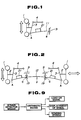
- FIG. 1 schematically shows a suspension system according to a first embodiment of the present invention, for use with one road wheel only.
- the suspension system shown in FIG. 1 is in the form of a double-wishbone suspension system comprising a road wheel 1, an axle 2, a knuckle 3, an upper arm 4, and a lower arm 11 comprising a leaf spring serving as an elongate resilient member and having resiliency in vertical directions and extending transversely of a motor vehicle.
- the leaf spring 11 has an outer end coupled at a supporting point A to a lower portion of the knuckle 3 and an inner end fixedly supporting a vehicle body 9 at a supporting point B.
- a damper comprising a shock absorber only is combined with the suspension system.
- the knuckle 3 that is coupled to the outer end of the leaf spring 11 at the supporting point A is normally urged downwardly under the resiliency of the leaf spring 11 with its inner end fixed to the vehicle body 9 at the supporting point B.
- the suspension system is reduced in weight and the damper in the form of a shock absorber only with no coil spring can be employed.
- a single strain detector 21 is mounted on an intermediate portion of the leaf spring 11.
- the strain detector 21 comprises a simple strain gage or the like for detecting a strain of the leaf spring 11 which is caused upon flexing thereof by an external force applied to the leaf spring 11.
- a detected signal from the strain detector 21 is applied to a vehicle-mounted computer (not shown) which calculates changes in the condition of the suspension caused by the external force applied thereto, through arithmetic operations or based on a data map.
- loads applied to the road wheel in three directions, i.e., vertical, longitudinal, and transverse directions of the motor vehicle, and changes in the loads are determined from changes in the strain of the leaf spring 11.
- a vertical displacement of the center of the road wheel (i.e., the axle 2) with respect to the vehicle body 9, for example, is determined to calculate the height of the vehicle body 9 from the ground.
- FIG. 2 shows a suspension system according to a second embodiment of the present invention in which an elongate leaf spring 12 extends transversely of a motor vehicle between suspensions supporting two laterally spaced road wheels. Knuckles 3 supporting road wheels 1, respectively, have lower portions coupled respectively to the opposite ends of the leaf spring 12 at supporting points A.
- the leaf spring 12 has an intermediate portion supported by two holder members 19 coupled to a vehicle body 9 at two laterally spaced holding points C of the leaf spring 12 for bearing the weight of the vehicle body 9, the holding points C being held by the holder member 19 so as to be swingable with the leaf spring 12 and slidable therewith in the longitudinal direction of the leaf spring 12 with respect to the vehicle body 9.
- the leaf spring 12 doubles as lower arms of the suspensions.
- a suitable load means (not shown) is interposed between the vehicle body 9 and a center, for example, of the intermediate portion of the leaf spring 12 between the holding points C. Dampers comprising shock absorbers only are associated respectively with the suspensions.
- An upward bending stress is applied as indicated by the arrow F by the load means from below or above the leaf spring 12 to the center of the leaf spring 12 or a certain range thereof between the holding points C.
- the leaf spring 12 is elastically deformed to lift the intermediate portion thereof, thus lowering the wheel supporting points A about the holding points C. Since the knuckles 3 are lowered with respect to the vehicle body 9, the height of the vehicle body from the ground is increased. Conversely, when a downward bending stress is applied to the intermediate portion of the leaf spring 12, the height of the vehicle body above the ground is reduced.
- the suspension system shown in FIG. 2 further includes two strain detectors 21, for example, mounted respectively on the leaf spring 12 at laterally spaced portions thereof, i.e., portions between the holding points C and the wheel supporting points A.
- Changes in the condition of the suspensions caused by external force applied thereto are determined from detected signals from the strain detectors 21.
- Loads imposed on the road wheels 1 in three directions, i.e., vertical, longitudinal, and transverse directions of the motor vehicle, and changes in the loads are determined from changes in the strains of the laterally spaced portions of the leaf spring 12.
- FIG. 3 illustrates a suspension system according to a third embodiment of the present invention.
- a lower arm 5 is provided separately from a leaf spring 13, and an intermediate portion of the lower arm 5 is coupled to the outer end of the leaf spring 13 at a supporting point A.
- the lower arm 5 has an outer end coupled to a knuckle 3 supporting a road wheel 1 and an inner end fixedly supporting a vehicle body 9 at a supporting point B.
- the suspension system of FIG. 3 offers substantially the same advantages as those of the first embodiment except that the leaf spring does not double as the lower arm.
- a single strain detector 21, for example, is mounted on an intermediate portion of the leaf spring 13 for detecting a strain of the leaf spring 13 to determine loads applied to the road wheel 1 in three directions, i.e., vertical, longitudinal, and transverse directions of the motor vehicle, and changes in the loads.
- an elongate leaf spring 14 extends transversely of a motor vehicle between suspensions supporting two laterally spaced road wheels.
- lower arms 5 are provided separately from the leaf spring 14.
- the leaf spring 14 has opposite ends coupled to intermediate portions, respectively, of the lower arms 5 at supporting points A.
- the leaf spring 14 also has an intermediate portion slidably and swingably held at two holding points C by holder members 19 coupled to a vehicle body 9.
- the suspension system of FIG. 4 also offers substantially the same advantages of those of the first embodiment except that the leaf spring does not double as the lower arm.
- the suspension system shown in FIG. 4 further includes two strain detectors 21, for example, mounted on the intermediate portion of the leaf spring 12 respectively at laterally spaced locations between the holding points C.
- Changes in the condition of the suspensions caused by external forces applied thereto are determined from detected signals from the strain detectors 21.
- Loads imposed on the road wheels 1 in three directions, i.e., vertical, longitudinal, and transverse directions of the motor vehicle, and changes in the loads are determined from changes in the strains of the laterally spaced locations of the intermediate portion of the leaf spring 14.
- strain detectors 21 may be selected as desired in view of objectives in designing the suspension system and other factors.
- the strain detec tor or detectors may be mounted on the entire surface or a partial surface of, or disposed within, each of the leaf springs 11, 12, 13, 14.
- H L k′1 ⁇ L + k′2 ⁇ R + K′ L ( ⁇ L , ⁇ R )
- H R k′3 ⁇ L + k′4 ⁇ R + K′ R ( ⁇ L , ⁇ R )
- H L k′1 ⁇ L + k′2 ⁇ R + k′3 ⁇ f L + k′4 ⁇ f R + K′ L ( ⁇ L , ⁇ R ,f L ,f R )
- H R k′5 ⁇ L + k′6 ⁇ R + k′7 ⁇ f L + k′8 ⁇ f R + K′ R ( ⁇ L , ⁇ R ,f R ,f L )
- the load means used herein comprises, for example, a bag 30 filled with a fluid 31 and disposed between the leaf spring 12 and a beam or a bag support member 40 supported by the holder members 19 and extending below the holder members 19.
- the bag 30 is prevented from being deformed downwardly by the beam or the bag support member 40.
- the amount of load applied to the leaf spring 12 can freely be adjusted by controlling the pressure of the fluid in the bag 30 with a pump or the like.
- the bag 30 is made of a flexible inexpansible material, and the filled fluid 31 comprises a gas as a compressible fluid.
- the bag 30 may be made of an expansible material, and the fluid 31 may be an inexpansible fluid.
- the present invention is based on the fact that an elongate resilient member (i.e., the leaf spring in the above embodiments) extending transversely of a motor vehicle as part of suspension components interconnecting road wheels and a motor vehicle body is subject to a strain dependent on an external force applied to the elongate resilient member.
- the amount of strain detected by at least one strain detector means mounted on the resilient member or leaf spring is processed by an arithmetic means to determine changes in the condition of a suspension which are caused by an external force imposed on the suspension, i.e., loads applied to the road wheels in the vertical, longitudinal, and transverse directions of the motor vehicle, displacements of the road wheels with respect to the vehicle body, and bending stresses applied to the leaf spring.
- At least two strain detectors are required, and if there are three unknown, at least three strain detectors are required. If no load is applied to the leaf spring by a load means (FIGS. 5 and 6), then the two strain detectors may be attached anywhere to the leaf spring. If a load is applied to the leaf spring by the load means (FIGS. 7 and 8), and the applied load is unknown, then at least two out of strain detectors mounted on the leaf spring must be located between the two holding points C in order to determine the unknown load. If the load applied by the load means is known, at least one strain detector should preferably be positioned between the holding points C.
- the leaf spring serving as the elongate resilient member may double as upper arms or may be connected to upper arms.
- the suspension or suspensions to which the present invention can be applied are not limited to double-wishbone suspensions, but may be strut suspensions.
- the height of a motor vehicle from the ground can be adjusted by using a leaf spring with its longitudinal axis extending longitudinally of the motor vehicle.
- the strain detectors used are simple in structure as they are only required to detect any strain of the resilient member, and are good in space utility efficiency, and lightweight, but nevertheless produce signals which are employed to determine loads on road wheels in vertical, longitudinal, and transverse directions of a motor vehicle, and displacements of the road wheels with respect to the motor vehicle body. By using detected signals from the strain detectors and results of arithmetic operations on the detected signals, suspension control can easily be performed.
Landscapes
- Engineering & Computer Science (AREA)
- Mechanical Engineering (AREA)
- Vehicle Body Suspensions (AREA)
- Force Measurement Appropriate To Specific Purposes (AREA)
Abstract
a suspension including at least a resilient member (11) extending transversely of the motor vehicle and having one end coupled to a knuckle (3), said resilient member supporting a vehicle body of the motor vehicle; and
detector means (21) disposed on said resilient member for detecting at least one of a change in a load and a change in the height of the motor vehicle from the ground due to an external force applied to said suspension.
Description
- The present invention relates to a suspension system having means for easily determining a change in the condition of a suspension which is caused by an external force applied to the suspension.
- There has been proposed a vehicular suspension system including a shock absorber having a coil spring with a lower end coupled to a knuckle by which a road wheel is rotatably supported and an upper end coupled to a vehicle body through a resilient member with an electrically conductive rubber layer mounted thereon as a strain detector (see Japanese Laid-Open Utility Model Publication No. 60-106807). While a motor vehicle equipped with such a suspension system is running, loads acting on the shock absorber and the resilient member are varied by irregularities on the road surface and swinging movement of the vehicle body, thus expanding and contracting the resilient member and the electrically conductive rubber member. Therefore, the road surface irregularities and the swinging movement of the vehicle body can be detected as changes in electric resistance which are brought about by the expansion and contraction of the rubber member.
- Japanese Laid-Open Utility Model Publication No. 60-155610 discloses another vehicular suspension system including a shock absorber having a coil spring with a lower end coupled to a knuckle by which a road wheel is rotatably supported and an upper end coupled to a vehicle body through a resilient member. The upper end of the shock absorber and a load detector are fastened together to the vehicle body. The load detector comprises a piezoelectric element for producing an output signal indicative of a change in a load on the shock absorber.
- Determination of a change in the condition of the suspension based on the detected value in the suspension assembly for controlling the attitude of the suspension lacks a desired degree of accuracy. Since the suspension system itself cannot detect a change in the height of the vehicle body from the ground as a change in the condition of the suspension which is induced by an external force applied, a separate vehicle height sensor is required. Because the load detector is mounted on the upper end of the shock absorber where a large load is concentrated, the suspension system is complex in structure, expensive to manufacture, and has a durability problem.
- In view of the aforesaid shortcomings of the conventional suspension systems, it is an object of the present invention to provide a suspension system which is lightweight and of good space utility efficiency and has a suspension component interconnecting a road wheel and a vehicle body and including a resilient member or an elongate resiliency member extending transversely of the vehicle body, and also has at least one simple strain detector mounted on the resilient member for detecting a strain produced in the resilient member in response to an external force applied thereto, so that changes in the condition of a suspension which are caused by the applied external force, i.e., loads applied to the road wheel in three directions, or vertical, longitudinal, and transverse directions with respect to the vehicle body, and an amount of displacement of the road wheel with respect to the vehicle body, can easily be determined.
- According to the present invention, a suspension system in a motor vehicle has a suspension including at least a resilient member extending transversely of the motor vehicle and having one end coupled to a knuckle, the resilient member supporting a vehicle body of the motor vehicle, and detector means disposed on the resilient member for detecting at least one of a change in a load and a change in the height of the motor vehicle from the ground due to an external force applied to the suspension. The resilient member comprises at least a leaf spring, and the detector means is attached to the leaf spring for detecting a strain of the leaf spring due to flexing thereof. The suspension system also includes arithmetic means for calculating at least one of a vertical load applied to a road wheel coupled to the knuckle and a displacement of the road wheel with respect to the vehicle body based on a change in the strain detected by the detector means.
- The resilient member may comprise an elongate resilient member extending between knuckles supporting two laterally spaced road wheels, respectively, of the motor vehicle, and having opposite ends coupled respectively to the knuckles, the suspension further including holder means coupled to the vehicle body and holding the elongate resilient member at two holding points which are swingable and slidable in the longitudinal direction of the elongate resilient member with respect to the vehicle body for bearing the load of the vehicle body.
- The above and further objects, details and advantages of the present invention will become apparent from the following detailed description of preferred embodiments thereof, when read in conjunction with the accompanying drawings.
- FIG. 1 is a schematic front elevational view of a suspension system according to a first embodiment of the present invention for use with one road wheel, with a leaf spring employed as a lower arm;
- FIG. 2 is a schematic front elevational view of a suspension system according to a second embodiment of the present invention for use with two road wheels with a leaf spring which extends between the road wheels being used as lower arms;
- FIG. 3 is a schematic front elevational view of a suspension system according to a third embodiment of the present invention for use with one road wheel, with a leaf spring employed as a portion of a lower arm;
- FIG. 4 is a schematic front elevational view of a suspension system according to a fourth embodiment of the present invention for use with two road wheels with a leaf spring which extends between the road wheels being used as portions of lower arms;
- FIG. 5 is a schematic front elevational view of a suspension system, showing the manner in which a change in a suspension is determined when only the weight of a motor vehicle is applied as an external force;
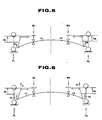
- FIG. 6 is a schematic front elevational view of a suspension system, showing the manner in which a change in a suspension is determined when forces fL, fR, as well as the weight of a motor vehicle, are applied as external forces respectively to suspension components;
- FIG. 7 is a schematic front elevational view of a suspension system, showing the manner in which a change in a suspension is determined when an unknown concentrated load F or distributed load W, as well as the weight of a motor vehicle, are applied as an external force to a leaf spring;
- FIG. 8 is a schematic front elevational view of a suspension system, showing the manner in which a change in a suspension is determined when a known concentrated load F or distributed load W, as well as the weight of a motor vehicle, are applied as an external force to a leaf spring; and
- FIG. 9 is a block diagram of an arrangement for determining a change in the condition of a suspension according to the present invention.
- FIG. 1 schematically shows a suspension system according to a first embodiment of the present invention, for use with one road wheel only. The suspension system shown in FIG. 1 is in the form of a double-wishbone suspension system comprising a road wheel 1, an
axle 2, aknuckle 3, anupper arm 4, and a lower arm 11 comprising a leaf spring serving as an elongate resilient member and having resiliency in vertical directions and extending transversely of a motor vehicle. The leaf spring 11 has an outer end coupled at a supporting point A to a lower portion of theknuckle 3 and an inner end fixedly supporting avehicle body 9 at a supporting point B. A damper comprising a shock absorber only is combined with the suspension system. - Since the lower arm comprises the leaf spring 11, the
knuckle 3 that is coupled to the outer end of the leaf spring 11 at the supporting point A is normally urged downwardly under the resiliency of the leaf spring 11 with its inner end fixed to thevehicle body 9 at the supporting point B. With the leaf spring 11 doubling as the lower arm, therefore, the suspension system is reduced in weight and the damper in the form of a shock absorber only with no coil spring can be employed. - According to the present invention, a
single strain detector 21, for example, is mounted on an intermediate portion of the leaf spring 11. Thestrain detector 21 comprises a simple strain gage or the like for detecting a strain of the leaf spring 11 which is caused upon flexing thereof by an external force applied to the leaf spring 11. - A detected signal from the
strain detector 21 is applied to a vehicle-mounted computer (not shown) which calculates changes in the condition of the suspension caused by the external force applied thereto, through arithmetic operations or based on a data map. Specifically, loads applied to the road wheel in three directions, i.e., vertical, longitudinal, and transverse directions of the motor vehicle, and changes in the loads are determined from changes in the strain of the leaf spring 11. Moreover, a vertical displacement of the center of the road wheel (i.e., the axle 2) with respect to thevehicle body 9, for example, is determined to calculate the height of thevehicle body 9 from the ground. - A specific process of calculating the above values will be described later on with reference to FIGS. 5 through 9.
- FIG. 2 shows a suspension system according to a second embodiment of the present invention in which an
elongate leaf spring 12 extends transversely of a motor vehicle between suspensions supporting two laterally spaced road wheels.Knuckles 3 supporting road wheels 1, respectively, have lower portions coupled respectively to the opposite ends of theleaf spring 12 at supporting points A. Theleaf spring 12 has an intermediate portion supported by twoholder members 19 coupled to avehicle body 9 at two laterally spaced holding points C of theleaf spring 12 for bearing the weight of thevehicle body 9, the holding points C being held by theholder member 19 so as to be swingable with theleaf spring 12 and slidable therewith in the longitudinal direction of theleaf spring 12 with respect to thevehicle body 9. Theleaf spring 12 doubles as lower arms of the suspensions. A suitable load means (not shown) is interposed between thevehicle body 9 and a center, for example, of the intermediate portion of theleaf spring 12 between the holding points C. Dampers comprising shock absorbers only are associated respectively with the suspensions. - Since the lower arms of the suspensions are constituted by the opposite end portions of the
common leaf spring 12, unlike the first embodiment,knuckles 3 coupled to the opposite ends of theleaf spring 12 at supporting points A are normally urged downwardly under the resiliency of theleaf spring 12. Thecommon leaf spring 12 doubling as the lower arms provides a stabilizer function, allows the load means to be shared by both suspensions, and makes the suspension system lighter in weight. As with the first embodiment, dampers in the form of shock absorbers with no coil springs can be employed. - An upward bending stress is applied as indicated by the arrow F by the load means from below or above the
leaf spring 12 to the center of theleaf spring 12 or a certain range thereof between the holding points C. Upon application of such an upward bending stress, theleaf spring 12 is elastically deformed to lift the intermediate portion thereof, thus lowering the wheel supporting points A about the holding points C. Since theknuckles 3 are lowered with respect to thevehicle body 9, the height of the vehicle body from the ground is increased. Conversely, when a downward bending stress is applied to the intermediate portion of theleaf spring 12, the height of the vehicle body above the ground is reduced. - The suspension system shown in FIG. 2 further includes two
strain detectors 21, for example, mounted respectively on theleaf spring 12 at laterally spaced portions thereof, i.e., portions between the holding points C and the wheel supporting points A. - Changes in the condition of the suspensions caused by external force applied thereto are determined from detected signals from the
strain detectors 21. Loads imposed on the road wheels 1 in three directions, i.e., vertical, longitudinal, and transverse directions of the motor vehicle, and changes in the loads are determined from changes in the strains of the laterally spaced portions of theleaf spring 12. - FIG. 3 illustrates a suspension system according to a third embodiment of the present invention. According to the third embodiment, a
lower arm 5 is provided separately from aleaf spring 13, and an intermediate portion of thelower arm 5 is coupled to the outer end of theleaf spring 13 at a supporting point A. Thelower arm 5 has an outer end coupled to aknuckle 3 supporting a road wheel 1 and an inner end fixedly supporting avehicle body 9 at a supporting point B. The suspension system of FIG. 3 offers substantially the same advantages as those of the first embodiment except that the leaf spring does not double as the lower arm. - A
single strain detector 21, for example, is mounted on an intermediate portion of theleaf spring 13 for detecting a strain of theleaf spring 13 to determine loads applied to the road wheel 1 in three directions, i.e., vertical, longitudinal, and transverse directions of the motor vehicle, and changes in the loads. - According to a fourth embodiment of the present invention shown in FIG. 4, an
elongate leaf spring 14 extends transversely of a motor vehicle between suspensions supporting two laterally spaced road wheels. In addition,lower arms 5 are provided separately from theleaf spring 14. Theleaf spring 14 has opposite ends coupled to intermediate portions, respectively, of thelower arms 5 at supporting points A. Theleaf spring 14 also has an intermediate portion slidably and swingably held at two holding points C byholder members 19 coupled to avehicle body 9. The suspension system of FIG. 4 also offers substantially the same advantages of those of the first embodiment except that the leaf spring does not double as the lower arm. - The suspension system shown in FIG. 4 further includes two
strain detectors 21, for example, mounted on the intermediate portion of theleaf spring 12 respectively at laterally spaced locations between the holding points C. - Changes in the condition of the suspensions caused by external forces applied thereto are determined from detected signals from the
strain detectors 21. Loads imposed on the road wheels 1 in three directions, i.e., vertical, longitudinal, and transverse directions of the motor vehicle, and changes in the loads are determined from changes in the strains of the laterally spaced locations of the intermediate portion of theleaf spring 14. - The location and number of
strain detectors 21 may be selected as desired in view of objectives in designing the suspension system and other factors. The strain detec tor or detectors may be mounted on the entire surface or a partial surface of, or disposed within, each of theleaf springs - Arithmetic processes which will be carried out based on the detected signals from the strain detectors will be described below.
- The following calculations are based on a lateral leaf spring suspension system as shown in FIG. 2 which has a leaf spring employed as part of suspension arms. Various examples of calculations dependent on different types of external forces applied to suspensions will be given below.
- Only the weight of a motor vehicle (WL, WR) is applied to a leaf spring shown in FIG. 5:
- The condition of the leaf spring with no passenger and no cargo on the motor vehicle will be used as a reference. Strain detectors are mounted on the leaf spring at two positions, and changes in strain detected thereby are represented respectively by εL, εR. Assuming that loads applied to the road wheels (i.e., changes in loads from the loads applied to the road wheels under the reference condition, i.e., no passenger and no cargo on the motor vehicle) are indicated by FL, FR, the loads FL, FR are calculated as follows:
FL = k₁·εL + k₂·εR + KL(εL,εR)
FR = k₃·εL + k₄·εR + KR(εL,εR) - Similarly, changes HL, HR in the heights of lateral portions of the motor vehicle from the ground (relative vertical changes in the distances between the vehicle body and the centers of the road wheels) are calculated as follows:
HL = k′₁·εL + k′₂·εR + K′L(εL,εR)
HR = k′₃·εL + k′₄·εR + K′R(εL,εR) - In the above and following equations, k₁, k₂, k₃, ... kn, k′₁, k′₂, k′₃, ... k′n (n = 1, 2, 3, ...) represent coefficients determined dependent on strain detecting positions and the like, and KL, KR, K′L, K′R, KM, etc. represent corrective terms (i.e., functions of ε, f, F, W, etc.). These coefficients (k) and the corrective terms are used in the following examples, but have different values in the examples.
- Loads fL, fR, as well as the weight of a motor vehicle is applied to suspension components shown in FIG. 6:
- Changes FL, FR in the loads applied to the road wheels are calculated by:
FL = k₁·εL + k₂·εR + k₃·fL + KL(εL,εR,fL)
FR = k₄·εL + k₅·εR + k₆·fR + KR(εL,εR, fR) - Changes HL, HR in the heights of the lateral portions of the motor vehicle are calculated by:
HL = k′₁·εL + k′₂·εR + k′₃·fL + k′₄·fR + K′L(εL,εR,fL,fR)
HR = k′₅·εL + k′₆·εR + k′₇·fL + k′₈·fR + K′R(εL,εR,fR,fL) - A concentrated load F or distributed load W produced by the load means, other than the motor vehicle weight (WL, WR), is applied to the leaf spring shown in FIGS. 7 and 8:
- i) As shown in FIG. 7, where the concentrated load F or distributed load W is unknown, changes FL, FR in the loads imposed on the road wheels are given as follows:
FL = k₁·εL + k₂·εM + k₃·εR + KL(εL,εM,εR)
FR = k₄·εL + k₅·εM + k₆·εR + KR(εL,εM,εR)
A load F is given by:
F = k₇·εL + k₈·εM + k₉·εR + KM(εL,εM,εR)
Changes HL, HR in the heights of the lateral portions of the motor vehicle are calculated by:
HL = k′₁·εL + k′₂·εM + k′₃·εR + K′L(εL,εR,εR)
HR = k′₄·εL + k′₅·εM + k′₆·εR + K′R(εL,εM,εM) - ii) As shown in FIG. 8, where the concentrated load F or distributed load W is known, changes FL, FR in the loads imposed on the road wheels are given as follows:
FL = k₁·εL + k₂·εR + k₃·F + KL(εL,εR,F)
FR = k₄·εL + k₅·εR + k₆·F + KR(εL,εR,F)
or
FL = k₇·εL + k₈·εR + k₉·W + KL(εL,εR,W)
FR = k₁₀·εL + K₁₁·εR + k₁₂·W + KR(εL,εR,W)
Changes HL, HR in the heights of the lateral portions of the motor vehicle are calculated by:
HL = k′₁·εL + k′₂·εR + k′₃·F + K′L(εL,εR,F)
HR = k′₄·εL + k′₅·εR + k′₆·F + K′R(εL,εR,F)
or
HL = k′₇·εL + k′₈·εR + k′₉·W + K′L(εL,εR,W)
HR = k′₁₀·εL + k′₁₁·εR + k′₁₂·W + K′R(εL,εR,W) - As schematically shown in FIGS. 7 and 8, the load means used herein comprises, for example, a
bag 30 filled with a fluid 31 and disposed between theleaf spring 12 and a beam or abag support member 40 supported by theholder members 19 and extending below theholder members 19. Thebag 30 is prevented from being deformed downwardly by the beam or thebag support member 40. The amount of load applied to theleaf spring 12 can freely be adjusted by controlling the pressure of the fluid in thebag 30 with a pump or the like. Thebag 30 is made of a flexible inexpansible material, and the filledfluid 31 comprises a gas as a compressible fluid. Conversely, thebag 30 may be made of an expansible material, and the fluid 31 may be an inexpansible fluid. - The present invention is based on the fact that an elongate resilient member (i.e., the leaf spring in the above embodiments) extending transversely of a motor vehicle as part of suspension components interconnecting road wheels and a motor vehicle body is subject to a strain dependent on an external force applied to the elongate resilient member. As schematically shown in FIG. 9, the amount of strain detected by at least one strain detector means mounted on the resilient member or leaf spring is processed by an arithmetic means to determine changes in the condition of a suspension which are caused by an external force imposed on the suspension, i.e., loads applied to the road wheels in the vertical, longitudinal, and transverse directions of the motor vehicle, displacements of the road wheels with respect to the vehicle body, and bending stresses applied to the leaf spring.
- If there are two unknown (FL, FR or HL, HR and F, W, etc.), then at least two strain detectors are required, and if there are three unknown, at least three strain detectors are required. If no load is applied to the leaf spring by a load means (FIGS. 5 and 6), then the two strain detectors may be attached anywhere to the leaf spring. If a load is applied to the leaf spring by the load means (FIGS. 7 and 8), and the applied load is unknown, then at least two out of strain detectors mounted on the leaf spring must be located between the two holding points C in order to determine the unknown load. If the load applied by the load means is known, at least one strain detector should preferably be positioned between the holding points C.
- While the arithmetic process has been described to determine changes in the condition of a suspension, changes in the condition of a suspension which are caused by strains of the leaf spring, and changes in the condition of a leaf spring which are caused by changes in the attitude of a motor vehicle and loads on the motor vehicle may be stored as a data map, and a suspension condition may be determined from the data map based on a detected strain. The changes HL, HR in the motor vehicle heights from the ground can be determined more accurately by taking into account amounts VL, VR of flexing of the ends of the leaf spring.
- The leaf spring serving as the elongate resilient member may double as upper arms or may be connected to upper arms. The suspension or suspensions to which the present invention can be applied are not limited to double-wishbone suspensions, but may be strut suspensions. The height of a motor vehicle from the ground can be adjusted by using a leaf spring with its longitudinal axis extending longitudinally of the motor vehicle.
- The strain detectors used are simple in structure as they are only required to detect any strain of the resilient member, and are good in space utility efficiency, and lightweight, but nevertheless produce signals which are employed to determine loads on road wheels in vertical, longitudinal, and transverse directions of a motor vehicle, and displacements of the road wheels with respect to the motor vehicle body. By using detected signals from the strain detectors and results of arithmetic operations on the detected signals, suspension control can easily be performed.
- Although there have been described what are at present considered to be the preferred embodiments of the present invention, it will be understood that the invention may be embodied in other specific forms without departing from the essential characteristics thereof. The present embodiments are therefore to be considered in all aspects as illustrative, and not restrictive. The scope of the invention is indicated by the appended claims rather than by the foregoing description.
Claims (12)
a suspension including at least a resilient member extending transversely of the motor vehicle and having one end coupled to a knuckle, said resilient member supporting a vehicle body of the motor vehicle; and
detector means disposed on said resilient member for detecting at least one of a change in a load and a change in the height of the motor vehicle from the ground due to an external force applied to said suspension.
a suspension including a leaf spring extending transversely of the motor vehicle and having opposite ends coupled to respective knuckles, and holder means for holding said leaf spring at two holding points which are swingable and slidable in the longitudinal direction of the leaf spring with respect to the vehicle body for supporting the vehicle body;
load means connected between said vehicle body and said leaf spring for applying a bending stress to said leaf spring between said two holding points to adjust the height of the motor vehicle from the ground;
strain detector means disposed on said leaf spring for detecting a strain of said leaf spring due to an external force applied thereto; and
arithmetic means for calculating vertical loads applied to road wheels coupled to said knuckles and dis placements of the road wheels with respect to the vehicle body based on a change in the strain detected by said strain detector means.
Priority Applications (1)
| Application Number | Priority Date | Filing Date | Title |
|---|---|---|---|
| AT89106739T ATE90919T1 (en) | 1988-04-15 | 1989-04-14 | SUSPENSION. |
Applications Claiming Priority (2)
| Application Number | Priority Date | Filing Date | Title |
|---|---|---|---|
| JP63094074A JPH01266005A (en) | 1988-04-15 | 1988-04-15 | Suspension device |
| JP94074/88 | 1988-04-15 |
Publications (3)
| Publication Number | Publication Date |
|---|---|
| EP0337488A2 true EP0337488A2 (en) | 1989-10-18 |
| EP0337488A3 EP0337488A3 (en) | 1990-10-24 |
| EP0337488B1 EP0337488B1 (en) | 1993-06-23 |
Family
ID=14100350
Family Applications (1)
| Application Number | Title | Priority Date | Filing Date |
|---|---|---|---|
| EP89106739A Expired - Lifetime EP0337488B1 (en) | 1988-04-15 | 1989-04-14 | Suspension system |
Country Status (6)
| Country | Link |
|---|---|
| US (1) | US4997202A (en) |
| EP (1) | EP0337488B1 (en) |
| JP (1) | JPH01266005A (en) |
| AT (1) | ATE90919T1 (en) |
| CA (1) | CA1311771C (en) |
| DE (1) | DE68907253T2 (en) |
Cited By (12)
| Publication number | Priority date | Publication date | Assignee | Title |
|---|---|---|---|---|
| EP0386748A1 (en) * | 1989-03-08 | 1990-09-12 | Honda Giken Kogyo Kabushiki Kaisha | Suspension system for motor vehicle |
| WO1994021480A1 (en) * | 1993-03-20 | 1994-09-29 | Lucas Industries Public Limited Company | Vehicle force transducer system |
| WO1998057814A1 (en) * | 1997-06-16 | 1998-12-23 | Patrick Pascal Labbe | Suspension structure in particular for motor vehicle |
| WO2003039894A1 (en) * | 2001-11-06 | 2003-05-15 | ZF Lemförder Metallwaren AG | Chassis part consisting of fibre-reinforced plastics, equipped with an integrated sensor |
| WO2003055706A1 (en) * | 2001-12-22 | 2003-07-10 | Patrick Pascal Labbe | Suspension system of a vehicle |
| EP1905618A1 (en) * | 2006-11-29 | 2008-04-02 | PM Group PLC | System for indicating the state of loading of a vehicle |
| EP2072294A1 (en) * | 2007-12-18 | 2009-06-24 | Iveco S.p.A. | Method and system for detecting the load of a vehicle equipped with non-pneumatic suspensions |
| US20120161411A1 (en) * | 2010-12-28 | 2012-06-28 | GM Global Technology Operations LLC | Vehicle with a leaf spring element for the spring suspension of the vehicle |
| EP2791640B1 (en) * | 2011-12-13 | 2018-10-17 | Renault S.A.S. | Spring having a built-in deformation sensor |
| CN111623909A (en) * | 2019-02-28 | 2020-09-04 | 北京新能源汽车股份有限公司 | Stress test method for double-fork-arm two-force rod |
| EP4000971A1 (en) * | 2020-11-24 | 2022-05-25 | Volvo Truck Corporation | Method and control unit for contolling a chassis system in a vehicle comprising a leaf spring |
| CN120063544A (en) * | 2025-04-28 | 2025-05-30 | 陕西雷帕得悬架系统有限公司 | Automobile leaf spring stress detection method |
Families Citing this family (18)
| Publication number | Priority date | Publication date | Assignee | Title |
|---|---|---|---|---|
| EP0363570B1 (en) * | 1988-10-13 | 1996-02-21 | Japan Electronics Industry, Ltd. | Road surface friction sensor and road surface friction coefficient detector, and vehicle antilock braking device |
| JP2587627Y2 (en) * | 1990-05-28 | 1998-12-24 | 株式会社ユニシアジェックス | Damping force control device |
| JP2612642B2 (en) * | 1991-01-17 | 1997-05-21 | 本田技研工業株式会社 | Horizontally mounted leaf spring suspension system |
| US5670345A (en) * | 1995-06-07 | 1997-09-23 | Arctech, Inc. | Biological production of humic acid and clean fuels from coal |
| US6273441B1 (en) * | 1999-04-27 | 2001-08-14 | Thomas Neavitt | Vehicle suspension stabilizing device |
| GB2364234A (en) * | 2000-07-04 | 2002-01-23 | D D S A Internat Ltd | Child's garment |
| US6659482B2 (en) * | 2002-01-03 | 2003-12-09 | Meritor Light Vehicle Technology, Llc | Composite spring and control arm |
| US20050023792A1 (en) * | 2003-08-01 | 2005-02-03 | Miller Steven R. | Lateral leaf spring with inboard air spring trailer suspension |
| JP2005121405A (en) * | 2003-10-15 | 2005-05-12 | Yazaki Corp | Vehicle weight scale |
| WO2010002460A1 (en) | 2008-07-02 | 2010-01-07 | Ciris Energy, Inc. | Method for optimizing in-situ bioconversion of carbon-bearing formations |
| US8485543B2 (en) * | 2009-04-29 | 2013-07-16 | Reyco Granning, Llc | Independent suspension and steering assembly |
| SG10201408469TA (en) * | 2009-12-18 | 2015-02-27 | Ciris Energy Inc | Biogasification of coal to methane and other useful products |
| US9452657B1 (en) * | 2015-12-22 | 2016-09-27 | Ford Global Technologies, Llc | Height determination for two independently suspended wheels using a height sensor for only one wheel |
| DE102017103898A1 (en) * | 2017-02-24 | 2018-08-30 | Dr. Ing. H.C. F. Porsche Aktiengesellschaft | Fahrzeugachsanordnung |
| DE102017113971B4 (en) * | 2017-06-23 | 2024-09-05 | Dr. Ing. H.C. F. Porsche Aktiengesellschaft | Transverse leaf spring arrangement of a chassis axle of a motor vehicle |
| DE102018200459B4 (en) * | 2018-01-12 | 2022-02-24 | Ford Global Technologies, Llc | Connection arrangement for connecting a leaf spring and a link unit |
| US11084349B2 (en) * | 2019-01-31 | 2021-08-10 | Tenneco Automotive Operating Company Inc. | Leaf spring and actuator control systems and methods |
| DE102019207658A1 (en) * | 2019-05-24 | 2020-11-26 | Continental Automotive Gmbh | Sensor device for detecting the distance between an axle beam of a vehicle wheel and a vehicle body |
Family Cites Families (22)
| Publication number | Priority date | Publication date | Assignee | Title |
|---|---|---|---|---|
| FR664698A (en) * | 1928-09-15 | 1929-09-06 | Regenerative air suspension applicable to vehicles | |
| DE583749C (en) * | 1932-05-08 | 1933-09-08 | Jos Ganz Dipl Ing | Axle arrangement, especially for motor vehicles |
| US3204717A (en) * | 1961-11-30 | 1965-09-07 | Ford Motor Co | Vehicle power plant and wheel suspension system |
| US3140083A (en) * | 1962-01-23 | 1964-07-07 | Pasco Air Aid Inc | Auxiliary vehicle air spring |
| US3169026A (en) * | 1962-11-14 | 1965-02-09 | American Motors Corp | Vehicle wheel suspension system |
| FR1483928A (en) * | 1966-04-27 | 1967-06-09 | Saviem | Improvements to oleopneumatic suspensions |
| US3499662A (en) * | 1967-07-10 | 1970-03-10 | Mahrle F Paul | Air cushion system for vehicles |
| DE2541841A1 (en) * | 1975-09-19 | 1977-03-24 | Volkswagenwerk Ag | Simplified self adjusting suspension - uses transverse leaf spring with height servo to middle of spring |
| DE2722015A1 (en) * | 1977-05-14 | 1978-11-16 | Trenkamp & Gehle | Fixture for suspension on heavy vehicle - has sprung bellows and locating stub for leaf spring to prevent lateral roll on corners |
| DE2927486A1 (en) * | 1979-07-07 | 1981-01-22 | Daimler Benz Ag | Rear suspension for car - has transverse leaf spring clamped in centre as lateral support |
| DE3004158C2 (en) * | 1980-02-05 | 1984-08-30 | M.A.N. Maschinenfabrik Augsburg-Nürnberg AG, 8000 München | Device for lifting a non-driven rigid vehicle axle |
| GB2080552B (en) * | 1980-07-12 | 1984-11-21 | Rubery Owen Group Services Ltd | Measuring loads |
| JPS58175236U (en) * | 1982-05-18 | 1983-11-24 | カヤバ工業株式会社 | Damping force adjustable shock absorber unit |
| JPS59213509A (en) * | 1983-05-16 | 1984-12-03 | Chuo Spring Co Ltd | Car height adjusting device |
| JPS60106807A (en) * | 1983-11-15 | 1985-06-12 | Mitsui Petrochem Ind Ltd | Ultrahigh molecular weight polyolefin powder |
| FR2556993B1 (en) * | 1983-12-22 | 1986-09-19 | Somafer Sa | TOOL FOR CLEANING THE CASTING RIGOLES |
| US4619467A (en) * | 1984-04-16 | 1986-10-28 | Lafferty James W | Variable rate air spring apparatus for vehicle suspension |
| EP0218322A1 (en) * | 1985-08-12 | 1987-04-15 | Ford Motor Company Limited | Transverse leaf spring suspension |
| DE3530353A1 (en) * | 1985-08-24 | 1987-03-05 | Opel Adam Ag | WHEEL SUSPENSION FOR VEHICLES |
| IT1197357B (en) * | 1986-10-07 | 1988-11-30 | Pirelli Accessori Ind | MOTOR VEHICLE SUSPENSION DEVICE |
| DE3876658T2 (en) * | 1987-03-12 | 1993-04-22 | Honda Motor Co Ltd | LEVEL CONTROL FOR MOTOR VEHICLES. |
| JPH01145214A (en) * | 1987-12-01 | 1989-06-07 | Honda Motor Co Ltd | Horizontally placed leaf spring type suspension |
-
1988
- 1988-04-15 JP JP63094074A patent/JPH01266005A/en active Granted
-
1989
- 1989-04-14 US US07/338,116 patent/US4997202A/en not_active Expired - Fee Related
- 1989-04-14 AT AT89106739T patent/ATE90919T1/en not_active IP Right Cessation
- 1989-04-14 DE DE89106739T patent/DE68907253T2/en not_active Expired - Fee Related
- 1989-04-14 EP EP89106739A patent/EP0337488B1/en not_active Expired - Lifetime
- 1989-04-17 CA CA000596920A patent/CA1311771C/en not_active Expired - Lifetime
Cited By (22)
| Publication number | Priority date | Publication date | Assignee | Title |
|---|---|---|---|---|
| EP0386748A1 (en) * | 1989-03-08 | 1990-09-12 | Honda Giken Kogyo Kabushiki Kaisha | Suspension system for motor vehicle |
| US5058918A (en) * | 1989-03-08 | 1991-10-22 | Honda Giken Kogyo Kabushiki Kaisha | Suspension system for motor vehicle |
| WO1994021480A1 (en) * | 1993-03-20 | 1994-09-29 | Lucas Industries Public Limited Company | Vehicle force transducer system |
| WO1998057814A1 (en) * | 1997-06-16 | 1998-12-23 | Patrick Pascal Labbe | Suspension structure in particular for motor vehicle |
| US7083199B2 (en) | 2001-11-06 | 2006-08-01 | ZF Lemförder Metallwaren AG | Chassis part consisting of fiber-reinforced plastics, equipped with an integrated sensor |
| WO2003039894A1 (en) * | 2001-11-06 | 2003-05-15 | ZF Lemförder Metallwaren AG | Chassis part consisting of fibre-reinforced plastics, equipped with an integrated sensor |
| WO2003055706A1 (en) * | 2001-12-22 | 2003-07-10 | Patrick Pascal Labbe | Suspension system of a vehicle |
| US8412485B2 (en) | 2006-11-29 | 2013-04-02 | Vishay Pm Onboard Ltd. | System and method of monitoring a load condition of a vehicle |
| EP1905618A1 (en) * | 2006-11-29 | 2008-04-02 | PM Group PLC | System for indicating the state of loading of a vehicle |
| WO2008043578A1 (en) * | 2006-11-29 | 2008-04-17 | Vishay Pm Onboard Ltd | System for indicating the state of loading of a vehicle |
| USRE46706E1 (en) | 2006-11-29 | 2018-02-13 | Vpg Systems U.K., Limited | System and method of monitoring a load condition of a vehicle |
| US7761258B2 (en) | 2006-11-29 | 2010-07-20 | Vishay Pm Onboard Ltd. | Method of monitoring a load condition of a vehicle |
| GB2444277B (en) * | 2006-11-29 | 2012-02-08 | Vishay Pm Onboard Ltd | System and method for indicating the state of loading of a vehicle |
| EP2075145A1 (en) * | 2007-12-18 | 2009-07-01 | Iveco S.p.A. | Method and system for detecting the load of a vehicle equipped with non-pneumatic suspensions |
| EP2072294A1 (en) * | 2007-12-18 | 2009-06-24 | Iveco S.p.A. | Method and system for detecting the load of a vehicle equipped with non-pneumatic suspensions |
| US20120161411A1 (en) * | 2010-12-28 | 2012-06-28 | GM Global Technology Operations LLC | Vehicle with a leaf spring element for the spring suspension of the vehicle |
| US8632078B2 (en) * | 2010-12-28 | 2014-01-21 | GM Global Technology Operations LLC | Vehicle with a leaf spring element for the spring suspension of the vehicle |
| EP2791640B1 (en) * | 2011-12-13 | 2018-10-17 | Renault S.A.S. | Spring having a built-in deformation sensor |
| CN111623909A (en) * | 2019-02-28 | 2020-09-04 | 北京新能源汽车股份有限公司 | Stress test method for double-fork-arm two-force rod |
| CN111623909B (en) * | 2019-02-28 | 2021-07-30 | 北京新能源汽车股份有限公司 | Stress test method for double-fork-arm two-force rod |
| EP4000971A1 (en) * | 2020-11-24 | 2022-05-25 | Volvo Truck Corporation | Method and control unit for contolling a chassis system in a vehicle comprising a leaf spring |
| CN120063544A (en) * | 2025-04-28 | 2025-05-30 | 陕西雷帕得悬架系统有限公司 | Automobile leaf spring stress detection method |
Also Published As
| Publication number | Publication date |
|---|---|
| JPH01266005A (en) | 1989-10-24 |
| US4997202A (en) | 1991-03-05 |
| EP0337488A3 (en) | 1990-10-24 |
| ATE90919T1 (en) | 1993-07-15 |
| DE68907253T2 (en) | 1993-11-04 |
| DE68907253D1 (en) | 1993-07-29 |
| JPH0577524B2 (en) | 1993-10-26 |
| EP0337488B1 (en) | 1993-06-23 |
| CA1311771C (en) | 1992-12-22 |
Similar Documents
| Publication | Publication Date | Title |
|---|---|---|
| EP0337488A2 (en) | Suspension system | |
| EP0174007B1 (en) | Strut suspension structure of automotive vehicle with variable geometry | |
| US6688620B2 (en) | Vehicle suspension with camber control | |
| EP0279507A2 (en) | Control system for motor vehicle suspension unit | |
| WO1997030858A2 (en) | Constant force suspension, near constant force suspension, and associated control algorithms | |
| EP0283879B1 (en) | Vehicle height adjusting device | |
| JPH0365414A (en) | Active suspension | |
| EP1138531A1 (en) | Hydraulic anti-roll suspension system for motor vehicles | |
| EP0277788B1 (en) | Motor vehicle suspension with adjustable unit and control system therefor | |
| JPH0585369B2 (en) | ||
| JPH07304318A (en) | Active suspension | |
| EP0386748B1 (en) | Suspension system for motor vehicle | |
| JPH06286447A (en) | Suspension device for automobile | |
| JPH058625A (en) | Spring device and suspension device for vehicle | |
| EP0000979A1 (en) | Rigid axle suspension system for a vehicle | |
| JP3156502B2 (en) | Suspension preview control device | |
| JP2997984B2 (en) | Air suspension system for vehicles | |
| JPH0612136B2 (en) | Elastic support device for cab | |
| JPH0640231A (en) | Vehicle height detector mounting structure | |
| JPH08207541A (en) | Electric control device for damping force application mechanism for vehicle | |
| JPH0524421A (en) | Suspension device for vehicle | |
| JPH0885315A (en) | Rear suspension | |
| JPS61218412A (en) | Vehicle attitude control device | |
| JPH04262910A (en) | Attitude control device for vehicle | |
| KR0185445B1 (en) | Car suspension system |
Legal Events
| Date | Code | Title | Description |
|---|---|---|---|
| PUAI | Public reference made under article 153(3) epc to a published international application that has entered the european phase |
Free format text: ORIGINAL CODE: 0009012 |
|
| AK | Designated contracting states |
Kind code of ref document: A2 Designated state(s): AT CH DE FR GB IT LI NL SE |
|
| PUAL | Search report despatched |
Free format text: ORIGINAL CODE: 0009013 |
|
| AK | Designated contracting states |
Kind code of ref document: A3 Designated state(s): AT CH DE FR GB IT LI NL SE |
|
| 17P | Request for examination filed |
Effective date: 19910412 |
|
| 17Q | First examination report despatched |
Effective date: 19920220 |
|
| GRAA | (expected) grant |
Free format text: ORIGINAL CODE: 0009210 |
|
| AK | Designated contracting states |
Kind code of ref document: B1 Designated state(s): AT CH DE FR GB IT LI NL SE |
|
| PG25 | Lapsed in a contracting state [announced via postgrant information from national office to epo] |
Ref country code: IT Free format text: LAPSE BECAUSE OF FAILURE TO SUBMIT A TRANSLATION OF THE DESCRIPTION OR TO PAY THE FEE WITHIN THE PRE;WARNING: LAPSES OF ITALIAN PATENTS WITH EFFECTIVE DATE BEFORE 2007 MAY HAVE OCCURRED AT ANY TIME BEFORE 2007. THE CORRECT EFFECTIVE DATE MAY BE DIFFERENT FROM THE ONE RECORDED.SCRIBED TIME-LIMIT Effective date: 19930623 Ref country code: NL Effective date: 19930623 Ref country code: LI Effective date: 19930623 Ref country code: SE Effective date: 19930623 Ref country code: AT Effective date: 19930623 Ref country code: CH Effective date: 19930623 |
|
| REF | Corresponds to: |
Ref document number: 90919 Country of ref document: AT Date of ref document: 19930715 Kind code of ref document: T |
|
| REF | Corresponds to: |
Ref document number: 68907253 Country of ref document: DE Date of ref document: 19930729 |
|
| ET | Fr: translation filed | ||
| REG | Reference to a national code |
Ref country code: CH Ref legal event code: PL |
|
| NLV1 | Nl: lapsed or annulled due to failure to fulfill the requirements of art. 29p and 29m of the patents act | ||
| PLBE | No opposition filed within time limit |
Free format text: ORIGINAL CODE: 0009261 |
|
| STAA | Information on the status of an ep patent application or granted ep patent |
Free format text: STATUS: NO OPPOSITION FILED WITHIN TIME LIMIT |
|
| 26N | No opposition filed | ||
| PGFP | Annual fee paid to national office [announced via postgrant information from national office to epo] |
Ref country code: FR Payment date: 19950425 Year of fee payment: 7 |
|
| PG25 | Lapsed in a contracting state [announced via postgrant information from national office to epo] |
Ref country code: FR Effective date: 19961227 |
|
| REG | Reference to a national code |
Ref country code: FR Ref legal event code: ST |
|
| PGFP | Annual fee paid to national office [announced via postgrant information from national office to epo] |
Ref country code: GB Payment date: 19970409 Year of fee payment: 9 |
|
| PGFP | Annual fee paid to national office [announced via postgrant information from national office to epo] |
Ref country code: DE Payment date: 19970430 Year of fee payment: 9 |
|
| PG25 | Lapsed in a contracting state [announced via postgrant information from national office to epo] |
Ref country code: GB Free format text: LAPSE BECAUSE OF NON-PAYMENT OF DUE FEES Effective date: 19980414 |
|
| GBPC | Gb: european patent ceased through non-payment of renewal fee |
Effective date: 19980414 |
|
| PG25 | Lapsed in a contracting state [announced via postgrant information from national office to epo] |
Ref country code: DE Free format text: LAPSE BECAUSE OF NON-PAYMENT OF DUE FEES Effective date: 19990202 |