EP0336983A1 - Titanimplantat für kardiovaskulare chirurgie und verfahren zur herstellung - Google Patents
Titanimplantat für kardiovaskulare chirurgie und verfahren zur herstellung Download PDFInfo
- Publication number
- EP0336983A1 EP0336983A1 EP88909006A EP88909006A EP0336983A1 EP 0336983 A1 EP0336983 A1 EP 0336983A1 EP 88909006 A EP88909006 A EP 88909006A EP 88909006 A EP88909006 A EP 88909006A EP 0336983 A1 EP0336983 A1 EP 0336983A1
- Authority
- EP
- European Patent Office
- Prior art keywords
- implant
- balls
- workpiece
- chamber
- titanium
- Prior art date
- Legal status (The legal status is an assumption and is not a legal conclusion. Google has not performed a legal analysis and makes no representation as to the accuracy of the status listed.)
- Withdrawn
Links
- 239000007943 implant Substances 0.000 title claims abstract description 31
- RTAQQCXQSZGOHL-UHFFFAOYSA-N Titanium Chemical compound [Ti] RTAQQCXQSZGOHL-UHFFFAOYSA-N 0.000 title claims abstract description 17
- 239000010936 titanium Substances 0.000 title claims abstract description 17
- 229910052719 titanium Inorganic materials 0.000 title claims abstract description 17
- 238000004519 manufacturing process Methods 0.000 title claims description 7
- 238000013130 cardiovascular surgery Methods 0.000 title claims description 6
- 238000000034 method Methods 0.000 claims abstract description 21
- 208000007536 Thrombosis Diseases 0.000 claims abstract description 12
- 239000008149 soap solution Substances 0.000 claims abstract description 4
- 230000009471 action Effects 0.000 claims abstract description 3
- 239000008187 granular material Substances 0.000 claims description 8
- 238000012805 post-processing Methods 0.000 claims description 5
- 229910000669 Chrome steel Inorganic materials 0.000 claims description 2
- 230000003993 interaction Effects 0.000 claims description 2
- 238000007493 shaping process Methods 0.000 claims 1
- 230000008569 process Effects 0.000 abstract description 6
- 239000000243 solution Substances 0.000 abstract description 3
- XLYOFNOQVPJJNP-UHFFFAOYSA-N water Substances O XLYOFNOQVPJJNP-UHFFFAOYSA-N 0.000 abstract description 2
- 238000003754 machining Methods 0.000 abstract 2
- 210000003709 heart valve Anatomy 0.000 description 9
- 238000012545 processing Methods 0.000 description 8
- 239000011148 porous material Substances 0.000 description 6
- 238000000576 coating method Methods 0.000 description 5
- 239000011248 coating agent Substances 0.000 description 4
- 238000007781 pre-processing Methods 0.000 description 4
- 230000015572 biosynthetic process Effects 0.000 description 3
- 239000010410 layer Substances 0.000 description 3
- OKTJSMMVPCPJKN-UHFFFAOYSA-N Carbon Chemical compound [C] OKTJSMMVPCPJKN-UHFFFAOYSA-N 0.000 description 2
- 230000008901 benefit Effects 0.000 description 2
- 229910052799 carbon Inorganic materials 0.000 description 2
- 238000007675 cardiac surgery Methods 0.000 description 2
- 229910017052 cobalt Inorganic materials 0.000 description 2
- 239000010941 cobalt Substances 0.000 description 2
- GUTLYIVDDKVIGB-UHFFFAOYSA-N cobalt atom Chemical compound [Co] GUTLYIVDDKVIGB-UHFFFAOYSA-N 0.000 description 2
- 230000003746 surface roughness Effects 0.000 description 2
- 238000012360 testing method Methods 0.000 description 2
- 210000001519 tissue Anatomy 0.000 description 2
- 241000700159 Rattus Species 0.000 description 1
- 230000004071 biological effect Effects 0.000 description 1
- 230000000903 blocking effect Effects 0.000 description 1
- 210000004369 blood Anatomy 0.000 description 1
- 239000008280 blood Substances 0.000 description 1
- 238000013461 design Methods 0.000 description 1
- 238000011161 development Methods 0.000 description 1
- 238000010586 diagram Methods 0.000 description 1
- 239000003814 drug Substances 0.000 description 1
- 238000011156 evaluation Methods 0.000 description 1
- 238000002474 experimental method Methods 0.000 description 1
- 238000000227 grinding Methods 0.000 description 1
- 230000000004 hemodynamic effect Effects 0.000 description 1
- 238000011835 investigation Methods 0.000 description 1
- 229910052751 metal Inorganic materials 0.000 description 1
- 239000002184 metal Substances 0.000 description 1
- 239000000203 mixture Substances 0.000 description 1
- 210000003205 muscle Anatomy 0.000 description 1
- 238000005498 polishing Methods 0.000 description 1
- 230000008092 positive effect Effects 0.000 description 1
- 230000008439 repair process Effects 0.000 description 1
- 238000011160 research Methods 0.000 description 1
- 230000000717 retained effect Effects 0.000 description 1
- 210000002966 serum Anatomy 0.000 description 1
- 238000004088 simulation Methods 0.000 description 1
- 239000002344 surface layer Substances 0.000 description 1
- 238000013519 translation Methods 0.000 description 1
- 210000000689 upper leg Anatomy 0.000 description 1
- 238000011179 visual inspection Methods 0.000 description 1
Images
Classifications
-
- C—CHEMISTRY; METALLURGY
- C23—COATING METALLIC MATERIAL; COATING MATERIAL WITH METALLIC MATERIAL; CHEMICAL SURFACE TREATMENT; DIFFUSION TREATMENT OF METALLIC MATERIAL; COATING BY VACUUM EVAPORATION, BY SPUTTERING, BY ION IMPLANTATION OR BY CHEMICAL VAPOUR DEPOSITION, IN GENERAL; INHIBITING CORROSION OF METALLIC MATERIAL OR INCRUSTATION IN GENERAL
- C23C—COATING METALLIC MATERIAL; COATING MATERIAL WITH METALLIC MATERIAL; SURFACE TREATMENT OF METALLIC MATERIAL BY DIFFUSION INTO THE SURFACE, BY CHEMICAL CONVERSION OR SUBSTITUTION; COATING BY VACUUM EVAPORATION, BY SPUTTERING, BY ION IMPLANTATION OR BY CHEMICAL VAPOUR DEPOSITION, IN GENERAL
- C23C24/00—Coating starting from inorganic powder
- C23C24/02—Coating starting from inorganic powder by application of pressure only
- C23C24/04—Impact or kinetic deposition of particles
-
- A—HUMAN NECESSITIES
- A61—MEDICAL OR VETERINARY SCIENCE; HYGIENE
- A61F—FILTERS IMPLANTABLE INTO BLOOD VESSELS; PROSTHESES; DEVICES PROVIDING PATENCY TO, OR PREVENTING COLLAPSING OF, TUBULAR STRUCTURES OF THE BODY, e.g. STENTS; ORTHOPAEDIC, NURSING OR CONTRACEPTIVE DEVICES; FOMENTATION; TREATMENT OR PROTECTION OF EYES OR EARS; BANDAGES, DRESSINGS OR ABSORBENT PADS; FIRST-AID KITS
- A61F2/00—Filters implantable into blood vessels; Prostheses, i.e. artificial substitutes or replacements for parts of the body; Appliances for connecting them with the body; Devices providing patency to, or preventing collapsing of, tubular structures of the body, e.g. stents
- A61F2/02—Prostheses implantable into the body
- A61F2/24—Heart valves ; Vascular valves, e.g. venous valves; Heart implants, e.g. passive devices for improving the function of the native valve or the heart muscle; Transmyocardial revascularisation [TMR] devices; Valves implantable in the body
-
- A—HUMAN NECESSITIES
- A61—MEDICAL OR VETERINARY SCIENCE; HYGIENE
- A61F—FILTERS IMPLANTABLE INTO BLOOD VESSELS; PROSTHESES; DEVICES PROVIDING PATENCY TO, OR PREVENTING COLLAPSING OF, TUBULAR STRUCTURES OF THE BODY, e.g. STENTS; ORTHOPAEDIC, NURSING OR CONTRACEPTIVE DEVICES; FOMENTATION; TREATMENT OR PROTECTION OF EYES OR EARS; BANDAGES, DRESSINGS OR ABSORBENT PADS; FIRST-AID KITS
- A61F2/00—Filters implantable into blood vessels; Prostheses, i.e. artificial substitutes or replacements for parts of the body; Appliances for connecting them with the body; Devices providing patency to, or preventing collapsing of, tubular structures of the body, e.g. stents
- A61F2/0077—Special surfaces of prostheses, e.g. for improving ingrowth
-
- A—HUMAN NECESSITIES
- A61—MEDICAL OR VETERINARY SCIENCE; HYGIENE
- A61L—METHODS OR APPARATUS FOR STERILISING MATERIALS OR OBJECTS IN GENERAL; DISINFECTION, STERILISATION OR DEODORISATION OF AIR; CHEMICAL ASPECTS OF BANDAGES, DRESSINGS, ABSORBENT PADS OR SURGICAL ARTICLES; MATERIALS FOR BANDAGES, DRESSINGS, ABSORBENT PADS OR SURGICAL ARTICLES
- A61L27/00—Materials for grafts or prostheses or for coating grafts or prostheses
- A61L27/02—Inorganic materials
- A61L27/04—Metals or alloys
- A61L27/06—Titanium or titanium alloys
-
- A—HUMAN NECESSITIES
- A61—MEDICAL OR VETERINARY SCIENCE; HYGIENE
- A61F—FILTERS IMPLANTABLE INTO BLOOD VESSELS; PROSTHESES; DEVICES PROVIDING PATENCY TO, OR PREVENTING COLLAPSING OF, TUBULAR STRUCTURES OF THE BODY, e.g. STENTS; ORTHOPAEDIC, NURSING OR CONTRACEPTIVE DEVICES; FOMENTATION; TREATMENT OR PROTECTION OF EYES OR EARS; BANDAGES, DRESSINGS OR ABSORBENT PADS; FIRST-AID KITS
- A61F2/00—Filters implantable into blood vessels; Prostheses, i.e. artificial substitutes or replacements for parts of the body; Appliances for connecting them with the body; Devices providing patency to, or preventing collapsing of, tubular structures of the body, e.g. stents
- A61F2/02—Prostheses implantable into the body
- A61F2/04—Hollow or tubular parts of organs, e.g. bladders, tracheae, bronchi or bile ducts
- A61F2/06—Blood vessels
-
- A—HUMAN NECESSITIES
- A61—MEDICAL OR VETERINARY SCIENCE; HYGIENE
- A61F—FILTERS IMPLANTABLE INTO BLOOD VESSELS; PROSTHESES; DEVICES PROVIDING PATENCY TO, OR PREVENTING COLLAPSING OF, TUBULAR STRUCTURES OF THE BODY, e.g. STENTS; ORTHOPAEDIC, NURSING OR CONTRACEPTIVE DEVICES; FOMENTATION; TREATMENT OR PROTECTION OF EYES OR EARS; BANDAGES, DRESSINGS OR ABSORBENT PADS; FIRST-AID KITS
- A61F2/00—Filters implantable into blood vessels; Prostheses, i.e. artificial substitutes or replacements for parts of the body; Appliances for connecting them with the body; Devices providing patency to, or preventing collapsing of, tubular structures of the body, e.g. stents
- A61F2/02—Prostheses implantable into the body
- A61F2/24—Heart valves ; Vascular valves, e.g. venous valves; Heart implants, e.g. passive devices for improving the function of the native valve or the heart muscle; Transmyocardial revascularisation [TMR] devices; Valves implantable in the body
- A61F2/2403—Heart valves ; Vascular valves, e.g. venous valves; Heart implants, e.g. passive devices for improving the function of the native valve or the heart muscle; Transmyocardial revascularisation [TMR] devices; Valves implantable in the body with pivoting rigid closure members
-
- A—HUMAN NECESSITIES
- A61—MEDICAL OR VETERINARY SCIENCE; HYGIENE
- A61F—FILTERS IMPLANTABLE INTO BLOOD VESSELS; PROSTHESES; DEVICES PROVIDING PATENCY TO, OR PREVENTING COLLAPSING OF, TUBULAR STRUCTURES OF THE BODY, e.g. STENTS; ORTHOPAEDIC, NURSING OR CONTRACEPTIVE DEVICES; FOMENTATION; TREATMENT OR PROTECTION OF EYES OR EARS; BANDAGES, DRESSINGS OR ABSORBENT PADS; FIRST-AID KITS
- A61F2/00—Filters implantable into blood vessels; Prostheses, i.e. artificial substitutes or replacements for parts of the body; Appliances for connecting them with the body; Devices providing patency to, or preventing collapsing of, tubular structures of the body, e.g. stents
- A61F2/02—Prostheses implantable into the body
- A61F2/30—Joints
- A61F2/30767—Special external or bone-contacting surface, e.g. coating for improving bone ingrowth
- A61F2002/30906—Special external or bone-contacting surface, e.g. coating for improving bone ingrowth shot- sand- or grit-blasted
-
- A—HUMAN NECESSITIES
- A61—MEDICAL OR VETERINARY SCIENCE; HYGIENE
- A61F—FILTERS IMPLANTABLE INTO BLOOD VESSELS; PROSTHESES; DEVICES PROVIDING PATENCY TO, OR PREVENTING COLLAPSING OF, TUBULAR STRUCTURES OF THE BODY, e.g. STENTS; ORTHOPAEDIC, NURSING OR CONTRACEPTIVE DEVICES; FOMENTATION; TREATMENT OR PROTECTION OF EYES OR EARS; BANDAGES, DRESSINGS OR ABSORBENT PADS; FIRST-AID KITS
- A61F2310/00—Prostheses classified in A61F2/28 or A61F2/30 - A61F2/44 being constructed from or coated with a particular material
- A61F2310/00005—The prosthesis being constructed from a particular material
- A61F2310/00011—Metals or alloys
- A61F2310/00023—Titanium or titanium-based alloys, e.g. Ti-Ni alloys
Definitions
- the present invention relates to medicine and in particular to an implant for cardiovascular surgery and a method for producing the same.
- cardiac valve prostheses which contain a ring with the opening for the blood to flow through, in which a blocking member (US, A, 4713071) is attached.
- a blocking member US, A, 4713071
- Such heart valve prostheses are subject to tough requirements with regard to avoiding thrombus formation under the influence of their surface and with regard to the extremely low biological effectiveness or high biological inertia of the surfaces.
- the coating requires the use of complicated and expensive equipment to create the high vacuum of about 10 ⁇ 6 Torr and to control the temperatures precisely. And finally, the coating that can be produced begins to layer and peel over time, and this leads to very unpleasant consequences, taking particular account of the impossibility of carrying out the repair work on the applicable implant. Precisely because of the given conditions, both this method and a number of other methods are not used today.
- the object of the invention is to design the surfaces of a titanium implant in such a way that they have such a structure that ensures increased thrombus resistance and reduced biological effectiveness, and to develop a simple and economical method for producing such layers on implants.
- machined surfaces according to the invention are plastically deformed surfaces which are compacted under the action of free granulated bodies.
- This surface structure of the implant can be produced by a method which provides for the pre- and post-processing of the workpiece, the workpiece being introduced into a chamber filled with polished granules as rotating bodies and aqueous soap solution at the post-processing stage and the chamber set in planetary motion at a speed , which is sufficient to trigger the plastic deformation of surfaces of the workpiece by the interaction of the same with granules.
- the advantage of this process is that the high fineness of the machined surface and practically the full pore filling within the titanium surface are achieved, which ensures the high thrombus resistance.
- the use of this method also makes it possible to meet the requirements reduce the quality of the preprocessing because the achievable surface fineness depends to a very small extent on the preprocessing.
- the granules can represent any body of revolution, but the most expedient is the use of balls, because in this case there is point contact with the surface to be machined and the surface is best compacted by plastic deformation of the surface.
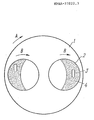
- An implant for cardiovascular surgery which has a plastically deformed surface layer or simply a plastically deformed surface, can be produced with the aid of a device shown in the drawing.
- This device contains a rotor 1 rotatably arranged according to arrow A, in which two chambers 2 are accommodated, which are arranged rotatably about their own axis according to arrow B and together with the rotor 1.
- a workpiece 3 for implant is introduced into the chamber 2, which is filled with granules 4 which are exposed therein and with the aqueous soap solution to be poured therein.
- Granules 4 should be designed as rotating bodies to ensure point or line contact with the workpiece 3 to be machined for the implant.
- the rotor 1 and the chambers 2 simultaneously rotate, as the arrows go, the workpieces 3 and granules 4 located in the chambers gain kinetic energy, collide with one another, as a result of which the plastic deformation of the surface of the workpiece 3 for implant takes place, so that the by post-processing adjustable surface is smooth and bare.
- the machined surface has no pores, which has a positive effect on thrombus resistance and practically excludes it.
- heart valve prostheses namely their housing and locking member
- the processing of heart valve prostheses is of the greatest interest.
- Workpieces for housings made of pure titanium were first manufactured. Each housing was pre-machined to achieve the given surface fineness and then degreased. After this preprocessing, the workpiece was processed according to the present invention using the examples below.
- a preprocessed housing of the heart valve prosthesis was placed in the 1 liter chamber of a device for processing in a planetary centrifugal process, which device is manufactured by the Experimental Research Institute for Machine Tools (Eksperimentalny nauchno-issledovatelsky institut metallorezhuschikh stankov ENIIMS (Moscow) and from this for This chamber was filled to 50% volume with a mixture of polished hardened chrome steel balls with a diameter of 0.8 to 1.0 mm, which process all sections of the workpiece surface, and 0.5 liter of water was then poured into the chamber page solution poured.
- the chambers were placed in planetary motion in which the angular velocities of translation and relative rotation / were 60 rpm. the processing took 3 hours.
- the machined parts were subject to visual inspection and evaluation of the surface roughness, said surface roughness R a 0.32 micron lay the O There were no surface pores.
- Example 2 The procedure of Example 1 was repeated, except that the speed was 150 rpm.
- the housing had a bare surface, the pores were missing.
- the roughness depth R a was 0.20 ⁇ m.
- Example 1 The procedure of Example 1 was repeated, except that the angular velocity was 200 rpm. The case had a bright shiny surface. The roughness depth R a was 0.18 ⁇ m. In the same experiment, an additional pair of housings were machined at a speed greater than 200 RPM. The housings produced in this way, however, had the burr on the machined surfaces due to excessive plastic deformation.
- titanium plates For the purpose of determining the biological inertia of manufactured products, we additionally processed titanium plates under the conditions according to Examples 1 to 3. These titanium plates were then tested in simulation media (physiological solution, plasma and blood serum) at a constant temperature of 37 o C within 1 year. No micro-defects were found by the electron microscopic examination of these plates, while the plates made of similar titanium, which were not processed as stated above, already showed micro-defects after half a year, the number of which increased over time.
- simulation media physiological solution, plasma and blood serum
- the present invention can be successfully used to manufacture both aortic and mitral heart valve prostheses. Similarly, tube elements can also be processed for the replacement of damaged vessels.
Landscapes
- Health & Medical Sciences (AREA)
- Cardiology (AREA)
- Chemical & Material Sciences (AREA)
- Public Health (AREA)
- Oral & Maxillofacial Surgery (AREA)
- Transplantation (AREA)
- Engineering & Computer Science (AREA)
- Veterinary Medicine (AREA)
- Life Sciences & Earth Sciences (AREA)
- Animal Behavior & Ethology (AREA)
- General Health & Medical Sciences (AREA)
- Heart & Thoracic Surgery (AREA)
- Vascular Medicine (AREA)
- Biomedical Technology (AREA)
- Chemical Kinetics & Catalysis (AREA)
- Dermatology (AREA)
- Medicinal Chemistry (AREA)
- Epidemiology (AREA)
- Inorganic Chemistry (AREA)
- Materials Engineering (AREA)
- Mechanical Engineering (AREA)
- Metallurgy (AREA)
- Organic Chemistry (AREA)
- Materials For Medical Uses (AREA)
- Prostheses (AREA)
- Nitrogen And Oxygen Or Sulfur-Condensed Heterocyclic Ring Systems (AREA)
Abstract
A titanium implant has surface areas bombarded by a mass of granular bodies of spherical form. Said surface structure is obtained by treating the implant blank in a centrifugal-planetary device with a chamber filled with balls and a soap-water solution into which the implant blank is immersed, the desired structure surface of the implant being obtained in the coarse of rotation of the chamber, as a result of impacts of the balls with the blank surface. The implant obtained is characterized by high thromboresistance and biological inertia properties.
Zusammenfassung
Das Titanimplantat weist plastisch verformte Oberflächen, die unter Einwirkung von freien granulierten Körpern in Form von Kugeln verdichtet sind. Solche Oberflächenstruktur wird durch die Bearbeitung des Werkstücks für Implantat in einer Einrichtung für die Bearbeitung im Planeten-Schleuderverfahren erreicht, in welcher man das Werkstück in eine mit Kugeln und wässriger Seifenlösung angefüllte Kammer einbringt, wodurch im Laufe der Rotation der Kammer beim Aufprallen der Kugeln mit Werkstückoberflächen die Bearbeitung derselben erfolgt, die die erforderliche Oberflächenstruktur ergibt. Das hergestellte Implantat besitzt eine erhöhte Thrombenresistenz und hohe biologische Trägheit.
Description
- Die vorliegende Erfindung bezieht sich auf die Medizin und insbesondere auf ein Implantat für die kardiovaskuläre Chirurgie und ein Verfahren zur Herstellung desselben.
- In den letzten Jahren finden Metallimplantate, insbesondere aus Kobalt und Titan in der Kardiochirurgie zunehmend Anwendung, wobei die Titanimplantate wegen hoher Kobaltkosten am meisten verbreitet sind. Als Implantate dienen in der Kardiochirurgie weitestgehend Herzklappanprothesen, welche einen Ring mit der Öffnung zum Durchfliessen der Blut enthalten, in der ein Sperrglied (US, A, 4713071) angebracht ist. An solche Herzklappenprothese werden harte Anforderungen hinsichtlich der Vermeidung der Thrombenbildung unter Einwirkung ihrer Oberfläche sowie hinsichtlich der äusserst geringen biologischen Wirksamkeit oder hohen biologischen Trägheit der Oberflächen gestellt.
- Zur Erfüllung dieser hohen Anforderungen an die Oberfläche wurde schon vorgeschlagen, auf die vorbehandelte Oberfläche oder auf die vorbehandelten Oberflächen verschiedene Überzüge, insbesondere einen Überzug aus spektroskopisch reinem Kohlenstoff (SU, A, 1155263) aufzubringen. Die dabei herstellbare Herzklappenprothese weist auf ihrer Oberfläche die hochwertige 6 bis 8 µm dicke Kohlenstoffschicht auf, die die Thrombenbildung in ihrem Ausgangszustand wirklich verhindert und eine sehr geringe biologische Wirksamkeit besitzt. Dieses Verfahren hat inzwischen wegen einer ihm eigenen Reihe von Nachteilen keine Verwendung gefunden, wobei von denen folgende zu nennen sind: Es ist sehr schwer, eine gleichmässige Dicke über die ganze Oberfläche der Herzklappe zu erreichen, und der Dickenunterschied verschlechtert das hämodynamische Stromverhalten. In diesem Falle fordert das Überziehen die Verwendung von komplizierten und kostspieligen Einrichtungen, um das Hochvakuum von etwa 10⁻⁶ Torr zu erzeugen und die Temperaturen genau zu kontrollieren. Und schliesslich beginnt sich der herstellbare Überzug mit der Zeit abzuschichten und zu schälen, und dies führt zu sehr unangenehmen Folgen unter besonderer Berücksichtigung der Unmöglichkeit, die Reparaturarbeiten am anwendbaren Implantat durchzuführen. Gerade infolge der angegebenen Verhältnisse kommt sowohl dieses Verfahren als auch eine Reihe von anderen Verfahren heute zur Verwendung nicht.
- In der Praxis werden verschiedene modernisierte schon bekannte Verfahren benutzt, welche den Einsatz von Titanimplantaten vorsehen, die keinen Überzug, aber die hochwertige Oberfläche besitzen, wobei die hohe Oberflächengüte durch vielstufige Bearbeitung einschliesslich solcher Arbeitsgänge wie Schleifen, Polieren, Läppolieren mit Pasten und andere Arten der Sonderbearbeitung erreicht wird, welche die Herstellung der Oberfläche mit einer Rauheit von etwa 0,16 µm sichern, was der Meinung von Fachleuten nach die hohe Thrombenresistenz ergeben soll. Wie die Praxis gezeigt hat, beeinflusst inzwischen die so hohe Bearbeitungsgüte die Thrombenresistenz entscheidend nicht und zugleich erweist sich dieser vielstuffige Prozess als dauernd und teuer. Es sei dabei berücksichtigt werden, dass der Grundfaktor, nämlich die Neigung des Implantats zur Thrombenbildung durch Vorhandensein einer porigen Struktur innerhalb seiner Oberfläche bedingt ist, die im Laufe der konventionellen Bearbeitung erhalten bleibt.
- Es ist also anerkennenswert, dass es einen Bedarf gibt, eine prinzipiell neue Einstellung zur Entwicklung von Implantaten für die kardiovaskuläre Chirurgie zu erarbeiten, die eine einfache, aber zugleich sehr thrombenresistente Oberflächenstruktur aufweisen, welche nach einem einfachen Verfahren hergestellt werden könnte.
- Der Erfindung liegt die Aufgabe zugrunde, die Oberflächen eines Titanimplantats so auszuführen, dass sie solch eine Struktur besitzen, die eine erhöhte Thrombenresistenz und erniedrigte biologische Wirksamkeit sichert, sowie ein einfaches und wirtschaftliches Verfahren zur Herstellung solcher Schichten an Implantaten zu entwickeln.
- Die gestellte Aufgabe wird dadurch gelöst, dass beim Titanimplantat für die kardiovaskuläre Chirurgie, welches bearbeitete thrombenresistente biologisch träge Oberflächen aufweist, bearbeitete Oberflächen erfindungsgemäss plastisch verformte und unter Einwirkung von freien granulierten Körpern verdichtete Oberflächen darstellen.
- Der Vorteil solcher Oberflächenstruktur liegt darin, dass sie keine dem gewöhnlichen Titan eigenen Poren aufweist, wodurch die Möglichkeit der Thrombenbildung bedeutend herabgesetzt wird, wobei die von uns durchgeführten Versuche, wie ferner gezeigt werden wird, auch eine äusserst geringe biologische Wirksamkeit des Implantats mit solcher Oberfläche ergeben haben.
- Diese Oberflächenstruktur des Implantats kann nach einem Verfahren hergestellt werden, welches die Vorund Nachbearbeitung des Werkstücks vorsieht, wobei man erfindungsgemäss im Stadium der Nachbearbeitung das Werkstück in eine mit polierten Granalien als Rotationskörpern und wässriger Seifenlösung eingefüllte Kammer einbringt und die Kammer in Planetenbewegung mit einer Geschwindigkeit versetzt, die ausreicht, um die plastische Verformung von Oberflächen des Werkstücks durch Zusammenwirken derselben mit Granalien auszulösen.
- Der Vorteil dieses Verfahrens besteht darin, dass die hohe Feinheit der bearbeiteten Oberfläche und praktisch das volle Fahlen von Poren innerhalb der Titanoberfläche erreicht werden, wodurch die hohe Thrombenresistenz gesichert wird. Die Verwendung dieses Verfahrens macht es ausserdem möglich, die Anforderungen an die Vorbearbeitungsgüte herabzusetzen, weil die erreichbare Oberflächenfeinheit praktisch in einem sehr geringen Masse von der Vorbearbeitung abhängt.
- Die Granalien können beliebige Rotationskörper darstellen, aber am zweckmässigsten ist die Verwendung von Kugeln, weil es in diesem Fall zum Punktkontakt mit der zu bearbeitenden Oberfläche und zur besten Verdichtung der Oberfläche durch plastische Verformung derselben kommt.
- Nachstehend wird die Erfindung an Hand der Beschreibung der konkreten Ausführungsform und der beiliegenden Zeichnung näher erläutert, wobei die Zeichnung das Schema der Einrichtung zur Durchführung des Verfahrens zur Herstellung der plastisch verformten Oberfläche des Implantats darstellt.
- Ein Implantat für die kardiovaskuläre Chirurgie, welches eine plastisch verformte Oberflächenschicht oder einfach eine plastisch verformte Oberfläche besitzt, kann mit Hilfe einer in der Zeichnung gezeigten Einrichtung hergestellt werden. Diese Einrichtung enthält einen nach Pfeil A drehbar angeordneten Rotor 1, in dem zwei Kammern 2 untergebracht sind, die um ihre eigene Achse nach dem Pfeil B und zusammen mit dem Rotor 1 drehbar angeordnet sind. Ein Werkstück 3 für Implantat wird in die Kammer 2 eingebracht, die mit darin frei liegenden Granalien 4 und mit der darin einzugiessenden wässrigen Seifenlösung eingefüllt wird. Granalien 4 sollen als Rotationskörper ausgeführt sein, um den Punkt- oder Linienkontakt mit dem zu bearbeitenden Werkstück 3 für Implantat sicherzustellen. Beim gleichzeitigen Rotieren des Rotors 1 und der Kammern 2, wie die Pfeile ziegen, gewinnen die in den Kammern befindlichen Werkstücke 3 und Granalien 4 an kinetischer Energie, prallen aufeinander, wodurch die plastische Verformung der Oberfläche des Werkstücks 3 für Implantat erfolgt, so dass die durch Nachbearbeitung her stellbare Oberfläche glatt und blank ist. Die bearbeitete Oberfläche weist keine Poren auf, was sich günstig auf der Thrombenresistenz auswirkt und sie praktisch ausschliesst.
- Obwohl nach dem beschriebenen Verfahren unterschiedliche kardiochirurgische Implantate einschliesslich Herzklappen, Röhrenelemente für Gefässe und anderes mehr hergestellt werden können, ist die Bearbeitung von Herzklappenprothesen und zwar ihres Gehäuses und Sperrgliedes von grösstem Interesse. Betrachten wir einige Beispiele für die Bearbeitung der Gehäuse von Herzklappenprothesen. Man stellte zuerst Werkstücke für Gehäuse aus Reintitan her. Jedes Gehäuse wurde vorbearbeitet, um die bestimmte gegebene Oberflächenfeinheit zu erreichen, und dann entfettet. Nach dieser Vorbearbeitung wurde das Werkstück an Hand der nachstehenden Beispiele gemäss der vorliegenden Erfindung bearbeitet.
- Ein vorbearbeitetes Gehäuse der Herzklappenprothese wurde in die 1 Liter grosse Kammer einer Einrichtung zur Bearbeitung in einem Planeten-Schleuderverfahren eingebracht, wobei diese Einrichtung vom Experimentier-Forschungsinstitut für Werkzeugmaschinen (Eksperimentalny nauchno-issledovatelsky institut metallorezhuschikh stankov ENIIMS (Moskau) gefertigt wird und aus diesem zum Verkauf kommt. Diese Kammer wurde zu 50% Volumen mit einem Gemisch von polierten gehärteten Chromstahlkugeln mit einem Durchmesser von 0,8 bis 1,0 mm angefüllt, welche die Bearbeitung aller Abschnitte der Werkstückfläche ausführen. In die Kammer wurde dann 0,5 Liter wässrige Seitenlösung eingegossen. Die Kammern wurden in Planetenbewegung versetzt, wobei die Winkelgeschwindigkeiten der Translation und Relativdrehung 60 U/min betrugen. Die Bearbeitung dauerte 3 Stunden. Die bearbeiteten Werkstücke unterlagen der Sichtprüfung und Beurteilung der Oberflächenrauhigkeit, wobei die Rauhtiefe Ra bei 0,32 µm lag, die Oberflächenporen waren nicht vorhanden.
- Wir haben die Versuche mit einer geringeren Relativdrehgeschwindigkeit bei den gleichen Kugelgrössen durchgeführt. Die Oberfläche wurde trübe, eine bedeutende Porenmenge blieb erhalten.
- Die Verfahrensweise des Beispiels 1 wurde wiederholt, nur dass die Geschwindigkeit 150 U/min betrug. Das Gehäuse hatte eine blanke Oberfläche, die Poren fehlten. Die Rauhtiefe Ra betrug 0,20 µm.
- Die Verfahrensweise des Beispiels 1 wurde wiederholt, nur dass die Winkelgeschwindigkeit 200 U/min betrug. Das Gehäuse hatte eine helle glänzende Oberfläche. Die Rauhtiefe Ra betrug 0,18 µm. In demselben Versuch wurde ein zusätzliches Paar von Gehäusen mit einer Geschwindigkeit von mehr als 200 U/min bearbeitet. Die dabei hergestellten Gehäuse wiesen jedoch den Grat am Rand bearbeiteten Oberflächen wegen zu starker plastischer Verformung auf.
- Zu Zwecken der Bestimmung der biologischen Trägheit von hergestellten Erzeugnissen wurden von uns Titanplatten unter Bedingungen gemäss Beispielen 1 bis 3 zusätzlich bearbeitet. Diese Titanplatten wurden danach in Simulationsmedien (physiologische Lösung, Plasma und Blutserum) bei einer Konstanttemperatur von 37oC innerhalb von 1 Jahr geprüft. Durch die elektronenmikroskopische Untersuchung dieser Platten waren keine Mikrofehler festgestellt, während die Platten aus ähnlichem Titan, die wie oben angegeben nicht bearbeitet wurden, schon nach einem halben Jahr Mikrofehler aufweisen, wobei ihre Anzahl mit der Zeit zunahm.
- Die nach den Verfahren von Beispielen 1 bis 3 bearbeiteten Platten wurden ausserdem in Schenkelmuskeln von weissen Laborratten implantiert, wobei die Gewebe des Implantats dann morphologisch untersucht wurden. Diese Untersuchung hat ergeben, dass die nach dem angegebenen Verfahren bearbeiteten Titanplatten biologisch auf die Umgebungsgewebe praktisch nicht wirken.
- Die vorliegende Erfindung lässt sich zur Herstellung von Herzklappenprothesen sowohl Aorten- als auch Mitralherzklappenprothesen mit Erfolg verwenden. Analog können ausserdem auch Röhrenelemente für den Ersatz von geschädigten Gefässen bearbeitet werden.
Claims (6)
1. Titanimplantat für die kardiovaskuläre Chirurgie, welches bearbeitete thrombenresistente und biologisch träge Oberflächen ausweist, dadurch gekennzeichnet, dass die bearbeiteten Oberflächen plastisch verformte und unter Einwirkung von freien granulierten Körpern verdichtete Oberflächen sind.
2. Verfahren zur Herstellung des Titanimplantats nach Anspruch 1, welches die Formung des Werkstücks für Implantat und die anschliessende Vor- und Nachbearbeitung seiner Oberfläche vorsieht, dadurch gekennzeichnet, dass man im Stadium der Nachbearbeitung das Werkstück in eine Kammer, angefüllt mit freiem Medium in Form von polierten Granalien als Rotationskörpern und wässriger Seifenlösung, einbringt und die Kammer in Planetenbewegung mit einer Geschwindigkeit versetzt, die ausreicht, um die plastische Verformung des Werkstücks durch Zusammenwirken desselben mit Granalien auszulösen.
3. Verfahren nach Anspruch 2, dadurch gekennzeichnet, dass Rotationskörper Kugeln darstellen.
4. Verfahren nach Anspruch 3, dadurch gekennzeichnet, dass die Kugeln aus Chromstahl bestehen.
5. Verfahren nach Anspruch 4, dadurch gekennzeichnet, dass die Kugeln einen Durchmesser von 0,8 bis 1,0 haben.
6. Verfahren nach Anspruch 5, dadurch gekennzeichnet, dass die Kammer in Planetenbewegung mit einer zwischen 60 und 200 U/min liegenden Summengeschwindigkeit innerhalb von 2 bis 4 Stunden bei einem Kugeldurchmesser von 0,8 bis 1,0 mm versetzt wird.
Applications Claiming Priority (2)
| Application Number | Priority Date | Filing Date | Title |
|---|---|---|---|
| SU4303285 | 1987-09-18 | ||
| SU4303285 | 1987-09-18 |
Publications (2)
| Publication Number | Publication Date |
|---|---|
| EP0336983A1 true EP0336983A1 (de) | 1989-10-18 |
| EP0336983A4 EP0336983A4 (de) | 1990-04-10 |
Family
ID=21326719
Family Applications (1)
| Application Number | Title | Priority Date | Filing Date |
|---|---|---|---|
| EP19880909006 Withdrawn EP0336983A4 (de) | 1987-09-18 | 1988-09-16 | Titanimplantat für kardiovaskulare chirurgie und verfahren zur herstellung. |
Country Status (8)
| Country | Link |
|---|---|
| EP (1) | EP0336983A4 (de) |
| JP (1) | JPH02501279A (de) |
| CN (1) | CN1013242B (de) |
| ES (2) | ES2008588A6 (de) |
| FI (1) | FI892369A0 (de) |
| PL (1) | PL155691B1 (de) |
| WO (1) | WO1989002253A1 (de) |
| YU (1) | YU175488A (de) |
Cited By (2)
| Publication number | Priority date | Publication date | Assignee | Title |
|---|---|---|---|---|
| WO2019215343A1 (de) * | 2018-05-11 | 2019-11-14 | Ejot Gmbh & Co. Kg | Verfahren zur beschichtung von teilen in einem tauch-schleuderverfahren |
| WO2020234194A1 (de) * | 2019-05-17 | 2020-11-26 | Ejot Gmbh & Co. Kg | Verfahren zum beschichten von teilen |
Family Cites Families (4)
| Publication number | Priority date | Publication date | Assignee | Title |
|---|---|---|---|---|
| US4038702A (en) * | 1973-09-21 | 1977-08-02 | Philip Nicholas Sawyer | Electrochemical and chemical methods for production of non-thrombogenic metal heart valves |
| US3911502A (en) * | 1974-08-23 | 1975-10-14 | Us Health | Composite heart valve poppet |
| US4101984A (en) * | 1975-05-09 | 1978-07-25 | Macgregor David C | Cardiovascular prosthetic devices and implants with porous systems |
| GB2060700B (en) * | 1979-10-11 | 1984-02-08 | Ural Nii Trub Promysh | Electrolyte for electrochemical polishing of articles made of titanium alloys |
-
1988
- 1988-09-16 PL PL1988274712A patent/PL155691B1/pl unknown
- 1988-09-16 ES ES8802844A patent/ES2008588A6/es not_active Expired
- 1988-09-16 WO PCT/SU1988/000179 patent/WO1989002253A1/ru not_active Ceased
- 1988-09-16 YU YU01754/88A patent/YU175488A/xx unknown
- 1988-09-16 EP EP19880909006 patent/EP0336983A4/de not_active Withdrawn
- 1988-09-16 FI FI892369A patent/FI892369A0/fi not_active IP Right Cessation
- 1988-09-16 ES ES8802843A patent/ES2008587A6/es not_active Expired
- 1988-09-16 JP JP88508310A patent/JPH02501279A/ja active Pending
- 1988-09-17 CN CN88107575A patent/CN1013242B/zh not_active Expired
Cited By (5)
| Publication number | Priority date | Publication date | Assignee | Title |
|---|---|---|---|---|
| WO2019215343A1 (de) * | 2018-05-11 | 2019-11-14 | Ejot Gmbh & Co. Kg | Verfahren zur beschichtung von teilen in einem tauch-schleuderverfahren |
| US11471910B2 (en) | 2018-05-11 | 2022-10-18 | Ejot Gmbh & Co. Kg | Method for coating parts in a dip centrifugation process |
| TWI804624B (zh) * | 2018-05-11 | 2023-06-11 | 德商毅結特有限兩合公司 | 在浸漬-旋轉工序中塗覆部件的方法 |
| WO2020234194A1 (de) * | 2019-05-17 | 2020-11-26 | Ejot Gmbh & Co. Kg | Verfahren zum beschichten von teilen |
| US11969749B2 (en) | 2019-05-17 | 2024-04-30 | Ejot Gmbh & Co. Kg | Method for coating parts |
Also Published As
| Publication number | Publication date |
|---|---|
| PL274712A1 (en) | 1989-05-02 |
| FI892369L (fi) | 1989-05-17 |
| WO1989002253A1 (fr) | 1989-03-23 |
| EP0336983A4 (de) | 1990-04-10 |
| CN1013242B (zh) | 1991-07-24 |
| ES2008588A6 (es) | 1989-07-16 |
| YU175488A (en) | 1990-10-31 |
| PL155691B1 (en) | 1991-12-31 |
| FI892369A7 (fi) | 1989-05-17 |
| JPH02501279A (ja) | 1990-05-10 |
| FI892369A0 (fi) | 1989-05-17 |
| CN1034128A (zh) | 1989-07-26 |
| ES2008587A6 (es) | 1989-07-16 |
Similar Documents
| Publication | Publication Date | Title |
|---|---|---|
| EP1386591B1 (de) | Verfahren zur Herstellung eines Implantats und Verfahren zum Dekontaminieren einer mit Strahlpartikeln behandelten Oberfläche | |
| DE2404214C3 (de) | Knochenprothese und Verfahren zu deren Herstellung | |
| DE602005002353T2 (de) | Metallimplantate | |
| DE69100853T2 (de) | Gasturbinenschaufel. | |
| DE2546824C2 (de) | Beschichtete Endoprothese und Verfahren zu ihrer Herstellung | |
| DE4021044A1 (de) | Verfahren zum auftragen einer schleifschicht auf titanlegierungsverdichterschaufeln | |
| DE3723560C2 (de) | ||
| WO2002064185A2 (de) | VERFAHREN ZUR VERRINGERUNG VON FOLGEKOMPLIKATIONEN BEI DER IMPLANTATION VON GEFÄssSTÜTZEN | |
| DE19916315A1 (de) | Verfahren zum Bilden einer dünnen keramikartigen Schicht auf einem Bioimplantat | |
| DE2620631A1 (de) | Kardiovaskulaere prosthetische vorrichtungen und implantate mit poroesen systemen | |
| EP1264606B1 (de) | Apatitbeschichteter metallischer Werkstoff, Verfahren zu dessen Herstellung sowie Verwendung | |
| DE602004010445T2 (de) | Metalloberflächenbehandlung | |
| DE3917061A1 (de) | Verfahren zum herstellen von turbinenschaufeln mit abschleifbaren spitzen sowie turbinenschaufel | |
| EP0299238A2 (de) | Verfahren zur Beschichtung von Prothesen aus Titan und Titanlegierungen | |
| EP0114025B1 (de) | Verfahren zur Herstellung künstlicher Herzklappen | |
| CA2636218A1 (en) | Open-pore biocompatible surface layer for an implant, methods of production and use | |
| DE3723901A1 (de) | Verfahren zum herstellen eines oe-spinnrotors | |
| DE10006992B4 (de) | Verfahren zur Beschichtung eines Implantats und Implantat mit Beschichtung | |
| DE19855786A1 (de) | Radioaktiver Carbon Stent | |
| EP0662024B1 (de) | Werkzeug zur behandlung von oberflächen von bauteilen | |
| DE3328905A1 (de) | Zahnprothese und verfahren fuer ihre herstellung | |
| EP3879007A1 (de) | Verfahren zur herstellung eines beschichteten bauteils | |
| EP0262354B1 (de) | Implantat aus Titan mit drahtförmigen Oberflächenstrukturen | |
| DE2522816A1 (de) | Verfahren zur herstellung einer geschichteten roentgendrehanode und durch dieses verfahren erhaltene roentgendrehanode | |
| DE69528772T2 (de) | Verfahren zur verbesserung mechanischer herzklappenprothese und anderer medizinischer implantate und nach diesem verfahren hergestellte produkte |
Legal Events
| Date | Code | Title | Description |
|---|---|---|---|
| PUAI | Public reference made under article 153(3) epc to a published international application that has entered the european phase |
Free format text: ORIGINAL CODE: 0009012 |
|
| 17P | Request for examination filed |
Effective date: 19890517 |
|
| AK | Designated contracting states |
Kind code of ref document: A1 Designated state(s): BE DE GB IT LU NL SE |
|
| A4 | Supplementary search report drawn up and despatched |
Effective date: 19900410 |
|
| 17Q | First examination report despatched |
Effective date: 19910910 |
|
| STAA | Information on the status of an ep patent application or granted ep patent |
Free format text: STATUS: THE APPLICATION HAS BEEN WITHDRAWN |
|
| 18W | Application withdrawn |
Withdrawal date: 19911024 |