EP0336044B1 - A high temperature low thermal expansion ceramic and method for the production thereof - Google Patents
A high temperature low thermal expansion ceramic and method for the production thereof Download PDFInfo
- Publication number
- EP0336044B1 EP0336044B1 EP88311789A EP88311789A EP0336044B1 EP 0336044 B1 EP0336044 B1 EP 0336044B1 EP 88311789 A EP88311789 A EP 88311789A EP 88311789 A EP88311789 A EP 88311789A EP 0336044 B1 EP0336044 B1 EP 0336044B1
- Authority
- EP
- European Patent Office
- Prior art keywords
- percent
- solid solution
- sintered ceramic
- rare earth
- mullite
- Prior art date
- Legal status (The legal status is an assumption and is not a legal conclusion. Google has not performed a legal analysis and makes no representation as to the accuracy of the status listed.)
- Expired - Lifetime
Links
- 239000000919 ceramic Substances 0.000 title claims description 21
- 238000000034 method Methods 0.000 title claims description 11
- 238000004519 manufacturing process Methods 0.000 title description 2
- GWEVSGVZZGPLCZ-UHFFFAOYSA-N Titan oxide Chemical compound O=[Ti]=O GWEVSGVZZGPLCZ-UHFFFAOYSA-N 0.000 claims description 57
- 239000000203 mixture Substances 0.000 claims description 44
- 229910000505 Al2TiO5 Inorganic materials 0.000 claims description 39
- 239000006104 solid solution Substances 0.000 claims description 34
- PNEYBMLMFCGWSK-UHFFFAOYSA-N aluminium oxide Inorganic materials [O-2].[O-2].[O-2].[Al+3].[Al+3] PNEYBMLMFCGWSK-UHFFFAOYSA-N 0.000 claims description 33
- UQSXHKLRYXJYBZ-UHFFFAOYSA-N Iron oxide Chemical compound [Fe]=O UQSXHKLRYXJYBZ-UHFFFAOYSA-N 0.000 claims description 31
- 229910001404 rare earth metal oxide Inorganic materials 0.000 claims description 31
- 229910052863 mullite Inorganic materials 0.000 claims description 27
- KZHJGOXRZJKJNY-UHFFFAOYSA-N dioxosilane;oxo(oxoalumanyloxy)alumane Chemical compound O=[Si]=O.O=[Si]=O.O=[Al]O[Al]=O.O=[Al]O[Al]=O.O=[Al]O[Al]=O KZHJGOXRZJKJNY-UHFFFAOYSA-N 0.000 claims description 25
- 229910052593 corundum Inorganic materials 0.000 claims description 21
- 229910001845 yogo sapphire Inorganic materials 0.000 claims description 20
- VYPSYNLAJGMNEJ-UHFFFAOYSA-N Silicium dioxide Chemical compound O=[Si]=O VYPSYNLAJGMNEJ-UHFFFAOYSA-N 0.000 claims description 18
- 238000000354 decomposition reaction Methods 0.000 claims description 18
- JEIPFZHSYJVQDO-UHFFFAOYSA-N iron(III) oxide Inorganic materials O=[Fe]O[Fe]=O JEIPFZHSYJVQDO-UHFFFAOYSA-N 0.000 claims description 18
- 239000013078 crystal Substances 0.000 claims description 15
- 229910052761 rare earth metal Inorganic materials 0.000 claims description 10
- 229910052681 coesite Inorganic materials 0.000 claims description 9
- 229910052906 cristobalite Inorganic materials 0.000 claims description 9
- 150000002910 rare earth metals Chemical group 0.000 claims description 9
- 239000000377 silicon dioxide Substances 0.000 claims description 9
- 235000012239 silicon dioxide Nutrition 0.000 claims description 9
- 229910052682 stishovite Inorganic materials 0.000 claims description 9
- 229910052905 tridymite Inorganic materials 0.000 claims description 9
- KCZFLPPCFOHPNI-UHFFFAOYSA-N alumane;iron Chemical compound [AlH3].[Fe] KCZFLPPCFOHPNI-UHFFFAOYSA-N 0.000 claims description 8
- 238000010304 firing Methods 0.000 claims description 6
- 239000000843 powder Substances 0.000 claims description 6
- 238000002156 mixing Methods 0.000 claims description 4
- 229910052779 Neodymium Inorganic materials 0.000 claims description 3
- 229910052746 lanthanum Inorganic materials 0.000 claims description 3
- 238000005382 thermal cycling Methods 0.000 claims description 3
- 229910052684 Cerium Inorganic materials 0.000 claims description 2
- 229910052692 Dysprosium Inorganic materials 0.000 claims description 2
- 229910052691 Erbium Inorganic materials 0.000 claims description 2
- 229910052693 Europium Inorganic materials 0.000 claims description 2
- 229910052688 Gadolinium Inorganic materials 0.000 claims description 2
- 229910052777 Praseodymium Inorganic materials 0.000 claims description 2
- 229910052772 Samarium Inorganic materials 0.000 claims description 2
- 229910052771 Terbium Inorganic materials 0.000 claims description 2
- 229910052769 Ytterbium Inorganic materials 0.000 claims description 2
- 230000001747 exhibiting effect Effects 0.000 claims description 2
- 238000000227 grinding Methods 0.000 claims description 2
- FZLIPJUXYLNCLC-UHFFFAOYSA-N lanthanum atom Chemical compound [La] FZLIPJUXYLNCLC-UHFFFAOYSA-N 0.000 claims description 2
- QEFYFXOXNSNQGX-UHFFFAOYSA-N neodymium atom Chemical compound [Nd] QEFYFXOXNSNQGX-UHFFFAOYSA-N 0.000 claims description 2
- 229910052706 scandium Inorganic materials 0.000 claims description 2
- 229910052727 yttrium Inorganic materials 0.000 claims description 2
- 238000001354 calcination Methods 0.000 claims 3
- GWXLDORMOJMVQZ-UHFFFAOYSA-N cerium Chemical compound [Ce] GWXLDORMOJMVQZ-UHFFFAOYSA-N 0.000 claims 1
- KBQHZAAAGSGFKK-UHFFFAOYSA-N dysprosium atom Chemical compound [Dy] KBQHZAAAGSGFKK-UHFFFAOYSA-N 0.000 claims 1
- UYAHIZSMUZPPFV-UHFFFAOYSA-N erbium Chemical compound [Er] UYAHIZSMUZPPFV-UHFFFAOYSA-N 0.000 claims 1
- OGPBJKLSAFTDLK-UHFFFAOYSA-N europium atom Chemical compound [Eu] OGPBJKLSAFTDLK-UHFFFAOYSA-N 0.000 claims 1
- UIWYJDYFSGRHKR-UHFFFAOYSA-N gadolinium atom Chemical compound [Gd] UIWYJDYFSGRHKR-UHFFFAOYSA-N 0.000 claims 1
- PUDIUYLPXJFUGB-UHFFFAOYSA-N praseodymium atom Chemical compound [Pr] PUDIUYLPXJFUGB-UHFFFAOYSA-N 0.000 claims 1
- KZUNJOHGWZRPMI-UHFFFAOYSA-N samarium atom Chemical compound [Sm] KZUNJOHGWZRPMI-UHFFFAOYSA-N 0.000 claims 1
- SIXSYDAISGFNSX-UHFFFAOYSA-N scandium atom Chemical compound [Sc] SIXSYDAISGFNSX-UHFFFAOYSA-N 0.000 claims 1
- GZCRRIHWUXGPOV-UHFFFAOYSA-N terbium atom Chemical compound [Tb] GZCRRIHWUXGPOV-UHFFFAOYSA-N 0.000 claims 1
- NAWDYIZEMPQZHO-UHFFFAOYSA-N ytterbium Chemical compound [Yb] NAWDYIZEMPQZHO-UHFFFAOYSA-N 0.000 claims 1
- VWQVUPCCIRVNHF-UHFFFAOYSA-N yttrium atom Chemical compound [Y] VWQVUPCCIRVNHF-UHFFFAOYSA-N 0.000 claims 1
- AABBHSMFGKYLKE-SNAWJCMRSA-N propan-2-yl (e)-but-2-enoate Chemical compound C\C=C\C(=O)OC(C)C AABBHSMFGKYLKE-SNAWJCMRSA-N 0.000 description 25
- 235000013980 iron oxide Nutrition 0.000 description 13
- 238000002441 X-ray diffraction Methods 0.000 description 9
- 230000035939 shock Effects 0.000 description 9
- 238000005245 sintering Methods 0.000 description 9
- 238000007792 addition Methods 0.000 description 8
- 230000006641 stabilisation Effects 0.000 description 7
- 238000011105 stabilization Methods 0.000 description 7
- XEEYBQQBJWHFJM-UHFFFAOYSA-N Iron Chemical compound [Fe] XEEYBQQBJWHFJM-UHFFFAOYSA-N 0.000 description 6
- RTAQQCXQSZGOHL-UHFFFAOYSA-N Titanium Chemical compound [Ti] RTAQQCXQSZGOHL-UHFFFAOYSA-N 0.000 description 5
- 239000000463 material Substances 0.000 description 5
- 239000000758 substrate Substances 0.000 description 5
- 238000012360 testing method Methods 0.000 description 5
- 229910052782 aluminium Inorganic materials 0.000 description 4
- XAGFODPZIPBFFR-UHFFFAOYSA-N aluminium Chemical compound [Al] XAGFODPZIPBFFR-UHFFFAOYSA-N 0.000 description 4
- 230000008859 change Effects 0.000 description 4
- 230000000694 effects Effects 0.000 description 4
- JCDAAXRCMMPNBO-UHFFFAOYSA-N iron(3+);oxygen(2-);titanium(4+) Chemical compound [O-2].[O-2].[O-2].[O-2].[O-2].[O-2].[O-2].[Ti+4].[Ti+4].[Fe+3].[Fe+3] JCDAAXRCMMPNBO-UHFFFAOYSA-N 0.000 description 4
- 239000011148 porous material Substances 0.000 description 4
- 239000000654 additive Substances 0.000 description 3
- 230000003197 catalytic effect Effects 0.000 description 3
- 239000012530 fluid Substances 0.000 description 3
- 229910052742 iron Inorganic materials 0.000 description 3
- 238000005259 measurement Methods 0.000 description 3
- 239000002245 particle Substances 0.000 description 3
- 238000005979 thermal decomposition reaction Methods 0.000 description 3
- XLYOFNOQVPJJNP-UHFFFAOYSA-N water Substances O XLYOFNOQVPJJNP-UHFFFAOYSA-N 0.000 description 3
- 229910002651 NO3 Inorganic materials 0.000 description 2
- 238000004458 analytical method Methods 0.000 description 2
- 238000000498 ball milling Methods 0.000 description 2
- 230000008901 benefit Effects 0.000 description 2
- 230000001413 cellular effect Effects 0.000 description 2
- 239000000470 constituent Substances 0.000 description 2
- 238000001125 extrusion Methods 0.000 description 2
- 239000003966 growth inhibitor Substances 0.000 description 2
- 238000010438 heat treatment Methods 0.000 description 2
- 238000002844 melting Methods 0.000 description 2
- 230000008018 melting Effects 0.000 description 2
- 230000008569 process Effects 0.000 description 2
- -1 rare earth nitrate Chemical class 0.000 description 2
- 239000000243 solution Substances 0.000 description 2
- 229910003079 TiO5 Inorganic materials 0.000 description 1
- JAQXDZTWVWLKGC-UHFFFAOYSA-N [O-2].[Al+3].[Fe+2] Chemical compound [O-2].[Al+3].[Fe+2] JAQXDZTWVWLKGC-UHFFFAOYSA-N 0.000 description 1
- 230000009471 action Effects 0.000 description 1
- 230000000996 additive effect Effects 0.000 description 1
- 230000009286 beneficial effect Effects 0.000 description 1
- 239000011230 binding agent Substances 0.000 description 1
- 230000015556 catabolic process Effects 0.000 description 1
- 229910010293 ceramic material Inorganic materials 0.000 description 1
- 238000006243 chemical reaction Methods 0.000 description 1
- 239000004927 clay Substances 0.000 description 1
- 239000002131 composite material Substances 0.000 description 1
- 238000007596 consolidation process Methods 0.000 description 1
- 239000010431 corundum Substances 0.000 description 1
- 238000005336 cracking Methods 0.000 description 1
- 230000001351 cycling effect Effects 0.000 description 1
- 230000003247 decreasing effect Effects 0.000 description 1
- 238000006731 degradation reaction Methods 0.000 description 1
- 238000009826 distribution Methods 0.000 description 1
- 238000000635 electron micrograph Methods 0.000 description 1
- 229910052595 hematite Inorganic materials 0.000 description 1
- 239000011019 hematite Substances 0.000 description 1
- 238000001513 hot isostatic pressing Methods 0.000 description 1
- 238000007731 hot pressing Methods 0.000 description 1
- 230000002452 interceptive effect Effects 0.000 description 1
- VBMVTYDPPZVILR-UHFFFAOYSA-N iron(2+);oxygen(2-) Chemical class [O-2].[Fe+2] VBMVTYDPPZVILR-UHFFFAOYSA-N 0.000 description 1
- LIKBJVNGSGBSGK-UHFFFAOYSA-N iron(3+);oxygen(2-) Chemical compound [O-2].[O-2].[O-2].[Fe+3].[Fe+3] LIKBJVNGSGBSGK-UHFFFAOYSA-N 0.000 description 1
- 238000000462 isostatic pressing Methods 0.000 description 1
- NLYAJNPCOHFWQQ-UHFFFAOYSA-N kaolin Chemical compound O.O.O=[Al]O[Si](=O)O[Si](=O)O[Al]=O NLYAJNPCOHFWQQ-UHFFFAOYSA-N 0.000 description 1
- 229910052622 kaolinite Inorganic materials 0.000 description 1
- 239000011159 matrix material Substances 0.000 description 1
- 229920000609 methyl cellulose Polymers 0.000 description 1
- 239000001923 methylcellulose Substances 0.000 description 1
- 150000002823 nitrates Chemical class 0.000 description 1
- 230000000737 periodic effect Effects 0.000 description 1
- 230000000704 physical effect Effects 0.000 description 1
- 239000000049 pigment Substances 0.000 description 1
- 238000003825 pressing Methods 0.000 description 1
- 238000012545 processing Methods 0.000 description 1
- 230000002035 prolonged effect Effects 0.000 description 1
- 239000011819 refractory material Substances 0.000 description 1
- 239000011833 salt mixture Substances 0.000 description 1
- 238000007569 slipcasting Methods 0.000 description 1
- 238000005728 strengthening Methods 0.000 description 1
- 239000000126 substance Substances 0.000 description 1
- 230000008646 thermal stress Effects 0.000 description 1
Images

Classifications
-
- C—CHEMISTRY; METALLURGY
- C04—CEMENTS; CONCRETE; ARTIFICIAL STONE; CERAMICS; REFRACTORIES
- C04B—LIME, MAGNESIA; SLAG; CEMENTS; COMPOSITIONS THEREOF, e.g. MORTARS, CONCRETE OR LIKE BUILDING MATERIALS; ARTIFICIAL STONE; CERAMICS; REFRACTORIES; TREATMENT OF NATURAL STONE
- C04B35/00—Shaped ceramic products characterised by their composition; Ceramics compositions; Processing powders of inorganic compounds preparatory to the manufacturing of ceramic products
- C04B35/01—Shaped ceramic products characterised by their composition; Ceramics compositions; Processing powders of inorganic compounds preparatory to the manufacturing of ceramic products based on oxide ceramics
- C04B35/48—Shaped ceramic products characterised by their composition; Ceramics compositions; Processing powders of inorganic compounds preparatory to the manufacturing of ceramic products based on oxide ceramics based on zirconium or hafnium oxides, zirconates, zircon or hafnates
- C04B35/49—Shaped ceramic products characterised by their composition; Ceramics compositions; Processing powders of inorganic compounds preparatory to the manufacturing of ceramic products based on oxide ceramics based on zirconium or hafnium oxides, zirconates, zircon or hafnates containing also titanium oxides or titanates
-
- C—CHEMISTRY; METALLURGY
- C04—CEMENTS; CONCRETE; ARTIFICIAL STONE; CERAMICS; REFRACTORIES
- C04B—LIME, MAGNESIA; SLAG; CEMENTS; COMPOSITIONS THEREOF, e.g. MORTARS, CONCRETE OR LIKE BUILDING MATERIALS; ARTIFICIAL STONE; CERAMICS; REFRACTORIES; TREATMENT OF NATURAL STONE
- C04B35/00—Shaped ceramic products characterised by their composition; Ceramics compositions; Processing powders of inorganic compounds preparatory to the manufacturing of ceramic products
- C04B35/01—Shaped ceramic products characterised by their composition; Ceramics compositions; Processing powders of inorganic compounds preparatory to the manufacturing of ceramic products based on oxide ceramics
- C04B35/16—Shaped ceramic products characterised by their composition; Ceramics compositions; Processing powders of inorganic compounds preparatory to the manufacturing of ceramic products based on oxide ceramics based on silicates other than clay
- C04B35/18—Shaped ceramic products characterised by their composition; Ceramics compositions; Processing powders of inorganic compounds preparatory to the manufacturing of ceramic products based on oxide ceramics based on silicates other than clay rich in aluminium oxide
-
- C—CHEMISTRY; METALLURGY
- C04—CEMENTS; CONCRETE; ARTIFICIAL STONE; CERAMICS; REFRACTORIES
- C04B—LIME, MAGNESIA; SLAG; CEMENTS; COMPOSITIONS THEREOF, e.g. MORTARS, CONCRETE OR LIKE BUILDING MATERIALS; ARTIFICIAL STONE; CERAMICS; REFRACTORIES; TREATMENT OF NATURAL STONE
- C04B35/00—Shaped ceramic products characterised by their composition; Ceramics compositions; Processing powders of inorganic compounds preparatory to the manufacturing of ceramic products
- C04B35/01—Shaped ceramic products characterised by their composition; Ceramics compositions; Processing powders of inorganic compounds preparatory to the manufacturing of ceramic products based on oxide ceramics
- C04B35/46—Shaped ceramic products characterised by their composition; Ceramics compositions; Processing powders of inorganic compounds preparatory to the manufacturing of ceramic products based on oxide ceramics based on titanium oxides or titanates
- C04B35/462—Shaped ceramic products characterised by their composition; Ceramics compositions; Processing powders of inorganic compounds preparatory to the manufacturing of ceramic products based on oxide ceramics based on titanium oxides or titanates based on titanates
- C04B35/478—Shaped ceramic products characterised by their composition; Ceramics compositions; Processing powders of inorganic compounds preparatory to the manufacturing of ceramic products based on oxide ceramics based on titanium oxides or titanates based on titanates based on aluminium titanates
Definitions
- This invention relates to a high temperature low thermal expansion ceramic and method for the production thereof.
- it relates to the high temperature stabilization of aluminum titanate and aluminum titanate-mullite compositions by the addition of iron oxide. It has been discovered that iron oxide concentrations greater than 5% and as high as approximately 25% by weight have a stabilization effect at high temperatures on aluminum titanate. The effect is uncommon to prior stabilization attempts.
- Aluminum titanates may be effectively used as filters for fluids, in particular, as diesel particulate filters and as substrates for catalytic converters, an example of which is known commonly in the art as a honeycomb substrate. Additionally, aluminum titanates are desirable in applications where the thermal shock resistance and the ultimate use temperature are high. Cellular substrates used under conditions of high thermal gradients are examples of this application.
- structures such as the above are subjected to harsh environments which require high thermal shock resistance, low thermal expansion, and high mechanical shock properties. Skilled workers in the art appreciate that maintaining these properties for extended periods of time in their intended environments eliminates many potentially useful refractory materials. The reordering of crystalline phases, which commonly occurs in ceramic materials subjected to these environments, impairs the desired physical and chemical properties. The result is a degraded structure which is no longer appropriate for its intended use.
- rare earth oxides and iron oxides to compositions consisting essentially of aluminum titanate, provides the body with sintering aids and further increases stabilization to high temperature degradation. It has not been conclusively determined how the stabilization is effected, although it is known that Fe2TiO5 is in solid solution with Al2TiO5. The solid solution is effected during firing, and is facilitated at high temperatures, above about 1400°C. The role the rare earth oxide plays is to affect the grain growth behavior, thus adding mechanical strength.
- an aluminum titanate-mullite ceramic composition which includes .5 to 5% iron oxide and .5 to 5% rare earth oxides.
- .5 to 5% iron oxide and .5 to 5% rare earth metal oxides will most desirably be present to serve as a sintering aid and to inhibit the decomposition of Al2O3.TiO2 crystals when exposed to high temperatures.
- U.S. Patent 4,327,188 discloses the use of aluminum titanate with the rare earth and iron oxide additives.
- the '188 patent discloses that there is a disadvantage to adding more than 2 weight percent of the specific additive due to an increase in the thermal expansion and a decrease in the melting point.
- the primary objective of the present invention was to develop an aluminum titanate-containing body which exhibits high mechanical strength, a low linear coefficient of thermal expansion, is capable of extended use at temperatures in the vicinity of 1400°C, while maintaining crystalline integrity after very prolonged exposure to temperatures within the range of 1000°-1300°C. Additionally, the body is capable of repeated cyclings in the temperature range between room temperature and well over 1000°C without significant change in dimensional integrity.
- the bodies consisting essentially of five basic components; viz., Al2O3, TiO2, SiO2, rare earth oxide (expressed as RE2O3), and iron oxide (expressed as Fe2O3).
- the bodies consist essentially of two crystal phases; viz., aluminum titanate (Al2TiO5) and mullite (3Al2O3.2SiO2).
- Al2TiO5 aluminum titanate
- mullite 3Al2O3.2SiO2
- the aluminum titanate phase present in the inventive products may actually consist of a solid solution containing Fe2TiO5.
- Such solid solution is readily apparent from a study of x-ray diffraction patterns produced by the crystals.
- the typical overall pattern of aluminum titanate is present, but the d-spacings and intensities are slightly altered. Accordingly, the expression aluminum titanate solid solution will be used in the description to generally identify the aluminum titanate containing crystals.
- alumina, titania, and iron oxide provide a body with excellent thermal decomposition properties.
- the environment of eventual use demands a ceramic body with good thermal shock resistant properties and high mechanical strength. Therefore, to make the ceramic body useful for its intended environment, strengthening components must be added. Additives must be chosen so that strength is added to the body without interfering with the desirable thermal properties.
- the present invention contemplates the use of rare earth oxides and mullite to solve this problem.
- the inventive compositions consist essentially of about 1.5-20% SiO2, 0.1-5% RE2O3, >5-25% Fe2O3, 35-75% Al2O3, and 10-40% TiO2, wherein the rare earth metal is selected from the group consisting of La, Ce, Pr, Nd, Sm, Eu, Gd, Tb, Dy, Er, Yb, Y, Sc, and mixtures thereof.
- the preferred compositions consist essentially, expressed in terms of weight percent on the oxide basis, of about 5-20% SiO2, 0.1-5% RE2O3, >5-25% Fe2O3, 40-65% Al2O3, and 10-35% TiO2, and the most preferred compositions consist essentially of 10-20% SiO2, 0.1-5% RE2O3, 8-25% Fe2O3, 45-60% Al2O3, and 15-30% TiO2.
- Amounts of Fe2O3 in excess of 5% are demanded to impart the desired resistance to thermal decomposition of the aluminum titanate crystals; i.e., to insure the stabilization of the aluminum titanate crystals. Above 25% Fe2O3, however, thermal deformation and actual melting of the products have been observed at temperatures in the vicinity of 1400°C.
- Iron-aluminum oxide or titanate solid solutions within the invention can consist essentially of, by weight percent, 30 to 75 percent alumina, 20 to 65 percent titania, and optionally, greater than 5% to 25% iron oxide exhibit excellent thermal stability. This thermal stability was indicated by x-ray diffraction patterns. The patterns revealed that the solid solution decomposition products of Al2O3, Fe2O3, and TiO2 were less than 20 percent of the total stoichiometric decomposition. The bodies had been heat treated within the temperature range of approximately 1000°C to 1300°C.
- a preferred solid solution consists essentially of, 35 to 50 percent alumina, 40 to 42 percent titania, and 8 to 25 percent iron oxide. The most preferred solid solution consists essentially of 35 to 50 percent alumina, 40 to 42 percent titania, and 15 to 25 percent iron oxide.
- any of the practices conventionally employed in the ceramic art for forming finely-divided powders into shapes of a desired configuration are applicable with the inventive compositions.
- Such methods include dry pressing, hot pressing, slip casting, isostatic pressing, hot isostatic pressing, and extrusion.
- inventive materials are to be used as filters for fluids or as substrates for catalytic converters, they can be readily extruded into honeycomb structures.
- sintering temperatures over the interval of about 1400°-1650°C will be utilized. Nevertheless, it will be recognized that through the use of expedients known to the ceramic art, such as the use of substantial amounts of sintering aids, the use of calcined or prereacted clinker as a portion of the batch, and the careful choice of batch materials, the firing temperatures required can be reduced. It will be appreciated, however, that the applications to which the fired bodies are to be exposed for extended periods will involve temperatures below that at which the bodies were sintered. Hence, the shrinkage undergone by a body during sintering is a function of the firing temperature employed.
- the shrinkage experienced by the inventive bodies sintered over the temperature interval of 1400°-1650°C will range about 2-15%, the level of shrinkage increasing as the temperature is raised.
- porosity of the body and the size of the pores are important.
- the total porosity and the size of the pores are directly influenced by the temperature at which the body is sintered; hence, the higher the temperature, the lower total porosity and the smaller the average pore size.
- open porosity in the inventive products will average about 30-50% when a sintering temperature of 1400°C is employed; whereas at a firing temperature of 1650°C, the average is decreased to about 5-15%.
- the average pore size varies between about 1-15 microns, the size being generally smaller at the higher sintering temperatures.
- X-ray diffraction analyses have indicated the microstructure of the inventive products to consist essentially of aluminum titanate solid solution and mullite with a very minor amount of rare earth metal oxide. Microscopic examinations have shown that the rare earth metal oxides are generally located along the grain boundaries of the mullite crystals and aluminum titanate solid solution crystals. It has been postulated that the rare earth metal oxides act as grain growth inhibitors with respect to the solid solution crystals. Such action is especially beneficial when the inventive bodies are fired at high temperature and/or are subsequently exposed to high temperatures. In general, the aluminum titanate solid solution crystals tend to grow in size as the temperature is increased.
- the content of iron-aluminum titanate solid solution crystals ranges about 25-90% and the content of mullite crystals varies about 5-70% with the rare earth metal oxide comprising up to the remainder.
- a preferred composition of this solid solution is 50 to 75 percent iron-aluminum titanate solid solution, 20 to 50 percent mullite, and .1 to 5 percent rare earth oxide.
- this invention provides an aluminum titanate based body wherein the linear coefficient of thermal expansion (25°-800°C) ranges between -25 x 10 ⁇ 7 per °C and 25 x 10 ⁇ 7 per °C and measurements of modulus of rupture (MOR) by the four point bend method, range from 6,9 Mpa to 62,1 Mpa (1000 psi to 9000 psi).
- linear coefficient of thermal expansion 25°-800°C
- MOR modulus of rupture
- our invention provides an aluminum titanate based ceramic body with a coefficient of thermal cycling growth approaching approximately 200 x 10 ⁇ 4 % per cycle, with the most preferred embodiment exhibiting a coefficient of thermal cycling growth approaching 25 x 10 ⁇ 4 .
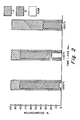
- Figures 1 and 2 show x-ray diffraction results of isothermal heat treatment data which include prior art compositions and the titanate solid solution for the present inventive compositions, treated for 512 and 1024 hours, respectively.
- the prior art, Examples 1, 2 and 3 exhibit the heretofore known decomposition results characteristic of aluminum titanate bodies exposed to the 1000°C to 1300°C temperature range. It is noteworthy that each composition tested exhibited a maximum decomposition at approximately 1100°C when tested for 512 hours. The decomposition effect broadens as the testing time is lengthened to 1024 hours, extending the maximum decomposition of the aluminum titanate body to a higher and lower temperature range.
- the percent of decomposition is determined by x-ray diffraction.
- the x-ray diffraction pattern When a sample thermally decomposes, the x-ray diffraction pattern exhibits prominent Al2O3 and TiO2 peaks. The area under the peaks is proportional to the amount of aluminum titanate that has decomposed into its constituent molecular forms, titania and alumina.
- titanate solid solution compositions of the present invention exhibit remarkable durability to thermal decomposition, when compared to the same temperatures as those experienced by Examples 1, 2, and 3. There was no greater than 20 percent decomposition exhibited by the titanate solid solution of the inventive compositions.
- Table 1 shows the compositions of the iron-aluminum titanate solid solution phase of these Examples. There is a mark difference in thermal durability between Examples 3 and 4 where the primary difference in the compositions is the increase in iron oxide concentration.
- Table 1 Concentrations in Weight Percent Example Al2O3 TiO2 Fe2O3 1 56.10 43.90 0.00 2 55.33 43.79 0.88 3 52.43 43.25 4.32 4 48.91 42.58 8.51 5 45.49 41.94 12.57 6 42.17 41.31 16.52 7 35.83 40.05 24.05
- Thermal shock resistance is proportional to the thermal expansion coefficient. Therefore, it can be inferred from Figs. 1 and 2, that thermal shock resistance for heat treated samples within the temperature region of approximately 1000°C to 1300°C is greatly enhanced for the compositions in Examples 4 through 7. The enhancement is evidenced by the lack of significant increase in thermal expansion. It has been found that too much iron oxide, greater than 25 weight percent, causes the body to slump on firing, and in some cases the body melted.
- the bodies were mixed with mullite and rare earth oxides to determine if a composite body of this composition would exhibit desirable mechanical properties.
- the rare earth oxides such as the nitrate salt mixture of lanthanum and neodymium in concentrations ranging from .1 to 5 weight percent, were mixed with the titanates before mixing with mullite and fired in the body as a sintering aid and grain growth inhibitor.
- the addition of the rare earths and mullite did not negatively affect the desired thermal stability or expansion properties of the high iron titanate body.
- the resultant ceramic body exhibits high thermal shock resistance, low thermal expansion, and high mechanical strength.
- the linear coefficient of thermal expansion (25°-800°C) of the composition corresponding to Example 9 is approximately 21.1 x 10 ⁇ 7 and that of the corresponding Example 12 is approximately -8.0 x 10 ⁇ 7 per °C. This thermal expansion range indicates that the material has a low thermal expansion over the temperature range of interest.
- the four point bend MOR's for the same mullite, rare earth additions to Examples 4 and 7 ranged from 6,9 Mpa to 62,1 Mpa (1000 psi to 9000 psi), respectively.
- the levels of the representative mullite phase in the above Examples 8-12 were, respectively, 30, 30, 50, 50, and 30 percent. These same Examples exhibited little or no decomposition when analyzed by x-ray diffraction, after being heat treated, similar to those Examples in Figs. 1 and 2. All Examples in Table 2 exhibited significant improvements over the prior art samples exhibited in Figs. 1 and 2. Although the coefficient of thermal expansion increased in Examples 8, 9, and 11 over the Examples of Figs. 1 and 2, the thermal expansion exhibited is well within the limits desirable for good thermal expansion properties.
- Table 3 shows the results of MOR tests performed on samples lacking mullite and rare earth oxides. The compositions are given in weight percent and the MOR values in psi. Table 3 Example Al2O3 TiO2 Fe2O3 MOR x 6,9.10 ⁇ 3 Mpa 13 52.43 43.25 4.32 164 14 48.91 42.58 8.51 142 15 42.17 41.31 16.52 183 16 35.83 40.12 24.05 269
- the body of the inventive composition consists essentially of Al2TiO5, Fe2TiO2, rare earths, and mullite. Those skilled in the art will appreciate that there are several methods available to intermix these components to effect the advantages afforded by this composition.
- Table 4 shows the as-analyzed composition of a preferred embodiment of the invention.
- Table 4 Component Weight Percent Al2O3 56.13 SiO2 13.90 TiO2 20.35 Fe2O3 8.14 Re2O3 1.50
- a preferred method to prepare the composition in Table 4 is essentially a two-step process.
- the first step was to mix 37 weight percent of Al2O3 with the Fe2O3 (a pigment grade hematite), and the TiO2.
- the particle size distribution of these components was preferably -100 mesh (less than 149 ⁇ diameter).
- the powdered components were placed in a Littleford mixer and blended for a period of 5 minutes. This material was transferred to a Simpson mix-muller and combined with water and an organic binder, such as methylcellulose, to form agglomerates of the mixture.
- the water addition contained a solution of 3 weight percent rare earth nitrate.
- the rare earth nitrate was a solution of La/Nd in a 75/25 by weight proportion, respectively.
- the rare earth component may be optionally added to either step in the process without significant loss of properties in the resultant body.
- the agglomerated material was air-dried for 24 hours, transferred to alumina vessels, placed in a periodic kiln, and fired at 1400°C for 6 hours.
- the resultant composition consisted essentially of a single phase solid solution of Fe2TiO5 and Al2TiO5.
- the rare earth oxides reside principally at the grain boundaries to control grain growth behavior.
- the calcined agglomerates were ground to -100 mesh (149 ⁇ m) with a preferred median particle size of approximately 40 ⁇ m. Initially, the agglomerates were ground in a jaw crusher and subsequently ground by ball milling with ⁇ -alumina grinding media. After ball milling, the powder was sieved and the particle size measured.
- the calcined powder was transferred to a Littleford mixer and mixed with the remaining components to form the preferred composition in Table 4.
- the additional components of 14.10 weight percent SiO2 and 12.14 weight percent Al2O3 were added in the form of kaolinite clay.
- the remaining 7.00 weight percent alumina was added in the form of ⁇ -alumina in this step to provide the total composition of 56.13 weight percent alumina.
- the total mix was blended in a Littleford mixer for 5 minutes.
- the powdered mixture was transferred to a Simpson mix-muller, plasticized, and extruded according to standard extrusion practices known in the art. Water was removed from the cellular ware using dielectric dryers, and the honeycomb pieces were subsequently fired between approximately 1400°C and 1650°C.
- the treated Examples were analyzed by x-ray diffraction to determine the extent of decomposition from the solid solution to Al2O3 and TiO2.
- the composition of Table 5 exhibited pronounced peaks at the TiO2 and Al2O3 peak sites hence, evidencing the substantial decomposition observed in Examples 1, 2, and 3 in Figs. 1 and 2.
- the Example from Table 4 exhibited smaller peak heights, thereby indicating significantly less decomposition. The latter peak heights were quite analogous to the percent decomposition exhibited by Example 4 in Figs. 1 and 2.
Landscapes
- Chemical & Material Sciences (AREA)
- Engineering & Computer Science (AREA)
- Ceramic Engineering (AREA)
- Manufacturing & Machinery (AREA)
- Materials Engineering (AREA)
- Structural Engineering (AREA)
- Organic Chemistry (AREA)
- Composite Materials (AREA)
- Compositions Of Oxide Ceramics (AREA)
Description
- This invention relates to a high temperature low thermal expansion ceramic and method for the production thereof. In particular it relates to the high temperature stabilization of aluminum titanate and aluminum titanate-mullite compositions by the addition of iron oxide. It has been discovered that iron oxide concentrations greater than 5% and as high as approximately 25% by weight have a stabilization effect at high temperatures on aluminum titanate. The effect is uncommon to prior stabilization attempts.
- Aluminum titanates may be effectively used as filters for fluids, in particular, as diesel particulate filters and as substrates for catalytic converters, an example of which is known commonly in the art as a honeycomb substrate. Additionally, aluminum titanates are desirable in applications where the thermal shock resistance and the ultimate use temperature are high. Cellular substrates used under conditions of high thermal gradients are examples of this application. Typically, structures such as the above are subjected to harsh environments which require high thermal shock resistance, low thermal expansion, and high mechanical shock properties. Skilled workers in the art appreciate that maintaining these properties for extended periods of time in their intended environments eliminates many potentially useful refractory materials. The reordering of crystalline phases, which commonly occurs in ceramic materials subjected to these environments, impairs the desired physical and chemical properties. The result is a degraded structure which is no longer appropriate for its intended use.
- It is known in the art that the inclusion of rare earth oxides and iron oxides to compositions consisting essentially of aluminum titanate, provides the body with sintering aids and further increases stabilization to high temperature degradation. It has not been conclusively determined how the stabilization is effected, although it is known that Fe₂TiO₅ is in solid solution with Al₂TiO₅. The solid solution is effected during firing, and is facilitated at high temperatures, above about 1400°C. The role the rare earth oxide plays is to affect the grain growth behavior, thus adding mechanical strength.
- It has been found with the present invention that the addition of surprisingly large amounts of Fe₂O₃ may be incorporated in the Al₂TiO₅ matrix. This combination may then be subsequently extruded and sintered to form a honeycomb structure. The resultant structure produces a thermally durable product with improved physical properties, unknown to the prior art.
- In U.S. Patent 4,483,944 (the '944 patent), an aluminum titanate-mullite ceramic composition is disclosed which includes .5 to 5% iron oxide and .5 to 5% rare earth oxides. In the '944 patent it was disclosed that .5 to 5% iron oxide and .5 to 5% rare earth metal oxides will most desirably be present to serve as a sintering aid and to inhibit the decomposition of Al₂O₃.TiO₂ crystals when exposed to high temperatures.
- U.S. Patent 4,327,188 (the '188 patent) discloses the use of aluminum titanate with the rare earth and iron oxide additives. The '188 patent discloses that there is a disadvantage to adding more than 2 weight percent of the specific additive due to an increase in the thermal expansion and a decrease in the melting point.
- That there is a trade-off between the thermal properties and long life of aluminum titanate bodies has been known to the art. A remaining difficulty in the art is to insure stabilization of the additive-laden aluminum titanate body. A goal has been to find a body that can withstand temperatures in excess of 1400°C and maintain the crystalline integrity at lower temperatures. The body should be able to withstand, without significant decomposition, extended use at temperatures between approximately 1000°C and 1300°C. This property is important since it is well known to those skilled in the art that Al₂O₃.TiO₂ will decompose into corundum and rutile when exposed to temperatures within the above cited temperature range. To guard against this decomposition, it is necessary to thermally stabilize the aluminum titanate phase.
- Therefore, the primary objective of the present invention was to develop an aluminum titanate-containing body which exhibits high mechanical strength, a low linear coefficient of thermal expansion, is capable of extended use at temperatures in the vicinity of 1400°C, while maintaining crystalline integrity after very prolonged exposure to temperatures within the range of 1000°-1300°C. Additionally, the body is capable of repeated cyclings in the temperature range between room temperature and well over 1000°C without significant change in dimensional integrity.
- We have found that the above objective and others that will be illustrated below can be attained in ceramic bodies consisting essentially of five basic components; viz., Al₂O₃, TiO₂, SiO₂, rare earth oxide (expressed as RE₂O₃), and iron oxide (expressed as Fe₂O₃). Fundamentally, the bodies consist essentially of two crystal phases; viz., aluminum titanate (Al₂TiO₅) and mullite (3Al₂O₃.2SiO₂). Because of the ready reaction of Fe₂O₃ with TiO₂, however, at least a portion of the aluminum titanate phase present in the inventive products may actually consist of a solid solution containing Fe₂TiO₅. Such solid solution is readily apparent from a study of x-ray diffraction patterns produced by the crystals. Hence, the typical overall pattern of aluminum titanate is present, but the d-spacings and intensities are slightly altered. Accordingly, the expression aluminum titanate solid solution will be used in the description to generally identify the aluminum titanate containing crystals.
- The consolidation of alumina, titania, and iron oxide provide a body with excellent thermal decomposition properties. However, the environment of eventual use demands a ceramic body with good thermal shock resistant properties and high mechanical strength. Therefore, to make the ceramic body useful for its intended environment, strengthening components must be added. Additives must be chosen so that strength is added to the body without interfering with the desirable thermal properties. The present invention contemplates the use of rare earth oxides and mullite to solve this problem.
- As expressed in terms of weight percent on the oxide basis, the inventive compositions consist essentially of about 1.5-20% SiO₂, 0.1-5% RE₂O₃, >5-25% Fe₂O₃, 35-75% Al₂O₃, and 10-40% TiO₂, wherein the rare earth metal is selected from the group consisting of La, Ce, Pr, Nd, Sm, Eu, Gd, Tb, Dy, Er, Yb, Y, Sc, and mixtures thereof. The preferred compositions consist essentially, expressed in terms of weight percent on the oxide basis, of about 5-20% SiO₂, 0.1-5% RE₂O₃, >5-25% Fe₂O₃, 40-65% Al₂O₃, and 10-35% TiO₂, and the most preferred compositions consist essentially of 10-20% SiO₂, 0.1-5% RE₂O₃, 8-25% Fe₂O₃, 45-60% Al₂O₃, and 15-30% TiO₂. Amounts of Fe₂O₃ in excess of 5% (e.g. at least 8%) are demanded to impart the desired resistance to thermal decomposition of the aluminum titanate crystals; i.e., to insure the stabilization of the aluminum titanate crystals. Above 25% Fe₂O₃, however, thermal deformation and actual melting of the products have been observed at temperatures in the vicinity of 1400°C.
- Iron-aluminum oxide or titanate solid solutions within the invention can consist essentially of, by weight percent, 30 to 75 percent alumina, 20 to 65 percent titania, and optionally, greater than 5% to 25% iron oxide exhibit excellent thermal stability. This thermal stability was indicated by x-ray diffraction patterns. The patterns revealed that the solid solution decomposition products of Al₂O₃, Fe₂O₃, and TiO₂ were less than 20 percent of the total stoichiometric decomposition. The bodies had been heat treated within the temperature range of approximately 1000°C to 1300°C. A preferred solid solution consists essentially of, 35 to 50 percent alumina, 40 to 42 percent titania, and 8 to 25 percent iron oxide. The most preferred solid solution consists essentially of 35 to 50 percent alumina, 40 to 42 percent titania, and 15 to 25 percent iron oxide.
- Any of the practices conventionally employed in the ceramic art for forming finely-divided powders into shapes of a desired configuration are applicable with the inventive compositions. Such methods include dry pressing, hot pressing, slip casting, isostatic pressing, hot isostatic pressing, and extrusion. For example, where the inventive materials are to be used as filters for fluids or as substrates for catalytic converters, they can be readily extruded into honeycomb structures.
- In general, sintering temperatures over the interval of about 1400°-1650°C will be utilized. Nevertheless, it will be recognized that through the use of expedients known to the ceramic art, such as the use of substantial amounts of sintering aids, the use of calcined or prereacted clinker as a portion of the batch, and the careful choice of batch materials, the firing temperatures required can be reduced. It will be appreciated, however, that the applications to which the fired bodies are to be exposed for extended periods will involve temperatures below that at which the bodies were sintered. Hence, the shrinkage undergone by a body during sintering is a function of the firing temperature employed. Accordingly, where a body is subsequently exposed to a temperature above that at which it was sintered, further shrinkage will occur which may render the body unusable for a particular application. Typically, the shrinkage experienced by the inventive bodies sintered over the temperature interval of 1400°-1650°C will range about 2-15%, the level of shrinkage increasing as the temperature is raised.
- Where the inventive products are to be used in fluid filter applications or as substrates for catalytic converters, porosity of the body and the size of the pores are important. As can be appreciated, the total porosity and the size of the pores are directly influenced by the temperature at which the body is sintered; hence, the higher the temperature, the lower total porosity and the smaller the average pore size. To illustrate, open porosity in the inventive products will average about 30-50% when a sintering temperature of 1400°C is employed; whereas at a firing temperature of 1650°C, the average is decreased to about 5-15%. The average pore size varies between about 1-15 microns, the size being generally smaller at the higher sintering temperatures.
- Microscopic examination of the sintered inventive products has revealed the presence of extensive very fine intracrystalline and grain boundary cracking similar to that described in the '944 patent. As was explained there, these forms of microcracking permit the bodies to yield under thermal stress, thereby conferring upon the bodies excellent resistance to thermal shock. It appears that more of such microcracking occurs at the sintering temperature is raised.
- X-ray diffraction analyses have indicated the microstructure of the inventive products to consist essentially of aluminum titanate solid solution and mullite with a very minor amount of rare earth metal oxide. Microscopic examinations have shown that the rare earth metal oxides are generally located along the grain boundaries of the mullite crystals and aluminum titanate solid solution crystals. It has been postulated that the rare earth metal oxides act as grain growth inhibitors with respect to the solid solution crystals. Such action is especially beneficial when the inventive bodies are fired at high temperature and/or are subsequently exposed to high temperatures. In general, the aluminum titanate solid solution crystals tend to grow in size as the temperature is increased. Through x-ray diffraction analyses and electron micrographs it has been estimated that, by volume, the content of iron-aluminum titanate solid solution crystals ranges about 25-90% and the content of mullite crystals varies about 5-70% with the rare earth metal oxide comprising up to the remainder. A preferred composition of this solid solution is 50 to 75 percent iron-aluminum titanate solid solution, 20 to 50 percent mullite, and .1 to 5 percent rare earth oxide.
- We have found that this invention provides an aluminum titanate based body wherein the linear coefficient of thermal expansion (25°-800°C) ranges between


- And finally, our invention provides an aluminum titanate based ceramic body with a coefficient of thermal cycling growth approaching approximately


- Figures 1 and 2 show x-ray diffraction results of isothermal heat treatment data which include prior art compositions and the titanate solid solution for the present inventive compositions, treated for 512 and 1024 hours, respectively. The prior art, Examples 1, 2 and 3, exhibit the heretofore known decomposition results characteristic of aluminum titanate bodies exposed to the 1000°C to 1300°C temperature range. It is noteworthy that each composition tested exhibited a maximum decomposition at approximately 1100°C when tested for 512 hours. The decomposition effect broadens as the testing time is lengthened to 1024 hours, extending the maximum decomposition of the aluminum titanate body to a higher and lower temperature range. The percent of decomposition is determined by x-ray diffraction. When a sample thermally decomposes, the x-ray diffraction pattern exhibits prominent Al₂O₃ and TiO₂ peaks. The area under the peaks is proportional to the amount of aluminum titanate that has decomposed into its constituent molecular forms, titania and alumina.
- The titanate solid solution compositions of the present invention, those embodied by Examples 4, 5, 6, and 7, as in Figs. 1 and 2, exhibit remarkable durability to thermal decomposition, when compared to the same temperatures as those experienced by Examples 1, 2, and 3. There was no greater than 20 percent decomposition exhibited by the titanate solid solution of the inventive compositions.
- Table 1 shows the compositions of the iron-aluminum titanate solid solution phase of these Examples. There is a mark difference in thermal durability between Examples 3 and 4 where the primary difference in the compositions is the increase in iron oxide concentration.
Table 1 Concentrations in Weight Percent Example Al₂O₃ TiO₂ Fe₂O₃ 1 56.10 43.90 0.00 2 55.33 43.79 0.88 3 52.43 43.25 4.32 4 48.91 42.58 8.51 5 45.49 41.94 12.57 6 42.17 41.31 16.52 7 35.83 40.05 24.05 - The compositions in Table 1 were batched, fired, and tested for thermal durability at 512 and 1024 hours. Thermal shock resistance is proportional to the thermal expansion coefficient. Therefore, it can be inferred from Figs. 1 and 2, that thermal shock resistance for heat treated samples within the temperature region of approximately 1000°C to 1300°C is greatly enhanced for the compositions in Examples 4 through 7. The enhancement is evidenced by the lack of significant increase in thermal expansion. It has been found that too much iron oxide, greater than 25 weight percent, causes the body to slump on firing, and in some cases the body melted.
- Once the thermal properties of the solid solution of iron and aluminum titanate bodies were determined, the bodies were mixed with mullite and rare earth oxides to determine if a composite body of this composition would exhibit desirable mechanical properties. Samples batched, as in Examples 4 through 7 in Table 1, were mixed with rare earth oxides and mullite. Advantageously, the rare earth oxides, such as the nitrate salt mixture of lanthanum and neodymium in concentrations ranging from .1 to 5 weight percent, were mixed with the titanates before mixing with mullite and fired in the body as a sintering aid and grain growth inhibitor. The addition of the rare earths and mullite did not negatively affect the desired thermal stability or expansion properties of the high iron titanate body.
- The resultant ceramic body exhibits high thermal shock resistance, low thermal expansion, and high mechanical strength. The linear coefficient of thermal expansion (25°-800°C) of the composition corresponding to Example 9 is approximately 21.1 x 10⁻⁷ and that of the corresponding Example 12 is approximately -8.0
x 10⁻⁷ per °C. This thermal expansion range indicates that the material has a low thermal expansion over the temperature range of interest. The four point bend MOR's for the same mullite, rare earth additions to Examples 4 and 7 ranged from 6,9 Mpa to 62,1 Mpa (1000 psi to 9000 psi), respectively. - Shown in Table 2 are the results of the four point bend Modulus of Rupture (MOR) tests performed on 0.79 cm (5/16 inch) round cross sectional rods of the high iron-aluminum titanate solid solution, mullite, and rare earth ceramic bodies. The compositions, in weight percent, track very closely to those of Examples 3-7 in Table 1.
Table 2 Example SiO₂ Al₂O₃ TiO₂ Fe₂O₃ RE₂O₃ MOR x 6,9.10⁻³ Mpa CTE x 10⁻⁷/°C (25°-800°C) 8 8.46 54.78 28.94 5.78 2.04 3010 -.7 9 8.46 45.89 27.27 16.34 2.04 4850 21.1 10 14.10 53.30 19.48 11.67 1.45 5820 - 11 14.10 56.37 20.05 8.02 1.46 3350 8.1 12 8.46 50.20 28.07 11.23 2.04 4250 -8.0 - The levels of the representative mullite phase in the above Examples 8-12 were, respectively, 30, 30, 50, 50, and 30 percent. These same Examples exhibited little or no decomposition when analyzed by x-ray diffraction, after being heat treated, similar to those Examples in Figs. 1 and 2. All Examples in Table 2 exhibited significant improvements over the prior art samples exhibited in Figs. 1 and 2. Although the coefficient of thermal expansion increased in Examples 8, 9, and 11 over the Examples of Figs. 1 and 2, the thermal expansion exhibited is well within the limits desirable for good thermal expansion properties.
- Table 3 shows the results of MOR tests performed on samples lacking mullite and rare earth oxides. The compositions are given in weight percent and the MOR values in psi.
Table 3 Example Al₂O₃ TiO₂ Fe₂O₃ MOR x 6,9.10⁻³ Mpa 13 52.43 43.25 4.32 164 14 48.91 42.58 8.51 142 15 42.17 41.31 16.52 183 16 35.83 40.12 24.05 269 - The addition of the mullite and rare earth oxides produces more than an order of magnitude difference in the mechanical strength as measured by the four point bend test. Comparisons between the two tables are inexact since the normalized values of the compositions change as the constituent oxides change. The range, however, of the iron titanate phase is sufficiently broad to indicate that within this range, the values of mechanical strength vary by not more than 70 to 80 percent. This indicates that changes in the composition, therein, do not critically change the mechanical strength of the body. Higher processing temperatures, such as those greater than 1500°C, will lead to CTEs bounded by -20
x 10⁻⁷/°C. - When the MOR measurements in Table 3 are compared to those exhibited by the mullite, rare earth, iron aluminum titanate Examples in Table 2, it is easily concluded that for the same approximate solid solution phase, titanate compositional range, Table 2 Examples show the desired and critical increase in measured strength (moe than 2000% over that in Table 3). Therefore, the addition of mullite and rare earth oxides to the high iron titanate body significantly increases mechanical strength, as inferred from the MOR measurements. This increase in strength, as will be shown below, does not significantly compromise the thermal properties of the high iron titanate body.
- The body of the inventive composition consists essentially of Al₂TiO₅, Fe₂TiO₂, rare earths, and mullite. Those skilled in the art will appreciate that there are several methods available to intermix these components to effect the advantages afforded by this composition. Table 4 shows the as-analyzed composition of a preferred embodiment of the invention.
Table 4 Component Weight Percent Al₂O₃ 56.13 SiO₂ 13.90 TiO₂ 20.35 Fe₂O₃ 8.14 Re₂O₃ 1.50 - A preferred method to prepare the composition in Table 4 is essentially a two-step process. The first step was to mix 37 weight percent of Al₂O₃ with the Fe₂O₃ (a pigment grade hematite), and the TiO₂. The particle size distribution of these components was preferably -100 mesh (less than 149µ diameter). The powdered components were placed in a Littleford mixer and blended for a period of 5 minutes. This material was transferred to a Simpson mix-muller and combined with water and an organic binder, such as methylcellulose, to form agglomerates of the mixture. The water addition contained a solution of 3 weight percent rare earth nitrate. The rare earth nitrate was a solution of La/Nd in a 75/25 by weight proportion, respectively. The rare earth component may be optionally added to either step in the process without significant loss of properties in the resultant body. The agglomerated material was air-dried for 24 hours, transferred to alumina vessels, placed in a periodic kiln, and fired at 1400°C for 6 hours. The resultant composition consisted essentially of a single phase solid solution of Fe₂TiO₅ and Al₂TiO₅. The rare earth oxides reside principally at the grain boundaries to control grain growth behavior.
- The calcined agglomerates were ground to -100 mesh (149µm) with a preferred median particle size of approximately 40µm. Initially, the agglomerates were ground in a jaw crusher and subsequently ground by ball milling with α-alumina grinding media. After ball milling, the powder was sieved and the particle size measured.
- In the second step, the calcined powder was transferred to a Littleford mixer and mixed with the remaining components to form the preferred composition in Table 4. The additional components of 14.10 weight percent SiO₂ and 12.14 weight percent Al₂O₃ were added in the form of kaolinite clay. The remaining 7.00 weight percent alumina was added in the form of α-alumina in this step to provide the total composition of 56.13 weight percent alumina. The total mix was blended in a Littleford mixer for 5 minutes.
- The powdered mixture was transferred to a Simpson mix-muller, plasticized, and extruded according to standard extrusion practices known in the art. Water was removed from the cellular ware using dielectric dryers, and the honeycomb pieces were subsequently fired between approximately 1400°C and 1650°C.
- To compare the properties of the inventive composition with a prior art composition, samples were prepared according to the composition in Table 5 and the above preferred method.
Table 5 Component Weight Percent Al₂O₃ 59.29 SiO₂ 13.68 TiO₂ 21.28 Fe₂O₃ 4.25 Re₂O₃ 1.50 - Examples from Table 4, the inventive composition, and Table 5, a low iron prior art composition, were subjected to isothermal heat treatment at 1000°C, 1100°C, and 1200°C, for 1024, 537, and 1024 hours, respectively. The treated Examples were analyzed by x-ray diffraction to determine the extent of decomposition from the solid solution to Al₂O₃ and TiO₂. The composition of Table 5 exhibited pronounced peaks at the TiO₂ and Al₂O₃ peak sites hence, evidencing the substantial decomposition observed in Examples 1, 2, and 3 in Figs. 1 and 2. The Example from Table 4 exhibited smaller peak heights, thereby indicating significantly less decomposition. The latter peak heights were quite analogous to the percent decomposition exhibited by Example 4 in Figs. 1 and 2.
- These tests indicate that the addition of mullite and rare earths, individually or collectively, to the Fe₂ TiO₅ and Al₂TiO₅ single phase solid solution does not interfere with the advantageous properties exhibited by the solid solution examples of the invention in Figs. 1 and 2. The resultant mullite and rare earth enriched body is fortified with the thermal shock resistant property attributed to the iron rich aluminum titanate phase, and continues to benefit from the mechanical strength properties added by the mullite and rare earths. The body of the inventive composition is capable of withstanding the critical temperature range without the loss of thermal expansion and/or mechanical strength properties.
Claims (10)
- A sintered ceramic article containing iron-aluminum titanate solid solution and mullite as the predominant crystal phases with a minor amount of a rare earth metal oxide crystal phases, said article exhibiting grain boundary and intracrystalline microcracking and consisting essentially, expressed in terms of weight percent on the oxide basis, of 1.5-20% SiO₂, >5-25% Fe₂O₃, 35-75% Al₂O₃, 10-40% TiO₂, and 0.1-5% RE₂O₃, RE = rare earth metal.
- A sintered ceramic article according to claim 1 wherein said crystal phases, expressed in terms of volume percent, consist essentially of about 25-90% iron-aluminum titanate solid solution, of about 5-70% mullite with the rare earth metal oxide comprising up to the remainder.
- A sintered ceramic body as in claim 2 wherein said solid solution consists essentially of, by weight percent, 30 to 75 percent alumina, 20 to 65 percent titania, and >5 to 25 percent iron oxide.
- A sintered ceramic body as in claim 3 wherein said solid solution is stable to within less than 20 percent of a total stoichiometric decomposition, wherein said decomposition products are Al₂O₃, Fe₂O₃, and TiO₂, within the temperature range between approximately 1000°C to 1300°C.
- A sintered ceramic body as in claim 1 wherein said rare earth oxide is selected from the group consisting essentially of lanthanum, cerium, praseodymium, neodymium, samarium, europium, gadolinium, terbium, dysprosium, erbium, ytterbium, yttrium, scandium, and/or a combination thereof.
- A sintered ceramic body as in claim 1 wherein said body exhibits a coefficient of thermal expansion between -25 x 10⁻⁷/°C and -25 x 10⁻⁷/°C (25°-800°C), and/or a four point bend MOR in the range from 6,9 to 62,1 Mpa (1000 psi to 9000 psi), and/or a coefficient of thermal cycling growth of less than 200 x 10⁻⁴ percent per cycle.
- A sintered ceramic body as in any of claims 1-6 wherein said body is a honeycomb.
- A sintered ceramic body having a composition in weight selected from the group of (a) 50 to 75 percent iron-aluminum titanate solid solution, 20 to 50 percent mullite, and .1 to 5 percent rare earth oxide, (b) 35 to 50 percent alumina, 40 to 42 percent titania, and 8 to 25 percent iron oxide, (c) 35 to 50 percent alumina, 40 to 42 percent titania, and 15 to 25 percent iron oxide.
- A method for making a sintered ceramic body consisting essentially of:a) calcining a mixture of Fe₂O₃, TiO₂ and Al₂O₃ to a single phase solid solution,b) grinding said solid solution to a powder,c) mixing rare earth either to mixture prior to calcining step or to powder in mixing step,d) mixing mullite with said powder to form a homogeneous body, ande) firing and body.
- A method for making a sintered ceramic body as in claim 9 wherein said rare earths are added prior to the calcining step.
Applications Claiming Priority (2)
| Application Number | Priority Date | Filing Date | Title |
|---|---|---|---|
| US177050 | 1988-04-04 | ||
| US07/177,050 US4855265A (en) | 1988-04-04 | 1988-04-04 | High temperature low thermal expansion ceramic |
Publications (3)
| Publication Number | Publication Date |
|---|---|
| EP0336044A2 EP0336044A2 (en) | 1989-10-11 |
| EP0336044A3 EP0336044A3 (en) | 1990-04-18 |
| EP0336044B1 true EP0336044B1 (en) | 1992-08-12 |
Family
ID=22646979
Family Applications (1)
| Application Number | Title | Priority Date | Filing Date |
|---|---|---|---|
| EP88311789A Expired - Lifetime EP0336044B1 (en) | 1988-04-04 | 1988-12-13 | A high temperature low thermal expansion ceramic and method for the production thereof |
Country Status (9)
| Country | Link |
|---|---|
| US (1) | US4855265A (en) |
| EP (1) | EP0336044B1 (en) |
| JP (1) | JP2968534B2 (en) |
| KR (1) | KR970001255B1 (en) |
| CN (1) | CN1028018C (en) |
| BR (1) | BR8901552A (en) |
| CA (1) | CA1321214C (en) |
| DE (1) | DE3873743T2 (en) |
| ES (1) | ES2034270T3 (en) |
Families Citing this family (63)
| Publication number | Priority date | Publication date | Assignee | Title |
|---|---|---|---|---|
| DE68922193D1 (en) * | 1988-12-02 | 1995-05-18 | Ngk Insulators Ltd | Ceramic materials for composite casting and processes for their production. |
| US5139979A (en) * | 1989-01-30 | 1992-08-18 | Lanxide Technology Company, Lp | Method of producing self-supporting aluminum titanate composites and products relating thereto |
| US5340783A (en) * | 1989-01-30 | 1994-08-23 | Lanxide Technology Company, Lp | Method of producing self-supporting aluminum titanate composites and products relating thereto |
| US5667898A (en) * | 1989-01-30 | 1997-09-16 | Lanxide Technology Company, Lp | Self-supporting aluminum titanate composites and products relating thereto |
| EP0463437B2 (en) * | 1990-06-22 | 1998-12-02 | Bayer Ag | Sintered bodies based on aluminium titanate, process for their production and use thereof |
| JPH04305054A (en) * | 1991-03-29 | 1992-10-28 | Ngk Insulators Ltd | Aluminum titanate structure and production thereof |
| JP2533992B2 (en) * | 1991-08-28 | 1996-09-11 | 日本碍子株式会社 | Aluminum titanate ceramics and manufacturing method thereof |
| JP3192700B2 (en) * | 1991-09-30 | 2001-07-30 | 日本碍子株式会社 | Aluminum titanate ceramics and method for producing the same |
| US5350927A (en) * | 1992-06-17 | 1994-09-27 | Mitech Scientific Corp. | Radiation emitting ceramic materials and devices containing same |
| US5472720A (en) * | 1992-06-17 | 1995-12-05 | Mitec Scientific Corporation | Treatment of materials with infrared radiation |
| US5856263A (en) * | 1992-08-28 | 1999-01-05 | Union Carbide Chemicals & Plastics Technology Corporation | Catalysts comprising substantially pure alpha-alumina carrier for treating exhaust gases |
| US5290739A (en) * | 1992-09-22 | 1994-03-01 | Corning Incorporated | High temperature stabilized mullite-aluminum titanate |
| US6677272B2 (en) * | 2001-08-15 | 2004-01-13 | Corning Incorporated | Material for NOx trap support |
| US6849181B2 (en) * | 2002-07-31 | 2005-02-01 | Corning Incorporated | Mullite-aluminum titanate diesel exhaust filter |
| JP4750415B2 (en) * | 2002-07-31 | 2011-08-17 | コーニング インコーポレイテッド | Ceramic products based on aluminum titanate |
| US6942713B2 (en) * | 2003-11-04 | 2005-09-13 | Corning Incorporated | Ceramic body based on aluminum titanate |
| US7259120B2 (en) * | 2004-04-21 | 2007-08-21 | Corning Incorporated | Aluminum titanate ceramic articles and methods of making same |
| US20060021308A1 (en) | 2004-07-29 | 2006-02-02 | Merkel Gregory A | Mullite-aluminum titanate body and method for making same |
| US7071135B2 (en) | 2004-09-29 | 2006-07-04 | Corning Incorporated | Ceramic body based on aluminum titanate and including a glass phase |
| US20070259769A1 (en) * | 2005-02-22 | 2007-11-08 | Ellison Adam J G | Aluminum titanate ceramic articles and methods of making same |
| WO2007035468A2 (en) * | 2005-09-15 | 2007-03-29 | Adiabatics Technologies, Inc. | Composite sliding surfaces for sliding members |
| US20070254798A1 (en) * | 2006-03-31 | 2007-11-01 | Addiego William P | Peroxide containing compounds as pore formers in the manufacture of ceramic articles |
| CN101479213B (en) * | 2006-06-30 | 2012-07-04 | 康宁股份有限公司 | Cordierite aluminum magnesium titanate compositions and ceramic articles comprising same |
| US8956436B2 (en) | 2006-06-30 | 2015-02-17 | Corning Incorporated | Cordierite aluminum magnesium titanate compositions and ceramic articles comprising same |
| US10501375B2 (en) | 2006-06-30 | 2019-12-10 | Corning Incorporated | Cordierite aluminum magnesium titanate compositions and ceramic articles comprising same |
| US7744669B2 (en) * | 2006-07-14 | 2010-06-29 | Corning Incorporated | Plugging material for aluminum titanate ceramic wall flow filter manufacture |
| US8298311B2 (en) * | 2006-11-15 | 2012-10-30 | Corning Incorporated | Filters with controlled submicron porosity |
| US8974724B2 (en) * | 2006-11-29 | 2015-03-10 | Corning Incorporated | Aluminum titanate batch compositions and method |
| US20080138273A1 (en) * | 2006-12-11 | 2008-06-12 | Yi Jiang | Wall flow reactor for hydrogen production |
| CN101687719A (en) * | 2007-03-20 | 2010-03-31 | 康宁股份有限公司 | The low-shrinkage that is used for porcelain filter stops up mixture, the honeycomb filter of obstruction and manufacture method thereof |
| EP2176188B1 (en) * | 2007-07-31 | 2020-09-02 | Corning Incorporated | Methods for manufacturing porous ceramic filters and compositions for applying to ceramic honeycomb bodies |
| JP2011504159A (en) * | 2007-11-05 | 2011-02-03 | コーニング インコーポレイテッド | Low expansion cement composition for ceramic monoliths |
| EP2592059B1 (en) | 2007-11-30 | 2020-09-23 | Corning Incorporated | Composition for applying to honeycomb bodies |
| CN101903306A (en) * | 2007-12-17 | 2010-12-01 | 伊梅斯公司 | ceramic honeycomb structure |
| US8101117B2 (en) * | 2008-05-30 | 2012-01-24 | Corning, Incorporated | Controlled gas pore formers in extruded ware |
| EP2337659A2 (en) | 2008-08-28 | 2011-06-29 | Corning Incorporated | Managed pore size distribution in honeycomb substrates |
| US7914718B2 (en) * | 2008-08-28 | 2011-03-29 | Corning Incorporated | Gas pore former in cellular monoliths |
| CN101417876B (en) * | 2008-11-18 | 2011-11-09 | 哈尔滨工业大学 | Preparation method of ZrO2 and TiO2 superplastic forming ceramic mold with adjustable linear expansion coefficient |
| WO2010098347A1 (en) * | 2009-02-26 | 2010-09-02 | 京セラ株式会社 | Honeycomb structure and device for treating gas |
| US8051703B2 (en) * | 2009-02-27 | 2011-11-08 | Corning Incorporated | Methods for using a fluid stream to test a honeycomb body |
| US9227878B2 (en) * | 2009-04-30 | 2016-01-05 | Corning Incorporated | Selected binders for the extrusion of ultra-thin wall cellular ceramics |
| US20100301515A1 (en) * | 2009-05-29 | 2010-12-02 | Thomas William Brew | Honeycomb Extrusion Die Apparatus And Methods |
| US20110045233A1 (en) * | 2009-08-20 | 2011-02-24 | Sandra Lee Gray | Dimensional control during firing to form aluminum titanate honeycomb structures |
| WO2011036397A1 (en) * | 2009-09-22 | 2011-03-31 | Saint-Gobain Centre De Recherches Et D'etudes Europeen | Alumina titanate porous structure |
| EP2390307A1 (en) | 2010-05-27 | 2011-11-30 | Corning Incorporated | Porous ceramic processing using prilled wax and non-ionic surfactant |
| KR101907715B1 (en) | 2011-03-29 | 2018-12-05 | 다우 글로벌 테크놀로지스 엘엘씨 | Method for making porous mullite-tialite composites |
| US10526249B2 (en) | 2012-11-30 | 2020-01-07 | Corning Incorporated | Cordierite aluminum magnesium titanate compositions and ceramic articles comprising same |
| US9079799B2 (en) | 2012-11-30 | 2015-07-14 | Corning Incorporated | Cordierite aluminum magnesium titanate compositions and ceramic articles comprising same |
| CN102936133A (en) * | 2012-12-10 | 2013-02-20 | 青岛海诺水务科技股份有限公司 | Preparation method of aluminium titanate material |
| CN102936134A (en) * | 2012-12-11 | 2013-02-20 | 青岛森淼实业有限公司 | Preparation method of aluminium titanate sintering body |
| JP6789988B2 (en) | 2015-05-29 | 2020-11-25 | コーニング インコーポレイテッド | Honeycomb filter plugging and honeycomb filter plugging equipment |
| US20190177232A1 (en) * | 2016-06-13 | 2019-06-13 | Corning Incorporated | Aluminum titanate compositions, aluminum titanate articles, and methods of making same |
| JP6888087B2 (en) | 2016-11-10 | 2021-06-16 | コーニング インコーポレイテッド | Composite ceramic materials, articles, and manufacturing methods |
| US11661379B2 (en) | 2017-07-21 | 2023-05-30 | Corning Incorporated | Methods of extracting volatiles from ceramic green bodies |
| US20200231506A1 (en) | 2017-07-24 | 2020-07-23 | Corning Incorporated | Antioxidants in green ceramic bodies containing various oils for improved firing |
| EP3665136A1 (en) | 2017-08-11 | 2020-06-17 | Corning Incorporated | Green ceramic batch mixtures comprising an inverse emulsion and methods for forming a ceramic body |
| WO2019125972A1 (en) | 2017-12-19 | 2019-06-27 | Corning Incorporated | Green ceramic mixtures comprising a stabilized emulsion and methods for forming a ceramic body |
| WO2020018346A1 (en) | 2018-07-20 | 2020-01-23 | Corning Incorporated | System and method for detecting defects in a honeycomb body |
| US12129208B2 (en) | 2019-01-14 | 2024-10-29 | Corning Incorporated | Green ceramic batch mixtures comprising an inverse emulsion and methods for forming a ceramic body |
| EP4013727A1 (en) | 2019-08-13 | 2022-06-22 | Corning Incorporated | Cement mixtures for plugging honeycomb bodies and methods of making the same |
| WO2022046399A1 (en) | 2020-08-25 | 2022-03-03 | Corning Incorporated | Cement mixtures for plugging honeycomb bodies and methods of making the same |
| EP4612113A1 (en) | 2022-10-31 | 2025-09-10 | Corning Incorporated | Higher temperature extrusion of ceramic precursor paste |
| WO2024097048A1 (en) | 2022-10-31 | 2024-05-10 | Corning Incorporated | Method of inducing a reduced wall drag state in a high wall drag ceramic precursor paste |
Family Cites Families (5)
| Publication number | Priority date | Publication date | Assignee | Title |
|---|---|---|---|---|
| US2776896A (en) * | 1952-10-22 | 1957-01-08 | Cambridge Tile Mfg Company | Ceramic composition having thermal shock resistance |
| JPS5689844A (en) * | 1979-12-25 | 1981-07-21 | Asahi Glass Co Ltd | Ceramic honeycomb and its production |
| US4483944A (en) * | 1983-07-27 | 1984-11-20 | Corning Glass Works | Aluminum titanate-mullite ceramic articles |
| JPS6221756A (en) * | 1985-07-22 | 1987-01-30 | 日本碍子株式会社 | Aluminum titanate mullite base ceramic body |
| DE3814079A1 (en) * | 1988-04-26 | 1989-11-09 | Bayer Ag | SINTER MOLDED BODY BASED ON ALUMINUM TITANATE, METHOD FOR THE PRODUCTION AND USE THEREOF |
-
1988
- 1988-04-04 US US07/177,050 patent/US4855265A/en not_active Expired - Lifetime
- 1988-11-25 CN CN88108143A patent/CN1028018C/en not_active Expired - Fee Related
- 1988-11-28 CA CA000584337A patent/CA1321214C/en not_active Expired - Fee Related
- 1988-12-10 KR KR1019880016429A patent/KR970001255B1/en not_active Expired - Fee Related
- 1988-12-13 EP EP88311789A patent/EP0336044B1/en not_active Expired - Lifetime
- 1988-12-13 DE DE8888311789T patent/DE3873743T2/en not_active Expired - Fee Related
- 1988-12-13 ES ES198888311789T patent/ES2034270T3/en not_active Expired - Lifetime
-
1989
- 1989-02-02 JP JP1024736A patent/JP2968534B2/en not_active Expired - Fee Related
- 1989-04-03 BR BR898901552A patent/BR8901552A/en not_active Application Discontinuation
Also Published As
| Publication number | Publication date |
|---|---|
| KR970001255B1 (en) | 1997-02-04 |
| DE3873743D1 (en) | 1992-09-17 |
| EP0336044A2 (en) | 1989-10-11 |
| EP0336044A3 (en) | 1990-04-18 |
| ES2034270T3 (en) | 1993-04-01 |
| US4855265A (en) | 1989-08-08 |
| BR8901552A (en) | 1989-11-14 |
| CN1036379A (en) | 1989-10-18 |
| DE3873743T2 (en) | 1993-03-18 |
| JPH01257165A (en) | 1989-10-13 |
| CA1321214C (en) | 1993-08-10 |
| CN1028018C (en) | 1995-03-29 |
| KR890015979A (en) | 1989-11-27 |
| JP2968534B2 (en) | 1999-10-25 |
Similar Documents
| Publication | Publication Date | Title |
|---|---|---|
| US4855265A (en) | High temperature low thermal expansion ceramic | |
| US5290739A (en) | High temperature stabilized mullite-aluminum titanate | |
| US4915887A (en) | Method of preparing high temperature low thermal expansion ceramic | |
| US5175132A (en) | Sinterable ceramic compositions | |
| KR930009328B1 (en) | High toughness ceramic alloy | |
| EP0151335B2 (en) | Zirconia Porcelain and method of manufacturing the same | |
| DE4217605C2 (en) | Sintered zirconia ceramics and their use | |
| Erkalfa et al. | The densification and microstructural development of Al2O3 with manganese oxide addition | |
| US4690911A (en) | Zirconia ceramics and process for producing the same | |
| DE102017009848A1 (en) | Porous material, honeycomb structure and process for producing a porous material | |
| DE69223528T2 (en) | Sintered, ceramic composite material, process for its production and the same slide valve | |
| US5556816A (en) | Methods for preparation of tetragonal zirconia polycrystal composites | |
| DE60006358T2 (en) | MAGNESIUM OXIDE PARTIAL STABILIZED ZIRCONOXIDE HIGH STRENGTH | |
| JPS627667A (en) | Alumina-containing partially stabilized zirconia sintered body and manufacture | |
| US5021373A (en) | Porous cordierite compositions with improved thermal expansion characteristics | |
| JPS63201060A (en) | Low expansion zrtio4-al2tio5-zro2 base composition | |
| Kobayashi et al. | Compositions for strengthening porcelain bodies in aluminia-feldspar-kaolin system | |
| EP0200954B1 (en) | Sintered body, method of making it and its use | |
| Kilbourn | The role of the lanthanides and yttrium in advanced engineering and high-technology ceramics | |
| Maschio et al. | Microstructural Development and Mechanical Properties of Alumina Hexaluminate Composites As-Sintered and after Aging in Aqueous and Physiological Solution | |
| JP2587704B2 (en) | Zirconia sintered body and method for producing the same | |
| JPH02311361A (en) | Production of aluminum titanate sintered compact stable at high temperature | |
| WO2005026075A2 (en) | Liquid phase-compressed silicon carbide ceramics having high oxidation resistance in a humid atmosphere | |
| JPH0811707B2 (en) | Alumina-zirconia sintered body and method for producing the same | |
| Venkataramani et al. | Densification in PZT |
Legal Events
| Date | Code | Title | Description |
|---|---|---|---|
| PUAI | Public reference made under article 153(3) epc to a published international application that has entered the european phase |
Free format text: ORIGINAL CODE: 0009012 |
|
| AK | Designated contracting states |
Kind code of ref document: A2 Designated state(s): BE DE ES FR GB IT |
|
| PUAL | Search report despatched |
Free format text: ORIGINAL CODE: 0009013 |
|
| AK | Designated contracting states |
Kind code of ref document: A3 Designated state(s): BE DE ES FR GB IT |
|
| 17P | Request for examination filed |
Effective date: 19900925 |
|
| 17Q | First examination report despatched |
Effective date: 19911001 |
|
| GRAA | (expected) grant |
Free format text: ORIGINAL CODE: 0009210 |
|
| AK | Designated contracting states |
Kind code of ref document: B1 Designated state(s): BE DE ES FR GB IT |
|
| RAP2 | Party data changed (patent owner data changed or rights of a patent transferred) |
Owner name: CORNING GLASS WORKS |
|
| REF | Corresponds to: |
Ref document number: 3873743 Country of ref document: DE Date of ref document: 19920917 |
|
| ITF | It: translation for a ep patent filed | ||
| ET | Fr: translation filed | ||
| REG | Reference to a national code |
Ref country code: ES Ref legal event code: FG2A Ref document number: 2034270 Country of ref document: ES Kind code of ref document: T3 |
|
| PLBE | No opposition filed within time limit |
Free format text: ORIGINAL CODE: 0009261 |
|
| STAA | Information on the status of an ep patent application or granted ep patent |
Free format text: STATUS: NO OPPOSITION FILED WITHIN TIME LIMIT |
|
| 26N | No opposition filed | ||
| PGFP | Annual fee paid to national office [announced via postgrant information from national office to epo] |
Ref country code: FR Payment date: 19931207 Year of fee payment: 6 |
|
| PGFP | Annual fee paid to national office [announced via postgrant information from national office to epo] |
Ref country code: GB Payment date: 19941111 Year of fee payment: 7 |
|
| PGFP | Annual fee paid to national office [announced via postgrant information from national office to epo] |
Ref country code: ES Payment date: 19941216 Year of fee payment: 7 |
|
| PG25 | Lapsed in a contracting state [announced via postgrant information from national office to epo] |
Ref country code: FR Effective date: 19950831 |
|
| REG | Reference to a national code |
Ref country code: FR Ref legal event code: ST |
|
| PG25 | Lapsed in a contracting state [announced via postgrant information from national office to epo] |
Ref country code: GB Effective date: 19951213 |
|
| GBPC | Gb: european patent ceased through non-payment of renewal fee |
Effective date: 19951213 |
|
| PG25 | Lapsed in a contracting state [announced via postgrant information from national office to epo] |
Ref country code: ES Free format text: LAPSE BECAUSE OF NON-PAYMENT OF DUE FEES Effective date: 19961214 |
|
| PGFP | Annual fee paid to national office [announced via postgrant information from national office to epo] |
Ref country code: DE Payment date: 20031230 Year of fee payment: 16 |
|
| PGFP | Annual fee paid to national office [announced via postgrant information from national office to epo] |
Ref country code: BE Payment date: 20040114 Year of fee payment: 16 |
|
| REG | Reference to a national code |
Ref country code: ES Ref legal event code: FD2A Effective date: 19970113 |
|
| PG25 | Lapsed in a contracting state [announced via postgrant information from national office to epo] |
Ref country code: BE Free format text: LAPSE BECAUSE OF NON-PAYMENT OF DUE FEES Effective date: 20041231 |
|
| BERE | Be: lapsed |
Owner name: *CORNING GLASS WORKS Effective date: 20041231 |
|
| PG25 | Lapsed in a contracting state [announced via postgrant information from national office to epo] |
Ref country code: DE Free format text: LAPSE BECAUSE OF NON-PAYMENT OF DUE FEES Effective date: 20050701 |
|
| PG25 | Lapsed in a contracting state [announced via postgrant information from national office to epo] |
Ref country code: IT Free format text: LAPSE BECAUSE OF NON-PAYMENT OF DUE FEES Effective date: 20051213 |
|
| BERE | Be: lapsed |
Owner name: *CORNING GLASS WORKS Effective date: 20041231 |