EP0333095B1 - Power transmission apparatus - Google Patents
Power transmission apparatus Download PDFInfo
- Publication number
- EP0333095B1 EP0333095B1 EP89104395A EP89104395A EP0333095B1 EP 0333095 B1 EP0333095 B1 EP 0333095B1 EP 89104395 A EP89104395 A EP 89104395A EP 89104395 A EP89104395 A EP 89104395A EP 0333095 B1 EP0333095 B1 EP 0333095B1
- Authority
- EP
- European Patent Office
- Prior art keywords
- wheel drive
- hub
- rear wheel
- hubs
- casing
- Prior art date
- Legal status (The legal status is an assumption and is not a legal conclusion. Google has not performed a legal analysis and makes no representation as to the accuracy of the status listed.)
- Expired - Lifetime
Links
Images

Classifications
-
- B—PERFORMING OPERATIONS; TRANSPORTING
- B60—VEHICLES IN GENERAL
- B60K—ARRANGEMENT OR MOUNTING OF PROPULSION UNITS OR OF TRANSMISSIONS IN VEHICLES; ARRANGEMENT OR MOUNTING OF PLURAL DIVERSE PRIME-MOVERS IN VEHICLES; AUXILIARY DRIVES FOR VEHICLES; INSTRUMENTATION OR DASHBOARDS FOR VEHICLES; ARRANGEMENTS IN CONNECTION WITH COOLING, AIR INTAKE, GAS EXHAUST OR FUEL SUPPLY OF PROPULSION UNITS IN VEHICLES
- B60K17/00—Arrangement or mounting of transmissions in vehicles
- B60K17/34—Arrangement or mounting of transmissions in vehicles for driving both front and rear wheels, e.g. four wheel drive vehicles
- B60K17/348—Arrangement or mounting of transmissions in vehicles for driving both front and rear wheels, e.g. four wheel drive vehicles having differential means for driving one set of wheels, e.g. the front, at one speed and the other set, e.g. the rear, at a different speed
- B60K17/35—Arrangement or mounting of transmissions in vehicles for driving both front and rear wheels, e.g. four wheel drive vehicles having differential means for driving one set of wheels, e.g. the front, at one speed and the other set, e.g. the rear, at a different speed including arrangements for suppressing or influencing the power transfer, e.g. viscous clutches
- B60K17/3505—Arrangement or mounting of transmissions in vehicles for driving both front and rear wheels, e.g. four wheel drive vehicles having differential means for driving one set of wheels, e.g. the front, at one speed and the other set, e.g. the rear, at a different speed including arrangements for suppressing or influencing the power transfer, e.g. viscous clutches with self-actuated means, e.g. by difference of speed
- B60K17/351—Arrangement or mounting of transmissions in vehicles for driving both front and rear wheels, e.g. four wheel drive vehicles having differential means for driving one set of wheels, e.g. the front, at one speed and the other set, e.g. the rear, at a different speed including arrangements for suppressing or influencing the power transfer, e.g. viscous clutches with self-actuated means, e.g. by difference of speed comprising a viscous clutch
-
- F—MECHANICAL ENGINEERING; LIGHTING; HEATING; WEAPONS; BLASTING
- F16—ENGINEERING ELEMENTS AND UNITS; GENERAL MEASURES FOR PRODUCING AND MAINTAINING EFFECTIVE FUNCTIONING OF MACHINES OR INSTALLATIONS; THERMAL INSULATION IN GENERAL
- F16D—COUPLINGS FOR TRANSMITTING ROTATION; CLUTCHES; BRAKES
- F16D35/00—Fluid clutches in which the clutching is predominantly obtained by fluid adhesion
- F16D35/005—Fluid clutches in which the clutching is predominantly obtained by fluid adhesion with multiple lamellae
-
- F—MECHANICAL ENGINEERING; LIGHTING; HEATING; WEAPONS; BLASTING
- F16—ENGINEERING ELEMENTS AND UNITS; GENERAL MEASURES FOR PRODUCING AND MAINTAINING EFFECTIVE FUNCTIONING OF MACHINES OR INSTALLATIONS; THERMAL INSULATION IN GENERAL
- F16D—COUPLINGS FOR TRANSMITTING ROTATION; CLUTCHES; BRAKES
- F16D47/00—Systems of clutches, or clutches and couplings, comprising devices of types grouped under at least two of the following sets of groups: F16D1/00 - F16D9/00, F16D11/00 - F16D23/00, F16D25/00 - F16D29/00, F16D31/00 - F16D39/00, F16D41/00 - F16D45/00
- F16D47/06—Systems of clutches, or clutches and couplings, comprising devices of types grouped under at least two of the following sets of groups: F16D1/00 - F16D9/00, F16D11/00 - F16D23/00, F16D25/00 - F16D29/00, F16D31/00 - F16D39/00, F16D41/00 - F16D45/00 of which at least one is a clutch with a fluid or a semifluid as power-transmitting means
-
- F—MECHANICAL ENGINEERING; LIGHTING; HEATING; WEAPONS; BLASTING
- F16—ENGINEERING ELEMENTS AND UNITS; GENERAL MEASURES FOR PRODUCING AND MAINTAINING EFFECTIVE FUNCTIONING OF MACHINES OR INSTALLATIONS; THERMAL INSULATION IN GENERAL
- F16H—GEARING
- F16H48/00—Differential gearings
- F16H48/12—Differential gearings without gears having orbital motion
-
- Y—GENERAL TAGGING OF NEW TECHNOLOGICAL DEVELOPMENTS; GENERAL TAGGING OF CROSS-SECTIONAL TECHNOLOGIES SPANNING OVER SEVERAL SECTIONS OF THE IPC; TECHNICAL SUBJECTS COVERED BY FORMER USPC CROSS-REFERENCE ART COLLECTIONS [XRACs] AND DIGESTS
- Y10—TECHNICAL SUBJECTS COVERED BY FORMER USPC
- Y10T—TECHNICAL SUBJECTS COVERED BY FORMER US CLASSIFICATION
- Y10T74/00—Machine element or mechanism
- Y10T74/19—Gearing
- Y10T74/19005—Nonplanetary gearing differential type [e.g., gearless differentials]
-
- Y—GENERAL TAGGING OF NEW TECHNOLOGICAL DEVELOPMENTS; GENERAL TAGGING OF CROSS-SECTIONAL TECHNOLOGIES SPANNING OVER SEVERAL SECTIONS OF THE IPC; TECHNICAL SUBJECTS COVERED BY FORMER USPC CROSS-REFERENCE ART COLLECTIONS [XRACs] AND DIGESTS
- Y10—TECHNICAL SUBJECTS COVERED BY FORMER USPC
- Y10T—TECHNICAL SUBJECTS COVERED BY FORMER US CLASSIFICATION
- Y10T74/00—Machine element or mechanism
- Y10T74/19—Gearing
- Y10T74/19023—Plural power paths to and/or from gearing
- Y10T74/19074—Single drive plural driven
- Y10T74/19079—Parallel
Definitions
- the present invention relates to a power transmission apparatus, and more specifically to a power transmission apparatus provided with viscous coupling suitable for use in four-wheel drive vehicles by which an engine power transmission system can be switched from two-wheel drive to four-wheel drive or vice versa.
- Fig. 1 is a diagram for assistance in explaining an engine power transmission system for a four-wheel drive (4WD) vehicle.
- power generated by an engine 1A is speed-changed by a tansmission 3A, and then transmitted from a transfer box 5A directly to a front wheel differential gear 7A and to a rear wheel differential gear 11A via a propeller shaft 9A.
- the front wheel differential gear 7A distributes the transmitted power differentially to two (right and left) front wheels 19A and 17A.
- the rear wheel differential gear 11A distributes the transmitted power differentially to two (right and left) rear wheels 27A and 25A.
- the power transmission apparatus of the present invention provided with a viscous coupling is related to the rear wheel differential gear 11A shown in Fig. 1.
- the four-wheel drive vehicle for transmitting torque from an internal combustion engine 1A to front and rear wheels, there exists a problem in that braking occurs when the vehicle is driven around a sharp corner as when the vehicle is being put into a garage.
- the four-wheel drive vehicle is usually provided with a differential gear 11A for absorbing a difference in rotational speed between the front and rear wheel drive shafts.
- the four-wheel drive vehicle when the vehicle travels on a muddy road surface (whose friction coefficient is small) and therefore a front wheel slips, only a small torque (required for a slipping front wheel whose friction coefficient is small) is transmitted from the internal combustion engine 1A to the front and rear wheels in dependence upon the differential gear construction, so that it is impossible to extricate the vehicle from the muddy road.
- the four-wheel drive vehicle is usually provided with a viscous coupling including a differential limiting device by which differential operation of the differential gear is limited so that the vehicle can e extricated from a muddy road, as disclosed in "Automobile Engineering" page 62, June 1987.
- a part-time four-wheel drive vehicle is usually provided with a transfer box 5A by which two-wheel drive can selectively be switched to four-wheel drive or vice versa.
- the transfer box 5A by which two-wheel drive can selectively be switched to four-wheel drive or vice versa.
- the driven power transmission system from the transfer box to the rear wheels is rotated by the running vehicle.
- the driven power transmission system is rotated, there exist problems in that vehicle travelling resistance increases and therefore vehicle vibration and noise increase.
- Japanese Published Unexamined (Kokai) Patent Application No. 60-172764 discloses a power transmission apparatus usable in four-wheel drive (4WD) vehicles.
- This prior-art apparatus is disposed between a suboutput shaft of a transaxle and a rear wheel driving apparatus and is constructed in such a way that an output shaft of the viscous coupling is connected to the rear wheel driving apparatus and the suboutput shaft of the transaxle is connected to or disconnedted from input and output shafts of the viscous coupling.
- three drive modes can be obtained as follows: (1) when the suboutput shaft of the transaxle is disconnected from the input shaft of the viscous coupling, a two-wheel drive (2WD) can be attained; (2) when the suboutput shaft of the transaxle is connected to the input shaft of the viscous coupling, an automatic four-wheel drive (4WD) can be attained (a torque corresponding to a difference in relative revolution speed between the input and output shafts of the viscous coupling can be transmitted); and (3) when the suboutput shaft of the transaxle is connected to the output shaft of the viscous coupling, a direct coupled four-wheel drive (4WD) can be attained.
- a power transmission apparatus for transmitting power from a propeller shaft to first and second coaxially aligned rear wheel drive shafts in a four-wheel drive vehicle, which comprises:
- a cylindrial differential casing 29 is composed of a casing body 31 and a cover 33, and rotatably supported by a differential gear carrier 39 via two bearings 35 and 37.
- a ring gear 41 is fixed to the differential casing 29 by bolts 43.
- a drive pinion gear is formed integral with a rear end of a drive pinion shaft 47 connected to a propeller shaft 9A and geared with the ring gear 41.
- the differential casing 29 is driven via the propeller shaft 9A from the engine 1A.
- a pair of first (left) and second (right) hub members 49 and 51 are arranged coaxially with each other.
- the hub members 49 and 51 are rotably supported by axle support portions 53 and 55 formed in the differential casing 29, and rotatably and coaxially fit together at 57 so as to provide mutual support for their free ends.
- An annular working chamber 59 is formed between the differential casing 29 and the hub members 49 and 51 and filled with a high viscosity silicone oil.
- two X-shaped (in cross section) sealing rings 61 and 63 and two backup rings 65 and 67 are arranged between the differential casing 29 and the hub members 49 and 51 at the two shaft support portions 53 and 55.
- an X-shaped sealing ring 69 and a backup ring 71 are arranged between the two hub members 49 and 51 at 57.
- the working chamber 59 is therefore sealed.
- the differential casing 29 is formed with a spline 73 and the hub members 49 and 51 are also formed with splines 75 and 77.
- a ring-shaped partition wall member (spacer) 79 is engaged with the spline 73 so as to surround the interfitting end portions of the two hub members 49 and 51. That is, the working chamber 59 is partitioned by this wall member 79.
- This partition wall member 79 is formed with a through hole 81 providing communication between the right and left sides of the working chamber 59.
- a plurality of outer plates 83 are engaged with the spline 73 on either side of the partition wall member 79 so as to be movable axially of the casing 29.
- a plurality of inner plates 85 are engaged with the splines 75 and 77 being arranged alternately with the outer plates 83 and are also movable axially of the casing 29.
- a spacer 87 is arranged between each two outer plates 83, and a spacer 89 is arranged between each two inner plates 85. These spacers serve to keep the plates spaced apart at an appropriate distance.
- the arrangment described provides a pair of viscous couplings 91 and 93.
- two slidable clutch sleeves 99 and 101 are supported by two slide bearings 95 and 97 so as to be rotatable circumferentially and slidable axially.
- the clutch sleeves 99 and 101 are connected to each other via a coupling member 103.
- this coupling member 103 is a cylindrial member formed with three flexible arms 105 on each end thereof. Further, each arm 105 is formed with a claw 107 extending from an axially outward end of the arm 105 in the radially inward direction of the member 103.
- An outer circumferential groove 109 is formed at the adjacent ends of each sleeve 99 and 101.
- this coupling member 103 is fitted to the adjacent ends of the sleeves 99 and 101 by engaging the claws 107 of the arms 105 with the two circumferential grooves 109, the sleeves 99 and 101 are coupled so as to be rotatable relative to each other in the circumferential direction but slidable together in both axial directions.
- the first hub member 49 is formed with an inner spline 111 on the inner circumferential surface thereof;
- the second hub member 51 is formed with two inner splines 113 and 115 on the inner circumferential surface thereof;
- the differential casing 29 is formed with an inner spline 117 on the inner circumferential surface thereof.
- the sleeve 99 is formed with an outer spline 119 engageable with the inner splines 111 and 113; and the sleeve 101 is formed with an outer spline 121 engageable with the inner splines 115 and 117.
- the clutch spline 121 is also disengaged.
- the clutch spline 121 is also engaged with the hub spline 115 as shown in Fig. 4.
- the clutch spline 121 is also engaged with the hub spline 115 and the casing spline 117, as shown in Fig. 5.
- first and second rear wheel drive shafts 21A and 23A are arranged coaxially and rotatably relative to each other.
- the lefthand drive shaft 21A is connected to the left rear wheel via a coupling device (not shown), and the righthand drive shaft 23A is connected to the right rear wheel via a coupling device (not shown).
- the drive shaft 21A is formed with an outer spline 127 on the outer circumferential surface thereof and the drive shaft 23A is formed with an outer spline 129 on the outer circumferential surface thereof.
- the sleeve 99 is formed with an inner spline 131 engageable with the outer spline 127 of the drive shaft 21A
- the sleeve 101 is formed with an inner spline 133 engageable with the outer spline 129 of the drive shaft 23A.
- the sleeves 99 and 101 are fitted to the drive shafts 21A and 23A so as to be slidable axially thereof.
- a ring 137 formed with an outer circumferential groove 135 is fitted to the sleeve 101 and located in position by two stopper rings 139 and 141.
- An arm of a shift fork (not shown) is engaged with the groove 135 in the ring 137, so that the shift fork may slide the sleeve 99 and, via the ring 137, the sleeve 101 axially.
- This shift fork is actuated manually by a driver or automatically according to vehicle steering conditions or road surface conditions.
- the differential revolution of the viscous coupling 91 or 93 decreases with decreasing drive resistance of the right and left rear wheels 27A and 25A, so that the rotation difference is decreasingly limited and therefore, the transmission torque also decreases.
- the power from the engine 1A can be differentially distributed to the right and left rear wheels 27A and 25A. Simultaneously, the rotational difference between the right and left rear wheels 27A and 25A and the rotational difference between the front wheels 17A and 19A and the rear wheels 25A and 27A can be controlled (limited or allowed). As shown in Fig.
- the power transmission apparatus of the present invention can transmit torque under control (restriction and permission) of the rotational difference and further can interrupt the torque transmission.
- torque is interrupted, it is possible to eliminate the loss due to the operation of the viscous couplings.
Landscapes
- Engineering & Computer Science (AREA)
- General Engineering & Computer Science (AREA)
- Mechanical Engineering (AREA)
- Chemical & Material Sciences (AREA)
- Combustion & Propulsion (AREA)
- Transportation (AREA)
- Arrangement And Driving Of Transmission Devices (AREA)
Description
- The present invention relates to a power transmission apparatus, and more specifically to a power transmission apparatus provided with viscous coupling suitable for use in four-wheel drive vehicles by which an engine power transmission system can be switched from two-wheel drive to four-wheel drive or vice versa.
- Fig. 1 is a diagram for assistance in explaining an engine power transmission system for a four-wheel drive (4WD) vehicle. In the drawing, power generated by an
engine 1A is speed-changed by atansmission 3A, and then transmitted from atransfer box 5A directly to a front wheeldifferential gear 7A and to a rear wheeldifferential gear 11A via apropeller shaft 9A. The front wheeldifferential gear 7A distributes the transmitted power differentially to two (right and left)front wheels differential gear 11A distributes the transmitted power differentially to two (right and left)rear wheels - The power transmission apparatus of the present invention provided with a viscous coupling is related to the rear wheel
differential gear 11A shown in Fig. 1. - In conventional four-wheel drive vehicles for transmitting torque from an
internal combustion engine 1A to front and rear wheels, there exists a problem in that braking occurs when the vehicle is driven around a sharp corner as when the vehicle is being put into a garage. To overcome this problem, the four-wheel drive vehicle is usually provided with adifferential gear 11A for absorbing a difference in rotational speed between the front and rear wheel drive shafts. - In this four-wheel drive vehicle, when the vehicle travels on a muddy road surface (whose friction coefficient is small) and therefore a front wheel slips, only a small torque (required for a slipping front wheel whose friction coefficient is small) is transmitted from the
internal combustion engine 1A to the front and rear wheels in dependence upon the differential gear construction, so that it is impossible to extricate the vehicle from the muddy road. To overcome this problem, the four-wheel drive vehicle is usually provided with a viscous coupling including a differential limiting device by which differential operation of the differential gear is limited so that the vehicle can e extricated from a muddy road, as disclosed in "Automobile Engineering" page 62, June 1987. - On the other hand, a part-time four-wheel drive vehicle is usually provided with a
transfer box 5A by which two-wheel drive can selectively be switched to four-wheel drive or vice versa. However, when two-wheel drive is selected through thetransfer box 5A, the driven power transmission system from the transfer box to the rear wheels is rotated by the running vehicle. When the driven power transmission system is rotated, there exist problems in that vehicle travelling resistance increases and therefore vehicle vibration and noise increase. To overcome the above-mentioned problems, there has been proposed a power interruption apparatus for an four-wheel drive vehicle, by which a part of the driven power transmission system is disconnected, when the vehicle is driven in two-wheel drive mode, to allow the driven system to be free in order that the above-mentioned travelling resistance, vibration and noise can be reduced as much as possible, as disclosed in Japanese Published Unexamined (Kokai) Pat. Application No. 60-215428. - In the former prior-art four-wheel drive vehicle provided with a viscous coupling, although difference in the number of revolutions between the front and rear wheel drive shafts can be absorbed to allow the vehicle to be driven away from a muddy road, since the four wheels are always driven by the engine, there exists a problem in that the fuel consumption is high during vehicle travelling.
- On the other hand, in the latter prior-art four-wheel drive vehicle provided with a power interruption apparatus, since the vehicle is driven in two-wheel drive maode, it is possible to improve the fuel consumption rate and also reduce the travel resistance, vibration and noise due to the rotation of the driven power transmission system. However, there exists a problem in that braking occurs when the vehicle is driven around a sharp corner and therefore the vehicle cannot travel smoothly because the difference in the number of revolutions between the front and rear drive shafts cannot be absorbed during four-wheel drive travelling.
- Further, Japanese Published Unexamined (Kokai) Patent Application No. 60-172764 discloses a power transmission apparatus usable in four-wheel drive (4WD) vehicles. This prior-art apparatus is disposed between a suboutput shaft of a transaxle and a rear wheel driving apparatus and is constructed in such a way that an output shaft of the viscous coupling is connected to the rear wheel driving apparatus and the suboutput shaft of the transaxle is connected to or disconnedted from input and output shafts of the viscous coupling.
- In this prior-art apparatus, three drive modes can be obtained as follows: (1) when the suboutput shaft of the transaxle is disconnected from the input shaft of the viscous coupling, a two-wheel drive (2WD) can be attained; (2) when the suboutput shaft of the transaxle is connected to the input shaft of the viscous coupling, an automatic four-wheel drive (4WD) can be attained (a torque corresponding to a difference in relative revolution speed between the input and output shafts of the viscous coupling can be transmitted); and (3) when the suboutput shaft of the transaxle is connected to the output shaft of the viscous coupling, a direct coupled four-wheel drive (4WD) can be attained.
- In this prior-art apparatus as described above, however, there sill exist problems in that since the viscous coupling and the rear wheel drive apparatus are rotated by the rear wheels even during the two-wheel drive (2WD) operation, the fuel consumption is high and vibration and noise are produced due to the agitation resistance of the differential gear oil.
- With these problems in mind, therefore, it is an object of the present invention to provide a power transmission apparatus provided with three functions of free coupling (power interruption) in two-wheel drive, twin viscous coupling in four-wheel drive and direct coupling (power lock) in four-wheel drive.
- According to the invention these problems are solved by a power transmission apparatus for transmitting power from a propeller shaft to first and second coaxially aligned rear wheel drive shafts in a four-wheel drive vehicle, which comprises:
- (a) a first hub surrounding the first rear wheel drive shaft;
- (b) a second hub surrounding the second rear wheel drive shaft and aligned coaxially with said first hub;
- (c) a cylindrical casing formed with a ring gear, said casing being disposed coaxially with and being rotatable relative to said first and second hubs so as to surround said first and second hubs, an annular working chamber being formed between said first and second hubs and said cylindrical casing;
- (d) a plurality of first plates engaged with an inner circumferential surface of said casing;
- (e) a plurality of second plates engaged with an outer circumferential surface of said first and second hubs, each of said second plates intervening between an adjacent two of said first plates;
- (f) a drive pinion gear coupled to the propeller shaft and in mesh with the ring gear of said cylindrical casing; and
- (g) clutch means, disposed between the first and second rear wheel drive shafts and said first and second hubs, for selectively engaging the two rear wheel drive shafts with said two hubs in a first operating operating mode to realize four wheel drive through the twin viscous coupling for directly engaging the two rear wheel drive shafts with said cylindrical casing in a second operating mode to realize four-wheel drive with the viscous-couplings bypassed, and for disengaging the two rear wheel drive shafts from both said two hubs and said cylindrical casing in a third operating mode to realize two-wheel drive.
- When the hub members are engaged with the rear wheel drive shafts by the clutch means, torque can be transmitted from the cylindrical casing to the shafts via the viscous coupling. Under these conditions, the more the difference in revolution speed between the casing and the shafts, the more will the revolution difference be restricted and therefore the higher will be the transmittable torque. The less the difference in revolution speed is, the more will the revolution difference be allowed and therefore the lower will be the transmittable torque. Further, when the shafts are directly connected to the casing by the clutch means, torque can be transmitted to the shafts without passing through the viscous coupling. Furthermore, when the shafts are disengaged from both the casing and hub members torque transmission is interrupted.
- The features and advantages of the power transmission apparatus according to the present invention will be more clearly appreciated from the following description taken in conjunction with the accompanying drawings in which;
- Fig. 1 is a diagram for assistance in explaining an engine power transmission system for a four-wheel drive vehicle;
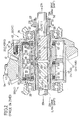
- Fig. 2 is a cross-sectional view showing an embodiment of the power transmission apparatus according to the present invention, in which the casing is disengaged from the viscous coupling to realize the free mode in two-wheel drive operation to eliminate vibration and noise;
- Fig. 3 is a perspective view showing a sleeve connecting member;
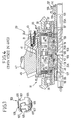
- Fig. 4 is a cross-sectional view showing the embodiment of Fig. 2 in which the casing is engaged with the viscous coupling to realize a twin viscous coupling mode in four-wheel drive operation to extricate the vehicle from a muddy road; and
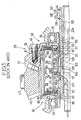
- Fig. 5 is a cross-sectional view showing the embodiment of Fig. 2 in which the casing is directly connected to the two rear wheel drive shafts to realize the lock mode in four-wheel drive operation to drive the vehicle on a muddy road at high speed.
- The present invention will be described in detail hereinbelow with reference to Figs. 3 to 5.
- A cylindrial
differential casing 29 is composed of acasing body 31 and acover 33, and rotatably supported by adifferential gear carrier 39 via twobearings ring gear 41 is fixed to thedifferential casing 29 bybolts 43. A drive pinion gear is formed integral with a rear end of adrive pinion shaft 47 connected to apropeller shaft 9A and geared with thering gear 41. As described above, thedifferential casing 29 is driven via thepropeller shaft 9A from theengine 1A. Within thedifferential casing 29, a pair of first (left) and second (right)hub members hub members axle support portions differential casing 29, and rotatably and coaxially fit together at 57 so as to provide mutual support for their free ends. Anannular working chamber 59 is formed between thedifferential casing 29 and thehub members sealing rings backup rings differential casing 29 and thehub members portions X-shaped sealing ring 69 and abackup ring 71 are arranged between the twohub members working chamber 59 is therefore sealed. Within theworking chamber 59, thedifferential casing 29 is formed with aspline 73 and thehub members splines spline 73 so as to surround the interfitting end portions of the twohub members working chamber 59 is partitioned by thiswall member 79. Thispartition wall member 79 is formed with a throughhole 81 providing communication between the right and left sides of the workingchamber 59. A plurality ofouter plates 83 are engaged with thespline 73 on either side of thepartition wall member 79 so as to be movable axially of thecasing 29. A plurality ofinner plates 85 are engaged with thesplines outer plates 83 and are also movable axially of thecasing 29. Aspacer 87 is arranged between each twoouter plates 83, and aspacer 89 is arranged between each twoinner plates 85. These spacers serve to keep the plates spaced apart at an appropriate distance. The arrangment described provides a pair ofviscous couplings - Within the inner circumferential surfaces of the
hub members clutch sleeves 99 and 101 (clutch means) are supported by twoslide bearings clutch sleeves coupling member 103. As shown in Fig. 3, thiscoupling member 103 is a cylindrial member formed with threeflexible arms 105 on each end thereof. Further, eacharm 105 is formed with aclaw 107 extending from an axially outward end of thearm 105 in the radially inward direction of themember 103. - An outer
circumferential groove 109 is formed at the adjacent ends of eachsleeve coupling member 103 is fitted to the adjacent ends of thesleeves claws 107 of thearms 105 with the twocircumferential grooves 109, thesleeves first hub member 49 is formed with aninner spline 111 on the inner circumferential surface thereof; thesecond hub member 51 is formed with twoinner splines differential casing 29 is formed with aninner spline 117 on the inner circumferential surface thereof. Thesleeve 99 is formed with anouter spline 119 engageable with theinner splines sleeve 101 is formed with anouter spline 121 engageable with theinner splines - As shown in Fig. 2 when the
clutch spline 119 is disengaged, theclutch spline 121 is also disengaged. However, when theclutch spline 119 is engaged with thehub spline 111, theclutch spline 121 is also engaged with thehub spline 115 as shown in Fig. 4. Further, when theclutch spline 119 is engaged with the hub splines 111 and 113, theclutch spline 121 is also engaged with thehub spline 115 and thecasing spline 117, as shown in Fig. 5. - Within the
sleeves wheel drive shafts lefthand drive shaft 21A is connected to the left rear wheel via a coupling device (not shown), and therighthand drive shaft 23A is connected to the right rear wheel via a coupling device (not shown). Thedrive shaft 21A is formed with anouter spline 127 on the outer circumferential surface thereof and thedrive shaft 23A is formed with anouter spline 129 on the outer circumferential surface thereof. Thesleeve 99 is formed with aninner spline 131 engageable with theouter spline 127 of thedrive shaft 21A, thesleeve 101 is formed with aninner spline 133 engageable with theouter spline 129 of thedrive shaft 23A. Thesleeves drive shafts - A
ring 137 formed with an outercircumferential groove 135 is fitted to thesleeve 101 and located in position by two stopper rings 139 and 141. An arm of a shift fork (not shown) is engaged with thegroove 135 in thering 137, so that the shift fork may slide thesleeve 99 and, via thering 137, thesleeve 101 axially. - This shift fork is actuated manually by a driver or automatically according to vehicle steering conditions or road surface conditions.
- The operation of this embodiment will now be described.
- As shown in Fig. 2 when the
sleeves hub members viscous couplings drive shafts rear wheels - As shown in Fig. 4, when the
sleeves clutch splines rear wheel 25A via theviscous coupling 91 and to the rightrear wheel 27A via theviscous coupling 93 as shown by thick arrows in Fig. 4 (TWIN VISCO IN 4WD). Under these conditions, since the twohub members viscous couplings viscous coupling rear wheels - Further, the differential revolution of the
viscous coupling rear wheels - As described above, the power from the
engine 1A can be differentially distributed to the right and leftrear wheels rear wheels front wheels rear wheels sleeves clutch spline 119 with the hub splines 111 and 113 and theclutch spline 121 with thehub spline 115 and thecasing spline 117, since thedifferential casing 29 is engaged with thehub member 51 and further thehub member 51 is engaged with thehub member 49, the twoviscous couplings viscous coupling engine 1A to the rightrear wheel 27A via thedifferential casing 29 and to the leftrear wheel 25A via thehub members hub members front wheels rear wheels - The function of the apparatus according to the embodiment described will be described in relation to the performance of the vehicle shown in Fig. 1.
- When the rear
differential gear 11A is allowed to be free as shown in Fig. 2 (FREE IN 2WD), since the tworear wheels engine 1A, the vehicle is driven in 2WD mode. In this case, the rotational power of therear wheels viscous couplings viscous couplings - When the rear
differential gear 11A is changed to the state as shown in Fig. 4, the vehicle is driven in 4WD mode (TWIN VISCO IN 4WD). Therefore, when the vehicle is turned by an external force and therefore a rotational difference is produced between the inner and outer wheels, the rotational difference is limited by the differential restriction function of the reardifferential gear 11A and therefore a yawing moment is generated to return the vehicle position to its original state, so that the vehicle forward stability can be improved. Further, since the drive power can be distributed to the four wheels, each wheel can not easily slip, so that vehicle driving manipulatability and stability can be improved. In addition, when thefront wheels viscous couplings rear wheels - Further, when the vehicle travels around a corner, since the rotational difference between the inner and outer wheels (the two
rear wheels viscous couplings - Further, when the rear
differential gear 11A is locked as shown in Fig. 5 (LOCK IN 4WD), since therear wheels engine 1A, a large drive power can be transmitted, so that the running capability over a long distance on muddy roads and high speed straight drive capability can be improved. - As described above, the power transmission apparatus of the present invention can transmit torque under control (restriction and permission) of the rotational difference and further can interrupt the torque transmission. When the torque is interrupted, it is possible to eliminate the loss due to the operation of the viscous couplings.
Claims (2)
Priority Applications (1)
| Application Number | Priority Date | Filing Date | Title |
|---|---|---|---|
| AT89104395T ATE76367T1 (en) | 1988-03-14 | 1989-03-13 | POWER TRANSMISSION UNIT. |
Applications Claiming Priority (4)
| Application Number | Priority Date | Filing Date | Title |
|---|---|---|---|
| JP5823588A JPH0626939B2 (en) | 1988-03-14 | 1988-03-14 | Drive force transmission / intermittent device for four-wheel drive vehicles |
| JP58235/88 | 1988-03-14 | ||
| JP203262/88 | 1988-08-17 | ||
| JP20326288A JPH0257730A (en) | 1988-08-17 | 1988-08-17 | Power transmission |
Publications (2)
| Publication Number | Publication Date |
|---|---|
| EP0333095A1 EP0333095A1 (en) | 1989-09-20 |
| EP0333095B1 true EP0333095B1 (en) | 1992-05-20 |
Family
ID=26399289
Family Applications (1)
| Application Number | Title | Priority Date | Filing Date |
|---|---|---|---|
| EP89104395A Expired - Lifetime EP0333095B1 (en) | 1988-03-14 | 1989-03-13 | Power transmission apparatus |
Country Status (4)
| Country | Link |
|---|---|
| US (1) | US4981192A (en) |
| EP (1) | EP0333095B1 (en) |
| AU (1) | AU614038B2 (en) |
| DE (1) | DE68901555D1 (en) |
Families Citing this family (12)
| Publication number | Priority date | Publication date | Assignee | Title |
|---|---|---|---|---|
| DE3924520A1 (en) * | 1989-07-25 | 1991-02-07 | Viscodrive Gmbh | AXLE DRIVE |
| DE4021747A1 (en) * | 1990-07-07 | 1992-01-16 | Gkn Automotive Ag | DRIVE ARRANGEMENT |
| US5996720A (en) * | 1996-05-21 | 1999-12-07 | Dana Corporation | Dual disconnect drive assembly |
| US6517462B2 (en) | 2001-05-11 | 2003-02-11 | Spicer Technology, Inc. | Dual disconnect drive assembly |
| US7096990B2 (en) | 2001-07-30 | 2006-08-29 | Spicer Technology Inc. | Double disconnect assembly for multi-axle vehicles |
| US20030047402A1 (en) | 2001-09-13 | 2003-03-13 | Borgen Wayne Lee | Dual disconnect drive assembly |
| US6779420B2 (en) * | 2002-03-20 | 2004-08-24 | Gkn Automotive, Inc. | Integrated twin pull electronic torque management axle |
| JP4010839B2 (en) * | 2002-03-25 | 2007-11-21 | 株式会社ショーワ | Power switching device |
| WO2007083716A1 (en) * | 2006-01-23 | 2007-07-26 | Viscodrive Japan Ltd. | Viscous coupling |
| US9643489B2 (en) * | 2013-03-10 | 2017-05-09 | Leonid Despotuli | System and method for controlling a vehicle |
| JP6112097B2 (en) * | 2013-11-25 | 2017-04-12 | トヨタ自動車株式会社 | Left and right driving force distribution unit with disconnect mechanism for four-wheel drive vehicles |
| JP6822183B2 (en) * | 2017-02-07 | 2021-01-27 | 株式会社ジェイテクト | Driving force distribution device |
Family Cites Families (7)
| Publication number | Priority date | Publication date | Assignee | Title |
|---|---|---|---|---|
| US4562897A (en) * | 1983-10-25 | 1986-01-07 | American Motors Corporation | Vehicle drivetrain including viscous clutch |
| AU572273B2 (en) * | 1984-08-27 | 1988-05-05 | Samuel Arthur Thomas Woodbridge | Transmission systems for vehicles |
| US4699237A (en) * | 1985-12-05 | 1987-10-13 | Fuji Jukogyo Kabushiki Kaisha | Four-wheel drive system for motor vehicles |
| DE3767168D1 (en) * | 1986-01-20 | 1991-02-14 | Honda Motor Co Ltd | DIFFERENTIAL DEVICE USING A LIQUID. |
| FR2593873B1 (en) * | 1986-01-24 | 1990-08-24 | Peugeot | DEVICE FOR DRIVING TWO ALIGNED SHAFTS, WITH DIFFERENTIAL MECHANISM, ESPECIALLY TWO TRANSMISSION SHAFTS CONNECTED TO TWO REAR VEHICLE WHEELS |
| US4650028A (en) * | 1986-02-03 | 1987-03-17 | Chrysler Motors Corporation | Viscous coupling apparatus for on-demand four wheel drive system |
| US4728010A (en) * | 1986-07-22 | 1988-03-01 | Johnston Mack S | Keg tapper |
-
1989
- 1989-03-13 EP EP89104395A patent/EP0333095B1/en not_active Expired - Lifetime
- 1989-03-13 US US07/322,641 patent/US4981192A/en not_active Expired - Lifetime
- 1989-03-13 DE DE8989104395T patent/DE68901555D1/en not_active Expired - Lifetime
- 1989-03-14 AU AU31289/89A patent/AU614038B2/en not_active Ceased
Also Published As
| Publication number | Publication date |
|---|---|
| EP0333095A1 (en) | 1989-09-20 |
| DE68901555D1 (en) | 1992-06-25 |
| AU614038B2 (en) | 1991-08-15 |
| AU3128989A (en) | 1989-09-14 |
| US4981192A (en) | 1991-01-01 |
Similar Documents
| Publication | Publication Date | Title |
|---|---|---|
| US4982808A (en) | Viscous shear coupling | |
| EP0262434B1 (en) | Interaxle differential restriction device for vehicle four wheel drive systems | |
| EP0315200B1 (en) | Power transmission apparatus | |
| US4493387A (en) | Clutch driven front axle fourwheel drive system | |
| EP0379721B1 (en) | Differential gear | |
| US6620073B2 (en) | Driving force transmitting device for vehicle | |
| EP0333095B1 (en) | Power transmission apparatus | |
| GB2267322A (en) | Differential gearing unit | |
| CA1294560C (en) | Four wheel drive vehicle | |
| US4889206A (en) | Viscous shear coupling | |
| US5083635A (en) | Power transmission system for automotive vehicle | |
| JPS61191434A (en) | vehicle drive system | |
| JPH0257730A (en) | Power transmission | |
| JPS6390438A (en) | Transfer for four-wheel drive vehicle | |
| JPH0322581Y2 (en) | ||
| JPH0626939B2 (en) | Drive force transmission / intermittent device for four-wheel drive vehicles | |
| JP2565890B2 (en) | Power transmission device | |
| GB2228979A (en) | Power transmission apparatus comprising assembly of differential and clutches for four wheel drive vehicle | |
| JPH0764220B2 (en) | Driving force transmission device for four-wheel drive vehicle | |
| JPH0341156Y2 (en) | ||
| JPH034833Y2 (en) | ||
| JPS63176723A (en) | Four-wheel-drive vehicle | |
| JPH0464730A (en) | Viscous coupling | |
| JPS62286836A (en) | Driving device for four-wheel driving vehicle | |
| JPS62286835A (en) | Four-wheel drive vehicle drive system |
Legal Events
| Date | Code | Title | Description |
|---|---|---|---|
| PUAI | Public reference made under article 153(3) epc to a published international application that has entered the european phase |
Free format text: ORIGINAL CODE: 0009012 |
|
| 17P | Request for examination filed |
Effective date: 19890313 |
|
| AK | Designated contracting states |
Kind code of ref document: A1 Designated state(s): AT DE FR GB IT |
|
| RAP1 | Party data changed (applicant data changed or rights of an application transferred) |
Owner name: VISCODRIVE JAPAN LTD |
|
| 17Q | First examination report despatched |
Effective date: 19901203 |
|
| GRAA | (expected) grant |
Free format text: ORIGINAL CODE: 0009210 |
|
| AK | Designated contracting states |
Kind code of ref document: B1 Designated state(s): AT DE FR GB IT |
|
| REF | Corresponds to: |
Ref document number: 76367 Country of ref document: AT Date of ref document: 19920615 Kind code of ref document: T |
|
| ITF | It: translation for a ep patent filed | ||
| REF | Corresponds to: |
Ref document number: 68901555 Country of ref document: DE Date of ref document: 19920625 |
|
| ET | Fr: translation filed | ||
| PLBE | No opposition filed within time limit |
Free format text: ORIGINAL CODE: 0009261 |
|
| STAA | Information on the status of an ep patent application or granted ep patent |
Free format text: STATUS: NO OPPOSITION FILED WITHIN TIME LIMIT |
|
| 26N | No opposition filed | ||
| PGFP | Annual fee paid to national office [announced via postgrant information from national office to epo] |
Ref country code: GB Payment date: 19990222 Year of fee payment: 11 |
|
| PGFP | Annual fee paid to national office [announced via postgrant information from national office to epo] |
Ref country code: FR Payment date: 19990318 Year of fee payment: 11 |
|
| PGFP | Annual fee paid to national office [announced via postgrant information from national office to epo] |
Ref country code: AT Payment date: 19990322 Year of fee payment: 11 |
|
| PGFP | Annual fee paid to national office [announced via postgrant information from national office to epo] |
Ref country code: DE Payment date: 19990521 Year of fee payment: 11 |
|
| PG25 | Lapsed in a contracting state [announced via postgrant information from national office to epo] |
Ref country code: GB Free format text: LAPSE BECAUSE OF NON-PAYMENT OF DUE FEES Effective date: 20000313 Ref country code: AT Free format text: LAPSE BECAUSE OF NON-PAYMENT OF DUE FEES Effective date: 20000313 |
|
| GBPC | Gb: european patent ceased through non-payment of renewal fee |
Effective date: 20000313 |
|
| PG25 | Lapsed in a contracting state [announced via postgrant information from national office to epo] |
Ref country code: FR Free format text: LAPSE BECAUSE OF NON-PAYMENT OF DUE FEES Effective date: 20001130 |
|
| REG | Reference to a national code |
Ref country code: FR Ref legal event code: ST |
|
| PG25 | Lapsed in a contracting state [announced via postgrant information from national office to epo] |
Ref country code: DE Free format text: LAPSE BECAUSE OF NON-PAYMENT OF DUE FEES Effective date: 20010103 |
|
| PG25 | Lapsed in a contracting state [announced via postgrant information from national office to epo] |
Ref country code: IT Free format text: LAPSE BECAUSE OF NON-PAYMENT OF DUE FEES;WARNING: LAPSES OF ITALIAN PATENTS WITH EFFECTIVE DATE BEFORE 2007 MAY HAVE OCCURRED AT ANY TIME BEFORE 2007. THE CORRECT EFFECTIVE DATE MAY BE DIFFERENT FROM THE ONE RECORDED. Effective date: 20050313 |