EP0332200A2 - Servo positioning apparatus - Google Patents
Servo positioning apparatus Download PDFInfo
- Publication number
- EP0332200A2 EP0332200A2 EP89104221A EP89104221A EP0332200A2 EP 0332200 A2 EP0332200 A2 EP 0332200A2 EP 89104221 A EP89104221 A EP 89104221A EP 89104221 A EP89104221 A EP 89104221A EP 0332200 A2 EP0332200 A2 EP 0332200A2
- Authority
- EP
- European Patent Office
- Prior art keywords
- terminal
- resistor
- capacitors
- network
- filter
- Prior art date
- Legal status (The legal status is an assumption and is not a legal conclusion. Google has not performed a legal analysis and makes no representation as to the accuracy of the status listed.)
- Granted
Links
Images





Classifications
-
- G—PHYSICS
- G11—INFORMATION STORAGE
- G11B—INFORMATION STORAGE BASED ON RELATIVE MOVEMENT BETWEEN RECORD CARRIER AND TRANSDUCER
- G11B21/00—Head arrangements not specific to the method of recording or reproducing
- G11B21/02—Driving or moving of heads
- G11B21/08—Track changing or selecting during transducing operation
-
- G—PHYSICS
- G05—CONTROLLING; REGULATING
- G05D—SYSTEMS FOR CONTROLLING OR REGULATING NON-ELECTRIC VARIABLES
- G05D3/00—Control of position or direction
- G05D3/12—Control of position or direction using feedback
- G05D3/14—Control of position or direction using feedback using an analogue comparing device
- G05D3/1445—Control of position or direction using feedback using an analogue comparing device with a plurality of loops
-
- G—PHYSICS
- G11—INFORMATION STORAGE
- G11B—INFORMATION STORAGE BASED ON RELATIVE MOVEMENT BETWEEN RECORD CARRIER AND TRANSDUCER
- G11B21/00—Head arrangements not specific to the method of recording or reproducing
- G11B21/02—Driving or moving of heads
- G11B21/08—Track changing or selecting during transducing operation
- G11B21/081—Access to indexed tracks or parts of continuous track
- G11B21/083—Access to indexed tracks or parts of continuous track on discs
-
- G—PHYSICS
- G11—INFORMATION STORAGE
- G11B—INFORMATION STORAGE BASED ON RELATIVE MOVEMENT BETWEEN RECORD CARRIER AND TRANSDUCER
- G11B21/00—Head arrangements not specific to the method of recording or reproducing
- G11B21/02—Driving or moving of heads
- G11B21/10—Track finding or aligning by moving the head ; Provisions for maintaining alignment of the head relative to the track during transducing operation, i.e. track following
- G11B21/106—Track finding or aligning by moving the head ; Provisions for maintaining alignment of the head relative to the track during transducing operation, i.e. track following on disks
-
- G—PHYSICS
- G11—INFORMATION STORAGE
- G11B—INFORMATION STORAGE BASED ON RELATIVE MOVEMENT BETWEEN RECORD CARRIER AND TRANSDUCER
- G11B5/00—Recording by magnetisation or demagnetisation of a record carrier; Reproducing by magnetic means; Record carriers therefor
- G11B5/48—Disposition or mounting of heads or head supports relative to record carriers ; arrangements of heads, e.g. for scanning the record carrier to increase the relative speed
- G11B5/54—Disposition or mounting of heads or head supports relative to record carriers ; arrangements of heads, e.g. for scanning the record carrier to increase the relative speed with provision for moving the head into or out of its operative position or across tracks
- G11B5/55—Track change, selection or acquisition by displacement of the head
- G11B5/5521—Track change, selection or acquisition by displacement of the head across disk tracks
- G11B5/5526—Control therefor; circuits, track configurations or relative disposition of servo-information transducers and servo-information tracks for control thereof
- G11B5/553—Details
- G11B5/5547—"Seek" control and circuits therefor
-
- G—PHYSICS
- G11—INFORMATION STORAGE
- G11B—INFORMATION STORAGE BASED ON RELATIVE MOVEMENT BETWEEN RECORD CARRIER AND TRANSDUCER
- G11B5/00—Recording by magnetisation or demagnetisation of a record carrier; Reproducing by magnetic means; Record carriers therefor
- G11B5/48—Disposition or mounting of heads or head supports relative to record carriers ; arrangements of heads, e.g. for scanning the record carrier to increase the relative speed
- G11B5/58—Disposition or mounting of heads or head supports relative to record carriers ; arrangements of heads, e.g. for scanning the record carrier to increase the relative speed with provision for moving the head for the purpose of maintaining alignment of the head relative to the record carrier during transducing operation, e.g. to compensate for surface irregularities of the latter or for track following
- G11B5/596—Disposition or mounting of heads or head supports relative to record carriers ; arrangements of heads, e.g. for scanning the record carrier to increase the relative speed with provision for moving the head for the purpose of maintaining alignment of the head relative to the record carrier during transducing operation, e.g. to compensate for surface irregularities of the latter or for track following for track following on disks
- G11B5/59605—Circuits
- G11B5/59622—Gain control; Filters
Definitions
- This invention relates to a servo positioning apparatus, for example for use in positioning a read/write head of a magnetic recording disk, and more particularly concerns a filter used in a feedback loop of servo control circuitry of the apparatus.
- Servo positioning apparatuses have been widely employed for quickly and accurately positioning mechanical elements, such as a magnetic head in a magnetic recording disk apparatus.
- a typical servo control system of such disk apparatus is illustrated in Fig. 1.
- Magnetic recording disks 10 are mounted on an axle 11, driven to spin by a spindle motor 12.
- Magnetic heads 13 are mounted on accessors 140 which are connected to a movable part of a voice coil motor 14.
- the accessors 140 are moved in an essentially radial direction of the disks 10 by a coil 141 and a magnet 142 of the voice coil motor.
- Positions or speeds hereinafter referred to relate to positions or speeds in radial directions of the disks 10, i.e. in a seek direction.
- the above-mentioned parts are installed in a magnetic disk unit 1 enclosed in a disk enclosure 16.
- the disk unit 1 is mounted in a main chassis of a magnetic disk apparatus but is detachable therefrom, for servicing, etc.
- a coarse controller i.e. a velocity control circuit 2 generates a velocity error signal ⁇ V depending on a position signal PS obtained from a servo signal generated from a magnetic head 13. Details of the controller 2 are described below.
- the position signal PS indicates radial position (of the magnetic head) relative to an adjacent track (on a disk 10), and is generally designed to be zero when the head is positioned on a centre line of a track to be traced.
- a fine controller (i.e. a position controller) 3 generates a position error signal ⁇ P from the phase-compensated position signal PS processed using proportional control (P), derivative control (D) and integral control (I).
- a controller 4 composed of a microprocessor calculates a number of tracks to be jumped, according to an instruction from an upper processor unit, then switches coarse/fine modes by outputting a mode switching signal MS to a switch 5, and outputs instructions to the coarse controller 2 and fine controller 3, each to drive the voice coil motor 14.
- the coarse controller 2, the fine controller 3, the controller 4 and the switch 5 constitute a servo controller CT.
- the switch 5 connects one terminal "a" to the output of the servo controller CT and accordingly a driving current proportional to the velocity error signal ⁇ V is supplied from a power amplifier 6 to the voice coil motor 14.
- the magnetic head 13 is moved to a destination track in accordance with a predetermined velocity schedule depending on a difference between a target velocity V c and an actual velocity V r of the head 13 obtained from the position signal PS.
- the controller 4 switches the switch 5 to connect a terminal "b" to the output of the servo controller CT.
- ⁇ indicates the width of a track to be traced
- MS indicates a signal for switching switch 5.
- the fine controller 3 delivers the position error signal ⁇ P to the amplifier 6. Accordingly, a driving current I m proportional to the position error signal ⁇ P (when terminal "a" was connected I m was proportional the velocity error signal ⁇ V) is supplied from the power amplifier 6 to the voice coil motor 14. Thus, the head is controlled to trace or move to a destination track.
- a notch filter 32 has been widely employed in the servo loop (i.e. feedback loop) of the servo positioning apparatus, in order to damp undesirable oscillation of the heads 13 caused by the mechanical resonance.
- a fine position amplifier 30 generates from the position signal PS a signal which becomes zero volts when the head is located at the centre of a track, and takes positive or negative values proportional to deviations of the head from the centre of the track to one side or the other.
- a clamp circuit 31 generates a clamped position signal, which is a modification of the signal output from the fine position amplifier 30 which saturates at predetermined positive and negative levels.
- a notch filter 32 has an attenuation characteristic as shown in Fig. 5(B), such that attenuation is maximum at the frequency f0 of a mechanical resonance.
- a second filter 33 attenuates high-frequency gain of the servo loop in order to attain a stable servo operation.
- a phase compensation circuit 34 is also provided for attaining a stable servo operation.
- An integrator circuit 34a integrates an output from the second filter 33 for integral control, an amplifier 34b amplifies the output from the second filter 33 for proportional control, and a differentiator circuit 34c differentiates the output from the second filter 33 for derivative control.
- An adder circuit 34d adds the outputs from the integrator circuit 34a, the amplifier 34b and the differentiator circuit 34c, then outputs the position error signal ⁇ P to the switch 5.
- the notch filter 32 is typically composed of a twin T-type filter as shown in Fig. 5(a).
- a parallel connection of capacitors C1 and C2 connected to a connecting point of resistors r1 and r2 forms a first T-type network.
- a series connection of resistors r3 and r4 connected to a connecting point of capacitors C3 and C4 forms a second T-type network.
- These two T-type networks are connected in parallel to form a twin T-type filter.
- An output from resistor r2 and capacitor C4 is input to an amplifier AMP1 having a unity gain.
- An output of amplifier AMP1 is divided by resistors r5 and r6, and the divided output level is input to another amplifier AMP2 having a unity gain.
- Output of the second amplifier AMP2 is fed to a return terminal t3, which is the connecting point of capacitors C1, C2 and resistor r4.
- a problem with the twin T-type filter is in that all of the four resistors r1 to r4 or all of the four capacitors C1 to C4 must be replaced according to the formula (1) for adjusting the resonant frequency while keeping the attenuation unchanged, when the disk unit 1 is replaced for servicing, etc.
- notch filter which may be employed in the servo control circuit is a bridged T-type filter as shown in Fig. 6. Problems with this type of filter are that the available attenuation is not adequate, for example -12 dB, and three or four capacitors or resistors must be replaced for adjusting the resonant frequency while keeping the attenuation unchanged.
- Disk units do not always have the same resonant frequency even if they are of the same design, and furthermore if the design is changed, for reasons of improvement, etc., the resonant frequency consequently changes.
- the notch filter is generally mounted on a printed circuit board, which is installed in a main chassis on which the disk apparatus is installed. The exchange of the three or four circuit elements is a time-consuming job requiring a precise instrument. Exchange of the printed circuit board is of course expensive. In any event, costs of production and servicing are considerable.
- the notch filter may be mounted on the replaceable (detachable) disk unit 1, in which the notch frequency is tuned at the factory, as disclosed in Japanese Unexamined Patent Publication Tokukai Sho 58-188374.
- a problem still remains in that frequency adjustment is a troublesome job even in a factory production line.
- An embodiment of the present invention can provide an efficiently adjustable filter used in a servo positioning apparatus, applicable for example to positioning of a read/write head of a magnetic recording disk.
- An embodiment of the present invention can provide for an exchangeable disk unit structure which is economical in terms of its servicing characteristics.
- servo positioning apparatus comprising:- a mechanism for positioning an object, the mechanism having a resonant frequency; and a controller for providing a servo signal derived from a position signal representing position of the object, for example relative to a track to be traced by the object, said controller including:- a bridged serial T-type notch filter having a notch frequency substantially equal to said resonant frequency.
- servo positioning apparatus comprising:- a mechanism for positioning an object, the mechanism being installed in a unit detachable from other portions of the apparatus, the mechanism having a resonant frequency; and a controller for providing a servo signal derived from a position signal representing position of the object, for example relative to a track to be traced by the object, said controller including:- a notch filter having a notch frequency substantially equal to said resonant frequency, an element for tuning said notch frequency being separately installed in said unit.
- servo positioning apparatus comprising:- a mechanism for positioning an object, said mechanism being installed in a disk unit, said mechanism having a resonant frequency; and a controller for providing a servo signal derived from a position signal representing position of the object relative to a track to be traced by the object, said controller including:- a bridged serial T-type notch filter having a notch frequency substantially equal to said resonant frequency, said filter comprising a network composed of:- a serial circuit of first to third capacitors connecting an input terminal of said network and an output terminal of said network; a first resistor connected in parallel to said serial circuit of said first to third capacitors; and second and third resistors serially connected between a third terminal of said network and an interconnection point of said first and second capacitors, an end of said third resistor being connected to said third terminal; and fourth and fifth resistors serially connected between said third terminal and an interconnection point of said second and third capacitors, an end of said fifth resistor being connected to
- a notch filter used in a servo loop for dampening a mechanical resonance of moving parts of the mechanism to be servo controlled has a CR (capacitor resistor) network including a serial connection of first to third capacitors having approximately equal capacitance values connected between an input terminal of the filter and an output terminal of the CR network; a first resistor connected between a return terminal of the CR network and an interconnection of the first and second capacitors; a second resistor connected between the return terminal and an interconnection of the second and third capacitors; and a third resistor connected in parallel to the three serial capacitors.
- CR capacitor resistor
- the notch frequency of the filter is adjusted by varying the resistance values of only the first and second resistors.
- the first and second resistors may be composed of fixed and/or potentiometer-type variable resistor(s) whose variable terminal then becomes the return terminal.
- An output from the CR network may be divided to be fed back to the return terminal.
- the resistor(s) for adjusting the notch frequency may be separately installed in a detachable disk unit including the mechanism to be servo controlled.
- the detachable disk unit is less expensive and, furthermore, the detachable disk unit may be prepared to have an individual notch frequency tuned to the resonant frequency of the individual mechanism beforehand in the factory.
- FIG. 7 an apparatus for servo positioning read/write heads of a recording disk system, in which an embodiment of the present invention can be applied, is representatively described hereinafter.
- Magnetic recording disks 10 are mounted on an axle 11 driven to spin by a spindle motor 12.
- Magnetic heads 13 are connected to a coil of a voice coil motor 14. The heads 13 are moved in an essentially radial direction of the disks 10 by the voice coil motor 14.
- a position signal generator 7 generates a position signal PS depending on a servo signal SVS produced by one of the heads 13 which reads servo signals of the track the head is currently on and its adjacent track both recorded on a servo surface (typically the lower surface of the second disk).
- the position signal generator 7 includes an AGC (automatic gain control) amplifier 70, which keeps the servo signal SVS at an essentially constant amplitude; and a position signal detector 71, which decodes the AGC-controlled servo signal SVS to provide a position signal PS (as shown in Fig. 2).
- a target velocity generator 20 in the velocity controller 2 generates a target velocity V c , according to a predetermined schedule that typically consists of a constant acceleration section, a constant velocity section and a constant deceleration section, depending on the number of tracks to be jumped, the number being instructed from a controller 4.
- a velocity signal generator 21 generates a velocity signal V r , which indicates proportionally the actual velocity of the head depending on the position signal PS and an indication current i i , which indicates proportionally the amplitude of a driving current I m of voice coil motor 14 supplied from the power amplifier 6.
- An error signal generator 22 generates and supplies a velocity error ⁇ V depending on the difference between the target velocity V c and the velocity signal V r to switch 5. Accordingly, the head 13 driven by the voice coil motor 14 moves with thus given velocity to the destination track.
- the controller 4 is composed of a microprocessor to receive a seek instruction and a destination track number given from an upper (higher level) processing device and outputs instructions for the seek control.
- the controller 4 calculates a number of tracks to be jumped, for output to the target velocity generator 20.
- the controller 4 On arrival of the head 13 at the destination track as shown in Fig. 2, the controller 4 detects this fact from the position signal PS and outputs a coarse/fine switching signal MS to the switch 5, to change the switch from its "a" position to its "b” position, i.e.
- the controller 4 has also a function of outputting a seek end signal to the upper (higher level) processing device when a seek operation is finished.
- a fine controller 3 is composed of: a fine position amplifier 30 which generates, in dependence upon the position signal PS, a signal which has a neutral voltage (e.g. zero volts) when the head is located at the centre of a track, and becomes more positive or more negative in proportion to deviation from the centre of the track to one side or the other; a clamp circuit 31, which generates a clamped position signal, this being a modification of the signal output from the fine position amplifier 30 such that it saturates at predetermined positive and negative levels; a notch filter 32, which has a notch frequency equal to a mechanical resonant frequency f0 of moving parts of the mechanism to be servo controlled, i.e.
- a second filter 33 composed of a low pass filter, is connected to the output of the notch filter 32 in order to attenuate high-frequency gain of the servo loop so as to remove noise and to achieve a stable servo operation.
- a phase compensation circuit 34 is connected to the output of the second filter 33 so as to attain a stable quality servo operation.
- the phase compensation circuit 34 includes: an integrator circuit 34a for integrating an output from the second filter 33 for integral control; an amplifier 34b for amplifying the output from the second filter 33 for proportional control; and a differentiator circuit 34c for differentiating the output from the second filter 33 for derivative control.
- An adder circuit 34d adds outputs from the integrator circuit 34a, the amplifier 34b and the differentiator circuit 34c, then outputs the thus derived position error signal ⁇ P to the switch 5.
- FIG. 8 there is shown a practical schematic circuit diagram of a bridged serial T-type filter of an embodiment of the present invention, to be used as the notch filter 32′ in Fig. 7.
- a serial connection of capacitors C1, C2 and C3 is connected between an input terminal t1 and an output terminal t2 of a CR (capacitor, resistor) network.
- a first resistor R1 connects a return terminal t3 and a connection point of the capacitors C1 and C2.
- a second resistor R2 connects the return terminal t3 and a connection point of the capacitors C2 and C3.
- a third resistor R3 connects, i.e. bridges, the ends of the serial connection of the capacitors C1 to C3.
- An output from the output terminal t2 of the CR network is input to an amplifier AMP1 having generally a unity gain.
- An output of amplifier AMP1 having generally a unity gain.
- An output of amplifier AMP1 is divided by resistors R4 and R5, and the divided output level is input to a second amplifier AMP2 having generally a unity gain.
- the first amplifier AMP1 isolates the CR network from effects of input impedance of the next stage, i.e. the second filter 33, and the divider resistors R4 and R5.
- the output of the second amplifier AMP2 is connected to the return terminal t3.
- the notch frequency can be shifted as shown in Fig. 9(a) from f0 to f0′ by changing the resistance values of R1 and R2.
- resistance value R3 287 k ohm
- the effect of the varied resistance on the notch frequency is shown in Fig. 9(b).
- a notch frequency variation of more than 1 kHz is achieved, which is adequate to cover variation of the resonant frequencies (in the servo system).
- the division ratio of the output of the amplifier AMP1 by the resistors R4 and R5 determines the feedback ration (R4/R4+R5) to the network.
- the effects of the feedback ratio on band width of the notch frequency f0 are shown in Fig. 10, where the values of the elements in the CR network are the same as those mentioned above.
- Attenuation at the notch frequency can also be kept essentially unvaried when notch frequency is varied corresponding to the case of Fig. 9(b). Then, attenuation at the notch frequency can be as much as or more than 40 dB, which is adequate for dampening mechanical resonance in the feedback system, even if some drift of frequency takes place.
- the bridged T-type filter shown in Fig. 6 achieves only -12 dB at most.
- Phase rotation by the notch filter is a factor to be controlled in the servo control system, particularly at a lower frequency band, typically from 300 to 800 Hz, at which the servo mechanism is driven most often. If phase rotation is excessive in this band the stability of the servo system is deteriorated.
- Phase characteristics of the notch filter having the above-mentioned element values and a feedback ratio of 0.95 are shown in Fig. 11(a). As seen in these characteristics, the amount of phase rotation at 800 Hz is 10° which is fully satisfactory.
- a similar filter having feedback ratio of zero, i.e. the return terminal t3 is grounded, is shown in Fig. 11(b).
- the bridged T-type filter of Fig. 6 can have a problem with phase rotation, as can the filter of Fig. 5(a).
- x/i is then calculated.
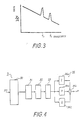
- the gain versus frequency curve is plotted as shown in Fig. 3. Location of the peak of the gain curve represents the mechanical resonant frequency f0.
- the thus obtained resonant frequency f0 is input into equation (3) to obtain resistance values for R1 and R2.
- the resistors R1 and R2 are adjusted to have thus calculated resistance values.
- the first and second resistors R1 and R2 consist of a resistor R1′ plus an additional resistor R1 ⁇ (Fig. 12(a)) or an additional resistor R6′ (Fig. 12(b)); and a resistor R2′ plus an additional resistor R2 ⁇ (Fig. 12(a)) or R7′ (Fig. 12(b)), respectively.
- the sum of the resistance values of the resistors R1′, R2′, R1 ⁇ (or R6′) and R2 ⁇ (or R7′) are kept essentially to one-sixth of the resistance value R3 to satisfy equation (2).
- Adjustment of the notch frequency f0 is carried out by changing the resistance values of R1 ⁇ and/or R2 ⁇ for the configuration of Fig. 12(a), or simply selecting (by means of a switch SW) one of connection points A, B or C (each at an interconnecting point of resistors R1′, R6′, R7′ and R2′) as the return terminal t3 to which the feedback from amplifier AMP2 is connected for the configuration of Fig. 12(b).
- the resistance values of the first and second resistor R1 and R2 of equation (3) are varied.
- notch frequency can be selected to tune to three different frequencies to meet the resonant frequency f0 of the mechanism of the magnetic disk unit 1.
- the number of taps or connection point for additional resistors can be arbitrarily chosen depending on design requirements; that is, two taps between resistors R1 and R2′ allow selection of two frequencies, whilst four taps allow selection of four frequencies as well.
- the two resistors R ⁇ and R2 ⁇ used in Fig. 12(a) may be replaced with a potentiometer-type variable resistor R8 as shown in Fig. 13.
- Two fixed ends, denoted by “m” and “n”, of the variable resistor R8 are connected to resistors R1 ⁇ and R2′, respectively.
- the sum of resistance values of resistors R1′, R2′ and fixed part of R8 is essentially one-sixth of that of resistor R3.
- a variable terminal "l" of the variable resistor R8 corresponds to the return terminal t3 to which the output of the second amplifier AMP2 is connected. Accordingly, frequency adjustment can be effected precisely and efficiently by observing frequency characteristics of the filter on a spectrum analyser display whilst the input frequency to the filter is swept, or by calculation from equation (3).
- frequency adjusting elements such as two resistors R6′ and R7′ used in Fig. 12(a), the resistors R6′, R7 and their switch SW used in Fig. 12(B), or the potentiometer-type variable resistor R8 may be installed in a circuit board 17 mounted on a disk unit 1, separately from the below-described main portion of the filter, as illustrated in Fig. 13.
- Fig. 13 illustrates representatively the case where the variable resistor R8 is employed.
- the magnetic recording disks 10 the spindle motor 12, the read/write head 13 and the voice coil motor to drive the heads 13 are also installed.
- the disk unit 1 is detachable from the main chassis of the magnetic disk drive apparatus, for facilitating replacement of recorded disks or servicing of a defective unit.
- the main portion of the notch filter 32 including the elements which require no adjustment, such as capacitors C1 to C3, resistors R1′, R2′ and R3, the amplifiers AMP1 and 2, are installed on a printed circuit board (which is given reference numeral 32 ⁇ in Fig. 13) in a main chassis of the magnetic disk drive apparatus.
- the resistance values and the capacitance values of the filter can be kept essentially same and constant for each product.
- each one of the completed units 1 is first mounted in the main chassis of the magnetic recording apparatus, as an adjusting jig.
- the mechanical resonance characteristics of the unit is measured according, for example, to the method described above.
- the resistors R1 ⁇ and R2′ or the variable resistor R8 installed in the unit 1 is adjusted so that the notch frequency is tuned to the mechanical resonant frequency of this mounted unit according to the above-described method.
- the disk unit 1 is removed from the main chassis, so as to be a stock for shipment.
- the new unit needs no more frequency adjustment, resulting in efficient servicing.
- the electronic circuit installed in the disk unit 1, which must be replaced upon servicing, can be made less expensive, because the main portion of the filter does not have to be exchanged. Therefore, servicing costs can be reduced both in terms of time required and hardware cost.
- a mechanism generally has two or more resonances.
- the notch filter is typically tuned to the major one of the resonances.
- a first amplifier AMP1 is provided to isolate the CR network from the effects of the dividing resistors and the input impedance of the second filter 33, the first amplifier AMP1 may be omitted, as long as the effects of the dividing resistors and the input impedance of the second filter 33 are negligible or within a degree adjustable by the CR network.
- a second amplifier AMP2 is provided to isolate the network from the effects of the dividing resistors, the second amplifier AMP2 may be omitted, as long as the effects of the dividing resistors is negligible or within a degree adjustable by the CR network.
- the capacitance values of the capacitors C1 to C3 are chosen essentially equal, the capacitance values may be different from each other as long as the effects of the different capacitances is negligible or within a degree adjustable by the CR network.
- the sum of the resistance values of the capacitors R1 and R2 is chosen essentially one-sixth of the resistance values of the resistor R3, the resistance values may be deviated from this condition as long as the effect is negligible or within a degree adjustable by the network.
- Embodiments of the invention are applicable to servo positioning apparatus in any other kind of system, such as an optically recording disk apparatus, etc.
- a notch filter used in a servo loop, for dampening a mechanical resonance of moving parts of the mechanism to be servo controlled, is composed of a serial T-type filter, that is a CR network including a serial connection of first to third capacitors connected between an input terminal of the filter and an output terminal of the CR network; a first resistor connected between a return terminal of the CR network and an interconnection of the first and second capacitors; a second resistor connected between the return terminal and an interconnection of the second and third capacitors; and a third resistor connected in parallel to the three serial capacitors.
- the notch frequency is adjusted by varying the resistance values of the first and second resistors.
- the first and second resistors may be composed of fixed resistors and/or potentiometer-type variable resistors.
- An output from the CR network may be divided to be fed back to the return terminal.
- Isolation amplifiers may be added to the output circuit and the feedback circuit to the return terminal.
- Only the resistor(s) for adjusting the notch frequency may be separately installed in a detachable disk unit including the mechanism to be servo controlled. The notch frequency can be efficiently adjusted by replacing only two fixed resistors or adjusting a variable resistor, and the cost of the disk unit can be reduced.
- the present invention provides servo positioning apparatus having a mechanism for positioning an object, for example a magnetic head in a magnetic disk recording system, and a controller for providing a servo signal derived from a position signal representing position of the object, for example relative to a track to be traced on a disk.
- the controller has a notch filter, the notch frequency of which corresponds to a resonance of the mechanism.
- Components of the notch filter network for example resistors, which can be exchanged or varied, to alter the notch frequency, are separately installed from other components, so that they may be more easily accessed or exchanged, without need to access or exchange the other components.
- the notch filter has a bridged serial T configuration with a series connection of capacitors, for example three capacitors, with a parallel-connected resistor, and with further resistors connected respectively to interconnection points between successive capacitors of the series.
- Notch frequency can be altered by exchanging or varying these further resistors, which are thus the components to be separately mounted.
Landscapes
- Physics & Mathematics (AREA)
- General Physics & Mathematics (AREA)
- Engineering & Computer Science (AREA)
- Automation & Control Theory (AREA)
- Moving Of The Head To Find And Align With The Track (AREA)
- Control Of Position Or Direction (AREA)
- Control Of Electric Motors In General (AREA)
- Control Of Linear Motors (AREA)
Abstract
Description
- This invention relates to a servo positioning apparatus, for example for use in positioning a read/write head of a magnetic recording disk, and more particularly concerns a filter used in a feedback loop of servo control circuitry of the apparatus.
- Servo positioning apparatuses have been widely employed for quickly and accurately positioning mechanical elements, such as a magnetic head in a magnetic recording disk apparatus. A typical servo control system of such disk apparatus is illustrated in Fig. 1.
Magnetic recording disks 10 are mounted on anaxle 11, driven to spin by aspindle motor 12.Magnetic heads 13 are mounted onaccessors 140 which are connected to a movable part of avoice coil motor 14. Theaccessors 140 are moved in an essentially radial direction of thedisks 10 by acoil 141 and amagnet 142 of the voice coil motor. Positions or speeds hereinafter referred to relate to positions or speeds in radial directions of thedisks 10, i.e. in a seek direction. The above-mentioned parts are installed in amagnetic disk unit 1 enclosed in adisk enclosure 16. Thedisk unit 1 is mounted in a main chassis of a magnetic disk apparatus but is detachable therefrom, for servicing, etc. - A coarse controller (i.e. a velocity control circuit) 2 generates a velocity error signal ΔV depending on a position signal PS obtained from a servo signal generated from a
magnetic head 13. Details of thecontroller 2 are described below. The position signal PS indicates radial position (of the magnetic head) relative to an adjacent track (on a disk 10), and is generally designed to be zero when the head is positioned on a centre line of a track to be traced. A fine controller (i.e. a position controller) 3 generates a position error signal ΔP from the phase-compensated position signal PS processed using proportional control (P), derivative control (D) and integral control (I). Acontroller 4 composed of a microprocessor calculates a number of tracks to be jumped, according to an instruction from an upper processor unit, then switches coarse/fine modes by outputting a mode switching signal MS to aswitch 5, and outputs instructions to thecoarse controller 2 andfine controller 3, each to drive thevoice coil motor 14. Thus, thecoarse controller 2, thefine controller 3, thecontroller 4 and theswitch 5 constitute a servo controller CT. - Now, when the coarse mode is instructed from the
controller 4, theswitch 5 connects one terminal "a" to the output of the servo controller CT and accordingly a driving current proportional to the velocity error signal ΔV is supplied from apower amplifier 6 to thevoice coil motor 14. Thus, themagnetic head 13 is moved to a destination track in accordance with a predetermined velocity schedule depending on a difference between a target velocity Vc and an actual velocity Vr of thehead 13 obtained from the position signal PS. As shown in Fig. 2, on detecting that the head has reached a destination track according to the position signal PS, thecontroller 4 switches theswitch 5 to connect a terminal "b" to the output of the servo controller CT. In Fig. 2, α indicates the width of a track to be traced, and MS indicates a signal forswitching switch 5. - With terminal "b" connected to the output of the servo controller CT, the
fine controller 3 delivers the position error signal ΔP to theamplifier 6. Accordingly, a driving current Im proportional to the position error signal ΔP (when terminal "a" was connected Im was proportional the velocity error signal ΔV) is supplied from thepower amplifier 6 to thevoice coil motor 14. Thus, the head is controlled to trace or move to a destination track. - However, as illustrated in Fig. 3, the moving parts of the apparatus naturally suffer from mechanical resonance. Therefore, a
notch filter 32 has been widely employed in the servo loop (i.e. feedback loop) of the servo positioning apparatus, in order to damp undesirable oscillation of theheads 13 caused by the mechanical resonance. - Details of the
fine controller 3 are indicated in Fig. 4 and Figs. 5(a) and 5(b). Afine position amplifier 30 generates from the position signal PS a signal which becomes zero volts when the head is located at the centre of a track, and takes positive or negative values proportional to deviations of the head from the centre of the track to one side or the other. Aclamp circuit 31 generates a clamped position signal, which is a modification of the signal output from thefine position amplifier 30 which saturates at predetermined positive and negative levels. Anotch filter 32 has an attenuation characteristic as shown in Fig. 5(B), such that attenuation is maximum at the frequency f₀ of a mechanical resonance. Asecond filter 33 attenuates high-frequency gain of the servo loop in order to attain a stable servo operation. Aphase compensation circuit 34 is also provided for attaining a stable servo operation. Anintegrator circuit 34a integrates an output from thesecond filter 33 for integral control, anamplifier 34b amplifies the output from thesecond filter 33 for proportional control, and adifferentiator circuit 34c differentiates the output from thesecond filter 33 for derivative control. Anadder circuit 34d adds the outputs from theintegrator circuit 34a, theamplifier 34b and thedifferentiator circuit 34c, then outputs the position error signal ΔP to theswitch 5. - The
notch filter 32 is typically composed of a twin T-type filter as shown in Fig. 5(a). A parallel connection of capacitors C₁ and C₂ connected to a connecting point of resistors r₁ and r₂ forms a first T-type network. A series connection of resistors r₃ and r₄ connected to a connecting point of capacitors C₃ and C₄ forms a second T-type network. These two T-type networks are connected in parallel to form a twin T-type filter. An output from resistor r₂ and capacitor C₄ is input to an amplifier AMP1 having a unity gain. An output of amplifier AMP1 is divided by resistors r₅ and r₆, and the divided output level is input to another amplifier AMP2 having a unity gain. Output of the second amplifier AMP2 is fed to a return terminal t₃, which is the connecting point of capacitors C₁, C₂ and resistor r₄. - A notch frequency f₀ of this filter is given by the following formula, where the resistors r₁ to r₄, have equal resistance values R and the capacitors C₁ to C₄ have equal capacitance values C.
f₀ =(1)
Accordingly, the notch frequency f₀ can be adjusted by varying the resistance value R or the capacitance value C. - A problem with the twin T-type filter is in that all of the four resistors r₁ to r₄ or all of the four capacitors C₁ to C₄ must be replaced according to the formula (1) for adjusting the resonant frequency while keeping the attenuation unchanged, when the
disk unit 1 is replaced for servicing, etc. - Another notch filter which may be employed in the servo control circuit is a bridged T-type filter as shown in Fig. 6. Problems with this type of filter are that the available attenuation is not adequate, for example -12 dB, and three or four capacitors or resistors must be replaced for adjusting the resonant frequency while keeping the attenuation unchanged.
- Disk units do not always have the same resonant frequency even if they are of the same design, and furthermore if the design is changed, for reasons of improvement, etc., the resonant frequency consequently changes. The notch filter is generally mounted on a printed circuit board, which is installed in a main chassis on which the disk apparatus is installed. The exchange of the three or four circuit elements is a time-consuming job requiring a precise instrument. Exchange of the printed circuit board is of course expensive. In any event, costs of production and servicing are considerable. In order to avoid this problem, the notch filter may be mounted on the replaceable (detachable)
disk unit 1, in which the notch frequency is tuned at the factory, as disclosed in Japanese Unexamined Patent Publication Tokukai Sho 58-188374. However, a problem still remains in that frequency adjustment is a troublesome job even in a factory production line. - An embodiment of the present invention can provide an efficiently adjustable filter used in a servo positioning apparatus, applicable for example to positioning of a read/write head of a magnetic recording disk.
- An embodiment of the present invention can provide for an exchangeable disk unit structure which is economical in terms of its servicing characteristics.
- According to the present invention there is provided servo positioning apparatus, comprising:-
a mechanism for positioning an object, the mechanism having a resonant frequency; and
a controller for providing a servo signal derived from a position signal representing position of the object, for example relative to a track to be traced by the object, said controller including:-
a bridged serial T-type notch filter having a notch frequency substantially equal to said resonant frequency. - According to the present invention there is also provided servo positioning apparatus, comprising:-
a mechanism for positioning an object, the mechanism being installed in a unit detachable from other portions of the apparatus, the mechanism having a resonant frequency; and
a controller for providing a servo signal derived from a position signal representing position of the object, for example relative to a track to be traced by the object, said controller including:-
a notch filter having a notch frequency substantially equal to said resonant frequency, an element for tuning said notch frequency being separately installed in said unit. - According to the present invention there is further provided servo positioning apparatus, comprising:-
a mechanism for positioning an object, said mechanism being installed in a disk unit, said mechanism having a resonant frequency; and
a controller for providing a servo signal derived from a position signal representing position of the object relative to a track to be traced by the object, said controller including:-
a bridged serial T-type notch filter having a notch frequency substantially equal to said resonant frequency, said filter comprising a network composed of:-
a serial circuit of first to third capacitors connecting an input terminal of said network and an output terminal of said network;
a first resistor connected in parallel to said serial circuit of said first to third capacitors; and
second and third resistors serially connected between a third terminal of said network and an interconnection point of said first and second capacitors, an end of said third resistor being connected to said third terminal; and
fourth and fifth resistors serially connected between said third terminal and an interconnection point of said second and third capacitors, an end of said fifth resistor being connected to said third terminal, said third and fifth resistor being separately installed in said disk unit. - According to an embodiment of the present invention a notch filter used in a servo loop for dampening a mechanical resonance of moving parts of the mechanism to be servo controlled, has a CR (capacitor resistor) network including a serial connection of first to third capacitors having approximately equal capacitance values connected between an input terminal of the filter and an output terminal of the CR network; a first resistor connected between a return terminal of the CR network and an interconnection of the first and second capacitors; a second resistor connected between the return terminal and an interconnection of the second and third capacitors; and a third resistor connected in parallel to the three serial capacitors.
- The notch frequency of the filter is adjusted by varying the resistance values of only the first and second resistors. The first and second resistors may be composed of fixed and/or potentiometer-type variable resistor(s) whose variable terminal then becomes the return terminal.
- An output from the CR network may be divided to be fed back to the return terminal. The resistor(s) for adjusting the notch frequency may be separately installed in a detachable disk unit including the mechanism to be servo controlled.
- Thus, frequency adjustment is efficient, the detachable disk unit is less expensive and, furthermore, the detachable disk unit may be prepared to have an individual notch frequency tuned to the resonant frequency of the individual mechanism beforehand in the factory.
- Reference is made, by way of example, to the accompanying drawings, in which:-
- Fig. 1 is a schematic block diagram of a servo positioning apparatus used in a conventional recording disk system,
- Fig. 2 is a time chart schematically illustrating a position signal, in the vicinity of a destination track to be traced, and timing for switching a control mode,
- Fig. 3 is a graph illustrating servo loop gain versus frequency, before compensation of frequency characteristics of the loop,
- Fig. 4 is a schematic block diagram of a fine controller used in servo positioning apparatus,
- Fig. 5(a) is a schematic circuit diagram of a twin T-type notch filter used in previously proposed servo positioning apparatus,
- Fig. 5(b) is a graph illustrating attenuation characteristics of the notch filter of Fig. 5(a),
- Fig. 6 is a schematic circuit diagram of a previously proposed bridged T-type notch filter used in servo positioning apparatus,
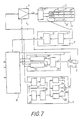
- Fig. 7 is a schematic block diagram of servo control apparatus which can be employed in accordance with an embodiment of the present invention,
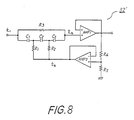
- Fig. 8 is a schematic diagram of a bridged serial T-type notch filter according to an embodiment of the present invention,
- Fig. 9(a) is a graph illustrating frequency characteristics of the filter of Fig. 8,
- Fig. 9(b) is a graph illustrating the effect of the variation of a resistance value on the notch frequency of a filter in accordance with an embodiment of the present invention,
- Fig. 10 is a graph illustrating the effect of varying feedback ratio on the frequency characteristics of a filter in accordance with an embodiment of the present invention,
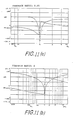
- Figs. 11(a) and 11(b) ane graphs which illustrate phase characteristics of notch filters,
- Figs. 12(a) and 12(b) are schematic circuit diagrams of notch filters in accordance with respective further embodiments of the present invention, and
- Fig. 13 is a schematic circuit diagram of a notch filter in accordance with another embodiment of the present invention.
- Referring to the block diagram of Fig. 7, an apparatus for servo positioning read/write heads of a recording disk system, in which an embodiment of the present invention can be applied, is representatively described hereinafter.
-
Magnetic recording disks 10 are mounted on anaxle 11 driven to spin by aspindle motor 12.Magnetic heads 13 are connected to a coil of avoice coil motor 14. Theheads 13 are moved in an essentially radial direction of thedisks 10 by thevoice coil motor 14. - A position signal generator 7 generates a position signal PS depending on a servo signal SVS produced by one of the
heads 13 which reads servo signals of the track the head is currently on and its adjacent track both recorded on a servo surface (typically the lower surface of the second disk). The position signal generator 7 includes an AGC (automatic gain control) amplifier 70, which keeps the servo signal SVS at an essentially constant amplitude; and a position signal detector 71, which decodes the AGC-controlled servo signal SVS to provide a position signal PS (as shown in Fig. 2). - A
target velocity generator 20 in thevelocity controller 2 generates a target velocity Vc, according to a predetermined schedule that typically consists of a constant acceleration section, a constant velocity section and a constant deceleration section, depending on the number of tracks to be jumped, the number being instructed from acontroller 4. Avelocity signal generator 21 generates a velocity signal Vr, which indicates proportionally the actual velocity of the head depending on the position signal PS and an indication current ii, which indicates proportionally the amplitude of a driving current Im ofvoice coil motor 14 supplied from thepower amplifier 6. Anerror signal generator 22 generates and supplies a velocity error ΔV depending on the difference between the target velocity Vc and the velocity signal Vr to switch 5. Accordingly, thehead 13 driven by thevoice coil motor 14 moves with thus given velocity to the destination track. - The
controller 4 is composed of a microprocessor to receive a seek instruction and a destination track number given from an upper (higher level) processing device and outputs instructions for the seek control. Into thecontroller 4, the position signal PS from the position signal detector 71 and the velocity signal Vr from thevelocity signal generator 21 are input as well, then thecontroller 4 calculates a number of tracks to be jumped, for output to thetarget velocity generator 20. On arrival of thehead 13 at the destination track as shown in Fig. 2, thecontroller 4 detects this fact from the position signal PS and outputs a coarse/fine switching signal MS to theswitch 5, to change the switch from its "a" position to its "b" position, i.e. from thecoarse controller 2 to thefine controller 3, in order to trace the track the head is now on (even when the track is eccentrically rotating). Thecontroller 4 has also a function of outputting a seek end signal to the upper (higher level) processing device when a seek operation is finished. - A
fine controller 3 is composed of: afine position amplifier 30 which generates, in dependence upon the position signal PS, a signal which has a neutral voltage (e.g. zero volts) when the head is located at the centre of a track, and becomes more positive or more negative in proportion to deviation from the centre of the track to one side or the other; aclamp circuit 31, which generates a clamped position signal, this being a modification of the signal output from thefine position amplifier 30 such that it saturates at predetermined positive and negative levels; anotch filter 32, which has a notch frequency equal to a mechanical resonant frequency f₀ of moving parts of the mechanism to be servo controlled, i.e. thevoice coil motor 14, theheads 13 and accessor members connecting the heads to thevoice coil motor 14, so that undesirable oscillation of theheads 13 is prevented. Details of thenotch filter 32 are described below. Asecond filter 33, composed of a low pass filter, is connected to the output of thenotch filter 32 in order to attenuate high-frequency gain of the servo loop so as to remove noise and to achieve a stable servo operation. Aphase compensation circuit 34 is connected to the output of thesecond filter 33 so as to attain a stable quality servo operation. Thephase compensation circuit 34 includes: anintegrator circuit 34a for integrating an output from thesecond filter 33 for integral control; anamplifier 34b for amplifying the output from thesecond filter 33 for proportional control; and adifferentiator circuit 34c for differentiating the output from thesecond filter 33 for derivative control. Anadder circuit 34d adds outputs from theintegrator circuit 34a, theamplifier 34b and thedifferentiator circuit 34c, then outputs the thus derived position error signal ΔP to theswitch 5. - In Fig. 8, there is shown a practical schematic circuit diagram of a bridged serial T-type filter of an embodiment of the present invention, to be used as the
notch filter 32′ in Fig. 7. A serial connection of capacitors C₁, C₂ and C₃ is connected between an input terminal t₁ and an output terminal t₂ of a CR (capacitor, resistor) network. A first resistor R₁ connects a return terminal t₃ and a connection point of the capacitors C₁ and C₂. A second resistor R₂ connects the return terminal t₃ and a connection point of the capacitors C₂ and C₃. Thus, they compose a serial T formation. A third resistor R₃ connects, i.e. bridges, the ends of the serial connection of the capacitors C₁ to C₃. An output from the output terminal t₂ of the CR network is input to an amplifier AMP1 having generally a unity gain. An output of amplifier AMP1 having generally a unity gain. An output of amplifier AMP1 is divided by resistors R₄ and R₅, and the divided output level is input to a second amplifier AMP2 having generally a unity gain. The first amplifier AMP1 isolates the CR network from effects of input impedance of the next stage, i.e. thesecond filter 33, and the divider resistors R₄ and R₅. The output of the second amplifier AMP₂ is connected to the return terminal t₃. - In this bridged serial T-type filter, a notch frequency f₀ at which a gain of the filter is significantly decreased, is given by the following equation, where
C1 = C2 = C3 = C
R₃ = 6 (R₁+R₂) (2)
- Accordingly, the notch frequency can be shifted as shown in Fig. 9(a) from f₀ to f₀′ by changing the resistance values of R₁ and R₂. In a typical case where the capacitance value C₁ = C₂ = C₃ = 2200 pF, resistance value R₃ = 287 k ohm and a partial resistance assigned to R₁ and R₂ is varied while keeping the total resistance value R₁ and R₂ = 47.7 k ohm, the effect of the varied resistance on the notch frequency is shown in Fig. 9(b). As seen in Fig. 9(b), a notch frequency variation of more than 1 kHz is achieved, which is adequate to cover variation of the resonant frequencies (in the servo system).
- The division ratio of the output of the amplifier AMP1 by the resistors R₄ and R₅ determines the feedback ration (R₄/R₄+R₅) to the network. The effects of the feedback ratio on band width of the notch frequency f₀ are shown in Fig. 10, where the values of the elements in the CR network are the same as those mentioned above.
- In Fig. 10 the curves (a) to (e) correspond to feedback ratios 0.15, 0.35, 0.55, 0.75 and 0.95, respectively. As seen in this Figure, the larger the feedback ratio the narrower the band width of the filter, whilst attenuation at the notch frequency is kept essentially constant.
- Attenuation at the notch frequency can also be kept essentially unvaried when notch frequency is varied corresponding to the case of Fig. 9(b). Then, attenuation at the notch frequency can be as much as or more than 40 dB, which is adequate for dampening mechanical resonance in the feedback system, even if some drift of frequency takes place. The bridged T-type filter shown in Fig. 6 achieves only -12 dB at most.
- Phase rotation by the notch filter is a factor to be controlled in the servo control system, particularly at a lower frequency band, typically from 300 to 800 Hz, at which the servo mechanism is driven most often. If phase rotation is excessive in this band the stability of the servo system is deteriorated. Phase characteristics of the notch filter having the above-mentioned element values and a feedback ratio of 0.95 are shown in Fig. 11(a). As seen in these characteristics, the amount of phase rotation at 800 Hz is 10° which is fully satisfactory. For comparison, a similar filter having feedback ratio of zero, i.e. the return terminal t₃ is grounded, is shown in Fig. 11(b). The bridged T-type filter of Fig. 6 can have a problem with phase rotation, as can the filter of Fig. 5(a).
- One practical procedure for adjusting the notch frequency is as follows. Before adjusting the notch frequency of the
notch filter 32, mechanical resonant frequency of the mechanism to be servo controlled is first measured. Withswitch 5 connected to terminal "b", a low-level test signal having frequencies swept from 300 Hz to approximately 5.0 kHz is input to the terminal "b", i.e. an input terminal of thepower amplifier 6, from a signal generator (not shown in the Figure). Then, an output level "x" from thefine position amplifier 30 and the current indication "i" which is proportional to the voice coil current Im, and accordingly indicates the output level of the voice coil current to thepower amplifier 6, are measured for the varied input frequencies. Gain of thepower amplifier 6 and the movable parts of the mechanism, i.e. x/i, is then calculated. The gain versus frequency curve is plotted as shown in Fig. 3. Location of the peak of the gain curve represents the mechanical resonant frequency f₀. Next, the thus obtained resonant frequency f₀ is input into equation (3) to obtain resistance values for R₁ and R₂. The resistors R₁ and R₂ are adjusted to have thus calculated resistance values. - Replacement of only two resistors (according to equation (3)) instead of four elements of the previously proposed twin T-type filter or three elements of the previously proposed bridge T-type filter, considerably reduces working time required for the frequency adjustment of the filter at production or during servicing, which requires exchange of the disk unit.
- Referring to Figs. 12(a) and 12(b), further embodiments of the present invention will be described. In these embodiments the first and second resistors R₁ and R₂ consist of a resistor R₁′ plus an additional resistor R₁˝ (Fig. 12(a)) or an additional resistor R₆′ (Fig. 12(b)); and a resistor R₂′ plus an additional resistor R₂˝ (Fig. 12(a)) or R₇′ (Fig. 12(b)), respectively. The sum of the resistance values of the resistors R₁′, R₂′, R₁˝ (or R₆′) and R₂˝ (or R₇′) are kept essentially to one-sixth of the resistance value R₃ to satisfy equation (2). Adjustment of the notch frequency f₀ is carried out by changing the resistance values of R₁˝ and/or R₂˝ for the configuration of Fig. 12(a), or simply selecting (by means of a switch SW) one of connection points A, B or C (each at an interconnecting point of resistors R₁′, R₆′, R₇′ and R₂′) as the return terminal t₃ to which the feedback from amplifier AMP2 is connected for the configuration of Fig. 12(b). Thus, the resistance values of the first and second resistor R₁ and R₂ of equation (3) are varied.
- Assuming R₂′ = R₁′ + R₆′ + R₇′ for the configuration of Fig. 12(b), and if the switch selects connection point "C", then
R₁ = R₁′ + R₆′ + R₇′
R₂ = R₂′ (4)
Accordingly, the notch frequency becomes the lowest. - If the switch selects connection point "B", then
R₁ = R₁′ + R₆′
R₂ = R2′ + R₇′ (5)
Accordingly, the notch frequency comes higher than that of condition (4). - If the switch selects connection point "A", then
R₁ = R₁′
R₂ = R2′ + R₆′ + R₇′ (6)
Accordingly, the notch frequency becomes the highest. - Thus, notch frequency can be selected to tune to three different frequencies to meet the resonant frequency f₀ of the mechanism of the
magnetic disk unit 1. The number of taps or connection point for additional resistors can be arbitrarily chosen depending on design requirements; that is, two taps between resistors R₁ and R₂′ allow selection of two frequencies, whilst four taps allow selection of four frequencies as well. - The two resistors R˝ and R₂˝ used in Fig. 12(a) may be replaced with a potentiometer-type variable resistor R₈ as shown in Fig. 13. Two fixed ends, denoted by "m" and "n", of the variable resistor R₈ are connected to resistors R₁˝ and R₂′, respectively. The sum of resistance values of resistors R₁′, R₂′ and fixed part of R₈ is essentially one-sixth of that of resistor R₃. A variable terminal "l" of the variable resistor R₈ corresponds to the return terminal t₃ to which the output of the second amplifier AMP2 is connected. Accordingly, frequency adjustment can be effected precisely and efficiently by observing frequency characteristics of the filter on a spectrum analyser display whilst the input frequency to the filter is swept, or by calculation from equation (3).
- As mentioned above, even if disk units are produced to the same design, individual units will have slightly different resonant frequencies from each other. Therefore, frequency adjusting elements, such as two resistors R₆′ and R₇′ used in Fig. 12(a), the resistors R₆′, R₇ and their switch SW used in Fig. 12(B), or the potentiometer-type variable resistor R₈ may be installed in a
circuit board 17 mounted on adisk unit 1, separately from the below-described main portion of the filter, as illustrated in Fig. 13. Fig. 13 illustrates representatively the case where the variable resistor R₈ is employed. In thedisk unit 1, themagnetic recording disks 10, thespindle motor 12, the read/write head 13 and the voice coil motor to drive theheads 13 are also installed. Thedisk unit 1 is detachable from the main chassis of the magnetic disk drive apparatus, for facilitating replacement of recorded disks or servicing of a defective unit. The main portion of thenotch filter 32, including the elements which require no adjustment, such as capacitors C₁ to C₃, resistors R₁′, R₂′ and R₃, the amplifiers AMP1 and 2, are installed on a printed circuit board (which is givenreference numeral 32˝ in Fig. 13) in a main chassis of the magnetic disk drive apparatus. In the main chassis of the magnetic disk drive apparatus, the resistance values and the capacitance values of the filter can be kept essentially same and constant for each product. Therefore, in a factory where a new disk unit is completed, each one of the completedunits 1 is first mounted in the main chassis of the magnetic recording apparatus, as an adjusting jig. Next, the mechanical resonance characteristics of the unit is measured according, for example, to the method described above. Then, the resistors R₁˝ and R₂′ or the variable resistor R₈ installed in theunit 1 is adjusted so that the notch frequency is tuned to the mechanical resonant frequency of this mounted unit according to the above-described method. Next, thedisk unit 1 is removed from the main chassis, so as to be a stock for shipment. When a defective disk unit is to be replaced with a new unit in field, i.e. for servicing, the new unit needs no more frequency adjustment, resulting in efficient servicing. - Furthermore, the electronic circuit installed in the
disk unit 1, which must be replaced upon servicing, can be made less expensive, because the main portion of the filter does not have to be exchanged. Therefore, servicing costs can be reduced both in terms of time required and hardware cost. - Although in the above description relating to embodiments of the invention it is indicated that a single notch filter is employed in the
fine controller 3, a mechanism (servo system) generally has two or more resonances. In this case, the notch filter is typically tuned to the major one of the resonances. Alternatively, there may be provided a plurality of notch filters. - Although in the above description relating to embodiments of the invention it is indicated that a first amplifier AMP1 is provided to isolate the CR network from the effects of the dividing resistors and the input impedance of the
second filter 33, the first amplifier AMP1 may be omitted, as long as the effects of the dividing resistors and the input impedance of thesecond filter 33 are negligible or within a degree adjustable by the CR network. - Although in the above description relating to embodiments of the invention it is indicated that a second amplifier AMP2 is provided to isolate the network from the effects of the dividing resistors, the second amplifier AMP2 may be omitted, as long as the effects of the dividing resistors is negligible or within a degree adjustable by the CR network.
- Although it is indicated in the above description relating to embodiments of the invention that the capacitance values of the capacitors C₁ to C₃ are chosen essentially equal, the capacitance values may be different from each other as long as the effects of the different capacitances is negligible or within a degree adjustable by the CR network.
- Although it is indicated in the above description relating to embodiments of the invention that the sum of the resistance values of the capacitors R₁ and R₂ is chosen essentially one-sixth of the resistance values of the resistor R₃, the resistance values may be deviated from this condition as long as the effect is negligible or within a degree adjustable by the network.
- Although reference is made above to the use of embodiments of the invention in relation to magnetic disk drive apparatus, this use is merely representative or exemplary. Embodiments of the invention are applicable to servo positioning apparatus in any other kind of system, such as an optically recording disk apparatus, etc.
- In an embodiment of the present invention, a notch filter, used in a servo loop, for dampening a mechanical resonance of moving parts of the mechanism to be servo controlled, is composed of a serial T-type filter, that is a CR network including a serial connection of first to third capacitors connected between an input terminal of the filter and an output terminal of the CR network; a first resistor connected between a return terminal of the CR network and an interconnection of the first and second capacitors; a second resistor connected between the return terminal and an interconnection of the second and third capacitors; and a third resistor connected in parallel to the three serial capacitors. The notch frequency is adjusted by varying the resistance values of the first and second resistors. The first and second resistors may be composed of fixed resistors and/or potentiometer-type variable resistors. An output from the CR network may be divided to be fed back to the return terminal. Isolation amplifiers may be added to the output circuit and the feedback circuit to the return terminal. Only the resistor(s) for adjusting the notch frequency may be separately installed in a detachable disk unit including the mechanism to be servo controlled. The notch frequency can be efficiently adjusted by replacing only two fixed resistors or adjusting a variable resistor, and the cost of the disk unit can be reduced.
- The present invention provides servo positioning apparatus having a mechanism for positioning an object, for example a magnetic head in a magnetic disk recording system, and a controller for providing a servo signal derived from a position signal representing position of the object, for example relative to a track to be traced on a disk. The controller has a notch filter, the notch frequency of which corresponds to a resonance of the mechanism.
- Components of the notch filter network, for example resistors, which can be exchanged or varied, to alter the notch frequency, are separately installed from other components, so that they may be more easily accessed or exchanged, without need to access or exchange the other components.
- For example, the notch filter has a bridged serial T configuration with a series connection of capacitors, for example three capacitors, with a parallel-connected resistor, and with further resistors connected respectively to interconnection points between successive capacitors of the series.
- Notch frequency can be altered by exchanging or varying these further resistors, which are thus the components to be separately mounted.
Claims (26)
a mechanism for positioning an object, the mechanism having a resonant frequency; and
a controller for providing a servo signal derived from a position signal representing position of the object, for example relative to a track to be traced by the object, said controller including:-
a bridged serial T-type notch filter having a notch frequency substantially equal to said resonant frequency.
first to third capacitors connected in a series circuit bridging an input terminal of said network and an output terminal of said network;
a first resistor connected between a third terminal of said network and an interconnection point of said first and second capacitors;
a second resistor connected between said third terminal and an interconnection point of said second and third capacitors; and
a third resistor connected in parallel to said series circuit of said first to third capacitors.
a mechanism for positioning an object, the mechanism being installed in a unit detachable from other portions of the apparatus, the mechanism having a resonant frequency; and
a controller for providing a servo signal derived from a position signal representing position of the object, for example relative to a track to be traced by the object, said controller including:
a notch filter having a notch frequency substantially equal to said resonant frequency, an element for tuning said notch frequency being separately installed in said unit.
first to third capacitors connected in a series circuit bridging an input terminal of said network and an output terminal of said network;
a first resistor connected in parallel to said series circuit of said first to third capacitors;
a second resistor connected between a third terminal of said network and an interconnection point of said first and second capacitors;
a third resistor connected between a fourth terminal of said network and an interconnection point of said second and third capacitors; and
fourth and fifth resistors serially connected between said third and fourth terminals, said fourth and fifth resistors being installed in said detachable unit, an output signal from said output terminal being fed back to a fifth terminal which is at an interconnection point of said fourth and fifth resistors.
a mechanism for positioning an object, said mechanism being installed in a disk unit, said mechanism having a resonant frequency; and
a controller for providing a servo signal derived from a position signal representing position of the object relative to a track to be traced by the object, said controller including:-
a bridged serial T-type notch filter having a notch frequency substantially equal to said resonant frequency, said filter comprising a network composed of:-
a serial circuit of first to third capacitors connecting an input terminal of said network and an output terminal of said network;
a first resistor connected in parallel to said serial circuit of said first to third capacitors; and
second and third resistors serially connected between a third terminal of said network and an interconnection point of said first and second capacitors, an end of said third resistor being connected to said third terminal; and
fourth and fifth resistors serially connected between said third terminal and an interconnection point of said second and third capacitors, an end of said fifth resistor being connected to said third terminal, said third and fifth resistor being separately installed in said disk unit.
a phase compensation circuit for adjusting phase characteristics of the servo loop.
Applications Claiming Priority (2)
| Application Number | Priority Date | Filing Date | Title |
|---|---|---|---|
| JP63056979A JPH0820905B2 (en) | 1988-03-10 | 1988-03-10 | Servo positioning device |
| JP56979/88 | 1988-03-10 |
Publications (3)
| Publication Number | Publication Date |
|---|---|
| EP0332200A2 true EP0332200A2 (en) | 1989-09-13 |
| EP0332200A3 EP0332200A3 (en) | 1989-11-29 |
| EP0332200B1 EP0332200B1 (en) | 1995-05-03 |
Family
ID=13042626
Family Applications (1)
| Application Number | Title | Priority Date | Filing Date |
|---|---|---|---|
| EP89104221A Expired - Lifetime EP0332200B1 (en) | 1988-03-10 | 1989-03-09 | Servo positioning apparatus |
Country Status (5)
| Country | Link |
|---|---|
| US (1) | US4963806A (en) |
| EP (1) | EP0332200B1 (en) |
| JP (1) | JPH0820905B2 (en) |
| KR (1) | KR920003996B1 (en) |
| DE (1) | DE68922425T2 (en) |
Cited By (3)
| Publication number | Priority date | Publication date | Assignee | Title |
|---|---|---|---|---|
| EP0577839A4 (en) * | 1992-01-23 | 1994-03-23 | Fanuc Ltd. | |
| FR2810419A1 (en) * | 2000-06-19 | 2001-12-21 | Lucas Aerospace Fcs | POSITION CERVO-CONTROL DEVICE, IN PARTICULAR FOR AN AIRCRAFT FLIGHT CONTROL ACTUATOR |
| GB2357893B (en) * | 1998-06-26 | 2002-12-11 | Seagate Technology Llc | Improved notch filtering as used in a disc drive servo |
Families Citing this family (33)
| Publication number | Priority date | Publication date | Assignee | Title |
|---|---|---|---|---|
| JPH02278582A (en) * | 1989-04-20 | 1990-11-14 | Fujitsu Ltd | Position control circuit |
| JP3064336B2 (en) * | 1989-06-28 | 2000-07-12 | 株式会社日立製作所 | Information handling device and disk device |
| JP2774327B2 (en) * | 1989-10-06 | 1998-07-09 | 日本電信電話株式会社 | Positioning device |
| US5231550A (en) * | 1990-03-12 | 1993-07-27 | Fujitsu Limited | Track access control system preventing unintentional delay in movement of head in non-adjusted disc device |
| JP2504307B2 (en) * | 1990-08-01 | 1996-06-05 | 三菱電機株式会社 | Electric motor speed controller |
| JPH04178185A (en) * | 1990-11-07 | 1992-06-25 | Matsushita Electric Ind Co Ltd | Drive device for electromechanical transducer |
| US5459383A (en) * | 1991-02-07 | 1995-10-17 | Quantum Corporation | Robust active damping control system |
| US5206570A (en) * | 1991-03-19 | 1993-04-27 | Maxtor Corporation | Actuator servo compensation method |
| US5220262A (en) * | 1992-02-25 | 1993-06-15 | Cincinnati Milacron, Inc. | Method and apparatus for reducing cross-coupled movement through the structural dynamics of a computer numerically controlled machine |
| WO1994001861A1 (en) * | 1992-07-10 | 1994-01-20 | Wangtek, Inc. | Servo controlled magnetic head positioner |
| US5325247A (en) * | 1992-11-12 | 1994-06-28 | Quantum Corporation | Digital multi-rate notch filter for sampled servo digital control system |
| EP0686971B1 (en) * | 1994-06-07 | 2002-02-06 | Hitachi, Ltd. | Information storing device and method for controlling same to record/reproduce information by selecting one of working modes |
| US5671098A (en) * | 1995-06-01 | 1997-09-23 | Maxtor Corporation | Adaptive preamplifier for resonance tuning useful in a disk drive |
| US6122125A (en) * | 1997-08-28 | 2000-09-19 | International Business Machines Corporation | Head selectable servo notch filter and method for improving servo system performance |
| US6107767A (en) * | 1998-03-20 | 2000-08-22 | Trw Inc. | Electric assist steering system having an improved motor current controller with notch filter |
| US7483232B2 (en) * | 1999-03-04 | 2009-01-27 | Convolve, Inc. | Dynamic system control method |
| JP2000322105A (en) * | 1999-05-07 | 2000-11-24 | Toshiba Mach Co Ltd | Servo controller and method for stabilizing and adjusting servo controller |
| US6643080B1 (en) | 1999-08-25 | 2003-11-04 | Seagate Technology Llc | Resonance identification by commanding a spindle speed change |
| US6774598B1 (en) * | 1999-09-08 | 2004-08-10 | Dr. Johannes Heidenhain Gmbh | Method and circuitry for producing nominal position values for a closed loop position control of a numerically continuous-path controlled machine |
| US6624607B1 (en) * | 1999-11-18 | 2003-09-23 | Parker-Hannifin Corporation | Energy-absorbing filter for a motor |
| JP4691753B2 (en) * | 2000-03-31 | 2011-06-01 | ソニー株式会社 | Sound quality adjustment circuit |
| WO2001097215A1 (en) * | 2000-06-09 | 2001-12-20 | Seagate Technology Llc | Reducing actuator arm oscillation during settle mode in a disc drive servo system |
| JP3699882B2 (en) * | 2000-06-26 | 2005-09-28 | 株式会社日立グローバルストレージテクノロジーズ | Head positioning device |
| JP3975812B2 (en) * | 2001-08-17 | 2007-09-12 | 株式会社安川電機 | Resonant frequency detection device for motor control device |
| JP4110358B2 (en) * | 2001-09-04 | 2008-07-02 | 株式会社安川電機 | Machine model estimation device for motor controller |
| WO2003030170A1 (en) | 2001-10-02 | 2003-04-10 | Seagate Technology Llc | A phase-advanced filter for robust resonance cancellation |
| JP3956120B2 (en) | 2002-08-23 | 2007-08-08 | インターナショナル・ビジネス・マシーンズ・コーポレーション | Data storage device, servo control method and program |
| US6836032B2 (en) * | 2002-11-14 | 2004-12-28 | Levram Medical Systems, Ltd. | Electromagnetic moving-coil device |
| US6958879B2 (en) * | 2003-07-10 | 2005-10-25 | Samsung Electronics Co., Ltd. | Method and apparatus reducing off track head motion due to disk vibration in a hard disk drive using configuration of the disk drive servo controller |
| US7136260B2 (en) * | 2003-07-10 | 2006-11-14 | Samsung Electronics Co., Ltd. | Method and apparatus reducing off track head motion due to disk vibration in a hard disk drive through the head gimbal assembly |
| JPWO2008146365A1 (en) * | 2007-05-29 | 2010-08-12 | 東芝ストレージデバイス株式会社 | Controller and storage device |
| JP5778925B2 (en) * | 2010-12-24 | 2015-09-16 | セミコンダクター・コンポーネンツ・インダストリーズ・リミテッド・ライアビリティ・カンパニー | Motor drive circuit |
| WO2015190971A1 (en) * | 2014-06-11 | 2015-12-17 | Catena Wireless Electronics Ab | Method for using an accurate adjustable high-frequency phase-detector |
Family Cites Families (10)
| Publication number | Priority date | Publication date | Assignee | Title |
|---|---|---|---|---|
| US2996689A (en) * | 1960-05-24 | 1961-08-15 | Donald W F Janz | Constant d.-c. resistance frequency variable t-t notch network |
| GB1577132A (en) * | 1976-03-19 | 1980-10-22 | Rca Corp | Compensation apparatus for a servo system with periodic command signals |
| US4268785A (en) * | 1979-09-13 | 1981-05-19 | Ampex Corporation | Transient overshoot, undershoot and delay compensation circuit in systems comprising reactive filter networks |
| US4540946A (en) * | 1980-06-06 | 1985-09-10 | National Research Development Corp. | Variable characteristic filters |
| JPS5868316A (en) * | 1981-10-19 | 1983-04-23 | Nippon Koden Corp | Notch filter |
| JPS6014525U (en) * | 1983-07-07 | 1985-01-31 | 日本光電工業株式会社 | notsuchi filter |
| JPH0626039B2 (en) * | 1983-10-31 | 1994-04-06 | ソニー株式会社 | Displacement drive device for magnetic head |
| US4638384A (en) * | 1985-11-19 | 1987-01-20 | Rodime, Plc | Head positioning mechanism for rotating disk data storage system |
| JPH0664481B2 (en) * | 1985-11-27 | 1994-08-22 | オムロン株式会社 | XY stage control device |
| JPS62269203A (en) * | 1986-05-16 | 1987-11-21 | Fujitsu Ltd | Notch filter adjusting method for positioning control system |
-
1988
- 1988-03-10 JP JP63056979A patent/JPH0820905B2/en not_active Expired - Fee Related
-
1989
- 1989-02-24 KR KR1019890002216A patent/KR920003996B1/en not_active Expired
- 1989-03-09 DE DE68922425T patent/DE68922425T2/en not_active Expired - Fee Related
- 1989-03-09 US US07/321,108 patent/US4963806A/en not_active Expired - Lifetime
- 1989-03-09 EP EP89104221A patent/EP0332200B1/en not_active Expired - Lifetime
Cited By (4)
| Publication number | Priority date | Publication date | Assignee | Title |
|---|---|---|---|---|
| EP0577839A4 (en) * | 1992-01-23 | 1994-03-23 | Fanuc Ltd. | |
| GB2357893B (en) * | 1998-06-26 | 2002-12-11 | Seagate Technology Llc | Improved notch filtering as used in a disc drive servo |
| FR2810419A1 (en) * | 2000-06-19 | 2001-12-21 | Lucas Aerospace Fcs | POSITION CERVO-CONTROL DEVICE, IN PARTICULAR FOR AN AIRCRAFT FLIGHT CONTROL ACTUATOR |
| EP1168132A1 (en) * | 2000-06-19 | 2002-01-02 | TRW Systemes Aeronautiques Civils | Position servo-control device, in particular for aircraft flight control actuator |
Also Published As
| Publication number | Publication date |
|---|---|
| US4963806A (en) | 1990-10-16 |
| KR920003996B1 (en) | 1992-05-21 |
| KR890015252A (en) | 1989-10-28 |
| JPH0820905B2 (en) | 1996-03-04 |
| EP0332200A3 (en) | 1989-11-29 |
| JPH01230109A (en) | 1989-09-13 |
| DE68922425T2 (en) | 1995-09-07 |
| DE68922425D1 (en) | 1995-06-08 |
| EP0332200B1 (en) | 1995-05-03 |
Similar Documents
| Publication | Publication Date | Title |
|---|---|---|
| EP0332200B1 (en) | Servo positioning apparatus | |
| US7054094B2 (en) | Real-time automatic loop-shaping for a disc drive servo control system | |
| US5063454A (en) | Automatic adjustment method and system for servo motor circuit of a magnetic disk apparatus | |
| EP0509545B1 (en) | A magnetic head position controller in a magnetic recording and reproducing apparatus | |
| EP0378329B1 (en) | Servo circuit for magnetic disk apparatus | |
| US5867342A (en) | Tracking servo system for magnetic disc drive with reduced head-settling time | |
| EP0025606B1 (en) | Apparatus for compensation of overshoot, undershoot and delay in response to step signals in a system comprising a reactive filter network | |
| US5105318A (en) | Head positioning device for use in magnetic disk equipment | |
| US4246536A (en) | Electronic velocity measurement device | |
| US5742568A (en) | Tracking controller and seek controller for optical recording device | |
| US6765749B2 (en) | Frequency attenuating filter apparatus and method for a data storage device | |
| US5206570A (en) | Actuator servo compensation method | |
| EP0453223B1 (en) | Automatic loop gain control apparatus | |
| JP2970679B2 (en) | Head positioning control device | |
| US5138595A (en) | Servo control circuit for optical disc apparatus | |
| US4389683A (en) | Switch-tuned filters | |
| EP0465159B1 (en) | Data recording apparatus | |
| US6445526B1 (en) | Reproducing apparatus capable of controlling amplitude and phase characteristics of reproduced signals | |
| JP2938475B2 (en) | Optical head positioning method for optical disk recording / reproducing device | |
| WO2001065690A1 (en) | Self-tracking filter | |
| CA1136763A (en) | Transient overshoot, undershoot and delay compensation circuit in systems comprising reactive filter networks | |
| KR910004536B1 (en) | Track-off detection and correction circuit of magnetic disk recording device | |
| SU1610493A1 (en) | Device for checking parameters of magnetic heads | |
| EP0458565A2 (en) | Servo controlled positioning system | |
| JPH04368683A (en) | Servo circuit |
Legal Events
| Date | Code | Title | Description |
|---|---|---|---|
| PUAI | Public reference made under article 153(3) epc to a published international application that has entered the european phase |
Free format text: ORIGINAL CODE: 0009012 |
|
| AK | Designated contracting states |
Kind code of ref document: A2 Designated state(s): DE FR GB IT |
|
| PUAL | Search report despatched |
Free format text: ORIGINAL CODE: 0009013 |
|
| AK | Designated contracting states |
Kind code of ref document: A3 Designated state(s): DE FR GB IT |
|
| 17P | Request for examination filed |
Effective date: 19900215 |
|
| 17Q | First examination report despatched |
Effective date: 19921208 |
|
| GRAA | (expected) grant |
Free format text: ORIGINAL CODE: 0009210 |
|
| AK | Designated contracting states |
Kind code of ref document: B1 Designated state(s): DE FR GB IT |
|
| REF | Corresponds to: |
Ref document number: 68922425 Country of ref document: DE Date of ref document: 19950608 |
|
| ITF | It: translation for a ep patent filed | ||
| ET | Fr: translation filed | ||
| PLBE | No opposition filed within time limit |
Free format text: ORIGINAL CODE: 0009261 |
|
| STAA | Information on the status of an ep patent application or granted ep patent |
Free format text: STATUS: NO OPPOSITION FILED WITHIN TIME LIMIT |
|
| 26N | No opposition filed | ||
| REG | Reference to a national code |
Ref country code: GB Ref legal event code: IF02 |
|
| PGFP | Annual fee paid to national office [announced via postgrant information from national office to epo] |
Ref country code: DE Payment date: 20050304 Year of fee payment: 17 |
|
| PGFP | Annual fee paid to national office [announced via postgrant information from national office to epo] |
Ref country code: FR Payment date: 20050308 Year of fee payment: 17 |
|
| PG25 | Lapsed in a contracting state [announced via postgrant information from national office to epo] |
Ref country code: IT Free format text: LAPSE BECAUSE OF NON-PAYMENT OF DUE FEES Effective date: 20050309 |
|
| PGFP | Annual fee paid to national office [announced via postgrant information from national office to epo] |
Ref country code: GB Payment date: 20050309 Year of fee payment: 17 |
|
| PG25 | Lapsed in a contracting state [announced via postgrant information from national office to epo] |
Ref country code: GB Free format text: LAPSE BECAUSE OF NON-PAYMENT OF DUE FEES Effective date: 20060309 |
|
| PG25 | Lapsed in a contracting state [announced via postgrant information from national office to epo] |
Ref country code: DE Free format text: LAPSE BECAUSE OF NON-PAYMENT OF DUE FEES Effective date: 20061003 |
|
| GBPC | Gb: european patent ceased through non-payment of renewal fee |
Effective date: 20060309 |
|
| REG | Reference to a national code |
Ref country code: FR Ref legal event code: ST Effective date: 20061130 |
|
| PG25 | Lapsed in a contracting state [announced via postgrant information from national office to epo] |
Ref country code: FR Free format text: LAPSE BECAUSE OF NON-PAYMENT OF DUE FEES Effective date: 20060331 |