EP0332015B1 - Adhesive - Google Patents
Adhesive Download PDFInfo
- Publication number
- EP0332015B1 EP0332015B1 EP89103448A EP89103448A EP0332015B1 EP 0332015 B1 EP0332015 B1 EP 0332015B1 EP 89103448 A EP89103448 A EP 89103448A EP 89103448 A EP89103448 A EP 89103448A EP 0332015 B1 EP0332015 B1 EP 0332015B1
- Authority
- EP
- European Patent Office
- Prior art keywords
- carbon atoms
- alkyl
- adhesive
- radical
- mixture
- Prior art date
- Legal status (The legal status is an assumption and is not a legal conclusion. Google has not performed a legal analysis and makes no representation as to the accuracy of the status listed.)
- Expired - Lifetime
Links
- 239000000853 adhesive Substances 0.000 title claims abstract description 20
- 230000001070 adhesive effect Effects 0.000 title claims abstract description 20
- 239000000203 mixture Substances 0.000 claims abstract description 23
- 125000004432 carbon atom Chemical group C* 0.000 claims abstract description 19
- 125000000217 alkyl group Chemical group 0.000 claims abstract description 14
- 150000001875 compounds Chemical class 0.000 claims abstract description 6
- 239000000654 additive Substances 0.000 claims abstract description 4
- 229910052760 oxygen Inorganic materials 0.000 claims abstract description 4
- 239000001301 oxygen Substances 0.000 claims abstract description 4
- 125000003545 alkoxy group Chemical group 0.000 claims abstract description 3
- 125000004849 alkoxymethyl group Chemical group 0.000 claims abstract description 3
- QVGXLLKOCUKJST-UHFFFAOYSA-N atomic oxygen Chemical compound [O] QVGXLLKOCUKJST-UHFFFAOYSA-N 0.000 claims abstract description 3
- 239000006185 dispersion Substances 0.000 claims description 24
- 239000004815 dispersion polymer Substances 0.000 claims description 4
- FBPFZTCFMRRESA-JGWLITMVSA-N D-glucitol Chemical compound OC[C@H](O)[C@@H](O)[C@H](O)[C@H](O)CO FBPFZTCFMRRESA-JGWLITMVSA-N 0.000 claims description 2
- 239000011230 binding agent Substances 0.000 claims description 2
- 125000003302 alkenyloxy group Chemical group 0.000 claims 1
- 239000002562 thickening agent Substances 0.000 abstract description 17
- 229920000642 polymer Polymers 0.000 abstract description 15
- LFQSCWFLJHTTHZ-UHFFFAOYSA-N Ethanol Chemical compound CCO LFQSCWFLJHTTHZ-UHFFFAOYSA-N 0.000 abstract description 5
- 239000000839 emulsion Substances 0.000 abstract 1
- -1 alkenyloxy radical Chemical class 0.000 description 15
- 229920001577 copolymer Polymers 0.000 description 13
- 229920005862 polyol Polymers 0.000 description 10
- 238000009472 formulation Methods 0.000 description 8
- 239000011521 glass Substances 0.000 description 8
- PPBRXRYQALVLMV-UHFFFAOYSA-N Styrene Chemical compound C=CC1=CC=CC=C1 PPBRXRYQALVLMV-UHFFFAOYSA-N 0.000 description 6
- 125000002947 alkylene group Chemical group 0.000 description 5
- 239000007788 liquid Substances 0.000 description 5
- KAKZBPTYRLMSJV-UHFFFAOYSA-N Butadiene Chemical compound C=CC=C KAKZBPTYRLMSJV-UHFFFAOYSA-N 0.000 description 4
- IAYPIBMASNFSPL-UHFFFAOYSA-N Ethylene oxide Chemical compound C1CO1 IAYPIBMASNFSPL-UHFFFAOYSA-N 0.000 description 4
- 239000004721 Polyphenylene oxide Substances 0.000 description 4
- NIXOWILDQLNWCW-UHFFFAOYSA-N acrylic acid group Chemical group C(C=C)(=O)O NIXOWILDQLNWCW-UHFFFAOYSA-N 0.000 description 4
- CQEYYJKEWSMYFG-UHFFFAOYSA-N butyl acrylate Chemical compound CCCCOC(=O)C=C CQEYYJKEWSMYFG-UHFFFAOYSA-N 0.000 description 4
- GYZLOYUZLJXAJU-UHFFFAOYSA-N diglycidyl ether Chemical class C1OC1COCC1CO1 GYZLOYUZLJXAJU-UHFFFAOYSA-N 0.000 description 4
- 150000002118 epoxides Chemical class 0.000 description 4
- 239000003292 glue Substances 0.000 description 4
- 238000004519 manufacturing process Methods 0.000 description 4
- 238000004806 packaging method and process Methods 0.000 description 4
- 229920000570 polyether Polymers 0.000 description 4
- 150000003077 polyols Chemical class 0.000 description 4
- LYCAIKOWRPUZTN-UHFFFAOYSA-N Ethylene glycol Chemical compound OCCO LYCAIKOWRPUZTN-UHFFFAOYSA-N 0.000 description 3
- PEDCQBHIVMGVHV-UHFFFAOYSA-N Glycerine Chemical compound OCC(O)CO PEDCQBHIVMGVHV-UHFFFAOYSA-N 0.000 description 3
- GOOHAUXETOMSMM-UHFFFAOYSA-N Propylene oxide Chemical compound CC1CO1 GOOHAUXETOMSMM-UHFFFAOYSA-N 0.000 description 3
- XTXRWKRVRITETP-UHFFFAOYSA-N Vinyl acetate Chemical compound CC(=O)OC=C XTXRWKRVRITETP-UHFFFAOYSA-N 0.000 description 3
- 238000004026 adhesive bonding Methods 0.000 description 3
- MTHSVFCYNBDYFN-UHFFFAOYSA-N diethylene glycol Chemical compound OCCOCCO MTHSVFCYNBDYFN-UHFFFAOYSA-N 0.000 description 3
- 150000002334 glycols Chemical class 0.000 description 3
- 239000000123 paper Substances 0.000 description 3
- 150000003254 radicals Chemical group 0.000 description 3
- 239000004753 textile Substances 0.000 description 3
- 230000008719 thickening Effects 0.000 description 3
- 125000000391 vinyl group Chemical group [H]C([*])=C([H])[H] 0.000 description 3
- 229920002554 vinyl polymer Polymers 0.000 description 3
- XLYOFNOQVPJJNP-UHFFFAOYSA-N water Substances O XLYOFNOQVPJJNP-UHFFFAOYSA-N 0.000 description 3
- 239000002023 wood Substances 0.000 description 3
- PUPZLCDOIYMWBV-UHFFFAOYSA-N (+/-)-1,3-Butanediol Chemical compound CC(O)CCO PUPZLCDOIYMWBV-UHFFFAOYSA-N 0.000 description 2
- SMZOUWXMTYCWNB-UHFFFAOYSA-N 2-(2-methoxy-5-methylphenyl)ethanamine Chemical compound COC1=CC=C(C)C=C1CCN SMZOUWXMTYCWNB-UHFFFAOYSA-N 0.000 description 2
- HOSGXJWQVBHGLT-UHFFFAOYSA-N 6-hydroxy-3,4-dihydro-1h-quinolin-2-one Chemical group N1C(=O)CCC2=CC(O)=CC=C21 HOSGXJWQVBHGLT-UHFFFAOYSA-N 0.000 description 2
- NLHHRLWOUZZQLW-UHFFFAOYSA-N Acrylonitrile Chemical compound C=CC#N NLHHRLWOUZZQLW-UHFFFAOYSA-N 0.000 description 2
- WYURNTSHIVDZCO-UHFFFAOYSA-N Tetrahydrofuran Chemical compound C1CCOC1 WYURNTSHIVDZCO-UHFFFAOYSA-N 0.000 description 2
- 150000001298 alcohols Chemical class 0.000 description 2
- 125000003342 alkenyl group Chemical group 0.000 description 2
- 229920001400 block copolymer Polymers 0.000 description 2
- WERYXYBDKMZEQL-UHFFFAOYSA-N butane-1,4-diol Chemical compound OCCCCO WERYXYBDKMZEQL-UHFFFAOYSA-N 0.000 description 2
- 125000003178 carboxy group Chemical group [H]OC(*)=O 0.000 description 2
- 239000005018 casein Substances 0.000 description 2
- BECPQYXYKAMYBN-UHFFFAOYSA-N casein, tech. Chemical compound NCCCCC(C(O)=O)N=C(O)C(CC(O)=O)N=C(O)C(CCC(O)=N)N=C(O)C(CC(C)C)N=C(O)C(CCC(O)=O)N=C(O)C(CC(O)=O)N=C(O)C(CCC(O)=O)N=C(O)C(C(C)O)N=C(O)C(CCC(O)=N)N=C(O)C(CCC(O)=N)N=C(O)C(CCC(O)=N)N=C(O)C(CCC(O)=O)N=C(O)C(CCC(O)=O)N=C(O)C(COP(O)(O)=O)N=C(O)C(CCC(O)=N)N=C(O)C(N)CC1=CC=CC=C1 BECPQYXYKAMYBN-UHFFFAOYSA-N 0.000 description 2
- 235000021240 caseins Nutrition 0.000 description 2
- 239000001913 cellulose Substances 0.000 description 2
- 229920002678 cellulose Polymers 0.000 description 2
- 238000006243 chemical reaction Methods 0.000 description 2
- 230000000694 effects Effects 0.000 description 2
- 150000002191 fatty alcohols Chemical class 0.000 description 2
- 125000002887 hydroxy group Chemical group [H]O* 0.000 description 2
- 238000003475 lamination Methods 0.000 description 2
- 239000004014 plasticizer Substances 0.000 description 2
- YPFDHNVEDLHUCE-UHFFFAOYSA-N propane-1,3-diol Chemical compound OCCCO YPFDHNVEDLHUCE-UHFFFAOYSA-N 0.000 description 2
- 238000010791 quenching Methods 0.000 description 2
- 229920005604 random copolymer Polymers 0.000 description 2
- 229920005989 resin Polymers 0.000 description 2
- 239000011347 resin Substances 0.000 description 2
- 150000003839 salts Chemical class 0.000 description 2
- 239000007787 solid Substances 0.000 description 2
- 239000002904 solvent Substances 0.000 description 2
- 239000000758 substrate Substances 0.000 description 2
- ORTVZLZNOYNASJ-UPHRSURJSA-N (z)-but-2-ene-1,4-diol Chemical compound OC\C=C/CO ORTVZLZNOYNASJ-UPHRSURJSA-N 0.000 description 1
- RBACIKXCRWGCBB-UHFFFAOYSA-N 1,2-Epoxybutane Chemical compound CCC1CO1 RBACIKXCRWGCBB-UHFFFAOYSA-N 0.000 description 1
- DSZTYVZOIUIIGA-UHFFFAOYSA-N 1,2-Epoxyhexadecane Chemical compound CCCCCCCCCCCCCCC1CO1 DSZTYVZOIUIIGA-UHFFFAOYSA-N 0.000 description 1
- PQXKWPLDPFFDJP-UHFFFAOYSA-N 2,3-dimethyloxirane Chemical compound CC1OC1C PQXKWPLDPFFDJP-UHFFFAOYSA-N 0.000 description 1
- ARPLRHRVUYILPU-UHFFFAOYSA-N 2-(2-hexyldodecoxymethyl)oxirane Chemical compound CCCCCCCCCCC(CCCCCC)COCC1CO1 ARPLRHRVUYILPU-UHFFFAOYSA-N 0.000 description 1
- GOXQRTZXKQZDDN-UHFFFAOYSA-N 2-Ethylhexyl acrylate Chemical compound CCCCC(CC)COC(=O)C=C GOXQRTZXKQZDDN-UHFFFAOYSA-N 0.000 description 1
- MPGABYXKKCLIRW-UHFFFAOYSA-N 2-decyloxirane Chemical compound CCCCCCCCCCC1CO1 MPGABYXKKCLIRW-UHFFFAOYSA-N 0.000 description 1
- NJWSNNWLBMSXQR-UHFFFAOYSA-N 2-hexyloxirane Chemical compound CCCCCCC1CO1 NJWSNNWLBMSXQR-UHFFFAOYSA-N 0.000 description 1
- QTBSBXVTEAMEQO-UHFFFAOYSA-M Acetate Chemical compound CC([O-])=O QTBSBXVTEAMEQO-UHFFFAOYSA-M 0.000 description 1
- FBPFZTCFMRRESA-FSIIMWSLSA-N D-Glucitol Natural products OC[C@H](O)[C@H](O)[C@@H](O)[C@H](O)CO FBPFZTCFMRRESA-FSIIMWSLSA-N 0.000 description 1
- MYMOFIZGZYHOMD-UHFFFAOYSA-N Dioxygen Chemical compound O=O MYMOFIZGZYHOMD-UHFFFAOYSA-N 0.000 description 1
- SNRUBQQJIBEYMU-UHFFFAOYSA-N Dodecane Natural products CCCCCCCCCCCC SNRUBQQJIBEYMU-UHFFFAOYSA-N 0.000 description 1
- BRLQWZUYTZBJKN-UHFFFAOYSA-N Epichlorohydrin Chemical compound ClCC1CO1 BRLQWZUYTZBJKN-UHFFFAOYSA-N 0.000 description 1
- VGGSQFUCUMXWEO-UHFFFAOYSA-N Ethene Chemical compound C=C VGGSQFUCUMXWEO-UHFFFAOYSA-N 0.000 description 1
- 239000005977 Ethylene Substances 0.000 description 1
- 240000000731 Fagus sylvatica Species 0.000 description 1
- 235000010099 Fagus sylvatica Nutrition 0.000 description 1
- WQZGKKKJIJFFOK-GASJEMHNSA-N Glucose Natural products OC[C@H]1OC(O)[C@H](O)[C@@H](O)[C@@H]1O WQZGKKKJIJFFOK-GASJEMHNSA-N 0.000 description 1
- 239000004354 Hydroxyethyl cellulose Substances 0.000 description 1
- 229920000663 Hydroxyethyl cellulose Polymers 0.000 description 1
- WHNWPMSKXPGLAX-UHFFFAOYSA-N N-Vinyl-2-pyrrolidone Chemical compound C=CN1CCCC1=O WHNWPMSKXPGLAX-UHFFFAOYSA-N 0.000 description 1
- 239000004820 Pressure-sensitive adhesive Substances 0.000 description 1
- 102100040678 Programmed cell death protein 1 Human genes 0.000 description 1
- 101710089372 Programmed cell death protein 1 Proteins 0.000 description 1
- UWHCKJMYHZGTIT-UHFFFAOYSA-N Tetraethylene glycol, Natural products OCCOCCOCCOCCO UWHCKJMYHZGTIT-UHFFFAOYSA-N 0.000 description 1
- ZJCCRDAZUWHFQH-UHFFFAOYSA-N Trimethylolpropane Chemical compound CCC(CO)(CO)CO ZJCCRDAZUWHFQH-UHFFFAOYSA-N 0.000 description 1
- BZHJMEDXRYGGRV-UHFFFAOYSA-N Vinyl chloride Chemical compound ClC=C BZHJMEDXRYGGRV-UHFFFAOYSA-N 0.000 description 1
- HCHKCACWOHOZIP-UHFFFAOYSA-N Zinc Chemical compound [Zn] HCHKCACWOHOZIP-UHFFFAOYSA-N 0.000 description 1
- 230000002745 absorbent Effects 0.000 description 1
- 239000002250 absorbent Substances 0.000 description 1
- 239000002253 acid Substances 0.000 description 1
- 230000002378 acidificating effect Effects 0.000 description 1
- 125000005396 acrylic acid ester group Chemical group 0.000 description 1
- 239000012790 adhesive layer Substances 0.000 description 1
- 235000012216 bentonite Nutrition 0.000 description 1
- WQZGKKKJIJFFOK-VFUOTHLCSA-N beta-D-glucose Chemical compound OC[C@H]1O[C@@H](O)[C@H](O)[C@@H](O)[C@@H]1O WQZGKKKJIJFFOK-VFUOTHLCSA-N 0.000 description 1
- 229910021538 borax Inorganic materials 0.000 description 1
- 239000011449 brick Substances 0.000 description 1
- DLDJFQGPPSQZKI-UHFFFAOYSA-N but-2-yne-1,4-diol Chemical compound OCC#CCO DLDJFQGPPSQZKI-UHFFFAOYSA-N 0.000 description 1
- BMRWNKZVCUKKSR-UHFFFAOYSA-N butane-1,2-diol Chemical compound CCC(O)CO BMRWNKZVCUKKSR-UHFFFAOYSA-N 0.000 description 1
- 150000001735 carboxylic acids Chemical class 0.000 description 1
- 239000011093 chipboard Substances 0.000 description 1
- 239000011248 coating agent Substances 0.000 description 1
- 239000004567 concrete Substances 0.000 description 1
- 125000002704 decyl group Chemical group [H]C([H])([H])C([H])([H])C([H])([H])C([H])([H])C([H])([H])C([H])([H])C([H])([H])C([H])([H])C([H])([H])C([H])([H])* 0.000 description 1
- 230000002542 deteriorative effect Effects 0.000 description 1
- 235000014113 dietary fatty acids Nutrition 0.000 description 1
- SZXQTJUDPRGNJN-UHFFFAOYSA-N dipropylene glycol Chemical compound OCCCOCCCO SZXQTJUDPRGNJN-UHFFFAOYSA-N 0.000 description 1
- 239000002270 dispersing agent Substances 0.000 description 1
- 125000003438 dodecyl group Chemical group [H]C([H])([H])C([H])([H])C([H])([H])C([H])([H])C([H])([H])C([H])([H])C([H])([H])C([H])([H])C([H])([H])C([H])([H])C([H])([H])C([H])([H])* 0.000 description 1
- 238000001035 drying Methods 0.000 description 1
- 125000003700 epoxy group Chemical group 0.000 description 1
- 150000002148 esters Chemical class 0.000 description 1
- GLVVKKSPKXTQRB-UHFFFAOYSA-N ethenyl dodecanoate Chemical compound CCCCCCCCCCCC(=O)OC=C GLVVKKSPKXTQRB-UHFFFAOYSA-N 0.000 description 1
- UIWXSTHGICQLQT-UHFFFAOYSA-N ethenyl propanoate Chemical compound CCC(=O)OC=C UIWXSTHGICQLQT-UHFFFAOYSA-N 0.000 description 1
- 239000000194 fatty acid Substances 0.000 description 1
- 229930195729 fatty acid Natural products 0.000 description 1
- 150000004665 fatty acids Chemical class 0.000 description 1
- 239000000945 filler Substances 0.000 description 1
- 239000006260 foam Substances 0.000 description 1
- 239000008103 glucose Substances 0.000 description 1
- NYTBHLJJQXOHJR-UHFFFAOYSA-N hept-3-ene-1,2,6,7-tetrol Chemical compound OCC(O)CC=CC(O)CO NYTBHLJJQXOHJR-UHFFFAOYSA-N 0.000 description 1
- TUYVVZNULFVBEZ-UHFFFAOYSA-N hex-4-ene-1,3,6-triol Chemical compound OCCC(O)C=CCO TUYVVZNULFVBEZ-UHFFFAOYSA-N 0.000 description 1
- ZJUFPQDVIGUBQX-UHFFFAOYSA-N hex-4-yne-1,3,6-triol Chemical compound OCCC(O)C#CCO ZJUFPQDVIGUBQX-UHFFFAOYSA-N 0.000 description 1
- KUQWZSZYIQGTHT-UHFFFAOYSA-N hexa-1,5-diene-3,4-diol Chemical compound C=CC(O)C(O)C=C KUQWZSZYIQGTHT-UHFFFAOYSA-N 0.000 description 1
- 229930195733 hydrocarbon Natural products 0.000 description 1
- 150000002430 hydrocarbons Chemical class 0.000 description 1
- 235000019447 hydroxyethyl cellulose Nutrition 0.000 description 1
- 229910010272 inorganic material Inorganic materials 0.000 description 1
- 239000011147 inorganic material Substances 0.000 description 1
- 125000000959 isobutyl group Chemical group [H]C([H])([H])C([H])(C([H])([H])[H])C([H])([H])* 0.000 description 1
- 150000002576 ketones Chemical class 0.000 description 1
- 238000010030 laminating Methods 0.000 description 1
- 239000010410 layer Substances 0.000 description 1
- 229910052751 metal Inorganic materials 0.000 description 1
- 239000002184 metal Substances 0.000 description 1
- 150000002739 metals Chemical class 0.000 description 1
- 125000005397 methacrylic acid ester group Chemical group 0.000 description 1
- 238000000034 method Methods 0.000 description 1
- 239000000178 monomer Substances 0.000 description 1
- 125000001421 myristyl group Chemical group [H]C([*])([H])C([H])([H])C([H])([H])C([H])([H])C([H])([H])C([H])([H])C([H])([H])C([H])([H])C([H])([H])C([H])([H])C([H])([H])C([H])([H])C([H])([H])C([H])([H])[H] 0.000 description 1
- 125000004108 n-butyl group Chemical group [H]C([H])([H])C([H])([H])C([H])([H])C([H])([H])* 0.000 description 1
- SLCVBVWXLSEKPL-UHFFFAOYSA-N neopentyl glycol Chemical compound OCC(C)(C)CO SLCVBVWXLSEKPL-UHFFFAOYSA-N 0.000 description 1
- 239000002736 nonionic surfactant Substances 0.000 description 1
- NXBZOSIUSIHMDY-UHFFFAOYSA-N oct-4-yne-1,2,7,8-tetrol Chemical compound OCC(O)CC#CCC(O)CO NXBZOSIUSIHMDY-UHFFFAOYSA-N 0.000 description 1
- 125000002347 octyl group Chemical group [H]C([*])([H])C([H])([H])C([H])([H])C([H])([H])C([H])([H])C([H])([H])C([H])([H])C([H])([H])[H] 0.000 description 1
- 239000011368 organic material Substances 0.000 description 1
- 239000003960 organic solvent Substances 0.000 description 1
- 230000003647 oxidation Effects 0.000 description 1
- 238000007254 oxidation reaction Methods 0.000 description 1
- 125000005702 oxyalkylene group Chemical group 0.000 description 1
- 125000006353 oxyethylene group Chemical group 0.000 description 1
- 125000000913 palmityl group Chemical group [H]C([*])([H])C([H])([H])C([H])([H])C([H])([H])C([H])([H])C([H])([H])C([H])([H])C([H])([H])C([H])([H])C([H])([H])C([H])([H])C([H])([H])C([H])([H])C([H])([H])C([H])([H])C([H])([H])[H] 0.000 description 1
- WXZMFSXDPGVJKK-UHFFFAOYSA-N pentaerythritol Chemical compound OCC(CO)(CO)CO WXZMFSXDPGVJKK-UHFFFAOYSA-N 0.000 description 1
- 229920000233 poly(alkylene oxides) Polymers 0.000 description 1
- 229920000915 polyvinyl chloride Polymers 0.000 description 1
- 239000004800 polyvinyl chloride Substances 0.000 description 1
- 239000011148 porous material Substances 0.000 description 1
- 239000000843 powder Substances 0.000 description 1
- 238000002360 preparation method Methods 0.000 description 1
- 239000011253 protective coating Substances 0.000 description 1
- 230000000171 quenching effect Effects 0.000 description 1
- 239000004328 sodium tetraborate Substances 0.000 description 1
- 235000010339 sodium tetraborate Nutrition 0.000 description 1
- 239000000600 sorbitol Substances 0.000 description 1
- 239000003381 stabilizer Substances 0.000 description 1
- 150000005846 sugar alcohols Polymers 0.000 description 1
- YLQBMQCUIZJEEH-UHFFFAOYSA-N tetrahydrofuran Natural products C=1C=COC=1 YLQBMQCUIZJEEH-UHFFFAOYSA-N 0.000 description 1
- ZIBGPFATKBEMQZ-UHFFFAOYSA-N triethylene glycol Chemical compound OCCOCCOCCO ZIBGPFATKBEMQZ-UHFFFAOYSA-N 0.000 description 1
- 229920001567 vinyl ester resin Polymers 0.000 description 1
- 229910052725 zinc Inorganic materials 0.000 description 1
- 239000011701 zinc Substances 0.000 description 1
- 239000004711 α-olefin Substances 0.000 description 1
Classifications
-
- C—CHEMISTRY; METALLURGY
- C09—DYES; PAINTS; POLISHES; NATURAL RESINS; ADHESIVES; COMPOSITIONS NOT OTHERWISE PROVIDED FOR; APPLICATIONS OF MATERIALS NOT OTHERWISE PROVIDED FOR
- C09K—MATERIALS FOR MISCELLANEOUS APPLICATIONS, NOT PROVIDED FOR ELSEWHERE
- C09K3/00—Materials not provided for elsewhere
-
- C—CHEMISTRY; METALLURGY
- C08—ORGANIC MACROMOLECULAR COMPOUNDS; THEIR PREPARATION OR CHEMICAL WORKING-UP; COMPOSITIONS BASED THEREON
- C08G—MACROMOLECULAR COMPOUNDS OBTAINED OTHERWISE THAN BY REACTIONS ONLY INVOLVING UNSATURATED CARBON-TO-CARBON BONDS
- C08G65/00—Macromolecular compounds obtained by reactions forming an ether link in the main chain of the macromolecule
- C08G65/02—Macromolecular compounds obtained by reactions forming an ether link in the main chain of the macromolecule from cyclic ethers by opening of the heterocyclic ring
- C08G65/26—Macromolecular compounds obtained by reactions forming an ether link in the main chain of the macromolecule from cyclic ethers by opening of the heterocyclic ring from cyclic ethers and other compounds
- C08G65/2603—Macromolecular compounds obtained by reactions forming an ether link in the main chain of the macromolecule from cyclic ethers by opening of the heterocyclic ring from cyclic ethers and other compounds the other compounds containing oxygen
- C08G65/2606—Macromolecular compounds obtained by reactions forming an ether link in the main chain of the macromolecule from cyclic ethers by opening of the heterocyclic ring from cyclic ethers and other compounds the other compounds containing oxygen containing hydroxyl groups
- C08G65/2609—Macromolecular compounds obtained by reactions forming an ether link in the main chain of the macromolecule from cyclic ethers by opening of the heterocyclic ring from cyclic ethers and other compounds the other compounds containing oxygen containing hydroxyl groups containing aliphatic hydroxyl groups
-
- C—CHEMISTRY; METALLURGY
- C09—DYES; PAINTS; POLISHES; NATURAL RESINS; ADHESIVES; COMPOSITIONS NOT OTHERWISE PROVIDED FOR; APPLICATIONS OF MATERIALS NOT OTHERWISE PROVIDED FOR
- C09J—ADHESIVES; NON-MECHANICAL ASPECTS OF ADHESIVE PROCESSES IN GENERAL; ADHESIVE PROCESSES NOT PROVIDED FOR ELSEWHERE; USE OF MATERIALS AS ADHESIVES
- C09J157/00—Adhesives based on unspecified polymers obtained by reactions only involving carbon-to-carbon unsaturated bonds
-
- C—CHEMISTRY; METALLURGY
- C09—DYES; PAINTS; POLISHES; NATURAL RESINS; ADHESIVES; COMPOSITIONS NOT OTHERWISE PROVIDED FOR; APPLICATIONS OF MATERIALS NOT OTHERWISE PROVIDED FOR
- C09J—ADHESIVES; NON-MECHANICAL ASPECTS OF ADHESIVE PROCESSES IN GENERAL; ADHESIVE PROCESSES NOT PROVIDED FOR ELSEWHERE; USE OF MATERIALS AS ADHESIVES
- C09J171/00—Adhesives based on polyethers obtained by reactions forming an ether link in the main chain; Adhesives based on derivatives of such polymers
- C09J171/02—Polyalkylene oxides
-
- C—CHEMISTRY; METALLURGY
- C08—ORGANIC MACROMOLECULAR COMPOUNDS; THEIR PREPARATION OR CHEMICAL WORKING-UP; COMPOSITIONS BASED THEREON
- C08L—COMPOSITIONS OF MACROMOLECULAR COMPOUNDS
- C08L2666/00—Composition of polymers characterized by a further compound in the blend, being organic macromolecular compounds, natural resins, waxes or and bituminous materials, non-macromolecular organic substances, inorganic substances or characterized by their function in the composition
- C08L2666/02—Organic macromolecular compounds, natural resins, waxes or and bituminous materials
-
- C—CHEMISTRY; METALLURGY
- C08—ORGANIC MACROMOLECULAR COMPOUNDS; THEIR PREPARATION OR CHEMICAL WORKING-UP; COMPOSITIONS BASED THEREON
- C08L—COMPOSITIONS OF MACROMOLECULAR COMPOUNDS
- C08L2666/00—Composition of polymers characterized by a further compound in the blend, being organic macromolecular compounds, natural resins, waxes or and bituminous materials, non-macromolecular organic substances, inorganic substances or characterized by their function in the composition
- C08L2666/02—Organic macromolecular compounds, natural resins, waxes or and bituminous materials
- C08L2666/14—Macromolecular compounds according to C08L59/00 - C08L87/00; Derivatives thereof
Definitions
- the invention relates to adhesives based on polymer dispersions with improved properties.
- the dispersions are formulated with viscosity-regulating additives in order to obtain good processability which is adapted to the particular application.
- an adhesive based on polymer dispersions applied to absorbent substrates such as paper, textile, foam, concrete, brick, so this formulation should be easy to process, on the other hand so viscous that the adhesive layer is fixed to the surface so that the adhesive does not penetrates through the porous materials, but is available for gluing.
- Adhesive formulations are used for lamination, packaging and wood glues on a dispersion basis, which, in addition to the good final properties of the bonds, have a relatively high viscosity with good flow (almost Newtonian liquids). This prevents, for example, splashing in the high-speed packaging machines and maintains a good wet suitability.
- polymer dispersions can be thickened by various natural and synthetic thickeners based on organic and inorganic materials, e.g. through cellulose, cellulose derivatives, casein, casein borax mixtures, bentonites, finely divided silicas, high-molecular water-soluble synthetic products such as poly (acrylic) acid salts, water-soluble homo- and copolymers of vinyl pyrrolidone and other water-soluble high polymer compounds.
- organic and inorganic materials e.g. through cellulose, cellulose derivatives, casein, casein borax mixtures, bentonites, finely divided silicas, high-molecular water-soluble synthetic products such as poly (acrylic) acid salts, water-soluble homo- and copolymers of vinyl pyrrolidone and other water-soluble high polymer compounds.
- the object of the present invention is therefore to rheologically modify the dispersions used for adhesives in such a way that their processability can be easily adapted to the respective area of application.
- the thickeners used according to the invention are polyether polyols which consist of a linear or branched lower alkylene oxide homo- or copolymer which is terminated with 1,2-alkylene oxides having 8 to 20 carbon atoms or alkyl or alkenyl glycidyl ethers having 6 to 18 carbon atoms in the alkyl or alkenyl chain is implemented.
- the average molecular weight is in the range from 1000 to 75000.
- Such polyether polyols are obtained by, as described in EP 61822 and EP 116564, a polyhydric alcohol (having 2 to 6 hydroxyl groups) containing 2 to 10 carbon atoms, with ethylene oxide alone or with ethylene oxide and one or more alkylene oxides with 3 or 4 carbon atoms implemented (in the latter case, the reaction takes place in a mixture if a random copolymer is desired, and takes place successively if a block copolymer is desired) and then this intermediate with at least 0.3 equivalent (per hydroxyl group) alkylene oxide having 8 to 20 carbon atoms and terminal epoxy group or with 0.3 equivalent of alkyl or alkenyl glycidyl ether having 6 to 18 carbon atoms in the alkyl or alkenyl radical.
- the preparation can, as described in US 4398045, by reacting an already present polyalkylene oxide homo- or copolymer, which is composed of C2 or C2 and C3 / C4 epoxides, with the above. longer-chain alkylene oxides or glycidyl ethers are obtained.
- 2 to 6-valent alcohols are meant those which have 2 to 6 hydroxyl groups. Specifically, they are alkane polyols, alkene polyols, alkyne polyols or oligooxyalkylene glycols, each with 2 to 10, preferably 2 to 6, carbon atoms.
- alkane polyols examples include ethylene glycol, 1,2- and 1,3-propylene glycol, neopentyl glycol, 1,2-butanediol, 1,3-butanediol, 1,4-butanediol, trimethylolpropane, glycerol, pentaerythritol, 2,3,4, 5-hexane tetrol, sorbitol, glucose.
- alkene polyols examples include 2-butene-1,4-diol, 2-hexene-1,4,6-triol, 1,5-hexadiene-3,4-diol, 3-heptene-1,2,6,7- tetrol.
- alkyne polyols examples include 2-butyne-1,4-diol, 2-hexyne-1,4,6-triol, 4-octyne-1,2,7,8-tetrol.
- oligooxyalkylene glycols examples include diethylene glycol, triethylene glycol, tetraethylene glycol, dipropylene glycol.
- the basic structure of the polyether polyol can either be composed only of oxyethylene units or, in addition, also contain oxyalkylene units with 3 to 4 carbon atoms in an amount of up to 50, preferably up to 30, mol%.
- Corresponding alkylene oxides are, in particular, propylene oxide, but also 1,2-butylene oxide, 2,3-butylene oxide and also tetrahydrofuran.
- the corresponding copolymers can be random or block copolymers. Among the copolymers, those which contain ethylene oxide and propylene oxide in a weight ratio of 70:30 to 95: 5 are particularly preferred.
- the longer-chain epoxides or glycidyl ethers having 8 to 20 or 9 to 21 carbon atoms installed at the end of the chain are prepared in the customary manner by ⁇ -olefin oxidation or by reaction of fatty alcohols with epichlorohydrin.
- the amount of longer-chain 1,2-alkylene oxide or glycidyl ether is generally between 0.5 and 75% by weight, based on the total molecule.
- the average molar ratio of longer-chain epoxide or glycidyl ether to each individual hydroxyl group of the polyfunctional alcohol should be in the range from 0.3 to 5, preferably between 0.5 and 2.
- Examples of long-chain 1,2-epoxides are 1,2-epoxyoctane, 1,2-epoxydodecane, 1,2-epoxyhexadecane and also mixtures of such epoxides, which are commercially available.
- alkyl glycidyl ethers examples include octyl, decyl, dodecyl, tetradecyl, hexadecyl, 2-methyldodecyl and 2-hexyldodecylglycidyl ether.
- Preferred thickeners are polyether polyols with a molecular weight of 1000 to 75000, which are obtained by reacting a bi- or trifunctional alcohol with ethylene oxide, optionally in a mixture with up to 30% by weight of propylene oxide, and then further reacting with at least one 1,2-alkylene oxide 8 to 18 carbon atoms or at least one alkyl or alkenyl glycidyl ether having 8 to 18 carbon atoms in the alkyl or alkenyl group in an amount of 2 to 5 moles per mole of bi- or trifunctional alcohol.
- the polymers of the polymer dispersion can have the composition customary for adhesives and can consist, for example, of acrylic and / or methacrylic acid esters of straight-chain or branched alkanols, which usually have 1 to 10, in particular 4 to 8, carbon atoms, vinyl aromatic monomers such as styrene; of vinyl esters of 2 to 10, in particular 2 to 4, carbon atoms containing carboxylic acids, vinyl and / or vinylidene halides and / or Derive 1,3-diolefins, preferably butadiene.
- Polymer dispersions with adhesive properties are of particular interest.
- Polymer dispersions whose polymers are composed of n-butyl, isobutyl and 2-ethylhexyl acrylate, vinyl acetate, vinyl propionate and vinyl laurate, optionally mixed with one another and / or in a mixture with, for example, ethylene, styrene and butadiene, are therefore particularly suitable.
- the solids content of the polymer dispersions is generally in the range from 35 to 70, in particular from 40 to 60,% by weight of polymer.
- additives for example: inorganic, water-insoluble powders and organic resins as fillers, plasticizers, dispersants, stabilizers.
- the thickeners according to the invention can be used in the entire pH range from 1 to 10, since their effect depends very little on the pH. They can be made from water or aqueous mixtures of water-miscible solvents such as alcohols, glycols and from conventional solvents in which the thickeners are soluble, such as esters, ketones, hydrocarbons, plasticizers, liquid resins or from liquid nonionic surfactants such as fatty alcohol alkoxylates, alkylphenol alkoxylates, fatty acid alkoxylates are processed. Because of the very strong thickening effects, it is advantageous to work with about 10% thickening solutions.
- the proportion of the thickener of the formula I (100% solids content) in the total formulation is between 0.02 and 2% by weight, preferably between 0.05 and 1.0% by weight. When combined with other thickeners, e.g. Hydroxyethyl cellulose, these quantities can be significantly undercut.
- the thickeners are preferably used as a solution in water or a combination of water and at least partially water-miscible organic solvents.
- Example 10 The mixture of polymer dispersion PD 6 and V 2 listed in Example 10 was applied with a spiral doctor knife to paper labels in a layer thickness (wet) of 20 ⁇ m and the labels with the coated side were applied to various surfaces. The bond strengths were evaluated after drying.
- the glue was applied to beech wood with a brush and glued immediately.
- the bond area was 4 cm2. This area was loaded with 300 g during bonding.
- the bond strengths were determined from five individual values according to DIN 68603-B 1/1.
Landscapes
- Chemical & Material Sciences (AREA)
- Organic Chemistry (AREA)
- Chemical Kinetics & Catalysis (AREA)
- Medicinal Chemistry (AREA)
- Materials Engineering (AREA)
- Health & Medical Sciences (AREA)
- Engineering & Computer Science (AREA)
- Polymers & Plastics (AREA)
- Adhesives Or Adhesive Processes (AREA)
- Addition Polymer Or Copolymer, Post-Treatments, Or Chemical Modifications (AREA)
- Materials For Medical Uses (AREA)
- Lubrication Of Internal Combustion Engines (AREA)
- Air Bags (AREA)
- Organic Low-Molecular-Weight Compounds And Preparation Thereof (AREA)
- Compositions Of Macromolecular Compounds (AREA)
Abstract
Description
Die Erfindung betrifft Klebstoffe auf der Basis von Polymerdispersionen mit verbesserten Eigenschaften.The invention relates to adhesives based on polymer dispersions with improved properties.
Bei der Herstellung von Klebstoffen, basierend auf Polymerdispersionen, werden die Dispersionen mit viskositätsregelnden Zusätzen formuliert, um eine gute, an die jeweilige Anwendung angepaßte Verarbeitbarkeit zu erhalten.In the production of adhesives based on polymer dispersions, the dispersions are formulated with viscosity-regulating additives in order to obtain good processability which is adapted to the particular application.
Wird z.B. ein Klebstoff auf Basis von Polymerdispersionen auf saugende Untergründe wie Papier, Textil, Schaumstoffe, Beton, Ziegel aufgebracht, so sollte diese Formulierung leicht fließend verarbeitbar, auf der anderen Seite so viskos sein, daß die Klebstoffschicht an der Oberfläche fixiert wird, damit der Klebstoff nicht durch die porösen Materialien durchschlägt, sondern für die Verklebung zur Verfügung steht.E.g. an adhesive based on polymer dispersions applied to absorbent substrates such as paper, textile, foam, concrete, brick, so this formulation should be easy to process, on the other hand so viscous that the adhesive layer is fixed to the surface so that the adhesive does not penetrates through the porous materials, but is available for gluing.
Bei den Kaschier-, Verpackungsklebstoffen und Holzleimen auf Dispersionsbasis werden Klebstoff-Formulierungen verwendet, die neben den guten Endeigenschaften der Verklebungen eine relativ hohe Viskosität mit gutem Fließen (fast Newton'sche Flüssigkeiten) aufweisen. Dadurch wird zum Beispiel Spritzen bei den schnellaufenden Verpackungsmaschinen verhindert sowie ein gutes Naßanzugsvermögen erhalten.Adhesive formulations are used for lamination, packaging and wood glues on a dispersion basis, which, in addition to the good final properties of the bonds, have a relatively high viscosity with good flow (almost Newtonian liquids). This prevents, for example, splashing in the high-speed packaging machines and maintains a good wet suitability.
Bei der maschinellen Verarbeitung solcher Klebstoff-Formulierungen, z.B. bei Möbelfolienkaschierung (Polyvinylchlorid-Folie gegen Spanplatten) hat man Förderprobleme, wenn die Formulierungen Fließgrenzen aufweisen.When processing such adhesive formulations, e.g. With furniture lamination (polyvinyl chloride film against chipboard) there are conveying problems if the formulations have yield limits.
Es ist bekannt, daß Polymerdispersionen durch verschiedene natürliche und synthetische Verdickungsmittel auf Basis von organischen sowie anorganischen Materialien verdickt werden können, z.B. durch Cellulose, Cellulosederivate, Kasein, Kaseinborax-Mischungen, Bentonite, feinteilige Kieselsäuren, hochmolekulare wasserlösliche synthetische Produkte wie Poly(acryl)säuresalze, wasserlösliche Homo- und Copolymere des Vinylpyrrolidons und andere wasserlösliche hochpolymere Verbindungen.It is known that polymer dispersions can be thickened by various natural and synthetic thickeners based on organic and inorganic materials, e.g. through cellulose, cellulose derivatives, casein, casein borax mixtures, bentonites, finely divided silicas, high-molecular water-soluble synthetic products such as poly (acrylic) acid salts, water-soluble homo- and copolymers of vinyl pyrrolidone and other water-soluble high polymer compounds.
Alle diese Verdickungsmittel führen zu einer mehr oder weniger stark ausgeprägten Strukturviskosität der Formulierungen, und viele, vor allem solche auf Basis polymerer Polysäure-Salze, sind in sauren pH-Bereichen wirkungslos.All of these thickeners lead to a more or less pronounced structural viscosity of the formulations, and many, especially those based on polymeric polyacid salts, are ineffective in acidic pH ranges.
Aufgabe der vorliegenden Erfindung ist daher, die für Klebstoffe eingesetzten Dispersionen rheologisch so zu modifizieren, daß deren Verarbeitbarkeit dem jeweiligen Anwendungsbereich leicht angepaßt werden kann.The object of the present invention is therefore to rheologically modify the dispersions used for adhesives in such a way that their processability can be easily adapted to the respective area of application.
Es wurde gefunden, daß Polymerdispersionen für Klebstoff-Formulierungen sich durch Zusatz von Verbindungen der allgemeinen Formel I

- R = über Sauerstoff gebundener Rest eines 2 bis 6-wertigen Alkohols mit 2 bis 10 C-Atomen,
- R¹ = Alkyl-, Alkoxymethyl- oder Alkenyloxymethyl-Rest oder eine Mischung dieser Reste, mit jeweils 6 bis 18 C-Atomen im Alkyl-, Alkoxy- bzw. Alkenyloxy-Rest,
- A = ―CH₂CH₂-O― (= EO) allein oder in Mischung mit
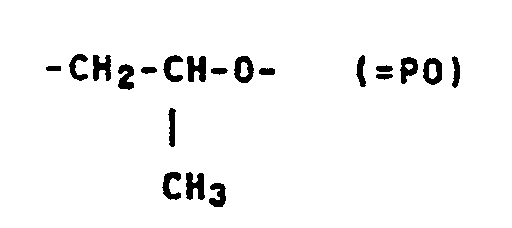


wobei A zu mindestens 50, vorzugsweise mindestens 70 Mol% ―CH₂CH₂O― bedeutet, - x = 12 bis 500,
- y = ein Durchschnittswert (gemittelt über zahlreiche Moleküle) von 0,3 bis 5
- n = eine ganze Zahl von 2 bis 6,
als Verdicker so modifizieren lassen, daß deren Verarbeitung auf den verschiedenen Gebieten der Klebstoffe vorteilhaft beeinflußt wird.
- R = radical of a 2 to 6-valent alcohol with 2 to 10 carbon atoms bound via oxygen,
- R¹ = alkyl, alkoxymethyl or alkenyloxymethyl radical or a mixture of these radicals, each having 6 to 18 carbon atoms in the alkyl, alkoxy or alkenyloxy radical,
- A = ―CH₂CH₂-O― (= EO) alone or in a mixture with
where A is at least 50, preferably at least 70 mol% ―CH₂CH₂O―, - x = 12 to 500,
- y = an average value (averaged over numerous molecules) from 0.3 to 5
- n = an integer from 2 to 6,
Modify as a thickener so that its processing in the various fields of adhesives is advantageously influenced.
Derartige Verbindungen wurden bereits als Verdicker für hydraulische Flüssigkeiten auf wäßriger Basis (US 4411819, 4649224, 4665239, WO 84/00361) sowie für wäßrige Quenchflüssigkeiten (US 4381205) zum Abschrecken heißer Metalle vorgeschlagen. Ihre hervorragende Eignung als Verdicker für Klebstoffe war dadurch jedoch nicht nahegelegt.Such compounds have already been proposed as thickeners for hydraulic liquids on an aqueous basis (US 4411819, 4649224, 4665239, WO 84/00361) and for aqueous quench liquids (US 4381205) for quenching hot metals. However, their excellent suitability as thickeners for adhesives was not suggested.
Die erfindungsgemäß eingesetzten Verdicker sind Polyetherpolyole, die aus einem linearen oder verzweigten Niedrigalkylenoxid-Homo- oder -Copolymeren bestehen, das endständig mit 1,2-Alkylenoxiden mit 8 bis 20 Kohlenstoffatomen oder Alkyl- bzw. Alkenylglycidylethern mit 6 bis 18 Kohlenstoffatomen in der Alkyl- bzw. Alkenylkette umgesetzt ist. Das mittlere Molekulargewicht liegt im Bereich von 1000 bis 75000.The thickeners used according to the invention are polyether polyols which consist of a linear or branched lower alkylene oxide homo- or copolymer which is terminated with 1,2-alkylene oxides having 8 to 20 carbon atoms or alkyl or alkenyl glycidyl ethers having 6 to 18 carbon atoms in the alkyl or alkenyl chain is implemented. The average molecular weight is in the range from 1000 to 75000.
Solche Polyetherpolyole werden erhalten, indem man, wie in EP 61822 und EP 116564 beschrieben, einen mehrwertigen Alkohol (mit 2 bis 6 Hydroxylgruppen), enthaltend 2 bis 10 Kohlenstoffatome, mit Ethylenoxid alleine oder mit Ethylenoxid und einem oder mehreren Alkylenoxiden mit 3 oder 4 Kohlenstoffatomen umsetzt (wobei im letzteren Fall die Umsetzung im Gemisch erfolgt, wenn ein statistisches Copolymeres gewünscht ist, und sukzessiv erfolgt, wenn ein Blockcopolymeres gewünscht ist) und anschließend diese Zwischenstufe mit mindestens 0,3 Äquivalent (pro Hydroxylgruppe) Alkylenoxid mit 8 bis 20 Kohlenstoffatomen und endständiger Epoxidgruppe oder mit 0,3 Äquivalent Alkyl- oder Alkenylglycidylether mit 6 bis 18 Kohlenstoffatomen im Alkyl bzw. Alkenylrest umsetzt. Die Herstellung kann auch, wie in US 4398045 beschrieben, durch Umsetzung eines bereits vorliegenden Polyalkylenoxidhomo- oder copolymeren, das aus C₂- bzw. C₂ und C₃/C₄-Epoxiden aufgebaut ist, mit den o.g. längerkettigen Alkylenoxiden bzw. Glycidylethern erhalten werden.Such polyether polyols are obtained by, as described in EP 61822 and EP 116564, a polyhydric alcohol (having 2 to 6 hydroxyl groups) containing 2 to 10 carbon atoms, with ethylene oxide alone or with ethylene oxide and one or more alkylene oxides with 3 or 4 carbon atoms implemented (in the latter case, the reaction takes place in a mixture if a random copolymer is desired, and takes place successively if a block copolymer is desired) and then this intermediate with at least 0.3 equivalent (per hydroxyl group) alkylene oxide having 8 to 20 carbon atoms and terminal epoxy group or with 0.3 equivalent of alkyl or alkenyl glycidyl ether having 6 to 18 carbon atoms in the alkyl or alkenyl radical. The preparation can, as described in US 4398045, by reacting an already present polyalkylene oxide homo- or copolymer, which is composed of C₂ or C₂ and C₃ / C₄ epoxides, with the above. longer-chain alkylene oxides or glycidyl ethers are obtained.
Mit 2 bis 6-wertigen Alkoholen sind solche gemeint, die 2 bis 6 Hydroxylgruppen besitzen. Es handelt sich im einzelnen um Alkanpolyole, Alkenpolyole, Alkinpolyole oder Oligooxyalkylenglykole, jeweils mit 2 bis 10, vorzugsweise 2 bis 6 Kohlenstoffatomen.By 2 to 6-valent alcohols are meant those which have 2 to 6 hydroxyl groups. Specifically, they are alkane polyols, alkene polyols, alkyne polyols or oligooxyalkylene glycols, each with 2 to 10, preferably 2 to 6, carbon atoms.
Beispiele für geeignete Alkanpolyole sind Ethylenglykol, 1,2- und 1,3-Propylenglykol, Neopentylglykol, 1,2-Butandiol, 1,3-Butandiol, 1,4-Butandiol, Trimethylolpropan, Glycerin, Pentaerythrit, 2,3,4,5-Hexantetrol, Sorbit, Glucose.Examples of suitable alkane polyols are ethylene glycol, 1,2- and 1,3-propylene glycol, neopentyl glycol, 1,2-butanediol, 1,3-butanediol, 1,4-butanediol, trimethylolpropane, glycerol, pentaerythritol, 2,3,4, 5-hexane tetrol, sorbitol, glucose.
Beispiele für Alkenpolyole sind 2-Buten-1,4-diol, 2-Hexen-1,4,6-triol, 1,5-Hexadien-3,4-diol, 3-Hepten-1,2,6,7-tetrol.Examples of alkene polyols are 2-butene-1,4-diol, 2-hexene-1,4,6-triol, 1,5-hexadiene-3,4-diol, 3-heptene-1,2,6,7- tetrol.
Beispiele für Alkinpolyole sind 2-Butin-1,4-diol, 2-Hexin-1,4,6-triol, 4-Octin-1,2,7,8-tetrol.Examples of alkyne polyols are 2-butyne-1,4-diol, 2-hexyne-1,4,6-triol, 4-octyne-1,2,7,8-tetrol.
Beispiele für Oligooxyalkylenglykole sind Diethylenglykol, Triethylenglykol, Tetraethylenglykol, Dipropylenglykol.Examples of oligooxyalkylene glycols are diethylene glycol, triethylene glycol, tetraethylene glycol, dipropylene glycol.
Das Grundgerüst des Polyetherpolyols kann entweder nur aus Oxyethyleneinheiten aufgebaut sein oder daneben auch Oxyalkyleneinheiten mit 3 bis 4 Kohlenstoffatomen in einer Menge bis zu 50, vorzugsweise bis zu 30 Mol% enthalten. Entsprechende Alkylenoxide sind insbesondere Propylenoxid, aber auch 1,2-Butylenoxid, 2,3-Butylenoxid, ferner auch Tetrahydrofuran. Die entsprechenden Copolymeren können statistische oder Blockcopolymere sein. Unter den Copolymeren besonders bevorzugt sind solche, die Ethylenoxid und Propylenoxid im Gewichtsverhältnis 70: 30 bis 95: 5 enthalten.The basic structure of the polyether polyol can either be composed only of oxyethylene units or, in addition, also contain oxyalkylene units with 3 to 4 carbon atoms in an amount of up to 50, preferably up to 30, mol%. Corresponding alkylene oxides are, in particular, propylene oxide, but also 1,2-butylene oxide, 2,3-butylene oxide and also tetrahydrofuran. The corresponding copolymers can be random or block copolymers. Among the copolymers, those which contain ethylene oxide and propylene oxide in a weight ratio of 70:30 to 95: 5 are particularly preferred.
Die Herstellung der am Kettende eingebauten längerkettigen Epoxide bzw. Glycidylether mit 8 bis 20 bzw. 9 bis 21 Kohlenstoffatomen erfolgt in üblicher Weise durch α-Olefinoxidation bzw. durch Umsetzung von Fettalkoholen mit Epichlorhydrin.The longer-chain epoxides or glycidyl ethers having 8 to 20 or 9 to 21 carbon atoms installed at the end of the chain are prepared in the customary manner by α-olefin oxidation or by reaction of fatty alcohols with epichlorohydrin.
Die Menge an längerkettigem 1,2-Alkylenoxid bzw. Glycidylether liegt im allgemeinen zwischen 0,5 und 75 Gew.%, bezogen auf das Gesamtmolekül. Das durchschnittliche molare Verhältnis von längerkettigem Epoxid bzw. Glycidylether zu jeder einzelnen Hydroxygruppe des mehrfunktionellen Alkohols soll im Bereich von 0,3 bis 5, vorzugsweise zwischen 0,5 und 2 liegen.The amount of longer-chain 1,2-alkylene oxide or glycidyl ether is generally between 0.5 and 75% by weight, based on the total molecule. The average molar ratio of longer-chain epoxide or glycidyl ether to each individual hydroxyl group of the polyfunctional alcohol should be in the range from 0.3 to 5, preferably between 0.5 and 2.
Beispiele für langkettige 1,2-Epoxide sind 1,2-Epoxyoctan, 1,2-Epoxydodekan, 1,2-Epoxyhexadekan wie auch Mischungen solcher Epoxide, die käuflich erhältlich sind.Examples of long-chain 1,2-epoxides are 1,2-epoxyoctane, 1,2-epoxydodecane, 1,2-epoxyhexadecane and also mixtures of such epoxides, which are commercially available.
Beispiele für Alkylglycidylether sind Octyl-, Decyl-, Dodecyl-, Tetradecyl-, Hexadecyl-, 2-Methyldodecyl- und 2-Hexyldodecylglycidylether.Examples of alkyl glycidyl ethers are octyl, decyl, dodecyl, tetradecyl, hexadecyl, 2-methyldodecyl and 2-hexyldodecylglycidyl ether.
Als Verdickungsmittel werden Polyetherpolyole vom Molgewicht 1000 bis 75000 bevorzugt, die man durch Umsetzung eines bi- oder trifunktionellen Alkohols mit Ethlyenoxid, ggf. im Gemisch mit bis zu 30 Gew.% Propylenoxid, und anschließende weitere Umsetzung mit mindestens einem 1,2-Alkylenoxid mit 8 bis 18 Kohlenstoffatomen oder mindestens einem Alkyl- oder Alkenylglycidylether mit 8 bis 18 Kohlenstoffatomen in der Alkyl- bzw. Alkenylgruppe in einer Menge von 2 bis 5 Mol pro Mol bi- oder trifunktioneller Alkohol erhält.Preferred thickeners are polyether polyols with a molecular weight of 1000 to 75000, which are obtained by reacting a bi- or trifunctional alcohol with ethylene oxide, optionally in a mixture with up to 30% by weight of propylene oxide, and then further reacting with at least one 1,2-alkylene oxide 8 to 18 carbon atoms or at least one alkyl or alkenyl glycidyl ether having 8 to 18 carbon atoms in the alkyl or alkenyl group in an amount of 2 to 5 moles per mole of bi- or trifunctional alcohol.
Die Polymerisate der Polymer-Dispersion können die für Klebstoffe übliche Zusammensetzung aufweisen und sich z.B. von Acryl- und/oder Methacrylsäureestern geradkettiger oder verzweigter Alkanole, die meist 1 bis 10, insbesondere 4 bis 8 C-Atome aufweisen, von vinylaromatischen Monomeren, wie Styrol; von Vinylestern 2 bis 10, insbesondere 2 bis 4 C-Atome enthaltender Carbonsäuren, Vinyl- und/oder Vinylidenhalogeniden und/oder 1,3-Diolefinen, vorzugsweise Butadien, ableiten. Von besonderem Interesse sind Polymer-Dispersionen mit Klebstoffeigenschaften. Besonders geeignet sind daher Polymer-Dispersionen, deren Polymerisate sich aus n-Butyl-, Isobutyl- und 2-Ethylhexylacrylat, Vinylacetat, Vinylpropionat und Vinyllaurat, gegebenenfalls untereinander gemischt und/oder im Gemisch mit z.B. Ethylen, Styrol und Butadien, aufbauen. Der Feststoffgehalt der Polymer-Dispersionen liegt im allgemeinen im Bereich von 35 bis 70, insbesondere von 40 bis 60 Gew.% Polymerisat.The polymers of the polymer dispersion can have the composition customary for adhesives and can consist, for example, of acrylic and / or methacrylic acid esters of straight-chain or branched alkanols, which usually have 1 to 10, in particular 4 to 8, carbon atoms, vinyl aromatic monomers such as styrene; of vinyl esters of 2 to 10, in particular 2 to 4, carbon atoms containing carboxylic acids, vinyl and / or vinylidene halides and / or Derive 1,3-diolefins, preferably butadiene. Polymer dispersions with adhesive properties are of particular interest. Polymer dispersions whose polymers are composed of n-butyl, isobutyl and 2-ethylhexyl acrylate, vinyl acetate, vinyl propionate and vinyl laurate, optionally mixed with one another and / or in a mixture with, for example, ethylene, styrene and butadiene, are therefore particularly suitable. The solids content of the polymer dispersions is generally in the range from 35 to 70, in particular from 40 to 60,% by weight of polymer.
Neben der Polymerdispersion als Bindemittel und dem Verdicker sind als weitere Bestandteile (Zusatzstoffe) beispielsweise üblich: anorganische, wasserunlösliche Pulver sowie organische Harze als Füllstoffe, Weichmacher, Dispergierhilfsmittel, Stabilisatoren.In addition to the polymer dispersion as a binder and the thickener, the following are further common components (additives), for example: inorganic, water-insoluble powders and organic resins as fillers, plasticizers, dispersants, stabilizers.
Die erfindungsgemäßen Verdicker können im Gegensatz zu vielen üblichen im gesamten pH-Bereich von 1 bis 10 eingesetzt werden, da ihr Effekt sehr wenig vom pH-Wert abhängt. Sie können aus Wasser oder wäßrigen Mischungen von mit Wasser mischbaren Lösungsmitteln wie Alkoholen, Glykolen und aus üblichen Lösungsmitteln, in denen die Verdicker löslich sind, wie Estern, Ketonen, Kohlenwasserstoffen, Weichmachern, flüssigen Harzen oder aus flüssigen nichtionischen Tensiden wie Fettalkoholalkoxylaten, Alkylphenolalkoxylaten, Fettsäurealkoxylaten verarbeitet werden. Wegen der sehr starken Verdickungseffekte ist es vorteilhaft, mit etwa 10%igen Verdickerlösungen zu arbeiten.In contrast to many conventional thickeners, the thickeners according to the invention can be used in the entire pH range from 1 to 10, since their effect depends very little on the pH. They can be made from water or aqueous mixtures of water-miscible solvents such as alcohols, glycols and from conventional solvents in which the thickeners are soluble, such as esters, ketones, hydrocarbons, plasticizers, liquid resins or from liquid nonionic surfactants such as fatty alcohol alkoxylates, alkylphenol alkoxylates, fatty acid alkoxylates are processed. Because of the very strong thickening effects, it is advantageous to work with about 10% thickening solutions.
Der Anteil des Verdickers der Formel I (100% Festgehalt) an der gesamten Formulierung liegt zwischen 0,02 und 2 Gew.%, vorzugsweise zwischen 0,05 und 1,0 Gew.%. Bei Kombination mit anderen Verdickungsmitteln, z.B. Hydroxyethylcellulose, können diese Mengen deutlich unterschritten werden. Die Verdicker werden vorzugsweise als Lösung in Wasser oder einer Kombination aus Wasser und wenigstens teilweise wassermischbaren organischen Lösemitteln eingesetzt.The proportion of the thickener of the formula I (100% solids content) in the total formulation is between 0.02 and 2% by weight, preferably between 0.05 and 1.0% by weight. When combined with other thickeners, e.g. Hydroxyethyl cellulose, these quantities can be significantly undercut. The thickeners are preferably used as a solution in water or a combination of water and at least partially water-miscible organic solvents.
Die in den Formulierungen und Beispielen angegebenen Teile und Verhältnisse beziehen sich auf das Gewicht.



- PD 1:PD 1:
-
Eine handelsübliche 50%ige wäßrige Dispersion eines thermisch vernetzbaren Copolymerisats aus Acrylsäurebutylestern und Acrylnitril. Sie wird zum Herstellen von Klebstoffen für Beflocken und Kaschieren verwendet.
Viskosität bei 25°C: 25 mPas
(Contraves Rheometer STV, A III)
pH-Wert: 3,2
Glastemperatur des Films: -36°CA commercially available 50% aqueous dispersion of a thermally crosslinkable copolymer of butyl acrylate and acrylonitrile. It is used to make adhesives for flocking and laminating.
Viscosity at 25 ° C: 25 mPas
(Contraves Rheometer STV, A III)
pH: 3.2
Glass temperature of the film: -36 ° C - PD 2:PD 2:
-
Eine handelsübliche 60%ige wäßrige Dispersion eines Copolymerisates aus Acrylsäureestern und Acrylsäure. Sie wird zum Herstellen von Klebstoffen für das Kleben von Bodenbelägen verwendet.
Viskosität bei 25°C: 120 mPas
(Contraves Rheometer STV, A III)
pH-Wert: 5,2
Glastemperatur des Films: -20°CA commercially available 60% aqueous dispersion of a copolymer of acrylic acid esters and acrylic acid. It is used to manufacture adhesives for gluing floor coverings.
Viscosity at 25 ° C: 120 mPas
(Contraves Rheometer STV, A III)
pH: 5.2
Glass temperature of the film: -20 ° C - PD 3:PD 3:
-
Eine handelsübliche 50%ige wäßrige Dispersion eines thermisch vernetzbaren Copolymerisats aus Vinylacetat und einem Acrylsäurebutylester.
Viskosität bei 25°C: 90 mPas
(Contraves Rheometer STV, B III)
pH-Wert: 5,0
Glastemperatur des Films: +19°CA commercially available 50% aqueous dispersion of a thermally crosslinkable copolymer of vinyl acetate and a butyl acrylate.
Viscosity at 25 ° C: 90 mPas
(Contraves Rheometer STV, B III)
pH: 5.0
Glass temperature of the film: + 19 ° C - PD 4:PD 4:
-
Eine handelsübliche 55%ige wäßrige Dispersion eines Vinylester-Acrylester-Copolymerisats. Sie wird für das Verkleben von textilen Bodenbelägen verwendet.
Viskosität bei 25°C: 1000 mPas
(Contraves Rheometer STV, B III)
pH-Wert: 6,0
Glastemperatur des Films: +6°CA commercially available 55% aqueous dispersion of a vinyl ester-acrylic ester copolymer. It is used for gluing textile floor coverings.
Viscosity at 25 ° C: 1000 mPas
(Contraves Rheometer STV, B III)
pH: 6.0
Glass temperature of the film: + 6 ° C - PD 5:PD 5:
-
Eine handelsübliche 55%ige wäßrige Dispersion eines Copolymerisats aus Vinylchlorid, Acrylester und Acrylnitril. Sie wird als Schutzbeschichtungsdispersion im Verpackungssektor verwendet.
Viskosität bei 25°C: 15 mPas
(Contraves Rheometer STV, B III)
pH-Wert: 1,8
Glastemperatur des Films: -13°CA commercially available 55% aqueous dispersion of a copolymer of vinyl chloride, acrylic ester and acrylonitrile. It is used as a protective coating dispersion in the packaging sector.
Viscosity at 25 ° C: 15 mPas
(Contraves Rheometer STV, B III)
pH: 1.8
Glass temperature of the film: -13 ° C - PD 6:PD 6:
-
Eine handelsübliche 50%ige wäßrige Dispersion eines carboxylgruppenhaltigen Copolymerisats aus Vinylacetat und Butylacrylat. Sie wird zum Herstellen von Klebstoffen für die Papier- und Folienverarbeitung sowie als Beschichtungsmittel für textile Substrate verwendet.
Viskosität bei 25°C: 22 mPas
(Contraves Rheometer STV, B III)
pH-Wert: 4,1
Glastemperatur des Films: -13°CA commercially available 50% aqueous dispersion of a carboxyl-containing copolymer of vinyl acetate and butyl acrylate. It is used to manufacture adhesives for paper and film processing and as a coating agent for textile substrates.
Viscosity at 25 ° C: 22 mPas
(Contraves Rheometer STV, B III)
pH: 4.1
Glass temperature of the film: -13 ° C - PD 7:PD 7:
-
Eine handelsübliche 50%ige wäßrige Dispersion eines Copolymerisats aus Acrylsäure, Styrol und Butylacrylat mit Zinktetramminacetat-Komplex.
Viskosität bei 25°C: 90 mPas
(Contraves Rheometer STV, B III)
pH-Wert: 9,0
Glastemperatur des Films: +23°CA commercially available 50% aqueous dispersion of a copolymer of acrylic acid, styrene and butyl acrylate with a zinc tetrammine acetate complex.
Viscosity at 25 ° C: 90 mPas
(Contraves Rheometer STV, B III)
pH: 9.0
Glass temperature of the film: + 23 ° C - PD 8:PD 8:
-
Eine handelsübliche 60%ige wäßrige Dispersion eines carboxylgruppenhaltigen Acrylester-Copolymerisats. Sie wird zum Herstellen von Haftklebstoffen für selbstklebende Erzeugnisse verwendet.
Viskosität bei 25°C: 110 mPas
(Contraves Rheometer STV, B III)
pH-Wert: 4,0
Glastemperatur des Films: -40°CA commercially available 60% aqueous dispersion of an acrylic ester copolymer containing carboxyl groups. It is used to manufacture pressure sensitive adhesives for self-adhesive products.
Viscosity at 25 ° C: 110 mPas
(Contraves Rheometer STV, B III)
pH: 4.0
Glass temperature of the film: -40 ° C
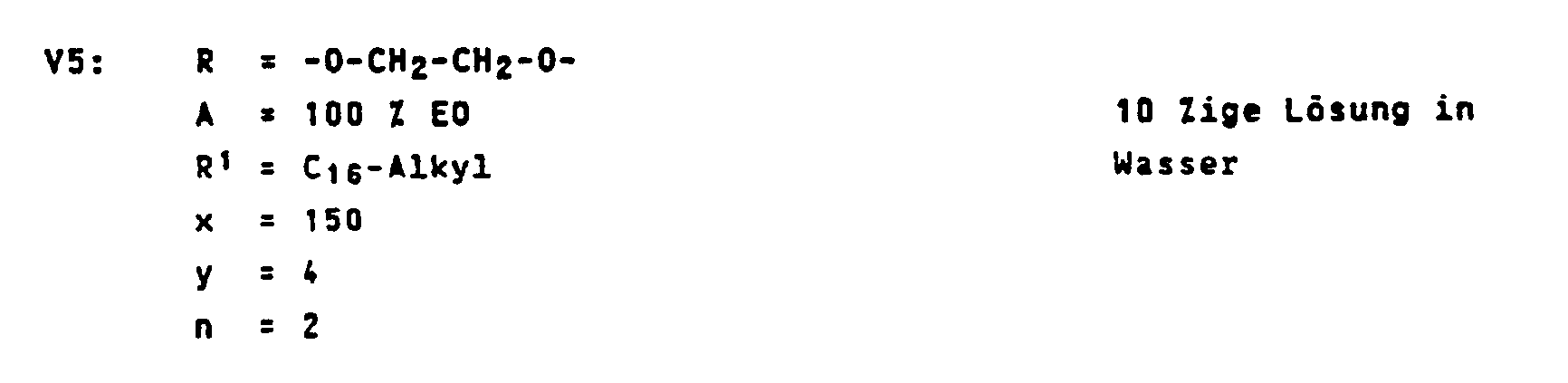
Die oben beschriebenen Polymerdispersionen wurden mit den erfindungsgemäßen, oben beschriebenen Verdickern abgemischt, wobei gut fließende, hochviskose Mischungen erhalten wurden. Die Daten der Abmischungen sind in Tabelle 1 zusammengestellt.

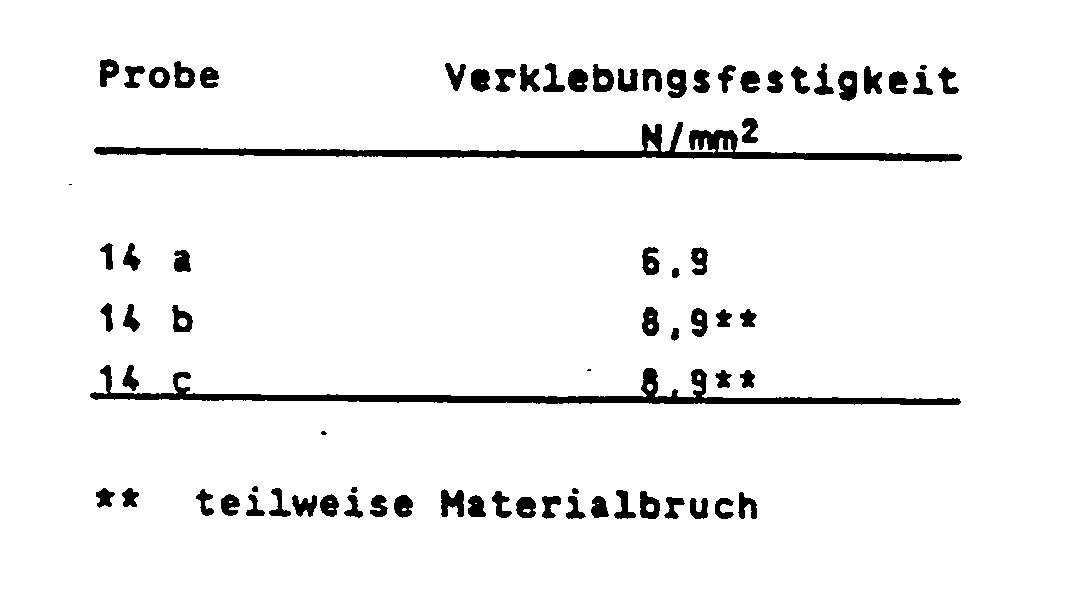
Die in Beispiel 10 aufgeführte Mischung aus Polymerdispersion PD 6 und V 2 wurde mit einer Spiralrakel auf Papier-Etiketten in einer Schichtdicke (naß) von 20 µm aufgetragen und die Etiketten mit der beschichteten Seite auf verschiedene Oberflächen aufgebracht. Die Verklebungsfestigkeiten wurden nach dem Trocknen bewertet.

Durch Zusatz des erfindungsgemäßen Verdickers wurde eine für diese Anwendung notwendige hohe Viskosität mit fast Newtonschem Fließen erhalten, ohne daß eine Haftungsverschlechterung eintrat.By adding the thickener according to the invention, a high viscosity with almost Newtonian flow, which was necessary for this application, was obtained without the adhesion deteriorating.
Die verdickten Dispersionen mit hoher Viskosität und gutem Fließen wurden nach DIN 68603 als Holzleim geprüft.

Die Kleber wurden mit Pinsel auf Buchenholz aufgetragen und sofort verklebt. Die Verklebungsfläche betrug 4 cm². Diese Fläche wurde bei der Verklebung mit 300 g belastet.The glue was applied to beech wood with a brush and glued immediately. The bond area was 4 cm². This area was loaded with 300 g during bonding.
Die Verklebungsfestigkeiten wurden aus fünf Einzelwerten nach DIN 68603-B 1/1 ermittelt.
Claims (2)


A consisting of not less than 50 mol% of ―CH₂CH₂O―,
Priority Applications (1)
| Application Number | Priority Date | Filing Date | Title |
|---|---|---|---|
| AT89103448T ATE67231T1 (en) | 1988-03-05 | 1989-02-28 | ADHESIVE. |
Applications Claiming Priority (2)
| Application Number | Priority Date | Filing Date | Title |
|---|---|---|---|
| DE3807238 | 1988-03-05 | ||
| DE3807238A DE3807238A1 (en) | 1988-03-05 | 1988-03-05 | ADHESIVE |
Publications (2)
| Publication Number | Publication Date |
|---|---|
| EP0332015A1 EP0332015A1 (en) | 1989-09-13 |
| EP0332015B1 true EP0332015B1 (en) | 1991-09-11 |
Family
ID=6348940
Family Applications (1)
| Application Number | Title | Priority Date | Filing Date |
|---|---|---|---|
| EP89103448A Expired - Lifetime EP0332015B1 (en) | 1988-03-05 | 1989-02-28 | Adhesive |
Country Status (6)
| Country | Link |
|---|---|
| EP (1) | EP0332015B1 (en) |
| JP (1) | JPH026584A (en) |
| AT (1) | ATE67231T1 (en) |
| AU (1) | AU3093689A (en) |
| DE (2) | DE3807238A1 (en) |
| FI (1) | FI891033A7 (en) |
Families Citing this family (4)
| Publication number | Priority date | Publication date | Assignee | Title |
|---|---|---|---|---|
| JP4108499B2 (en) * | 2002-02-25 | 2008-06-25 | 日東電工株式会社 | Water-dispersed pressure-sensitive adhesive composition and pressure-sensitive adhesive product |
| SG120911A1 (en) | 2002-02-25 | 2006-04-26 | Nitto Denko Corp | Aqueous dispersion type pressure-sensitive adhesive composition and pressure-sensisive adhesive product |
| US7396868B2 (en) | 2002-02-25 | 2008-07-08 | Nitto Denko Corporation | Aqueous dispersion type pressure-sensitive adhesive composition and pressure-sensitive adhesive product |
| JP3877670B2 (en) * | 2002-11-08 | 2007-02-07 | 日東電工株式会社 | Adhesive tape or sheet |
Family Cites Families (2)
| Publication number | Priority date | Publication date | Assignee | Title |
|---|---|---|---|---|
| EP0061822B1 (en) * | 1981-04-01 | 1987-07-29 | BASF Corporation | Polyethers modified with alpha olefin oxides |
| CA1319319C (en) * | 1986-03-17 | 1993-06-22 | Donald Charles Mente | Thickening aqueous systems |
-
1988
- 1988-03-05 DE DE3807238A patent/DE3807238A1/en not_active Withdrawn
-
1989
- 1989-02-28 EP EP89103448A patent/EP0332015B1/en not_active Expired - Lifetime
- 1989-02-28 DE DE8989103448T patent/DE58900265D1/en not_active Expired - Lifetime
- 1989-02-28 AT AT89103448T patent/ATE67231T1/en not_active IP Right Cessation
- 1989-03-03 FI FI891033A patent/FI891033A7/en not_active Application Discontinuation
- 1989-03-03 AU AU30936/89A patent/AU3093689A/en not_active Abandoned
- 1989-03-06 JP JP1052193A patent/JPH026584A/en active Pending
Also Published As
| Publication number | Publication date |
|---|---|
| DE58900265D1 (en) | 1991-10-17 |
| DE3807238A1 (en) | 1989-09-14 |
| FI891033A0 (en) | 1989-03-03 |
| EP0332015A1 (en) | 1989-09-13 |
| ATE67231T1 (en) | 1991-09-15 |
| JPH026584A (en) | 1990-01-10 |
| FI891033A7 (en) | 1989-09-06 |
| AU3093689A (en) | 1989-09-07 |
Similar Documents
| Publication | Publication Date | Title |
|---|---|---|
| DE3750761T2 (en) | Use of a thermoplastic polyester as an additive for epoxy resins. | |
| DE3630955C2 (en) | ||
| DE3717545A1 (en) | CYANACRYLATE COMPOSITIONS | |
| DE3883513T2 (en) | Process for coating oxyalkylene polymers with a reactive silicone group with alkyd paints. | |
| WO2010004038A1 (en) | Curable compositions | |
| EP0332015B1 (en) | Adhesive | |
| DE60206173T2 (en) | HARDENING COMPOSITION AND METHOD FOR APPLYING ALKYDE COATING MATERIAL THEREWITH | |
| DE69206926T2 (en) | Water soluble or water dispersible pressure sensitive adhesive composition | |
| DE3323880C1 (en) | Polyoxyalkylene ether of castor oil and its use in the production of polyurethanes | |
| EP0133672A2 (en) | Adhesive stick and its method of manufacture | |
| DE1914273C3 (en) | Pictorial carriers, the characters of which can be transferred by printing onto a substrate, and the process for their production | |
| EP0332016B1 (en) | Laying of tiles by means of a tile adhesive | |
| EP0136396B1 (en) | Use of selected polyetherols and polyisocyanates for preparing adhesives on a polyurethane basis | |
| EP0346736A2 (en) | Polyether | |
| DE10015914A1 (en) | Copolymers for use as binders in flexible adhesives, obtained by radical copolymerisation of esters of unsaturated polyfunctional carboxylic acids with alkylene oxide adducts and other comonomers | |
| DE2019233C3 (en) | Process for the preparation of vinyl acetate-ethylene copolymer emulsion | |
| EP1705172A1 (en) | Hydroxylgroups containing detergents with low surface tension and use thereof | |
| EP0188809A1 (en) | Adhesive stick and a process for making said stick | |
| EP0332017B1 (en) | Manufacture of sealings by means of a sealing mass | |
| EP1025179B1 (en) | Use of an aqueous polyacrylic preparation for labelling | |
| EP0332013A2 (en) | Manufacture of paints using aqueous paint components | |
| DE19725038A1 (en) | Low-emission aqueous dispersion adhesive | |
| DE69516928T2 (en) | Aqueous ink composition for ballpoint pens | |
| EP0521920B1 (en) | Deep acting primer | |
| DE3319794C2 (en) | Liquid record care agent with silicone oil and its use |
Legal Events
| Date | Code | Title | Description |
|---|---|---|---|
| PUAI | Public reference made under article 153(3) epc to a published international application that has entered the european phase |
Free format text: ORIGINAL CODE: 0009012 |
|
| AK | Designated contracting states |
Kind code of ref document: A1 Designated state(s): AT BE CH DE ES FR GB IT LI NL SE |
|
| 17P | Request for examination filed |
Effective date: 19890725 |
|
| 17Q | First examination report despatched |
Effective date: 19910130 |
|
| GRAA | (expected) grant |
Free format text: ORIGINAL CODE: 0009210 |
|
| AK | Designated contracting states |
Kind code of ref document: B1 Designated state(s): AT BE CH DE ES FR GB IT LI NL SE |
|
| PG25 | Lapsed in a contracting state [announced via postgrant information from national office to epo] |
Ref country code: IT Free format text: LAPSE BECAUSE OF FAILURE TO SUBMIT A TRANSLATION OF THE DESCRIPTION OR TO PAY THE FEE WITHIN THE PRE;WARNING: LAPSES OF ITALIAN PATENTS WITH EFFECTIVE DATE BEFORE 2007 MAY HAVE OCCURRED AT ANY TIME BEFORE 2007. THE CORRECT EFFECTIVE DATE MAY BE DIFFERENT FROM THE ONE RECORDED.SCRIBED TIME-LIMIT Effective date: 19910911 Ref country code: SE Effective date: 19910911 Ref country code: NL Effective date: 19910911 Ref country code: ES Free format text: THE PATENT HAS BEEN ANNULLED BY A DECISION OF A NATIONAL AUTHORITY Effective date: 19910911 |
|
| REF | Corresponds to: |
Ref document number: 67231 Country of ref document: AT Date of ref document: 19910915 Kind code of ref document: T |
|
| REF | Corresponds to: |
Ref document number: 58900265 Country of ref document: DE Date of ref document: 19911017 |
|
| GBT | Gb: translation of ep patent filed (gb section 77(6)(a)/1977) | ||
| ET | Fr: translation filed | ||
| PGFP | Annual fee paid to national office [announced via postgrant information from national office to epo] |
Ref country code: FR Payment date: 19920114 Year of fee payment: 4 |
|
| PGFP | Annual fee paid to national office [announced via postgrant information from national office to epo] |
Ref country code: BE Payment date: 19920205 Year of fee payment: 4 |
|
| NLV1 | Nl: lapsed or annulled due to failure to fulfill the requirements of art. 29p and 29m of the patents act | ||
| PGFP | Annual fee paid to national office [announced via postgrant information from national office to epo] |
Ref country code: DE Payment date: 19920222 Year of fee payment: 4 |
|
| PG25 | Lapsed in a contracting state [announced via postgrant information from national office to epo] |
Ref country code: AT Effective date: 19920228 |
|
| PG25 | Lapsed in a contracting state [announced via postgrant information from national office to epo] |
Ref country code: CH Effective date: 19920229 Ref country code: LI Effective date: 19920229 |
|
| PLBE | No opposition filed within time limit |
Free format text: ORIGINAL CODE: 0009261 |
|
| STAA | Information on the status of an ep patent application or granted ep patent |
Free format text: STATUS: NO OPPOSITION FILED WITHIN TIME LIMIT |
|
| 26N | No opposition filed | ||
| REG | Reference to a national code |
Ref country code: CH Ref legal event code: PL |
|
| PG25 | Lapsed in a contracting state [announced via postgrant information from national office to epo] |
Ref country code: BE Effective date: 19930228 Ref country code: GB Effective date: 19930228 |
|
| BERE | Be: lapsed |
Owner name: BASF A.G. Effective date: 19930228 |
|
| GBPC | Gb: european patent ceased through non-payment of renewal fee |
Effective date: 19930228 |
|
| PG25 | Lapsed in a contracting state [announced via postgrant information from national office to epo] |
Ref country code: FR Effective date: 19931029 |
|
| PG25 | Lapsed in a contracting state [announced via postgrant information from national office to epo] |
Ref country code: DE Effective date: 19931103 |
|
| REG | Reference to a national code |
Ref country code: FR Ref legal event code: ST |