EP0332013A2 - Manufacture of paints using aqueous paint components - Google Patents
Manufacture of paints using aqueous paint components Download PDFInfo
- Publication number
- EP0332013A2 EP0332013A2 EP89103445A EP89103445A EP0332013A2 EP 0332013 A2 EP0332013 A2 EP 0332013A2 EP 89103445 A EP89103445 A EP 89103445A EP 89103445 A EP89103445 A EP 89103445A EP 0332013 A2 EP0332013 A2 EP 0332013A2
- Authority
- EP
- European Patent Office
- Prior art keywords
- paints
- carbon atoms
- thickener
- water
- radical
- Prior art date
- Legal status (The legal status is an assumption and is not a legal conclusion. Google has not performed a legal analysis and makes no representation as to the accuracy of the status listed.)
- Withdrawn
Links
- 239000003973 paint Substances 0.000 title claims abstract description 45
- 238000004519 manufacturing process Methods 0.000 title claims abstract description 4
- 125000004432 carbon atom Chemical group C* 0.000 claims abstract description 19
- 239000000203 mixture Substances 0.000 claims abstract description 18
- 125000000217 alkyl group Chemical group 0.000 claims abstract description 12
- 239000004815 dispersion polymer Substances 0.000 claims abstract description 7
- LFQSCWFLJHTTHZ-UHFFFAOYSA-N Ethanol Chemical compound CCO LFQSCWFLJHTTHZ-UHFFFAOYSA-N 0.000 claims abstract description 6
- 239000000654 additive Substances 0.000 claims abstract description 5
- 150000001875 compounds Chemical class 0.000 claims abstract description 4
- 125000003545 alkoxy group Chemical group 0.000 claims abstract description 3
- 125000004849 alkoxymethyl group Chemical group 0.000 claims abstract description 3
- QVGXLLKOCUKJST-UHFFFAOYSA-N atomic oxygen Chemical compound [O] QVGXLLKOCUKJST-UHFFFAOYSA-N 0.000 claims abstract description 3
- 229910052760 oxygen Inorganic materials 0.000 claims abstract description 3
- 239000001301 oxygen Substances 0.000 claims abstract description 3
- 239000000049 pigment Substances 0.000 claims description 14
- 239000006185 dispersion Substances 0.000 claims description 13
- 239000011230 binding agent Substances 0.000 claims description 6
- 238000000034 method Methods 0.000 claims description 6
- 230000008569 process Effects 0.000 claims description 4
- 239000000758 substrate Substances 0.000 claims description 2
- 239000002562 thickening agent Substances 0.000 abstract description 40
- XLYOFNOQVPJJNP-UHFFFAOYSA-N water Substances O XLYOFNOQVPJJNP-UHFFFAOYSA-N 0.000 description 29
- -1 alkenyloxy radical Chemical class 0.000 description 20
- 238000005260 corrosion Methods 0.000 description 14
- 229920005862 polyol Polymers 0.000 description 14
- 230000007797 corrosion Effects 0.000 description 10
- 229920001577 copolymer Polymers 0.000 description 9
- 239000004721 Polyphenylene oxide Substances 0.000 description 8
- GWEVSGVZZGPLCZ-UHFFFAOYSA-N Titan oxide Chemical compound O=[Ti]=O GWEVSGVZZGPLCZ-UHFFFAOYSA-N 0.000 description 8
- 229920000570 polyether Polymers 0.000 description 8
- 150000003077 polyols Chemical class 0.000 description 8
- 239000007787 solid Substances 0.000 description 7
- QGZKDVFQNNGYKY-UHFFFAOYSA-N Ammonia Chemical compound N QGZKDVFQNNGYKY-UHFFFAOYSA-N 0.000 description 6
- PPBRXRYQALVLMV-UHFFFAOYSA-N Styrene Chemical compound C=CC1=CC=CC=C1 PPBRXRYQALVLMV-UHFFFAOYSA-N 0.000 description 6
- ZJCCRDAZUWHFQH-UHFFFAOYSA-N Trimethylolpropane Chemical compound CCC(CO)(CO)CO ZJCCRDAZUWHFQH-UHFFFAOYSA-N 0.000 description 6
- 125000002947 alkylene group Chemical group 0.000 description 6
- 230000000052 comparative effect Effects 0.000 description 6
- 229920000642 polymer Polymers 0.000 description 6
- IAYPIBMASNFSPL-UHFFFAOYSA-N Ethylene oxide Chemical compound C1CO1 IAYPIBMASNFSPL-UHFFFAOYSA-N 0.000 description 5
- 238000000576 coating method Methods 0.000 description 5
- 239000003086 colorant Substances 0.000 description 5
- 239000013530 defoamer Substances 0.000 description 5
- 239000000945 filler Substances 0.000 description 5
- 238000003860 storage Methods 0.000 description 5
- OAYXUHPQHDHDDZ-UHFFFAOYSA-N 2-(2-butoxyethoxy)ethanol Chemical compound CCCCOCCOCCO OAYXUHPQHDHDDZ-UHFFFAOYSA-N 0.000 description 4
- NBIIXXVUZAFLBC-UHFFFAOYSA-N Phosphoric acid Chemical compound OP(O)(O)=O NBIIXXVUZAFLBC-UHFFFAOYSA-N 0.000 description 4
- DNIAPMSPPWPWGF-UHFFFAOYSA-N Propylene glycol Chemical compound CC(O)CO DNIAPMSPPWPWGF-UHFFFAOYSA-N 0.000 description 4
- GOOHAUXETOMSMM-UHFFFAOYSA-N Propylene oxide Chemical compound CC1CO1 GOOHAUXETOMSMM-UHFFFAOYSA-N 0.000 description 4
- GYZLOYUZLJXAJU-UHFFFAOYSA-N diglycidyl ether Chemical class C1OC1COCC1CO1 GYZLOYUZLJXAJU-UHFFFAOYSA-N 0.000 description 4
- 239000002270 dispersing agent Substances 0.000 description 4
- 238000001035 drying Methods 0.000 description 4
- 239000007788 liquid Substances 0.000 description 4
- 150000003839 salts Chemical class 0.000 description 4
- SMZOUWXMTYCWNB-UHFFFAOYSA-N 2-(2-methoxy-5-methylphenyl)ethanamine Chemical compound COC1=CC=C(C)C=C1CCN SMZOUWXMTYCWNB-UHFFFAOYSA-N 0.000 description 3
- NIXOWILDQLNWCW-UHFFFAOYSA-N 2-Propenoic acid Natural products OC(=O)C=C NIXOWILDQLNWCW-UHFFFAOYSA-N 0.000 description 3
- LYCAIKOWRPUZTN-UHFFFAOYSA-N Ethylene glycol Chemical compound OCCO LYCAIKOWRPUZTN-UHFFFAOYSA-N 0.000 description 3
- PEDCQBHIVMGVHV-UHFFFAOYSA-N Glycerine Chemical compound OCC(O)CO PEDCQBHIVMGVHV-UHFFFAOYSA-N 0.000 description 3
- 229910021529 ammonia Inorganic materials 0.000 description 3
- CQEYYJKEWSMYFG-UHFFFAOYSA-N butyl acrylate Chemical compound CCCCOC(=O)C=C CQEYYJKEWSMYFG-UHFFFAOYSA-N 0.000 description 3
- 125000003178 carboxy group Chemical group [H]OC(*)=O 0.000 description 3
- 239000011248 coating agent Substances 0.000 description 3
- 239000000470 constituent Substances 0.000 description 3
- MTHSVFCYNBDYFN-UHFFFAOYSA-N diethylene glycol Chemical compound OCCOCCO MTHSVFCYNBDYFN-UHFFFAOYSA-N 0.000 description 3
- 230000000694 effects Effects 0.000 description 3
- 150000002118 epoxides Chemical class 0.000 description 3
- 150000002148 esters Chemical class 0.000 description 3
- 238000002474 experimental method Methods 0.000 description 3
- 238000009472 formulation Methods 0.000 description 3
- 150000002334 glycols Chemical class 0.000 description 3
- UQSXHKLRYXJYBZ-UHFFFAOYSA-N iron oxide Inorganic materials [Fe]=O UQSXHKLRYXJYBZ-UHFFFAOYSA-N 0.000 description 3
- JEIPFZHSYJVQDO-UHFFFAOYSA-N iron(III) oxide Inorganic materials O=[Fe]O[Fe]=O JEIPFZHSYJVQDO-UHFFFAOYSA-N 0.000 description 3
- 229910052751 metal Inorganic materials 0.000 description 3
- 239000002184 metal Substances 0.000 description 3
- 239000004033 plastic Substances 0.000 description 3
- 229920003023 plastic Polymers 0.000 description 3
- 230000000379 polymerizing effect Effects 0.000 description 3
- 150000003254 radicals Chemical group 0.000 description 3
- 239000002904 solvent Substances 0.000 description 3
- 239000000080 wetting agent Substances 0.000 description 3
- PUPZLCDOIYMWBV-UHFFFAOYSA-N (+/-)-1,3-Butanediol Chemical compound CC(O)CCO PUPZLCDOIYMWBV-UHFFFAOYSA-N 0.000 description 2
- DSZTYVZOIUIIGA-UHFFFAOYSA-N 1,2-Epoxyhexadecane Chemical compound CCCCCCCCCCCCCCC1CO1 DSZTYVZOIUIIGA-UHFFFAOYSA-N 0.000 description 2
- VTYYLEPIZMXCLO-UHFFFAOYSA-L Calcium carbonate Chemical compound [Ca+2].[O-]C([O-])=O VTYYLEPIZMXCLO-UHFFFAOYSA-L 0.000 description 2
- JOYRKODLDBILNP-UHFFFAOYSA-N Ethyl urethane Chemical compound CCOC(N)=O JOYRKODLDBILNP-UHFFFAOYSA-N 0.000 description 2
- XEEYBQQBJWHFJM-UHFFFAOYSA-N Iron Chemical compound [Fe] XEEYBQQBJWHFJM-UHFFFAOYSA-N 0.000 description 2
- VVQNEPGJFQJSBK-UHFFFAOYSA-N Methyl methacrylate Chemical compound COC(=O)C(C)=C VVQNEPGJFQJSBK-UHFFFAOYSA-N 0.000 description 2
- QQONPFPTGQHPMA-UHFFFAOYSA-N Propene Chemical group CC=C QQONPFPTGQHPMA-UHFFFAOYSA-N 0.000 description 2
- WYURNTSHIVDZCO-UHFFFAOYSA-N Tetrahydrofuran Chemical compound C1CCOC1 WYURNTSHIVDZCO-UHFFFAOYSA-N 0.000 description 2
- 239000002253 acid Substances 0.000 description 2
- 150000001298 alcohols Chemical class 0.000 description 2
- 229910000147 aluminium phosphate Inorganic materials 0.000 description 2
- 150000008064 anhydrides Chemical class 0.000 description 2
- 230000001588 bifunctional effect Effects 0.000 description 2
- 229920001400 block copolymer Polymers 0.000 description 2
- WERYXYBDKMZEQL-UHFFFAOYSA-N butane-1,4-diol Chemical compound OCCCCO WERYXYBDKMZEQL-UHFFFAOYSA-N 0.000 description 2
- 238000006243 chemical reaction Methods 0.000 description 2
- 150000002191 fatty alcohols Chemical class 0.000 description 2
- 125000002887 hydroxy group Chemical group [H]O* 0.000 description 2
- 235000013980 iron oxide Nutrition 0.000 description 2
- 239000000463 material Substances 0.000 description 2
- 239000002736 nonionic surfactant Substances 0.000 description 2
- 239000004014 plasticizer Substances 0.000 description 2
- 238000002360 preparation method Methods 0.000 description 2
- 239000003755 preservative agent Substances 0.000 description 2
- YPFDHNVEDLHUCE-UHFFFAOYSA-N propane-1,3-diol Chemical compound OCCCO YPFDHNVEDLHUCE-UHFFFAOYSA-N 0.000 description 2
- 238000010791 quenching Methods 0.000 description 2
- 229920005604 random copolymer Polymers 0.000 description 2
- 239000007921 spray Substances 0.000 description 2
- 230000008719 thickening Effects 0.000 description 2
- 239000004408 titanium dioxide Substances 0.000 description 2
- 239000002966 varnish Substances 0.000 description 2
- 239000002023 wood Substances 0.000 description 2
- ORTVZLZNOYNASJ-UPHRSURJSA-N (z)-but-2-ene-1,4-diol Chemical compound OC\C=C/CO ORTVZLZNOYNASJ-UPHRSURJSA-N 0.000 description 1
- RBACIKXCRWGCBB-UHFFFAOYSA-N 1,2-Epoxybutane Chemical compound CCC1CO1 RBACIKXCRWGCBB-UHFFFAOYSA-N 0.000 description 1
- FENFUOGYJVOCRY-UHFFFAOYSA-N 1-propoxypropan-2-ol Chemical compound CCCOCC(C)O FENFUOGYJVOCRY-UHFFFAOYSA-N 0.000 description 1
- PQXKWPLDPFFDJP-UHFFFAOYSA-N 2,3-dimethyloxirane Chemical compound CC1OC1C PQXKWPLDPFFDJP-UHFFFAOYSA-N 0.000 description 1
- JAHNSTQSQJOJLO-UHFFFAOYSA-N 2-(3-fluorophenyl)-1h-imidazole Chemical compound FC1=CC=CC(C=2NC=CN=2)=C1 JAHNSTQSQJOJLO-UHFFFAOYSA-N 0.000 description 1
- DDHJMUWKDMGQFH-KTKRTIGZSA-N 2-[[(z)-octadec-9-enoxy]methyl]oxirane Chemical compound CCCCCCCC\C=C/CCCCCCCCOCC1CO1 DDHJMUWKDMGQFH-KTKRTIGZSA-N 0.000 description 1
- MPGABYXKKCLIRW-UHFFFAOYSA-N 2-decyloxirane Chemical compound CCCCCCCCCCC1CO1 MPGABYXKKCLIRW-UHFFFAOYSA-N 0.000 description 1
- JCGRTWRFDLWVDA-UHFFFAOYSA-N 2-docosyloxirane Chemical compound CCCCCCCCCCCCCCCCCCCCCCC1CO1 JCGRTWRFDLWVDA-UHFFFAOYSA-N 0.000 description 1
- MBJVZMPEPVSKAS-UHFFFAOYSA-N 2-hexacosyloxirane Chemical compound CCCCCCCCCCCCCCCCCCCCCCCCCCC1CO1 MBJVZMPEPVSKAS-UHFFFAOYSA-N 0.000 description 1
- QBJWYMFTMJFGOL-UHFFFAOYSA-N 2-hexadecyloxirane Chemical compound CCCCCCCCCCCCCCCCC1CO1 QBJWYMFTMJFGOL-UHFFFAOYSA-N 0.000 description 1
- NJWSNNWLBMSXQR-UHFFFAOYSA-N 2-hexyloxirane Chemical compound CCCCCCC1CO1 NJWSNNWLBMSXQR-UHFFFAOYSA-N 0.000 description 1
- VHAXNXDRZSLKOX-UHFFFAOYSA-N 2-tetracosyloxirane Chemical compound CCCCCCCCCCCCCCCCCCCCCCCCC1CO1 VHAXNXDRZSLKOX-UHFFFAOYSA-N 0.000 description 1
- BUIXEGYUDCDLCD-UHFFFAOYSA-N 3-(2-methylpropoxy)propan-1-ol Chemical compound CC(C)COCCCO BUIXEGYUDCDLCD-UHFFFAOYSA-N 0.000 description 1
- HOSGXJWQVBHGLT-UHFFFAOYSA-N 6-hydroxy-3,4-dihydro-1h-quinolin-2-one Chemical group N1C(=O)CCC2=CC(O)=CC=C21 HOSGXJWQVBHGLT-UHFFFAOYSA-N 0.000 description 1
- 229920002126 Acrylic acid copolymer Polymers 0.000 description 1
- 239000005995 Aluminium silicate Substances 0.000 description 1
- GAWIXWVDTYZWAW-UHFFFAOYSA-N C[CH]O Chemical class C[CH]O GAWIXWVDTYZWAW-UHFFFAOYSA-N 0.000 description 1
- OYPRJOBELJOOCE-UHFFFAOYSA-N Calcium Chemical compound [Ca] OYPRJOBELJOOCE-UHFFFAOYSA-N 0.000 description 1
- 229920002134 Carboxymethyl cellulose Chemical class 0.000 description 1
- FBPFZTCFMRRESA-FSIIMWSLSA-N D-Glucitol Natural products OC[C@H](O)[C@H](O)[C@@H](O)[C@H](O)CO FBPFZTCFMRRESA-FSIIMWSLSA-N 0.000 description 1
- FBPFZTCFMRRESA-JGWLITMVSA-N D-glucitol Chemical compound OC[C@H](O)[C@@H](O)[C@H](O)[C@H](O)CO FBPFZTCFMRRESA-JGWLITMVSA-N 0.000 description 1
- SNRUBQQJIBEYMU-UHFFFAOYSA-N Dodecane Natural products CCCCCCCCCCCC SNRUBQQJIBEYMU-UHFFFAOYSA-N 0.000 description 1
- BRLQWZUYTZBJKN-UHFFFAOYSA-N Epichlorohydrin Chemical compound ClCC1CO1 BRLQWZUYTZBJKN-UHFFFAOYSA-N 0.000 description 1
- WQZGKKKJIJFFOK-GASJEMHNSA-N Glucose Natural products OC[C@H]1OC(O)[C@H](O)[C@@H](O)[C@@H]1O WQZGKKKJIJFFOK-GASJEMHNSA-N 0.000 description 1
- 229920000663 Hydroxyethyl cellulose Polymers 0.000 description 1
- 239000004354 Hydroxyethyl cellulose Substances 0.000 description 1
- 229920001479 Hydroxyethyl methyl cellulose Polymers 0.000 description 1
- CERQOIWHTDAKMF-UHFFFAOYSA-N Methacrylic acid Chemical compound CC(=C)C(O)=O CERQOIWHTDAKMF-UHFFFAOYSA-N 0.000 description 1
- 239000002202 Polyethylene glycol Substances 0.000 description 1
- 229920000388 Polyphosphate Polymers 0.000 description 1
- OFOBLEOULBTSOW-UHFFFAOYSA-N Propanedioic acid Natural products OC(=O)CC(O)=O OFOBLEOULBTSOW-UHFFFAOYSA-N 0.000 description 1
- 229920002125 Sokalan® Chemical class 0.000 description 1
- 229910000831 Steel Inorganic materials 0.000 description 1
- UWHCKJMYHZGTIT-UHFFFAOYSA-N Tetraethylene glycol, Natural products OCCOCCOCCOCCO UWHCKJMYHZGTIT-UHFFFAOYSA-N 0.000 description 1
- WGLPBDUCMAPZCE-UHFFFAOYSA-N Trioxochromium Chemical compound O=[Cr](=O)=O WGLPBDUCMAPZCE-UHFFFAOYSA-N 0.000 description 1
- 238000005299 abrasion Methods 0.000 description 1
- 238000010521 absorption reaction Methods 0.000 description 1
- 239000000853 adhesive Substances 0.000 description 1
- 230000001070 adhesive effect Effects 0.000 description 1
- 125000003342 alkenyl group Chemical group 0.000 description 1
- 235000012211 aluminium silicate Nutrition 0.000 description 1
- 125000001204 arachidyl group Chemical group [H]C([*])([H])C([H])([H])C([H])([H])C([H])([H])C([H])([H])C([H])([H])C([H])([H])C([H])([H])C([H])([H])C([H])([H])C([H])([H])C([H])([H])C([H])([H])C([H])([H])C([H])([H])C([H])([H])C([H])([H])C([H])([H])C([H])([H])C([H])([H])[H] 0.000 description 1
- 239000010426 asphalt Substances 0.000 description 1
- 230000001580 bacterial effect Effects 0.000 description 1
- 230000008901 benefit Effects 0.000 description 1
- WQZGKKKJIJFFOK-VFUOTHLCSA-N beta-D-glucose Chemical compound OC[C@H]1O[C@@H](O)[C@H](O)[C@@H](O)[C@@H]1O WQZGKKKJIJFFOK-VFUOTHLCSA-N 0.000 description 1
- 230000015572 biosynthetic process Effects 0.000 description 1
- 238000009835 boiling Methods 0.000 description 1
- DLDJFQGPPSQZKI-UHFFFAOYSA-N but-2-yne-1,4-diol Chemical compound OCC#CCO DLDJFQGPPSQZKI-UHFFFAOYSA-N 0.000 description 1
- VXTQKJXIZHSXBY-UHFFFAOYSA-N butan-2-yl 2-methylprop-2-enoate Chemical compound CCC(C)OC(=O)C(C)=C VXTQKJXIZHSXBY-UHFFFAOYSA-N 0.000 description 1
- BMRWNKZVCUKKSR-UHFFFAOYSA-N butane-1,2-diol Chemical compound CCC(O)CO BMRWNKZVCUKKSR-UHFFFAOYSA-N 0.000 description 1
- 239000011575 calcium Substances 0.000 description 1
- 229910052791 calcium Inorganic materials 0.000 description 1
- 229910000019 calcium carbonate Inorganic materials 0.000 description 1
- 235000010216 calcium carbonate Nutrition 0.000 description 1
- 235000012241 calcium silicate Nutrition 0.000 description 1
- WETINTNJFLGREW-UHFFFAOYSA-N calcium;iron;tetrahydrate Chemical compound O.O.O.O.[Ca].[Fe].[Fe] WETINTNJFLGREW-UHFFFAOYSA-N 0.000 description 1
- 239000001768 carboxy methyl cellulose Chemical class 0.000 description 1
- 235000010948 carboxy methyl cellulose Nutrition 0.000 description 1
- 239000008112 carboxymethyl-cellulose Chemical class 0.000 description 1
- 239000001913 cellulose Substances 0.000 description 1
- 229920002678 cellulose Polymers 0.000 description 1
- 229920003086 cellulose ether Polymers 0.000 description 1
- 239000003795 chemical substances by application Substances 0.000 description 1
- 229910000423 chromium oxide Inorganic materials 0.000 description 1
- LDHQCZJRKDOVOX-NSCUHMNNSA-N crotonic acid Chemical compound C\C=C\C(O)=O LDHQCZJRKDOVOX-NSCUHMNNSA-N 0.000 description 1
- 230000006735 deficit Effects 0.000 description 1
- 235000014113 dietary fatty acids Nutrition 0.000 description 1
- SZXQTJUDPRGNJN-UHFFFAOYSA-N dipropylene glycol Chemical compound OCCCOCCCO SZXQTJUDPRGNJN-UHFFFAOYSA-N 0.000 description 1
- 125000003438 dodecyl group Chemical group [H]C([H])([H])C([H])([H])C([H])([H])C([H])([H])C([H])([H])C([H])([H])C([H])([H])C([H])([H])C([H])([H])C([H])([H])C([H])([H])C([H])([H])* 0.000 description 1
- 239000000839 emulsion Substances 0.000 description 1
- 238000007720 emulsion polymerization reaction Methods 0.000 description 1
- 125000003700 epoxy group Chemical group 0.000 description 1
- 150000002170 ethers Chemical class 0.000 description 1
- 239000000194 fatty acid Substances 0.000 description 1
- 229930195729 fatty acid Natural products 0.000 description 1
- 150000004665 fatty acids Chemical class 0.000 description 1
- 239000010408 film Substances 0.000 description 1
- 239000010419 fine particle Substances 0.000 description 1
- 238000001595 flow curve Methods 0.000 description 1
- 239000011521 glass Substances 0.000 description 1
- 239000008103 glucose Substances 0.000 description 1
- NYTBHLJJQXOHJR-UHFFFAOYSA-N hept-3-ene-1,2,6,7-tetrol Chemical compound OCC(O)CC=CC(O)CO NYTBHLJJQXOHJR-UHFFFAOYSA-N 0.000 description 1
- TUYVVZNULFVBEZ-UHFFFAOYSA-N hex-4-ene-1,3,6-triol Chemical compound OCCC(O)C=CCO TUYVVZNULFVBEZ-UHFFFAOYSA-N 0.000 description 1
- ZJUFPQDVIGUBQX-UHFFFAOYSA-N hex-4-yne-1,3,6-triol Chemical compound OCCC(O)C#CCO ZJUFPQDVIGUBQX-UHFFFAOYSA-N 0.000 description 1
- KUQWZSZYIQGTHT-UHFFFAOYSA-N hexa-1,5-diene-3,4-diol Chemical compound C=CC(O)C(O)C=C KUQWZSZYIQGTHT-UHFFFAOYSA-N 0.000 description 1
- 229920001519 homopolymer Polymers 0.000 description 1
- 229930195733 hydrocarbon Natural products 0.000 description 1
- 150000002430 hydrocarbons Chemical class 0.000 description 1
- 235000019447 hydroxyethyl cellulose Nutrition 0.000 description 1
- 230000006872 improvement Effects 0.000 description 1
- 230000008595 infiltration Effects 0.000 description 1
- 238000001764 infiltration Methods 0.000 description 1
- 229910052500 inorganic mineral Inorganic materials 0.000 description 1
- 239000002563 ionic surfactant Substances 0.000 description 1
- 229910052742 iron Inorganic materials 0.000 description 1
- VBMVTYDPPZVILR-UHFFFAOYSA-N iron(2+);oxygen(2-) Chemical class [O-2].[Fe+2] VBMVTYDPPZVILR-UHFFFAOYSA-N 0.000 description 1
- NLYAJNPCOHFWQQ-UHFFFAOYSA-N kaolin Chemical compound O.O.O=[Al]O[Si](=O)O[Si](=O)O[Al]=O NLYAJNPCOHFWQQ-UHFFFAOYSA-N 0.000 description 1
- 150000002576 ketones Chemical class 0.000 description 1
- 238000005339 levitation Methods 0.000 description 1
- 125000002463 lignoceryl group Chemical group [H]C([*])([H])C([H])([H])C([H])([H])C([H])([H])C([H])([H])C([H])([H])C([H])([H])C([H])([H])C([H])([H])C([H])([H])C([H])([H])C([H])([H])C([H])([H])C([H])([H])C([H])([H])C([H])([H])C([H])([H])C([H])([H])C([H])([H])C([H])([H])C([H])([H])C([H])([H])C([H])([H])C([H])([H])[H] 0.000 description 1
- 230000007774 longterm Effects 0.000 description 1
- 239000000391 magnesium silicate Substances 0.000 description 1
- 235000012243 magnesium silicates Nutrition 0.000 description 1
- VZCYOOQTPOCHFL-UPHRSURJSA-N maleic acid Chemical compound OC(=O)\C=C/C(O)=O VZCYOOQTPOCHFL-UPHRSURJSA-N 0.000 description 1
- 239000011976 maleic acid Substances 0.000 description 1
- 150000002739 metals Chemical class 0.000 description 1
- LVHBHZANLOWSRM-UHFFFAOYSA-N methylenebutanedioic acid Natural products OC(=O)CC(=C)C(O)=O LVHBHZANLOWSRM-UHFFFAOYSA-N 0.000 description 1
- 244000005700 microbiome Species 0.000 description 1
- 239000011707 mineral Substances 0.000 description 1
- 239000000178 monomer Substances 0.000 description 1
- 125000001421 myristyl group Chemical group [H]C([*])([H])C([H])([H])C([H])([H])C([H])([H])C([H])([H])C([H])([H])C([H])([H])C([H])([H])C([H])([H])C([H])([H])C([H])([H])C([H])([H])C([H])([H])C([H])([H])[H] 0.000 description 1
- SLCVBVWXLSEKPL-UHFFFAOYSA-N neopentyl glycol Chemical compound OCC(C)(C)CO SLCVBVWXLSEKPL-UHFFFAOYSA-N 0.000 description 1
- NXBZOSIUSIHMDY-UHFFFAOYSA-N oct-4-yne-1,2,7,8-tetrol Chemical compound OCC(O)CC#CCC(O)CO NXBZOSIUSIHMDY-UHFFFAOYSA-N 0.000 description 1
- 125000002347 octyl group Chemical group [H]C([*])([H])C([H])([H])C([H])([H])C([H])([H])C([H])([H])C([H])([H])C([H])([H])C([H])([H])[H] 0.000 description 1
- 239000003960 organic solvent Substances 0.000 description 1
- 230000003647 oxidation Effects 0.000 description 1
- 238000007254 oxidation reaction Methods 0.000 description 1
- 125000005702 oxyalkylene group Chemical group 0.000 description 1
- 125000006353 oxyethylene group Chemical group 0.000 description 1
- 125000000913 palmityl group Chemical group [H]C([*])([H])C([H])([H])C([H])([H])C([H])([H])C([H])([H])C([H])([H])C([H])([H])C([H])([H])C([H])([H])C([H])([H])C([H])([H])C([H])([H])C([H])([H])C([H])([H])C([H])([H])C([H])([H])[H] 0.000 description 1
- 239000002245 particle Substances 0.000 description 1
- WXZMFSXDPGVJKK-UHFFFAOYSA-N pentaerythritol Chemical compound OCC(CO)(CO)CO WXZMFSXDPGVJKK-UHFFFAOYSA-N 0.000 description 1
- 229920000233 poly(alkylene oxides) Polymers 0.000 description 1
- 229920001490 poly(butyl methacrylate) polymer Polymers 0.000 description 1
- 229920000058 polyacrylate Polymers 0.000 description 1
- 239000004584 polyacrylic acid Chemical class 0.000 description 1
- 229920001223 polyethylene glycol Polymers 0.000 description 1
- 239000001205 polyphosphate Substances 0.000 description 1
- 235000011176 polyphosphates Nutrition 0.000 description 1
- 229920002635 polyurethane Polymers 0.000 description 1
- 239000004814 polyurethane Substances 0.000 description 1
- 239000011148 porous material Substances 0.000 description 1
- 239000000843 powder Substances 0.000 description 1
- 230000002335 preservative effect Effects 0.000 description 1
- 239000010453 quartz Substances 0.000 description 1
- 230000000171 quenching effect Effects 0.000 description 1
- 230000005855 radiation Effects 0.000 description 1
- 229920005989 resin Polymers 0.000 description 1
- 239000011347 resin Substances 0.000 description 1
- 238000007873 sieving Methods 0.000 description 1
- VYPSYNLAJGMNEJ-UHFFFAOYSA-N silicon dioxide Inorganic materials O=[Si]=O VYPSYNLAJGMNEJ-UHFFFAOYSA-N 0.000 description 1
- 235000012239 silicon dioxide Nutrition 0.000 description 1
- 239000000344 soap Substances 0.000 description 1
- WQQPDTLGLVLNOH-UHFFFAOYSA-M sodium;4-hydroxy-4-oxo-3-sulfobutanoate Chemical compound [Na+].OC(=O)CC(C([O-])=O)S(O)(=O)=O WQQPDTLGLVLNOH-UHFFFAOYSA-M 0.000 description 1
- 239000000600 sorbitol Substances 0.000 description 1
- 238000005507 spraying Methods 0.000 description 1
- 238000003892 spreading Methods 0.000 description 1
- 230000007480 spreading Effects 0.000 description 1
- 125000004079 stearyl group Chemical group [H]C([*])([H])C([H])([H])C([H])([H])C([H])([H])C([H])([H])C([H])([H])C([H])([H])C([H])([H])C([H])([H])C([H])([H])C([H])([H])C([H])([H])C([H])([H])C([H])([H])C([H])([H])C([H])([H])C([H])([H])C([H])([H])[H] 0.000 description 1
- 239000010959 steel Substances 0.000 description 1
- 238000003756 stirring Methods 0.000 description 1
- 150000005846 sugar alcohols Polymers 0.000 description 1
- 239000004094 surface-active agent Substances 0.000 description 1
- 239000000725 suspension Substances 0.000 description 1
- 239000000454 talc Substances 0.000 description 1
- 229910052623 talc Inorganic materials 0.000 description 1
- 235000012222 talc Nutrition 0.000 description 1
- YLQBMQCUIZJEEH-UHFFFAOYSA-N tetrahydrofuran Natural products C=1C=COC=1 YLQBMQCUIZJEEH-UHFFFAOYSA-N 0.000 description 1
- VZCYOOQTPOCHFL-UHFFFAOYSA-N trans-butenedioic acid Natural products OC(=O)C=CC(O)=O VZCYOOQTPOCHFL-UHFFFAOYSA-N 0.000 description 1
- LDHQCZJRKDOVOX-UHFFFAOYSA-N trans-crotonic acid Natural products CC=CC(O)=O LDHQCZJRKDOVOX-UHFFFAOYSA-N 0.000 description 1
- ZIBGPFATKBEMQZ-UHFFFAOYSA-N triethylene glycol Chemical compound OCCOCCOCCO ZIBGPFATKBEMQZ-UHFFFAOYSA-N 0.000 description 1
- 229920001567 vinyl ester resin Polymers 0.000 description 1
- LRXTYHSAJDENHV-UHFFFAOYSA-H zinc phosphate Chemical compound [Zn+2].[Zn+2].[Zn+2].[O-]P([O-])([O-])=O.[O-]P([O-])([O-])=O LRXTYHSAJDENHV-UHFFFAOYSA-H 0.000 description 1
- 229910000165 zinc phosphate Inorganic materials 0.000 description 1
- 239000004711 α-olefin Substances 0.000 description 1
Classifications
-
- C—CHEMISTRY; METALLURGY
- C09—DYES; PAINTS; POLISHES; NATURAL RESINS; ADHESIVES; COMPOSITIONS NOT OTHERWISE PROVIDED FOR; APPLICATIONS OF MATERIALS NOT OTHERWISE PROVIDED FOR
- C09D—COATING COMPOSITIONS, e.g. PAINTS, VARNISHES OR LACQUERS; FILLING PASTES; CHEMICAL PAINT OR INK REMOVERS; INKS; CORRECTING FLUIDS; WOODSTAINS; PASTES OR SOLIDS FOR COLOURING OR PRINTING; USE OF MATERIALS THEREFOR
- C09D7/00—Features of coating compositions, not provided for in group C09D5/00; Processes for incorporating ingredients in coating compositions
- C09D7/40—Additives
- C09D7/43—Thickening agents
-
- C—CHEMISTRY; METALLURGY
- C08—ORGANIC MACROMOLECULAR COMPOUNDS; THEIR PREPARATION OR CHEMICAL WORKING-UP; COMPOSITIONS BASED THEREON
- C08L—COMPOSITIONS OF MACROMOLECULAR COMPOUNDS
- C08L71/00—Compositions of polyethers obtained by reactions forming an ether link in the main chain; Compositions of derivatives of such polymers
Definitions
- the invention relates to working with aqueous paints with high storage stability and good flow properties, which dry to paints of high gloss and high water and corrosion resistance.
- Paints with aqueous polymer dispersions as binders generally show plastic flow behavior. This is very important when applied to mineral substrates - examples are facade and interior colors. When coating wood or metal, on the other hand, a smooth, trouble-free surface is often sought, in which irregularities due to the applicator or fine unevenness of the surface can no longer be recognized. These requirements cannot be met with plastic flow behavior: as a result of the low spreading resistance, such paints are difficult to spread with a brush and hardly run during drying.
- Conventional thickeners for example cellulose derivatives such as hydroxyethyl or carboxymethyl cellulose or polyacrylic acid salts, further reinforce this flow behavior.
- Cellulose ethers are also broken down by microorganisms, which affects the storage stability of the paints.
- the invention was based on the object of providing aqueous paints with improved flow properties, long shelf life, good flow, to develop high gloss and at the same time high water resistance and corrosion protection.
- the thickeners used according to the invention are polyether polyols which consist of a linear or branched lower alkylene oxide homo- or copolymer which is terminated with 1,2-alkylene oxides having 8 to 32 carbon atoms or alkyl or alkenyl glycidyl ethers having 6 to 30 carbon atoms in the alkyl or alkenyl chain is implemented.
- the average molecular weight is in the range from 1,000 to 75,000.
- Such polyether polyols are obtained by reacting, as described in EP 61 822 and EP 116 564, a polyhydric alcohol having 2 to 10 carbon atoms, with ethylene oxide alone or with ethylene oxide and one or more alkylene oxides with 3 or 4 carbon atoms (in the latter case the reaction takes place in a mixture if a random copolymer is desired, and takes place successively if a block copolymer is desired) and then this intermediate with at least 0.3 equivalent (per hydroxyl group) of alkylene oxide with 8 to 32 carbon atoms and terminal epoxy group or with at least 0 , 3 equivalent of alkyl or alkenyl glycidyl ether having 6 to 30 carbon atoms in the alkyl or alkenyl radical.
- the preparation can also, as described in US 4,398,045, by reacting a polyalkylene oxide homo- or copolymer already present, which is composed of C2- or C2 and C3 / C4-epoxides, with the above. longer chain alkylene oxides or glycidyl ethers.
- 2 to 6-valent alcohols are meant those which have 2 to 6 hydroxyl groups. Specifically, they are alkane polyols, alkene polyols, alkyne polyols or oligooxyalkylene glycols, each with 2 to 10, preferably 2 to 6, carbon atoms.
- alkane polyols examples include ethylene glycol, 1,2- and 1,3-propylene glycol, neopentyl glycol, 1,2-butanediol, 1,3-butanediol, 1,4-butanediol, trimethylolpropane, glycerol, pentaerythritol, 2,3,4, 5-hexane tetrol, sorbitol, glucose.
- alkene polyols examples include 2-butene-1,4-diol, 2-hexene-1,4,6-triol, 1,5-hexadiene-3,4-diol, 3-heptene-1,2,6,7- tetrol.
- alkyne polyols examples include 2-butyne-1,4-diol, 2-hexyne-1,4,6-triol, 4-octyne-1,2,7,8-tetrol.
- oligooxyalkylene glycols examples include diethylene glycol, triethylene glycol, tetraethylene glycol, dipropylene glycol.
- the basic structure of the polyether polyol can either be composed only of oxyethylene units or, in addition, also contain oxyalkylene units with 3 to 4 carbon atoms in an amount of up to 50, preferably up to 30, mol%.
- Corresponding alkylene oxides are, in particular, propylene oxide, but also 1,2-butylene oxide, 2,3-butylene oxide and also tetrahydrofuran.
- the corresponding copolymers can be random or block copolymers. Among the copolymers, those which contain ethylene oxide and propylene oxide in a weight ratio of 70:30 to 95: 5 are particularly preferred.
- the longer-chain epoxides or glycidyl ethers with 8 to 32 or 6 to 30 carbon atoms installed at the end of the chain are prepared in the customary manner by ⁇ -olefin oxidation or by reaction of fatty alcohols with epichlorohydrin (see, for example, US Pat. No. 4,086,279).
- the amount of longer-chain 1,2-alkylene oxide or glycidyl ether is generally between 0.5 and 75% by weight, based on the total molecule.
- the average molar ratio of longer-chain epoxide or glycidyl ether to each individual hydroxyl group of the polyfunctional alcohol should be in the range from 0.3 to 5, preferably between 0.5 and 2.
- 1,2-epoxides examples include 1,2-epoxyoctane, 1,2-epoxydodecane, 1,2-epoxyhexadecane, 1,2-epoxyoctadecane, 1,2-epoxytetracosane, 1,2-epoxyhexacosane, 1,2-epoxyoctacosane as well as mixtures of such epoxides, which are commercially available.
- alkyl glycidyl ethers examples include octyl, dodecyl, 2-methyldodecyl, tetradecyl, hexadecyl, 2-hexyldecyl, octadecyl, 2-hexyldodecyl, eicosyl, 2-octyldodecyl, tetracosyl and cerylglycidyl ethers.
- alkenyl glycidyl ethers are oleyl glycidyl ether or phytyl glycidyl ether.
- Preferred thickeners are polyether polyols which are obtained by reacting a bifunctional or trifunctional alcohol with ethylene oxide, optionally in a mixture with up to 30% by weight of propylene oxide, and then further reacting with at least one 1,2-alkylene oxide having 8 to 18 carbon atoms or at least one alkyl or alkenyl glycidyl ether having 8 to 18 carbon atoms in the alkyl or alkylene group in an amount of 2 to 5 moles per mole of bifunctional or trifunctional alcohol.
- Binders of the paints according to the invention are aqueous polymer dispersions which consist of ⁇ , ⁇ -olefinically unsaturated monomers by the emulsion polymerization process or, for corrosion protection, by secondary dispersion, in particular in accordance with EP-A-91021 or 225 612.
- the polymer composition can vary within wide limits, but there are essentially three classes: (meth) acrylic ester homopolymers and copolymers, styrene (meth) acrylate copolymers and vinyl ester copolymers, each with carboxyl group-containing comonomers.
- the non-volatile fraction of the polymer dispersions used in the preparation of the paints is 30 to 70, preferably 40 to 65,% by weight.
- the paints according to the invention (consisting of polymer dispersion and all additives) have solids contents of 30 to 80, preferably 40 to 65% by weight.
- the pigment volume concentration depends on the formulation: for silk gloss paints it is 30 to 45, for gloss paints 15 to 20%, for anti-corrosion paints 15 to 40%.
- Titanium dioxide in particular rutile, can be used as the pigment.
- colored pigments such as iron oxides, chromium oxide or special pigments for protection against corrosion, such as zinc phosphate, calcium ferrite, or against UV radiation can be used.
- fillers are kaolin, calcium carbonate, talc, calcium or magnesium silicates, quartz powder, heavy spar.
- Defoamers e.g. Defoamers, preservatives, film-forming aids, optionally plasticizers, and matting and antiblocking agents, and optionally ammonia to adjust the pH.
- surfactants are required.
- polyphosphates, polyacrylate salts and ionic or nonionic surfactants can be used for this purpose.
- carboxyl groups are incorporated into the copolymer of the binder by polymerizing comonomers containing carboxyl groups, such as maleic acid or its anhydride, itaconic acid or its anhydride, methacrylic acid, crotonic acid and, above all, acrylic acid.
- binders then also have a dispersing effect and are therefore preferred for corrosion protection, in particular if they are produced in accordance with EP-A-91 021 or EP-A-225 612 and after 7 days of water storage at 23 ° C. ⁇ 10, preferably ⁇ 5 Take up% water.
- the essential and surprising advantage of the preferred corrosion protection paints according to the invention is given above all by the simultaneous fulfillment of the contrary requirements for high water resistance and good flow. This results in better protection for a wide variety of materials, such as iron, steel, wood and plastics, against weather-related and other corrosive stresses, in particular against salt spray, and better resistance against simultaneous mechanical stresses.
- Such paints are therefore particularly suitable, for example, as anti-corrosion paints, such as anti-rust primers, anti-corrosion fill primers and top coats, or as road marking paints.
- the paints according to the invention are distinguished by a significantly improved shelf life, for example against hard settling of pigments and fillers, and against bacterial attack, and above all because of their good flow properties and the gloss of their film.
- the improvement is particularly noticeable with silk gloss and gloss colors.
- thickeners In contrast to many conventional thickeners to be used according to the invention, they can be used in the entire pH range from 1 to 10, since their effect depends very little on the pH. They can be made from water or aqueous mixtures of water-miscible solvents such as alcohols, glycols and from conventional solvents in which the thickeners are soluble, such as esters, ketones, hydrocarbons, plasticizers, liquid resins or from liquid nonionic surfactants such as fatty alcohol alkoxylates, alkylphenol alkoxylates, fatty acid alkoxylates are processed. Because of the very strong thickening effects, it is advantageous to work with about 5% thickening solutions.
- water-miscible solvents such as alcohols, glycols and from conventional solvents in which the thickeners are soluble, such as esters, ketones, hydrocarbons, plasticizers, liquid resins or from liquid nonionic surfactants such as fatty alcohol alkoxylates, alkylphenol alkoxylates,
- the proportion of the thickener of the formula I (100% solids content) in the total formulation is between 0.02 and 2% by weight, preferably 0.05 to 1.0% by weight.
- a combination with other thickeners, e.g. Hydroxyethyl cellulose can only be used if the water resistance and corrosion resistance of the paint are not important. When combined with other thickeners, the weight may fall below 0.02 percent by weight.
- the thickeners are preferably used as a solution in water or a combination of water and at least partially water-miscible organic solvents.
- a styrene / acrylic acid copolymer which is commercially available as a 35% strength aqueous ammoniacal solution, served as the dispersant.
- the thickeners of Examples 1 to 3 are polyether polyols with a molecular weight of approx. 17,000, which are obtained by reacting trimethylolpropane (TMP) with an ethylene oxide / propylene oxide mixture in a molar ratio of 85/15 and then further reacting with 3 equivalents ( on TMP) of a mixture of longer-chain 1,2-alkylene oxides were obtained.
- TMP trimethylolpropane
- Chain length of the longer-chain 1,2-alkylene oxides Examples 1 and 3: 15 to 18 carbon atoms
- the binders were consistently low-viscosity, commercially available, fine-particle soap dispersions: Dispersion Polymer type average particle size ( ⁇ m) Solids content (% by weight) a Methyl methacrylate / 2-ethylhexyl acrylate copolymer about 0.2 50 b Butyl methacrylate / butyl acrylate / styrene acrylate copolymer about 0.05 42 c Polybutyl methacrylate about 0.04 42
- the emulsion paints were prepared in such a way that, after the dispersant had been introduced, the other constituents were metered in with stirring in the order given above.
- the pigment was dispersed in the constituents mentioned before rutile for 20 min at 1000 rpm, the remaining constituents were then stirred in at reduced speed. After standing for two hours, sieving was carried out.
- Viscosities for two speed gradients were calculated from the flow curves of the dispersion varnishes, recorded with a rotary viscometer, standard measuring system DIN 53018.
- the viscosity of the paints according to the invention is considerably higher than in the comparative test, despite the lower thickener solids content. Surprisingly, they still show good, varnish-like flow behavior: they are easier to spread than the comparison test, and the course is just as good. The superior shine is also surprising and indicates good compatibility.
- a 17,000 molecular weight polyether polyol was used as the thickener, which had been obtained by reacting trimethylolpropane with an EO / PO mixture in a molar ratio of 85/15 and then reacting it with 1,2-epoxyhexadecane (3 moles per mole of trimethylolpropane).
- a coating applied to asphalt with a wet layer thickness of 0.04 mm was water-, abrasion- and weather-resistant after drying.
- Analog colors were produced without a thickener or with the same and with twice the amount of a commercially available thickener, such as a urethane thickener.
- the comparison paint was very low viscosity and unstable. The pigment settled in a short time. About 4 to 5 times the amount of thickener was required in order to achieve similar viscosity values and comparable levitation for the pigment.
- this comparative paint did not provide enough water-swell-resistant and wet-abrasion-resistant paints to be useful as road marking amounts.
- Example 4 Comparison test Required amount of thickener to set 2.0 Pa ⁇ s 0.30 1.35 % Thickener (solid) on polymer (solid) Water absorption of the paint (24 h water storage at 23 ° C) Drying: a) 1 week room temperature 5% 23% b) 24 h 50 ° C 1.7% 10%
- a polyether polyol was used as the thickener, which was obtained by reacting a polyethylene glycol with a molecular weight of 15,000 with 1,2-epoxioctadecane in a molar ratio of 1: 8.
- a degreased deep-drawn sheet was coated with this paint with a dry layer thickness of 0.08 mm.
- the paint was characterized by a good flow. After drying, it was cut to the metal surface and the coated sheet was exposed to salt spray for 200 hours. Rust appeared on the cut, the coating remained largely intact.
- Analog colors were produced without the addition of a thickener as well as with the same and with twice the amount of a commercially available urethane thickener.
- the comparison colors were very low viscosity and settled their pigments relatively quickly and strongly when stored at room temperature, while the color of Example 5 remained stable. In order to set a viscosity of 1.5 Pa ⁇ s as in Example 5, about 3 times the amount of thickener was required.
- the comparative coatings showed relatively strong signs of corrosion on the cut, such as rust, blistering and infiltration of the paint with loss of adhesive strength.
Landscapes
- Chemical & Material Sciences (AREA)
- Life Sciences & Earth Sciences (AREA)
- Engineering & Computer Science (AREA)
- Materials Engineering (AREA)
- Wood Science & Technology (AREA)
- Organic Chemistry (AREA)
- Paints Or Removers (AREA)
Abstract
Herstellen von Anstrichen mittels wäßriger Anstrichstoffe auf Basis einer Polymerdispersion und üblicher Zusatzstoffe mit einer Verbindung der allgemeinen Formel I als Verdicker

R = über Sauerstoff gebundener Rest eines 2 bis 6-wertigen Alkohols mit 2 bis 10 C-Atomen,
R¹ = Alkyl-, Alkoxymethyl- oder Alkenyloxymethyl-Rest oder eine Mischung dieser Reste, mit jeweils 6 bis 30 C-Atomen im Alkyl-, Alkoxy- bzw. Alkenyloxy-Rest,
A = -CH₂CH₂-O- allein oder in Mischung mit
-CH₂-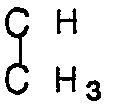


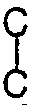

-CH₂CH₂CH₂CH₂-O-, wobei A zu mindestens 50 Mol% -CH₂CH₂O- bedeutet,
x = 12 bis 500,
y = ein Durchschnittswert von 0,3 bis 5,
n = eine ganze Zahl von 2 bis 6. Manufacture of paints using aqueous paints based on a polymer dispersion and conventional additives with a compound of general formula I as a thickener
R = radical of a 2 to 6-valent alcohol with 2 to 10 carbon atoms bound via oxygen,
R¹ = alkyl, alkoxymethyl or alkenyloxymethyl radical or a mixture of these radicals, each having 6 to 30 carbon atoms in the alkyl, alkoxy or alkenyloxy radical,
A = -CH₂CH₂-O- alone or in a mixture with
-CH₂-
-CH₂CH₂CH₂CH₂-O-, where A is at least 50 mol% -CH₂CH₂O-,
x = 12 to 500,
y = an average value of 0.3 to 5,
n = an integer from 2 to 6.
Description
Die Erfindung betrifft das Arbeiten mit wäßrigen Anstrichstoffe mit hoher Lagerbeständigkeit und guten Fließeigenschaften, die zu Anstrichen von hohem Glanz und hoher Wasser- und Korrosionsfestigkeit auftrocknen.The invention relates to working with aqueous paints with high storage stability and good flow properties, which dry to paints of high gloss and high water and corrosion resistance.
Anstrichstoffe mit wäßrigen Polymerdispersionen als Bindemittel zeigen im allgemeinen plastisches Fließverhalten. Dies ist bei Applikation auf mineralische Untergründe - Beispiele sind Fassaden- und Innenfarben -durchaus erwünscht. Bei der Beschichtung von Holz oder Metall wird dagegen häufig eine glatte, störungsfreie Oberfläche angestrebt, bei der Unregelmäßigkeiten, bedingt durch das Auftragsgerät oder feine Unebenheiten des Untergrunds, nicht mehr zu erkennen sind. Bei plastischem Fließverhalten lassen sich diese Anforderungen nicht erfüllen: Als Folge des geringen Streichwiderstandes sind derartige Anstrichstoffe mit dem Pinsel schlecht zu verteilen und verlaufen auch kaum während der Trocknung. Übliche Verdickungsmittel, beispielsweise Cellulosederivate wie Hydroxyethyl- oder Carboxymethylcellulose oder Polyacrylsäuresalze, verstärken dieses Fließverhalten noch.Paints with aqueous polymer dispersions as binders generally show plastic flow behavior. This is very important when applied to mineral substrates - examples are facade and interior colors. When coating wood or metal, on the other hand, a smooth, trouble-free surface is often sought, in which irregularities due to the applicator or fine unevenness of the surface can no longer be recognized. These requirements cannot be met with plastic flow behavior: as a result of the low spreading resistance, such paints are difficult to spread with a brush and hardly run during drying. Conventional thickeners, for example cellulose derivatives such as hydroxyethyl or carboxymethyl cellulose or polyacrylic acid salts, further reinforce this flow behavior.
Celluloseether werden darüber hinaus von Mikroorganismen abgebaut, was die Lagerstabilität der Anstrichstoffe beeinträchtigt.Cellulose ethers are also broken down by microorganisms, which affects the storage stability of the paints.
Für Korrosionsschutzanstriche kommt überdies die Forderung hinzu, daß sie eine hohe Wasserquellfestigkeit besitzen müssen. Verdicker für wäßrige Dispersionen sind naturnotwendig hydrophil und beeinträchtigen dadurch die Wasserfestigkeit des Anstrichs. Daraus ergibt sich die Forderung, daß der Gehalt an Verdicker möglichst gering ist, und dies wiederum bedingt eine möglichst hohe Wirksamkeit des Verdickers. Eine hohe Wirksamkeit ist bei den bisher bekannten Verdickern stets mit einem schlechten Verlauf verknüpft. Schlechter Verlauf ist aber nicht nur optisch nachteilig, sondern führt auch zu schlechtem Korrosionsschutz infolge Poren- und Blasenbildung.For corrosion protection paints there is also the requirement that they must have a high water swell resistance. Thickeners for aqueous dispersions are naturally hydrophilic and thus impair the water resistance of the paint. This leads to the requirement that the thickener content is as low as possible, and this in turn requires the thickener to be as effective as possible. In the case of the thickeners known hitherto, a high level of effectiveness is always linked to a poor course. Poor flow is not only visually disadvantageous, but also leads to poor corrosion protection due to the formation of pores and bubbles.
Die Beeinträchtigung der Wasserfestigkeit des Anstrichs infolge schlechten Verlaufs tritt besonders deutlich hervor, wenn eine Polymerdispersion verwendet wird, die an sich eine hohe Wasserquellfestigkeit besitzt, wie sie beispielsweise in den EP-A-91021 und 225 612 beschrieben sind.The impairment of the water resistance of the paint due to poor flow is particularly evident when a polymer dispersion is used which has a high water swell resistance as described, for example, in EP-A-91021 and 225 612.
Der Erfindung lag die Aufgabe zugrunde, wäßrige Anstrichstoffe mit verbesserten Fließeigenschaften, hoher Lagerbeständigkeit, gutem Verlauf, hohem Glanz und gleichzeitig hoher Wasserfestigkeit und Korrosionsschutzwirkung zu entwickeln.The invention was based on the object of providing aqueous paints with improved flow properties, long shelf life, good flow, to develop high gloss and at the same time high water resistance and corrosion protection.
Gegenstand der Erfindung sind wäßrige Anstrichstoffe auf Basis von Polymerdispersionen mit gegebenenfalls Pigmenten, Füllstoffen und üblichen Additiven wie Dispergier-, Netz-, Filmbindehilfsmitteln, Entschäumern, die dadurch gekennzeichnet sind, daß sie als Verdickungsmittel Polyetherpolyole der Formel I enthalten

R = über Sauerstoff gebundener Rest eines 2 bis 6-wertigen Alkohols mit 2 bis 10 C-Atomen,
R¹ = Alkyl-, Alkoxymethyl- oder Alkenyloxymethyl-Rest oder eine Mischung dieser Reste, mit jeweils 6 bis 30, vorzugsweise 6 bis 18 C-Atomen im Alkyl-, Alkoxy- bzw. Alkenyloxy-Rest, A = -CH₂CH₂-O- allein oder in Mischung mit
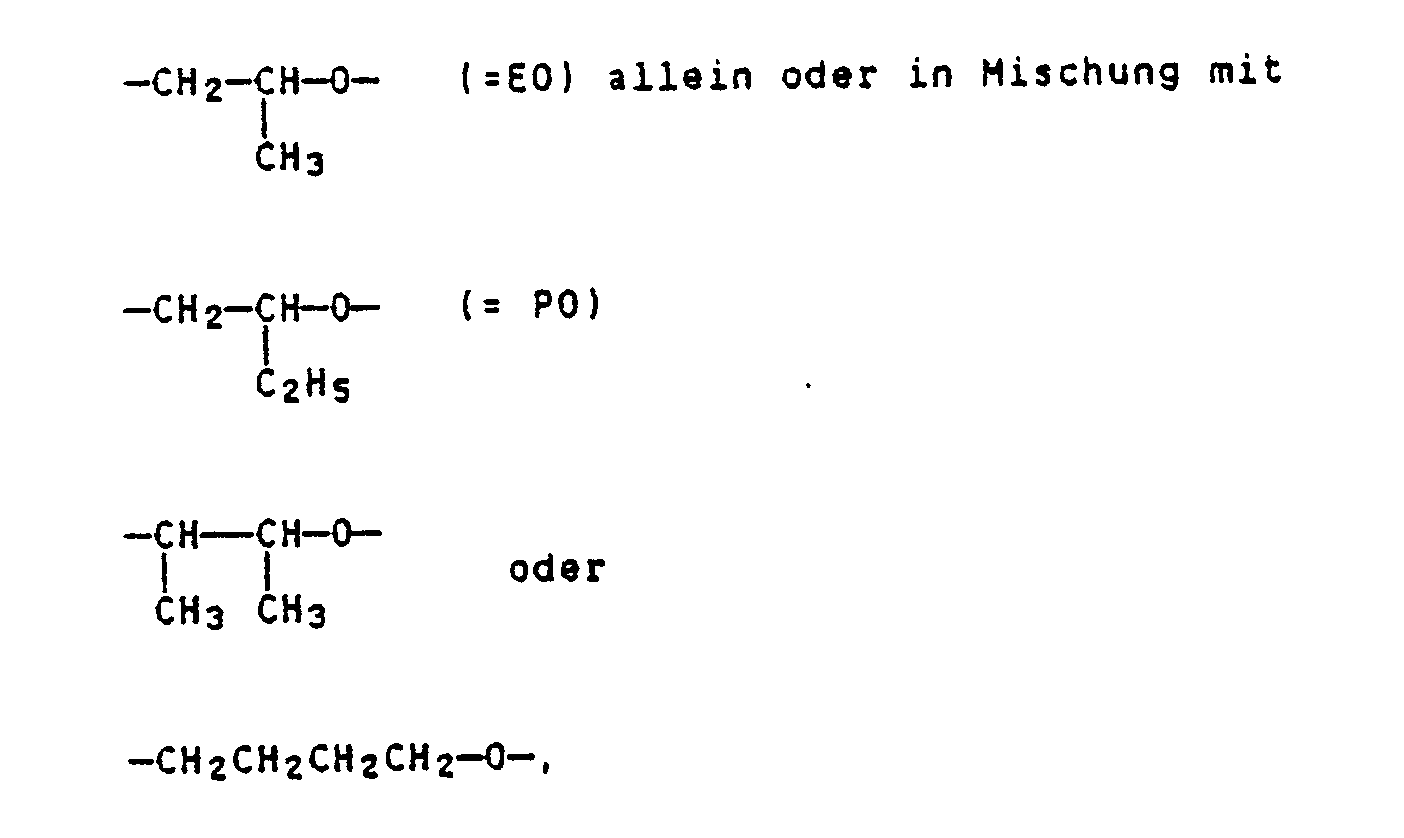
x = 12 bis 500,
y = ein Durchschnittswert (gemittelt über zahlreiche Moleküle) von 0,3 bis 5
n = eine ganze Zahl von 2 bis 6.The invention relates to aqueous paints based on polymer dispersions, optionally with pigments, fillers and conventional additives such as dispersing agents, wetting agents, film-binding auxiliaries and defoamers, which are characterized in that they contain polyether polyols of the formula I as thickeners
R = radical of a 2 to 6-valent alcohol with 2 to 10 carbon atoms bound via oxygen,
R¹ = alkyl, alkoxymethyl or alkenyloxymethyl radical or a mixture of these radicals, each with 6 to 30, preferably 6 to 18 carbon atoms in the alkyl, alkoxy or alkenyloxy radical, A = -CH₂CH₂-O- alone or mixed with
x = 12 to 500,
y = an average value (averaged over numerous molecules) from 0.3 to 5
n = an integer from 2 to 6.
Derartige Verbindungen wurden bereits als Verdicker für hydraulische Flüssigkeiten auf wäßriger Basis (US 4 411 819, 4 649 224, 4 665 239, WO 84/00361) sowie für wäßrige Quenchflüssigkeiten (US 4 381 205) zum Abschrecken heißer Metalle vorgeschlagen. Ihre hervorragende Eignung als Verdicker für Anstrichstoffe war dadurch jedoch nicht nahegelegt.Such compounds have already been proposed as thickeners for hydraulic liquids on an aqueous basis (US 4,411,819, 4,649,224, 4,665,239, WO 84/00361) and for aqueous quench liquids (US 4,381,205) for quenching hot metals. However, their excellent suitability as a thickener for paints was not suggested.
Die erfindungsgemäß eingesetzten Verdicker sind Polyetherpolyole, die aus einem linearen oder verzweigten Niedrigalkylenoxid-Homo- oder -Copolymeren bestehen, das endständig mit 1,2-Alkylenoxiden mit 8 bis 32 Kohlenstoffatomen oder Alkyl- bzw. Alkenylglycidylethern mit 6 bis 30 Kohlenstoffatomen in der Alkyl- bzw. Alkenylkette umgesetzt ist. Das mittlere Molekulargewicht liegt im Bereich von 1 000 bis 75 000.The thickeners used according to the invention are polyether polyols which consist of a linear or branched lower alkylene oxide homo- or copolymer which is terminated with 1,2-alkylene oxides having 8 to 32 carbon atoms or alkyl or alkenyl glycidyl ethers having 6 to 30 carbon atoms in the alkyl or alkenyl chain is implemented. The average molecular weight is in the range from 1,000 to 75,000.
Solche Polyetherpolyole werden erhalten, indem man, wie in EP 61 822 und EP 116 564 beschrieben, einen mehrwertigen Alkohol mit 2 bis 10 Kohlenstoffatomen, mit Ethylenoxid alleine oder mit Ethylenoxid und einem oder mehreren Alkylenoxiden mit 3 oder 4 Kohlenstoffatomen umsetzt (wobei im letzteren Fall die Umsetzung im Gemisch erfolgt, wenn ein statistisches Copolymeres gewünscht ist, und sukzessiv erfolgt, wenn ein Blockcopolymeres gewünscht ist) und anschließend diese Zwischenstufe mit mindestens 0,3 Äquivalent (pro Hydroxylgruppe) Alkylenoxid mit 8 bis 32 Kohlenstoffatomen und endständiger Epoxidgruppe oder mit mindestens 0,3 Äquivalent Alkyl- oder Alkenylglycidylether mit 6 bis 30 Kohlenstoffatomen im Alkyl bzw. Alkenylrest umsetzt. Die Herstellung kann auch, wie in US 4 398 045 beschrieben, durch Umsetzung eines bereits vorliegenden Polyalkylenoxidhomo- oder copolymeren, das aus C₂- bzw. C₂ und C₃/C₄-Epoxiden aufgebaut ist, mit den o.g. längerkettigen Alkylenoxiden bzw. Glycidylethern erfolgen.Such polyether polyols are obtained by reacting, as described in EP 61 822 and EP 116 564, a polyhydric alcohol having 2 to 10 carbon atoms, with ethylene oxide alone or with ethylene oxide and one or more alkylene oxides with 3 or 4 carbon atoms (in the latter case the reaction takes place in a mixture if a random copolymer is desired, and takes place successively if a block copolymer is desired) and then this intermediate with at least 0.3 equivalent (per hydroxyl group) of alkylene oxide with 8 to 32 carbon atoms and terminal epoxy group or with at least 0 , 3 equivalent of alkyl or alkenyl glycidyl ether having 6 to 30 carbon atoms in the alkyl or alkenyl radical. The preparation can also, as described in US 4,398,045, by reacting a polyalkylene oxide homo- or copolymer already present, which is composed of C₂- or C₂ and C₃ / C₄-epoxides, with the above. longer chain alkylene oxides or glycidyl ethers.
Mit 2 bis 6-wertigen Alkoholen sind solche gemeint, die 2 bis 6 Hydroxylgruppen besitzen. Es handelt sich im einzelnen um Alkanpolyole, Alkenpolyole, Alkinpolyole oder Oligooxyalkylenglykole, jeweils mit 2 bis 10, vorzugsweise 2 bis 6 Kohlenstoffatomen.By 2 to 6-valent alcohols are meant those which have 2 to 6 hydroxyl groups. Specifically, they are alkane polyols, alkene polyols, alkyne polyols or oligooxyalkylene glycols, each with 2 to 10, preferably 2 to 6, carbon atoms.
Beispiele für geeignete Alkanpolyole sind Ethylenglykol, 1,2- und 1,3-Propylenglykol, Neopentylglykol, 1,2-Butandiol, 1,3-Butandiol, 1,4-Butandiol, Trimethylolpropan, Glycerin, Pentaerythrit, 2,3,4,5-Hexantetrol, Sorbit, Glucose.Examples of suitable alkane polyols are ethylene glycol, 1,2- and 1,3-propylene glycol, neopentyl glycol, 1,2-butanediol, 1,3-butanediol, 1,4-butanediol, trimethylolpropane, glycerol, pentaerythritol, 2,3,4, 5-hexane tetrol, sorbitol, glucose.
Beispiele für Alkenpolyole sind 2-Buten-1,4-diol, 2-Hexen-1,4,6-triol, 1,5-Hexadien-3,4-diol, 3-Hepten-1,2,6,7-tetrol.Examples of alkene polyols are 2-butene-1,4-diol, 2-hexene-1,4,6-triol, 1,5-hexadiene-3,4-diol, 3-heptene-1,2,6,7- tetrol.
Beispiele für Alkinpolyole sind 2-Butin-1,4-diol, 2-Hexin-1,4,6-triol, 4-Octin-1,2,7,8-tetrol.Examples of alkyne polyols are 2-butyne-1,4-diol, 2-hexyne-1,4,6-triol, 4-octyne-1,2,7,8-tetrol.
Beispiele für Oligooxyalkylenglykole sind Diethylenglykol, Triethylenglykol, Tetraethylenglykol, Dipropylenglykol.Examples of oligooxyalkylene glycols are diethylene glycol, triethylene glycol, tetraethylene glycol, dipropylene glycol.
Das Grundgerüst des Polyetherpolyols kann entweder nur aus Oxyethyleneinheiten aufgebaut sein oder daneben auch Oxyalkyleneinheiten mit 3 bis 4 Kohlenstoffatomen in einer Menge bis zu 50, vorzugsweise bis zu 30 Mol% enthalten. Entsprechende Alkylenoxide sind insbesondere Propylenoxid, aber auch 1,2-Butylenoxid, 2,3-Butylenoxid, ferner auch Tetrahydrofuran. Die entsprechenden Copolymeren können statistische oder Blockcopolymere sein. Unter den Copolymeren besonders bevorzugt sind solche, die Ethylenoxid und Propylenoxid im Gewichtsverhältnis 70:30 bis 95:5 enthalten.The basic structure of the polyether polyol can either be composed only of oxyethylene units or, in addition, also contain oxyalkylene units with 3 to 4 carbon atoms in an amount of up to 50, preferably up to 30, mol%. Corresponding alkylene oxides are, in particular, propylene oxide, but also 1,2-butylene oxide, 2,3-butylene oxide and also tetrahydrofuran. The corresponding copolymers can be random or block copolymers. Among the copolymers, those which contain ethylene oxide and propylene oxide in a weight ratio of 70:30 to 95: 5 are particularly preferred.
Die Herstellung der am Kettende eingebauten längerkettigen Epoxide bzw. Glycidylether mit 8 bis 32 bzw. 6 bis 30 Kohlenstoffatomen erfolgt in üblicher Weise durch α-Olefinoxidation bzw. durch Umsetzung von Fettalkoholen mit Epichlorhydrin (vgl. z.B. US 4 086 279).The longer-chain epoxides or glycidyl ethers with 8 to 32 or 6 to 30 carbon atoms installed at the end of the chain are prepared in the customary manner by α-olefin oxidation or by reaction of fatty alcohols with epichlorohydrin (see, for example, US Pat. No. 4,086,279).
Die Menge an längerkettigem 1,2-Alkylenoxid bzw. Glycidylether liegt im allgemeinen zwischen 0,5 und 75 Gew.%, bezogen auf das Gesamtmolekül. Das durchschnittliche molare Verhältnis von längerkettigem Epoxid bzw. Glycidylether zu jeder einzelnen Hydroxygruppe des mehrfunktionellen Alkohols soll im Bereich von 0,3 bis 5, vorzugsweise zwischen 0,5 und 2 liegen.The amount of longer-chain 1,2-alkylene oxide or glycidyl ether is generally between 0.5 and 75% by weight, based on the total molecule. The average molar ratio of longer-chain epoxide or glycidyl ether to each individual hydroxyl group of the polyfunctional alcohol should be in the range from 0.3 to 5, preferably between 0.5 and 2.
Beispiele für langkettige 1,2-Epoxide sind 1,2-Epoxyoctan, 1,2-Epoxydodecan, 1,2-Epoxyhexadecan, 1,2-Epoxyoctadecan, 1,2-Epoxytetracosan, 1,2-Epoxyhexacosan, 1,2-Epoxyoctacosan wie auch Mischungen solcher Epoxide, die käuflich erhältlich sind.Examples of long-chain 1,2-epoxides are 1,2-epoxyoctane, 1,2-epoxydodecane, 1,2-epoxyhexadecane, 1,2-epoxyoctadecane, 1,2-epoxytetracosane, 1,2-epoxyhexacosane, 1,2-epoxyoctacosane as well as mixtures of such epoxides, which are commercially available.
Beispiele für Alkylglycidylether sind Octyl-, Dodecyl-, 2-Methyldodecyl-, Tetradecyl-, Hexadecyl-, 2-Hexyldecyl-, Octadecyl-, 2-Hexyldodecyl-, Eicosyl-, 2-Octyldodecyl-, Tetracosyl- und Cerylglycidylether.Examples of alkyl glycidyl ethers are octyl, dodecyl, 2-methyldodecyl, tetradecyl, hexadecyl, 2-hexyldecyl, octadecyl, 2-hexyldodecyl, eicosyl, 2-octyldodecyl, tetracosyl and cerylglycidyl ethers.
Beispiele für Alkenylglycidylether sind Oleylglycidylether oder Phytylglycidylether.Examples of alkenyl glycidyl ethers are oleyl glycidyl ether or phytyl glycidyl ether.
Als Verdickungsmittel werden Polyetherpolyole bevorzugt, die man durch Umsetzung eines bi- oder trifunktionellen Alkohols mit Ethylenoxid, ggf. im Gemisch mit bis zu 30 Gew.% Propylenoxid, und anschließende weitere Umsetzung mit mindestens einem 1,2-Alkylenoxid mit 8 bis 18 Kohlenstoffatomen oder mindestens einem Alkyl- oder Alkenylglycidylether mit 8 bis 18 Kohlenstoffatomen in der Alkyl- bzw. Alkylengruppe in einer Menge von 2 bis 5 Mol pro Mol bi- oder trifunktioneller Alkohol erhält.Preferred thickeners are polyether polyols which are obtained by reacting a bifunctional or trifunctional alcohol with ethylene oxide, optionally in a mixture with up to 30% by weight of propylene oxide, and then further reacting with at least one 1,2-alkylene oxide having 8 to 18 carbon atoms or at least one alkyl or alkenyl glycidyl ether having 8 to 18 carbon atoms in the alkyl or alkylene group in an amount of 2 to 5 moles per mole of bifunctional or trifunctional alcohol.
Bindemittel der erfindungsgemäßen Anstrichstoffe sind wäßrige Polymerdispersionen, die aus α,β-olefinisch ungesättigten Monomeren nach dem Verfahren der Emulsionspolymerisation oder, für den Korrosionsschutz bevorzugt, durch Sekundärdispersion, insbesondere gemäß EP-A-91021 oder 225 612, erhalten werden. Die Polymerisatzusammensetzung kann in weiten Grenzen variieren, es lassen sich jedoch im wesentlichen drei Klassen unterscheiden: (Meth)Acrylesterhomo- und Copolymerisate, Styrol-(meth)acrylat-Copolymerisate sowie Vinylestercopolymerisate, jeweils gegebenenfalls mit carboxylgruppenhaltigen Comonomeren.Binders of the paints according to the invention are aqueous polymer dispersions which consist of α, β-olefinically unsaturated monomers by the emulsion polymerization process or, for corrosion protection, by secondary dispersion, in particular in accordance with EP-A-91021 or 225 612. The polymer composition can vary within wide limits, but there are essentially three classes: (meth) acrylic ester homopolymers and copolymers, styrene (meth) acrylate copolymers and vinyl ester copolymers, each with carboxyl group-containing comonomers.
Der nichtflüchtige Anteil der bei der Zubereitung der Anstrichstoffe eingesetzten Polymerdispersionen beträgt 30 bis 70, vorzugsweise 40 bis 65 Gew.%.The non-volatile fraction of the polymer dispersions used in the preparation of the paints is 30 to 70, preferably 40 to 65,% by weight.
Die erfindungsgemäßen Anstrichstoffe (bestehend aus Polymerdispersion und allen Zusatzstoffen) besitzen Feststoffgehalte von 30 bis 80, vorzugsweise 40 bis 65 Gew.%. Die Pigmentvolumenkonzentration hängt von der Formulierung ab: bei Seidenglanzfarben liegt sie bei 30 bis 45, bei Glanzfarben bei 15 bis 20 %, bei Korrosionsschutz-Anstrichstoffen bei 15 bis 40 %. Als Pigment kommt Titandioxid, insbesondere Rutil, in Frage. Darüber hinaus können Buntpigmente, wie Eisenoxide, Chromoxid oder Spezialpigmente zum Schutz vor Korrosion, wie Zinkphosphat, Kalziumferrit, oder vor UV-Strahlung eingesetzt werden.The paints according to the invention (consisting of polymer dispersion and all additives) have solids contents of 30 to 80, preferably 40 to 65% by weight. The pigment volume concentration depends on the formulation: for silk gloss paints it is 30 to 45, for gloss paints 15 to 20%, for anti-corrosion paints 15 to 40%. Titanium dioxide, in particular rutile, can be used as the pigment. In addition, colored pigments, such as iron oxides, chromium oxide or special pigments for protection against corrosion, such as zinc phosphate, calcium ferrite, or against UV radiation can be used.
Beispiele für Füllstoffe sind Kaolin, Kalziumcarbonat, Talkum, Kalzium- oder Magnesiumsilikate, Quarzmehl, Schwerspat.Examples of fillers are kaolin, calcium carbonate, talc, calcium or magnesium silicates, quartz powder, heavy spar.
Dazu kommen als übliche Zusatzstoffe z.B. Entschäumer, Konservierungsmittel, Filmbildehilfsmittel, gegebenenfalls Weichmacher, sowie Mattierungs- und Antiblockmittel, ferner gegebenenfalls Ammoniak zur Einstellung des pH-Wertes.In addition there are the usual additives e.g. Defoamers, preservatives, film-forming aids, optionally plasticizers, and matting and antiblocking agents, and optionally ammonia to adjust the pH.
Um die Pigment-Füllstoffe im feindispergierten Zustand zu halten, sind grenzflächenaktive Stoffe erforderlich. Hierzu können beispielsweise Polyphosphate , Polyacrylat-Salze sowie ionische oder nichtionische Tenside eingesetzt werden. Zur Herstellung der bevorzugten, wasserfesten Korrosionsschutz-Anstrichstoffe werden in das Copolymerisat des Bindemittels Carboxylgruppen eingebaut, indem man carboxylgruppenhaltige Comonomere wie Maleinsäure oder deren Anhydrid, Itaconsäure oder deren Anhydrid, Methacrylsäure, Crotonsäure und vor allem Acrylsäure einpolymerisiert. Diese Bindemittel haben dann gleichzeitig dispergierende Wirkung und werden deshalb für den Korrosionsschutz bevorzugt, insbesondere, wenn sie nach EP-A-91 021 oder EP-A-225 612 hergestellt sind und nach 7 Tagen Wasserlagerung bei 23°C <10, vorzugsweise <5 Gew.% Wasser aufnehmen.In order to keep the pigment fillers in the finely dispersed state, surfactants are required. For example, polyphosphates, polyacrylate salts and ionic or nonionic surfactants can be used for this purpose. To produce the preferred water-resistant anti-corrosion paints, carboxyl groups are incorporated into the copolymer of the binder by polymerizing comonomers containing carboxyl groups, such as maleic acid or its anhydride, itaconic acid or its anhydride, methacrylic acid, crotonic acid and, above all, acrylic acid. These binders then also have a dispersing effect and are therefore preferred for corrosion protection, in particular if they are produced in accordance with EP-A-91 021 or EP-A-225 612 and after 7 days of water storage at 23 ° C. <10, preferably <5 Take up% water.
Der wesentliche und überraschende Vorteil der bevorzugten erfindungsgemäßen Korrosionsschutz-Anstrichstoffe ist vor allem durch die gleichzeitige Erfüllung der gegenläufigen Forderungen nach hoher Wasserfestigkeit und gutem Verlauf gegeben. Dies wirkt sich aus in einem besseren Schutz für die verschiedensten Werkstoffe, wie Eisen, Stahl, Holz und Kunststoffe, gegen witterungsbedingte und andere korrosive Beanspruchungen, insbesondere gegen Salzsprühnebel, und die bessere Beständigkeit gegen gleichzeitige mechanische Beanspruchungen. Derartige Anstrichstoffe eignen sich daher beispielsweise besonders als Korrosionsschutzfarbe, wie Rostschutzgrundierungen, Korrosionsschutzfüllgrundierungen und -deckanstriche, oder auch als Straßenmarkierungsfarben.The essential and surprising advantage of the preferred corrosion protection paints according to the invention is given above all by the simultaneous fulfillment of the contrary requirements for high water resistance and good flow. This results in better protection for a wide variety of materials, such as iron, steel, wood and plastics, against weather-related and other corrosive stresses, in particular against salt spray, and better resistance against simultaneous mechanical stresses. Such paints are therefore particularly suitable, for example, as anti-corrosion paints, such as anti-rust primers, anti-corrosion fill primers and top coats, or as road marking paints.
Aber auch ohne die Wasserfestigkeit zeichnen sich die erfindungsgemäßen Anstrichstoffe durch entscheidend verbesserte Lagerbeständigkeit aus, beispielsweise gegen hartes Absetzen von Pigmenten und Füllstoffen, sowie gegen bakteriellen Angriff, ferner vor allem durch ihre guten Fließeigenschaften und den Glanz ihres Films. Die Verbesserung kommt besonders bei Seidenglanz- und Glanzfarben zum Tragen.But even without the water resistance, the paints according to the invention are distinguished by a significantly improved shelf life, for example against hard settling of pigments and fillers, and against bacterial attack, and above all because of their good flow properties and the gloss of their film. The improvement is particularly noticeable with silk gloss and gloss colors.
Die erfindungsgemäß einzusetzenden Verdicker können im Gegensatz zu vielen üblichen im gesamten pH-Bereich von 1 bis 10 eingesetzt werden, da ihr Effekt sehr wenig vom pH-Wert abhängt. Sie können aus Wasser oder wäßrigen Mischungen von mit Wasser mischbaren Lösungsmitteln wie Alkoholen, Glykolen und aus üblichen Lösungsmitteln, in denen die Verdicker löslich sind, wie Estern, Ketonen, Kohlenwasserstoffen, Weichmachern, flüssigen Harzen oder aus flüssigen nichtionischen Tensiden wie Fettalkoholalkoxylaten, Alkylphenolalkoxylaten, Fettsäurealkoxylaten verarbeitet werden. Wegen der sehr starken Verdickungseffekte ist es vorteilhaft, mit etwa 5 %igen Verdickerlösungen zu arbeiten.In contrast to many conventional thickeners to be used according to the invention, they can be used in the entire pH range from 1 to 10, since their effect depends very little on the pH. They can be made from water or aqueous mixtures of water-miscible solvents such as alcohols, glycols and from conventional solvents in which the thickeners are soluble, such as esters, ketones, hydrocarbons, plasticizers, liquid resins or from liquid nonionic surfactants such as fatty alcohol alkoxylates, alkylphenol alkoxylates, fatty acid alkoxylates are processed. Because of the very strong thickening effects, it is advantageous to work with about 5% thickening solutions.
Der Anteil des Verdickers der Formel I (100 % Festgehalt) an der gesamten Formulierung liegt zwischen 0,02 und 2 Gew.%, vorzugsweise bei 0,05 bis 1,0 Gew.%. Eine Kombination mit anderen Verdickungsmitteln, z.B. Hydroxyethylcellulose, kommt nur in Betracht, wenn es auf die Wasserfestigkeit und Korrosionsbeständigkeit des Anstrichs nicht ankommt. Bei Kombination mit anderen Verdickungsmitteln können 0,02 Gewichtsprozent noch unterschritten werden. Die Verdicker werden vorzugsweise als Lösung in Wasser oder einer Kombination aus Wasser und wenigstens teilweise wassermischbaren organischen Lösemitteln eingesetzt.The proportion of the thickener of the formula I (100% solids content) in the total formulation is between 0.02 and 2% by weight, preferably 0.05 to 1.0% by weight. A combination with other thickeners, e.g. Hydroxyethyl cellulose can only be used if the water resistance and corrosion resistance of the paint are not important. When combined with other thickeners, the weight may fall below 0.02 percent by weight. The thickeners are preferably used as a solution in water or a combination of water and at least partially water-miscible organic solvents.
Die in den Formulierungen und Beispielen angegebenen Teile und Verhältnisse beziehen sich auf das Gewicht, sofern nichts anderes angegeben ist.The parts and ratios given in the formulations and examples are based on weight, unless stated otherwise.
Als Dispergiermittel diente ein Styrol/Acrylsäure-Copolymer, das als 35 %ige wäßrig-ammoniakalische Lösung im Handel erhältlich ist.A styrene / acrylic acid copolymer, which is commercially available as a 35% strength aqueous ammoniacal solution, served as the dispersant.
Bei den Verdickern der Beispiele 1 bis 3 handelt es sich um Polyetherpolyole mit einem Molekulargewicht von ca. 17 000, die durch Umsetzung von Trimethylolpropan (TMP) mit Ethylenoxid/Propylenoxid-Gemisch im Molverhältnis 85/15 und anschließende weitere Umsetzung mit 3 Äquivalenten (bezogen auf TMP) eines Gemisches längerkettiger 1,2-Alkylenoxide erhalten wurden.The thickeners of Examples 1 to 3 are polyether polyols with a molecular weight of approx. 17,000, which are obtained by reacting trimethylolpropane (TMP) with an ethylene oxide / propylene oxide mixture in a molar ratio of 85/15 and then further reacting with 3 equivalents ( on TMP) of a mixture of longer-chain 1,2-alkylene oxides were obtained.
Kettenlänge der längerkettigen 1,2-Alkylenoxide:
Beim Vergleichsversuch wurde ein für Dispersionslacke empfohlener handelsüblicher Polyurethanverdicker eingesetzt, der als 50 %ige Lösung in Wasser/Isobutoxipropanol 1:1 vorlag. Diese Lösung wurde mit Wasser auf 25 Gew.% Festgehalt verdünnt (Verdickerlösung D).In the comparative experiment, a commercially available polyurethane thickener recommended for dispersion coatings was used, which was present as a 50% solution in water / isobutoxy propanol 1: 1. This solution was diluted with water to a solids content of 25% by weight (thickener solution D).
Bei den Bindemitteln handelte es sich durchweg um niederviskose, handelsübliche, feinteilige Seifendispersionen:
Rezepturen (Angaben in Gew.-Teilen)
Die Herstellung der Dispersionslackfarben erfolgte derart, daß nach Vorlage des Dispergiermittels die weiteren Bestandteile in der oben angegebenen Reihenfolge unter Rühren zudosiert wurden. Das Pigment wurde 20 min bei 1000 Upm in den vor Rutil genannten Bestandteilen dispergiert, die restlichen Bestandteile anschließend bei reduzierter Drehzahl eingerührt. Nach zweistündigem Stehen wurde abgesiebt.The emulsion paints were prepared in such a way that, after the dispersant had been introduced, the other constituents were metered in with stirring in the order given above. The pigment was dispersed in the constituents mentioned before rutile for 20 min at 1000 rpm, the remaining constituents were then stirred in at reduced speed. After standing for two hours, sieving was carried out.
Aus den Fließkurven der Dispersionslacke, aufgenommen mit einem Rotationsviskosimeter, Standardmeßsystem DIN 53018, wurden Viskositäten für zwei Geschwindigkeitsgefälle errechnet.Viscosities for two speed gradients were calculated from the flow curves of the dispersion varnishes, recorded with a rotary viscometer, standard measuring system DIN 53018.
Zur Beurteilung von Streichzähigkeit und Verlauf wurden die Lacke auf Glanzkarton gestrichen (0 = guter Verlauf, 5 = kein Verlauf). Auch der Unterschied im Glanzgrad zwischen gestörtem und ungestörtem Film ist ein Maß für den Verlauf.The paints were coated on glossy cardboard to assess the spreadability and flow (0 = good flow, 5 = no flow). The difference in the degree of gloss between disturbed and undisturbed film is also a measure of the course.
Der Glanz wurde gemäß DIN 67 530 bestimmt.
Wie die obigen Ergebnisse zeigen, ist die Viskosität der erfindungsgemäßen Anstrichstoffe (in diesem Fall Dispersionslacke) trotz geringerem Verdicker-Festgehalt erheblich höher als bei dem Vergleichsversuch. Überraschenderweise zeigen sie trotzdem ein gutes, lackartiges Fließverhalten: sie lassen sich besser verstreichen als der Vergleichsversuch, und der Verlauf ist ebensogut. Auch der überlegene Glanz ist überraschend und weist auf eine gute Verträglichkeit hin.As the results above show, the viscosity of the paints according to the invention (in this case, dispersion varnishes) is considerably higher than in the comparative test, despite the lower thickener solids content. Surprisingly, they still show good, varnish-like flow behavior: they are easier to spread than the comparison test, and the course is just as good. The superior shine is also surprising and indicates good compatibility.
Als Verdickungsmittel wurde ein Polyetherpolyol vom Molgewicht 17 000 verwendet, das durch Umsetzung von Trimethylolpropan mit EO/PO-Gemisch im Molverhältnis 85/15 und anschließende Umsetzung mit 1,2-Epoxihexadecan (3 Mol pro Mol Trimethylolpropan) erhalten worden war.A 17,000 molecular weight polyether polyol was used as the thickener, which had been obtained by reacting trimethylolpropane with an EO / PO mixture in a molar ratio of 85/15 and then reacting it with 1,2-epoxyhexadecane (3 moles per mole of trimethylolpropane).
213 Teile einer 47 %igen wäßrig-ammoniakalischen Dispersion, hergestellt durch Polymerisation von 720 Teilen Methylmethacrylat, 450 Teilen Butylacrylat und 30 Teilen Acrylsäure entsprechend dem Beispiel 2 der EP-A-225 612, wurden mit 35 Teilen entsalztem Wasser, 2 Teilen eines Entschäumers, 1,5 Teilen konz. Ammoniak, 1,5 Teilen eines wasserlöslichen Netzmittels auf der Basis eines Phosphorsäuremonoalkylesters mit einer Säurezahl von 270 mg KOH/g sowie 1,2 Teilen einer 25 %igen Lösung des Verdickungsmittels in Wasser/Butyldiglykol 80/20 vermischt.213 parts of a 47% strength aqueous-ammoniacal dispersion, prepared by polymerizing 720 parts of methyl methacrylate, 450 parts of butyl acrylate and 30 parts of acrylic acid in accordance with Example 2 of EP-A-225 612, were mixed with 35 parts of demineralized water, 2 parts of a defoamer, 1.5 parts conc. Ammonia, 1.5 parts of a water-soluble wetting agent based on a phosphoric acid monoalkyl ester with an acid number of 270 mg KOH / g and 1.2 parts of a 25% strength solution of the thickener in water / butyl diglycol 80/20.
In die Mischung wurden 60 Teile Rutil und 220 Teile Kristobalith sowie 10 Teile Solventnaphtha (Siedebereich 140 bis 180°C) eingerührt und am Dissolver dispergiert. Die erhaltene Farbe wurde mit 10 Teilen Wasser auf eine Viskosität von 2 Pa·s eingestellt. Sie zeichnete sich durch gute Viskositätskonstanz und geringes Absitzen der Pigmente und Füllstoffe bei langzeitiger Lagerung bei Raumtemperatur aus und war trotz der relativ hohen Viskosität noch gut durch Luftdruckspritzen verarbeitbar.60 parts of rutile and 220 parts of kristobalite and 10 parts of solvent naphtha (boiling range 140 to 180 ° C.) were stirred into the mixture and dispersed on a dissolver. The color obtained was adjusted to a viscosity of 2 Pa · s with 10 parts of water. It was characterized by good viscosity constancy and low settling of the pigments and fillers after long-term storage at room temperature and, despite the relatively high viscosity, was still easy to process by air pressure spraying.
Eine mit einer Naßschichtdicke von 0,04 mm auf Asphalt aufgetragene Beschichtung war nach dem Durchtrocknen wasser-, abrieb- und witterungsbeständig.A coating applied to asphalt with a wet layer thickness of 0.04 mm was water-, abrasion- and weather-resistant after drying.
Analoge Farben wurden ohne Verdicker bzw. mit der gleichen und mit der doppelten Menge eines marktgängigen Verdickungsmittels, wie einem Urethanverdicker, hergestellt. Der Vergleichs-Anstrichstoff war sehr niedrig viskos und instabil. Das Pigment setzte sich in kurzer Zeit ab. Es war etwa die 4- bis 5-fache Menge Verdickungsmittel erforderlich, um auf ähnliche Viskositätswerte und vergleichbares Schwebevermögen für das Pigment zu kommen. Dieser Vergleichs-Anstrichstoff ergab dann jedoch keine ausreichend wasserquellfesten und naßabriebbeständigen Anstriche mehr, um für die Anwendung als Straßenmarkiermengen brauchbar zu sein.
Als Verdickungsmittel wurde ein Polyetherpolyol eingesetzt, das durch Umsetzung eines Polyethylenglykols vom Molgewicht 15 000 mit 1,2-Epoxioctadecan im Molverhältnis 1:8 erhalten wurde.A polyether polyol was used as the thickener, which was obtained by reacting a polyethylene glycol with a molecular weight of 15,000 with 1,2-epoxioctadecane in a molar ratio of 1: 8.
55 Teile einer 45 %igen wäßrig-ammoniakalischen Dispersion, erhalten durch Polymerisation von 456 Teilen Styrol, 612 Teilen Butylacrylat und 72 Teilen Acrylsäure nach dem in der EP-A-225 612, Beispiel 1 beschriebenen Verfahren, wurden mit 25 Teilen entsalztem Wasser, 2 Teilen konz. Ammoniak, 2 Teilen Entschäumer, 5 Teilen Butyldiglykol, 0,5 Teilen eines wasserlöslichen Netzmittels auf der Basis eines Phosphorsäuremonoalkylesters mit einer Säurezahl von 270 mg KOH/g sowie 1 Teil einer 25 %igen Lösung des Verdickungsmittels in Wasser/Butyldiglykol 80/20 vermischt.55 parts of a 45% aqueous-ammoniacal dispersion, obtained by polymerizing 456 parts of styrene, 612 parts of butyl acrylate and 72 parts of acrylic acid by the process described in EP-A-225 612, Example 1, were treated with 25 parts of demineralized water, 2 Share conc. Ammonia, 2 parts defoamer, 5 parts butyl diglycol, 0.5 part of a water-soluble wetting agent based on a phosphoric acid monoalkyl ester with an acid number of 270 mg KOH / g and 1 part of a 25% solution of the thickener in water / butyl diglycol 80/20 mixed.
In die Mischung wurden 50 Teile Eisenoxidrot und 30 Teile Schwerspat eingerührt und am Dissolver dispergiert. Die erhaltene Pigmentsuspension wurde mit weiteren 110 Teilen der obigen 45 %igen Polymerdispersion sowie weiteren 2 Teilen Entschäumer vermischt. Die Farbe wurde mit Wasser auf eine Viskosität von 1,5 Pa·s eingestellt.50 parts of iron oxide red and 30 parts of heavy spar were stirred into the mixture and dispersed on a dissolver. The pigment suspension obtained was mixed with a further 110 parts of the above 45% polymer dispersion and a further 2 parts of defoamer. The color was adjusted to a viscosity of 1.5 Pa · s with water.
Ein entfettetes Tiefziehblech wurde mit dieser Farbe mit einer Trockenschichtdicke von 0,08 mm beschichtet. Der Anstrich zeichnete sich durch guten Verlauf aus. Nach dem Durchtrocknen wurde er mit einem Schnitt bis auf den Metalluntergrund versehen und das beschichtete Blech einer Salzsprühbeanspruchung von 200 Stunden ausgesetzt. Am Schnitt entstand Rost, die Beschichtung bleib weitgehend unversehrt.A degreased deep-drawn sheet was coated with this paint with a dry layer thickness of 0.08 mm. The paint was characterized by a good flow. After drying, it was cut to the metal surface and the coated sheet was exposed to salt spray for 200 hours. Rust appeared on the cut, the coating remained largely intact.
Analoge Farben wurden ohne Zusatz eines Verdickungsmittels wie auch mit der gleichen und mit der doppelten Menge eines marktgängigen Urethanverdickers hergestellt. Die Vergleichsfarben waren sehr niedrig viskos und setzten relativ schnell und stark ihre Pigmente bei Lagerung bei Raumtemperatur ab, während die Farbe des Beispiels 5 lagerstabil blieb. Um eine Viskosität von 1,5 Pa·s wie in Beispiel 5 einzustellen, war etwa die 3-fache Menge Verdickungsmittel erforderlich. Die Vergleichsbeschichtungen zeigten am Schnitt verhältnismäßig starke Korrosionserscheinungen, wie Unterrostung, Blasenbildung und Unterwanderung des Anstrichs unter Verlust der Haftfestigkeit.Analog colors were produced without the addition of a thickener as well as with the same and with twice the amount of a commercially available urethane thickener. The comparison colors were very low viscosity and settled their pigments relatively quickly and strongly when stored at room temperature, while the color of Example 5 remained stable. In order to set a viscosity of 1.5 Pa · s as in Example 5, about 3 times the amount of thickener was required. The comparative coatings showed relatively strong signs of corrosion on the cut, such as rust, blistering and infiltration of the paint with loss of adhesive strength.
Claims (3)

R = über Sauerstoff gebundener Rest eines 2 bis 6-wertigen Alkohols mit 2 bis 10 C-Atomen,
R¹ = Alkyl-, Alkoxymethyl- oder Alkenyloxymethyl-Rest oder eine Mischung dieser Reste, mit jeweils 6 bis 30 C-Atomen im Alkyl-, Alkoxy- bzw. Alkenyloxy-Rest,
A = -CH₂CH₂-O- allein oder in Mischung mit
-CH₂-
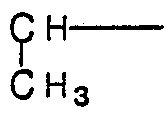


-CH₂CH₂CH₂CH₂-O-,
wobei A zu mindestens 50 Mol% -CH₂CH₂O- bedeutet,
x = eine Zahl von 12 bis 500,
y = ein Durchschnittswert von 0,3 bis 5,
n = eine ganze Zahl von 2 bis 6.1. A process for the production of paints, an aqueous paint based on a polymer dispersion which, in addition to the dispersion, contains conventional additives as a binder, is applied to a substrate in the manner of a paint, characterized in that paints are used which are associated with a compound of general formula I are thickened:
R = radical of a 2 to 6-valent alcohol with 2 to 10 carbon atoms bound via oxygen,
R¹ = alkyl, alkoxymethyl or alkenyloxymethyl radical or a mixture of these radicals, each having 6 to 30 carbon atoms in the alkyl, alkoxy or alkenyloxy radical,
A = -CH₂CH₂-O- alone or in a mixture with
-CH₂-
-CH₂CH₂CH₂CH₂-O-,
where A is at least 50 mol% -CH₂CH₂O-,
x = a number from 12 to 500,
y = an average value of 0.3 to 5,
n = an integer from 2 to 6.
Applications Claiming Priority (2)
| Application Number | Priority Date | Filing Date | Title |
|---|---|---|---|
| DE3807234 | 1988-03-05 | ||
| DE3807234A DE3807234A1 (en) | 1988-03-05 | 1988-03-05 | AQUEOUS PAINT |
Publications (1)
| Publication Number | Publication Date |
|---|---|
| EP0332013A2 true EP0332013A2 (en) | 1989-09-13 |
Family
ID=6348937
Family Applications (1)
| Application Number | Title | Priority Date | Filing Date |
|---|---|---|---|
| EP89103445A Withdrawn EP0332013A2 (en) | 1988-03-05 | 1989-02-28 | Manufacture of paints using aqueous paint components |
Country Status (5)
| Country | Link |
|---|---|
| EP (1) | EP0332013A2 (en) |
| JP (1) | JPH026563A (en) |
| AU (1) | AU3093389A (en) |
| DE (1) | DE3807234A1 (en) |
| FI (1) | FI891030A7 (en) |
Cited By (1)
| Publication number | Priority date | Publication date | Assignee | Title |
|---|---|---|---|---|
| EP0618243A3 (en) * | 1993-04-01 | 1995-02-22 | Bayer Ag | Preparation of a binder from polyurethane and its use as a binder for aqueous systems. |
Families Citing this family (2)
| Publication number | Priority date | Publication date | Assignee | Title |
|---|---|---|---|---|
| DE19841976A1 (en) * | 1998-09-14 | 2000-03-30 | Herberts & Co Gmbh | Two-coat coating of aqueous basecoat and clearcoat with an improved clearcoat wetting limit |
| JP5036940B2 (en) * | 2001-09-10 | 2012-09-26 | ローム アンド ハース カンパニー | Waterborne paint composition for road marking |
-
1988
- 1988-03-05 DE DE3807234A patent/DE3807234A1/en not_active Withdrawn
-
1989
- 1989-02-28 EP EP89103445A patent/EP0332013A2/en not_active Withdrawn
- 1989-03-03 AU AU30933/89A patent/AU3093389A/en not_active Abandoned
- 1989-03-03 FI FI891030A patent/FI891030A7/en not_active Application Discontinuation
- 1989-03-06 JP JP1052190A patent/JPH026563A/en active Pending
Cited By (1)
| Publication number | Priority date | Publication date | Assignee | Title |
|---|---|---|---|---|
| EP0618243A3 (en) * | 1993-04-01 | 1995-02-22 | Bayer Ag | Preparation of a binder from polyurethane and its use as a binder for aqueous systems. |
Also Published As
| Publication number | Publication date |
|---|---|
| JPH026563A (en) | 1990-01-10 |
| FI891030A0 (en) | 1989-03-03 |
| FI891030A7 (en) | 1989-09-06 |
| AU3093389A (en) | 1989-09-07 |
| DE3807234A1 (en) | 1989-09-14 |
Similar Documents
| Publication | Publication Date | Title |
|---|---|---|
| DE3881545T2 (en) | Particulate polymer gel which can be deposited cathodically and a cathodically electrodepositable coating composition containing the same. | |
| EP0281936B1 (en) | Aqueous dispersions of lamellar silicates, use thereof as paint additives and water-dilutable coating compositions containing lamellar silicates | |
| DE10296465T5 (en) | Epoxy polyester, emulsion containing such a polyester, preparations thereof and a water-based paint containing the emulsion | |
| DE2614047A1 (en) | COATING MATERIAL | |
| DE3120286C2 (en) | A water-slurry-coating composition based on a thermosetting powder resin | |
| DE2652360A1 (en) | Aqueous polymer composition and process for the production of a multi-layer coating | |
| EP0225612B1 (en) | Aqueous polymer dispersions, process for their preparation and their use | |
| EP0303207B1 (en) | Aqueous coating compositions based on secondary dispersions of copolymers of acrylic or methacrylic esters containing carboxylic groups | |
| EP3080181A1 (en) | Coating composition in the form of a non-aqueous transparent dispersion | |
| DE69033635T2 (en) | Use of a steric stabilizer with particles of film-binding polymer | |
| EP0332013A2 (en) | Manufacture of paints using aqueous paint components | |
| EP0091021B1 (en) | Process for the preparation of a water-dilutable, physically drying binder containing a solvent, and use thereof | |
| EP0459991A1 (en) | Process for coating finish films and endless edges | |
| DE3022824A1 (en) | COPOLYMERISAT AND ITS USE AS A BINDING AGENT FOR WATER-DUMBABLE, PHYSICALLY DRYING COMPOSITIONS | |
| DE3022870A1 (en) | COPOLYMERISAT AND ITS USE AS A BINDING AGENT FOR WATER-DUMBABLE, PHYSICALLY DRYING COMPOSITIONS | |
| EP0332015B1 (en) | Adhesive | |
| EP0865467B1 (en) | Radiation-hardened aqueous matt paints | |
| DE4008699C3 (en) | Deep-acting primer | |
| EP0062226B2 (en) | Process for preparing water-dilutable binder solutions using mono-alkyl-glycol ethers | |
| DE2558085A1 (en) | SOLID PAINTING | |
| EP0865471B1 (en) | Methods of producing aqueous radiation-hardened paints | |
| DE9314230U1 (en) | Aqueous coating agent for effect coatings and substrates coated with this coating agent | |
| DE2654915A1 (en) | Aq. emulsion coatings contg. water-soluble resin adduct - of liquid diene polymer and unsatd. acid or anhydride |
Legal Events
| Date | Code | Title | Description |
|---|---|---|---|
| PUAI | Public reference made under article 153(3) epc to a published international application that has entered the european phase |
Free format text: ORIGINAL CODE: 0009012 |
|
| AK | Designated contracting states |
Kind code of ref document: A2 Designated state(s): AT BE CH DE ES FR GB IT LI NL SE |
|
| STAA | Information on the status of an ep patent application or granted ep patent |
Free format text: STATUS: THE APPLICATION HAS BEEN WITHDRAWN |
|
| 18W | Application withdrawn |
Withdrawal date: 19890831 |