EP0331708B1 - Improved process for the preparation of tetracycline derivatives - Google Patents
Improved process for the preparation of tetracycline derivatives Download PDFInfo
- Publication number
- EP0331708B1 EP0331708B1 EP88908310A EP88908310A EP0331708B1 EP 0331708 B1 EP0331708 B1 EP 0331708B1 EP 88908310 A EP88908310 A EP 88908310A EP 88908310 A EP88908310 A EP 88908310A EP 0331708 B1 EP0331708 B1 EP 0331708B1
- Authority
- EP
- European Patent Office
- Prior art keywords
- palladium
- catalyst
- selenium
- platinum
- tellurium
- Prior art date
- Legal status (The legal status is an assumption and is not a legal conclusion. Google has not performed a legal analysis and makes no representation as to the accuracy of the status listed.)
- Expired - Lifetime
Links
- 238000000034 method Methods 0.000 title claims abstract description 23
- 238000002360 preparation method Methods 0.000 title claims abstract description 9
- 239000004098 Tetracycline Substances 0.000 title claims abstract description 8
- 229960002180 tetracycline Drugs 0.000 title claims abstract description 8
- 235000019364 tetracycline Nutrition 0.000 title claims abstract description 8
- 229930101283 tetracycline Natural products 0.000 title claims abstract description 8
- 150000003522 tetracyclines Chemical class 0.000 title claims abstract description 8
- 239000003054 catalyst Substances 0.000 claims abstract description 54
- 229940042016 methacycline Drugs 0.000 claims abstract description 22
- XIYOPDCBBDCGOE-IWVLMIASSA-N (4s,4ar,5s,5ar,12ar)-4-(dimethylamino)-1,5,10,11,12a-pentahydroxy-6-methylidene-3,12-dioxo-4,4a,5,5a-tetrahydrotetracene-2-carboxamide Chemical compound C=C1C2=CC=CC(O)=C2C(O)=C2[C@@H]1[C@H](O)[C@H]1[C@H](N(C)C)C(=O)C(C(N)=O)=C(O)[C@@]1(O)C2=O XIYOPDCBBDCGOE-IWVLMIASSA-N 0.000 claims abstract description 21
- 229910045601 alloy Inorganic materials 0.000 claims abstract description 21
- 239000000956 alloy Substances 0.000 claims abstract description 21
- KDLHZDBZIXYQEI-UHFFFAOYSA-N Palladium Chemical compound [Pd] KDLHZDBZIXYQEI-UHFFFAOYSA-N 0.000 claims abstract description 19
- 238000005984 hydrogenation reaction Methods 0.000 claims abstract description 18
- BASFCYQUMIYNBI-UHFFFAOYSA-N platinum Chemical compound [Pt] BASFCYQUMIYNBI-UHFFFAOYSA-N 0.000 claims abstract description 17
- 150000003839 salts Chemical class 0.000 claims abstract description 17
- 229910052714 tellurium Inorganic materials 0.000 claims abstract description 17
- UFHFLCQGNIYNRP-UHFFFAOYSA-N Hydrogen Chemical compound [H][H] UFHFLCQGNIYNRP-UHFFFAOYSA-N 0.000 claims abstract description 15
- 239000002253 acid Substances 0.000 claims abstract description 12
- 238000005695 dehalogenation reaction Methods 0.000 claims abstract description 12
- 229910052711 selenium Inorganic materials 0.000 claims abstract description 10
- 239000011669 selenium Substances 0.000 claims abstract description 10
- BUGBHKTXTAQXES-UHFFFAOYSA-N Selenium Chemical compound [Se] BUGBHKTXTAQXES-UHFFFAOYSA-N 0.000 claims abstract description 9
- 229910000510 noble metal Inorganic materials 0.000 claims abstract description 8
- 229910052763 palladium Inorganic materials 0.000 claims abstract description 7
- PORWMNRCUJJQNO-UHFFFAOYSA-N tellurium atom Chemical compound [Te] PORWMNRCUJJQNO-UHFFFAOYSA-N 0.000 claims abstract description 7
- 229910052697 platinum Inorganic materials 0.000 claims abstract description 6
- 239000003960 organic solvent Substances 0.000 claims abstract description 3
- 229960003722 doxycycline Drugs 0.000 claims description 19
- SGKRLCUYIXIAHR-AKNGSSGZSA-N (4s,4ar,5s,5ar,6r,12ar)-4-(dimethylamino)-1,5,10,11,12a-pentahydroxy-6-methyl-3,12-dioxo-4a,5,5a,6-tetrahydro-4h-tetracene-2-carboxamide Chemical compound C1=CC=C2[C@H](C)[C@@H]([C@H](O)[C@@H]3[C@](C(O)=C(C(N)=O)C(=O)[C@H]3N(C)C)(O)C3=O)C3=C(O)C2=C1O SGKRLCUYIXIAHR-AKNGSSGZSA-N 0.000 claims description 18
- 239000000203 mixture Substances 0.000 claims description 14
- LFQSCWFLJHTTHZ-UHFFFAOYSA-N Ethanol Chemical compound CCO LFQSCWFLJHTTHZ-UHFFFAOYSA-N 0.000 claims description 12
- OKKJLVBELUTLKV-UHFFFAOYSA-N Methanol Chemical compound OC OKKJLVBELUTLKV-UHFFFAOYSA-N 0.000 claims description 12
- CSCPPACGZOOCGX-UHFFFAOYSA-N Acetone Chemical compound CC(C)=O CSCPPACGZOOCGX-UHFFFAOYSA-N 0.000 claims description 9
- XLYOFNOQVPJJNP-UHFFFAOYSA-N water Substances O XLYOFNOQVPJJNP-UHFFFAOYSA-N 0.000 claims description 9
- 239000002904 solvent Substances 0.000 claims description 8
- ZMXDDKWLCZADIW-UHFFFAOYSA-N N,N-Dimethylformamide Chemical compound CN(C)C=O ZMXDDKWLCZADIW-UHFFFAOYSA-N 0.000 claims description 6
- 238000005275 alloying Methods 0.000 claims description 5
- MUSFRELEIXGPKU-UHFFFAOYSA-N selanylidenepalladium Chemical compound [Pd]=[Se] MUSFRELEIXGPKU-UHFFFAOYSA-N 0.000 claims description 5
- LFGRDRAXRZFPAB-UHFFFAOYSA-N selanylideneplatinum Chemical compound [Pt]=[Se] LFGRDRAXRZFPAB-UHFFFAOYSA-N 0.000 claims description 4
- 150000002576 ketones Chemical class 0.000 claims description 3
- 238000009738 saturating Methods 0.000 claims description 2
- ZWEHNKRNPOVVGH-UHFFFAOYSA-N 2-Butanone Chemical compound CCC(C)=O ZWEHNKRNPOVVGH-UHFFFAOYSA-N 0.000 claims 3
- BDERNNFJNOPAEC-UHFFFAOYSA-N propan-1-ol Chemical compound CCCO BDERNNFJNOPAEC-UHFFFAOYSA-N 0.000 claims 1
- 230000000887 hydrating effect Effects 0.000 abstract 1
- VEXZGXHMUGYJMC-UHFFFAOYSA-N Hydrochloric acid Chemical compound Cl VEXZGXHMUGYJMC-UHFFFAOYSA-N 0.000 description 20
- 239000000706 filtrate Substances 0.000 description 15
- 239000000047 product Substances 0.000 description 13
- 238000006243 chemical reaction Methods 0.000 description 10
- JOXIMZWYDAKGHI-UHFFFAOYSA-N toluene-4-sulfonic acid Chemical compound CC1=CC=C(S(O)(=O)=O)C=C1 JOXIMZWYDAKGHI-UHFFFAOYSA-N 0.000 description 10
- 230000000694 effects Effects 0.000 description 9
- YCPXWRQRBFJBPZ-UHFFFAOYSA-N 5-sulfosalicylic acid Chemical compound OC(=O)C1=CC(S(O)(=O)=O)=CC=C1O YCPXWRQRBFJBPZ-UHFFFAOYSA-N 0.000 description 4
- VYPSYNLAJGMNEJ-UHFFFAOYSA-N Silicium dioxide Chemical compound O=[Si]=O VYPSYNLAJGMNEJ-UHFFFAOYSA-N 0.000 description 4
- 239000003610 charcoal Substances 0.000 description 4
- 229910052739 hydrogen Inorganic materials 0.000 description 4
- 239000001257 hydrogen Substances 0.000 description 4
- ORQWTLCYLDRDHK-UHFFFAOYSA-N phenylselanylbenzene Chemical compound C=1C=CC=CC=1[Se]C1=CC=CC=C1 ORQWTLCYLDRDHK-UHFFFAOYSA-N 0.000 description 4
- 239000011541 reaction mixture Substances 0.000 description 4
- 229940000207 selenious acid Drugs 0.000 description 4
- MCAHWIHFGHIESP-UHFFFAOYSA-N selenous acid Chemical compound O[Se](O)=O MCAHWIHFGHIESP-UHFFFAOYSA-N 0.000 description 4
- PNEYBMLMFCGWSK-UHFFFAOYSA-N Alumina Chemical compound [O-2].[O-2].[O-2].[Al+3].[Al+3] PNEYBMLMFCGWSK-UHFFFAOYSA-N 0.000 description 3
- 239000004480 active ingredient Substances 0.000 description 3
- 150000001875 compounds Chemical class 0.000 description 3
- 238000001914 filtration Methods 0.000 description 3
- PIBWKRNGBLPSSY-UHFFFAOYSA-L palladium(II) chloride Chemical compound Cl[Pd]Cl PIBWKRNGBLPSSY-UHFFFAOYSA-L 0.000 description 3
- 229910052703 rhodium Inorganic materials 0.000 description 3
- 239000010948 rhodium Substances 0.000 description 3
- MHOVAHRLVXNVSD-UHFFFAOYSA-N rhodium atom Chemical compound [Rh] MHOVAHRLVXNVSD-UHFFFAOYSA-N 0.000 description 3
- 238000007086 side reaction Methods 0.000 description 3
- 239000007858 starting material Substances 0.000 description 3
- 238000004809 thin layer chromatography Methods 0.000 description 3
- VXPSARQTYDZXAO-CCHMMTNSSA-N (4s,4ar,5s,5ar,12ar)-4-(dimethylamino)-1,5,10,11,12a-pentahydroxy-6-methylidene-3,12-dioxo-4,4a,5,5a-tetrahydrotetracene-2-carboxamide;hydron;chloride Chemical compound Cl.C=C1C2=CC=CC(O)=C2C(O)=C2[C@@H]1[C@H](O)[C@H]1[C@H](N(C)C)C(=O)C(C(N)=O)=C(O)[C@@]1(O)C2=O VXPSARQTYDZXAO-CCHMMTNSSA-N 0.000 description 2
- IHGRARUXKULRDG-CVHRZJFOSA-N (4s,4ar,5s,5ar,6r,12ar)-4-(dimethylamino)-1,5,10,11,12a-pentahydroxy-6-methyl-3,12-dioxo-4a,5,5a,6-tetrahydro-4h-tetracene-2-carboxamide;2-hydroxy-5-sulfobenzoic acid Chemical compound OC(=O)C1=CC(S(O)(=O)=O)=CC=C1O.C1=CC=C2[C@H](C)[C@@H]([C@H](O)[C@@H]3[C@](C(O)=C(C(N)=O)C(=O)[C@H]3N(C)C)(O)C3=O)C3=C(O)C2=C1O IHGRARUXKULRDG-CVHRZJFOSA-N 0.000 description 2
- PTNZGHXUZDHMIQ-UHFFFAOYSA-N 4-(dimethylamino)-1,5,10,11,12a-pentahydroxy-6-methyl-3,12-dioxo-4a,5,5a,6-tetrahydro-4h-tetracene-2-carboxamide;hydrochloride Chemical compound Cl.C1=CC=C2C(C)C(C(O)C3C(C(O)=C(C(N)=O)C(=O)C3N(C)C)(O)C3=O)C3=C(O)C2=C1O PTNZGHXUZDHMIQ-UHFFFAOYSA-N 0.000 description 2
- 229910001252 Pd alloy Inorganic materials 0.000 description 2
- XYFCBTPGUUZFHI-UHFFFAOYSA-N Phosphine Chemical compound P XYFCBTPGUUZFHI-UHFFFAOYSA-N 0.000 description 2
- 229910001260 Pt alloy Inorganic materials 0.000 description 2
- SMWDFEZZVXVKRB-UHFFFAOYSA-N Quinoline Chemical compound N1=CC=CC2=CC=CC=C21 SMWDFEZZVXVKRB-UHFFFAOYSA-N 0.000 description 2
- NINIDFKCEFEMDL-UHFFFAOYSA-N Sulfur Chemical compound [S] NINIDFKCEFEMDL-UHFFFAOYSA-N 0.000 description 2
- WYURNTSHIVDZCO-UHFFFAOYSA-N Tetrahydrofuran Chemical compound C1CCOC1 WYURNTSHIVDZCO-UHFFFAOYSA-N 0.000 description 2
- 230000015572 biosynthetic process Effects 0.000 description 2
- 238000005352 clarification Methods 0.000 description 2
- 239000003245 coal Substances 0.000 description 2
- HGCIXCUEYOPUTN-UHFFFAOYSA-N cyclohexene Chemical compound C1CCC=CC1 HGCIXCUEYOPUTN-UHFFFAOYSA-N 0.000 description 2
- 230000007423 decrease Effects 0.000 description 2
- HALQELOKLVRWRI-VDBOFHIQSA-N doxycycline hyclate Chemical compound O.[Cl-].[Cl-].CCO.O=C1C2=C(O)C=CC=C2[C@H](C)[C@@H]2C1=C(O)[C@]1(O)C(=O)C(C(N)=O)=C(O)[C@@H]([NH+](C)C)[C@@H]1[C@H]2O.O=C1C2=C(O)C=CC=C2[C@H](C)[C@@H]2C1=C(O)[C@]1(O)C(=O)C(C(N)=O)=C(O)[C@@H]([NH+](C)C)[C@@H]1[C@H]2O HALQELOKLVRWRI-VDBOFHIQSA-N 0.000 description 2
- 229960001172 doxycycline hyclate Drugs 0.000 description 2
- 229960004082 doxycycline hydrochloride Drugs 0.000 description 2
- 239000012535 impurity Substances 0.000 description 2
- 238000006317 isomerization reaction Methods 0.000 description 2
- 229940051860 methacycline hydrochloride Drugs 0.000 description 2
- 150000003003 phosphines Chemical group 0.000 description 2
- JPJALAQPGMAKDF-UHFFFAOYSA-N selenium dioxide Chemical compound O=[Se]=O JPJALAQPGMAKDF-UHFFFAOYSA-N 0.000 description 2
- 239000000741 silica gel Substances 0.000 description 2
- 229910002027 silica gel Inorganic materials 0.000 description 2
- 229960001866 silicon dioxide Drugs 0.000 description 2
- 239000000725 suspension Substances 0.000 description 2
- 150000003498 tellurium compounds Chemical class 0.000 description 2
- UGFAIRIUMAVXCW-UHFFFAOYSA-N Carbon monoxide Chemical compound [O+]#[C-] UGFAIRIUMAVXCW-UHFFFAOYSA-N 0.000 description 1
- RYGMFSIKBFXOCR-UHFFFAOYSA-N Copper Chemical compound [Cu] RYGMFSIKBFXOCR-UHFFFAOYSA-N 0.000 description 1
- 239000004100 Oxytetracycline Substances 0.000 description 1
- 239000007868 Raney catalyst Substances 0.000 description 1
- NPXOKRUENSOPAO-UHFFFAOYSA-N Raney nickel Chemical compound [Al].[Ni] NPXOKRUENSOPAO-UHFFFAOYSA-N 0.000 description 1
- 229910000564 Raney nickel Inorganic materials 0.000 description 1
- BQCADISMDOOEFD-UHFFFAOYSA-N Silver Chemical compound [Ag] BQCADISMDOOEFD-UHFFFAOYSA-N 0.000 description 1
- 239000005864 Sulphur Substances 0.000 description 1
- 230000002378 acidificating effect Effects 0.000 description 1
- 239000000654 additive Substances 0.000 description 1
- 150000001298 alcohols Chemical class 0.000 description 1
- 150000001408 amides Chemical class 0.000 description 1
- 239000003242 anti bacterial agent Substances 0.000 description 1
- 229940088710 antibiotic agent Drugs 0.000 description 1
- 239000007900 aqueous suspension Substances 0.000 description 1
- 239000006227 byproduct Substances 0.000 description 1
- 229910002091 carbon monoxide Inorganic materials 0.000 description 1
- 230000003197 catalytic effect Effects 0.000 description 1
- MHIGBKBJSQVXNH-UHFFFAOYSA-N chembl3182330 Chemical compound OC1C2C(=C)C3=CC=CC(O)=C3C(=O)C2=C(O)C2(O)C1C(N(C)C)C(O)=C(C(N)=O)C2=O MHIGBKBJSQVXNH-UHFFFAOYSA-N 0.000 description 1
- 239000007795 chemical reaction product Substances 0.000 description 1
- 239000003795 chemical substances by application Substances 0.000 description 1
- 229910017052 cobalt Inorganic materials 0.000 description 1
- 239000010941 cobalt Substances 0.000 description 1
- GUTLYIVDDKVIGB-UHFFFAOYSA-N cobalt atom Chemical compound [Co] GUTLYIVDDKVIGB-UHFFFAOYSA-N 0.000 description 1
- 229910052802 copper Inorganic materials 0.000 description 1
- 239000010949 copper Substances 0.000 description 1
- 238000000354 decomposition reaction Methods 0.000 description 1
- 230000018109 developmental process Effects 0.000 description 1
- 239000003814 drug Substances 0.000 description 1
- 230000002349 favourable effect Effects 0.000 description 1
- PCHJSUWPFVWCPO-UHFFFAOYSA-N gold Chemical compound [Au] PCHJSUWPFVWCPO-UHFFFAOYSA-N 0.000 description 1
- 229910052737 gold Inorganic materials 0.000 description 1
- 239000010931 gold Substances 0.000 description 1
- 239000002638 heterogeneous catalyst Substances 0.000 description 1
- 238000004128 high performance liquid chromatography Methods 0.000 description 1
- 238000007172 homogeneous catalysis Methods 0.000 description 1
- 150000002431 hydrogen Chemical class 0.000 description 1
- 238000002955 isolation Methods 0.000 description 1
- 150000002596 lactones Chemical class 0.000 description 1
- 229910052751 metal Inorganic materials 0.000 description 1
- 239000002184 metal Substances 0.000 description 1
- 150000002739 metals Chemical class 0.000 description 1
- 125000001570 methylene group Chemical group [H]C([H])([*:1])[*:2] 0.000 description 1
- 238000003541 multi-stage reaction Methods 0.000 description 1
- 230000007935 neutral effect Effects 0.000 description 1
- 230000003647 oxidation Effects 0.000 description 1
- 238000007254 oxidation reaction Methods 0.000 description 1
- AUONHKJOIZSQGR-UHFFFAOYSA-N oxophosphane Chemical compound P=O AUONHKJOIZSQGR-UHFFFAOYSA-N 0.000 description 1
- IWVCMVBTMGNXQD-PXOLEDIWSA-N oxytetracycline Chemical compound C1=CC=C2[C@](O)(C)[C@H]3[C@H](O)[C@H]4[C@H](N(C)C)C(O)=C(C(N)=O)C(=O)[C@@]4(O)C(O)=C3C(=O)C2=C1O IWVCMVBTMGNXQD-PXOLEDIWSA-N 0.000 description 1
- 229960000625 oxytetracycline Drugs 0.000 description 1
- 235000019366 oxytetracycline Nutrition 0.000 description 1
- 229910000073 phosphorus hydride Inorganic materials 0.000 description 1
- 150000003057 platinum Chemical class 0.000 description 1
- 231100000572 poisoning Toxicity 0.000 description 1
- 230000000607 poisoning effect Effects 0.000 description 1
- 238000000746 purification Methods 0.000 description 1
- 238000011084 recovery Methods 0.000 description 1
- 230000008929 regeneration Effects 0.000 description 1
- 238000011069 regeneration method Methods 0.000 description 1
- BDDWSAASCFBVBK-UHFFFAOYSA-N rhodium;triphenylphosphane Chemical class [Rh].C1=CC=CC=C1P(C=1C=CC=CC=1)C1=CC=CC=C1 BDDWSAASCFBVBK-UHFFFAOYSA-N 0.000 description 1
- MOODSJOROWROTO-UHFFFAOYSA-N salicylsulfuric acid Chemical compound OC(=O)C1=CC=CC=C1OS(O)(=O)=O MOODSJOROWROTO-UHFFFAOYSA-N 0.000 description 1
- 238000000926 separation method Methods 0.000 description 1
- 239000000377 silicon dioxide Substances 0.000 description 1
- 229910052709 silver Inorganic materials 0.000 description 1
- 239000004332 silver Substances 0.000 description 1
- 238000003756 stirring Methods 0.000 description 1
- 229940071103 sulfosalicylate Drugs 0.000 description 1
- LAJZODKXOMJMPK-UHFFFAOYSA-N tellurium dioxide Chemical compound O=[Te]=O LAJZODKXOMJMPK-UHFFFAOYSA-N 0.000 description 1
- IWVCMVBTMGNXQD-UHFFFAOYSA-N terramycin dehydrate Natural products C1=CC=C2C(O)(C)C3C(O)C4C(N(C)C)C(O)=C(C(N)=O)C(=O)C4(O)C(O)=C3C(=O)C2=C1O IWVCMVBTMGNXQD-UHFFFAOYSA-N 0.000 description 1
- YLQBMQCUIZJEEH-UHFFFAOYSA-N tetrahydrofuran Natural products C=1C=COC=1 YLQBMQCUIZJEEH-UHFFFAOYSA-N 0.000 description 1
- 239000010891 toxic waste Substances 0.000 description 1
Classifications
-
- C—CHEMISTRY; METALLURGY
- C07—ORGANIC CHEMISTRY
- C07C—ACYCLIC OR CARBOCYCLIC COMPOUNDS
- C07C237/00—Carboxylic acid amides, the carbon skeleton of the acid part being further substituted by amino groups
- C07C237/24—Carboxylic acid amides, the carbon skeleton of the acid part being further substituted by amino groups having the carbon atom of at least one of the carboxamide groups bound to a carbon atom of a ring other than a six-membered aromatic ring of the carbon skeleton
- C07C237/26—Carboxylic acid amides, the carbon skeleton of the acid part being further substituted by amino groups having the carbon atom of at least one of the carboxamide groups bound to a carbon atom of a ring other than a six-membered aromatic ring of the carbon skeleton of a ring being part of a condensed ring system formed by at least four rings, e.g. tetracycline
-
- C—CHEMISTRY; METALLURGY
- C07—ORGANIC CHEMISTRY
- C07C—ACYCLIC OR CARBOCYCLIC COMPOUNDS
- C07C233/00—Carboxylic acid amides
Definitions
- the present invention relates to an improved process for the preparation of doxycycline and methacycline and acid addition salts thereof by catalytic dehalogenation and hydrogenation by using a tellurium and/or selenium containing alloy catalyst.
- metalhacycline 4-dimethylamino-1,4,4a,5,5a,6,11,12a-octahydro-3,5,10,12,12a-pentahydroxy-6-methylene-1,11-dioxo-2-naphthacene-carboxamide of the formula "chloro-methacycline”: 4-dimethylamino-1,4,4a,5,5a,6,11,12-12a-nonahydro-3,5,10,12a-tetrahydroxy-11a-chloro-6-methylene-1,11,12-trioxo-2-naphthacene-carboxamide of the formula "doxycycline”: ⁇ -6-desoxy-5-hydroxy-tetracycline, i.e.
- 4-dimethylamino-1,4,4a,5,5a,6,11,12a-octahydro-3,5,10,12-12a-pentahydroxy-6 ⁇ -methyl-1,11-dioxo-2-naphthacene-carboxamide of the formula " ⁇ -Doxycycline" is the ⁇ -isomer of doxycycline.
- methacycline and doxycycline are very effective representatives of the tetracycline type antibiotics.
- Dehalogenation has been performed with hydrogen gas in the presence of a catalyst, see e.g. Example 9 of HU-PS 150909, where rhodium precipitated on active coal was used.
- 6-desoxy-5-hydroxytetracycline of the formula (IV) can occur in the form of ⁇ - and ⁇ -isomers. Only the ⁇ -isomer is valuable as medicine, i.e. doxycycline.
- the amount of the ⁇ -isomer during hydrogenation determines if the hydrogenation process is successful, i.e. if hydrogenation can be carried out selectively, to produce mainly ⁇ -isomer in good yield and pure quality.
- 6-desoxy-5-hydroxy-tetracycline can be prepared in a yield of 60 % by using a 5 % palladium or rhodium catalyst on a carrier, but the product is a 1:1 mixture of ⁇ - and ⁇ -isomers and the separation of the ⁇ -isomer is accompanied by further losses (US-PS 3 200 149).
- the ratio of the formation of the ⁇ -isomer can considerably be improved, if the noble metal catalyst on a carrier is poisoned by carbon monoxide, quinoline, sulphur or other sulphur compounds.
- the yield of the ⁇ -isomer can be increased to 40-50 %, but even so the product has to be further purified due to the remaining 10 % ⁇ -isomer impurities (HU-PS 156 925).
- an alloy catalyst of metals of platinum group, copper, silver or gold has been used and a doxycycline yield of about 70 % has been disclosed with 1 to 10 % ⁇ -isomer impurities (HU-PS 167 250).
- a 92 % ⁇ -isomer content has been achieved by using a catalyst containing palladium atoms located on ultramicroporous active coal, without poisoning, with a yield of 76 % (HU-PS 169 667).
- Hydrogenation can be performed by using Raney nickel and Raney cobalt as a catalyst according to GB-PS 1 296 340, but the formation of ⁇ -isomer in the reaction mixtures amounts only to about 40 %.
- a complex of bis(diphenylselenide) palladium(II)chloride is added to a palladium/carbon catalyst, resulting in a yield of 75 %, wherein the ⁇ -isomer content was about 95 %. According to the disclosure this effect cannot be achieved if diphenylselenide is not used in a complex form.
- Doxycycline could thus be prepared with a good yield and selectivity.
- Rhodium is very expensive, it is difficult to obtain, its recovery is complicated, expensive and it can contaminate the product.
- US-A 3 962 139 and US-A 4 384 986 generally disclose alloys of palladium or platinum with tellurium as catalysts.
- methacycline and doxycycline are prepared in a heterogeneous system, wherein dehalogenation can be performed with good yield and reduction takes place stereoselectively, the side reactions can be eliminated to such extent that no extra purification of the product is needed, and the catalyst can be prepared simply and at low cost.
- the dehalogenation and hydrogenation can be performed without any extra equipment by using the same type of catalyst.
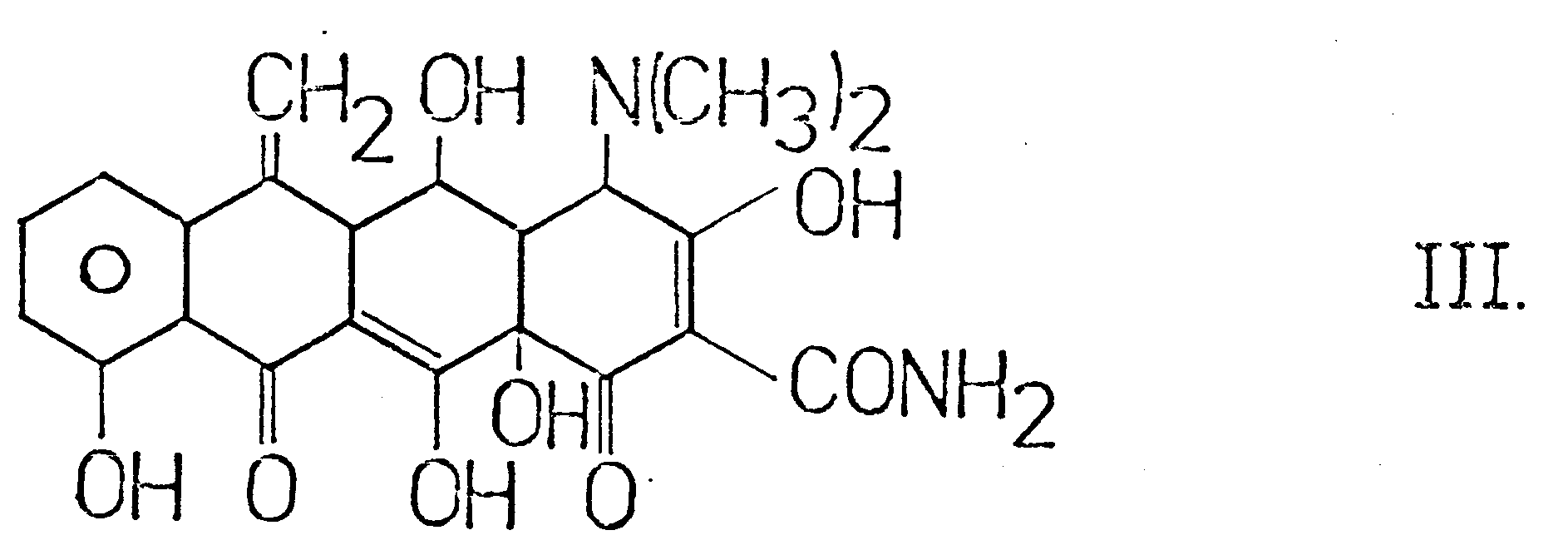
- the present invention is directed to a process for the preparation of tetracycline derivatives and acid addition salts thereof of the general formula (I). by dehalogenating and hydrogenating chloromethacycline or an acid addition salt thereof of the formula II or by hydrogenating methacycline or an acid addition salt thereof of the formula III by a treatment with hydrogen gas in the presence of a noble metal alloy catalyst on a carrier in the presence of an organic solvent.
- the hydrogenation is carried out at a pressure of 0.1-1.0 MPa with an alloy catalyst used at a ratio of 1:0.01-0.5 relative to the starting tetracycline derivative and consisting of an alloy of palladium or platinum and selenium and/or tellurium. If desired the dehalogenation and hydrogenation can be performed in one step.
- silica or aluminium oxide can be used as a carrier e.g. active charcoal, silica or aluminium oxide.
- the noble metal-containing catalyst In order to prepare the noble metal-containing catalyst one may proceed by treating an aqueous suspension of palladium or platinum on a carrier with a solution or suspension of an organic or inorganic selenium or tellurium compound and optionally by reducing the obtained compound.
- Such compounds can be selected from salts, oxides and other derivatives, such as selenious acid, diphenyl selenide etc.
- palladium or platinum salts and selenium or tellurium compounds may be dissolved in acidic water and added to a carrier, preferably active charcoal, followed by reduction.
- the noble metal content of the catalyst may vary between 1 to 30 % by weight, preferably 5 to 10 % by weight, and the amount of the alloying components may vary between 1 to 70 % by weight relative to the amount of the noble metal content.
- a solvent lower alcohols, ketones, N,N-dialkyl amides, water and mixtures thereof may preferably be used. It is not necessary to dissolve the starting material completely.
- methacycline may be prepared by saturating chloromethacycline with equimolar hydrogen gas at a pressure of 0.1-0.3 MPa in the presence of an alloy catalyst selected from palladium-selenium, palladium-tellurium, platinium-selenium and platinium-tellurium, by using the catalyst in an amount of 1:0.01-0.2 relative to the weight of chloromethacycline, wherein the amount of the alloying components is 20-70 % by weight relative to the noble metal content.
- an alloy catalyst selected from palladium-selenium, palladium-tellurium, platinium-selenium and platinium-tellurium
- Methacycline may be recovered from the reaction mixture by any known method in the form of a base, acid addition salt or complex.
- dehalogenation can be performed without side reactions, the conversion of methacyclines to 5-12a lactones can be suppressed, and the reaction takes place at atmospheric pressure and room temperature within a short time.
- the catalyst can be prepared simply, it is not pyrophoric and its activity does not decline with storing or in the course of the reaction, and thus it can be used several times without regeneration. Thus the catalyst costs are minimal, and almost negligible.
- methacycline or chloromethacycline or a salt thereof can be treated with hydrogen gas in the presence of an alloy catalyst consisting of palladium-selenium, palladium-tellurium, platinum-selenium or platinum-tellurium at a pressure of 0.1-1.0 MPa with a catalyst ratio of 1:0.05-0.5, preferably 0.15-0.25, relative to the weight of methacycline, wherein the amount of the alloying components is 1 to 40 % by weight.
- an alloy catalyst consisting of palladium-selenium, palladium-tellurium, platinum-selenium or platinum-tellurium at a pressure of 0.1-1.0 MPa with a catalyst ratio of 1:0.05-0.5, preferably 0.15-0.25, relative to the weight of methacycline, wherein the amount of the alloying components is 1 to 40 % by weight.
- chloromethacycline or a salt thereof are used as starting material, then dehalogenation and the selective saturation of the double bond can be performed in a single step.
- a solvent lower alcohol ketones, dimethylformamide, water and mixtures thereof are used.
- the catalyst When the reaction is terminated the catalyst is filtered and may be used for further reactions.
- the product may be isolated from the filtrate by any known method, such as in the form of a salt of hydrogen halogenic acid, 5-sulfosalicylic acid or in the form of hyclates.
- the activity of the catalysts prepared according to the above Examples are estimated by a method known per se, by hydrogenating a cyclohexene model compound.
- the quality of the products is homogenous according to thin layer chromatography (developing agent: a 95:5 mixture of tetrahydrofuran and water) on a silicagel carrier plate impregnated with a buffer of pH 6. Active ingredient content by biological value testing: 100 %. The details are shown in Table I.
Landscapes
- Chemical & Material Sciences (AREA)
- Organic Chemistry (AREA)
- Organic Low-Molecular-Weight Compounds And Preparation Thereof (AREA)
- Catalysts (AREA)
- Low-Molecular Organic Synthesis Reactions Using Catalysts (AREA)
- Acyclic And Carbocyclic Compounds In Medicinal Compositions (AREA)
- Pharmaceuticals Containing Other Organic And Inorganic Compounds (AREA)
Abstract
Description
- The present invention relates to an improved process for the preparation of doxycycline and methacycline and acid addition salts thereof by catalytic dehalogenation and hydrogenation by using a tellurium and/or selenium containing alloy catalyst.
- The following abbreviations are used throughout the specification:
"methacycline": 4-dimethylamino-1,4,4a,5,5a,6,11,12a-octahydro-3,5,10,12,12a-pentahydroxy-6-methylene-1,11-dioxo-2-naphthacene-carboxamide of the formula
"chloro-methacycline": 4-dimethylamino-1,4,4a,5,5a,6,11,12-12a-nonahydro-3,5,10,12a-tetrahydroxy-11a-chloro-6-methylene-1,11,12-trioxo-2-naphthacene-carboxamide of the formula
"doxycycline": α-6-desoxy-5-hydroxy-tetracycline, i.e. 4-dimethylamino-1,4,4a,5,5a,6,11,12a-octahydro-3,5,10,12-12a-pentahydroxy-6α-methyl-1,11-dioxo-2-naphthacene-carboxamide of the formula
"β-Doxycycline" is the β-isomer of doxycycline. - It is known that methacycline and doxycycline are very effective representatives of the tetracycline type antibiotics.
- Several processes are known for the preparation thereof using oxytetracycline as starting material to prepare chloromethacycline, followed by dehalogenation and if desired by hydrogenating the obtained methacycline to doxycycline.
- Dehalogenation has been performed with hydrogen gas in the presence of a catalyst, see e.g. Example 9 of HU-PS 150909, where rhodium precipitated on active coal was used.
- This process, however, was not satisfactory as reaction products were produced which were difficult to separate from side-products, and the conversion was not complete. Therefore the use of secondary or tertiary phosphines has been recommended in HU-PS 169 605. This process was accompanied by the disadvantage that an equimolar amount of tertiary or secondary phosphines was needed, resulting in a great amount of toxic waste, and the formed phosphine oxide could be converted again to phosphine only by a multi-step reaction.
- The introduction of hydrogen gas in the presence of a catalyst was also used for the saturation of the double bond of the methylene group at the 6-position on methacycline in order to produce doxycycline.
- In the course of hydrogenation, 6-desoxy-5-hydroxytetracycline of the formula (IV) can occur in the form of α- and β-isomers. Only the α-isomer is valuable as medicine, i.e. doxycycline. The amount of the α-isomer during hydrogenation determines if the hydrogenation process is successful, i.e. if hydrogenation can be carried out selectively, to produce mainly α-isomer in good yield and pure quality.
- It is known that 6-desoxy-5-hydroxy-tetracycline can be prepared in a yield of 60 % by using a 5 % palladium or rhodium catalyst on a carrier, but the product is a 1:1 mixture of α- and β-isomers and the separation of the α-isomer is accompanied by further losses (US-PS 3 200 149). The ratio of the formation of the α-isomer can considerably be improved, if the noble metal catalyst on a carrier is poisoned by carbon monoxide, quinoline, sulphur or other sulphur compounds. Thus the yield of the α-isomer can be increased to 40-50 %, but even so the product has to be further purified due to the remaining 10 % β-isomer impurities (HU-PS 156 925). In order to improve the stereoselectivity of hydrogenation an alloy catalyst of metals of platinum group, copper, silver or gold has been used and a doxycycline yield of about 70 % has been disclosed with 1 to 10 % β-isomer impurities (HU-PS 167 250).
- A 92 % α-isomer content has been achieved by using a catalyst containing palladium atoms located on ultramicroporous active coal, without poisoning, with a yield of 76 % (HU-PS 169 667).
- Hydrogenation can be performed by using Raney nickel and Raney cobalt as a catalyst according to GB-PS 1 296 340, but the formation of α-isomer in the reaction mixtures amounts only to about 40 %. According to Finnish PS 67210, a complex of bis(diphenylselenide) palladium(II)chloride is added to a palladium/carbon catalyst, resulting in a yield of 75 %, wherein the α-isomer content was about 95 %. According to the disclosure this effect cannot be achieved if diphenylselenide is not used in a complex form.
- In order to give a complete review of the known processes, we mention other hydrogenation processes performed by using triphenyl phosphine rhodium complexes, which are soluble in the reaction mixture (DE-OS 2 403 714), or by using further additives with the complexes (HU-PS 169 753, 169 508, 175 508 and 187 465).
- Doxycycline could thus be prepared with a good yield and selectivity.
- Inspite of the significant development the known processes show many drawbacks. As already mentioned the use of the known heterogeneous catalysts only partially solves the problem of stereoselectivity. A considerable amount of these catalysts have to be used, and so the ratio substrate-catalyst is not favourable. The relatively great amount of solvent is also unfavourable. Although the catalysts can be removed from the reaction mixture by filtration, the solvent has to be recovered before use by a costly and inefficient procedure.
- In case of homogeneous catalysis the catalyst is in solution and its isolation is not easy. Rhodium is very expensive, it is difficult to obtain, its recovery is complicated, expensive and it can contaminate the product.
- US-A 3 962 139 and US-A 4 384 986 generally disclose alloys of palladium or platinum with tellurium as catalysts.
- According to the present invention methacycline and doxycycline are prepared in a heterogeneous system, wherein dehalogenation can be performed with good yield and reduction takes place stereoselectively, the side reactions can be eliminated to such extent that no extra purification of the product is needed, and the catalyst can be prepared simply and at low cost. The dehalogenation and hydrogenation can be performed without any extra equipment by using the same type of catalyst.
- The present invention is directed to a process for the preparation of tetracycline derivatives and acid addition salts thereof of the general formula (I).

by dehalogenating and hydrogenating chloromethacycline or an acid addition salt thereof of the formula II or by hydrogenating methacycline or an acid addition salt thereof of the formula III by a treatment with hydrogen gas in the presence of a noble metal alloy catalyst on a carrier in the presence of an organic solvent. The hydrogenation is carried out at a pressure of 0.1-1.0 MPa with an alloy catalyst used at a ratio of 1:0.01-0.5 relative to the starting tetracycline derivative and consisting of an alloy of palladium or platinum and selenium and/or tellurium. If desired the dehalogenation and hydrogenation can be performed in one step. - As a carrier e.g. active charcoal, silica or aluminium oxide can be used.
- In order to prepare the noble metal-containing catalyst one may proceed by treating an aqueous suspension of palladium or platinum on a carrier with a solution or suspension of an organic or inorganic selenium or tellurium compound and optionally by reducing the obtained compound. Such compounds can be selected from salts, oxides and other derivatives, such as selenious acid, diphenyl selenide etc.
- Alternatively, palladium or platinum salts and selenium or tellurium compounds may be dissolved in acidic water and added to a carrier, preferably active charcoal, followed by reduction.
- The noble metal content of the catalyst may vary between 1 to 30 % by weight, preferably 5 to 10 % by weight, and the amount of the alloying components may vary between 1 to 70 % by weight relative to the amount of the noble metal content.
- As a solvent, lower alcohols, ketones, N,N-dialkyl amides, water and mixtures thereof may preferably be used. It is not necessary to dissolve the starting material completely.
- According to a preferred method methacycline may be prepared by saturating chloromethacycline with equimolar hydrogen gas at a pressure of 0.1-0.3 MPa in the presence of an alloy catalyst selected from palladium-selenium, palladium-tellurium, platinium-selenium and platinium-tellurium, by using the catalyst in an amount of 1:0.01-0.2 relative to the weight of chloromethacycline, wherein the amount of the alloying components is 20-70 % by weight relative to the noble metal content.
- Methacycline may be recovered from the reaction mixture by any known method in the form of a base, acid addition salt or complex.
- The main advantages of the dehalogenation according to the present invention: dehalogenation can be performed without side reactions, the conversion of methacyclines to 5-12a lactones can be suppressed, and the reaction takes place at atmospheric pressure and room temperature within a short time. The catalyst can be prepared simply, it is not pyrophoric and its activity does not decline with storing or in the course of the reaction, and thus it can be used several times without regeneration. Thus the catalyst costs are minimal, and almost negligible.
- In order to obtain doxycycline, methacycline or chloromethacycline or a salt thereof can be treated with hydrogen gas in the presence of an alloy catalyst consisting of palladium-selenium, palladium-tellurium, platinum-selenium or platinum-tellurium at a pressure of 0.1-1.0 MPa with a catalyst ratio of 1:0.05-0.5, preferably 0.15-0.25, relative to the weight of methacycline, wherein the amount of the alloying components is 1 to 40 % by weight.
- If chloromethacycline or a salt thereof are used as starting material, then dehalogenation and the selective saturation of the double bond can be performed in a single step. As a solvent lower alcohol, ketones, dimethylformamide, water and mixtures thereof are used.
- When the reaction is terminated the catalyst is filtered and may be used for further reactions. The product may be isolated from the filtrate by any known method, such as in the form of a salt of hydrogen halogenic acid, 5-sulfosalicylic acid or in the form of hyclates.
- The main advantages of the process for the preparation of doxycycline are as follows:
- the saturation of the exocyclic methylene bond in methacycline takes place substantially stereoselectively, i.e. the β-isomer content is reduced to below 1 % by weight (according to HPLC),
- in the reactions starting with chloromethacycline, dehalogenation and hydrogenation can be carried out in a single step, and the reaction can be performed at atmospheric pressure and room temperature in a short time,
- the catalyst can be rapidly prepared simply, it is not pyrophoric, and its activity does not decrease under storing or in the course of the hydrogenation reaction, and thus the catalyst costs of the process are minimal, almost negligible,
- the process may be continual,
- the isomerisation side reaction occurring in heterogeneous catalytical reactions, causing intensive decomposition, is suppressed and therefor doxycycline can be obtained in good yield. This experience is highly suprising as selenium is known to act as a catalyst in oxidation and isomerisation reactions.
- Further details of the invention can be found in the following Examples:
- 10 g 10 % by weight palladium/charcoal catalyst are suspended in 100 ml of water and 0.1 to 0.7 g of selenious acid are added as desired and the mixture is subjected to hydrogenation at room temperature under stirring. The mixture is then filtered, washed with water and acetone and dried. The activity of the catalyst is measured.
- 1.33 g of palladium(II)chloride and 0.2-0.7 g of tellurium(IV)oxide are dissolved in 100 ml of 6N hydrochloric acid, whereafter 10 g of charcoal are added and the mixture is stirred for 3 hours and hydrogenated with hydrogen gas. The catalyst is filtered, washed to neutral and dried. Its activity is measured.
- 5 g of 10 % by weight palladium/charcoal catalyst are suspended in 50 ml of ethanol, and as desired 0.15-1 g of diphenyl selenide are added, the suspension is boiled for 30 minutes, and the catalyst is filtered and dried. Its activity is measured.
- 10 g of 5 % by weight palladium/silica catalyst are suspended in 100 ml of water and as desired 0.1-0.4 g of selenious acid are added and we further proceed as given in Example 1. The activity is measured.
- 10 g of 5 % by weight platinum/active charcoal catalyst are suspended in 100 ml of water and as desired 0.05 g to 0.4 g of selenious acid are added and we further proceed as disclosed in Example 1.
- 1.77 g of palladium(II)chloride and as desired 0.1-0.75 g of selenium dioxide are dissolved in 80 ml of 12 N hydrochloric acid and 5 g of silica gel are added, the mixture is hydrogenated, filtered and dried. Its activity is measured.
- The activity of the catalysts prepared according to the above Examples are estimated by a method known per se, by hydrogenating a cyclohexene model compound.
- 20 g of 11a-chloro-methacycline-p-toluene-sulfonate are reacted with hydrogen gas in 200 ml of solvent by using 1-3 g alloy on carrier catalyst at room temperature at a pressure of 0.1-0.3 MPa. When the equimolar amount of hydrogen is taken up, the catalyst is filtered off, and working up may be performed as desired as follows:
- a) 20 g of 5-sulfosalicylic acid are added, the product is crystallized and methacycline sulfosalicylate is isolated, or
- b) the filtrate is evaporated in vacuo, and 75 ml of methanol and 7.5 g of p-toluene sulfonic acid are added to the residue. The mixture is crystallized and methacycline tosylate is isolated, or
- c) the filtrate is evaporated in vacuo and 50 ml concentrated hydrochloric acid are added and methacycline hydrochloride is isolated. Yield: 85-95 %.
- The quality of the products is homogenous according to thin layer chromatography (developing agent: a 95:5 mixture of tetrahydrofuran and water) on a silicagel carrier plate impregnated with a buffer of pH 6. Active ingredient content by biological value testing: 100 %.
The details are shown in Table I.
- 47.3 g of methacycline hydrochloride or 63.6 g of methacycline p-toluene sulfonate are hydrogenated in 500-580 ml of solvent by using 3.5 to 10 g of an alloy catalyst on carrier at room temperature and a pressure of 0.1 to 1.0 MPa until the hydrogen uptake is completed. After filtering off the catalyst the filtrate can be worked up as follows:
- a) 50 g of 5-sulfosalicylic acid are added to the filtrate and the product is crystallized, filtered and dried. Doxycycline sulfosalicylate is obtained as a product, or
- b) the filtrate is evaporated in vacuo, 250 ml methanol and 25 g of p-toluene sulfonic acid are added to the residue, the mixture is crystallized and doxycycline tosylate is isolated, or
- c) the filtrate is evaporated in vacuo, 180 ml of ethanol and 30 ml of hydrochloric acid are added to the residue and, after dissolving and clarification, 50 ml of hydrochloric acid and ethanol in hydrochloric acid are added to the filtrate. The mixture is crystallized and doxycycline hyclate is isolated, or
- d) the filtrate is evaporated to dryness in vacuo, 250 ml of acetone are added to the residue and by introducing hydrochloric acid gas the doxycycline hydrochloride is recovered. Yield: 80-90 %. Quality of the product is homogeneous according to thin layer chromatography.
- 66.7 g of 11a-chloro-methacycline-p-toluene-sulfonate are subjected to hydrogenation in 500-580 ml of solvent by using 3.5 to 10 g of an alloy catalyst on carrier at room temperature and a pressure of 0.1 to 1.0 MPa until the hydrogen uptake is completed. After filtering off the catalyst the filtrate can be worked up as follows:
- a) 50 g of 5-sulfosalicylic acid are added to the filtrate and the product is crystallized and filtered, dried. Doxycycline sulfosalicylate is obtained as a product, or
- b) the filtrate is evaporated in vacuo, 250 ml methanol and 25 g of p-toluene sulfonic acid are added to the residue, the mixture is crystallized and doxycycline tosylate is isolated, or
- c) the filtrate is evaporated in vacuo, 180 ml of ethanol and 30 ml of hydrochloric acid are added to the residue and, after dissolving and clarification, 50 ml of hydrochloric acid and ethanol in hydrochloric acid are added to the filtrate. The mixture is crystallized and doxycycline hyclate is isolated, or
- d) the filtrate is evaporated to dryness in vacuo, 250 ml of acetone are added to the residue and by introducing hydrochloric acid gas the doxycycline hydrochloride is recovered. Yield: 80-90 %. Quality of the product is homogeneous according to thin layer chromatography.
Ratio of α-isomer: 99 %, ratio of β-isomer: 0-0.6 %.
The details are shown in Table II.

Ratio of α-isomer: 99 %, ratio of β-isomer: 0-0.6 %.
The details are shown in Table III.

Claims (6)
- Process for the preparation of a tetracycline derivative of the formula

wherein R stands for -CH₃ or = CH₂,
by dehalogenating and hydrogenating chloromethacycline or an acid addition salt thereof of the formula
- Process as claimed in claim 1 which comprises preparing methacycline by saturating chloromethacycline with equimolar hydrogen gas in the presence of an alloy catalyst on a carrier (the alloy being palladium-selenium, palladium-tellurium or platinum-selenium or platinum-tellurium) under a pressure of 0.1-0.3 MPa at a ratio of 1:0.01-0.2 catalyst relative to the amount of chloromethacycline, wherein the amount of selenium and/or tellurium is 20-70 % by weight relative to the amount of palladium and/or platinum.
- Process as claimed in claim 1 which comprises preparing doxycycline by treating methacycline or a salt thereof with hydrogen gas in the presence of alloy on carrier catalyst (the alloy being palladium-selenium, palladium-tellurium, platinum-selenium or platinum-tellurium) at a pressure of 0.1-1 MPa at a ratio of 1:0.05-5 catalyst relative to the weight of methacycline, wherein the amount of the alloying components is to 1-40 % by weight.
- Process as claimed in claim 1 which comprises preparing doxycycline by treating chloromethacycline or a salt thereof with hydrogen gas in the presence of alloy on carrier catalyst (the alloy being palladium-selenium, palladium-tellurium, platinum-selenium or platinum-tellurium) at a pressure of 0.1-1 MPa at a ratio of 1:0.05-5 catalyst relative to the weight of methacycline, wherein the amount of the alloying components is 1-40 % by weight.
- Process as claimed in any of claims 2 to 4 which comprises using water, an alcohol or a ketone, preferably methanol, propanol, dimethylformamide, acetone, methyl ethyl ketone or mixtures thereof, as the solvent.
- Process as claimed in any of claims 1 to 4 which comprises using as alloys which contain 1-70 % by weight of selenium or tellurium and 99-30 % by weight of palladium or platinum.
Priority Applications (1)
| Application Number | Priority Date | Filing Date | Title |
|---|---|---|---|
| AT88908310T ATE89265T1 (en) | 1987-09-18 | 1988-09-16 | PROCESS FOR THE MANUFACTURE OF TETRACYCLINE. |
Applications Claiming Priority (2)
| Application Number | Priority Date | Filing Date | Title |
|---|---|---|---|
| HU874164A HU198173B (en) | 1987-09-18 | 1987-09-18 | Process for producing doxycycline |
| HU416487 | 1987-09-18 |
Publications (2)
| Publication Number | Publication Date |
|---|---|
| EP0331708A1 EP0331708A1 (en) | 1989-09-13 |
| EP0331708B1 true EP0331708B1 (en) | 1993-05-12 |
Family
ID=10967162
Family Applications (1)
| Application Number | Title | Priority Date | Filing Date |
|---|---|---|---|
| EP88908310A Expired - Lifetime EP0331708B1 (en) | 1987-09-18 | 1988-09-16 | Improved process for the preparation of tetracycline derivatives |
Country Status (9)
| Country | Link |
|---|---|
| US (1) | US4960913A (en) |
| EP (1) | EP0331708B1 (en) |
| JP (1) | JPH02501223A (en) |
| KR (1) | KR890701546A (en) |
| AT (1) | ATE89265T1 (en) |
| DE (1) | DE3881024T2 (en) |
| HU (1) | HU198173B (en) |
| RU (2) | RU2057747C1 (en) |
| WO (1) | WO1989002429A1 (en) |
Families Citing this family (18)
| Publication number | Priority date | Publication date | Assignee | Title |
|---|---|---|---|---|
| US8106225B2 (en) * | 1999-09-14 | 2012-01-31 | Trustees Of Tufts College | Methods of preparing substituted tetracyclines with transition metal-based chemistries |
| US9192615B2 (en) | 2008-08-06 | 2015-11-24 | Medicis Pharmaceutical Corporation | Method for the treatment of acne and certain dosage forms thereof |
| US7541347B2 (en) * | 2007-04-02 | 2009-06-02 | Medicis Pharmaceutical Coropration | Minocycline oral dosage forms for the treatment of acne |
| US7544373B2 (en) * | 2007-04-02 | 2009-06-09 | Medicis Pharmaceutical Corporation | Minocycline oral dosage forms for the treatment of acne |
| US20080242642A1 (en) * | 2007-04-02 | 2008-10-02 | Medicis Pharmaceutical Corporation | Minocycline oral dosage forms for the treatment of acne |
| US20080241235A1 (en) * | 2007-04-02 | 2008-10-02 | Medicis Pharmaceutical Corporation | Minocycline oral dosage forms for the treatment of acne |
| US8722650B1 (en) | 2005-06-24 | 2014-05-13 | Medicis Pharmaceutical Corporation | Extended-release minocycline dosage forms |
| US8252776B2 (en) | 2007-04-02 | 2012-08-28 | Medicis Pharmaceutical Corporation | Minocycline oral dosage forms for the treatment of acne |
| US7919483B2 (en) * | 2005-06-24 | 2011-04-05 | Medicis Pharmaceutical Corporation | Method for the treatment of acne |
| US20080241197A1 (en) * | 2007-04-02 | 2008-10-02 | Medicis Pharmaceutical Corporation | Minocycline dosage forms for the treatment of acne |
| DE102007034259A1 (en) | 2007-07-20 | 2009-01-22 | Otto-Von-Guericke-Universität Magdeburg Medizinische Fakultät | Process for the synthesis of A-ring-flavored acetyl-minocycline |
| CN102086165B (en) * | 2010-12-29 | 2013-06-19 | 开封制药(集团)有限公司 | Application of Pd catalyst in hydrogenation process for producing doxycycline |
| US9561241B1 (en) | 2011-06-28 | 2017-02-07 | Medicis Pharmaceutical Corporation | Gastroretentive dosage forms for minocycline |
| WO2013040433A1 (en) | 2011-09-15 | 2013-03-21 | Genentech, Inc. | Methods of promoting differentiation |
| CN105152961B (en) * | 2015-08-31 | 2017-07-11 | 河南师范大学 | A kind of synthetic method of the methine terramycin of fortimicin intermediate 6 |
| CN109134291B (en) * | 2017-06-19 | 2021-04-16 | 河南后羿制药有限公司 | A kind of preparation method of doxycycline hydrochloride and doxycycline hydrochloride prepared by this method |
| CN108440329A (en) * | 2018-02-27 | 2018-08-24 | 河南师范大学 | A kind of method of green high-efficient synthetic hydrochloric acid Doxycycline |
| CN116768748B (en) * | 2023-08-18 | 2024-01-26 | 山东国邦药业有限公司 | Preparation method of metacycline p-toluenesulfonate |
Family Cites Families (12)
| Publication number | Priority date | Publication date | Assignee | Title |
|---|---|---|---|---|
| US3444198A (en) * | 1967-02-13 | 1969-05-13 | Pfizer & Co C | Process for producing alpha-6-deoxytetracyclines |
| US4066694A (en) * | 1971-02-09 | 1978-01-03 | Pfizer Inc. | 4-hydroxy-4-dedimethylamino-tetracyclines |
| US4061676A (en) * | 1970-07-03 | 1977-12-06 | Ivan Villax | Recovery of doxycycline and products thereof |
| GB1456369A (en) * | 1972-11-30 | 1976-11-24 | Stamicarbon | Catalyst preparation |
| HU167250B (en) * | 1973-06-08 | 1975-09-27 | ||
| HU168073B (en) * | 1973-12-19 | 1976-02-28 | ||
| LU76107A1 (en) * | 1976-10-29 | 1978-05-16 | ||
| US4743699A (en) * | 1982-01-19 | 1988-05-10 | Plurichemie Anstalt | Homogeneous catalytic system and a process for the preparation of same |
| PT76061A (en) * | 1982-12-30 | 1983-01-01 | Stable homogeneous hydrogenation rhodium catalyst - useful in high yield prodn. of doxycycline by stereospecific hydrogenation | |
| FI67210C (en) * | 1982-05-21 | 1985-02-11 | Suomen Laeaeketehdas Oy Salco | FRAME STARTER FOR ALFA-6-DEOXY-TETRACYKLIN |
| DK386784A (en) * | 1983-08-17 | 1985-02-18 | Hovione Int Ltd | PROCEDURE FOR PREPARING ALFA-6-DESOXY-TETRACYCLINES |
| US4902447A (en) * | 1988-10-28 | 1990-02-20 | Ranbaxy Laboratories Limited | Process for the production of alpha-6-deoxytetracyclines and hydrogenation catalyst useful therein |
-
1987
- 1987-09-18 HU HU874164A patent/HU198173B/en unknown
-
1988
- 1988-09-16 RU SU904743320A patent/RU2057747C1/en active
- 1988-09-16 US US07/353,657 patent/US4960913A/en not_active Expired - Fee Related
- 1988-09-16 EP EP88908310A patent/EP0331708B1/en not_active Expired - Lifetime
- 1988-09-16 AT AT88908310T patent/ATE89265T1/en not_active IP Right Cessation
- 1988-09-16 DE DE8888908310T patent/DE3881024T2/en not_active Expired - Fee Related
- 1988-09-16 JP JP63507644A patent/JPH02501223A/en active Pending
- 1988-09-16 WO PCT/HU1988/000063 patent/WO1989002429A1/en not_active Ceased
-
1989
- 1989-05-16 KR KR1019890700863A patent/KR890701546A/en not_active Ceased
- 1989-05-17 RU SU894614058A patent/RU1830065C/en active
Non-Patent Citations (3)
| Title |
|---|
| Chemical Abstracts, vol. 102, no. 4, 1987, Jan. 28, (Columbus, Ohio, US); S.G. RYBKIN et al.: "Platinum. -tellurium system", see p. 570, Abstr. no. 33 485q, Izv. Akad. Nauk. SSSR, Neorg. Mater. 1984, 20(5), 828-30(Russ.) * |
| Chemical Abstracts, vol. 107, no. 18, 1987, Nov. 2, (Columbus, Ohio, US); T. TAKABATAKE et al.: "Superconductivity and phase relations in the palladium-selenium system", see p. 559, Abstr. 162 723f, J. Less-Common Med. 1987, 134(1), 79-89(Eng.) * |
| Chemical Abstracts, Vol. 89, no. 14, 1978, Oct. 2 (Columbus, Ohio, US); S. BHAN et al.: "Ordered bcc. phases at high temperatures in alloys of transition metals and A-subgroup elements", see p. 786, Abstr. no. 121 060r, Z. Metallkd. 1978, 69(5), 333-6(Eng.) * |
Also Published As
| Publication number | Publication date |
|---|---|
| RU1830065C (en) | 1993-07-23 |
| DE3881024D1 (en) | 1993-06-17 |
| KR890701546A (en) | 1989-12-20 |
| JPH02501223A (en) | 1990-04-26 |
| WO1989002429A1 (en) | 1989-03-23 |
| DE3881024T2 (en) | 1993-08-19 |
| HU198173B (en) | 1989-08-28 |
| ATE89265T1 (en) | 1993-05-15 |
| EP0331708A1 (en) | 1989-09-13 |
| RU2057747C1 (en) | 1996-04-10 |
| US4960913A (en) | 1990-10-02 |
Similar Documents
| Publication | Publication Date | Title |
|---|---|---|
| US4960913A (en) | Process for the preparation of pharmaceutical compositions | |
| JPS6045938B2 (en) | Method for producing oxalic acid diester hydrogenation catalyst | |
| CN100344633C (en) | Process for the preparation of 7-alkyl-10-hydroxy-20(S)-camptothecin | |
| EP0283616A1 (en) | Rhodium hydrogenation catalysts | |
| US4902447A (en) | Process for the production of alpha-6-deoxytetracyclines and hydrogenation catalyst useful therein | |
| JP3016727B2 (en) | Modified Raney nickel catalyst and method for producing diol compound using the catalyst | |
| KR20060059942A (en) | Novel Method of Preparation of 4-Aminomethyl-3-alkoxyiminopyrrolidine Methanesulfonate | |
| US6765114B1 (en) | Process for the synthesis of 1-(aminomethyl)cyclohexyl-acetic acid | |
| US4973719A (en) | Process for the production of alpha-6-deoxytetracyclines | |
| US4987242A (en) | Hydrogenation catalyst useful in the production of alpha-6-deoxytetracyclines | |
| EP0391005B1 (en) | Process for the production of alpha-6-deoxytetracyclines | |
| RU2203885C2 (en) | Method of synthesis of para-aminobenzoic acid ethyl ester | |
| JPH07106991B2 (en) | Partial hydrogenation method | |
| CA1080725A (en) | Process for producing phthalide | |
| EP1140793B1 (en) | Process for the synthesis of 1-(aminomethyl)cyclohexyl-acetic acid | |
| JP4099630B2 (en) | Method for producing perfluoroalkyl compound | |
| CN1137521A (en) | Process for the preparation of subtituted 1,2,3,4-tetrahydrocarbazoles | |
| JP2002348267A (en) | Method for producing bis (4-aminocyclohexyl) methane | |
| US4990636A (en) | Process for the production of alpha-6-deoxytetracyclines and hydrogenation catalyst useful therein | |
| KR790001994B1 (en) | Method for preparing 6-deoxytetracycline | |
| JPS5811423B2 (en) | Method for producing α-6-deoxycycline | |
| JPH03176463A (en) | Pyrrolidinol derivative and its production | |
| CN117603129A (en) | Method for preparing 2-substituted pyridine from succinic acid diester | |
| JPH06263692A (en) | Process for producing glyco-ester | |
| TH35752A (en) | A new method for producing 9-amino-6-dmethyl-6-deoxytetracycline. |
Legal Events
| Date | Code | Title | Description |
|---|---|---|---|
| PUAI | Public reference made under article 153(3) epc to a published international application that has entered the european phase |
Free format text: ORIGINAL CODE: 0009012 |
|
| 17P | Request for examination filed |
Effective date: 19890703 |
|
| AK | Designated contracting states |
Kind code of ref document: A1 Designated state(s): AT BE CH DE FR GB IT LI NL SE |
|
| RAP3 | Party data changed (applicant data changed or rights of an application transferred) |
Owner name: CHINOIN GYOGYSZER ES VEGYESZETI TERMEKEK GYARA RT. |
|
| 17Q | First examination report despatched |
Effective date: 19910515 |
|
| GRAA | (expected) grant |
Free format text: ORIGINAL CODE: 0009210 |
|
| AK | Designated contracting states |
Kind code of ref document: B1 Designated state(s): AT BE CH DE FR GB IT LI NL SE |
|
| REF | Corresponds to: |
Ref document number: 89265 Country of ref document: AT Date of ref document: 19930515 Kind code of ref document: T |
|
| REF | Corresponds to: |
Ref document number: 3881024 Country of ref document: DE Date of ref document: 19930617 |
|
| ET | Fr: translation filed | ||
| ITF | It: translation for a ep patent filed | ||
| EAL | Se: european patent in force in sweden |
Ref document number: 88908310.1 |
|
| PGFP | Annual fee paid to national office [announced via postgrant information from national office to epo] |
Ref country code: SE Payment date: 19950811 Year of fee payment: 8 |
|
| PGFP | Annual fee paid to national office [announced via postgrant information from national office to epo] |
Ref country code: GB Payment date: 19950912 Year of fee payment: 8 |
|
| PGFP | Annual fee paid to national office [announced via postgrant information from national office to epo] |
Ref country code: AT Payment date: 19950915 Year of fee payment: 8 |
|
| PGFP | Annual fee paid to national office [announced via postgrant information from national office to epo] |
Ref country code: CH Payment date: 19950919 Year of fee payment: 8 |
|
| PGFP | Annual fee paid to national office [announced via postgrant information from national office to epo] |
Ref country code: BE Payment date: 19950920 Year of fee payment: 8 |
|
| PGFP | Annual fee paid to national office [announced via postgrant information from national office to epo] |
Ref country code: FR Payment date: 19950928 Year of fee payment: 8 |
|
| PGFP | Annual fee paid to national office [announced via postgrant information from national office to epo] |
Ref country code: NL Payment date: 19950929 Year of fee payment: 8 |
|
| PGFP | Annual fee paid to national office [announced via postgrant information from national office to epo] |
Ref country code: DE Payment date: 19951130 Year of fee payment: 8 |
|
| PG25 | Lapsed in a contracting state [announced via postgrant information from national office to epo] |
Ref country code: GB Effective date: 19960916 Ref country code: AT Effective date: 19960916 |
|
| PG25 | Lapsed in a contracting state [announced via postgrant information from national office to epo] |
Ref country code: SE Effective date: 19960917 |
|
| PG25 | Lapsed in a contracting state [announced via postgrant information from national office to epo] |
Ref country code: LI Effective date: 19960930 Ref country code: FR Effective date: 19960930 Ref country code: CH Effective date: 19960930 Ref country code: BE Effective date: 19960930 |
|
| BERE | Be: lapsed |
Owner name: CHINOIN GYOGYSZER ES VEGYESZETI TERMEKEK GYARA RT Effective date: 19960930 |
|
| PG25 | Lapsed in a contracting state [announced via postgrant information from national office to epo] |
Ref country code: NL Effective date: 19970401 |
|
| GBPC | Gb: european patent ceased through non-payment of renewal fee |
Effective date: 19960916 |
|
| REG | Reference to a national code |
Ref country code: CH Ref legal event code: PL |
|
| NLV4 | Nl: lapsed or anulled due to non-payment of the annual fee |
Effective date: 19970401 |
|
| PG25 | Lapsed in a contracting state [announced via postgrant information from national office to epo] |
Ref country code: DE Effective date: 19970603 |
|
| EUG | Se: european patent has lapsed |
Ref document number: 88908310.1 |
|
| REG | Reference to a national code |
Ref country code: FR Ref legal event code: ST |
|
| REG | Reference to a national code |
Ref country code: FR Ref legal event code: ST |
|
| PG25 | Lapsed in a contracting state [announced via postgrant information from national office to epo] |
Ref country code: IT Free format text: LAPSE BECAUSE OF NON-PAYMENT OF DUE FEES;WARNING: LAPSES OF ITALIAN PATENTS WITH EFFECTIVE DATE BEFORE 2007 MAY HAVE OCCURRED AT ANY TIME BEFORE 2007. THE CORRECT EFFECTIVE DATE MAY BE DIFFERENT FROM THE ONE RECORDED. Effective date: 20050916 |
|
| PLBE | No opposition filed within time limit |
Free format text: ORIGINAL CODE: 0009261 |
|
| STAA | Information on the status of an ep patent application or granted ep patent |
Free format text: STATUS: NO OPPOSITION FILED WITHIN TIME LIMIT |