EP0331187B1 - Process for producing a ceramic preform - Google Patents
Process for producing a ceramic preform Download PDFInfo
- Publication number
- EP0331187B1 EP0331187B1 EP89103767A EP89103767A EP0331187B1 EP 0331187 B1 EP0331187 B1 EP 0331187B1 EP 89103767 A EP89103767 A EP 89103767A EP 89103767 A EP89103767 A EP 89103767A EP 0331187 B1 EP0331187 B1 EP 0331187B1
- Authority
- EP
- European Patent Office
- Prior art keywords
- alkoxysilane
- silica powder
- fine silica
- mixture
- alcoholysis
- Prior art date
- Legal status (The legal status is an assumption and is not a legal conclusion. Google has not performed a legal analysis and makes no representation as to the accuracy of the status listed.)
- Expired - Lifetime
Links
- 238000000034 method Methods 0.000 title claims description 34
- 239000000919 ceramic Substances 0.000 title claims description 30
- VYPSYNLAJGMNEJ-UHFFFAOYSA-N Silicium dioxide Chemical compound O=[Si]=O VYPSYNLAJGMNEJ-UHFFFAOYSA-N 0.000 claims description 111
- 239000000377 silicon dioxide Substances 0.000 claims description 40
- 239000000843 powder Substances 0.000 claims description 37
- 239000000203 mixture Substances 0.000 claims description 28
- 238000006136 alcoholysis reaction Methods 0.000 claims description 19
- 239000002904 solvent Substances 0.000 claims description 15
- 239000002245 particle Substances 0.000 claims description 11
- 238000002156 mixing Methods 0.000 claims description 10
- 238000000465 moulding Methods 0.000 claims description 10
- 238000005245 sintering Methods 0.000 claims description 7
- 125000000217 alkyl group Chemical group 0.000 claims description 6
- 238000010438 heat treatment Methods 0.000 claims description 6
- 125000004432 carbon atom Chemical group C* 0.000 claims description 2
- 125000005372 silanol group Chemical group 0.000 claims 1
- XLYOFNOQVPJJNP-UHFFFAOYSA-N water Substances O XLYOFNOQVPJJNP-UHFFFAOYSA-N 0.000 description 33
- 239000000047 product Substances 0.000 description 27
- OKKJLVBELUTLKV-UHFFFAOYSA-N Methanol Chemical compound OC OKKJLVBELUTLKV-UHFFFAOYSA-N 0.000 description 24
- 125000002887 hydroxy group Chemical group [H]O* 0.000 description 16
- LFQSCWFLJHTTHZ-UHFFFAOYSA-N Ethanol Chemical compound CCO LFQSCWFLJHTTHZ-UHFFFAOYSA-N 0.000 description 14
- 238000005336 cracking Methods 0.000 description 14
- 235000012239 silicon dioxide Nutrition 0.000 description 9
- 229910052681 coesite Inorganic materials 0.000 description 7
- 229910052906 cristobalite Inorganic materials 0.000 description 7
- 239000000463 material Substances 0.000 description 7
- 238000003980 solgel method Methods 0.000 description 7
- 229910052682 stishovite Inorganic materials 0.000 description 7
- 229910052905 tridymite Inorganic materials 0.000 description 7
- 238000002329 infrared spectrum Methods 0.000 description 6
- 238000003825 pressing Methods 0.000 description 6
- 238000006243 chemical reaction Methods 0.000 description 5
- 238000009694 cold isostatic pressing Methods 0.000 description 5
- 238000004519 manufacturing process Methods 0.000 description 5
- 239000003153 chemical reaction reagent Substances 0.000 description 4
- 229910021485 fumed silica Inorganic materials 0.000 description 4
- 239000011521 glass Substances 0.000 description 4
- 239000007788 liquid Substances 0.000 description 4
- 238000002360 preparation method Methods 0.000 description 4
- 238000007873 sieving Methods 0.000 description 4
- 239000007858 starting material Substances 0.000 description 4
- LFQCEHFDDXELDD-UHFFFAOYSA-N tetramethyl orthosilicate Chemical compound CO[Si](OC)(OC)OC LFQCEHFDDXELDD-UHFFFAOYSA-N 0.000 description 4
- ZWEHNKRNPOVVGH-UHFFFAOYSA-N 2-Butanone Chemical compound CCC(C)=O ZWEHNKRNPOVVGH-UHFFFAOYSA-N 0.000 description 3
- 229910002012 Aerosil® Inorganic materials 0.000 description 3
- OKTJSMMVPCPJKN-UHFFFAOYSA-N Carbon Chemical compound [C] OKTJSMMVPCPJKN-UHFFFAOYSA-N 0.000 description 3
- 239000004677 Nylon Substances 0.000 description 3
- 150000004703 alkoxides Chemical class 0.000 description 3
- 238000001035 drying Methods 0.000 description 3
- 230000007062 hydrolysis Effects 0.000 description 3
- 238000006460 hydrolysis reaction Methods 0.000 description 3
- 229910052751 metal Inorganic materials 0.000 description 3
- 239000002184 metal Substances 0.000 description 3
- ARYZCSRUUPFYMY-UHFFFAOYSA-N methoxysilane Chemical compound CO[SiH3] ARYZCSRUUPFYMY-UHFFFAOYSA-N 0.000 description 3
- 229920001778 nylon Polymers 0.000 description 3
- 238000003756 stirring Methods 0.000 description 3
- CSCPPACGZOOCGX-UHFFFAOYSA-N Acetone Chemical compound CC(C)=O CSCPPACGZOOCGX-UHFFFAOYSA-N 0.000 description 2
- 229910002020 Aerosil® OX 50 Inorganic materials 0.000 description 2
- RTZKZFJDLAIYFH-UHFFFAOYSA-N Diethyl ether Chemical compound CCOCC RTZKZFJDLAIYFH-UHFFFAOYSA-N 0.000 description 2
- LRHPLDYGYMQRHN-UHFFFAOYSA-N N-Butanol Chemical compound CCCCO LRHPLDYGYMQRHN-UHFFFAOYSA-N 0.000 description 2
- BOTDANWDWHJENH-UHFFFAOYSA-N Tetraethyl orthosilicate Chemical compound CCO[Si](OCC)(OCC)OCC BOTDANWDWHJENH-UHFFFAOYSA-N 0.000 description 2
- 239000011362 coarse particle Substances 0.000 description 2
- 239000000539 dimer Substances 0.000 description 2
- 230000003301 hydrolyzing effect Effects 0.000 description 2
- 238000010298 pulverizing process Methods 0.000 description 2
- 239000004065 semiconductor Substances 0.000 description 2
- 229920003002 synthetic resin Polymers 0.000 description 2
- 239000000057 synthetic resin Substances 0.000 description 2
- 229920002134 Carboxymethyl cellulose Polymers 0.000 description 1
- 239000004372 Polyvinyl alcohol Substances 0.000 description 1
- 229910007156 Si(OH)4 Inorganic materials 0.000 description 1
- 229920002472 Starch Polymers 0.000 description 1
- 239000002250 absorbent Substances 0.000 description 1
- 230000002745 absorbent Effects 0.000 description 1
- 229910052787 antimony Inorganic materials 0.000 description 1
- 239000011230 binding agent Substances 0.000 description 1
- 230000015572 biosynthetic process Effects 0.000 description 1
- 238000009835 boiling Methods 0.000 description 1
- 239000001768 carboxy methyl cellulose Substances 0.000 description 1
- 235000010948 carboxy methyl cellulose Nutrition 0.000 description 1
- 239000008112 carboxymethyl-cellulose Substances 0.000 description 1
- 239000000969 carrier Substances 0.000 description 1
- 239000003054 catalyst Substances 0.000 description 1
- 239000003795 chemical substances by application Substances 0.000 description 1
- 238000006482 condensation reaction Methods 0.000 description 1
- 238000007796 conventional method Methods 0.000 description 1
- 238000000354 decomposition reaction Methods 0.000 description 1
- 230000018044 dehydration Effects 0.000 description 1
- 238000006297 dehydration reaction Methods 0.000 description 1
- 238000010981 drying operation Methods 0.000 description 1
- 238000005265 energy consumption Methods 0.000 description 1
- CWAFVXWRGIEBPL-UHFFFAOYSA-N ethoxysilane Chemical compound CCO[SiH3] CWAFVXWRGIEBPL-UHFFFAOYSA-N 0.000 description 1
- 125000001495 ethyl group Chemical group [H]C([H])([H])C([H])([H])* 0.000 description 1
- 238000001704 evaporation Methods 0.000 description 1
- 230000008020 evaporation Effects 0.000 description 1
- 238000001125 extrusion Methods 0.000 description 1
- 239000004744 fabric Substances 0.000 description 1
- 239000012467 final product Substances 0.000 description 1
- 125000000524 functional group Chemical group 0.000 description 1
- XLYOFNOQVPJJNP-UHFFFAOYSA-M hydroxide Chemical compound [OH-] XLYOFNOQVPJJNP-UHFFFAOYSA-M 0.000 description 1
- 239000012535 impurity Substances 0.000 description 1
- 238000001746 injection moulding Methods 0.000 description 1
- 238000009434 installation Methods 0.000 description 1
- 239000012528 membrane Substances 0.000 description 1
- 125000002496 methyl group Chemical group [H]C([H])([H])* 0.000 description 1
- 231100000989 no adverse effect Toxicity 0.000 description 1
- 239000005304 optical glass Substances 0.000 description 1
- 239000003960 organic solvent Substances 0.000 description 1
- 239000008188 pellet Substances 0.000 description 1
- 230000000737 periodic effect Effects 0.000 description 1
- 238000006068 polycondensation reaction Methods 0.000 description 1
- 229920002451 polyvinyl alcohol Polymers 0.000 description 1
- 235000019422 polyvinyl alcohol Nutrition 0.000 description 1
- BDERNNFJNOPAEC-UHFFFAOYSA-N propan-1-ol Chemical compound CCCO BDERNNFJNOPAEC-UHFFFAOYSA-N 0.000 description 1
- 239000010453 quartz Substances 0.000 description 1
- 229910052761 rare earth metal Inorganic materials 0.000 description 1
- 150000002910 rare earth metals Chemical class 0.000 description 1
- 238000000926 separation method Methods 0.000 description 1
- 229910052710 silicon Inorganic materials 0.000 description 1
- 239000010703 silicon Substances 0.000 description 1
- 150000003377 silicon compounds Chemical class 0.000 description 1
- -1 silicon halide Chemical class 0.000 description 1
- 239000008107 starch Substances 0.000 description 1
- 235000019698 starch Nutrition 0.000 description 1
- 238000003860 storage Methods 0.000 description 1
- 239000004094 surface-active agent Substances 0.000 description 1
- UQMOLLPKNHFRAC-UHFFFAOYSA-N tetrabutyl silicate Chemical compound CCCCO[Si](OCCCC)(OCCCC)OCCCC UQMOLLPKNHFRAC-UHFFFAOYSA-N 0.000 description 1
- ZQZCOBSUOFHDEE-UHFFFAOYSA-N tetrapropyl silicate Chemical compound CCCO[Si](OCCC)(OCCC)OCCC ZQZCOBSUOFHDEE-UHFFFAOYSA-N 0.000 description 1
- 229910052727 yttrium Inorganic materials 0.000 description 1
Classifications
-
- C—CHEMISTRY; METALLURGY
- C04—CEMENTS; CONCRETE; ARTIFICIAL STONE; CERAMICS; REFRACTORIES
- C04B—LIME, MAGNESIA; SLAG; CEMENTS; COMPOSITIONS THEREOF, e.g. MORTARS, CONCRETE OR LIKE BUILDING MATERIALS; ARTIFICIAL STONE; CERAMICS; REFRACTORIES; TREATMENT OF NATURAL STONE
- C04B35/00—Shaped ceramic products characterised by their composition; Ceramics compositions; Processing powders of inorganic compounds preparatory to the manufacturing of ceramic products
- C04B35/01—Shaped ceramic products characterised by their composition; Ceramics compositions; Processing powders of inorganic compounds preparatory to the manufacturing of ceramic products based on oxide ceramics
- C04B35/14—Shaped ceramic products characterised by their composition; Ceramics compositions; Processing powders of inorganic compounds preparatory to the manufacturing of ceramic products based on oxide ceramics based on silica
Definitions
- the present invention relates to a process for producing a ceramic preform. More particularly, it relates to a process for producing a ceramic preform which is free from fracture or cracking and which can be sintered to obtain a sintered product having a low water content.
- sol-gel method wherein a sol obtainable by hydrolyzing a metal alkoxide such as alkoxysilane by an addition of water, is gelled and dried to obtain a dry gel i.e. a ceramic preform, which is then sintered to obtain a sintered ceramic product.
- water is used in an amount several times the theoretical amount for the hydrolysis, or an alcohol is used as the solvent. Therefore, the gel contains substantial amounts of water and the alcohol, and it takes a long time of from 0.5 to 2 months for drying the gel. Yet, as the volume reduces, fracture or cracking is likely to take place.
- the reduction of the water content (the OH group content) in the quartz glass used to be about 1,000 ppm at best, and it has been difficult to reduce the water content to a level of molten natural quartz, i.e. to a water content of 300 ppm.
- Derwent Abstract 87-98187 (D) discloses a method of making a ceramic product by treating silicon dioxide with an alkoxysilane having an Si-C-bonded alkyl group, and baking and finally sintering the thus obtained product.
- Japanese Unexamined Patent Publication No. 168542/1986 discloses a process for producing quartz glass by a sol-gel method using an alkylsilicate and super fine silica powder as starting materials, wherein a dry gel is held within a temperature range of from 900 to 1,300°C for at least 20 hours to reduce the water content in quartz glass.
- a dry gel is held within a temperature range of from 900 to 1,300°C for at least 20 hours to reduce the water content in quartz glass.
- this method in order to reduce the water content in quartz glass to a level of not more than 300 ppm, it is required to continue the heating within the above temperature range for at least 80 hours.
- this method involves many practical problems for industrial operation.
- the present inventors have accomplished this object by mixing an alkoxysilane and fine silica powder, molding the mixture, followed by heating for de-alcoholysis.
- the present invention provides a process for producing a ceramic preform, which comprises mixing (A) an alkoxysilane of the formula: wherein n is an interger of from 0 to 9 and R is an alkyl group and (B) fine silica powder, molding the mixture followed by heating for de-alcoholysis.
- R is preferably an alkyl group having from 1 to 4 carbon atoms, more preferably a methyl group or an ethyl group.
- the alkoxysilane includes tetramethoxysilane, tetraethoxysilane, tetrapropoxysilane and tetrabutoxysilane.
- Oligomeric alkoxysilanes (such as each of the dimer to decamer) are obtainable by partial hydrolysis and poly-condensation of the above-mentioned monomeric alkoxysilanes. Such oligomeric alkoxysilanes are industrially suitable in view of the transportation and storage stability, the handling efficiency and the cost effectiveness.
- the fine silica powder may be produced, for instance, by a method wherein a hydroxide prepared by hydrolyzing a silicon compound in a wet system, is sintered, or by a method wherein a silicon halide or an alkoxysilane is hydrolyzed in a dry system or burned. In the case of a dry system, it is possible to obtain fine silica powder having adsorbed water remarkably reduced.
- the fine silica powder is required to have hydroxyl groups on its surface.
- fine silica powder may have an extremely small density of surface hydroxyl groups.
- the surface hydroxyl group density obtainable by the contact with air after the production, may be sufficient. Therefore, there is no particular restriction as to the method for the prepration of fine silica powder to be used in the present invention.
- the fine silica powder to be used in the present invention usually has a hydroxyl group density of from 0.1 to 8 groups/100 ⁇ 2, preferably from 0.2 to 4 groups/100 ⁇ 2.
- the fine silica powder preferably has a particle size of from 5 to 1,000 nm, more preferably from 10 to 500 nm. If the particle size is too small, deaeration during the molding tends to be inadequate, whereby it tends to be difficult to obtain a highly dense preform, or cracking tends to take place during the after-mentioned step for de-alcoholysis. On the other hand, if the particle size is too large, it requires a high sintering temperature when the preform is sintered to obtain a sintered product, such being disadvantageous from the viewpoint of energy consumption. There is an additional drawback that it is thereby difficult to obtain a transparent sintered product.
- the fine silica powder is used preferably in an amount of from 0.2 to 50 parts by weight, more preferably from 0.5 to 20 parts by weight, per part by weight of the alkoxysilane. If the amount is too small, the strength of the preform tends to be low, and the amount of the alcohol generated during the step for de-alcoholysis tends to be large, whereby fracture or cracking is likely to take place. On the other hand, if the amount is too large, it tends to be difficult to obtain a dense sintered product.
- the method for mixing the alkoxysilane and the fine silica powder may be simply stirred and mixed, or a solvent may be used in a case where a material having a high viscosity such as an oligomeric alkoxysilane, is used. Usually, it is preferred to stir and mix them in the presence of a solvent (or a dispersing medium).
- the solvent for this purpose, not only the same alcohol as the alcohol component of the above alkoxysilane, but also a lower alcohol such as methanol, ethanol, propanol or butanol, an ether, acetone or methyl ethyl ketone, or other inert organic solvents having a low boiling point, may be mentioned.
- the solvent is used usually in an amount of from 0.5 to 10 parts by weight, preferably from 1 to 5 parts by weight, per part by weight of the total amount of the alkoxysilane and the fine silica powder.
- the solvent used here may optionally be evaporated after the mixing. Of course the solvent can be recovered and reused.
- a binder such as polyvinyl alcohol, carboxymethyl cellulose or starch, a surfactant, a pH controlling agent, etc. may be added, as the case requires.
- a small amount of fine powder of an alkoxide or an oxide of a metal in Groups III to V of the Periodic Table, such as Al, B, Ti, P, Ge, Zr, Sb, Y or rare earth metals, may also be added.
- the mixture of the alkoxysilane and the fine silica powder thus obtained is molded in a dry state or in a wet state where the solvent or the like remains to some extent.
- the fine silica powder is mostly agglomerated in such a state that the alkoxysilane is deposited on its surface or it is dispersed in a liquid comprising the alkoxysilane and the solvent. It may some times form coarse agglomerates.
- the particle size of the mixture prior to the molding operation, it is preferred to adjust the particle size of the mixture to a level of at most 150 ⁇ m, preferably at most 100 ⁇ m, more preferably at most 50 ⁇ m, so that no agglomerates remain, whereby it is possible to prevent the turbidity or non-uniformity of the ceramic preform, and it is possible to obtain a uniform and highly dense ceramic preform.
- the particle size may be adjusted by a method such as sieving by means of a sieve, or pulverization followed by sieving.
- a sieve any filter material having a desired mesh size may be employed such as a net, cloth or a sintered product made of various materials.
- a filter material made of a synthetic resin it is preferred to employ a filter material made of a synthetic resin.
- the pulverizer may preferably be made of a synthetic resin.
- the agglomerates in the above mixture are usually in a loosely agglomerated state and can be pulverized during the sieving by means of such a sieve. Therefore, in many cases, the object can be attained simply by sieving. However, pulverization may be conducted as the case requires.
- the mixture may simply be filled in a predetermined container, or may be put into a mold and pressed. Otherwise, molding may be conducted by means of an extrusion molding machine or an injection molding machine.
- the shape of the molded product may be in the form of the final product or in the form of a shaped material for further processing, such as pellets, strands or sheets.
- mold pressing is preferred. In this case, pressing is conducted usually under a pressure of from 50 to 3,000 kg/cm2, preferably from 100 to 2,000 kg/cm2. If the pressing pressure is too low, voids tend to remain in the preform, or the shape is likely to change. On the other hand, even if the pressing pressure is high, there is no adverse effect to the preform. However, the pressing under a pressure of higher than 3,000 kg/cm2 is not advantageous from the view-point of installation and operation.
- the preform thus obtained is then heated for the de-alcoholysis reaction of the alkoxysilane with hydroxyl groups on the surface of the fine silica powder.
- the de-alcoholysis is conducted usually at a temperature of from 100 to 300°C, preferably from 120 to 250°C, for at least 10 minutes, usually at least 30 minutes. If the temperature is too low or the time is too short, the de-alcoholysis reaction of the alkoxysilane with hydroxyl groups on the surface of the fine silica powder does not proceed adequately, whereby the strength of the ceramic preform will be low. On the other hand, if the temperature is too high, decomposition or evaporation of the alkoxysilane tends to increase, whereby fracture or cracking tends to take place, such being undesirable.
- the volume change of the preform is small, and the resulting ceramic preform will be free from fracture and cracking.
- n is an integer of from 0 to 9
- R is an alkyl group
- SiO2 particle indicates that a OH group is attached on the surface of a SiO2 particle, and for convenience sake, it is represented by a mono functional group.
- the product is considered to be as follows: wherein n and are as defined above.
- the ceramic preform thus prepared can be converted by sintering to glass or strong ceramics, which can be used as optical glass such as a lens, a prism or a photomask, as a belljar, a crucible, as a semiconductor product such as semiconductor jig, as quartz glass for science and chemistry or as a structural material used at a high temperature. Further, the ceramic preform may be used by-itself without sintering for applications such as separation membranes, catalysts carriers, gas absorbents or heat shielding materials utilizing the porous nature.
- the temperature for sintering the ceramic preform varies depending upon the content of the fine silica powder, the particle size, etc. However, it is usually at a level of from 800 to 1,900°C. For example, in a case where transparent quartz glass is to be prepared by using an alkoxysilane and fine silica powder as the starting materials, the temperature is preferably from 1,000 to 1,300°C.
- the presence of a large amount of water means that the preform and the sintered product thereof will contain water. Accordigly, fracture or cracking will thereby be caused, and the de-alcoholysis will thereby be hindered in the subsequence de-alcoholysis step, whereby the strength of the preform is likely to be low.
- the presence of water can be reduced, and it is thereby possible to avoid the above-mentioned problems inherent to use of a large amount of water as in the sol-gel method.
- the present invention does not require an absolute anhydrous state.
- An alcohol used as the solvent such as an alcohol for industrial purposes, usually contains water in an amount of a few hundreds ppm, and air or the starting materials have deposited water. In the present invention, the presence of water of this degree is permissible.
- the alkoxysilane has low compatibility with water, and water in an amount of about 1 mol per mol of the alkoxysilane, will be consumed by the conversion of the alkoxysilane to an oligomeric alkoxysilane, whereby the presence of water is reduced.
- the amount of water adsorbed on the fine silica powder varies depending upon the method for the preparation of silica powder or on the state of contact with air after the preparation, and such may affect the formation of OH groups on the surface of the fine silica powder. Accordingly, it is preferred that water adsorbed on the fine silica powder is controlled to be not more than 1 mol%, more preferably not more than 0.1 mol%, relative to the fine silica powder.
- the ceramic preform obtained by the present invention can be converted by sintering to quartz glass having a low water content at a level of not higher than a few hundreds ppm and having excellent heat stability and transparency-retaining properties.
- Mixture I was passed through a nylon net having a mesh size of 50 ⁇ m to remove coarse agglomerate particles larger than the mesh size of the net.
- the mixture after the removal of coarse particles was charged into a SUS 304 press container having a square cross sectional shape with each side being 55 mm and press-molded under a pressure of 150 kg/cm2G. Further, a pressure of 2,000 kg/cm2G was exerted by cold isostatic pressing to obtain a molded product of a sheet shape of 52.7 mm x 52.7 mm x 6.5 mm. This molded product was placed in a drier and subjected to de-alcoholysis at 200°C for 4 hours.
- the weight of the obtained ceramic preform was 23.5 g, and no dimensional change or no cracking was observed.
- the ceramic preform was introduced into an electric furnace, heated to 1,250°C at a temperature raising rate of 50°C/hr and maintained at that temperature for 5 hours to obtain a transparent quartz glass having a size of 43.5 mm x 43.5 mm x 5.4 mm and a weight of 22.6 g (density: 2.2 g/cc) and having no turbidity.
- the water content (OH groups) in this quartz glass was measured by the infrared spectrum and found to be 300 ppm.
- the same operation as above was conducted except that as the nylon net, one having a mesh size of 70 ⁇ m or 100 ⁇ m was used.
- the quartz glass obtained was a trasparent quartz glass having no turbidity.
- the water content (OH groups) in each quartz glass was measured by the infrared spectrum and found to be 300 ppm in each case.
- methyl silicate methoxysilane oligomer containing SiO2 at a concentration of 51%) and 250 g of methanol (guaranteed reagent) were mixed.
- 100 g of fumed silica (Aerosil OX 50, tradename, manufactured by Degussa, Fed. Rep. of Germany) was added and dispersed uniformly by mixing with a stirrer.
- the mixture was heated under reduced pressure (30-60 Torr) at 40°C by means of an evaporator to evaporate the methanol solvent. As a result, a non-sticky powder mixture was obtained.
- this ceramic preform was introduced into an electric furnace and heated to 1,250°C at a temperature raising rate of 50°C/hr and held at that temperature for 6 hours to obtain a transparent quartz glass having a size of 43.5 mm x 43.5 mm x 5.4 mm and a weight of 22.63 g (density: 2.2 g/cc) although 10 white turbid points of a size of from 0.1 to 1 mm were observed in the glass.
- the water content (OH groups) in the quartz glass was measured by the infrared spectrum and found to be 300 ppm.
- methyl silicate methoxysilane oligomer containing SiO2 at a concentration of 51%) and 500 g of methanol (guaranteed reagent) were mixed.
- methanol methanol
- fumed silica (Aerosil #200, tradename, Nippon Aerosil Company Limited) was added and dispersed uniformly by mixing with a stirrer.
- This mixture was heated to 60°C under stirring to evaporate the methanol solvent. As a result, a non-sticky dry powder mixture was obtained. 16.40 g of this mixture was charged into a SUS 304 press container having a square cross sectional shape with each side being 55 mm and press-molded under a pressure 130 kg/cm2G. Further, a pressure of 2,000 kg/cm2G was exerted by cold isostatic pressing to obtain a molded product of a sheet shape of 51 mm x 51 mm x 6.0 mm.
- the molded product was introduced into an electric furnace and subjected to de-alcoholysis at 200°C for 2 hours. Then, it was heated from 200°C to 1,200°C at a temperature raising rate of 50°C/hr and held at that temperature for 2 hours, to obtain a transparent quartz glass having a size of 35.8 mm x 35.8 mm x 5.0 mm and a weight of 14.09 g (density: 2.2 g/cc) although 15 white turbid points of a size of from 0.1 to 1 mm were observed in the glass.
- the water content (OH groups) in the quartz glass was measured by the infrared spectrum and found to be 300 ppm.
- ethyl silicate ethoxysilane oligomer containing SiO2 at a concentration of 40%
- ethanol guaranteed reagent
- the molded product was put in an electric furnace, heated to 1,250°C at a temperature raising rate of 50°C/hr and held at that temperature for 6 hours to obtain a transparent quartz glass having a size of 43.1 mm x 43.1 mm x 6.5 mm and a weight of 26.6 g (density: 2.2 g/cc) although 13 white turbid points of a size of from 0.1 to 1 mm were observed in the glass.
- the water content (OH groups) in the quartz glass was measured by the infrared spectrum and found to be 300 ppm.
Landscapes
- Engineering & Computer Science (AREA)
- Chemical & Material Sciences (AREA)
- Ceramic Engineering (AREA)
- Manufacturing & Machinery (AREA)
- Materials Engineering (AREA)
- Structural Engineering (AREA)
- Organic Chemistry (AREA)
- Glass Melting And Manufacturing (AREA)
- Silicon Compounds (AREA)
- Compositions Of Oxide Ceramics (AREA)
Description
- The present invention relates to a process for producing a ceramic preform. More particularly, it relates to a process for producing a ceramic preform which is free from fracture or cracking and which can be sintered to obtain a sintered product having a low water content.
- Heretofore, for the production of ceramic shaped products, a so-called sol-gel method wherein a sol obtainable by hydrolyzing a metal alkoxide such as alkoxysilane by an addition of water, is gelled and dried to obtain a dry gel i.e. a ceramic preform, which is then sintered to obtain a sintered ceramic product. However, in this method, water is used in an amount several times the theoretical amount for the hydrolysis, or an alcohol is used as the solvent. Therefore, the gel contains substantial amounts of water and the alcohol, and it takes a long time of from 0.5 to 2 months for drying the gel. Yet, as the volume reduces, fracture or cracking is likely to take place. For the purpose of preventing such fracture or cracking, it has been proposed to incorporate fine silica powder in an amount of from 0.2 to 5 mol times to the metal alkoxide. However, even by this method, when the gel to be dried is left to stand at room temperature, the surface drying takes place rapidly, whereby it has been difficult to adequately prevent fracture or cracking. Therefore, it used to be required to put a cover having a relatively small opening on the container and gradually dry the gel. (Japanese Unexamined Patent Publication No. 131833/1975)
- According to the conventional technique for producing a sintered product such as quartz glass by the sol-gel method, the reduction of the water content (the OH group content) in the quartz glass used to be about 1,000 ppm at best, and it has been difficult to reduce the water content to a level of molten natural quartz, i.e. to a water content of 300 ppm.
- Derwent Abstract 87-98187 (D) discloses a method of making a ceramic product by treating silicon dioxide with an alkoxysilane having an Si-C-bonded alkyl group, and baking and finally sintering the thus obtained product.
- Japanese Unexamined Patent Publication No. 168542/1986 discloses a process for producing quartz glass by a sol-gel method using an alkylsilicate and super fine silica powder as starting materials, wherein a dry gel is held within a temperature range of from 900 to 1,300°C for at least 20 hours to reduce the water content in quartz glass. However, even by this method, in order to reduce the water content in quartz glass to a level of not more than 300 ppm, it is required to continue the heating within the above temperature range for at least 80 hours. Thus, this method involves many practical problems for industrial operation.
- It is an object of the present invention to provide a process for producing a ceramic preform having excellent quality, particularly a ceramic preform free from fracture or cracking and capable of being sintered to form a sintered product having a low water content.
- The present inventors have accomplished this object by mixing an alkoxysilane and fine silica powder, molding the mixture, followed by heating for de-alcoholysis.
- In the broadest sense, the present invention provides a process for producing a ceramic preform, which comprises mixing (A) an alkoxysilane of the formula:

wherein n is an interger of from 0 to 9 and R is an alkyl group and (B) fine silica powder, molding the mixture followed by heating for de-alcoholysis. R is preferably an alkyl group having from 1 to 4 carbon atoms, more preferably a methyl group or an ethyl group. - Specifically, the alkoxysilane includes tetramethoxysilane, tetraethoxysilane, tetrapropoxysilane and tetrabutoxysilane.
- Oligomeric alkoxysilanes (such as each of the dimer to decamer) are obtainable by partial hydrolysis and poly-condensation of the above-mentioned monomeric alkoxysilanes. Such oligomeric alkoxysilanes are industrially suitable in view of the transportation and storage stability, the handling efficiency and the cost effectiveness.
- In the case of an alkoxysilane which has a relatively high vapor pressure and which is likely to evaporate and disperse during the subsequent heating for de-alcoholysis, it is preferred to use its oligomeric alkoxysilane having a low vapor pressure, as the starting material.
- The fine silica powder may be produced, for instance, by a method wherein a hydroxide prepared by hydrolyzing a silicon compound in a wet system, is sintered, or by a method wherein a silicon halide or an alkoxysilane is hydrolyzed in a dry system or burned. In the case of a dry system, it is possible to obtain fine silica powder having adsorbed water remarkably reduced.
- As will be described hereinafter, it is beleived that in the present invention, a reaction of the fine silica powder and the alkoxysilane i.e. a reaction of the hydroxyl groups of the fine silica powder with the alkoxysilane, is utilized. Therefore, the fine silica powder is required to have hydroxyl groups on its surface. Depending upon the process for its preparation, fine silica powder may have an extremely small density of surface hydroxyl groups. However, for the purpose of the present invention, the surface hydroxyl group density obtainable by the contact with air after the production, may be sufficient. Therefore, there is no particular restriction as to the method for the prepration of fine silica powder to be used in the present invention.
- The fine silica powder to be used in the present invention usually has a hydroxyl group density of from 0.1 to 8 groups/100 Ų, preferably from 0.2 to 4 groups/100 Ų.
- The fine silica powder preferably has a particle size of from 5 to 1,000 nm, more preferably from 10 to 500 nm. If the particle size is too small, deaeration during the molding tends to be inadequate, whereby it tends to be difficult to obtain a highly dense preform, or cracking tends to take place during the after-mentioned step for de-alcoholysis. On the other hand, if the particle size is too large, it requires a high sintering temperature when the preform is sintered to obtain a sintered product, such being disadvantageous from the viewpoint of energy consumption. There is an additional drawback that it is thereby difficult to obtain a transparent sintered product.
- The fine silica powder is used preferably in an amount of from 0.2 to 50 parts by weight, more preferably from 0.5 to 20 parts by weight, per part by weight of the alkoxysilane. If the amount is too small, the strength of the preform tends to be low, and the amount of the alcohol generated during the step for de-alcoholysis tends to be large, whereby fracture or cracking is likely to take place. On the other hand, if the amount is too large, it tends to be difficult to obtain a dense sintered product.
- There is no particular restriction as to the method for mixing the alkoxysilane and the fine silica powder. They may be simply stirred and mixed, or a solvent may be used in a case where a material having a high viscosity such as an oligomeric alkoxysilane, is used. Usually, it is preferred to stir and mix them in the presence of a solvent (or a dispersing medium).
- As the solvent for this purpose, not only the same alcohol as the alcohol component of the above alkoxysilane, but also a lower alcohol such as methanol, ethanol, propanol or butanol, an ether, acetone or methyl ethyl ketone, or other inert organic solvents having a low boiling point, may be mentioned. The solvent is used usually in an amount of from 0.5 to 10 parts by weight, preferably from 1 to 5 parts by weight, per part by weight of the total amount of the alkoxysilane and the fine silica powder.
- The solvent used here may optionally be evaporated after the mixing. Of course the solvent can be recovered and reused.
- During the mixing, a binder such as polyvinyl alcohol, carboxymethyl cellulose or starch, a surfactant, a pH controlling agent, etc. may be added, as the case requires. At that time, a small amount of fine powder of an alkoxide or an oxide of a metal in Groups III to V of the Periodic Table, such as Aℓ, B, Ti, P, Ge, Zr, Sb, Y or rare earth metals, may also be added.
- The mixture of the alkoxysilane and the fine silica powder thus obtained, is molded in a dry state or in a wet state where the solvent or the like remains to some extent. In such a mixture, the fine silica powder is mostly agglomerated in such a state that the alkoxysilane is deposited on its surface or it is dispersed in a liquid comprising the alkoxysilane and the solvent. It may some times form coarse agglomerates. Therefore, prior to the molding operation, it is preferred to adjust the particle size of the mixture to a level of at most 150 µm, preferably at most 100 µm, more preferably at most 50 µm, so that no agglomerates remain, whereby it is possible to prevent the turbidity or non-uniformity of the ceramic preform, and it is possible to obtain a uniform and highly dense ceramic preform.
- The particle size may be adjusted by a method such as sieving by means of a sieve, or pulverization followed by sieving. As the sieve, any filter material having a desired mesh size may be employed such as a net, cloth or a sintered product made of various materials. However, in order to avoid inclusion of impurities, it is preferred to employ a filter material made of a synthetic resin. For the same reason, the pulverizer may preferably be made of a synthetic resin.
- The agglomerates in the above mixture are usually in a loosely agglomerated state and can be pulverized during the sieving by means of such a sieve. Therefore, in many cases, the object can be attained simply by sieving. However, pulverization may be conducted as the case requires.
- There is no particular restriction as to the method for molding. For example, the mixture may simply be filled in a predetermined container, or may be put into a mold and pressed. Otherwise, molding may be conducted by means of an extrusion molding machine or an injection molding machine. The shape of the molded product may be in the form of the final product or in the form of a shaped material for further processing, such as pellets, strands or sheets. Among these methods, mold pressing is preferred. In this case, pressing is conducted usually under a pressure of from 50 to 3,000 kg/cm², preferably from 100 to 2,000 kg/cm². If the pressing pressure is too low, voids tend to remain in the preform, or the shape is likely to change. On the other hand, even if the pressing pressure is high, there is no adverse effect to the preform. However, the pressing under a pressure of higher than 3,000 kg/cm² is not advantageous from the view-point of installation and operation.
- If a product molded by such as pressing is further subjected to finish molding such as cold isostatic pressing (CIP), distortion due to the molding can be reduced to obtain a preform having a higher density.
- The preform thus obtained is then heated for the de-alcoholysis reaction of the alkoxysilane with hydroxyl groups on the surface of the fine silica powder. The de-alcoholysis is conducted usually at a temperature of from 100 to 300°C, preferably from 120 to 250°C, for at least 10 minutes, usually at least 30 minutes. If the temperature is too low or the time is too short, the de-alcoholysis reaction of the alkoxysilane with hydroxyl groups on the surface of the fine silica powder does not proceed adequately, whereby the strength of the ceramic preform will be low. On the other hand, if the temperature is too high, decomposition or evaporation of the alkoxysilane tends to increase, whereby fracture or cracking tends to take place, such being undesirable.
- In this de-alcoholysis, the volume change of the preform is small, and the resulting ceramic preform will be free from fracture and cracking.
- The de-alcoholysis in the process of the present invention is considered to proceed as shown by the following scheme in the case where the monomeric alkoxysilane or oligomeric alkoxysilane (dimer to decamer) and fine silica powder are used:

In the above formulas, n is an integer of from 0 to 9, R is an alkyl group, and
is SiO₂ particle.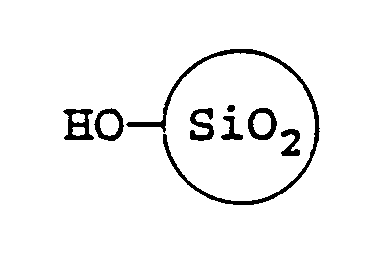
indicates that a OH group is attached on the surface of a SiO₂ particle, and for convenience sake, it is represented by a mono functional group. - Accordingly, if the de-alcoholysis adequately proceeds, the product is considered to be as follows:

wherein n and
are as defined above. - The ceramic preform thus prepared can be converted by sintering to glass or strong ceramics, which can be used as optical glass such as a lens, a prism or a photomask, as a belljar, a crucible, as a semiconductor product such as semiconductor jig, as quartz glass for science and chemistry or as a structural material used at a high temperature. Further, the ceramic preform may be used by-itself without sintering for applications such as separation membranes, catalysts carriers, gas absorbents or heat shielding materials utilizing the porous nature.
- The temperature for sintering the ceramic preform varies depending upon the content of the fine silica powder, the particle size, etc. However, it is usually at a level of from 800 to 1,900°C. For example, in a case where transparent quartz glass is to be prepared by using an alkoxysilane and fine silica powder as the starting materials, the temperature is preferably from 1,000 to 1,300°C.
- For the purpose of comparison with the present invention, the assumed reaction scheme of the reaction by the above-mentioned sol-gel method will be given below wherein alkoxysilane is employed.
-
Si(OR)₄ + 4H₂O → Si(OH)₄ + 4ROH
-
XSi(OH)₄ → (SiO₂)X + 2XH₂O
The process of the present invention does not require the presence of water, whereby a ceramic preform having excellent quality is believed to be obtainable. - The presence of a large amount of water means that the preform and the sintered product thereof will contain water. Accordigly, fracture or cracking will thereby be caused, and the de-alcoholysis will thereby be hindered in the subsequence de-alcoholysis step, whereby the strength of the preform is likely to be low.
- However, according to the process of the present invention, the presence of water can be reduced, and it is thereby possible to avoid the above-mentioned problems inherent to use of a large amount of water as in the sol-gel method. The present invention does not require an absolute anhydrous state. An alcohol used as the solvent, such as an alcohol for industrial purposes, usually contains water in an amount of a few hundreds ppm, and air or the starting materials have deposited water. In the present invention, the presence of water of this degree is permissible. The alkoxysilane has low compatibility with water, and water in an amount of about 1 mol per mol of the alkoxysilane, will be consumed by the conversion of the alkoxysilane to an oligomeric alkoxysilane, whereby the presence of water is reduced. Further, as mentioned above, the amount of water adsorbed on the fine silica powder varies depending upon the method for the preparation of silica powder or on the state of contact with air after the preparation, and such may affect the formation of OH groups on the surface of the fine silica powder. Accordingly, it is preferred that water adsorbed on the fine silica powder is controlled to be not more than 1 mol%, more preferably not more than 0.1 mol%, relative to the fine silica powder.
- The ceramic preform obtained by the present invention can be converted by sintering to quartz glass having a low water content at a level of not higher than a few hundreds ppm and having excellent heat stability and transparency-retaining properties.
- Now, the present invention will be described in further detail with reference to Examples. However, it should be understood that the present invention is by no means restricted by such specific Examples.
- 100 g of commercially available fumed silica (Aerosil OX 50, tradename, manufactured by Degussa, Fed. Rep. of Germany) was added to 500 g of methanol (guaranteed reagent) and dispersed uniformly in the methanol by mixing with a stirrer. Further, 18.2 g of methyl silicate (methoxysilane oligomer containing SiO₂ at a concenration of 51%) was added thereto, and the mixture was thoroughly stirred and mixed. Then, the methanol solvent was evaporated from the mixture by an evaporator to obtain a non-sticky powder mixture (Mixture I).
- Mixture I was passed through a nylon net having a mesh size of 50 µm to remove coarse agglomerate particles larger than the mesh size of the net. The mixture after the removal of coarse particles, was charged into a SUS 304 press container having a square cross sectional shape with each side being 55 mm and press-molded under a pressure of 150 kg/cm²G. Further, a pressure of 2,000 kg/cm²G was exerted by cold isostatic pressing to obtain a molded product of a sheet shape of 52.7 mm x 52.7 mm x 6.5 mm. This molded product was placed in a drier and subjected to de-alcoholysis at 200°C for 4 hours. As a result, the weight of the obtained ceramic preform was 23.5 g, and no dimensional change or no cracking was observed. Then, the ceramic preform was introduced into an electric furnace, heated to 1,250°C at a temperature raising rate of 50°C/hr and maintained at that temperature for 5 hours to obtain a transparent quartz glass having a size of 43.5 mm x 43.5 mm x 5.4 mm and a weight of 22.6 g (density: 2.2 g/cc) and having no turbidity. The water content (OH groups) in this quartz glass was measured by the infrared spectrum and found to be 300 ppm.
- Then, the same operation as above was conducted except that as the nylon net, one having a mesh size of 70 µm or 100 µm was used. As a result, in each case, the quartz glass obtained was a trasparent quartz glass having no turbidity. The water content (OH groups) in each quartz glass was measured by the infrared spectrum and found to be 300 ppm in each case.
- Further, the same operation as above was conducted except that as the nylon net, one having a mesh size of at least 300 µm was used for the removal of coarse agglomerate particles, or the operation for the removal of coarse particles was omitted. As a result, in each case, a transparent quartz glass having a size of 43.5 mm x 43.5 mm x 5.4 mm and a weight of 22.6 g (density: 2.2/cc) was obtained although three or fifteen white turbid points of a size of from 0.1 to 1 mm were observed in it. The water content (OH groups) in each quartz glass was measured by the infrared spectrum and found to be 300 ppm in each case.
- 18.2 g of methyl silicate (methoxysilane oligomer containing SiO₂ at a concentration of 51%) and 250 g of methanol (guaranteed reagent) were mixed. To this liquid mixture, 100 g of fumed silica (Aerosil OX 50, tradename, manufactured by Degussa, Fed. Rep. of Germany) was added and dispersed uniformly by mixing with a stirrer.
- The mixture was heated under reduced pressure (30-60 Torr) at 40°C by means of an evaporator to evaporate the methanol solvent. As a result, a non-sticky powder mixture was obtained.
- 24.9 g of this mixture was charged into a SUS 304 press container having a square cross sectional shape with each side being 55 mm and press-molded under a pressure of 100 kg/cm²G. Further, a pressure of 1,500 kg/cm²G was exerted by cold isostatic pressing to obtain a molded product of a sheet shape of 53. 2 mm x 53.2 mm x 6.6 mm. This molded product was put in a drier and subjected to de-alcoholysis at 150°C for 6 hours. The weight of the ceramic preform thus obtained was 23.5 g, and no dimensional change or no cracking was observed.
- Then, this ceramic preform was introduced into an electric furnace and heated to 1,250°C at a temperature raising rate of 50°C/hr and held at that temperature for 6 hours to obtain a transparent quartz glass having a size of 43.5 mm x 43.5 mm x 5.4 mm and a weight of 22.63 g (density: 2.2 g/cc) although 10 white turbid points of a size of from 0.1 to 1 mm were observed in the glass.
- The water content (OH groups) in the quartz glass was measured by the infrared spectrum and found to be 300 ppm.
- 36.7 g of methyl silicate (methoxysilane oligomer containing SiO₂ at a concentration of 51%) and 500 g of methanol (guaranteed reagent) were mixed. To this liquid mixture, 100 g of fumed silica (Aerosil #200, tradename, Nippon Aerosil Company Limited) was added and dispersed uniformly by mixing with a stirrer.
- This mixture was heated to 60°C under stirring to evaporate the methanol solvent. As a result, a non-sticky dry powder mixture was obtained. 16.40 g of this mixture was charged into a SUS 304 press container having a square cross sectional shape with each side being 55 mm and press-molded under a pressure 130 kg/cm²G. Further, a pressure of 2,000 kg/cm²G was exerted by cold isostatic pressing to obtain a molded product of a sheet shape of 51 mm x 51 mm x 6.0 mm.
- The molded product was introduced into an electric furnace and subjected to de-alcoholysis at 200°C for 2 hours. Then, it was heated from 200°C to 1,200°C at a temperature raising rate of 50°C/hr and held at that temperature for 2 hours, to obtain a transparent quartz glass having a size of 35.8 mm x 35.8 mm x 5.0 mm and a weight of 14.09 g (density: 2.2 g/cc) although 15 white turbid points of a size of from 0.1 to 1 mm were observed in the glass. The water content (OH groups) in the quartz glass was measured by the infrared spectrum and found to be 300 ppm.
- 25.0 g of ethyl silicate (ethoxysilane oligomer containing SiO₂ at a concentration of 40%) and 250 g of ethanol (guaranteed reagent) were mixed. To this liquid mixture, 100 g of fumed silica (Aerosil OX·50, tradename, manufactured by Degussa, Fed. Rep. of Germany) was added and dispersed uniformly by mixing with a stirrer. This mixture was heated to about 75°C under stirring to evaporate the ethanol solvent. As a result, a non-sticky dry powder mixture was obtained. 30.0 g of this mixture was charged into a SUS 304 press container having a square cross sectional shape with each side being 55 mm and press-molded under pressure of 130 kg/cm²G. Then, a pressure of 2,000 kg/cm²G was exerted by cold isostatic pressing to obtain a molded product of a sheet shape of 53 mm x 53 mm x 8.0 mm. The molded product was introduced into a drier and subjected to de-alcoholysis at 200°C for 2 hours. As a result, the weight of the molded product was 27.9 g, and no dimensional change or no cracking was observed.
- Then, the molded product was put in an electric furnace, heated to 1,250°C at a temperature raising rate of 50°C/hr and held at that temperature for 6 hours to obtain a transparent quartz glass having a size of 43.1 mm x 43.1 mm x 6.5 mm and a weight of 26.6 g (density: 2.2 g/cc) although 13 white turbid points of a size of from 0.1 to 1 mm were observed in the glass. The water content (OH groups) in the quartz glass was measured by the infrared spectrum and found to be 300 ppm.
- As is apparent from the Examples, according to the present invention, there is no problem of fracture or cracking due to the shrinkage of the gel during the drying operation, as compared with the conventional process for the preparation of a ceramic preform by a sol-gel method, and the drying step which used to be a controlling factor for the period required for the production, can be omitted. Yet, as opposed to the production of a ceramic preform by the conventional sol-gel method, no water is used during the process. Thus, it is possible to obtain a sintered ceramic product having a very small water content and excellent heat stability and transparency-retaining properties. Thus, the process of the present invention is very advantageous from the industrial point of view.
Claims (8)
- A process for producing a ceramic preform, which comprises mixing (A) an alkoxysilane of the formula:

- The process according to Claim 1, wherein R is an alkyl group having from 1 to 4 carbon atoms.
- The process according to any one of Claims 1 to 2, wherein the fine silica powder has a surface silanol group density of from 0.1 to 8 groups/100 Ų.
- The process according to any one of Claims 1 to 3, wherein the fine silica powder is used in an amount of from 0.2 to 50 parts by weight per part by weight of the alkoxysilane.
- The process according to any one of Claims 1 to 4, wherein the alkoxysilane and the fine silica powder are mixed in the presence of a solvent.
- The process according to any one of Claims 1 to 5, wherein the mixture is adjusted to have a particle size of at most 150 µm prior to the molding.
- The process according to any one of Claims 1 to 6, wherein the de-alcoholysis is conducted by heating at a temperature of from 100 to 300 °C.
- A process for producing a sintered ceramic product, which comprises sintering the ceramic preform prepared by the process of any one of Claims 1 to 7.
Applications Claiming Priority (4)
| Application Number | Priority Date | Filing Date | Title |
|---|---|---|---|
| JP5083888 | 1988-03-04 | ||
| JP50838/88 | 1988-03-04 | ||
| JP24538/89 | 1989-02-02 | ||
| JP1024538A JPH01317155A (en) | 1988-03-04 | 1989-02-02 | Production of ceramic compact |
Publications (2)
| Publication Number | Publication Date |
|---|---|
| EP0331187A1 EP0331187A1 (en) | 1989-09-06 |
| EP0331187B1 true EP0331187B1 (en) | 1993-08-25 |
Family
ID=26362080
Family Applications (1)
| Application Number | Title | Priority Date | Filing Date |
|---|---|---|---|
| EP89103767A Expired - Lifetime EP0331187B1 (en) | 1988-03-04 | 1989-03-03 | Process for producing a ceramic preform |
Country Status (4)
| Country | Link |
|---|---|
| US (1) | US5114881A (en) |
| EP (1) | EP0331187B1 (en) |
| JP (1) | JPH01317155A (en) |
| DE (1) | DE68908582T2 (en) |
Families Citing this family (12)
| Publication number | Priority date | Publication date | Assignee | Title |
|---|---|---|---|---|
| DE4142898A1 (en) * | 1991-12-23 | 1993-06-24 | Sued Chemie Ag | Pyrogenic silica moulding used as catalyst support or catalyst - prepd. from paste in aq. alcoholic ammonia by moulding, drying and calcining |
| US5314520A (en) * | 1992-02-12 | 1994-05-24 | The Furukawa Electric Co., Ltd. | Method for manufacturing optical fiber preform |
| JPH0826742A (en) * | 1994-07-11 | 1996-01-30 | Mitsubishi Chem Corp | Synthetic quartz glass powder |
| GB9603128D0 (en) * | 1996-02-15 | 1996-04-17 | Tsl Group Plc | Improved vitreous silica product and method of manufacture |
| US6261872B1 (en) * | 1997-09-18 | 2001-07-17 | Trw Inc. | Method of producing an advanced RF electronic package |
| US6132649A (en) * | 1999-01-29 | 2000-10-17 | Lucent Technologies Inc. | Fabrication including sol-gel processing |
| US6193926B1 (en) | 1999-09-03 | 2001-02-27 | Heraeus Amersil, Inc. | Process for making molded glass and ceramic articles |
| EP1242557B8 (en) * | 1999-12-17 | 2006-02-01 | Cabot Microelectronics Corporation | Method of polishing or planarizing a substrate |
| JP4444559B2 (en) * | 2002-10-09 | 2010-03-31 | ジャパンスーパークォーツ株式会社 | Method for strengthening quartz glass crucible and method for pulling silicon single crystal |
| US8701441B2 (en) * | 2006-08-21 | 2014-04-22 | 3M Innovative Properties Company | Method of making inorganic, metal oxide spheres using microstructured molds |
| JP5213059B2 (en) * | 2008-07-18 | 2013-06-19 | 株式会社キャディック | Mold composition |
| CN103030405B (en) * | 2012-11-23 | 2014-02-12 | 江苏中硅工程材料有限公司 | Control method for firing high-performance quartz ceramic |
Family Cites Families (14)
| Publication number | Priority date | Publication date | Assignee | Title |
|---|---|---|---|---|
| DE3390375T1 (en) * | 1982-12-23 | 1985-02-07 | Suwa Seikosha Co. Ltd., Tokio/Tokyo | Process for the manufacture of silica glass |
| JPS6065735A (en) * | 1983-09-21 | 1985-04-15 | Seiko Epson Corp | Production of quartz glass |
| NL8403667A (en) * | 1984-12-03 | 1986-07-01 | Philips Nv | METHOD FOR THE MANUFACTURE OF MONOLITIC GLASS BODIES |
| JPS61168542A (en) * | 1985-01-23 | 1986-07-30 | Seiko Epson Corp | Silica glass manufacturing method |
| JPS61251578A (en) * | 1985-04-30 | 1986-11-08 | 住友電気工業株式会社 | Manufacturing method of silicon nitride sintered body |
| DE3522194A1 (en) * | 1985-06-21 | 1987-01-02 | Philips Patentverwaltung | METHOD FOR PRODUCING GLASS BODIES |
| JPS6246950A (en) * | 1985-08-23 | 1987-02-28 | 花王株式会社 | Manufacture of alumina and/or silica base ceramic |
| JPS62100421A (en) * | 1985-10-24 | 1987-05-09 | Seiko Epson Corp | Method for manufacturing fluorinated glass |
| CH668591A5 (en) * | 1986-04-03 | 1989-01-13 | Battelle Memorial Institute | High dielectric internal grain boundary barrier layer ceramic |
| US4680049A (en) * | 1986-08-15 | 1987-07-14 | Gte Laboratories Incorporated | Process for molding optical components of silicate glass to a near net shape optical precision |
| EP0310486B1 (en) * | 1987-09-30 | 1992-03-18 | Shin-Etsu Chemical Co., Ltd. | A method for the preparation of silica glass |
| US4943542A (en) * | 1987-10-31 | 1990-07-24 | Hitachi Chemical Company, Ltd. | Process for producing silica glass |
| JPH01126276A (en) * | 1987-11-11 | 1989-05-18 | Inax Corp | Production of ceramic sintered body |
| JPH03112434A (en) * | 1989-09-25 | 1991-05-14 | Yakult Honsha Co Ltd | Agent for improving quality of wheat flour product |
-
1989
- 1989-02-02 JP JP1024538A patent/JPH01317155A/en active Pending
- 1989-03-03 EP EP89103767A patent/EP0331187B1/en not_active Expired - Lifetime
- 1989-03-03 DE DE89103767T patent/DE68908582T2/en not_active Expired - Fee Related
-
1991
- 1991-04-15 US US07/684,501 patent/US5114881A/en not_active Expired - Fee Related
Also Published As
| Publication number | Publication date |
|---|---|
| US5114881A (en) | 1992-05-19 |
| JPH01317155A (en) | 1989-12-21 |
| DE68908582T2 (en) | 1994-04-21 |
| EP0331187A1 (en) | 1989-09-06 |
| DE68908582D1 (en) | 1993-09-30 |
Similar Documents
| Publication | Publication Date | Title |
|---|---|---|
| EP0517841B1 (en) | Process for making non-porous, micron-sized high purity silica | |
| Lee et al. | Crystallization and densification of nano‐size amorphous cordierite powder prepared by a PVA solution‐polymerization route | |
| US5114881A (en) | Process for producing a ceramic preform | |
| JP6401612B2 (en) | Method for producing high-purity metal oxide particles and material produced therefor | |
| US5063003A (en) | Method for manufacturing amorphous silica objects | |
| JPH072513A (en) | Method for producing synthetic quartz glass powder | |
| EP0391447B1 (en) | Method for production of inorganic oxide particles | |
| US6849114B2 (en) | Dispersion comprising silicon/titanium mixed oxide powder, and green bodies and shaped glass articles produced therefrom | |
| EP0335175B1 (en) | Method of making large particle size, high purity dense silica | |
| TW312686B (en) | ||
| KR20030017617A (en) | Sol-gel process for the production of high dimensions dry gels and derived glasses | |
| KR100704520B1 (en) | Manufacturing Method of Molten Glass Products | |
| EP0335171A2 (en) | Method of making high purity dense silica of large particle size | |
| JPH03275527A (en) | Porous silica glass powder | |
| JPS63274603A (en) | Method for elevating purity of hexagonal boron nitride to high level | |
| KR100770176B1 (en) | Method for producing transparent silica glass | |
| JP3318946B2 (en) | Powdery dry gel, silica glass powder, and method for producing silica glass melt molded article | |
| KR100722377B1 (en) | Method for producing transparent silica glass | |
| JPH054827A (en) | Silica glass powder, method for producing the same, and silica glass molding using the same | |
| KR100722379B1 (en) | Method for producing transparent silica glass | |
| JPH10101322A (en) | Silica gel, synthetic quartz glass powder, method for producing the same, and method for producing quartz glass compact | |
| KR100824986B1 (en) | Composition for manufacturing transparent silica glass and method for producing silica glass using same | |
| JP2734083B2 (en) | Method for producing transparent quartz glass molded body | |
| KR20040056544A (en) | A method of preparing transparent silica glass | |
| JP3806956B2 (en) | Method for producing synthetic quartz glass powder |
Legal Events
| Date | Code | Title | Description |
|---|---|---|---|
| PUAI | Public reference made under article 153(3) epc to a published international application that has entered the european phase |
Free format text: ORIGINAL CODE: 0009012 |
|
| AK | Designated contracting states |
Kind code of ref document: A1 Designated state(s): DE FR GB |
|
| 17P | Request for examination filed |
Effective date: 19900212 |
|
| 17Q | First examination report despatched |
Effective date: 19920402 |
|
| GRAA | (expected) grant |
Free format text: ORIGINAL CODE: 0009210 |
|
| AK | Designated contracting states |
Kind code of ref document: B1 Designated state(s): DE FR GB |
|
| REF | Corresponds to: |
Ref document number: 68908582 Country of ref document: DE Date of ref document: 19930930 |
|
| ET | Fr: translation filed | ||
| PLBE | No opposition filed within time limit |
Free format text: ORIGINAL CODE: 0009261 |
|
| STAA | Information on the status of an ep patent application or granted ep patent |
Free format text: STATUS: NO OPPOSITION FILED WITHIN TIME LIMIT |
|
| 26N | No opposition filed | ||
| PGFP | Annual fee paid to national office [announced via postgrant information from national office to epo] |
Ref country code: FR Payment date: 19981215 Year of fee payment: 11 |
|
| PGFP | Annual fee paid to national office [announced via postgrant information from national office to epo] |
Ref country code: GB Payment date: 19981224 Year of fee payment: 11 |
|
| PGFP | Annual fee paid to national office [announced via postgrant information from national office to epo] |
Ref country code: DE Payment date: 19990331 Year of fee payment: 11 |
|
| PG25 | Lapsed in a contracting state [announced via postgrant information from national office to epo] |
Ref country code: GB Free format text: LAPSE BECAUSE OF NON-PAYMENT OF DUE FEES Effective date: 20000303 |
|
| GBPC | Gb: european patent ceased through non-payment of renewal fee |
Effective date: 20000303 |
|
| PG25 | Lapsed in a contracting state [announced via postgrant information from national office to epo] |
Ref country code: FR Free format text: LAPSE BECAUSE OF NON-PAYMENT OF DUE FEES Effective date: 20001130 |
|
| REG | Reference to a national code |
Ref country code: FR Ref legal event code: ST |
|
| PG25 | Lapsed in a contracting state [announced via postgrant information from national office to epo] |
Ref country code: DE Free format text: LAPSE BECAUSE OF NON-PAYMENT OF DUE FEES Effective date: 20010103 |