EP0329331A2 - Verfahren zur Bewertung einer kumulativen Exposition an einem Bestandteil eines Gases und Gerät dafür - Google Patents
Verfahren zur Bewertung einer kumulativen Exposition an einem Bestandteil eines Gases und Gerät dafür Download PDFInfo
- Publication number
- EP0329331A2 EP0329331A2 EP89301219A EP89301219A EP0329331A2 EP 0329331 A2 EP0329331 A2 EP 0329331A2 EP 89301219 A EP89301219 A EP 89301219A EP 89301219 A EP89301219 A EP 89301219A EP 0329331 A2 EP0329331 A2 EP 0329331A2
- Authority
- EP
- European Patent Office
- Prior art keywords
- conduit
- gas
- reagent
- component
- reservoir
- Prior art date
- Legal status (The legal status is an assumption and is not a legal conclusion. Google has not performed a legal analysis and makes no representation as to the accuracy of the status listed.)
- Withdrawn
Links
Images

Classifications
-
- G—PHYSICS
- G01—MEASURING; TESTING
- G01N—INVESTIGATING OR ANALYSING MATERIALS BY DETERMINING THEIR CHEMICAL OR PHYSICAL PROPERTIES
- G01N31/00—Investigating or analysing non-biological materials by the use of the chemical methods specified in the subgroup; Apparatus specially adapted for such methods
- G01N31/22—Investigating or analysing non-biological materials by the use of the chemical methods specified in the subgroup; Apparatus specially adapted for such methods using chemical indicators
- G01N31/223—Investigating or analysing non-biological materials by the use of the chemical methods specified in the subgroup; Apparatus specially adapted for such methods using chemical indicators for investigating presence of specific gases or aerosols
- G01N31/224—Investigating or analysing non-biological materials by the use of the chemical methods specified in the subgroup; Apparatus specially adapted for such methods using chemical indicators for investigating presence of specific gases or aerosols for investigating presence of dangerous gases
-
- Y—GENERAL TAGGING OF NEW TECHNOLOGICAL DEVELOPMENTS; GENERAL TAGGING OF CROSS-SECTIONAL TECHNOLOGIES SPANNING OVER SEVERAL SECTIONS OF THE IPC; TECHNICAL SUBJECTS COVERED BY FORMER USPC CROSS-REFERENCE ART COLLECTIONS [XRACs] AND DIGESTS
- Y10—TECHNICAL SUBJECTS COVERED BY FORMER USPC
- Y10S—TECHNICAL SUBJECTS COVERED BY FORMER USPC CROSS-REFERENCE ART COLLECTIONS [XRACs] AND DIGESTS
- Y10S435/00—Chemistry: molecular biology and microbiology
- Y10S435/807—Gas detection apparatus
-
- Y—GENERAL TAGGING OF NEW TECHNOLOGICAL DEVELOPMENTS; GENERAL TAGGING OF CROSS-SECTIONAL TECHNOLOGIES SPANNING OVER SEVERAL SECTIONS OF THE IPC; TECHNICAL SUBJECTS COVERED BY FORMER USPC CROSS-REFERENCE ART COLLECTIONS [XRACs] AND DIGESTS
- Y10—TECHNICAL SUBJECTS COVERED BY FORMER USPC
- Y10S—TECHNICAL SUBJECTS COVERED BY FORMER USPC CROSS-REFERENCE ART COLLECTIONS [XRACs] AND DIGESTS
- Y10S436/00—Chemistry: analytical and immunological testing
- Y10S436/807—Apparatus included in process claim, e.g. physical support structures
-
- Y—GENERAL TAGGING OF NEW TECHNOLOGICAL DEVELOPMENTS; GENERAL TAGGING OF CROSS-SECTIONAL TECHNOLOGIES SPANNING OVER SEVERAL SECTIONS OF THE IPC; TECHNICAL SUBJECTS COVERED BY FORMER USPC CROSS-REFERENCE ART COLLECTIONS [XRACs] AND DIGESTS
- Y10—TECHNICAL SUBJECTS COVERED BY FORMER USPC
- Y10S—TECHNICAL SUBJECTS COVERED BY FORMER USPC CROSS-REFERENCE ART COLLECTIONS [XRACs] AND DIGESTS
- Y10S436/00—Chemistry: analytical and immunological testing
- Y10S436/902—Dosimeter
Definitions
- This invention relates to a method of estimating a cumulative exposure to a component of a gas and apparatus therefor.
- pumps may be relatively expensive and if they do not pump at the intended rate due for example to an electrical fault or battery discharge or other fault, can lead to a wrong estimate of the cumulative exposure. They may also be inconvenient for a worker to wear if the worker's personal exposure to the component is to be estimated during a period of work.
- the present invention relates to a method of estimating a cumulative exposure to a component of a gas which comprises contacting a liquid reagent held by surface tension in a reservoir with a body of the gas through a conduit into which substantially only diffusional migration of the said component from the said body of gas occurs.
- the quantity of reagent charged to the reservoir is suitably 0.05 to 5 preferably 0.2 to 2 microlitres.
- conduits may be provided which may be in parallel.
- the conduit may be convoluted if desired but is suitably substantially linear.
- the culmulative exposure may be estimated by removal and analysis of the reagent or by observing a colour change in it.
- the reservoir should comprise a translucent or preferably transparent zone so that the colour change may be observed without removal of the reagent from the reservoir.
- the colour change may be observed for example by looking down the conduit or if preferred by looking through a transparent wall of the reservoir.
- the method be simultaneously carried out with a number of reagents of differing sensitivity to the component.
- the cumulative exposure may be visually estimated by observing which reagents have changed colour, the least sensitive reagent to have changed colour giving an indication of this.
- sensitivity is meant the amount of the component which must be absorbed to produce the colour change.
- the method may be simultaneously carried out using a number of samples of identical reagent to which differing diffusional access is available through their conduits, for example by using longer and/or narrower conduits to restrict access. In this case the colour change in the sample with most restricted access indicates the cumulative exposure.
- the reagent is a solvent for a component of a gas.
- the quantity of gas dissolved may be estimated by analytical or physical means at the conclusion of the period of exposure. If necessary the reagent may be cooled to increase the solubility of a component of a gas in the reagent.
- the quantity of liquid reagent within the reservoir is preferably small so that surface tension effects will be sufficient to immobilise it during an impact, and/or the viscosity of the reagent may be increased by for example the addition of a viscosity increasing agent.
- Suitable viscosity increasing agents include high molecular weight derivatives of alkylene oxides for example ethylene oxide and or propylene oxide of which the molecules consist largely of residues of said alkylene oxides suitably of molecular weight of 1,000 to 100,000 and preferably 1,500 to 50,000, for example polyalkylene glycols.
- Suitable viscosity increasing agents are the materials sold by ICI C and P Limited under the trade name Emkarox HV165 or HV105.
- the invention also comprises a sampling device for use in a method as aforesaid which comprises a conduit of ratio of equivalent internal diameter to length in the range 2:1 to 1:100 and preferably 1:1 to 1:10, removable means for closing one end of the conduit with a member containing a reservoir communicating with the conduit for holding the liquid reagent in a fixed and removable relationship with the conduit and means for closing the other end of the conduit with a gas permeable dust rejecting and gas motion limiting member.
- equivalent internal diameter is meant the diameter of a circle of area equal to the internal cross sectional area of the conduit at right angles to its length.
- the invention further comprises a sampling device as aforesaid provided with cooling means for the reagent.
- the invention also comprises a sampling device for use in a method as aforesaid which comprises at least two and preferably at least four readily visible reservoirs.
- the sampling device may be filled with reagent immediately prior to use or supplied prefilled.
- Prefilled devices should be protected from atmospheric contamination prior to use by enclosure in an air-tight container. Individual devices may be protected from atmospheric contamination prior to use by for example an air-tight lid or removable gas impermeable strip isolating the reagent from the atmosphere. If the device is to accompany a moving workman to estimate his exposure to a body of gas, a pin or clip or other suitable attachment means may be provided for attachment of the device to his clothing.
- the device may be worn inverted to minimise contamination from moisture or dust, in this way the device may be used without a gas permeable dust rejecting and motion limiting member.
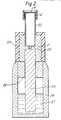
- FIG. 1 shows a device in cross-section.
- This device comprises a conduit 1 and a member 2 releasably secured to a reproducible height against abutments 3 of the conduit by means of a screw cap 4 thereby closing one end of the conduit.
- a reservoir 5 At the end of member 2 facing the conduit is a reservoir 5.
- the gas space of the conduit is protected from contamination with solids such as dust by means of a filter cap 6 which releasably closes the opposite end of the conduit by means of a gas permeable filter 8 which is secured within the filter cap against an abutment by circlip 9.
- This filter may be a metal gauze which may be backed by an underlying membrane which may if desired by a water rejecting membrane.
- the filter cap is a push fit over the conduit and is held by 'O' rings 7.
- the device In use the device is dismantled and a liquid reagent is placed within reservoir 5 by a syringe or similar means whereby the reagent is held in place by surface tension.
- the member 2 is inserted into conduit 2 and secured in a fixed position by tightening screw cap 4 until the member is brought to rest against the abutments 3 of the conduit.
- Filter cap 6 is pressed onto the top of the conduit.
- the cumulative exposure of subjects for example the environment, people, machinery, plants and structures may be determined.
- the device may be used for monitoring atmospheric contamination by exposing it for a known period of time to the atmosphere to be tested. It may be used as a static testing device or may for example be secured to the clothing of a workman to give an indication of his cumulative exposure to a contaminant during a period of work.
- FIG. 2 A second form of the invention is shown in cross-section in Figure 2 which represents a sampling device as aforesaid provided with cooling means for the reagent.
- This device comprises a conduit 20 abutted within a cylindrical member 21, which is formed with coaxial bores at top and bottom the top bore leading to reservoir 22 which faces the conduit.
- the gas space of the conduit is protected from contamination with solids by means of a filter cap 6 as described in Figure 1.
- Member 21 abuts one end of a copper rod 23 and is surrounded by insulation 24.
- the other end of the copper rod is surrounded by a Dewar vessel 25 which is fitted with a loose fitting plug 26.
- the device In use the device is dismantled, a suitable reagent placed in reservoir 22 and a coolant 27 placed in Dewar vessel 25.
- the apparatus is reassembled as shown in Figure 2.
- the reagent is cooled by conduction through copper rod 23 and exposed for a known period of time to the atmosphere to be tested.
- Gas permeable filter 8 typically contains a polymethyl silicone membrane which remains close to room temperature throughout the sampling procedure.
- the reagent is removed by syringe and analysed by gas liquid chromatography. It is preferable to wash the reagent out of the reservoir with a solvent containing an internal standard and to withdraw part of the liquid with a syringe for such analysis for greater convenience and accuracy.
- the device may be used for sampling gaseous components which do not react with the reagent and subsequent analysis thereof. Alternatively it may be used to sample the headspace gas from a liquid sample in order to extract and preconcentrate the component of interest.
- a third form of the invention is shown in cross section in Figure 3 which represents a block of polytetrafluoroethylene formed with conduits 30 leading to reservoirs 31 in which are placed reagents of decreasing sensitivity to a component of the atmosphere and which change colour on absorption of increasing amounts thereof.
- the block may be worn by a workman who can estimate his cumulative exposure during the period when it is worn by observing which, if any, reagents have changed colour and can withdraw from a contaminated atmosphere when a safety limit is reached.
- the reservoir 5 has 1.1 mm internal diameter and is 1 mm deep, and the open end of the reservoir is about 17 mm from the open end of conduit 1. It was assembled with 1 ul of reagent in the reservoir.
- the reagent was 0.1M sulphuric acid in a mixture of water (20% by volume) in diethylene glycol (80% by volume).
- the filter 8 was a metal gauze.
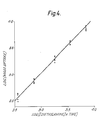
- the uptake rate U was also found to remain constant when exposure time was varied, when the diethylamine concentration was varied during exposure and when the velocity of air across the sampler face was varied.
- a sampler was prepared as above and exposed to an unknown concentration of diethylamine for 240 minutes and the sampler was found by internal standard gas chromatography to contain 1765 ng of diethylamine the average concentration to which the sampler had been exposed was calculated as 7.07 ppm diethylamine.
- the reagents were washed out mixed with excess alkaline solution and analysed by gas chromatography.
- example 1 The procedure of example 1 was repeated using a filter 8 as described in example 2 and using 0.8 ul of a mixture of N-benzylethanolamine (5% by volume) in a polyalkylene glycol ether, molecular weight 2,000 sold commercially as "Emkarox" VG 217W (95% by volume), as reagent.
- the sampler was exposed to a known concentration of 2 ppm formaldehyde in air for 4 hours.
- the mass of formaldehyde absorbed by reaction with N-benzylethanolamine to produce 3-benzyloxazolidine was measured and the mass uptake rate U, calculated for formaldehyde as 0.85 ng/ppm/min.
- a sampler consisting of a translucent plastic tube internal diameter 4.4mm of which one end is closed by a flat surface which accommodates a central recess 1.1mm internal diameter 0.8 mm depth serving as a reservoir, the tube length from reservoir to its open end being 10 mm was used for the following tests.
- a sampler as shown in Figure 3 was then used in which the conduits were 4.5 mm diameter and 10 mm deep and the resevoirs were 1 mm diameter by 1 mm deep.
- the resevoirs were filled in order with 0.8 ul of reagents comprising 0.001, 0.002, 0.004, 0.010, 0.02, 0.05 and 0.1 M hydrochloric acid and 0.004 g bromocresol green in 80%, diethylene glycol, 0.8% methanol (by volume) the balance being water.
- the sampler was exposed for the periods stated in the Table below to the stated concentrations of diethylamine.
- the symbol on the right is the actual colour indication noted after the exposure time.
- G green means that the colour is in the process of changing from yellow to blue.
- the symbol on the left is the colour of the solution which would be expected given the uptake rate of 1.71 ng/ppm/min for diethylamine which has been obtained experimentally.
- the relationship between exposure concentration and the colour changes of the solutions demonstrates that the device can be used for measuring average exposure concentrations.
- the good agreement between the calculated colour and actual colour after exposure demonstrates that the calculation procedures can be used to determine unknown concentrations using the procedure.
Landscapes
- Life Sciences & Earth Sciences (AREA)
- Health & Medical Sciences (AREA)
- Chemical & Material Sciences (AREA)
- Analytical Chemistry (AREA)
- General Health & Medical Sciences (AREA)
- Biophysics (AREA)
- Molecular Biology (AREA)
- Physics & Mathematics (AREA)
- Toxicology (AREA)
- Biochemistry (AREA)
- Dispersion Chemistry (AREA)
- General Physics & Mathematics (AREA)
- Immunology (AREA)
- Pathology (AREA)
- Investigating Or Analyzing Non-Biological Materials By The Use Of Chemical Means (AREA)
- Testing Resistance To Weather, Investigating Materials By Mechanical Methods (AREA)
- Sampling And Sample Adjustment (AREA)
Applications Claiming Priority (2)
| Application Number | Priority Date | Filing Date | Title |
|---|---|---|---|
| GB8803515 | 1988-02-16 | ||
| GB888803515A GB8803515D0 (en) | 1988-02-16 | 1988-02-16 | Method of estimating cumulative exposure to component of gas & apparatus therefor |
Publications (2)
| Publication Number | Publication Date |
|---|---|
| EP0329331A2 true EP0329331A2 (de) | 1989-08-23 |
| EP0329331A3 EP0329331A3 (de) | 1990-09-26 |
Family
ID=10631773
Family Applications (1)
| Application Number | Title | Priority Date | Filing Date |
|---|---|---|---|
| EP19890301219 Withdrawn EP0329331A3 (de) | 1988-02-16 | 1989-02-08 | Verfahren zur Bewertung einer kumulativen Exposition an einem Bestandteil eines Gases und Gerät dafür |
Country Status (3)
| Country | Link |
|---|---|
| US (1) | US5013668A (de) |
| EP (1) | EP0329331A3 (de) |
| GB (1) | GB8803515D0 (de) |
Families Citing this family (10)
| Publication number | Priority date | Publication date | Assignee | Title |
|---|---|---|---|---|
| DE3929541A1 (de) * | 1989-09-06 | 1991-03-14 | Draegerwerk Ag | Nachweisgeraet zur enzymatischen bestimmung von gasproben |
| US5340546A (en) * | 1993-04-05 | 1994-08-23 | David Bromley | Gas filter |
| US5320807A (en) * | 1993-05-07 | 1994-06-14 | Brinton William F | Test kits for determining the chemical stability of a compost sample |
| DE19600762A1 (de) * | 1996-01-11 | 1997-07-17 | Wolfgang Dr Ing Lorenz | Verfahren zur Analyse der Formaldehydemission aus Oberflächen |
| DK174312B1 (da) * | 1996-06-06 | 2002-12-02 | Ole Pedersen | Fremgangsmåde til måling af strømningshastighed og diffusivitet, mikrosensor til brug ved fremgangsmåden samt anvendelse af sådan mikrosensor |
| WO2001035057A2 (en) * | 1999-11-09 | 2001-05-17 | Photonic Biosystems, Inc. | Ammonia detection and measurement device |
| US7049683B1 (en) * | 2003-07-19 | 2006-05-23 | Ns Electronics Bangkok (1993) Ltd. | Semiconductor package including organo-metallic coating formed on surface of leadframe roughened using chemical etchant to prevent separation between leadframe and molding compound |
| WO2007115321A2 (en) * | 2006-04-04 | 2007-10-11 | Photonic Biosystems, Inc. | Visual, continuous and simultaneous measurement of solution ammonia and hydrogen ion concentration |
| US20090021740A1 (en) * | 2007-07-17 | 2009-01-22 | Chung Yuan Christian University | Optical sensor and method for measuring blood gas |
| US10829729B2 (en) | 2016-11-03 | 2020-11-10 | President And Fellows Of Harvard College | Cellular poration using laser radiation |
Family Cites Families (5)
| Publication number | Priority date | Publication date | Assignee | Title |
|---|---|---|---|---|
| US4158958A (en) * | 1978-06-09 | 1979-06-26 | Minnesota Mining And Manufacturing Co. | Controlled sensitivity monitoring devices |
| US4258000A (en) * | 1979-08-02 | 1981-03-24 | Obermayer Arthur S | Toxic-monitoring badge and method of use |
| US4269804A (en) * | 1979-08-24 | 1981-05-26 | E. I. Du Pont De Nemours And Company | Self-contained gaseous contaminant dosimeter |
| JPS5883262A (ja) * | 1981-11-13 | 1983-05-19 | Midori Anzen Kk | 有害ガス積算濃度チエツカ− |
| US4790857A (en) * | 1986-11-20 | 1988-12-13 | Miksch Robert R | Gaseous contaminant dosimeter with diffusive material for regulating mass uptake |
-
1988
- 1988-02-16 GB GB888803515A patent/GB8803515D0/en active Pending
-
1989
- 1989-02-08 EP EP19890301219 patent/EP0329331A3/de not_active Withdrawn
- 1989-02-10 US US07/308,675 patent/US5013668A/en not_active Expired - Fee Related
Also Published As
| Publication number | Publication date |
|---|---|
| GB8803515D0 (en) | 1988-03-16 |
| US5013668A (en) | 1991-05-07 |
| EP0329331A3 (de) | 1990-09-26 |
Similar Documents
| Publication | Publication Date | Title |
|---|---|---|
| US3985017A (en) | Gaseous contaminate dosimeter and method | |
| Brown et al. | The development of an improved diffusive sampler | |
| CA1137333A (en) | Self-contained gaseous contaminant dosimeter | |
| US5013668A (en) | Method of estimating a cumulative exposure to a compound of a gas and apparatus therefor | |
| US20180202902A1 (en) | Method for sampling and extracting pollutants in a fluid, sampling cartridge, sampling and extracting devices using said method | |
| JPS6111386B2 (de) | ||
| Henry et al. | The development of a standard method for evaluating chemical protective clothing to permeation by hazardous liquids | |
| Keller et al. | Sampling of isocyanates in air | |
| KRING et al. | A new passive colorimetric air monitoring badge system for ammonia, sulfur dioxide and nitrogen dioxide | |
| Patil et al. | Determination of benzene, aniline and nitrobenzene in workplace air: a comparison of active and passive sampling | |
| AU535721B2 (en) | Biocide conc. in aqueous systems | |
| McCONNAUGHEY et al. | Passive colorimetric dosimeter tubes for ammonia, carbon monoxide, carbon dioxide, hydrogen sulfide, nitrogen dioxide and sulfur dioxide | |
| JP2750841B2 (ja) | pH測定素子の較正方法 | |
| Tucker et al. | A sampling and analytical method for ethylene glycol in air | |
| CASSINELLI et al. | Performance of sulfur dioxide passive monitors | |
| KR100411237B1 (ko) | 수질조사 키트 | |
| RU2823760C1 (ru) | Способ экспресс-обнаружения загрязнения поверхности объекта фенолом | |
| MORALES et al. | Air sampling and analytical procedures for benzidine, 3, 3′-dichlorobenzidine and their salts | |
| Peach et al. | Air sampling and analysis for gases and vapors | |
| PUSKAR et al. | Field validation of passive dosimeters for the determination of employee exposures to ethylene oxide in hospital product sterilization facilities | |
| US4083691A (en) | Method for detecting contaminants in water | |
| BISHOP et al. | Field comparison between two nitrous oxide (N2O) passive monitors and conventional sampling methods | |
| ITRM980584A1 (it) | Dispositivo per il campionamento diffusionale di vapori organici nello ambiente | |
| Tanaka et al. | Monitoring for N, N-dimethylformamide and N, N-dimethylacetamide with a diffusive sampler using distilled water as an absorbent | |
| Gonzalez et al. | The development and evaluation of a thermally-desorbable miniature passive dosimeter for the monitoring of organic vapors |
Legal Events
| Date | Code | Title | Description |
|---|---|---|---|
| PUAI | Public reference made under article 153(3) epc to a published international application that has entered the european phase |
Free format text: ORIGINAL CODE: 0009012 |
|
| AK | Designated contracting states |
Kind code of ref document: A2 Designated state(s): BE DE FR GB IT NL |
|
| PUAL | Search report despatched |
Free format text: ORIGINAL CODE: 0009013 |
|
| AK | Designated contracting states |
Kind code of ref document: A3 Designated state(s): BE DE FR GB IT NL |
|
| 17P | Request for examination filed |
Effective date: 19910227 |
|
| 17Q | First examination report despatched |
Effective date: 19930405 |
|
| STAA | Information on the status of an ep patent application or granted ep patent |
Free format text: STATUS: THE APPLICATION IS DEEMED TO BE WITHDRAWN |
|
| 18D | Application deemed to be withdrawn |
Effective date: 19930817 |