EP0326002A1 - Electrode material/electrolyte system for non-aqueous cells - Google Patents
Electrode material/electrolyte system for non-aqueous cells Download PDFInfo
- Publication number
- EP0326002A1 EP0326002A1 EP89100768A EP89100768A EP0326002A1 EP 0326002 A1 EP0326002 A1 EP 0326002A1 EP 89100768 A EP89100768 A EP 89100768A EP 89100768 A EP89100768 A EP 89100768A EP 0326002 A1 EP0326002 A1 EP 0326002A1
- Authority
- EP
- European Patent Office
- Prior art keywords
- cell
- coo2
- ester
- cells
- electrolyte
- Prior art date
- Legal status (The legal status is an assumption and is not a legal conclusion. Google has not performed a legal analysis and makes no representation as to the accuracy of the status listed.)
- Withdrawn
Links
Images

Classifications
-
- H—ELECTRICITY
- H01—ELECTRIC ELEMENTS
- H01M—PROCESSES OR MEANS, e.g. BATTERIES, FOR THE DIRECT CONVERSION OF CHEMICAL ENERGY INTO ELECTRICAL ENERGY
- H01M10/00—Secondary cells; Manufacture thereof
- H01M10/05—Accumulators with non-aqueous electrolyte
- H01M10/052—Li-accumulators
-
- H—ELECTRICITY
- H01—ELECTRIC ELEMENTS
- H01M—PROCESSES OR MEANS, e.g. BATTERIES, FOR THE DIRECT CONVERSION OF CHEMICAL ENERGY INTO ELECTRICAL ENERGY
- H01M10/00—Secondary cells; Manufacture thereof
- H01M10/05—Accumulators with non-aqueous electrolyte
- H01M10/056—Accumulators with non-aqueous electrolyte characterised by the materials used as electrolytes, e.g. mixed inorganic/organic electrolytes
- H01M10/0564—Accumulators with non-aqueous electrolyte characterised by the materials used as electrolytes, e.g. mixed inorganic/organic electrolytes the electrolyte being constituted of organic materials only
- H01M10/0566—Liquid materials
- H01M10/0568—Liquid materials characterised by the solutes
-
- H—ELECTRICITY
- H01—ELECTRIC ELEMENTS
- H01M—PROCESSES OR MEANS, e.g. BATTERIES, FOR THE DIRECT CONVERSION OF CHEMICAL ENERGY INTO ELECTRICAL ENERGY
- H01M10/00—Secondary cells; Manufacture thereof
- H01M10/05—Accumulators with non-aqueous electrolyte
- H01M10/056—Accumulators with non-aqueous electrolyte characterised by the materials used as electrolytes, e.g. mixed inorganic/organic electrolytes
- H01M10/0564—Accumulators with non-aqueous electrolyte characterised by the materials used as electrolytes, e.g. mixed inorganic/organic electrolytes the electrolyte being constituted of organic materials only
- H01M10/0566—Liquid materials
- H01M10/0569—Liquid materials characterised by the solvents
-
- H—ELECTRICITY
- H01—ELECTRIC ELEMENTS
- H01M—PROCESSES OR MEANS, e.g. BATTERIES, FOR THE DIRECT CONVERSION OF CHEMICAL ENERGY INTO ELECTRICAL ENERGY
- H01M4/00—Electrodes
- H01M4/02—Electrodes composed of, or comprising, active material
- H01M4/36—Selection of substances as active materials, active masses, active liquids
- H01M4/48—Selection of substances as active materials, active masses, active liquids of inorganic oxides or hydroxides
- H01M4/52—Selection of substances as active materials, active masses, active liquids of inorganic oxides or hydroxides of nickel, cobalt or iron
- H01M4/525—Selection of substances as active materials, active masses, active liquids of inorganic oxides or hydroxides of nickel, cobalt or iron of mixed oxides or hydroxides containing iron, cobalt or nickel for inserting or intercalating light metals, e.g. LiNiO2, LiCoO2 or LiCoOxFy
-
- H—ELECTRICITY
- H01—ELECTRIC ELEMENTS
- H01M—PROCESSES OR MEANS, e.g. BATTERIES, FOR THE DIRECT CONVERSION OF CHEMICAL ENERGY INTO ELECTRICAL ENERGY
- H01M6/00—Primary cells; Manufacture thereof
- H01M6/14—Cells with non-aqueous electrolyte
- H01M6/16—Cells with non-aqueous electrolyte with organic electrolyte
- H01M6/162—Cells with non-aqueous electrolyte with organic electrolyte characterised by the electrolyte
- H01M6/164—Cells with non-aqueous electrolyte with organic electrolyte characterised by the electrolyte by the solvent
-
- Y—GENERAL TAGGING OF NEW TECHNOLOGICAL DEVELOPMENTS; GENERAL TAGGING OF CROSS-SECTIONAL TECHNOLOGIES SPANNING OVER SEVERAL SECTIONS OF THE IPC; TECHNICAL SUBJECTS COVERED BY FORMER USPC CROSS-REFERENCE ART COLLECTIONS [XRACs] AND DIGESTS
- Y02—TECHNOLOGIES OR APPLICATIONS FOR MITIGATION OR ADAPTATION AGAINST CLIMATE CHANGE
- Y02E—REDUCTION OF GREENHOUSE GAS [GHG] EMISSIONS, RELATED TO ENERGY GENERATION, TRANSMISSION OR DISTRIBUTION
- Y02E60/00—Enabling technologies; Technologies with a potential or indirect contribution to GHG emissions mitigation
- Y02E60/10—Energy storage using batteries
Definitions
- the present invention relates generally to the field of high energy non-aqueous electrochemical cells and, more particularly, to an active cathode material and electrolyte solution that, when in combination, can offer significant advantages for both primary and rechargeable cell applications.
- Secondary or rechargeable active metal cells typically consist of a light, strongly reducing anode, normally an alkali metal such as lithium, an aprotic, non-aqueous solvent into which an appropriate quantity of a salt of the anode metal has been dissolved to form a conductive solution, and an oxidizing agent as the cathode material. While these cells have been shown to exhibit good cycle life capabilities, many of the prior art active cathode materials, such as MoS2 and TiS2, are low voltage, low energy density materials. In addition, most of the prior art electrolyte solutions, generally selected on their ability to efficiently recharge the anode, exhibit low conductivities and thus severely limit cell performance with respect to rate capabilities and low temperature operation.
- Li x CoO2 Li x CoO2
- This compound is disclosed in US-A 4,497,726, 1985 and further discussed in K. Mizushima, P. C. Jones, P. J. Wiseman, and J. B. Goodenough, "Li x CoO2 (0 ⁇ x ⁇ 1): A New Cathode Material For Batteries of High Energy Density," Mat. Res. Bull., Vol. 15, 783 (1980).
- This material offers outstanding performance capabilities, including good reversibility, but has not been used in cells because of the lack of a suitable electrolyte solution.
- Li x CoO2 The high oxidizing potentials required to charge Li x CoO2 decompose most conventional electrolyte solutions; and, since the material is manufactured in the discharged state and thus must be charged prior to use, this has prevented its application even in primary cells.
- the present invention involves a high energy lithium electrochemical system that can offer significant advantages over prior art rechargeable technologies.
- the advantages in energy density are illustrated in Table I which compares the theoretical energy densities of several known cathode materials, including that of the present invention. This system is also very attractive for primary cell applications.
- the proposed electrochemical system consists of a lithium metal anode, and an active cathode material of Li x CoO2 (0 ⁇ x ⁇ 1.0) in combination a high conductivity ester-based electrolyte solution.
- Preferred solutions include those in which the ester solvent is selected form methyl formate (HCOOCH3), methyl acetate (CH3COOCH3) and the like.
- Electrolyte salts include LiAsF6, LiBF4 (or combinations thereof), LiClO4, LiAlCl4, LiGaCl4, and so on.
- the cells of the present invention operate at or near 4.0 volts and offer theoretical energy densities in excess of 1000 Wh/Kg, over twice that yielded by TiS2 or MoS2.
- the system of the present invention can operate at moderate to high discharge rates over a wide range of temperatures.
- ester-based solutions offer electrochemical stability superior to that of other non-aqueous solutions typically used in lithium cells and so are able to withstand the high potentials required to charge Li x CoO2 cells. Through combinations using the unique properties of ester-based solutions, therefore, Li x CoO2 becomes a viable cathode material for high energy density lithium cells in both primary and secondary applications.
- the present invention takes advantage of the unusually high energy density of Li x CoO2 cathode material by combining it with an electrolyte solution which can withstand the high operating potentials characteristic of this system, particularly during charging. It should be noted, however, that charging is a concern even for primary cell applications because Li x CoO2 is manufactured in the discharged state and all cells must therefore be charged before use.
- the present invention describes an electrochemical system consisting of a lithium metal anode, a cathode having Li x CoO2 as the active cathode material, and an ester-based electrolyte solution.
- This system offers superior capabilities over existing systems based on Li x CoO2 primarily due to the unique properties of ester-based electrolyte solutions. These solutions offer not only the excellent electrochemical stabilities needed to withstand the high oxidizing potentials present at Li x CoO2 cathodes but also possess high conductivities that can allow Li/Li x CoO2 cells to operate at high rates of discharge and at low temperatures. Hence, by combining Li x CoO2 with the unique and outstanding properties of ester-based electrolyte solutions, an electrochemical system is obtained that offers high energy density, reversibility, and good rate capabilities and which is thus suitable for a wide range of applications.
- Cathodes consisted of 85 weight percent Li x CoO2, 10 weight percent of Vulcan XC-72R, trademark of Cabot Corporation of Boston, Massachusetts, carbon as the conductive diluent, and 5 weight percent of Teflon powder (polytetrafluoro- ethylene) as the binder.
- the individual components were suspended in mineral spirits solvent and then mixed in a high speed blender. Electrodes were fabricated using a roll milling technique. The resulting cathodes were first air dried and then dried at 200°C under vacuum.
- Laboratory cells were constructed using a lithium anode and a cathode separated by two or more layers of microporous polyethylene or polypropylene separator material. Each electrode had a geometric surface area of 3,2 cm2.
- the anode consisted of lithium foil pressed onto a nickel expanded metal grid.
- the cathode employed an aluminum grid as the current collector and the cell assembly was supported between two glass plates.
- the cell was placed into a sealed vessel containing approximately 2 ml of a 2M LiAsF6 + 0.4M LiBF4/methyl formate electrolyte solution. The ends of the separator extended down into the electrolyte solution and thereby wicked the solution up into the cell stack.
- Table I compares theoretical values of many known cathode materials including that of the present invention. Note that the performance capabilities of the materials of the cell of the present invention show a drastic improvement over those of the prior art.
Landscapes
- Chemical & Material Sciences (AREA)
- Chemical Kinetics & Catalysis (AREA)
- Electrochemistry (AREA)
- General Chemical & Material Sciences (AREA)
- Inorganic Chemistry (AREA)
- Engineering & Computer Science (AREA)
- Manufacturing & Machinery (AREA)
- Physics & Mathematics (AREA)
- Condensed Matter Physics & Semiconductors (AREA)
- General Physics & Mathematics (AREA)
- Secondary Cells (AREA)
- Battery Electrode And Active Subsutance (AREA)
Abstract
A lithium non-aqueous secondary electrochemical cell is disclosed having an ester-based organic electrolyte solution and a cathode active material comprising LixCoO₂, (0< x ≦1).
Description
- The present invention relates generally to the field of high energy non-aqueous electrochemical cells and, more particularly, to an active cathode material and electrolyte solution that, when in combination, can offer significant advantages for both primary and rechargeable cell applications.
- Secondary or rechargeable active metal cells typically consist of a light, strongly reducing anode, normally an alkali metal such as lithium, an aprotic, non-aqueous solvent into which an appropriate quantity of a salt of the anode metal has been dissolved to form a conductive solution, and an oxidizing agent as the cathode material. While these cells have been shown to exhibit good cycle life capabilities, many of the prior art active cathode materials, such as MoS₂ and TiS₂, are low voltage, low energy density materials. In addition, most of the prior art electrolyte solutions, generally selected on their ability to efficiently recharge the anode, exhibit low conductivities and thus severely limit cell performance with respect to rate capabilities and low temperature operation.
- One prior art development related to high energy density active cathode materials is the lithium intercalated compound LixCoO₂. This compound is disclosed in US-A 4,497,726, 1985 and further discussed in K. Mizushima, P. C. Jones, P. J. Wiseman, and J. B. Goodenough, "LixCoO₂ (0<x≦1): A New Cathode Material For Batteries of High Energy Density," Mat. Res. Bull., Vol. 15, 783 (1980). This material offers outstanding performance capabilities, including good reversibility, but has not been used in cells because of the lack of a suitable electrolyte solution. The high oxidizing potentials required to charge LixCoO₂ decompose most conventional electrolyte solutions; and, since the material is manufactured in the discharged state and thus must be charged prior to use, this has prevented its application even in primary cells. The few prior electrolyte solutions that have been found to be compatible with LixCoO₂, such as LiAsF₆/sulfolane and LiAsF₆/methyl sulfolane, offer very low conductivities and are thus unsuitable for most cell applications.
- Thus, there has remained a need for improvement in secondary active metal cells with respect to increasing energy density, rate capabilities, and low temperature performance.
- The present invention involves a high energy lithium electrochemical system that can offer significant advantages over prior art rechargeable technologies. The advantages in energy density are illustrated in Table I which compares the theoretical energy densities of several known cathode materials, including that of the present invention. This system is also very attractive for primary cell applications.
- The proposed electrochemical system consists of a lithium metal anode, and an active cathode material of LixCoO₂ (0<x≦1.0) in combination a high conductivity ester-based electrolyte solution. Preferred solutions include those in which the ester solvent is selected form methyl formate (HCOOCH₃), methyl acetate (CH₃COOCH₃) and the like. Electrolyte salts include LiAsF₆, LiBF₄ (or combinations thereof), LiClO₄, LiAlCl₄, LiGaCl₄, and so on.
- The cells of the present invention operate at or near 4.0 volts and offer theoretical energy densities in excess of 1000 Wh/Kg, over twice that yielded by TiS₂ or MoS₂. When combined with ester-based electrolyte solutions, the system of the present invention can operate at moderate to high discharge rates over a wide range of temperatures. In addition to high conductivities, ester-based solutions offer electrochemical stability superior to that of other non-aqueous solutions typically used in lithium cells and so are able to withstand the high potentials required to charge LixCoO₂ cells. Through combinations using the unique properties of ester-based solutions, therefore, LixCoO₂ becomes a viable cathode material for high energy density lithium cells in both primary and secondary applications.
- In the drawings:
- Figure 1 illustrates the discharge performance of Li/LixCoO₂ laboratory cells at three different discharge rates at 25°C; and
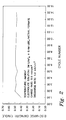
- Figure 2 graphically illustrates the delivered discharge capacity of a rechargeable Li/LixCoO₂ cell versus cycle number.
- The present invention takes advantage of the unusually high energy density of LixCoO₂ cathode material by combining it with an electrolyte solution which can withstand the high operating potentials characteristic of this system, particularly during charging. It should be noted, however, that charging is a concern even for primary cell applications because LixCoO₂ is manufactured in the discharged state and all cells must therefore be charged before use.
- The present invention describes an electrochemical system consisting of a lithium metal anode, a cathode having LixCoO₂ as the active cathode material, and an ester-based electrolyte solution.
- This system offers superior capabilities over existing systems based on LixCoO₂ primarily due to the unique properties of ester-based electrolyte solutions. These solutions offer not only the excellent electrochemical stabilities needed to withstand the high oxidizing potentials present at LixCoO₂ cathodes but also possess high conductivities that can allow Li/LixCoO₂ cells to operate at high rates of discharge and at low temperatures. Hence, by combining LixCoO₂ with the unique and outstanding properties of ester-based electrolyte solutions, an electrochemical system is obtained that offers high energy density, reversibility, and good rate capabilities and which is thus suitable for a wide range of applications.
- To demonstrate the performance of the system of the present invention, tests were conducted with laboratory cells constructed as follows:
- The LixCoO₂ (x=1.0) was a commercial grade of material purchased from Morton Thiokol, Inc., Alfa Products (Catalog No. 13998). Cathodes consisted of 85 weight percent LixCoO₂, 10 weight percent of Vulcan XC-72R, trademark of Cabot Corporation of Boston, Massachusetts, carbon as the conductive diluent, and 5 weight percent of Teflon powder (polytetrafluoro- ethylene) as the binder. The individual components were suspended in mineral spirits solvent and then mixed in a high speed blender. Electrodes were fabricated using a roll milling technique. The resulting cathodes were first air dried and then dried at 200°C under vacuum. Laboratory cells were constructed using a lithium anode and a cathode separated by two or more layers of microporous polyethylene or polypropylene separator material. Each electrode had a geometric surface area of 3,2 cm². The anode consisted of lithium foil pressed onto a nickel expanded metal grid. The cathode employed an aluminum grid as the current collector and the cell assembly was supported between two glass plates. The cell was placed into a sealed vessel containing approximately 2 ml of a 2M LiAsF₆ + 0.4M LiBF₄/methyl formate electrolyte solution. The ends of the separator extended down into the electrolyte solution and thereby wicked the solution up into the cell stack.
- Table I, compares theoretical values of many known cathode materials including that of the present invention. Note that the performance capabilities of the materials of the cell of the present invention show a drastic improvement over those of the prior art.
- Figure 1 depicts experimental results showing the excellent rate capabilities of the proposed system as evidenced by the little loss in delivered capacity or operating voltage that is observed when the discharge rate is increased from 1 mA/cm² to 10 mA/cm².
- Figure 2 illustrates the rechargeable performance of Li/LixCoO₂ cells in limited cycle life tests. The fact that the delivered capacity remains constant as the cell is cycled demonstrates the high reversibility of this cathode material.
| INSERTION CATHODE COMPARISON OVER DEMONSTRATED REVERSIBLE OPERATING RANGE | |||||
| Cathode Material | Cycle DOD F/Mole | Discharge Cutoff Voltage V | Average Open Circuit Voltage, V | Delivered Specific Cathode Capacity, mAh/gm | Energy Density Wh/Kg |
| TiS₂ | 1.0 | 1.7 | 2.15 | 239 | 484 |
| V₂O₅ | 1.0 | 2.5 | 3.22 | 147 | 457 |
| V₆O₁₃ | 4.0 | 1.9 | 2.40 | 209 | 475 |
| Li1.05V₃O₈ | 2.0 | 1.8 | 2.49 | 186 | 442 |
| V₂S₅ | 4.0 | 1.7 | 2.28 | 409 | 843 |
| MoS₂ (amorphous) | 1.0 | 1.5 | 1.89 | 167 | 303 |
| MoS₃ (amorphous) | 3.0 | 1.6 | 1.90 | 418 | 717 |
| LixCo1.01O₂ | 1.0 | 3.9 | 4.24 | 293 | 1154 |
Claims (6)
1. An active metal non-aqueous electrochemical cell comprising a lithium anode, characterized by an organic ester-based organic electrolyte solution and a cathode active material comprising LixCoO₂ where 0< x ≦1.0
2. The cell of claim 1, characterized in that it is a secondary electrochemical cell having an ester-based organic eletrolyte solvent.
3. The cell of claim 1 or 2, characterized in that said ester or electrolyte solvent is selected from methyl formate, methyl acetate and mixtures thereof.
4. The cell of claim 3, characterized in that said ester or electrolyte solvent is methyl acetate.
5. The cell of claim 3 or 4, characterized by an amount of LiAsF₆ electrolyte salt.
6. The cell of claim 3, 4 or 5, characterized in that the electrolyte further comprises an amount of LiBF₄.
Applications Claiming Priority (2)
| Application Number | Priority Date | Filing Date | Title |
|---|---|---|---|
| US07/146,536 US4804596A (en) | 1988-01-21 | 1988-01-21 | Electrode material/electrolyte system for non-aqueous cells |
| US146536 | 1993-11-01 |
Publications (1)
| Publication Number | Publication Date |
|---|---|
| EP0326002A1 true EP0326002A1 (en) | 1989-08-02 |
Family
ID=22517832
Family Applications (1)
| Application Number | Title | Priority Date | Filing Date |
|---|---|---|---|
| EP89100768A Withdrawn EP0326002A1 (en) | 1988-01-21 | 1989-01-18 | Electrode material/electrolyte system for non-aqueous cells |
Country Status (3)
| Country | Link |
|---|---|
| US (1) | US4804596A (en) |
| EP (1) | EP0326002A1 (en) |
| JP (1) | JP2556992B2 (en) |
Cited By (1)
| Publication number | Priority date | Publication date | Assignee | Title |
|---|---|---|---|---|
| EP0482287A1 (en) * | 1990-10-25 | 1992-04-29 | Matsushita Electric Industrial Co., Ltd. | A non-aqueous secondary electrochemical battery |
Families Citing this family (21)
| Publication number | Priority date | Publication date | Assignee | Title |
|---|---|---|---|---|
| JPH0626138B2 (en) * | 1987-11-20 | 1994-04-06 | 昭和電工株式会社 | Secondary battery |
| DE3826812A1 (en) * | 1988-08-06 | 1990-02-08 | Heitbaum Joachim | NONWATER, RECHARGEABLE GALVANIC LITHIUM ELEMENT WITH INORGANIC ELECTROLYTE SOLUTION |
| JP2797390B2 (en) * | 1989-04-03 | 1998-09-17 | ソニー株式会社 | Non-aqueous electrolyte secondary battery |
| GB2242898B (en) * | 1990-04-12 | 1993-12-01 | Technology Finance Corp | Lithium transition metal oxide |
| US4983476A (en) * | 1990-06-18 | 1991-01-08 | The United States Of America As Represented By The Secretary Of The Army | Rechargeable lithium battery system |
| US5147739A (en) * | 1990-08-01 | 1992-09-15 | Honeywell Inc. | High energy electrochemical cell having composite solid-state anode |
| US5284721A (en) * | 1990-08-01 | 1994-02-08 | Alliant Techsystems Inc. | High energy electrochemical cell employing solid-state anode |
| US5219683A (en) * | 1990-08-02 | 1993-06-15 | Eveready Battery Company, Inc. | Diol diesters and alkoxyalkylesters as solvents for nonaqueous battery electrolytes |
| US5521027A (en) * | 1990-10-25 | 1996-05-28 | Matsushita Electric Industrial Co., Ltd. | Non-aqueous secondary electrochemical battery |
| JP3160920B2 (en) † | 1991-02-05 | 2001-04-25 | ソニー株式会社 | Non-aqueous electrolyte secondary battery |
| JP3077218B2 (en) * | 1991-03-13 | 2000-08-14 | ソニー株式会社 | Non-aqueous electrolyte secondary battery |
| US5206099A (en) * | 1991-09-05 | 1993-04-27 | Alliant Techsystems Inc. | Highly resistive cell separator for bi-polar battery |
| US5256504A (en) * | 1991-09-13 | 1993-10-26 | Matsushita Electric Industrial Co., Ltd. | Monaqueous electrolyte secondary batteries |
| US5474862A (en) * | 1991-09-13 | 1995-12-12 | Matsushita Electric Industrial Co., Ltd. | Nonaqueous electrolyte secondary batteries |
| US5484669A (en) * | 1991-12-27 | 1996-01-16 | Matsushita Electric Industrial Co., Ltd. | Nonaqueous electrolyte secondary batteries |
| US5154990A (en) * | 1992-01-21 | 1992-10-13 | The United States Of America As Represented By The Secretary Of The Army | Rechargeable solid lithium ion electrochemical system |
| CA2130807A1 (en) * | 1992-12-25 | 1994-06-26 | Jun Tsukamoto | Electrode and secondary battery using the same |
| US5240790A (en) * | 1993-03-10 | 1993-08-31 | Alliant Techsystems Inc. | Lithium-based polymer electrolyte electrochemical cell |
| US5667660A (en) * | 1995-09-12 | 1997-09-16 | Alliant Techsystems Inc. | Synthesis of charged Lix CoO2 (0<×<1) for primary and secondary batteries |
| US6306546B1 (en) | 1998-10-30 | 2001-10-23 | Rohm And Haas Company | Electrolyte cosolvents including acrylate and methacrylate oligomers |
| KR100553736B1 (en) * | 1999-09-02 | 2006-02-20 | 삼성에스디아이 주식회사 | Active Material Composition for Lithium Secondary Battery |
Citations (4)
| Publication number | Priority date | Publication date | Assignee | Title |
|---|---|---|---|---|
| US28169A (en) * | 1860-05-08 | Improvement in plows | ||
| EP0143966A2 (en) * | 1983-11-30 | 1985-06-12 | AlliedSignal Inc. | Battery having polymeric anode coated with reaction product of oxirane compound |
| EP0243926A1 (en) * | 1986-04-30 | 1987-11-04 | Sony Corporation | Organic electrolyte cell |
| US4751160A (en) * | 1987-07-06 | 1988-06-14 | The United States Of America As Represented By The Secretary Of The Army | Organic electrolyte for use in a lithium rechargeable electrochemical cell and lithium rechargeable electrochemical cell including said organic electrolyte |
Family Cites Families (5)
| Publication number | Priority date | Publication date | Assignee | Title |
|---|---|---|---|---|
| US4497726A (en) * | 1983-05-31 | 1985-02-05 | Combustion Engineering, Inc. | Electrode material |
| US4463071A (en) * | 1983-11-30 | 1984-07-31 | Allied Corporation | Secondary batteries using room-temperature molten non-aqueous electrolytes containing 1,2,3-trialkylimidazolium halides or 1,3-dialkylimidazolium halide |
| JPS6164081A (en) * | 1984-09-05 | 1986-04-02 | Sanyo Electric Co Ltd | non-aqueous electrolyte battery |
| JPH0785413B2 (en) * | 1986-04-30 | 1995-09-13 | ソニー株式会社 | Organic electrolyte primary battery |
| JPH0763010B2 (en) * | 1986-05-12 | 1995-07-05 | ソニー株式会社 | Organic electrolyte battery |
-
1988
- 1988-01-21 US US07/146,536 patent/US4804596A/en not_active Expired - Lifetime
-
1989
- 1989-01-18 EP EP89100768A patent/EP0326002A1/en not_active Withdrawn
- 1989-01-21 JP JP1013029A patent/JP2556992B2/en not_active Expired - Lifetime
Patent Citations (4)
| Publication number | Priority date | Publication date | Assignee | Title |
|---|---|---|---|---|
| US28169A (en) * | 1860-05-08 | Improvement in plows | ||
| EP0143966A2 (en) * | 1983-11-30 | 1985-06-12 | AlliedSignal Inc. | Battery having polymeric anode coated with reaction product of oxirane compound |
| EP0243926A1 (en) * | 1986-04-30 | 1987-11-04 | Sony Corporation | Organic electrolyte cell |
| US4751160A (en) * | 1987-07-06 | 1988-06-14 | The United States Of America As Represented By The Secretary Of The Army | Organic electrolyte for use in a lithium rechargeable electrochemical cell and lithium rechargeable electrochemical cell including said organic electrolyte |
Non-Patent Citations (2)
| Title |
|---|
| CHEMICAL ABSTRACTS, vol. 107, no. 26, December 1987, page 180, abstract no. 239773u, Columbus, Ohio, US; & US-A-28 169 (UNITED STATES DEPT. OF THE ARMY) 15-07-1987 * |
| JOURNAL OF POWER SOURCES, vol. 21, no. 1, August 1987, pages 26-31, Lausanne, CH; E. PLICHTA et al.: "A rechargeable Li/LixCO02 cell" * |
Cited By (1)
| Publication number | Priority date | Publication date | Assignee | Title |
|---|---|---|---|---|
| EP0482287A1 (en) * | 1990-10-25 | 1992-04-29 | Matsushita Electric Industrial Co., Ltd. | A non-aqueous secondary electrochemical battery |
Also Published As
| Publication number | Publication date |
|---|---|
| JP2556992B2 (en) | 1996-11-27 |
| JPH01309261A (en) | 1989-12-13 |
| US4804596A (en) | 1989-02-14 |
Similar Documents
| Publication | Publication Date | Title |
|---|---|---|
| US4804596A (en) | Electrode material/electrolyte system for non-aqueous cells | |
| US5498489A (en) | Rechargeable non-aqueous lithium battery having stacked electrochemical cells | |
| US6203947B1 (en) | Long cycle-life alkali metal battery | |
| EP0827231B1 (en) | Non-aqueous electrolyte lithium secondary battery | |
| EP0478379B1 (en) | A nonaqueous electrolyte secondary battery | |
| US5284721A (en) | High energy electrochemical cell employing solid-state anode | |
| US6890686B1 (en) | Lithium-containing phosphate active materials | |
| KR20020020698A (en) | Non-aqueous electrolyte secondary cell and device using the same | |
| JPH05290843A (en) | Lithium secondary battery | |
| JP2000067914A (en) | Non-aqueous organic electrolyte for low temperature discharge of rechargeable electrochemical cells | |
| EP1113515B1 (en) | Non-aqueous electrolytic secondary cell | |
| US6342320B2 (en) | Electrochemically stable plasticizer | |
| US4786499A (en) | Lithium electrochemical cell including aprotic solvent-dialkyl carbonate solvent mixture | |
| US4751158A (en) | Amorphous cathode material for use in lithium electrochemical cell and lithium electrochemical cell including the amorphous cathode material | |
| JP3244389B2 (en) | Lithium secondary battery | |
| JP3564756B2 (en) | Non-aqueous electrolyte secondary battery | |
| US6472100B1 (en) | Nonaqueous-electrolyte battery | |
| KR20020043596A (en) | Lactone solvents for electrochemical cells | |
| US4818647A (en) | Method of making a cathode for use in a rechargeable lithium battery, cathode so made, and rechargeable lithium battery including the cathode | |
| USH1076H (en) | Lithium ion rechargeable intercallation cell | |
| US6395425B1 (en) | Non-aqueous electrolyte secondary battery with a lithium copper titanium oxide electrode | |
| GB2038537A (en) | Lithium-lead sulphate primary electrochemical cell | |
| GB2298309A (en) | Fan-folded lithium battery construction comprising lithium ion-containing polymer electrolyte sandwiched between discrete electrode plates | |
| JP3076887B2 (en) | Non-aqueous electrolyte secondary battery and method of manufacturing the same | |
| JP3158412B2 (en) | Lithium secondary battery |
Legal Events
| Date | Code | Title | Description |
|---|---|---|---|
| PUAI | Public reference made under article 153(3) epc to a published international application that has entered the european phase |
Free format text: ORIGINAL CODE: 0009012 |
|
| AK | Designated contracting states |
Kind code of ref document: A1 Designated state(s): CH DE FR GB IT LI NL |
|
| 18D | Application deemed to be withdrawn |
Effective date: 19900203 |