EP0325614B1 - Verfahren zum auslangen fester körniger substanzen - Google Patents
Verfahren zum auslangen fester körniger substanzen Download PDFInfo
- Publication number
- EP0325614B1 EP0325614B1 EP87907050A EP87907050A EP0325614B1 EP 0325614 B1 EP0325614 B1 EP 0325614B1 EP 87907050 A EP87907050 A EP 87907050A EP 87907050 A EP87907050 A EP 87907050A EP 0325614 B1 EP0325614 B1 EP 0325614B1
- Authority
- EP
- European Patent Office
- Prior art keywords
- particles
- stage
- solid material
- particulate solid
- bone
- Prior art date
- Legal status (The legal status is an assumption and is not a legal conclusion. Google has not performed a legal analysis and makes no representation as to the accuracy of the status listed.)
- Expired
Links
- 238000000034 method Methods 0.000 title claims abstract description 110
- 230000008569 process Effects 0.000 title claims abstract description 106
- 238000002386 leaching Methods 0.000 title claims abstract description 43
- 239000011343 solid material Substances 0.000 title claims abstract description 39
- 239000002245 particle Substances 0.000 claims abstract description 183
- 210000000988 bone and bone Anatomy 0.000 claims abstract description 82
- 238000000605 extraction Methods 0.000 claims abstract description 59
- 239000002904 solvent Substances 0.000 claims abstract description 43
- 239000007788 liquid Substances 0.000 claims abstract description 37
- 239000002253 acid Substances 0.000 claims abstract description 29
- 239000000463 material Substances 0.000 claims abstract description 14
- 238000005192 partition Methods 0.000 claims abstract description 11
- 229910052500 inorganic mineral Inorganic materials 0.000 claims abstract description 10
- 239000011707 mineral Substances 0.000 claims abstract description 10
- 230000000694 effects Effects 0.000 claims abstract description 7
- 238000005204 segregation Methods 0.000 claims abstract description 7
- 238000013019 agitation Methods 0.000 claims description 25
- VEXZGXHMUGYJMC-UHFFFAOYSA-N Hydrochloric acid Chemical compound Cl VEXZGXHMUGYJMC-UHFFFAOYSA-N 0.000 claims description 24
- 239000002002 slurry Substances 0.000 claims description 17
- 230000007423 decrease Effects 0.000 claims description 2
- 230000000063 preceeding effect Effects 0.000 claims description 2
- 108010010803 Gelatin Proteins 0.000 abstract description 17
- 229920000159 gelatin Polymers 0.000 abstract description 17
- 239000008273 gelatin Substances 0.000 abstract description 17
- 235000019322 gelatine Nutrition 0.000 abstract description 17
- 235000011852 gelatine desserts Nutrition 0.000 abstract description 17
- 238000004519 manufacturing process Methods 0.000 abstract description 7
- 238000011084 recovery Methods 0.000 abstract description 2
- 239000007787 solid Substances 0.000 description 24
- 238000005115 demineralization Methods 0.000 description 16
- 230000002328 demineralizing effect Effects 0.000 description 16
- 238000013461 design Methods 0.000 description 10
- 238000000926 separation method Methods 0.000 description 10
- 238000006243 chemical reaction Methods 0.000 description 9
- 239000004519 grease Substances 0.000 description 7
- 239000000725 suspension Substances 0.000 description 6
- 230000009286 beneficial effect Effects 0.000 description 5
- 238000009826 distribution Methods 0.000 description 5
- 239000000047 product Substances 0.000 description 5
- 230000009471 action Effects 0.000 description 4
- 230000008901 benefit Effects 0.000 description 4
- 239000000356 contaminant Substances 0.000 description 4
- 239000000203 mixture Substances 0.000 description 4
- 150000003839 salts Chemical class 0.000 description 4
- 239000007858 starting material Substances 0.000 description 4
- 241000283690 Bos taurus Species 0.000 description 3
- YMWUJEATGCHHMB-UHFFFAOYSA-N Dichloromethane Chemical compound ClCCl YMWUJEATGCHHMB-UHFFFAOYSA-N 0.000 description 3
- 230000015556 catabolic process Effects 0.000 description 3
- 238000006731 degradation reaction Methods 0.000 description 3
- 230000001419 dependent effect Effects 0.000 description 3
- 238000009792 diffusion process Methods 0.000 description 3
- 239000012530 fluid Substances 0.000 description 3
- 235000013305 food Nutrition 0.000 description 3
- VLKZOEOYAKHREP-UHFFFAOYSA-N n-Hexane Chemical compound CCCCCC VLKZOEOYAKHREP-UHFFFAOYSA-N 0.000 description 3
- 239000011236 particulate material Substances 0.000 description 3
- 238000012545 processing Methods 0.000 description 3
- 239000000126 substance Substances 0.000 description 3
- 238000012546 transfer Methods 0.000 description 3
- 238000005406 washing Methods 0.000 description 3
- XLYOFNOQVPJJNP-UHFFFAOYSA-N water Substances O XLYOFNOQVPJJNP-UHFFFAOYSA-N 0.000 description 3
- VTYYLEPIZMXCLO-UHFFFAOYSA-L Calcium carbonate Chemical compound [Ca+2].[O-]C([O-])=O VTYYLEPIZMXCLO-UHFFFAOYSA-L 0.000 description 2
- CURLTUGMZLYLDI-UHFFFAOYSA-N Carbon dioxide Chemical compound O=C=O CURLTUGMZLYLDI-UHFFFAOYSA-N 0.000 description 2
- RYYVLZVUVIJVGH-UHFFFAOYSA-N caffeine Chemical compound CN1C(=O)N(C)C(=O)C2=C1N=CN2C RYYVLZVUVIJVGH-UHFFFAOYSA-N 0.000 description 2
- 230000008859 change Effects 0.000 description 2
- 238000003889 chemical engineering Methods 0.000 description 2
- 235000012343 cottonseed oil Nutrition 0.000 description 2
- 239000000284 extract Substances 0.000 description 2
- 239000000376 reactant Substances 0.000 description 2
- 241000219310 Beta vulgaris subsp. vulgaris Species 0.000 description 1
- DGAQECJNVWCQMB-PUAWFVPOSA-M Ilexoside XXIX Chemical compound C[C@@H]1CC[C@@]2(CC[C@@]3(C(=CC[C@H]4[C@]3(CC[C@@H]5[C@@]4(CC[C@@H](C5(C)C)OS(=O)(=O)[O-])C)C)[C@@H]2[C@]1(C)O)C)C(=O)O[C@H]6[C@@H]([C@H]([C@@H]([C@H](O6)CO)O)O)O.[Na+] DGAQECJNVWCQMB-PUAWFVPOSA-M 0.000 description 1
- LPHGQDQBBGAPDZ-UHFFFAOYSA-N Isocaffeine Natural products CN1C(=O)N(C)C(=O)C2=C1N(C)C=N2 LPHGQDQBBGAPDZ-UHFFFAOYSA-N 0.000 description 1
- FYYHWMGAXLPEAU-UHFFFAOYSA-N Magnesium Chemical compound [Mg] FYYHWMGAXLPEAU-UHFFFAOYSA-N 0.000 description 1
- ZLMJMSJWJFRBEC-UHFFFAOYSA-N Potassium Chemical compound [K] ZLMJMSJWJFRBEC-UHFFFAOYSA-N 0.000 description 1
- 241000533293 Sesbania emerus Species 0.000 description 1
- 229930006000 Sucrose Natural products 0.000 description 1
- CZMRCDWAGMRECN-UGDNZRGBSA-N Sucrose Chemical compound O[C@H]1[C@H](O)[C@@H](CO)O[C@@]1(CO)O[C@@H]1[C@H](O)[C@@H](O)[C@H](O)[C@@H](CO)O1 CZMRCDWAGMRECN-UGDNZRGBSA-N 0.000 description 1
- 235000021536 Sugar beet Nutrition 0.000 description 1
- 238000005903 acid hydrolysis reaction Methods 0.000 description 1
- 238000010420 art technique Methods 0.000 description 1
- 210000004369 blood Anatomy 0.000 description 1
- 239000008280 blood Substances 0.000 description 1
- 210000001185 bone marrow Anatomy 0.000 description 1
- 229960001948 caffeine Drugs 0.000 description 1
- VJEONQKOZGKCAK-UHFFFAOYSA-N caffeine Natural products CN1C(=O)N(C)C(=O)C2=C1C=CN2C VJEONQKOZGKCAK-UHFFFAOYSA-N 0.000 description 1
- 229910000019 calcium carbonate Inorganic materials 0.000 description 1
- 229940043430 calcium compound Drugs 0.000 description 1
- 239000001506 calcium phosphate Substances 0.000 description 1
- 229910000389 calcium phosphate Inorganic materials 0.000 description 1
- 235000011010 calcium phosphates Nutrition 0.000 description 1
- 239000001569 carbon dioxide Substances 0.000 description 1
- 229910002092 carbon dioxide Inorganic materials 0.000 description 1
- 238000004140 cleaning Methods 0.000 description 1
- 238000010960 commercial process Methods 0.000 description 1
- 238000005056 compaction Methods 0.000 description 1
- 150000001875 compounds Chemical class 0.000 description 1
- 239000012141 concentrate Substances 0.000 description 1
- 239000002385 cottonseed oil Substances 0.000 description 1
- 239000013078 crystal Substances 0.000 description 1
- 235000014113 dietary fatty acids Nutrition 0.000 description 1
- 239000003925 fat Substances 0.000 description 1
- 239000000194 fatty acid Substances 0.000 description 1
- 229930195729 fatty acid Natural products 0.000 description 1
- 150000004665 fatty acids Chemical class 0.000 description 1
- 238000011010 flushing procedure Methods 0.000 description 1
- 230000007062 hydrolysis Effects 0.000 description 1
- 238000006460 hydrolysis reaction Methods 0.000 description 1
- 238000007654 immersion Methods 0.000 description 1
- 239000011777 magnesium Substances 0.000 description 1
- 229910052749 magnesium Inorganic materials 0.000 description 1
- 238000012423 maintenance Methods 0.000 description 1
- 239000012452 mother liquor Substances 0.000 description 1
- 238000005325 percolation Methods 0.000 description 1
- 239000011591 potassium Substances 0.000 description 1
- 229910052700 potassium Inorganic materials 0.000 description 1
- 239000012716 precipitator Substances 0.000 description 1
- 239000002994 raw material Substances 0.000 description 1
- 230000000630 rising effect Effects 0.000 description 1
- 238000012216 screening Methods 0.000 description 1
- 238000004088 simulation Methods 0.000 description 1
- 239000011734 sodium Substances 0.000 description 1
- 229910052708 sodium Inorganic materials 0.000 description 1
- 239000012265 solid product Substances 0.000 description 1
- 238000000956 solid--liquid extraction Methods 0.000 description 1
- 241000894007 species Species 0.000 description 1
- 239000005720 sucrose Substances 0.000 description 1
- 239000013589 supplement Substances 0.000 description 1
- QORWJWZARLRLPR-UHFFFAOYSA-H tricalcium bis(phosphate) Chemical compound [Ca+2].[Ca+2].[Ca+2].[O-]P([O-])([O-])=O.[O-]P([O-])([O-])=O QORWJWZARLRLPR-UHFFFAOYSA-H 0.000 description 1
Images



Classifications
-
- A—HUMAN NECESSITIES
- A23—FOODS OR FOODSTUFFS; TREATMENT THEREOF, NOT COVERED BY OTHER CLASSES
- A23J—PROTEIN COMPOSITIONS FOR FOODSTUFFS; WORKING-UP PROTEINS FOR FOODSTUFFS; PHOSPHATIDE COMPOSITIONS FOR FOODSTUFFS
- A23J1/00—Obtaining protein compositions for foodstuffs; Bulk opening of eggs and separation of yolks from whites
- A23J1/10—Obtaining protein compositions for foodstuffs; Bulk opening of eggs and separation of yolks from whites from hair, feathers, horn, skins, leather, bones, or the like
-
- B—PERFORMING OPERATIONS; TRANSPORTING
- B01—PHYSICAL OR CHEMICAL PROCESSES OR APPARATUS IN GENERAL
- B01D—SEPARATION
- B01D11/00—Solvent extraction
- B01D11/02—Solvent extraction of solids
-
- Y—GENERAL TAGGING OF NEW TECHNOLOGICAL DEVELOPMENTS; GENERAL TAGGING OF CROSS-SECTIONAL TECHNOLOGIES SPANNING OVER SEVERAL SECTIONS OF THE IPC; TECHNICAL SUBJECTS COVERED BY FORMER USPC CROSS-REFERENCE ART COLLECTIONS [XRACs] AND DIGESTS
- Y10—TECHNICAL SUBJECTS COVERED BY FORMER USPC
- Y10S—TECHNICAL SUBJECTS COVERED BY FORMER USPC CROSS-REFERENCE ART COLLECTIONS [XRACs] AND DIGESTS
- Y10S530/00—Chemistry: natural resins or derivatives; peptides or proteins; lignins or reaction products thereof
- Y10S530/827—Proteins from mammals or birds
- Y10S530/84—Bones; tendons; teeth; cartilage
Definitions
- This invention relates in general to extraction processes and in particular to liquid/solid extraction processes typically referred to as leaching processes. More specifically, this invention relates to a novel high-efficiency leaching process applicable to the leaching of a wide variety of particulate solid materials comprised of extractable and non-extractable portions.
- liquid/solid extraction also known as leaching
- leaching involves the transfer of a solute from a solid, generally employed in particulate form, to a liquid solvent which is termed the "extract".
- the solid imbibes the solvent which dissolves the solute and thereby extracts it from the solid.
- the process is very widely used, especially in the food industry where it is employed in such diverse tasks as the leaching of cottonseed oil from cottonseed using hexane as the solvent, the leaching of caffeine from coffee beans using methylene chloride as the solvent, the leaching of sucrose from sugar beets using water as the solvent, and the leaching of minerals from bone, using hydrochloric acid as the solvent.
- the solvent also serves as a chemical reactant.
- the hydrochloric acid reacts with the minerals present in bone to convert them to soluble salts and, accordingly, the leaching process in this instance is actually an extraction/reaction process.
- Leaching is a very old process and a great diversity of apparatus has been developed over the years to meet the varying requirements of the process in respect to its widely diverse applications.
- Leaching processes have been proposed which operate in a batch, semi-batch or continuous mode, and both single-stage and multi-stage contacting techniques are used.
- Leaching equipment is commercially available for a wide variety of processes, including fixed-bed processes in which solvent is percolated through a stationary bed of solids, moving-bed processes in which the solids are conveyed through the solvent with little or no agitation, and dispersed-solid processes in which the solids are dispersed in the solvent by mechanical agitation.
- Cattle bone is one of the important raw materials for the manufacture of photographic gelatin, as well as several grades of food gelatin.
- the bone is ground, classified by size, cleaned of fats, grease, blood and bone marrow by hot water washing, and then demineralized in a liquid/solid extraction/reaction process, using dilute acid solution, usually hydrochloric acid, as the solvent/reactant.
- dilute acid solution usually hydrochloric acid
- Removal of the minerals from the bone particles in the demineralization process yields particles of a material known as ossein, similar in size and shape to the original bone particles, which are further processed by means of various well-known steps, typically including a liming step, to produce gelatin.
- the demineralization is accomplished in large vats filled with the granulated bone to a depth of as much as two meters or more, and flooded with the acid solution so as to completely immerse the bone.
- the reaction proceeds throughout the settled bed of bone particles until the original acid charge is exhausted. Meanwhile, fresh acid is added at the top of the bed, the liquor containing dissolved acid salts is withdrawn at the bottom of the bed, and carbon dioxide evolves from the top of the bed.
- the acid liquors are drained.
- the bed now composed of particles of ossein, is water washed to remove residual liquor and evacuated as an aqueous slurry.
- the granulated cattle bone which serves as the starting material in the gelatin manufacturing process comprises particles of varying size _ typically ranging from about 2 to about 30 millimeters in diameter _ and of widely varying density _ ranging from particles which are hard, non-porous and of high density to particles which are soft, porous and of low density.
- the problem of treating these heterogeneous particles in a manner which even approximates an optimum for each is clearly a formidably difficult one.
- the demineralization is essentially a diffusion-controlled process (see P. J. Makarewicz, L. Harasta and S. L. Webb, "Kinetics of Acid Diffusion and Demineralization of Bone", The Journal of Photographic Science, Vol.
- the actual time at which an individual particle of bone is completely acidulated depends on its size, its density, and its location in the bed.
- the bone particles are usually classified before treatment, there are still significant differences in particle diameters within a bone batch. Bone at the top of the bed is completely acidulated first, because it is closer to the fresh acid feed; whereas fresh acid cannot reach the bottom of the bed until the bulk of the bone through which it must percolate is completely acidulated. Dense bone contains more mineral and offers more resistance to acid diffusion within a particle. Therefore, dense bone can be expected to acidulate much more slowly than light bone.
- Ossein exposed to fresh acid is vulnerable to significant degradation by excessive acid hydrolysis. Demineralized particles which, for whatever reason, suffer longer exposure, especially at higher temperature, can expect to be found to have been hydrolyzed more completely.
- This ossein is more soluble and subject to loss or degradation to undesirably low molecular weight gelatin.
- the settled bed process now in use for acidulation of bone produces ossein which is not uniform with respect to degree of demineralization or degree of hydrolysis.
- the acidulation time necessary to completely acidulate a large bed is excessive for many of the particles therein.
- Non-uniformity in the acidulation step potentially results in loss of yield and variability in the molecular weight and quality of the gelatin produced.
- the present invention is a novel leaching process which is useful for leaching a particulate solid material that comprises extractable and non-extractable portions.
- the process includes the steps of introducing the particulate solid material and a liquid solvent to an extraction zone; agitating the liquid solvent to a degree sufficient to suspend the particulate solid material and effect segregation of particles thereof in relation to their propensity to settle; maintaining contact between the liquid solvent and the particulate solid material for a time sufficient to leach extractable material therefrom; and selectively withdrawing particles from the extraction zone.
- the leaching process is a multi-stage process employing a series of stages in which the selectively withdrawn particles from each stage are introduced to the next successive stage of the series.
- the key to successful operation of the process of this invention is to maintain the particles in a state of suspension in the liquid solvent under conditions where they are able to segregate in relation to their propensity to settle. This is readily achieved by appropriate control of the level of agitation. Such segregation makes it an easy matter to then withdraw the particles on a selective basis.
- Application of this principle to the field of liquid/solid extraction is believed to be broadly novel, and provides important benefits in this art not easily achievable by any other means. For example, the need for mechanical devices which convey solid particles from stage to stage, as is typical in the prior art, and the resulting mechanical complexity and need for costly and time-consuming maintenance work, is entirely avoided. Moreover, since the solid particles are suspended in the liquid solvent, they are acted on in a uniform manner by a solution of substantially the same composition at all points within an extraction stage.
- the extraction process brings about a change in buoyancy of the particles.
- the particles become more buoyant as the degree of extraction increases, whereas when the extractable portion is less dense than the non-extractable portion, they become less buoyant. In either instance, this change in buoyancy contributes to the segregation of the particles and the ability to effect the desired selective separation.
- the leaching process is applied to the leaching of minerals from bone particles so as to convert such particles to ossein in the first major step of the well-known process for producing gelatin from bone.
- the invention is a novel leaching process which can be applied to the leaching of any of a very wide variety of solid particulate materials, and provides particular benefit where the solid particulate material is of a highly heterogeneous character, such as particles of widely varying size, shape and density.
- the invention is described hereinafter with particular reference to the demineralization of bone to facilitate ease of description, but it should be understood that this is only one of many industrial processes in which the invention can be beneficially applied.
- the propensity of solid particles to settle in a liquid medium and the effect of agitation of the medium on such settling are the fundamental aspects of particle behaviour of concern in this invention.
- This propensity which can be characterized by reference to terminal settling velocity, is a function of particle size, aspect ratio or shape, and density. Particles of granulated bone typically exhibit the classical bell-shaped distribution curve of terminal settling velocities and it is by making use of this characteristic that the present invention achieves its success.
- the process of this invention can be carried out in a wide variety of different ways, depending on the specific requirements of the particular system to which it is applied.
- the process can be operated on a batch, semi-continuous or continuous basis, as desired.
- the process is operable with only a single stage, but usually the requirements of commercial operation will dictate that a multi-stage process be used.
- the flow can be co-current or countercurrent, but under most circumstances, countercurrent flow will be preferable.
- the equipment used can comprise a series of individual stirred vessels which function as extraction stages, or a vertical column which provides a series of compartments, each of which serves as an extraction stage.
- each extraction zone agitation is provided and the degree of agitation employed is preferably sufficient to suspend all, or substantially all, of the particles. This is a very important aspect of the process. If there is too little agitation, the particles will settle to the bottom of the extraction zone, and no separation on the basis of propensity to settle will be possible. On the other hand, if there is too much agitation, the particles will all circulate about the extraction zone, regardless of their individual propensity to settle, and again, no separation on the basis of propensity to settle will be possible.
- baffles or obstructions are placed within the extraction stages to create zones which differ with respect to the velocity of fluid flow therein. Under such conditions, unsegregated particles moving between zones characterized by different fluid velocities will tend to segregate upon entering a zone of appropriate velocity.
- the agitation needed to suspend the particles in the liquid solvent can be provided by any suitable means.
- the agitation can be provided by a mechanical agitator such as a flat or axial turbine, a marine style propeller, or a closed pump impeller.
- Mechanical agitation would typically be used for any large scale commercial process.
- any form of agitation can be used which induces a consistent liquid flow which will dependably buoy particles according to their size and density.
- the level of agitation is not narrowly critical and, under ordinary circumstances, there is a considerable range over which successful operation can be achieved.
- the agitation can be provided by sparging with air or other gaseous medium and agitation by use of a gaseous medium will be beneficial for processes in which the gas promotes required chemical reaction or propensity for separation.
- Agitation by means of a gaseous medium can be used alone or in conjunction with and as a supplement to mechanical agitation.
- the particle density typically ranges from about 1.0 gm/cc to about 2.1 gm/cc with an average of about 1.7 gm/cc.
- the density distribution varies somewhat with the origin of the bone.
- the acid solution typically has a density of between about 1.04 and about 1.08 gm/cc depending on the concentration of extracted minerals present therein.
- the mineral species which are extracted are calcium phosphate, calcium carbonate and compounds of sodium, potassium and magnesium.
- the bone particles which serve as starting material for the process typically range from about 2 to about 30 millimeters in diameter.
- Granulated bone is a material that is highly heterogeneous in character.
- the particle shape can vary from almost spherical, to plate-like, to sliver-like.
- the density, hardness, and porosity can all vary substantially. Accordingly, the process of this invention is especially beneficial when applied to the demineralization of granulated bone, because of its ability to provide uniformity of treatment in spite of the heterogeneity of the starting material.
- the longest dimension of the particle is defined as the length, the middle dimension as the width, and the shortest dimension as the depth.
- Aspect ratios between the length, width and depth dimensions can be calculated, and particle shapes characterized by reference to aspect ratio. If all the dimensions are similar, then the particle can be described as a "spheroid" (this term being used to include spheres, prolate spheroids and oblate spheroids). If the depth and width dimension are the same and much less than the length dimension, then the particle can be described as a "cylindroid".
- the particle can be described as a "slab" and, if these ratios are even smaller, as a "flake".
- the term spheroid could be employed where the ratio of width: depth: length equals 1: 1: 1 to 1: 0.7: 0.7; the term cylindroid where the ratio depth: width equals 1: 1 to 1: 0.7 and the ratio width: length is less than 0.7; the term slab where the ratio depth: width equals 1: 0.7 to 1: 0.3; and the term flake where the ratio depth: width is less than 0.3.
- Demineralization of bone is an example of a process in which the extractable portion of the solid material is more dense than the non-extractable portion.
- the greater the degree to which extraction takes place the more buoyant the particle becomes, since the ratio of the particle's exterior surface area to mass increases as the extractable material is removed. In other words, extraction decreases the propensity of the particle to settle.
- the agitators are designed to promote suspension of all, or nearly all, of the particles in the extraction zone, but are restrained either in speed or size, or by the presence of baffles or obstructions, from the capability of suspending all particles uniformly throughout the extraction zone without regard to individual propensity to settle. Therefore, particles with less propensity to settle will have a tendency to drift into and occupy certain portions of the extraction zone, whereas particles having a greater propensity to settle will drift short of these areas.
- the particles with the least propensity to settle would, for example, be most capable of being suspended in an upper region of the extraction zone or a region where the upward velocity of the liquid solvent is lowest. Conversely, the particles with the greatest propensity to settle would be relatively incapable of remaining suspended in that region.
- a slurry withdrawn from such a region would contain a higher concentration of particles of a low propensity to settle than the concentration of such particles averaged over the entire extraction zone. From this it also follows that by withdrawing slurry from such a region one can selectively remove particles of a low propensity to settle while leaving behind particles with a high propensity to settle. The particles remaining in the extraction zone would continue to lose dense material as a result of the extraction. Eventually, all particles fed into the extraction zone would reach the withdrawal point.
- particles which inherently have less propensity to settle, or are caused to have less propensity to settle by the extracting action of the solvent would have a tendency to be withdrawn more quickly and thereby occupy the extraction zone for a shorter time than particles which inherently have a greater tendency to settle, or that tend to resist the action of the solvent.
- dense bone will tend to remain longer in the extraction zone, and be subjected to a more protracted acidulation before it is withdrawn.
- Less dense and/or porous bone, which has a tendency to demineralize more quickly, will have a congruent tendency to pass more quickly through the process and thereby avoid an excessively protracted acidulation.
- the propensity of particles to settle in an agitated liquid medium is a function of size, aspect ratio or shape, and density.
- a plate-shaped object will settle more slowly, perhaps in an erratic fashion, than a spheroid of the same weight and bulk density.
- a plate-shaped bone particle will react more quickly with hydrochloric acid than a spherical bone particle of the same weight and density. Therefore, the lower settling velocity of the plate-shaped object is an asset, in the context of this invention, because it allows the process to convey more rapidly the very particle which will react more rapidly.
- the extractable portion of the bone particle is more dense than the non-extractable portion.
- buoyancy increases as extraction proceeds, and the process operates by withdrawing the relatively more buoyant particles in each stage.
- these relatively more buoyant particles will be withdrawn from a region near the upper part of the stage, as that is where they will tend to collect.
- they can be withdrawn from any point within the stage where they tend to concentrate, and such point will depend upon the design of the specific apparatus used in conducting the process.
- segregation and separation of particles can be effected not on the basis of lighter particles rising, but on the basis of heavier particles falling, and the selective withdrawal can then be near the bottom of each stage rather than near the top. This technique would be especially applicable where the extractable portion of the solid particle is less dense than the non-extractable portion.
- the relative densities of the solid material to be leached and the liquid solvent are not critical in the present invention.
- the solid material In leaching processes, the solid material typically has a much higher density than the liquid solvent, and such substantial density difference facilitates the effective operation of the process of this invention.
- solvent is used herein to refer to any medium which functions to extract material from the particulate solid whether the action of the solvent is physical or both chemical and physical in nature.
- the residence time that the particles spend in a particular extraction stage is dependent upon various factors such as throughput rate, volume of the stage, and the design of the equipment. It is a matter of design choice, and can be varied widely. It is only necessary to maintain contact between the liquid solvent and the particulate solid material for a time sufficient to leach extractable material from the solid. The total time required to complete the demineralization is dependent on numerous factors including the size and density of the bone particle, the acid concentration, and the temperature at which the process is carried out.
- any means by which particles can be selectively withdrawn from the process is intended to be within the scope of the present invention.
- selective withdrawal is meant withdrawal in accordance with some predetermined characteristic, for example, withdrawal from an extraction stage of particles which are more buoyant than the average for that stage or less buoyant than the average for that stage.
- a single stage process i.e., a single compartment
- a single stage process may, in many instances, not be selective enough to achieve the desired degree of process uniformity.
- fluid velocity regimes are often unstable and may periodically disrupt _ resulting in temporary dislocation of particle populations, e.g., less buoyant particles may temporarily surge to the top of a vessel.
- Partially processed particles from the first stage are fed to the second.
- the second stage is similar to the first in that it also consists of an agitated compartment with means to selectively remove certain particles in preference to others, for example to selectively remove more buoyant particles in preference to less buoyant.
- the second stage may differ in size, degree and type of agitation, and exact location and design of means for selective withdrawal. For example, as the particles are generally less dense than those in the first stage, a less vigorous agitation may be required to produce the non-uniform suspension needed to provide regions with preferential buoyant particle concentration.
- Third and subsequent stages may be similarly provided.
- a preferred embodiment of the invention employs a counterflow of acid liquor, that is, acid liquor leaving the process is withdrawn principally from the first stage compartment whereas processed solid particles leaving the process as ossein are withdrawn from the last stage.
- Fresh acid or other liquid solvent can be added to any stage.
- Counterflow is achieved by separating the liquor from the particle slurry withdrawn from the first stage or from any stream of particle slurry which is withdrawn from and then recycled to the first stage. Further, it is advantageous to return the liquor separated from the ossein product slurry to the final stage.
- means are typically provided to transfer any excess of liquor which may accumulate in any stage following the first to the preceeding stage. The purpose of this counterflow is to separate fine degradable particles, grease, and soluble contaminants from the product ossein.
- FIG. 1 illustrates a particular embodiment of the process of this invention in which leaching is carried out in a series of stirred vessels interspersed with separators.
- first stage tank 2 which is equipped with agitator 4, and a particle slurry is drawn off from the upper portion of tank 2 by pump 6 and pumped to first stage separator 8, which separates out most of the liquor (sometimes referred to as "mother liquor") and splits it between a recycle stream that is directed to tank 2 and a process effluent stream containing grease, sinews, and dissolved solids.
- Partially demineralized bone (referred to in Figure 1 as bone/ossein) is directed from first stage separator 8 to second stage tank 10, and particle slurry is drawn off from near the top of tank 10 by pump 14 and pumped to second stage separator 16.
- Each combination of tank and separator constituting an extraction stage functions in a similar manner with liquor from the second stage separator 16 being partially recycled to first stage tank 2 and partially recycled to second stage tank 10, liquor from the third stage separator 24 being partially recycled to second stage tank 10 and par- tially recycled to third stage tank 18, and so forth
- FIG. 1 The process illustrated in Figure 1 is shown as being constituted of "N" stages, with the product from the "N" stage separator 2 being ossein, i.e., bone that has been completely demineralized.
- the ossein is thereafter subjected to washing and liming steps as are conventionally employed in the gelatin manufacturing process.
- FIG. 2 An alternative embodiment of the process of this invention is illustrated in Figure 2.
- leaching is carried out in a vertical column comprised of a series of five vertically juxtaposed compartments.
- granulated bone is discharged from power shovel 100 to hopper 102, which feeds it to slurry tank 104.
- the slurry in tank 104 is kept in constant motion by agitator 106 and pumped by recycle pump 108 to the bottom of extraction column 110, with a portion of the slurry being recycled back to tank 104.
- Acid liquor containing grease and salts is withdrawn from tank 104 by a separations device (not shown) and sent to precipitators (not shown) for the recovery of dissolved salts.
- Extraction column 110 is equipped with a single centrally located agitator shaft 112 which passes through all five compartments and supplies rotational power to low shear turbines 114, 116, 118, 120 and 122 that furnish agitation to the respective stages of the column.
- Shaft 112 is driven by agitator 124, and passes through openings in partitions 126, 128, 130 and 132, each of which separates adjacent compartments.
- the agitation in each compartment is designed to impell the more buoyant particles through the opening in the partition separating this compartment from the compartment above it.
- Each partition is also designed to allow the simultaneous downflow of liquor. This can be achieved by constructing the partition from screen or perforated plate material which will allow liquid to pass, but will substantially block solid particles. It can also be achieved by the use of baffles which do not completely interdict downflow of liquid, but tend to block the preferred downflow paths of solid particles (particularly buoyant particles).
- Fresh hydrochloric acid solution is fed to the top of column 110 and to intermediate stages, as acid makeup, as required to maintain proper acid concentration.
- Ossein particles are withdrawn from the upper stage of column 110 by a rotary screener 134, or other separations device, are reslurried in tank 136 by means of agitator 138 and then pumped to the liming step of the gelatin manufacturing process.
- Liquor from the rotary screener 134 is pumped by recycle pump 140 to grease decanter 142, and recycled back to the upper stage of column 110.
- raw bone particle slurry can be fed to a stage of the column other than the first stage; product slurry can be withdrawn from a stage other than the last stage; slurry bypass lines can be employed to pump slurry between stages that are not physically adjacent; and partitions can be designed to allow the least buoyant particles in a compartment to fall through to the compartment below with the downflowing liquor, as this will enhance the separation in the column between more buoyant and less buoyant particles.
- bone particles to one or more intermediate stages of the column can be especially beneficial.
- less buoyant particles can first descend to lower stages of the column and then, as extraction proceeds and they are rendered more buoyant, they can rise and make their way toward the top of the column. In this way, the total residence time within the column is increased for less buoyant particles as compared with more buoyant particles, as is desired.
- Bone particles can be introduced only to the first stage, to a single intermediate stage, to two or more intermediate stages, or to the first stage and to one or more intermediate stages, with the choice being determined primarily by the character of the particular bone particles being processed. For example, where the bone particles being processed have densities extending over a broad range, introduction to an intermediate stage is beneficial to provide increased total residence time for the most dense particles and reduced total residence time for the least dense particles.
- Figure 3 illustrates a five stage column like that of Figure 2, in which bone particles are fed to an intermediate stage, namely stage 3.
- the flow path for the least buoyant particles is from stage 3 to stage 2 to stage 1, then back to stage 2 and then to stage 3, stage 4 and stage 5.
- stages 1, 2 and 3 are used twice in regard to these particles, since the particles traverse these stages in a downward course and then in an upward course.
- the path of the most buoyant particles is from stage 3 to stage 4 to stage 5.
- the least buoyant particles are subject to a much greater residence time than the most buoyant particles, as is desired.
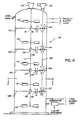
- FIG 4 illustrates an alternative design for the five-stage vertical reaction/extraction column shown in Figure 2.
- extraction column 110′ is equipped with main agitator shaft 112′ which is positioned off-center and passes through all five compartments of column 110′.
- Shaft 112′ which provides rotational power to low shear turbines 114′, 116′, 118′, 120′ and 122′, is driven by agitator 124′ and passes through labyrinth seals 125, 127, 129 and 131 in partitions 126′, 128′, 130′ and 132′, each of which separates adjacent compartments.
- Variable speed drive motor 133 drives auxiliary shafat 135 which in turn drives propellerstyle pump impellers 137, 139, 141, and 143 positioned, respectively, within partitions 126′, 128′, 130′ and 132′.
- the low shear turbines provide agitation within each stage that is sufficient to maintain the particles in a state of suspension, while the pump impellers lift liquor containing the most buoyant particles between stages.
- Partitions 126′, 128′, 130′ and 132′ are equipped, respectively, with ports 145, 147, 149 and 151 through which liquor containing the least buoyant particles is able to pass to the stage below. In counterflow operation, the flow rate of liquor passing down through the ports exceeds the rate at which liquor is lifted by the pump impellers.
- Labyrinth seals 125, 127, 129 and 131 provide tortuous flow paths which severely restrict the flow of liquor, and thereby facilitate the desired control of the flow of liquor by the action of the ports and pump impellers.
- main agitator shaft 112′ is mounted off-center and pump impeller 137 is spaced an appropriate distance from port 145 to provide a flow pattern which promotes the desired transfer of the most buoyant particles to the stage above and of the least buoyant particles to the stage below.
- bone particles of varying size, shape, hardness and density can be acidulated more uniformly and more rapidly than by the conventional settled bed method.
- the process improves both the yield of gelatin and the uniformity and physical characteristics of the finished gelatin. It also more effectively separates contaminants from the ossein during the acidulation step, and this is easier and much more cost effective than prior art techniques in which contaminants are substantially separated after completion of the acidulation step.
- the particles are individually suspended in the solvent and all particles in a stage contact solvent of substantially the same composition.
- the process of this invention reduces the processing vessel volume and the overall processing time needed for acidulation of bone. It provides a process which is inherently more controllable with respect to the constituency and physical characteristics of the finished product.
Landscapes
- Chemical & Material Sciences (AREA)
- Life Sciences & Earth Sciences (AREA)
- Chemical Kinetics & Catalysis (AREA)
- Zoology (AREA)
- Biochemistry (AREA)
- Engineering & Computer Science (AREA)
- Food Science & Technology (AREA)
- Polymers & Plastics (AREA)
- Extraction Or Liquid Replacement (AREA)
- Meat, Egg Or Seafood Products (AREA)
Claims (16)
Applications Claiming Priority (2)
| Application Number | Priority Date | Filing Date | Title |
|---|---|---|---|
| US06/917,342 US4824939A (en) | 1986-10-09 | 1986-10-09 | Process for leaching particulate solid materials |
| US917342 | 1986-10-09 |
Publications (2)
| Publication Number | Publication Date |
|---|---|
| EP0325614A1 EP0325614A1 (de) | 1989-08-02 |
| EP0325614B1 true EP0325614B1 (de) | 1991-03-13 |
Family
ID=25438655
Family Applications (1)
| Application Number | Title | Priority Date | Filing Date |
|---|---|---|---|
| EP87907050A Expired EP0325614B1 (de) | 1986-10-09 | 1987-09-25 | Verfahren zum auslangen fester körniger substanzen |
Country Status (5)
| Country | Link |
|---|---|
| US (1) | US4824939A (de) |
| EP (1) | EP0325614B1 (de) |
| JP (1) | JPH02500960A (de) |
| DE (1) | DE3768661D1 (de) |
| WO (1) | WO1988002650A1 (de) |
Families Citing this family (34)
| Publication number | Priority date | Publication date | Assignee | Title |
|---|---|---|---|---|
| FR2625412B1 (fr) * | 1987-12-30 | 1990-06-29 | Mero Rousselot Satia | Procede continu d'obtention de gelatine a partir de poudre d'os et gelatine obtenue |
| US4975526A (en) * | 1989-02-23 | 1990-12-04 | Creative Biomolecules, Inc. | Bone collagen matrix for zenogenic implants |
| US20070166353A1 (en) * | 1988-04-08 | 2007-07-19 | Stryker Corporation | Osteogenic proteins |
| US6586388B2 (en) | 1988-04-08 | 2003-07-01 | Stryker Corporation | Method of using recombinant osteogenic protein to repair bone or cartilage defects |
| US5354557A (en) * | 1988-04-08 | 1994-10-11 | Stryker Corporation | Osteogenic devices |
| US6919308B2 (en) * | 1988-04-08 | 2005-07-19 | Stryker Corporation | Osteogenic devices |
| US5266683A (en) | 1988-04-08 | 1993-11-30 | Stryker Corporation | Osteogenic proteins |
| JP2845346B2 (ja) * | 1989-10-17 | 1999-01-13 | ストライカー・コーポレーション | 骨形成具 |
| US5236456A (en) * | 1989-11-09 | 1993-08-17 | Osteotech, Inc. | Osteogenic composition and implant containing same |
| US5275954A (en) * | 1991-03-05 | 1994-01-04 | Lifenet | Process for demineralization of bone using column extraction |
| US5314476A (en) * | 1992-02-04 | 1994-05-24 | Osteotech, Inc. | Demineralized bone particles and flowable osteogenic composition containing same |
| US20080233170A1 (en) * | 1992-02-21 | 2008-09-25 | Stryker Corporation | Osteogenic Proteins |
| US5434332A (en) * | 1993-12-06 | 1995-07-18 | Cash; Alan B. | Process for removing hazardous, toxic, and radioactive wastes from soils, sediments, and debris |
| US5908921A (en) * | 1998-11-03 | 1999-06-01 | Eastman Kodak Company | Method of manufacturing gelatin |
| US6495181B1 (en) | 1999-01-22 | 2002-12-17 | Bush Brothers & Company | Soak apparatus for leaching soluble constituents from insoluble materials |
| US20050059953A1 (en) | 1999-09-03 | 2005-03-17 | Lifenet | Apparatus for demineralizing osteoinductive bone |
| US20030228288A1 (en) | 1999-10-15 | 2003-12-11 | Scarborough Nelson L. | Volume maintaining osteoinductive/osteoconductive compositions |
| US9387094B2 (en) | 2000-07-19 | 2016-07-12 | Warsaw Orthopedic, Inc. | Osteoimplant and method of making same |
| US7323193B2 (en) | 2001-12-14 | 2008-01-29 | Osteotech, Inc. | Method of making demineralized bone particles |
| JP2005505351A (ja) * | 2001-10-12 | 2005-02-24 | オステオテック インコーポレーテッド | 改善された骨移植片 |
| AU2002362220A1 (en) * | 2001-12-27 | 2003-07-24 | Osteotech Inc. | Bone fasteners and method for stabilizing vertebral bone facets using the bone fasteners |
| US6824941B2 (en) * | 2002-05-08 | 2004-11-30 | Eastman Kodak Company | Photographic element containing acid processed gelatin |
| US6589326B1 (en) | 2002-05-30 | 2003-07-08 | Eastman Kodak Company | Coating fluid for imaging element comprising solubilized collagen gelatin and hardener |
| US6573037B1 (en) | 2002-05-30 | 2003-06-03 | Eastman Kodak Company | Imaging element comprising solubilized collagen gelatin and hardener |
| US6706467B2 (en) | 2002-05-30 | 2004-03-16 | Eastman Kodak Company | Coating fluid for imaging element comprising solubilized collagen gelatin colloidal dispersion |
| KR20060031808A (ko) * | 2003-06-11 | 2006-04-13 | 오스테오테크, 인코포레이티드 | 뼈 임플란트 및 그의 제조 방법 |
| EP1708652A4 (de) * | 2004-01-30 | 2011-08-24 | Warsaw Orthopedic Inc | Stapelimplantate bei der wirbelsäulenfusion |
| US20050196460A1 (en) * | 2004-03-08 | 2005-09-08 | Malinin Theodore I. | Particulate cartilage compositions, processes for their preparation and methods for regenerating cartilage |
| DE202005009755U1 (de) * | 2005-06-21 | 2005-09-08 | Cervitech, Inc. | Halter für Zwischenwirbelprothesen |
| WO2007056671A1 (en) * | 2005-11-02 | 2007-05-18 | Osteotech, Inc. | Hemostatic bone graft |
| US20080279825A1 (en) * | 2007-05-10 | 2008-11-13 | Malinin Theodore I | Cartilage material |
| EP2339725B1 (de) | 2008-10-07 | 2016-07-06 | Mitsuba Corporation | Elektromotor und reduktionsmotor |
| CA2742047A1 (en) * | 2008-10-24 | 2010-04-29 | Warsaw Orthopedic, Inc. | Compositions and methods for promoting bone formation |
| WO2024201669A1 (ja) * | 2023-03-27 | 2024-10-03 | 日揮グローバル株式会社 | 縦型多段撹拌システム及びco2固定化方法 |
Family Cites Families (9)
| Publication number | Priority date | Publication date | Assignee | Title |
|---|---|---|---|---|
| US3142667A (en) * | 1960-10-26 | 1964-07-28 | Swift & Co | Countercurrent extraction of gelatin |
| US3142570A (en) * | 1962-12-31 | 1964-07-28 | John E Thompson | Separation process |
| US3384458A (en) * | 1965-06-16 | 1968-05-21 | Continental Oil Co | Water hydrolysis reactor for making alumina |
| US3445448A (en) * | 1967-04-14 | 1969-05-20 | Theobald Ind The | Methods for producing glues and/or gelatins and protein and phosphate rich residues |
| US3539549A (en) * | 1969-02-27 | 1970-11-10 | Charles Greenfield | Recovery of protein from bone |
| DE1929124A1 (de) * | 1969-03-17 | 1970-11-05 | Ceskoslovenska Akademie Ved | Verfahren zur Trennung schuettiger Rohstoffe zur Erzeugung von Gelatine und Leim |
| US4294753A (en) * | 1980-08-04 | 1981-10-13 | The Regents Of The University Of California | Bone morphogenetic protein process |
| ZA816771B (en) * | 1980-10-07 | 1982-10-27 | Lensfield Prod Ltd | Protein production |
| US4614543A (en) * | 1985-01-31 | 1986-09-30 | Amax Inc. | Mixed lixiviant for separate recovery of zinc and lead from iron-containing waste materials |
-
1986
- 1986-10-09 US US06/917,342 patent/US4824939A/en not_active Expired - Fee Related
-
1987
- 1987-09-25 WO PCT/US1987/002436 patent/WO1988002650A1/en not_active Ceased
- 1987-09-25 EP EP87907050A patent/EP0325614B1/de not_active Expired
- 1987-09-25 JP JP62506519A patent/JPH02500960A/ja active Pending
- 1987-09-25 DE DE8787907050T patent/DE3768661D1/de not_active Expired - Fee Related
Also Published As
| Publication number | Publication date |
|---|---|
| EP0325614A1 (de) | 1989-08-02 |
| WO1988002650A1 (en) | 1988-04-21 |
| JPH02500960A (ja) | 1990-04-05 |
| US4824939A (en) | 1989-04-25 |
| DE3768661D1 (de) | 1991-04-18 |
Similar Documents
| Publication | Publication Date | Title |
|---|---|---|
| EP0325614B1 (de) | Verfahren zum auslangen fester körniger substanzen | |
| CN100544810C (zh) | 固液接触装置和方法 | |
| EP0290156B1 (de) | Extraktion von teilchenförmigen Stoffen | |
| US5066388A (en) | Process and apparatus for disengaging and separating bitumen from pulverized tar sands using selective cohesion | |
| US4416764A (en) | Method and appratus for extracting tar sand | |
| EP0104099B1 (de) | Verfahren für Schaumflotation | |
| US4154675A (en) | Ion exchange processes using cellulosic materials | |
| EP1135197B1 (de) | Vorrichtung und verfahren zum trennen eines bestandteils von teilchenförmigem material durch extraktion | |
| WO2009017389A2 (en) | Method for extracting crude palm oil | |
| US4512956A (en) | Digester | |
| US3958947A (en) | Hydrometallurgical leaching apparatus | |
| US3224358A (en) | Apparatus for recovering fermentable liquors | |
| US1076666A (en) | Apparatus for thickening and agitating pulp. | |
| US3071450A (en) | Method for the treatment of potassium ores | |
| US1873251A (en) | Method and apparatus for separating salts and liquors | |
| US2458261A (en) | Process and apparatus for effecting chemical reactions | |
| US2894841A (en) | Process for the production of wort | |
| US2847282A (en) | Countercurrent extraction apparatus | |
| US4292281A (en) | Selective leaching of chloride from copper oxide minerals | |
| JPS62129162A (ja) | 泡沫浮選用の装置及び方法 | |
| GB1439246A (en) | Hydrometallurgical leaching | |
| US3174927A (en) | Ion exchange processes | |
| KR101557140B1 (ko) | 칼륨 화합물 제조 장치 | |
| US3961022A (en) | Silicate dissolving | |
| US4043760A (en) | Counter current decantation apparatus |
Legal Events
| Date | Code | Title | Description |
|---|---|---|---|
| PUAI | Public reference made under article 153(3) epc to a published international application that has entered the european phase |
Free format text: ORIGINAL CODE: 0009012 |
|
| 17P | Request for examination filed |
Effective date: 19890316 |
|
| AK | Designated contracting states |
Kind code of ref document: A1 Designated state(s): BE CH DE FR GB LI NL |
|
| 17Q | First examination report despatched |
Effective date: 19900713 |
|
| GRAA | (expected) grant |
Free format text: ORIGINAL CODE: 0009210 |
|
| AK | Designated contracting states |
Kind code of ref document: B1 Designated state(s): BE CH DE FR GB LI NL |
|
| REF | Corresponds to: |
Ref document number: 3768661 Country of ref document: DE Date of ref document: 19910418 |
|
| ET | Fr: translation filed | ||
| PLBE | No opposition filed within time limit |
Free format text: ORIGINAL CODE: 0009261 |
|
| STAA | Information on the status of an ep patent application or granted ep patent |
Free format text: STATUS: NO OPPOSITION FILED WITHIN TIME LIMIT |
|
| 26N | No opposition filed | ||
| PGFP | Annual fee paid to national office [announced via postgrant information from national office to epo] |
Ref country code: GB Payment date: 19950810 Year of fee payment: 9 |
|
| PGFP | Annual fee paid to national office [announced via postgrant information from national office to epo] |
Ref country code: FR Payment date: 19950908 Year of fee payment: 9 |
|
| PGFP | Annual fee paid to national office [announced via postgrant information from national office to epo] |
Ref country code: BE Payment date: 19950926 Year of fee payment: 9 |
|
| PGFP | Annual fee paid to national office [announced via postgrant information from national office to epo] |
Ref country code: NL Payment date: 19950929 Year of fee payment: 9 |
|
| PGFP | Annual fee paid to national office [announced via postgrant information from national office to epo] |
Ref country code: DE Payment date: 19951004 Year of fee payment: 9 |
|
| PGFP | Annual fee paid to national office [announced via postgrant information from national office to epo] |
Ref country code: CH Payment date: 19951020 Year of fee payment: 9 |
|
| PG25 | Lapsed in a contracting state [announced via postgrant information from national office to epo] |
Ref country code: GB Effective date: 19960925 |
|
| PG25 | Lapsed in a contracting state [announced via postgrant information from national office to epo] |
Ref country code: LI Effective date: 19960930 Ref country code: FR Effective date: 19960930 Ref country code: CH Effective date: 19960930 Ref country code: BE Effective date: 19960930 |
|
| BERE | Be: lapsed |
Owner name: EASTMAN KODAK CY (A NEW JERSEY CORP.) Effective date: 19960930 |
|
| PG25 | Lapsed in a contracting state [announced via postgrant information from national office to epo] |
Ref country code: NL Effective date: 19970401 |
|
| GBPC | Gb: european patent ceased through non-payment of renewal fee |
Effective date: 19960925 |
|
| REG | Reference to a national code |
Ref country code: CH Ref legal event code: PL |
|
| NLV4 | Nl: lapsed or anulled due to non-payment of the annual fee |
Effective date: 19970401 |
|
| PG25 | Lapsed in a contracting state [announced via postgrant information from national office to epo] |
Ref country code: DE Effective date: 19970603 |
|
| REG | Reference to a national code |
Ref country code: FR Ref legal event code: ST |
|
| REG | Reference to a national code |
Ref country code: FR Ref legal event code: ST |