EP0324910A2 - Reibungsmaterial, Methode und Vorrichtung zur Herstellung - Google Patents
Reibungsmaterial, Methode und Vorrichtung zur Herstellung Download PDFInfo
- Publication number
- EP0324910A2 EP0324910A2 EP88118393A EP88118393A EP0324910A2 EP 0324910 A2 EP0324910 A2 EP 0324910A2 EP 88118393 A EP88118393 A EP 88118393A EP 88118393 A EP88118393 A EP 88118393A EP 0324910 A2 EP0324910 A2 EP 0324910A2
- Authority
- EP
- European Patent Office
- Prior art keywords
- yarn
- resin
- mill
- chilling
- inlet
- Prior art date
- Legal status (The legal status is an assumption and is not a legal conclusion. Google has not performed a legal analysis and makes no representation as to the accuracy of the status listed.)
- Withdrawn
Links
Images
Classifications
-
- F—MECHANICAL ENGINEERING; LIGHTING; HEATING; WEAPONS; BLASTING
- F16—ENGINEERING ELEMENTS AND UNITS; GENERAL MEASURES FOR PRODUCING AND MAINTAINING EFFECTIVE FUNCTIONING OF MACHINES OR INSTALLATIONS; THERMAL INSULATION IN GENERAL
- F16D—COUPLINGS FOR TRANSMITTING ROTATION; CLUTCHES; BRAKES
- F16D69/00—Friction linings; Attachment thereof; Selection of coacting friction substances or surfaces
- F16D69/02—Composition of linings ; Methods of manufacturing
-
- C—CHEMISTRY; METALLURGY
- C08—ORGANIC MACROMOLECULAR COMPOUNDS; THEIR PREPARATION OR CHEMICAL WORKING-UP; COMPOSITIONS BASED THEREON
- C08J—WORKING-UP; GENERAL PROCESSES OF COMPOUNDING; AFTER-TREATMENT NOT COVERED BY SUBCLASSES C08B, C08C, C08F, C08G or C08H
- C08J5/00—Manufacture of articles or shaped materials containing macromolecular substances
- C08J5/04—Reinforcing macromolecular compounds with loose or coherent fibrous material
-
- B—PERFORMING OPERATIONS; TRANSPORTING
- B29—WORKING OF PLASTICS; WORKING OF SUBSTANCES IN A PLASTIC STATE IN GENERAL
- B29B—PREPARATION OR PRETREATMENT OF THE MATERIAL TO BE SHAPED; MAKING GRANULES OR PREFORMS; RECOVERY OF PLASTICS OR OTHER CONSTITUENTS OF WASTE MATERIAL CONTAINING PLASTICS
- B29B17/00—Recovery of plastics or other constituents of waste material containing plastics
- B29B17/02—Separating plastics from other materials
-
- B—PERFORMING OPERATIONS; TRANSPORTING
- B29—WORKING OF PLASTICS; WORKING OF SUBSTANCES IN A PLASTIC STATE IN GENERAL
- B29B—PREPARATION OR PRETREATMENT OF THE MATERIAL TO BE SHAPED; MAKING GRANULES OR PREFORMS; RECOVERY OF PLASTICS OR OTHER CONSTITUENTS OF WASTE MATERIAL CONTAINING PLASTICS
- B29B17/00—Recovery of plastics or other constituents of waste material containing plastics
- B29B17/04—Disintegrating plastics, e.g. by milling
- B29B17/0404—Disintegrating plastics, e.g. by milling to powder
- B29B17/0408—Disintegrating plastics, e.g. by milling to powder using cryogenic systems
-
- F—MECHANICAL ENGINEERING; LIGHTING; HEATING; WEAPONS; BLASTING
- F16—ENGINEERING ELEMENTS AND UNITS; GENERAL MEASURES FOR PRODUCING AND MAINTAINING EFFECTIVE FUNCTIONING OF MACHINES OR INSTALLATIONS; THERMAL INSULATION IN GENERAL
- F16D—COUPLINGS FOR TRANSMITTING ROTATION; CLUTCHES; BRAKES
- F16D69/00—Friction linings; Attachment thereof; Selection of coacting friction substances or surfaces
- F16D69/02—Composition of linings ; Methods of manufacturing
- F16D69/025—Compositions based on an organic binder
- F16D69/026—Compositions based on an organic binder containing fibres
-
- B—PERFORMING OPERATIONS; TRANSPORTING
- B29—WORKING OF PLASTICS; WORKING OF SUBSTANCES IN A PLASTIC STATE IN GENERAL
- B29K—INDEXING SCHEME ASSOCIATED WITH SUBCLASSES B29B, B29C OR B29D, RELATING TO MOULDING MATERIALS OR TO MATERIALS FOR MOULDS, REINFORCEMENTS, FILLERS OR PREFORMED PARTS, e.g. INSERTS
- B29K2277/00—Use of PA, i.e. polyamides, e.g. polyesteramides or derivatives thereof, as reinforcement
- B29K2277/10—Aromatic polyamides [Polyaramides] or derivatives thereof
-
- B—PERFORMING OPERATIONS; TRANSPORTING
- B29—WORKING OF PLASTICS; WORKING OF SUBSTANCES IN A PLASTIC STATE IN GENERAL
- B29L—INDEXING SCHEME ASSOCIATED WITH SUBCLASS B29C, RELATING TO PARTICULAR ARTICLES
- B29L2009/00—Layered products
-
- B—PERFORMING OPERATIONS; TRANSPORTING
- B29—WORKING OF PLASTICS; WORKING OF SUBSTANCES IN A PLASTIC STATE IN GENERAL
- B29L—INDEXING SCHEME ASSOCIATED WITH SUBCLASS B29C, RELATING TO PARTICULAR ARTICLES
- B29L2031/00—Other particular articles
- B29L2031/48—Wearing apparel
- B29L2031/4807—Headwear
- B29L2031/4814—Hats
- B29L2031/4821—Helmets
-
- Y—GENERAL TAGGING OF NEW TECHNOLOGICAL DEVELOPMENTS; GENERAL TAGGING OF CROSS-SECTIONAL TECHNOLOGIES SPANNING OVER SEVERAL SECTIONS OF THE IPC; TECHNICAL SUBJECTS COVERED BY FORMER USPC CROSS-REFERENCE ART COLLECTIONS [XRACs] AND DIGESTS
- Y02—TECHNOLOGIES OR APPLICATIONS FOR MITIGATION OR ADAPTATION AGAINST CLIMATE CHANGE
- Y02W—CLIMATE CHANGE MITIGATION TECHNOLOGIES RELATED TO WASTEWATER TREATMENT OR WASTE MANAGEMENT
- Y02W30/00—Technologies for solid waste management
- Y02W30/50—Reuse, recycling or recovery technologies
- Y02W30/62—Plastics recycling; Rubber recycling
-
- Y—GENERAL TAGGING OF NEW TECHNOLOGICAL DEVELOPMENTS; GENERAL TAGGING OF CROSS-SECTIONAL TECHNOLOGIES SPANNING OVER SEVERAL SECTIONS OF THE IPC; TECHNICAL SUBJECTS COVERED BY FORMER USPC CROSS-REFERENCE ART COLLECTIONS [XRACs] AND DIGESTS
- Y10—TECHNICAL SUBJECTS COVERED BY FORMER USPC
- Y10S—TECHNICAL SUBJECTS COVERED BY FORMER USPC CROSS-REFERENCE ART COLLECTIONS [XRACs] AND DIGESTS
- Y10S241/00—Solid material comminution or disintegration
- Y10S241/37—Cryogenic cooling
Definitions
- Our invention relates to a novel friction material for use in the manufacture of friction products such as automotive disk and drum brakes, clutches and gaskets, as well as to a method and apparatus for making the friction material.
- One of the objects of our invention is to provide a noncarcinogenic substitute for asbestos-based friction materials.
- Another object of our invention is to provide a friction material that is readily dispersible.
- Another object of our invention is to provide a friction material that is simple and inexpensive to manufacture.
- our invention contemplates a method of making friction material in which aramid yarn impregnated with resin is first cryogenically chilled to the point of embrittlement and then comminuted to produce a friction material comprising aramid fibers and adhering resin.
- the aramid yarn is in the form of a woven fabric, and is derived from uncured or partially cured scraps from the fabrication of protective helmets from laminates of resin-impregnated cloth.
- the cryogenic chilling is preferably performed by immersion in a cryogenic liquid such as liquid nitrogen at -320°F.
- the comminution step is performed in a rotary impact mill which is supplied with a cold gas such as nitrogen to maintain the milling temperature below 75°F.
- a cold gas such as nitrogen
- the resulting fibrous product may, if desired, be compacted using a baler or the like to facilitate subsequent handling or shipment.
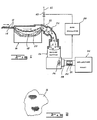
- FIGURE 1 schematically shows a system, indicated generally by the reference numeral 10, for practicing our invention.
- scraps 12 of aramid yarn material preferably pieces of fabric that have been impregnated with a resin
- conveyor belt 14 which carries the material to the entrance of an immersion freezer, indicated generally by the reference numeral 16, such as the one made by Koach Engineering. If desired, conveyor belt 14 may be omitted and the material 12 fed to the freezer manually.
- a second conveyor belt 18 carries the material 12 supplied to the entrance of freezer 16 through a liquid nitrogen bath 20 having an equilibrium temperature of -320°F. Conveyor belts 14 and 18 are operated at such speeds as to allow the immersed material 12 to reach cryogenic equilibrium with the liquid nitrogen in the bath 20. Such equilibrium is reached when the bath 20 stops effervescing.
- the yarn is preferably the aramid cloth specified in Military Specification MIL-C-44050 (amended September 24, 1982), the disclosure of which is incorporated herein by reference.
- the cloth is made from virgin aramid fiber, preferivelyably that manufactured by E. I. du Pont de Nemours and Company under the trademark KEVLAR 29.
- the warp and filling yarns of the cloth are continuous-filament 1500 denier, with a minimum fiber tenacity of 20 grams per denier and a minimum of 1.5 warp turns per inch.
- the preferred cloth has a weight of between 13.7 and 14.7 ounces per square yard, 35 warp yarns per inch and 39 filling yarns per inch, the weave being a two-by-two basket.
- the resin is preferably that specified in Military Specification MIL-H-44099A (December 22, 1986), the disclosure of which is incorporated herein by reference.
- the resin is a catalyzed system composed of 50 percent phenol formaldehyde and 50 percent polyvinyl butyral resins, a particular formulation being as follows: Component Parts by Weight % of Total Solids Polyvinyl butyral (18-20% hydroxyl) 868(25% solids in ethanol) 47.2 Phenol formaldehyde 100(57% solids in ethanol) 12.4 Trimethylol phenol 267(60% solids in ethanol) 34.8 Phthalic anhydride 25.6 5.6 Methanol 51.2 Total 1311.8 100.0
- the aramid cloth is coated on both sides with equal amounts of the laminating resin.
- the resin content of the coated cloth is 15% to 18% solids by weight (volatile free), based on the uncoated material weight, and the mix reduced to spraying consistency.
- Other resins such as epoxy resins and cross-linked polyesters may be used instead of the resin described above.
- the resin selected is present in an amount not exceeding about 20% of the weight of the yarn.
- the raw material 12 consists of at least partially uncured scraps from the manufacture of helmet shells from laminates of resin-impregnated cloth.
- a plurality of superimposed layers of the impregnated cloth are placed between the two halves of a compression mold, and then compression-molded while applying heat to form the shell.
- Scraps from such manufacturing process typically consist of "table cuttings", or uncured pieces of impregnated cloth removed before placement in the mold, and "pinchoff", or partially cured portions removed from the periphery after the curing of the central portion.
- Belt 18 carries material 12 upwardly out of the bath 20 to the exit of the freezer 16, where the material travels through an exit chute 22 into the throat 24 of a high-speed rotary impact mill or cutter indicated generally by the reference character 26.
- a suitable such cutter 26, used in the system 10 is the Munson SCC-30 rotary cutter, available from Munson Machinery Company, Inc. of Utica, New York.
- Cutter 26 is fitted with a 3/8-inch screen (not shown) so that the fibrous material 32 issuing from exit point 28 has an average length of 1 inch.
- Cutter 26 has blades (not shown) that are fixed relative to the mill rotor.
- other types of mills including hammer mills in which the impact elements are movable relative to the mill rotor, may also be used.
- the term "rotary impact mill” as used herein thus includes mills in which the impact elements move relative to a mill rotor as well as mills in which the impact elements are fixed relative thereto.
- the material 32 is removed from cutter 26 and conveyed through a duct 30 to a collection point 34, preferably pneumatically by means of a partial vacuum at the downstream end of duct 30. There the material 32 is compressed and wrapped into a bale for shipment to customers.
- a suitable baler is the Model 36 manufactured by Accurate Industries, of Williamstown, New Jersey. If desired, however, duct 30 and collection point 34 may be omitted and the material 32 simply collected as it passes through the screen of cutter 26.
- the liquid nitrogen in the bath 20 lowers the temperature of the resin in the material 12 to a point where it can be easily fractured, since the bath temperature of -320°F is well below the glass-transition temperature of the polymers. Lowering the temperature of the material 12 also prevents thermal degradation of the resin and aramid constituents and eliminates the explosion hazards that can result from heat buildup.
- thermocouple 36 is used to monitor the temperature at the exit from cutter 26.
- Thermocouple 36 controls a gas regulator 38, which in turn regulates a valve 40 in a conduit 42 coupled to the exit duct 22.
- Conduit 42 may simply be a flue for diverting gaseous nitrogen from throat 24 or, if desired, may be a line coupled to a separate supply (not shown) of cold gaseous nitrogen.
- Valve 40 is regulated in such a manner as to maintain the exit temperature in cutter 26 below 75°F.
- the resulting product 32 may be used in the manufacture of friction products such as automotive disk and drum brakes, clutches and gaskets in a manner known to the art as exemplified by the above-identified Gallagher et al patent and Loken article and the references cited therein.
Landscapes
- Engineering & Computer Science (AREA)
- Mechanical Engineering (AREA)
- Chemical & Material Sciences (AREA)
- General Engineering & Computer Science (AREA)
- Environmental & Geological Engineering (AREA)
- Medicinal Chemistry (AREA)
- Health & Medical Sciences (AREA)
- Chemical Kinetics & Catalysis (AREA)
- Materials Engineering (AREA)
- Polymers & Plastics (AREA)
- Organic Chemistry (AREA)
- Manufacturing & Machinery (AREA)
- Braking Arrangements (AREA)
- Disintegrating Or Milling (AREA)
- Manufacture Of Macromolecular Shaped Articles (AREA)
- Treatments For Attaching Organic Compounds To Fibrous Goods (AREA)
- Crushing And Pulverization Processes (AREA)
- Processing And Handling Of Plastics And Other Materials For Molding In General (AREA)
Applications Claiming Priority (2)
| Application Number | Priority Date | Filing Date | Title |
|---|---|---|---|
| US146479 | 1988-01-21 | ||
| US07/146,479 US4846408A (en) | 1988-01-21 | 1988-01-21 | Method for making a friction material |
Publications (2)
| Publication Number | Publication Date |
|---|---|
| EP0324910A2 true EP0324910A2 (de) | 1989-07-26 |
| EP0324910A3 EP0324910A3 (de) | 1991-01-23 |
Family
ID=22517547
Family Applications (1)
| Application Number | Title | Priority Date | Filing Date |
|---|---|---|---|
| EP19880118393 Withdrawn EP0324910A3 (de) | 1988-01-21 | 1988-11-04 | Reibungsmaterial, Methode und Vorrichtung zur Herstellung |
Country Status (4)
| Country | Link |
|---|---|
| US (1) | US4846408A (de) |
| EP (1) | EP0324910A3 (de) |
| JP (1) | JP2884411B2 (de) |
| KR (1) | KR970006008B1 (de) |
Cited By (5)
| Publication number | Priority date | Publication date | Assignee | Title |
|---|---|---|---|---|
| RU2114019C1 (ru) * | 1997-03-12 | 1998-06-27 | Открытое акционерное общество Научно-исследовательский и конструкторско-технологический институт асбестовых технических изделий - фирма "ТИИР" | Тормозная колодка железнодорожного подвижного состава |
| RU2114338C1 (ru) * | 1996-11-20 | 1998-06-27 | Открытое акционерное общество Научно-исследовательский и конструкторско-технологический институт асбестовых технических изделий - фирма "ТИИР" | Фрикционное изделие |
| RU2115840C1 (ru) * | 1997-06-26 | 1998-07-20 | Открытое акционерное общество "Научно-исследовательский и конструкторско-технологический институт асбестовых технических изделий" - фирма "ТИИР" | Способ изготовления фрикционного изделия с металлическим каркасом |
| WO2003097316A1 (en) * | 2002-05-20 | 2003-11-27 | Du Pont-Toray Co.,Ltd. | Shreds for reinforcement, fiber-reinforced product using the shreds, and method of manufacturing the shreds and the product |
| WO2026008752A1 (en) | 2024-07-05 | 2026-01-08 | Teijin Aramid B.V. | Recycling of aramid honeycombs |
Families Citing this family (10)
| Publication number | Priority date | Publication date | Assignee | Title |
|---|---|---|---|---|
| US5164131A (en) * | 1990-09-19 | 1992-11-17 | The Dow Chemical Company | Methods for synthesizing pulps and short fibers containing polybenzazole polymers |
| US5333802A (en) * | 1992-01-24 | 1994-08-02 | Conec, Inc. | Method and apparatus for producing chunks or kibbles of a foodstuff |
| DE4332031C1 (de) * | 1993-09-21 | 1995-05-11 | Nikka Norddeutsche Isolierwerk | Verfahren zur Aufbereitung von faserstoffhaltigen Materialien |
| US6399393B1 (en) | 1999-09-21 | 2002-06-04 | The United States Of America As Represented By The Department Of Energy | Cryogenic homogenization and sampling of heterogeneous multi-phase feedstock |
| NZ520125A (en) * | 2002-07-12 | 2006-03-31 | Agres Ltd | Compound preparation method |
| DE102004027239A1 (de) * | 2004-06-03 | 2005-12-22 | Gebrüder Lödige Maschinenbau-Gesellschaft mit beschränkter Haftung | Rotationsspaltgranulation |
| US7346961B2 (en) * | 2004-09-08 | 2008-03-25 | Toray Fluorofibers (America), Inc. | Fiber having increased filament separation and method of making same |
| CA2744066C (en) * | 2008-11-21 | 2017-09-05 | Mcneil-Ppc, Inc. | Chiller box |
| CH700090B1 (de) * | 2008-12-08 | 2013-01-31 | Ppc Print Packaging Consulting Gmbh | Verfahren zur Rezyklierung von Vlies, insbesondere Polyurethanvlies. |
| CN101769353B (zh) * | 2010-02-09 | 2012-11-14 | 衡水众成摩擦材料有限公司 | 一种偏航刹车片及其制备方法 |
Family Cites Families (24)
| Publication number | Priority date | Publication date | Assignee | Title |
|---|---|---|---|---|
| US2347464A (en) * | 1939-12-08 | 1944-04-25 | Lehon Co | Method of pulverizing resinous and thermoplastic materials |
| US2609150A (en) * | 1949-11-05 | 1952-09-02 | Union Carbide & Carbon Corp | Mechanical pulverization of refrigerated plastics |
| US2665850A (en) * | 1950-07-25 | 1954-01-12 | Sol B Wiczer | Comminuted product and method of grinding |
| US2879005A (en) * | 1954-12-29 | 1959-03-24 | Melvin Sobel | Method of refining scrap plastic and apparatus therefor |
| US3527414A (en) * | 1967-11-14 | 1970-09-08 | Union Corp | Method and apparatus for stripping the insulation from metallic wire |
| CH491675A (de) * | 1969-12-01 | 1970-06-15 | Inventa Ag | Verfahren zum mahlen von körnigen materialien bei tiefen temperaturen |
| CH503520A (de) * | 1969-12-15 | 1971-02-28 | Inventa Ag | Verfahren zum Vermahlen von körnigen Materialien, insbesondere von Kunststoffgranulaten, bei tiefen Temperaturen |
| ES395231A1 (es) * | 1970-09-23 | 1973-11-16 | Air Liquide | Procedimiento para la molienda de una sustancia fragil a las temperaturas criogenicas. |
| DE2049848A1 (de) * | 1970-10-10 | 1972-04-13 | Klöckner-Humboldt-Deutz AG, 5000 Köln | Mahlverfahren für Schwingmühlen |
| DE2061837A1 (de) * | 1970-12-16 | 1972-06-22 | Air Products GmbH, 4000 Düsseldorf; Klöckner-Humboldt-Deutz AG, 5000 Köln | Verfahren zur Durchführung von Niedrigtemperatur-Mahlprozessen in einer Schwingmühle |
| US3771729A (en) * | 1971-06-17 | 1973-11-13 | Air Prod & Chem | Cryogenic comminution system |
| GB1425940A (en) * | 1972-12-22 | 1976-02-25 | Monsanto Ltd | Fragmenting poly-ethylene masses |
| DE2311933C3 (de) * | 1973-03-09 | 1979-12-20 | Linde Ag, 6200 Wiesbaden | Verfahren und Vorrichtung zur Zerkleinerung von Stoffen bei tiefen Temperaturen |
| GB1534274A (en) * | 1975-01-21 | 1978-11-29 | Boc International Ltd | Size reduction |
| US4102503A (en) * | 1975-04-16 | 1978-07-25 | Linde Aktiengesellschaft | Method of and apparatus for the low-temperature milling of materials |
| US4020992A (en) * | 1975-11-20 | 1977-05-03 | Aluminum Company Of America | Separation of joined plastic and metal components |
| US4219452A (en) * | 1978-05-19 | 1980-08-26 | Amsted Industries Incorporated | Composite friction element |
| US4340076A (en) * | 1979-02-27 | 1982-07-20 | General Technology Applications, Inc. | Dissolving polymers in compatible liquids and uses thereof |
| US4356137A (en) * | 1980-12-10 | 1982-10-26 | Borg-Warner Corporation | Process for preparing friction clutch facing |
| US4483488A (en) * | 1981-06-30 | 1984-11-20 | Air Products And Chemicals, Inc. | Method and apparatus for recovering thermoplastic from coated fabric scrap |
| CA1207729A (en) * | 1981-06-30 | 1986-07-15 | Bruce A. Luff | Method and apparatus for recovering thermoplastic from coated fabric scrap |
| US4374211A (en) * | 1981-09-15 | 1983-02-15 | Thiokol Corporation | Aramid containing friction materials |
| JPS58211415A (ja) * | 1982-06-04 | 1983-12-08 | Mitsubishi Rayon Co Ltd | 樹脂成形用材料の製造方法 |
| DE3230441C2 (de) * | 1982-08-16 | 1994-12-15 | Borg Warner | Trockenes, asbestfreies Reibmaterial und/oder Reibelemente und ein Verfahren zu ihrer Herstellung |
-
1988
- 1988-01-21 US US07/146,479 patent/US4846408A/en not_active Expired - Lifetime
- 1988-11-04 EP EP19880118393 patent/EP0324910A3/de not_active Withdrawn
-
1989
- 1989-01-20 KR KR1019890000583A patent/KR970006008B1/ko not_active Expired - Fee Related
- 1989-01-21 JP JP1101689A patent/JP2884411B2/ja not_active Expired - Lifetime
Cited By (5)
| Publication number | Priority date | Publication date | Assignee | Title |
|---|---|---|---|---|
| RU2114338C1 (ru) * | 1996-11-20 | 1998-06-27 | Открытое акционерное общество Научно-исследовательский и конструкторско-технологический институт асбестовых технических изделий - фирма "ТИИР" | Фрикционное изделие |
| RU2114019C1 (ru) * | 1997-03-12 | 1998-06-27 | Открытое акционерное общество Научно-исследовательский и конструкторско-технологический институт асбестовых технических изделий - фирма "ТИИР" | Тормозная колодка железнодорожного подвижного состава |
| RU2115840C1 (ru) * | 1997-06-26 | 1998-07-20 | Открытое акционерное общество "Научно-исследовательский и конструкторско-технологический институт асбестовых технических изделий" - фирма "ТИИР" | Способ изготовления фрикционного изделия с металлическим каркасом |
| WO2003097316A1 (en) * | 2002-05-20 | 2003-11-27 | Du Pont-Toray Co.,Ltd. | Shreds for reinforcement, fiber-reinforced product using the shreds, and method of manufacturing the shreds and the product |
| WO2026008752A1 (en) | 2024-07-05 | 2026-01-08 | Teijin Aramid B.V. | Recycling of aramid honeycombs |
Also Published As
| Publication number | Publication date |
|---|---|
| US4846408A (en) | 1989-07-11 |
| KR970006008B1 (ko) | 1997-04-23 |
| JP2884411B2 (ja) | 1999-04-19 |
| EP0324910A3 (de) | 1991-01-23 |
| JPH0284439A (ja) | 1990-03-26 |
| KR890012103A (ko) | 1989-08-24 |
Similar Documents
| Publication | Publication Date | Title |
|---|---|---|
| EP0324910A2 (de) | Reibungsmaterial, Methode und Vorrichtung zur Herstellung | |
| EP0407439B1 (de) | Formmasse und verfahren zu ihrer herstellung | |
| US5518188A (en) | Method of recycling carpet forming components from waste carpet | |
| US8454795B1 (en) | System and method for producing bonded fiber/cellulose products | |
| EP0849381B1 (de) | Zerhacker und Verfahren zum kontinuierlichen Zerschneiden von Fasern | |
| JP2019049010A (ja) | 熱可塑性安定化材料を有する広幅物のリサイクリング | |
| WO1996041820A2 (en) | Process and apparatus for making crumb rubber | |
| EP0056864A2 (de) | Aus Fasern und Füllstoff luftgelegtes Vlies enthaltende dekorative Schichtstoffe, hergestellt unter hohem Druck, und Verfahren zu ihrer Herstellung | |
| US4054434A (en) | Production of glass fibres | |
| US4476185A (en) | Blowable glass fiber thermal insulation product | |
| US6099775A (en) | Fiberglass insulation product and process for making | |
| US4073443A (en) | Comminuting plant at cryogenic temperatures | |
| US5883020A (en) | Fiberglass insulation product and process for making | |
| JP7540182B2 (ja) | 繊維成形体製造用原料および繊維成形体の製造方法 | |
| US20010023903A1 (en) | Process for recycling material containing high-tenacity fibers impregnated with a resin matrix | |
| US6868877B2 (en) | Method for producing a processed continuous veneer ribbon and consolidated processed veneer strand product therefrom | |
| Hwang et al. | Mechanical properties and density profile of ceramics manufactured from a board mixed with sawdust and mandarin peels | |
| RU2157758C1 (ru) | Способ переработки полимерных материалов, например, резины и установка для его осуществления | |
| JP7271923B2 (ja) | 解繊装置および再生処理装置 | |
| CA2177984A1 (en) | Processing lignocellulosic agricultural residue | |
| CA1159295A (en) | Device for production of mechanical pulp | |
| WO1998056723A1 (en) | Production of man-made vitreous fibre products | |
| CA1171742A (en) | Self-supporting moldable fiber mat and process for producing the same | |
| WO2026003542A1 (en) | System for producing recycled polyurethane foam | |
| WO2023031670A1 (en) | Process for manufacturing of loose fill insulation and an insulation material produced according to said process |
Legal Events
| Date | Code | Title | Description |
|---|---|---|---|
| PUAI | Public reference made under article 153(3) epc to a published international application that has entered the european phase |
Free format text: ORIGINAL CODE: 0009012 |
|
| AK | Designated contracting states |
Kind code of ref document: A2 Designated state(s): BE DE ES FR GB IT LU NL |
|
| 17P | Request for examination filed |
Effective date: 19900110 |
|
| PUAL | Search report despatched |
Free format text: ORIGINAL CODE: 0009013 |
|
| AK | Designated contracting states |
Kind code of ref document: A3 Designated state(s): BE DE ES FR GB IT LU NL |
|
| 17Q | First examination report despatched |
Effective date: 19920309 |
|
| STAA | Information on the status of an ep patent application or granted ep patent |
Free format text: STATUS: THE APPLICATION IS DEEMED TO BE WITHDRAWN |
|
| 18D | Application deemed to be withdrawn |
Effective date: 19940601 |