EP0323948A2 - Kontinuierliche Isoelektrische Proteinabtrennung - Google Patents
Kontinuierliche Isoelektrische Proteinabtrennung Download PDFInfo
- Publication number
- EP0323948A2 EP0323948A2 EP89870001A EP89870001A EP0323948A2 EP 0323948 A2 EP0323948 A2 EP 0323948A2 EP 89870001 A EP89870001 A EP 89870001A EP 89870001 A EP89870001 A EP 89870001A EP 0323948 A2 EP0323948 A2 EP 0323948A2
- Authority
- EP
- European Patent Office
- Prior art keywords
- conduit
- membrane
- protein
- electric field
- hydrogel
- Prior art date
- Legal status (The legal status is an assumption and is not a legal conclusion. Google has not performed a legal analysis and makes no representation as to the accuracy of the status listed.)
- Withdrawn
Links
Images


Classifications
-
- C—CHEMISTRY; METALLURGY
- C07—ORGANIC CHEMISTRY
- C07K—PEPTIDES
- C07K1/00—General methods for the preparation of peptides, i.e. processes for the organic chemical preparation of peptides or proteins of any length
- C07K1/14—Extraction; Separation; Purification
- C07K1/24—Extraction; Separation; Purification by electrochemical means
- C07K1/26—Electrophoresis
- C07K1/28—Isoelectric focusing
Definitions
- the present invention provides a method and apparatus for continuous separation of proteins. More particularly, the invention involves the separation of proteins or protein fractions based on the difference in their isoelectric points. The method is easily carried out using an apparatus such as the hollow fiber membrane apparatus described herein.
- polyacrylamide gel sucrose gradient or a bed of packed beads provide the anti-convective medium in many systems.
- the polyacrylamide gel system has the additional advantage that the gel acts not only as the convective stabilizer but also increases resolution by a sieving effect.
- the major limitations of these analytical systems are that they are not practical to scale up and are typically single use devices since the gels cannot be reused, typically, due to the configuration of such devices.
- the present invention is directed to a method and apparatus for the continuous separation of a target protein, from a protein mixture containing two or more proteins, at a pH substantially equal to the pI of the target protein.
- the method and apparatus employ a non-ionic, non-electrically conductive porous conduit along which the feed protein mixture is passed, and through which the undesired protein is passed in the course of the effected separation.
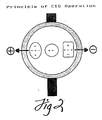
- the conduit is subjected to the influence of an electrical field substantially perpendicular to the flow of fluid therethrough resulting in movement of all charged protein from the conduit lumen by passage through the walls of the conduct along the lines of electric field force.
- the target protein which is unaffected by the electric field since it does not have a net charge at a pH equal to its pI, is collected from the conduit outlet in substantially purified, and not excessively diluted, form.
- conduit wall diffusion properties and flow rate through the conduit are such that 1)loss of the desired protein through passive diffusion is limited with respect to the rate at which said protein passes through the conduit; 2)the pressure within the conduit is maintained at a pressure lower than the pressure outside the conduit such that significant diffusive flow of the desired protein through the wall is not induced by a pressure differential across the wall; 3)the pressure within the conduit is not so great that a negative pressure differential is maintained so as to cause significant dilution of the desired protein by passage of water into the conduit from the external region due to the maintained negative pressure differential; and 4)the conduit dimensional properties are adjusted to minimize convective diffusion with respect to the passage of fluid through the conduit.
- net charge is meant the overall electrostatic charge of a molecule at a particular pH and ionic strength.
- pH is meant the pH at which the protein has a net charge of zero.
- electrophoretic mobility is meant the movement exhibited by a charged molecule under the influence of an electric field.
- target protein is meant the protein which is to be selectively separated from a solution comprising two or more proteins
- the present invention provides a method and apparatus for purifying a target protein or protein fraction from other components of a protein mixture which other components possess different net charges from the target protein or protein fraction.
- the difference in net charge of the various proteins depends upon the pH of the protein solution to be separated and the pI of the various proteins comprising the solution.
- the present invention provides a useful apparatus for the continuous purification and collection of a target protein or protein fraction which comprises:
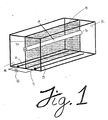
- the exemplary apparatus of Figure 1 consists of a hollow fiber membrane 10 mounted in a linear fashion such that an electric field can be applied perpendicular to the direction of fluid flow down the fiber bore.
- the electric field is generated substantially uniformly in a single direction by carrying out electrolysis on a solution of current carrying buffer 20 using a positive electrode (anode) 30 and a negative electrode 40 (cathode) connected to a direct current (D.C.) power source 50 .
- the electrodes 30 and 40 are of a configuration such that the electric field induced upon the hollow fiber membrane 10 is uniformly perpendicular to the fluid flow through such membrane.
- similarly configurated multiple electrodes, or a single plate electrode is preferable in order to generate an electric field which is substantially perpendicular to the fluid flow through such conduit(s).
- the hollow fiber membrane 10 acts as the septum of the system and, through its porosity, permits the flow of the ionic components of the buffer such that a uniform electric field gradient is established across the diameter of the fiber conduit.
- the configurations of the conduit be adapted to facilitate uniform flow therethrough, i.e., well defined flow field vector, such that convective flow patterns are reduced to the extent that there is no interference with the free flow of electrophoretically-driven proteins across the diameter of the conduit.
- the diameter of the inlet and outlet ports of the conduit should be of the same as or substantially similar to the diameter of the conduit membrane so that convective flow patterns are minimized.
- the target protein will have a net charge of zero.
- the contaminating proteins which possess a different isoelectric point will be affected by the electric field as described above since they will possess a net charge.
- the target protein will not be affected by the electric field since it will have no net charge at a pH equal to its isoelectric point.
- the pH of the inlet mixture can be adjusted to within about 0.1 pH units, such as within about 0.01 pH units, and effective separation can be achieved. However for optimal results, the pH of the inlet mixture should be adjusted to within about 0.001 pH units.
- the fate of the contaminating proteins impinging the fiber wall is dependent on the pore size of the membrane used in the system, on the nature of the pore structure, its interactive (hydrophobic or hydrophelic) properties with respect to the protein, and by any material or modification of the pore surface or material placed within the pores. For example, if the pore size of the membrane is large enough to allow the molecule to pass there through, the molecule will exit the lumen of the fiber and enter into the wall of the membrane and eventually, given enough time, will pass through the conduit wall and exit the fiber thereby entering the adjoining buffer chamber.
- the orientation of electric field to conduit axis be substantially perpendicular. This is an important aspect of the present invention because when an electric field is applied to the charged particles contained in the sample stream, the force which moves such particles thereby causing them to impinge on the walls of the conduit is preferably substantially perpendicular with respect to such walls. A force in another direction tends to create forces within the conduit membrane in addition to the flow and electric field forces.
- a force in another direction (1) will force the charged particles in the direction of flow thus contaminating the collected sample stream containing the target protein and/or (2) will force the charged particles to move against the flow thereby creating convective forces which further disrupt flow separation and will reduce achievable resolution and will further contaminate the collected sample stream containing the target protein, and/or (3) will create significant convective forces by forcing charged particles to areas of the conduit membrane without causing them to impinge the conduit wall.
- convective forces significantly interferes with free flow of electrophoretically-driven proteins through the membrane thereby decreasing the capability of the apparatus to purify the target protein from the feed protein mixture.
- the separation apparatus can be operated continuously.
- feed material is pumped into the inlet of the hollow fiber 60 .
- Buffer is pumped into the inlet of each buffer chamber 70 while waste buffer exits at the outlets of each buffer chamber 80 carrying away unwanted components of the feed material.
- the target protein is collected continuously at the outlet of the hollow fiber 90 in a substantially purified form.
- Membranes which are suitable for use in the present apparatus must be non-ionioc and electrically non-conductive.
- the selected membranes must be porous enough to permit the contaminating proteins to impinge or pass through the wall of the membrane in whatever form and with whatever modification or addition may be made to the membrane to alter its properties.
- Suitable membranes can be either hydrophilic or hydrophobic and can be made of polymers or ceramic material including, but not necessarily limited to, polysulfone, polyethersulfone, polypropylene, polyvinylidene difluoride, various ceramics, and the like.
- the membrane porosity and other properties in combination with the conditions of operation should be such that the feed mixture containing the desired protein preferably does not undergo any appreciable amount of filtration through the walls of the conduit.
- the filtration driving force can also transport material from the fiber bore but in a relatively nonselective fashion, hence as described above the pressure differentials across the fiber wall should preferably not be positive.
- the filtration effects can be minimized by a combination of apparatus design and membrane construction.
- the apparatus must be designed to prevent any significant pressure drop from developing across the membrane wall. This includes any hydrostatic or dynamic pressures that may arise in the system. For example, hydrostatic pressures due to the presence of the hollow fiber membrane can be reduced by keeping the fiber minimally submerged in buffer. Also, the hydrostatic pressure at the lumen inlet and lumen outlet should be such that substantially no net flow of buffer across the membrane wall occurs.
- the pressure drop P can be made such that it is either higher or lower than that of the surrounding buffer. In the case where it is higher, a loss of the material to the buffer chamber occurs. When P is lower (e.g. by drawing the solution into the conduit from a reservoir instead of pumping (pushing) it), no loss would occur, but there would be a a slight dilution. This dilution may re-contaminate the mixture, but it will be proportional to the ratio of the volume of the conduit to that of the buffer chamber, which is normally very small. Contamination will also be minimized by keeping fresh buffer chambers.
- any chosen membrane can be further reduced without preventing proteins from being electrophoretically driven out of the fiber by a number of methods, for example, by impregnating a microporous membrane (i.e. pores greater than about 0.01 microns) with a hydrogel or other suitable resistance creating material of suitable concentration.
- Suitable hydrogels include, but are not necessarily limited to, agarose or polyacrylamide.
- a hydrogel or similar such material within the pores of the membrane greatly reduces the tendency of water to move through the pores while still permitting changed proteins to pass through the membrane as they are driven by the electric field.
- the preferred concentration of hydrogel is the same as that used in standard protein electrophoresis separations, i.e. 0.1-1% (w/v) agarose or 1-20% (w/v) polyacrylamide.
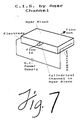
- the highest concentration of hydrogel that will allow the unwanted proteins to be electrophoretically driven out of the membrane will give the greatest reduction in membrane L p . If this is not sufficient, the L p can be further reduced by coating the outside of the membrane with a layer of the hydrogel. Increasing thickness of the external coating will reduce the effective L p of the membrane until the desired level is reached. Further, in cases where the mechanical strength of the membrane is not required a channel cut into a block of hydrogel can be used to carry out the separation, see Figure 7.
- the apparatus and methods of the present invention are useful in the recovery of product protein from a production process.
- the slip stream is the feed stream to the apparatus following any necessary preparation (i.e. pH adjustment).
- the fiber bore outlet of the apparatus may be directly linked to a spectrophotometer to continuously monitor the level of target protein in the process stream from which the slip stream is obtained.
- the optimum apparatus will include a membrane conduit having a radius such that t c is minimized, to yield results in a reasonable period of time, without increasing convection due to flow and/or heat.
- the radius of the membrane conduit will range between about .05 and about .60 centimeter, such as between about .075 centimeter and about 0.45 centimeter, preferably between about 0.15 and 0.30 centimeter.
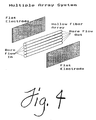
- Figures 4 through 6 illustrate several alternative embodiments of the present invention.
- Figure 4 reprevers a multiple membrane conduit apparatus in which a plurality of hollow-fibers are used.
- Figure 5 represents a multiple membrane conduit apparatus in which a channel defined by two flat sheet membranes is divided into a plurality of membrane conduits by fabricating numerous septums between the two flat sheets.
- the length of the apparatus may be reduced by using other configurations for the individual fibers.
- Figure 6 represents a spiral wound hollow fiber apparatus in which one electrode is contained in the center of the coil and the other electrode surrounds the coil and is in the form of a cylinder.
- the fiber length of the apparatus of Figure 1 may be increased by having the fiber fold-back on itself to make multiple passes while still being positioned in the plane separating the two buffer chambers.
- an apparatus of the present invention will be constructed such that the electric field strength is at least about 1 volt/centimeter (v/cm), such as at least about 10 v/cm, preferably at least about 5v/cm.
- the ratio of fluid flow per conduit to electric field strength is then between about 0.001 square centimeter per volt second (cm2/vs) and about 2 cm2/vs, such as about 0.01 cm2/vs and about 1.5 cm2/vs, preferable, between about 0.1 cm2/vs and about 1.0 cm2/vs.
- a 0.2 micron pore size polypropylene fiber membrane was impregnated with 1% (w/v) agarose in the manner.
- the dry hydrophobic membrane is wetted by submerging it in isopropanol at room temperature for at least 15 minutes.
- the alcohol is exchanged for water by exhaustive washing of the wetted membrane.
- the re-wetted polypropylene membrane is then submerged in a 1% agarose solution maintained at about 60°C for about 16-24 hours.
- the membrane is then removed from the agarose solution and drained of excess hydrogel. Upon cooling the agarose solidifies and the membrane is ready to use.
- the membrane was mounted in the chamber shown in Figure 1.
- the carrier buffer was 0.06 molar barbital buffer pH 8.6.
- An electric field was applied to the system such that 40 mA of current was generated.
- the negatively charged phycocyanin migrated toward the positive electrode, the positively charged cytochrome C migrated toward the negative electrode and the gamma globulins remained substantially inside the hollow fiber membrane.
- the red colored cytochrome C and the blue colored phycocyanin could be seen exiting the hollow fiber membrane into surrounding buffer chambers.
- the presence of gamma globulins inside the membrane and the selective removal of cytochrome C and phycocyanin was confirmed by gel electrophoresis analysis.
- a mixture of 1.25 mg/ml IgG2b, kappa monoclonal antibody from lyophilized mouse ascites plus 20% fetal bovine serum in del Becicos medium was dialyzed against 0.2M phosphate buffer, pH 7.0.
- the mixture was pumped into the hollow fiber membrane (1.8 ml per 64.3 minutes) apparatus described in Example 1.
- the buffer chambers contained 0.175M phosphate buffer pH 7.0, a voltage of 22V and a current of 1A was generated in the system.
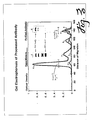
- the material flowing out the outlet of the fiber lumen was analyzed by gel electrophoresis. Referring to Figure 3, the data show that a substantial enrichment of antibody in the product solution was achieved.
Landscapes
- Chemical & Material Sciences (AREA)
- Chemical Kinetics & Catalysis (AREA)
- Electrochemistry (AREA)
- Organic Chemistry (AREA)
- Biophysics (AREA)
- Health & Medical Sciences (AREA)
- Life Sciences & Earth Sciences (AREA)
- Biochemistry (AREA)
- Analytical Chemistry (AREA)
- General Health & Medical Sciences (AREA)
- Genetics & Genomics (AREA)
- Medicinal Chemistry (AREA)
- Molecular Biology (AREA)
- Proteomics, Peptides & Aminoacids (AREA)
- General Chemical & Material Sciences (AREA)
- Peptides Or Proteins (AREA)
- Separation Using Semi-Permeable Membranes (AREA)
Applications Claiming Priority (4)
| Application Number | Priority Date | Filing Date | Title |
|---|---|---|---|
| US14085588A | 1988-01-05 | 1988-01-05 | |
| US140855 | 1988-01-05 | ||
| US07/273,780 US5114555A (en) | 1988-01-05 | 1988-11-23 | Continuous isoelectric separation |
| US273780 | 1988-11-23 |
Publications (2)
| Publication Number | Publication Date |
|---|---|
| EP0323948A2 true EP0323948A2 (de) | 1989-07-12 |
| EP0323948A3 EP0323948A3 (de) | 1991-11-21 |
Family
ID=26838532
Family Applications (1)
| Application Number | Title | Priority Date | Filing Date |
|---|---|---|---|
| EP19890870001 Withdrawn EP0323948A3 (de) | 1988-01-05 | 1989-01-04 | Kontinuierliche Isoelektrische Proteinabtrennung |
Country Status (6)
| Country | Link |
|---|---|
| US (1) | US5114555A (de) |
| EP (1) | EP0323948A3 (de) |
| JP (1) | JPH026739A (de) |
| DK (1) | DK1989A (de) |
| ES (1) | ES2010983A4 (de) |
| NO (1) | NO890038L (de) |
Cited By (7)
| Publication number | Priority date | Publication date | Assignee | Title |
|---|---|---|---|---|
| US4971670A (en) * | 1987-04-11 | 1990-11-20 | Ciba-Geigy Corporation | Isoelectric focusing process and a means for carrying out said process |
| US5430099A (en) * | 1992-05-28 | 1995-07-04 | Aligena Ag | Immobilized buffered gels and membranes of hydroxy groups containing polymers |
| CN1051245C (zh) * | 1995-01-20 | 2000-04-12 | 清华大学 | 制备型等电点电泳分离方法及设备 |
| WO2001086279A1 (en) * | 2000-05-05 | 2001-11-15 | Ecole Polytechnique Federale De Lausanne | Electrophoretic separation of compounds |
| WO2002051115A1 (de) * | 2000-12-18 | 2002-06-27 | Gerhard Weber | Elektrophoresevorrichtung, elektrophoreseverfahren unter verwendung einer elektrophoresevorrichtung und verwendung der elektrophoresevorrichtung |
| WO2006021465A1 (en) * | 2004-08-25 | 2006-03-02 | Agilent Technologies, Inc. | Electrophoretic separation in a moving fluid |
| US7166202B2 (en) | 2001-07-16 | 2007-01-23 | Protein Forest, Inc. | Matrixes, arrays, systems and methods |
Families Citing this family (17)
| Publication number | Priority date | Publication date | Assignee | Title |
|---|---|---|---|---|
| AU1183195A (en) * | 1993-11-17 | 1995-06-06 | Applied Hydrogel Technology Corporation | Methods for the separation of biological materials |
| EP0928418B1 (de) * | 1996-09-28 | 2003-12-17 | Fuhr, Günter | Verfahren und vorrichtung zur isoelektrischen teilchentrennung |
| AUPP521298A0 (en) * | 1998-08-12 | 1998-09-03 | Life Therapeutics Limited | Purification of fibrinogen |
| AUPP790698A0 (en) * | 1998-12-23 | 1999-01-28 | Life Therapeutics Limited | Separation of microorganisms |
| US20050224355A1 (en) * | 1999-12-23 | 2005-10-13 | Brendon Conlan | Removal of biological contaminants |
| AUPP790898A0 (en) | 1998-12-23 | 1999-01-28 | Life Therapeutics Limited | Renal dialysis |
| US7077942B1 (en) | 1999-12-23 | 2006-07-18 | Gradipore Limited | Removal of biological contaminants |
| AUPQ691400A0 (en) | 2000-04-14 | 2000-05-11 | Life Therapeutics Limited | Separation of micromolecules |
| EP1294472B1 (de) | 2000-04-18 | 2009-11-18 | Gradipore Limited | Trennung und behandlung von proben durch elektrophorese |
| AUPQ697300A0 (en) | 2000-04-18 | 2000-05-11 | Life Therapeutics Limited | Separation apparatus |
| WO2001085830A1 (en) * | 2000-05-05 | 2001-11-15 | University Of Louisville Research Foundation, Inc. | Improved electrophoresis gel support |
| US6923896B2 (en) * | 2000-09-22 | 2005-08-02 | The Texas A&M University System | Electrophoresis apparatus and method |
| DE60142520D1 (de) * | 2000-10-06 | 2010-08-19 | Arturus Capital Ltd | Multi-port-elektrophorese-trennvorrichtung und entsprechendes verfahren |
| AUPR222300A0 (en) * | 2000-12-21 | 2001-01-25 | Life Therapeutics Limited | Electrophoresis device and method |
| GB0121189D0 (en) * | 2001-08-31 | 2001-10-24 | Diagnoswiss Sa | Apparatus and method for separating an analyte |
| TWI341217B (en) * | 2008-10-14 | 2011-05-01 | Ind Tech Res Inst | Membrane cleaning method and apparatus |
| US20220334033A1 (en) * | 2021-04-20 | 2022-10-20 | Brown University | Electrical dissociation of tissue samples into single cells and/or smaller groups of cells |
Family Cites Families (6)
| Publication number | Priority date | Publication date | Assignee | Title |
|---|---|---|---|---|
| US2976576A (en) * | 1956-04-24 | 1961-03-28 | Wichterle Otto | Process for producing shaped articles from three-dimensional hydrophilic high polymers |
| US3051640A (en) * | 1959-09-21 | 1962-08-28 | Armour Pharma | Amino acid separation process |
| US3240692A (en) * | 1961-03-13 | 1966-03-15 | Swift & Co | Electrophoretic fractionation of ampholytes |
| CH489259A (de) * | 1968-06-08 | 1970-04-30 | Dietzsch Gmbh Hans Joachim | Verfahren zur Herstellung von kapillaren Austauschern |
| GB2036081B (en) * | 1977-06-15 | 1982-08-25 | Nat Res Dev | Membrane electrophoresis |
| JPS58147639A (ja) * | 1982-02-26 | 1983-09-02 | Hideyuki Nishizawa | 連続電気泳動分離法および装置 |
-
1988
- 1988-11-23 US US07/273,780 patent/US5114555A/en not_active Expired - Fee Related
-
1989
- 1989-01-04 ES ES89870001T patent/ES2010983A4/es active Pending
- 1989-01-04 EP EP19890870001 patent/EP0323948A3/de not_active Withdrawn
- 1989-01-04 JP JP8945A patent/JPH026739A/ja active Pending
- 1989-01-04 DK DK001989A patent/DK1989A/da not_active Application Discontinuation
- 1989-01-04 NO NO89890038A patent/NO890038L/no unknown
Cited By (15)
| Publication number | Priority date | Publication date | Assignee | Title |
|---|---|---|---|---|
| US4971670A (en) * | 1987-04-11 | 1990-11-20 | Ciba-Geigy Corporation | Isoelectric focusing process and a means for carrying out said process |
| US5082548A (en) * | 1987-04-11 | 1992-01-21 | Ciba-Geigy Corporation | Isoelectric focusing apparatus |
| US5430099A (en) * | 1992-05-28 | 1995-07-04 | Aligena Ag | Immobilized buffered gels and membranes of hydroxy groups containing polymers |
| US5597863A (en) * | 1992-05-28 | 1997-01-28 | Aligena Ag | Immobilized buffered gels and membranes of hydroxy groups containing polymers |
| US5599506A (en) * | 1992-05-28 | 1997-02-04 | Aligena Ag | Immobilized buffered gels and membranes of hydroxy groups containing polymers |
| CN1051245C (zh) * | 1995-01-20 | 2000-04-12 | 清华大学 | 制备型等电点电泳分离方法及设备 |
| WO2001086279A1 (en) * | 2000-05-05 | 2001-11-15 | Ecole Polytechnique Federale De Lausanne | Electrophoretic separation of compounds |
| AU2001267455B2 (en) * | 2000-05-05 | 2005-12-08 | Ecole Polytechnique Federale De Lausanne | Electrophoretic separation of compounds |
| US7615354B2 (en) | 2000-05-05 | 2009-11-10 | Ecole Polytechnique Federale De Lausanne | Electrophoretic separation of compounds |
| WO2002051115A1 (de) * | 2000-12-18 | 2002-06-27 | Gerhard Weber | Elektrophoresevorrichtung, elektrophoreseverfahren unter verwendung einer elektrophoresevorrichtung und verwendung der elektrophoresevorrichtung |
| US7399394B2 (en) | 2000-12-18 | 2008-07-15 | Becton, Dickinson And Company | Electrophoresis device, electrophoresis method using an electrophoresis device and use of the electrophoresis device |
| CN100439916C (zh) * | 2000-12-18 | 2008-12-03 | 贝克顿迪金森公司 | 电泳装置、使用电泳装置的电泳法及电泳装置的用途 |
| US7166202B2 (en) | 2001-07-16 | 2007-01-23 | Protein Forest, Inc. | Matrixes, arrays, systems and methods |
| US7914656B2 (en) | 2001-07-16 | 2011-03-29 | Protein Forest, Inc. | Matrixes, arrays, systems and methods |
| WO2006021465A1 (en) * | 2004-08-25 | 2006-03-02 | Agilent Technologies, Inc. | Electrophoretic separation in a moving fluid |
Also Published As
| Publication number | Publication date |
|---|---|
| ES2010983A4 (es) | 1989-12-16 |
| US5114555A (en) | 1992-05-19 |
| NO890038L (no) | 1989-07-06 |
| DK1989A (da) | 1989-07-06 |
| DK1989D0 (da) | 1989-01-04 |
| JPH026739A (ja) | 1990-01-10 |
| EP0323948A3 (de) | 1991-11-21 |
| NO890038D0 (no) | 1989-01-04 |
Similar Documents
| Publication | Publication Date | Title |
|---|---|---|
| US5114555A (en) | Continuous isoelectric separation | |
| US6467630B1 (en) | Continuous particle and molecule separation with an annular flow channel | |
| US5336387A (en) | Electrical separator apparatus and method of counterflow gradient focusing | |
| EP0018375B1 (de) | Vorrichtung und verfahren zum kontinuierlichen fluss isoelektrischer fokussierung | |
| EP0067549B1 (de) | Verfahren und Vorrichtungen zur isoelektrischen Fokussierung | |
| US3616453A (en) | Separation apparatus | |
| JPH02245653A (ja) | 荷電高分子化合物の連続分離方法および装置 | |
| US20020166769A1 (en) | Apparatus and method for combined capillary separation and blotting of biological macromolecules | |
| WO1991012073A1 (en) | Enhanced capillary zone electrophoresis and apparatus for performance thereof | |
| US6923896B2 (en) | Electrophoresis apparatus and method | |
| JP2025098158A5 (de) | ||
| US3149060A (en) | Electrophoresis method and apparatus | |
| Rios et al. | Basic transport mechanisms of ultrafiltration in the presence of an electric field | |
| US4900421A (en) | Vortex stabilized electrophoretic separation apparatus | |
| O'Connor et al. | Electrophoretic mobilities of proteins and protein mixtures in porous membranes | |
| EP1217367A1 (de) | Gerät und Verfahren zur Radialelektrophorese | |
| Cooper et al. | Water purification by forced-flow electrophoresis | |
| US6758953B2 (en) | Multistage electrophoresis apparatus and method of use for the separation and purification of cells, particles and solutes | |
| Hochstrasser et al. | An improved column for preparative electrophoresis | |
| JPS62175498A (ja) | タンパク質の分離方法 | |
| US20020060154A1 (en) | Isoelectric gateways and method and apparatus for using such isoelectric gateways | |
| US20250102501A1 (en) | Systems and methods for membrane-based assaying | |
| Lee | Membrane separation coupled with electrophoresis | |
| 高瑞昶 et al. | Studies on counteracting chromatographic electrophoresis and its utilization for protein purification | |
| AU2001291491B2 (en) | Electrophoresis apparatus and method |
Legal Events
| Date | Code | Title | Description |
|---|---|---|---|
| PUAI | Public reference made under article 153(3) epc to a published international application that has entered the european phase |
Free format text: ORIGINAL CODE: 0009012 |
|
| AK | Designated contracting states |
Kind code of ref document: A2 Designated state(s): AT BE CH DE ES FR GB GR IT LI LU NL SE |
|
| PUAL | Search report despatched |
Free format text: ORIGINAL CODE: 0009013 |
|
| AK | Designated contracting states |
Kind code of ref document: A3 Designated state(s): AT BE CH DE ES FR GB GR IT LI LU NL SE |
|
| 17P | Request for examination filed |
Effective date: 19920407 |
|
| STAA | Information on the status of an ep patent application or granted ep patent |
Free format text: STATUS: THE APPLICATION HAS BEEN WITHDRAWN |
|
| 18W | Application withdrawn |
Withdrawal date: 19931022 |