EP0323032A2 - Verfahren zur Herstellung von schweren Kohlenwasserstoffen aus leichten Olefinen in katalytischen Mehrstufenreaktoren - Google Patents
Verfahren zur Herstellung von schweren Kohlenwasserstoffen aus leichten Olefinen in katalytischen Mehrstufenreaktoren Download PDFInfo
- Publication number
- EP0323032A2 EP0323032A2 EP88311267A EP88311267A EP0323032A2 EP 0323032 A2 EP0323032 A2 EP 0323032A2 EP 88311267 A EP88311267 A EP 88311267A EP 88311267 A EP88311267 A EP 88311267A EP 0323032 A2 EP0323032 A2 EP 0323032A2
- Authority
- EP
- European Patent Office
- Prior art keywords
- stage
- reactor
- olefinic
- hydrocarbons
- primary
- Prior art date
- Legal status (The legal status is an assumption and is not a legal conclusion. Google has not performed a legal analysis and makes no representation as to the accuracy of the status listed.)
- Withdrawn
Links
Images

Classifications
-
- C—CHEMISTRY; METALLURGY
- C07—ORGANIC CHEMISTRY
- C07C—ACYCLIC OR CARBOCYCLIC COMPOUNDS
- C07C2/00—Preparation of hydrocarbons from hydrocarbons containing a smaller number of carbon atoms
-
- C—CHEMISTRY; METALLURGY
- C07—ORGANIC CHEMISTRY
- C07C—ACYCLIC OR CARBOCYCLIC COMPOUNDS
- C07C2/00—Preparation of hydrocarbons from hydrocarbons containing a smaller number of carbon atoms
- C07C2/02—Preparation of hydrocarbons from hydrocarbons containing a smaller number of carbon atoms by addition between unsaturated hydrocarbons
- C07C2/04—Preparation of hydrocarbons from hydrocarbons containing a smaller number of carbon atoms by addition between unsaturated hydrocarbons by oligomerisation of well-defined unsaturated hydrocarbons without ring formation
- C07C2/06—Preparation of hydrocarbons from hydrocarbons containing a smaller number of carbon atoms by addition between unsaturated hydrocarbons by oligomerisation of well-defined unsaturated hydrocarbons without ring formation of alkenes, i.e. acyclic hydrocarbons having only one carbon-to-carbon double bond
- C07C2/08—Catalytic processes
- C07C2/12—Catalytic processes with crystalline alumino-silicates or with catalysts comprising molecular sieves
-
- C—CHEMISTRY; METALLURGY
- C10—PETROLEUM, GAS OR COKE INDUSTRIES; TECHNICAL GASES CONTAINING CARBON MONOXIDE; FUELS; LUBRICANTS; PEAT
- C10G—CRACKING HYDROCARBON OILS; PRODUCTION OF LIQUID HYDROCARBON MIXTURES, e.g. BY DESTRUCTIVE HYDROGENATION, OLIGOMERISATION, POLYMERISATION; RECOVERY OF HYDROCARBON OILS FROM OIL-SHALE, OIL-SAND, OR GASES; REFINING MIXTURES MAINLY CONSISTING OF HYDROCARBONS; REFORMING OF NAPHTHA; MINERAL WAXES
- C10G50/00—Production of liquid hydrocarbon mixtures from lower carbon number hydrocarbons, e.g. by oligomerisation
-
- C—CHEMISTRY; METALLURGY
- C10—PETROLEUM, GAS OR COKE INDUSTRIES; TECHNICAL GASES CONTAINING CARBON MONOXIDE; FUELS; LUBRICANTS; PEAT
- C10L—FUELS NOT OTHERWISE PROVIDED FOR; NATURAL GAS; SYNTHETIC NATURAL GAS OBTAINED BY PROCESSES NOT COVERED BY SUBCLASSES C10G OR C10K; LIQUIFIED PETROLEUM GAS; USE OF ADDITIVES TO FUELS OR FIRES; FIRE-LIGHTERS
- C10L1/00—Liquid carbonaceous fuels
- C10L1/04—Liquid carbonaceous fuels essentially based on blends of hydrocarbons
- C10L1/06—Liquid carbonaceous fuels essentially based on blends of hydrocarbons for spark ignition
-
- C—CHEMISTRY; METALLURGY
- C07—ORGANIC CHEMISTRY
- C07C—ACYCLIC OR CARBOCYCLIC COMPOUNDS
- C07C2529/00—Catalysts comprising molecular sieves
- C07C2529/04—Catalysts comprising molecular sieves having base-exchange properties, e.g. crystalline zeolites, pillared clays
- C07C2529/06—Crystalline aluminosilicate zeolites; Isomorphous compounds thereof
- C07C2529/40—Crystalline aluminosilicate zeolites; Isomorphous compounds thereof of the pentasil type, e.g. types ZSM-5, ZSM-8 or ZSM-11
Definitions
- This invention relates to a process and operating system for upgrading light olefins to liquid hydrocarbons.
- it provides a continuous process for oligomerizing olefinic feedstock to produce distillate product for use as diesel fuel or the like.
- It provides a technique for oligomerizing lower alkene-containing light gas feedstock, optionally containing ethene, propene, and/or butylenes, to produce predominantly C10+ distillate hydrocarbons and a minor amount of olefinic gasoline and other useful products.
- Patents 3,960,978 and 4,021,502 Plank, Rosinski and Givens disclose conversion of C2-C5 olefins, alone or in admixture with paraffinic components, into higher hydrocarbons over crystalline zeolites having controlled acidity.
- Garwood et al. have also contributed to the understanding of catalytic olefin upgrading techniques and improved processes as in U.S. Patents 4,150,062, 4,211,640 and 4,227,992. The above-identified disclosures are incorporated herein by reference.
- Conversion of lower olefins, especially ethene, propene and butenes, over HZSM-5 is effective at moderately elevated temperatures and pressures.
- the conversion products are sought as liquid fuels, especially the C5+ hydrocarbons.
- Product distribution for liquid hydrocarbons can be varied by controlling process conditions, such as temperature, pressure and space velocity.
- Olefinic gasoline eg, C5-C9 is readily formed at elevated temperature (e.g., up to about 350°C) and moderate pressure from ambient to about 5500 kPa, preferably about 250 to 2900 kPa.
- olefinic gasoline can be produced in good yield and may be recovered as a product or fed to a high pressure reactor system containing high acid acitivity catalyst for further conversion to heavier hydrocarbons, especially C10-C20 distillate-range products.
- Distillate mode operation can be employed to maximize production of C10+ aliphatics by reacting the lower and intermediate olefins at high pressure and moderate temperature.
- Operating details for typical olefin oligomerization units are disclosed in U.S. Patents 4,456,779; 4,497,968 (Owen et al.) and 4,433,185 (Tabak).
- Lubricants can be manufactured by multistage reactors according to U.S. Patents 4,520,215 and 4,568,786 (Chen and Tabak). Lower olefinic feedstocks containing C2-C4 alkenes may be converted selectively. While propene and butene may be converted to the extent of 50% to 99% at moderate temperature, only about 10% to 30% of ethene will be converted using only HZSM-5 or similar process condtions and acid zeolites.
- olefinic light gas rich in C2-C4 alkene can be upgraded to intermediate dimer and trimer liquid hydrocarbons rich in heavier C6-C12 olefinic hydrocarbons by catalytic conversion in a fixed bed or turbulent fluidized bed of solid acid zeolite catalyst at a high space velocity and under controlled reaction severity conditions to prevent substantial formation of aromatics.
- This technique is particularly useful in a two-stage process for upgrading olefinic components of LPG and FCC light gas.
- Typical feedstock may contain significant amounts of ethene, propene, butenes, C2-C4 paraffins and hydrogen produced in cracking heavy petroleum oils or the like.
- An improved multistage catalytic process has been found for conversion of light olefinic gas feedstock, especially olefinic C2-C4 hydrocarbons, to distillate range hydrocarbons rich in C10+ aliphatics and alkylated aromatics, comprising the methods and means for:
- both primary and secondary feedstocks may contain a mixture of lower olefins, such as present in crackate gas derived by catalytic cracking of petroleum fractions.
- the primary feedstock stream contains a significant amount of ethene (ethylene); whereas this component may be present in only minor amounts in the secondary feedstock stream.
- a typical primary feestream is FCC fuel gas, usually rich in ethene, ethane, methane, hydrogen; and lean in C3+ hydrocarbon components.
- the preferred secondary feedstock contains C3+ alkenes, such as mono-olefinic propene and butenes, wherein the total C3-C6 alkenes are in the range of about 10 to 80 wt%.
- Non-deleterious components such as paraffins and inert gases, may be present.
- a particularly useful secondary feedstock is LPG (liquefied petroleum gas) light gas by-product of FCC gas oil cracking units containing typically 20-60 mol % C3-C4 olefins.
- the process may be tolerant of a wide range of lower alkanes, from 0 to 95%.
- Preferred feedstocks contain more than 50 wt. % C3-C4 lower aliphatic hydrocarbons, and contain sufficient olefins to provide total olefinic partial pressure of at least 1400 kPa.
- the primary reactor is advantageously configured as a fluidized catalyst bed.
- the main advantages of the fluid bed configurations are its flexibility for running various feedstock and temperature control.
- FIG. 1 a typical multistage olefins upgrading system is depicted by a schematic process diagram.
- the primary olefinic feedstock is introduced via inlet conduit 11 and heat exchanger 18 to the bottom inlet of primary stage reactor means 20. Additional feedstock or recycle may be injected optionally via line 21.
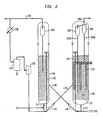
- a preferred reactor design is shown in detail in Fig. 2.
- Hot effluent gas passes via conduit 22 to condenser cooler means 24, wherein a major portion of the C5-C9 light gasoline hydrocarbons are condenses and separated in primary separation unit 26 to provide one or more light gas streams 28, 29 rich in unreacted C4-aliphatics, and a condensed liquid stream 30 containing a large amount of olefinic intermediate components and about 1 to 20 wt% of aromatic components.
- Fluid handling means is operatively connected between stages to receive, store and pump liquid hydrocarbons within the system. The condensed liquid hydrocarbons are withdrawn from storage and/or taken directly from upstream processing units via pump means 32 and passed through valve means 34, 36 to the secondary stage for inter-reactor quenching.
- the secondary reaction stage feedstream 12 contains predominantly C3-C4 aliphatics, optionally supplemented by stream 12A, and is passed via compressor means 38 and heat exchange means 39 to the inlet of the secondary stage reaction section 40.
- the secondary feedstream is pressurized to about 2800 to 10,000 kPa and heated to about 235°C-315°C, along with any recycle or diluent stream, eg. 39A.
- Secondary reaction zone 40 may be configured as adiabatic fixed bed reactors, especially as a plurality of serially connected beds 40A, 40B, 40C with inter-reactor cooling means 42A, 42B, as described in U.S. Patent 4,456,779 (Owen et al), incorporated by reference. This prior patent also gives details of equipment and regeneration operation for oxidative regeneration of a typical fixed bed reactor system.
- the hot effluent streams from at least one of the front beds 40A, 40B may be quenched by cold liquid intermediate streams from the primary stage separation means 26 via valves 34 and /or 36.
- the aromatic components of the primary stage intermediate fraction are further reacted by catalytic alkylation by olefinic components derived from the secondary stage upgrading reactions.
- These hydrocarbons are further upgraded to distillate range hydrocarbon product in contact with at least one downstream bed of oligomerization catalyst.
- the secondary stage reaction zone is maintained in distillate operating mode at moderately elevated temperature and high pressure favorable to formation of C10+ aliphatic product.
- the secondary stage effluent stream is cooled by exchanger 42C and passed to product separation and recovery means 44.
- a liquid stream rich in C5-C9 hydrocarbons may be pressurized and recycled via line 39A for mixture with fresh secondary olefinic feed from the primary stage or recovered as gasoline product.
- the present system is flexible with regard to composition of feedstock and conversion.
- the gaseous primary effluent components are separated from the C5+ rich liquid stream in a phase separator unit 26 or the like.
- Light gas stream 28, containing C2 and lighter gaseous components may be removed from the system as off gas for fuel, or part of it may be recycled via line 11 or 21 to the primary stage reactor 20.
- recycle of unreacted C4- may be considered as an optional processing technique. It is impossible to generate olefins in situ by feeding methanol or other olefin precursors to the primary stage reactor.
- first stage LPG product can optionally be upgraded in the second stage reaction system.
- Other interstage processing equipment and operating steps are fully described in U.S. Patent 4,497,968 (wright et al).
- ZSM-5 medium pore siliceous materials having similar pore geometry. Most prominent among these intermediate pore size zeolites is ZSM-5, which is usually synthesized with Bronsted acid active sites by incorporating a tetrahedrally coordinated metal, such as Al, Ga, B or Fe, within the zeolitic framework. These medium pore zeolites are favored for acid catalysis; however, the advantages of ZSM-5 structures may be utilized by employing highly siliceous materials or cystalline metallosilicate having one or more tetrahedral species having varying degrees of acidity. ZSM-5 crystalline structure is readily recognized by its X-ray diffraction pattern, which is described in U.S. Patent No. 3,702,866 (Argauer.
- the oligomerization catalysts preferred for use herein include the medium pore (i.e., about 5-7A) shape-selective crystalline aluminosilicate zeolites having a silica-to-alumina ratio of at least 12, a constraint index of about 1 to 12 and significant Bronsted acid activity.
- the coked catalyst preferably have an acid activity (alpha value) of about 0.1 to 20 under steady state process conditions to achieve the required degree of reaction severity.
- the second stage catalyst is generally more active (e.g.- alpha value of 10-200 or higher).
- Representative of the ZSM-5 type zeolites are ZSM-5, ZSM-11, ZSM-12, ZSM-22, ZSM-23, and ZSM-35.
- ZSM-5 is disclosed in U.S. Patent No. 3,702,886 and U.S. Patent No. Re. 29,948.
- Other suitable zeolites are disclosed in U.S. Patents 3,709,979; 3,832,449; 4,076,979; 3,832,449; 4,076,842; 4,016,245 and 4,046,839; 4,414,423; 4,417,086; 4,517,396 and 4,542,251.
- suitable zeolites having a coordinated metal oxide to silica molar ratio of 20:1 to 200:1 or higher may be used
- a typical zeolite catalyst component having Bronsted acid sites may consist essentially of crystalline aluminosilicate having the structure of ZSM-5 zeolite with 5 to 95 wt.% silica, clay and/or alumina binder.
- siliceous zeolites may be employed in their acid form, ion exchanged or impregnated with one or more suitable metals, such as Ga, Pd, Zn, Ni, Co and/or other metals of Periodic Groups III to VIII.
- suitable metals such as Ga, Pd, Zn, Ni, Co and/or other metals of Periodic Groups III to VIII.
- Gallium and other metals are known to promote aromatics formation under the process conditions of the primary stage reactor.
- Ni-exchanged or impregnated catalyst is particularly useful in converting ethene under low severity conditions.
- the zeolite may include other components, generally one or more metals of group IB, IIB, IIIB,VA, VIA or VIIIA of the Periodic Table (IUPAC).
- Useful hydrogenation components include the noble metals of Group VIIIA, especially platinum, but other noble metals, such as palladium, gold, silver, rhenium or rhodium, may also be used.
- Base metal hydrogenation components may also be used, especially nickel, cobalt, molybdenum, tungsten, copper or zinc,
- the catalyst materials may include two or more catalytic components, such as a metallic oligomerization component (eg, ionic Ni+2, and a shape-selective medium pore acidic oligomerization catalyst, such as ZSM-5 zeolite) which components may be present in admixture or combined in a unitary bifunctional solid particle.
- a metallic oligomerization component eg, ionic Ni+2
- a shape-selective medium pore acidic oligomerization catalyst such as ZSM-5 zeolite
- ethene dimerization metal or oligomerization agent it is possible to utilize an ethene dimerization metal or oligomerization agent to effectively convert feedstock ethene in a continuous reaction zone.
- Certain of the ZSM-5 type medium pore shape selective catalysts are sometimes known as pentasils.
- the borosilicate, ferrosilicate and "silicalite" materials may be employed.
- ZSM-5 type pentasil zeolites are particularly useful in the process because of their regenerability, long life and stability under the extreme conditions of operation.
- the zeolite crystals have a crystal size from about 0.01 to over 2 microns or more, with 0.02-1 micron being preferred.
- Catalyst versatility permits similar zeolites to be used in both the primary stage and distillate mode secondary oligomerization stage. While it is within the inventive concept to employ substantially different catalysts in these stages, it is advantageous to employ a standard ZSM-5, suitability modified.
- primary stage fluidized bed catalyst particles consist essentially of 25% H-ZSM-5 catalyst contained within a silica-alumina matrix and having a fresh alpha value of less than about 100, based on total catalyst weight.
- the secondary stage catalyst may consist of a standard 70:1 aluminosilicate H-ZSM-5 extrudate having an acid value of at least 20, preferably 150 or higher.
- the preferred primary stage reactor is a fluidized reactor system operating under turbulent fluidization.
- Particle size distribution can be a significant factor in achieving overall homogeneity in turbulent regime fluidization. It is desired to operate the process with particles that will mix well throughout the bed. Large particles having a particle size greater than 250 microns should be avoided, and it is advantageous to employ a particle size range of 1 to 150 microns. Average particle size is usually about 20 to 100 microns, preferably 40 to 80 microns. Particle distribution may be enhanced by having a mixture of larger and smaller particles within the operative range, and it is particularly desirable to have a significant amount of fines. Close control of distribution can be maintained to keep about 10 to 25 wt % of the total catalyst in the reaction zone in the size range less than 32 microns. This class of fluidizable particles is classified as Geldart Group A. Accordingly, the fluidization regime is controlled to assure operation between the transition velocity and transport velocity. Fluidization conditions are substantially different from those found in non-turbulent dense beds or transport beds.
- the primary stage products are mainly C5 to C9 hydrocarbons, which will comprise at least 50 wt.% of the recovered product, preferrably 80% or more.
- this intermediate stream may comprise olefins as the predominant fraction of the C5+ reaction effluent, up to 90% pentenes, hexenes, heptenes, octenes, nonenes and heavier olefins.
- olefins as the predominant fraction of the C5+ reaction effluent, up to 90% pentenes, hexenes, heptenes, octenes, nonenes and heavier olefins.
- Aromatics production can be increased by known operating techniques.
- the reaction severity conditions can be controlled to optimize yield of benzene, toluene, xylenes (BTX) aromatics or C5+ aliphatic hydrocarbons. It is understood that aromatics and light paraffin production is promoted by those zeolite catalysts having a high concentration of Bronsted acid reaction sites. Accordingly, an important criterion is selecting and maintaining catalyst inventory to provide either fresh catalyst having acid activity or by controlling primary stage catalyst deactivation and regeneration rates to provide an average acid cracking activity (alpha value) of about 1 to 100, preferably about 3-20, based on total catalyst solids.
- Reaction temperatures and contact time are also significant factors in determining the reaction severity, and the process parameters are followed to give a substantially steady state condition wherein the reaction severity is maintained within the limits which yield a desired weight ratio of alkane to alkene produced in the reaction zone.
- This technique is particularly useful for operation with a fluidized catalytic cracking (FCC) unit to increase overall production of liquid product in fuel gas limited petroleum refineries.
- FCC fluidized catalytic cracking
- Light olefins and some of the light paraffins, such as those in FCC light gas can be converted to valuable C5+ gasoline and C10+ distillate hydrocarbon products in a multistage reactor containing a zeolite catalyst.
- C2-C4 olefin upgrading the load to the refinery fuel gas plant is decreased considerably.
- the primary stage feed gas rich in lower olefins passes under pressure through conduit 210, with the main flow being directed through the bottom inlet of reactor vessel 220 for distribution through grid plate 222 into the fluidization zone 224.
- the feed gas contacts the turbulent bed of finely divided catalyst particles.
- Reactor vessel 210 is shown provided with heat exchange tubes 226. The bottoms of the tubes are spaced above feed distributor grid 222 sufficiently to be free of jet action by the charged feed through the small diameter holes in the grid.
- no internal cooling coils are required whenever reaction heat can be partially or completely removed by using cold feed.
- Baffles may be added to control radial and axial mixing.
- the vertical reaction zone can contain open end tubes above the grid for maintaining hydraulic constraints, as disclosed in US Pat. 4,251,484 (Daviduk and Haddad). Heat released from the reaction can be controlled by adjusting feed temperature in a known manner.
- Catalyst outlet means 228 is provided for withdrawing catalyst from above bed 224 and passed for catalyst regeneration in vessel 230 via control valve 229.
- the partially deactivated catalyst is oxidatively regenerated by controlled contact with air or other regeneration gas at elevated temperature in a fluidized regeneration zone to remove carbonaceous deposits and restore acid acitivity.
- the catalyst particles are entrained in a lift gas and transported via riser tube 232 to a top portion of vessel 230. Air is distributed at the bottom of the bed to effect fluidization, with oxidation byproducts being carried out of the regeneration zone through cyclone separator 234, which returns any entrained solids to the bed.
- Flue gas is withdrawn via top conduit 236 for disposal; however, a portion of the flue gas may be recirculated via heat exchanger 238, separator 240, and compressor 242 for return to the vessel with fresh oxidation gas via line 244 and as lift gas for the catalyst in riser 232.
- Regenerated catalyst is passed to the main reactor 220 through conduit 246 provided with flow control valve 248.
- the regenerated catalyst may be lifted to the catalyst bed with pressurized feed gas through catalyst return riser conduit 250. Since the amount of regenerated catalyst passed to the reactor is relatively small, the temperature of the regenerated catalyst does not upset the temperature constraints of the reactor operations in significant amount.
- a series of sequentially connected cyclone separators 252, 254 are provided with diplegs 252A, 254A to return any entrained catalyst fines to the lower bed. These separators are positioned in an upper portion of the reactor vessel comprising dispersed catalyst phase 224.
- filters such as sintered metal plate filters, can be used alone or conjunction with cyclones.
- the product effluent separated from catalyst particles in the cyclone separating system is then withdrawn from the reactor vessel 220 through top gas outlet means 256.
- the recovered hydrocarbon product comprising C5+ olefins and/or aromatics, paraffins and naphthenes is thereafter processed as required to provide a desired gasoline and/or higher boiling product.
- the turbulent bed may have a superficial vapor velocity of about 0.2 to 2 meters per second (m/sec).
- the velocity specified here is for an operation at a total reactor pressure of about 100 to 300 kPa.
- a higher pressures a lower gas velocity may be employed to ensure operation in the turbulent fluidization regime.
- a convenient measure of turbulent fluidization is the bed density.
- a typical turbulent bed has an operating density of about 100 to 500 kg/m3, preferrably about 300 to 500 kg/m3, measured at the bottom of the reaction zone, becoming less dense toward the top of the reaction zone, due to pressure drop and particle size differentiation.
- the weight hourly space velocity and uniform contact provides a close control of contact time between vapor and solid phases.
- the weight hourly space velocity (WHSV, based on total olefins in the fresh feedstock) is usually about 0.1 to 10 WHSV.
- the fluidized bed unit can be operated over a wide range of process variables and catalyst activity.
- a typical reactor unit employs a temperature-controlled catalyst zone with indirect heat exchange and/or adjustable gas preheat, whereby the reaction exotherm can be carefully controlled to prevent excessive temperature above the usual operating range of about 260°C to 650°C.
- an average reactor temperature of 300°C to 400°C is maintained.
- aromatics production is favored by higher temperature, e.g.- 500°C-650°C.
- Energy conservation in the system may utilize at least a portion of the reactor exotherm heat value by exchanging hot reactor effluent with feedstock and/or recycle streams.
- Optional heat exchangers may recover heat from the effluent stream prior to fractionation.
- the use of a fluid-bed reactor in the primary stage offers several advantages over a fixed-bed reactor. Due to continuous catalyst regeneration, fluid-bed reactor operation will not be adversely affected by oxygenate, sulfur and/or nitrogen containing contaminants presented in the feed gas.
- the secondary distillate production stage provides catalytic oligomerization reactor means, preferrably a fixed bed system containing medium pore shape selective acid zeolite oligomerization catalyst for converting fresh C3-C4 rich feed and intermediate range hydrocarbons from Stage I to liquid hydrocarbons comprising a major amount of distillate.
- the secondary feed stream is preheated by indirect heat exchange with a hot stream, such as, distillate product or first stage reactor effluent, in exchanger 39 and passed to the Stage II reactor 40 at a pressure of at least about 2800 kPa, preferably about 4225 to 7000 kPa (600 to 1000 psig) for light distillate production and higher pressure (e.g. 10,000 kPa) for heavy distillate or lube production.
- a hot stream such as, distillate product or first stage reactor effluent
- a single train distillate mode fixed bed secondary stage reactor system is depicted.
- the plural reactor system may be employed with liquid quenching alone or with additional inter-reactor cooling, whereby the reaction exotherm can be carefully controlled to optimize the normal moderate temperature window of about 190°C to 315°C (375°-600°F) and a total pressure of 4225 kPa (600 psig), with a minimum olefin partial pressure at the inlet of about 1100 kPa (160 psig).
- the space velocity (WHSV based on fresh olefin feed) is about 0.1 to 1.5.
- the secondary stage reactor conditions are optimized to produce heavy liquid hydrocarbons having a normal boiling point above 165°C (330°F).
- Product fractionation is achieved by typical product fractionation systems as described in U.S. Patents 4,456,779 and 4,504,693 (Owen et al).
- Feed No. 1 is mainly C3-C4 olefins from LPG crackate
- Feed No. 2 is an ethene-containing FCC light gas (normally used as fuel gas).
- Table 1 summarizes the feed compositions and products from each independent unit operation, and further demonstrates the improved yield of C11+ distillate product by the integrated process of this invention, wherein C5+ gasoline from the fluid bed reactor product is introduced between fixed bed reactors in the distillate mode reactor system.
- the thru material balances are based on equivalent parts of feed, expressed as parts by weight.
Landscapes
- Chemical & Material Sciences (AREA)
- Organic Chemistry (AREA)
- Chemical Kinetics & Catalysis (AREA)
- Oil, Petroleum & Natural Gas (AREA)
- Engineering & Computer Science (AREA)
- General Chemical & Material Sciences (AREA)
- Crystallography & Structural Chemistry (AREA)
- Production Of Liquid Hydrocarbon Mixture For Refining Petroleum (AREA)
- Catalysts (AREA)
- Organic Low-Molecular-Weight Compounds And Preparation Thereof (AREA)
Applications Claiming Priority (2)
| Application Number | Priority Date | Filing Date | Title |
|---|---|---|---|
| US137913 | 1987-12-28 | ||
| US07/137,913 US4788366A (en) | 1987-12-28 | 1987-12-28 | Production of heavier hydrocarbons from light olefins in multistage catalytic reactors |
Publications (2)
| Publication Number | Publication Date |
|---|---|
| EP0323032A2 true EP0323032A2 (de) | 1989-07-05 |
| EP0323032A3 EP0323032A3 (de) | 1989-08-16 |
Family
ID=22479605
Family Applications (1)
| Application Number | Title | Priority Date | Filing Date |
|---|---|---|---|
| EP88311267A Withdrawn EP0323032A3 (de) | 1987-12-28 | 1988-11-28 | Verfahren zur Herstellung von schweren Kohlenwasserstoffen aus leichten Olefinen in katalytischen Mehrstufenreaktoren |
Country Status (7)
| Country | Link |
|---|---|
| US (1) | US4788366A (de) |
| EP (1) | EP0323032A3 (de) |
| JP (1) | JPH01210496A (de) |
| AR (1) | AR244189A1 (de) |
| AU (1) | AU604993B2 (de) |
| NZ (1) | NZ227081A (de) |
| ZA (1) | ZA888948B (de) |
Cited By (4)
| Publication number | Priority date | Publication date | Assignee | Title |
|---|---|---|---|---|
| US5672800A (en) * | 1992-01-30 | 1997-09-30 | Exxon Chemical Patents Inc. | Alkene oligomerization |
| EP1254887A1 (de) * | 2001-05-02 | 2002-11-06 | Sumitomo Chemical Company, Limited | Verfahren zur Herstellung von Methylmethacrylat |
| EP1218321A4 (de) * | 1999-09-16 | 2005-04-20 | Conocophillips Co | Oligomerisierung von olefinen |
| WO2005047216A1 (en) * | 2003-11-13 | 2005-05-26 | Neste Oil Oyj | Process for the hydrogenation of olefins |
Families Citing this family (35)
| Publication number | Priority date | Publication date | Assignee | Title |
|---|---|---|---|---|
| US4873385A (en) * | 1987-01-23 | 1989-10-10 | Mobil Oil Corp. | Single zone oligomerization of lower olefins to distillate under low severity in a fluid bed with tailored activity |
| GB8803112D0 (en) * | 1988-02-11 | 1988-03-09 | British Petroleum Co Plc | Zeolite catalysts suitable for hydrocarbon conversion |
| US4879428A (en) * | 1988-03-03 | 1989-11-07 | Harandi Mohsen N | Upgrading lower olefins |
| US5059744A (en) * | 1988-03-03 | 1991-10-22 | Mobil Oil Corporation | Reactor and recovery system for upgrading lower olefins |
| US5009851A (en) * | 1988-05-31 | 1991-04-23 | Mobil Oil Corporation | Integrated catalytic reactor system with light olefin upgrading |
| US4899002A (en) * | 1988-07-25 | 1990-02-06 | Mobil Oil Corp. | Integrated staged conversion of methanol to gasoline and distillate |
| US5045287A (en) * | 1988-07-25 | 1991-09-03 | Mobil Oil Corporation | Multireactor system for conversion of methanol to gasoline and distillate |
| US4879424A (en) * | 1988-09-19 | 1989-11-07 | Mobil Oil Corporation | Conversion of alkanes to gasoline |
| US4935568A (en) * | 1988-12-05 | 1990-06-19 | Mobil Oil Corporation | Multistage process for oxygenate conversion to hydrocarbons |
| US4939314A (en) * | 1988-12-19 | 1990-07-03 | Mobil Oil Corporation | Method for on-stream low-pressure regeneration of an oligomerization catalyst from a fluid-bed reactor operating at high pressure with hydrocarbons in a non-liquid phase |
| US5326466A (en) * | 1991-01-22 | 1994-07-05 | Mobil Oil Corporation | Distillate dewaxing reactor system integrated with olefin upgrading |
| US5202015A (en) * | 1991-01-22 | 1993-04-13 | Mobil Oil Corporation | Process for distillate dewaxing coincident with light olefin oligomerization |
| US5258563A (en) * | 1992-06-11 | 1993-11-02 | Uop | Process for the production of benzene from light hydrocarbons |
| US20020182124A1 (en) * | 1997-10-14 | 2002-12-05 | William M. Woodard | Olefin production process |
| WO2006084286A2 (en) * | 2005-01-31 | 2006-08-10 | Exxonmobil Chemical Patents Inc. | Hydrocarbon compositions useful for producing fuels |
| US8481796B2 (en) * | 2005-01-31 | 2013-07-09 | Exxonmobil Chemical Patents Inc. | Olefin oligomerization and compositions therefrom |
| WO2006084285A2 (en) * | 2005-01-31 | 2006-08-10 | Exxonmobil Chemical Patents Inc. | Olefin oligomerization and biodegradable compositions therefrom |
| US7692049B2 (en) * | 2005-01-31 | 2010-04-06 | Exxonmobil Chemical Patents Inc. | Hydrocarbon compositions useful for producing fuels and methods of producing the same |
| US7678953B2 (en) * | 2005-01-31 | 2010-03-16 | Exxonmobil Chemical Patents Inc. | Olefin oligomerization |
| GB0512377D0 (en) * | 2005-06-17 | 2005-07-27 | Exxonmobil Chem Patents Inc | Oligomerisation of olefins with zeolite catalyst |
| US7588738B2 (en) * | 2005-08-23 | 2009-09-15 | Exxonmobil Chemical Patents Inc. | Series catalyst beds |
| US7741526B2 (en) * | 2006-07-19 | 2010-06-22 | Exxonmobil Chemical Patents Inc. | Feedstock preparation of olefins for oligomerization to produce fuels |
| GB0625528D0 (en) | 2006-12-21 | 2007-01-31 | Exxonmobil Chem Patents Inc | Oligomerisation of olefins |
| US7956227B2 (en) * | 2007-12-06 | 2011-06-07 | Conocophillips Company | Oligomerization of hydrocarbons |
| EP2238095A1 (de) * | 2008-01-29 | 2010-10-13 | Basf Se | Verfahren zur oligomerisierung von alkenen |
| EP2311554A1 (de) * | 2009-10-07 | 2011-04-20 | Linde Aktiengesellschaft | Verfahren zur Reaktionskontrolle einer exothermen Reaktion und Vorrichtung dafür |
| FR2951163B1 (fr) * | 2009-10-13 | 2012-09-28 | Total Raffinage Marketing | Procede de production de distillat par oligomerisation catalytique d'olefines en presence de composes oxygenes |
| FR2951162B1 (fr) * | 2009-10-13 | 2012-01-06 | Total Raffinage Marketing | Procede de production de distillat par oligomerisation catalytique d'olefines en presence de methanol et/ou dimethyl ether |
| FR2951160B1 (fr) * | 2009-10-13 | 2012-09-28 | Total Raffinage Marketing | Procede de production de distillat a partir de composes organiques heteroatomiques |
| US20110147263A1 (en) * | 2009-12-18 | 2011-06-23 | Exxonmobil Research And Engineering Company | Process and system to convert olefins to diesel and other distillates |
| US20120197053A1 (en) * | 2010-09-21 | 2012-08-02 | Synfuels International., Inc. | System and method for the production of liquid fuels |
| US20170121615A1 (en) * | 2015-10-28 | 2017-05-04 | Exxonmobil Research And Engineering Company | Upgrading olefin-containing feeds to diesel boiling range compounds |
| US11603500B2 (en) * | 2017-09-07 | 2023-03-14 | Purdue Research Foundation | Natural gas liquids upgrading process: two-step catalytic process for alkane dehydrogenation and oligomerization |
| US12012561B2 (en) * | 2022-04-06 | 2024-06-18 | ExxonMobil Technology and Engineering Company | Methods for converting C2+ olefins to higher carbon number olefins |
| JP2026504849A (ja) * | 2023-01-19 | 2026-02-10 | ユーオーピー エルエルシー | オレフィンをジェット燃料に転化するための多相オレゴン化プロセス |
Family Cites Families (11)
| Publication number | Priority date | Publication date | Assignee | Title |
|---|---|---|---|---|
| US3760024A (en) * | 1971-06-16 | 1973-09-18 | Mobil Oil Corp | Preparation of aromatics |
| US4444988A (en) * | 1982-07-22 | 1984-04-24 | Mobil Oil Corporation | Use of liquefied propane and butane or butane recycle to control heat of reaction of converting olefins to gasoline and distillate |
| US4433185A (en) * | 1983-04-04 | 1984-02-21 | Mobil Oil Corporation | Two stage system for catalytic conversion of olefins with distillate and gasoline modes |
| US4456779A (en) * | 1983-04-26 | 1984-06-26 | Mobil Oil Corporation | Catalytic conversion of olefins to higher hydrocarbons |
| US4450311A (en) * | 1983-06-29 | 1984-05-22 | Mobil Oil Corporation | Heat exchange technique for olefin fractionation and catalytic conversion system |
| US4487985A (en) * | 1983-08-26 | 1984-12-11 | Mobil Oil Corporation | Catalytic conversion with catalyst regeneration sequence |
| US4482772A (en) * | 1983-11-03 | 1984-11-13 | Mobil Oil Corporation | Multistage process for converting oxygenates to hydrocarbons |
| US4511747A (en) * | 1984-02-01 | 1985-04-16 | Mobil Oil Corporation | Light olefin conversion to heavier hydrocarbons with sorption recovery of unreacted olefin vapor |
| US4605807A (en) * | 1984-04-27 | 1986-08-12 | Atlantic Richfield Company | Process for catalytic conversion of ethylene to higher hydrocarbons |
| US4543435A (en) * | 1985-01-17 | 1985-09-24 | Mobil Oil Corporation | Multistage process for converting oxygenates to liquid hydrocarbons with ethene recycle |
| US4891457A (en) * | 1985-09-13 | 1990-01-02 | Hartley Owen | Multistage process for converting olefins to heavier hydrocarbons |
-
1987
- 1987-12-28 US US07/137,913 patent/US4788366A/en not_active Expired - Fee Related
-
1988
- 1988-11-25 NZ NZ227081A patent/NZ227081A/xx unknown
- 1988-11-28 EP EP88311267A patent/EP0323032A3/de not_active Withdrawn
- 1988-11-28 AU AU25960/88A patent/AU604993B2/en not_active Ceased
- 1988-11-28 JP JP63298438A patent/JPH01210496A/ja active Pending
- 1988-11-28 AR AR88312575A patent/AR244189A1/es active
- 1988-11-29 ZA ZA888948A patent/ZA888948B/xx unknown
Cited By (5)
| Publication number | Priority date | Publication date | Assignee | Title |
|---|---|---|---|---|
| US5672800A (en) * | 1992-01-30 | 1997-09-30 | Exxon Chemical Patents Inc. | Alkene oligomerization |
| EP1218321A4 (de) * | 1999-09-16 | 2005-04-20 | Conocophillips Co | Oligomerisierung von olefinen |
| EP1254887A1 (de) * | 2001-05-02 | 2002-11-06 | Sumitomo Chemical Company, Limited | Verfahren zur Herstellung von Methylmethacrylat |
| WO2005047216A1 (en) * | 2003-11-13 | 2005-05-26 | Neste Oil Oyj | Process for the hydrogenation of olefins |
| US7473811B2 (en) | 2003-11-13 | 2009-01-06 | Neste Oil Oyj | Process for the hydrogenation of olefins |
Also Published As
| Publication number | Publication date |
|---|---|
| JPH01210496A (ja) | 1989-08-24 |
| AR244189A1 (es) | 1993-10-29 |
| EP0323032A3 (de) | 1989-08-16 |
| ZA888948B (en) | 1990-07-25 |
| US4788366A (en) | 1988-11-29 |
| NZ227081A (en) | 1990-03-27 |
| AU604993B2 (en) | 1991-01-03 |
| AU2596088A (en) | 1989-07-06 |
Similar Documents
| Publication | Publication Date | Title |
|---|---|---|
| US4788366A (en) | Production of heavier hydrocarbons from light olefins in multistage catalytic reactors | |
| US4919896A (en) | Multistage catalytic reactor system for production of heavy hydrocarbons | |
| EP0318132B1 (de) | Verfahren zur Herstellung von Kohlenwasserstoffen aus Olefinen in einer Reaktorenreihe | |
| EP0276095B1 (de) | Verfahren zur Verwertung von leichten Olefinen in einem Wirbelschichtreaktor mit Katalysator | |
| US5034565A (en) | Production of gasoline from light olefins in a fluidized catalyst reactor system | |
| US4831203A (en) | Integrated production of gasoline from light olefins in a fluid cracking process plant | |
| US4966680A (en) | Integrated catalytic cracking process with light olefin upgrading | |
| US4855524A (en) | Process for combining the operation of oligomerization reactors containing a zeolite oligomerization catalyst | |
| US4822477A (en) | Integrated process for gasoline production | |
| US5019357A (en) | Reactor system for upgrading light olefins in staged reactors | |
| US4891457A (en) | Multistage process for converting olefins to heavier hydrocarbons | |
| US4751338A (en) | Conversion of diene-containing light olefins to aromatic hydrocarbons | |
| EP0418318B1 (de) | Verfahren zur anreicherung von propen-äther-mischungen in einem katalysator-wirbelbettreaktor | |
| US4950823A (en) | Benzene upgrading reformer integration | |
| CA2028945C (en) | Upgrading light olefin fuel gas in a fluidized bed catalyst reactor and regeneration of the catalyst | |
| EP0325438A2 (de) | Zweistufiges Verfahren zur Umwandlung von Alkanen zu Benzin | |
| US4831204A (en) | Production of gasoline from light olefins with FCC gas plant improvement by olefin upgrading | |
| US5043499A (en) | Fluid bed oligomerization of olefins | |
| US5009851A (en) | Integrated catalytic reactor system with light olefin upgrading | |
| US4834949A (en) | Multistage system for converting olefins to heavier hydrocarbons | |
| US4855521A (en) | Fluidized bed process for upgrading diene-containing light olefins | |
| US4873389A (en) | Conversion of light olefins to gasoline using low-temperature catalyst regeneration | |
| AU631553B2 (en) | Single zone oligomerization of lower olefins to distillate under low severity in a fluid bed with tailored activity | |
| EP0295018A2 (de) | Integriertes Verfahren zur Erzeugung von Benzin | |
| EP0275930B1 (de) | Verbesserung von Diolefine enthaltenden Kohlenwasserstoffen |
Legal Events
| Date | Code | Title | Description |
|---|---|---|---|
| PUAI | Public reference made under article 153(3) epc to a published international application that has entered the european phase |
Free format text: ORIGINAL CODE: 0009012 |
|
| PUAL | Search report despatched |
Free format text: ORIGINAL CODE: 0009013 |
|
| AK | Designated contracting states |
Kind code of ref document: A2 Designated state(s): BE DE FR GB IT NL |
|
| AK | Designated contracting states |
Kind code of ref document: A3 Designated state(s): BE DE FR GB IT NL |
|
| 17P | Request for examination filed |
Effective date: 19900109 |
|
| 17Q | First examination report despatched |
Effective date: 19910729 |
|
| STAA | Information on the status of an ep patent application or granted ep patent |
Free format text: STATUS: THE APPLICATION HAS BEEN WITHDRAWN |
|
| 18W | Application withdrawn |
Withdrawal date: 19920610 |