EP0321936A2 - Folienblasanlage mit Rolle - Google Patents
Folienblasanlage mit Rolle Download PDFInfo
- Publication number
- EP0321936A2 EP0321936A2 EP88121344A EP88121344A EP0321936A2 EP 0321936 A2 EP0321936 A2 EP 0321936A2 EP 88121344 A EP88121344 A EP 88121344A EP 88121344 A EP88121344 A EP 88121344A EP 0321936 A2 EP0321936 A2 EP 0321936A2
- Authority
- EP
- European Patent Office
- Prior art keywords
- roll
- film
- circumference
- diameter
- over
- Prior art date
- Legal status (The legal status is an assumption and is not a legal conclusion. Google has not performed a legal analysis and makes no representation as to the accuracy of the status listed.)
- Withdrawn
Links
- 238000010096 film blowing Methods 0.000 title claims abstract description 9
- 238000001816 cooling Methods 0.000 claims description 11
- 238000005259 measurement Methods 0.000 claims description 4
- 239000004033 plastic Substances 0.000 claims description 4
- 238000001739 density measurement Methods 0.000 claims description 3
- 238000004519 manufacturing process Methods 0.000 description 6
- 238000004804 winding Methods 0.000 description 6
- 238000009826 distribution Methods 0.000 description 1
- 230000008030 elimination Effects 0.000 description 1
- 238000003379 elimination reaction Methods 0.000 description 1
- 238000001125 extrusion Methods 0.000 description 1
- 239000011888 foil Substances 0.000 description 1
- 239000000463 material Substances 0.000 description 1
- 239000000155 melt Substances 0.000 description 1
- 238000000034 method Methods 0.000 description 1
- 239000002985 plastic film Substances 0.000 description 1
- 229920006255 plastic film Polymers 0.000 description 1
- 238000003825 pressing Methods 0.000 description 1
- 238000002604 ultrasonography Methods 0.000 description 1
Images
Classifications
-
- B—PERFORMING OPERATIONS; TRANSPORTING
- B29—WORKING OF PLASTICS; WORKING OF SUBSTANCES IN A PLASTIC STATE IN GENERAL
- B29C—SHAPING OR JOINING OF PLASTICS; SHAPING OF MATERIAL IN A PLASTIC STATE, NOT OTHERWISE PROVIDED FOR; AFTER-TREATMENT OF THE SHAPED PRODUCTS, e.g. REPAIRING
- B29C48/00—Extrusion moulding, i.e. expressing the moulding material through a die or nozzle which imparts the desired form; Apparatus therefor
- B29C48/25—Component parts, details or accessories; Auxiliary operations
- B29C48/88—Thermal treatment of the stream of extruded material, e.g. cooling
- B29C48/885—External treatment, e.g. by using air rings for cooling tubular films
-
- B—PERFORMING OPERATIONS; TRANSPORTING
- B29—WORKING OF PLASTICS; WORKING OF SUBSTANCES IN A PLASTIC STATE IN GENERAL
- B29C—SHAPING OR JOINING OF PLASTICS; SHAPING OF MATERIAL IN A PLASTIC STATE, NOT OTHERWISE PROVIDED FOR; AFTER-TREATMENT OF THE SHAPED PRODUCTS, e.g. REPAIRING
- B29C48/00—Extrusion moulding, i.e. expressing the moulding material through a die or nozzle which imparts the desired form; Apparatus therefor
- B29C48/03—Extrusion moulding, i.e. expressing the moulding material through a die or nozzle which imparts the desired form; Apparatus therefor characterised by the shape of the extruded material at extrusion
- B29C48/09—Articles with cross-sections having partially or fully enclosed cavities, e.g. pipes or channels
- B29C48/10—Articles with cross-sections having partially or fully enclosed cavities, e.g. pipes or channels flexible, e.g. blown foils
-
- B—PERFORMING OPERATIONS; TRANSPORTING
- B29—WORKING OF PLASTICS; WORKING OF SUBSTANCES IN A PLASTIC STATE IN GENERAL
- B29C—SHAPING OR JOINING OF PLASTICS; SHAPING OF MATERIAL IN A PLASTIC STATE, NOT OTHERWISE PROVIDED FOR; AFTER-TREATMENT OF THE SHAPED PRODUCTS, e.g. REPAIRING
- B29C48/00—Extrusion moulding, i.e. expressing the moulding material through a die or nozzle which imparts the desired form; Apparatus therefor
- B29C48/25—Component parts, details or accessories; Auxiliary operations
- B29C48/30—Extrusion nozzles or dies
- B29C48/32—Extrusion nozzles or dies with annular openings, e.g. for forming tubular articles
- B29C48/325—Extrusion nozzles or dies with annular openings, e.g. for forming tubular articles being adjustable, i.e. having adjustable exit sections
-
- B—PERFORMING OPERATIONS; TRANSPORTING
- B29—WORKING OF PLASTICS; WORKING OF SUBSTANCES IN A PLASTIC STATE IN GENERAL
- B29C—SHAPING OR JOINING OF PLASTICS; SHAPING OF MATERIAL IN A PLASTIC STATE, NOT OTHERWISE PROVIDED FOR; AFTER-TREATMENT OF THE SHAPED PRODUCTS, e.g. REPAIRING
- B29C48/00—Extrusion moulding, i.e. expressing the moulding material through a die or nozzle which imparts the desired form; Apparatus therefor
- B29C48/25—Component parts, details or accessories; Auxiliary operations
- B29C48/78—Thermal treatment of the extrusion moulding material or of preformed parts or layers, e.g. by heating or cooling
- B29C48/86—Thermal treatment of the extrusion moulding material or of preformed parts or layers, e.g. by heating or cooling at the nozzle zone
-
- B—PERFORMING OPERATIONS; TRANSPORTING
- B29—WORKING OF PLASTICS; WORKING OF SUBSTANCES IN A PLASTIC STATE IN GENERAL
- B29C—SHAPING OR JOINING OF PLASTICS; SHAPING OF MATERIAL IN A PLASTIC STATE, NOT OTHERWISE PROVIDED FOR; AFTER-TREATMENT OF THE SHAPED PRODUCTS, e.g. REPAIRING
- B29C48/00—Extrusion moulding, i.e. expressing the moulding material through a die or nozzle which imparts the desired form; Apparatus therefor
- B29C48/25—Component parts, details or accessories; Auxiliary operations
- B29C48/78—Thermal treatment of the extrusion moulding material or of preformed parts or layers, e.g. by heating or cooling
- B29C48/86—Thermal treatment of the extrusion moulding material or of preformed parts or layers, e.g. by heating or cooling at the nozzle zone
- B29C48/87—Cooling
-
- B—PERFORMING OPERATIONS; TRANSPORTING
- B29—WORKING OF PLASTICS; WORKING OF SUBSTANCES IN A PLASTIC STATE IN GENERAL
- B29C—SHAPING OR JOINING OF PLASTICS; SHAPING OF MATERIAL IN A PLASTIC STATE, NOT OTHERWISE PROVIDED FOR; AFTER-TREATMENT OF THE SHAPED PRODUCTS, e.g. REPAIRING
- B29C48/00—Extrusion moulding, i.e. expressing the moulding material through a die or nozzle which imparts the desired form; Apparatus therefor
- B29C48/25—Component parts, details or accessories; Auxiliary operations
- B29C48/88—Thermal treatment of the stream of extruded material, e.g. cooling
- B29C48/911—Cooling
- B29C48/9115—Cooling of hollow articles
- B29C48/912—Cooling of hollow articles of tubular films
-
- B—PERFORMING OPERATIONS; TRANSPORTING
- B29—WORKING OF PLASTICS; WORKING OF SUBSTANCES IN A PLASTIC STATE IN GENERAL
- B29C—SHAPING OR JOINING OF PLASTICS; SHAPING OF MATERIAL IN A PLASTIC STATE, NOT OTHERWISE PROVIDED FOR; AFTER-TREATMENT OF THE SHAPED PRODUCTS, e.g. REPAIRING
- B29C48/00—Extrusion moulding, i.e. expressing the moulding material through a die or nozzle which imparts the desired form; Apparatus therefor
- B29C48/25—Component parts, details or accessories; Auxiliary operations
- B29C48/92—Measuring, controlling or regulating
-
- B—PERFORMING OPERATIONS; TRANSPORTING
- B29—WORKING OF PLASTICS; WORKING OF SUBSTANCES IN A PLASTIC STATE IN GENERAL
- B29C—SHAPING OR JOINING OF PLASTICS; SHAPING OF MATERIAL IN A PLASTIC STATE, NOT OTHERWISE PROVIDED FOR; AFTER-TREATMENT OF THE SHAPED PRODUCTS, e.g. REPAIRING
- B29C2948/00—Indexing scheme relating to extrusion moulding
- B29C2948/92—Measuring, controlling or regulating
- B29C2948/92009—Measured parameter
- B29C2948/92114—Dimensions
- B29C2948/92123—Diameter or circumference
-
- B—PERFORMING OPERATIONS; TRANSPORTING
- B29—WORKING OF PLASTICS; WORKING OF SUBSTANCES IN A PLASTIC STATE IN GENERAL
- B29C—SHAPING OR JOINING OF PLASTICS; SHAPING OF MATERIAL IN A PLASTIC STATE, NOT OTHERWISE PROVIDED FOR; AFTER-TREATMENT OF THE SHAPED PRODUCTS, e.g. REPAIRING
- B29C2948/00—Indexing scheme relating to extrusion moulding
- B29C2948/92—Measuring, controlling or regulating
- B29C2948/92323—Location or phase of measurement
- B29C2948/92438—Conveying, transporting or storage of articles
-
- B—PERFORMING OPERATIONS; TRANSPORTING
- B29—WORKING OF PLASTICS; WORKING OF SUBSTANCES IN A PLASTIC STATE IN GENERAL
- B29C—SHAPING OR JOINING OF PLASTICS; SHAPING OF MATERIAL IN A PLASTIC STATE, NOT OTHERWISE PROVIDED FOR; AFTER-TREATMENT OF THE SHAPED PRODUCTS, e.g. REPAIRING
- B29C2948/00—Indexing scheme relating to extrusion moulding
- B29C2948/92—Measuring, controlling or regulating
- B29C2948/92504—Controlled parameter
- B29C2948/9258—Velocity
- B29C2948/926—Flow or feed rate
-
- B—PERFORMING OPERATIONS; TRANSPORTING
- B29—WORKING OF PLASTICS; WORKING OF SUBSTANCES IN A PLASTIC STATE IN GENERAL
- B29C—SHAPING OR JOINING OF PLASTICS; SHAPING OF MATERIAL IN A PLASTIC STATE, NOT OTHERWISE PROVIDED FOR; AFTER-TREATMENT OF THE SHAPED PRODUCTS, e.g. REPAIRING
- B29C2948/00—Indexing scheme relating to extrusion moulding
- B29C2948/92—Measuring, controlling or regulating
- B29C2948/92504—Controlled parameter
- B29C2948/92609—Dimensions
- B29C2948/92619—Diameter or circumference
-
- B—PERFORMING OPERATIONS; TRANSPORTING
- B29—WORKING OF PLASTICS; WORKING OF SUBSTANCES IN A PLASTIC STATE IN GENERAL
- B29C—SHAPING OR JOINING OF PLASTICS; SHAPING OF MATERIAL IN A PLASTIC STATE, NOT OTHERWISE PROVIDED FOR; AFTER-TREATMENT OF THE SHAPED PRODUCTS, e.g. REPAIRING
- B29C2948/00—Indexing scheme relating to extrusion moulding
- B29C2948/92—Measuring, controlling or regulating
- B29C2948/92504—Controlled parameter
- B29C2948/92609—Dimensions
- B29C2948/92647—Thickness
-
- B—PERFORMING OPERATIONS; TRANSPORTING
- B29—WORKING OF PLASTICS; WORKING OF SUBSTANCES IN A PLASTIC STATE IN GENERAL
- B29C—SHAPING OR JOINING OF PLASTICS; SHAPING OF MATERIAL IN A PLASTIC STATE, NOT OTHERWISE PROVIDED FOR; AFTER-TREATMENT OF THE SHAPED PRODUCTS, e.g. REPAIRING
- B29C2948/00—Indexing scheme relating to extrusion moulding
- B29C2948/92—Measuring, controlling or regulating
- B29C2948/92504—Controlled parameter
- B29C2948/92704—Temperature
-
- B—PERFORMING OPERATIONS; TRANSPORTING
- B29—WORKING OF PLASTICS; WORKING OF SUBSTANCES IN A PLASTIC STATE IN GENERAL
- B29C—SHAPING OR JOINING OF PLASTICS; SHAPING OF MATERIAL IN A PLASTIC STATE, NOT OTHERWISE PROVIDED FOR; AFTER-TREATMENT OF THE SHAPED PRODUCTS, e.g. REPAIRING
- B29C2948/00—Indexing scheme relating to extrusion moulding
- B29C2948/92—Measuring, controlling or regulating
- B29C2948/92819—Location or phase of control
- B29C2948/92857—Extrusion unit
- B29C2948/92904—Die; Nozzle zone
-
- B—PERFORMING OPERATIONS; TRANSPORTING
- B29—WORKING OF PLASTICS; WORKING OF SUBSTANCES IN A PLASTIC STATE IN GENERAL
- B29C—SHAPING OR JOINING OF PLASTICS; SHAPING OF MATERIAL IN A PLASTIC STATE, NOT OTHERWISE PROVIDED FOR; AFTER-TREATMENT OF THE SHAPED PRODUCTS, e.g. REPAIRING
- B29C2948/00—Indexing scheme relating to extrusion moulding
- B29C2948/92—Measuring, controlling or regulating
- B29C2948/92819—Location or phase of control
- B29C2948/92923—Calibration, after-treatment or cooling zone
-
- B—PERFORMING OPERATIONS; TRANSPORTING
- B29—WORKING OF PLASTICS; WORKING OF SUBSTANCES IN A PLASTIC STATE IN GENERAL
- B29C—SHAPING OR JOINING OF PLASTICS; SHAPING OF MATERIAL IN A PLASTIC STATE, NOT OTHERWISE PROVIDED FOR; AFTER-TREATMENT OF THE SHAPED PRODUCTS, e.g. REPAIRING
- B29C2948/00—Indexing scheme relating to extrusion moulding
- B29C2948/92—Measuring, controlling or regulating
- B29C2948/92819—Location or phase of control
- B29C2948/92933—Conveying, transporting or storage of articles
-
- B—PERFORMING OPERATIONS; TRANSPORTING
- B29—WORKING OF PLASTICS; WORKING OF SUBSTANCES IN A PLASTIC STATE IN GENERAL
- B29C—SHAPING OR JOINING OF PLASTICS; SHAPING OF MATERIAL IN A PLASTIC STATE, NOT OTHERWISE PROVIDED FOR; AFTER-TREATMENT OF THE SHAPED PRODUCTS, e.g. REPAIRING
- B29C48/00—Extrusion moulding, i.e. expressing the moulding material through a die or nozzle which imparts the desired form; Apparatus therefor
- B29C48/001—Combinations of extrusion moulding with other shaping operations
- B29C48/0018—Combinations of extrusion moulding with other shaping operations combined with shaping by orienting, stretching or shrinking, e.g. film blowing
-
- B—PERFORMING OPERATIONS; TRANSPORTING
- B29—WORKING OF PLASTICS; WORKING OF SUBSTANCES IN A PLASTIC STATE IN GENERAL
- B29C—SHAPING OR JOINING OF PLASTICS; SHAPING OF MATERIAL IN A PLASTIC STATE, NOT OTHERWISE PROVIDED FOR; AFTER-TREATMENT OF THE SHAPED PRODUCTS, e.g. REPAIRING
- B29C48/00—Extrusion moulding, i.e. expressing the moulding material through a die or nozzle which imparts the desired form; Apparatus therefor
- B29C48/001—Combinations of extrusion moulding with other shaping operations
- B29C48/0019—Combinations of extrusion moulding with other shaping operations combined with shaping by flattening, folding or bending
Definitions
- the invention relates to a film blowing system with a roll for receiving the first tubular and then folded film.
- Such film blowing systems are known and they are used to manufacture a plastic tube which was initially produced with the aid of a die head and then stretched while still warm in order to reduce the wall thickness and which is laid flat when the final cooled state has been reached and wound up on a roll. Another possibility is to disconnect the hose and then roll it up to bring it together. For a variety of reasons, the thickness of these tubular foils is varied over their circumference. The deviations from the mean are easily 10% even with the most precise adjustment. When the film is wound directly onto the roll, different winding radii are formed, so that the diameter obtained is a function of the roll axis. Such rolls with different radii are unusable for further processing.
- the invention has set itself the task of further developing such film blowing systems in such a way that the diameter of the roll and the wall thickness of the film are made more uniform.
- This object is achieved according to the invention in that the diameter of the roll is measured in the direction of the axis and accordingly the thickness is generally controlled differently over the circumference of the hose with the aid of the actuator.
- the main idea of the present invention is to measure the (outside) diameter of the roll in the direction the thickness of the film and in particular the deviation across the width.
- the value for the diameter gives a measure of the thickness of the film or its deviation; the measuring point in relation to the axis of the roll the location of the deviations in the width of the film.
- the measured value can thus be used to generate a control signal which is fed to an actuator which, in turn, influences the thickness of the hose during the manufacturing stage. Since different diameters are generally determined in the longitudinal direction of the roll, the influence on the individual points of the hose circumference is different. In a first approximation, there is a proportional relationship between the roll diameter as a function of the roll axis and the thickness over the circumference of the hose. In this way, a targeted influence on the film thickness is possible, and none of the distribution over the longitudinal axis of the roll, which is customary in the prior art, is required.
- the actuator can be used to individually adjust the amount of plastic that is emitted over the circumference.
- this is done by setting the nozzle gap and / or by the temperature in the tool.
- the nozzle gap allows a direct influence on the discharge quantity.
- the temperature influences the flowability and orientability of the melt in the sense that a higher temperature increases both the flowability and the orientability during the flow phase, so that it is possible to influence the wall thickness. In the opposite sense, the lowering of the temperature causes an increase in the wall thickness.
- Another way of influencing the thickness of the film is to influence the stretching and expansion taking place behind the die head.
- the already finished film tube is set to different temperatures only behind the blow head over its circumference, in which the cooling ring located there provides different cooling capacities over its circumference.
- the cooling ring is set differently over its circumference in accordance with the measured values, for example by dividing it into sectors and setting the delivery rate of the individual sectors differently.
- Another think Bare possibility would be to influence the cooling capacity of the cooling ring consisting essentially of two spaced-apart letters in its cooling capacity over the extent that at least one of the disks influences elastically and over a larger number of actuating motors arranged over the circumference in its respective performance and accordingly of the measured values is set.
- the roller it is proposed to press against the roller during the measurement of the diameter.
- loose and firm windings can be recognized and taken into account when evaluating and controlling the actuator.
- the contact pressure can be generated, for example, by pressing the sensor itself against the roller and detecting the diameter when a certain pressure value is reached.
- the roll could be compressed in one direction and separated by one the measuring device used in this area can be determined optically in terms of the diameter. Regardless of a looser or fixed winding, a diameter of the roll is obtained which is essentially only determined by the film thickness.
- Another possibility that serves the same goal is to carry out a radial density measurement in addition to determining the diameter of the roll, the result of which is also a measure of the loose or firm winding.
- the density measurement can be carried out by ultrasound without restricting the generality.
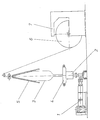
- the system consists of an extruder 1 serving to supply the plastic material and a blow head 2 directly adjoining it. This is used for the production and as the starting point for a tubular film 3 that widens upwards in the vertical direction. On the blow head 2 there is a cooling ring 4.
- the film 3 starts from the blow head 2 through the cooling ring 4, then spreads to larger diameters, cools down and is consolidated in the solidified state via a folding system. From there, the film 3, in the now flat state, arrives at the reel 6 serving for winding.
- the diameter of the roller 6 is detected by a measuring device 7, which, which can not be seen from the drawing here, this measuring device 7 is movable perpendicular to the plane of the drawing, so that the roller diameter can be recorded and recorded as a function of the axis of the roller 6. It is advantageous if, during the measurement of the diameter in the area of the measuring section, the film wound on the roll 6 is pressed against the central axis so that loose and / or tight windings can be compensated for and taken into account, so that the result of the measurement is solely due to the thickness the film 3 certain value for the diameter can be obtained.
- the result is a film blowing system that is inexpensive to manufacture and that can be used to produce plastic films of uniform thickness across the width.
Landscapes
- Engineering & Computer Science (AREA)
- Mechanical Engineering (AREA)
- Physics & Mathematics (AREA)
- Thermal Sciences (AREA)
- Manufacturing & Machinery (AREA)
- Extrusion Moulding Of Plastics Or The Like (AREA)
- Shaping By String And By Release Of Stress In Plastics And The Like (AREA)
Abstract
Für eine Folienblasanlage mit einer Rolle 6 zur Aufnahme der zunächst schlauchförmigen und dann zusammengelegten Folie 3 wird vorgeschlagen, daß der Durchmesser der Rolle 6 in Richtung der Achse gemessen und dementsprechend die Dicke, in aller Regel unterschiedlich über den Umfang des Schlauches mit Hilfe eines Stellgliedes gesteuert wird.
Description
- Die Erfindung bezieht sich auf eine Folienblasanlage mit einer Rolle zur Aufnahme der zunächst schlauchförmigen und dann zusammengelegten Folie.
- Derartige Folienblasanlagen sind bekannt und sie dienen der Herstellung eines zunächst mit Hilfe eines Blaskopfes erzeugten, anschließend zur Verringerung der Wandstärke noch in warmem Zustand verstreckten Kunststoffschlauches, welcher mit Erreichen des ausgekühlten Endzustandes flachgelegt und auf einer Rolle aufgewickelt wird. Eine andere Möglichkeit besteht im Auftrennen des Schlauches und im anschließenden, das Zusammenlegen bewirkenden Aufrollen. Aus unterschiedlichsten Gründen ergeben sich bei diesen schlauchförmigen Folien unterschiedliche Dicken über ihren Umfang. Die Abweichungen vom Mittelwert betragen auch bei genauester Justierung ohne weiteres 10 %. Bei unmittelbarem Aufwickeln der Folie auf die Rolle bilden sich unterschiedliche Wickelradien, so daß der erhaltene Durchmesser eine Funktion der Rollenachse ist. Derartige Rollen mit unterschiedlichen Radien sind für die Weiterverarbeitung unbrauchbar.
- Zur Abhilfe sind im Stand der Technik unterschiedliche Maßnahmen bekannt, deren gemeinsamer Nachteil der hohe bauliche und konstruktive Aufwand und damit kostenintensive Herstellung ist. So ist es bekannt, durch Drehen der Extrusionsanlage zu erreichen, daß sich die unterschiedlichen Dicken des Folienschlauches sukzessive über die gesamte Breite verteilen, so daß sich integral gesehen auf die Länge der Rolle der gleiche Durchmesser ergibt. Etwa die gleiche Wirkung läßt sich erreichen, wenn das Werkzeug selbst oder die anschließende Flachlegevorrichtung, in welcher der Schlauch in eine Ebene überführt wird, mit etwa gleichförmiger Rotationsgeschwindigkeit gedreht wird. Bei all diesen Verfahren ist von Nachteil, daß die unterschiedliche Wandstärke der Folie nicht beseitigt sondern aufgrund der Rotation sukzessive über die gesamte Länge der Rolle verteilt wird.
- Hiervon ausgehend hat sich die Erfindung die Weiterbildung derartiger Folienblasanlagen dahingehend zur Aufgabe gemacht, daß der Durchmesser der Rolle ebenso wie die Wandstärke der Folie vergleichmäßigt wird.
- Gelöst wird diese Aufgabe erfindungsgemäß dadurch, daß der Durchmesser der Rolle in Richtung der Achse gemessen und dementsprechend die Dicke in aller Regel unterschiedlich über den Umfang des schlauches mit Hilfe des Stellgliedes gesteuert wird.
- Der Kerngedanke vorliegender Erfindung besteht einmal darin, durch die Messung des (Außen)-Durchmessers der Rolle in Richtung der Achse die Dicke der Folie und insbesondere die Abweichung über die Breite zu erfassen. Der Wert für den Durchmesser ergibt ein Maß für die Dicke der Folie bzw. deren Abweichung; der Meßpunkt im Bezug auf die Achse der Rolle der Ort der Abweichungen hinsichtlich der Breite der Folie. Damit kann der Meßwert zur Erzeugung eines Steuersignales verwendet werden, welches einem Stellglied zugeführt wird, das seinerseits im Herstellungsstadium auf die Dicke des Schlauches Einfluß nimmt. Da in aller Regel in Längsrichtung der Rolle unterschiedliche Durchmesser ermittelt werden, ist die Einflußnahme auf die einzelnen Punkte des Schlauchumfanges unterschiedlich. In erster Näherung ergibt sich ein proportionaler Zusammenhang des Rollendurchmessers in Abhängigkeit von der Rollenachse mit der Dicke über den Umfang des Schlauches. Auf diese Weise ist eine gezielte Einflußnahme auf die Foliendicke möglich und es bedarf keiner der aus dem Stand der Technik üblichen Verteilung über die Längsachse der Rolle.
- Die hierdurch erreichbaren Vorteile sind in zweifacher Hinsicht entscheidend: Zum einen sind die Herstellungskosten einer derartigen Folienblasanlage aufgrund des Wegfalles der drehbaren Anordnung gewisser Aggregate wesentlich niedriger. Zum anderen wird erstmalig eine gleiche Wandstärke über die gesamte Breite der Folie erreichbar.
- Auf welcher Art und Weise die konkrete Einfluß nahme auf die Dicke der Folie während der Her stellung erfolgt, steht hierbei im Rahmen der Erfindung grundsätzlich frei. Mehere Möglichkeiten sind hier denkbar: So kann das Stellglied dazu benutzt werden, bereits die Austrittsmenge des Kunststoffes über den Umfang individuell einzustellen.
- In einer konkreten Ausgestaltung erfolgt dies durch die Einstellung des Düsenspaltes und/oder durch die Temperatur im Werkzeug. Der Düsenspalt gestattet eine unmittelbare Einflußnahme auf die Austrittsmenge. Die Temperatur beeinflußt die Fließfähigkeit und Orientierbarkeit der Schmelze in dem Sinne, daß eine höhere Temperatur sowohl die Fließfähigkeit als auch die Orientierbarkeit während der Strömungsphase erhöht, so daß eine Einflußnahme auf die Wandstärke möglich ist. Im umgekehrten Sinn bedingt die Erniedrigung der Temperatur eine Erhöhung der Wandstärke.
- Eine andere Möglichkeit der Einflußnahme auf die Dicke der Folie besteht in der Beeinflussung der hinter dem Blaskopf stattfindenden Verstreckung und Ausdehnung. Hierbei wird der bereits fertige Folienschlauch erst hinter dem Blaskopf über seinen Umfang auf unterschiedliche Temperaturen eingestellt, in dem der dort befindliche Kühlring über seinen Umfang gesehen unterschiedliche Kühlleistungen erbringt. Hierzu wird der Kühlring über seinen Umfang entsprechend der Meßwerte unterschiedlich eingestellt, beispielsweise dadurch, daß er in Sektoren unterteilt und die Fördermenge des einzelnen Sektors unterschiedlich eingestellt wird. Eine andere denk bare Möglichkeit bestände darin, den im wesentlichen aus zwei im Abstand zueinander angeordneten Schreiben bestehenden Kühlring in seiner Kühlleistung über den Umfang dadurch zu beeinflussen, daß wenigstens eine der Scheiben elastisch und über eine größere Anzahl über den Umfang angeordneter Stellmotoren in seiner jeweiligen Leistungsfähigkeit beeinflußt und entsprechend der Meßwerte eingestellt wird. Entscheidend ist, durch unterschiedliche Kühlung in einem ringförmigen Bereich über den Umfang des Schlauches die Temperatur und damit die Verstreckung zu beeinflussen. Auch hier bedeutet höhere Temperatur höhere Verstreckbarkeit und folglich geringere Folienstärke. Aus über den Umfang des Kühlringes unterschiedlichen Durchsatzmengen ergeben sich verschiedene Temperaturen und unterschiedliche Verstreckbarkeit, die bei entsprechender Steuerung eine gleichmäßige Dicke der Folie über den Gesamtumfang ergeben.
- In einer besonders bevorzugten Ausführungsform ist vorgeschlagen, während der Messung des Durchmessers eine Anpressung gegen die Rolle vorzunehmen. Auf diese Weise lassen sich lockere und feste Wicklungen erkennen und bei der Auswertung und Steuerung des Stellgliedes berücksichtigen. Die Anpressung kann beispielsweise dadurch erzeugt werden, daß der Meßfühler selbst gegen die Rolle gepreßt und mit Erreichen eines gewissen Druckwertes der Duchmesser erfaßt wird. Andererseits könnte die Rolle in einer Richtung zusammengepreßt und durch eine gesondert davon eingesetzte Meßvorrichtung in diesem Bereich auf optischen Wege der Durchmesser ermittelt werden. Unabhängig von einer lokkeren oder festen Wicklung erhält man einen Durchmesser der Rolle, der im wesentlichen nur noch durch die Foliendicke bestimmt wird.
- Eine andere, dem gleichen Ziel dienende Möglichkeit besteht darin, neben der Erfassung des Durchmessers der Rolle eine radiale Dichtemessung vorzunehmen, deren Resultat ebenfalls ein Maß für die lockere oder feste Wickelung ist. Die Dichtemessung kann ohne Beschränkung der Allgemeinheit durch Ultraschall erfolgen.
- Weitere Einzelheiten, Merkmale und Vorteile der Erfindung lassen sich nachfolgendem Beschreibungsteil entnehmen, indem anhand der Zeichnung ein Ausführungsbeispiel der Erfindung näher erläutert wird. Sie zeigt in schematischer Darstellung eine erfindungsgemäße Folienblasanlage.
- In allgemein bekannter Weise besteht die Anlage aus einem der Zufuhr des Kunststoffmaterials dienenden Extruder 1 und einem sich unmittelbar daran anschließenden Blaskopf 2. Dieser dient der Herstellung und als Ausgangspunkt für ein in vertikaler Richtung nach oben zu sich ausweitende schlauchförmige Folie 3. Auf dem Blaskopf 2 defindet sich ein Kühlring 4.
- Die Folie 3 bewegt sich ausgehend von Blaskopf 2 durch den Kühlring 4, verbreitet sich anschließend zu größeren Durchmessern hin, kühlt dabei aus und wird in verfestigtem Zustand über ein Faltsystem zusammengelegt. Von dort gelangt die Folie 3 in nunmehr ebenem Zustand zu der der Aufwicklung dienenden Rolle 6.
- Der Durchmesser der Rolle 6 wird über eine Meßvorrichtung 7 erfaßt, wobei, was hier nicht aus der Zeichnung entnehmbar ist, diese Meßvorrichtung 7 senkrecht zur Zeichenebene bewegbar ist, so daß der Rollendurchmesser als Funktion der Achse der Rolle 6 aufgezeichnet und erfaßt werden kann. Von Vorteil ist, wenn während der Messung des Durchmessers im Bereich der Meßstrecke eine Anpressung der auf der Rolle 6 aufgewickelten Folie zur Mittelachse hin erfolgt, damit lockere und/oder feste Wicklungen ausgeglichen und berücksichtigt werden können, so daß als Meßergebnis ein einzig durch die Dicke der Folie 3 bestimmter Wert für den Durchmesser erhaltbar wird.
- Im Ergebnis erhält man eine in der Herstellung preisgünstige Folienblasanglage, mit deren Hilfe über die Breite gleichmäßig dicke Kunststoffolien herstellbar sind.
Claims (6)
1. Folienblasanlage mit einer Rolle zur Aufnahme der zunächst schlauchförmigen und dann zusammengelegten Folie, dadurch gekennzeichnet, daß der Durchmesser der Rolle 6 in Richtung der Achse gemessen und dementsprechend die Dicke in aller Regel unterschiedlich über den Umfang des Schlauches mit Hilfe des Stellgliedes gesteuert wird.
2. Anlage nach Anspruch 1, dadurch gekennzeichnet, daß das Stellglied die Austrittsmenge des Kunststoffes über den Umfang einstellt.
3. Anlage nach Anspruch 1 oder 2, dadurch gekennzeichnet, daß das Stellglied den Düsenspalt im Werkzeug und/oder die Temperatur im Werkzeug ändert.
4. Anlage nach einem der Ansprüche 1 bis 3, dadurch gekennzeichnet, daß der Luftdurchlaß des Kühlringes 4 über seinen Umfang eingestellt wird.
5. Anlage nach einen der Ansprüche 1 bis 4, dadurch gekennzeichnet, daß während der Messung eine Anpressung gegen die Rolle 6 vorgenommen wird.
6. Anlage nach einem der Ansprüche 1 bis 5, dadurch gekennzeichnet, daß bei Messung des Durchmessers eine radiale Dichtemessung erfolgt.
Applications Claiming Priority (2)
| Application Number | Priority Date | Filing Date | Title |
|---|---|---|---|
| DE19873743721 DE3743721A1 (de) | 1987-12-23 | 1987-12-23 | Folienblasanlage mit rolle |
| DE3743721 | 1987-12-23 |
Publications (2)
| Publication Number | Publication Date |
|---|---|
| EP0321936A2 true EP0321936A2 (de) | 1989-06-28 |
| EP0321936A3 EP0321936A3 (de) | 1990-07-25 |
Family
ID=6343368
Family Applications (1)
| Application Number | Title | Priority Date | Filing Date |
|---|---|---|---|
| EP88121344A Withdrawn EP0321936A3 (de) | 1987-12-23 | 1988-12-21 | Folienblasanlage mit Rolle |
Country Status (3)
| Country | Link |
|---|---|
| US (1) | US4966536A (de) |
| EP (1) | EP0321936A3 (de) |
| DE (1) | DE3743721A1 (de) |
Cited By (3)
| Publication number | Priority date | Publication date | Assignee | Title |
|---|---|---|---|---|
| WO1991010553A1 (de) * | 1990-01-10 | 1991-07-25 | REIFENHäUSER GMBH & CO. MASCHINENFABRIK | Verfahren zur herstellung einer kunststoffolie aus thermoplastischem kunststoff |
| DE102009033171A1 (de) * | 2009-07-13 | 2011-01-27 | Hosokawa Alpine Ag | Verfahren zur Dickenregelung von gereckter Blasfolie |
| DE102016012389A1 (de) * | 2016-10-18 | 2018-04-19 | Reifenhäuser GmbH & Co. KG Maschinenfabrik | Blasfolienanlage und Verfahren zum Betreiben einer Blasfolienanlage zum Herstellen einer Folienbahn aus thermoplastischem Kunststoff |
Families Citing this family (4)
| Publication number | Priority date | Publication date | Assignee | Title |
|---|---|---|---|---|
| DE4013612A1 (de) * | 1990-01-10 | 1991-12-12 | Reifenhaeuser Masch | Verfahren zur herstellung einer kunststoffolie aus thermoplastischem kunststoff |
| DE4013611C2 (de) * | 1990-04-27 | 1994-03-31 | Reifenhaeuser Masch | Verfahren zur Herstellung einer Kunststoffolie sowie zum Aufwickeln der Kunststoffolie zu einem Coil |
| US9050760B2 (en) * | 2011-12-15 | 2015-06-09 | Ndc Technologies, Inc. | Blown film scanning method |
| CN106079405B (zh) * | 2016-06-29 | 2019-03-12 | 浙江汇锋薄膜科技有限公司 | 具有改良的收卷机构的吹膜机 |
Family Cites Families (20)
| Publication number | Priority date | Publication date | Assignee | Title |
|---|---|---|---|---|
| DD53298A (de) * | ||||
| US3286302A (en) * | 1963-12-26 | 1966-11-22 | Industrial Nucleonics Corp | Control system for maximizing the production of a material forming process |
| AT362922B (de) * | 1975-02-26 | 1981-06-25 | Cincinnati Milacron Austria | Strangpresse |
| DE2613453A1 (de) * | 1976-03-30 | 1977-10-13 | Bernhard Bruene | Wickelmaschine fuer folien |
| DE2658518C2 (de) * | 1976-12-23 | 1983-04-28 | Reifenhäuser KG, 5210 Troisdorf | Anlage zur Herstellung von Blasfolien aus thermoplastischem Kunststoff |
| DE2721609C2 (de) * | 1977-05-13 | 1986-07-10 | Reifenhäuser KG, 5210 Troisdorf | Regeleinrichtung für eine Anlage zur Herstellung von Kunststoffblasfolien |
| DE2816583A1 (de) * | 1978-04-17 | 1979-10-18 | Windmoeller & Hoelscher | Verfahren und vorrichtung zur optimierung der ausstossleistung einer blasfolienextruderanlage mittels eines prozessrechners |
| SU779093A1 (ru) * | 1978-12-04 | 1980-11-15 | Воронежский инженерно-строительный институт | Устройство дл контрол работы асбестоцементной листоформовочной машины |
| US4244897A (en) * | 1979-03-22 | 1981-01-13 | Measurex Corporation | Method and apparatus to control the density of products produced from an extrusion process |
| DE2947293C2 (de) * | 1979-11-23 | 1983-09-15 | Windmöller & Hölscher, 4540 Lengerich | Verfahren zur Regelung der Foliendicke an einer Blasfolien-Extruderanlage |
| DE3014989C2 (de) * | 1980-04-18 | 1991-01-24 | Windmöller & Hölscher, 4540 Lengerich | Verfahren zur Steuerung der Foliendicke an einer Blasfolienextruderanlage |
| GB2124966B (en) * | 1982-07-29 | 1986-05-08 | Reifenhaeuser Masch | Process and equipment for winding a flattened extrusion blown tubular plastics foil ribbon into a coil |
| US4464319A (en) * | 1982-08-05 | 1984-08-07 | Reifenhauser Gmbh & Co. Maschinenfabrik | Method of and apparatus for the coiling of flattened synthetic resin foil tubes |
| DE3347733A1 (de) * | 1983-12-31 | 1985-11-07 | Lenze GmbH & Co KG Aerzen, 3258 Aerzen | Kontaktwalzensteuerung fuer aufwickelvorrichtung |
| DE3427915C1 (de) * | 1984-07-28 | 1986-03-06 | Reifenhäuser GmbH & Co Maschinenfabrik, 5210 Troisdorf | Kalibrieraggregat einer Strangpressvorrichtung fuer thermoplastifizierten Kunststoff |
| EP0180571A3 (de) * | 1984-09-11 | 1986-11-26 | Erwin Hartl | Strangpressdüsen-Anordnung und automatisch zentrierendes Strangpress-Verfahren |
| DE3546480C2 (de) * | 1985-04-18 | 1987-02-26 | Jagenberg AG, 4000 Düsseldorf | Meßeinrichtung für die Wickelhärte eines Wickels |
| US4699580A (en) * | 1985-12-12 | 1987-10-13 | Co Yee Tiat O | Blown film tube diameter control apparatus |
| DE3631503C1 (de) * | 1986-09-16 | 1987-09-24 | Windmoeller & Hoelscher | Verfahren zur Herstellung von Rollen aus extrudierten Folienbahnen |
| DE8707626U1 (de) * | 1987-05-27 | 1987-08-13 | Alpine Ag, 8900 Augsburg | Abzugsvorrichtung für Schlauchfolien |
-
1987
- 1987-12-23 DE DE19873743721 patent/DE3743721A1/de not_active Withdrawn
-
1988
- 1988-12-21 US US07/288,006 patent/US4966536A/en not_active Expired - Fee Related
- 1988-12-21 EP EP88121344A patent/EP0321936A3/de not_active Withdrawn
Cited By (6)
| Publication number | Priority date | Publication date | Assignee | Title |
|---|---|---|---|---|
| WO1991010553A1 (de) * | 1990-01-10 | 1991-07-25 | REIFENHäUSER GMBH & CO. MASCHINENFABRIK | Verfahren zur herstellung einer kunststoffolie aus thermoplastischem kunststoff |
| US5178806A (en) * | 1990-01-10 | 1993-01-12 | Reifenhauser Gmbh & Co. Maschinenfabrik | Process for producing a plastic foil of thermoplastic material |
| DE102009033171A1 (de) * | 2009-07-13 | 2011-01-27 | Hosokawa Alpine Ag | Verfahren zur Dickenregelung von gereckter Blasfolie |
| DE102009033171B4 (de) * | 2009-07-13 | 2016-03-03 | Hosokawa Alpine Ag | Verfahren zur Regelung der Foliendicke von verstreckten Schlauchfolien sowie Vorrichtung zur Durchführung des Verfahrens |
| US9302423B2 (en) | 2009-07-13 | 2016-04-05 | Hosakawa Alpine Aktiengesellschaft | Process to regulate the thickness of oriented blown film |
| DE102016012389A1 (de) * | 2016-10-18 | 2018-04-19 | Reifenhäuser GmbH & Co. KG Maschinenfabrik | Blasfolienanlage und Verfahren zum Betreiben einer Blasfolienanlage zum Herstellen einer Folienbahn aus thermoplastischem Kunststoff |
Also Published As
| Publication number | Publication date |
|---|---|
| EP0321936A3 (de) | 1990-07-25 |
| DE3743721A1 (de) | 1989-07-06 |
| US4966536A (en) | 1990-10-30 |
Similar Documents
| Publication | Publication Date | Title |
|---|---|---|
| EP2277681B1 (de) | Verfahren und Vorrichtung zur Dickenregelung von gereckter Blasfolie | |
| DE102011018320B4 (de) | Verfahren und Vorrichtung zur Dickenprofilregelung | |
| DE2950003C2 (de) | Verfahren zur Regelung der Foliendicke an einer Blasfolien-Extruderanlage | |
| DE69016818T2 (de) | Verfahren und Vorrichtung zum Aufwickeln. | |
| DE102019215875A1 (de) | Verfahren zum Starten oder Beenden einer Folienproduktion in einer Folienmaschine, Folienmaschine und Computerprogrammprodukt | |
| EP2086744A1 (de) | Verfahren zum betrieb einer produktionsanlage zur herstellung eines stranges | |
| DE2252084C3 (de) | Verfahren zur Herstellung von thermoplastischen Folien | |
| DE102019215492B4 (de) | Blasfolienanlage und Verfahren zur Herstellung von Folienschläuchen oder Folienbahnen | |
| DE3631503C1 (de) | Verfahren zur Herstellung von Rollen aus extrudierten Folienbahnen | |
| EP4257332A1 (de) | Verfahren und vorrichtung zur foliendickenregelung von gereckter im folienblasverfahren hergestellter schlauchfolie | |
| DE3743721A1 (de) | Folienblasanlage mit rolle | |
| EP3205612B1 (de) | Verfahren zum betreiben einer verpackungsmaschine | |
| DE19631640C1 (de) | Verfahren zur Regelung der Foliendicke an einer Blasfolienanlage | |
| WO2018073083A1 (de) | Verfahren und anlage zur herstellung einer kunststofffolie | |
| DE102019107335A1 (de) | Vorrichtung und verfahren zur herstellung einer folienbahn | |
| DE102004017952B4 (de) | Vorrichtung zum Transport eines Folienschlauches | |
| EP1583649B1 (de) | Verfahren und vorrichtung zur regelung der dicke extrudierter folie | |
| EP0594018A1 (de) | Vorrichtung zum Extrudieren von Kunststoffprofilen | |
| DE4238868C2 (de) | Folienblasvorrichtung | |
| DE102019127993A1 (de) | Vorrichtung zur Herstellung von inline gereckten Schlauchfolien im Blasverfahren | |
| DE2831212C2 (de) | ||
| DE102019215782A1 (de) | Blasfolienanlage und Verfahren zur Herstellung einer Folienbahn | |
| DE102006012417A1 (de) | Vorrichtung zur Regulierung der Folientemperatur in einer Folien-Fertigungsanlage, Folien-Fertigungsanlage mit einer solchen Vorrichtung, diesbezügliches Verfahren, sowie Verwendung der Vorrichtung zur Regulierung der Folientemperatur | |
| DE9218580U1 (de) | Vorrichtung zum Extrudieren von Kunststoffprofilen | |
| EP3307513A1 (de) | Verfahren zur online-überwachung einer folienqualität sowie folienmaschine mit einer vorrichtung zur online-überwachung der folienqualität |
Legal Events
| Date | Code | Title | Description |
|---|---|---|---|
| PUAI | Public reference made under article 153(3) epc to a published international application that has entered the european phase |
Free format text: ORIGINAL CODE: 0009012 |
|
| AK | Designated contracting states |
Kind code of ref document: A2 Designated state(s): DE FR GB IT |
|
| PUAL | Search report despatched |
Free format text: ORIGINAL CODE: 0009013 |
|
| AK | Designated contracting states |
Kind code of ref document: A3 Designated state(s): DE FR GB IT |
|
| STAA | Information on the status of an ep patent application or granted ep patent |
Free format text: STATUS: THE APPLICATION HAS BEEN WITHDRAWN |
|
| 18W | Application withdrawn |
Withdrawal date: 19901110 |