EP0321919B1 - Neue Pigmente und ihre Verwendung - Google Patents
Neue Pigmente und ihre Verwendung Download PDFInfo
- Publication number
- EP0321919B1 EP0321919B1 EP88121275A EP88121275A EP0321919B1 EP 0321919 B1 EP0321919 B1 EP 0321919B1 EP 88121275 A EP88121275 A EP 88121275A EP 88121275 A EP88121275 A EP 88121275A EP 0321919 B1 EP0321919 B1 EP 0321919B1
- Authority
- EP
- European Patent Office
- Prior art keywords
- pigment
- parts
- formula
- radical
- sec
- Prior art date
- Legal status (The legal status is an assumption and is not a legal conclusion. Google has not performed a legal analysis and makes no representation as to the accuracy of the status listed.)
- Expired - Lifetime
Links
- 239000000049 pigment Substances 0.000 title claims description 116
- RAXXELZNTBOGNW-UHFFFAOYSA-N imidazole Natural products C1=CNC=N1 RAXXELZNTBOGNW-UHFFFAOYSA-N 0.000 claims description 12
- NRCMAYZCPIVABH-UHFFFAOYSA-N Quinacridone Chemical compound N1C2=CC=CC=C2C(=O)C2=C1C=C1C(=O)C3=CC=CC=C3NC1=C2 NRCMAYZCPIVABH-UHFFFAOYSA-N 0.000 claims description 8
- 125000003118 aryl group Chemical group 0.000 claims description 8
- 239000000463 material Substances 0.000 claims description 8
- 239000003973 paint Substances 0.000 claims description 8
- 229920000877 Melamine resin Polymers 0.000 claims description 7
- 125000000623 heterocyclic group Chemical group 0.000 claims description 7
- 229910052757 nitrogen Inorganic materials 0.000 claims description 7
- -1 thioindigo radical Chemical class 0.000 claims description 7
- IJGRMHOSHXDMSA-UHFFFAOYSA-N Atomic nitrogen Chemical compound N#N IJGRMHOSHXDMSA-UHFFFAOYSA-N 0.000 claims description 6
- 125000000217 alkyl group Chemical group 0.000 claims description 6
- 238000000576 coating method Methods 0.000 claims description 6
- 239000013078 crystal Substances 0.000 claims description 6
- 239000000976 ink Substances 0.000 claims description 6
- 230000000485 pigmenting effect Effects 0.000 claims description 6
- 125000003367 polycyclic group Chemical group 0.000 claims description 6
- 229920000180 alkyd Polymers 0.000 claims description 5
- YLQBMQCUIZJEEH-UHFFFAOYSA-N Furan Chemical compound C=1C=COC=1 YLQBMQCUIZJEEH-UHFFFAOYSA-N 0.000 claims description 4
- SIKJAQJRHWYJAI-UHFFFAOYSA-N Indole Chemical compound C1=CC=C2NC=CC2=C1 SIKJAQJRHWYJAI-UHFFFAOYSA-N 0.000 claims description 4
- 239000000020 Nitrocellulose Substances 0.000 claims description 4
- KAESVJOAVNADME-UHFFFAOYSA-N Pyrrole Chemical compound C=1C=CNC=1 KAESVJOAVNADME-UHFFFAOYSA-N 0.000 claims description 4
- YTPLMLYBLZKORZ-UHFFFAOYSA-N Thiophene Chemical compound C=1C=CSC=1 YTPLMLYBLZKORZ-UHFFFAOYSA-N 0.000 claims description 4
- 125000002947 alkylene group Chemical group 0.000 claims description 4
- IOJUPLGTWVMSFF-UHFFFAOYSA-N benzothiazole Chemical compound C1=CC=C2SC=NC2=C1 IOJUPLGTWVMSFF-UHFFFAOYSA-N 0.000 claims description 4
- 239000001257 hydrogen Substances 0.000 claims description 4
- 229910052739 hydrogen Inorganic materials 0.000 claims description 4
- 125000004435 hydrogen atom Chemical class [H]* 0.000 claims description 4
- 229920001220 nitrocellulos Polymers 0.000 claims description 4
- FYNROBRQIVCIQF-UHFFFAOYSA-N pyrrolo[3,2-b]pyrrole-5,6-dione Chemical compound C1=CN=C2C(=O)C(=O)N=C21 FYNROBRQIVCIQF-UHFFFAOYSA-N 0.000 claims description 4
- 229920000178 Acrylic resin Polymers 0.000 claims description 3
- 239000004925 Acrylic resin Substances 0.000 claims description 3
- NIXOWILDQLNWCW-UHFFFAOYSA-N acrylic acid group Chemical group C(C=C)(=O)O NIXOWILDQLNWCW-UHFFFAOYSA-N 0.000 claims description 3
- 125000001931 aliphatic group Chemical group 0.000 claims description 3
- PPSZHCXTGRHULJ-UHFFFAOYSA-N dioxazine Chemical compound O1ON=CC=C1 PPSZHCXTGRHULJ-UHFFFAOYSA-N 0.000 claims description 3
- DGBWPZSGHAXYGK-UHFFFAOYSA-N perinone Chemical compound C12=NC3=CC=CC=C3N2C(=O)C2=CC=C3C4=C2C1=CC=C4C(=O)N1C2=CC=CC=C2N=C13 DGBWPZSGHAXYGK-UHFFFAOYSA-N 0.000 claims description 3
- BCMCBBGGLRIHSE-UHFFFAOYSA-N 1,3-benzoxazole Chemical compound C1=CC=C2OC=NC2=C1 BCMCBBGGLRIHSE-UHFFFAOYSA-N 0.000 claims description 2
- FCEHBMOGCRZNNI-UHFFFAOYSA-N 1-benzothiophene Chemical compound C1=CC=C2SC=CC2=C1 FCEHBMOGCRZNNI-UHFFFAOYSA-N 0.000 claims description 2
- HYZJCKYKOHLVJF-UHFFFAOYSA-N 1H-benzimidazole Chemical compound C1=CC=C2NC=NC2=C1 HYZJCKYKOHLVJF-UHFFFAOYSA-N 0.000 claims description 2
- WTKZEGDFNFYCGP-UHFFFAOYSA-N Pyrazole Chemical compound C=1C=NNC=1 WTKZEGDFNFYCGP-UHFFFAOYSA-N 0.000 claims description 2
- NINIDFKCEFEMDL-UHFFFAOYSA-N Sulfur Chemical compound [S] NINIDFKCEFEMDL-UHFFFAOYSA-N 0.000 claims description 2
- PGEHNUUBUQTUJB-UHFFFAOYSA-N anthanthrone Chemical compound C1=CC=C2C(=O)C3=CC=C4C=CC=C5C(=O)C6=CC=C1C2=C6C3=C54 PGEHNUUBUQTUJB-UHFFFAOYSA-N 0.000 claims description 2
- PYKYMHQGRFAEBM-UHFFFAOYSA-N anthraquinone Natural products CCC(=O)c1c(O)c2C(=O)C3C(C=CC=C3O)C(=O)c2cc1CC(=O)OC PYKYMHQGRFAEBM-UHFFFAOYSA-N 0.000 claims description 2
- 150000004056 anthraquinones Chemical class 0.000 claims description 2
- QVGXLLKOCUKJST-UHFFFAOYSA-N atomic oxygen Chemical compound [O] QVGXLLKOCUKJST-UHFFFAOYSA-N 0.000 claims description 2
- 229910052799 carbon Inorganic materials 0.000 claims description 2
- 125000004432 carbon atom Chemical group C* 0.000 claims description 2
- 125000005842 heteroatom Chemical group 0.000 claims description 2
- 125000002768 hydroxyalkyl group Chemical group 0.000 claims description 2
- 235000019239 indanthrene blue RS Nutrition 0.000 claims description 2
- UHOKSCJSTAHBSO-UHFFFAOYSA-N indanthrone blue Chemical compound C1=CC=C2C(=O)C3=CC=C4NC5=C6C(=O)C7=CC=CC=C7C(=O)C6=CC=C5NC4=C3C(=O)C2=C1 UHOKSCJSTAHBSO-UHFFFAOYSA-N 0.000 claims description 2
- PZOUSPYUWWUPPK-UHFFFAOYSA-N indole Natural products CC1=CC=CC2=C1C=CN2 PZOUSPYUWWUPPK-UHFFFAOYSA-N 0.000 claims description 2
- RKJUIXBNRJVNHR-UHFFFAOYSA-N indolenine Natural products C1=CC=C2CC=NC2=C1 RKJUIXBNRJVNHR-UHFFFAOYSA-N 0.000 claims description 2
- PXZQEOJJUGGUIB-UHFFFAOYSA-N isoindolin-1-one Chemical compound C1=CC=C2C(=O)NCC2=C1 PXZQEOJJUGGUIB-UHFFFAOYSA-N 0.000 claims description 2
- GWVMLCQWXVFZCN-UHFFFAOYSA-N isoindoline Chemical compound C1=CC=C2CNCC2=C1 GWVMLCQWXVFZCN-UHFFFAOYSA-N 0.000 claims description 2
- BSIHWSXXPBAGTC-UHFFFAOYSA-N isoviolanthrone Chemical compound C12=CC=CC=C2C(=O)C2=CC=C3C(C4=C56)=CC=C5C5=CC=CC=C5C(=O)C6=CC=C4C4=C3C2=C1C=C4 BSIHWSXXPBAGTC-UHFFFAOYSA-N 0.000 claims description 2
- 239000000155 melt Substances 0.000 claims description 2
- OBJNZHVOCNPSCS-UHFFFAOYSA-N naphtho[2,3-f]quinazoline Chemical compound C1=NC=C2C3=CC4=CC=CC=C4C=C3C=CC2=N1 OBJNZHVOCNPSCS-UHFFFAOYSA-N 0.000 claims description 2
- 150000002916 oxazoles Chemical class 0.000 claims description 2
- 229910052760 oxygen Inorganic materials 0.000 claims description 2
- 239000001301 oxygen Substances 0.000 claims description 2
- CSHWQDPOILHKBI-UHFFFAOYSA-N peryrene Natural products C1=CC(C2=CC=CC=3C2=C2C=CC=3)=C3C2=CC=CC3=C1 CSHWQDPOILHKBI-UHFFFAOYSA-N 0.000 claims description 2
- IEQIEDJGQAUEQZ-UHFFFAOYSA-N phthalocyanine Chemical compound N1C(N=C2C3=CC=CC=C3C(N=C3C4=CC=CC=C4C(=N4)N3)=N2)=C(C=CC=C2)C2=C1N=C1C2=CC=CC=C2C4=N1 IEQIEDJGQAUEQZ-UHFFFAOYSA-N 0.000 claims description 2
- 239000004033 plastic Substances 0.000 claims description 2
- 229920003023 plastic Polymers 0.000 claims description 2
- LLBIOIRWAYBCKK-UHFFFAOYSA-N pyranthrene-8,16-dione Chemical compound C12=CC=CC=C2C(=O)C2=CC=C3C=C4C5=CC=CC=C5C(=O)C5=C4C4=C3C2=C1C=C4C=C5 LLBIOIRWAYBCKK-UHFFFAOYSA-N 0.000 claims description 2
- IZMJMCDDWKSTTK-UHFFFAOYSA-N quinoline yellow Chemical compound C1=CC=CC2=NC(C3C(C4=CC=CC=C4C3=O)=O)=CC=C21 IZMJMCDDWKSTTK-UHFFFAOYSA-N 0.000 claims description 2
- 238000009987 spinning Methods 0.000 claims description 2
- 229910052717 sulfur Inorganic materials 0.000 claims description 2
- 239000011593 sulfur Substances 0.000 claims description 2
- 150000003557 thiazoles Chemical class 0.000 claims description 2
- 229930192474 thiophene Natural products 0.000 claims description 2
- 150000003852 triazoles Chemical class 0.000 claims description 2
- 150000003254 radicals Chemical class 0.000 claims 4
- JDSHMPZPIAZGSV-UHFFFAOYSA-N melamine Chemical compound NC1=NC(N)=NC(N)=N1 JDSHMPZPIAZGSV-UHFFFAOYSA-N 0.000 claims 1
- 125000002080 perylenyl group Chemical group C1(=CC=C2C=CC=C3C4=CC=CC5=CC=CC(C1=C23)=C45)* 0.000 claims 1
- 150000001875 compounds Chemical class 0.000 description 28
- 238000000518 rheometry Methods 0.000 description 25
- 239000000203 mixture Substances 0.000 description 21
- HEMHJVSKTPXQMS-UHFFFAOYSA-M Sodium hydroxide Chemical compound [OH-].[Na+] HEMHJVSKTPXQMS-UHFFFAOYSA-M 0.000 description 18
- 239000004922 lacquer Substances 0.000 description 18
- 239000000047 product Substances 0.000 description 18
- XLYOFNOQVPJJNP-UHFFFAOYSA-N water Substances O XLYOFNOQVPJJNP-UHFFFAOYSA-N 0.000 description 15
- 238000005189 flocculation Methods 0.000 description 13
- ZXEKIIBDNHEJCQ-UHFFFAOYSA-N isobutanol Chemical compound CC(C)CO ZXEKIIBDNHEJCQ-UHFFFAOYSA-N 0.000 description 12
- 230000016615 flocculation Effects 0.000 description 11
- 239000002966 varnish Substances 0.000 description 10
- 230000007935 neutral effect Effects 0.000 description 9
- QAOWNCQODCNURD-UHFFFAOYSA-N Sulfuric acid Chemical compound OS(O)(=O)=O QAOWNCQODCNURD-UHFFFAOYSA-N 0.000 description 8
- 239000006185 dispersion Substances 0.000 description 8
- 0 CCC(C)(C)C(*)(*)N(C(C1C(c2ccccc2)N2)=O)C(c3ccccc3)=C1C2=O Chemical compound CCC(C)(C)C(*)(*)N(C(C1C(c2ccccc2)N2)=O)C(c3ccccc3)=C1C2=O 0.000 description 7
- 238000000034 method Methods 0.000 description 7
- 230000019612 pigmentation Effects 0.000 description 7
- QTBSBXVTEAMEQO-UHFFFAOYSA-N Acetic acid Chemical compound CC(O)=O QTBSBXVTEAMEQO-UHFFFAOYSA-N 0.000 description 6
- 238000009826 distribution Methods 0.000 description 6
- 238000004519 manufacturing process Methods 0.000 description 6
- 238000012360 testing method Methods 0.000 description 6
- FVDOBFPYBSDRKH-UHFFFAOYSA-N perylene-3,4,9,10-tetracarboxylic acid Chemical compound C=12C3=CC=C(C(O)=O)C2=C(C(O)=O)C=CC=1C1=CC=C(C(O)=O)C2=C1C3=CC=C2C(=O)O FVDOBFPYBSDRKH-UHFFFAOYSA-N 0.000 description 5
- 150000003839 salts Chemical class 0.000 description 5
- 239000002904 solvent Substances 0.000 description 5
- 238000003756 stirring Methods 0.000 description 5
- UBHDUFNPQJWPRQ-UHFFFAOYSA-N (5-methyl-1h-imidazol-3-ium-4-yl)methanol;chloride Chemical compound Cl.CC=1NC=NC=1CO UBHDUFNPQJWPRQ-UHFFFAOYSA-N 0.000 description 4
- TXWSZJSDZKWQAU-UHFFFAOYSA-N 2,9-dimethyl-5,12-dihydroquinolino[2,3-b]acridine-7,14-dione Chemical compound N1C2=CC=C(C)C=C2C(=O)C2=C1C=C(C(=O)C=1C(=CC=C(C=1)C)N1)C1=C2 TXWSZJSDZKWQAU-UHFFFAOYSA-N 0.000 description 4
- 239000004640 Melamine resin Substances 0.000 description 4
- BAVYZALUXZFZLV-UHFFFAOYSA-N Methylamine Chemical compound NC BAVYZALUXZFZLV-UHFFFAOYSA-N 0.000 description 4
- 229920000137 polyphosphoric acid Polymers 0.000 description 4
- 229920005989 resin Polymers 0.000 description 4
- 239000011347 resin Substances 0.000 description 4
- 238000006467 substitution reaction Methods 0.000 description 4
- 229930040373 Paraformaldehyde Natural products 0.000 description 3
- GTDPSWPPOUPBNX-UHFFFAOYSA-N ac1mqpva Chemical compound CC12C(=O)OC(=O)C1(C)C1(C)C2(C)C(=O)OC1=O GTDPSWPPOUPBNX-UHFFFAOYSA-N 0.000 description 3
- 239000002253 acid Substances 0.000 description 3
- 239000002585 base Substances 0.000 description 3
- 239000011324 bead Substances 0.000 description 3
- 238000006243 chemical reaction Methods 0.000 description 3
- 238000009833 condensation Methods 0.000 description 3
- 230000005494 condensation Effects 0.000 description 3
- 238000001035 drying Methods 0.000 description 3
- 239000012065 filter cake Substances 0.000 description 3
- 238000001914 filtration Methods 0.000 description 3
- 125000001570 methylene group Chemical group [H]C([H])([*:1])[*:2] 0.000 description 3
- 239000011368 organic material Substances 0.000 description 3
- FWFGVMYFCODZRD-UHFFFAOYSA-N oxidanium;hydrogen sulfate Chemical compound O.OS(O)(=O)=O FWFGVMYFCODZRD-UHFFFAOYSA-N 0.000 description 3
- 229920002866 paraformaldehyde Polymers 0.000 description 3
- 238000002360 preparation method Methods 0.000 description 3
- 235000011149 sulphuric acid Nutrition 0.000 description 3
- 239000000725 suspension Substances 0.000 description 3
- LXBGSDVWAMZHDD-UHFFFAOYSA-N 2-methyl-1h-imidazole Chemical compound CC1=NC=CN1 LXBGSDVWAMZHDD-UHFFFAOYSA-N 0.000 description 2
- UXVMQQNJUSDDNG-UHFFFAOYSA-L Calcium chloride Chemical compound [Cl-].[Cl-].[Ca+2] UXVMQQNJUSDDNG-UHFFFAOYSA-L 0.000 description 2
- VEXZGXHMUGYJMC-UHFFFAOYSA-M Chloride anion Chemical compound [Cl-] VEXZGXHMUGYJMC-UHFFFAOYSA-M 0.000 description 2
- 239000011248 coating agent Substances 0.000 description 2
- 239000007859 condensation product Substances 0.000 description 2
- 238000001816 cooling Methods 0.000 description 2
- XCJYREBRNVKWGJ-UHFFFAOYSA-N copper(II) phthalocyanine Chemical compound [Cu+2].C12=CC=CC=C2C(N=C2[N-]C(C3=CC=CC=C32)=N2)=NC1=NC([C]1C=CC=CC1=1)=NC=1N=C1[C]3C=CC=CC3=C2[N-]1 XCJYREBRNVKWGJ-UHFFFAOYSA-N 0.000 description 2
- 238000009837 dry grinding Methods 0.000 description 2
- 150000002148 esters Chemical class 0.000 description 2
- 238000000227 grinding Methods 0.000 description 2
- 125000004029 hydroxymethyl group Chemical group [H]OC([H])([H])* 0.000 description 2
- RVTZCBVAJQQJTK-UHFFFAOYSA-N oxygen(2-);zirconium(4+) Chemical compound [O-2].[O-2].[Zr+4] RVTZCBVAJQQJTK-UHFFFAOYSA-N 0.000 description 2
- 125000001997 phenyl group Chemical group [H]C1=C([H])C([H])=C(*)C([H])=C1[H] 0.000 description 2
- 238000012545 processing Methods 0.000 description 2
- 238000006798 ring closing metathesis reaction Methods 0.000 description 2
- 239000000344 soap Substances 0.000 description 2
- 239000000126 substance Substances 0.000 description 2
- 238000001238 wet grinding Methods 0.000 description 2
- 229910001928 zirconium oxide Inorganic materials 0.000 description 2
- AXJZCJSXNZZMDU-UHFFFAOYSA-N (5-methyl-1h-imidazol-4-yl)methanol Chemical compound CC=1N=CNC=1CO AXJZCJSXNZZMDU-UHFFFAOYSA-N 0.000 description 1
- BGJSXRVXTHVRSN-UHFFFAOYSA-N 1,3,5-trioxane Chemical compound C1OCOCO1 BGJSXRVXTHVRSN-UHFFFAOYSA-N 0.000 description 1
- 238000005160 1H NMR spectroscopy Methods 0.000 description 1
- KORIJXKQGMTQTO-UHFFFAOYSA-N 1h-pyrrol-2-ylmethanol Chemical compound OCC1=CC=CN1 KORIJXKQGMTQTO-UHFFFAOYSA-N 0.000 description 1
- FVLUGNOOEZYDNV-UHFFFAOYSA-N 2,5-bis(4-methylanilino)terephthalic acid Chemical compound C1=CC(C)=CC=C1NC(C(=C1)C(O)=O)=CC(C(O)=O)=C1NC1=CC=C(C)C=C1 FVLUGNOOEZYDNV-UHFFFAOYSA-N 0.000 description 1
- ZJQZWNLKRBUEKX-UHFFFAOYSA-N 2,5-dianilinoterephthalic acid Chemical compound OC(=O)C=1C=C(NC=2C=CC=CC=2)C(C(=O)O)=CC=1NC1=CC=CC=C1 ZJQZWNLKRBUEKX-UHFFFAOYSA-N 0.000 description 1
- DSLRVRBSNLHVBH-UHFFFAOYSA-N 2,5-furandimethanol Chemical compound OCC1=CC=C(CO)O1 DSLRVRBSNLHVBH-UHFFFAOYSA-N 0.000 description 1
- OXEUETBFKVCRNP-UHFFFAOYSA-N 9-ethyl-3-carbazolamine Chemical compound NC1=CC=C2N(CC)C3=CC=CC=C3C2=C1 OXEUETBFKVCRNP-UHFFFAOYSA-N 0.000 description 1
- 239000001856 Ethyl cellulose Substances 0.000 description 1
- ZZSNKZQZMQGXPY-UHFFFAOYSA-N Ethyl cellulose Chemical compound CCOCC1OC(OC)C(OCC)C(OCC)C1OC1C(O)C(O)C(OC)C(CO)O1 ZZSNKZQZMQGXPY-UHFFFAOYSA-N 0.000 description 1
- LGRFSURHDFAFJT-UHFFFAOYSA-N Phthalic anhydride Natural products C1=CC=C2C(=O)OC(=O)C2=C1 LGRFSURHDFAFJT-UHFFFAOYSA-N 0.000 description 1
- 239000004952 Polyamide Substances 0.000 description 1
- 239000004698 Polyethylene Substances 0.000 description 1
- 239000004743 Polypropylene Substances 0.000 description 1
- 239000004793 Polystyrene Substances 0.000 description 1
- 229920002125 Sokalan® Polymers 0.000 description 1
- QAOWNCQODCNURD-ZSJDYOACSA-N Sulfuric acid-d2 Chemical compound [2H]OS(=O)(=O)O[2H] QAOWNCQODCNURD-ZSJDYOACSA-N 0.000 description 1
- XSQUKJJJFZCRTK-UHFFFAOYSA-N Urea Chemical compound NC(N)=O XSQUKJJJFZCRTK-UHFFFAOYSA-N 0.000 description 1
- 229920001807 Urea-formaldehyde Polymers 0.000 description 1
- GLLRIXZGBQOFLM-UHFFFAOYSA-N Xanthorin Natural products C1=C(C)C=C2C(=O)C3=C(O)C(OC)=CC(O)=C3C(=O)C2=C1O GLLRIXZGBQOFLM-UHFFFAOYSA-N 0.000 description 1
- QSLDNQDWZXDJRW-UHFFFAOYSA-N [4-(hydroxymethyl)-2-propan-2-yl-1h-imidazol-5-yl]methanol Chemical compound CC(C)C1=NC(CO)=C(CO)N1 QSLDNQDWZXDJRW-UHFFFAOYSA-N 0.000 description 1
- 230000002378 acidificating effect Effects 0.000 description 1
- 150000007513 acids Chemical class 0.000 description 1
- 229920003180 amino resin Polymers 0.000 description 1
- 239000007900 aqueous suspension Substances 0.000 description 1
- 150000004982 aromatic amines Chemical class 0.000 description 1
- QRUDEWIWKLJBPS-UHFFFAOYSA-N benzotriazole Chemical compound C1=CC=C2N[N][N]C2=C1 QRUDEWIWKLJBPS-UHFFFAOYSA-N 0.000 description 1
- 239000012964 benzotriazole Substances 0.000 description 1
- MPFUOCVWJGGDQN-UHFFFAOYSA-N butan-1-ol;1,2-xylene Chemical group CCCCO.CC1=CC=CC=C1C MPFUOCVWJGGDQN-UHFFFAOYSA-N 0.000 description 1
- JHIWVOJDXOSYLW-UHFFFAOYSA-N butyl 2,2-difluorocyclopropane-1-carboxylate Chemical compound CCCCOC(=O)C1CC1(F)F JHIWVOJDXOSYLW-UHFFFAOYSA-N 0.000 description 1
- QHIWVLPBUQWDMQ-UHFFFAOYSA-N butyl prop-2-enoate;methyl 2-methylprop-2-enoate;prop-2-enoic acid Chemical compound OC(=O)C=C.COC(=O)C(C)=C.CCCCOC(=O)C=C QHIWVLPBUQWDMQ-UHFFFAOYSA-N 0.000 description 1
- 238000004364 calculation method Methods 0.000 description 1
- 239000004202 carbamide Substances 0.000 description 1
- 239000005018 casein Substances 0.000 description 1
- BECPQYXYKAMYBN-UHFFFAOYSA-N casein, tech. Chemical compound NCCCCC(C(O)=O)N=C(O)C(CC(O)=O)N=C(O)C(CCC(O)=N)N=C(O)C(CC(C)C)N=C(O)C(CCC(O)=O)N=C(O)C(CC(O)=O)N=C(O)C(CCC(O)=O)N=C(O)C(C(C)O)N=C(O)C(CCC(O)=N)N=C(O)C(CCC(O)=N)N=C(O)C(CCC(O)=N)N=C(O)C(CCC(O)=O)N=C(O)C(CCC(O)=O)N=C(O)C(COP(O)(O)=O)N=C(O)C(CCC(O)=N)N=C(O)C(N)CC1=CC=CC=C1 BECPQYXYKAMYBN-UHFFFAOYSA-N 0.000 description 1
- 235000021240 caseins Nutrition 0.000 description 1
- 229920002678 cellulose Polymers 0.000 description 1
- 229920002301 cellulose acetate Polymers 0.000 description 1
- 229920001727 cellulose butyrate Polymers 0.000 description 1
- 229920003086 cellulose ether Polymers 0.000 description 1
- 238000001311 chemical methods and process Methods 0.000 description 1
- 239000003086 colorant Substances 0.000 description 1
- 238000004040 coloring Methods 0.000 description 1
- 230000007547 defect Effects 0.000 description 1
- 210000003298 dental enamel Anatomy 0.000 description 1
- 238000001212 derivatisation Methods 0.000 description 1
- 235000014113 dietary fatty acids Nutrition 0.000 description 1
- 238000004821 distillation Methods 0.000 description 1
- 238000007580 dry-mixing Methods 0.000 description 1
- 239000000975 dye Substances 0.000 description 1
- 238000004043 dyeing Methods 0.000 description 1
- 229920001971 elastomer Polymers 0.000 description 1
- 229920001249 ethyl cellulose Polymers 0.000 description 1
- 235000019325 ethyl cellulose Nutrition 0.000 description 1
- 239000000194 fatty acid Substances 0.000 description 1
- 229930195729 fatty acid Natural products 0.000 description 1
- 150000004665 fatty acids Chemical class 0.000 description 1
- 230000002349 favourable effect Effects 0.000 description 1
- 238000007730 finishing process Methods 0.000 description 1
- 238000001595 flow curve Methods 0.000 description 1
- WSFSSNUMVMOOMR-UHFFFAOYSA-N formaldehyde Substances O=C WSFSSNUMVMOOMR-UHFFFAOYSA-N 0.000 description 1
- 239000012458 free base Substances 0.000 description 1
- 239000011521 glass Substances 0.000 description 1
- RBTKNAXYKSUFRK-UHFFFAOYSA-N heliogen blue Chemical compound [Cu].[N-]1C2=C(C=CC=C3)C3=C1N=C([N-]1)C3=CC=CC=C3C1=NC([N-]1)=C(C=CC=C3)C3=C1N=C([N-]1)C3=CC=CC=C3C1=N2 RBTKNAXYKSUFRK-UHFFFAOYSA-N 0.000 description 1
- 230000007062 hydrolysis Effects 0.000 description 1
- 238000006460 hydrolysis reaction Methods 0.000 description 1
- 239000005457 ice water Substances 0.000 description 1
- 125000002883 imidazolyl group Chemical group 0.000 description 1
- IVYPNXXAYMYVSP-UHFFFAOYSA-N indole-3-methanol Chemical compound C1=CC=C2C(CO)=CNC2=C1 IVYPNXXAYMYVSP-UHFFFAOYSA-N 0.000 description 1
- 238000002955 isolation Methods 0.000 description 1
- 239000007788 liquid Substances 0.000 description 1
- 238000005259 measurement Methods 0.000 description 1
- 238000010297 mechanical methods and process Methods 0.000 description 1
- 230000005226 mechanical processes and functions Effects 0.000 description 1
- WSFSSNUMVMOOMR-NJFSPNSNSA-N methanone Chemical compound O=[14CH2] WSFSSNUMVMOOMR-NJFSPNSNSA-N 0.000 description 1
- 238000002156 mixing Methods 0.000 description 1
- 238000012986 modification Methods 0.000 description 1
- 239000000025 natural resin Substances 0.000 description 1
- 238000000655 nuclear magnetic resonance spectrum Methods 0.000 description 1
- 150000007524 organic acids Chemical class 0.000 description 1
- 235000005985 organic acids Nutrition 0.000 description 1
- 150000002894 organic compounds Chemical class 0.000 description 1
- 239000003960 organic solvent Substances 0.000 description 1
- 239000002245 particle Substances 0.000 description 1
- 229920001568 phenolic resin Polymers 0.000 description 1
- 239000004584 polyacrylic acid Substances 0.000 description 1
- 229920002239 polyacrylonitrile Polymers 0.000 description 1
- 229920002647 polyamide Polymers 0.000 description 1
- 229920000515 polycarbonate Polymers 0.000 description 1
- 239000004417 polycarbonate Substances 0.000 description 1
- 229920000728 polyester Polymers 0.000 description 1
- 229920000573 polyethylene Polymers 0.000 description 1
- 238000006116 polymerization reaction Methods 0.000 description 1
- 229920000098 polyolefin Polymers 0.000 description 1
- 229920001155 polypropylene Polymers 0.000 description 1
- 229920001296 polysiloxane Polymers 0.000 description 1
- 229920002223 polystyrene Polymers 0.000 description 1
- 229920002635 polyurethane Polymers 0.000 description 1
- 239000004814 polyurethane Substances 0.000 description 1
- 229920000915 polyvinyl chloride Polymers 0.000 description 1
- 239000004800 polyvinyl chloride Substances 0.000 description 1
- 239000004540 pour-on Substances 0.000 description 1
- 239000002244 precipitate Substances 0.000 description 1
- 238000001556 precipitation Methods 0.000 description 1
- 239000002243 precursor Substances 0.000 description 1
- 239000012429 reaction media Substances 0.000 description 1
- 239000001054 red pigment Substances 0.000 description 1
- WBHHMMIMDMUBKC-QJWNTBNXSA-N ricinoleic acid Chemical compound CCCCCC[C@@H](O)C\C=C/CCCCCCCC(O)=O WBHHMMIMDMUBKC-QJWNTBNXSA-N 0.000 description 1
- 229960003656 ricinoleic acid Drugs 0.000 description 1
- 238000004062 sedimentation Methods 0.000 description 1
- 229920002050 silicone resin Polymers 0.000 description 1
- 239000000243 solution Substances 0.000 description 1
- 238000003860 storage Methods 0.000 description 1
- 125000001424 substituent group Chemical group 0.000 description 1
- 125000000542 sulfonic acid group Chemical group 0.000 description 1
- 229920003002 synthetic resin Polymers 0.000 description 1
- 239000000057 synthetic resin Substances 0.000 description 1
- UGNWTBMOAKPKBL-UHFFFAOYSA-N tetrachloro-1,4-benzoquinone Chemical compound ClC1=C(Cl)C(=O)C(Cl)=C(Cl)C1=O UGNWTBMOAKPKBL-UHFFFAOYSA-N 0.000 description 1
- JOUDBUYBGJYFFP-FOCLMDBBSA-N thioindigo Chemical group S\1C2=CC=CC=C2C(=O)C/1=C1/C(=O)C2=CC=CC=C2S1 JOUDBUYBGJYFFP-FOCLMDBBSA-N 0.000 description 1
- ZPHGMBGIFODUMF-UHFFFAOYSA-N thiophen-2-ylmethanol Chemical compound OCC1=CC=CS1 ZPHGMBGIFODUMF-UHFFFAOYSA-N 0.000 description 1
- 230000007704 transition Effects 0.000 description 1
- 239000012463 white pigment Substances 0.000 description 1
Images


Classifications
-
- C—CHEMISTRY; METALLURGY
- C09—DYES; PAINTS; POLISHES; NATURAL RESINS; ADHESIVES; COMPOSITIONS NOT OTHERWISE PROVIDED FOR; APPLICATIONS OF MATERIALS NOT OTHERWISE PROVIDED FOR
- C09B—ORGANIC DYES OR CLOSELY-RELATED COMPOUNDS FOR PRODUCING DYES, e.g. PIGMENTS; MORDANTS; LAKES
- C09B69/00—Dyes not provided for by a single group of this subclass
-
- C—CHEMISTRY; METALLURGY
- C09—DYES; PAINTS; POLISHES; NATURAL RESINS; ADHESIVES; COMPOSITIONS NOT OTHERWISE PROVIDED FOR; APPLICATIONS OF MATERIALS NOT OTHERWISE PROVIDED FOR
- C09B—ORGANIC DYES OR CLOSELY-RELATED COMPOUNDS FOR PRODUCING DYES, e.g. PIGMENTS; MORDANTS; LAKES
- C09B19/00—Oxazine dyes
- C09B19/02—Bisoxazines prepared from aminoquinones
-
- C—CHEMISTRY; METALLURGY
- C09—DYES; PAINTS; POLISHES; NATURAL RESINS; ADHESIVES; COMPOSITIONS NOT OTHERWISE PROVIDED FOR; APPLICATIONS OF MATERIALS NOT OTHERWISE PROVIDED FOR
- C09B—ORGANIC DYES OR CLOSELY-RELATED COMPOUNDS FOR PRODUCING DYES, e.g. PIGMENTS; MORDANTS; LAKES
- C09B47/00—Porphines; Azaporphines
- C09B47/04—Phthalocyanines abbreviation: Pc
- C09B47/08—Preparation from other phthalocyanine compounds, e.g. cobaltphthalocyanineamine complex
- C09B47/12—Obtaining compounds having alkyl radicals, or alkyl radicals substituted by hetero atoms, bound to the phthalocyanine skeleton
-
- C—CHEMISTRY; METALLURGY
- C09—DYES; PAINTS; POLISHES; NATURAL RESINS; ADHESIVES; COMPOSITIONS NOT OTHERWISE PROVIDED FOR; APPLICATIONS OF MATERIALS NOT OTHERWISE PROVIDED FOR
- C09B—ORGANIC DYES OR CLOSELY-RELATED COMPOUNDS FOR PRODUCING DYES, e.g. PIGMENTS; MORDANTS; LAKES
- C09B5/00—Dyes with an anthracene nucleus condensed with one or more heterocyclic rings with or without carbocyclic rings
- C09B5/62—Cyclic imides or amidines of peri-dicarboxylic acids of the anthracene, benzanthrene, or perylene series
Definitions
- the present invention relates to new pigments with improved flocculation stabilities and rheological properties and to their use for pigmenting high-molecular materials.
- Pigment compositions are known from DE-OS 3106906 and JP 58/145762, JP 58/225159 and JP 58/225160, which have improved flocculation stability and more favorable rheological properties in coating systems.
- the pigment derivatives used for this purpose have to be produced in a multi-stage process. The procedure described there leads to unsatisfactory yields and results in several cases and cannot be used for some pigment classes.
- the compounds mentioned there have different structures in which, in contrast to aromatic amines, aliphatic amines are used for their preparation.
- the methylene groups are linked on the one hand for example via CO and SO2 groups, on the other hand on the nitrogen of the aliphatic amines.
- the methylene group is, on the one hand, bound directly to the coloring pigment residue. Furthermore, pigments are combined with chemically unrelated pigment derivatives in accordance with the aforementioned Japanese laid-open publications.
- the aim of the present invention was to provide pigments with improved flocculation stability and rheological properties which are suitable for dyeing high molecular weight materials.
- A represents a five- or six-membered aromatic, optionally condensed heterocycle which contains one to three heteroatoms from the series nitrogen and / or oxygen and / or sulfur and which is bonded to the methylene group via a carbon atom
- R3 is hydrogen, alkyl C1-C4, hydroxyalkyl C1-C3 or alkylene C2 and wherein the alkyl groups can be linear or branched
- P represents the residue of a polycyclic pigment and n represents a number from 0.001 to 0.2.
- P is the residue of a polycyclic pigment, preferably an anthraquinone, anthrapyrimidine, Anthanthrone, quinacridone, quinophthalone, diketopyrrolopyrrole, dioxazine, flavanthrone, indanthrone isoindoline, isoindolinone, isoviolanthrone, perinone perylene, phthalocyanine, pyranthrone or thioindigo residue P can also be the remainder of a mixed crystal from polycrystalline group, poly from polycrystalline group of the pigment classes mentioned above.
- a polycyclic pigment preferably an anthraquinone, anthrapyrimidine, Anthanthrone, quinacridone, quinophthalone, diketopyrrolopyrrole, dioxazine, flavanthrone, indanthrone isoindoline, isoindolinone, isoviolanthrone, perinone perylene, phthalo
- Suitable five-membered aromatic heterocycles A are preferably furan, thiophene, pyrrole, pyrazole, thiazoles, oxazoles, triazoles and in particular imidazole.
- n depends on the chemical constitution, the crystal and surface properties of the pigment and the properties of the application medium and must be determined for each combination of pigment / application medium through tests in individual cases. Too low or too high values of n do not lead to the optimal pigment properties.
- pigment is to be understood as a product of the formula (I) mentioned, in which n ⁇ 0.2, and the term “pigment derivative” is a product of the formula (I), in which n> 0.2 is.
- the pigment derivatives of the above general formula (I) substituted by aromatic, optionally condensed methylene heterocycles can be prepared in the following ways: They can be prepared by known processes either from hydroxymethyl heterocycles or from heterocycles in the presence of formaldehyde-donating substances, such as, for example, paraformaldehyde or trioxane, in the acidic reaction medium, such as, for example, sulfuric acid, oleum or polyphosphoric acid, in the presence of the pigments mentioned, it being advantageous to add an acid choose in which the respective pigment is soluble.
- formaldehyde-donating substances such as, for example, paraformaldehyde or trioxane
- the acidic reaction medium such as, for example, sulfuric acid, oleum or polyphosphoric acid
- Sulfuric acid or oleum as a condensation medium can be incorporated to a small extent into sulfonic acid groups.
- heterocycles which contain more than one hydroxymethyl group or in the case of an excess of formaldehyde, it is possible for the hydroxymethyl groups of a heterocycle to react repeatedly with pigment residues.
- the degree of substitution n of the polycyclic pigment P can be achieved directly.
- a pigment derivative of the formula I can also be prepared and adjusted to the final degree of substitution n in a further step. This setting of the degree of substitution n can be carried out in a subsequent process step (fine distribution, finish, wet or dry grinding, final mixing).
- the degree of substitution n can be set in the course of a fine distribution before or after a fine distribution process or during a fine distribution process.
- the Fine distribution can be carried out by a mechanical process, for example wet or dry grinding, or by a chemical process, for example dissolving in strong acids or alkalis and subsequent precipitation or overturning.
- the final setting can also be carried out in a finishing process in an aqueous and / or solvent-containing system.
- the pigment derivative of the formula I can be added in the form of the free base or in the form of the salt, for example in dissolved form in suitable solvents, with suitable control of the pH.
- Isolation of the pigment in a weakly alkaline medium at a pH of about 8 to about 11 is preferred.
- the final setting can also be carried out by dry mixing, for example in a mill.
- the pigments according to the invention are particularly suitable for pigmenting high molecular weight organic materials.
- High molecular weight organic materials which can be pigmented with the products of the formula I mentioned are, for example, cellulose ethers and esters, such as ethyl cellulose, nitrocellulose, cellulose acetate, cellulose butyrate, natural resins or synthetic resins, such as polymerization resins or condensation resins, for example Aminoplasts, especially urea and melamine-formaldehyde resins, alkyd resins, acrylic resins, phenoplasts, polycarbonates, polyolefins, such as polystyrene, polyvinyl chloride, polyethylene, polypropylene, polyacrylonitrile, polyacrylic acid esters, polyamides, polyurethanes or polyesters, rubber, casein, silicone and silicone resins, individually or in Mixtures.
- cellulose ethers and esters such as ethyl cellulose, nitrocellulose, cellulose acetate,
- the high-molecular organic compounds mentioned are in the form of plastic masses, melts or in the form of spinning solutions, lacquers, paints or printing inks. Depending on the intended use, it proves advantageous to use the pigments according to the invention as toners or in the form of preparations or dispersions.
- the compounds of the formula I mentioned are used in an amount of preferably 0.1 to 10% by weight.
- lacquer systems are stoving lacquers from the class of alkyd melamine resin or acrylic melamine resin lacquers and two-component lacquers based on polyisocyanate-crosslinkable acrylic resins.
- lacquers from the class of alkyd melamine resin or acrylic melamine resin lacquers and two-component lacquers based on polyisocyanate-crosslinkable acrylic resins.
- printing inks printing inks based on nitrocellulose are particularly worth mentioning.
- the pigments according to the invention are light in many application media and dispersible to high finenesses.
- dispersions have high flocculation stability and show excellent rheological properties even with high pigmentation. They can be used to produce coatings and prints of high color strength, high gloss and high transparency with excellent fastness properties.
- the pigments according to the invention are compounds which are insoluble in such media and which are present in one phase and which are also not present in the customary organic solvents go into solution and thus have excellent fastness properties.
- an alkyd-melamine resin lacquer (AM) based on a medium-oil, non-drying alkyd resin made of synthetic fatty acids and phthalic anhydride and a butanol-etherified melamine resin and proportions of a non-drying alkyd resin based on ricinic acid (short-oiled) as well as a was from the large number of known systems Acrylic stoving enamel based on a non-aqueous dispersion (TSA-NAD) selected.
- TSA-NAD non-aqueous dispersion
- the viscosity can be assessed with the Rossmann viscospatula, type 301 from Erichsen.
- parts mean parts by weight.
- a commercially available AM lacquer is pigmented 12% with the compound of the above formula. After a dispersion of 45 minutes with glass beads of 3 mm ⁇ , the rheology of the mill base is rated 4, while a correspondingly produced mill base with the unsubstituted pigment shows a rheology of grade 1.
- the 4% pigmented full-tone paint has a viscosity of 3.6 seconds compared to 6.2 seconds for the unsubstituted pigment.
- the full-tone paint is adjusted to a viscosity by adding an n-butanol-xylene mixture (1: 1), which corresponds to a run-out time in the Ford cup (nozzle 4 mm mm) of 22 seconds.
- the varnish is then poured onto a film and baked at 140 ° C for 30 minutes after it has been vented.
- the gloss value is 86 compared to 42 for the unsubstituted pigment.
- magenta pigment shows better rheological and coloristic behavior in the AM varnish than the unsubstituted product.
- Example 13 comparison Rheology 5 1 to 2 viscosity 2.9 sec 6.2 sec shine 94 40
- 21.8 parts of the pigment derivative of the formula are obtained 180 parts of the by reaction of tetrachloro-p-benzoquinone with 2 moles of 3-amino-9-ethylcarbazole to form 2,5-di- (9-ethylcarbazol-3-yl-amino) -3,6-dichlorobenzoquinone- (1,4 ) and subsequent ring closure to the crude pigment CI Violet 23, CI 51319 (cf.
- the pigment obtained has a significantly lower rheology in the AM lacquer and a lower viscosity than the untreated pigment.
- Example 14 comparison Rheology 5 1 to 2 viscosity 4.9 sec 7.1 sec
- the pigment obtained has a significantly better rheology and a lower viscosity than the comparison.
- Example 15 comparison Rheology 5 1 to 2 viscosity 2.5 sec 7.1 sec
- Example 14 20 parts of crude pigment CI Violet 23 (salt-free) and 3.9 parts of 2,5-bishydroxymethylfuran are reacted. 23.4 parts of the pigment derivative of the idealized formula are obtained 180 parts of raw pigment CI Violet 23 are mixed with 14.4 parts of the above formula and treated according to Example 14.
- Example 14 60 parts of crude pigment CI Violet 23 (salt-free) in 1500 parts of polyphosphoric acid and 13.6 parts of 5-hydroxymethyl-4-methylimidazole hydrochloride are reacted. 65 parts of the pigment derivative of the formula (A) are obtained. The 1H-NMR spectroscopic examination of the pigment derivative gives a degree of derivatization of ⁇ 50%. The calculation was based on the integral ratio of N-CH2- CH3 : imidazolyl- CH3 .
- Example 14 20 parts of crude pigment CI Violet 23 (salt-free) and 4.5 parts of 3-hydroxymethylindole are reacted. 23.8 parts of the pigment derivative of the formula are obtained 180 parts of raw pigment CI Violet 23 are mixed with 14.4 parts of the compound of the above formula and treated according to Example 14. 138 parts of a pigment of the formula are obtained The pigment obtained has a lower rheology, a lower viscosity and a higher gloss value in the AM lacquer compared to the untreated pigment CI Violet 23.
- Example 20 comparison Rheology 5 1 to 2 viscosity 5.0 sec 7.1 sec shine 70 36
Landscapes
- Chemical & Material Sciences (AREA)
- Organic Chemistry (AREA)
- Paints Or Removers (AREA)
- Compositions Of Macromolecular Compounds (AREA)
- Inks, Pencil-Leads, Or Crayons (AREA)
Description
- Die vorliegende Erfindung betrifft neue Pigmente mit verbesserten Flockungsstabilitäten und rheologischen Eigenschaften sowie deren Verwendung zum Pigmentieren von hochmolekularen Materialien.
- Bei der Dispergierung von Pigmenten in hochmolekularen Materialien können eine Vielzahl von Problemen auftreten. Bei stark agglomerierenden und schwer dispergierbaren Pigmenten bleibt die Dispergierung unvollständig, und die optimale Feinheit und Farbstärke werden nicht erreicht.
- Unvollständig dispergierte Agglomerate sowie große Teilchen können bei der Weiterverarbeitung stören, insbesondere können sie in niedrigviskosen Systemen (Lacken und Druckfarben) zu Sedimentationsproblemen fuhren. Desweiteren können Flockulationen bei der Dispergierung, Lagerung oder Weiterverarbeitung zu unerwünschten rheologischen Veränderungen des Systems sowie zu Oberflächenstörungen, Farbstärke- und Glanzverlusten eines applizierten Films führen.
- Es sind aus der DE-OS 3106906 und JP 58/145762, JP 58/225159 und JP 58/225160 Pigmentzusammensetzungen bekannt, die eine verbesserte Flockungsstabilität und gunstigere rheologische Eigenschaften in Lacksystemen aufweisen. Die zu diesem Zweck eingesetzten Pigmentderivate müssen jedoch in einem mehrstufigen Prozeß hergestellt werden. Die dort beschriebene Verfahrensweise führt in mehreren Fällen zu unbefriedigenden Ausbeuten und Resultaten und ist bei einigen Pigmentklassen nicht anwendbar. Außerdem haben die dort genannten Verbindungen andere Strukturen, in dem zu ihrer Herstellung aliphatische Amine, im Gegensatz zu aromatischen Aminen, eingesetzt werden. Die Verknüpfungen der Methylengruppen erfolgen einerseits beispielsweise über CO- und SO₂-Gruppen, andererseits am Stickstoff der aliphatischen Amine.
- Im Gegensatz hierzu ist bei den erf indungsgemäßen Pigmenten die Methylengruppe einerseits direkt an den farbgebenden Pigmentrest gebunden. Ferner werden gemäß den vorstehend genannten japanischen Offenlegungsschriften Pigmente mit chemisch nicht verwandten Pigmentderivaten kombiniert.
- Ziel der vorliegenden Erfindung waren Pigmente mit verbesserter Flockungsstabilität und rheologischen Eigenschaften, die zum Färben von hochmolekularen Materialien geeignet sind.
- Gegenstand der vorliegenden Anmeldung sind neue Pigmente der allgemeinen Formel I

in welcher A einen fünf- oder sechsgliedrigen aromatischen, ggf. kondensierten Heterocyclus darstellt, welcher ein bis drei Heteroatome aus der Reihe Stickstoff und/oder Sauerstoff und/oder Schwefel enthält und welcher über ein Kohlenstoffatom an die Methylengruppe gebunden ist, R₁, R₂, Wasserstoff, Alkyl C₁-C₄, Alkylen C₂ oder Aryl, beispielsweise Phenyl, bedeutet, wobei R₁ und R₂ gemeinsam auch einen aliphatischen oder aromatischen Ring, beispielsweise einen Benzolring darstellen können, R₃ Wasserstoff, Alkyl C₁-C₄, Hydroxyalkyl C₁-C₃ oder Alkylen C₂ bedeutet und wobei die Alkylgruppen linear oder verzweigt sein können, P den Rest eines polycyclischen Pigments darstellt und n eine Zahl von 0,001 bis 0,2 darstellt. - P steht als Rest eines polycylischen Pigmentes, vorzugsweise für einen Anthrachinon-, Anthrapyrimidin-, Anthanthron-, Chinacridon, Chinophthalon, Diketopyrrolopyrrol, Dioxazin-, Flavanthron, Indanthron-Isoindolin-, Isoindolinon, Isoviolanthron, Perinon-Perylen, Phthalocyanin, Pyranthron- oder Thioindigo-Rest P kann auch der Rest eines Mischkristalls aus polycyclischen Pigmenten, insbesondere aus der Gruppe der vorstehend genannten Pigmentklassen sein.
- Als fünfgliedrige aromatische Heterocyclen A kommen vorzugsweise Furan, Thiophen, Pyrrol, Pyrazol, Thiazole, Oxazole, Triazole und insbesondere Imidazol in Betracht.
- Bevorzugte kondensierte Heterocyclen sind Thionaphthen, Benzoxazol, Benzthiazol, Benzimidazol, Benztriazol und insbesondere Indol. Während n in der obengenannten Formel (I) allgemein 0,001 bis 0,2 ist, sind bevorzugte Pigmente solche mit n = 0,01 bis 0,1 und besonders bevorzugt solche mit n = 0,02 bis 0,08.
- Der optimale Wert für n ist abhängig von der chemischen Konstitution, von Kristall- und Oberflächeneigenschaften des Pigmentes sowie den Eigenschaften des Anwendungsmediums und muß für jede Kombination Pigment/Anwendungsmedium durch Versuche im Einzelfall ermittelt werden. Zu geringe oder zu hohe Werte von n führen nicht zu den optimalen Pigmenteigenschaften.
- Nachstehend ist unter dem Begriff "Pigment" ein Produkt der genannten Formel (I) zu verstehen, in welcher n ≦ 0,2 ist, und unter dem Begriff "Pigmentderivat" ein Produkt der Formel (I), in welcher n > 0,2 ist.
- Die durch aromatische, ggf. kondensierte Methylenheterocyclen substituierten Pigmentderivate der vorstehend genannten allgemeinen Formel (I) lassen sich auf folgenden Wegen herstellen:
Sie können nach bekannten Verfahren entweder aus Hydroxymethylheterocyclen oder aus Heterocyclen in Gegenwart von Formaldehyd abgebenden Substanzen, wie z.B. Paraformaldehyd oder Trioxan im sauren Reaktionsmedium, wie z.B. Schwefelsäure, Oleum oder Polyphosphorsäure in Gegenwart der genannten Pigmente hergestellt werden, wobei es vorteilhaft ist, eine Säure zu wählen, in der das jeweilige Pigment löslich ist. - Bei der Verwendung von konz. Schwefelsäure oder Oleum als Kondensationsmedium können in geringem Umfang Sulfonsäuregruppen eingebaut werden. Bei Heterocyclen, die mehr als eine Hydroxymethylgruppe enthalten oder bei einem Überschuß an Formaldehyd, ist es möglich, daß die Hydroxymethylgruppen eines Heterocyclus mehrfach mit Pigmentresten reagieren.
- Es ist auch möglich, den Methylenheterocyclus als Substituent in einer Pigmentvorstufe einzuführen und daraus dann das erfindungsgemäße Pigment herzustellen.
- Der Substitutionsgrad n des polycyclischen Pigments P kann auf dem direkten Weg erreicht werden. Es kann aber auch ein Pigmentderivat der Formel I hergestellt und in einem weiteren Schritt auf den endgültigen Substitutionsgrad n eingestellt werden. Diese Einstellung des Substitutionsgrades n kann bei einem nachfolgenden Verfahrensschritt (Feinverteilung, Finish, Naß- oder Trockenmahlung, Endmischung) erfolgen.
- Die Einstellung des Substitutionsgrads n im Rahmen einer Feinverteilung kann vor oder nach einem Feinverteilungsprozeß oder während eines Feinverteilungsprozesses erfolgen. Die Feinverteilung kann durch einen mechanischen Prozeß, beispielsweise eine Naß- oder Trockenmahlung oder durch einen chemischen Prozeß, beispielsweise Auflösen in starken Säuren oder Laugen und anschließendes Ausfällen oder Umküpen, erfolgen.
- Die Endeinstellung kann auch bei einem Finishprozeß in einem wäßrigen und/oder lösemittelhaltigen System vorgenommen werden. Die Zugabe des Pigmentderivates der Formel I kann in Form der freien Base oder in Form des Salzes, beispielsweise in gelöster Form in geeigneten Lösemitteln, unter geeigneter Steuerung des pH-Wertes erfolgen.
- Bevorzugt ist die Isolierung des Pigmentes in schwach alkalischem Medium bei einem pH-Wert von etwa 8 bis etwa 11.
- Die Endeinstellung kann auch durch trockenes Vermischen, beispielsweise in einer Mühle, erfolgen.
- Zur Erzielung optimaler Eigenschaften der Pigmente in der Endzusammensetzung müssen sie in einem Prozeß einer intensiven mechanischen Beanspruchung unterzogen werden (Stoß-, Prall- oder Scherbeanspruchung). Diese Behandlung kann bei der Feinverteilung, beim Finish oder bei der Dispergierung im Anwendungsmedium stattfinden, wobei die entscheidenden Eigenschaften erst bei dieser mechanischen Beanspruchung endgültig geprägt werden.
- Die erfindungsgemäßen Pigmente eignen sich besonders zum Pigmentieren von hochmolekularen organischen Materialien. Hochmolekulare organische Materialien, die mit den Produkten der genannten Formel I pigmentiert werden können, sind beispielsweise Celluloseether und -ester, wie Ethylcellulose, Nitrocellulose, Celluloseacetat, Cellulosebutyrat, natürliche Harze oder Kunstharze, wie Polymerisationsharze oder Kondensationsharze, z.B. Aminoplaste, insbesondere Harnstoff- und Melamin-Formaldehydharze, Alkydharze, Acrylharze, Phenoplaste, Polycarbonate, Polyolefine, wie Polystyrol, Polyvinylchlorid, Polyethylen, Polypropylen, Polyacrylnitril, Polacrylsäureester, Polyamide, Polyurethane oder Polyester, Gummi, Casein, Silikon und Silikonharze, einzeln oder in Mischungen.
- Es spielt dabei keine Rolle, ob die erwähnten hochmolekularen organischen Verbindungen als plastische Massen, Schmelzen oder in Form von Spinnlösungen, Lacken, Anstrichstoffen oder Druckfarben vorliegen. Je nach Verwendungszweck erweist es sich als vorteilhaft, die erfindungsgemäßen Pigmente als Toner oder in Form von Präparationen oder Dispersionen einzusetzen. Bezogen auf das zu pigmentierende hochmolekulare organische Material setzt man die Verbindungen der genannten Formel I in einer Menge von vorzugsweise 0,1 bis 10 Gew.-% ein.
- Besonders bevorzugte Lacksysteme sind Einbrennlacke aus der Klasse der Alkydmelaminharz- oder Acrylmelaminharzlacke sowie Zweikomponentenlacke auf Basis polyisocyanatvernetzbarer Acrylharze. Von der Vielzahl der Druckfarben sind Druckfarben auf Basis Nitrocellulose besonders zu erwähnen.
- Die erfindungsgemäßen Pigmente sind in vielen Anwendungsmedien leicht und bis zu hohen Feinheiten dispergierbar.
- Diese Dispersionen besitzen eine hohe Flockungsstabilität und zeigen hervorragende rheologische Eigenschaften selbst bei hoher Pigmentierung. Mit ihnen lassen sich Lackierungen und Drucke von hoher Farbstärke, hohem Glanz und hoher Transparenz mit hervorragenden Echtheitseigenschaften herstellen.
- Im Gegensatz zu den in der EP 0034725 beschriebenen imidazolgruppenhaltigen Farbstoffen, die in Wasser oder organischen Säuren löslich sind, handelt es sich bei den erf indungsgemäßen Pigmenten um in solchen Medien unlösliche Verbindungen, die in einer Phase vorliegen und die auch in den üblichen organischen Lösemitteln nicht in Lösung gehen und somit hervorragende Echtheiten aufweisen. Zur Prüfung der Eigenschaften wurden aus der Vielzahl der bekannten Systeme ein Alkyd-Melaminharz-Lack (AM) auf Basis eines mittelöligen, nichttrocknenden Alkydharzes aus synthetischen Fettsäuren und Phthalsäureanhydrid und eines butanolveretherten Melaminharzes und Anteilen eines nichttrocknenden Alkydharzes auf Basis von Ricinensäure (kurzölig) sowie ein Acrylharzeinbrennlack auf Basis einer nichtwäßrigen Dispersion (TSA-NAD) ausgewählt.
- Die Rheologie des Mahlguts nach der Dispergierung wird anhand der folgenden fünfstufigen Skala beurteilt:
5 dünnflüssig
4 flüssig
3 dickflüssig
2 leicht gestockt
1 gestockt
Zur weiteren Charakterisierung des Mahlgutes wurden von einigen Beispielen Fließkurven im Rotationsviskosimeter Rotavisko RV 3 der Firma Haake aufgenommen. - Nach dem Verdünnen des Mahlguts auf die Pigmentendkonzentration kann die Viskosität mit dem Viskospatel nach Rossmann, Typ 301 der Firma Erichsen beurteilt werden.
- Glanzmessungen erfolgten unter einem Winkel von 20° nach DIN 67530 (ASTMD 523) mit dem "multigloss"-Glanzmeßgerät der Firma Byk-Mallinckrodt.
- In den nachstehenden Beispielen bedeuten Teile Gewichtsteile.
- 20,6 Teile C.I. Pigment Orange 43, 71105 (Perinon) werden bei 0°C in 250 Teile Schwefelsäuremonohydrat eingetragen. Dann werden in Portionen 3,7 Teile 4-Methyl-5-hydroxymethylimidazolhydrochlorid eingetragen. Es wird 4 Stunden bei 105°C nachgerührt. Die Reaktionslösung gibt man nach dem Abkühlen auf Wasser und Eis. Mit Natronlauge stellt man auf pH 10. Das ausgefallene Produkt wird abgesaugt, salzfrei gewaschen und getrocknet. Gewonnen werden 22,6 Teile des Produktes der Formel

Die vorstehend genannte Formel leitet sich aus dem H¹-NMR-Spektrum in D₂SO₄ aus der Lage und den Intensitäten der aliphatischen und der aromatischen Protonen ab. 9,5 Teile C.I. Pigment Orange 43 und 0,5 Teile der Verbindung der vorstehend genannten Formel werden gemeinsam vermahlen. - Man erhält so die Verbindung der vorstehenden Formel mit n ∼ 0,025.
- Ein handelsüblicher AM-Lack wird mit der Verbindung der vorstehend genannten Formel 12 %ig pigmentiert. Nach einer Dispergierung von 45 Minuten mit Glasperlen von 3 mm ⌀ wird die Rheologie des Mahlgutes mit der Note 4 bewertet, während ein entsprechend hergestelltes Mahlgut mit dem unsubstituierten Pigment eine Rheologie der Note 1 zeigt.
- Der 4 %ig pigmentierte Volltonlack besitzt eine Viskosität von 3,6 sec. im Vergleich zu 6,2 sec. beim unsubstituierten Pigment. Der Volltonlack wird durch Zugabe eines n-Butanol-Xylol-Gemisches (1 : 1) auf eine Viskosität eingestellt, die einer Auslaufzeit im Fordbecher (Düse 4 mm ⌀) von 22 sec. entspricht. Dann wird der Lack auf eine Folie gegossen und nach dem Ablüften 30 Minuten bei 140°C eingebrannt. Der Glanzwert beträgt 86 im Vergleich zu 42 beim unsubstituierten Pigment.
- Der Volltonlack wird mit 25 %igem Weißlack so verdünnt, daß das Verhältnis Bunt- zu Weißpigment 1 : 10 beträgt.
- Nach einer Einrührzeit von 3 Minuten wird das Prüfmedium mit einem Filmziehgerät auf weißen Kunstdruckkarton aufgezogen. Zur Prüfung der Flockungsstabilität wird ein Teil des Films nach kurzem Antrocknen mit einem Pinsel oder mit dem Finger nachgerieben. Fand beim Einrühren ein Flockungsprozeß statt, so wird das ausgeflockte Pigment durch die auf den Film ausgeübten Scherkräfte zumindest zum Teil entagglomerisiert. Die nachgeriebene Fläche ist dann kräftiger gefärbt als die nicht nachbehandelte Fläche.
- Im Falle des erfindungsgemäßen Pigments fand kein Flockungsprozeß statt, während beim unsubstituierten Pigment starke Flockungserscheinungen zu erkennen sind.
- 60 Teile feuchter Filterkuchen von C.I. Pigment Orange 43, 71105 (Perinon) (≙ 20 Teile Trockenprodukt) werden mit 9,8 Teilen feuchtem Filterkuchen der Verbindung der in Beispiel 1 genannten Formel (≙ 0,8 Teile Trockenprodukt) mit 327 Teilen Isobutanol 3 Stunden auf 90°C erhitzt und dann mit Natronlauge auf pH 9 gestellt. Nach der destillativen Entfernung von Isobutanol wird abgesaugt, neutral gewaschen und bei 60 °C getrocknet. Gewonnen werden 20,1 Teile eines Produktes der in Beispiel 1 genannten Formel mit n ∼ 0,02.
- Wird das Produkt analog wie in Beispiel 1 beschrieben geprüft, so erhält man folgende Werte:
Beispiel 2 Vergleich Rheologie 5 1 Glanz 86 42 - Beide Lackierungen weisen eine einwandfreie Überlackierbarkeit auf. Beide Pigmente sind in verdünnter Essigsäure unlöslich. Im Gegensatz dazu sind Produkte mit n = 1 und 2 in verdünnter Essigsäure gut löslich.
- Ein Mischkristall bestehend aus 8,7 Teilen C.I. Pigment Red 194, 71100 (Perinon), 1,0 Teil C.I. Pigment Orange 43 (Perinon) und 0,3 Teilen der Verbindung der in Beispiel 1 genannten Formel werden vermahlen.
- Man erhält ein Produkt der Formel

- Bei der Ausprüfung erhält man in 8 %iger Pigmentierung im AM-Lack folgende Ergebnisse:
Beispiel 3 Vergleich Viskosität 3,6 sec 5,8 sec Glanz 80 40 - Die Lackierungen sind transparenter und farbstärker als der Vergleich.
- Durch Umsetzung von 28,6 Teilen Diketopyrrolopyrrol mit 13,4 Teilen 4-Methyl-5-hydroxymethylimidazolhydrochlorid in Schwefelsäuremonohydrat erhält man die Verbindung der Formel
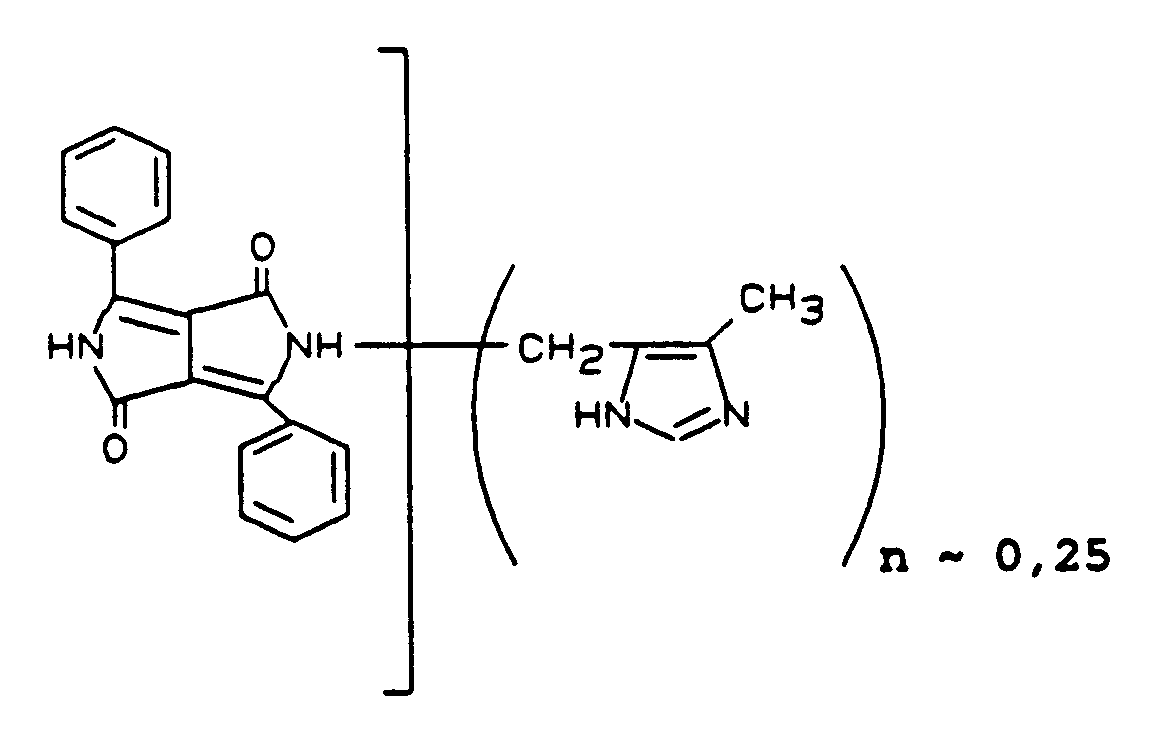
9,5 Teile Diketopyrrolopyrrolpigment und 0,5 Teile der Verbindung der obigen Formel werden vermahlen. - Man erhält so die Verbindung der vorstehenden Formel mit n ∼ 0,013.
- Bei der Ausprüfung erhält man in 5 %iger Pigmentierung im AM-Lack transparentere und farbstärkere Lackierungen als bei Verwendung des unsubstituierten Pigments.
Beispiel 4 Vergleich Rheologie 5 2 Glanz 86 27 - 50 Teile Perylen-3,4,9,10-tetracarbonsäuredianhydrid in Form des feuchten Preßkuchens werden in 1 441 Teilen Wasser angerührt. Danach werden 27,6 Teile feuchter Preßkuchen (entsprechend 5 Teilen trocken) der Verbindung der Formel

zugegeben, die durch Umsetzung von Perylen-3,4,9,10-tetracarbonsäuredianhydrid mit Paraformaldehyd und Imidazol in H₂SO₄ hergestellt wurde. Anschließend gibt man 15 Teile einer 50 %igen handelsüblichen Harzseife zu und kühlt auf 0 bis 5°C ab. Zu dieser Mischung läßt man bei dieser Temperatur in 10 Minuten 158,8 Teile einer 31,9 %igen Monomethylamin-Lösung zutropfen. Man läßt 15 Minuten bei 0 bis 5°C nachrühren und tropft danach in 15 Minuten eine Lösung aus 28,5 Teilen wasserfreiem Calciumchlorid und 94,5 Teilen Wasser zu. Man rührt 1 Stunde bei 0 bis 5°C nach. Danach heizt man auf 80°C und rührt 2 Stunden bei 80°C nach. Anschließend saugt man bei 50°C ab, wäscht neutral und chloridfrei und trocknet bei 80°C. Man erhält 66 Teile der Verbindung der vorstehend genannten Formel mit n = 0,04, die im AM-Lack dunklere Färbungen liefert als die des unsubstituierten Pigmentes. Die Rheologie beträgt 5 im Vergleich zu 1. - 50 Teile Perylen-3,4,9,10-tetracarbonsäuredianhydrid in Form des feuchten Preßkuchens werden in 1 441 Teilen Wasser angerührt. Danach werden 34,5 Teile Preßkuchen (entsprechend 5 Teilen trocken) der Verbindung der Formel

zugegeben, die durch Umsetzung von Perylen-3,4,9,10-tetracarbonsäure-N,N′-dimethylimid mit Paraformaldehyd und Imidazol in H₂SO₄ hergestellt wurde. - Anschließend gibt man 15 Teile einer 50 %igen handelsüblichen Harzseife zu und kühlt auf 0 bis 5°C ab. Zu dieser Mischung läßt man bei dieser Temperatur in 10 Minuten 158,8 Teile einer 31,9 %igen Monomethylamin-Lösung zutropfen. Man läßt 15 Minuten bei 0 bis 5°C nachrühren und tropft danach in 15 Minuten eine Lösung aus 28,5 Teilen wasserfreiem Calciumchlorid und 94,5 Teilen Wasser zu. Man rührt 1 Stunde bei 0 bis 5°C nach. Danach heizt man auf 80°C und rührt 2 Stunden bei 80°C nach. Anschließend saugt man bei 50°C ab, wäscht neutral und chloridfrei und trocknet bei 80°C.
- Man erhält 62,3 Teile der Verbindung der vorstehenden Formel mit n ∼ 0,08, die im TSA-NAD-Lack dunklere Färbungen liefert als die des unsubstituierten Pigmentes. Die Rheologie beträgt 5 im Vergleich zu 1.
- Man mischt 9 Teile Pigment Red 179 mit 1 Teil der Verbindung der idealisierten Formel
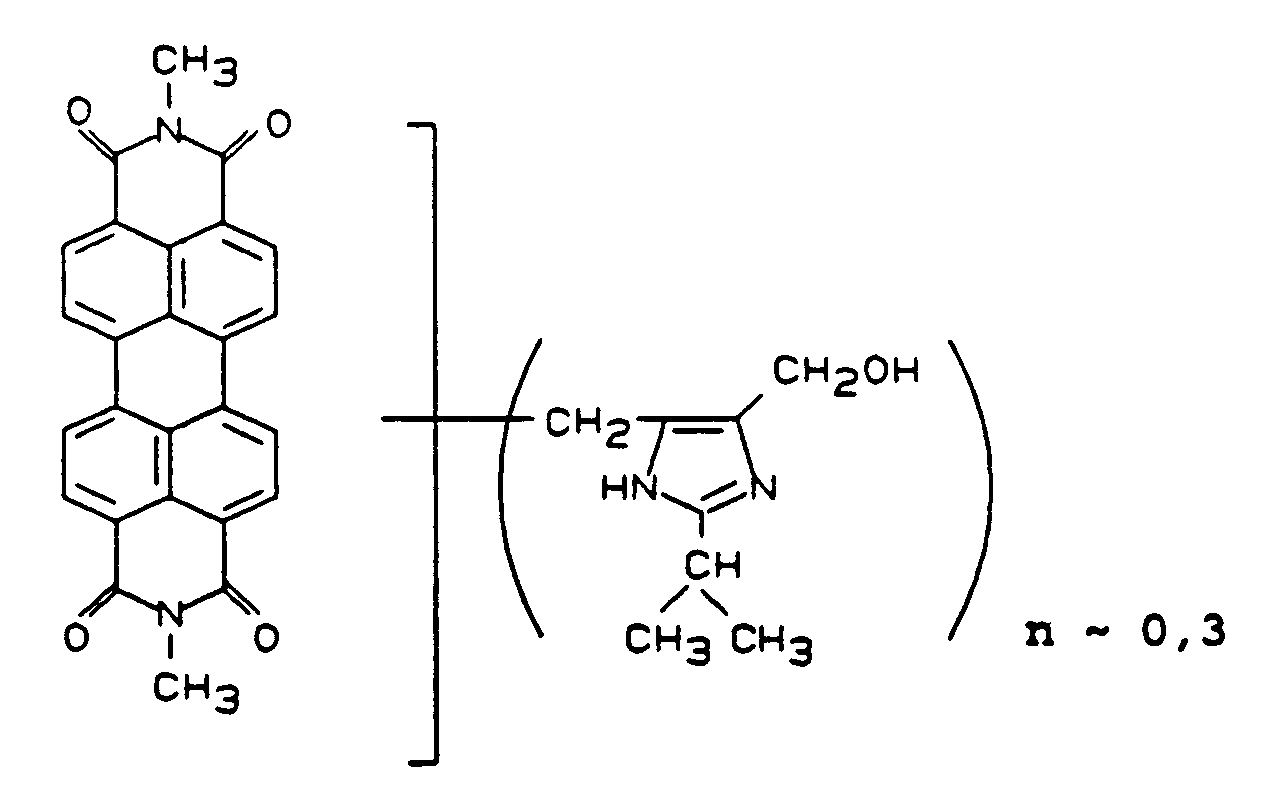
die durch Umsetzung von Perylen-3,4,9,10-tetracarbonsäure-N,N′-dimethylimid mit 2-Isopropyl-4,5-dihydroxymethylimidazol hergestellt wurde, in einer Labormühle. - Man erhält die Verbindung der vorstehend genannten Formel mit n ∼ 0,03, die im TSA-NAD-Lack eine dunklere Nuance liefert als der Vergleich. Die Rheologie beträgt 5 im Vergleich zu 1.
- 14,4 Teile Kupferphthalocyanin werden bei Raumtemperatur in 200 Teile Schwefelsäuremonohydrat eingetragen Dann werden bei 0°C 3,4 Teile 5-Hydroxymethyl-4-methylimidazolhydrochlorid in Portionen eingerührt. Man rührt 1 Stunde bei 30 bis 35°C und dann 24 Stunden bei 100°C. Nach dem Abkühlen gibt man auf Eis und Wasser und saugt ab. Der Filterkuchen wird in Wasser angeschlämmt und mit Natronlauge auf pH = 10 gestellt. Man saugt ab, wäscht neutral und salzfrei und trocknet.
- Gewonnen werden 16 Teile des Produktes der Formel

8,0 Teile C.I. Pigment Blue 15 : 1 und 2,0 Teile der Verbindung der vorstehenden Formel werden in einer Labormühle vermahlen. Man erhält eine Verbindung der vorstehend genannten Formel mit n ∼ 0,18. - Bei der Ausprüfung erhält man in 5 %iger Pigmentierung im AM-Lack folgende Ergebnisse:
Beispiel 8 Vergleich Viskosität 4,1 sec 23,5 sec Glanz 74 23 - 8,0 Teile C.I. Pigment Blue 15 : 3 und 2,0 Teile der Verbindung der Formel im Herstellungsbeispiel 8 werden in einer Labormühle vermahlen. Man erhält eine Verbindung der Formel

Bei der Ausprüfung erhält man in 15 %iger Pigmentierung im AM-Lack folgende Ergebnisse:Beispiel Vergleich Rheologie (15 %ige Pigmentierung) 5 1 bis 2 Viskosität (5 %ige Pigmentierung) 3,2 sec 6,1 sec Glanz 86 30 - In 157 Teile Polyphophosphorsäure (83,5 % P₂O₅) werden bei 80°C in 1 Stunde 17,4 Teile 2,5-Diphenylaminoterephthalsäure eingetragen und 30 Minuten verrührt. Dann werden in 20 Minuten 3,7 Teile 2-Methylimidazol eingetragen und 20 Minuten verrührt. Anschließend werden 2,1 Teile p-Formaldehyd zugegeben und 3 Stunden bei 80 bis 85°C verrührt.
- Danach wird in 30 Minuten auf 120 bis 125°C geheizt und 2 Stunden bei dieser Temperatur nachgerührt. Danach wird die Lösung <auf Eis und Wasser hydrolysiert, abgesaugt und neutral gewaschen.
- Man erhält in feuchter Form eine Verbindung der Formel
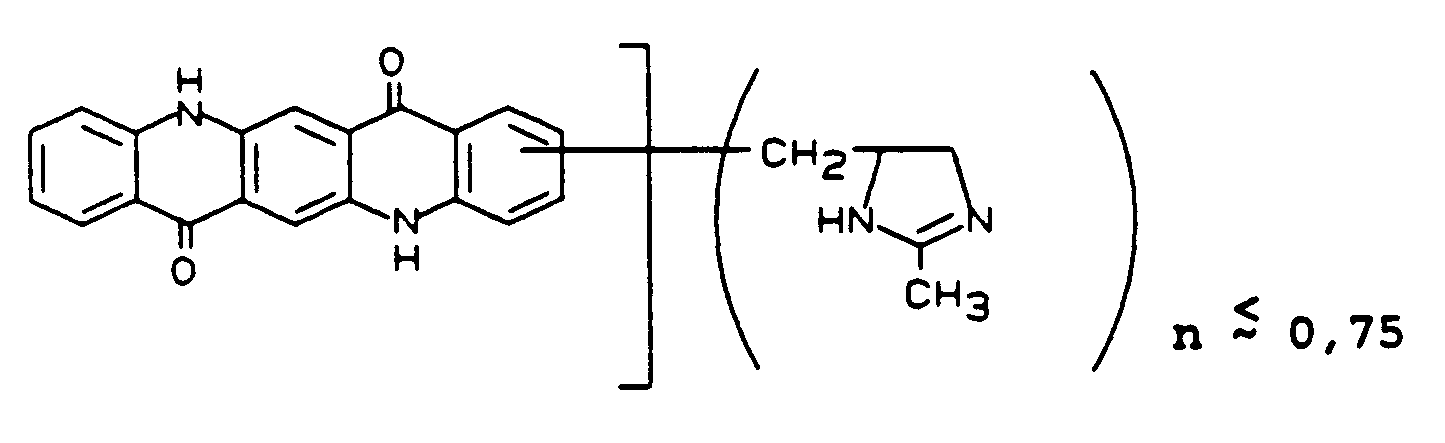
183,3 Teile eines feuchten Rohchinacridons (24 %ig), das durch Ringschluß von 2,5-Di-(4′-methylphenylamino)terephthalsäure in Polyphosphorsäure, Hydrolyse auf Wasser und Filtration erhalten wird, werden in 270 Teilen Isobutanol suspendiert und nach Zusatz von 5 g NaOH 33 %ig 3 Stunden bei 125°C verrührt. Anschließend wird auf 60°C abgekühlt und 10,2 Teile einer 34,5 %igen wäßrigen Paste eines Pigmentderivates der vorstehend genannten Formel zugesetzt. Danach wird unter Rühren in 2 Stunden das Isobutanol mit Wasserdampf abdestilliert, das Pigment durch Filtration isoliert, neutral gewaschen und getrocknet. - Man erhält ein Magenta-Pigment der Formel
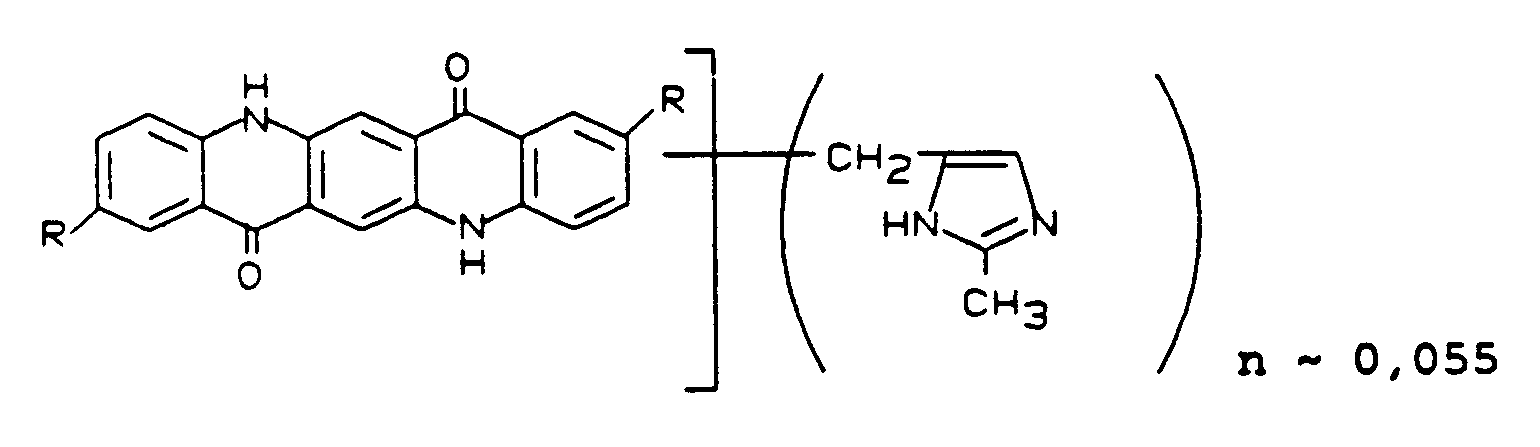
R = CH₃, H
Im AM- und TSA-NAD-Lack erhält man transparente Volltonlackierungen mit einem klaren Farbton.
- Verwendet man statt des in Beispiel 10 eingesetzten 2,9-Dimethylchinacridons die gleiche Menge eines Chinacridonmischkristalls aus 3 Teilen 2,9-Dimethylchinacridon und 1 Teil Chinacridon als feuchtes Rohchinacridon und verfährt im übrigen wie in Beispiel 10 beschrieben, so erhält man ein Magenta-Pigment der Formel analog Beispiel 10 mit n ∼ 0,055, das im AM-Lack hochtransparente Lackierungen gibt.
Beispiel 11 Vergleich Rheologie 5 1 bis 2 Viskosität 2,9 sec 4,9 sec Glanz 97 48 - Zu 500 Teilen einer 8,8 %igen wäßrigen Pigmentsuspension der deckenden γ-Modifikation des unsubstituierten linearen Chinacridons werden bei 50 bis 60°C unter Rühren 26,4 Teile einer wäßrigen 13,3 %igen Suspension eines Kondensationsprodukts aus 1 Mol unsubstituiertem Chinacridon und 0,95 Mol 4-Methyl-5-hydroxymethylimidazol, das durch Kondensation in H₂SO₄ hergestellt wurde, der Formel

gegeben und 2 Stunden verrührt. Danach wird das Pigment abfiltriert und getrocknet. - Man erhält eine Verbindung der vorstehenden Formel mit n ∼ 0,063. Das auf diese Weise hergestellte blaustichigrote Pigment gibt im AM-Lack farbstärkere und etwas blauere Lackierungen als der Vergleich.
Beispiel 12 Vergleich Rheologie 5 3 bis 4 Viskosität 2 sec 2,4 sec Glanz 93 20 - 27,84 Teile eines Kondensationsprodukts aus 1 Mol 2,9-Dimethylchinacridon, 0,9 Mol 2-Methylimidazol und p-Formaldehyd, hergestellt in Schwefelsäure konz. bei 50 bis 70°C, der Formel

läßt man als 8 %ige wäßrige Suspension bei 70 bis 80°C zu 3000 Teilen einer Suspension, die 348 Teile pigmentäres 2,9-Dimethylchinacridon und 15 g NaOH enthält, zulaufen. Nach einstündigem Nachrühren wird das Pigment durch Filtration isoliert, neutral gewaschen und getrocknet. - Man erhält eine Verbindung der vorstehenden Formel mit n ∼ 0,035.
- Das Magenta-Pigment zeigt im AM-Lack besseres rheologisches und coloristisches Verhalten als das unsubstituierte Produkt.
Beispiel 13 Vergleich Rheologie 5 1 bis 2 Viskosität 2,9 sec 6,2 sec Glanz 94 40 - In 500 Teile Polyphosphorsäure werden bei 120°C 20 Teile Rohpigment C.I. Violet 23 (salzfrei) eingetragen. Nach einstündigem Rühren werden langsam 3 Teile 2-Hydroxymethylpyrrol zugesetzt. Anschließend wird 5 Stunden bei 120°C gerührt. Die Reaktionslösung wird danach auf Eiswaser ausgetragen, mit konz. Natronlauge auf pH 10 gestellt und über Nacht stehengelassen. Anschließend wird der Niederschlag abgesaugt, mit Wasser neutral und salzfrei gewaschen und bei 50°C getrocknet.
Man erhält 21,8 Teile des Pigmentderivates der Formel
180 Teile des durch Umsetzung von Tetrachlor-p-benzochinon mit 2 Mol 3-Amino-9-ethylcarbazol zum 2,5-Di-(9-ethylcarbazol-3-yl-amino)-3,6-dichlorbenzochinon-(1,4) und anschließenden Ringschluß zum Rohpigment C.I. Violet 23, C.I. 51319 (vgl. "Venkataraman" Band II (1952), Seiten 786 und 787) erhaltenen salzhaltigen Produktes( ∼ 80 %ig) werden mit 14,4 Teilen der Verbindung der vorstehend genannten Formel versetzt und gemäß DE 2742575 (≙ US 4253839) Beispiel 3, einer Schwingmahlung (Präpigment) und einem Lösemittelfinish unterworfen. - Nach Entfernen des Solvens wird mit Wasser neutral und salzfrei gewaschen und das Produkt bei 50°C getrocknet.
- Man erhält 138 Teile eines Pigmentes der Formel

- Das erhaltene Pigment besitzt gegenüber dem unbehandelten Pigment eine wesentlich niedrigere Rheologie im AM-Lack und eine geringere Viskosität.
Beispiel 14 Vergleich Rheologie 5 1 bis 2 Viskosität 4,9 sec 7,1 sec - Gemäß Beispiel 14 werden 20 Teile Rohpigment C.I. Violet 23 (salzfrei) und 3,5 Teile 2-Hydroxymethylthiophen zur Reaktion gebracht. Man erhält 22,3 Teile des Pigmentderivates der Formel

180 Teile Rohpigment C.I. Violet 23 werden mit 14,4 Teilen der Verbindung der vorstehend genannten Formel versetzt und gemäß Beispiel 14 behandelt. - Man erhält 138 Teile eines Pigmentes der Formel

- Das erhaltene Pigment besitzt gegenüber dem Vergleich eine wesentlich bessere Rheologie und eine geringere Viskosität.
Beispiel 15 Vergleich Rheologie 5 1 bis 2 Viskosität 2,5 sec 7,1 sec - Gemäß Beispiel 14 werden 20 Teile Rohpigment C.I. Violet 23 (salzfrei) und 3,9 Teile 2,5-Bishydroxymethylfuran zur Reaktion gebracht. Man erhält 23,4 Teile des Pigmentderivates der idealisierten Formel

180 Teile Rohpigment C.I. Violet 23 werden mit 14,4 Teilen der vorstehenden Formel versetzt und gemäß Beispiel 14 behandelt. - Man erhält 138 Teile eines Pigmentes der idealisierten Formel

Das erhaltene Pigment besitzt gegenüber dem Vergleich eine wesentliche bessere Rheologie im AM-Lack und eine geringere Viskosität.Beispiel 16 Vergleich Rheologie 5 1 bis 2 Viskosität 4,0 sec 7,1 sec - Gemäß Beispiel 14 werden 60 Teile Rohpigment C.I. Violet 23 (salzfrei) in 1500 Teilen Polyphosphorsäure und 13,6 Teile 5-Hydroxymethyl-4-methylimidazolhydrochlorid zur Reaktion gebracht. Man erhält 65 Teile des Pigmentderivates der Formel (A)

Die ¹H-NMR-spektroskopische Untersuchung des Pigmentderivates liefert einen Derivatisierungsgrad von ∼ 50 %. Grundlage für die Berechnung war das Integralverhältnis von N-CH₂-CH₃ : Imidazolyl-CH₃. - 180 Teile Rohpigment C.I. Violet 23 werden mit 14,4 Teilen der Verbindung der vorstehend genannten Formel versetzt und gemäß Beispiel 14 behandelt. Man erhält 138 Teile eines Pigmentes der Formel (B)

Das auf diese Weise hergestellte Dioxazinpigment zeichnet sich durch hervorragende rheologische Eigenschaften im AM- und TSA-NAD-Lack aus. Ferner besitzt es im Vergleich zu einem unter denselben Bedingungen ohne Pigmentderivat hergestellten Pigment eine wesentlich höhere Farbstärke, eine hohe Reinheit des Farbtons, hohe Transparenz, gute Dispergierbarkeit, Flockungsstabilität, eine niedrige Viskosität und einen hervorragenden Glanz.Beispiel 17 AM TSA/NAD Vergleich AM TSA/NAD Rheologie 5 5 1 bis 2 2 bis 3 Viskosität 2,9 sec 4,3 sec 7,1 sec 11,6 sec Glanz 85 76 36 56 - 160 Teile Präpigment Violet 23 werden mit 12,8 Teilen des gemäß Beispiel 17 hergestellten Pigmentderivates versetzt und gemäß DE 2742575, Beispiel 3, einem Lösemittelfinish unterworfen. Man erhält 135 Teile eines Pigmentes, das ebenfalls die in Beispiel 17 aufgeführten Vorteile besitzt.
Beispiel 18 AM TSA/NAD Vergleich AM TSA/NAD Rheologie 5 5 1 bis 2 2 bis 3 Viskosität 3,0 sec 4,6 sec 7,1 sec 11,6 sec Glanz 83 74 36 56 - 50 Teile Pigment C.I. Violet 23, 51319, werden mit 5 Teilen des gemäß Beispiel 17 hergestellten Pigmentderivates versetzt und in einer Mühle mechanisch gemischt.
- Man erhält 54,5 Teile eines Pigmentes, das im AM- und TSA-NAD-Lack im Vergleich zum unbehandelten Pigment Violet 23 die bei Beispiel 17 aufgeführten Vorteile besitzt.
Beispiel 19 AM TSA/NAD Vergleich AM TSA/NAD Rheologie 5 5 1 bis 2 2 bis 3 Viskosität 2,8 sec 3,4 sec 7,1 sec 11,6 sec Glanz 83 74 36 56 - Gemäß Beispiel 14 werden 20 Teile Rohpigment C.I. Violet 23 (salzfrei) und 4,5 Teile 3-Hydroxymethylindol zur Reaktion gebracht. Man erhält 23,8 Teile des Pigmentderivates der Formel

180 Teile Rohpigment C.I. Violet 23 werden mit 14,4 Teilen der Verbindung der vorstehend genannten Formel versetzt und gemäß Beispiel 14 behandelt. Man erhält 138 Teile eines Pigmentes der Formel
Das erhaltene Pigment besitzt gegenüber dem unbehandelten Pigment C.I. Violet 23 eine niedrigere Rheologie, eine geringere Viskosität und einen höheren Glanzwert im AM-Lack.Beispiel 20 Vergleich Rheologie 5 1 bis 2 Viskosität 5,0 sec 7,1 sec Glanz 70 36 - Man legt 137 Teile Preßkuchen C.I. Pigment Violet 23 entsprechend 50 Teilen trocken vor. Man gibt danach 312 Teile Wasser und 21 Teile Isobutanol zu und mahlt diese Mischung 40 Minuten in einer Rührwerkskugelmühle, die mit Zirkonoxidperlen ⌀ 1 bis 1,5 mm gefüllt ist. Danach gibt man 29 g Preßkuchen des Derivats aus Beispiel 17 (entsprechend 5 Teile trocken) zu und mahlt noch 20 Minuten. Danach siebt man das Mahlgut ab, wäscht die Zirkonoxidperlen mit Wasser nach und destilliert das Isobutanol bis 100°C am Übergang ab. Anschließend saugt man ab, wäscht mit Wasser nach und trocknet das Pigment bei 80°C.
- Man erhält 53,9 g Pigment der Formel B (Beispiel 17) mit n ∼ 0,045, das sich auszeichnet im Nitrocellulosetiefdruck durch seine hohe Farbstärke, Reinheit des Farbtons, gute Dispergierbarkeit und niedrige Viskosität. Außerdem zeigt das erf indungsgemäße Pigment keine Flockung, während der Vergleich stark flockt.
- Im AM-Lack wird dieses Pigment wie folgt bewertet:
Beispiel 21 Vergleich Farbstärke sehr farbstark farbschwach Rheologie 5 3 bis 4 Flockung flockt nicht flockt stark Glanz 85 52 - Im TSA-NAD-Lack wird dieses Pigment wie folgt bewertet:
Beispiel 21 Vergleich Farbstärke sehr farbstark farbschwach Rheologie 5 4 Flockung flockt nicht flockt stark Glanz 80 59
Claims (9)
- Pigmente der allgemeinen Formel I

- Pigmente der Formel (I) gemäß Anspruch 1, dadurch gekennzeichnet, daß P für einen Anthrachinon-, Anthrapyrimidin-, Anthanthron-, Chinacridon-, Chinophthalon-, Diketopyrrolopyrrol-, Dioxazin-, Flavanthron-, Indanthron-, Isoindolin-, Isoindolinon-, Isoviolanthron-, Perinon-, Perylen-, Phthalocyanin-, Pyranthron- oder Thioindigo-Rest steht oder den Rest eines Mischkristalls aus den vorstehend genannten polyclischen Pigmenten darstellt.
- Pigmente der Formel (I) gemäß Anspruch 1, dadurch gekennzeichnet, daß A für den Rest eines fünfgliedrigen aromatischen Heterocyclus aus der Reihe Furan, Thiophen, Pyrrol, Pyrazol, Thiazole, Oxazole, Triazole und Imidazol steht.
- Pigmente der Formel (I) gemäß Anspruch 1, dadurch gekennzeichnet, daß A für den Rest eines kondensierten Heterocyclus aus der Reihe Thionaphthen, Benzoxazol, Benzthiazol, Benzimidazol, Benztriazol und Indol steht.
- Pigmente der Formel (I) gemäß Anspruch 1, dadurch gekennzeichnet, daß n 0,01 bis 0,1 ist.
- Verwendung der Pigmente nach mindestens einem der Ansprüche 1 bis 5 zum Pigmentieren hochmolekularer Materialien.
- Verwendung der Pigmente nach mindestens einem der Ansprüche 1 bis 5 zum Pigmentieren hochmolekularer Materialien in Form plastischer Massen, Schmelzen, Spinnlösungen, Lacken, Anstrichfarben oder Druckfarben.
- Verwendung der Pigmente nach mindestens einem der Ansprüche 1 bis 5 zum Pigmentieren von Einbrennlacken aus der Klasse der Alkydmelaminharz- oder Acrylmelaminharzlacke und von Zweikomponentenlacken auf Basis polyisocyanatvernetzbarer Acrylharze.
- Verwendung der Pigmente nach mindestens einem der Ansprüche 1 bis 5 zum Pigmentieren von Druckfarben auf Basis Nitrocellulose.
Applications Claiming Priority (4)
| Application Number | Priority Date | Filing Date | Title |
|---|---|---|---|
| DE3743619 | 1987-12-22 | ||
| DE3743619 | 1987-12-22 | ||
| DE3838814 | 1988-11-17 | ||
| DE3838814A DE3838814A1 (de) | 1987-12-22 | 1988-11-17 | Neue pigmente und ihre verwendung |
Publications (3)
| Publication Number | Publication Date |
|---|---|
| EP0321919A2 EP0321919A2 (de) | 1989-06-28 |
| EP0321919A3 EP0321919A3 (de) | 1991-10-30 |
| EP0321919B1 true EP0321919B1 (de) | 1994-02-09 |
Family
ID=25863102
Family Applications (1)
| Application Number | Title | Priority Date | Filing Date |
|---|---|---|---|
| EP88121275A Expired - Lifetime EP0321919B1 (de) | 1987-12-22 | 1988-12-20 | Neue Pigmente und ihre Verwendung |
Country Status (7)
| Country | Link |
|---|---|
| US (1) | US4986852A (de) |
| EP (1) | EP0321919B1 (de) |
| JP (1) | JP2650993B2 (de) |
| KR (1) | KR960012873B1 (de) |
| CA (1) | CA1338668C (de) |
| DE (2) | DE3838814A1 (de) |
| DK (1) | DK169629B1 (de) |
Cited By (1)
| Publication number | Priority date | Publication date | Assignee | Title |
|---|---|---|---|---|
| US7045637B2 (en) | 1999-12-02 | 2006-05-16 | Clariant Gmbh | Pigment dispersants based on diketopyrrolopyrrole compounds and pigment preparations |
Families Citing this family (32)
| Publication number | Priority date | Publication date | Assignee | Title |
|---|---|---|---|---|
| DE3833423A1 (de) * | 1988-10-01 | 1990-04-19 | Hoechst Ag | Chinacridon-pigmente, verfahren zu ihrer herstellung und ihre verwendung |
| DE4007618A1 (de) * | 1990-03-10 | 1991-09-12 | Langhals Heinz | Perylenfarbstoffe als dokumentenechte toner fuer die elektrophotographie - verwendung in laserdruckern und xerox-kopiergeraeten |
| DE69109057T2 (de) * | 1990-11-08 | 1995-09-21 | Ciba Geigy Ag | Pyrazol enthaltende Pigmentderivate. |
| ES2093670T3 (es) * | 1990-12-06 | 1997-01-01 | Hoechst Ag | Preparados pigmentarios. |
| JP3337234B2 (ja) * | 1991-03-22 | 2002-10-21 | クラリアント・ゲゼルシヤフト・ミト・ベシユレンクテル・ハフツング | ジオキサジン化合物を基礎とする新規の顔料調製物 |
| JP3388591B2 (ja) * | 1991-03-22 | 2003-03-24 | クラリアント・ゲゼルシヤフト・ミト・ベシユレンクテル・ハフツング | C.i.ピグメント・バイオレット23を基礎とする顔料調製物の製造方法 |
| EP0511165B1 (de) * | 1991-04-26 | 1996-08-14 | Ciba-Geigy Ag | Neue Diketopyrrolopyrrolverbindungen |
| EP0538784B2 (de) * | 1991-10-23 | 2000-12-27 | Clariant GmbH | Pigmentzubereitungen |
| EP0643114A3 (de) * | 1993-09-14 | 1997-08-27 | Sumitomo Chemical Co | Zusammensetzung für Drucktinten. |
| JPH07188576A (ja) * | 1993-12-27 | 1995-07-25 | Sumitomo Chem Co Ltd | 顔料組成物 |
| DE4400329A1 (de) * | 1994-01-07 | 1995-07-20 | Hoechst Ag | Verwendung von Fettsäuretauriden zum Dispergieren polycyclischer Pigmente |
| DE4403231A1 (de) * | 1994-02-03 | 1995-08-10 | Hoechst Ag | Verfahren zur Herstellung von Chinacridonpigmenten |
| DE19709798A1 (de) * | 1997-03-10 | 1998-09-17 | Clariant Gmbh | Pigmentzubereitungen und Verfahren zu ihrer Herstellung |
| EP0937724B1 (de) | 1998-02-21 | 2005-10-26 | Clariant GmbH | Perylenverbindungen und ihre Verwendung als Pigmentdispergatoren |
| US6057449A (en) * | 1998-06-02 | 2000-05-02 | Ciba Specialty Chemicals Corporation | Direct preparation of pyrrolo[3,4-c]pyrroles |
| DE19831097A1 (de) | 1998-07-10 | 2000-01-13 | Clariant Gmbh | Verfahren zur Herstellung von Chinacridonpigmenten |
| DE19902907A1 (de) | 1999-01-26 | 2000-07-27 | Clariant Gmbh | Pigmentzubereitungen mit mehreren Perylenverbindungen |
| DE19906494A1 (de) | 1999-02-17 | 2000-08-24 | Clariant Gmbh | Pigmentzubereitungen auf Basis von Diketopyrrolopyrrolpigmenten mit basischen Perylendispergatoren |
| US6313300B1 (en) | 1999-09-07 | 2001-11-06 | Ciba Specialty Chemicals Corp. | Oxidation process for preparing quinacridone pigments |
| DE10005186A1 (de) | 2000-02-05 | 2001-08-09 | Clariant Gmbh | Verfahren zur Herstellung von Perylen-3,4,9,10-tetracarbonsäurediimid in transparenter Pigmentform |
| DE10052858A1 (de) * | 2000-10-24 | 2002-04-25 | Clariant Gmbh | Mischkristalle aus Benzimidazolondioxazin-Verbindungen |
| DE10307557A1 (de) * | 2003-02-21 | 2004-09-02 | Clariant Gmbh | Verfahren zur Herstellung von transparenten Pigmentzubereitungen auf Basis von Perylen-3,4,9,10-tetracarbonsäurediimid |
| DE102004009230A1 (de) * | 2004-02-26 | 2005-09-08 | Clariant Gmbh | Verfahren zur Herstellung transparenter Phthalocyaninpigmente |
| DE102004010284A1 (de) * | 2004-03-03 | 2005-09-22 | Clariant Gmbh | Pigmentzubereitungen auf Basis Phthalocyaninpigment |
| DE102004010282A1 (de) * | 2004-03-03 | 2005-09-22 | Clariant Gmbh | Violettes Farbmittel für Color Filter, Ink Jet Tinten, elektrophotographische Toner und Entwickler und e-inks |
| DE102005008659A1 (de) * | 2005-02-25 | 2006-08-31 | Clariant Produkte (Deutschland) Gmbh | Verfahren zur Herstellung transparenter Dioxazinpigmente |
| DE102005024722A1 (de) * | 2005-05-31 | 2006-12-07 | Clariant Produkte (Deutschland) Gmbh | Blaues Farbmittel auf Basis von C.I. Pigment Blue 80 |
| DE102007031354A1 (de) * | 2007-07-05 | 2009-01-08 | Clariant International Limited | Pigmentzubereitungen auf Basis von Dioxazinen |
| WO2009144115A1 (en) | 2008-05-28 | 2009-12-03 | Basf Se | Improved, red colour filter composition |
| KR101130651B1 (ko) * | 2009-12-24 | 2012-04-02 | (주)경인양행 | 디스플레이의 컬러 필터용 피라졸 함유 안료 유도체 |
| US8524121B2 (en) * | 2012-01-27 | 2013-09-03 | Xerox Corporation | Bi-indoline-dithione polymers |
| US8613870B2 (en) * | 2012-01-27 | 2013-12-24 | Xerox Corporation | Isothioindigo-based polymers |
Family Cites Families (7)
| Publication number | Priority date | Publication date | Assignee | Title |
|---|---|---|---|---|
| DE2905114C2 (de) * | 1979-02-10 | 1981-03-19 | Basf Ag, 6700 Ludwigshafen | Pigmentzubereitungen |
| DE3164935D1 (en) * | 1980-02-18 | 1984-08-30 | Basf Ag | Dyestuffs containing imidazolylethylene groups and their use |
| JPS56118462A (en) * | 1980-02-25 | 1981-09-17 | Toyo Ink Mfg Co Ltd | Pigment composition |
| JPS58145762A (ja) * | 1982-02-25 | 1983-08-30 | Toyo Ink Mfg Co Ltd | 顔料分散体 |
| JPS58225159A (ja) * | 1982-06-22 | 1983-12-27 | Toyo Ink Mfg Co Ltd | 顔料分散体 |
| JPS58225160A (ja) * | 1982-06-22 | 1983-12-27 | Toyo Ink Mfg Co Ltd | 顔料分散体 |
| DE3434379A1 (de) * | 1984-09-19 | 1986-03-20 | Basf Farben + Fasern Ag, 2000 Hamburg | Pigmentzubereitungen |
-
1988
- 1988-11-17 DE DE3838814A patent/DE3838814A1/de not_active Withdrawn
- 1988-12-20 EP EP88121275A patent/EP0321919B1/de not_active Expired - Lifetime
- 1988-12-20 US US07/286,894 patent/US4986852A/en not_active Expired - Lifetime
- 1988-12-20 DE DE88121275T patent/DE3887744D1/de not_active Expired - Lifetime
- 1988-12-21 CA CA000586550A patent/CA1338668C/en not_active Expired - Fee Related
- 1988-12-21 DK DK714688A patent/DK169629B1/da not_active IP Right Cessation
- 1988-12-21 JP JP63320725A patent/JP2650993B2/ja not_active Expired - Lifetime
- 1988-12-22 KR KR1019880017213A patent/KR960012873B1/ko not_active Expired - Fee Related
Cited By (1)
| Publication number | Priority date | Publication date | Assignee | Title |
|---|---|---|---|---|
| US7045637B2 (en) | 1999-12-02 | 2006-05-16 | Clariant Gmbh | Pigment dispersants based on diketopyrrolopyrrole compounds and pigment preparations |
Also Published As
| Publication number | Publication date |
|---|---|
| JPH01213366A (ja) | 1989-08-28 |
| KR890010131A (ko) | 1989-08-07 |
| EP0321919A3 (de) | 1991-10-30 |
| DK169629B1 (da) | 1994-12-27 |
| DK714688D0 (da) | 1988-12-21 |
| EP0321919A2 (de) | 1989-06-28 |
| US4986852A (en) | 1991-01-22 |
| DK714688A (da) | 1989-06-23 |
| CA1338668C (en) | 1996-10-22 |
| KR960012873B1 (ko) | 1996-09-25 |
| DE3838814A1 (de) | 1989-07-06 |
| DE3887744D1 (de) | 1994-03-24 |
| JP2650993B2 (ja) | 1997-09-10 |
Similar Documents
| Publication | Publication Date | Title |
|---|---|---|
| EP0321919A2 (de) | Neue Pigmente und ihre Verwendung | |
| EP0485441B1 (de) | Neue pigmentzubereitungen auf basis von perylenverbindungen | |
| EP0538784B1 (de) | Pigmentzubereitungen | |
| EP0864613B1 (de) | Pigmentzubereitungen und Verfahren zu ihrer Herstellung | |
| EP1716208B2 (de) | Schwarze perylenpigmente | |
| EP0296111B1 (de) | Mit Metalloxiden beschichtete organische Pigmente | |
| EP0504923B1 (de) | Verfahren zur Herstellung von Pigmentzubereitungen auf Basis von C.I. Pigment Violet 23 | |
| EP0511165B1 (de) | Neue Diketopyrrolopyrrolverbindungen | |
| EP0014458A1 (de) | Pigmentzubereitungen für Lack- und Druckfarben | |
| DE3833423A1 (de) | Chinacridon-pigmente, verfahren zu ihrer herstellung und ihre verwendung | |
| EP0504922B1 (de) | Neue Pigmentzubereitungen auf Basis von Dioxazinverbindungen | |
| EP0937724A1 (de) | Perylenverbindungen und ihre Verwendung als Pigmentdispergatoren | |
| EP1024177B1 (de) | Pigmentzubereitungen mit mehreren Perylenverbindungen | |
| EP0360182B1 (de) | Pigmentzubereitungen | |
| EP0489421B1 (de) | Pigmentzubereitungen | |
| EP0662497A1 (de) | Verwendung von Fettsäuretauriden zum Dispergieren polycyclischer Pigmente | |
| DE3832064A1 (de) | Verfahren zur herstellung von pigmentzubereitungen der anthanthronreihe | |
| DE60003961T2 (de) | Wässriges Verfahren zur Herstellung von linearen Chinacridonen mit reduzierter Teilchengrösse | |
| EP1163294B1 (de) | Purpurfarbene pigmentzusammensetzung und deren verwendung | |
| DE3836536A1 (de) | Mischkristallpigmente auf basis halogenierter perylentetracarbonsaeurediimide | |
| EP0803544A2 (de) | Oberflächenbehandelte Chinacridon- und Dioxazin-Pigmente | |
| EP0656403A2 (de) | Pigmentzusammensetzung aus Diketopyrrolopyrrol und Aminoalkylacrylatharz | |
| EP2370523B1 (de) | Flockungsstabile diketopyrrolopyrrol-pigmentzubereitungen | |
| EP1706459B1 (de) | Triphendioxazinpigmente | |
| DE19838142A1 (de) | Organische Pigmentzusammensetzungen |
Legal Events
| Date | Code | Title | Description |
|---|---|---|---|
| PUAI | Public reference made under article 153(3) epc to a published international application that has entered the european phase |
Free format text: ORIGINAL CODE: 0009012 |
|
| AK | Designated contracting states |
Kind code of ref document: A2 Designated state(s): CH DE FR GB IT LI |
|
| 17P | Request for examination filed |
Effective date: 19901221 |
|
| PUAL | Search report despatched |
Free format text: ORIGINAL CODE: 0009013 |
|
| AK | Designated contracting states |
Kind code of ref document: A3 Designated state(s): CH DE FR GB IT LI |
|
| 17Q | First examination report despatched |
Effective date: 19921026 |
|
| GRAA | (expected) grant |
Free format text: ORIGINAL CODE: 0009210 |
|
| AK | Designated contracting states |
Kind code of ref document: B1 Designated state(s): CH DE FR GB IT LI |
|
| REF | Corresponds to: |
Ref document number: 3887744 Country of ref document: DE Date of ref document: 19940324 |
|
| ITF | It: translation for a ep patent filed | ||
| GBT | Gb: translation of ep patent filed (gb section 77(6)(a)/1977) |
Effective date: 19940427 |
|
| ET | Fr: translation filed | ||
| PLBE | No opposition filed within time limit |
Free format text: ORIGINAL CODE: 0009261 |
|
| STAA | Information on the status of an ep patent application or granted ep patent |
Free format text: STATUS: NO OPPOSITION FILED WITHIN TIME LIMIT |
|
| 26N | No opposition filed | ||
| REG | Reference to a national code |
Ref country code: CH Ref legal event code: PUE Owner name: HOECHST AKTIENGESELLSCHAFT TRANSFER- CLARIANT GMBH |
|
| REG | Reference to a national code |
Ref country code: FR Ref legal event code: TP |
|
| REG | Reference to a national code |
Ref country code: GB Ref legal event code: 732E |
|
| REG | Reference to a national code |
Ref country code: GB Ref legal event code: IF02 |
|
| REG | Reference to a national code |
Ref country code: CH Ref legal event code: PFA Owner name: CLARIANT PRODUKTE (DEUTSCHLAND) GMBH Free format text: CLARIANT GMBH#BRUENINGSTRASSE 50#65929 FRANKFURT AM MAIN (DE) -TRANSFER TO- CLARIANT PRODUKTE (DEUTSCHLAND) GMBH#BRUENINGSTRASSE 50#65929 FRANKFURT AM MAIN (DE) |
|
| REG | Reference to a national code |
Ref country code: FR Ref legal event code: CD |
|
| PGFP | Annual fee paid to national office [announced via postgrant information from national office to epo] |
Ref country code: CH Payment date: 20071015 Year of fee payment: 20 Ref country code: IT Payment date: 20071026 Year of fee payment: 20 |
|
| PGFP | Annual fee paid to national office [announced via postgrant information from national office to epo] |
Ref country code: FR Payment date: 20071009 Year of fee payment: 20 Ref country code: GB Payment date: 20071119 Year of fee payment: 20 |
|
| PGFP | Annual fee paid to national office [announced via postgrant information from national office to epo] |
Ref country code: DE Payment date: 20071006 Year of fee payment: 20 |
|
| REG | Reference to a national code |
Ref country code: CH Ref legal event code: PL |
|
| REG | Reference to a national code |
Ref country code: GB Ref legal event code: PE20 Expiry date: 20081219 |
|
| PG25 | Lapsed in a contracting state [announced via postgrant information from national office to epo] |
Ref country code: GB Free format text: LAPSE BECAUSE OF EXPIRATION OF PROTECTION Effective date: 20081219 |