EP0320780A2 - Method and apparatus for forming an elongated composite part - Google Patents
Method and apparatus for forming an elongated composite part Download PDFInfo
- Publication number
- EP0320780A2 EP0320780A2 EP88120469A EP88120469A EP0320780A2 EP 0320780 A2 EP0320780 A2 EP 0320780A2 EP 88120469 A EP88120469 A EP 88120469A EP 88120469 A EP88120469 A EP 88120469A EP 0320780 A2 EP0320780 A2 EP 0320780A2
- Authority
- EP
- European Patent Office
- Prior art keywords
- perimeter
- slip tape
- section
- tool
- plies
- Prior art date
- Legal status (The legal status is an assumption and is not a legal conclusion. Google has not performed a legal analysis and makes no representation as to the accuracy of the status listed.)
- Withdrawn
Links
- 239000002131 composite material Substances 0.000 title claims abstract description 53
- 238000000034 method Methods 0.000 title claims abstract description 16
- 230000000295 complement effect Effects 0.000 claims abstract description 9
- 239000004593 Epoxy Substances 0.000 description 7
- 239000000853 adhesive Substances 0.000 description 6
- 230000001070 adhesive effect Effects 0.000 description 6
- 239000004744 fabric Substances 0.000 description 5
- 230000035939 shock Effects 0.000 description 4
- 230000015572 biosynthetic process Effects 0.000 description 3
- OKTJSMMVPCPJKN-UHFFFAOYSA-N Carbon Chemical compound [C] OKTJSMMVPCPJKN-UHFFFAOYSA-N 0.000 description 2
- 239000004677 Nylon Substances 0.000 description 2
- 229920006362 Teflon® Polymers 0.000 description 2
- 229910002804 graphite Inorganic materials 0.000 description 2
- 239000010439 graphite Substances 0.000 description 2
- 238000003475 lamination Methods 0.000 description 2
- 239000007788 liquid Substances 0.000 description 2
- 239000000463 material Substances 0.000 description 2
- 239000011159 matrix material Substances 0.000 description 2
- 229920001778 nylon Polymers 0.000 description 2
- 230000000717 retained effect Effects 0.000 description 2
- XAGFODPZIPBFFR-UHFFFAOYSA-N aluminium Chemical compound [Al] XAGFODPZIPBFFR-UHFFFAOYSA-N 0.000 description 1
- 229910052782 aluminium Inorganic materials 0.000 description 1
- 238000005452 bending Methods 0.000 description 1
- 239000011248 coating agent Substances 0.000 description 1
- 238000000576 coating method Methods 0.000 description 1
- 230000003247 decreasing effect Effects 0.000 description 1
- 239000000835 fiber Substances 0.000 description 1
- 238000012986 modification Methods 0.000 description 1
- 230000004048 modification Effects 0.000 description 1
- 238000007493 shaping process Methods 0.000 description 1
- 239000013464 silicone adhesive Substances 0.000 description 1
- 229920001187 thermosetting polymer Polymers 0.000 description 1
Images


Classifications
-
- B—PERFORMING OPERATIONS; TRANSPORTING
- B29—WORKING OF PLASTICS; WORKING OF SUBSTANCES IN A PLASTIC STATE IN GENERAL
- B29D—PRODUCING PARTICULAR ARTICLES FROM PLASTICS OR FROM SUBSTANCES IN A PLASTIC STATE
- B29D99/00—Subject matter not provided for in other groups of this subclass
- B29D99/0003—Producing profiled members, e.g. beams
-
- B—PERFORMING OPERATIONS; TRANSPORTING
- B29—WORKING OF PLASTICS; WORKING OF SUBSTANCES IN A PLASTIC STATE IN GENERAL
- B29C—SHAPING OR JOINING OF PLASTICS; SHAPING OF MATERIAL IN A PLASTIC STATE, NOT OTHERWISE PROVIDED FOR; AFTER-TREATMENT OF THE SHAPED PRODUCTS, e.g. REPAIRING
- B29C53/00—Shaping by bending, folding, twisting, straightening or flattening; Apparatus therefor
- B29C53/02—Bending or folding
- B29C53/04—Bending or folding of plates or sheets
-
- B—PERFORMING OPERATIONS; TRANSPORTING
- B29—WORKING OF PLASTICS; WORKING OF SUBSTANCES IN A PLASTIC STATE IN GENERAL
- B29C—SHAPING OR JOINING OF PLASTICS; SHAPING OF MATERIAL IN A PLASTIC STATE, NOT OTHERWISE PROVIDED FOR; AFTER-TREATMENT OF THE SHAPED PRODUCTS, e.g. REPAIRING
- B29C70/00—Shaping composites, i.e. plastics material comprising reinforcements, fillers or preformed parts, e.g. inserts
- B29C70/04—Shaping composites, i.e. plastics material comprising reinforcements, fillers or preformed parts, e.g. inserts comprising reinforcements only, e.g. self-reinforcing plastics
- B29C70/28—Shaping operations therefor
- B29C70/40—Shaping or impregnating by compression not applied
- B29C70/50—Shaping or impregnating by compression not applied for producing articles of indefinite length, e.g. prepregs, sheet moulding compounds [SMC] or cross moulding compounds [XMC]
- B29C70/52—Pultrusion, i.e. forming and compressing by continuously pulling through a die
- B29C70/525—Component parts, details or accessories; Auxiliary operations
-
- B—PERFORMING OPERATIONS; TRANSPORTING
- B29—WORKING OF PLASTICS; WORKING OF SUBSTANCES IN A PLASTIC STATE IN GENERAL
- B29C—SHAPING OR JOINING OF PLASTICS; SHAPING OF MATERIAL IN A PLASTIC STATE, NOT OTHERWISE PROVIDED FOR; AFTER-TREATMENT OF THE SHAPED PRODUCTS, e.g. REPAIRING
- B29C70/00—Shaping composites, i.e. plastics material comprising reinforcements, fillers or preformed parts, e.g. inserts
- B29C70/04—Shaping composites, i.e. plastics material comprising reinforcements, fillers or preformed parts, e.g. inserts comprising reinforcements only, e.g. self-reinforcing plastics
- B29C70/28—Shaping operations therefor
- B29C70/54—Component parts, details or accessories; Auxiliary operations, e.g. feeding or storage of prepregs or SMC after impregnation or during ageing
- B29C70/542—Placing or positioning the reinforcement in a covering or packaging element before or during moulding, e.g. drawing in a sleeve
-
- B—PERFORMING OPERATIONS; TRANSPORTING
- B29—WORKING OF PLASTICS; WORKING OF SUBSTANCES IN A PLASTIC STATE IN GENERAL
- B29K—INDEXING SCHEME ASSOCIATED WITH SUBCLASSES B29B, B29C OR B29D, RELATING TO MOULDING MATERIALS OR TO MATERIALS FOR MOULDS, REINFORCEMENTS, FILLERS OR PREFORMED PARTS, e.g. INSERTS
- B29K2105/00—Condition, form or state of moulded material or of the material to be shaped
- B29K2105/06—Condition, form or state of moulded material or of the material to be shaped containing reinforcements, fillers or inserts
-
- B—PERFORMING OPERATIONS; TRANSPORTING
- B29—WORKING OF PLASTICS; WORKING OF SUBSTANCES IN A PLASTIC STATE IN GENERAL
- B29L—INDEXING SCHEME ASSOCIATED WITH SUBCLASS B29C, RELATING TO PARTICULAR ARTICLES
- B29L2009/00—Layered products
-
- Y—GENERAL TAGGING OF NEW TECHNOLOGICAL DEVELOPMENTS; GENERAL TAGGING OF CROSS-SECTIONAL TECHNOLOGIES SPANNING OVER SEVERAL SECTIONS OF THE IPC; TECHNICAL SUBJECTS COVERED BY FORMER USPC CROSS-REFERENCE ART COLLECTIONS [XRACs] AND DIGESTS
- Y10—TECHNICAL SUBJECTS COVERED BY FORMER USPC
- Y10T—TECHNICAL SUBJECTS COVERED BY FORMER US CLASSIFICATION
- Y10T156/00—Adhesive bonding and miscellaneous chemical manufacture
- Y10T156/10—Methods of surface bonding and/or assembly therefor
- Y10T156/1002—Methods of surface bonding and/or assembly therefor with permanent bending or reshaping or surface deformation of self sustaining lamina
- Y10T156/1043—Subsequent to assembly
- Y10T156/1044—Subsequent to assembly of parallel stacked sheets only
Definitions
- the force that is provided by an individual holding component 36 or 38 is determined by the relative change in length of the holding component between its relaxes length and its installed length.
- the ends of holding components 36 and 38 are defined by knots 54 that engage against pin pairs 56 and 58.
- Pin pairs 56 placed in holes 60 along side edges 62, define the stretched length of holding components 36.
- Pin pairs 58 which fit into holes 64 along undersurface 66 of form 22, define the stretched length of holding components 38.
- the distance between corresponding pin pairs 56 around upper perimeter 44 of part blank 18 is constant, independent of the position of the pin pairs 56 along form 22. Therefore, holding components 36 can provide increasing tension by making them with shorter relaxed lengths the further they are from leading edge 28 and toward trailing edge 30. Similarly, the holding components 38 having shorter relaxed lengths are placed closer to trailing edge 30.
Landscapes
- Engineering & Computer Science (AREA)
- Mechanical Engineering (AREA)
- Chemical & Material Sciences (AREA)
- Composite Materials (AREA)
- Moulding By Coating Moulds (AREA)
- Laminated Bodies (AREA)
- Processing And Handling Of Plastics And Other Materials For Molding In General (AREA)
Abstract
A method and an apparatus for forming elongated composite parts having constant cross sections. The apparatus comprises a form having a cross section, a portion of which is complementary to a first portion of the desired cross section of the elongated part. The apparatus further comprises a holding means (24) having a cross section, a portion of which is complementary to a second portion of the desired cross section of the elongated part. Plies (10) of preimpregnated composite material are held within a slip tape (12), which, in turn, is forced against the complementary cross section of the form by the holding means. The apparatus is then passed lengthwise along the slip tape enclosing the preimpregnated plies of composite material to cause the slip tape to tighten around the preimpregnated plies and to generate a slip tape-enclosed, elongated part which is appropriately shaped to pass through a pultrusion die.
Description
- This invention relates to forming an elongated composite material part, and more particularly, to a method and an apparatus for forming an elongated composite material part having a predetermined cross section.
- Pultrusion formation of elongated composite material parts is well known to the art. In essence, pultrusion forms parts by pulling uncured laminations of plies of a matrix material (such as graphite fiber cloth) preimpregnated with an adhesive (such as a thermosetting epoxy) through a die having a desired cross section and hardening the resulting elongated composite material part by curing the adhesive. In order to retain the preimpregnated adhesive within the composite material matrix before the adhesive is cured, the preimpregnated plies are enclosed in one or more slip tapes. The slip tape, along with the preimpregnated composite material plies, is pulled through the pultrusion die, which includes a heated punch, and then into an autoclave, wherein the uncured epoxy is hardened. After the epoxy is cured, the slip tape (which does not adhere to the cured epoxy of the part) can be easily removed.
- Prior to the development of the present invention, the tools used to wrap the preimpregnated composite material plies with the slip tape provided, at best, a loose fit of the slip tape on the laminations. The loose fit required the additional use of end stops in the slip tape to aid in containing the liquid epoxy along the slip tape edges during the pultrusion process. The loose fit also made the slip tape and preimpregnated plies difficult to pull through the pultrusion die.
- It is therefore desirable to provide a tool and method for tightening the wrap of a slip tape around preimpregnated plies of composite material and preforming the wrapped preimpregnated plies into the shape of the desired elongated part.
- The present invention attempts to provide a method and an apparatus for tightening the wrap of a slip tape around a plurality of plies of uncured, preimpregnated composite material and for preforming the enclosed preimpregnated plies to the desired shape. More specifically it comprises a tool for tightening a slip tape around an elongated composite part blank, the desired cross section of the elongated part being defined by a perimeter including at least two portions, the tool comprising a form adapted to receive a relatively short section of a length of a slip tape enclosing preimpregnated plies of uncured composite material, the form having a leading edge and a trailing edge, the edges defining the direction of travel of the length of the slip tape along the form from the leading edge to the trailing edge, a portion of the perimeter of the cross section of the form being complementary to a first of the portions of the perimeter of the elongated composite part, and holding means, attachable to the form for forcing the preimpregnated plies of uncured composite material in the slip tape against the perimeter portion of the form to form the first portion of the perimeter of the elongated composite part and for forming a second portion of the perimeter of the elongated part.
- The present invention also attempts to provide a method and an apparatus for progressively tightening a slip tape around a plurality of preimpregnated plies of composite material.
- Further, the present invention attempts to provide a method and an apparatus for preforming a plurality of preimpregnated composite plies enclosed in a slip tape into a desired cross-sectional shape.
- Finally, the present invention attempts to provide a method and an apparatus for tightening a slip tape around a plurality of plies of preimpregnated composite material in order to contain the liquid epoxy within the preimpregnated plies.
- In one aspect, the present invention provides a tool for tightening a slip tape around a preformed, elongated, composite material part blank, the elongated part having a predetermined desired cross section defined by a perimeter including at least two portions. The tool comprises a form adapted to receive a relatively short section of a length of a slip tape enclosing preimpregnated plies of uncured composite material and to travel along the length of the slip tape. The form has a leading edge and a trailing edge, the edges defining the direction of travel of the form along the length of the slip tape from the leading edge to the trailing edge. A portion of the perimeter of the cross section of the form is complementary to a first of the portions of the perimeter of the elongated composite part. The tool further comprises holding means attachable to the form for forcing the preimpregnated plies of uncured composite material in the elongated slip tape against the perimeter portion of the form to form the first portion of the perimeter of the elongated composite part and for forming a second portion of the perimeter of the elongated part.
- In another aspect, the method of the present invention comprises the steps of placing a relatively short portion of the length of a slip tape enclosing preimpregnated plies of uncured composite material in a form having a portion of its cross section complementary to the cross section of the desired elongated composite part, attaching a holding means to the form for forcing the preimpregnated plies of uncured composite material in the elongated slip tape against the perimeter portion of the form to form the first portion of the perimeter of the elongated composite part and for forming a second portion of the perimeter of the elongated part, and causing the form and the holding means to travel the length of the preimpregnated plies of uncured composite material and the slip tape, thereby tightening the slip tape around the preimpregnated plies.
-
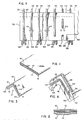
- Figure 1 is an isometric view of preimpregnated plies of composite material enclosed in a slip tape.
- Figure 2 is a closeup cross-sectional view of a portion of Figure 1.
- Figure 3 is an isometric drawing showing the preimpregnated plies of composite material in the slip tape of Figure 1 after the plies and slip tape have been formed in the desired shape.
- Figure 4 is an isometric view of one embodiment of the apparatus of the present invention.
- Figure 5 is an edge-on view of the wrapper tool shown in Figure 4.
- Figure 6 is a cross-sectional view of a portion of the apparatus shown in Figure 4.
- Figure 7 is a view, in partial cross section, of one face of the tool shown in Figure 4.
- Figure 8 is an isometric view of a second embodiment of the apparatus of the invention in partial cross section.
- Figure 9 is an edge-on view of a third embodiment of the apparatus of the present invention.
- Figure 10 is an edge-on view of a fourth embodiment of the apparatus of the present invention.
- Figure 1 is an isometric view of a part blank consisting of a plurality of
preimpregnated plies 10 of uncured composite material enclosed in aslip tape 12. The plies can be, for example, several lengths of graphite fabric and can be preimpregnated with uncured epoxy. The transverse width of each ply is typically up to six inches, but can be virtually any dimension. Theslip tape 12 can be made from any suitable material, such as a nylon fabric having a Teflon® coating. Theslip tape 12 can completely enclose thepreimpregnated plies 10 with one or more lengths. In the typical application shown in Figure 1,slip tape 12 comprises two lengths of Teflon®-coated nylon fabric. Afirst length 14 covers substantially the entire width of the bottom surface ofpreimpregnated plies 10. Thesecond length 16 covers the entire upper surface ofpreimpregnated plies 10 and overlaps the two edges of thefirst length 14 on the bottom surface of thepreimpregnated plies 10. The details of the overlapping first and second lengths of slip tape can be seen in the closeup cross-sectional view of Figure 2. - The part blank can be formed to the desired final cross section and wrapped tightly in its slip tape by the method and apparatus of the present invention. A portion of the desired cross section of the elongated part is created by a form (or other forming means) of the apparatus, while the remainder of the cross section is generated by a coacting resilient holding means of the apparatus. Assuming that the part that is to be formed is L-shaped, Figure 3 shows the shape of the slip tape-wrapped,
preimpregnated plies 10 after they have been folded lengthwise to produce a part having the desired cross section. - A first embodiment of the apparatus of the present invention is shown in Figure 4.
Tool 20 consists of aform 22 and a holding means 24.Tool 20 tightens the wrap of the slip tape around the part blank and forms the L-shaped elongated part blank 18 of Figure 3 (also shown in phantom lines in Figures 4, 5 and 7). Theconcave portion 17 of part blank 18 is placed against theupper surface 26 ofform 22. Theholding means 24 is resiliently biased against the upper surface of part blank 18 to force the part blank 18 to conform to the shape of theform 22. Holding means 24 also causesslip tape 12 to wrap more tightly aroundpreimpregnated plies 10, as explained in greater detail below. - Aluminum has been found to be a convenient material for making
form 22, and it can be formed by bending a plate lengthwise and thereby creatingrounded ridge 32.Rounded ridge 32 extends between a leadingedge 28 and atrailing edge 30, and separates the two planar portions ofupper surface 26.Rounded ridge 32 is slightly tapered adjacent leadingedge 28 ofform 22 in order to facilitate the shaping of part blank 18 byupper surface 26. Taperedridge 34 can, for example, taper at an angle of about three degrees with respect to the remainder of therounded ridge 32. To further facilitate the easy slippage of part blank 18 ontool 20, sections of slip tape fabric can be attached toupper surface 26 by an adhesive. - Holding means 24 can comprise a plurality of separate resilient
transverse holding components Holding components components form 22 by the thickness of the part blank 18 (indicated in dashed lines). In operation, the part blank is moved along theform 22 from the leadingedge 28 to thetrailing edge 30. The transverse force produced by holdingcomponents tool 20. The increasing tension of theholding components form 22 causes theslip tape 12 to "crawl" and tighten againstplies 10 to the required dimensions of part blank 18 before part blank 18 is introduced into the pultrusion die. The tension of the holdingcomponents 36, stretching betweenrounded edges side edge 62, thus tighten theslip tape 12 on thepart blank 18 and force thepart blank 18 to conform to the shape of theform 22. Side edges 62 connect leading and trailingedges tool 20. In addition, side edges 62 are located transversely outward frompart blank 18. In this way, form 22 further supports uncured part blank 18 until it has been formed bytool 20 and then cured. - Holding
components 38 also help to defineupper perimeter 44 of the cross section ofpart blank 18, but, more importantly, defineedges 46 ofpart blank 18. Holdingcomponents 38 stretch betweenrounded edges notches 52, which are formed in side edges 62 ofform 22. A holdingcomponent 38 must be longer than anadjacent holding component 36 in order to provide the same tensioning force against L-shapedelongated part blank 18. This is because, even though the distance aroundupper perimeter 44 of L-shapedpart blank 18 is shorter betweenrounded edges rounded edges components 38 attach to sideedges 62 while holdingcomponents 36 attach to theundersurface 66 ofform 22. The attachment of holdingcomponents - The force that is provided by an
individual holding component components knots 54 that engage against pin pairs 56 and 58. Pin pairs 56, placed inholes 60 along side edges 62, define the stretched length of holdingcomponents 36. Pin pairs 58, on the other hand, which fit intoholes 64 alongundersurface 66 ofform 22, define the stretched length of holdingcomponents 38. The distance between corresponding pin pairs 56 aroundupper perimeter 44 ofpart blank 18 is constant, independent of the position of the pin pairs 56 alongform 22. Therefore, holdingcomponents 36 can provide increasing tension by making them with shorter relaxed lengths the further they are from leadingedge 28 and toward trailingedge 30. Similarly, the holdingcomponents 38 having shorter relaxed lengths are placed closer to trailingedge 30. - If desired, alternating holding
components adjacent knots 54 shown in Figure 4). The length can have a series of knots spaced appropriately to define the required changing lengths of the alternating holdingcomponents pairs form 22 by an adhesive, such as a small dab of silicone adhesive. - To produce an L-shaped elongated composite part having three-inch legs with a tool that is fifteen inches long, it has been found convenient for holding
components Position (Ref. No.) Relaxed Length (inches) 1 36 6.85 2 38 7.75 3 36 6.50 4 38 7.33 5 36 6.14 6 38 6.92 7 36 5.78 8 38 6.50 9 36 5.42 10 38 6.08 11 36 5.07 12 38 5.67 13 36 4.71 14 38 5.25 15 36 4.35 edge 28 to trailingedge 30. The positions are spaced one inch apart. - While it is designed primarily to be held in a fixed position with respect to a pultrusion die, the
tool 20 can also be adapted for hand use by attaching ahandle 68 to theundersurface 66 ofform 22.Handle 68 can be attached to form 22 through matching threads formed on the end ofhandle 68 and in the body ofform 22. - The above-described
tool 20 produces L-shapedelongated parts 18 having legs whose lengths are retained within a tolerance of ten one-thousandths of an inch and whose angularity is controlled to one-tenth of a degree. In addition, leg thickness can be controlled to three one-thousandths of an inch. In some cases, it may be desirable to further control the uniformity of the legs of an L-shapedpart blank 18. This can be accomplished by means ofcinch plates 70, as shown in the isometric view of Figure 8. Theundersurface 72 ofcinch plate 70 can be made extremely smooth in order to very accurately control the thickness ofpart blank 18. Typically,undersurface 72 very closely parallelsupper surface 26 ofform 22.Cinch plate 70 is held in place by a holdingcomponent 38, such as knotted shock cord. The knots defining the relaxed length of holdingcomponent 38 are caught behind apin pair 58 and it passes throughnotch 52 and overcinch plate 70 to acorresponding pin pair 58. - The steps required to produce an L-shaped elongated part blank 18 with the apparatus described above are: first, to place a relatively short portion of the length of
slip tape 12 in theform 22. The next step is to attach holding means 24 to theform 22 for forcing the preimpregnated plies 10 of uncured composite material against the perimeter portion of theform 22 to force thepart blank 18 to have the desired cross section. The last step is to cause theform 22 and the holding means 24 to travel the length of the preimpregnated plies 10 and theslip tape 12. This tightens theslip tape 12 around the shape of the preimpregnated plies 10. - The above-described method and apparatus can be generalized by those skilled in the art to produce elongated parts whose cross sections are more complicated than L-shaped. As shown in the cross-sectional view of a wrapper tool in Figure 9, a T-shaped elongated part blank 80 can be placed in a
form 82 comprising pieces 84-88. Thepart blank 80 can be formed from preimpregnated plies 10 of a composite material, and fully enclosed in aslip tape 12. Pieces 84 through 88 have internal cross sections, portions of which are complementary to portions of the desired cross section ofpart blank 80. Force is simultaneously applied to parts 84-88 by holdingmeans 90. Holding means 90 can, for example, be one or more lengths of shock cord. Parts 84-88 can be retained in lengthwise alignment by means ofnotches 92 which are formed in parts 84-88. The part blank 80 passes through the wrapper tool from a leading edge to a trailing edge. In order to facilitate the smooth formation of the T-shaped part frompart blank 80, the leading edges of the forming means 82-84 can be tapered in a manner similar to the taperedridge portion 34 of roundedridge 32 inform 22 of Figures 4, 5, and 7. If further desired, the force applied by formingmeans 82 against part blank 80 can be increased in the direction of travel by decreasing the length of the respective holding means 90 in the direction of travel. - A third embodiment of the tool of the present invention is shown in the cross-sectional view of Figure 10. In this case, the tool receives an I-shaped
elongated part blank 100.Form 102 comprisesend plates 104 to define the upper and lower crossbars of thepart blank 100, and further comprisesforms 106, which define the connecting web between the end pieces of thepart blank 100.End plates 104 andforms 106 containnotches 108, which help to retainend plates 104 andforms 106 in correct lengthwise alignment. As disclosed above in connection with Figure 9, the leading edges ofend plates 104 andforms 106 can be tapered in order to facilitate the formation of the I-shaped part. In addition, if it is desirable to impose an increasing transverse force onpart blank 100 in the direction of travel, the lengths of holding means 110 can be caused to decrease in the direction of travel. - While the foregoing has described the method and preferred embodiments of the apparatus of the present invention, one skilled in the art will appreciate that a variety of modifications can be made to these embodiments without departing from the spirit and scope of the invention. Accordingly, the spirit and scope of the present invention are to be limited only by the following claims.
Claims (14)
1. A tool for tightening a slip tape around an elongated composite part blank, the desired cross section of the elongated part being defined by a perimeter including at least two portions, the tool comprising:
a form adapted to receive a relatively short section of a length of a slip tape enclosing preimpregnated plies of uncured composite material, said form having a leading edge and a trailing edge, said edges defining the direction of travel of the length of the slip tape along the form from the leading edge to the trailing edge, a portion of the perimeter of the cross section of said form being complementary to a first of said portions of the perimeter of said elongated composite part; and
holding means, attachable to the form for forcing the preimpregnated plies of uncured composite material in the slip tape against said perimeter portion of the form to form said first portion of the perimeter of the elongated composite part and for forming a second portion of the perimeter of the elongated part.
a form adapted to receive a relatively short section of a length of a slip tape enclosing preimpregnated plies of uncured composite material, said form having a leading edge and a trailing edge, said edges defining the direction of travel of the length of the slip tape along the form from the leading edge to the trailing edge, a portion of the perimeter of the cross section of said form being complementary to a first of said portions of the perimeter of said elongated composite part; and
holding means, attachable to the form for forcing the preimpregnated plies of uncured composite material in the slip tape against said perimeter portion of the form to form said first portion of the perimeter of the elongated composite part and for forming a second portion of the perimeter of the elongated part.
2. The tool of claim 1 wherein at least a portion of the leading edge of the form is tapered in the direction of travel.
3. The tool of claim 1, said form further comprising side edges that connect said leading and trailing edges, said side edges being substantially parallel to the direction of travel and extending transversely outwardly from the uncured part in order to support the uncured part. parallel to the direction of travel and extending transversely outwardly from the uncured part in order to support the uncured part.
4. The tool of claims 1 through 3 wherein the holding means comprises a plurality of transverse holding components and the form includes at least one pair of transversely opposing notches, one notch formed in each of the side edges, each pair of notches adapted to receive one transverse holding component, said holding means forcing the preimpregnated plies of uncured composite material in the slip tape against said perimeter portion of the form to form said first portion of the perimeter of the elongated composite part and for forming a second portion of the perimeter of the elongated part, each of the plurality of the transverse holding components producing a greater transverse force against said preimpregnated plies as a function of the direction of travel.
5. The tool of any one of the preceding claims wherein said form includes a handle and an undersurface disposed oppositely from said portion of the perimeter of the cross section of the form, said handle being adapted to attach to said undersurface.
6. The tool of claim 4 wherein said form includes a plurality of transversely opposed attachment means, each of said plurality of attachment means adapted to attach one of said plurality of transverse holding components to said form.
7. The tool of claim 4 wherein the holding components are knotted segments of elastic strap and each of said attachment means includes means for engaging said knotted segments.
8. The tool of claim 7 wherein said means for engaging said knotted segments comprises a pair of closely spaced pins.
9. The tool of claim 7 wherein the knotted segments of elastic strap are formed on a single length of elastic strap.
10. The tool of claim 1 wherein said holding means comprises one or more cinch plates adapted to be forced against said second portion of the perimeter of the elongated part.
11. The tool of claim 10 wherein said holding means further comprises a plurality of transverse holding components, each of said cinch plates being adapted to receive at least one of said holding components.
12. The method of tightening an elongated slip tape around a plurality of uncured, preimpregnated, composite material plies and forming the wrapped plurality of preimpregnated, composite material plies to a shape having a desired cross section defined by a perimeter including at least two portions, comprising the steps of:
(a) placing a relatively short section of the length of said slip tape in a form that has a portion of its cross section complementary to said desired cross section;
(b) attaching a holding means to said form for forcing said preimpregnated plies of uncured composite material and said slip tape against said perimeter of the elongated composite part and for forming a second portion of said perimeter of said desired cross section; and
(c) causing said form and said holding means to travel the length of said preimpregnated plies of uncured composite material and said slip tape,
thereby tightening said slip tape on said preimpregnated plies which have the desired cross section of the elongated composite part.
thereby tightening said slip tape on said preimpregnated plies which have the desired cross section of the elongated composite part.
13. The method of claim 12 wherein step (b) includes stretching at least one transverse holding component across the form to force said preimpregnated plies of uncured composite material and said slip tape against said perimeter portion of said form and to form said second portion of said perimeter of said desired cross section.
14. The method of claims 12 and 13 wherein step (b) includes placing one or more cinch plates against the plurality of preimpregnated plies of uncured composite material and said slip tape and stretching at least one transverse holding component across said one or more cinch plates against said preimpregnated plies of uncured composite material and said slip tape to form said second portion of said perimeter of said desired cross section.
Applications Claiming Priority (2)
| Application Number | Priority Date | Filing Date | Title |
|---|---|---|---|
| US07/133,014 US4816102A (en) | 1987-12-15 | 1987-12-15 | Method and apparatus for forming an elongated composite part |
| US133014 | 1987-12-15 |
Publications (2)
| Publication Number | Publication Date |
|---|---|
| EP0320780A2 true EP0320780A2 (en) | 1989-06-21 |
| EP0320780A3 EP0320780A3 (en) | 1991-09-11 |
Family
ID=22456624
Family Applications (1)
| Application Number | Title | Priority Date | Filing Date |
|---|---|---|---|
| EP19880120469 Withdrawn EP0320780A3 (en) | 1987-12-15 | 1988-12-07 | Method and apparatus for forming an elongated composite part |
Country Status (3)
| Country | Link |
|---|---|
| US (1) | US4816102A (en) |
| EP (1) | EP0320780A3 (en) |
| JP (1) | JPH01301254A (en) |
Cited By (3)
| Publication number | Priority date | Publication date | Assignee | Title |
|---|---|---|---|---|
| EP0446851A1 (en) * | 1990-03-13 | 1991-09-18 | Fuji Jukogyo Kabushiki Kaisha | Mold for forming composite-material structures |
| FR2660893A1 (en) * | 1990-04-17 | 1991-10-18 | Lhomme Sa | PROCESS AND DEVICE FOR THE MANUFACTURE OF CARDBOARD CORNERS PROVIDED WITH A COVER AND CORNERS THUS PRODUCED. |
| EP3885122A1 (en) * | 2020-03-27 | 2021-09-29 | Faurecia Intérieur Industrie | Method for manufacturing a sheet for holding a cover of an airbag device |
Families Citing this family (5)
| Publication number | Priority date | Publication date | Assignee | Title |
|---|---|---|---|---|
| US5240542A (en) * | 1990-09-06 | 1993-08-31 | The Board Of Trustees Of The Leland Stanford Junior University | Joining of composite materials by induction heating |
| US5320700A (en) * | 1991-04-15 | 1994-06-14 | Phillips Petroleum Company | Process for molding utilizing compression sleeve |
| US5127980A (en) * | 1991-04-18 | 1992-07-07 | Graphite Design And Detail, Incorporated | Apparatus for continuously forming composite material into a rigid structural member |
| US6280001B1 (en) | 1999-03-05 | 2001-08-28 | Cascade Engineering, Inc. | Waste container and wheel assembly with pultruded axle |
| JP3400399B2 (en) * | 2000-01-11 | 2003-04-28 | 株式会社ジャムコ | Continuous molding equipment for F-shaped H-shaped members |
Family Cites Families (14)
| Publication number | Priority date | Publication date | Assignee | Title |
|---|---|---|---|---|
| US3200023A (en) * | 1961-05-09 | 1965-08-10 | Fmc Corp | Method of making a reinforced plastic pipe fitting |
| US3399094A (en) * | 1963-11-14 | 1968-08-27 | American Cyanamid Co | Method for forming tubular reinforced plastic members |
| US3793108A (en) * | 1967-06-23 | 1974-02-19 | Glastrusions | Augmented curing of reinforced plastic stock |
| US3887761A (en) * | 1967-09-07 | 1975-06-03 | Gore & Ass | Tape wrapped conductor |
| US3756004A (en) * | 1970-09-21 | 1973-09-04 | Gore & Ass | Method and apparatus for insulating electrical conductors |
| US3806394A (en) * | 1972-02-23 | 1974-04-23 | R Davis | Web forming machine |
| CH590724A5 (en) * | 1975-05-15 | 1977-08-31 | Baumgartner Papiers Sa | Mfg. rods and tubes from bundles of filaments - which are bonded by heat with precise timing of plasticising period |
| US4038018A (en) * | 1976-06-21 | 1977-07-26 | Fmc Corporation | Apparatus for molding of filament-reinforced plastic rods |
| US4154634A (en) * | 1977-09-22 | 1979-05-15 | Plas/Steel Products, Inc. | Method for fabricating improved fiber reinforced plastic rods having a smooth surface |
| DE3121241C2 (en) * | 1980-05-28 | 1984-07-19 | Dainippon Ink And Chemicals, Inc., Tokio/Tokyo | Method of manufacturing a composite plastic pipe from thermoplastic resin |
| DE3022303A1 (en) * | 1980-06-13 | 1981-12-17 | Siemens AG, 1000 Berlin und 8000 München | METHOD FOR BANDING THREE-DIMENSIONAL CURVED LADDERS |
| US4307053A (en) * | 1980-08-18 | 1981-12-22 | Owens-Corning Fiberglas Corporation | Method and apparatus for processing compressible material |
| US4581263A (en) * | 1984-08-27 | 1986-04-08 | Fiber Materials, Inc. | Graphite fiber mold |
| US4624726A (en) * | 1985-06-06 | 1986-11-25 | Ltv Aerospace And Defense Company | Apparatus for forming elongate structures of composite materials |
-
1987
- 1987-12-15 US US07/133,014 patent/US4816102A/en not_active Expired - Fee Related
-
1988
- 1988-12-07 EP EP19880120469 patent/EP0320780A3/en not_active Withdrawn
- 1988-12-14 JP JP63316062A patent/JPH01301254A/en active Pending
Cited By (6)
| Publication number | Priority date | Publication date | Assignee | Title |
|---|---|---|---|---|
| EP0446851A1 (en) * | 1990-03-13 | 1991-09-18 | Fuji Jukogyo Kabushiki Kaisha | Mold for forming composite-material structures |
| FR2660893A1 (en) * | 1990-04-17 | 1991-10-18 | Lhomme Sa | PROCESS AND DEVICE FOR THE MANUFACTURE OF CARDBOARD CORNERS PROVIDED WITH A COVER AND CORNERS THUS PRODUCED. |
| WO1991016193A3 (en) * | 1990-04-17 | 1991-12-12 | Lhomme Sa | Method and device for manufacturing coated cardboard corner pieces, and corner pieces thereby produced |
| EP3885122A1 (en) * | 2020-03-27 | 2021-09-29 | Faurecia Intérieur Industrie | Method for manufacturing a sheet for holding a cover of an airbag device |
| EP3885121A1 (en) * | 2020-03-27 | 2021-09-29 | Faurecia Intérieur Industrie | Method for manufacturing a sheet for holding a cover of an airbag device |
| FR3108549A1 (en) * | 2020-03-27 | 2021-10-01 | Faurecia Interieur Industrie | Method of making a sheet for retaining a cover of an airbag device |
Also Published As
| Publication number | Publication date |
|---|---|
| EP0320780A3 (en) | 1991-09-11 |
| JPH01301254A (en) | 1989-12-05 |
| US4816102A (en) | 1989-03-28 |
Similar Documents
| Publication | Publication Date | Title |
|---|---|---|
| JP2935722B2 (en) | Aircraft fuselage structure and molding method thereof | |
| DE69322171T2 (en) | DEVICE FOR SHAPING A FABRIC AND MATERIAL AND METHOD FOR HIGH PRESSURE BREAKING A LIGHT COMPOSITE ITEM WITH A HONEYCOMB CORE, WITH SLOPED SURFACES USING LIGHT, STABILIZED, TROUBLED PRODUCTS | |
| EP0320780A2 (en) | Method and apparatus for forming an elongated composite part | |
| CA1229709A (en) | Method of fabricating double-toothed belts | |
| DE2404106A1 (en) | TIMING BELT AND THE PROCESS AND DEVICE FOR ITS MANUFACTURING | |
| US4759815A (en) | Forming thermoplastic laminates into major sections | |
| US3419449A (en) | Method of making transmission belts | |
| DE1504794A1 (en) | Method for connecting the ends of conveyor belts or the like. | |
| DE60118865T2 (en) | Method for producing a stiffened hollow body of a fiber-reinforced composite material | |
| DE68902448D1 (en) | FASTENING DEVICE ARRANGED ON TAPES, ESPECIALLY FOR FASTENING PLASTIC FILMS AND THE LIKE ON REINFORCEMENT NETWORKS, METHOD FOR THEIR PRODUCTION AND MACHINE FOR THEIR ASSEMBLY. | |
| US20240058987A1 (en) | Forming a preform into a shaped body | |
| EP0932906B1 (en) | Wiring harness breakout clip, wiring harness assembly apparatus and method of constructing wiring harnesses | |
| DE2949604C2 (en) | Method and device for producing a support device for electronic components | |
| US2955065A (en) | Method of repairing a wire-reinforced conveyer belt | |
| JP2511989B2 (en) | Simultaneous biaxial stretching method for sheet material | |
| DE2232337B2 (en) | Method of forming endless conveyor belts, drive belts and the like | |
| US4543226A (en) | Method and apparatus for heat setting fastener elements | |
| JPH0430745B2 (en) | ||
| JPH057179B2 (en) | ||
| JPS5833443A (en) | Preparation of toothed belt | |
| EP0145501A2 (en) | Method of and apparatus for the manufacture of long cogged power transmission belts | |
| JPH0592805A (en) | Transport belt and manufacture thereof | |
| JPS6448344A (en) | Tensely laying method for shadow mask | |
| DE2403329A1 (en) | METHOD FOR MANUFACTURING SEMI-FINISHED PRODUCTS FROM SALES FABRIC, FABRIC OR THE LIKE | |
| JP2985680B2 (en) | Drive shaft manufacturing method |
Legal Events
| Date | Code | Title | Description |
|---|---|---|---|
| PUAI | Public reference made under article 153(3) epc to a published international application that has entered the european phase |
Free format text: ORIGINAL CODE: 0009012 |
|
| AK | Designated contracting states |
Kind code of ref document: A2 Designated state(s): CH ES FR GB LI SE |
|
| PUAL | Search report despatched |
Free format text: ORIGINAL CODE: 0009013 |
|
| AK | Designated contracting states |
Kind code of ref document: A3 Designated state(s): CH ES FR GB LI SE |
|
| STAA | Information on the status of an ep patent application or granted ep patent |
Free format text: STATUS: THE APPLICATION IS DEEMED TO BE WITHDRAWN |
|
| 18D | Application deemed to be withdrawn |
Effective date: 19920312 |