EP0318902A2 - Use of linear annelated tricyclics as inhibitors of erythrocyte aggregation - Google Patents
Use of linear annelated tricyclics as inhibitors of erythrocyte aggregation Download PDFInfo
- Publication number
- EP0318902A2 EP0318902A2 EP88119839A EP88119839A EP0318902A2 EP 0318902 A2 EP0318902 A2 EP 0318902A2 EP 88119839 A EP88119839 A EP 88119839A EP 88119839 A EP88119839 A EP 88119839A EP 0318902 A2 EP0318902 A2 EP 0318902A2
- Authority
- EP
- European Patent Office
- Prior art keywords
- group
- oder
- alkyl
- eine
- atom
- Prior art date
- Legal status (The legal status is an assumption and is not a legal conclusion. Google has not performed a legal analysis and makes no representation as to the accuracy of the status listed.)
- Withdrawn
Links
Classifications
-
- A—HUMAN NECESSITIES
- A61—MEDICAL OR VETERINARY SCIENCE; HYGIENE
- A61K—PREPARATIONS FOR MEDICAL, DENTAL OR TOILETRY PURPOSES
- A61K31/00—Medicinal preparations containing organic active ingredients
- A61K31/33—Heterocyclic compounds
- A61K31/395—Heterocyclic compounds having nitrogen as a ring hetero atom, e.g. guanethidine or rifamycins
- A61K31/435—Heterocyclic compounds having nitrogen as a ring hetero atom, e.g. guanethidine or rifamycins having six-membered rings with one nitrogen as the only ring hetero atom
- A61K31/44—Non condensed pyridines; Hydrogenated derivatives thereof
-
- A—HUMAN NECESSITIES
- A61—MEDICAL OR VETERINARY SCIENCE; HYGIENE
- A61K—PREPARATIONS FOR MEDICAL, DENTAL OR TOILETRY PURPOSES
- A61K31/00—Medicinal preparations containing organic active ingredients
- A61K31/33—Heterocyclic compounds
- A61K31/395—Heterocyclic compounds having nitrogen as a ring hetero atom, e.g. guanethidine or rifamycins
- A61K31/54—Heterocyclic compounds having nitrogen as a ring hetero atom, e.g. guanethidine or rifamycins having six-membered rings with at least one nitrogen and one sulfur as the ring hetero atoms, e.g. sulthiame
-
- A—HUMAN NECESSITIES
- A61—MEDICAL OR VETERINARY SCIENCE; HYGIENE
- A61K—PREPARATIONS FOR MEDICAL, DENTAL OR TOILETRY PURPOSES
- A61K31/00—Medicinal preparations containing organic active ingredients
- A61K31/33—Heterocyclic compounds
- A61K31/395—Heterocyclic compounds having nitrogen as a ring hetero atom, e.g. guanethidine or rifamycins
- A61K31/40—Heterocyclic compounds having nitrogen as a ring hetero atom, e.g. guanethidine or rifamycins having five-membered rings with one nitrogen as the only ring hetero atom, e.g. sulpiride, succinimide, tolmetin, buflomedil
-
- A—HUMAN NECESSITIES
- A61—MEDICAL OR VETERINARY SCIENCE; HYGIENE
- A61K—PREPARATIONS FOR MEDICAL, DENTAL OR TOILETRY PURPOSES
- A61K31/00—Medicinal preparations containing organic active ingredients
- A61K31/33—Heterocyclic compounds
- A61K31/395—Heterocyclic compounds having nitrogen as a ring hetero atom, e.g. guanethidine or rifamycins
- A61K31/41—Heterocyclic compounds having nitrogen as a ring hetero atom, e.g. guanethidine or rifamycins having five-membered rings with two or more ring hetero atoms, at least one of which being nitrogen, e.g. tetrazole
- A61K31/415—1,2-Diazoles
-
- A—HUMAN NECESSITIES
- A61—MEDICAL OR VETERINARY SCIENCE; HYGIENE
- A61K—PREPARATIONS FOR MEDICAL, DENTAL OR TOILETRY PURPOSES
- A61K31/00—Medicinal preparations containing organic active ingredients
- A61K31/33—Heterocyclic compounds
- A61K31/395—Heterocyclic compounds having nitrogen as a ring hetero atom, e.g. guanethidine or rifamycins
- A61K31/41—Heterocyclic compounds having nitrogen as a ring hetero atom, e.g. guanethidine or rifamycins having five-membered rings with two or more ring hetero atoms, at least one of which being nitrogen, e.g. tetrazole
- A61K31/42—Oxazoles
-
- A—HUMAN NECESSITIES
- A61—MEDICAL OR VETERINARY SCIENCE; HYGIENE
- A61K—PREPARATIONS FOR MEDICAL, DENTAL OR TOILETRY PURPOSES
- A61K31/00—Medicinal preparations containing organic active ingredients
- A61K31/33—Heterocyclic compounds
- A61K31/395—Heterocyclic compounds having nitrogen as a ring hetero atom, e.g. guanethidine or rifamycins
- A61K31/41—Heterocyclic compounds having nitrogen as a ring hetero atom, e.g. guanethidine or rifamycins having five-membered rings with two or more ring hetero atoms, at least one of which being nitrogen, e.g. tetrazole
- A61K31/425—Thiazoles
-
- A—HUMAN NECESSITIES
- A61—MEDICAL OR VETERINARY SCIENCE; HYGIENE
- A61K—PREPARATIONS FOR MEDICAL, DENTAL OR TOILETRY PURPOSES
- A61K31/00—Medicinal preparations containing organic active ingredients
- A61K31/33—Heterocyclic compounds
- A61K31/395—Heterocyclic compounds having nitrogen as a ring hetero atom, e.g. guanethidine or rifamycins
- A61K31/495—Heterocyclic compounds having nitrogen as a ring hetero atom, e.g. guanethidine or rifamycins having six-membered rings with two or more nitrogen atoms as the only ring heteroatoms, e.g. piperazine or tetrazines
- A61K31/50—Pyridazines; Hydrogenated pyridazines
-
- A—HUMAN NECESSITIES
- A61—MEDICAL OR VETERINARY SCIENCE; HYGIENE
- A61P—SPECIFIC THERAPEUTIC ACTIVITY OF CHEMICAL COMPOUNDS OR MEDICINAL PREPARATIONS
- A61P1/00—Drugs for disorders of the alimentary tract or the digestive system
- A61P1/04—Drugs for disorders of the alimentary tract or the digestive system for ulcers, gastritis or reflux esophagitis, e.g. antacids, inhibitors of acid secretion, mucosal protectants
-
- A—HUMAN NECESSITIES
- A61—MEDICAL OR VETERINARY SCIENCE; HYGIENE
- A61P—SPECIFIC THERAPEUTIC ACTIVITY OF CHEMICAL COMPOUNDS OR MEDICINAL PREPARATIONS
- A61P17/00—Drugs for dermatological disorders
-
- A—HUMAN NECESSITIES
- A61—MEDICAL OR VETERINARY SCIENCE; HYGIENE
- A61P—SPECIFIC THERAPEUTIC ACTIVITY OF CHEMICAL COMPOUNDS OR MEDICINAL PREPARATIONS
- A61P25/00—Drugs for disorders of the nervous system
- A61P25/02—Drugs for disorders of the nervous system for peripheral neuropathies
-
- A—HUMAN NECESSITIES
- A61—MEDICAL OR VETERINARY SCIENCE; HYGIENE
- A61P—SPECIFIC THERAPEUTIC ACTIVITY OF CHEMICAL COMPOUNDS OR MEDICINAL PREPARATIONS
- A61P29/00—Non-central analgesic, antipyretic or antiinflammatory agents, e.g. antirheumatic agents; Non-steroidal antiinflammatory drugs [NSAID]
-
- A—HUMAN NECESSITIES
- A61—MEDICAL OR VETERINARY SCIENCE; HYGIENE
- A61P—SPECIFIC THERAPEUTIC ACTIVITY OF CHEMICAL COMPOUNDS OR MEDICINAL PREPARATIONS
- A61P3/00—Drugs for disorders of the metabolism
- A61P3/08—Drugs for disorders of the metabolism for glucose homeostasis
-
- A—HUMAN NECESSITIES
- A61—MEDICAL OR VETERINARY SCIENCE; HYGIENE
- A61P—SPECIFIC THERAPEUTIC ACTIVITY OF CHEMICAL COMPOUNDS OR MEDICINAL PREPARATIONS
- A61P35/00—Antineoplastic agents
-
- A—HUMAN NECESSITIES
- A61—MEDICAL OR VETERINARY SCIENCE; HYGIENE
- A61P—SPECIFIC THERAPEUTIC ACTIVITY OF CHEMICAL COMPOUNDS OR MEDICINAL PREPARATIONS
- A61P7/00—Drugs for disorders of the blood or the extracellular fluid
- A61P7/02—Antithrombotic agents; Anticoagulants; Platelet aggregation inhibitors
-
- A—HUMAN NECESSITIES
- A61—MEDICAL OR VETERINARY SCIENCE; HYGIENE
- A61P—SPECIFIC THERAPEUTIC ACTIVITY OF CHEMICAL COMPOUNDS OR MEDICINAL PREPARATIONS
- A61P9/00—Drugs for disorders of the cardiovascular system
-
- A—HUMAN NECESSITIES
- A61—MEDICAL OR VETERINARY SCIENCE; HYGIENE
- A61P—SPECIFIC THERAPEUTIC ACTIVITY OF CHEMICAL COMPOUNDS OR MEDICINAL PREPARATIONS
- A61P9/00—Drugs for disorders of the cardiovascular system
- A61P9/08—Vasodilators for multiple indications
-
- A—HUMAN NECESSITIES
- A61—MEDICAL OR VETERINARY SCIENCE; HYGIENE
- A61P—SPECIFIC THERAPEUTIC ACTIVITY OF CHEMICAL COMPOUNDS OR MEDICINAL PREPARATIONS
- A61P9/00—Drugs for disorders of the cardiovascular system
- A61P9/10—Drugs for disorders of the cardiovascular system for treating ischaemic or atherosclerotic diseases, e.g. antianginal drugs, coronary vasodilators, drugs for myocardial infarction, retinopathy, cerebrovascula insufficiency, renal arteriosclerosis
Definitions
- the compounds described in the abovementioned applications are primarily suitable for the treatment of those diseases in which an increase in cardiac strength and a reduction in blood pressure are in the foreground, an additional pharmacological effect being the improvement of the flow in the microcirculation by inhibiting platelet aggregation on the one hand and is achieved by increasing the contractility of the heart.
- R is a phenyl ring of the general formula 11, the alkyl part of the substituents mentioned for R 2 , R 3 and R4 can contain 1-5 carbon atoms, preferably 1-4 carbon atoms.
- preference is given, for example, to methanesulfonyloxy-, ethanesulfonyloxy-, n-propanesulfonyloxy-, isopropanesulfonyloxy-, trifluoromethanesulfonyloxy-, methylsulfenylmethyl-, ethylsulfenylmethyl-, n-propylsulfenylmethyl-, methylsulfinylmethyl- methylsethyl- ethylsulfylmethyl- ethylsulfylmethyl- ethylsulfylmethyl- ethylsulfylmethyl- ethylsulfylmethyl- -, n
- sulfonyl groups which can be substituted by cyclic imino groups
- the morpholino, thiomorpholino, pyrrolidino, piperidino and hexamethyleneiminosulfonyl groups are preferred.
- the phenyl moiety can carry 1 to 3 substituents.
- Preferred monosubstituted phenyl compounds are the hydroxy, C 1 -C 3 alkyl, C i -C 3 alkoxy, allyloxy, propargyloxy, cyanomethyloxy, methoxycarbonylmethyloxy, halogen, nitro, cyano, aminocarbonyl, methoxycarbonyl , Amino, C 1 -C 3 dialkylamino, C 1 -C 3 alkylmercapto, C 1 -C 3 alkylsulfinyl, C 1 -C 3 alkylsulfonyl, C 1 -C a alkylsulfonyloxy, and the 1-imidazolylphenyls , wherein the substituent can be in the 2-, 3- or 4-position.
- Preferred disubstituted phenyls contain, as substituents, an alkanesulfonyloxy-, trifluoromethylsulfonyloxy-, alkylsulfenylmethyl-, alkylsulfinylmethyl-, alkylsulfonylmethyl-, alkylsulfonylamino-, N-alkyl-alkylsulfonylamino-, trifluoromethylsulfonylamino-fluorine, a-hydroxylamino- or n-mono- Amino, alkylamino or dialkylamino group substituted carbonyl group or a sulfonyl group substituted by an amino, dialkylamino or morpholino group, an alkylaminosulfonyl, alkylcarbonylamino, aminocarbonylamino or N-alkylamino carbonylamino group, a hydroxy, allyloxy, alkoxy
- Preferred trisubstituted phenyl contain hydroxyl and methoxy groups as substituents.
- R i is a heterocyclic five-membered ring with 1-4 heteroatoms or a heterocyclic six-membered ring with 1-5 heteroatoms, where the heteroatoms of the aforementioned five or six-membered rings can be the same or different and denote nitrogen, oxygen or sulfur and optionally one or more nitrogen atoms
- Alkyl, alkoxy and alkyl mercapto substituents in the heterocyclic five and six rings can contain 1-6, preferably 1-4 carbon atoms.
- the methyl, ethyl, methoxy, ethoxy, methylmercapto and ethyl mercapto radical is preferred.
- Halogen is to be understood as fluorine, chlorine and bromine, preferably chlorine.
- R 1 is an alkyl, alkenyl or alkynyl radical
- R 1 is an alkyl, alkenyl or alkynyl radical
- R i is a cycloalkyl or cycloalkenyl radical, it is to be understood as meaning rings with three to seven members. In this sense, the cyclopropyl, cyclobutyl, cyclopentyl, cyclohexyl, cyclopentenyl and cyclohexenyl radical is preferred.
- Ri is an alkoxyalkyl, carboxyalkyl, alkoxycarbonylalkyl, hydroxyalkyl radical, the alkyl or alkoxy groups can contain 1 to 6 carbon atoms.
- X a bond, a methylene, ethylene or the vinylene group is preferred.
- A is the group pCR s and R 5 is an alkylcarbonyl, alkoxycarbonyl, aminocarbonyl, alkylaminocarbonyl or dialkylaminocarbonyl group
- the alkyl or alkoxy radicals mentioned can contain 1-7 carbon atoms, preferably 1-5 carbon atoms.
- the acetyl, propionyl, methoxycarbonyl, ethoxycarbonyl, aminocarbonyl, methylaminocarbonyl or dimethylaminocarbonyl group are preferred.
- B is the group NR 6 and R 6 is an alkyl group
- the methyl, ethyl, propyl, isopropyl, butyl, 2-butyl and 1,1-dimethyl-ethyl group are preferred.
- each of the abovementioned alkyl or alkenyl parts can be straight-chain or branched and contain 1-6 or 2-6 carbon atoms and the cycloalkyl part mentioned 3-7 carbon atoms.
- R 7 is a hydrogen atom, the methyl, ethyl, isopropyl, 3-pentyl, Cyclopentyl or cyclohexyl group.
- R 8 may preferably be hydrogen, methyl, ethyl, isopropyl, 3-pentyl, cyano, carboxy, acetyl, propynyl, methoxycarbonyl, ethoxycarbonyl, aminocarbonyl, methylaminocarbonyl, dimethylaminocarbonyl and hydrazinocarbonyl represent.
- R 7 and R 8 form a cycloalkyl ring together with the carbon atom to which they are attached, it is preferably the spirocyclopropyl, spirocyclobutyl, spirocyclopentyl and spirocyclohexyl group. If R 7 and R 8 together form an alkylidene or cycloalkylidene group, the isopropylidene or cyclohexylidene group is preferred.
- the substances of the general formula I are mixed in a manner known per se with suitable pharmaceutical carriers, flavorings, flavors and colors and shaped, for example, as tablets or dragées or with the addition of appropriate auxiliaries in water or oil, such as e.g. Olive oil, suspended or dissolved.
- the substances of general formula I and their salts can be administered enterally or parenterally in liquid or solid form.
- Water is preferably used as the injection medium, which contains the additives customary for injection solutions, such as stabilizing agents, solubilizers or buffers.
- Such additives are e.g. Tartrate and citrate buffers, ethanol, complexing agents (such as ethylenediaminetetraacetic acid and its non-toxic salts) and high molecular weight polymers (such as liquid polyethylene oxide) for viscosity regulation.
- Solid carriers are e.g. Starch, lactose, mannitol, methyl cellulose, talc, highly disperse silicas, high molecular fatty acids (such as stearic acid), gelatin, agar, calcium phosphate, magnesium stearate, animal and vegetable fats and solid high molecular polymers (such as polyethylene glycols).
- Preparations suitable for oral administration can, if desired, contain flavoring and sweetening agents.
- the compounds are usually applied in amounts of 10-2000 mg per day based on 75 kg of body weight. It is preferred to administer 1-2 tablets 2-4 times a day with an active substance content of 5-500 mg. The tablets can also be delayed, which means that 1-2 tablets with 20-1000 mg of active ingredient only have to be given once a day.
- the active ingredient can also be given by injection 1-8 may per day or by continuous infusion, with amounts of 10-1000 mg per day usually being sufficient.
- the erythrocyte aggregation was determined using the mini erythrocyte aggregometer from Myrenne, Rötgen (Kiesewetter et al., Biomed.technik 27, 209-213 (1982)). As a measure, this device specifies a dimensionless index that increases as the tendency to aggregate increases.
- the blood was adjusted to a hematocrit of 45% and the control solution or a substance solution was added and incubated. Then the erythrocyte aggregation was measured. Each substance was examined in a concentration of 10 -5 molar. Two tests were carried out for each substance with the blood of two donors. The difference in the aggregation indices between the initial value of the control solution and the values with the substance solution was calculated (AE).
- erythrocyte aggregation The lower the listed value, the more effective the substance. Venoruton, a mixture of different 0- (beta-hydroxyethyl) rutosides, however, works at a comparable concentration of 1.7. 10 -5 M only a change in the erythrocyte aggregation index by -0.4. Even at a concentration of 1.7. 10-3 M the change is only -3.9 ⁇ 0.9.
- Venoruton is said to inhibit the tendency of erythrocyte aggregation. (Schmid-Schönbein et al., VASA 4 263-270 (1975)).
- the substances mentioned of the present invention inhibit erythrocyte aggregation to a significantly greater extent.
Landscapes
- Health & Medical Sciences (AREA)
- Life Sciences & Earth Sciences (AREA)
- General Health & Medical Sciences (AREA)
- Veterinary Medicine (AREA)
- Public Health (AREA)
- Chemical & Material Sciences (AREA)
- Animal Behavior & Ethology (AREA)
- Pharmacology & Pharmacy (AREA)
- Medicinal Chemistry (AREA)
- Epidemiology (AREA)
- General Chemical & Material Sciences (AREA)
- Organic Chemistry (AREA)
- Chemical Kinetics & Catalysis (AREA)
- Nuclear Medicine, Radiotherapy & Molecular Imaging (AREA)
- Bioinformatics & Cheminformatics (AREA)
- Engineering & Computer Science (AREA)
- Heart & Thoracic Surgery (AREA)
- Cardiology (AREA)
- Diabetes (AREA)
- Hematology (AREA)
- Neurosurgery (AREA)
- Dermatology (AREA)
- Endocrinology (AREA)
- Obesity (AREA)
- Pain & Pain Management (AREA)
- Rheumatology (AREA)
- Emergency Medicine (AREA)
- Biomedical Technology (AREA)
- Vascular Medicine (AREA)
- Neurology (AREA)
- Urology & Nephrology (AREA)
- Pharmaceuticals Containing Other Organic And Inorganic Compounds (AREA)
- Nitrogen And Oxygen Or Sulfur-Condensed Heterocyclic Ring Systems (AREA)
- Nitrogen Condensed Heterocyclic Rings (AREA)
- Plural Heterocyclic Compounds (AREA)
- Heterocyclic Carbon Compounds Containing A Hetero Ring Having Oxygen Or Sulfur (AREA)
Abstract
Verwendung von linear anellierten Tricyclen der allgemeinen Formel I

- in der R, einen gegebenenfalls substituierten Phenylring oder einen gegebenenfalls substituierten heterocyclischen Fünfring mit 1 - 4 Heteroatomen oder einen heterocyclischen Sechsring mit 1 - 5 Heteroatomen darstellt, wobei die Heteroatome gleich oder verschieden sein können und Sauerstoff, Schwefel oder Stickstoff bedeuten und gewünschtenfalls an einem oder mehreren Stickstoffatomen ein Sauerstoffatomen tragen können,
- oder für den Fall, daß X eine Bindung darstellt, R, neben den oben genannten Gruppen auch ein Wasserstoffatom, eine Alkyl-, Cycloalkyl-, Alkenyl-, Cycloalkenyl-, Alkinyl-, Halogenalkyl-, Alkoxyalkyl-, Carboxyalkyl-, Alkoxy-, carbonylalkyl-, eine Hydroxy-, Mercapto-, Amino-, Alkylmercapto-,
- Formylaminoalkyl-, oder eine Pyridylcarbonylaminogruppe bedeutet,
- X eine Bindung, eine Alkylen-, oder die Vinylengruppe bedeutet,
- A ein Stickstoffatom oder die Gruppe CRs sein kann, wobei R5 ein Wasserstoffatom, eine Alkyl-, Alkenyl-, Cycloalkyl-, Cycloalkenyl-, Cyan-, Alkylcarbonyl-, Alkoxycarbonyl-, Carboxy-, Aminocarbonyl-, Alkylaminocarbonyl-, Dialkylaminocarbonyl- oder Arylgruppe bedeutet,
- B ein Sauerstoffatom, ein Schwefelatom oder die Gruppe NR6 bedeutet, wobei R6 ein Wasserstoffatom oder eine Alkylgruppe bedeutet, oder B die Gruppe CR7R8 sein kann, wobei R7 ein Wasserstofatom, eine Alkyl-, Alkenyl-, oder eine Cycloalkylgruppe bedeutet, und R8 ein Wasserstoffatom, eine Alkyl-, Alkenyl-oder Cyangruppe, eine durch eine Hydroxy-, Alkyl-, Alkoxy-, Amino-, Alkylamino-, Dialkylamino- oder Hydrazinogruppe substituierte Carbonylgruppe, oder R7 und R8 zusammen eine Alkyliden-oder Cycloalkylidengruppe bilden, oder R7 und R8 zusammen mit dem C-Atom, an das sie gebunden sind einen Spirocyclus bilden,
- sowie deren pharmakologisch verträglichen Salze zur Behandlung von Krankheiten, bei denen in der Pathogenese die Erythrozytenaggregation eine wichtige Rolle spielt.
- in which R represents an optionally substituted phenyl ring or an optionally substituted heterocyclic five-membered ring with 1-4 heteroatoms or a heterocyclic six-membered ring with 1-5 heteroatoms, where the heteroatoms can be the same or different and denote oxygen, sulfur or nitrogen and, if desired, on one or several nitrogen atoms can carry one oxygen atom,
- or in the event that X represents a bond, R, in addition to the groups mentioned above, also a hydrogen atom, an alkyl, cycloalkyl, alkenyl, cycloalkenyl, alkynyl, haloalkyl, alkoxyalkyl, carboxyalkyl, alkoxy, carbonylalkyl, a hydroxy, mercapto, amino, alkylmercapto,
- Means formylaminoalkyl or a pyridylcarbonylamino group,
- X represents a bond, an alkylene group or the vinylene group,
- A can be a nitrogen atom or the group CRs, where R 5 is a hydrogen atom, an alkyl, alkenyl, cycloalkyl, cycloalkenyl, cyano, alkylcarbonyl, alkoxycarbonyl, carboxy, aminocarbonyl, alkylaminocarbonyl, dialkylaminocarbonyl or Aryl group means
- B represents an oxygen atom, a sulfur atom or the group NR 6 , where R 6 represents a hydrogen atom or an alkyl group, or B can be the group CR 7 R 8 , where R 7 represents a hydrogen atom, an alkyl, alkenyl or a cycloalkyl group means, and R 8 is a hydrogen atom, an alkyl, alkenyl or cyano group, a carbonyl group substituted by a hydroxy, alkyl, alkoxy, amino, alkylamino, dialkylamino or hydrazino group, or R 7 and R 8 together are one Form alkylidene or cycloalkylidene group, or R 7 and R 8 together with the carbon atom to which they are attached form a spirocycle,
- as well as their pharmacologically acceptable salts for the treatment of diseases in which erythrocyte aggregation plays an important role in the pathogenesis.
Description
Gegenstand der vorliegenden Erfindung ist die Verwendung von Verbindungen der allgemeinen Formel I,

- R1 einen Phenylring der allgemeinen Formel 11 darstellt,
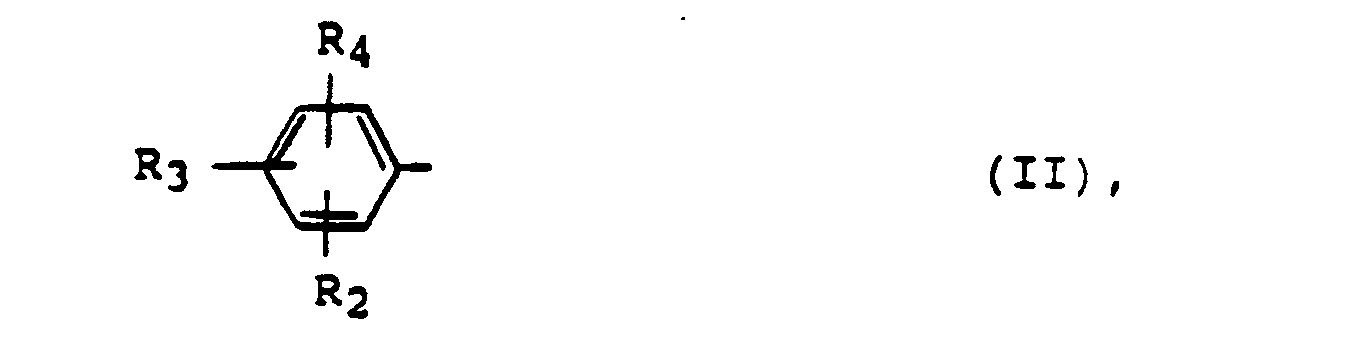
- wobei R2, Ra, R4 gleich oder verschieden sein können und jeweils Wasserstoff, eine Alkansulfonyloxy-, Trifluormethansulfonyloxy-, Alkansulfonylamino-, Trifluormethansulfonylamino-, N-Alkyl-alkansulfonylamino-, N-Alkyltrifluormethansulfonylamino-, Alkylsulfenylmethyl-, Alkylsulfinylmethyl- oder Alkylsulfonylmethylgruppe, eine durch eine Hydroxy-, Alkoxy-, Amino-, Alkylamino- oder Dialkylaminogruppe substituierte Carbonylgruppe, eine durch eine Amino-, Alkylamino-, Dialkylamino- oder cyclische Iminogruppe substituierte Sulfonylgruppe, wobei eine Methylengruppe in 4-Stellung durch ein Schwefel- oder Sauerstoffatom ersetzt
- sein kann, eine Alkylcarbonylamino-, Aminocarbonylamino- oder Alkylaminocarbonylaminogruppe, eine Alkylmercapto-, Alkylsulfinyl- oder Alkylsulfonylgruppe, eine Nitro-, Halogen-, Amino-, Hydroxy-, Alkyl-, Alkoxy-, Alkenyloxy-, Alkinyloxy-, Cyanoalkyloxy-, Carboxyalkoxy-, Alkoxycarbonylalkyloxy-, Dialkylamino-, 1-Imidazolyl-, Trifluormethyl- oder Cyangruppe sein können,
- oder einen heterocyclischen Fünfring mit 1-4 Heteroatomen oder einen heterocyclischen Sechsring mit 1-5 Heteroatomen darstellt, wobei die Heteroatome gleich oder verschieden sein können und Sauerstoff, Schwefel oder Stickstoff bedeuten und gewünschtenfalls an einem oder mehreren Stickstoffatomen ein Sauerstoffatom tragen können, und die Fünf- oder Sechsringe gegebenenfalls durch eine oder mehrere Alkyl-, Alkoxy, Alkylmercapto-, Hydroxy-, Nitro-, Amino-, Halogen- oder Cyangruppen substituiert sein können,
- oder für den Fall, daß X eine Bindung darstellt, R1 neben den oben genannten Gruppen auch ein Wasserstoffatom, eine Alkyl-, Cycloalkyl-, Alkenyl-, Cycloalkenyl-, Alkinyl-, Halogenalkyl-, Alkoxyalkyl-, Carboxylalkyl-, Alkoxy-carbonylalkyl-, eine Hydroxy-, Mercapto-, Amino-, Alkylmercapto-, Formylaminoalkyl-, oder eine Pyridylcarbonyl-aminogruppe bedeutet,
- X eine Bindung, eine Alkylen-, oder die Vinylengruppe bedeutet,
- A ein Stickstoffatom oder die Gruppe CR5 sein kann, wobei Rs ein Wasserstoffatomen, eine Alkyl-,
- Alkenyl-, Cycloalkyl-, Cycloalkenyl, Cyan-, Alkylcarbonyl-, Alkoxycarbonyl-, Carboxy-, Aminocarbonyl-, Alkylaminocarbonyl-, Dialkylaminocarbonyl- oder Arylgruppe bedeutet,
- B ein Sauerstoffatom, ein Schwefelatom oder die Gruppe NR6 bedeutet, wobei R6 ein Wasserstoffatom
- oder eine Alkylgruppe bedeutet, oder B die Gruppe CR7R8 sein kann, wobei R7 ein Wasserstofatom,
- eine Alkyl-, Alkenyl-, oder eine Cycloalkylgruppe bedeutet, und R8 ein Wasserstoffatom, eine Alkyl-,
- Alkenyl- oder Cyangruppe, eine durch eine Hydroxy-, Alkyl-, Alkoxy-, Amino-, Alkylamino-, Dialkylamino-oder Hydrazinogruppe substituierte Carbonylgruppe, oder R7 und Rs zusammen eine Alkyliden-oder Cycloalkylidengruppe bilden, oder R7 und R8 zusammen mit dem C-Atom, an das sie gebunden sind einen Spirocyclus bilden,
- oder deren Tautomeren, optisch aktiven Formen und racemischen Gemischen, oder deren physiologisch . verträglichen Salzen anorganischer und organischer Säuren, zur Herstellung von Arzneimitteln mit erythrozytenaggregationshemmender Wirkung.
- R 1 represents a phenyl ring of the general formula 11,
- where R 2 , R a , R4 may be the same or different and each is hydrogen, an alkanesulfonyloxy, trifluoromethanesulfonyloxy, alkanesulfonylamino, trifluoromethanesulfonylamino, N-alkylalkanesulfonylamino, N-alkyltrifluoromethanesulfonylamino, alkyl, alkylsulfylmethylmethyl, alkylsulfylmethyl group, a carbonyl group substituted by a hydroxy, alkoxy, amino, alkylamino or dialkylamino group, a sulfonyl group substituted by an amino, alkylamino, dialkylamino or cyclic imino group, a methylene group in the 4-position being replaced by a sulfur or oxygen atom
- can be an alkylcarbonylamino, aminocarbonylamino or alkylaminocarbonylamino group, an alkylmercapto, alkylsulfinyl or alkylsulfonyl group, a nitro, halogen, amino, hydroxy, alkyl, alkoxy, alkenyloxy, alkynyloxy, cyanoalkyloxy, carboxyalkoxy , Alkoxycarbonylalkyloxy, dialkylamino, 1-imidazolyl, trifluoromethyl or cyano group,
- or represents a heterocyclic five-membered ring with 1-4 heteroatoms or a heterocyclic six-membered ring with 1-5 heteroatoms, where the heteroatoms can be the same or different and mean oxygen, sulfur or nitrogen and, if desired, can carry an oxygen atom on one or more nitrogen atoms, and the five six-membered rings can optionally be substituted by one or more alkyl, alkoxy, alkylmercapto, hydroxyl, nitro, amino, halogen or cyano groups,
- or in the event that X represents a bond, R 1 in addition to the groups mentioned above also a hydrogen atom, an alkyl, cycloalkyl, alkenyl, cycloalkenyl, alkynyl, haloalkyl, alkoxyalkyl, carboxylalkyl, alkoxycarbonylalkyl -, a hydroxyl, mercapto, amino, alkylmercapto, formylaminoalkyl, or a pyridylcarbonylamino group,
- X represents a bond, an alkylene group or the vinylene group,
- A can be a nitrogen atom or the group CR 5 , where R s is a hydrogen atom, an alkyl,
- Means alkenyl, cycloalkyl, cycloalkenyl, cyano, alkylcarbonyl, alkoxycarbonyl, carboxy, aminocarbonyl, alkylaminocarbonyl, dialkylaminocarbonyl or aryl group,
- B represents an oxygen atom, a sulfur atom or the group NR 6 , where R 6 is a hydrogen atom
- or denotes an alkyl group, or B can be the group CR7R8, where R 7 is a hydrogen atom,
- represents an alkyl, alkenyl or a cycloalkyl group, and R 8 represents a hydrogen atom, an alkyl,
- Alkenyl or cyano group, a carbonyl group substituted by a hydroxyl, alkyl, alkoxy, amino, alkylamino, dialkylamino or hydrazino group, or R 7 and Rs together form an alkylidene or cycloalkylidene group, or R 7 and R 8 together form a spirocycle with the carbon atom to which they are attached,
- or their tautomers, optically active forms and racemic mixtures, or their physiological . compatible salts of inorganic and organic acids, for the production of medicinal products with an erythrocyte aggregation-inhibiting effect.
Die Verbindungen der allgemeinen Formel I, Verfahren zu ihrer Herstellung und deren Verwendung als Arzneimittel sind aus EP-A-0,161,632, EP-A-0,186,010, EP-A-0,189,103, EP-A-0,207,483, EP-A-0,214,592 und EP-A-0,216,165 bekannt. Die Verbindungen werden in diesen Anmeldungen mit den folgenden pharmakologischen Wirkungen beschrieben: Steigerung der Herzkraft, Blutdrucksenkung, Beeinflussung der Thrombozytenaggregation und Verbesserung der Mikrozirkulation.The compounds of general formula I, processes for their preparation and their use as medicaments are disclosed in EP-A-0.161.632, EP-A-0.186.010, EP-A-0.189.103, EP-A-0.207.483, EP-A-0.214.592 and EP- A-0,216,165. The compounds are described in these applications with the following pharmacological effects: increase in cardiac strength, lower blood pressure, influence on platelet aggregation and improvement in microcirculation.
Die in den oben genannten Anmeldungen beschriebenen Verbindungen eignen sich jedoch primär für die Behandlung solcher Krankheiten, bei denen eine Steigerung der Herzkraft und eine Senkung des Blutdrucks im Vordergrund stehen, wobei als zusätzlicher pharmakologischer Effekt die Verbesserung des Flußes in der Mikrozirkulation durch die Thrombozytenaggregationshemmung einerseits und durch die Zunahme der Kontraktilität des Herzens andererseits erreicht wird.However, the compounds described in the abovementioned applications are primarily suitable for the treatment of those diseases in which an increase in cardiac strength and a reduction in blood pressure are in the foreground, an additional pharmacological effect being the improvement of the flow in the microcirculation by inhibiting platelet aggregation on the one hand and is achieved by increasing the contractility of the heart.
Überraschenderweise wurde nun gefunden, daß Verbindungen der allgemeinen Formel eine ausgeprägte Wirkung hinsichtlich der Hemmung der Erythrozytenaggregation aufweisen. Damit eignen sich diese Verbindungen auch zur Behandlung von solchen Krankheiten, bei denen in der Pathogenese die Erythrozytenaggregation eine wichtige Rolle spielt, wie z.B. periphere, coronare oder zerebrale Durchblutungsstörungen, Schockzustände, degenerative Gefäßerkrankungen, rheumatische Erkrankungen, verschiedene Arten von Ulcera, nekrotischen Prozessen in Tumoren, degenerative Störungen der Retina, Nerven und Muskeln, oder von verschiedenen Hautkrankheiten. Insbesondere kommt auch die Behandlung von arteriellen Verschlußkrankheiten, ischämischen Zuständen, venöser Insuffizienz oder Diabetes mellitus in Frage. Mit Hilfe dieser Verbindungen können nun auch solche Erkrankungen behandelt werden, die nicht mit einer Schwächung des Herzens oder einer Blutdruckerhöhung verbunden sind, sondern für deren Ursache eine gesteigerte Erythrozytenaggregationsneigung eine bedeutende Rolle spielt. Damit wird ein neues erfolgversprechendes therapeutisches Prinzip realisiert, da diese Verbindungen die ersten Verbindungen darstellen, die in pharmakologisch relevanten Konzentrationen die Erythrozytenaggregation vermindern, und rheologisch wirksam sind.Surprisingly, it has now been found that compounds of the general formula have a pronounced action with regard to the inhibition of erythrocyte aggregation. These compounds are therefore also suitable for the treatment of diseases in which erythrocyte aggregation plays an important role in pathogenesis, such as peripheral, coronary or cerebral circulatory disorders, shock conditions, degenerative vascular diseases, rheumatic diseases, various types of ulcers, necrotic processes in tumors, degenerative disorders of the retina, nerves and muscles, or various skin diseases. In particular, the treatment of arterial occlusive diseases, ischemic conditions, venous insufficiency or diabetes mellitus is also possible. With the help of these compounds, it is now also possible to treat diseases which are not associated with a weakening of the heart or an increase in blood pressure, but which are caused by an increased tendency towards erythrocyte aggregation to play an important role. A new promising therapeutic principle is thus realized, since these compounds are the first compounds that reduce erythrocyte aggregation in pharmacologically relevant concentrations and are rheologically active.
Bedeutet R, eine Phenylring der allgemeinen Formel 11, so kann der Alkylteil der bei R2, R3 und R4 genannten Substituenten 1-5 Kohlenstoffatome enthalten, vorzugsweise 1-4 Kohlenstoffatome. Bevorzugt in diesem Sinne sind beispielsweise die Methansulfonyloxy-, Ethansulfonyloxy-, n-Propansulfonyloxy-, Isopropansulfonyloxy-, Trifluormethansulfonyloxy-, Methylsulfenylmethyl-, Ethylsulfenylmethyl-, n-Propylsulfenylmethyl-, Methylsulfinylmethyl-, Ethylsulfinylmethyl-, n-Propylsulfinylmethyl-, Methylsulfonylmethyl-, Ethylsulfonylmethyl-, n-Propylsulfonylmethyl-, Methansulfonylamino-, Ethansulfonylamino-, n-Propansulfonylamino-, Trifluormethansulfonylamino-, n-Methylmethansulfonylamino-, N-Ethyl-methansulfonylamino-, N-Methyl-ethansulfonylamino-, N-Ethyl-ethansulfonylamino-, N-Isopropylethansulfonylamino-, N-Methyl-n-propansulfonylamino-, N-n-Propyl-n-propansulfonylamino-, N-Methyltrifluormethansulfonylamino-, N-Ethyl-trifluormethan sulfonylamino-, N-Isopropyl-trifluormethansulfonylamino- , Methoxycarbonyl-, Ethoxycarbonyl-, Propoxycarbonyl-, Isopropoxycarbonyl-, Methylaminocarbonyl-, Ethylaminocarbonyl-, Dimethylaminocarbonyl, Di-n-propylaminocarbonyl-, N-Methyl-ethylaminocarbonyl-, Trifluormethyl-, Methylaminosulfonyl-, Ethylaminosulfonyl-, n-Propylaminosulfonyl-, n-Butylaminosulfonyl-, n-Pentylaminosulfonyl-, Dimethylaminosulfonyl-, Diethylaminosulfonyl-, Di-n-propylaminosulfonyl-, N-Methylisopropylaminosulfonyl-, Acetylamino-, Propionylamino-, Methylcarbonylamino-, Ethylaminocarbonylamino-oder Propylaminocarbonylaminogruppe, eine Methyl-, Ethyl-, Propyl-, Methoxy-, Ethoxy-, Propyloxy-, Allyloxy-, 2-Butenyloxy-, 3-Butenyloxy-, 2-Pentenyloxy-, Propargyloxy-, 2-Butinyloxy-, 3-Butinyloxy-, Cyanmethyloxy-, Cyanethyloxy-, Methoxycarbonylmethyloxy-, Methoxycarbonylethyloxy-, Methylmercapto-, Ethylmercapto-, Methylsulfinyl-, Ethylsulfinyl-, Methylsulfonyl oder Ethylsulfonylgruppe.If R is a phenyl ring of the general formula 11, the alkyl part of the substituents mentioned for R 2 , R 3 and R4 can contain 1-5 carbon atoms, preferably 1-4 carbon atoms. In this sense, preference is given, for example, to methanesulfonyloxy-, ethanesulfonyloxy-, n-propanesulfonyloxy-, isopropanesulfonyloxy-, trifluoromethanesulfonyloxy-, methylsulfenylmethyl-, ethylsulfenylmethyl-, n-propylsulfenylmethyl-, methylsulfinylmethyl- methylsethyl- ethylsulfylmethyl- ethylsulfylmethyl- ethylsulfylmethyl- -, n-Propylsulfonylmethyl-, methanesulfonylamino-, ethanesulfonylamino-, n-propanesulfonylamino-, trifluoromethanesulfonylamino-, n-methylmethanesulfonylamino-, N-ethyl-methanesulfonylamino-, N-methyl-ethanesulfonylamino-, N-methylsulfonylamino-, N- -, N-methyl-n-propanesulfonylamino-, Nn-propyl-n-propanesulfonylamino-, N-methyltrifluoromethanesulfonylamino-, N-ethyl-trifluoromethanesulfonylamino-, N-isopropyl-trifluoromethanesulfonylamino-, methoxycarbonyl, propoxycarbonyl, propoxycarbonyl -, Methylaminocarbonyl, ethylaminocarbonyl, dimethylaminocarbonyl, di-n-propylaminocarbonyl, N-methylethylaminocarbony l-, trifluoromethyl-, methylaminosulfonyl-, ethylaminosulfonyl-, n-propylaminosulfonyl-, n-butylaminosulfonyl-, n-pentylaminosulfonyl-, dimethylaminosulfonyl-, diethylaminosulfonyl-, di-n-propylaminosulfonyl-, N-methylisyl- amyl-, N-methylisylyl- propyl , Methylcarbonylamino, ethylaminocarbonylamino or propylaminocarbonylamino group, a methyl, ethyl, propyl, methoxy, ethoxy, propyloxy, allyloxy, 2-butenyloxy, 3-butenyloxy, 2-pentenyloxy, propargyloxy, 2 -Butinyloxy, 3-butynyloxy, cyanomethyloxy, cyanoethyloxy, methoxycarbonylmethyloxy, methoxycarbonylethyloxy, methylmercapto, ethylmercapto, methylsulfinyl, ethylsulfinyl, methylsulfonyl or ethylsulfonyl group.
Bei Sulfonylgruppen, die durch cyclische Iminogruppen substituiert sein können, sind bevorzugt die Morpholino-, Thiomorpholino-, Pyrrolidino-, Piperidino- und Hexamethyleniminosulfonylgruppen.In the case of sulfonyl groups, which can be substituted by cyclic imino groups, the morpholino, thiomorpholino, pyrrolidino, piperidino and hexamethyleneiminosulfonyl groups are preferred.
Insbesondere sind bevorzugt für
- R2 Wasserstoff, eine Alkylsulfonyloxy-, Trifluormethylsulfonyloxy-, Alkylsulfenylmethyl-, Alkylsulfinylmethyl-, Alkylsulfonylmethyl-, Alkylsulfonylamino-, N-Alkyl-alkylsulfonylamino-, Trifluormethylsulfonylamino- oder N-Alkyltrifluormethylsulfonylaminogruppe, eine durch eine Hydroxy-, Alkoxy-, Amino-, Alkylamino- oder Dialkylaminogruppe substituierte Carbonylgruppe oder eine durch eine Amino-, Dialkylamino- oder Morpholinogruppe substituierte Sulfonylgruppe, wobei jeder der vorstehend genannten Alkylteile 1 oder 2 Kohlenstoffatome enthalten kann, eine Nitro-, Cyan- oder Alkylaminosulfonylgruppe mit 1-4 Kohlenstoffatomen, eine Alkylcarbonylamino-, Aminocarbonylamino- oder N-Alkyl-aminocarbonylaminogruppe, eine Alkylmercapto-, Alkylsulfinyl- oder Alkylsulfonylgruppe, wobei jeder der vorgenannten Alkylteile 1 oder 2 Kohlenstoffatome enthalten kann, eine Halogen-, Amino-, Hydroxy-, Dialkylamino-, Alkyl-, Alkoxy-, Alkenyloxy- oder Alkinyloxygruppe vorzugsweise mit 1-3 Kohlenstoffatomen, eine Cyanmethyloxy- oder Methoxycarbonylmethyloxygruppe, die Trifluormethylgruppe oder die 1-Imidazolylgruppe, für R3 Wasserstoff, eine Alkylgruppe mit 1-3 Kohlenstoffatomen, eine Alkoxy-oder Dialkylaminogruppe mit 1 oder 2 Kohlenstoffatomen in jedem Alkylteil oder ein Halogenatom und
- für R4 Wasserstoff oder die Methoxygruppe.
- R 2 is hydrogen, an alkylsulfonyloxy, trifluoromethylsulfonyloxy, alkylsulfonylmethyl, alkylsulfinylmethyl, alkylsulfonylmethyl, alkylsulfonylamino, N-alkyl-alkylsulfonylamino, trifluoromethylsulfonylamino or N-alkyltrifluoromethylamino, hydroxylamino, hydroxylamino, hydroxylamino, amino, hydroxylamino, amino, through-amyloxyamino group, a - or dialkylamino group substituted carbonyl group or a sulfonyl group substituted by an amino, dialkylamino or morpholino group, where each of the above-mentioned alkyl parts can contain 1 or 2 carbon atoms, a nitro, cyano or alkylaminosulfonyl group with 1-4 carbon atoms, an alkylcarbonylamino group, Aminocarbonylamino or N-alkylaminocarbonylamino group, an alkylmercapto, alkylsulfinyl or alkylsulfonyl group, where each of the aforementioned alkyl parts can contain 1 or 2 carbon atoms, a halogen, amino, hydroxy, dialkylamino, alkyl, alkoxy, alkenyloxy - Or alkynyloxy group, preferably with 1-3 carbon atoms, egg ne cyanomethyloxy or methoxycarbonylmethyl loxy group, the trifluoromethyl group or the 1-imidazolyl group, for R 3 hydrogen, an alkyl group with 1-3 carbon atoms, an alkoxy or dialkylamino group with 1 or 2 carbon atoms in each alkyl part or a halogen atom and
- for R 4 hydrogen or the methoxy group.
Der Phenylteil kann 1 bis 3 genannten Substituenten tragen.The phenyl moiety can carry 1 to 3 substituents.
Bevorzugte monosubstituierte Phenylverbindungen sind die Hydroxy-, C1-C3 Alkyl-, Ci-C3 Alkoxy-, Allyloxy-, Propargyloxy-, Cyanmethyloxy-, Methoxycarbonylmethyloxy-, Halogen-, Nitro-, Cyan-, Aminocarbonyl-, Methoxycarbonyl-, Amino-, C1-C3 Dialkylamino-, C1-C3 Alkylmercapto, C1-C3 Alkylsulfinyl-, C1-C3 Alkylsulfonyl-, C1-Ca Alkylsulfonyloxy-, und die 1-lmidazolyl-phenyle, wobei der Substituent in 2-, 3-oder 4-Stellung stehen kann.Preferred monosubstituted phenyl compounds are the hydroxy, C 1 -C 3 alkyl, C i -C 3 alkoxy, allyloxy, propargyloxy, cyanomethyloxy, methoxycarbonylmethyloxy, halogen, nitro, cyano, aminocarbonyl, methoxycarbonyl , Amino, C 1 -C 3 dialkylamino, C 1 -C 3 alkylmercapto, C 1 -C 3 alkylsulfinyl, C 1 -C 3 alkylsulfonyl, C 1 -C a alkylsulfonyloxy, and the 1-imidazolylphenyls , wherein the substituent can be in the 2-, 3- or 4-position.
Bevorzugte disubstituierte Phenyle enthalten als Substituenten eine Alkansulfonyloxy-, Trifluormethylsulfonyloxy-, Alkylsulfenylmethyl-, Alkylsulfinylmethyl-, Alkylsulfonylmethyl-, Alkylsulfonylamino-, N-Alkyl-alkylsulfonylamino-, Trifluormethylsulfonylamino- oder N-Alkyl-trifluormethylsulfonylaminogruppe, eine durch eine Hydroxy-, Alkoxy-, Amino-, Alkylamino- oder Dialkylaminogruppe substituierte Carbonylgruppe oder eine durch eine Amino-, Dialkylamino-oder Morpholinogruppe substituierte Sulfonylgruppe, eine Alkylaminosulfonyl-, Alkylcarbonylamino-, Aminocarbonylamino- oder N-Alkyl-aminocarbonylaminogruppe, eine Hydroxy-, Alkyl-, Alkoxy-, Allyloxy-, Propargyloxy-, Cyanmethyloxy-, Methoxycarbonylmethyloxy-, Cyan-, Halogen-, Nitro-, Amino-, Dialkylamino-, Alkylmercapto-, Alkylsulfinyl-, Alkylsulfonyl- oder eine 1-Imidazolylgruppe, wobei die beiden Substituenten gleich oder verschieden sein können und in 2,3-, 2,4-, 2,5-, 2,6-, 3,4- und 3,5-Stellung, bevorzugt jedoch in 2,4-, 2,5- und 3,4-Stellung stehen können und die vorgenannten Alkylreste, allein oder in Kombination mit anderen Resten. 1-3 C-Atomen aufweisen können.Preferred disubstituted phenyls contain, as substituents, an alkanesulfonyloxy-, trifluoromethylsulfonyloxy-, alkylsulfenylmethyl-, alkylsulfinylmethyl-, alkylsulfonylmethyl-, alkylsulfonylamino-, N-alkyl-alkylsulfonylamino-, trifluoromethylsulfonylamino-fluorine, a-hydroxylamino- or n-mono- Amino, alkylamino or dialkylamino group substituted carbonyl group or a sulfonyl group substituted by an amino, dialkylamino or morpholino group, an alkylaminosulfonyl, alkylcarbonylamino, aminocarbonylamino or N-alkylamino carbonylamino group, a hydroxy, allyloxy, alkoxy -, Propargyloxy, cyanomethyloxy, methoxycarbonylmethyloxy, cyan, halogen, nitro, amino, dialkylamino, alkylmercapto, alkylsulfinyl, alkylsulfonyl or a 1-imidazolyl group, where the two substituents can be the same or different and in the 2,3-, 2,4-, 2,5-, 2,6-, 3,4- and 3,5-position, but preferably in 2,4-, 2,5- and 3, Can be 4-position and the aforementioned alkyl radicals, alone or in combination with other radicals. Can have 1-3 carbon atoms.
Bevorzugte trisubstituierte Phenyl enthalten Hydroxy- und Methoxygruppen als Substituenten.Preferred trisubstituted phenyl contain hydroxyl and methoxy groups as substituents.
Bedeutet Ri einen heterocyclischen Fünfring mit 1-4 Heteroatomen oder einen heterocyclischen Sechsring mit 1-5 Heteroatomen, wobei die Heteroatome der vorgenannten Fünf-oder Sechsringe gleich oder veschieden sein können und Stickstoff, Sauerstoff oder Schwefel bedeuten und gegebenenfalls an einem oder mehreren Stickstoffatomen ein Sauerstoff tragen können, so sind in diesem Sinne bevorzugt der Pyrrol-, Furan-, Thiophen-, Pyrazol-, Imidazol-, Thiazol-, Isothiazol-, Oxazol-, Isoxazol-, Triazol-, Tetrazol- , Thiadiazol-, Oxadiazol-, Pyrazin-, N,N'-Dioxypyrazin-, Pyrimidin-, N,N'-Dioxy-pyrimidin-, Pyridazin-, Oxazin-, Thiazin-, Triazin-, Tetrazin-, Pyridin-, und N-Oxy-pyridinrest.R i is a heterocyclic five-membered ring with 1-4 heteroatoms or a heterocyclic six-membered ring with 1-5 heteroatoms, where the heteroatoms of the aforementioned five or six-membered rings can be the same or different and denote nitrogen, oxygen or sulfur and optionally one or more nitrogen atoms In this sense, the pyrrole, furan, thiophene, pyrazole, imidazole, thiazole, isothiazole, oxazole, isoxazole, triazole, tetrazole, thiadiazole, oxadiazole, Pyrazine, N, N'-dioxypyrazine, pyrimidine, N, N'-dioxy-pyrimidine, pyridazine, oxazine, thiazine, triazine, tetrazine, pyridine, and N-oxypyridine residue.
Alkyl-, Alkoxy- und Alkylmercapto-Substituenten in den heterocyclischen Fünf- und Sechsringen können 1-6, vorzugsweise 1-4 Kohlenstoffatome enthalten. Bevorzugt ist der Methyl-, Ethyl-, Methoxy-, Ethoxy-, Methylmercapto-und Ethylmercaptorest. Unter Halogen ist Fluor, Chlor und Brom, vorzugsweise Chlor zu verstehen.Alkyl, alkoxy and alkyl mercapto substituents in the heterocyclic five and six rings can contain 1-6, preferably 1-4 carbon atoms. The methyl, ethyl, methoxy, ethoxy, methylmercapto and ethyl mercapto radical is preferred. Halogen is to be understood as fluorine, chlorine and bromine, preferably chlorine.
Bedeutet X eine Bindung und R1 einen Alkyl-, Alkenyl- oder Alkinylrest, so sind darunter gerade oder verzweigte Ketten mit bis zu acht C-Atomen zu verstehen. Bevorzugt in diesem Sinne ist der Methyl-, Ethyl- , Propyl-, Butyl-, Pentyl-, Hexyl-, Vinyl-, Propenyl- und Propinylrest. Bedeutet X eine Bindung und Ri einen Cycloalkyl- oder Cycloalkenylrest, so sind darunter Ringe mit drei bis sieben Gliedern zu verstehen. Bevorzugt in diesem Sinne ist der Cyclopropyl-, Cyclobutyl-, Cyclopentyl-, Cyclohexyl-, Cyclopentenyl- und Cyclohexenylrest. Bedeutet X eine Bindung und Ri einen Alkoxyalkyl-, Carboxyalkyl-, Alkoxycarbonylalkyl-, Hydroxyalkylrest, so können die Alkyl- oder Alkoxygruppen 1 bis 6 C-Atome enthalten.If X is a bond and R 1 is an alkyl, alkenyl or alkynyl radical, this means straight or branched chains with up to eight carbon atoms. In this sense, the methyl, ethyl, propyl, butyl, pentyl, hexyl, vinyl, propenyl and propynyl radical is preferred. If X is a bond and R i is a cycloalkyl or cycloalkenyl radical, it is to be understood as meaning rings with three to seven members. In this sense, the cyclopropyl, cyclobutyl, cyclopentyl, cyclohexyl, cyclopentenyl and cyclohexenyl radical is preferred. If X is a bond and Ri is an alkoxyalkyl, carboxyalkyl, alkoxycarbonylalkyl, hydroxyalkyl radical, the alkyl or alkoxy groups can contain 1 to 6 carbon atoms.
Bevorzugt in diesem Sinne ist der Ethoxymethyl-, Methoxyethyl-, Ethoxyethyl-, Carboxymethyl-, Carboxypropyl-, Carboxybutyl-, Methoxycarbonylmethyl-, Methoxycarbonylethyl-, Methoxycarbonylpropyl-, Ethoxycarbonylmethyl-, Ethoxycarbonylethyl-, Ethoxycarbonylpropyl-, Propoxycarbonylethyl-, Hydroxymethyl-, Hydroxyethyl-, Hydroxypropyl-, Hydroxybutylrest.In this sense, preference is given to ethoxymethyl, methoxyethyl, ethoxyethyl, carboxymethyl, carboxypropyl, carboxybutyl, methoxycarbonylmethyl, methoxycarbonylethyl, methoxycarbonylpropyl, ethoxycarbonylmethyl, ethoxycarbonylethyl, ethoxycarbonylpropyl, propoxycarbonylethyl, hydroxymethylethyl, hydroxylethyl , Hydroxypropyl, hydroxybutyl radical.
Für X ist eine Bindung, eine Methylen-, Ethylen- oder die Vinylengruppe bevorzugt.For X, a bond, a methylene, ethylene or the vinylene group is preferred.
Bedeutet A die Gruppe pCRs und R5 eine Alkylcarbonyl-, Alkoxycarbonyl-, Aminocarbonyl-, Alkylaminocarbonyl-, oder Dialkylaminocarbonylgruppe, so können die genannten Alkyl-oder Alkoxyreste 1-7 Kohlenstoffatome, vorzugsweise 1-5 Kohlenstoffatome enthalten. Bevorzugt sind dabei die Acetyl-, Propionyl-, Methoxycarbonyl-, Ethoxycarbonyl-, Aminocarbonyl-, Methylaminocarbonyl- oder Dimethylaminocarbonylgruppe.If A is the group pCR s and R 5 is an alkylcarbonyl, alkoxycarbonyl, aminocarbonyl, alkylaminocarbonyl or dialkylaminocarbonyl group, the alkyl or alkoxy radicals mentioned can contain 1-7 carbon atoms, preferably 1-5 carbon atoms. The acetyl, propionyl, methoxycarbonyl, ethoxycarbonyl, aminocarbonyl, methylaminocarbonyl or dimethylaminocarbonyl group are preferred.
Bedeutet B die Gruppe NR6 und R6 eine Alkylgruppe, so sind bevorzugt die Methyl-, Ethyl-, Propyl-, Isopropyl-, Butyl-, 2-Butyl- und die 1,1-Dimethyl-ethylgruppe.If B is the group NR 6 and R 6 is an alkyl group, the methyl, ethyl, propyl, isopropyl, butyl, 2-butyl and 1,1-dimethyl-ethyl group are preferred.
Bedeutet B die Gruppe CR7R8 und R7 und/oder Rs eine Alkyl-, Cycloalkyl-, Alkenyl- oder eine durch eine Alkyl-, Alkoxy-, Alkylamino- oder Dialkylaminogruppe substituierte Carbonylgruppe, so kann jeder der vorgenannten Alkyl- oder Alkenylteile geradkettig oder verzweigt sein und 1-6 bzw. 2-6 Kohlenstoffatome und der genannte Cycloalkylteil 3-7 Kohlenstoffatome enthalten.
Bevorzugt in diesem Sinne ist für R7 ein Wasserstoffatom, die Methyl-, Ethyl-, Isopropyl-, 3-Pentyl-, Cyclopentyl-oder Cyclohexylgruppe. R8 kann vorzugsweise das Wasserstoffatom, eine Methyl-, Ethyl-, Isopropyl-, 3-Pentyl-, Cyan-, Carboxy-, Acetyl-, Propinyl-, Methoxycarbonyl-, Ethoxycarbonyl-, Aminocarbonyl-, Methylaminocarbonyl-, Dimethylaminocarbonyl- und Hydrazinocarbonylgruppe darstellen.If B is the group CR 7 R 8 and R 7 and / or Rs is an alkyl, cycloalkyl, alkenyl or a carbonyl group substituted by an alkyl, alkoxy, alkylamino or dialkylamino group, each of the abovementioned alkyl or alkenyl parts can be straight-chain or branched and contain 1-6 or 2-6 carbon atoms and the cycloalkyl part mentioned 3-7 carbon atoms.
In this sense, preferred for R 7 is a hydrogen atom, the methyl, ethyl, isopropyl, 3-pentyl, Cyclopentyl or cyclohexyl group. R 8 may preferably be hydrogen, methyl, ethyl, isopropyl, 3-pentyl, cyano, carboxy, acetyl, propynyl, methoxycarbonyl, ethoxycarbonyl, aminocarbonyl, methylaminocarbonyl, dimethylaminocarbonyl and hydrazinocarbonyl represent.
Bilden R7 und R8 zusammen mit dem C-Atom, an das sie gebunden sind, ein Cycloalkylring, so handelt es sich dabei vorzugsweise um die Spirocyclopropyl-, Spirocyclobutyl-, Spirocyclopentyl- und Spirocyclohexylgruppe. Bilden R7 und R8 zusammen eine Alkyliden- oder Cycloalkylidengruppe, so ist dabei die Isopropyliden- oder Cyclohexylidengruppe bevorzugt.When R 7 and R 8 form a cycloalkyl ring together with the carbon atom to which they are attached, it is preferably the spirocyclopropyl, spirocyclobutyl, spirocyclopentyl and spirocyclohexyl group. If R 7 and R 8 together form an alkylidene or cycloalkylidene group, the isopropylidene or cyclohexylidene group is preferred.
Besonders bevorzugt sind Verbindungen der allgemeinen Formel 1, in der Ri den Phenylrest der allgemeinen Formel II bedeutet, in der
- R2 Wasserstoff, die Methansulfonyloxy-, Trifluormethansulfonyloxy-, Methansulfonylamino-, Trifluormethansulfonylamino-, Methansulfonyl-methylamino-, Trifluormethansulfonyl-methylamino-, Methylsuflinylmethyl-, Methylsulfonylmethyl-, Aminocarbonyl-, Aminosulfonyl-, Methylaminosulfonyl-, Dimethylaminosulfonyl-, Acetylamino-, Methylmercapto-, Methylsulfinyl-, Methylsulfonyl-, Hydroxy-, Allyloxy- , Methyl-, Methoxy-, Propargyloxy-, Cyanmethyl-, oxy-, Methoxycarbonyl-methyloxy-, Cyan-, Chlor-, Nitro-, Amino-, Dimethylamino-, Trifluormethyl- oder die 1-Imidazolylgruppe,
- R3 Wasserstoff, die Methyl-, Methoxy-, die Hydroxy-, Dimethylamino- oder Chlorgruppe bedeutet,
- R4 Wasserstoff oder die Methoxygruppe ist oder
- Ri den Pyrrol-, Furan-, Thiphen-, Pyrazol-, Imidazol-, Isothiazol-, Thiazol-, Oxazol-, Triazol-, Tetrazol-, Thiadiazol-, Isoxazol-, Oxadiazol-, Pyridin-, N-Oxy-pyridin-, Pyrazin-, Pyrimidin-, N,N'-Dioxypyrimidin-, Pyridazin-, Oxazin-, Thiazin-, Triazin- oder Tetrazinrest darstellt, sowie deren Methyl-, Ethyl-, Methoxy-, Ethoxy-, Methylmercapto-, Ethylmercapto- und chlorsubstituierten Derivate, oder
- Ri für den Fall, daß X eine Bindung darstellt, neben den genannten Gruppen auch ein Wasserstoffatom, die Methyl-, Ethyl-, Propyl-, Butyl-, Pentyl-, Hexyl-, Propenyl-, Cyclopentenyl-, Cyclohexyl-, Trifluormethyl-, Hydroxy-, Mercapto-, Methylmercapto-, Aminogruppe bedeutet,
- X eine Bindung, die Ethylen- oder Vinylengruppe bedeutet,
- A ein Stickstoffatom oder die - C H-Gruppe bedeutet,
- B ein Sauerstoffatom, Schwefelatom, oder die Gruppe NR6 bedeutet, wobei R6 die Methyl-, Ethyl- oder Propylgruppe bedeutet, oder B die Gruppe CR7Rs bedeutet, wobei R7 ein Wasserstoffatom, oder die Methylgruppe darstellt und R8 die Methyl-, Ethyl- oder Isopropylgruppe bedeutet, oder R7 und Rs zusammen mit dem C-Atom, an das sie gebunden sind, einen Spirocyclopentylring darstellen.
- R 2 is hydrogen, the methanesulfonyloxy-, trifluoromethanesulfonyloxy-, methanesulfonylamino-, trifluoromethanesulfonylamino-, methanesulfonyl-methylamino-, trifluoromethanesulfonyl-methylamino-, methylsuflinylmethyl-, methylsulfonylmethyl-, aminocarbonyl- methylamino, aminocarbonyl- methylamino, aminocarbonyl- methyl-, aminocarbonyl- methylamino-, aminocarbonyl-, aminocarbonyl- , Methylsulfinyl, methylsulfonyl, hydroxy, allyloxy, methyl, methoxy, propargyloxy, cyanomethyl, oxy, methoxycarbonylmethyloxy, cyan, chlorine, nitro, amino, dimethylamino, trifluoromethyl or the 1-imidazolyl group,
- R 3 is hydrogen, which means methyl, methoxy, hydroxyl, dimethylamino or chlorine group,
- R 4 is hydrogen or the methoxy group or
- Ri den pyrrole, furan, thiphene, pyrazole, imidazole, isothiazole, thiazole, oxazole, triazole, tetrazole, thiadiazole, isoxazole, oxadiazole, pyridine, N-oxy-pyridine Represents, pyrazine, pyrimidine, N, N'-dioxypyrimidine, pyridazine, oxazine, thiazine, triazine or tetrazine residue, and their methyl, ethyl, methoxy, ethoxy, methylmercapto, ethylmercapto and chlorine-substituted derivatives, or
- In the event that X represents a bond, in addition to the groups mentioned, there is also a hydrogen atom, the methyl, ethyl, propyl, butyl, pentyl, hexyl, propenyl, cyclopentenyl, cyclohexyl, trifluoromethyl, Hydroxyl, mercapto, methylmercapto, amino group means
- X is a bond which means ethylene or vinylene group,
- A represents a nitrogen atom or the --CH group,
- B represents an oxygen atom, sulfur atom, or the group NR6, where R 6 represents the methyl, ethyl or propyl group, or B represents the group CR 7 Rs, where R 7 represents a hydrogen atom or the methyl group and R 8 represents the methyl , Ethyl or isopropyl group, or R 7 and Rs together with the carbon atom to which they are attached represent a spirocyclopentyl ring.
Zur Herstellung von Arzneimitteln werden die Substanzen der allgemeinen Formel I in an sich bekannter Weise mit geeigneten pharmazeutischen Trägersubstanzen, Aroma-, Geschmacks- und Farbstoffen gemischt und beispielsweise als Tabletten oder Dragees ausgeformt oder unter Zugabe entsprechender Hilfsstoffe in Wasser oder Öl, wie z.B. Olivenöl, suspendiert oder gelöst.For the production of pharmaceuticals, the substances of the general formula I are mixed in a manner known per se with suitable pharmaceutical carriers, flavorings, flavors and colors and shaped, for example, as tablets or dragées or with the addition of appropriate auxiliaries in water or oil, such as e.g. Olive oil, suspended or dissolved.
Die Substanzen der allgemeinen Formel I und ihre Salze können in flüssiger oder fester Form enteral oder parenteral appliziert werden. Als Injektionsmedium kommt vorzugsweise Wasser zur Anwendung, welches die bei Injektionslösungen üblichen Zusätze wie Stabilisierungsmittel, Lösungsvermittler oder Puffer enthält.The substances of general formula I and their salts can be administered enterally or parenterally in liquid or solid form. Water is preferably used as the injection medium, which contains the additives customary for injection solutions, such as stabilizing agents, solubilizers or buffers.
Derartige Zusätze sind z.B. Tartrat- und Citratpuffer, Ethanol, Komplexbildner (wie Ethylendiamintetraessigsäure und deren nicht toxische Salze) und hochmolekulare Polymere (wie flüssiges Polyethylenoxid) zur Viskositätsregulierung. Feste Trägerstoffe sind z.B. Stärke, Lactose, Mannit, Methylcellulose, Talkum, hochdisperse Kieselsäuren, hochmolekulare Fettsäuren (wie Stearinsäure), Gelatine, Agar-Agar, Calciumphosphat, Magnesiumstearat, tierische und pflanzliche Fette und feste hochmolekulare Polymere (wie Polyethylenglykole). Für orale Applikation geeignete Zubereitungen können gewünschtenfalls Geschmacks-und Süßstoffe enthalten.Such additives are e.g. Tartrate and citrate buffers, ethanol, complexing agents (such as ethylenediaminetetraacetic acid and its non-toxic salts) and high molecular weight polymers (such as liquid polyethylene oxide) for viscosity regulation. Solid carriers are e.g. Starch, lactose, mannitol, methyl cellulose, talc, highly disperse silicas, high molecular fatty acids (such as stearic acid), gelatin, agar, calcium phosphate, magnesium stearate, animal and vegetable fats and solid high molecular polymers (such as polyethylene glycols). Preparations suitable for oral administration can, if desired, contain flavoring and sweetening agents.
Die Verbindungen werden üblicherweise in Mengen von 10-2000 mg pro Tag bezogen auf 75 kg Körpergewicht appliziert. Bevorzugt ist es, 2-4 mal pro Tag 1-2 Tabletten mit einem Wirkstoffgehalt von 5-500 mg zu verabreichen. Die Tabletten können auch retardiert sein, wodurch nur noch 1 mal pro Tag 1-2 Tabletten mit 20-1000 mg Wirkstoff gegeben werden müssen. Der Wirkstoff kann auch durch Injektion 1-8 mai pro Tag bzw. durch Dauerinfusion gegeben werden, wobei Mengen von 10-1000 mg pro Tag normalerweise ausreichen.The compounds are usually applied in amounts of 10-2000 mg per day based on 75 kg of body weight. It is preferred to administer 1-2 tablets 2-4 times a day with an active substance content of 5-500 mg. The tablets can also be delayed, which means that 1-2 tablets with 20-1000 mg of active ingredient only have to be given once a day. The active ingredient can also be given by injection 1-8 may per day or by continuous infusion, with amounts of 10-1000 mg per day usually being sufficient.
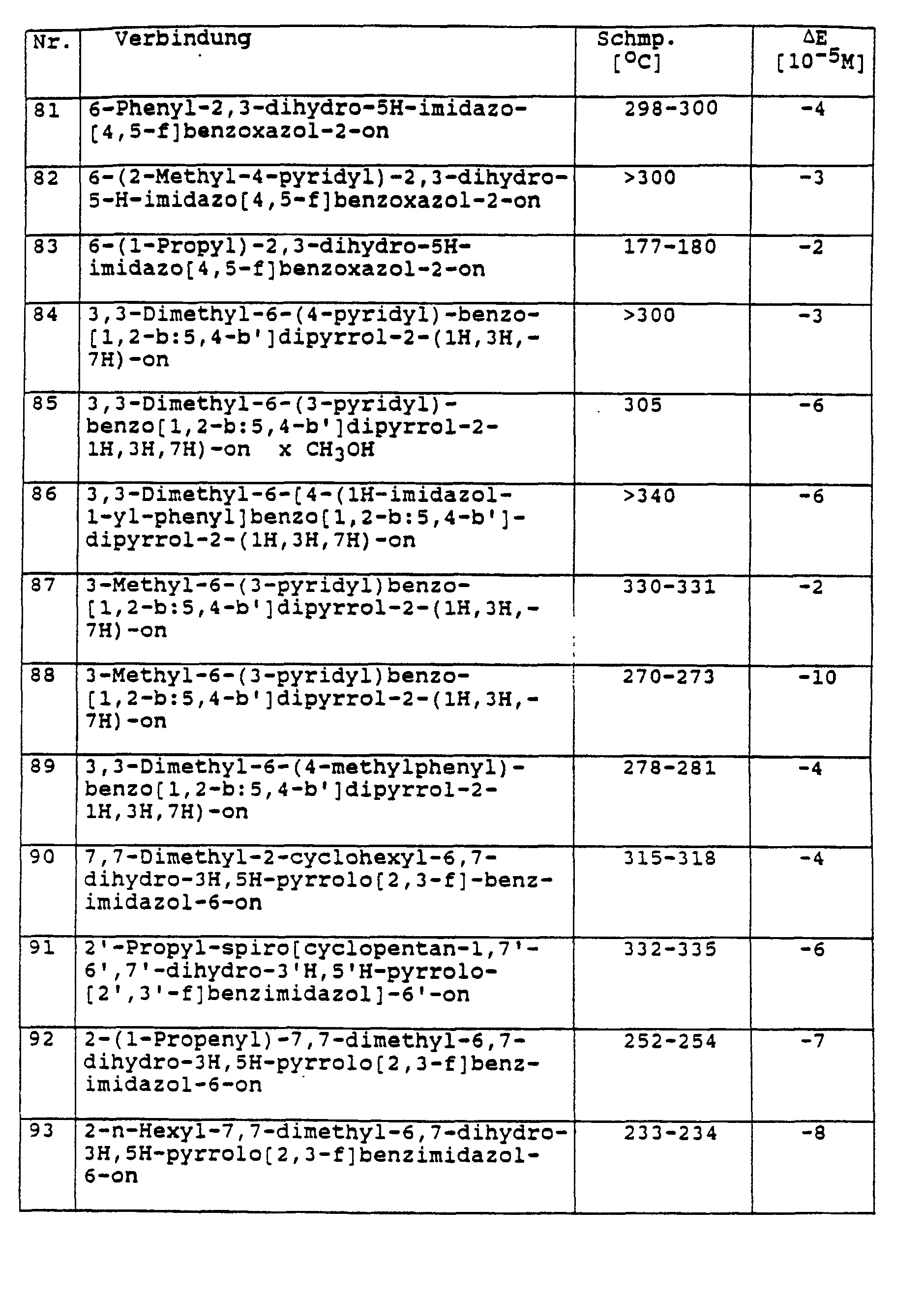
Die Bestimmung der Erythrozytenaggregation erfolgte mit dem Mini-Erythrozyten-Aggregometer der Fa. Myrenne, Rötgen (Kiesewetter et al., Biomed. Technik 27, 209-213 (1982)). Als Maß gibt dieses Gerät einen dimensionslosen Index an, der mit steigender Aggregationstendenz zunimmt.The erythrocyte aggregation was determined using the mini erythrocyte aggregometer from Myrenne, Rötgen (Kiesewetter et al., Biomed. Technik 27, 209-213 (1982)). As a measure, this device specifies a dimensionless index that increases as the tendency to aggregate increases.
Die Untersuchungen wurden mit Humanblut gesunder Spender durchgeführt. Das Blut wurde auf einen Hämatokrit von 45 % eingestellt mit der Kontrollösung oder einer Substanzlösung versetzt und inkubiert. Dann wurde die Erythrozyten-Aggregation gemessen. Jede Substanz wurde in einer Konzentration von 10-5 molar untersucht. Pro Substanz wurden zwei Versuche mit dem Blut zweier Spender durchgeführt. Es wurde die Differenz der Aggregationsindizes zwischen dem Ausgangswert der Kontrollösung und den Werten mit der Substanzlösung errechnet (AE).The investigations were carried out with human blood from healthy donors. The blood was adjusted to a hematocrit of 45% and the control solution or a substance solution was added and incubated. Then the erythrocyte aggregation was measured. Each substance was examined in a concentration of 10 -5 molar. Two tests were carried out for each substance with the blood of two donors. The difference in the aggregation indices between the initial value of the control solution and the values with the substance solution was calculated (AE).
In der folgenden Tabelle sind die vorliegenden Befunde zur Erythrozyten-Aggregation (AE) aufgelistet. Je niederiger der aufgeführte Wert ist, desto wirksamer ist die Substanz. Venoruton , ein Gemisch aus verschiedenen 0-(beta-Hydroxyethyl)rutosiden, bewirkt dagegen bei einer vergleichbaren Konzentration von 1.7 . 10-5 M lediglich eine Änderung des Erythrozyten-Aggregationsindexes um -0.4. Selbst bei einer Konzentration von 1.7 . 10-3 M beträgt die Änderung nur -3.9 ± 0.9.The following table lists the available findings on erythrocyte aggregation (AE). The lower the listed value, the more effective the substance. Venoruton, a mixture of different 0- (beta-hydroxyethyl) rutosides, however, works at a comparable concentration of 1.7. 10 -5 M only a change in the erythrocyte aggregation index by -0.4. Even at a concentration of 1.7. 10-3 M the change is only -3.9 ± 0.9.
Venoruton soll die Tendenz der Erythrozyten-Aggregation hemmen. (Schmid-Schönbein et al., VASA 4 263-270 (1975)).Venoruton is said to inhibit the tendency of erythrocyte aggregation. (Schmid-Schönbein et al., VASA 4 263-270 (1975)).
Im Vergleich zum Stand der Technik hemmen die genannten Substanzen der vorliegenden Erfindung die Erythrozyten-Aggregation deutlich stärker.



Claims (8)


Applications Claiming Priority (2)
| Application Number | Priority Date | Filing Date | Title |
|---|---|---|---|
| DE19873740985 DE3740985A1 (en) | 1987-12-03 | 1987-12-03 | USE OF LINEAR FURNISHED TRICYCLES AS AN INHIBITORS OF THE ERYTHROCYTE AGGREGATION |
| DE3740985 | 1987-12-03 |
Publications (2)
| Publication Number | Publication Date |
|---|---|
| EP0318902A2 true EP0318902A2 (en) | 1989-06-07 |
| EP0318902A3 EP0318902A3 (en) | 1990-12-12 |
Family
ID=6341813
Family Applications (1)
| Application Number | Title | Priority Date | Filing Date |
|---|---|---|---|
| EP19880119839 Withdrawn EP0318902A3 (en) | 1987-12-03 | 1988-11-29 | Use of linear annelated tricyclics as inhibitors of erythrocyte aggregation |
Country Status (10)
| Country | Link |
|---|---|
| US (1) | US4981864A (en) |
| EP (1) | EP0318902A3 (en) |
| JP (1) | JPH01193219A (en) |
| KR (1) | KR890009404A (en) |
| AU (1) | AU616620B2 (en) |
| DE (1) | DE3740985A1 (en) |
| DK (1) | DK666388A (en) |
| HU (1) | HUT51486A (en) |
| IL (1) | IL88533A0 (en) |
| ZA (1) | ZA888880B (en) |
Cited By (8)
| Publication number | Priority date | Publication date | Assignee | Title |
|---|---|---|---|---|
| DE4027592A1 (en) * | 1990-08-31 | 1992-03-05 | Beiersdorf Ag | NEW PYRROLOBENZIMIDAZOLE, IMIDAZOBENZOXAZINONE AND IMIDAZOCHINOLONE, PROCESS FOR THEIR PREPARATION AND THEIR USE AND THE COMPOUNDS CONTAINING PREPARATIONS |
| US7285569B2 (en) | 2004-09-24 | 2007-10-23 | Hoff Hoffmann-La Roche Inc. | Tricycles, their manufacture and use as pharmaceutical agents |
| WO2008021369A3 (en) * | 2006-08-14 | 2008-05-29 | Chembridge Res Lab Inc | Tricyclic compounds and its use as tyrosine kinase modulators |
| US7645881B2 (en) | 2004-07-22 | 2010-01-12 | Ptc Therapeutics, Inc. | Methods for treating hepatitis C |
| US7772271B2 (en) | 2004-07-14 | 2010-08-10 | Ptc Therapeutics, Inc. | Methods for treating hepatitis C |
| US7781478B2 (en) | 2004-07-14 | 2010-08-24 | Ptc Therapeutics, Inc. | Methods for treating hepatitis C |
| US7868037B2 (en) | 2004-07-14 | 2011-01-11 | Ptc Therapeutics, Inc. | Methods for treating hepatitis C |
| CN105246876B (en) * | 2013-02-28 | 2017-06-16 | 住友化学株式会社 | Fused heterocyclic compounds and their use in pest control |
Families Citing this family (4)
| Publication number | Priority date | Publication date | Assignee | Title |
|---|---|---|---|---|
| WO1992012144A1 (en) * | 1990-12-28 | 1992-07-23 | Teijin Limited | Condensed benzoxa ring compound, production thereof, and pharmaceutical composition containing the same |
| AR050949A1 (en) * | 2004-09-24 | 2006-12-06 | Hoffmann La Roche | DERIVATIVES OF 5,7-DIHIDRO-1H-IMIDAZOL [4,5-F] INDOL OR [4,5-G] QUINOLIN-6-ONA; ITS DEVELOPMENT AND ITS USE IN THE PREPARATION OF A MEDICINAL PRODUCT FOR THE TREATMENT OF CANCER |
| CA2645892A1 (en) * | 2006-03-23 | 2007-09-27 | F. Hoffmann-La Roche Ag | Substituted indazole derivatives, their manufacture and use as pharmaceutical agents |
| AR072297A1 (en) | 2008-06-27 | 2010-08-18 | Novartis Ag | DERIVATIVES OF INDOL-2-IL-PIRIDIN-3-ILO, PHARMACEUTICAL COMPOSITION THAT INCLUDES THEM AND ITS USE IN MEDICINES FOR THE TREATMENT OF DISEASES MEDIATED BY THE SYNTHESIS ALDOSTERONE. |
Family Cites Families (6)
| Publication number | Priority date | Publication date | Assignee | Title |
|---|---|---|---|---|
| PL144822B1 (en) * | 1984-05-12 | 1988-07-30 | Boehringer Mannheim Gmbh | Method of obtaining novel pyrolobenzimidazoles |
| DE3445669A1 (en) * | 1984-12-14 | 1986-06-19 | Boehringer Mannheim Gmbh, 6800 Mannheim | NEW PYRROLO-BENZIMIDAZOLES, METHOD FOR THEIR PRODUCTION AND MEDICINAL PRODUCTS CONTAINING THESE COMPOUNDS |
| DE3501497A1 (en) * | 1985-01-18 | 1986-07-24 | Boehringer Mannheim Gmbh, 6800 Mannheim | NEW PYRROLO-BENZIMIDAZOLES, METHOD FOR THE PRODUCTION THEREOF AND MEDICINAL PRODUCTS CONTAINING THESE COMPOUNDS AND INTERMEDIATE PRODUCTS |
| DE3524067A1 (en) * | 1985-07-05 | 1987-01-08 | Boehringer Mannheim Gmbh | NEW BENZIMIDAZOLES, METHOD FOR THEIR PRODUCTION AND MEDICINAL PRODUCTS CONTAINING THESE COMPOUNDS, AND INTERMEDIATE PRODUCTS |
| DE3530825A1 (en) * | 1985-08-29 | 1987-03-05 | Boehringer Mannheim Gmbh | NEW BENZODIPYRROLE, METHOD FOR THE PRODUCTION THEREOF, AND MEDICINAL PRODUCTS CONTAINING THESE COMPOUNDS |
| DE3531678A1 (en) * | 1985-09-05 | 1987-03-12 | Boehringer Mannheim Gmbh | NEW PYRROLO-BENZIMIDAZOLES, METHOD FOR THEIR PRODUCTION AND MEDICINAL PRODUCTS CONTAINING THESE COMPOUNDS |
-
1987
- 1987-12-03 DE DE19873740985 patent/DE3740985A1/en not_active Withdrawn
-
1988
- 1988-11-29 DK DK666388A patent/DK666388A/en not_active Application Discontinuation
- 1988-11-29 ZA ZA888880A patent/ZA888880B/en unknown
- 1988-11-29 IL IL88533A patent/IL88533A0/en unknown
- 1988-11-29 EP EP19880119839 patent/EP0318902A3/en not_active Withdrawn
- 1988-11-30 US US07/278,190 patent/US4981864A/en not_active Expired - Fee Related
- 1988-12-02 JP JP63304281A patent/JPH01193219A/en active Pending
- 1988-12-02 HU HU886153A patent/HUT51486A/en unknown
- 1988-12-02 AU AU26506/88A patent/AU616620B2/en not_active Expired - Fee Related
- 1988-12-03 KR KR1019880016155A patent/KR890009404A/en not_active Withdrawn
Cited By (12)
| Publication number | Priority date | Publication date | Assignee | Title |
|---|---|---|---|---|
| DE4027592A1 (en) * | 1990-08-31 | 1992-03-05 | Beiersdorf Ag | NEW PYRROLOBENZIMIDAZOLE, IMIDAZOBENZOXAZINONE AND IMIDAZOCHINOLONE, PROCESS FOR THEIR PREPARATION AND THEIR USE AND THE COMPOUNDS CONTAINING PREPARATIONS |
| US5212186A (en) * | 1990-08-31 | 1993-05-18 | Beiersdorf Aktiengesellschaft | Cardioactive pyrrolobenzimidazoles |
| US7772271B2 (en) | 2004-07-14 | 2010-08-10 | Ptc Therapeutics, Inc. | Methods for treating hepatitis C |
| US7781478B2 (en) | 2004-07-14 | 2010-08-24 | Ptc Therapeutics, Inc. | Methods for treating hepatitis C |
| US7868037B2 (en) | 2004-07-14 | 2011-01-11 | Ptc Therapeutics, Inc. | Methods for treating hepatitis C |
| US7973069B2 (en) | 2004-07-14 | 2011-07-05 | Ptc Therapeutics, Inc. | Methods for treating hepatitis C |
| US7645881B2 (en) | 2004-07-22 | 2010-01-12 | Ptc Therapeutics, Inc. | Methods for treating hepatitis C |
| US7285569B2 (en) | 2004-09-24 | 2007-10-23 | Hoff Hoffmann-La Roche Inc. | Tricycles, their manufacture and use as pharmaceutical agents |
| WO2008021369A3 (en) * | 2006-08-14 | 2008-05-29 | Chembridge Res Lab Inc | Tricyclic compounds and its use as tyrosine kinase modulators |
| US8063225B2 (en) | 2006-08-14 | 2011-11-22 | Chembridge Corporation | Tricyclic compound derivatives useful in the treatment of neoplastic diseases, inflammatory disorders and immunomodulatory disorders |
| US8686005B2 (en) | 2006-08-14 | 2014-04-01 | Chembridge Corporation | Tricyclic compound derivatives useful in the treatment of neoplastic diseases, inflammatory disorders and immunomodulatory disorders |
| CN105246876B (en) * | 2013-02-28 | 2017-06-16 | 住友化学株式会社 | Fused heterocyclic compounds and their use in pest control |
Also Published As
| Publication number | Publication date |
|---|---|
| IL88533A0 (en) | 1989-06-30 |
| HUT51486A (en) | 1990-05-28 |
| AU2650688A (en) | 1989-06-08 |
| DE3740985A1 (en) | 1989-06-15 |
| US4981864A (en) | 1991-01-01 |
| DK666388A (en) | 1989-06-04 |
| JPH01193219A (en) | 1989-08-03 |
| EP0318902A3 (en) | 1990-12-12 |
| ZA888880B (en) | 1989-08-30 |
| AU616620B2 (en) | 1991-10-31 |
| KR890009404A (en) | 1989-08-01 |
| DK666388D0 (en) | 1988-11-29 |
Similar Documents
| Publication | Publication Date | Title |
|---|---|---|
| DE60025632T2 (en) | Thrombopoietin mimetics | |
| EP3041815B1 (en) | Mixtures of cannabinoid compounds, their preparation and use | |
| DE69229975T2 (en) | Pharmaceutical compositions containing an anticytokine | |
| DE3876773T2 (en) | PHARMACEUTICAL COMPOSITIONS. | |
| WO1991004974A1 (en) | 2-bicyclo-benzimidazoles, process for their production and drugs containing said compounds | |
| EP0318902A2 (en) | Use of linear annelated tricyclics as inhibitors of erythrocyte aggregation | |
| WO1991006545A1 (en) | Bicyclo-imidazoles, process for producing them and drugs containing them | |
| DE3803775A1 (en) | NEW SUBSTITUTED LACTAME, METHOD FOR THE PRODUCTION THEREOF, AND MEDICINAL PRODUCTS CONTAINING THESE COMPOUNDS | |
| DE2160148C2 (en) | Medicines and certain sulphoxides as such | |
| DE2625012C3 (en) | Medicines to control liver disease | |
| WO1997043284A1 (en) | New thiazolidinediones, process for preparing the same and medicaments containing the same | |
| DE60203844T2 (en) | Use of hydantoin and its derivatives for hypoalbuminemia | |
| DE60025826T2 (en) | Pyrazolidinol CONNECTIONS | |
| DE3323105C2 (en) | Dithiolane derivatives, processes for their preparation and pharmaceutical compositions containing these compounds | |
| EP0556245A1 (en) | Use of thiazolo-isoindolinone derivatives as antiviral medicaments. | |
| DE68915595T2 (en) | Use of isoxazolinones as cerebroactive drugs. | |
| DE3730542A1 (en) | MEDICINAL PRODUCTS CONTAINING SPECIFIC 6-MERCAPTOPURIN DERIVATIVES, USE OF THESE 6-MERCAPTOPURIN DERIVATIVES, METHOD FOR PRODUCING THE MEDICINAL PRODUCTS AND SOME NEW 6-MERCAPTOPURIN DERIVATIVES AND METHOD FOR THE PRODUCTION THEREOF | |
| EP0557876A1 (en) | Use of xanthine derivatives for the treatment of muscle damage subsequent to complete interruption of blood circulation | |
| DE3413876A1 (en) | DRUG | |
| EP0253182A1 (en) | Use of thiadiazinones for combatting endoparasites | |
| DE1467832A1 (en) | Pharmaceutical preparations | |
| DE10320732A1 (en) | Rapid-acting anesthetics with short duration of action, especially useful during surgical intervention, comprises thiazolo-(3,2-a)-(1,3)-diazepine-3-carboxylic acid derivatives | |
| DE3925584A1 (en) | NEW N- (DIMETHYLOXOPHOSPHINYLMETHYL -) LACTAME, METHOD FOR THE PRODUCTION THEREOF AND MEDICINAL PRODUCTS CONTAINING THESE COMPOUNDS | |
| DE2858177C2 (en) | Medicinal products containing N-substituted 2-cyanaziridines | |
| EP0350742A1 (en) | 6-Merkaptopurines derivatives, their preparation and their use against retrovirus infections |
Legal Events
| Date | Code | Title | Description |
|---|---|---|---|
| PUAI | Public reference made under article 153(3) epc to a published international application that has entered the european phase |
Free format text: ORIGINAL CODE: 0009012 |
|
| 17P | Request for examination filed |
Effective date: 19881129 |
|
| AK | Designated contracting states |
Kind code of ref document: A2 Designated state(s): AT BE CH DE ES FR GB GR IT LI LU NL SE |
|
| PUAL | Search report despatched |
Free format text: ORIGINAL CODE: 0009013 |
|
| AK | Designated contracting states |
Kind code of ref document: A3 Designated state(s): AT BE CH DE ES FR GB GR IT LI LU NL SE |
|
| 17Q | First examination report despatched |
Effective date: 19911202 |
|
| STAA | Information on the status of an ep patent application or granted ep patent |
Free format text: STATUS: THE APPLICATION IS DEEMED TO BE WITHDRAWN |
|
| 18D | Application deemed to be withdrawn |
Effective date: 19920414 |