EP0317563B2 - Improvements in or relating to printing - Google Patents
Improvements in or relating to printing Download PDFInfo
- Publication number
- EP0317563B2 EP0317563B2 EP87904913A EP87904913A EP0317563B2 EP 0317563 B2 EP0317563 B2 EP 0317563B2 EP 87904913 A EP87904913 A EP 87904913A EP 87904913 A EP87904913 A EP 87904913A EP 0317563 B2 EP0317563 B2 EP 0317563B2
- Authority
- EP
- European Patent Office
- Prior art keywords
- water
- ink
- screen printing
- printing
- printing ink
- Prior art date
- Legal status (The legal status is an assumption and is not a legal conclusion. Google has not performed a legal analysis and makes no representation as to the accuracy of the status listed.)
- Expired - Lifetime
Links
Classifications
-
- C—CHEMISTRY; METALLURGY
- C09—DYES; PAINTS; POLISHES; NATURAL RESINS; ADHESIVES; COMPOSITIONS NOT OTHERWISE PROVIDED FOR; APPLICATIONS OF MATERIALS NOT OTHERWISE PROVIDED FOR
- C09D—COATING COMPOSITIONS, e.g. PAINTS, VARNISHES OR LACQUERS; FILLING PASTES; CHEMICAL PAINT OR INK REMOVERS; INKS; CORRECTING FLUIDS; WOODSTAINS; PASTES OR SOLIDS FOR COLOURING OR PRINTING; USE OF MATERIALS THEREFOR
- C09D11/00—Inks
- C09D11/02—Printing inks
- C09D11/10—Printing inks based on artificial resins
- C09D11/101—Inks specially adapted for printing processes involving curing by wave energy or particle radiation, e.g. with UV-curing following the printing
-
- B—PERFORMING OPERATIONS; TRANSPORTING
- B41—PRINTING; LINING MACHINES; TYPEWRITERS; STAMPS
- B41M—PRINTING, DUPLICATING, MARKING, OR COPYING PROCESSES; COLOUR PRINTING
- B41M1/00—Inking and printing with a printer's forme
- B41M1/12—Stencil printing; Silk-screen printing
Definitions
- This invention relates to printing and in particular to screen printing (commonly known as silk screen printing).
- silk screen printing commonly known as silk screen printing
- the silk screen printing process involves the use of a screen of silk, polyester, nylon, metal gauze or any other suitable mesh-like or perforated material.
- silk screen printing will be used herein and it will be appreciated that no restriction to "silk” material is thereby intended.
- the printing inks required for screen printing are quite different from those to be used for other forms of printing.
- the screen printing inks being generally used at present are organic solvent-based and usually contain ethyl or nitro cellulose resins. They are dried in warm air tunnels by driving off the organic solvents, and are thus potentially hazardous to the printing operatives.
- Another problem which arises with such organic solvent-based screen printing inks relates to solvent loss from the ink on the printing screen whereby the ink increases in viscosity and after a certain period of time will not properly pass through the open areas of the printing mesh. This "drying in” results in loss of printed image and is described as screen stability, i.e. inks with poor screen stability "dry in” rapidly.
- the formulations use raw materials which do not increase in their viscosity on the printing screen but instead dry by exposure to intense Ultra Violet light.
- This means that this type of ink has almost unlimited screen stability compared to non-UV curing, organic solvent-based, screen printing inks.
- UV-curing inks are expensive, and leave a very thick print coat on the paper surface - particularly where multi-colour, e.g. four-colour, silk screen printing is effected.
- Posters printed with offset litho inks have less tendency to curl when they dry out compared to those. produced with screen printing inks. As the screen printing process achieves its high quality print appearance by a much higher ink deposit, the curl problem is pronounced with screen printing inks. Therefore the adhesives used with screen printed posters need to have better adhesion properties to prevent overlap curl.
- a method of multi-colour, half-tone screen printing upon a poster paper substrate utilising a water-based screen ink the method being characterised by the steps of:
- the first half-tone screen printing is of the predominant colour separation image, of a colour composition
- the or each subsequent half-tone screen printing is of the or each other colour separation image of the said colour composition.
- printing is effected on a cylinder action screen printing press.
- the printed sheet can be readily fed again through the screen printing machine to be overprinted with the subsequent printing(s).
- Said first silk screen printing may be effected utilising an organic solvent-based printing ink, or a non-aqueous printing ink that is curable by irradiation, or an aqueous ink of high solid and low water content, e.g. water content less than 20%.
- the printing ink used for the first printing in effect seals the surface of the paper sheet thereby reducing the risk of damage to the sheet from the water content of the water-based printing ink.
- said water-based printing ink used for the or each subsequent printing is at least partially curable by irradiation.
- irradiation refers to electromagnetic radiations having wavelengths shorter than those of the visible spectrum. The term thus includes ultra-violet (UV) and electron beam radiations.
- the water-based printing ink used for the or each subsequent printing comprises one or more photoinitiators and is at least partially curable by irradiation comprising electromagnetic radiations in the ultra-violet light waveband.
- the water-based ink used for the or each subsequent printing may be at least partially curable by irradiation with an electron beam.
- photoiniator(s) may be omitted from the printing ink composition.
- the water-based printing ink used for the or each subsequent printing is subjected to heat or to thermal radiation, e.g. is subjected to electromagnetic radiations in the infra-red light waveband, prior to curing.
- the print is subjected to cold air from a jet air dryer or is subjected to microwave or radio frequency drying.
- said water-based ink used for the or each subsequent printing comprises an unsaturated acrylate resin, e.g. a polyester acrylate resin.
- the water-based screen printing ink used for the or each subsequent printing comprises an emulsion of a resin in water.
- the emulsion has said resin wholly, or at least substantially, as the dispersed phase and wholly, or at least substantially, insoluble in water, water being the continuous phase of the emulsion.
- said resin comprises 30% to 60% (preferably 50%) of the emulsion.
- Preferably said method is employed to screen print a plurality of colours upon a sheet and, after printing, the printed sheet is subjected to corona discharge to render the sheet readily mountable, e.g. upon a hoarding, by use of a starch-based adhesive.
- the corona discharge provides miniscule perforations through the printing ink which enable the adhesive to extend through the sheet to provide a "keying" effect facilitating the efficient bonding together of overlapping marginal edges of adjacent sheets.
- the following relates to the production of individual silk screen printed sheets and their treatment for application onto hoarding sites in accord with embodiments of the present invention.
- the embodiments are concerned with the usual combinations of multiple sheet posters (e.g. "16 sheet”, “48 sheet” or “96 sheet” posters) for pasting up onto large hoardings.
- the screen printing method used in these embodiments may be for the production of four colour halftone prints as well as continuous line and tone colour prints.
- the following embodiments of this invention concern the screen ink used to print the sheets.
- the first colour printed is with a non-aqueous UV-curing printing ink of cyan shade, e.g. a screen ink having a composition in accord with Example 6 below.
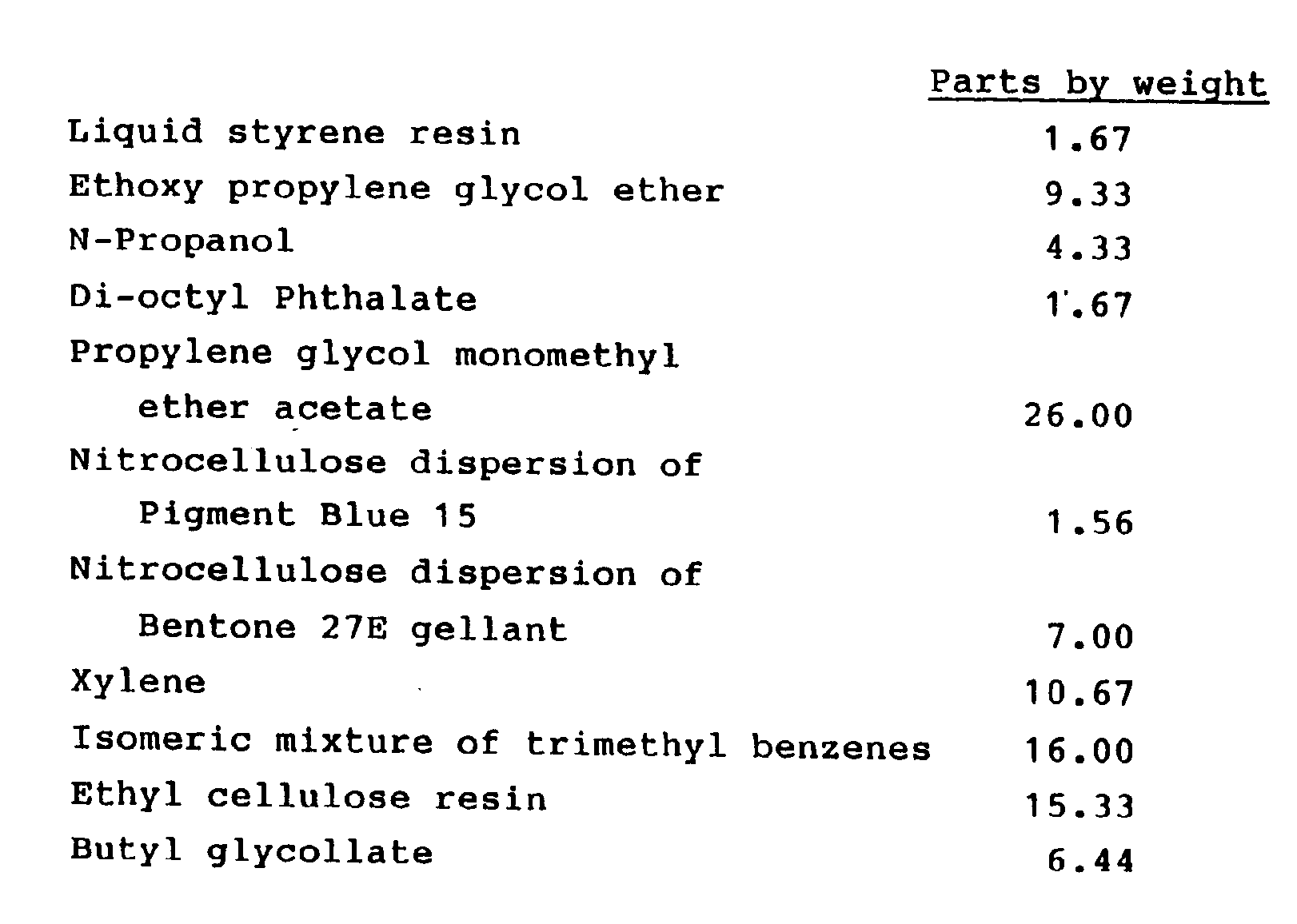
- the first colour printed is with an organic solvent-based printing ink of cyan shade, e.g. a screen ink having a composition in accord with Example 7 below.
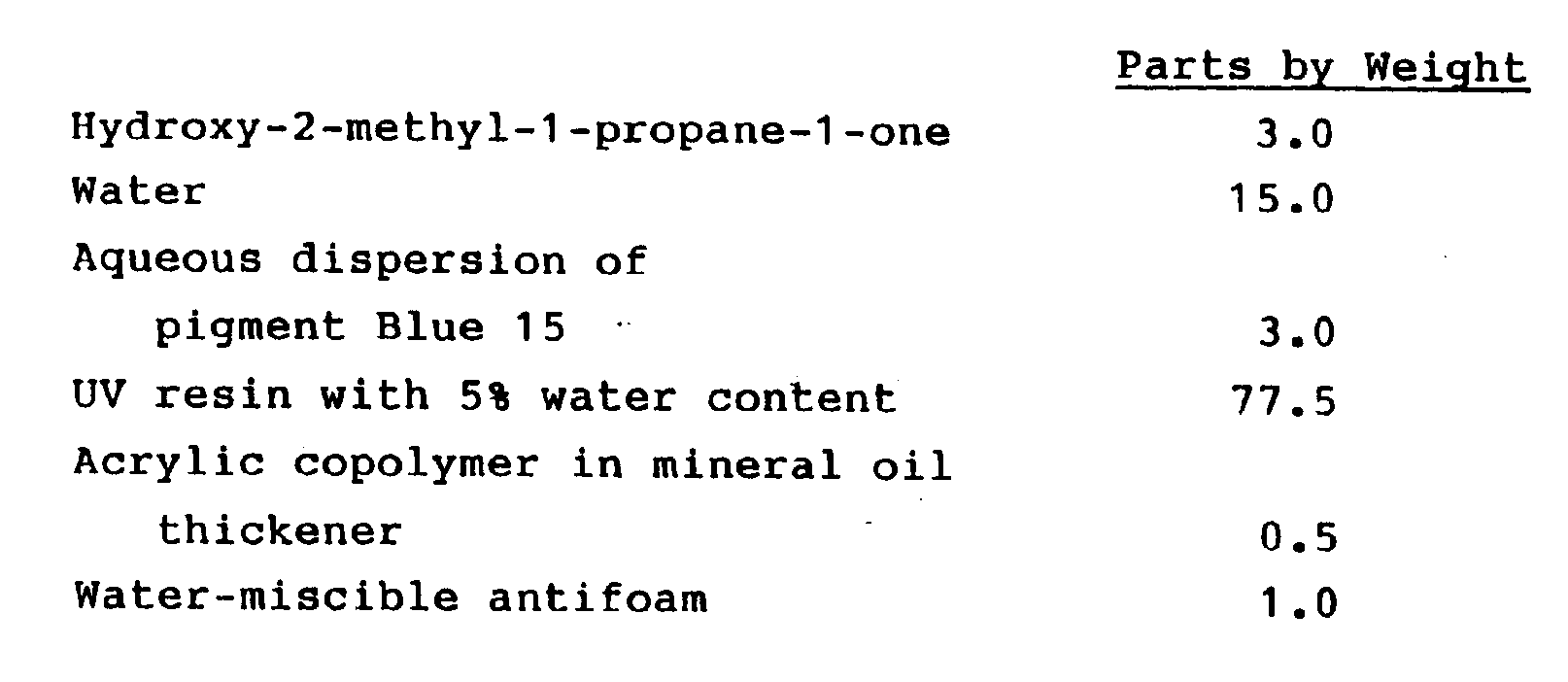
- the first colour printed is with a slightly aqueous (i.e. less than 20%), predominantly solids (i.e. greater than 80%), screen printing ink of appropriate, e.g. cyan, shade.
- the screen ink employed for the first printing in this case preferably has a composition in accord with Example 8 below.
- the screen ink employed for the first colour is of cyan shade
- the colour can be any other primary trichromatic colour, and usually will be the predominant or principal colour produced by the photographic colour separation of the original.
- each of the subsequent colours printed in superimposition on the first colour is screen printed in a water-based, UV-curing ink.
- the water-based, UV-curing screen ink comprises an emulsion of a resin in water, said resin being wholly (or at least substantially) in dispersed phase and wholly (or at least substantially) insoluble in the water, the water being the continuous phase of the emulsion.
- the screen printing ink employed for the or each subsequent printing contains water, is water miscible and is water thinnable to a considerable extent, but the water is to be regarded as a carrier or diluent (rendering the ink aqueously reducible in viscosity) rather than as a solvent.
- the ink employed for the or each superimposed printing contains at least 40% water.
- the water-based printing ink employed for the or each subsequent printing has a composition comprising an Ultra Violet curing resin emulsified with water, a photinitiator and an aqueous pigment dispersion.
- a composition comprising an Ultra Violet curing resin emulsified with water, a photinitiator and an aqueous pigment dispersion.
- Example 1 A composition as formulated in Example 1 was printed through a screen made from 165 threads per cm polyester mesh half-calendered. The calendered side was positioned face down towards the substrate, ie. M.G. (machine glazed) poster paper. The stencil was made from direct emulsion using a half-tone positive. The print was produced on an S.P.S. cylinder action screen printing press. The ink was dried through a two lamp S.P.S. U.V. dryer (rated at 300 watt per inch). The resultant dried print was a good half tone image of high definition.
- Example 2 A composition as formulated in Example 2 was printed and dried in the same manner as for Example 1. The resultant dried print was a good half tone image of high definition.
- Example 3 A composition formulated as in Example 3 was printed and dried in the same manner as for Example 1. The resultant dried print was a good half tone image of high definition.
- Trichromatic yellow, magenta, cyan and black were made for container storage stability trials.
- a fourth embodiment was devised in which the n-vinyl pyrrolidone and the photoinitiator mixture were replaced by a solvent, ethoxy-propanol and a single initiator compound rather than the mixture of photoinitiators.
- the calcium carbonate extender was also omitted as this was not now required to obtain an acceptable raw material cost.
- a thickening agent was introduced to maintain the ink at a printable viscosity.
- Example 4 A specific formulation of this fourth embodiment, in which (as before) the resin amounted to 50% of the emulsion, is provided in Example 4.
- Example 4 A composition formulated as in Example 4 was printed and dried in the same manner as for Example 1. The resultant dried print was a good half tone image of high definition.
- a fifth embodiment was devised in which the ethoxy propanol was replaced by a mixture of water and an acrylic monomer - Tripropylene glycol diacrylate (T.P.G.D.A.) - for maintaining the appropriate dispersion of the resin solids.
- T.P.G.D.A. acrylic monomer - Tripropylene glycol diacrylate
- Example 5 A composition formulated as in Example 5 was printed and dried in the same manner as for Example 1. The resultant dried print was a good half tone image of high definition.
- Example 6 A composition formulated as in Example 6 was printed and dried in the same manner as for Example 1. The resultant dried print was a good half tone image of high definition.
- a composition formulated as in Example 7 was printed through a screen made from 140 threads per cm polyester mesh.
- the stencil was made from direct emulsion using a half tone positive.
- the print was produced on a Svecia cylinder action screen printing press.
- the ink was dried through a warm air jet dryer.
- the resultant dried print was a good half tone image of high definition.
- Example 8 A composition formulated as in Example 8 was printed and dried in the same manner as for Example 1. The resultant dried print was a good half tone image of high definition.
Landscapes
- Chemical & Material Sciences (AREA)
- Life Sciences & Earth Sciences (AREA)
- Engineering & Computer Science (AREA)
- Materials Engineering (AREA)
- Wood Science & Technology (AREA)
- Organic Chemistry (AREA)
- Printing Methods (AREA)
- Inks, Pencil-Leads, Or Crayons (AREA)
Abstract
Description
- This invention relates to printing and in particular to screen printing (commonly known as silk screen printing). As is well known, the silk screen printing process involves the use of a screen of silk, polyester, nylon, metal gauze or any other suitable mesh-like or perforated material. For convenience (and for consistency with the terminology historically employed in this art) the term "silk screen printing" will be used herein and it will be appreciated that no restriction to "silk" material is thereby intended.
- Although silk screen printing is a very old technique, it still has numerous problems and/or limitations associated with it. For example, where several large-size multi-colour sheets are to be silk screen printed for, say, a poster to be pasted up on a hoarding, large quantities of printing inks are needed which are expensive.
- The printing inks required for screen printing are quite different from those to be used for other forms of printing. The screen printing inks being generally used at present are organic solvent-based and usually contain ethyl or nitro cellulose resins. They are dried in warm air tunnels by driving off the organic solvents, and are thus potentially hazardous to the printing operatives. Another problem which arises with such organic solvent-based screen printing inks, relates to solvent loss from the ink on the printing screen whereby the ink increases in viscosity and after a certain period of time will not properly pass through the open areas of the printing mesh. This "drying in" results in loss of printed image and is described as screen stability, i.e. inks with poor screen stability "dry in" rapidly.
- Recent developments over the last ten years have seen the introduction of Ultra-Violet-curing screen process inks.
- Here the formulations use raw materials which do not increase in their viscosity on the printing screen but instead dry by exposure to intense Ultra Violet light. This means that this type of ink has almost unlimited screen stability compared to non-UV curing, organic solvent-based, screen printing inks. However, such UV-curing inks are expensive, and leave a very thick print coat on the paper surface - particularly where multi-colour, e.g. four-colour, silk screen printing is effected.
- Such thick or heavy print images on the surface of a sheet of poster paper often necessitate that for mounting the poster to its hoarding, a special adhesive - which is other than an inexpensive starch-based adhesive - must be used if efficient bonding is to be achieved. A similar problem often arises with the older type of organic solvent-based silk screen printing inks. This adhesion problem is common where the individual sheets overlap, e.g. at overlapping marginal edges of adjacent poster sheets. The back of the top sheet does not have sufficient adhesion to the ink surface printed on the sheet beneath. When the poster paste dries out, the top sheet of the overlap often curls up and away from the sheet underneath. The problem is particularly severe when the paper is completely covered with several layers of ink. Posters printed with offset litho inks have less tendency to curl when they dry out compared to those. produced with screen printing inks. As the screen printing process achieves its high quality print appearance by a much higher ink deposit, the curl problem is pronounced with screen printing inks. Therefore the adhesives used with screen printed posters need to have better adhesion properties to prevent overlap curl.
- Mixtures of one or more starch adhesives and one or more polyvinyl alchol (P.V.A.) adhesives were investigated by the applicants, and these were found to give a much improved adhesion at the overlapping edges of superimposed sheets as compared to a 100% starch-based adhesive product. However, mixtures of starch and P.V.A. adhesives have the disadvantage of being more expensive and the resultant improved adhesion makes the removal of the total poster from the hoarding more difficult. Thus they are not likely to find favour with bill-posters, i.e. those responsible for putting up the posters on the hoardings.
- It is therefore considered desirable to reduce, if not wholly obviate, some or all of the above-mentioned and/or other disadvantages associated with or relating to prior art screen printing methods and inks.
- According to one aspect of this invention there is provided a method of multi-colour, half-tone screen printing upon a poster paper substrate utilising a water-based screen ink, the method being characterised by the steps of:
- (a) effecting a first colour half-tone screen printing on the poster paper substrate using an ink which produces minimal curl in the substrate edge, and thereafter
- (b) effecting at least one subsequent half-tone printing on the printed substrate resulting from step (a) using a water-based ink in another colour and such that any resulting edge curl is less than that which would have been obtained if the said first and the said subsequent screen printings had each been performed with said water-based ink.
- Advantageously, the first half-tone screen printing is of the predominant colour separation image, of a colour composition, and the or each subsequent half-tone screen printing is of the or each other colour separation image of the said colour composition.
- Preferably, printing is effected on a cylinder action screen printing press.
- By effecting said first printing with an ink that produces minimal curl, the printed sheet can be readily fed again through the screen printing machine to be overprinted with the subsequent printing(s).
- Said first silk screen printing may be effected utilising an organic solvent-based printing ink, or a non-aqueous printing ink that is curable by irradiation, or an aqueous ink of high solid and low water content, e.g. water content less than 20%.
- It is considered that the printing ink used for the first printing in effect seals the surface of the paper sheet thereby reducing the risk of damage to the sheet from the water content of the water-based printing ink.
- Preferably said water-based printing ink used for the or each subsequent printing is at least partially curable by irradiation. As used herein in relation to curing, the term "irradiation" refers to electromagnetic radiations having wavelengths shorter than those of the visible spectrum. The term thus includes ultra-violet (UV) and electron beam radiations.
- Preferably, the water-based printing ink used for the or each subsequent printing comprises one or more photoinitiators and is at least partially curable by irradiation comprising electromagnetic radiations in the ultra-violet light waveband.
- Alternatively, the water-based ink used for the or each subsequent printing may be at least partially curable by irradiation with an electron beam. Where the ink is curable by irradiation with an electron beam, then photoiniator(s) may be omitted from the printing ink composition.
- Preferably, and in either case, the water-based printing ink used for the or each subsequent printing is subjected to heat or to thermal radiation, e.g. is subjected to electromagnetic radiations in the infra-red light waveband, prior to curing. Alternatively, the print is subjected to cold air from a jet air dryer or is subjected to microwave or radio frequency drying.
- Preferably said water-based ink used for the or each subsequent printing comprises an unsaturated acrylate resin, e.g. a polyester acrylate resin.
- Advantageously, the water-based screen printing ink used for the or each subsequent printing comprises an emulsion of a resin in water.
- Preferably the emulsion has said resin wholly, or at least substantially, as the dispersed phase and wholly, or at least substantially, insoluble in water, water being the continuous phase of the emulsion.
- Advantageously said resin comprises 30% to 60% (preferably 50%) of the emulsion.
- Preferably said method is employed to screen print a plurality of colours upon a sheet and, after printing, the printed sheet is subjected to corona discharge to render the sheet readily mountable, e.g. upon a hoarding, by use of a starch-based adhesive.
- It is considered that the corona discharge provides miniscule perforations through the printing ink which enable the adhesive to extend through the sheet to provide a "keying" effect facilitating the efficient bonding together of overlapping marginal edges of adjacent sheets.
- The following relates to the production of individual silk screen printed sheets and their treatment for application onto hoarding sites in accord with embodiments of the present invention. As well as single sheet posters, the embodiments are concerned with the usual combinations of multiple sheet posters (e.g. "16 sheet", "48 sheet" or "96 sheet" posters) for pasting up onto large hoardings. The screen printing method used in these embodiments may be for the production of four colour halftone prints as well as continuous line and tone colour prints.
- The following embodiments of this invention concern the screen ink used to print the sheets.
- In one preferred form of a "four-colour printing" screen process embodying the present invention, the first colour printed is with a non-aqueous UV-curing printing ink of cyan shade, e.g. a screen ink having a composition in accord with Example 6 below.
- In another preferred form of the "four-colour printing" screen process, the first colour printed is with an organic solvent-based printing ink of cyan shade, e.g. a screen ink having a composition in accord with Example 7 below.
- In yet another preferred form of the "four-colour" screen printing process, the first colour printed is with a slightly aqueous (i.e. less than 20%), predominantly solids (i.e. greater than 80%), screen printing ink of appropriate, e.g. cyan, shade. The screen ink employed for the first printing in this case preferably has a composition in accord with Example 8 below.
- Although in each of these three cases the screen ink employed for the first colour is of cyan shade, it will be appreciated that the colour can be any other primary trichromatic colour, and usually will be the predominant or principal colour produced by the photographic colour separation of the original.
- In the following preferred embodiments of the invention, each of the subsequent colours printed in superimposition on the first colour, is screen printed in a water-based, UV-curing ink. In these preferred embodiments the water-based, UV-curing screen ink comprises an emulsion of a resin in water, said resin being wholly (or at least substantially) in dispersed phase and wholly (or at least substantially) insoluble in the water, the water being the continuous phase of the emulsion. Thus the screen printing ink employed for the or each subsequent printing contains water, is water miscible and is water thinnable to a considerable extent, but the water is to be regarded as a carrier or diluent (rendering the ink aqueously reducible in viscosity) rather than as a solvent. Preferably the ink employed for the or each superimposed printing contains at least 40% water.
- In a first embodiment of this invention the water-based printing ink employed for the or each subsequent printing has a composition comprising an Ultra Violet curing resin emulsified with water, a photinitiator and an aqueous pigment dispersion. One specific formulation of this, in which the emulsion has the resin amounting to 50% of the emulsion, is given in Example 1.

- A composition as formulated in Example 1 was printed through a screen made from 165 threads per cm polyester mesh half-calendered. The calendered side was positioned face down towards the substrate, ie. M.G. (machine glazed) poster paper. The stencil was made from direct emulsion using a half-tone positive. The print was produced on an S.P.S. cylinder action screen printing press. The ink was dried through a two lamp S.P.S. U.V. dryer (rated at 300 watt per inch). The resultant dried print was a good half tone image of high definition.
- However, this initial formulation, when tested, gave poor screen stability. This was improved, in a second embodiment, by the addition of n-vinyl pyrrolidone - a solvent miscible with water which also takes part in the curing reaction. A specific formulation of this second embodiment, which likewise has the resin amounting to 50% of the emulsion), is given in Example 2.

- A composition as formulated in Example 2 was printed and dried in the same manner as for Example 1. The resultant dried print was a good half tone image of high definition.
- Due to the relatively high price of this water-miscible solvent, i.e. the n-vinyl pyrrolidone, compared to the other materials used in the formulation, the final material cost was considered uneconomic. To offset this, a calcium carbonate extender was introduced into the composition to obtain a third embodiment with an acceptable raw material cost. A mixture of photoinitiators was also used in place of the single type. A specific formulation of this third embodiment, which likewise had the resin amounting to 50% of the emulsion, is given in Example 3.

- A composition formulated as in Example 3 was printed and dried in the same manner as for Example 1. The resultant dried print was a good half tone image of high definition.
- Samples of four colours Trichromatic yellow, magenta, cyan and black were made for container storage stability trials.
- After four weeks storage, the magenta and black inks had gelled whereas the yellow and cyan were unchanged. Further work was carried out to improve storage stability. In order to retain screen stability and an economic raw material cost, a fourth embodiment was devised in which the n-vinyl pyrrolidone and the photoinitiator mixture were replaced by a solvent, ethoxy-propanol and a single initiator compound rather than the mixture of photoinitiators. The calcium carbonate extender was also omitted as this was not now required to obtain an acceptable raw material cost. A thickening agent was introduced to maintain the ink at a printable viscosity. Slight improvements in screen stability were obtained with this embodiment by the introduction of small amounts of a humectant/surfactant compound and of a silicone emulsion lubricant. A specific formulation of this fourth embodiment, in which (as before) the resin amounted to 50% of the emulsion, is provided in Example 4.

- A composition formulated as in Example 4 was printed and dried in the same manner as for Example 1. The resultant dried print was a good half tone image of high definition.
- The storage stability of trichromatic yellow, magenta, cyan and black printing inks with this latest formulation were then retested and found to be satisfactory.
- To provide a completely aqueous-based composition avoiding the use of any inflammable solvents, a fifth embodiment was devised in which the ethoxy propanol was replaced by a mixture of water and an acrylic monomer - Tripropylene glycol diacrylate (T.P.G.D.A.) - for maintaining the appropriate dispersion of the resin solids. A specific formulation of this fifth embodiment is provided in Example 5.

- A composition formulated as in Example 5 was printed and dried in the same manner as for Example 1. The resultant dried print was a good half tone image of high definition.
- All the above-mentioned tests were carried out using 60" x 40" (1.5m x 1m) machine glazed (M.G.) Poster Paper. It was found that when heavy deposits of colour were used across the whole area of the paper, a high degree of curl at the edges of the paper was experienced if the first colour printed down onto the paper was not a non-aqueous UV-curing ink (e.g. such as that of Example 6 below), or was not an organic solvent-based printing ink (e.g. such as that of Example 7 below), or was not an ink of a high solids/low water composition (e.g. such as that of Example 8 below), i.e. an ink which contains less than 20% water.

- A composition formulated as in Example 6 was printed and dried in the same manner as for Example 1. The resultant dried print was a good half tone image of high definition.

- A composition formulated as in Example 7 was printed through a screen made from 140 threads per cm polyester mesh. The stencil was made from direct emulsion using a half tone positive. The print was produced on a Svecia cylinder action screen printing press. The ink was dried through a warm air jet dryer. The resultant dried print was a good half tone image of high definition.

- A composition formulated as in Example 8 was printed and dried in the same manner as for Example 1. The resultant dried print was a good half tone image of high definition.
- It was unexpectedly found that once the first (cyan) ink had been printed in a non-aqueous UV-curing printing ink (e.g. of Example 6), or in an organic solvent-based printing ink (e.g. of Example 7), or in a high solid, low screen ink (e.g. of Example 8) having 20% or less water, then water based inks according to Examples 1 to 5 - which contain at least 40% water - could nevertheless be used as additional colours without producing unacceptable curl of the paper, i.e. without preventing feeding of the printed sheet again through the screen printing machine.
- The water-based inks of Examples 1 to 5, when cured only by U.V. radiation, were found to have a wet rub-resistance not adequate for all purposes, and to have a variable gloss level. Experiments were carried out with infra red heating just before U.V. curing of the water-based inks was effected. This technique produced prints with good wet rub-resistance and with a substantially uniform level of gloss. It is thought that this was due to the removal of excess water by the infra-red heating. It was also found that more efficient water removal could be achieved by using a jet air dryer to force cold air over the print. It is considered that excess water might be removed, additionally or alternatively, by microwave or radio frequency drying.
- Tests were conducted in pasting up the individual sheets to produce hoarding posters, and starch based pastes (obtained from Wilsons Adhesives and Morris Greenhaugh) were used for these tests. The surface of the final prints produced in accord with the above Examples was found to accept the starch pastes used by bill-posters more readily than prints printed with the conventional screen inks which are currently in general use. Prints produced with the water-based inks of Examples 1 to 5, when dried only by UV radiation, showed excellent adhesion properties with the starch adhesives. Such prints, when dried both by infra-red and by UV radiation, showed a reduction in adhesion properties but this was still an improvement on that attainable with multi-colour prints produced with the standard organic solvent based screen printing inks. Nevertheless, by subjecting the final prints that had been dried by both infra-red and UV radiation to corona discharge, this reduction in adhesion properties was overcome and prints with good gloss and wet-rub resistance were still obtained. In a preferred example, prints dried by infra-red and UV radiation were treated to 73 dynes/cm using a Sherman Treaters Corona Discharge Machine. These prints showed the same excellent adhesion properties that were obtained by just drying with UV radiation.


Claims (29)
- A method of multi-colour, half-tone screen printing upon a poster paper substrate utilising a water-based screen ink, the method being characterised by the steps of:(a) effecting a first colour half-tone screen printing on the poster paper substrate using an ink which produces minimal curl in the substrate edge, and thereafter(b) effecting at least one subsequent half-tone printing on the printed substrate resulting from step (a) using a water-based ink in another colour and such that any resulting edge curl is less than that which would have been obtained if the said first and the said subsequent screen printings had each been performed with said water-based ink.
- A method according to Claim 1, wherein the first halftone screen printing is of the predominant colour separation image of a colour composition and wherein the or each subsequent half-tone screen printing is of the or each other colour separation image of the said colour composition.
- A method according to Claim 1, characterised in that the printing ink for said first screen printing comprises a non-aqueous printing ink that is at least partially curable by irradiation.
- A method according to Claim 3, characterised in that the non-aqueous printing ink that is curable by irradiation comprises one or more photoinitiators and is curable by irradiation comprising electromagnetic radiations in the ultra-violet light waveband.
- A method according to Claim 3, characterised in that the said non-aqueous printing ink is curable by irradiation with an electron beam.
- A method according to Claim 3 or Claim 4, characterised in that the non-aqueous screen printing ink that is curable by irradiation comprises:

- A method according to Claim 1 or Claim 2, characterised in that the printing ink for said first screen printing comprises an organic solvent-based printing ink.
- A method according to Claim 7, characterised in that the organic solvent-based screen printing ink comprises:
- A method according to Claim 1 or Claim 2, wherein the printing ink for said first screen printing comprises an aqueous ink of low water and high solids content.
- A method according to Claim 9, characterised in that the said aqueou ink for said first screen printing comprises:
- A method according to any one of the preceding Claims, characterised in that said water-based ink for the or each said subsequent screen printing comprises at least 40% water.
- A method according to any one of the preceding Claims, characterised in that the or each said subsequent screen printing is effected utilising a water-based printing ink that is at least partially curable by irradiation.
- A method according to any one of the preceding Claims, characterised in that the water-based printing ink for the or each said subsequent screen printing has a composition comprising one or more photoinitiators and is at least partially curable by irradiation comprising electromagnetic radiations in the ultra-violet light waveband.
- A method according to any one of Claims 1 to 12, characterised in that the water-based ink for the or each said subsequent screen printing is at least partially curable by irradiation with an electron beam.
- A method according to any one of the preceding Claims, characterised in that the each water-based printing ink for the or each said subsequent screen printing is subjected to heat or to thermal radiation prior to curing.
- A method according to any one of the preceding Claims, characterised in that the water-based printing ink for the or each said subsequent screen printing is subjected to electromagnetic radiations in the infra-red light waveband prior to curing.
- A method according to any one of the preceding Claims, characterised in that the water-based printing ink for the or each said subsequent screen printing comprises an unsaturated acrylate resin.
- A method according to any one of the preceding Claims, characterised in that the water-based printing ink for the or each said subsequent screen printing comprises a polyester acrylate resin.
- A method according to any one of the preceding Claims, characterised in that the water-based printing ink for the or each said subsequent screen printing comprises an emulsion of a resin in water.
- A method according to Claim 19, characterised in that the emulsion has the said resin wholly, or at least substantially, in dispersed phase and wholly or at least substantially insoluble in water, the water being the continuous phase of the emulsion.
- A method according to Claim 19 or Claim 20, characterised in that the resin comprises between 30% to 60% of the emulsion.
- A method according to any one of Claims 19 to 21, characterised in that the resin comprises 50% of the emulsion.
- A method according to any one of Claims 1 to 22, characterised in that the water-based printing ink for the or each said subsequent screen printing comprises:

- A method according to any one of Claims 1 to 22, characterised in that the water-based printing ink for the or each said subsequent screen printing comprises:
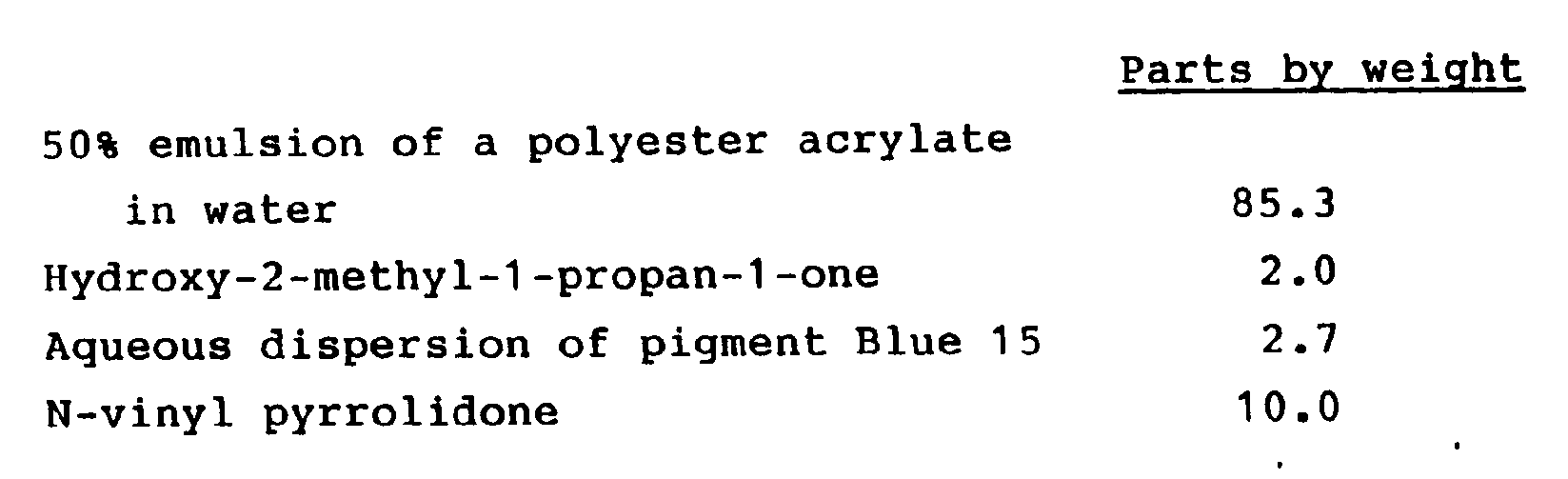
- A method according to any one of Claims 1 to 22, characterised in that the water-based printing ink for the or each said subsequent screen printing comprises:

- A method according to any one of Claims 1 to 22, characterised in that the water-based printing ink for the or each said subsequent screen printing comprises:

- A method according to any one of Claims 1 to 22, characterised in that the water-based printing ink for the or each said subsequent screen printing comprises:

- A method according to any one of the preceding Claims employed to screen print a plurality of colours upon a sheet and characterised in that, after printing, the printed sheet is subjected to corona discharge to render the sheet suitable for mounting by use of a starch-based adhesive.
- A method according to any one of the preceding Claims, wherein printing is effected on an automatic screen printing press.
Priority Applications (1)
| Application Number | Priority Date | Filing Date | Title |
|---|---|---|---|
| AT87904913T ATE58091T1 (en) | 1986-07-30 | 1987-07-30 | IMPROVEMENTS IN OR RELATING TO PRINTING. |
Applications Claiming Priority (5)
| Application Number | Priority Date | Filing Date | Title |
|---|---|---|---|
| GB8618595 | 1986-07-30 | ||
| GB868618595A GB8618595D0 (en) | 1986-07-30 | 1986-07-30 | Printing |
| GB868619245A GB8619245D0 (en) | 1986-07-30 | 1986-08-06 | Printing |
| GB8619245 | 1986-08-06 | ||
| PCT/GB1987/000541 WO1988000889A1 (en) | 1986-07-30 | 1987-07-30 | Improvements in or relating to printing |
Publications (3)
| Publication Number | Publication Date |
|---|---|
| EP0317563A1 EP0317563A1 (en) | 1989-05-31 |
| EP0317563B1 EP0317563B1 (en) | 1990-11-07 |
| EP0317563B2 true EP0317563B2 (en) | 1994-05-25 |
Family
ID=26291102
Family Applications (1)
| Application Number | Title | Priority Date | Filing Date |
|---|---|---|---|
| EP87904913A Expired - Lifetime EP0317563B2 (en) | 1986-07-30 | 1987-07-30 | Improvements in or relating to printing |
Country Status (10)
| Country | Link |
|---|---|
| US (1) | US4927663A (en) |
| EP (1) | EP0317563B2 (en) |
| JP (1) | JPH01503771A (en) |
| AU (1) | AU593938B2 (en) |
| CA (1) | CA1288296C (en) |
| DK (1) | DK168110B1 (en) |
| ES (1) | ES2004960A6 (en) |
| FI (1) | FI890431A7 (en) |
| GR (1) | GR871219B (en) |
| WO (1) | WO1988000889A1 (en) |
Families Citing this family (13)
| Publication number | Priority date | Publication date | Assignee | Title |
|---|---|---|---|---|
| EP0296176A1 (en) * | 1986-07-30 | 1988-12-28 | Small Products Limited | Improvements in or relating to printing |
| FR2641736B1 (en) * | 1989-01-17 | 1995-09-01 | Riso Kagaku Corp | IMAGE FORMING METHOD AND DEVICE, IMAGE OBTAINED AND IMAGE FORMING MATERIAL USED FOR THIS PURPOSE |
| AU655668B2 (en) * | 1991-08-09 | 1995-01-05 | Minnesota Mining And Manufacturing Company | Water-based chemical compositions |
| US5709038A (en) * | 1993-09-24 | 1998-01-20 | Optimum Air Corporation | Automated air filtration and drying system for waterborne paint and industrial coatings |
| US5562951A (en) * | 1995-05-01 | 1996-10-08 | Revlon Consumer Products Corporation | Method for printing articles with multiple radiation curable compositions |
| JP3877802B2 (en) * | 1995-05-02 | 2007-02-07 | 株式会社リコー | Emulsion ink and printing method using the same |
| AU6316498A (en) * | 1997-01-15 | 1998-08-07 | Optimum Air Corporation | System and method for drying and curing waterbased coatings |
| DE10041934A1 (en) * | 2000-08-25 | 2002-03-07 | Roland Man Druckmasch | Method and device for coating printed products |
| US7566473B2 (en) * | 2003-11-25 | 2009-07-28 | Vin Mark Security Services, Llc | Vehicle identification marking system |
| US7455877B2 (en) * | 2003-11-25 | 2008-11-25 | Vin Mark Security Services, Llc | Vehicle identification marking system |
| US8109211B2 (en) * | 2009-03-24 | 2012-02-07 | Ideon Llc | Method of gravure printing with liquid radiation curable inks |
| CN104553409B (en) * | 2014-12-30 | 2017-12-22 | 宁波创源文化发展股份有限公司 | A kind of method for printing screen of cork sheet |
| EP3081606B1 (en) * | 2015-01-27 | 2018-09-12 | Teikoku Printing Inks Mfg. Co., Ltd | Ink composition for high-quality and high-resolution screen printing, printed article obtained by screen printing with same, and method for producing said printed article |
Family Cites Families (5)
| Publication number | Priority date | Publication date | Assignee | Title |
|---|---|---|---|---|
| US3499781A (en) * | 1964-09-02 | 1970-03-10 | Mc Donnell Douglas Corp | Process for producing multiple layer colored coating using actinic irradiation |
| US3470054A (en) * | 1965-03-15 | 1969-09-30 | John J Tyrrell | Method of process color printing with water-base inks |
| US3429852A (en) * | 1967-03-30 | 1969-02-25 | Nat Starch Chem Corp | Ethylenically unsaturated derivatives of benzophenone and crosslinkable polymers thereof |
| US4113895A (en) * | 1976-11-19 | 1978-09-12 | American Can Company | Method for producing multilayered coated substrate |
| DE3368949D1 (en) * | 1982-10-08 | 1987-02-12 | Johnson Matthey Plc | Printing ink |
-
1987
- 1987-07-30 EP EP87904913A patent/EP0317563B2/en not_active Expired - Lifetime
- 1987-07-30 FI FI890431A patent/FI890431A7/en not_active IP Right Cessation
- 1987-07-30 CA CA000543465A patent/CA1288296C/en not_active Expired - Fee Related
- 1987-07-30 US US07/254,800 patent/US4927663A/en not_active Expired - Lifetime
- 1987-07-30 GR GR871219A patent/GR871219B/en unknown
- 1987-07-30 AU AU77804/87A patent/AU593938B2/en not_active Ceased
- 1987-07-30 ES ES8702247A patent/ES2004960A6/en not_active Expired
- 1987-07-30 WO PCT/GB1987/000541 patent/WO1988000889A1/en not_active Ceased
- 1987-07-30 JP JP62504539A patent/JPH01503771A/en active Granted
-
1988
- 1988-03-28 DK DK169288A patent/DK168110B1/en not_active IP Right Cessation
Also Published As
| Publication number | Publication date |
|---|---|
| DK168110B1 (en) | 1994-02-14 |
| ES2004960A6 (en) | 1989-02-16 |
| WO1988000889A1 (en) | 1988-02-11 |
| DK169288D0 (en) | 1988-03-28 |
| AU7780487A (en) | 1988-02-24 |
| FI890431A0 (en) | 1989-01-27 |
| GR871219B (en) | 1987-12-11 |
| JPH01503771A (en) | 1989-12-21 |
| FI890431L (en) | 1989-01-27 |
| JPH0515388B2 (en) | 1993-03-01 |
| AU593938B2 (en) | 1990-02-22 |
| US4927663A (en) | 1990-05-22 |
| EP0317563B1 (en) | 1990-11-07 |
| EP0317563A1 (en) | 1989-05-31 |
| DK169288A (en) | 1988-03-28 |
| CA1288296C (en) | 1991-09-03 |
| FI890431A7 (en) | 1989-01-27 |
Similar Documents
| Publication | Publication Date | Title |
|---|---|---|
| EP0317563B2 (en) | Improvements in or relating to printing | |
| DE2732576A1 (en) | HEAT TRANSFER PRINT PATTERN AND METHOD FOR MARKING AND PRINTING SURFACES USING THE SAME | |
| EP2104617B1 (en) | Method for transfer printing and copy for said purpose | |
| WO1988000961A1 (en) | Improvements in or relating to printing | |
| DE10041781A1 (en) | Digital pre-pressing system for providing excellent proof copy free of faulty characters and little image colour difference transfers digital data onto flatbed and ink jet printers after processing it on a raster image processor. | |
| JP2001030611A (en) | Gravure printing method using aqueous gravure ink, plate cylinder used for application of the method and printed matter printed by the method | |
| GB2193469A (en) | Silk screen printing | |
| DE3226368A1 (en) | Printing ink | |
| GB2195954A (en) | Printing ink | |
| US3470054A (en) | Method of process color printing with water-base inks | |
| CN106916326A (en) | A kind of printing material and preparation method for synthesizing stationery | |
| WO1997043126A1 (en) | Improved process for the production of scratch-off cards | |
| JPH0930154A (en) | Color prints | |
| US8177323B2 (en) | Variable data imaging | |
| US6245136B1 (en) | Matte ink composition and method of use | |
| GB2278314A (en) | A printing process | |
| JP2659389B2 (en) | Inkjet recording sheet having excellent water resistance and method for producing the same | |
| CN112477458B (en) | Offset printing process and printed matter | |
| US6626985B1 (en) | Matte ink composition and method of use | |
| US8163038B2 (en) | Low volatile sublimation printing | |
| DE69506151T2 (en) | Process for preparing a surface for printing, and product made thereafter | |
| Smith | Web offset inks | |
| Oil and Colour Chemists’ Association | Printing Inks | |
| US6341857B1 (en) | Ink set for a multi-color, high speed continuous ink jet printer | |
| DE4305221C2 (en) | Process for the production of reproductions of printing forms and the reproductions obtained by this process and their use |
Legal Events
| Date | Code | Title | Description |
|---|---|---|---|
| PUAI | Public reference made under article 153(3) epc to a published international application that has entered the european phase |
Free format text: ORIGINAL CODE: 0009012 |
|
| 17P | Request for examination filed |
Effective date: 19880817 |
|
| AK | Designated contracting states |
Kind code of ref document: A1 Designated state(s): AT BE CH DE FR GB IT LI LU NL SE |
|
| 17Q | First examination report despatched |
Effective date: 19891129 |
|
| GRAA | (expected) grant |
Free format text: ORIGINAL CODE: 0009210 |
|
| AK | Designated contracting states |
Kind code of ref document: B1 Designated state(s): AT BE CH DE FR IT LI LU NL SE |
|
| REF | Corresponds to: |
Ref document number: 58091 Country of ref document: AT Date of ref document: 19901115 Kind code of ref document: T |
|
| REF | Corresponds to: |
Ref document number: 3766109 Country of ref document: DE Date of ref document: 19901213 |
|
| ET | Fr: translation filed | ||
| ITF | It: translation for a ep patent filed | ||
| PGFP | Annual fee paid to national office [announced via postgrant information from national office to epo] |
Ref country code: LU Payment date: 19910729 Year of fee payment: 5 Ref country code: CH Payment date: 19910729 Year of fee payment: 5 |
|
| PGFP | Annual fee paid to national office [announced via postgrant information from national office to epo] |
Ref country code: NL Payment date: 19910731 Year of fee payment: 5 |
|
| PLBI | Opposition filed |
Free format text: ORIGINAL CODE: 0009260 |
|
| 26 | Opposition filed |
Opponent name: MARABUWERKE ERWIN MARTZ GMBH & CO. Effective date: 19910806 |
|
| NLR1 | Nl: opposition has been filed with the epo |
Opponent name: MARABUWERKE ERWIN MARTZ GMBH & CO. |
|
| EPTA | Lu: last paid annual fee | ||
| PG25 | Lapsed in a contracting state [announced via postgrant information from national office to epo] |
Ref country code: LU Free format text: LAPSE BECAUSE OF NON-PAYMENT OF DUE FEES Effective date: 19920730 |
|
| PG25 | Lapsed in a contracting state [announced via postgrant information from national office to epo] |
Ref country code: LI Effective date: 19920731 Ref country code: CH Effective date: 19920731 |
|
| PG25 | Lapsed in a contracting state [announced via postgrant information from national office to epo] |
Ref country code: NL Effective date: 19930201 |
|
| NLV4 | Nl: lapsed or anulled due to non-payment of the annual fee | ||
| REG | Reference to a national code |
Ref country code: CH Ref legal event code: PL |
|
| PUAH | Patent maintained in amended form |
Free format text: ORIGINAL CODE: 0009272 |
|
| STAA | Information on the status of an ep patent application or granted ep patent |
Free format text: STATUS: PATENT MAINTAINED AS AMENDED |
|
| 27A | Patent maintained in amended form |
Effective date: 19940525 |
|
| AK | Designated contracting states |
Kind code of ref document: B2 Designated state(s): AT BE CH DE FR IT LI LU NL SE |
|
| ET3 | Fr: translation filed ** decision concerning opposition | ||
| EAL | Se: european patent in force in sweden |
Ref document number: 87904913.8 |
|
| PGFP | Annual fee paid to national office [announced via postgrant information from national office to epo] |
Ref country code: AT Payment date: 19950721 Year of fee payment: 9 |
|
| PGFP | Annual fee paid to national office [announced via postgrant information from national office to epo] |
Ref country code: BE Payment date: 19950731 Year of fee payment: 9 |
|
| PG25 | Lapsed in a contracting state [announced via postgrant information from national office to epo] |
Ref country code: AT Effective date: 19960730 |
|
| PG25 | Lapsed in a contracting state [announced via postgrant information from national office to epo] |
Ref country code: BE Effective date: 19960731 |
|
| BERE | Be: lapsed |
Owner name: SMALL PRODUCTS LTD Effective date: 19960731 |
|
| PGFP | Annual fee paid to national office [announced via postgrant information from national office to epo] |
Ref country code: DE Payment date: 20000710 Year of fee payment: 14 |
|
| PG25 | Lapsed in a contracting state [announced via postgrant information from national office to epo] |
Ref country code: DE Free format text: LAPSE BECAUSE OF NON-PAYMENT OF DUE FEES Effective date: 20020501 |
|
| PGFP | Annual fee paid to national office [announced via postgrant information from national office to epo] |
Ref country code: SE Payment date: 20030717 Year of fee payment: 17 |
|
| PGFP | Annual fee paid to national office [announced via postgrant information from national office to epo] |
Ref country code: FR Payment date: 20030730 Year of fee payment: 17 |
|
| PG25 | Lapsed in a contracting state [announced via postgrant information from national office to epo] |
Ref country code: SE Free format text: LAPSE BECAUSE OF NON-PAYMENT OF DUE FEES Effective date: 20040731 |
|
| EUG | Se: european patent has lapsed | ||
| PG25 | Lapsed in a contracting state [announced via postgrant information from national office to epo] |
Ref country code: FR Free format text: LAPSE BECAUSE OF NON-PAYMENT OF DUE FEES Effective date: 20050331 |
|
| REG | Reference to a national code |
Ref country code: FR Ref legal event code: ST |
|
| PG25 | Lapsed in a contracting state [announced via postgrant information from national office to epo] |
Ref country code: IT Free format text: LAPSE BECAUSE OF NON-PAYMENT OF DUE FEES;WARNING: LAPSES OF ITALIAN PATENTS WITH EFFECTIVE DATE BEFORE 2007 MAY HAVE OCCURRED AT ANY TIME BEFORE 2007. THE CORRECT EFFECTIVE DATE MAY BE DIFFERENT FROM THE ONE RECORDED. Effective date: 20050730 |