EP0312353B1 - Zearalanol derivatives with anabolic activity - Google Patents
Zearalanol derivatives with anabolic activity Download PDFInfo
- Publication number
- EP0312353B1 EP0312353B1 EP88309598A EP88309598A EP0312353B1 EP 0312353 B1 EP0312353 B1 EP 0312353B1 EP 88309598 A EP88309598 A EP 88309598A EP 88309598 A EP88309598 A EP 88309598A EP 0312353 B1 EP0312353 B1 EP 0312353B1
- Authority
- EP
- European Patent Office
- Prior art keywords
- compound
- hydroxyl
- animal
- group
- product
- Prior art date
- Legal status (The legal status is an assumption and is not a legal conclusion. Google has not performed a legal analysis and makes no representation as to the accuracy of the status listed.)
- Expired - Lifetime
Links
- 230000001195 anabolic effect Effects 0.000 title claims description 30
- FPQFYIAXQDXNOR-QDKLYSGJSA-N alpha-Zearalenol Chemical class O=C1O[C@@H](C)CCC[C@H](O)CCC\C=C\C2=CC(O)=CC(O)=C21 FPQFYIAXQDXNOR-QDKLYSGJSA-N 0.000 title description 3
- 150000001875 compounds Chemical class 0.000 claims abstract description 86
- 241001465754 Metazoa Species 0.000 claims abstract description 50
- 239000001257 hydrogen Substances 0.000 claims abstract description 22
- 229910052739 hydrogen Inorganic materials 0.000 claims abstract description 22
- 125000000217 alkyl group Chemical group 0.000 claims abstract description 20
- 125000002887 hydroxy group Chemical group [H]O* 0.000 claims abstract description 14
- 229930194542 Keto Natural products 0.000 claims abstract description 6
- 125000000468 ketone group Chemical group 0.000 claims abstract description 6
- 125000002924 primary amino group Chemical group [H]N([H])* 0.000 claims abstract description 6
- 125000004435 hydrogen atom Chemical group [H]* 0.000 claims abstract 9
- ZWEHNKRNPOVVGH-UHFFFAOYSA-N 2-Butanone Chemical compound CCC(C)=O ZWEHNKRNPOVVGH-UHFFFAOYSA-N 0.000 claims description 33
- 238000000034 method Methods 0.000 claims description 31
- BWHMMNNQKKPAPP-UHFFFAOYSA-L potassium carbonate Chemical compound [K+].[K+].[O-]C([O-])=O BWHMMNNQKKPAPP-UHFFFAOYSA-L 0.000 claims description 18
- 230000008569 process Effects 0.000 claims description 18
- 239000000203 mixture Substances 0.000 claims description 16
- 125000003118 aryl group Chemical group 0.000 claims description 15
- 230000015572 biosynthetic process Effects 0.000 claims description 14
- 238000006243 chemical reaction Methods 0.000 claims description 13
- KDLHZDBZIXYQEI-UHFFFAOYSA-N Palladium Chemical compound [Pd] KDLHZDBZIXYQEI-UHFFFAOYSA-N 0.000 claims description 11
- 125000004432 carbon atom Chemical group C* 0.000 claims description 11
- 238000010992 reflux Methods 0.000 claims description 11
- 239000003054 catalyst Substances 0.000 claims description 10
- RTZKZFJDLAIYFH-UHFFFAOYSA-N Diethyl ether Chemical compound CCOCC RTZKZFJDLAIYFH-UHFFFAOYSA-N 0.000 claims description 9
- DWTTZBARDOXEAM-GXTWGEPZSA-N alpha-Zearalanol Chemical compound O=C1O[C@@H](C)CCC[C@H](O)CCCCCC2=CC(O)=CC(O)=C21 DWTTZBARDOXEAM-GXTWGEPZSA-N 0.000 claims description 9
- 150000002576 ketones Chemical class 0.000 claims description 9
- 229910000027 potassium carbonate Inorganic materials 0.000 claims description 9
- BASFCYQUMIYNBI-UHFFFAOYSA-N platinum Chemical compound [Pt] BASFCYQUMIYNBI-UHFFFAOYSA-N 0.000 claims description 8
- 230000032050 esterification Effects 0.000 claims description 7
- 238000005886 esterification reaction Methods 0.000 claims description 7
- 230000004060 metabolic process Effects 0.000 claims description 7
- -1 para-toluene sulfonic acids Chemical class 0.000 claims description 7
- MHOVAHRLVXNVSD-UHFFFAOYSA-N rhodium atom Chemical compound [Rh] MHOVAHRLVXNVSD-UHFFFAOYSA-N 0.000 claims description 6
- 239000003810 Jones reagent Substances 0.000 claims description 5
- 238000006266 etherification reaction Methods 0.000 claims description 5
- 230000001965 increasing effect Effects 0.000 claims description 5
- SUKJFIGYRHOWBL-UHFFFAOYSA-N sodium hypochlorite Chemical compound [Na+].Cl[O-] SUKJFIGYRHOWBL-UHFFFAOYSA-N 0.000 claims description 5
- 239000007868 Raney catalyst Substances 0.000 claims description 4
- 229910000564 Raney nickel Inorganic materials 0.000 claims description 4
- NPXOKRUENSOPAO-UHFFFAOYSA-N Raney nickel Chemical compound [Al].[Ni] NPXOKRUENSOPAO-UHFFFAOYSA-N 0.000 claims description 4
- 238000010521 absorption reaction Methods 0.000 claims description 4
- 239000002253 acid Substances 0.000 claims description 4
- 125000001931 aliphatic group Chemical group 0.000 claims description 4
- WPYMKLBDIGXBTP-UHFFFAOYSA-N benzoic acid Chemical compound OC(=O)C1=CC=CC=C1 WPYMKLBDIGXBTP-UHFFFAOYSA-N 0.000 claims description 4
- 238000009903 catalytic hydrogenation reaction Methods 0.000 claims description 4
- 229910052763 palladium Inorganic materials 0.000 claims description 4
- 230000010412 perfusion Effects 0.000 claims description 4
- 229910052697 platinum Inorganic materials 0.000 claims description 4
- 238000002360 preparation method Methods 0.000 claims description 4
- 239000003377 acid catalyst Substances 0.000 claims description 3
- 238000004519 manufacturing process Methods 0.000 claims description 3
- 150000007522 mineralic acids Chemical class 0.000 claims description 3
- 230000001737 promoting effect Effects 0.000 claims description 3
- 229910052703 rhodium Inorganic materials 0.000 claims description 3
- 239000010948 rhodium Substances 0.000 claims description 3
- NHQDETIJWKXCTC-UHFFFAOYSA-N 3-chloroperbenzoic acid Chemical compound OOC(=O)C1=CC=CC(Cl)=C1 NHQDETIJWKXCTC-UHFFFAOYSA-N 0.000 claims description 2
- PSUIIKIEUATWCZ-UHFFFAOYSA-N 5-(2-chlorophenyl)-2h-tetrazole Chemical compound ClC1=CC=CC=C1C1=NNN=N1 PSUIIKIEUATWCZ-UHFFFAOYSA-N 0.000 claims description 2
- VEXZGXHMUGYJMC-UHFFFAOYSA-M Chloride anion Chemical compound [Cl-] VEXZGXHMUGYJMC-UHFFFAOYSA-M 0.000 claims description 2
- 239000012359 Methanesulfonyl chloride Substances 0.000 claims description 2
- KJTLSVCANCCWHF-UHFFFAOYSA-N Ruthenium Chemical compound [Ru] KJTLSVCANCCWHF-UHFFFAOYSA-N 0.000 claims description 2
- 239000005708 Sodium hypochlorite Substances 0.000 claims description 2
- 230000001476 alcoholic effect Effects 0.000 claims description 2
- 239000003153 chemical reaction reagent Substances 0.000 claims description 2
- 239000007943 implant Substances 0.000 claims description 2
- 238000010255 intramuscular injection Methods 0.000 claims description 2
- 238000010253 intravenous injection Methods 0.000 claims description 2
- 239000011159 matrix material Substances 0.000 claims description 2
- QARBMVPHQWIHKH-UHFFFAOYSA-N methanesulfonyl chloride Chemical compound CS(Cl)(=O)=O QARBMVPHQWIHKH-UHFFFAOYSA-N 0.000 claims description 2
- XEZQLSOFXLPSJR-UHFFFAOYSA-N oxane-2-carbaldehyde Chemical compound O=CC1CCCCO1 XEZQLSOFXLPSJR-UHFFFAOYSA-N 0.000 claims description 2
- 230000002572 peristaltic effect Effects 0.000 claims description 2
- 125000006239 protecting group Chemical group 0.000 claims description 2
- 229910052707 ruthenium Inorganic materials 0.000 claims description 2
- 238000010254 subcutaneous injection Methods 0.000 claims description 2
- 150000007524 organic acids Chemical class 0.000 claims 3
- 238000003776 cleavage reaction Methods 0.000 claims 2
- 230000007017 scission Effects 0.000 claims 2
- FGUUSXIOTUKUDN-IBGZPJMESA-N C1(=CC=CC=C1)N1C2=C(NC([C@H](C1)NC=1OC(=NN=1)C1=CC=CC=C1)=O)C=CC=C2 Chemical compound C1(=CC=CC=C1)N1C2=C(NC([C@H](C1)NC=1OC(=NN=1)C1=CC=CC=C1)=O)C=CC=C2 FGUUSXIOTUKUDN-IBGZPJMESA-N 0.000 claims 1
- 125000001797 benzyl group Chemical group [H]C1=C([H])C([H])=C(C([H])=C1[H])C([H])([H])* 0.000 claims 1
- 238000004587 chromatography analysis Methods 0.000 claims 1
- 239000003085 diluting agent Substances 0.000 claims 1
- ZWLPBLYKEWSWPD-UHFFFAOYSA-N o-toluic acid Chemical compound CC1=CC=CC=C1C(O)=O ZWLPBLYKEWSWPD-UHFFFAOYSA-N 0.000 claims 1
- 230000003054 hormonal effect Effects 0.000 abstract description 7
- 229940124325 anabolic agent Drugs 0.000 abstract description 5
- 239000003263 anabolic agent Substances 0.000 abstract description 5
- 230000000845 anti-microbial effect Effects 0.000 abstract description 4
- 150000002148 esters Chemical class 0.000 abstract description 2
- LFQSCWFLJHTTHZ-UHFFFAOYSA-N Ethanol Chemical compound CCO LFQSCWFLJHTTHZ-UHFFFAOYSA-N 0.000 description 30
- 229910001868 water Inorganic materials 0.000 description 19
- 239000000243 solution Substances 0.000 description 14
- CSCPPACGZOOCGX-UHFFFAOYSA-N Acetone Chemical compound CC(C)=O CSCPPACGZOOCGX-UHFFFAOYSA-N 0.000 description 12
- XEKOWRVHYACXOJ-UHFFFAOYSA-N Ethyl acetate Chemical compound CCOC(C)=O XEKOWRVHYACXOJ-UHFFFAOYSA-N 0.000 description 12
- VLKZOEOYAKHREP-UHFFFAOYSA-N n-Hexane Chemical compound CCCCCC VLKZOEOYAKHREP-UHFFFAOYSA-N 0.000 description 12
- 238000003786 synthesis reaction Methods 0.000 description 12
- 239000000047 product Substances 0.000 description 11
- XLYOFNOQVPJJNP-UHFFFAOYSA-N water Substances O XLYOFNOQVPJJNP-UHFFFAOYSA-N 0.000 description 11
- HEDRZPFGACZZDS-MICDWDOJSA-N Trichloro(2H)methane Chemical compound [2H]C(Cl)(Cl)Cl HEDRZPFGACZZDS-MICDWDOJSA-N 0.000 description 10
- VYPSYNLAJGMNEJ-UHFFFAOYSA-N Silicium dioxide Chemical compound O=[Si]=O VYPSYNLAJGMNEJ-UHFFFAOYSA-N 0.000 description 9
- 150000002431 hydrogen Chemical group 0.000 description 9
- 239000007787 solid Substances 0.000 description 8
- 230000000694 effects Effects 0.000 description 7
- 125000001434 methanylylidene group Chemical group [H]C#[*] 0.000 description 7
- 239000003921 oil Substances 0.000 description 7
- 235000019198 oils Nutrition 0.000 description 7
- QAOWNCQODCNURD-UHFFFAOYSA-N sulfuric acid group Chemical group S(O)(O)(=O)=O QAOWNCQODCNURD-UHFFFAOYSA-N 0.000 description 7
- 238000005160 1H NMR spectroscopy Methods 0.000 description 6
- KFZMGEQAYNKOFK-UHFFFAOYSA-N Isopropanol Chemical compound CC(C)O KFZMGEQAYNKOFK-UHFFFAOYSA-N 0.000 description 6
- 241001494479 Pecora Species 0.000 description 6
- UFHFLCQGNIYNRP-UHFFFAOYSA-N Hydrogen Chemical compound [H][H] UFHFLCQGNIYNRP-UHFFFAOYSA-N 0.000 description 5
- FAPWRFPIFSIZLT-UHFFFAOYSA-M Sodium chloride Chemical compound [Na+].[Cl-] FAPWRFPIFSIZLT-UHFFFAOYSA-M 0.000 description 5
- 239000012043 crude product Substances 0.000 description 5
- 239000013078 crystal Substances 0.000 description 5
- 235000019439 ethyl acetate Nutrition 0.000 description 5
- 210000002196 fr. b Anatomy 0.000 description 5
- 238000001819 mass spectrum Methods 0.000 description 5
- 239000000463 material Substances 0.000 description 5
- 239000011541 reaction mixture Substances 0.000 description 5
- 238000004809 thin layer chromatography Methods 0.000 description 5
- 230000004584 weight gain Effects 0.000 description 5
- 235000019786 weight gain Nutrition 0.000 description 5
- QTBSBXVTEAMEQO-UHFFFAOYSA-N Acetic acid Chemical compound CC(O)=O QTBSBXVTEAMEQO-UHFFFAOYSA-N 0.000 description 4
- IJGRMHOSHXDMSA-UHFFFAOYSA-N Atomic nitrogen Chemical compound N#N IJGRMHOSHXDMSA-UHFFFAOYSA-N 0.000 description 4
- 229910004373 HOAc Inorganic materials 0.000 description 4
- 241000282849 Ruminantia Species 0.000 description 4
- 125000000218 acetic acid group Chemical group C(C)(=O)* 0.000 description 4
- 235000013305 food Nutrition 0.000 description 4
- 238000005984 hydrogenation reaction Methods 0.000 description 4
- 230000001939 inductive effect Effects 0.000 description 4
- 125000002496 methyl group Chemical group [H]C([H])([H])* 0.000 description 4
- 125000000325 methylidene group Chemical group [H]C([H])=* 0.000 description 4
- 238000001953 recrystallisation Methods 0.000 description 4
- 239000000377 silicon dioxide Substances 0.000 description 4
- 239000002904 solvent Substances 0.000 description 4
- XIVIOPBAXBBQPU-UHFFFAOYSA-N 2-phenyl-1h-tetrazol-5-one Chemical compound N1C(=O)N=NN1C1=CC=CC=C1 XIVIOPBAXBBQPU-UHFFFAOYSA-N 0.000 description 3
- WEVYAHXRMPXWCK-UHFFFAOYSA-N Acetonitrile Chemical compound CC#N WEVYAHXRMPXWCK-UHFFFAOYSA-N 0.000 description 3
- 0 COC1OC2(CC2)CCCC(*)CCCCCC(C2)=C1C(*)=C*2=O Chemical compound COC1OC2(CC2)CCCC(*)CCCCCC(C2)=C1C(*)=C*2=O 0.000 description 3
- YMWUJEATGCHHMB-UHFFFAOYSA-N Dichloromethane Chemical compound ClCCl YMWUJEATGCHHMB-UHFFFAOYSA-N 0.000 description 3
- WQZGKKKJIJFFOK-GASJEMHNSA-N Glucose Natural products OC[C@H]1OC(O)[C@H](O)[C@@H](O)[C@@H]1O WQZGKKKJIJFFOK-GASJEMHNSA-N 0.000 description 3
- DNIAPMSPPWPWGF-UHFFFAOYSA-N Propylene glycol Chemical compound CC(O)CO DNIAPMSPPWPWGF-UHFFFAOYSA-N 0.000 description 3
- 230000001580 bacterial effect Effects 0.000 description 3
- KCXMKQUNVWSEMD-UHFFFAOYSA-N benzyl chloride Chemical group ClCC1=CC=CC=C1 KCXMKQUNVWSEMD-UHFFFAOYSA-N 0.000 description 3
- 229940073608 benzyl chloride Drugs 0.000 description 3
- 239000003795 chemical substances by application Substances 0.000 description 3
- 239000010779 crude oil Substances 0.000 description 3
- 239000008121 dextrose Substances 0.000 description 3
- RGLYKWWBQGJZGM-ISLYRVAYSA-N diethylstilbestrol Chemical compound C=1C=C(O)C=CC=1C(/CC)=C(\CC)C1=CC=C(O)C=C1 RGLYKWWBQGJZGM-ISLYRVAYSA-N 0.000 description 3
- 239000000839 emulsion Substances 0.000 description 3
- 238000001914 filtration Methods 0.000 description 3
- 150000002596 lactones Chemical class 0.000 description 3
- 239000012452 mother liquor Substances 0.000 description 3
- 239000000902 placebo Substances 0.000 description 3
- 229940068196 placebo Drugs 0.000 description 3
- 210000004767 rumen Anatomy 0.000 description 3
- 239000011780 sodium chloride Substances 0.000 description 3
- 235000011149 sulphuric acid Nutrition 0.000 description 3
- 239000000725 suspension Substances 0.000 description 3
- 238000001644 13C nuclear magnetic resonance spectroscopy Methods 0.000 description 2
- DHELIGKVOGTMGF-UHFFFAOYSA-N 5-chloro-1-phenyltetrazole Chemical compound ClC1=NN=NN1C1=CC=CC=C1 DHELIGKVOGTMGF-UHFFFAOYSA-N 0.000 description 2
- QTBSBXVTEAMEQO-UHFFFAOYSA-M Acetate Chemical compound CC([O-])=O QTBSBXVTEAMEQO-UHFFFAOYSA-M 0.000 description 2
- HEDRZPFGACZZDS-UHFFFAOYSA-N Chloroform Chemical compound ClC(Cl)Cl HEDRZPFGACZZDS-UHFFFAOYSA-N 0.000 description 2
- 238000005033 Fourier transform infrared spectroscopy Methods 0.000 description 2
- CSNNHWWHGAXBCP-UHFFFAOYSA-L Magnesium sulfate Chemical compound [Mg+2].[O-][S+2]([O-])([O-])[O-] CSNNHWWHGAXBCP-UHFFFAOYSA-L 0.000 description 2
- 229910019093 NaOCl Inorganic materials 0.000 description 2
- 206010028980 Neoplasm Diseases 0.000 description 2
- 229960000583 acetic acid Drugs 0.000 description 2
- 239000007864 aqueous solution Substances 0.000 description 2
- WQZGKKKJIJFFOK-VFUOTHLCSA-N beta-D-glucose Chemical compound OC[C@H]1O[C@@H](O)[C@H](O)[C@@H](O)[C@@H]1O WQZGKKKJIJFFOK-VFUOTHLCSA-N 0.000 description 2
- 210000004369 blood Anatomy 0.000 description 2
- 239000008280 blood Substances 0.000 description 2
- 239000002775 capsule Substances 0.000 description 2
- 230000008859 change Effects 0.000 description 2
- KRVSOGSZCMJSLX-UHFFFAOYSA-L chromic acid Substances O[Cr](O)(=O)=O KRVSOGSZCMJSLX-UHFFFAOYSA-L 0.000 description 2
- 239000012230 colorless oil Substances 0.000 description 2
- 238000004440 column chromatography Methods 0.000 description 2
- 229960000452 diethylstilbestrol Drugs 0.000 description 2
- 239000003937 drug carrier Substances 0.000 description 2
- 238000000921 elemental analysis Methods 0.000 description 2
- 230000008030 elimination Effects 0.000 description 2
- 238000003379 elimination reaction Methods 0.000 description 2
- 230000001076 estrogenic effect Effects 0.000 description 2
- AWJWCTOOIBYHON-UHFFFAOYSA-N furo[3,4-b]pyrazine-5,7-dione Chemical compound C1=CN=C2C(=O)OC(=O)C2=N1 AWJWCTOOIBYHON-UHFFFAOYSA-N 0.000 description 2
- 239000000499 gel Substances 0.000 description 2
- 239000012362 glacial acetic acid Substances 0.000 description 2
- 230000036541 health Effects 0.000 description 2
- 238000004128 high performance liquid chromatography Methods 0.000 description 2
- SHFJWMWCIHQNCP-UHFFFAOYSA-M hydron;tetrabutylazanium;sulfate Chemical compound OS([O-])(=O)=O.CCCC[N+](CCCC)(CCCC)CCCC SHFJWMWCIHQNCP-UHFFFAOYSA-M 0.000 description 2
- 239000003701 inert diluent Substances 0.000 description 2
- 239000007788 liquid Substances 0.000 description 2
- 239000008297 liquid dosage form Substances 0.000 description 2
- 235000013372 meat Nutrition 0.000 description 2
- 244000005700 microbiome Species 0.000 description 2
- 229910052757 nitrogen Inorganic materials 0.000 description 2
- 239000012071 phase Substances 0.000 description 2
- 238000000926 separation method Methods 0.000 description 2
- 239000002002 slurry Substances 0.000 description 2
- VZGDMQKNWNREIO-UHFFFAOYSA-N tetrachloromethane Chemical compound ClC(Cl)(Cl)Cl VZGDMQKNWNREIO-UHFFFAOYSA-N 0.000 description 2
- 239000010409 thin film Substances 0.000 description 2
- 238000003828 vacuum filtration Methods 0.000 description 2
- 239000003981 vehicle Substances 0.000 description 2
- 229960002300 zeranol Drugs 0.000 description 2
- GUBGYTABKSRVRQ-XLOQQCSPSA-N Alpha-Lactose Chemical compound O[C@@H]1[C@@H](O)[C@@H](O)[C@@H](CO)O[C@H]1O[C@@H]1[C@@H](CO)O[C@H](O)[C@H](O)[C@H]1O GUBGYTABKSRVRQ-XLOQQCSPSA-N 0.000 description 1
- 241000283690 Bos taurus Species 0.000 description 1
- OKTJSMMVPCPJKN-UHFFFAOYSA-N Carbon Chemical compound [C] OKTJSMMVPCPJKN-UHFFFAOYSA-N 0.000 description 1
- LVGKNOAMLMIIKO-UHFFFAOYSA-N Elaidinsaeure-aethylester Natural products CCCCCCCCC=CCCCCCCCC(=O)OCC LVGKNOAMLMIIKO-UHFFFAOYSA-N 0.000 description 1
- 108010010803 Gelatin Proteins 0.000 description 1
- 241000282412 Homo Species 0.000 description 1
- GUBGYTABKSRVRQ-QKKXKWKRSA-N Lactose Natural products OC[C@H]1O[C@@H](O[C@H]2[C@H](O)[C@@H](O)C(O)O[C@@H]2CO)[C@H](O)[C@@H](O)[C@H]1O GUBGYTABKSRVRQ-QKKXKWKRSA-N 0.000 description 1
- 206010067572 Oestrogenic effect Diseases 0.000 description 1
- 239000002202 Polyethylene glycol Substances 0.000 description 1
- 229920002472 Starch Polymers 0.000 description 1
- 229930006000 Sucrose Natural products 0.000 description 1
- CZMRCDWAGMRECN-UGDNZRGBSA-N Sucrose Chemical compound O[C@H]1[C@H](O)[C@@H](CO)O[C@@]1(CO)O[C@@H]1[C@H](O)[C@@H](O)[C@H](O)[C@@H](CO)O1 CZMRCDWAGMRECN-UGDNZRGBSA-N 0.000 description 1
- PNNCWTXUWKENPE-UHFFFAOYSA-N [N].NC(N)=O Chemical compound [N].NC(N)=O PNNCWTXUWKENPE-UHFFFAOYSA-N 0.000 description 1
- PBCJIPOGFJYBJE-UHFFFAOYSA-N acetonitrile;hydrate Chemical compound O.CC#N PBCJIPOGFJYBJE-UHFFFAOYSA-N 0.000 description 1
- 150000007513 acids Chemical class 0.000 description 1
- 239000000654 additive Substances 0.000 description 1
- 238000004458 analytical method Methods 0.000 description 1
- 239000006053 animal diet Substances 0.000 description 1
- 230000000844 anti-bacterial effect Effects 0.000 description 1
- 230000003466 anti-cipated effect Effects 0.000 description 1
- 230000003110 anti-inflammatory effect Effects 0.000 description 1
- 239000004599 antimicrobial Substances 0.000 description 1
- 239000003963 antioxidant agent Substances 0.000 description 1
- 235000006708 antioxidants Nutrition 0.000 description 1
- 239000008365 aqueous carrier Substances 0.000 description 1
- 239000003125 aqueous solvent Substances 0.000 description 1
- 159000000032 aromatic acids Chemical class 0.000 description 1
- 239000012298 atmosphere Substances 0.000 description 1
- QVGXLLKOCUKJST-UHFFFAOYSA-N atomic oxygen Chemical compound [O] QVGXLLKOCUKJST-UHFFFAOYSA-N 0.000 description 1
- 125000001743 benzylic group Chemical group 0.000 description 1
- 239000007844 bleaching agent Substances 0.000 description 1
- 239000006172 buffering agent Substances 0.000 description 1
- 239000006227 byproduct Substances 0.000 description 1
- BPKIGYQJPYCAOW-FFJTTWKXSA-I calcium;potassium;disodium;(2s)-2-hydroxypropanoate;dichloride;dihydroxide;hydrate Chemical compound O.[OH-].[OH-].[Na+].[Na+].[Cl-].[Cl-].[K+].[Ca+2].C[C@H](O)C([O-])=O BPKIGYQJPYCAOW-FFJTTWKXSA-I 0.000 description 1
- 201000011510 cancer Diseases 0.000 description 1
- 229910052799 carbon Inorganic materials 0.000 description 1
- 238000001460 carbon-13 nuclear magnetic resonance spectrum Methods 0.000 description 1
- 230000003197 catalytic effect Effects 0.000 description 1
- 239000001913 cellulose Substances 0.000 description 1
- 229920002678 cellulose Polymers 0.000 description 1
- 238000001816 cooling Methods 0.000 description 1
- 238000001514 detection method Methods 0.000 description 1
- 238000004090 dissolution Methods 0.000 description 1
- 239000003792 electrolyte Substances 0.000 description 1
- 239000002702 enteric coating Substances 0.000 description 1
- 238000009505 enteric coating Methods 0.000 description 1
- 230000007613 environmental effect Effects 0.000 description 1
- 125000004185 ester group Chemical group 0.000 description 1
- LVGKNOAMLMIIKO-QXMHVHEDSA-N ethyl oleate Chemical compound CCCCCCCC\C=C/CCCCCCCC(=O)OCC LVGKNOAMLMIIKO-QXMHVHEDSA-N 0.000 description 1
- 229940093471 ethyl oleate Drugs 0.000 description 1
- 239000000284 extract Substances 0.000 description 1
- 239000012065 filter cake Substances 0.000 description 1
- 239000000706 filtrate Substances 0.000 description 1
- 238000003818 flash chromatography Methods 0.000 description 1
- 239000012530 fluid Substances 0.000 description 1
- 210000003918 fraction a Anatomy 0.000 description 1
- 210000001035 gastrointestinal tract Anatomy 0.000 description 1
- 239000008273 gelatin Substances 0.000 description 1
- 229920000159 gelatin Polymers 0.000 description 1
- 235000019322 gelatine Nutrition 0.000 description 1
- 235000011852 gelatine desserts Nutrition 0.000 description 1
- 210000004392 genitalia Anatomy 0.000 description 1
- 150000004676 glycans Chemical class 0.000 description 1
- 238000010438 heat treatment Methods 0.000 description 1
- 230000006872 improvement Effects 0.000 description 1
- 239000012535 impurity Substances 0.000 description 1
- 238000002347 injection Methods 0.000 description 1
- 239000007924 injection Substances 0.000 description 1
- 229910003480 inorganic solid Inorganic materials 0.000 description 1
- 230000010354 integration Effects 0.000 description 1
- 210000000936 intestine Anatomy 0.000 description 1
- 238000001990 intravenous administration Methods 0.000 description 1
- 238000002955 isolation Methods 0.000 description 1
- 239000008101 lactose Substances 0.000 description 1
- 239000000314 lubricant Substances 0.000 description 1
- 229910052943 magnesium sulfate Inorganic materials 0.000 description 1
- 235000019341 magnesium sulphate Nutrition 0.000 description 1
- 238000012423 maintenance Methods 0.000 description 1
- 210000005075 mammary gland Anatomy 0.000 description 1
- 230000004048 modification Effects 0.000 description 1
- 238000012986 modification Methods 0.000 description 1
- 210000003205 muscle Anatomy 0.000 description 1
- 239000012457 nonaqueous media Substances 0.000 description 1
- 239000000346 nonvolatile oil Substances 0.000 description 1
- 235000015097 nutrients Nutrition 0.000 description 1
- 239000004006 olive oil Substances 0.000 description 1
- 235000008390 olive oil Nutrition 0.000 description 1
- 150000002895 organic esters Chemical class 0.000 description 1
- 239000012074 organic phase Substances 0.000 description 1
- 239000007800 oxidant agent Substances 0.000 description 1
- 230000003647 oxidation Effects 0.000 description 1
- 238000007254 oxidation reaction Methods 0.000 description 1
- 239000001301 oxygen Substances 0.000 description 1
- 229910052760 oxygen Inorganic materials 0.000 description 1
- 238000007911 parenteral administration Methods 0.000 description 1
- ISWSIDIOOBJBQZ-UHFFFAOYSA-N phenol group Chemical group C1(=CC=CC=C1)O ISWSIDIOOBJBQZ-UHFFFAOYSA-N 0.000 description 1
- 239000006187 pill Substances 0.000 description 1
- 229920001223 polyethylene glycol Polymers 0.000 description 1
- 229920001282 polysaccharide Polymers 0.000 description 1
- 239000005017 polysaccharide Substances 0.000 description 1
- 239000003755 preservative agent Substances 0.000 description 1
- 238000010926 purge Methods 0.000 description 1
- 239000011347 resin Substances 0.000 description 1
- 229920005989 resin Polymers 0.000 description 1
- 230000000717 retained effect Effects 0.000 description 1
- 238000004007 reversed phase HPLC Methods 0.000 description 1
- 239000000741 silica gel Substances 0.000 description 1
- 229910002027 silica gel Inorganic materials 0.000 description 1
- 239000007909 solid dosage form Substances 0.000 description 1
- 238000001228 spectrum Methods 0.000 description 1
- 239000008107 starch Substances 0.000 description 1
- 235000019698 starch Nutrition 0.000 description 1
- 238000003756 stirring Methods 0.000 description 1
- 239000005720 sucrose Substances 0.000 description 1
- 238000000967 suction filtration Methods 0.000 description 1
- 235000000346 sugar Nutrition 0.000 description 1
- 150000008163 sugars Chemical class 0.000 description 1
- 230000002194 synthesizing effect Effects 0.000 description 1
- 239000006188 syrup Substances 0.000 description 1
- 235000020357 syrup Nutrition 0.000 description 1
- 239000003826 tablet Substances 0.000 description 1
- 235000015112 vegetable and seed oil Nutrition 0.000 description 1
- 239000008158 vegetable oil Substances 0.000 description 1
- 239000010455 vermiculite Substances 0.000 description 1
- 235000019354 vermiculite Nutrition 0.000 description 1
- 229910052902 vermiculite Inorganic materials 0.000 description 1
- 239000002023 wood Substances 0.000 description 1
Classifications
-
- C—CHEMISTRY; METALLURGY
- C07—ORGANIC CHEMISTRY
- C07D—HETEROCYCLIC COMPOUNDS
- C07D313/00—Heterocyclic compounds containing rings of more than six members having one oxygen atom as the only ring hetero atom
Definitions
- This invention is directed to new compounds having anabolic activity in animals, processes of making these compounds, and methods of using these compounds.
- anabolic agents have been heavily used as an aid in increasing the rate of growth in meat-producing animals.
- a drawback of such previously used compounds is that in addition to their anabolic activity, they possess some degree of hormonal activity.
- animals treated with these compounds tend to produce relatively high levels of fat as compared to the amount of muscle.
- the early anabolic compounds may have achieved some degree of success in terms weight gain, their hormonal properties resulted in weight gain which was of little economic value since a significant portion was due to the presence of fat.
- Another disadvantage of many anabolic compounds is that they often possess anti-bacterial activity. As a result, their use in animals may have a side effect wherein the natural balance of bacterial flora of the animal is disrupted. Such a change in the bacterial flora could be especially significant in ruminant animals where these compounds may disrupt the delicate ecological balance of bacterial flora in the rumen needed to insure the health and well being of the animal.
- Anti-inflammatory compounds derived from zearalanol which also have a growth promoting effect in animals are described in US-A-3,373,037.
- this invention provides compositions containing the compound of the invention useful in inducing anabolic metabolism in animals.
- a method of inducing anabolic metabolism in animals is provided using the claimed compounds.
- the invention also contemplates a method of making the claimed compounds.
- the compounds of the present invention provide effective means of inducing anabolic metabolism in animals. Moreover, these compounds are relatively non-hormonal and possess little antimicrobial activity.
- the compounds of the invention represent a significant advance in the science of anabolic agents.
- anabolic agents were known, these prior art compounds had significant side effects associated with them.
- prior art compounds, in addition to being anabolic are also estrogenic and, often, are associated with an increased risk of cancer.
- animals treated with these prior art compounds tend to be obese, more prone to develop tumors, and to develop accentuated secondary sex characteristics such as pendulous mammary glands and enlarged genitalia. Understandably, considerable public concern has arisen as to the introduction of these anabolic compounds into the human food chain.
- Another major drawback of prior art anabolic compounds is that many also possess antimicrobial activity which may cause an imbalance in the normal gut flora of the animal. This effect is particularly significant in ruminant animals, such as cattle and sheep, where the proper environmental balance of microorganisms in the rumen is essential to ensure the proper health and growth of the animal. The maintenance of a proper balance is important since these rumen microorganisms play a major role in allowing the animal to assimilate and break down cellulose as well as other components present in the animal diet.
- the compounds of the invention show anabolic activity, but no apparent hormonal or antimicrobial activity. Thus, animals administered the compounds of the invention display weight gain in the absence of the significant side effects commonly found associated with the administration of prior art anabolic compounds.
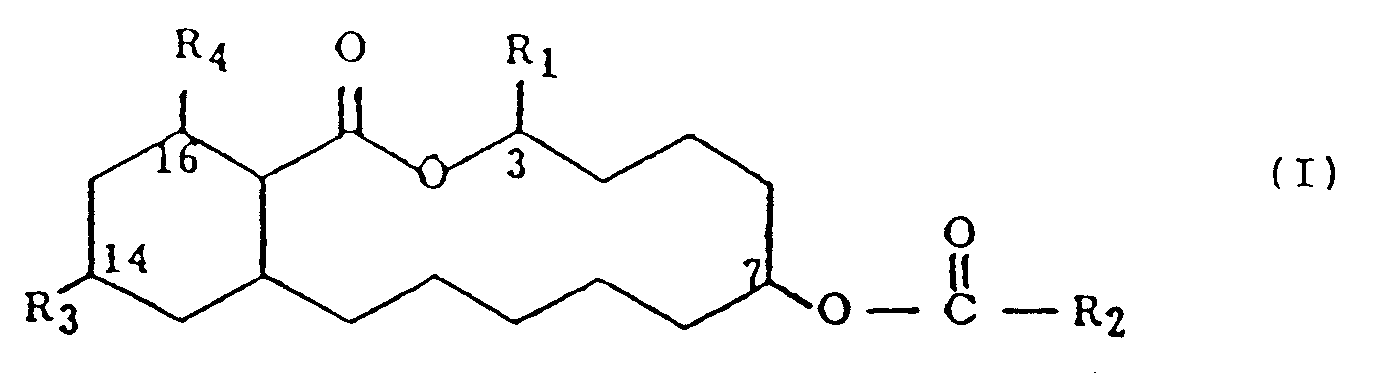
- the anabolic compounds of this invention have the formula (I) wherein R1 is hydrogen, or lower alkyl: R2 is hydrogen, or an alkyl or aryl group; R3 is keto, hydroxyl, or esterified hydroxyl; and R4 is hydrogen, lower alkyl or amino.
- Preferred compounds are those in which R1 is hydrogen, or an alkyl group having 1 to 3 carbon atoms; R2 is hydrogen, or an alkyl group having 1 to 18 carbon atoms; R3 is keto, or hydroxyl; and R4 is hydrogen, an alkyl group having 1 to 4 carbon atoms, or amino.
- a particularly preferred compound of the present invention is 7-acetoxy-hexahydrodideoxyzearalan-14-one.
- a process for preparing a compound of the invention which includes the step of catalytically hydrogenating a compound of formula (II) (wherein R3′ and R5 each represent -OH or protected -OH; R1 is as defined in claim 1; and R4 is as defined in claim 1 or protected forms of such groups) to saturate the aromatic ring, followed by removal of any unwanted protecting groups.
- a compound of formula (II) wherein R3′ and R5 each represent -OH or protected -OH; R1 is as defined in claim 1; and R4 is as defined in claim 1 or protected forms of such groups
- each of R3′ and R5 may be an ester group, which may be desirably retained following catalytic hydrogenation of the aromatic ring.
- the compounds of the present invention can be produced from the known compound, alpha-zearalanol: or its appropriate derivatives.
- Preparation of compounds of the invention may preferably begin with alpha-zearalanol and proceed such that the 16-hydroxyl group is eliminated. This elimination is carried out by selectively catalytically hydrogenating an intermediate compound. In order to accomplish this it is desirable to first protect the 14-hydroxyl group. It is also desirable, in a preferred embodiment, to esterify the 7-hydroxyl before this first hydrogenation. By first esterifying the 7-hydroxyl the product yield of the compounds of the invention is increased.
- the compound After elimination of the 16-hydroxyl group, the compound is catalytically hydrogenated to saturate the aromatic ring.
- the 14-hydroxyl is converted to a ketone.
- Preparation of compounds of this invention from alpha-zearalanol is preferably achieved by first protecting the 7-hydroxyl group by esterification.
- the esterification of this hydroxyl group can be performed by reacting zearalanol with an aliphatic acid up to about 20 carbon atoms in length.
- an aliphatic acid up to about 20 carbon atoms in length.
- esterification in position 7 can be carried out using aromatic acids such as, for example, benzoic and toluic acids.
- This reaction can be carried out in the presence of a catalytic amount of an inorganic acid such as, for example, sulfuric, hydrochloric or para-toluene sulfonic acids.
- Preferred as an acid catalyst is sulfuric acid.
- protection at this position is desirably obtained by formation of an ether.
- a preferred agent is benzyl chloride. This reaction can be carried out in the presence of potassium carbonate and methyl ethyl ketone (MEK). Protection can also be carried out, for example, by using the tetrahydropyranal derivative or alkyl groups of one or more carbon atoms in length.
- Etherification of the 16-hydroxyl group is desirable and is preferably accomplished by the addition of chloro-phenyl-tetrazole.
- Other compounds useful for reaction with the 16-hydroxyl group to provide a reductively eliminatable group are benzoxazoyl chloride and methanesulfonyl chloride. Selective etherification at this position can be carried out in the presence of potassium carbonate under refluxing conditions.
- Subsequent removal of the reductively eliminatable group from position 16 can be preferably accomplished by hydrogenation over palladium on carbon as catalyst.
- catalysts which can also be used are Raney nickel, platinum, ruthenium and rhodium.
- the product of this reaction is 16-deoxy-alpha-zearalanol-7-acetate.
- the compounds of the invention can be synthesized from alpha-zearalanol by first protecting the 14-hydroxyl group by forming an ether bond at this position. The product of this reaction may then be reacted with a compound to etherify the 16-hydroxyl group, before removal of oxygen from this position by hydrogenation. After this step the 7-hydroxyl group is protected by esterification. In general, each of these steps can be accomplished as described hereinbefore.
- the compound 16-deoxy-alpha-zearalanol-7-acetate can also be produced as disclosed in U.S. 3,887,583.
- Catalytic hydrogenation is employed to saturate the aromatic ring of 16-deoxy-alpha-zearalanol-7-acetate.
- the saturation of the aromatic ring can be advantageously accomplished using rhodium on alumina in a hydrogen atmosphere.
- Other catalysts which can also be used are palladium, Raney nickel, and platinum.
- the hydroxyl group at position 14 is converted to a ketone for the preferred embodiment of this invention.
- This conversion is preferably accomplished by the addition of the Jones reagent which consists primarily of chromic acid, sulfuric acid and water.
- the oxidation of the hydroxyl group to a ketone can be accomplished through the use of other agents such as, for example, meta-chloroperoxybenzoic acid or sodium hypochlorite.
- Other oxidizing agents are useful and known to those of skill in the art.
- the separation of the various isomers of the compounds of the invention can be done by chromotography.
- a preferred separation technique is column chromatography either with or without pressure.
- the compounds of this invention are useful in inducing anabolic metabolism in ruminant as well as non-ruminant animals. Because of their effect on the metabolism, these compounds are capable of causing an animal to gain more weight when fed a given amount of food as compared to animals not receiving the compounds of the invention that receive the same amount of food. In other words, animals receiving the compounds of the invention display an improvement in feed efficiency such that the number of pounds of feed needed to give a pound of weight gain is less when the animal is administered the compounds of the invention.
- the dosage for the administration of the compounds of the invention will vary with the type of animal, the weight and age of the animal, and the particular compound which is used. The determination of the proper dosage to enhance weight gain in light of these variables is within the control and competence of one skilled in the art.
- dosage can vary from about 0.05 mg/animal/day to about 10 mg/animal/day, preferably from about 0.1 mg/animal/day to about 4.0 mg/animal/day, most preferably from about 2.0 mg/animal/day to about 4.0 mg/animal/day.
- the compounds can be administered parenterally by subcutaneous, intramuscular or intravenous injection, nasopharyngeal or mucosal absorption, transdermal absorption, or by gradual perfusion over time. Examples of the manner in which gradual perfusion may be carried are by peristaltic means or using biodegradable matrix implants. (Wood, International Journal of Pharmacy , 7 :1, 1980).
- Preparations for parenteral administration include sterile aqueous or non-aqueous solutions, suspensions, and emulsions.
- non-aqueous solvents are propylene glycol, polyethylene glycol, vegetable oils such as olive oil, and injectable organic esters such as ethyloleate.
- Aqueous carriers include water, alcoholic/aqueous solutions, emulsions or suspensions, including saline and buffered media.
- Parenteral vehicles include sodium chloride solution, Ringer's dextrose, dextrose and sodium chloride, lactated Ringer's or fixed oils.
- Intravenous vehicles include fluid and nutrient replenishers, electrolyte replenishers, such as those based on Ringer's dextrose, and the like.
- electrolyte replenishers such as those based on Ringer's dextrose, and the like.
- preservatives and other additives may also be present such as, for example, antimicrobials, anti-oxidants and the like.
- the compounds of the invention can also be administered internally in feeds or separately. When administered separate from the animal feed the compound will usually be present in an oral composition.
- Oral compositions may be in a liquid, lyophilized, or gel form.
- the composition may comprise the compound of the invention together with a pharmaceutical carrier.
- the pharmaceutical carrier may be an aqueous or non-aqueous liquid or a solid.
- the composition may contain such inert diluents as sucrose, lactose, starch, or vermiculite as well as a lubricating agent.
- the composition may also comprise a buffering agent.
- Other forms for oral administration may also be prepared with an enteric coating which would prevent dissolution of the composition until reaching the intestines.
- Liquid dosage forms for oral administration generally will comprise an enterically coated capsule containing the liquid dosage form of the composition.
- suitable forms include emulsions, suspensions, solution and syrups containing inert diluents such as, for example, water, sugars, polysaccharides, silica gels, gelatin, or alcohol.
- 16 -deoxy-alpha-zearalanol (3.0 g, 0.01 moles) was added to 24 ml of glacial acetic acid containing 0.1 ml of concentrated H2SO4 (96%). This solution was warmed to 65-72°C and held at this temperature range for 4.0 hours. During this time, the O2-deoxy-alpha-zearalanol dissolved. At the end of the heating period, the solution was cooled to room temperature using a cold water bath and the clear, colorless solution allowed to stand undisturbed for 18 hours. During this time no crystals formed. The solution was poured into 1,000 ml H20 and a sticky solid obtained by suction filtration.
- the 1 H-NMR(CDCl3) gave : 4.97 delta (multiplet, 2H, 6′ and 10′ methine), 3.70 delta (broad multiplet, 2H, 4 methine and OH group (the integration for this region reduces by 1 proton when D2O is added and spectrum remeasured)); 2.65delta (broad multiplet, 1H, 1 methine); 2.01delta (singlet, 3H, acetyl); 1.1-2.1 delta (broad multiplet, 26H, methylene and methyl).
- reaction mixture was cooled and the inorganic solids were removed by filtration and washed with 300 ml MEK.
- the MEK reaction solution and wash were concentrated and filtered in several stages to give a total of 954 g crude product. Recrystallization from 3A ethanol 6:1 (vol/wt) gave 769 g product analyzing 97-98% by HPLC.
- a reverse phase column was eluted with 90:10 acetonitrile:water with U.V. detection at 254 nm. Approximate yield of product was 775 g or about 58% based on the starting weight of alpha-zearalanol- 7 -acetate.
- Methyl ethyl ketone (8 liters), 780 g (1.71 mole), O14-benzyl-alpha-zearalanol- 7 -acetate, 403 g(2.23 mole) 5-chloro-1-phenyl-1H-tetrazole and 478g(3.46 mole) anhydrous potassium carbonate were added to a 12 liter reflux flask equipped with mantle, stirrer and two reflux condensers. The contents were allowed to reflux for a total of 63 hours. Progress was monitored by TLC on silica and by reverse phase HPLC eluted with 90:10 acetonitrile-water.
- the major portion of MEK solvent was allowed to evaporate at room temperature in the hood.
- the resulting semi-solid mass was transferred to a 3 liter resin flask and vacuum stripped on a steam bath with a nitrogen purge at pump vacuum for 11 hours.
- the weight of the stripped material was 1090 g.
- the 1090 g of crude product was divided into four approximately equal portions and each was dissolved in 300 ml 3A ethanol.
- the ethanol solutions deposited white needles after several hours stirring at room temperature.
- the needles were filtered and triturated with three times their dry weight 3A ethanol (v/wt).
- the resulting crystalline solids were filtered and dried.
- the total amount of dry crystalline product weighed 823 g (1.38 mole) which was 81% of the starting weight of O14-benzyl-alpha-zearalanol-7 -acetate.
- the hydrogenation was carried out at 80°C, 500 psig hydrogen for five hours.
- the catalyst was removed by filtration and ethanol was stripped on a rotary evaporator to leave 98.6 g solids.
- the crude product from the reaction was triturated with carbon tetrachloride (5:1 v/wt) and filtered through a fine porosity pressure filter to remove phenyl tetrazolinone by-product.
- the resulting material contained approximately 88% 16-deoxy-alpha-zearalanol- 7 -acetate and 12% phenyl tetrazolinone.
- 16-deoxy-alpha-zearalanol-7 -acetate to hexahydro-16-deoxy-alpha-zearalanol-7 -acetate it is necessary to remove all but 1-2%, of the phenyl tetrazolinone. This was accomplished by flash chromotography.
- a mixture of 20g 16-deoxy-alpha-zearalanol-7-acetate, 4 g of 5% rhodium on alumina catalyst and 1 liter 3A ethanol were added to a 2 liter high pressure stirred reaction apparatus, pressurized to 1000psi with hydrogen gas. The contents were heated to 60°C and agitated for four hours maintaining temperature and pressure at 1000psi. At the end of this time reactor contents were cooled to room temperature, catalyst removed by filtration and solvent removed at the rotary evaporator. The residual oil was pumped to constant weight with a vacuum pump operating at 0.2mmHg. The viscous oil product was used directly in the next step.
- Hexahydro-16-deoxy-alpha-zearalanol-7 -acetate (15.0g) was dissolved in 500 ml acetone and cooled to 0°-5°C.
- the Jones Reagent 134 g chromic acid in 115 ml conc H2SO4, q.s. to 500 ml with H2O
- the exact amount of Jones reagent will depend on the purity of the hexahydro-16-deoxy-alpha-zeralanol- 7-acetate used. This can be easily determined by thin-layer chromatography (TLC). On the average, 17 ml of the Jones reagent was required.
- Example 1G The compound purified from Fraction B above (Example 1G) was tested in sheep to determine its anabolic activity. Sheep were daily injected subcutaneously with this compound and its anabolic activity compared to sheep receiving injections of diethylstilbestrol (DES) and placebo control animals receiving no anabolic compound. Periodically, over 10-14 days, blood samples were taken and blood urea nitrogen (BUN) determined. A compound which possesses anabolic activity will cause a decrease in BUN for the treated sheep relative to the placebo control injected sheep. The results of the study are shown in Table 1.
Landscapes
- Chemical & Material Sciences (AREA)
- Organic Chemistry (AREA)
- Acyclic And Carbocyclic Compounds In Medicinal Compositions (AREA)
- Organic Low-Molecular-Weight Compounds And Preparation Thereof (AREA)
- Pharmaceuticals Containing Other Organic And Inorganic Compounds (AREA)
- Steroid Compounds (AREA)
- Beans For Foods Or Fodder (AREA)
- Compounds Of Unknown Constitution (AREA)
- Cephalosporin Compounds (AREA)
- Pyrane Compounds (AREA)
- Low-Molecular Organic Synthesis Reactions Using Catalysts (AREA)
Abstract
Description
- This invention is directed to new compounds having anabolic activity in animals, processes of making these compounds, and methods of using these compounds.
- Over the years, anabolic agents have been heavily used as an aid in increasing the rate of growth in meat-producing animals. However, a drawback of such previously used compounds is that in addition to their anabolic activity, they possess some degree of hormonal activity. As a consequence, animals treated with these compounds tend to produce relatively high levels of fat as compared to the amount of muscle. Thus, while the early anabolic compounds may have achieved some degree of success in terms weight gain, their hormonal properties resulted in weight gain which was of little economic value since a significant portion was due to the presence of fat.
- In recent years, further concern has arisen over the use of these compounds in animals due to the possible estrogenic effect of these compounds on humans consuming the meat of these animals. As a result of this concern, one such common agent, diethylstilbestrol, is no longer sanctioned for use in animals in order to prevent entry of these compounds into the human food chain.
- Another disadvantage of many anabolic compounds is that they often possess anti-bacterial activity. As a result, their use in animals may have a side effect wherein the natural balance of bacterial flora of the animal is disrupted. Such a change in the bacterial flora could be especially significant in ruminant animals where these compounds may disrupt the delicate ecological balance of bacterial flora in the rumen needed to insure the health and well being of the animal.
- As a result of the many side effects associated with these early compounds there is a need for new anabolic compounds which lack undesirable hormonal activity.
- Anti-inflammatory compounds derived from zearalanol, which also have a growth promoting effect in animals are described in US-A-3,373,037.
- It is an object of the present invention to provide new compounds having anabolic activity in animals.
- It is an additional object of the present invention to provide new compounds having anabolic activity with low hormonal activity.
- It is a further object of the present invention to provide a process for synthesizing the new compounds.
- It is an additional object of the present invention to provide compositions useful in producing anabolic activity in animals.
- It is another object of the invention to provide a method of increasing the anabolic metabolism of an animal.
- In accordance with this invention, there are provided anabolic compounds of the formula (I)

wherein R₁ is hydrogen, or lower alkyl; R₂ is hydrogen, or an alkyl or aryl group; R₃ is keto, hydroxyl, or esterified hydroxyl; and R₄ is hydrogen, lower alkyl or amino. - In another embodiment, this invention provides compositions containing the compound of the invention useful in inducing anabolic metabolism in animals. In a further embodiment of the invention, a method of inducing anabolic metabolism in animals is provided using the claimed compounds. The invention also contemplates a method of making the claimed compounds.
- The compounds of the present invention provide effective means of inducing anabolic metabolism in animals. Moreover, these compounds are relatively non-hormonal and possess little antimicrobial activity.
- The compounds of the invention represent a significant advance in the science of anabolic agents. Although anabolic agents were known, these prior art compounds had significant side effects associated with them. For example, prior art compounds, in addition to being anabolic are also estrogenic and, often, are associated with an increased risk of cancer. As a result, animals treated with these prior art compounds tend to be obese, more prone to develop tumors, and to develop accentuated secondary sex characteristics such as pendulous mammary glands and enlarged genitalia. Understandably, considerable public concern has arisen as to the introduction of these anabolic compounds into the human food chain.
- Another major drawback of prior art anabolic compounds is that many also possess antimicrobial activity which may cause an imbalance in the normal gut flora of the animal. This effect is particularly significant in ruminant animals, such as cattle and sheep, where the proper environmental balance of microorganisms in the rumen is essential to ensure the proper health and growth of the animal. The maintenance of a proper balance is important since these rumen microorganisms play a major role in allowing the animal to assimilate and break down cellulose as well as other components present in the animal diet. In contrast to the prior art anabolic compounds, the compounds of the invention show anabolic activity, but no apparent hormonal or antimicrobial activity. Thus, animals administered the compounds of the invention display weight gain in the absence of the significant side effects commonly found associated with the administration of prior art anabolic compounds.
- The anabolic compounds of this invention have the formula (I)

wherein R₁ is hydrogen, or lower alkyl: R₂ is hydrogen, or an alkyl or aryl group; R₃ is keto, hydroxyl, or esterified hydroxyl; and R₄ is hydrogen, lower alkyl or amino. - Preferred compounds are those in which R₁ is hydrogen, or an alkyl group having 1 to 3 carbon atoms; R₂ is hydrogen, or an alkyl group having 1 to 18 carbon atoms; R₃ is keto, or hydroxyl; and R₄ is hydrogen, an alkyl group having 1 to 4 carbon atoms, or amino. A particularly preferred compound of the present invention is 7-acetoxy-hexahydrodideoxyzearalan-14-one.
- According to a further aspect of the present invention, we provide a process for preparing a compound of the invention which includes the step of catalytically hydrogenating a compound of formula (II)

(wherein R₃′ and R₅ each represent -OH or protected -OH;
R₁ is as defined in claim 1; and
R₄ is as defined in claim 1 or protected forms of such groups)
to saturate the aromatic ring, followed by removal of any unwanted protecting groups. - It will be understood that in a process step as hereinbefore defined each of R₃′ and R₅ may be an ester group, which may be desirably retained following catalytic hydrogenation of the aromatic ring.
- The compounds of the present invention can be produced from the known compound, alpha-zearalanol:

or its appropriate derivatives. - Preparation of compounds of the invention may preferably begin with alpha-zearalanol and proceed such that the 16-hydroxyl group is eliminated. This elimination is carried out by selectively catalytically hydrogenating an intermediate compound. In order to accomplish this it is desirable to first protect the 14-hydroxyl group. It is also desirable, in a preferred embodiment, to esterify the 7-hydroxyl before this first hydrogenation. By first esterifying the 7-hydroxyl the product yield of the compounds of the invention is increased.
- After elimination of the 16-hydroxyl group, the compound is catalytically hydrogenated to saturate the aromatic ring. In a preferred embodiment, the 14-hydroxyl is converted to a ketone.
- Preparation of compounds of this invention from alpha-zearalanol is preferably achieved by first protecting the 7-hydroxyl group by esterification. The esterification of this hydroxyl group can be performed by reacting zearalanol with an aliphatic acid up to about 20 carbon atoms in length. Preferred, are aliphatic acids having 1 to 6 carbon atoms. Alternatively, esterification in position 7 can be carried out using aromatic acids such as, for example, benzoic and toluic acids. This reaction can be carried out in the presence of a catalytic amount of an inorganic acid such as, for example, sulfuric, hydrochloric or para-toluene sulfonic acids. Preferred as an acid catalyst is sulfuric acid.
- After the 7-hydroxyl group has been protected, it is then preferable to protect the 14-hydroxyl group. Protection at this position is desirably obtained by formation of an ether. A preferred agent is benzyl chloride. This reaction can be carried out in the presence of potassium carbonate and methyl ethyl ketone (MEK). Protection can also be carried out, for example, by using the tetrahydropyranal derivative or alkyl groups of one or more carbon atoms in length.
- Etherification of the 16-hydroxyl group is desirable and is preferably accomplished by the addition of chloro-phenyl-tetrazole. Other compounds useful for reaction with the 16-hydroxyl group to provide a reductively eliminatable group are benzoxazoyl chloride and methanesulfonyl chloride. Selective etherification at this position can be carried out in the presence of potassium carbonate under refluxing conditions.
- Subsequent removal of the reductively eliminatable group from position 16 can be preferably accomplished by hydrogenation over palladium on carbon as catalyst. Other catalysts which can also be used are Raney nickel, platinum, ruthenium and rhodium. The product of this reaction is 16-deoxy-alpha-zearalanol-7-acetate.
- Alternatively, the compounds of the invention can be synthesized from alpha-zearalanol by first protecting the 14-hydroxyl group by forming an ether bond at this position. The product of this reaction may then be reacted with a compound to etherify the 16-hydroxyl group, before removal of oxygen from this position by hydrogenation. After this step the 7-hydroxyl group is protected by esterification. In general, each of these steps can be accomplished as described hereinbefore.
- The compound 16-deoxy-alpha-zearalanol-7-acetate can also be produced as disclosed in U.S. 3,887,583.
- Catalytic hydrogenation is employed to saturate the aromatic ring of 16-deoxy-alpha-zearalanol-7-acetate. The saturation of the aromatic ring can be advantageously accomplished using rhodium on alumina in a hydrogen atmosphere. Other catalysts which can also be used are palladium, Raney nickel, and platinum.
- After saturation of the aromatic ring, the hydroxyl group at position 14 is converted to a ketone for the preferred embodiment of this invention. This conversion is preferably accomplished by the addition of the Jones reagent which consists primarily of chromic acid, sulfuric acid and water. Alternatively, the oxidation of the hydroxyl group to a ketone can be accomplished through the use of other agents such as, for example, meta-chloroperoxybenzoic acid or sodium hypochlorite. Other oxidizing agents are useful and known to those of skill in the art.
- The separation of the various isomers of the compounds of the invention can be done by chromotography. A preferred separation technique is column chromatography either with or without pressure.
- The compounds of this invention are useful in inducing anabolic metabolism in ruminant as well as non-ruminant animals. Because of their effect on the metabolism, these compounds are capable of causing an animal to gain more weight when fed a given amount of food as compared to animals not receiving the compounds of the invention that receive the same amount of food. In other words, animals receiving the compounds of the invention display an improvement in feed efficiency such that the number of pounds of feed needed to give a pound of weight gain is less when the animal is administered the compounds of the invention.
- Generally, the dosage for the administration of the compounds of the invention will vary with the type of animal, the weight and age of the animal, and the particular compound which is used. The determination of the proper dosage to enhance weight gain in light of these variables is within the control and competence of one skilled in the art. Typically, dosage can vary from about 0.05 mg/animal/day to about 10 mg/animal/day, preferably from about 0.1 mg/animal/day to about 4.0 mg/animal/day, most preferably from about 2.0 mg/animal/day to about 4.0 mg/animal/day.
- The compounds can be administered parenterally by subcutaneous, intramuscular or intravenous injection, nasopharyngeal or mucosal absorption, transdermal absorption, or by gradual perfusion over time. Examples of the manner in which gradual perfusion may be carried are by peristaltic means or using biodegradable matrix implants. (Wood, International Journal of Pharmacy, 7:1, 1980).
- Preparations for parenteral administration include sterile aqueous or non-aqueous solutions, suspensions, and emulsions. Examples of non-aqueous solvents are propylene glycol, polyethylene glycol, vegetable oils such as olive oil, and injectable organic esters such as ethyloleate. Aqueous carriers include water, alcoholic/aqueous solutions, emulsions or suspensions, including saline and buffered media. Parenteral vehicles include sodium chloride solution, Ringer's dextrose, dextrose and sodium chloride, lactated Ringer's or fixed oils. Intravenous vehicles include fluid and nutrient replenishers, electrolyte replenishers, such as those based on Ringer's dextrose, and the like. In addition, preservatives and other additives may also be present such as, for example, antimicrobials, anti-oxidants and the like.
- The compounds of the invention can also be administered internally in feeds or separately. When administered separate from the animal feed the compound will usually be present in an oral composition.
- Oral compositions may be in a liquid, lyophilized, or gel form. In solid dosage forms, the composition may comprise the compound of the invention together with a pharmaceutical carrier. The pharmaceutical carrier may be an aqueous or non-aqueous liquid or a solid. The composition may contain such inert diluents as sucrose, lactose, starch, or vermiculite as well as a lubricating agent. In the case of capsules, tablets and pills the composition may also comprise a buffering agent. Other forms for oral administration may also be prepared with an enteric coating which would prevent dissolution of the composition until reaching the intestines.
- Liquid dosage forms for oral administration generally will comprise an enterically coated capsule containing the liquid dosage form of the composition. Suitable forms include emulsions, suspensions, solution and syrups containing inert diluents such as, for example, water, sugars, polysaccharides, silica gels, gelatin, or alcohol.
- A more complete understanding can be obtained by reference to the following specific examples which are provided for purposes of illustration only and are not intended to limit the scope of the invention.
- A mixture of 5.0g of alpha-zearalanol, 100ml of isopropyl alcohol, 5.0g of potassium carbonate (x1-1/2 H₂O) and 2.5 ml of benzyl chloride was allowed to reflux for 4 hours. The reaction mixture was cooled, filtered, and mixed with 50 ml of water to give 2.4 g. Recrystallization from 30 ml of isopropyl alcohol plus 20 ml of water followed by recrystallization from 30 ml of ethanol plus 15 ml of water gave 1.64 g of product (mp 129-131°C).
- A solution of O¹⁴-benzyl-alpha-zearalanol (51.6g, 0.125 moles) in 250ml dry methyl ethyl ketone containing anhydrous potassium carbonate (35.0 g, 0.25 moles) is stirred at reflux while 5-chloro-1-phenyl-1H-tetrazole (33.9 g, 0.25 moles) was added all at once. The solution was allowed to reflux under nitrogen for 62 hours. The slurry was filtered, volatile material partially removed at the rotary evaporator, diluted with 200 ml methylene chloride, washed with water, dried over magnesium sulfate, filtered and stripped at the rotary evaporator to yield an oil. The oil was recrystallized twice from aqueous 3A-ethanol (2000 ml water/100 ml 3A-ethanol). This gave 47.6 g of white needles. (mp 121.5-123°C).
- A solution of O¹⁴-benzyl-16 (5-phenyl-1H-2-tetrazoyl)-alpha-zearalanol (33.5 g, 0.06 moles) in 1200 ml 3A-ethanol containing 10.0 g of 5% Pd/carbon (Aldrich) was warmed to 70-75°C under 500 psi of hydrogen pressure for 3.5-4.0 hours. At the end of this time, the slurry was cooled to room temperature and filtered to remove catalyst and concentrated to give 3.42 g of crude 16 -deoxy-alpha-zearalanol whose ¹H-NMR shows the presence of 5-phenyl-1H-2-tetrazolone.
- The crude product was purified by column cromotography on silica to give after recrystallization from ethyl acetate 9.1g (50% yield) of light yellow solid (mp 181-183°C).
- 16 -deoxy-alpha-zearalanol (3.0 g, 0.01 moles) was added to 24 ml of glacial acetic acid containing 0.1 ml of concentrated H₂SO₄ (96%). This solution was warmed to 65-72°C and held at this temperature range for 4.0 hours. During this time, the O²-deoxy-alpha-zearalanol dissolved. At the end of the heating period, the solution was cooled to room temperature using a cold water bath and the clear, colorless solution allowed to stand undisturbed for 18 hours. During this time no crystals formed. The solution was poured into 1,000 ml H₂0 and a sticky solid obtained by suction filtration.
- Column chromatography (150 g silica gel, 35% EtOAc/hexane at 15 ml/min) gave 3.21 g (Rf=0.30) of colorless viscous oil whose ¹H-NMR (CHCl₃) gave: 7.75 delta (apparent triplet, 2H, 1H aromatic and 1H phenolic OH which exchanges with D₂O); 6.74 delta (multiplet, 2H, aromatic); 5.36 delta (multiplet, 1H, 6′ methine); 4.91 delta (multiplet, 1H, 10′ methine); 2.5-3.5 delta (very broad doublet, 2.2H, benzylic), 2.08 delta (singlet, 3H, acetyl); 1.40 delta (broad multiplet, 14H, methylene); 1.36 delta (doublet, 3H, methyl (J=6.0Hz)). A mass spectrum (EI) gave m/e 348 (M); m/e 330 (M -H₂O); m/e 288 (M-HOAc); m/e 270 (M- HOAc, -H₂O).
- 16-deoxy-alpha-zearalanol-7 -acetate (3.12g, 0.0090 moles) in 300 ml 3A-ethanol containing 1.5 g 5% rhodium/carbon (Aldrich) was added to a Parr pressure reactor, pressurized to 500 psi hydrogen and stirred at 400 rpm for 4.0 hours at 40°C. At the end of this time the reaction mixture was cooled to room temperature, contents suction filtered through 25 g of Filter Aide® and the filter cake washed with 3A-ethanol (2x50ml). The filtrate was stripped in a rotary evaporator to yield 2.76g of colorless oil. The 1 H-NMR(CDCl₃) gave : 4.97 delta (multiplet, 2H, 6′ and 10′ methine), 3.70 delta (broad multiplet, 2H, 4 methine and OH group (the integration for this region reduces by 1 proton when D₂O is added and spectrum remeasured)); 2.65delta (broad multiplet, 1H, 1 methine); 2.01delta (singlet, 3H, acetyl); 1.1-2.1 delta (broad multiplet, 26H, methylene and methyl). The mass spectrum (EI) gave: m/e 354 (M), m/e 336 (M -H₂O), m/e 294 (M -HOAc), m/e 276 (M -HOAc, -H₂O).
- A solution of hexahydro-16 -deoxy-alpha-zearalanol-7 -acetate (3.78g, 0.0107 moles) in 150 ml of ethyl acetate was stirred while tetrabutyl ammonium bisulfate (0.50g, 0.00147 moles) was added along with 150 ml of Chlorox® bleach (2.66% w/w NaOCl, density 1.06 g/ml; 4.23 g NaOCl, 0.0568 moles). This mixture was stirred vigorously for 7.0 hours. At the end of this time the layers were separated, the lower phase was washed with EtOAc (2 x 50 ml) and organic phases combined, washed with H₂O (2 x 50 ml), dried, filtered, and stripped to yield a colorless oil whose ¹H-NMR was consistent with the product of the invention. The TLC (30% acetone/hexane) shows two of the four spots in the starting 14-alcohol are now at higher Rf's.
- Crude product (2.47g) was subjected to flash chromatography using 25% EtOAc/pet. ether as solvent. This gave three fractions upon removing solvent at the rotary evaporator:
- A. 0.63g Rf 0.28
- B. 0.35g Rf 0.32
- C. 0.38g Rf 0.52 (broad)
- The crude oil representing this fraction was recrystallized from 25% acetone/hexane (10 ml/g) to give 0.38 g of white solid (mp 134-135°C, uncorrected) and 0.12 g of yellow oil from the mother liquor. The ¹H-NMR (CDCl₃) gave: 5.00 delta (broad multiplet, 1H,ester methine); 2.95 delta (broad multiplet, 1H, Cl methine); 2.01 delta (singlet, 3H, acetyl); 1.27 delta (doublet, (J=6.0Hz), 3H, methyl); 2.70-1.0 delta (broad multiplet, 23H, methylene). The ¹³C-NMR (CDCl₃) (ppm) 210.1 (ketone); 173.2, 170.4 (acetate, lactone); 73.3, 69.6 (C-OR); 44.3, 44.2, 39.1, 38.8, 35.1, 29.9, 29.1, 27.6, 26.0, 24.9, 23.8, 21.2, 20.6, 20.2, 18.4. The FT-IR (thin film) gave 2942, 2865.8 cm⁻¹ (CH), 1725 (ketone, lactone, ester). The mass spectrum (EI) gave: 352 m/e (M); 324 m/e (M -CO); 309 m/e (M -acetyl).
- Elemental analysis calculated for a compound having the formula C₂₀H₃₂O₅ was: C, 68.15%; H, 9.15%; O, 22.70%. Analysis of the material of fraction A showed that it contained: C, 68.11%; H, 9.13%; O, 22.94%.
- The crude oil was recrystallized from 15% acetone/hexane to give 0.080g of white solid (mp 78-81°C, uncorrected) and 0.24g of oil from the mother liquor. The ¹H-NMR(CDCl₃) gave: 5.02 delta (broad multiplet, 2H, ester methine); 2.99 delta (broad multiplet, 1H, Cl methine); 2.01 delta (singlet, 3H, acetyl); 1.28 delta (doublet (J=6.0Hz), 3H, methyl); 1.85-0.9 delta (broad multiplet, 23H, methylene). The ¹³C-NMR (CDCl₃) gave (ppm): 210.0 (ketone); 173.4, 170.5 (acetate, lactone); 73.1, 71.3, (C-OR); 45.8, 45.2, 39.5, 35.9, 30.8, 28.7, 28.6, 26.0, 24.8, 23.7, 21.3, 20.9, 20.2, 19.9. The FT-IR (thin film) gave: 2946, 2923, 2877, 2857 cm⁻ ¹ (CH); 1711 cm⁻¹ (C=O). The mass spectrum (EI) gave: 352 m/e (M); 324 m/e (M -CO); 309 m/e (M -acetyl).
- It was calculated that elemental analysis for a compound having the formula C₂₀H₃₂O₅ would have the following composition: C, 68.15%; H, 9.15%; O, 22.70%. Actual values determined for the compound of fraction B was: C, 67.89%; H, 9.13%; O, 23.04%.
- The crude oil of this fraction would not crystallize despite repeated attempts. The ¹³C-NMR spectrum of this material showed that at least two and possibly four components were present. The mass spectrum (EI) gave 326 m/e which was not consistent with the anticipated product.
- A mixture of 400g alpha-zearalanol, 4 ml conc H₂SO₄ and 4 liters glacial acetic acid were added to a flask equipped with stirrer, condenser and thermometer. The reaction mixture was heated at 70°-75° C for 7 hours. Contents were allowed to cool to room temperature overnight. White crystals were removed by vacuum filtration and dissolved in 7600 ml hot 3A ethanol. After cooling to room temperature the resulting white crystals were removed by vacuum filtration. The crystals were air dried for about 48-72 hours. Net weight was 379 g, mp 122-26°. An additional 27 g of crystals were recovered from the 3A mother liquor to give a total yield of about 406 g or 81% based on the starting weight of alpha-zearalanol.
- A solution containing 1220 g (2.92 mole) alpha-zearalanol- 7 -acetate, 481 g (3.80 mole) benzyl chloride (99.9%), 1200 g (8.68 mole) anhydrous potassium carbonate and 8 liters methyl ethyl ketone (MEK) was added to a flask equipped with mantle, stirrer and two reflux condensers. The contents were heated to reflux and held for 71 h. Progress of the reaction was monitored by TLC on silica plates. Reflux was continued until essentially all of the zearalanol-O⁶′-acetate had reacted. The reaction mixture was cooled and the inorganic solids were removed by filtration and washed with 300 ml MEK. The MEK reaction solution and wash were concentrated and filtered in several stages to give a total of 954 g crude product. Recrystallization from 3A ethanol 6:1 (vol/wt) gave 769 g product analyzing 97-98% by HPLC. A reverse phase column was eluted with 90:10 acetonitrile:water with U.V. detection at 254 nm. Approximate yield of product was 775 g or about 58% based on the starting weight of alpha-zearalanol- 7 -acetate.
- Methyl ethyl ketone (8 liters), 780 g (1.71 mole), O¹⁴-benzyl-alpha-zearalanol- 7 -acetate, 403 g(2.23 mole) 5-chloro-1-phenyl-1H-tetrazole and 478g(3.46 mole) anhydrous potassium carbonate were added to a 12 liter reflux flask equipped with mantle, stirrer and two reflux condensers. The contents were allowed to reflux for a total of 63 hours. Progress was monitored by TLC on silica and by reverse phase HPLC eluted with 90:10 acetonitrile-water.
- The major portion of MEK solvent was allowed to evaporate at room temperature in the hood. The resulting semi-solid mass was transferred to a 3 liter resin flask and vacuum stripped on a steam bath with a nitrogen purge at pump vacuum for 11 hours. The weight of the stripped material was 1090 g.
- The 1090 g of crude product was divided into four approximately equal portions and each was dissolved in 300 ml 3A ethanol. The ethanol solutions deposited white needles after several hours stirring at room temperature. The needles were filtered and triturated with three times their dry weight 3A ethanol (v/wt). The resulting crystalline solids were filtered and dried. The total amount of dry crystalline product weighed 823 g (1.38 mole) which was 81% of the starting weight of O¹⁴-benzyl-alpha-zearalanol-7 -acetate.
- A total of 983 g O¹⁴-benzyl-16-(5-phenyl-1H-2-tetrazolyl)-alpha-zearalanol-7-acetate was hydrogenated over palladium on carbon catalyst. A total of 13 runs in a 2 liter Parr autoclave were carried out. A typical run is described below. Earlier runs were charged with 60g O¹⁴-benzyl-16-(5-phenyl-1H-2-tetrazolyl)-alpha-zearalanol-7-acetate while later runs were charged with 120g per run.
- Typically, the hydrogenation was carried out at 80°C, 500 psig hydrogen for five hours. The catalyst was removed by filtration and ethanol was stripped on a rotary evaporator to leave 98.6 g solids.
- The crude product from the reaction was triturated with carbon tetrachloride (5:1 v/wt) and filtered through a fine porosity pressure filter to remove phenyl tetrazolinone by-product. The resulting material contained approximately 88% 16-deoxy-alpha-zearalanol- 7 -acetate and 12% phenyl tetrazolinone. For the conversion of 16-deoxy-alpha-zearalanol-7 -acetate to hexahydro-16-deoxy-alpha-zearalanol-7 -acetate it is necessary to remove all but 1-2%, of the phenyl tetrazolinone. This was accomplished by flash chromotography.
- A mixture of 20g 16-deoxy-alpha-zearalanol-7-acetate, 4 g of 5% rhodium on alumina catalyst and 1 liter 3A ethanol were added to a 2 liter high pressure stirred reaction apparatus, pressurized to 1000psi with hydrogen gas. The contents were heated to 60°C and agitated for four hours maintaining temperature and pressure at 1000psi. At the end of this time reactor contents were cooled to room temperature, catalyst removed by filtration and solvent removed at the rotary evaporator. The residual oil was pumped to constant weight with a vacuum pump operating at 0.2mmHg. The viscous oil product was used directly in the next step.
- Hexahydro-16-deoxy-alpha-zearalanol-7 -acetate (15.0g) was dissolved in 500 ml acetone and cooled to 0°-5°C. The Jones Reagent (134 g chromic acid in 115 ml conc H₂SO₄, q.s. to 500 ml with H₂O) is added dropwise until the initial green color changes to an orange brown color that persists for five minutes. The exact amount of Jones reagent will depend on the purity of the hexahydro-16-deoxy-alpha-zeralanol- 7-acetate used. This can be easily determined by thin-layer chromatography (TLC). On the average, 17 ml of the Jones reagent was required. When reagent addition was completed, the reaction mixture was stirred for five minutes longer and 500 ml of water was added and the solution extracted with ethyl ether. The volatile components were removed from the combined extracts at the rotary evaporator. The viscous residue was pumped to constant weight at the vacuum pump to give 13.5 g of product which on HPLC analysis contained 30% of the desired isomer, 50% of the inactive isomer and the remainder being impurities. The two isomers were separated and purified as described above in Example 1, part G.
- The compound purified from Fraction B above (Example 1G) was tested in sheep to determine its anabolic activity. Sheep were daily injected subcutaneously with this compound and its anabolic activity compared to sheep receiving injections of diethylstilbestrol (DES) and placebo control animals receiving no anabolic compound. Periodically, over 10-14 days, blood samples were taken and blood urea nitrogen (BUN) determined. A compound which possesses anabolic activity will cause a decrease in BUN for the treated sheep relative to the placebo control injected sheep. The results of the study are shown in Table 1.
TABLE 1 IN VIVO ANABOLIC ACTIVITY OF 7-ACETOXY-HEXAHYDRODIDEOXYZEARALAN-14-ONE TREATMENT BUN CHANGEa DAY 4 DAY 8 DAY 11 DES -2.18 -4.53e -3.48d INVENTIONb 0.1 -1.66 -0.93 -0.70 0.4 -0.90 -1.01 0.95 2.0 -2.21c -1.16 -1.45 4.0 0.10 -2.10c -2.00c aexpressed as difference in BUN value as compared to placebo control animals. bcompound of Fraction B, Example 1 G in mg. cP<0.10 dP<0.05 eP<0.01 - BUN's of animals receiving the compound of Fraction B were significantly lowered on day 4 at a dose level of 2.0mg/animal/day, and on days 8 and 11 at dose levels of 4.0mg/animal/day. This study confirms the BUN-lowering activity of the compound of the invention (Fraction B) and shows its efficacy as an anabolic agent.
- The invention now being fully described, it will be apparent to one of ordinary skill in the art that many changes and modifications can be made without departing from the spirit or scope of the invention.
Claims (31)
- An anabolic compound of formula (I)
- A compound as claimed in claim 1, wherein R₁ is hydrogen, or an alkyl group having 1 to 3 carbon atoms; R₂ is hydrogen, or an alkyl group having 1 to 18 carbon atoms; R₃ is keto, or hydroxyl; and R₄ is hydrogen, an alkyl group having 1 to 4 carbon atoms, or amino.
- The compound of claim 1, which is 7-acetoxyhexahydrodideoxyzearalan-14-one.
- A process for preparing a compound as claimed in claim 1 which includes the step of catalytically hydrogenating a compound of formula (II)

R₁ is as defined in claim 1; and
R₄ is as defined in claim 1 or protected forms of such groups)
to saturate the aromatic ring, followed by removal of any unwanted protecting groups. - A process as claimed in claim 4 which comprises the steps of:a.) selectively esterifying the 7-hydroxyl of alpha-zearalanol with an organic acid,b.) selectively etherifying the 14-hydroxyl of the product of step a.),c.) selectively reacting the 16-hydroxyl of the product of step b.) to introduce a reductively eliminatable group,d.) selectively catalytically hydrogenating the product of step c.) to remove the eliminatable group from position 16,e.) catalytically hydrogenating the aromatic ring of the product of step d.) to saturate said ring, andf.) converting the 14-hydroxyl group in the product of step e.) to a ketone, if necessary after cleavage of a 14-ether substituent.
- A process as claimed in claim 4 which comprises the steps of:a.) selectively etherifying the 14-hydroxyl of alpha-zearalanol,b.) selectively reacting the 16-hydroxyl of the product of step a.) to introduce a reductively eliminatable group,c.) selectively catalytically hydrogenating the product of step b.) to remove the eliminatable group from position 16,d.) selectively esterifying the 7-hydroxyl of the product of step d.) with an organic acid,e.) catalytically hydrogenating the aromatic ring of the product of step d.) to saturate said ring, andf.) converting the 14-hydroxyl group in the product of step e.) to a ketone, if necessary after cleavage of a 14-ether substituent.
- A process as claimed in claim 5 or claim 6 which further comprises separating the isomers formed in step f.) by chromatography.
- A process as claimed in any one of claims 5 to 7 wherein the organic acid employed for selective esterification of said 7-hydroxyl group is an aliphatic acid having up to 20 carbon atoms.
- A process as claimed in claim 8 wherein said aliphatic acid has 1 to 6 carbon atoms.
- A process as claimed in any one of claims 5 to 7 wherein an aromatic acid is employed for selective esterification of the 7-hydroxyl group.
- A process as claimed in claim 10 wherein said aromatic acid is benzoic or toluic acid.
- A process as claimed in any one of claims 5 to 11 wherein selective esterification of the 7-hydroxyl group is carried out in the presence of an inorganic acid catalyst.
- A process as claimed in claim 12 wherein said inorganic acid catalyst is selected from sulfuric, hydrochloric and para-toluene sulfonic acids.
- A process as claimed in any one of claims 5 to 13 wherein selective etherification of said 14-hydroxyl group is carried out by formation of an ether with a benzyl, tetrahydropyranal or alkyl group.
- A process as claimed in claim 14 wherein selective etherification of said 14-hydroxyl group is carried out in the presence of potassium carbonate and methyl ethyl ketone or alcoholic potassium carbonate.
- A process as claimed in any one of claims 5 to 15 wherein selective reaction of said 16-hydroxyl group uses a compound selected from chloro-phenyl-tetrazole, benzoxyazoyl chloride and methanesulfonyl chloride.
- A process as claimed in claim 16 wherein selective etherification of said 16-hydroxyl group is carried out in the presence of potassium carbonate and methyl ethyl ketone under refluxing conditions.
- A process as claimed in any one of claims 5 to 17 wherein said selective catalytic hydrogenation to remove the eliminatable group from position 16 is carried out in the presence of a catalyst selected from palladium, Raney nickel, platinum, ruthenium and rhodium.
- A process as claimed in any one of claims 4 to 18 wherein catalytic hydrogenation of the aromatic ring is carried out in the presence of a catalyst selected from rhodium, palladium, Raney nickel and platinum.
- A process as claimed in any one of claims 5 to 19 wherein conversion of said 14-hydroxyl group to a ketone utilises a reagent selected from Jones reagent, meta-chloro-peroxybenzoic acid and sodium hypochlorite.
- A composition for promoting growth of an animal which comprises a compound as claimed in any one of claims 1 to 3 in association with a physiologically acceptable carrier or diluent.
- A method for promoting growth of an animal which comprises administering to said animal an anabolically effective amount of a compound as claimed in any one of claims 1 to 3.
- A method as claimed in claim 22 wherein said compound is administered parenterally.
- A method as claimed in claim 23 wherein said parental administration is by subcutaneous, intramuscular, or intravenous injection, nasopharyngeal or mucosal absorption, or transdermal absorption.
- A method as claimed in claim 23 wherein said administration is by gradual perfusion.
- A method as claimed in claim 25 wherein said gradual perfusion is by peristaltic means or by use of a biodegradable matrix implant.
- A method as claimed in claim 22 wherein said compound is administered internally.
- A method as claimed in any one of claims 22 to 27 wherein said compound is administered at a dose of about 0.05 mg/animal/day to 10 mg/animal/day.
- A method as claimed in claim 28 wherein said compound is administered at a dose of about 0.1 mg/animal/day to 4.0 mg/animal/day.
- A method as claimed in claim 29 wherein said compound is administered at a dose of about 2.0 mg/animal/day to 4.0 mg/animal/day.
- Use of a compound as defined in any one of claims 1 to 3 for the preparation of a composition for increasing the anabolic metabolism of an animal.
Applications Claiming Priority (2)
| Application Number | Priority Date | Filing Date | Title |
|---|---|---|---|
| US07/108,539 US4849447A (en) | 1987-10-13 | 1987-10-13 | Zearalanol derivatives with anabolic activity |
| US108539 | 1987-10-13 |
Publications (3)
| Publication Number | Publication Date |
|---|---|
| EP0312353A2 EP0312353A2 (en) | 1989-04-19 |
| EP0312353A3 EP0312353A3 (en) | 1990-06-20 |
| EP0312353B1 true EP0312353B1 (en) | 1995-05-17 |
Family
ID=22322783
Family Applications (1)
| Application Number | Title | Priority Date | Filing Date |
|---|---|---|---|
| EP88309598A Expired - Lifetime EP0312353B1 (en) | 1987-10-13 | 1988-10-13 | Zearalanol derivatives with anabolic activity |
Country Status (6)
| Country | Link |
|---|---|
| US (1) | US4849447A (en) |
| EP (1) | EP0312353B1 (en) |
| JP (1) | JPH01199960A (en) |
| AT (1) | ATE122669T1 (en) |
| DE (1) | DE3853804T2 (en) |
| ES (1) | ES2072264T3 (en) |
Families Citing this family (11)
| Publication number | Priority date | Publication date | Assignee | Title |
|---|---|---|---|---|
| US5185365A (en) * | 1992-06-24 | 1993-02-09 | Cornell Research Foundation, Inc. | Insect deterrent azamcrolides |
| US8080682B2 (en) | 2006-08-24 | 2011-12-20 | University Of Tennessee Research Foundation | Substituted acylanilides and methods of use thereof |
| EP2136799B1 (en) * | 2006-08-11 | 2017-10-04 | Universite De Strasbourg | Macrocyclic compounds useful as inhibitors of kinases and hsp90 |
| US20110190237A1 (en) * | 2008-01-15 | 2011-08-04 | Nexgenix Pharmaceuticals | Macrocyclic Prodrug Compounds Useful as Therapeutics |
| US10258596B2 (en) | 2012-07-13 | 2019-04-16 | Gtx, Inc. | Method of treating HER2-positive breast cancers with selective androgen receptor modulators (SARMS) |
| HUE052574T2 (en) | 2012-07-13 | 2021-05-28 | Oncternal Therapeutics Inc | Method for treating breast cancer with a selective estrogen receptor modulator (SARM) |
| US10987334B2 (en) | 2012-07-13 | 2021-04-27 | University Of Tennessee Research Foundation | Method of treating ER mutant expressing breast cancers with selective androgen receptor modulators (SARMs) |
| US9969683B2 (en) | 2012-07-13 | 2018-05-15 | Gtx, Inc. | Method of treating estrogen receptor (ER)-positive breast cancers with selective androgen receptor modulator (SARMS) |
| US10314807B2 (en) | 2012-07-13 | 2019-06-11 | Gtx, Inc. | Method of treating HER2-positive breast cancers with selective androgen receptor modulators (SARMS) |
| US9622992B2 (en) | 2012-07-13 | 2017-04-18 | Gtx, Inc. | Method of treating androgen receptor (AR)-positive breast cancers with selective androgen receptor modulator (SARMs) |
| US9744149B2 (en) | 2012-07-13 | 2017-08-29 | Gtx, Inc. | Method of treating androgen receptor (AR)-positive breast cancers with selective androgen receptor modulator (SARMs) |
Family Cites Families (10)
| Publication number | Priority date | Publication date | Assignee | Title |
|---|---|---|---|---|
| US3373037A (en) * | 1966-06-29 | 1968-03-12 | Commercial Solvents Corp | Estrogenic compounds and animal growth promoters |
| FR96016E (en) * | 1966-06-29 | 1972-05-19 | Commercial Solvents Corp | Compound which can be used as a food supplement for animals. |
| US3453367A (en) * | 1966-06-29 | 1969-07-01 | Commercial Solvents Corp | Methods for treating inflammation with estrogenic compounds |
| FR96046E (en) * | 1966-06-29 | 1972-05-19 | Commercial Solvents Corp | Compound which can be used as a food supplement for animals. |
| US3887583A (en) * | 1968-05-15 | 1975-06-03 | Commercial Solvents Corp | Products and process |
| US3957825A (en) * | 1972-04-25 | 1976-05-18 | Commercial Solvents Corporation | Process for synthesizing zearalanone and related compounds |
| US4024602A (en) * | 1975-02-10 | 1977-05-24 | Actionite Company, Inc. | Apparatus for decasing food links |
| US4148808A (en) * | 1975-08-22 | 1979-04-10 | Int Minerals & Chem Corp | Method for reducing zearalenone |
| US4239772A (en) * | 1979-05-30 | 1980-12-16 | International Minerals & Chemical Corp. | Allyl and propyl zearalenone derivatives and their use as growth promoting agents |
| US4443470A (en) * | 1981-09-03 | 1984-04-17 | International Minerals & Chemical Corp. | Method of promoting growth and enhancing feed efficiency in meat producing animals |
-
1987
- 1987-10-13 US US07/108,539 patent/US4849447A/en not_active Expired - Fee Related
-
1988
- 1988-10-12 JP JP63255019A patent/JPH01199960A/en active Pending
- 1988-10-13 ES ES88309598T patent/ES2072264T3/en not_active Expired - Lifetime
- 1988-10-13 AT AT88309598T patent/ATE122669T1/en not_active IP Right Cessation
- 1988-10-13 EP EP88309598A patent/EP0312353B1/en not_active Expired - Lifetime
- 1988-10-13 DE DE3853804T patent/DE3853804T2/en not_active Expired - Fee Related
Also Published As
| Publication number | Publication date |
|---|---|
| ES2072264T3 (en) | 1995-07-16 |
| DE3853804T2 (en) | 1995-11-02 |
| EP0312353A2 (en) | 1989-04-19 |
| JPH01199960A (en) | 1989-08-11 |
| US4849447A (en) | 1989-07-18 |
| ATE122669T1 (en) | 1995-06-15 |
| DE3853804D1 (en) | 1995-06-22 |
| EP0312353A3 (en) | 1990-06-20 |
Similar Documents
| Publication | Publication Date | Title |
|---|---|---|
| EP0080934B1 (en) | (4-oxo-4h-(1)-benzopyran-8-yl)-alkanoic acids, salts and derivatives, preparation and medicines containing them | |
| EP0170117B1 (en) | Oxindole derivatives, process for their preparation, pharmaceutical compositions containing them and intermediate compounds | |
| DE3884517T2 (en) | Biologically active carboxylic acid esters. | |
| FR2601675A1 (en) | TAXOL DERIVATIVES, THEIR PREPARATION AND THE PHARMACEUTICAL COMPOSITIONS CONTAINING THEM | |
| FR2639349A1 (en) | NOVEL ACTIVE CHROMANE DERIVATIVES ON THE CENTRAL NERVOUS SYSTEM, PROCESS FOR THEIR PREPARATION AND PHARMACEUTICAL COMPOSITIONS CONTAINING SAME | |
| US4849447A (en) | Zearalanol derivatives with anabolic activity | |
| EP0312432B1 (en) | 2,2-Dimethyl chromene derivatives, preparation process and pharmaceutical compositions containing them | |
| EP0803503B1 (en) | Acids and esters of diosmetin and pharmaceutical compositions containing them | |
| US6013666A (en) | Oxirane carboxylic acid derivative and its manufacturing method | |
| LU83183A1 (en) | NOVEL CLASS OF ACYLATED CARNITINE DERIVATIVES, THEIR PREPARATION PROCESS AND THEIR THERAPEUTIC USE | |
| EP0427606A1 (en) | 4-Amidino chromane and 4-amidino pyrano(3,2-c)pyridine derivatives, process for preparation and pharmaceutical compositions containing them | |
| DE3852245T2 (en) | Derivatives of isoprene and anti-ulcer agents containing them. | |
| EP0021991A1 (en) | Cystamine derivatives, their preparation and pharmaceutical compositions containing them | |
| EP0275221B1 (en) | N-(1h-indol-4-yl) benzamide derivatives, their salts and their use as medicines, and composition containing them | |
| US20020198382A1 (en) | Oxiran carboxylic acids for the treatment of diabetes | |
| US3075997A (en) | 3, 5-dihydroxy-3-fluoro-methylpentanoic acid and the delta lactone thereof | |
| EP0298818B1 (en) | 1-benzenesulfonyl 2-oxo 5-alkylthio pyrrolidines, process for their preparation, their intermediaries and their use as medicines | |
| CH407147A (en) | Process for the preparation of anti-tumor compounds | |
| EP0288647B1 (en) | Derivatives of 5-[2-(1-pyrrolidinyl)ethoxy]-p-cymene, process for their preparation, and medicaments containing these derivatives | |
| EP0082059A1 (en) | Alpha-Beta-unsaturated oxime ethers, process for their preparation and their use as medicines | |
| FR2555179A1 (en) | New 1-Ä2-carbethoxy-4-(furyl- or benzofurylcarboxamido)phenoxyÜ-3-amino-2-propanols: their preparations and their applications in therapeutics | |
| BE882024A (en) | NOVEL CHANO-E-HOMOVINCAMONES, PROCESS FOR THEIR PREPARATION AND THEIR USE AS MEDICAMENTS | |
| FR2532847A1 (en) | Pharmaceutical composition comprising 3,7,11,15-tetramethyl-1-hexadecen-3-ol as active principle | |
| BE837320A (en) | 3-AMINO-1,2-PROPANODIOL ETHER DERIVATIVES | |
| BE834086A (en) | TRICYCLIC DICARBOXIMIDES |
Legal Events
| Date | Code | Title | Description |
|---|---|---|---|
| PUAI | Public reference made under article 153(3) epc to a published international application that has entered the european phase |
Free format text: ORIGINAL CODE: 0009012 |
|
| AK | Designated contracting states |
Kind code of ref document: A2 Designated state(s): AT BE CH DE ES FR GB GR IT LI LU NL SE |
|
| PUAL | Search report despatched |
Free format text: ORIGINAL CODE: 0009013 |
|
| AK | Designated contracting states |
Kind code of ref document: A3 Designated state(s): AT BE CH DE ES FR GB GR IT LI LU NL SE |
|
| 17P | Request for examination filed |
Effective date: 19901201 |
|
| 17Q | First examination report despatched |
Effective date: 19930427 |
|
| RAP1 | Party data changed (applicant data changed or rights of an application transferred) |
Owner name: PITMAN-MOORE, INC. |
|
| RAP1 | Party data changed (applicant data changed or rights of an application transferred) |
Owner name: MALLINCKRODT VETERINARY, INC. |
|
| RAP1 | Party data changed (applicant data changed or rights of an application transferred) |
Owner name: MALLINCKRODT VETERINARY, INC. |
|
| GRAA | (expected) grant |
Free format text: ORIGINAL CODE: 0009210 |
|
| AK | Designated contracting states |
Kind code of ref document: B1 Designated state(s): AT BE CH DE ES FR GB GR IT LI LU NL SE |
|
| PG25 | Lapsed in a contracting state [announced via postgrant information from national office to epo] |
Ref country code: LI Effective date: 19950517 Ref country code: GR Free format text: LAPSE BECAUSE OF FAILURE TO SUBMIT A TRANSLATION OF THE DESCRIPTION OR TO PAY THE FEE WITHIN THE PRESCRIBED TIME-LIMIT Effective date: 19950517 Ref country code: CH Effective date: 19950517 Ref country code: AT Effective date: 19950517 |
|
| REF | Corresponds to: |
Ref document number: 122669 Country of ref document: AT Date of ref document: 19950615 Kind code of ref document: T |
|
| ITF | It: translation for a ep patent filed | ||
| REF | Corresponds to: |
Ref document number: 3853804 Country of ref document: DE Date of ref document: 19950622 |
|
| ET | Fr: translation filed | ||
| REG | Reference to a national code |
Ref country code: ES Ref legal event code: FG2A Ref document number: 2072264 Country of ref document: ES Kind code of ref document: T3 |
|
| PG25 | Lapsed in a contracting state [announced via postgrant information from national office to epo] |
Ref country code: SE Effective date: 19950817 |
|
| REG | Reference to a national code |
Ref country code: CH Ref legal event code: PL |
|
| PG25 | Lapsed in a contracting state [announced via postgrant information from national office to epo] |
Ref country code: LU Free format text: LAPSE BECAUSE OF NON-PAYMENT OF DUE FEES Effective date: 19951031 |
|
| PLBE | No opposition filed within time limit |
Free format text: ORIGINAL CODE: 0009261 |
|
| STAA | Information on the status of an ep patent application or granted ep patent |
Free format text: STATUS: NO OPPOSITION FILED WITHIN TIME LIMIT |
|
| 26N | No opposition filed | ||
| PGFP | Annual fee paid to national office [announced via postgrant information from national office to epo] |
Ref country code: GB Payment date: 19960926 Year of fee payment: 9 Ref country code: FR Payment date: 19960926 Year of fee payment: 9 |
|
| PGFP | Annual fee paid to national office [announced via postgrant information from national office to epo] |
Ref country code: NL Payment date: 19960930 Year of fee payment: 9 |
|
| PGFP | Annual fee paid to national office [announced via postgrant information from national office to epo] |
Ref country code: DE Payment date: 19961011 Year of fee payment: 9 |
|
| PGFP | Annual fee paid to national office [announced via postgrant information from national office to epo] |
Ref country code: ES Payment date: 19961022 Year of fee payment: 9 |
|
| PGFP | Annual fee paid to national office [announced via postgrant information from national office to epo] |
Ref country code: BE Payment date: 19961023 Year of fee payment: 9 |
|
| PG25 | Lapsed in a contracting state [announced via postgrant information from national office to epo] |
Ref country code: GB Free format text: LAPSE BECAUSE OF NON-PAYMENT OF DUE FEES Effective date: 19971013 |
|
| PG25 | Lapsed in a contracting state [announced via postgrant information from national office to epo] |
Ref country code: ES Free format text: LAPSE BECAUSE OF NON-PAYMENT OF DUE FEES Effective date: 19971014 |
|
| PG25 | Lapsed in a contracting state [announced via postgrant information from national office to epo] |
Ref country code: FR Free format text: THE PATENT HAS BEEN ANNULLED BY A DECISION OF A NATIONAL AUTHORITY Effective date: 19971031 Ref country code: BE Free format text: LAPSE BECAUSE OF NON-PAYMENT OF DUE FEES Effective date: 19971031 |
|
| BERE | Be: lapsed |
Owner name: MALLINCKRODT VETERINARY INC. Effective date: 19971031 |
|
| PG25 | Lapsed in a contracting state [announced via postgrant information from national office to epo] |
Ref country code: NL Free format text: LAPSE BECAUSE OF NON-PAYMENT OF DUE FEES Effective date: 19980501 |
|
| GBPC | Gb: european patent ceased through non-payment of renewal fee |
Effective date: 19971013 |
|
| NLV4 | Nl: lapsed or anulled due to non-payment of the annual fee |
Effective date: 19980501 |
|
| PG25 | Lapsed in a contracting state [announced via postgrant information from national office to epo] |
Ref country code: DE Free format text: LAPSE BECAUSE OF NON-PAYMENT OF DUE FEES Effective date: 19980701 |
|
| REG | Reference to a national code |
Ref country code: FR Ref legal event code: ST |
|
| REG | Reference to a national code |
Ref country code: ES Ref legal event code: FD2A Effective date: 19981113 |
|
| PG25 | Lapsed in a contracting state [announced via postgrant information from national office to epo] |
Ref country code: IT Free format text: LAPSE BECAUSE OF NON-PAYMENT OF DUE FEES;WARNING: LAPSES OF ITALIAN PATENTS WITH EFFECTIVE DATE BEFORE 2007 MAY HAVE OCCURRED AT ANY TIME BEFORE 2007. THE CORRECT EFFECTIVE DATE MAY BE DIFFERENT FROM THE ONE RECORDED. Effective date: 20051013 |