EP0310966B1 - Additives coadjuvating the detaching from the molds of rubbers vulcanizable by means of peroxides - Google Patents
Additives coadjuvating the detaching from the molds of rubbers vulcanizable by means of peroxides Download PDFInfo
- Publication number
- EP0310966B1 EP0310966B1 EP88116220A EP88116220A EP0310966B1 EP 0310966 B1 EP0310966 B1 EP 0310966B1 EP 88116220 A EP88116220 A EP 88116220A EP 88116220 A EP88116220 A EP 88116220A EP 0310966 B1 EP0310966 B1 EP 0310966B1
- Authority
- EP
- European Patent Office
- Prior art keywords
- rubbers
- elastomer
- molecular weight
- rubber blends
- parts
- Prior art date
- Legal status (The legal status is an assumption and is not a legal conclusion. Google has not performed a legal analysis and makes no representation as to the accuracy of the status listed.)
- Expired - Lifetime
Links
Classifications
-
- C—CHEMISTRY; METALLURGY
- C08—ORGANIC MACROMOLECULAR COMPOUNDS; THEIR PREPARATION OR CHEMICAL WORKING-UP; COMPOSITIONS BASED THEREON
- C08L—COMPOSITIONS OF MACROMOLECULAR COMPOUNDS
- C08L21/00—Compositions of unspecified rubbers
-
- C—CHEMISTRY; METALLURGY
- C08—ORGANIC MACROMOLECULAR COMPOUNDS; THEIR PREPARATION OR CHEMICAL WORKING-UP; COMPOSITIONS BASED THEREON
- C08L—COMPOSITIONS OF MACROMOLECULAR COMPOUNDS
- C08L27/00—Compositions of homopolymers or copolymers of compounds having one or more unsaturated aliphatic radicals, each having only one carbon-to-carbon double bond, and at least one being terminated by a halogen; Compositions of derivatives of such polymers
- C08L27/02—Compositions of homopolymers or copolymers of compounds having one or more unsaturated aliphatic radicals, each having only one carbon-to-carbon double bond, and at least one being terminated by a halogen; Compositions of derivatives of such polymers not modified by chemical after-treatment
- C08L27/12—Compositions of homopolymers or copolymers of compounds having one or more unsaturated aliphatic radicals, each having only one carbon-to-carbon double bond, and at least one being terminated by a halogen; Compositions of derivatives of such polymers not modified by chemical after-treatment containing fluorine atoms
-
- C—CHEMISTRY; METALLURGY
- C08—ORGANIC MACROMOLECULAR COMPOUNDS; THEIR PREPARATION OR CHEMICAL WORKING-UP; COMPOSITIONS BASED THEREON
- C08L—COMPOSITIONS OF MACROMOLECULAR COMPOUNDS
- C08L71/00—Compositions of polyethers obtained by reactions forming an ether link in the main chain; Compositions of derivatives of such polymers
- C08L71/02—Polyalkylene oxides
Definitions
- This invention provides rubbers vulcanizable by means of peroxides and endowed with improved processability properties, i.e., a better extrudability and a better detachability of the vulcanizate from the forming molds utilized in injection molding or compression molding .
- the present invention provides rubbers or rubber blends vulcanizable by means of peroxides or mixed peroxy and ionic vulcanizing systems, showing improved detachability from the mold after vulcanization and improved processability, comprising, as processing adjuvant, an additive selected from or being a mixture of the following classes (a) and (b):
- the invention is based on the use, as additives, of, among others, products belonging to the class of perfluoropolyethers having an average molecular weight ranging from 500 to about 1,500, said perfluoropolyethers consisting of sequences of one or more of the following oxyperfluoroalkylene units: -CF2O-; CF2CF2O; CF2CF2CF2O . having perfluoroalkyl end groups and in particular being comprised in the following general formulas :
- Perfluoropolyethers of class (1) are marketed under the trade-mark Fomblin® Y or Galden®, the ones of class (2) under the trade-mark Fomblin® Z, all being produced by Montedison.
- Products of class (4) are marketed under the trade-mark Krytox® (DuPont).
- the products of class (3) are prepared according to US-A-3,665,041. Also the perfluoropolyethers described in US-A-4,523,039 or in J. Am. Chem. Soc. 1985 , 107, 1195-1201 are suitable.
- non-fibrillable PTFE polymerized in a water dispersion
- PTFE is utilizable as an additive, either alone or in admixture with the above-described perfluoropolyethers, said PTFE being characterized by a crystallization ⁇ H higher than 9 cal/g and preferably higher than 13 cal/g.
- the crystallization ⁇ H values are obtained by differential calorimetry.
- the perfluoropolyether-type additives according to the present invention are dispersed in the elastomer polymerization latex in the form of thermodynamically stable aqueous microemulsions which are dispersed in the polymerization latex by simple mixing.
- the additives dispersed in the latex are co-coagulated according to techniques, which are known to those skilled in the art, and the resulting polymeric product is additioned with a peroxy vulcanizing system or with a mixed peroxy-ionic vulcanizing system, so obtaining a blend having improved processability characteristics.
- vulcanizing systems based on peroxides are capable of vulcanizing many types of rubbers, imparting to the vulcanizates high properties of stability to heat, to mechanical agents and to mechanical stresses.
- the rubber blends vulcanizable with peroxides which are known in the art, are generally composed of the following ingredients :
- It consists of an organic peroxide, such as e.g. : benzoyl peroxide, dicumyl peroxide, 2,5-dimethyl-2,5-di(t-butyl-peroxy)-hexane, alpha,alpha'-bis(t-butyl-peroxy)-diisopropyl-benzene, aliphatic or cyclic bis-peroxycarbamates.
- organic peroxide such as e.g. : benzoyl peroxide, dicumyl peroxide, 2,5-dimethyl-2,5-di(t-butyl-peroxy)-hexane, alpha,alpha'-bis(t-butyl-peroxy)-diisopropyl-benzene, aliphatic or cyclic bis-peroxycarbamates.
- Acidity acceptors such as, for example, lead, zinc, calcium, magnesium oxides.
- plasticizing or lubricating properties such as e.g.: vegetable waxes, low molecular weight polyethylenes, various stearates, polyesters, octadecylamines, etc.
- plasticizers and lubricants are limited to small amounts (1-3 p.h.r.), which do not sensibly alter the final properties of the vulcanizates, but which, on the other hand, are insufficient to meet the abovesaid requirements.
- fluorinated polymers having a very low molecular weight and the consistency of waxes such as Viton® LM (Du Pont) was adopted in order to impart better rheological characteristics to the blends, in particular during the extrusion.
- Viton® LM Du Pont
- the use of such a "plasticizer”, in an amount of 10-20 parts by weight for 100 parts of fluoroelastomer is possible only with conventional vulcanizing systems, while it is not consistent with the use of vulcanizing systems based on peroxides. This results in a worsening of the resistance to heat, to chemical agents, to solvents and to oils, as well as in a decrease in the compression-set value.
- EP-A-222 201 describes the use of perfluoropolyethers having brominated end groups dispersed as additives in mixtures of fluoroelastomers with peroxy vulcanizing systems or with mixed peroxy and ionic vulcanizing systems in order to solve the problems relating to the processability during extrusion and to the detachment of the vulcanizate from the moulds.
- Said perfluoropolyethers having a brominated end group improve the processability in terms of yield and appearance of the extrudate, promote a good detachability from the mould, but make difficult the preparation of the compound, namely of the additioned polymer comprising the perfluoropolyether and the vulcanization ingredients, due to the incompatibility between the polymer and the perfluoropolyether, rendering the calendering step very difficult, for which so long times are required as to penalize a commercial-scale utilization of same.
- the dispersion of the additive in the polymerization latex through mechanical mixing and subsequent co-coagulation permits to obtain a better homogeneity of the dispersion.
- Microemulsions are thermodynamically stable systems within a certain temperature range and they form by mixing of the components at a temperature within the stability range without having to supply the system with a considerable dispersion mechanical energy, as in the case of conventional emulsions.
- Microemulsions of perfluoropolyethers are known, for example, from EP-A-250 766 and 247 379 as well as IT-A-20256/86 and they are preparable simply by mixing perfluoropolyethers in water in the presence of suitable amounts of a preferably perfluorinated surfactant and of an alkanol.
- perfluoropolyether additives in the form of an aqueous microemulsion to the polymerization latex permits to add higher amounts of additive to the latex and, by consequence, to obtain a maximum effect of detachability from the mold.
- the polytetrafluoroethylene used as additive in the present invention is characterized by a crystallization ⁇ H of >9 cal/gram, preferably >13 cal/gram, as mentioned above; this property corresponds to a relatively low molecular weight, lower than about 200,000.
- US-A-3,019,206 is directed to a coating composition which comprises an aqueous latex of a thermoplastic polymer, among others (conventional) PTFE, in admixture with an aqueous latex of a halogenated elastomeric copolymer in a weight ratio of from 1:1 to 1:200.
- the polytetrafluoroethylene to be added to the elastomer latex according to the present invention is prepared by polymerization in aqueous dispersion according to conventional methods, by using a high concentration of radical catalyst, for example ammonium persulphate.
- radical catalyst for example ammonium persulphate.
- polytetrafluoroethylene is capable of providing, also in the absence of perfluoropolyether, a good detachability, while the commercial type, high molecular weight PTFE does not improve at all the detachability of the vulcanizate from the mold.
- the polytetrafluoroethylene can be added to the polymerization latex in amounts ranging from 1 P.H.R. to 10 P.H.R.
- a preferred embodiment of the invention consists in using both types of additives (perfluoropolyether and polytetrafluoroethylene) in the polymerization latex, that leads to the best results of detachability of the vulcanizate from the mold thanks to the synergistic action of the two additives.
- Rubber blends containing the ingredients indicated in Table 1 were prepared. Using the blends so prepared, the tests and measurements indicated in said Table 1 were carried out.
- a polymer was prepared consisting of CH2CF2 (65%), C3F6 (19%), C2F4 (16%) and bromoethylvinylether (0.6%) having a Mooney viscosity ML (1+4) at 100°C equal to 102.
- the resulting latex was coagulated with an aqueous solution containing 6 g/l of Al2(SO4)3.8H2O under stirring, then the coagulated product was filtered and washed with demineralized water. The polymer so coagulated was dried in an oven.
- Perfluoropolyether of class 1) having a molecular weight equal to 800 (Galden LS®) added to the elastomer polymerization latex described in Table 1 at a temperature of 20°C in the liquid phase under stirring.
- the resulting microemulsion was characterized by the following properties: it was a limpid, transparent liquid having a stability range of 35 - 45 °C.
- microemulsion was added to the elastomer polymerization latex described in Table 1; the values are referred to the amount of neutral perfluoropolyether contained in the microemulsion.
- Tetrafluoroethylene was continuously added and polymerized in dispersion at a temperature of 95°C and at a pressure of 2MPa (20 atm). After 15 minutes a product was discharged, which exhibited a conversion of 100 g of polymer per liter of latex.
- the PTFE so produced was characterized by a crystallization ⁇ H higher than 13 cal/mole and an average molecular weight of about 40,000.
- the characteristics of the obtained vulcanizate were determined on test pieces prepared by vulcanization in a mold at 170°C for 10 minutes and by subsequent post-vulcanization in an oven at 250°C for 24 hours, the post-vulcanization being preceded by a temperature rise from 100°C to 250°C over 8 hours.
- additive 4 high molecular weight PTFE
- additive 4 does not impart to the vulcanizate a good detachability from the mold, while the optimum detachability is obtained by using the perfluoropolyether in the form of a microemulsion combined with low molecular weight PTFE and added to the elastomer polymerization latex.
Landscapes
- Chemical & Material Sciences (AREA)
- Health & Medical Sciences (AREA)
- Chemical Kinetics & Catalysis (AREA)
- Medicinal Chemistry (AREA)
- Polymers & Plastics (AREA)
- Organic Chemistry (AREA)
- Compositions Of Macromolecular Compounds (AREA)
- Moulds For Moulding Plastics Or The Like (AREA)
- Processes Of Treating Macromolecular Substances (AREA)
Description
- This invention provides rubbers vulcanizable by means of peroxides and endowed with improved processability properties, i.e., a better extrudability and a better detachability of the vulcanizate from the forming molds utilized in injection molding or compression molding .
- Accordingly, the present invention provides rubbers or rubber blends vulcanizable by means of peroxides or mixed peroxy and ionic vulcanizing systems, showing improved detachability from the mold after vulcanization and improved processability, comprising, as processing adjuvant, an additive selected from or being a mixture of the following classes (a) and (b):
- (a) perfluoropolyethers having perfluoroalkyl end groups and an average molecular weight ranging from 500 to about 1,500 (and preferably 500 to about 1000) in an amount of from 0.5 parts by weight to 3 parts by weight per hundred parts by weight of elastomer, said perfluoropolyethers being introduced into the starting elastomer polymerization latex in the form of microemulsions;
- (b) polytetrafluoroethylene prepared in aqueous dispersion and having an average molecular weight lower than about 200,000, in an amount ranging from 1 to 10 parts by weight per 100 parts of elastomer, said polytetrafluoroethylene being introduced into the starting elastomer polymerization latex in the form of an aqueous dispersion.
- The invention is based on the use, as additives, of, among others, products belonging to the class of perfluoropolyethers having an average molecular weight ranging from 500 to about 1,500, said perfluoropolyethers consisting of sequences of one or more of the following oxyperfluoroalkylene units:

-CF₂O-;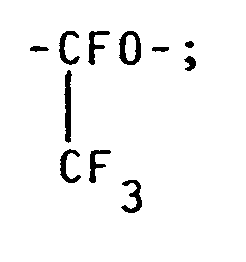
CF₂CF₂O; CF₂CF₂CF₂O .
having perfluoroalkyl end groups and in particular being comprised in the following general formulas : - (1)

- (2) RfO(CF₂CF₂O)n(CF₂O)mR'f,
wherein Rf and R'f, the same or different from each other, are -CF₃ or -C₂F₅; - (3)

- (4)

- (5) RfO(CF₂CF₂O)nR'f, wherein Rf and R'f, the same or different from each other, are -CF₃ or -C₂F₅;
- (6) RfO(CF₂CF₂CF₂O)nR'f, wherein Rf and R'f, the same or different from each other, are -CF₃, -C₂F₅ or -C₃F₇;
- Perfluoropolyethers of class (1) are marketed under the trade-mark Fomblin® Y or Galden®, the ones of class (2) under the trade-mark Fomblin® Z, all being produced by Montedison. Products of class (4) are marketed under the trade-mark Krytox® (DuPont).
- The products of class (5) are described in US-A-4,523,039; those of class (6) are described in EP-A-148,482.
- The products of class (3) are prepared according to US-A-3,665,041. Also the perfluoropolyethers described in US-A-4,523,039 or in J. Am. Chem. Soc. 1985, 107, 1195-1201 are suitable.
- According to another aspect of the present invention, non-fibrillable PTFE, polymerized in a water dispersion, is utilizable as an additive, either alone or in admixture with the above-described perfluoropolyethers, said PTFE being characterized by a crystallization ΔH higher than 9 cal/g and preferably higher than 13 cal/g. The crystallization ΔH values are obtained by differential calorimetry. The corresponding molecular weight values have been calculated according to the empiric equation :

- The perfluoropolyether-type additives according to the present invention are dispersed in the elastomer polymerization latex in the form of thermodynamically stable aqueous microemulsions which are dispersed in the polymerization latex by simple mixing.
- Subsequently, the additives dispersed in the latex are co-coagulated according to techniques, which are known to those skilled in the art, and the resulting polymeric product is additioned with a peroxy vulcanizing system or with a mixed peroxy-ionic vulcanizing system, so obtaining a blend having improved processability characteristics.
- It is known that vulcanizing systems based on peroxides are capable of vulcanizing many types of rubbers, imparting to the vulcanizates high properties of stability to heat, to mechanical agents and to mechanical stresses.
- The rubber blends vulcanizable with peroxides, which are known in the art, are generally composed of the following ingredients :
- As elastomers vulcanizable with peroxides, the following types can be cited : natural rubber, ethylene/propylene/diene copolymers, butadiene/styrene rubber, butadiene/acrylonitrile rubber, silicone rubber, fluoro-silicone rubber, fluoroelastomers containing peroxy cure sites, blends of rubbers, of which at least one is vulcanizable by means of peroxides or by means of mixed vulcanization systems, in particular blends of a fluoroelastomer based on CH₂ = CF₂ and of an elastomeric C₂F₄/C₃H₆ copolymer, such as AFLAS®.
- It consists of an organic peroxide, such as e.g. : benzoyl peroxide, dicumyl peroxide, 2,5-dimethyl-2,5-di(t-butyl-peroxy)-hexane, alpha,alpha'-bis(t-butyl-peroxy)-diisopropyl-benzene, aliphatic or cyclic bis-peroxycarbamates.
- It consists of an unsaturated di- or tri-functional compound such as for example triallylcyanurate, triallylisocyanurate, divinylbenzene, m-phenylene-bis(maleimide).
- Carbon black, silica, etc.
Acidity acceptors such as, for example, lead, zinc, calcium, magnesium oxides. - These are products endowed with plasticizing or lubricating properties, such as e.g.: vegetable waxes, low molecular weight polyethylenes, various stearates, polyesters, octadecylamines, etc.
- The use of such coadjuvants is required owing to the poor extrudability characteristics of the blends and to the phenomena of adhesion to the molds and the fouling of same.
- The known processing coadjuvants sometimes give rise to problems of interference with the peroxy vulcanizing system and to bad surface appearance of the molded article. Furthermore, in the specific case of the fluoroelastomers, a "thermal" stabilization" (post-vulcanization) at temperatures ranging from 200 to 250°C for 10 to 30 hours is absolutely necessary in order to impart to said fluoroelastomers the well known properties of resistance to heat, to chemical agents and to solvents. During this step, the usual plasticizing agents (glycols, stearates, organic phosphates, oleates, phthalates, etc.) volatilize and/or decompose. This fact causes a remarkable degradation of the mechanical properties of the final articles, in particular :
- excessive increase in hardness;
- decay of the resistance to compression set;
- decay of the elastic properties (low elongation value and high modulus value);
- low thermal stability, which precludes the utilization of the articles under severe applicative conditions (>.180°C).
- In conclusion, the benefits attainable in the processing step result in unacceptable shortcomings of the final articles.
- Therefore, the use of plasticizers and lubricants is limited to small amounts (1-3 p.h.r.), which do not sensibly alter the final properties of the vulcanizates, but which, on the other hand, are insufficient to meet the abovesaid requirements.
- In particular, it has been observed that the use of perfluorosilicone oils permits to lower the hardness by 4-5 points , however, some difficulties arise as regards the mixing and incorporation into the fluoroelastomer. Furthermore, a decrease in the vulcanization rate and a worsening of the compression set and of the stability to heat have been encountered.
- The use of fluorinated polymers having a very low molecular weight and the consistency of waxes, such as Viton® LM (Du Pont) was adopted in order to impart better rheological characteristics to the blends, in particular during the extrusion. Thus, it is possible to obtain extruded articles of large dimensions and with a complex profile. However, the use of such a "plasticizer", in an amount of 10-20 parts by weight for 100 parts of fluoroelastomer, is possible only with conventional vulcanizing systems, while it is not consistent with the use of vulcanizing systems based on peroxides. This results in a worsening of the resistance to heat, to chemical agents, to solvents and to oils, as well as in a decrease in the compression-set value.
- EP-A-222 201 describes the use of perfluoropolyethers having brominated end groups dispersed as additives in mixtures of fluoroelastomers with peroxy vulcanizing systems or with mixed peroxy and ionic vulcanizing systems in order to solve the problems relating to the processability during extrusion and to the detachment of the vulcanizate from the moulds.
- Said perfluoropolyethers having a brominated end group improve the processability in terms of yield and appearance of the extrudate, promote a good detachability from the mould, but make difficult the preparation of the compound, namely of the additioned polymer comprising the perfluoropolyether and the vulcanization ingredients, due to the incompatibility between the polymer and the perfluoropolyether, rendering the calendering step very difficult, for which so long times are required as to penalize a commercial-scale utilization of same.
- It has now surprisingly been found that by adding to the elastomer polymerization latex the perfluoropolyethers belonging to the above-described classes and having a molecular weight lower than about 1,500, and preferably ranging from 500 to 1,000, in amounts ranging from 0.5 to 3 p.h.r.it is possible to obtain an excellent detachability of the vulcanizate from the mould and at the same time an improved and easier preparation of the compound with consequent lowering of the calendering step times, thus permitting a more favourable commercial-scale utilization.
- The dispersion of the additive in the polymerization latex through mechanical mixing and subsequent co-coagulation permits to obtain a better homogeneity of the dispersion.
- Subsequent to the molding or extrusion step, the perfluoropolyether uniformly distributed in the mass homogeneously migrates to the whole surface of the manufactured article, thereby forming an inert lubricating substance, which prevents interactions between the mold and the vulcanizing material: an excellent detachability of the vulcanizate from the mold is so obtained, and the flow conditions in the case of extrusion processing are substantially improved.
- Microemulsions are thermodynamically stable systems within a certain temperature range and they form by mixing of the components at a temperature within the stability range without having to supply the system with a considerable dispersion mechanical energy, as in the case of conventional emulsions.
- Microemulsions of perfluoropolyethers are known, for example, from EP-A-250 766 and 247 379 as well as IT-A-20256/86 and they are preparable simply by mixing perfluoropolyethers in water in the presence of suitable amounts of a preferably perfluorinated surfactant and of an alkanol.
- The addition of the perfluoropolyether additives in the form of an aqueous microemulsion to the polymerization latex permits to add higher amounts of additive to the latex and, by consequence, to obtain a maximum effect of detachability from the mold.
- The polytetrafluoroethylene used as additive in the present invention is characterized by a crystallization ΔH of >9 cal/gram, preferably >13 cal/gram, as mentioned above; this property corresponds to a relatively low molecular weight, lower than about 200,000. (US-A-3,019,206 is directed to a coating composition which comprises an aqueous latex of a thermoplastic polymer, among others (conventional) PTFE, in admixture with an aqueous latex of a halogenated elastomeric copolymer in a weight ratio of from 1:1 to 1:200.)
- The polytetrafluoroethylene to be added to the elastomer latex according to the present invention is prepared by polymerization in aqueous dispersion according to conventional methods, by using a high concentration of radical catalyst, for example ammonium persulphate.
- It has been found that this particular type of polytetrafluoroethylene is capable of providing, also in the absence of perfluoropolyether, a good detachability, while the commercial type, high molecular weight PTFE does not improve at all the detachability of the vulcanizate from the mold.
- The polytetrafluoroethylene can be added to the polymerization latex in amounts ranging from 1 P.H.R. to 10 P.H.R.
- A preferred embodiment of the invention consists in using both types of additives (perfluoropolyether and polytetrafluoroethylene) in the polymerization latex, that leads to the best results of detachability of the vulcanizate from the mold thanks to the synergistic action of the two additives.
- The use of the additives according to the invention is particularly suitable for fluoroelastomers in general, such as for example the copolymers of CH₂=CF₂ with C₃F₆ or with C₃F₆ + C₂F₄ and containing peroxy cure sites; the copolymers of C₂F₄ with propylene or with perfluoroalkylperfluorovinylethers (in particular methylvinylether) containing, in the latter case, a cure site monomer; terpolymers of C₃F₆, vinylidene fluoride and perfluoroalkylperfluorovinylether (in particular methylvinylether) containing a cure site monomer.
- The following examples merely illustrate the present invention.
- By means of the usual mixing techniques, rubber blends containing the ingredients indicated in Table 1 were prepared. Using the blends so prepared, the tests and measurements indicated in said Table 1 were carried out.
A polymer was prepared consisting of CH₂CF₂ (65%), C₃F₆ (19%), C₂F₄ (16%) and bromoethylvinylether (0.6%) having a Mooney viscosity ML (1+4) at 100°C equal to 102. - The various additives reported in Table 1 and described hereinbelow were added to the elastomer polymerization latex and co-coagulated according to conventional techniques.
- In particular, after addition of the additives, the resulting latex was coagulated with an aqueous solution containing 6 g/l of Al₂(SO₄)₃.8H₂O under stirring, then the coagulated product was filtered and washed with demineralized water. The polymer so coagulated was dried in an oven.
- Perfluoropolyether of class 1) having a molecular weight equal to 800 (Galden LS®) added to the elastomer polymerization latex described in Table 1 at a temperature of 20°C in the liquid phase under stirring.
- 10 ml of an acid having the perfluoropolyether structure of the above defined class 1), having monocarboxylic functionality

and containing only small amounts of bicarboxylic acid (R'f = Rf = COOH), consisting of a mixture of compounds having different molecular weights and showing an average equivalent weight equal to 570, were neutralized with 11 ml of an ammonia/water (1/2) solution and were added to 30 ml of bidistilled water after addition of 11 ml of HNO₃ (1M). - To the surfactant solution so obtained there were added, under gentle stirring, 5 ml of an alcohol having the perfluoropolyether structure of class 1) with an average equivalent weight equal to 690, essentially consisting of monoalcohol

and containing only small amounts of divalent alcohol (R'f = Rf = -CH₂OH), and then 20 ml of perfluoropolyether belonging to class 1), consisting of a mixture of components having different molecular weights and showing an average molecular weight equal to 800. The resulting microemulsion was characterized by the following properties: it was a limpid, transparent liquid having a stability range of 35 - 45 °C. - Said microemulsion was added to the elastomer polymerization latex described in Table 1; the values are referred to the amount of neutral perfluoropolyether contained in the microemulsion.
- Into a stirrer-reactor having a 50-liter volume there were charged 30 l of water, 12 g of perfluorooctanoate and 5 g of ammonium persulphate.
- Tetrafluoroethylene was continuously added and polymerized in dispersion at a temperature of 95°C and at a pressure of 2MPa (20 atm). After 15 minutes a product was discharged, which exhibited a conversion of 100 g of polymer per liter of latex.
- The PTFE so produced was characterized by a crystallization ΔH higher than 13 cal/mole and an average molecular weight of about 40,000.
- Commercial type PTFE (DFl®, Montefluos) characterized by a molecular weight of about 800,000.
- The blend was vulcanized in a press at 170°C for 10 minutes and the piece was withdrawn from the mold at a temperature of 170°C.
Fouling of the molds was evaluated in a 7-circular impression mold (diameter = 40 mm, height = 3 mm) by repeating the molding of all the blends being tested until observing appearance differences on the bottom surface of the circular cavities in the form of blueings, or darker opalescences.
80 molding operations were carried out for each blend with the following evaluation scale : - 10. If after 80 moldings no blueings were present.
- 9. If after 70 moldings blueings were present.
- 8. If after 62 moldings blueings were present.
- 7. If after 55 moldings blueings were present.
- 6. If after 49 moldings blueings were present.
- 5. If after 42 moldings blueings were present.
- 4. If after 35 moldings blueings were present.
- 3. If after 28 moldings blueings were present.
- 2. If after 21 moldings blueings were present.
- 1. If after 14 moldings blueings were present.
- 0. If after 7 moldings blueings were present.
- The characteristics of the obtained vulcanizate were determined on test pieces prepared by vulcanization in a mold at 170°C for 10 minutes and by subsequent post-vulcanization in an oven at 250°C for 24 hours, the post-vulcanization being preceded by a temperature rise from 100°C to 250°C over 8 hours.
- From the examples of Table 1 it is apparent that additive 4 (high molecular weight PTFE) does not impart to the vulcanizate a good detachability from the mold, while the optimum detachability is obtained by using the perfluoropolyether in the form of a microemulsion combined with low molecular weight PTFE and added to the elastomer polymerization latex.

Claims (6)
- Rubbers or rubber blends vulcanizable by means of peroxides or mixed peroxy and ionic vulcanizing systems, showing improved detachability from the mold after vulcanization and improved processability, comprising, as processing adjuvant, an additive selected from or being a mixture of the following classes (a) and (b):(a) perfluoropolyethers having perfluoroalkyl end groups and an average molecular weight ranging from 500 to about 1,500 in an amount of from 0.5 parts by weight to 3 parts by weight per hundred parts by weight of elastomer, said perfluoropolyethers being introduced into the starting elastomer polymerization latex in the form of microemulsions;(b) polytetrafluoroethylene prepared in aqueous dispersion and having an average molecular weight lower than about 200,000, in an amount ranging from 1 to 10 parts by weight per 100 parts of elastomer, said polytetrafluoroethylene being introduced into the starting elastomer polymerization latex in the form of an aqueous dispersion.
- Rubbers or rubber blends according to claim 1, wherein the perfluoropolyethers have an average molecular weight of from 500 to about 1,000.
- Rubbers or rubber blends according to any of the preceding claims, wherein the perfluoropolyether additives of class (a) are selected from the following classes:(1)
 (2) RfO(CF₂CF₂O)n(CF₂O)mR'f,
wherein Rf and R'f, the same or different from each other, are -CF₃ or -C₂F₅;(3)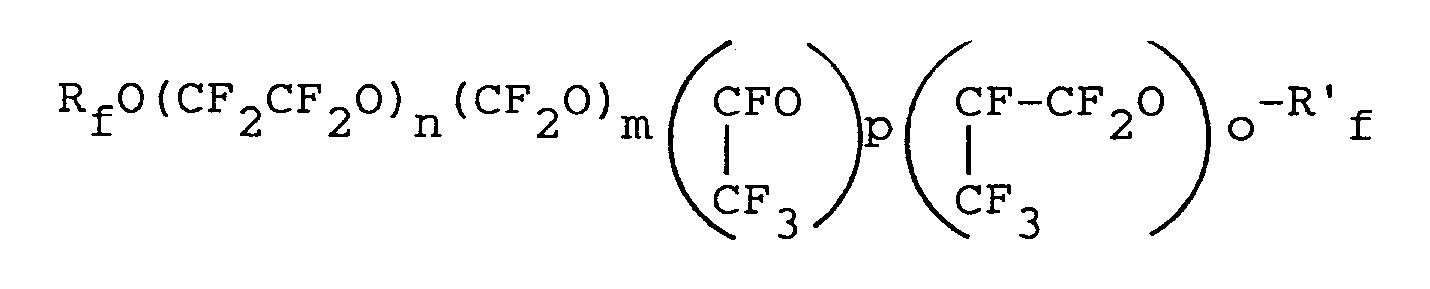 (4)
(4) (5) RfO(CF₂CF₂O)nR'f, wherein Rf and R'f, the same or different from each other, are -CF₃ or -C₂F₅;(6) RfO(CF₂CF₂CF₂O)nR'f, wherein Rf and R'f, the same or different from each other, are -CF₃, -C₂F₅ or -C₃F₇;the values of the above subscripts n, m, p and o being such as to satisfy the corresponding average molecular weight requirements and the units in parentheses of classes (1) to (3) being statistically distributed along the polyether chain.
 - Rubbers or rubber blends according to claim 1, wherein the polytetrafluoroethylene additives of class (b) are characterized by a crystallization enthalpy ΔH >13 cal/g.
- Rubbers or rubber blends according to any of the preceding claims, wherein the elastomer is selected from:(i) fluoroelastomeric copolymers of CH₂=CF₂ with C₃F₆, optionally containing C₂F₄;(ii) copolymers of C₂F₄ with propylene;(iii) fluoroelastomeric copolymers of C₂F₄ with perfluoroalkylperfluorovinylethers;(iv) fluoroelastomeric terpolymers of C₃F₆, CH₂=CF₂ and a perfluoroalkylperfluorovinylether;(i), (iii) and (iv) containing peroxy cure sites.
- Rubbers or rubber blends according to any of the preceding claims, wherein a mixture of a fluoroelastomer based on CH₂=CF₂ and of an elastomeric C₂F₄/C₃H₆ copolymer is employed as elastomer.
Applications Claiming Priority (2)
| Application Number | Priority Date | Filing Date | Title |
|---|---|---|---|
| IT22110/87A IT1222804B (en) | 1987-10-02 | 1987-10-02 | ADJUVANT ADDITIVES FOR THE RELEASE OF THE VULCANISABLE RUBBER MOLDS BY PEROXIDES |
| IT2211087 | 1987-10-02 |
Publications (2)
| Publication Number | Publication Date |
|---|---|
| EP0310966A1 EP0310966A1 (en) | 1989-04-12 |
| EP0310966B1 true EP0310966B1 (en) | 1993-05-12 |
Family
ID=11191641
Family Applications (1)
| Application Number | Title | Priority Date | Filing Date |
|---|---|---|---|
| EP88116220A Expired - Lifetime EP0310966B1 (en) | 1987-10-02 | 1988-09-30 | Additives coadjuvating the detaching from the molds of rubbers vulcanizable by means of peroxides |
Country Status (7)
| Country | Link |
|---|---|
| US (1) | US5093400A (en) |
| EP (1) | EP0310966B1 (en) |
| JP (1) | JP2717817B2 (en) |
| CA (1) | CA1328517C (en) |
| DE (1) | DE3880949T2 (en) |
| ES (1) | ES2040801T3 (en) |
| IT (1) | IT1222804B (en) |
Cited By (2)
| Publication number | Priority date | Publication date | Assignee | Title |
|---|---|---|---|---|
| US8575273B2 (en) | 2008-11-26 | 2013-11-05 | Schlumberger Technology Corporation | Coupling agents and compositions produced using them |
| US9403962B2 (en) | 2011-12-22 | 2016-08-02 | Schlumberger Technology Corporation | Elastomer compositions with silane functionalized silica as reinforcing fillers |
Families Citing this family (21)
| Publication number | Priority date | Publication date | Assignee | Title |
|---|---|---|---|---|
| US5208293A (en) * | 1990-01-29 | 1993-05-04 | Ntn Engineering Plastics Corporation | Rubber composition having low friction |
| US5266650A (en) * | 1990-10-11 | 1993-11-30 | Minnesota Mining And Manufacturing Company | Curing fluorocarbon elastomers |
| IT1243747B (en) * | 1990-10-24 | 1994-06-21 | Sviluppo Settori Impiego Srl | OIL-REPELLENT POLYMERIC COMPOSITIONS AND THEIR USE IN THE PREPARATION OF BODIES FORMED WITH SURFACES OF HIGH RESISTANCE TO SOLVENTS AND HIGH REPELLENCE TO DIRT. |
| US5384374A (en) * | 1991-01-11 | 1995-01-24 | Minnesota Mining And Manufacturing Company | Curing fluorocarbon elastomers |
| US5218031A (en) * | 1991-06-10 | 1993-06-08 | Man-Gill Chemical Company | Aqueous coating compositions, process and coated substrates |
| JPH05301228A (en) * | 1992-04-28 | 1993-11-16 | Daikin Ind Ltd | Release agent |
| JP2876375B2 (en) * | 1993-02-22 | 1999-03-31 | 株式会社 金陽社 | roll |
| US6531525B1 (en) | 1993-06-24 | 2003-03-11 | Daikin Industries, Ltd. | Abherent compsition |
| IT1269816B (en) * | 1994-05-23 | 1997-04-15 | Ausimont Spa | EXPANDABLE SOLID COMPOSITIONS BASED ON PERFLUOROPOLYMERS AND PROCESSES FOR THEIR PREPARATION |
| JPH08283516A (en) * | 1995-04-19 | 1996-10-29 | Central Glass Co Ltd | Thermoplastic fluororesin composition for calendering |
| US5681881A (en) * | 1996-05-24 | 1997-10-28 | Minnesota Mining And Manufacturing Company | Fluoroelastomer compositions |
| IT1308627B1 (en) * | 1999-02-23 | 2002-01-09 | Ausimont Spa | FLUOROELASTOMERIC COMPOSITIONS. |
| AU2002342745A1 (en) * | 2001-05-14 | 2002-11-25 | E.I. Du Pont De Nemours And Company | Fluoropolymer compositions comprising a fluor-containing liquid |
| US20040236028A1 (en) * | 2003-05-21 | 2004-11-25 | Ming-Hong Hung | Fluoroelastomer composition having excellent low temperature properties |
| EP1743921A1 (en) * | 2005-07-13 | 2007-01-17 | Solvay Solexis S.p.A. | Thermoplastic halopolymer composition |
| EP2065441A1 (en) * | 2007-11-30 | 2009-06-03 | Solvay Solexis S.p.A. | Fluoroelastomer composition |
| US9938402B2 (en) | 2012-11-30 | 2018-04-10 | 3M Innovative Properties Company | Additive composition and compositions and articles containing the same |
| EP3046964B1 (en) | 2013-09-20 | 2021-01-13 | 3M Innovative Properties Company | Polymer processing additive, compositions, and methods |
| JP2017538833A (en) | 2014-12-19 | 2017-12-28 | スリーエム イノベイティブ プロパティズ カンパニー | Poly (oxyalkylene) polymer processing additives, compositions and methods |
| JP2018532019A (en) | 2015-10-13 | 2018-11-01 | スリーエム イノベイティブ プロパティズ カンパニー | Fluoropolymer processing additives, compositions and methods |
| TW201815845A (en) | 2016-05-17 | 2018-05-01 | 3M新設資產公司 | Compositions including copolymers of vinylidene fluoride and tetrafluoroethylene and methods of using the same |
Family Cites Families (8)
| Publication number | Priority date | Publication date | Assignee | Title |
|---|---|---|---|---|
| US3019206A (en) * | 1958-09-24 | 1962-01-30 | Minnesota Mining & Mfg | Polyblends of a thermoplastic tetrafluoroethylene polymer latex and an elastomeric fluorocarbon polymer latex and article coated therewith |
| GB1087283A (en) * | 1965-03-18 | 1967-10-18 | Du Pont | Lubricant grease |
| US3484503A (en) * | 1967-06-19 | 1969-12-16 | Du Pont | Blends of fluorinated polymers |
| JPS5871906A (en) * | 1981-10-22 | 1983-04-28 | Daikin Ind Ltd | Manufacture of fluorine-containing elastic copolymer |
| IT1199986B (en) * | 1982-07-07 | 1989-01-05 | Montedison Spa | CONVULCANIZABLE COMPOSITIONS BASED ON FLUOROELASTOMERS AND POLYMERIC COMPOUNDS WITH A PERFLUOROPOLYEREE STRUCTURE |
| DE3337397A1 (en) * | 1983-10-14 | 1985-05-02 | Bayer Ag, 5090 Leverkusen | POLYMER MIXTURES AND COVULCANISES MADE THEREOF |
| IT1200801B (en) * | 1985-10-17 | 1989-01-27 | Ausimont Spa | ADJUVANT WORKING ADDITIVES FOR VULCANNISABLE TIRES VIA PEROXIDES |
| IT1189092B (en) * | 1986-04-29 | 1988-01-28 | Ausimont Spa | POLYMERIZATION PROCESS IN WATER DISPERSION OF FLUORINATED MONOMERS |
-
1987
- 1987-10-02 IT IT22110/87A patent/IT1222804B/en active
-
1988
- 1988-09-30 EP EP88116220A patent/EP0310966B1/en not_active Expired - Lifetime
- 1988-09-30 DE DE8888116220T patent/DE3880949T2/en not_active Expired - Lifetime
- 1988-09-30 CA CA000578994A patent/CA1328517C/en not_active Expired - Fee Related
- 1988-09-30 ES ES198888116220T patent/ES2040801T3/en not_active Expired - Lifetime
- 1988-10-03 JP JP63247573A patent/JP2717817B2/en not_active Expired - Lifetime
-
1989
- 1989-12-26 US US07/453,174 patent/US5093400A/en not_active Expired - Lifetime
Cited By (3)
| Publication number | Priority date | Publication date | Assignee | Title |
|---|---|---|---|---|
| US8575273B2 (en) | 2008-11-26 | 2013-11-05 | Schlumberger Technology Corporation | Coupling agents and compositions produced using them |
| US9394429B2 (en) | 2008-11-26 | 2016-07-19 | Schlumberger Technology Corporation | Coupling agents and compositions produced using them |
| US9403962B2 (en) | 2011-12-22 | 2016-08-02 | Schlumberger Technology Corporation | Elastomer compositions with silane functionalized silica as reinforcing fillers |
Also Published As
| Publication number | Publication date |
|---|---|
| ES2040801T3 (en) | 1993-11-01 |
| IT1222804B (en) | 1990-09-12 |
| JP2717817B2 (en) | 1998-02-25 |
| IT8722110A0 (en) | 1987-10-02 |
| EP0310966A1 (en) | 1989-04-12 |
| JPH01221443A (en) | 1989-09-04 |
| US5093400A (en) | 1992-03-03 |
| CA1328517C (en) | 1994-04-12 |
| DE3880949D1 (en) | 1993-06-17 |
| DE3880949T2 (en) | 1993-09-16 |
Similar Documents
| Publication | Publication Date | Title |
|---|---|---|
| US5093400A (en) | Additives coadjuvating the detaching from the molds of rubbers vulcanizable by means of peroxides | |
| EP0127407B1 (en) | Core/shell fluoropolymer compositions | |
| JP2590328B2 (en) | Melt blend composition | |
| EP0034177B1 (en) | Vulcanizable blend of bromine-containing fluoropolymer and fluorosilicone gum | |
| EP0222201B1 (en) | Processing coadjuvants for rubbers vulcanizable by means of peroxides | |
| US5266650A (en) | Curing fluorocarbon elastomers | |
| US4450263A (en) | Fluoropolymer gum of vinylidene fluoride, hexafluoropropene, and bromodifluoroethylene | |
| US4946936A (en) | Fluorinated polymers and copolymers containing perfluoropolyethers blocks | |
| JP3270469B2 (en) | Curable fluorocarbon elastomer | |
| EP0407937A1 (en) | Fluoroelastomers with improved processability and process for preparing them | |
| JPH11240997A (en) | Fluorinated thermoplastic elastomer | |
| US5026786A (en) | Perfluoropolyethers having brominated end groups and fluoroelastomers obtained therefrom | |
| US3769371A (en) | Fluorocarbon polymer blend and vulcanizates thereof | |
| JP2854863B2 (en) | Fluorinated elastomer composition | |
| JPS624708A (en) | Gelled fluoroelastomer | |
| US5155282A (en) | Perfluoropolyethers having brominated end groups and fluoroelastomers obtained therefrom | |
| JPH075810B2 (en) | Composition for cross-linking fluorine-containing elastic copolymer excellent in low temperature property and processability | |
| EP0251285B1 (en) | Curable compositions based on fluoroelastomers vulcanizable with peroxides | |
| JPS6059931B2 (en) | Fluorine-containing elastomer vulcanizing composition | |
| JPH06248146A (en) | Method for producing fluoropolymer composition | |
| JPH0425290B2 (en) | ||
| JPS5952645B2 (en) | Method for producing fluorine-containing elastomer |
Legal Events
| Date | Code | Title | Description |
|---|---|---|---|
| PUAI | Public reference made under article 153(3) epc to a published international application that has entered the european phase |
Free format text: ORIGINAL CODE: 0009012 |
|
| AK | Designated contracting states |
Kind code of ref document: A1 Designated state(s): DE ES FR GB IT NL SE |
|
| 17P | Request for examination filed |
Effective date: 19890616 |
|
| 17Q | First examination report despatched |
Effective date: 19900828 |
|
| ITF | It: translation for a ep patent filed | ||
| GRAA | (expected) grant |
Free format text: ORIGINAL CODE: 0009210 |
|
| AK | Designated contracting states |
Kind code of ref document: B1 Designated state(s): DE ES FR GB IT NL SE |
|
| REF | Corresponds to: |
Ref document number: 3880949 Country of ref document: DE Date of ref document: 19930617 |
|
| ET | Fr: translation filed | ||
| REG | Reference to a national code |
Ref country code: ES Ref legal event code: FG2A Ref document number: 2040801 Country of ref document: ES Kind code of ref document: T3 |
|
| EAL | Se: european patent in force in sweden |
Ref document number: 88116220.0 |
|
| PGFP | Annual fee paid to national office [announced via postgrant information from national office to epo] |
Ref country code: SE Payment date: 19960917 Year of fee payment: 9 |
|
| PGFP | Annual fee paid to national office [announced via postgrant information from national office to epo] |
Ref country code: ES Payment date: 19970930 Year of fee payment: 10 |
|
| PG25 | Lapsed in a contracting state [announced via postgrant information from national office to epo] |
Ref country code: SE Free format text: LAPSE BECAUSE OF NON-PAYMENT OF DUE FEES Effective date: 19971001 |
|
| EUG | Se: european patent has lapsed |
Ref document number: 88116220.0 |
|
| PG25 | Lapsed in a contracting state [announced via postgrant information from national office to epo] |
Ref country code: ES Free format text: LAPSE BECAUSE OF NON-PAYMENT OF DUE FEES Effective date: 19981001 |
|
| REG | Reference to a national code |
Ref country code: GB Ref legal event code: IF02 |
|
| REG | Reference to a national code |
Ref country code: ES Ref legal event code: FD2A Effective date: 19991013 |
|
| PGFP | Annual fee paid to national office [announced via postgrant information from national office to epo] |
Ref country code: DE Payment date: 20070927 Year of fee payment: 20 |
|
| PGFP | Annual fee paid to national office [announced via postgrant information from national office to epo] |
Ref country code: GB Payment date: 20070926 Year of fee payment: 20 |
|
| PGFP | Annual fee paid to national office [announced via postgrant information from national office to epo] |
Ref country code: IT Payment date: 20070926 Year of fee payment: 20 Ref country code: NL Payment date: 20070823 Year of fee payment: 20 |
|
| PGFP | Annual fee paid to national office [announced via postgrant information from national office to epo] |
Ref country code: FR Payment date: 20070914 Year of fee payment: 20 |
|
| REG | Reference to a national code |
Ref country code: GB Ref legal event code: PE20 Expiry date: 20080929 |
|
| PG25 | Lapsed in a contracting state [announced via postgrant information from national office to epo] |
Ref country code: NL Free format text: LAPSE BECAUSE OF EXPIRATION OF PROTECTION Effective date: 20080930 |
|
| NLV7 | Nl: ceased due to reaching the maximum lifetime of a patent |
Effective date: 20080930 |
|
| PG25 | Lapsed in a contracting state [announced via postgrant information from national office to epo] |
Ref country code: GB Free format text: LAPSE BECAUSE OF EXPIRATION OF PROTECTION Effective date: 20080929 |
|
| PLBE | No opposition filed within time limit |
Free format text: ORIGINAL CODE: 0009261 |
|
| STAA | Information on the status of an ep patent application or granted ep patent |
Free format text: STATUS: NO OPPOSITION FILED WITHIN TIME LIMIT |