EP0309870A2 - Liquid crystalline compounds containing the bicyclo[2,2,2]-octane ring and the phenylisothiocyanate group, their manufacturing and liquid crystalline mixtures containing same - Google Patents
Liquid crystalline compounds containing the bicyclo[2,2,2]-octane ring and the phenylisothiocyanate group, their manufacturing and liquid crystalline mixtures containing same Download PDFInfo
- Publication number
- EP0309870A2 EP0309870A2 EP88115414A EP88115414A EP0309870A2 EP 0309870 A2 EP0309870 A2 EP 0309870A2 EP 88115414 A EP88115414 A EP 88115414A EP 88115414 A EP88115414 A EP 88115414A EP 0309870 A2 EP0309870 A2 EP 0309870A2
- Authority
- EP
- European Patent Office
- Prior art keywords
- ring
- group
- general formula
- compounds
- alkyl chain
- Prior art date
- Legal status (The legal status is an assumption and is not a legal conclusion. Google has not performed a legal analysis and makes no representation as to the accuracy of the status listed.)
- Withdrawn
Links
- 0 *CCC1(CCCCC1)*(*)* Chemical compound *CCC1(CCCCC1)*(*)* 0.000 description 6
Images

Classifications
-
- C—CHEMISTRY; METALLURGY
- C07—ORGANIC CHEMISTRY
- C07D—HETEROCYCLIC COMPOUNDS
- C07D239/00—Heterocyclic compounds containing 1,3-diazine or hydrogenated 1,3-diazine rings
- C07D239/02—Heterocyclic compounds containing 1,3-diazine or hydrogenated 1,3-diazine rings not condensed with other rings
- C07D239/24—Heterocyclic compounds containing 1,3-diazine or hydrogenated 1,3-diazine rings not condensed with other rings having three or more double bonds between ring members or between ring members and non-ring members
- C07D239/26—Heterocyclic compounds containing 1,3-diazine or hydrogenated 1,3-diazine rings not condensed with other rings having three or more double bonds between ring members or between ring members and non-ring members with only hydrogen atoms, hydrocarbon or substituted hydrocarbon radicals, directly attached to ring carbon atoms
-
- C—CHEMISTRY; METALLURGY
- C07—ORGANIC CHEMISTRY
- C07C—ACYCLIC OR CARBOCYCLIC COMPOUNDS
- C07C331/00—Derivatives of thiocyanic acid or of isothiocyanic acid
- C07C331/16—Isothiocyanates
- C07C331/28—Isothiocyanates having isothiocyanate groups bound to carbon atoms of six-membered aromatic rings
-
- C—CHEMISTRY; METALLURGY
- C09—DYES; PAINTS; POLISHES; NATURAL RESINS; ADHESIVES; COMPOSITIONS NOT OTHERWISE PROVIDED FOR; APPLICATIONS OF MATERIALS NOT OTHERWISE PROVIDED FOR
- C09K—MATERIALS FOR MISCELLANEOUS APPLICATIONS, NOT PROVIDED FOR ELSEWHERE
- C09K19/00—Liquid crystal materials
- C09K19/04—Liquid crystal materials characterised by the chemical structure of the liquid crystal components, e.g. by a specific unit
- C09K19/06—Non-steroidal liquid crystal compounds
- C09K19/32—Non-steroidal liquid crystal compounds containing condensed ring systems, i.e. fused, bridged or spiro ring systems
- C09K19/321—Compounds containing a bicyclo [2,2,2] octane ring
-
- C—CHEMISTRY; METALLURGY
- C09—DYES; PAINTS; POLISHES; NATURAL RESINS; ADHESIVES; COMPOSITIONS NOT OTHERWISE PROVIDED FOR; APPLICATIONS OF MATERIALS NOT OTHERWISE PROVIDED FOR
- C09K—MATERIALS FOR MISCELLANEOUS APPLICATIONS, NOT PROVIDED FOR ELSEWHERE
- C09K19/00—Liquid crystal materials
- C09K19/04—Liquid crystal materials characterised by the chemical structure of the liquid crystal components, e.g. by a specific unit
- C09K19/06—Non-steroidal liquid crystal compounds
- C09K19/34—Non-steroidal liquid crystal compounds containing at least one heterocyclic ring
- C09K19/3441—Non-steroidal liquid crystal compounds containing at least one heterocyclic ring having nitrogen as hetero atom
-
- C—CHEMISTRY; METALLURGY
- C07—ORGANIC CHEMISTRY
- C07C—ACYCLIC OR CARBOCYCLIC COMPOUNDS
- C07C2601/00—Systems containing only non-condensed rings
- C07C2601/12—Systems containing only non-condensed rings with a six-membered ring
- C07C2601/14—The ring being saturated
-
- C—CHEMISTRY; METALLURGY
- C07—ORGANIC CHEMISTRY
- C07C—ACYCLIC OR CARBOCYCLIC COMPOUNDS
- C07C2602/00—Systems containing two condensed rings
- C07C2602/36—Systems containing two condensed rings the rings having more than two atoms in common
- C07C2602/44—Systems containing two condensed rings the rings having more than two atoms in common the bicyclo ring system containing eight carbon atoms
Definitions
- the present invention concerns liquid crystalline compounds containing in their molecule the bicyclo[2,2,2]-octane ring and the phenylisothiocyanato group, and also the methods of manufacturing these compounds, and those of preparing liquid crystalline mixtures containing same applicable in electrooptical indicating elements.
- Bi- and tri-nuclear liquid crystalline compounds are known that have in the nucleus of their molecules the bicyclo[2,2,2]octane ring, see United Kingdom Patents 2.027.027, 2.027.708, 2.065.104.
- those with one or more bicyclooctane rings in the molecule reveal a higher clearing points than the analogous compounds with the cyclohexane, benzene or pyrimidine ring in the molecule, but at the same time they show much higher melting points what makes that their solubility in liquid crystalline mixtures is moderate.
- the bicyclo[2,2,2]octane derivatives with non-polar substituens in the terminal position e.g.
- alkyl groups are usually smectics, while those with polar substitutents like -CN are nematics.
- the bicyclo[2,2,2]-octane derivatives with the -CN terminal group show high viscosity, several times higher than their analogs with the cyclohexane or benzene ring.
- the object of the present invention are novel liquid crystalline compounds containing in their molecule the bicyclo[2,2,2]octane ring and the phenylisothiocyanato group described by the general formula: where: R is a normal or branched alkyl H 2n+1 C n - or alkenyl H 2n-1 C n - group containing up to 15 carbon atoms (some hydrogen atoms in the alkyl chain may be substituted with a fluorine atom), Z is a single bond or -COO- or -OOC-, -CH2O- or -C ⁇ C- group, A is a 1,4-disubstituted benzene ring or trans-1,4-disubstituted cyclohexane ring or 2,5-disubstituted pyridine ring or 2,5-disubstituted 1,3-dioxane ring, m is an integer 0 or 1,
- the invention also concerns liquid crystalline mixtures including compounds of the general formula 1.
- the mixtures that are the object of this invention are at least binary mixtures containing at least one compound of the general formula 1.
- the remaining components of the mixture may be other known liquid crystalline compounds, optically active compounds, solvents and dyes.
- Mixtures with a wide range of the nematic phase can be obtained by mixing binuclear compounds, for instance, the members of the homologous series 1a and/or 1b and/or 1c and/or 1d and/or 1e or together 1a and/or 1b and/or 1c and/or 1d and/or 1e with one or several trinuclear compounds of formula 1 among which 1f, 1g, 1h, 1i, 1j, 1k and 1l are preferred.
- Compounds of general formula 1 can also be mixed with other liquid crystalline compounds known from the art. Compounds of the general formula 1 when added to mixtures composed of compounds with low clearing points raise effectively the clearing points of these mixtures.
- the preferable procedure of obtaining the compounds that are the subject of the present invention consist in treating the amine of formula 11: where R, Z, A and m have the same meaning as in the general formula 1, with thiophosgene in the presence of a hydrochloride acceptor, i.e. organic or inorganic base or basic salt - preferably tertiary amine, e.g. triethylamine, or calcium or sodium carbonate or calcium hydroxide.
- a hydrochloride acceptor i.e. organic or inorganic base or basic salt - preferably tertiary amine, e.g. triethylamine, or calcium or sodium carbonate or calcium hydroxide.
- a two-step method is also recommended in which amine 11 is treated in an organic solvent, preferably benzene, with carbon disulfide in the presence of a tertiary amine, preferably triethylamine, and the crystalline trialkylammonium dithiocarbamate obtained in the reaction is separated from the reaction mixture by filtration and subsequently treated with ethyl chloroformate in the presence of a tertiary amine.
- the dithiocarbamate is converted to the isothiocyanate of formula 1.
- the product obtained in the one-step or two-step process is isolated and purified by conventional methods, preferably by crystallization from organic solvents, and in the case of compound 1a or 1c also by distillation under vacuum.
- step F To convert 4-alkylbi-cyclo[2,2,2]octyl chloride obtained in step F into 4-alkylbicyclo[2,2,2]octylbenzene or 4-alkylbicyclo[2,2,2]-octylbiphenyl it is most favourable to react it with benzene or biphenyl in the presence of anhydrous ferrous chloride.
- ketone 21 is converted into ketone 21 by reacting with acetyl chloride in the presence of aluminium chloride; next ketone 21 in reaction with hydroxylamine in an acetate buffer solution yields oxime 22 which converts under the action of phosphorus pentachloride in a solvent, favourably dichloromethane, into the respective acetanilide 23 which heated with dilute hydrochloride acid hydrolyses yielding the amine 11a or 11f hydrochloride.
- Z a carboxylic group -COO-, amine 11 is preferably obtained according to the following scheme:
- the procedure shown in the scheme consist in treating with 4-n-alkylbicyclo[2,2,2]octane-1-carboxylic acid chloride the respective nitrophenol or nitrophenyl alcohol 25, e.g. p-nitro phenol, in an organic solvent (preferably benzene) with the 4-n-alkylbicyclo[2,2,2]octane-1-carboxylic acid chloride (obtained preferably by treating 4-n-alkylbicyclo[2,2,2]octane-1-carboxylic acid with oxalyl chloride) in the presence of a base, e.g. ternary amine, preferably pyridine.
- a base e.g. ternary amine, preferably pyridine.
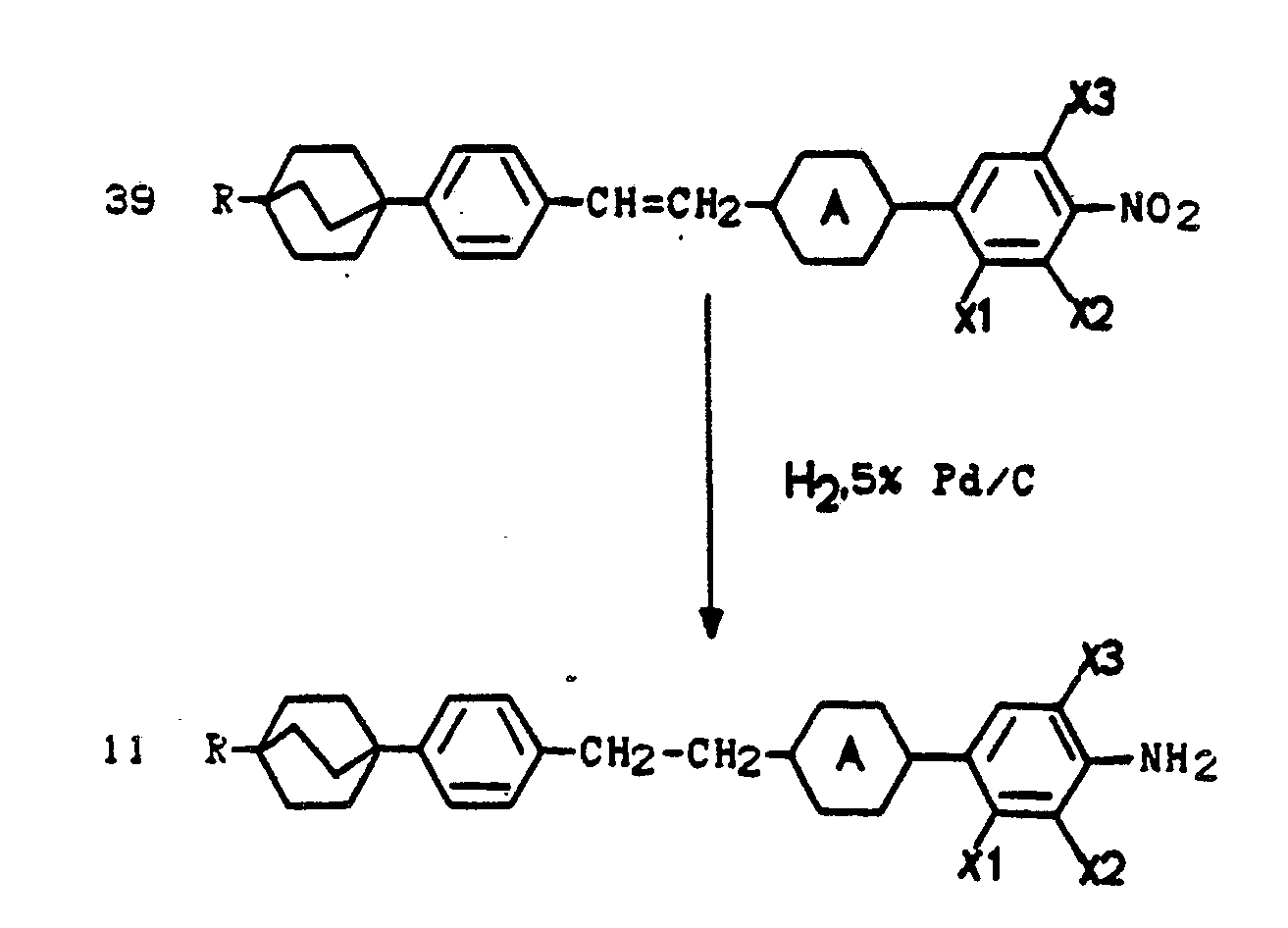
- the obtained nitro ester 26 may be converted with a high yield into the respective amino ester 11 if the hydrogen reduction is conducted on a palladium catalyst (5% Pd on carbon) in the conventional way.
- the relevant acid may easily be obtained by the method described by P.V. Adomenas, Zh. Org. Khim., 19 , 2366 (1983).
- the amine of the formula 11, where Z is the -C6H4-CHY-CH2 group can be obtained by treating 1-phenyl-4-alkylbicyclo[2,2,2]octane with the acid chloride 36 and converting the resulting ketone according to the scheme:
- the isothiocyanates that are the object of the present invention reveal stable nematic phases like the analogous compounds with the cyano group, however, in distinction from the cyano compounds that sometimes have a wider range of the nematic phase thanks to the lower melting points observed for certain alkyl chains.
- Compounds 1 are also characterized by a significantly lower viscosity, e.g. the viscosity of compounds 1a at 20°C is of the order of 20-30 mPa.s, while the viscosity of the analogous cyano compounds is of the order of 100 mPa*s. Thanks to the low melting enthalpies the solubility of the isothiocyanates in other classes of liquid crystalline compounds is very good.
- phase transition temperatures of isothicyanates (1a and 1b) and of the correspondnig cyano compounds are compared in Table 1.
- Tabl 1 Nr R Z m -NCS -CN 1 C3H7- O Cr103(N88)I Cr66.5N88I 2 C4H9- O Cr93.5(N82.5)I Cr75.5N85I 3 C5H11- O Cr71N98I Cr62N100I 4 C6H13- O Cr50.5N89I Cr72N86I 5 C8H17- O Cr50.5N87I Cr52N90I 6 C4H9- -COO O Cr73N101I Cr99(N96)I 7 C5H11- -COO O Cr74.5N116.5I Cr89N109I 8 C6H13- -COO- O Cr50.5N106I Cr77N102I 9 C8H17- -COO O where: Cr, N and I is the crystalline, nematic and isotropic phase, respectively.
- the liquid crystalline device in which the mixture of the present invention is used consists of two plates coated with a conducting layer spaced by a insulating material, one of which at least is transparent and has on its internal wall etched electrodes which allow application of an electric field to the layer of the liquid crystalline mixture, containing at least one compound of formula 1, placed between the plates.
- the ternary mixture A of the composition in wt. %: 4-(trans-4-n-propylcyclohexyl)-1-isothiocyanatobenzene 40 4-(trans-4-n-hexylcyklohexyl)-1-isothiocyanatobenzene 42 4-(trans-4-n-octylcyclohexyl)-1-isothiocyanatobenzene 18 has the clearing point at 41,5° and viscosity ⁇ 20° 11 mPa ⁇ s.
- mixture A 67,97 4-(4-n-propylbicyclo[2,2,2]octyl-1)isothiocyanatobenzene 6
- mixture A 63 4-(4-n-hexylbicyclo[2,2,2]octyl-1)isothiocyanato benzene 25 4-isothiocyanatophenyl ester of 4-n-hexylbicyclo[2,2,2] octane-1-carboxylic acid 11
Landscapes
- Chemical & Material Sciences (AREA)
- Organic Chemistry (AREA)
- Crystallography & Structural Chemistry (AREA)
- Engineering & Computer Science (AREA)
- Materials Engineering (AREA)
- Liquid Crystal Substances (AREA)
- Organic Low-Molecular-Weight Compounds And Preparation Thereof (AREA)
- Heterocyclic Compounds That Contain Two Or More Ring Oxygen Atoms (AREA)
- Pyridine Compounds (AREA)
Abstract

Description
- The present invention concerns liquid crystalline compounds containing in their molecule the bicyclo[2,2,2]-octane ring and the phenylisothiocyanato group, and also the methods of manufacturing these compounds, and those of preparing liquid crystalline mixtures containing same applicable in electrooptical indicating elements.
- Bi- and tri-nuclear liquid crystalline compounds are known that have in the nucleus of their molecules the bicyclo[2,2,2]octane ring, see United Kingdom Patents 2.027.027, 2.027.708, 2.065.104. As compared with other liquid crystalline compounds without bridging groups those with one or more bicyclooctane rings in the molecule reveal a higher clearing points than the analogous compounds with the cyclohexane, benzene or pyrimidine ring in the molecule, but at the same time they show much higher melting points what makes that their solubility in liquid crystalline mixtures is moderate. The bicyclo[2,2,2]octane derivatives with non-polar substituens in the terminal position, e.g. alkyl groups, are usually smectics, while those with polar substitutents like -CN are nematics. The bicyclo[2,2,2]-octane derivatives with the -CN terminal group show high viscosity, several times higher than their analogs with the cyclohexane or benzene ring. For instance, the ternary mixture of:
1-n-propyl-4-(4 -cyanophenyl)bicyclo[2,2,2]octane,
1-n-pentyl-4-(4 -cyanophenyl-bicyclo[2,2,2]octane, and
1-n-heptyl-4-(4 -cyanophenyl)bicyclo[2,2,2]octane
reveals at 20°C bulk viscosity of η20°= 96 mPa.s, while the viscosity of the analogous mixture composed of three 1-n-alkyl-4-(4′-cyanophenyl)cyclohexanes is η20°= 26 mPa.s, and that of the mixture composed of three 4-n-alkyl-4′-cyanobiphenyls is η20°= 34 mPa.s (M.J. Bradshaw et al., Mol. Cryst. Liq. Cryst., 97, 177 (1983). - Unexpectedly it was found that the substitution of the polar cyano group (-CN) by the isothiocyanato group (-NCS) in bicyclooctane derivatives results in a 3-5 time lowering of viscosity, and in many cases also of melting point (Tm) and melting enthalpy, the high clearing point and nematic properties remaining unaffected. The object of the present invention are novel liquid crystalline compounds containing in their molecule the bicyclo[2,2,2]octane ring and the phenylisothiocyanato group described by the general formula:

integer 0 or 1, X1, X2 and X3 are identical or different and each of them may be a hydrogen or fluorine or chlorine or bromine atom or cyano group; for m=1 when A is not a benzene ring, Z is also the -CH₂CO- or -CO-CH₂- or -CH=CH- or -CHYCH₂- or -CH₂-CHY- or -C₆H₄-CH₂-CHY- or -C₆H₄-CHY-CH₂- or -C₆H₄-C≡C- group where Y is hydrogen or fluorine or chlorine atom or cyano or methoxy or hydroxy group. - According to the given definition of the general formula, for m=0 the compounds with
formulae 1a, 1b, 1c, 1d and 1e reveal optimal applicational properties: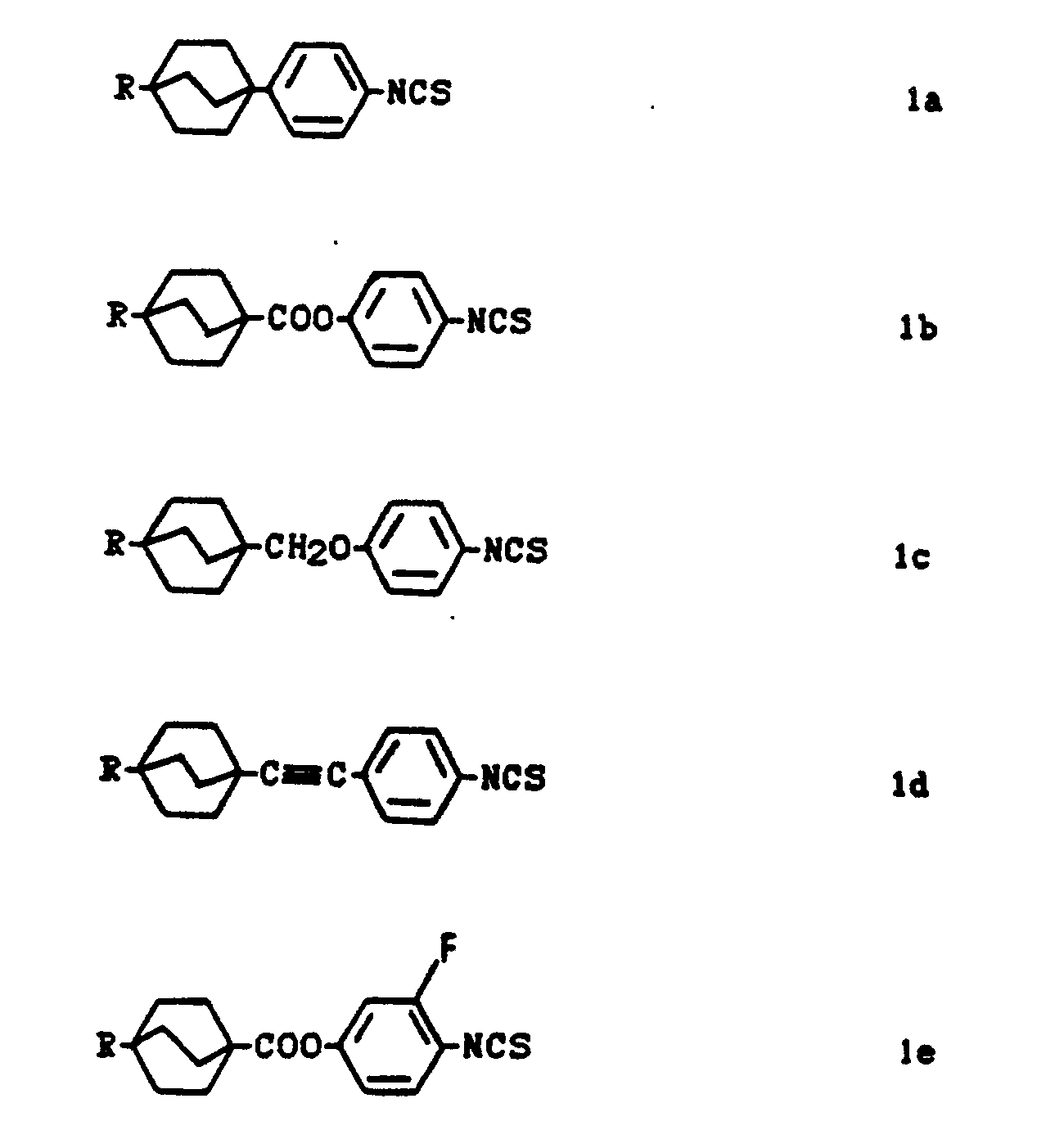

- These compounds are favourable components of liquid crystalline compositions used as indicator elements.
- The invention also concerns liquid crystalline mixtures including compounds of the
general formula 1. The mixtures that are the object of this invention are at least binary mixtures containing at least one compound of thegeneral formula 1. The remaining components of the mixture may be other known liquid crystalline compounds, optically active compounds, solvents and dyes. - Mixtures with a wide range of the nematic phase can be obtained by mixing binuclear compounds, for instance, the members of the
homologous series 1a and/or 1b and/or 1c and/or 1d and/or 1e or together 1a and/or 1b and/or 1c and/or 1d and/or 1e with one or several trinuclear compounds offormula 1 among which 1f, 1g, 1h, 1i, 1j, 1k and 1l are preferred. Compounds ofgeneral formula 1 can also be mixed with other liquid crystalline compounds known from the art. Compounds of thegeneral formula 1 when added to mixtures composed of compounds with low clearing points raise effectively the clearing points of these mixtures. Especially favourable mixtures are obtained when compounds offormula 1a, 1b, or 1c are used together with 4-(trans-4 -n-alkylcyclohexyl)-1-isothiocyanatobenzenes of formula 2 (described by us in U.S. Patent 4.528.116) in which they dissolve readily.
4-(trans-4-propylcyclohexyl)-1-isothiocyanatobenzene 40 wt%
4-(trans-4-hexylcyclohexyl)-1-izothiocyanatobenzene 42 wt%
4-(trans-4-octylcyclohexyl)-1-izothiocyanatobenzene 18 wt%
with the introduced quantity ofcompound 1a in the form of 4-(4 -n-hexylbicyclo[2,2,2]octyl-1)isothiocyanatobenzene.
In this way when the clearing point of the base mixture is raised by 10°C its viscosity at 20°C is raised only by 2,2 mPa.s. Mixtures of low viscosity and a very wide range of the mesophase are obtained from compounds of theformula 1a and/or 1b and/or 1c and/or 1d and/or 1e, and of compounds 2 i 3.


compounds 1 with certain non-polar compounds one should expect the induction of the smectic phase to occur. This can be taken advantage of in the preparation of smectic mixtures from nematic compounds , as well as in preparation of mixtures with the smectic and nematic phases of a required temperature range of the nematic phase above the smectic phase. Such properties are revealed by mixtures obtained fromcompounds 1a-1d and compound 10. - The preferable procedure of obtaining the compounds that are the subject of the present invention consist in treating the amine of formula 11:

general formula 1, with thiophosgene in the presence of a hydrochloride acceptor, i.e. organic or inorganic base or basic salt - preferably tertiary amine, e.g. triethylamine, or calcium or sodium carbonate or calcium hydroxide. A two-step method is also recommended in which amine 11 is treated in an organic solvent, preferably benzene, with carbon disulfide in the presence of a tertiary amine, preferably triethylamine, and the crystalline trialkylammonium dithiocarbamate obtained in the reaction is separated from the reaction mixture by filtration and subsequently treated with ethyl chloroformate in the presence of a tertiary amine. In this reaction the dithiocarbamate is converted to the isothiocyanate offormula 1. The product obtained in the one-step or two-step process is isolated and purified by conventional methods, preferably by crystallization from organic solvents, and in the case ofcompound 1a or 1c also by distillation under vacuum. - The scheme given below illustrates the described above process obtaining compound 1:



- The procedure shown in the scheme makes use of generally known methods, however, good results are obtained of the reactions in steps A, B, C, D and E if the method described by Gray'a w J.C.S.Perkin II, 1987 s.26 is used and in step F if the procedure described by P.V.Adomenas in Zh. Org. Khim. 19, 2366 (1983) is applied. To convert 4-alkylbi-cyclo[2,2,2]octyl chloride obtained in step F into 4-alkylbicyclo[2,2,2]octylbenzene or 4-alkylbicyclo[2,2,2]-octylbiphenyl it is most favourable to react it with benzene or biphenyl in the presence of anhydrous ferrous chloride. Next the hydrocarbons,
formula 20 are converted into ketone 21 by reacting with acetyl chloride in the presence of aluminium chloride; next ketone 21 in reaction with hydroxylamine in an acetate buffer solution yields oxime 22 which converts under the action of phosphorus pentachloride in a solvent, favourably dichloromethane, into the respective acetanilide 23 which heated with dilute hydrochloride acid hydrolyses yielding the amine 11a or 11f hydrochloride. If Z a carboxylic group -COO-, amine 11 is preferably obtained according to the following scheme:
- The procedure shown in the scheme consist in treating with 4-n-alkylbicyclo[2,2,2]octane-1-carboxylic acid chloride the respective nitrophenol or nitrophenyl alcohol 25, e.g. p-nitro phenol, in an organic solvent (preferably benzene) with the 4-n-alkylbicyclo[2,2,2]octane-1-carboxylic acid chloride (obtained preferably by treating 4-n-alkylbicyclo[2,2,2]octane-1-carboxylic acid with oxalyl chloride) in the presence of a base, e.g. ternary amine, preferably pyridine. The obtained nitro ester 26 may be converted with a high yield into the respective amino ester 11 if the hydrogen reduction is conducted on a palladium catalyst (5% Pd on carbon) in the conventional way. The relevant acid may easily be obtained by the method described by P.V. Adomenas, Zh. Org. Khim., 19, 2366 (1983).
- The amine of formula 11, if Z is -CH₂O-, is obtained according to the scheme below:


- Compound 31 may easily be converted into the derivative with Z= -CCl₂-CH₂- and next into the compound with Z= -C≡C- Compound 32 is a substrate not only for the compound with Z= -CH₂-CH₂-, as it is shown in the scheme, but may also be easily converted into derivatives in which Z= -CHCl-CH₂- -CHF-CH₂-, -CHCN-CH₂-, -CH(OCH₃)-CH₂- by treating with thionyl chloride followed by reaction with KF or KCN or CH₃ONa.
The amine of the formula 11, where Z is the -C₆H₄-CHY-CH₂ group, can be obtained by treating 1-phenyl-4-alkylbicyclo[2,2,2]octane with the acid chloride 36 and converting the resulting ketone according to the scheme:
formula 1 in which the alkyl chain has an even number of carbon atoms, for instance it is a hexyl or butyl group (n=6 or n=4).Compounds 1 are also characterized by a significantly lower viscosity, e.g. the viscosity ofcompounds 1a at 20°C is of the order of 20-30 mPa.s, while the viscosity of the analogous cyano compounds is of the order of 100 mPa*s. Thank to the low melting enthalpies the solubility of the isothiocyanates in other classes of liquid crystalline compounds is very good. The phase transition temperatures of isothicyanates (1a and 1b) and of the correspondnig cyano compounds are compared in Table 1.Tabl 1Nr R Z m -NCS -CN 1 C₃H₇- O Cr103(N88)I Cr66.5N88I 2 C₄H₉- O Cr93.5(N82.5)I Cr75.5N85I 3 C₅H₁₁- O Cr71N98I Cr62N100I 4 C₆H₁₃- O Cr50.5N89I Cr72N86I 5 C₈H₁₇- O Cr50.5N87I Cr52N90I 6 C₄H₉- -COO O Cr73N101I Cr99(N96)I 7 C₅H₁₁- -COO O Cr74.5N116.5I Cr89N109I 8 C₆H₁₃- -COO- O Cr50.5N106I Cr77N102I 9 C₈H₁₇- -COO O where: Cr, N and I is the crystalline, nematic and isotropic phase, respectively. - The liquid crystalline device in which the mixture of the present invention is used consists of two plates coated with a conducting layer spaced by a insulating material, one of which at least is transparent and has on its internal wall etched electrodes which allow application of an electric field to the layer of the liquid crystalline mixture, containing at least one compound of
formula 1, placed between the plates. - The examples given below illustrate the methods of obtaining new compounds of the
general formula 1, as well as of preparation of liquid crystalline mixtures containing these compounds. The examples are given to illustrate the invention rather than to limit its range. The temperatures are in all instances given in °C. -
- a) 70 g (0.306 mole) of 1-chloro-4-n-hexylbicyclo[2,2,2]-octane obtained according to Adomenas (Zh. Org. Khim, 19, 2366, (1983)). are added dropwise to a mixture of 500 cm³ of benzene and 20 g (0.122 mole) anhydrous FeCl₃ with vigorous stirring. After adding is terminated the contents are heated to 60°, then cooled to the room temperature and pourred into water with ice. The organic layer is separated, washed with water and dried with anhydrous MgSO₄. After filtration excess of benzene is distilled off and the residue distilled under vacuum, 0.01 mmHg. The yield of 1-phenyl-4-hexylbicyclo[2,2,2]octane is 72.3 g (87.6 % of theoretical) with m.p. 38-39°.
- b) The mixture of 16 g of anhydrous aluminium chloride, 100 cm³ of methylene chloride, 8.6 g (0.11 mole) acetyl chloride are cooled to -5° upon which the solution obtained by disolving 27 g (0.1 mole) 1-phenyl-4-hexylbicyclo[2,2,2]octane in 100 cm³ of methylene chloride is added dropwise and stirring is continued for 3 h, the temperatur by being kept at -5°. Next the contents are pourred into a mixture of water and ice, the organic layer is separated, washed with water, dried with anhydrous MgSO₄. After filtration the solvent is distilled off. The solid residue is recrystallized from hexane the yield 4-(4-n-hexylbicyclo[2,2,2]octyl-1)acetophenone of m.p. 82-83° being 22 g (70.5% theoretical).
- c) 11 g (0,207 mole) of sodium acetate added portionwise with stirring to the mixture composed of 21.5 g (0.069 mole) of 4-(4-n-hexylbicyclo[2,2,2]octyl-1)acetophenone, 7.2 g (0.104 mole) of hydroxylamine hydrochloride and 300 cm³ ethanol heated to the boil. The contents is next refluxed for 4 h, cooled to room temperature poured into water and the precipitated crystalline oxime is filtered off. After recrystallization from ethanol the yield of 4-(4-n-hexylbicyclo[2,2,2]octyl-1)acetophenone oxide of m.p. 175-176° of is 18 g ( 79.9 % theoretical).
- d) The 18 g (0,057 mole) of the oxime obtained in (c) are added with stirring to the mixture composed of 17.8 g (0.086 mole) of phosphorus pentachloride and 200 cm³ of methylene chloride at a rate ensuring that the temperature is kept in the range of 15-20°. Stirring is continued at room temperature for a further 4 h and next the contents are pourred on finely crushed ice. Methylene chloride is distilled off from the mixture and the crystalline 4-(4-n-hexylbicyclo[2,2,2]octyl-1)acetaniline of m.p. 195° is filtered off.
- e) the crude acetanilide obtained in (d) is heated at 95° with 250 cm³ of 20% hydrochloric acid for 4 h. The resulting 4-(4-n-hexylbicyclo[2,2,2]octyl-1)aniline hydrochloride is filtered off, washed with water and-refluxed for 2 h with 250 cm³ of 20% sodium hydroxide. Next the amine is extracted with benzene and after drying over NaOH benzene is distilled off and the residue is recrystallized from ethanol. The yield of the obtained 4-(4 -n-hexylbicyclo [2,2,2]octyl-1)aniline of m.p. 87° is 12.5 g (76.8 % of theoretical).
- f) A chloroform solution containing 12 g (0.042 mole) of 4-(4-n-hexylbicyclo[2,2,2]octyl-1)aniline is added dropwise with stirring to the mixture of 8.4 g (0.084 mole) of calcium carbonate, 50 cm³ of water, 50 cm³ of chloroform and 5.8 g (0.05 mole) of thiophosgene cooled to +50, the temperature being kept at +50. Stirring is further continued for 3 h, the contents are filtered and the organic layer is separated and dried over anhydrous MgSO₄. After distilling off chloroform the crude product is recrystallized twice from a methanol-ether mixture. The yield of 4-(4-n-hexylbicyclo[2,2,2]octyl-1)isothiocyanatobenzene is 11 g (80% of theoretical) and the phase transition points of this substance are: Cr50.5N89I.
The compounds:
4-(4-n-propylbicyclo[2,2,2]octyl-1)isothiocyanatobenzene, Cr103.5(N88)I
4-(4-n-butylbicyclo[2,2,2]octyl-1)isothiocyanatobenzene, Cr93(N82)I
4-(4-n-pentylbicyclo[2,2,2]octyl-1)isothiocyanatobenzene, Cr74N99.51
4-(4-n-octylbicyclo[2,2,2]octyl-1)isothiocyanatobenzene, Cr50N87I
4-(4-n-hexylbicyclo[2,2,2]octyl-1)-4′-isothiocyanatobiphenyl, 1-[4-(4-n-octylbicyclo[2,2,2]octyl-1]-2-[(4-isothiocyanatophenyl)cyclohexyl]ethane are obtained analogously. -
- a) The mixture containing 5 g (0,021 mole) of 4-n-hexylbicyclo[2,2,2]octane-1-carboxylic acid, 5 cm³ of oxalyl chloride, and one drop of DMF is left to stand at room temperature until the evolution of gases ceases. Then it is heated fo 2 h at 50°, and the excess of oxalyl chloride is distilled off. The residual crude acid chloride is dissolved in 20 cm³ of benzene, and the solution is added dropwise to a mixture composed of 3.5 g of 4-nitrophenol, 5 cm³ of pyridine, and 20 cm³ of benzene. The mixture is left to stand for 24 h at room temperature upon which it is poured onto water. The organic layer is separated, washed with 5 % hydrochloric acid and next with a 5 % solution of sodium bicarbonate and water, then dried with anhydrous magnesium sulfate. Benzene is distilled off and the crude ester is crystallized from ethanol. The 4-nitrophenyl ester of 4-n-hexylbicyclo[2,2,2]octane-1-carboxylic acid with phase transition point Cr55 N64.5 I is obtained with a yield of 5 g (66 % of theoretical).
The compounds:
4-nitrophenyl ester of 4-butylbicyclo[2,2,2]octane-1-carboxylic acid Cr85I
4-nitrophenyl ester of 4-pentylbicyclo[2,2,2]octane-1-carboxylic acid
4-nitrophenyl ester of 4-octylbicyclo[2,2,2]octane-1-carbo xylic acid Cr60N731 and
3-fluor-4-nitrophenyl ester of 4-octylbicyclo[2,2,2]octane-1 carboxylic acid are obtained in the same way. - b) The obtained ester is suspended in 100 cm³ of ethanol, 0.5g of 5 % palladium deposited on carbon is added, and hydrogenation is conducted under atmospheric pressure. When the reaction mixture ceases to absorb hydrogen it is heated to boil, the catalyst is filtered off, and the filtrate is left to crystallize. the 4-aminophenyl ester of 4-n-hexylbicyclo[,2,2,2]octane-1-carboxylic acid with phase transition points Cr104SA113.5I is obtained with a yield of 4.1 g (90 % of theoretical).
The compounds:
4-aminophenyl ester of 4-butylbicyclo[2,2,2]octane-1-carboxylic acid, Cr138.5I
4-aminophenyl ester of
4-pentylbicyclo[2,2,2]octane-1-carboxylic acid, Cr123(SA108)I
4-aminophenyl ester of 4-octylbicyclo[2,2,2]octane-1-carboxylic acid, Cr84SA119I
3-fluor-4-aminophenyl ester of 4-octylbicyclo[2,2,2]octane--1- carboxylic acid,
are obtained in a similar manner. - c) The mixture containing 5 g of calcium carbonate, 15 cm³ of water, 30 cm³ of chloroform is cooled to about 3° when 1.5 cm³ (0.0196 mole) of thiophosgene is added. Next the chloroform solution of 4.1 g of the amino ester obtained in step (b) are added dropwise with vigorous stirring, the temperature being kept at 3°. Stirring is continued for 1 h at 3° after the adding is terminated and then for 3 h at room temperature. The excess of calcium carbonate is filtered off and the organic phase is separated and dried with anhydrous magnesium sulfate. After distilling off chloroform the ester is recrystallized from ethanol and hexane. The 4-isothiocyanatophenyl ester of 4-n-hexylbicyclo [2,2,2]octane-1-carboxylic acid with phase transition points Cr50.5N106I is obtained with a yield of 2.1 g (45% of theoretical).
The compounds: 4-isothiocyanatophenyl ester of 4-butylbicyclo[2,2,2]octane-1-carboxylic acid, Cr73N101I,
4-isothiocyanatophenyl ester of
4-pentylbicyclo[2,2,2]octane-1-carboxylic acid, Cr74.5N116.5I 4-isothiocyanatophenyl ester of
4-octylbicyclo[2,2,2]octane-1-carboxylic acid, Cr58N102I 4-isothiocyanatophenyl ester of 3-fluoro-4-octylbicyclo[2,2,2]octane-1-carboxylic acid, Cr68.5N92I
are obtained analogously. -
- a) The mixture containing 4.17 g (0,03 mola) 4-nitrophenol, 11,34 g (0,03 mole) of 1-hydroxymethyl-4-hexylbicyclo[2,2,2] octyl 4-toluenesulfonate, 12,4g (0.09 mole) of anhydrous potassium carbonate, and 60 cm³ DMF was heated with mixing at 130° for 6 h. Next is poured into 300 cm³ of water. The separated oil is extracted three times with 50 cm³ portions of benzene, the benzene extracts are washed with a 5% solution of sodium hydroxide, water, dried with anhydrous MgSO₄, and filtered. Benzene is distilled off in a vacuum evaporator. The crude 4[α (4-hexylbicyclo[2,2,2]octy-1)]-nitroanisol is obtained with a yield of 5 g, and is subjected to reduction in (b) without purification.
- b) 5 g (0.0144 mole) of 4[α (4-hexylbicyclo[2,2,2]octy-1)]-nitroanisol, 2.26 g (0.036 mole) of 80% hydrazine hydrate, and 100 cm³ of ethanol are heated to 40° with stirring. On reaching this temperature a freshly prepared suspension of Raney nickel is added. After the reaction is terminated the nickel is filtered off and the filtrate is concentrated to complete evaporation. The residue is dissolved in 50 cm³ of chloroform and 3 cm³ of concentrated hydrochloric acid are added with stirring. The precipitating 4[α(4-hexylbicyclo[2,2,2]octyl-1)anisidine hydrochloride is filtered and treated with a 20 % solution of NaOH. The isolated amine is recrystallized from ethanol. The yield is 2.5 g (55.1 % of theoreetical) and the melting poit of the product is 75-77°.
- c) 10 cm³ of water, 10 cm³ chloroform, 1,6 g (0.016 mole) of calcium carbonate and 1.05 g (0.091 mole) of thiophosgene were cooled with stirring to +3°. At this temperature the solution of 2.5 g (0.079 mole) of 4[α(4-heksylobicyklo[2,2,2]oktylo-1)anisidine in 30 cm³ chloroform added dropwise. Next the unreacted calcium carbonate filtered off, and the chloroform layer separated, dried with anhydrous magnesium sulfate and filtered through silica gel. The product is recrystallized from a methanol:acetone mixture. The yield of (4-hexylbicyclo[2,2,2]octyl-1)methyl-4′-isothiocyanatophenylether is 1.5 g (53 % of theoretical, and the phase transition points of the product are Cr77°(N75.5°)I.
- 4-(trans-4-n-hexylcyclohexyl)-1-isothiocyanatobenzene has its clearing at 43° and viscosity η20°=13,3 mPa·s.
The equimolar mixture of 4-(trans-4-n-hexylcyclohexyl-1)-isothiocyanatobenzene and 4-(4-n-hexylbicyclo[2,2,2]octyl-1) isothiocyanatobenzene has a clearing point at 65,5° and viscosity η20°=17,3mPa·s - The ternary mixture A of the composition in wt. %:
4-(trans-4-n-propylcyclohexyl)-1-isothiocyanatobenzene 40
4-(trans-4-n-hexylcyklohexyl)-1-isothiocyanatobenzene 42
4-(trans-4-n-octylcyclohexyl)-1-isothiocyanatobenzene 18
has the clearing point at 41,5° and viscosity η20°=11 mPa·s.
The mixture of the following composition in wt. %:
mixture A 90
4-(4-n-propylbicyclo[2,2,2]octyl-1)isothiocyanatobenzene 10
has the clearing point at 49,5° (by 8°C higher than A) and viscosity η20°=12,8 mPa·s (only by 1,8 mPa·s higher than that of A).
- The mixture of the following composition in wt. %:
mixture A 67,97
4-(4-n-propylbicyclo[2,2,2]octyl-1)isothiocyanatobenzene 6
4-(4-n-hexylbicyclo[2,2,2]octyl-1)isothiocyanato benzene 26
1-[4-(2-methylbutyl)biphenylyl-4′]-2-(4-isothiocyanatophenyl)ethane
optical active 0,03
is a nematic with clearing point at 54,5° and viscosity η20°=15,6 mPa·s.
- The mixture of the following composition in wt. %:
mixture A 63
4-(4-n-hexylbicyclo[2,2,2]octyl-1)isothiocyanato benzene 25
4-isothiocyanatophenyl ester of 4-n-hexylbicyclo[2,2,2] octane-1-carboxylic acid 11
4-(2-methylbutoxy)phenyl 4-octyloxybenzoate optical active 1
is a nematic with clearing point at 56,5°C and viscosity η20°=16,4 mPa·s.
threshold voltage 20° V10%=1.7 V
saturation voltage 20° V90%=2.5 V
-
- The mixture of the following composition in wt. %:
mixture A 64,97
4-(4-n-hexylbicyclo[2,2,2]octyl-1)isothiocyanatobenzene 20
1-[4-(trans-4′-n-butylcyclohexyl(phenyl]-2-[trans-4-(4′-isothiocyanatophenyl)cyclohexyl]ethane 15
1-[4-(2-methylbutyl)biphenyl-4′]-2-[4-isothiocyanato phenyl]ethane 0,03
is a nematic with clearing point at 87°C and viscosity η20°=16,4 mPa·s, V10%=2.0 V, V90%=2.7 V
- The mixture of the following composition in wt. %:
4-(4-n-propylbicyclo[2,2,2]octyl-1)isothiocyanatobenzene 10
4-(4-n-hexylbicyclo[2,2,2]octyl-1)isothiocyanatobenzene 37
4-isothiocyanatophenyl ester of (4-n-hexylbicyclo[2,2,2]octane)-1-carboxylic acid 15
4-n-hexyloxyphenyl 4-n-butylbenzoate 37
4-(2-methylbutyloxy)phenyl 4-n-octyloxybenzoate
optical active 1
is a nematic from 46,5° to 71°, and below 46,5° has the smectic A phase.
- The mixture of the following composition in wt. %:
4-(trans-4-n-propylcyclohexyl-1)isothiocyanatobenzene 30.84
4-(trans-4-n-hexylcyclohexyl-1)isothiocyanatobenzene 30.72
4-(4-n-hexylbicyclo[2,2,2]octyl-1)isothiocyantobenzene 27.8
4-(4-n-pentylbicyclo[2,2,2]octyl-1)isothiocyanatobenzene 10.64
has the clearing point at 58,8°, viscosity η20°=13,5 mPa·s, Δ ε =6,6 and Δη=0,19
threshold voltage 20° V10%=1.7 V
saturation voltage 20° V90%=2.5 V
- The mixture of the following composition in wt. %:
4-(trans-4-n-propylcyclohexyl-1)isothiocyanatobenzene 30,84
4-(trans-4-n-hexylcyclohexyl-1)isothiocyanatobenzene 30,72
4-(4-n-hexylbicyclo[2,2,2]octyl-1)isothiocyanatobenzene 27,77
4-(4-n-pentylbicyclo[2,2,2]octyl-1)isothiocyanatobenzene 10,64
1-[4-(2-methylbutyl)biphenylyl-4′]-2-(4-isothiocyanatophenyl)ethane 0,003
has the nematic phase from -30 to 58.5° and it has attemperature 20° bulk viscosity η20°=13.5 mPa·s,Δε =5.8 Δη=0.2, threshold voltage V10%=1.7 V,saturation voltage 20° V90%=2.5 V
- The mixture of the following composition in wt.%:
4-(trans-4-n-propylcyclohexyl-1)isothiocyanatobenzene 30.47
4-(trans-4-n-hexylcyclohexyl-1)isothiocyanatobenzene 30.32
4-(4-n-hexylbicyclo[2,2,2]octyl-1)isothiocyanatobenzene 27.48
4-(4-n-pentylbicyclo[2,2,2]octyl-1)isothiocyanatobenzene 7.36
4-(4-n-hexylbicyclo[2,2,2]octyl-1)isothiocyanatobiphenylyl-1)ethane 4.34
1-[4-(2-methylbutyl)biphenylyl-4′]-2-(4-isothiocyanatophenyl)ethane 0.03
has the nematic phase from -30 to 68° and it has attemperature 20° bulk viscosity η 20°=14.5 mPa·s, Δε=7.0, Δη=0.21, threshold voltage V10%=1.8 V, saturation voltage V90%=2.6 V.
- The mixture of the following composition in wt. %:
4-(4-n-propylbicyclo[2,2,2]octyl-1)isothiocyanatobenzene 15
4-(4-n-hexylbicyclo[2,2,2]octyl-1)isothiocyanatobenzene 45
4-(4-n-octylbicyclo[2,2,2]octyl-1)isothiocyanatobenzene 40
has the clearing point at 86° and bulk viscosity attemperature 20° η20°=33 mPa·s.
Claims (21)


Applications Claiming Priority (2)
| Application Number | Priority Date | Filing Date | Title |
|---|---|---|---|
| PL267922 | 1987-09-25 | ||
| PL1987267922A PL151894B1 (en) | 1987-09-25 | 1987-09-25 | Liquid crystal composition |
Publications (2)
| Publication Number | Publication Date |
|---|---|
| EP0309870A2 true EP0309870A2 (en) | 1989-04-05 |
| EP0309870A3 EP0309870A3 (en) | 1990-10-24 |
Family
ID=20038228
Family Applications (1)
| Application Number | Title | Priority Date | Filing Date |
|---|---|---|---|
| EP19880115414 Withdrawn EP0309870A3 (en) | 1987-09-25 | 1988-09-20 | Liquid crystalline compounds containing the bicyclo[2,2,2]-octane ring and the phenylisothiocyanate group, their manufacturing and liquid crystalline mixtures containing same |
Country Status (3)
| Country | Link |
|---|---|
| EP (1) | EP0309870A3 (en) |
| JP (1) | JPH01106859A (en) |
| PL (1) | PL151894B1 (en) |
Cited By (3)
| Publication number | Priority date | Publication date | Assignee | Title |
|---|---|---|---|---|
| DE4027869B4 (en) * | 1989-09-07 | 2007-06-21 | Merck Patent Gmbh | Difluorophenylisothiocyanate and liquid crystalline medium |
| WO2011144299A1 (en) * | 2010-05-19 | 2011-11-24 | Merck Patent Gmbh | Optical switch element comprising a liquid-crystalline medium |
| WO2011154077A1 (en) * | 2010-06-07 | 2011-12-15 | Merck Patent Gmbh | Switch element comprising a liquid-crystalline medium |
Families Citing this family (2)
| Publication number | Priority date | Publication date | Assignee | Title |
|---|---|---|---|---|
| JP2010215524A (en) * | 2009-03-13 | 2010-09-30 | Fujifilm Corp | Fluorobicyclo[2.2.2]octane compound, method for producing the same, and use thereof |
| JP2010215523A (en) * | 2009-03-13 | 2010-09-30 | Fujifilm Corp | Fluorobicyclo[2.2.2]-2-octene compound, method for producing the same, and use thereof |
Family Cites Families (2)
| Publication number | Priority date | Publication date | Assignee | Title |
|---|---|---|---|---|
| CH649988A5 (en) * | 1982-07-13 | 1985-06-28 | Merck Patent Gmbh | NEMATOGENIC COMPOUNDS AND LIQUID CRYSTAL MIXTURES WITH THESE. |
| PL147864B1 (en) * | 1985-12-16 | 1989-08-31 | Wojskowa Akad Tech | A method of liquid crystal compounds with a terminal izotiocyanate group getting |
-
1987
- 1987-09-25 PL PL1987267922A patent/PL151894B1/en unknown
-
1988
- 1988-09-20 EP EP19880115414 patent/EP0309870A3/en not_active Withdrawn
- 1988-09-22 JP JP63239549A patent/JPH01106859A/en active Pending
Cited By (8)
| Publication number | Priority date | Publication date | Assignee | Title |
|---|---|---|---|---|
| DE4027869B4 (en) * | 1989-09-07 | 2007-06-21 | Merck Patent Gmbh | Difluorophenylisothiocyanate and liquid crystalline medium |
| WO2011144299A1 (en) * | 2010-05-19 | 2011-11-24 | Merck Patent Gmbh | Optical switch element comprising a liquid-crystalline medium |
| CN102892862A (en) * | 2010-05-19 | 2013-01-23 | 默克专利股份有限公司 | Optical switch element comprising a liquid-crystalline medium |
| US9023238B2 (en) | 2010-05-19 | 2015-05-05 | Merck Patent Gmbh | Optical switch element comprising a liquid-crystalline medium |
| WO2011154077A1 (en) * | 2010-06-07 | 2011-12-15 | Merck Patent Gmbh | Switch element comprising a liquid-crystalline medium |
| CN102933691A (en) * | 2010-06-07 | 2013-02-13 | 默克专利股份有限公司 | Switch element comprising a liquid-crystalline medium |
| CN102933691B (en) * | 2010-06-07 | 2015-05-20 | 默克专利股份有限公司 | Switching elements containing liquid crystal media |
| US9371483B2 (en) | 2010-06-07 | 2016-06-21 | Merck Patent Gmbh | Switch element comprising a liquid-crystalline medium |
Also Published As
| Publication number | Publication date |
|---|---|
| PL151894B1 (en) | 1990-10-31 |
| JPH01106859A (en) | 1989-04-24 |
| PL267922A1 (en) | 1989-06-12 |
| EP0309870A3 (en) | 1990-10-24 |
Similar Documents
| Publication | Publication Date | Title |
|---|---|---|
| Dabrowski et al. | Mesomorphic characteristics of some new homologous series with the isothiocyanato terminal group | |
| US4551280A (en) | Nematic liquid crystalline compounds | |
| HK2585A (en) | Cyclohexylcyclohexanoates, process for their preparation and liquid-crystal mixture containing them | |
| US4364838A (en) | Liquid crystal mixtures | |
| US4198312A (en) | 3'-Chloro-4'-cyanophenyl 4-n-alkylbenzoates | |
| US4528116A (en) | Liquid crystalline cyclohexylbenzene derivatives their preparation and the liquid compositions containing same | |
| US4970022A (en) | Liquid-crystalline mustard oils | |
| CN101580716B (en) | Terminal isothiocyano liquid-crystal compound containing pyrimidine ring and preparation method thereof | |
| EP0272580B1 (en) | Liquidcrystalline cyclohexylbenzene derivatives their manufacturing and novel nematic admixtures containing same | |
| US4816180A (en) | Novel tolan type liquid crystal compound | |
| US5254698A (en) | Phenyldioxanes | |
| US4558151A (en) | Nematic liquid crystalline compounds | |
| JPH04506815A (en) | Phenylcyclohexane compound and liquid crystal phase | |
| EP0309870A2 (en) | Liquid crystalline compounds containing the bicyclo[2,2,2]-octane ring and the phenylisothiocyanate group, their manufacturing and liquid crystalline mixtures containing same | |
| EP0170082A2 (en) | Liquid crystalline isothiocyanates with a dioxane ring and liquid crystalline admixtures containing the same | |
| EP0295602B1 (en) | Tolan derivative and liquid crystal composition containing the same | |
| EP0453503A1 (en) | Phenyl naphthalenes having liquid crystalline properties. | |
| Dǎbrowski et al. | New liquid-crystalline isothiocyanates with high clearing points, low viscosities and strong nematic character | |
| US5122297A (en) | Tetracyclic benzene derivatives and liquid-crystalline media | |
| DE19907063A1 (en) | New fluorinated thiophene derivatives useful as components of liquid crystal mixtures for use in switching and display devices | |
| JPS61233689A (en) | Heterocyclic boron compound | |
| US3963311A (en) | Liquid crystal esters | |
| Ruoliene et al. | Liquid Crystalline 4-Alkylamino-4'-Cyanobiphenyls | |
| US3976591A (en) | Novel chemical substance presenting a nematic liquid phase | |
| US3963313A (en) | Liquid crystal Schiffs bases |
Legal Events
| Date | Code | Title | Description |
|---|---|---|---|
| PUAI | Public reference made under article 153(3) epc to a published international application that has entered the european phase |
Free format text: ORIGINAL CODE: 0009012 |
|
| AK | Designated contracting states |
Kind code of ref document: A2 Designated state(s): CH DE GB LI |
|
| PUAL | Search report despatched |
Free format text: ORIGINAL CODE: 0009013 |
|
| AK | Designated contracting states |
Kind code of ref document: A3 Designated state(s): CH DE GB LI |
|
| 17P | Request for examination filed |
Effective date: 19910416 |
|
| 17Q | First examination report despatched |
Effective date: 19930209 |
|
| STAA | Information on the status of an ep patent application or granted ep patent |
Free format text: STATUS: THE APPLICATION HAS BEEN WITHDRAWN |
|
| 18W | Application withdrawn |
Withdrawal date: 19941107 |
|
| RTI1 | Title (correction) |
Free format text: LIQUID CRYSTALLINE COMPOUNDS CONTAINING THE BICYCLO??2,2,2 -OCTANE RING AND THE PHENYLISOTHIOCYANATE GROUP, THEIR MANUFACTURING AND LIQUID CRYSTALLINE MIXTURES CONTAINING SAME |