EP0307614A1 - Ravioli style food product - Google Patents
Ravioli style food product Download PDFInfo
- Publication number
- EP0307614A1 EP0307614A1 EP88112915A EP88112915A EP0307614A1 EP 0307614 A1 EP0307614 A1 EP 0307614A1 EP 88112915 A EP88112915 A EP 88112915A EP 88112915 A EP88112915 A EP 88112915A EP 0307614 A1 EP0307614 A1 EP 0307614A1
- Authority
- EP
- European Patent Office
- Prior art keywords
- dough
- food product
- dough sheet
- flange
- sheets
- Prior art date
- Legal status (The legal status is an assumption and is not a legal conclusion. Google has not performed a legal analysis and makes no representation as to the accuracy of the status listed.)
- Granted
Links
Images


Classifications
-
- A—HUMAN NECESSITIES
- A21—BAKING; EDIBLE DOUGHS
- A21C—MACHINES OR EQUIPMENT FOR MAKING OR PROCESSING DOUGHS; HANDLING BAKED ARTICLES MADE FROM DOUGH
- A21C9/00—Other apparatus for handling dough or dough pieces
- A21C9/06—Apparatus for filling pieces of dough such as doughnuts
- A21C9/066—Apparatus for filling pieces of dough such as doughnuts using two separate sheets or pieces of dough with filling in between, e.g. crimped at their edges; Ravioli-making machines
-
- A—HUMAN NECESSITIES
- A23—FOODS OR FOODSTUFFS; TREATMENT THEREOF, NOT COVERED BY OTHER CLASSES
- A23L—FOODS, FOODSTUFFS OR NON-ALCOHOLIC BEVERAGES, NOT OTHERWISE PROVIDED FOR; PREPARATION OR TREATMENT THEREOF
- A23L7/00—Cereal-derived products; Malt products; Preparation or treatment thereof
- A23L7/10—Cereal-derived products
- A23L7/109—Types of pasta, e.g. macaroni or noodles
- A23L7/11—Filled, stuffed or multilayered pasta
Definitions
- the present invention relates generally to the art of preparing dough based food products and more particularly to the preparation of a new ravioli style food product having a horizontally flanged periphery with a multiplicity of crimps therearound.
- the present invention is directed to an inventive method and apparatus for preparing such ravioli style food products as well as to the articles themselves.
- Ravioli and ravioli style food products are particularly well suited for commercial preparation as canned or frozen food products and for subsequent distribution to consumers through grocery store outlets. This is due largely to their broad consumer appeal, physical consistency which is suitable for reheating by microwave or other means, variability of fillings, variability of sauces, and cost factors which come into play when determining which types of food products are most suitable for the consumer grocery market.
- the present invention provides a novel ravioli style food product wherein two separate dough sheets are compressively conjoined about their peripheries so as to form a horizontal flange surrounding a bulbous midregion wherein filling material is encapsulated.
- Firm interlocking of the dough sheets is accomplished by providing a number of crimps in a predetermined pattern on a surface of the peripheral flange, such crimps being arranged and formed in a manner which results in even and complete interlocking of the dough sheets while providing a food product which may be prepared economically and reproducably which is appetizing and enticing to consumers.
- a novel ravioli style food product comprising first and second dough sheets with a portion of the filling material deposited therebetween.
- the dough sheets are interfacially, compressively joined at their peripheries so as to form a peripheral flange around the food product and to thereby accomplish firm interlocking of the dough sheets and to encapsulate the filling material therewithin.
- the peripheral flange is provided with a number of crimps arranged in a predetermined pattern on at least one surface of the flange, each such crimp having a predetermined shape.
- one of the dough sheets is of a generally planar configuration while the other dough sheet is provided with a generally planar periphery and a bulbous central area.
- the dough sheets are compressively conjoined and crimped about their peripheries, thereby giving rise to a ravioli style food product which is generally flat on the bottom, having a raised bulbous top and a horizontal peripheral flange with generally semi-cylindrical crimps arranged therearound.
- the above described semi-cylindrical crimps may be positioned equidistantly or non-equidistantly from one another.
- the outer ends of the semi-cylindrical crimps may be cut perpendicularly or angularly with respect to the major surfaces of the peripheral flange on which they are located.
- the outer ends of the semi-cylindrical crimps may be in the configuration of an inclined plane, quarter sphere or prism.
- the ravioli style food product is of a generally round or ovoid overall configuration.
- a method for the repetitive and reproducable production of the ravioli style food product whereby a first dough sheet is moved along a feed line such that at least a portion of the sheet will be in a generally horizontal plane at at least one point on the feedline; indenting the first dough sheet at one position on the feed line; depositing a portion of filling material within the indentation at a second position on the feed line; positioning a second dough sheet so as to interface with the first dough sheet at a third position on said feed line and compressively conjoining the dough sheets to form a compressed dough flange around each indentation wherein filling material is contained such that the flange is provided with a number of semi-cylindrical crimps on at least one surface, and cutting away excess dough from the outer edge of the peripheral flange.
- an improved ravioli style food product which is resistant to problems of dough sheet separation and degradation during handling, such improvement comprising a flange of compressed dough extending around the periphery of the food product and having a multiplicity of semi-cylindrical crimps positioned about a surface of said flange, each such crimp extending generally from the inner edge of the peripheral flange to the outer edge of the peripheral flange.
- the multiple semi-cylindrical crimps of the peripheral flange are of significantly greater thickness and overall mass than the thinner regions of the flange which exist between the crimps. Due to the increased thickness of the crimps, the dough at the center of each crimp will cook at a slower rate than dough at the center of the thin regions of the flange. Such will result in a comparative retention of pliability or cohesiveness of the dough at the center of each crimp and, accordingly, a decreased likelihood that the product will separate or degrade during handling.
- products of the present invention may be prepared in numerous sizes and configurations.
- the method and apparatus for preparing such products may, accordivelyingly, vary somewhat with respect to the desired size and configuration of the final product.
- the preferred embodiment described herein is a generally round shaped ravioli having an hemispherical, bulbous area at its center with a peripheral dough flange extending around such bulbous central portion and semi-cylindrical crimps extending radially about the flange.
- Ravioli style food products of the present invention may, however, be prepared in many other shapes so long as they employ the inventive concept of a peripheral flange having semi-cylindrical crimps spaced therearound.
- the cutting of the outside diameter of the ravioli may be accomplished either by a separate cutting step or by incorporating a cutting surface into the die from which the ravioli is formed.
- the appearance and cut angle of the cut outside diameter may vary somewhat depending on the particular cutting means employed.
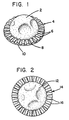
- FIGURE 1 shows a generally round ravioli style food product of the present invention having a generally flat underside with a bulbous central portion 2 and a peripheral flange 4 extending therearound.
- the upper surface of the flange 4 is provided with a multiplicity of semi-cylindrical crimps 6, each extending radially from the outer edge 8 of bulbous central portion 2 to the outer diameter of flange 4.
- the outer edge of flange 4 is cut at a slight angle 10 with respect to the horizontal surfaces of flange 4.
- FIGURE 2 is essentially a plan view of FIGURE 1 showing the bulbous central portion 12, a peripheral flange 14 and semi-cylindrical crimps 16.
- This novel ravoili style food product of the present invention may be commercially prepared in mass quantities by an apparatus such as that shown in FIGURE 3.
- the apparatus of FIGURE 3 comprises a first dough dispensing means 20 containing a quantity of ravioli dough.
- the ravioli dough is dispensed through exit port 22 and is compressed by rollers 24 to form a first dough sheet 26.
- the first dough sheet then travels along first dough conveyor 28 to a circular, rotating, multi-cavity forming die 30.
- the first dough sheet 26 Upon reaching the rotating die surface, the first dough sheet 26 is advanced onto the upper surface 32 of the rotating die 30 such that the first dough sheet 26 extends over top of sevral die cavities 34.
- dough sheet 26 is pressed into each die cavity by the cooperating dough forming surfaces 38 of dough plunger means 36.
- the dough forming surfaces 38 of plunger means 36 are partially spherical at their ends, such that plunging of the dough into each mold cavity 34 will create separate hemispherical indentation 40 of first dough sheet 26 within each mold cavity.
- each hemispherical indentation becomes positioned under filler dispenser 41 for a period of time sufficient to allow a quantity of filler material to pass from filler dispenser 41 through metering device 42 and to be deposited in the particular spherical indentation which is then positioned thereunder 44.
- a second dough dispensing means 50 is provided whereby dough material is dispensed through second exit port 52 and is forced through second rollers 54 forming a second dough sheet 56.
- This second dough sheet 56 is then passed along a second dough conveyor 58 to the surface of cooperating compression and cutting means 60.
- the cooperating compression and cutting means 60 moves correspondingly, thereby bringing the second dough sheet 56 into horizontal juxtaposition with first dough sheet 26.
- dough sheets 26 and 56 are compressed between the surfaces of the die 30 and the surface of the cooperating compression and cutting means 60.
- the scrap ejecting means 64 is formed in such a manner that the scrap dough material 66 is directed onto scrap conveyor 68 for subsequent collection.
- the scrap dough so collected may be reintroduced through either the first or second dough dispensing means 20, 50 or it may be discarded.
- each die cavity containing an individual cut ravioli will become momentarily positioned over the top of a catch conveyor 70.
- air pressure is permitted to flow from pressure source 72 through pressure conduit 74 thereby creating positive pressure within the particular die cavity which is, at the time, positioned over top of the catch conveyor 70. This positive pressure forces ejection of the cut ravioli 76 from the die cavity into catch conveyor 70.
- Catch conveyor 70 is located within a blancing chamber 78 and the ravioli moves slowly along conveyor 70 in blanching chamber 78, thereby completing the blancing process.
- transfer conveyor 80 which in turn transports the ravioli for the subsequent steps of cooling and packaging which are diagramatically represented by blocks 82 and 84 respectively.
- FIGURE 4-7 shows a die cavity 100 wherein one of the hemispherical plunger tips 104 of cooperating dough plunger means 106 has been advanced into the die cavity 100 thereby creating a bulbous indentation of dough sheet 108 within central cavity 109.
- Attendant pressure conduit 100 is inoperative as it is fully blocked by the solid hub 112 of the rotating multi-cavity forming die.
- FIGURE 5 depicts a single cavity 120 of the multi-cavity forming die during the filling process, whereby filling material 122 is deposited in the previously made bulbous indentation 124 of dough sheet 126 through output port 128 of the filler dispensing device. Again, air pressure conduit 130 remains in its inoperative state as the lumen of conduit 130 abuts the solid hub 132 of the rotting multi-cavity forming die.
- FIGURE 6 shows the interaction of a single cavity 140 of the rotating multi-cavity forming die with the surface of cooperating compression and cutting means 142.
- First dough sheet 144 and second dough sheet 146 have been compressed to form a single flange 148 around the bulbous indentation 150 of first dough sheet 144 thereby encapsulating a portion of filling material 152 therein.
- Dough cutting projection 154 extends from the face of the rotating multi-cavity forming die 30 thereby defining the desired outside diameter of the ravioli product formed therein.
- FIGURE 7 shows an individual cavity 170 of the rotating multi-cavity forming die 30.
- the air pressure conduit 172 is, at this point, open to pressure manifold 174 which is pressurized via air pressure source 176.
- pressure manifold 174 which is pressurized via air pressure source 176.
- FIGURE 8 A plan view of a single die cavity 190 of the multi-cavity due 30 is shown in FIGURE 8.
- Such bevel or fillet provides a sharp transition of dough from the central bulbous area to the peripheral flange. Avoidance of the sharp transition prevents dough sticking and attendant problems in demolding the ravioli from the die cavity.
- a multiplicity of semi-cylindrical indentations 194 are positioned around the peripheral flange 196 of the die cavity 190.
- each such semi-cylindrical depression 194 is generally narrowed at its innermost edge of the peripheral flange 196, while the areas between the semi-cylindrical depressions 194 are generally flat at 198 and with a slight bevel or fillet 200 running from the outer rim 202 of the central cavity 204 to a position 206 approximately one-third of the width of the peripheral flange 196.
- the solid dough cutting projection 208 At the extreme outer edge of the peripheral flange 196.
- the opening of an air pressure conduit 210 is shown in the center of central cavity 204.
- the solid dough cutting projection which extends around the periphery of each mold cavity is shown in isolated, crosssectional representation as FIGURE .
- the horizontal base of the flange portion of the die cavity 220 and the inner surface 222 of dough cutter 224 form a slighly obtuse angle 226.
- outer dough cutter 224 is narrowed at its tip 228 so as to provide for efficient cutting of the dough as it articulates with the opposing surface of the cooperating compression and cutting means described in connection with FIGURE 3.
- FIGURES 10A through 10D illustrate the means by which such interlocking occurs.
- the upper dough sheet 250 is marked with small diamonds 252 and lower dough sheet 256 is marked with squares 258.
- the sheets are generally situated in horizontal juxtaposition to one another with a narrow space 254 in between.
- FIGURE 10B a cut away portion of the mold cavity 259 is shown wherein a single semi-cylindrical depression 260 is located.
- the lower opposing surface 262 is forced against lower dough sheet 264 thereby advancing it into contact with upper dough sheet 266.
- the horizontal contact between upper dough sheet 266 and lower dough sheet 264 forms a knit line 268.
- the lower opposing surface 270 is further advanced, to compress both dough sheets and to advance the upper surface 276 of the die cavity.
- the upper surface 272 of upper dough sheet 274 is disrupted at 280 by the presence of the semi-cylindrical depression 282 such that dough partially fills said depression 282.
- the knit line 284 between upper dough sheet 274 and lower dough sheet 286 is disrupted at a region 288 directly beneath the semi-cylindrical indentation, mixing of the dough from the two dough sheets 274 and 286 is illustrated by the coming of the squares 290 originating from lower dough sheet 286 with the diamonds 292 originating from upper dough sheet 274.
- the lower opposing surface 300 has been fully advanced.
- the upper and lower dough sheets are shown to be fully compressively conjoined with the entire semi-cylindrical depression 302 of the die cavity having been filled with dough thereby forming a crimp 304 in the surface of the dough.
- FIGURES 11A through 11C depict, in a similar fashion, the prior art method of merely applying compressive force to the upper and lower dough sheets without the presene of the semicylindrical crimps.
- FIGURE 11A shows upper dough sheet 340 which is tagged with diamond shapes 342 and lower dough sheet 344 which is tagged with square shapes 346. The dough sheets are generally horizontally juxtapositiond.
- FIGURE 11B the dough sheets 360, 362 have been advanced into horizontal contact with one another forming knit line 364.
- FIGURE 11C shows the dough sheets being directly compressed on a flat surface 380 at two separate points, 382 and 384. Such compression results in invaginations 386 and 388 of the dough at points directly beneath the compression points 382 and 384 respectively.
- the dough knit line 390 which exist between the upper dough sheet 392 and the lower dough sheet 394 may be slightly disrupted at points 396 and 398. Such slight disruption is illustrated by minimal intermingling of the diamonds 400 of the upper dough sheet 392 and the squares 402 of the lower dough sheet 394 at two regions 396 and 398. The intermingling of dough from the upper and lower dough sheets does not occur to thedegree depicted in FIGURE 10D.
- inventive semi-cylindrical crimps may be incorporated into any ravioli style food product which has a peripheral compressed dough flange, regardless of the overall shape of the product. Additionally, the spacing of the crimps and the shape of the outer terminus of each crimp may be varied considerably without negating the inventive concept.
Landscapes
- Life Sciences & Earth Sciences (AREA)
- Engineering & Computer Science (AREA)
- Food Science & Technology (AREA)
- Health & Medical Sciences (AREA)
- Nutrition Science (AREA)
- Chemical & Material Sciences (AREA)
- Polymers & Plastics (AREA)
- Bakery Products And Manufacturing Methods Therefor (AREA)
- General Preparation And Processing Of Foods (AREA)
- Manufacturing And Processing Devices For Dough (AREA)
- Coloring Foods And Improving Nutritive Qualities (AREA)
- Noodles (AREA)
- Confectionery (AREA)
- Compounds Of Unknown Constitution (AREA)
- Food Preservation Except Freezing, Refrigeration, And Drying (AREA)
- Fats And Perfumes (AREA)
- Food-Manufacturing Devices (AREA)
- Dry Formation Of Fiberboard And The Like (AREA)
- Optical Fibers, Optical Fiber Cores, And Optical Fiber Bundles (AREA)
- Macromolecular Compounds Obtained By Forming Nitrogen-Containing Linkages In General (AREA)
Abstract
Description
- The present invention relates generally to the art of preparing dough based food products and more particularly to the preparation of a new ravioli style food product having a horizontally flanged periphery with a multiplicity of crimps therearound. The present invention is directed to an inventive method and apparatus for preparing such ravioli style food products as well as to the articles themselves.
- The present invention is described throughout this application with particular reference to the large scale commercial preparation of precooked, frozen or canned ravioli style food products. It will, however, be appreciated that the invention is equally applicable to the small scale preparation of such food items and especially to the home preparation of ravioli using small, commercially available ravioli making machines.
- "Ravioli"" is an Italian word, which, upon literal translation to the English language, means "little turnip". By definition, the term ravioli refers to "small casings of dough, often square, containing seasoned ground meat, cheese, etc., boiled and served usually in a savory tomato sauce". Webster's New World Dictionary (Simon and Schuster, 1980).
- Ravioli and ravioli style food products are particularly well suited for commercial preparation as canned or frozen food products and for subsequent distribution to consumers through grocery store outlets. This is due largely to their broad consumer appeal, physical consistency which is suitable for reheating by microwave or other means, variability of fillings, variability of sauces, and cost factors which come into play when determining which types of food products are most suitable for the consumer grocery market.
- The commercial preparation of frozen or canned ravioli style food products often involves abrupt thermal changes and considerable physical handling. Often times, ravioli products are prepared in mass quantities, blanched or precooked, mixed with sauce, packaged, frozen and then finally reheated prior to home consumption. Such thermal cycling and vigorous handling can cause the dough sheets of the products to separate, often resulting in a loss of filling material. Such degradation will generally render the product unappealing to consumers.
- The above-mentioned problems are overcome by the present invention which provides a novel ravioli style food product wherein two separate dough sheets are compressively conjoined about their peripheries so as to form a horizontal flange surrounding a bulbous midregion wherein filling material is encapsulated. Firm interlocking of the dough sheets is accomplished by providing a number of crimps in a predetermined pattern on a surface of the peripheral flange, such crimps being arranged and formed in a manner which results in even and complete interlocking of the dough sheets while providing a food product which may be prepared economically and reproducably which is appetizing and enticing to consumers.
- In accordance with the present invention, there is provided a novel ravioli style food product comprising first and second dough sheets with a portion of the filling material deposited therebetween. The dough sheets are interfacially, compressively joined at their peripheries so as to form a peripheral flange around the food product and to thereby accomplish firm interlocking of the dough sheets and to encapsulate the filling material therewithin. The peripheral flange is provided with a number of crimps arranged in a predetermined pattern on at least one surface of the flange, each such crimp having a predetermined shape.
- In accordance with another aspect of the present invention, one of the dough sheets is of a generally planar configuration while the other dough sheet is provided with a generally planar periphery and a bulbous central area. The dough sheets are compressively conjoined and crimped about their peripheries, thereby giving rise to a ravioli style food product which is generally flat on the bottom, having a raised bulbous top and a horizontal peripheral flange with generally semi-cylindrical crimps arranged therearound.
- In accordance with yet another aspect of the invention, the above described semi-cylindrical crimps may be positioned equidistantly or non-equidistantly from one another.
- In accordance with yet another aspect of the present invention, the outer ends of the semi-cylindrical crimps may be cut perpendicularly or angularly with respect to the major surfaces of the peripheral flange on which they are located.
- In accordance with a further aspect of the present invention, the outer ends of the semi-cylindrical crimps may be in the configuration of an inclined plane, quarter sphere or prism.
- In accordance with a still further object of the present invention, the ravioli style food product is of a generally round or ovoid overall configuration.
- In accordance with a still further aspect of the present invention, there is provided a method for the repetitive and reproducable production of the ravioli style food product whereby a first dough sheet is moved along a feed line such that at least a portion of the sheet will be in a generally horizontal plane at at least one point on the feedline; indenting the first dough sheet at one position on the feed line; depositing a portion of filling material within the indentation at a second position on the feed line; positioning a second dough sheet so as to interface with the first dough sheet at a third position on said feed line and compressively conjoining the dough sheets to form a compressed dough flange around each indentation wherein filling material is contained such that the flange is provided with a number of semi-cylindrical crimps on at least one surface, and cutting away excess dough from the outer edge of the peripheral flange.
- In accordance with yet a further aspect of the present invention, there is provided an apparatus by which the above described ravioli style food product may be repetitively and reproducably prepared.
- In accordance with a still further aspect of the present invention, there is provided an improved ravioli style food product which is resistant to problems of dough sheet separation and degradation during handling, such improvement comprising a flange of compressed dough extending around the periphery of the food product and having a multiplicity of semi-cylindrical crimps positioned about a surface of said flange, each such crimp extending generally from the inner edge of the peripheral flange to the outer edge of the peripheral flange.
- In accordance with a still further aspect of the invention, the multiple semi-cylindrical crimps of the peripheral flange are of significantly greater thickness and overall mass than the thinner regions of the flange which exist between the crimps. Due to the increased thickness of the crimps, the dough at the center of each crimp will cook at a slower rate than dough at the center of the thin regions of the flange. Such will result in a comparative retention of pliability or cohesiveness of the dough at the center of each crimp and, accordingly, a decreased likelihood that the product will separate or degrade during handling.
- Further objects and advantages of the invention will be apparent from the following detailed description of a preferred embodiment thereof and from the accompanying drawings.
- It is appreciated that products of the present invention may be prepared in numerous sizes and configurations. The method and apparatus for preparing such products may, accordingly, vary somewhat with respect to the desired size and configuration of the final product. The preferred embodiment described herein is a generally round shaped ravioli having an hemispherical, bulbous area at its center with a peripheral dough flange extending around such bulbous central portion and semi-cylindrical crimps extending radially about the flange. Ravioli style food products of the present invention may, however, be prepared in many other shapes so long as they employ the inventive concept of a peripheral flange having semi-cylindrical crimps spaced therearound.
- The cutting of the outside diameter of the ravioli may be accomplished either by a separate cutting step or by incorporating a cutting surface into the die from which the ravioli is formed. The appearance and cut angle of the cut outside diameter may vary somewhat depending on the particular cutting means employed.
-
- FIGURE 1 is a perspective view of the novel ravioli having a preferred round shape and an outer flange having radial, semi-cylindrical crimps on its upper surface;
- FIGURE 2 is a plan view of FIGURE 1;
- FIGURE 3 is a schematic representation of the novel apparatus whereby ravioli style products of the present invention may be prepared;
- FIGURE 4 is an enlarged cross-sectional view taken on line 4-4 of FIGURE 3 showing the indentation of the first dough sheet;
- FIGURE 5 is a cross-sectional view taken on line 5-5 of FIGURE 3 showing the addition of filling material to the indented portion of said first dough sheet;
- FIGURE 6 is a cross-sectional view taken on line 6-6 of FIGURE 3 showing the compressive conjoining of a second dough sheet with said first dough sheet;
- FIGURE 7 is a cross-sectional view taken on line 7-7 of FIGURE 3 showing the ejection of the finished, unblanced ravioli product from the apparatus;
- FIGURE 8 is a plan view taken on line 8-8 of FIGURE 3 showing the cavity of a tool for production of the ravioli style food product of the present invention;
- FIGURE 9 is a further enlarged cross-section view taken on line 9-9 of FIGURE 8;
- FIGURE 10A shows schematically two separate dough sheets positioned adjacent to one another;
- FIGURE 10B shows the initial compression of the dough sheets of FIGURE 10A;
- FIGURE 10C shows further compression of the dough sheets of 10A, with the dough of the top sheet and bottom sheet becoming mixed as dough is compressed into the semi-cylindrical indentation of the forming die;
- FIGURE 10D shows full compression of the dough sheet whereby the dough of the top and bottom sheets is fully mixed and cmpressively conjoined;
- FIGURE 11A shows two dough sheets positioned adjacent to one another;
- FIGURE 11B shows the initial compression of the two dough sheets by the method of the prior art; and,
- FIGURE 11C shows further compression of the dough sheets in accordance with the prior art.
- Referring now to the drawings wherein the showings are for the purpose of illustrating a preferred embodiment of the invention and not for the purpose of limiting same, FIGURE 1 shows a generally round ravioli style food product of the present invention having a generally flat underside with a bulbous central portion 2 and a
peripheral flange 4 extending therearound. The upper surface of theflange 4 is provided with a multiplicity ofsemi-cylindrical crimps 6, each extending radially from theouter edge 8 of bulbous central portion 2 to the outer diameter offlange 4. In the preferred embodiment shown in FIGURE 1, the outer edge offlange 4 is cut at a slight angle 10 with respect to the horizontal surfaces offlange 4. - FIGURE 2 is essentially a plan view of FIGURE 1 showing the bulbous
central portion 12, aperipheral flange 14 andsemi-cylindrical crimps 16. - This novel ravoili style food product of the present invention may be commercially prepared in mass quantities by an apparatus such as that shown in FIGURE 3. The apparatus of FIGURE 3 comprises a first dough dispensing means 20 containing a quantity of ravioli dough. The ravioli dough is dispensed through
exit port 22 and is compressed byrollers 24 to form afirst dough sheet 26. The first dough sheet then travels alongfirst dough conveyor 28 to a circular, rotating, multi-cavity forming die 30. Upon reaching the rotating die surface, thefirst dough sheet 26 is advanced onto theupper surface 32 of the rotatingdie 30 such that thefirst dough sheet 26 extends over top ofsevral die cavities 34. As the rotating die 30 advances in position,dough sheet 26 is pressed into each die cavity by the cooperatingdough forming surfaces 38 of dough plunger means 36. Thedough forming surfaces 38 of plunger means 36 are partially spherical at their ends, such that plunging of the dough into eachmold cavity 34 will create separate hemispherical indentation 40 offirst dough sheet 26 within each mold cavity. As the rotary forming die 30 advances, each hemispherical indentation becomes positioned underfiller dispenser 41 for a period of time sufficient to allow a quantity of filler material to pass fromfiller dispenser 41 throughmetering device 42 and to be deposited in the particular spherical indentation which is then positioned thereunder 44. A second dough dispensing means 50 is provided whereby dough material is dispensed throughsecond exit port 52 and is forced throughsecond rollers 54 forming asecond dough sheet 56. Thissecond dough sheet 56 is then passed along asecond dough conveyor 58 to the surface of cooperating compression and cutting means 60. As the rotating multicavity forming die 30 further advances, the cooperating compression and cutting means 60 moves correspondingly, thereby bringing thesecond dough sheet 56 into horizontal juxtaposition withfirst dough sheet 26. As the rotting die 30 and cooperating compression cutting means 60 continue to advance,dough sheets die 30 and the surface of the cooperating compression and cutting means 60. Generally semi-cylindrical indentations are positioned in the surfaceof the die 30 so as to give rise to a multiplicity of semi-cylindrical crimps extending radially about the peripheral flange of each of said die cavities which serve to form semi-circular crimps in the top surface of the peripheral dough flange as it is formed by the compressive conjoining of thedough sheets rotary mold 30 by scrap ejecting means 64 which is positioned so as to scrape the remaining dough from the surface of rotatingmold 30. The scrap ejecting means 64 is formed in such a manner that thescrap dough material 66 is directed ontoscrap conveyor 68 for subsequent collection. The scrap dough so collected may be reintroduced through either the first or second dough dispensing means 20, 50 or it may be discarded. As the rotatingmulti-cavity forming die 30 continues to advance, each die cavity containing an individual cut ravioli will become momentarily positioned over the top of acatch conveyor 70. When in such position, air pressure is permitted to flow from pressure source 72 throughpressure conduit 74 thereby creating positive pressure within the particular die cavity which is, at the time, positioned over top of thecatch conveyor 70. This positive pressure forces ejection of the cut ravioli 76 from the die cavity intocatch conveyor 70.Catch conveyor 70, as shown in FIGURE 3, is located within ablancing chamber 78 and the ravioli moves slowly alongconveyor 70 in blanchingchamber 78, thereby completing the blancing process. As the blanced ravioli arrive at the end of theconveyor 70, they are deposited ontotransfer conveyor 80 which in turn transports the ravioli for the subsequent steps of cooling and packaging which are diagramatically represented byblocks - The formation of the inventive crimped peripheral flange on each of the ravioli products prepared by the device of FIGURE 3 may be clearly appreciated by cut away FIGURES 4-7 wherein an individual cavity of the rotating multi-cavity forming die is shown at various points during the process. The
numbers 4 through 7 are labeled on FIGURE 2, showing the various points in the process to which FIGURES 4 through 7 correspond. FIGURE 4 shows adie cavity 100 wherein one of thehemispherical plunger tips 104 of cooperating dough plunger means 106 has been advanced into thedie cavity 100 thereby creating a bulbous indentation ofdough sheet 108 withincentral cavity 109.Attendant pressure conduit 100 is inoperative as it is fully blocked by thesolid hub 112 of the rotating multi-cavity forming die. - FIGURE 5 depicts a
single cavity 120 of the multi-cavity forming die during the filling process, whereby fillingmaterial 122 is deposited in the previously madebulbous indentation 124 ofdough sheet 126 throughoutput port 128 of the filler dispensing device. Again,air pressure conduit 130 remains in its inoperative state as the lumen ofconduit 130 abuts thesolid hub 132 of the rotting multi-cavity forming die. - FIGURE 6 shows the interaction of a
single cavity 140 of the rotating multi-cavity forming die with the surface of cooperating compression and cutting means 142.First dough sheet 144 andsecond dough sheet 146 have been compressed to form asingle flange 148 around thebulbous indentation 150 offirst dough sheet 144 thereby encapsulating a portion of fillingmaterial 152 therein.Dough cutting projection 154 extends from the face of the rotatingmulti-cavity forming die 30 thereby defining the desired outside diameter of the ravioli product formed therein. The slight anlge of the dough cutting projection result in the cutting of the outside diameter of each ravioli in a generally angular member such that the portion of the peripheral outer flange of the ravioli that is further into the mold cavity is slightly less in diameter than that portion of the peripheral outer flange to which its outermost in the mold cavity. This slight angling of the outer edge of the ravioli facilitates subsequent release of the ravioli from the die cavity. Again,pressure conduit 156 remains blocked by thesolid hub 158 of the rotating multi-cavity forming die. - Release of the ravioli from the forming die cavity occurs as shown in FIGURE 7. FIGURE 7, like the previous three figures, shows an
individual cavity 170 of the rotatingmulti-cavity forming die 30. Theair pressure conduit 172 is, at this point, open topressure manifold 174 which is pressurized viaair pressure source 176. Thus positive pressure is conveyed throughpressure conduit 172 intoindividual mold cavity 170 thereby causing ejection of theravioli 178 in a downward direction. - A plan view of a
single die cavity 190 of the multi-cavity due 30 is shown in FIGURE 8. Such bevel or fillet provides a sharp transition of dough from the central bulbous area to the peripheral flange. Avoidance of the sharp transition prevents dough sticking and attendant problems in demolding the ravioli from the die cavity. A multiplicity ofsemi-cylindrical indentations 194 are positioned around theperipheral flange 196 of thedie cavity 190. In this preferred embodiment, each suchsemi-cylindrical depression 194 is generally narrowed at its innermost edge of theperipheral flange 196, while the areas between thesemi-cylindrical depressions 194 are generally flat at 198 and with a slight bevel orfillet 200 running from theouter rim 202 of thecentral cavity 204 to aposition 206 approximately one-third of the width of theperipheral flange 196. At the extreme outer edge of theperipheral flange 196 is the soliddough cutting projection 208. The opening of anair pressure conduit 210 is shown in the center ofcentral cavity 204. - The solid dough cutting projection which extends around the periphery of each mold cavity is shown in isolated, crosssectional representation as FIGURE . The horizontal base of the flange portion of the
die cavity 220 and theinner surface 222 ofdough cutter 224 form a slighlyobtuse angle 226. Additionally,outer dough cutter 224 is narrowed at itstip 228 so as to provide for efficient cutting of the dough as it articulates with the opposing surface of the cooperating compression and cutting means described in connection with FIGURE 3. - The inventive semi-cylindrical crimps positioned around the peripheral flange of the ravioli bring about firm interlocking of the uppr and lower dough sheets. FIGURES 10A through 10D illustrate the means by which such interlocking occurs. In FIGURE 10A, the
upper dough sheet 250 is marked withsmall diamonds 252 andlower dough sheet 256 is marked withsquares 258. As shown in FIGURE 10A, the sheets are generally situated in horizontal juxtaposition to one another with anarrow space 254 in between. In FIGURE 10B, a cut away portion of themold cavity 259 is shown wherein a singlesemi-cylindrical depression 260 is located. The lower opposingsurface 262 is forced againstlower dough sheet 264 thereby advancing it into contact with upper dough sheet 266. The horizontal contact between upper dough sheet 266 andlower dough sheet 264 forms aknit line 268. In FIGURE 10C, the lower opposingsurface 270 is further advanced, to compress both dough sheets and to advance theupper surface 276 of the die cavity. As shown, theupper surface 272 ofupper dough sheet 274 is disrupted at 280 by the presence of thesemi-cylindrical depression 282 such that dough partially fills saiddepression 282. Additionally, theknit line 284 betweenupper dough sheet 274 andlower dough sheet 286 is disrupted at aregion 288 directly beneath the semi-cylindrical indentation, mixing of the dough from the twodough sheets squares 290 originating fromlower dough sheet 286 with thediamonds 292 originating fromupper dough sheet 274. In FIGURE 10D, the lower opposing surface 300 has been fully advanced. The upper and lower dough sheets are shown to be fully compressively conjoined with the entiresemi-cylindrical depression 302 of the die cavity having been filled with dough thereby forming acrimp 304 in the surface of the dough. The interlocking of the upper and lower dough sheets is clearly depicted by the intermingling of the diamond shapes 306 which had originated from the upper dough sheet and thesquare shapes 308 which had originated from the lower dough sheet. Also, there is no longer a discernible knit line dividing the upper and lower dough sheets. - FIGURES 11A through 11C depict, in a similar fashion, the prior art method of merely applying compressive force to the upper and lower dough sheets without the presene of the semicylindrical crimps. FIGURE 11A shows
upper dough sheet 340 which is tagged withdiamond shapes 342 andlower dough sheet 344 which is tagged withsquare shapes 346. The dough sheets are generally horizontally juxtapositiond. In FIGURE 11B, thedough sheets knit line 364. FIGURE 11C shows the dough sheets being directly compressed on aflat surface 380 at two separate points, 382 and 384. Such compression results ininvaginations dough knit line 390 which exist between theupper dough sheet 392 and thelower dough sheet 394 may be slightly disrupted atpoints diamonds 400 of theupper dough sheet 392 and the squares 402 of thelower dough sheet 394 at tworegions - It should be appreciated that the inventive semi-cylindrical crimps may be incorporated into any ravioli style food product which has a peripheral compressed dough flange, regardless of the overall shape of the product. Additionally, the spacing of the crimps and the shape of the outer terminus of each crimp may be varied considerably without negating the inventive concept.
Claims (11)
a first dough sheet;
a second dough sheet
a filling material contained between said first dough sheet and said second dough sheet;
the peripheries of said first and second dough sheets being compressively conjoined so as to form a peripheral flange around the food product and to thereby encapsulate said filling material therewithin;
said peripheral flange being provided with a multiplicity of crimps in a predetermined pattern and each such crimp having a predetermined shape; and
said first and second dough sheets being unified at regions of said flange corresponding to said crimps, and interfacially joined at regions adjacent said crimps.
Priority Applications (1)
| Application Number | Priority Date | Filing Date | Title |
|---|---|---|---|
| AT88112915T ATE78989T1 (en) | 1987-09-15 | 1988-08-09 | FOOD PRODUCT IN THE FORM OF RAVIOLI. |
Applications Claiming Priority (2)
| Application Number | Priority Date | Filing Date | Title |
|---|---|---|---|
| US9645387A | 1987-09-15 | 1987-09-15 | |
| US96453 | 1987-09-15 |
Publications (2)
| Publication Number | Publication Date |
|---|---|
| EP0307614A1 true EP0307614A1 (en) | 1989-03-22 |
| EP0307614B1 EP0307614B1 (en) | 1992-08-05 |
Family
ID=22257411
Family Applications (1)
| Application Number | Title | Priority Date | Filing Date |
|---|---|---|---|
| EP88112915A Expired - Lifetime EP0307614B1 (en) | 1987-09-15 | 1988-08-09 | Ravioli style food product |
Country Status (14)
| Country | Link |
|---|---|
| EP (1) | EP0307614B1 (en) |
| JP (1) | JP2725798B2 (en) |
| AT (1) | ATE78989T1 (en) |
| AU (1) | AU610627B2 (en) |
| CA (1) | CA1336242C (en) |
| DE (1) | DE3873456T2 (en) |
| DK (1) | DK474188A (en) |
| ES (1) | ES2034061T3 (en) |
| FI (1) | FI883784L (en) |
| GR (1) | GR3005355T3 (en) |
| IE (1) | IE61748B1 (en) |
| NO (1) | NO171882C (en) |
| PT (1) | PT88499B (en) |
| ZA (1) | ZA886036B (en) |
Cited By (16)
| Publication number | Priority date | Publication date | Assignee | Title |
|---|---|---|---|---|
| GB2232336A (en) * | 1989-05-09 | 1990-12-12 | Colin Vaughan Griffiths | Manufacture of pastry en croutes |
| EP0475911A1 (en) * | 1990-09-12 | 1992-03-18 | RAVIOLIFICIO BERTARINI S.r.l. | Stuffed ravioli and the like alimentary pasta provided with separated pockets for holding the stuffing |
| WO1995031907A1 (en) * | 1994-05-19 | 1995-11-30 | Primetta Zelli | Stuffed and shaped alimentary pasta simulating anatomic parts |
| EP0774209B1 (en) * | 1995-11-20 | 2002-07-17 | Societe Des Produits Nestle S.A. | Chocolate container with at least one sealed edge |
| EP1481592A3 (en) * | 2003-05-20 | 2006-06-14 | Lotte Co., Ltd | Method of preparing roasted confectionery containing solid state center material |
| WO2008124662A1 (en) * | 2007-04-05 | 2008-10-16 | Kellogg Company | Embossed cereal piece |
| CN105360199A (en) * | 2015-11-24 | 2016-03-02 | 黄巧玲 | Dumpling full-automatic processing machinery |
| CN105360198A (en) * | 2015-11-24 | 2016-03-02 | 黄巧玲 | Dumpling Wrapping Device |
| CN106509010B (en) * | 2016-11-26 | 2018-07-24 | 柯金狮 | A kind of automatic dumpling-making machine |
| IT201700019105A1 (en) * | 2017-02-21 | 2018-08-21 | Azionaria Costruzioni Macch Automatiche A C M A | Machine for making filled pasta |
| EP3628172A1 (en) * | 2018-09-27 | 2020-04-01 | Pastificio Rana S.p.A. | Stuffed pasta food item, apparatus and method to produce said food item |
| CN111358029A (en) * | 2018-12-26 | 2020-07-03 | 王庆久 | Method for producing sweet dumplings by adopting die pressing |
| CN112640933A (en) * | 2020-12-01 | 2021-04-13 | 杭州衡美食品科技有限公司 | Carry and stabilize and guarantee soft heart stick production facility of soft heart layer parcel effect |
| US11825852B2 (en) | 2017-02-21 | 2023-11-28 | Azionaria Costruzioni Macchine Automatiche A.C.M.A. S.P.A. | Machine for making filled pasta |
| US11937607B2 (en) | 2017-02-21 | 2024-03-26 | Azionaria Costruzioni Macchine Automatiche A.C.M.A. S.P.A. | Machine for making filled pasta |
| IT202300013356A1 (en) * | 2023-06-28 | 2024-12-28 | Pama Parsi Macch S R L | MULTIFUNCTIONAL MACHINE FOR THE PRODUCTION OF PASTA WITH AND WITHOUT FILLING |
Families Citing this family (2)
| Publication number | Priority date | Publication date | Assignee | Title |
|---|---|---|---|---|
| CN106509011A (en) * | 2016-12-13 | 2017-03-22 | 成都松川雷博机械设备有限公司 | Laced farci food forming device |
| CN107019013B (en) * | 2017-06-23 | 2022-11-22 | 成都松川雷博机械设备有限公司 | Stuffed food forming equipment |
Citations (5)
| Publication number | Priority date | Publication date | Assignee | Title |
|---|---|---|---|---|
| US3111914A (en) * | 1962-04-16 | 1963-11-26 | Mary C Viviano | Ravioli sealing and severing |
| FR2140458A1 (en) * | 1971-06-05 | 1973-01-19 | Sada Pietro | |
| US4381906A (en) * | 1981-10-08 | 1983-05-03 | Ugo Mancini | Apparatus for producing ravioli and the like |
| FR2578393A1 (en) * | 1985-01-08 | 1986-09-12 | Tomatis Giacomo | MACHINE FOR MAKING RAVIOLI |
| EP0206898A2 (en) * | 1985-06-11 | 1986-12-30 | Nabisco Brands, Inc. | Latticed pastry goods |
Family Cites Families (1)
| Publication number | Priority date | Publication date | Assignee | Title |
|---|---|---|---|---|
| US4678418A (en) * | 1985-06-11 | 1987-07-07 | Nabisco Brands, Inc. | Apparatus for continuously forming latticed pastry goods |
-
1988
- 1988-08-09 AT AT88112915T patent/ATE78989T1/en not_active IP Right Cessation
- 1988-08-09 ES ES198888112915T patent/ES2034061T3/en not_active Expired - Lifetime
- 1988-08-09 EP EP88112915A patent/EP0307614B1/en not_active Expired - Lifetime
- 1988-08-09 DE DE8888112915T patent/DE3873456T2/en not_active Expired - Lifetime
- 1988-08-09 IE IE242188A patent/IE61748B1/en not_active IP Right Cessation
- 1988-08-11 AU AU20688/88A patent/AU610627B2/en not_active Ceased
- 1988-08-15 ZA ZA886036A patent/ZA886036B/en unknown
- 1988-08-16 FI FI883784A patent/FI883784L/en not_active Application Discontinuation
- 1988-08-16 CA CA000574826A patent/CA1336242C/en not_active Expired - Fee Related
- 1988-08-25 DK DK474188A patent/DK474188A/en not_active Application Discontinuation
- 1988-09-07 NO NO883977A patent/NO171882C/en unknown
- 1988-09-13 JP JP63229706A patent/JP2725798B2/en not_active Expired - Lifetime
- 1988-09-14 PT PT88499A patent/PT88499B/en not_active IP Right Cessation
-
1992
- 1992-08-06 GR GR920401627T patent/GR3005355T3/el unknown
Patent Citations (5)
| Publication number | Priority date | Publication date | Assignee | Title |
|---|---|---|---|---|
| US3111914A (en) * | 1962-04-16 | 1963-11-26 | Mary C Viviano | Ravioli sealing and severing |
| FR2140458A1 (en) * | 1971-06-05 | 1973-01-19 | Sada Pietro | |
| US4381906A (en) * | 1981-10-08 | 1983-05-03 | Ugo Mancini | Apparatus for producing ravioli and the like |
| FR2578393A1 (en) * | 1985-01-08 | 1986-09-12 | Tomatis Giacomo | MACHINE FOR MAKING RAVIOLI |
| EP0206898A2 (en) * | 1985-06-11 | 1986-12-30 | Nabisco Brands, Inc. | Latticed pastry goods |
Cited By (19)
| Publication number | Priority date | Publication date | Assignee | Title |
|---|---|---|---|---|
| GB2232336A (en) * | 1989-05-09 | 1990-12-12 | Colin Vaughan Griffiths | Manufacture of pastry en croutes |
| EP0475911A1 (en) * | 1990-09-12 | 1992-03-18 | RAVIOLIFICIO BERTARINI S.r.l. | Stuffed ravioli and the like alimentary pasta provided with separated pockets for holding the stuffing |
| WO1995031907A1 (en) * | 1994-05-19 | 1995-11-30 | Primetta Zelli | Stuffed and shaped alimentary pasta simulating anatomic parts |
| EP0774209B1 (en) * | 1995-11-20 | 2002-07-17 | Societe Des Produits Nestle S.A. | Chocolate container with at least one sealed edge |
| EP1481592A3 (en) * | 2003-05-20 | 2006-06-14 | Lotte Co., Ltd | Method of preparing roasted confectionery containing solid state center material |
| WO2008124662A1 (en) * | 2007-04-05 | 2008-10-16 | Kellogg Company | Embossed cereal piece |
| CN105360199A (en) * | 2015-11-24 | 2016-03-02 | 黄巧玲 | Dumpling full-automatic processing machinery |
| CN105360198A (en) * | 2015-11-24 | 2016-03-02 | 黄巧玲 | Dumpling Wrapping Device |
| CN106509010B (en) * | 2016-11-26 | 2018-07-24 | 柯金狮 | A kind of automatic dumpling-making machine |
| IT201700019105A1 (en) * | 2017-02-21 | 2018-08-21 | Azionaria Costruzioni Macch Automatiche A C M A | Machine for making filled pasta |
| WO2018154455A1 (en) * | 2017-02-21 | 2018-08-30 | Azionaria Costruzioni Macchine Automatiche A.C.M.A. S.P.A. | Machine for making filled pasta |
| CN110430758A (en) * | 2017-02-21 | 2019-11-08 | 建筑自动机械制造A.C.M.A.股份公司 | machine for making stuffed pasta |
| CN110430758B (en) * | 2017-02-21 | 2022-09-23 | 建筑自动机械制造A.C.M.A.股份公司 | Machine for making filled pasta |
| US11825852B2 (en) | 2017-02-21 | 2023-11-28 | Azionaria Costruzioni Macchine Automatiche A.C.M.A. S.P.A. | Machine for making filled pasta |
| US11937607B2 (en) | 2017-02-21 | 2024-03-26 | Azionaria Costruzioni Macchine Automatiche A.C.M.A. S.P.A. | Machine for making filled pasta |
| EP3628172A1 (en) * | 2018-09-27 | 2020-04-01 | Pastificio Rana S.p.A. | Stuffed pasta food item, apparatus and method to produce said food item |
| CN111358029A (en) * | 2018-12-26 | 2020-07-03 | 王庆久 | Method for producing sweet dumplings by adopting die pressing |
| CN112640933A (en) * | 2020-12-01 | 2021-04-13 | 杭州衡美食品科技有限公司 | Carry and stabilize and guarantee soft heart stick production facility of soft heart layer parcel effect |
| IT202300013356A1 (en) * | 2023-06-28 | 2024-12-28 | Pama Parsi Macch S R L | MULTIFUNCTIONAL MACHINE FOR THE PRODUCTION OF PASTA WITH AND WITHOUT FILLING |
Also Published As
| Publication number | Publication date |
|---|---|
| NO171882B (en) | 1993-02-08 |
| PT88499A (en) | 1989-07-31 |
| NO883977D0 (en) | 1988-09-07 |
| ES2034061T3 (en) | 1993-04-01 |
| EP0307614B1 (en) | 1992-08-05 |
| CA1336242C (en) | 1995-07-11 |
| DK474188A (en) | 1989-03-16 |
| ATE78989T1 (en) | 1992-08-15 |
| FI883784A7 (en) | 1989-03-16 |
| DK474188D0 (en) | 1988-08-25 |
| DE3873456T2 (en) | 1992-12-03 |
| IE882421L (en) | 1989-03-15 |
| AU610627B2 (en) | 1991-05-23 |
| JPH0198454A (en) | 1989-04-17 |
| GR3005355T3 (en) | 1993-05-24 |
| JP2725798B2 (en) | 1998-03-11 |
| PT88499B (en) | 1993-09-30 |
| NO883977L (en) | 1989-03-16 |
| FI883784A0 (en) | 1988-08-16 |
| ZA886036B (en) | 1989-04-26 |
| DE3873456D1 (en) | 1992-09-10 |
| NO171882C (en) | 1993-05-26 |
| IE61748B1 (en) | 1994-11-30 |
| AU2068888A (en) | 1989-03-16 |
| FI883784L (en) | 1989-03-16 |
Similar Documents
| Publication | Publication Date | Title |
|---|---|---|
| EP0307614B1 (en) | Ravioli style food product | |
| US4661361A (en) | Method of making a pizza | |
| US4004035A (en) | Method and apparatus for producing lapped shredded food articles | |
| US5074777A (en) | Apparatus for making a split pie | |
| EP0828425B1 (en) | Conical food article and process for making same | |
| US6874409B2 (en) | Method and apparatus for making commercial crustless sandwiches and the crustless sandwich made thereby | |
| US20030134011A1 (en) | Frozen sandwich and method of making same | |
| JPS61111648A (en) | Improvement in common use extrusion molding apparatus of soft lumpy body having different inside and outside parts | |
| US20080032012A1 (en) | Assembly for producing wafer products, and water product produced by the assembly | |
| JPS5831180B2 (en) | Packaging method and packaging machine | |
| JPH0144291B2 (en) | ||
| AU613689B2 (en) | Method for preparing a food product | |
| ES534359A0 (en) | METHOD TO MANUFACTURE A FOOD PRODUCT BASED ON A MASS CONTAINING SUGAR, FLOUR AND BUTTER | |
| US20030008038A1 (en) | Frozen crustless sliced sandwich and method and apparatus for making same | |
| JPS6250109B2 (en) | ||
| GB2212097A (en) | Shaping foodstuffs | |
| JPS58121745A (en) | Production of biscuit | |
| US6139893A (en) | Method for manufacturing raised-brim products | |
| US4514434A (en) | Meat patty and process for forming the same | |
| US4420298A (en) | Device for making spatzels | |
| CN1033302C (en) | Method and device for making stuffed noodles | |
| US20060073246A1 (en) | Method and apparatus for making commercial crustless sandwiches and the crustless sandwich made thereby | |
| US20060147575A1 (en) | Apparatus for making meatballs and the like | |
| WO1994012035A1 (en) | Conical food article and process for making same | |
| GB2211391A (en) | Process for the manufacture of pastry cases |
Legal Events
| Date | Code | Title | Description |
|---|---|---|---|
| PUAI | Public reference made under article 153(3) epc to a published international application that has entered the european phase |
Free format text: ORIGINAL CODE: 0009012 |
|
| 17P | Request for examination filed |
Effective date: 19880809 |
|
| AK | Designated contracting states |
Kind code of ref document: A1 Designated state(s): AT BE CH DE ES FR GB GR IT LI LU NL SE |
|
| 17Q | First examination report despatched |
Effective date: 19910314 |
|
| ITF | It: translation for a ep patent filed | ||
| GRAA | (expected) grant |
Free format text: ORIGINAL CODE: 0009210 |
|
| AK | Designated contracting states |
Kind code of ref document: B1 Designated state(s): AT BE CH DE ES FR GB GR IT LI LU NL SE |
|
| REF | Corresponds to: |
Ref document number: 78989 Country of ref document: AT Date of ref document: 19920815 Kind code of ref document: T |
|
| ET | Fr: translation filed | ||
| REF | Corresponds to: |
Ref document number: 3873456 Country of ref document: DE Date of ref document: 19920910 |
|
| REG | Reference to a national code |
Ref country code: GR Ref legal event code: FG4A Free format text: 3005355 |
|
| REG | Reference to a national code |
Ref country code: ES Ref legal event code: FG2A Ref document number: 2034061 Country of ref document: ES Kind code of ref document: T3 |
|
| PLBE | No opposition filed within time limit |
Free format text: ORIGINAL CODE: 0009261 |
|
| STAA | Information on the status of an ep patent application or granted ep patent |
Free format text: STATUS: NO OPPOSITION FILED WITHIN TIME LIMIT |
|
| 26N | No opposition filed | ||
| EPTA | Lu: last paid annual fee | ||
| EAL | Se: european patent in force in sweden |
Ref document number: 88112915.9 |
|
| PGFP | Annual fee paid to national office [announced via postgrant information from national office to epo] |
Ref country code: GB Payment date: 19970731 Year of fee payment: 10 |
|
| PGFP | Annual fee paid to national office [announced via postgrant information from national office to epo] |
Ref country code: FR Payment date: 19970811 Year of fee payment: 10 |
|
| PGFP | Annual fee paid to national office [announced via postgrant information from national office to epo] |
Ref country code: AT Payment date: 19970813 Year of fee payment: 10 |
|
| PGFP | Annual fee paid to national office [announced via postgrant information from national office to epo] |
Ref country code: SE Payment date: 19970818 Year of fee payment: 10 Ref country code: DE Payment date: 19970818 Year of fee payment: 10 |
|
| PGFP | Annual fee paid to national office [announced via postgrant information from national office to epo] |
Ref country code: ES Payment date: 19970819 Year of fee payment: 10 |
|
| PGFP | Annual fee paid to national office [announced via postgrant information from national office to epo] |
Ref country code: CH Payment date: 19970821 Year of fee payment: 10 |
|
| PGFP | Annual fee paid to national office [announced via postgrant information from national office to epo] |
Ref country code: GR Payment date: 19970822 Year of fee payment: 10 |
|
| PGFP | Annual fee paid to national office [announced via postgrant information from national office to epo] |
Ref country code: NL Payment date: 19970826 Year of fee payment: 10 |
|
| PGFP | Annual fee paid to national office [announced via postgrant information from national office to epo] |
Ref country code: BE Payment date: 19970925 Year of fee payment: 10 |
|
| PGFP | Annual fee paid to national office [announced via postgrant information from national office to epo] |
Ref country code: LU Payment date: 19971216 Year of fee payment: 10 |
|
| PG25 | Lapsed in a contracting state [announced via postgrant information from national office to epo] |
Ref country code: LU Free format text: LAPSE BECAUSE OF NON-PAYMENT OF DUE FEES Effective date: 19980809 Ref country code: GB Free format text: LAPSE BECAUSE OF NON-PAYMENT OF DUE FEES Effective date: 19980809 Ref country code: AT Free format text: LAPSE BECAUSE OF NON-PAYMENT OF DUE FEES Effective date: 19980809 |
|
| PG25 | Lapsed in a contracting state [announced via postgrant information from national office to epo] |
Ref country code: SE Free format text: LAPSE BECAUSE OF NON-PAYMENT OF DUE FEES Effective date: 19980810 Ref country code: ES Free format text: LAPSE BECAUSE OF NON-PAYMENT OF DUE FEES Effective date: 19980810 |
|
| PG25 | Lapsed in a contracting state [announced via postgrant information from national office to epo] |
Ref country code: LI Free format text: LAPSE BECAUSE OF NON-PAYMENT OF DUE FEES Effective date: 19980831 Ref country code: GR Free format text: LAPSE BECAUSE OF NON-PAYMENT OF DUE FEES Effective date: 19980831 Ref country code: CH Free format text: LAPSE BECAUSE OF NON-PAYMENT OF DUE FEES Effective date: 19980831 Ref country code: BE Free format text: LAPSE BECAUSE OF NON-PAYMENT OF DUE FEES Effective date: 19980831 |
|
| BERE | Be: lapsed |
Owner name: SOC. DES PRODUITS NESTLE S.A. Effective date: 19980831 |
|
| PG25 | Lapsed in a contracting state [announced via postgrant information from national office to epo] |
Ref country code: NL Free format text: LAPSE BECAUSE OF NON-PAYMENT OF DUE FEES Effective date: 19990301 |
|
| GBPC | Gb: european patent ceased through non-payment of renewal fee |
Effective date: 19980809 |
|
| REG | Reference to a national code |
Ref country code: CH Ref legal event code: PL |
|
| PG25 | Lapsed in a contracting state [announced via postgrant information from national office to epo] |
Ref country code: FR Free format text: LAPSE BECAUSE OF NON-PAYMENT OF DUE FEES Effective date: 19990430 |
|
| EUG | Se: european patent has lapsed |
Ref document number: 88112915.9 |
|
| NLV4 | Nl: lapsed or anulled due to non-payment of the annual fee |
Effective date: 19990301 |
|
| PG25 | Lapsed in a contracting state [announced via postgrant information from national office to epo] |
Ref country code: DE Free format text: LAPSE BECAUSE OF NON-PAYMENT OF DUE FEES Effective date: 19990601 |
|
| REG | Reference to a national code |
Ref country code: FR Ref legal event code: ST |
|
| REG | Reference to a national code |
Ref country code: ES Ref legal event code: FD2A Effective date: 19990910 |
|
| PG25 | Lapsed in a contracting state [announced via postgrant information from national office to epo] |
Ref country code: IT Free format text: LAPSE BECAUSE OF NON-PAYMENT OF DUE FEES;WARNING: LAPSES OF ITALIAN PATENTS WITH EFFECTIVE DATE BEFORE 2007 MAY HAVE OCCURRED AT ANY TIME BEFORE 2007. THE CORRECT EFFECTIVE DATE MAY BE DIFFERENT FROM THE ONE RECORDED. Effective date: 20050809 |