EP0307548A2 - Verfahren zur Herstellung von Organotonen mit verbesserten Gel-Bildungseigenschaften - Google Patents
Verfahren zur Herstellung von Organotonen mit verbesserten Gel-Bildungseigenschaften Download PDFInfo
- Publication number
- EP0307548A2 EP0307548A2 EP88109351A EP88109351A EP0307548A2 EP 0307548 A2 EP0307548 A2 EP 0307548A2 EP 88109351 A EP88109351 A EP 88109351A EP 88109351 A EP88109351 A EP 88109351A EP 0307548 A2 EP0307548 A2 EP 0307548A2
- Authority
- EP
- European Patent Office
- Prior art keywords
- stator
- clay
- slurry
- rotor
- high speed
- Prior art date
- Legal status (The legal status is an assumption and is not a legal conclusion. Google has not performed a legal analysis and makes no representation as to the accuracy of the status listed.)
- Granted
Links
- 238000000034 method Methods 0.000 title claims abstract description 20
- 238000004519 manufacturing process Methods 0.000 title claims description 4
- 239000004927 clay Substances 0.000 claims abstract description 27
- 239000002002 slurry Substances 0.000 claims abstract description 18
- 239000012530 fluid Substances 0.000 claims abstract description 10
- 238000006243 chemical reaction Methods 0.000 claims abstract description 8
- 150000003856 quaternary ammonium compounds Chemical class 0.000 claims abstract description 6
- 125000000217 alkyl group Chemical group 0.000 claims abstract description 5
- 239000006185 dispersion Substances 0.000 claims abstract description 5
- 239000007787 solid Substances 0.000 claims description 8
- 238000010008 shearing Methods 0.000 claims description 3
- 150000003868 ammonium compounds Chemical class 0.000 claims description 2
- 239000000047 product Substances 0.000 description 8
- 239000003349 gelling agent Substances 0.000 description 7
- 150000001412 amines Chemical group 0.000 description 6
- 229910000278 bentonite Inorganic materials 0.000 description 6
- 239000000440 bentonite Substances 0.000 description 6
- SVPXDRXYRYOSEX-UHFFFAOYSA-N bentoquatam Chemical compound O.O=[Si]=O.O=[Al]O[Al]=O SVPXDRXYRYOSEX-UHFFFAOYSA-N 0.000 description 6
- 230000000694 effects Effects 0.000 description 5
- XLYOFNOQVPJJNP-UHFFFAOYSA-N water Substances O XLYOFNOQVPJJNP-UHFFFAOYSA-N 0.000 description 5
- 239000000203 mixture Substances 0.000 description 4
- 238000003756 stirring Methods 0.000 description 4
- 239000003760 tallow Substances 0.000 description 4
- YXFVVABEGXRONW-UHFFFAOYSA-N Toluene Chemical compound CC1=CC=CC=C1 YXFVVABEGXRONW-UHFFFAOYSA-N 0.000 description 3
- 150000001875 compounds Chemical class 0.000 description 3
- 239000002283 diesel fuel Substances 0.000 description 3
- 229910052500 inorganic mineral Inorganic materials 0.000 description 3
- 239000007788 liquid Substances 0.000 description 3
- 239000000463 material Substances 0.000 description 3
- 239000011707 mineral Substances 0.000 description 3
- 230000009965 odorless effect Effects 0.000 description 3
- 239000000523 sample Substances 0.000 description 3
- 235000015096 spirit Nutrition 0.000 description 3
- 230000008961 swelling Effects 0.000 description 3
- VEXZGXHMUGYJMC-UHFFFAOYSA-M Chloride anion Chemical compound [Cl-] VEXZGXHMUGYJMC-UHFFFAOYSA-M 0.000 description 2
- 238000005341 cation exchange Methods 0.000 description 2
- 150000001768 cations Chemical class 0.000 description 2
- 125000000118 dimethyl group Chemical group [H]C([H])([H])* 0.000 description 2
- 150000002894 organic compounds Chemical class 0.000 description 2
- 239000002245 particle Substances 0.000 description 2
- 238000002360 preparation method Methods 0.000 description 2
- 239000010453 quartz Substances 0.000 description 2
- -1 salt anion Chemical class 0.000 description 2
- 150000003839 salts Chemical class 0.000 description 2
- VYPSYNLAJGMNEJ-UHFFFAOYSA-N silicon dioxide Inorganic materials O=[Si]=O VYPSYNLAJGMNEJ-UHFFFAOYSA-N 0.000 description 2
- QWUWMCYKGHVNAV-UHFFFAOYSA-N 1,2-dihydrostilbene Chemical group C=1C=CC=CC=1CCC1=CC=CC=C1 QWUWMCYKGHVNAV-UHFFFAOYSA-N 0.000 description 1
- QTBSBXVTEAMEQO-UHFFFAOYSA-M Acetate Chemical compound CC([O-])=O QTBSBXVTEAMEQO-UHFFFAOYSA-M 0.000 description 1
- CPELXLSAUQHCOX-UHFFFAOYSA-M Bromide Chemical compound [Br-] CPELXLSAUQHCOX-UHFFFAOYSA-M 0.000 description 1
- DGAQECJNVWCQMB-PUAWFVPOSA-M Ilexoside XXIX Chemical group C[C@@H]1CC[C@@]2(CC[C@@]3(C(=CC[C@H]4[C@]3(CC[C@@H]5[C@@]4(CC[C@@H](C5(C)C)OS(=O)(=O)[O-])C)C)[C@@H]2[C@]1(C)O)C)C(=O)O[C@H]6[C@@H]([C@H]([C@@H]([C@H](O6)CO)O)O)O.[Na+] DGAQECJNVWCQMB-PUAWFVPOSA-M 0.000 description 1
- 229910002651 NO3 Inorganic materials 0.000 description 1
- NHNBFGGVMKEFGY-UHFFFAOYSA-N Nitrate Chemical compound [O-][N+]([O-])=O NHNBFGGVMKEFGY-UHFFFAOYSA-N 0.000 description 1
- 239000003082 abrasive agent Substances 0.000 description 1
- 125000004432 carbon atom Chemical group C* 0.000 description 1
- 239000007795 chemical reaction product Substances 0.000 description 1
- 239000000084 colloidal system Substances 0.000 description 1
- 230000000052 comparative effect Effects 0.000 description 1
- 238000010276 construction Methods 0.000 description 1
- 239000013068 control sample Substances 0.000 description 1
- GUJOJGAPFQRJSV-UHFFFAOYSA-N dialuminum;dioxosilane;oxygen(2-);hydrate Chemical compound O.[O-2].[O-2].[O-2].[Al+3].[Al+3].O=[Si]=O.O=[Si]=O.O=[Si]=O.O=[Si]=O GUJOJGAPFQRJSV-UHFFFAOYSA-N 0.000 description 1
- IPGANOYOHAODGA-UHFFFAOYSA-N dilithium;dimagnesium;dioxido(oxo)silane Chemical compound [Li+].[Li+].[Mg+2].[Mg+2].[O-][Si]([O-])=O.[O-][Si]([O-])=O.[O-][Si]([O-])=O IPGANOYOHAODGA-UHFFFAOYSA-N 0.000 description 1
- 125000006182 dimethyl benzyl group Chemical group 0.000 description 1
- 239000002270 dispersing agent Substances 0.000 description 1
- 238000001035 drying Methods 0.000 description 1
- 238000010336 energy treatment Methods 0.000 description 1
- 238000000227 grinding Methods 0.000 description 1
- KWLMIXQRALPRBC-UHFFFAOYSA-L hectorite Chemical compound [Li+].[OH-].[OH-].[Na+].[Mg+2].O1[Si]2([O-])O[Si]1([O-])O[Si]([O-])(O1)O[Si]1([O-])O2 KWLMIXQRALPRBC-UHFFFAOYSA-L 0.000 description 1
- 229910000271 hectorite Inorganic materials 0.000 description 1
- 125000002887 hydroxy group Chemical group [H]O* 0.000 description 1
- 238000005342 ion exchange Methods 0.000 description 1
- 235000021388 linseed oil Nutrition 0.000 description 1
- 239000000944 linseed oil Substances 0.000 description 1
- 230000001050 lubricating effect Effects 0.000 description 1
- 239000010687 lubricating oil Substances 0.000 description 1
- 238000005259 measurement Methods 0.000 description 1
- 125000006178 methyl benzyl group Chemical group 0.000 description 1
- 238000012986 modification Methods 0.000 description 1
- 230000004048 modification Effects 0.000 description 1
- 229910052901 montmorillonite Inorganic materials 0.000 description 1
- 150000002892 organic cations Chemical class 0.000 description 1
- 238000010951 particle size reduction Methods 0.000 description 1
- RUOJZAUFBMNUDX-UHFFFAOYSA-N propylene carbonate Chemical compound CC1COC(=O)O1 RUOJZAUFBMNUDX-UHFFFAOYSA-N 0.000 description 1
- 150000003242 quaternary ammonium salts Chemical class 0.000 description 1
- 239000002994 raw material Substances 0.000 description 1
- 229910000275 saponite Inorganic materials 0.000 description 1
- 150000003388 sodium compounds Chemical class 0.000 description 1
- 239000007858 starting material Substances 0.000 description 1
- 239000000126 substance Substances 0.000 description 1
Images
Classifications
-
- C—CHEMISTRY; METALLURGY
- C01—INORGANIC CHEMISTRY
- C01B—NON-METALLIC ELEMENTS; COMPOUNDS THEREOF; METALLOIDS OR COMPOUNDS THEREOF NOT COVERED BY SUBCLASS C01C
- C01B33/00—Silicon; Compounds thereof
- C01B33/20—Silicates
- C01B33/36—Silicates having base-exchange properties but not having molecular sieve properties
- C01B33/38—Layered base-exchange silicates, e.g. clays, micas or alkali metal silicates of kenyaite or magadiite type
- C01B33/44—Products obtained from layered base-exchange silicates by ion-exchange with organic compounds such as ammonium, phosphonium or sulfonium compounds or by intercalation of organic compounds, e.g. organoclay material
Definitions
- organophilic clays hereinafter referred to as "organoclays"
- organoclays organophilic clays
- Organoclays representing the reaction product of a smectite-type clay with a higher alkyl-containing quaternary ammonium compound, have long been known for use in gelling of organic liquids such as lubricating oils, linseed oil, toluene and the like. A large variety of highly useful products, such as lubricating greases are producible through use of such gelling agents. The procedures and chemical reactions pursuant to which these organoclays are prepared, are well-known. Thus, under appropriate conditions, the organic compound which contains a cation, will react by ion exchange with clays which contain a negative layer lattice and exchangeable cations to form the organoclay products. If the organic cation contains at least one alkyl group containing at least 10 carbon atoms, then the resultant organoclays will have the property of swelling in certain organic liquids.
- the smectitie-type clay, a selected quaternary compound and water are mixed together, preferably at an elevated temperature, typically in the range of 100°F (38°C) to 180°F (82°C) for a period of time sufficient for the organic quaternary ammonium compound to coat the clay particles.
- the product can be filtered, washed, dried and ground, or otherwise processed, depending upon the intended use. In some instances, for example, the drying and grinding step may be omitted.
- the drying and grinding step may be omitted.
- the known process for manufacture of an organoclay wherein a smectitie-type clay is reacted with a higher alkyl-containing quaternary ammonium compound, may be improved to yield striking enhancement of the gelling properties of the resultant organoclay product, by subjecting the clay as a pumpable slurry to high speed fluid shear prior to reaction thereof with the ammonium compound, by passing the slurry through a narrow gap defined between the stator and the rotor of a dispersion mill, said rotor being rotated at high speed with respect to the stator and said slurry being subjected to shearing forces in at least the gap between the stator and rotor.
- the said slurry will typically include less than 25% by weight of solids; however, the solids content can vary, and be above the indicated level if appropriate dispersing agents are present.
- the principal requirement is that the slurry indeed be pumpable, so that it is capable of being subjected to the aforementioned high speed fluid shear.
- the high speed fluid shear is effected, pursuant to the invention, by use of a dispersion or colloid mill, based upon a stator and a closely spaced rotor, wherein a high speed rotation is maintained between the two said elements.
- the slurry in this instance is subjected to the high speed fluid shear by being passed through the gap between the stator and rotor.
- the well-known Greer mill is one example of this type of construction, and may be utilized as one instrument in the practice of the present invention. In the said Greer mill a narrow gap is defined by a stationary stator and a rotor which rotates within the vertically surrounding stator. The slurry to be treated in accordance with the invention is passed through that gap under pressure.
- the smectite-type clays which are subjected to the improved process of this invention are precisely those which have been conventionally utilized in the prior art in the preparation of organoclays as aforementioned. These are smectite-type clays which have a cation exchange capacity of at least 75 milliequivalents per 100 grams of clay.
- Useful clays for such purposes include the naturally occurring Wyoming variety of swelling bentonite and similar clays, and hectorite, which is a swelling magnesium-lithium silicate clay.
- the clays are preferably converted to the sodium form if they are not already in this form. This can be effected, again as is known in the art, by a cation exchange reaction, or the clay can be converted via an aqueous reaction with a soluble sodium compound.
- Smectite-type clays prepared synthetically can also be utilized, such as montmorillonite, bentonite, beidelite, hectorite-saponite, and stevensite.
- the crude smectite-type clay as for example a bentonite
- the crude smectite-type clay is initially dispersed in water at relatively low solids, typically at less than 10% by weight.
- the slurry is then screened and centrifuged to remove non-clay components and especially abrasive elements such as quartz. Removal of these abrasive elements is especially preferred if the slurry is thereupon to be subjected to shearing forces as by passing through a narrow gap. Were such abrasives present, the orifice channel and attendant portions of the mill would rapidly become damaged.
- the fine fraction from the centrifuge which typically includes 4 to 5% solids, is then subjected to high speed fluid shear in accordance with the present invention.
- the output clay product from the high speed fluid shear step is then subjected to the conventional reaction with the quaternary amine.
- reaction of the high speed fluid-sheared clay with the amine is effected by the conventional procedures described at great length in the prior art, including in the previously mentioned patents.
- the organic compounds which are reacted with the treated clay are quaternary ammonium salts, where the salt anion is preferably chloride or bromide or mixtures thereof; and is more preferably chloride ion.
- the salt anion may also, however, be nitrate, hydroxyl, acetate, or mixtures of these, Any of such compounds as are known to be useful in producing organoclay gellants of the type herein discussed may be used in this aspect of the invention, specifically including the compounds so reported useful in the patents heretofore cited. Among others these include dimethyl di(hydrogenated tallow), dimethyl benzyl hydrogenated tallow, dibenzyl dialkyl, methyl benzyl dialkyl, and trimethyl hydrogenated tallow salts.
- the gelling characteristics i.e. the gelling efficiency of the clays treated by the invention
- the gelling efficiency of the clays treated by the invention are so markedly enhanced, as to make possible use of quantities of the gelling agent to achieve a given result, which are reduced in comparison to the amount which would be required in the absence of the invention.
- Further clays such as certain deposits of bentonite-type clays which heretofore had been considered unacceptable as crude materials for use in preparing suitable gellants, are found when treated by the precess of the invention, to yield organoclay gelling agents which are fully acceptable for use in gelling organic liquids or the like.
- a net effect of the invention in this regard is therefore to enable highly effective use of crude deposits previously deemed unusable for these purposes, thereby vastly expanding the possible sources of raw materials which can be used to produce the final gellant products.
- the smectite-type clay utilized as a starting material was a refined bentonite.
- the crude bentonite was initially dispersed in water at 7% solids by weight.
- the slurry was thereupon screened, and then centrifuged to remove non-clay components and especially abrasive elements such as quartz.
- the fine fraction from the centrifuge which then included approximately 4 to 5% solids by weight, was divided into two portions. One such portion served as a control sample.
- the second portion in accordance with the invention, was subjected to high speed fluid shear by being passed through a Greer mixer, which is a well-known dispersion mill of the rotor/stator type.
- the slurry was mixed in the Greer for a minimum of 5 minutes at maximum speed, 8500 rpm.
- the control and the sheared samples were each divided into further portions, which were reacted with the salt of a dimethyl di(hydrogenated tallow) amine.
- the ratio of amine to clay was varied in the samples from 85 to 105 milliequivalents per 100 grams of clay on a 100% active clay basis.
- the amine was stirred into the approximately 4 to 5% solids slurry at 60°C, with stirring being continued for approximately 1/2 hour, after which the material was filtered, washed with water and dried at 60°C.
- the dried material was pulverised with a Mikropul mill to approximately 95% less than 200 mesh. Tests were then conducted to determine the gelling properties of each of the control and invention samples.
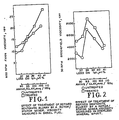
- Fann viscosity in cps is plotted as a function of milliequivalents of the amine added to the clay for the untreated bentonite samples, i.e., the prior art samples, and for the sample treated in accordance with the invention. (Loss on ignition is also plotted as abscissa, which is a measure of the organic combined with the clay). Viscosity measurements were effected by measuring a quantity of diesel oil into a multi-mixer can. In each instance, the sample to be evaluated was added to the diesel oil with stirring, after which water was stirred into the mix, the can removed from the mixer, and placed on the Fann viscometer, and the 600 and 300 rpm readings obtained. Gel readings were obtained after 10 seconds. The results show a good improvement where the process of the invention is used.
- Example 2 the same procedure was utilised as in Example 1, except that the effects of the invention on the gellant were evaluated by admixing same with odorless mineral spirits (OMS).
- OMS odorless mineral spirits
- a fixed quantity of the odorless mineral spirits was transferred to a container and the temperature is established for same.
- a small quantity of 100% propylene carbonate was added, while stirring.
- a specified quantity of the sample to be evaluated was transferred to the container, followed by vigorous stirring. The mixture was blunged with a Cowles blade for two minutes and the gel stirred for 10 revolutions with a spatula.
Landscapes
- Chemical & Material Sciences (AREA)
- Organic Chemistry (AREA)
- Health & Medical Sciences (AREA)
- General Health & Medical Sciences (AREA)
- Inorganic Chemistry (AREA)
- Silicates, Zeolites, And Molecular Sieves (AREA)
Priority Applications (2)
| Application Number | Priority Date | Filing Date | Title |
|---|---|---|---|
| AT88109351T ATE111057T1 (de) | 1985-10-18 | 1985-10-18 | Verfahren zur herstellung von organotonen mit verbesserten gel-bildungseigenschaften. |
| DE19853587926 DE3587926T2 (de) | 1985-10-18 | 1985-10-18 | Verfahren zur Herstellung von Organotonen mit verbesserten Gel-Bildungseigenschaften. |
Applications Claiming Priority (2)
| Application Number | Priority Date | Filing Date | Title |
|---|---|---|---|
| US06/551,957 US4569923A (en) | 1980-10-03 | 1983-11-15 | Process for manufacturing organoclays having enhanced gelling properties |
| EP19850307548 EP0220346B2 (de) | 1980-10-03 | 1985-10-18 | Verfahren zur Herstellung von Organotonen mit Gelbildungseigenschaften |
Related Parent Applications (1)
| Application Number | Title | Priority Date | Filing Date |
|---|---|---|---|
| EP85307548.9 Division | 1985-10-18 |
Publications (3)
| Publication Number | Publication Date |
|---|---|
| EP0307548A2 true EP0307548A2 (de) | 1989-03-22 |
| EP0307548A3 EP0307548A3 (en) | 1989-04-19 |
| EP0307548B1 EP0307548B1 (de) | 1994-09-07 |
Family
ID=26099407
Family Applications (1)
| Application Number | Title | Priority Date | Filing Date |
|---|---|---|---|
| EP88109351A Revoked EP0307548B1 (de) | 1983-11-15 | 1985-10-18 | Verfahren zur Herstellung von Organotonen mit verbesserten Gel-Bildungseigenschaften |
Country Status (1)
| Country | Link |
|---|---|
| EP (1) | EP0307548B1 (de) |
Citations (5)
| Publication number | Priority date | Publication date | Assignee | Title |
|---|---|---|---|---|
| US2531427A (en) | 1946-05-03 | 1950-11-28 | Ernst A Hauser | Modified gel-forming clay and process of producing same |
| US2966506A (en) | 1958-10-28 | 1960-12-27 | Nat Lead Co | Modified clay complexes and method of preparation |
| US3537994A (en) | 1967-07-25 | 1970-11-03 | Nat Lead Co | Organophilic clay greases |
| US3974125A (en) | 1974-09-27 | 1976-08-10 | Exxon Research And Engineering Company | Higher dialkyl dimethyl ammonium clay gelling agents for unsaturated polyester compositions |
| US4081496A (en) | 1977-06-27 | 1978-03-28 | N L Industries, Inc. | Thixotropic polyester compositions containing an organophilic clay gellant |
Family Cites Families (6)
| Publication number | Priority date | Publication date | Assignee | Title |
|---|---|---|---|---|
| US2173975A (en) * | 1936-02-14 | 1939-09-26 | Bird Machine Co | Method of and apparatus for blunging clay |
| GB1439828A (en) * | 1973-04-17 | 1976-06-16 | Laporte Industries Ltd | Organophilic clay mineral derivatives |
| US3951850A (en) * | 1973-06-22 | 1976-04-20 | Clocker Edwin T | Conversion of clay to its colloidal form by hydrodynamic attrition |
| US4371626A (en) * | 1981-04-13 | 1983-02-01 | Aurora Industries, Inc. | Method of upgrading crude sodium bentonite |
| US4469639A (en) * | 1982-04-28 | 1984-09-04 | Georgia Kaolin Company, Inc. | Preparation of organically modified smectites by treatment with methyl benzyl dialkyl ammonium halide |
| DE3304969A1 (de) * | 1983-02-12 | 1984-08-16 | Hans 4322 Sprockhövel Buchholz | Schermuehle |
-
1985
- 1985-10-18 EP EP88109351A patent/EP0307548B1/de not_active Revoked
Patent Citations (5)
| Publication number | Priority date | Publication date | Assignee | Title |
|---|---|---|---|---|
| US2531427A (en) | 1946-05-03 | 1950-11-28 | Ernst A Hauser | Modified gel-forming clay and process of producing same |
| US2966506A (en) | 1958-10-28 | 1960-12-27 | Nat Lead Co | Modified clay complexes and method of preparation |
| US3537994A (en) | 1967-07-25 | 1970-11-03 | Nat Lead Co | Organophilic clay greases |
| US3974125A (en) | 1974-09-27 | 1976-08-10 | Exxon Research And Engineering Company | Higher dialkyl dimethyl ammonium clay gelling agents for unsaturated polyester compositions |
| US4081496A (en) | 1977-06-27 | 1978-03-28 | N L Industries, Inc. | Thixotropic polyester compositions containing an organophilic clay gellant |
Also Published As
| Publication number | Publication date |
|---|---|
| EP0307548B1 (de) | 1994-09-07 |
| EP0307548A3 (en) | 1989-04-19 |
Similar Documents
| Publication | Publication Date | Title |
|---|---|---|
| US4569923A (en) | Process for manufacturing organoclays having enhanced gelling properties | |
| US5110501A (en) | Process for manufacturing organoclays having enhanced gelling properties | |
| US4664842A (en) | Process for manufacturing organoclays having enhanced gelling properties | |
| EP0160514B1 (de) | Organo-Tone | |
| US3671190A (en) | Synthetic clay-like minerals of the smectite type and method of preparation | |
| US5160454A (en) | Process for manufacturing organoclays having enhanced gelling properties | |
| US5739087A (en) | Organoclay products containing a branched chain alkyl quaternary ammonium ion | |
| US4208218A (en) | Viscosity increasing additive for non-aqueous fluid systems | |
| EP0222469B1 (de) | Verfahren zur Verbesserung der Dispergierbarkeit von Organoton | |
| US4054537A (en) | Process for synthesizing compositions containing smectite-type clays and gellants produced thereby | |
| US4382868A (en) | Organophilic clay gellants | |
| US5334241A (en) | Organophilic clay and method for its manufacture | |
| US4105578A (en) | Organophilic clay having enhanced dispersibility | |
| US2966506A (en) | Modified clay complexes and method of preparation | |
| US6172121B1 (en) | Process for preparing organoclays for aqueous and polar-organic systems | |
| US3954943A (en) | Synthesis of hydrous magnesium silicates | |
| CA2122808A1 (en) | Organoclay thickener compatible with system to be thickened | |
| US4422855A (en) | Method of thickening solutions using normally nongelling clays | |
| EP0215575B1 (de) | Herstellung von Organotonen und deren Verwendung zum erhöhen der Viskosität alkoholhaltiger Media | |
| EP0220346B1 (de) | Verfahren zur Herstellung von Organotonen mit Gelbildungseigenschaften | |
| DE69501989T2 (de) | Synthetisches Mischschichtsilicat und Methoden zu seiner Herstellung | |
| EP0135564B1 (de) | Thixotrope vernetzte ungesättigte polyesterzusammensetzungen und herstellungsverfahren | |
| EP0307548B1 (de) | Verfahren zur Herstellung von Organotonen mit verbesserten Gel-Bildungseigenschaften | |
| US3959118A (en) | Hydrocarbon cracking with synthetic smectite compositions | |
| EP0293016B1 (de) | Verfahren zur Herstellung von Organotonen mit verbesserten Gel-Bildungseigenschaften |
Legal Events
| Date | Code | Title | Description |
|---|---|---|---|
| PUAI | Public reference made under article 153(3) epc to a published international application that has entered the european phase |
Free format text: ORIGINAL CODE: 0009012 |
|
| PUAL | Search report despatched |
Free format text: ORIGINAL CODE: 0009013 |
|
| 17P | Request for examination filed |
Effective date: 19880628 |
|
| AC | Divisional application: reference to earlier application |
Ref document number: 220346 Country of ref document: EP |
|
| AK | Designated contracting states |
Kind code of ref document: A2 Designated state(s): AT BE CH DE FR GB IT LI LU NL SE |
|
| AK | Designated contracting states |
Kind code of ref document: A3 Designated state(s): AT BE CH DE FR GB IT LI LU NL SE |
|
| 17Q | First examination report despatched |
Effective date: 19900920 |
|
| GRAA | (expected) grant |
Free format text: ORIGINAL CODE: 0009210 |
|
| AC | Divisional application: reference to earlier application |
Ref document number: 220346 Country of ref document: EP |
|
| AK | Designated contracting states |
Kind code of ref document: B1 Designated state(s): AT BE CH DE FR GB IT LI LU NL SE |
|
| PG25 | Lapsed in a contracting state [announced via postgrant information from national office to epo] |
Ref country code: AT Effective date: 19940907 Ref country code: BE Effective date: 19940907 Ref country code: IT Free format text: LAPSE BECAUSE OF FAILURE TO SUBMIT A TRANSLATION OF THE DESCRIPTION OR TO PAY THE FEE WITHIN THE PRE;WARNING: LAPSES OF ITALIAN PATENTS WITH EFFECTIVE DATE BEFORE 2007 MAY HAVE OCCURRED AT ANY TIME BEFORE 2007. THE CORRECT EFFECTIVE DATE MAY BE DIFFERENT FROM THE ONE RECORDED.SCRIBED TIME-LIMIT Effective date: 19940907 |
|
| REF | Corresponds to: |
Ref document number: 111057 Country of ref document: AT Date of ref document: 19940915 Kind code of ref document: T |
|
| REF | Corresponds to: |
Ref document number: 3587926 Country of ref document: DE Date of ref document: 19941013 |
|
| PG25 | Lapsed in a contracting state [announced via postgrant information from national office to epo] |
Ref country code: LU Free format text: LAPSE BECAUSE OF NON-PAYMENT OF DUE FEES Effective date: 19941031 |
|
| ET | Fr: translation filed | ||
| PG25 | Lapsed in a contracting state [announced via postgrant information from national office to epo] |
Ref country code: SE Effective date: 19941207 |
|
| PLBI | Opposition filed |
Free format text: ORIGINAL CODE: 0009260 |
|
| 26 | Opposition filed |
Opponent name: SUED-CHEMIE AG Effective date: 19950607 |
|
| PGFP | Annual fee paid to national office [announced via postgrant information from national office to epo] |
Ref country code: NL Payment date: 19950912 Year of fee payment: 11 |
|
| PGFP | Annual fee paid to national office [announced via postgrant information from national office to epo] |
Ref country code: CH Payment date: 19950913 Year of fee payment: 11 Ref country code: FR Payment date: 19950913 Year of fee payment: 11 |
|
| PGFP | Annual fee paid to national office [announced via postgrant information from national office to epo] |
Ref country code: DE Payment date: 19950920 Year of fee payment: 11 |
|
| NLR1 | Nl: opposition has been filed with the epo |
Opponent name: SUED-CHEMIE AG |
|
| PGFP | Annual fee paid to national office [announced via postgrant information from national office to epo] |
Ref country code: GB Payment date: 19951011 Year of fee payment: 11 |
|
| PLBF | Reply of patent proprietor to notice(s) of opposition |
Free format text: ORIGINAL CODE: EPIDOS OBSO |
|
| RDAH | Patent revoked |
Free format text: ORIGINAL CODE: EPIDOS REVO |
|
| RDAG | Patent revoked |
Free format text: ORIGINAL CODE: 0009271 |
|
| STAA | Information on the status of an ep patent application or granted ep patent |
Free format text: STATUS: PATENT REVOKED |
|
| REG | Reference to a national code |
Ref country code: CH Ref legal event code: PL |
|
| GBPR | Gb: patent revoked under art. 102 of the ep convention designating the uk as contracting state |
Free format text: 961128 |
|
| 27W | Patent revoked |
Effective date: 19961128 |
|
| NLR2 | Nl: decision of opposition |