EP0306328B1 - Teaching device for artificial respiration - Google Patents
Teaching device for artificial respiration Download PDFInfo
- Publication number
- EP0306328B1 EP0306328B1 EP88308149A EP88308149A EP0306328B1 EP 0306328 B1 EP0306328 B1 EP 0306328B1 EP 88308149 A EP88308149 A EP 88308149A EP 88308149 A EP88308149 A EP 88308149A EP 0306328 B1 EP0306328 B1 EP 0306328B1
- Authority
- EP
- European Patent Office
- Prior art keywords
- bag
- head
- throat
- mouth
- artificial respiration
- Prior art date
- Legal status (The legal status is an assumption and is not a legal conclusion. Google has not performed a legal analysis and makes no representation as to the accuracy of the status listed.)
- Expired - Lifetime
Links
- 230000029058 respiratory gaseous exchange Effects 0.000 title claims description 10
- 210000004072 lung Anatomy 0.000 claims description 10
- 238000000034 method Methods 0.000 claims description 8
- 238000007664 blowing Methods 0.000 description 4
- 201000010099 disease Diseases 0.000 description 2
- 208000037265 diseases, disorders, signs and symptoms Diseases 0.000 description 2
- XLYOFNOQVPJJNP-UHFFFAOYSA-N water Substances O XLYOFNOQVPJJNP-UHFFFAOYSA-N 0.000 description 2
- 208000003443 Unconsciousness Diseases 0.000 description 1
- 230000002238 attenuated effect Effects 0.000 description 1
- 244000052616 bacterial pathogen Species 0.000 description 1
- 230000005540 biological transmission Effects 0.000 description 1
- 239000000969 carrier Substances 0.000 description 1
- 238000004140 cleaning Methods 0.000 description 1
- 230000005541 medical transmission Effects 0.000 description 1
- 239000011435 rock Substances 0.000 description 1
- 230000009182 swimming Effects 0.000 description 1
- 230000014599 transmission of virus Effects 0.000 description 1
Images

Classifications
-
- G—PHYSICS
- G09—EDUCATION; CRYPTOGRAPHY; DISPLAY; ADVERTISING; SEALS
- G09B—EDUCATIONAL OR DEMONSTRATION APPLIANCES; APPLIANCES FOR TEACHING, OR COMMUNICATING WITH, THE BLIND, DEAF OR MUTE; MODELS; PLANETARIA; GLOBES; MAPS; DIAGRAMS
- G09B23/00—Models for scientific, medical, or mathematical purposes, e.g. full-sized devices for demonstration purposes
- G09B23/28—Models for scientific, medical, or mathematical purposes, e.g. full-sized devices for demonstration purposes for medicine
- G09B23/288—Models for scientific, medical, or mathematical purposes, e.g. full-sized devices for demonstration purposes for medicine for artificial respiration or heart massage
Definitions
- This invention relates to a device for teaching artificial respiration to students.
- Patent Specification DE-A-1126170 shows a device of the relevant kind comprising a model head having air inlet openings at mouth and nose, a conduit leading therefrom to a valve, and another conduit leading from the valve to an air container.
- the whole is intended to simulate an unconscious person lying under a blanket, and is correspondingly bulky and expensive.
- a device comprises a hollow plastic head having mouth and throat openings, an inflatable bag removably attached about the throat opening and adapted to receive air blown into the mouth and through the throat, a flat portion at the back of the head to teach the student to rock the head back to open the throat of the victim.
- Such a device may be produced at sufficiently low cost that each student may be provided with his or her own device.
- the device is also adaptable to simulate the lung capacity of an adult, adolescent or child, and may be used in a pool to simulate the teaching of mouth-to-mouth resuscitation of a person in the water.
- a flow constricting device is preferably provided in the throat to resist the flow of air.
- the head be provided with a nose opening having two nostrils so that the student can simulate pinching the nose closed while blowing air into the mouth.
- the bag which receives the air may be attached to the neck by means of an elastic fitted about the bag and the neck.
- the neck portion may have a groove about its circumference to receive the bag and the elastic.
- the capacity of the bag may be adjusted by placing the elastic about the bag at different intervals along the bag's length.
- Figure 1 is a side view of the head of the preferred embodiment of the invention.
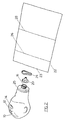
- Figure 2 is an exploded view of the components of the preferred embodiment of the invention.
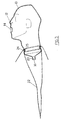
- Figure 3 is a side view of the components of the combination of the preferred embodiment of the invention fastened together.
- the head (10) is a hollow plastic shell having openings for nostrils (12), mouth (14) and a throat (16) which communicates with the interior of the hollow plastic head (10).
- the head (10) also has a flat portion (18) at the back of the head to permit the head to be rocked back and held firmly in the rock-back position. Because of the intercommunication of the openings of the nostrils (12), the mouth (14) and the throat (16), air may be blown into the mouth (14) to exhaust either through the nostrils (12) or the throat (16). Accordingly, a student blowing into the mouth should plug the nostrils (12) in order to direct air through the throat opening (16).
- the throat opening (16) is attenuated to a small diameter by comparison to the opening of the mouth in order to help constrict the flow of air thereby simulating the reverse back pressure of a lung.
- a number of alternative means may be used to constrict the flow through the throat area.
- the throat opening (16) is shown to have a screw-on attachment (20) which is adapted to constrict the flow of air through the throat (16).
- FIG. 2 Also illustrated in Figure 2 is the lung bag (22) and fastening elastic (24).
- the lung bag is adapted to fit over the neck portion of the head (10) with elastic (24) outside the bag (22) to fasten the bag (22) into the neck groove (25).
- Markings (26) and (28) are presented on the lung bag (22) to illustrate where the elastic should be fastened in order to simulate the lung size of an adult or a child.
- the lung bag is fitted over the neck groove (25) with the elastic band (24) securing the bag to the neck groove.
- a student fits together the components of the doll, as illustrated in Figure 3, then follows through the procedure of artificial respiration including tilting the head back to lie on the flat portion (18), pincing the nose and blowing into the mouth to inflate the bag (22) through the throat (16).
- the device in its combined form is water-tight except for the nostril and mouth openings (12) and (14), respectively, and therefore may be used by students in the water as well as on the side of the pool or on the beach. Students may purchase a doll as part of the tuition fee for taking the course and when they complete the course they may keep the doll for practice at home or simply dispose of it.
Landscapes
- Engineering & Computer Science (AREA)
- General Physics & Mathematics (AREA)
- Health & Medical Sciences (AREA)
- Physics & Mathematics (AREA)
- Computational Mathematics (AREA)
- Mathematical Optimization (AREA)
- Medical Informatics (AREA)
- Medicinal Chemistry (AREA)
- Chemical & Material Sciences (AREA)
- Algebra (AREA)
- Heart & Thoracic Surgery (AREA)
- Cardiology (AREA)
- Mathematical Analysis (AREA)
- General Health & Medical Sciences (AREA)
- Mathematical Physics (AREA)
- Pure & Applied Mathematics (AREA)
- Business, Economics & Management (AREA)
- Educational Administration (AREA)
- Educational Technology (AREA)
- Theoretical Computer Science (AREA)
- Respiratory Apparatuses And Protective Means (AREA)
- Instructional Devices (AREA)
- Toys (AREA)
Description
- This invention relates to a device for teaching artificial respiration to students.
- Artificial respiration is an important aspect of the teaching program in first aid courses and swimming courses.
- One of the most popular methods of artificial respiration involves blowing air from the lungs of the rescuer into the lungs of the victim. Since this method requires mouth-to-mouth contact between the rescuer and the victim, it is sometimes difficult to teach the technique in a class. Students may object to taking the course if it requires them to make mouth-to-mouth contact with other students who may be strangers to them. As a result, artificial respiration dolls have been used to help students overcome the social embarrassment associated with mouth-to-mouth contact with a stranger.
- Accordingly, it has become commonplace to use a doll to initiate students to the concepts of the mouth-to-mouth artificial respiration technique. Since the types of dolls which have been developed for teaching tend to be expensive, it is commonplace for each student to take a turn practicing the technique on the doll. Where many students use the same doll, it is most important that the doll be cleaned between uses to avoid the transmission of viruses and germs between the students. Methods of cleaning such dolls have been developed but there is another problem which remains unsolved, that is, even if the doll is perfectly clean, it may not be perceived to be clean by the students in the course or by prospective students about to enroll in such a course. Concern about the transmission of diseases is increasing. Persons who may not appear to be ill and who may not know that they are ill may be carriers of debilitating or even fatal diseases. As a result, it is perceived that there is increasing reluctance of students to enroll in courses or to participate in exercises that require them to expose themselves to real or imagined risks of disease transmission.
- Patent Specification DE-A-1126170 shows a device of the relevant kind comprising a model head having air inlet openings at mouth and nose, a conduit leading therefrom to a valve, and another conduit leading from the valve to an air container. The whole is intended to simulate an unconscious person lying under a blanket, and is correspondingly bulky and expensive.
- A device according to the invention comprises a hollow plastic head having mouth and throat openings, an inflatable bag removably attached about the throat opening and adapted to receive air blown into the mouth and through the throat, a flat portion at the back of the head to teach the student to rock the head back to open the throat of the victim.
- Such a device may be produced at sufficiently low cost that each student may be provided with his or her own device. The device is also adaptable to simulate the lung capacity of an adult, adolescent or child, and may be used in a pool to simulate the teaching of mouth-to-mouth resuscitation of a person in the water. A flow constricting device is preferably provided in the throat to resist the flow of air.
- It is preferred that the head be provided with a nose opening having two nostrils so that the student can simulate pinching the nose closed while blowing air into the mouth.
- The bag which receives the air may be attached to the neck by means of an elastic fitted about the bag and the neck. The neck portion may have a groove about its circumference to receive the bag and the elastic. The capacity of the bag may be adjusted by placing the elastic about the bag at different intervals along the bag's length.
- Figure 1 is a side view of the head of the preferred embodiment of the invention.
- Figure 2 is an exploded view of the components of the preferred embodiment of the invention.
- Figure 3 is a side view of the components of the combination of the preferred embodiment of the invention fastened together.
- Referring to Figure 1, the head (10) is a hollow plastic shell having openings for nostrils (12), mouth (14) and a throat (16) which communicates with the interior of the hollow plastic head (10). The head (10) also has a flat portion (18) at the back of the head to permit the head to be rocked back and held firmly in the rock-back position. Because of the intercommunication of the openings of the nostrils (12), the mouth (14) and the throat (16), air may be blown into the mouth (14) to exhaust either through the nostrils (12) or the throat (16). Accordingly, a student blowing into the mouth should plug the nostrils (12) in order to direct air through the throat opening (16).
- The throat opening (16) is attenuated to a small diameter by comparison to the opening of the mouth in order to help constrict the flow of air thereby simulating the reverse back pressure of a lung. A number of alternative means may be used to constrict the flow through the throat area. As an example of such means, in Figure 2, the throat opening (16) is shown to have a screw-on attachment (20) which is adapted to constrict the flow of air through the throat (16). This is an alternative embodiment which permits the flow constriction device to be changed in size to simulate different back pressures for adults or children.
- Also illustrated in Figure 2 is the lung bag (22) and fastening elastic (24). The lung bag is adapted to fit over the neck portion of the head (10) with elastic (24) outside the bag (22) to fasten the bag (22) into the neck groove (25). Markings (26) and (28) are presented on the lung bag (22) to illustrate where the elastic should be fastened in order to simulate the lung size of an adult or a child.
- As illustrated in Figure 3, the lung bag is fitted over the neck groove (25) with the elastic band (24) securing the bag to the neck groove. In operation, a student fits together the components of the doll, as illustrated in Figure 3, then follows through the procedure of artificial respiration including tilting the head back to lie on the flat portion (18), pincing the nose and blowing into the mouth to inflate the bag (22) through the throat (16).
- The device in its combined form is water-tight except for the nostril and mouth openings (12) and (14), respectively, and therefore may be used by students in the water as well as on the side of the pool or on the beach. Students may purchase a doll as part of the tuition fee for taking the course and when they complete the course they may keep the doll for practice at home or simply dispose of it.
Claims (3)
- An artificial respiration teaching device comprising a head (10) having mouth (14) and throat (16) openings and an inflatable bag (22) adapted to receive air blown into the mouth (14) and through the throat (16) characterized in that the head (10) is of hollow plastic, the bag (22) is removably attached about the throat opening (16), and the head has a flat portion at the back adapted to permit the head to be rocked back on a flat surface to simulate the head tilting procedure commonly used to open the throat of a victim.
- An artificial respiration teaching device according to claim 1 having a flow constricting device (20) at the throat opening (16).
- An artificial respiration teaching device according to claim 1 or claim 2 in which the bag (22) is adaptable to simulate the lung capacity of an adult, adolescent or child by placing an elastic about the bag at different intervals along the bag's length.
Applications Claiming Priority (2)
| Application Number | Priority Date | Filing Date | Title |
|---|---|---|---|
| CA546106 | 1987-09-03 | ||
| CA546106 | 1987-09-03 |
Publications (2)
| Publication Number | Publication Date |
|---|---|
| EP0306328A1 EP0306328A1 (en) | 1989-03-08 |
| EP0306328B1 true EP0306328B1 (en) | 1993-03-24 |
Family
ID=4136384
Family Applications (1)
| Application Number | Title | Priority Date | Filing Date |
|---|---|---|---|
| EP88308149A Expired - Lifetime EP0306328B1 (en) | 1987-09-03 | 1988-09-02 | Teaching device for artificial respiration |
Country Status (5)
| Country | Link |
|---|---|
| US (1) | US5083559A (en) |
| EP (1) | EP0306328B1 (en) |
| JP (1) | JP2606899B2 (en) |
| AU (1) | AU2186988A (en) |
| DE (1) | DE3879590T2 (en) |
Families Citing this family (20)
| Publication number | Priority date | Publication date | Assignee | Title |
|---|---|---|---|---|
| EP0396799B1 (en) * | 1989-05-11 | 1995-03-01 | Asmund S. Laerdal A/S | Model for practising artificial respiration, and respiratory tract simulator therefor |
| US4984987A (en) * | 1989-11-09 | 1991-01-15 | Actar Airforce, Inc. | CPR manikin |
| CA2065184C (en) * | 1992-04-06 | 1996-12-03 | Richard Brault | Valve means for training manikin |
| US5312259A (en) * | 1993-04-19 | 1994-05-17 | Stephen Flynn | CPR mannequin |
| US5885084A (en) * | 1997-03-12 | 1999-03-23 | Cpr Prompt, L.L.C. | Cardiopulmonary resuscitation manikin |
| US6780017B2 (en) | 1998-09-21 | 2004-08-24 | Cardiac Science, Inc. | Cardiopulmonary resuscitation manikin with replaceable lung bag and installation tool |
| US7044128B2 (en) * | 2003-04-08 | 2006-05-16 | Advanced Circulatory Systems, Inc. | CPR demonstration device and methods |
| EP3064242A1 (en) | 2003-04-28 | 2016-09-07 | Advanced Circulatory Systems Inc. | Ventilator and methods for treating head trauma and low blood circulation |
| US9092995B2 (en) | 2005-09-01 | 2015-07-28 | Prestan Products Llc | Medical training device |
| US8465293B2 (en) | 2005-09-01 | 2013-06-18 | Prestan Products Llc | Medical training device |
| NL1030574C2 (en) * | 2005-12-02 | 2007-06-05 | Jan Paul Van Geuns | Respiratory device for use in event of fire, comprises inflatable bag with mouthpiece containing check valve |
| KR100776364B1 (en) | 2006-10-31 | 2007-11-15 | 연세흠 | Respiratory Practice |
| US8151790B2 (en) | 2007-04-19 | 2012-04-10 | Advanced Circulatory Systems, Inc. | Volume exchanger valve system and method to increase circulation during CPR |
| US9352111B2 (en) | 2007-04-19 | 2016-05-31 | Advanced Circulatory Systems, Inc. | Systems and methods to increase survival with favorable neurological function after cardiac arrest |
| US12016820B2 (en) | 2010-02-12 | 2024-06-25 | Zoll Medical Corporation | Enhanced guided active compression decompression cardiopulmonary resuscitation systems and methods |
| US9724266B2 (en) | 2010-02-12 | 2017-08-08 | Zoll Medical Corporation | Enhanced guided active compression decompression cardiopulmonary resuscitation systems and methods |
| EP3560537B1 (en) | 2011-12-19 | 2021-03-24 | Zoll Medical Corporation | Systems for therapeutic intrathoracic pressure regulation |
| US9811634B2 (en) | 2013-04-25 | 2017-11-07 | Zoll Medical Corporation | Systems and methods to predict the chances of neurologically intact survival while performing CPR |
| US20140358047A1 (en) | 2013-05-30 | 2014-12-04 | ResQSystems, Inc. | End-tidal carbon dioxide and amplitude spectral area as non-invasive markers of coronary perfusion pressure and arterial pressure |
| US10265495B2 (en) | 2013-11-22 | 2019-04-23 | Zoll Medical Corporation | Pressure actuated valve systems and methods |
Family Cites Families (7)
| Publication number | Priority date | Publication date | Assignee | Title |
|---|---|---|---|---|
| US2904898A (en) * | 1958-10-07 | 1959-09-22 | Herman A Marsden | Training apparatus for practicing artificial respiration |
| DE1126170B (en) * | 1958-11-10 | 1962-03-22 | Holger Hesse Dr | Device for practicing resuscitation attempts |
| FR1207372A (en) * | 1958-11-13 | 1960-02-16 | Insufflation artificial respiration machine | |
| US3068590A (en) * | 1960-03-17 | 1962-12-18 | Ralph M Padellford | Resuscitation training device |
| GB941590A (en) * | 1961-01-27 | 1963-11-13 | Max Cheshire Ltd | Improvements relating to apparatus for demonstrating, training and teaching resuscitation and lifesaving techniques |
| JPS5547395B2 (en) * | 1972-04-10 | 1980-11-29 | ||
| AT355839B (en) * | 1973-04-10 | 1980-03-25 | Hesse Ruth Lea | ARTIFICIAL VENTILATION MODEL |
-
1988
- 1988-09-01 US US07/239,500 patent/US5083559A/en not_active Expired - Lifetime
- 1988-09-02 EP EP88308149A patent/EP0306328B1/en not_active Expired - Lifetime
- 1988-09-02 DE DE8888308149T patent/DE3879590T2/en not_active Expired - Lifetime
- 1988-09-02 JP JP63220255A patent/JP2606899B2/en not_active Expired - Lifetime
- 1988-09-05 AU AU21869/88A patent/AU2186988A/en not_active Abandoned
Also Published As
| Publication number | Publication date |
|---|---|
| JPH01163793A (en) | 1989-06-28 |
| DE3879590T2 (en) | 1993-07-01 |
| JP2606899B2 (en) | 1997-05-07 |
| AU2186988A (en) | 1989-03-09 |
| DE3879590D1 (en) | 1993-04-29 |
| US5083559A (en) | 1992-01-28 |
| EP0306328A1 (en) | 1989-03-08 |
Similar Documents
| Publication | Publication Date | Title |
|---|---|---|
| US5083559A (en) | Artificial respiration breathing device | |
| JP2854972B2 (en) | Cardiopulmonary resuscitation professor phantom | |
| US6780017B2 (en) | Cardiopulmonary resuscitation manikin with replaceable lung bag and installation tool | |
| JP2525115B2 (en) | Valve means for training manikin | |
| US5885084A (en) | Cardiopulmonary resuscitation manikin | |
| EP0417026B1 (en) | Protective device kit for use in pulmonary ventilation treatment by the mouth-to-mouth or mouth-to-nose methods | |
| US4850876A (en) | Training device for practicing emergency life saving techniques | |
| US3199225A (en) | Resuscitation teaching apparatus | |
| US4762494A (en) | Psychotherapy device | |
| Elam et al. | Head-tilt method of oral resuscitation | |
| US5249968A (en) | CPR manikin (piston) | |
| JP2007505360A (en) | CPR training device | |
| CA2174778A1 (en) | Method and device for assisting cardiopulmonary resuscitation | |
| US4697587A (en) | Disposable mouth-to-mouth resuscitation device | |
| US3274705A (en) | Apparatus for practising and teaching expired air artificial respiration | |
| CN211752266U (en) | Medical treatment is with lung function training ware | |
| US6530783B1 (en) | Cardiopulmonary resuscitation mannequin | |
| RU2144218C1 (en) | Training device for acquiring first aid skills | |
| CN112908141B (en) | Student prevents drowned training teaching device | |
| KR200300833Y1 (en) | Equipment for breathing capacity increase | |
| ES217105U (en) | Maniqui to exercise artificial breathing according to the method of mouth to mouth or mouth to nose. (Machine-translation by Google Translate, not legally binding) | |
| WO1999033506A1 (en) | Resuscitation device and method of using the same | |
| TW200540737A (en) | Training manikin | |
| Featherstone et al. | Manikins and training aids in resuscitation | |
| Ruben et al. | A resuscitation manikin. |
Legal Events
| Date | Code | Title | Description |
|---|---|---|---|
| PUAI | Public reference made under article 153(3) epc to a published international application that has entered the european phase |
Free format text: ORIGINAL CODE: 0009012 |
|
| AK | Designated contracting states |
Kind code of ref document: A1 Designated state(s): DE GB |
|
| 17P | Request for examination filed |
Effective date: 19890812 |
|
| 17Q | First examination report despatched |
Effective date: 19910529 |
|
| RTI1 | Title (correction) | ||
| RAP1 | Party data changed (applicant data changed or rights of an application transferred) |
Owner name: ACTAR AIRFORCE, INC. |
|
| RIN1 | Information on inventor provided before grant (corrected) |
Inventor name: BRAULT, RICHARD Inventor name: CROTEAU, DIANNE Inventor name: VINDEN, JONATHAN |
|
| GRAA | (expected) grant |
Free format text: ORIGINAL CODE: 0009210 |
|
| AK | Designated contracting states |
Kind code of ref document: B1 Designated state(s): DE GB |
|
| REF | Corresponds to: |
Ref document number: 3879590 Country of ref document: DE Date of ref document: 19930429 |
|
| PLBE | No opposition filed within time limit |
Free format text: ORIGINAL CODE: 0009261 |
|
| STAA | Information on the status of an ep patent application or granted ep patent |
Free format text: STATUS: NO OPPOSITION FILED WITHIN TIME LIMIT |
|
| 26N | No opposition filed | ||
| REG | Reference to a national code |
Ref country code: GB Ref legal event code: IF02 |
|
| PGFP | Annual fee paid to national office [announced via postgrant information from national office to epo] |
Ref country code: DE Payment date: 20070830 Year of fee payment: 20 |
|
| PGFP | Annual fee paid to national office [announced via postgrant information from national office to epo] |
Ref country code: GB Payment date: 20070829 Year of fee payment: 20 |
|
| REG | Reference to a national code |
Ref country code: GB Ref legal event code: PE20 Expiry date: 20080901 |
|
| PG25 | Lapsed in a contracting state [announced via postgrant information from national office to epo] |
Ref country code: GB Free format text: LAPSE BECAUSE OF EXPIRATION OF PROTECTION Effective date: 20080901 |