EP0304406B1 - Apparatus for automatically counting the microorganisms possibly present in liquids, particularly in waters for human use - Google Patents
Apparatus for automatically counting the microorganisms possibly present in liquids, particularly in waters for human use Download PDFInfo
- Publication number
- EP0304406B1 EP0304406B1 EP88830340A EP88830340A EP0304406B1 EP 0304406 B1 EP0304406 B1 EP 0304406B1 EP 88830340 A EP88830340 A EP 88830340A EP 88830340 A EP88830340 A EP 88830340A EP 0304406 B1 EP0304406 B1 EP 0304406B1
- Authority
- EP
- European Patent Office
- Prior art keywords
- liquid
- cells
- microorganisms
- sensor
- waters
- Prior art date
- Legal status (The legal status is an assumption and is not a legal conclusion. Google has not performed a legal analysis and makes no representation as to the accuracy of the status listed.)
- Expired - Lifetime
Links
- 239000007788 liquid Substances 0.000 title claims abstract description 35
- 244000005700 microbiome Species 0.000 title claims abstract description 33
- 239000003643 water by type Substances 0.000 title claims abstract description 14
- XLYOFNOQVPJJNP-UHFFFAOYSA-N water Substances O XLYOFNOQVPJJNP-UHFFFAOYSA-N 0.000 claims abstract description 35
- 238000005406 washing Methods 0.000 claims abstract description 12
- 230000001954 sterilising effect Effects 0.000 claims abstract description 11
- 230000004048 modification Effects 0.000 claims description 13
- 238000012986 modification Methods 0.000 claims description 13
- CURLTUGMZLYLDI-UHFFFAOYSA-N Carbon dioxide Chemical compound O=C=O CURLTUGMZLYLDI-UHFFFAOYSA-N 0.000 claims description 12
- 235000015097 nutrients Nutrition 0.000 claims description 11
- 239000000126 substance Substances 0.000 claims description 11
- 230000002572 peristaltic effect Effects 0.000 claims description 9
- 238000005070 sampling Methods 0.000 claims description 8
- QVGXLLKOCUKJST-UHFFFAOYSA-N atomic oxygen Chemical compound [O] QVGXLLKOCUKJST-UHFFFAOYSA-N 0.000 claims description 6
- 229910002092 carbon dioxide Inorganic materials 0.000 claims description 6
- 239000001301 oxygen Substances 0.000 claims description 6
- 229910052760 oxygen Inorganic materials 0.000 claims description 6
- 239000001569 carbon dioxide Substances 0.000 claims description 5
- 230000003287 optical effect Effects 0.000 claims description 5
- 239000000203 mixture Substances 0.000 claims description 4
- 238000000855 fermentation Methods 0.000 claims description 3
- 230000004151 fermentation Effects 0.000 claims description 3
- 238000003756 stirring Methods 0.000 claims description 2
- 239000011521 glass Substances 0.000 claims 1
- 239000000463 material Substances 0.000 claims 1
- 241000894006 Bacteria Species 0.000 abstract description 14
- 230000001580 bacterial effect Effects 0.000 abstract description 10
- 239000003153 chemical reaction reagent Substances 0.000 abstract description 8
- 238000005259 measurement Methods 0.000 abstract description 7
- 238000004458 analytical method Methods 0.000 abstract description 2
- 230000005540 biological transmission Effects 0.000 abstract 1
- 238000001514 detection method Methods 0.000 description 18
- 238000012360 testing method Methods 0.000 description 11
- 239000002609 medium Substances 0.000 description 9
- 241000588724 Escherichia coli Species 0.000 description 7
- 230000002503 metabolic effect Effects 0.000 description 6
- 238000000034 method Methods 0.000 description 6
- GUBGYTABKSRVRQ-QKKXKWKRSA-N Lactose Natural products OC[C@H]1O[C@@H](O[C@H]2[C@H](O)[C@@H](O)C(O)O[C@@H]2CO)[C@H](O)[C@@H](O)[C@H]1O GUBGYTABKSRVRQ-QKKXKWKRSA-N 0.000 description 5
- 230000002550 fecal effect Effects 0.000 description 5
- 239000008101 lactose Substances 0.000 description 5
- WQZGKKKJIJFFOK-GASJEMHNSA-N Glucose Natural products OC[C@H]1OC(O)[C@H](O)[C@@H](O)[C@@H]1O WQZGKKKJIJFFOK-GASJEMHNSA-N 0.000 description 4
- 239000001888 Peptone Substances 0.000 description 4
- 108010080698 Peptones Proteins 0.000 description 4
- 230000004075 alteration Effects 0.000 description 4
- 235000019319 peptone Nutrition 0.000 description 4
- QTWJRLJHJPIABL-UHFFFAOYSA-N 2-methylphenol;3-methylphenol;4-methylphenol Chemical compound CC1=CC=C(O)C=C1.CC1=CC=CC(O)=C1.CC1=CC=CC=C1O QTWJRLJHJPIABL-UHFFFAOYSA-N 0.000 description 3
- WKBOTKDWSSQWDR-UHFFFAOYSA-N Bromine atom Chemical compound [Br] WKBOTKDWSSQWDR-UHFFFAOYSA-N 0.000 description 3
- 229910019142 PO4 Inorganic materials 0.000 description 3
- GDTBXPJZTBHREO-UHFFFAOYSA-N bromine Substances BrBr GDTBXPJZTBHREO-UHFFFAOYSA-N 0.000 description 3
- 229910052794 bromium Inorganic materials 0.000 description 3
- 229930003836 cresol Natural products 0.000 description 3
- 230000004060 metabolic process Effects 0.000 description 3
- NBIIXXVUZAFLBC-UHFFFAOYSA-K phosphate Chemical compound [O-]P([O-])([O-])=O NBIIXXVUZAFLBC-UHFFFAOYSA-K 0.000 description 3
- 239000010452 phosphate Substances 0.000 description 3
- ZKHQWZAMYRWXGA-KQYNXXCUSA-N Adenosine triphosphate Chemical compound C1=NC=2C(N)=NC=NC=2N1[C@@H]1O[C@H](COP(O)(=O)OP(O)(=O)OP(O)(O)=O)[C@@H](O)[C@H]1O ZKHQWZAMYRWXGA-KQYNXXCUSA-N 0.000 description 2
- ZKHQWZAMYRWXGA-UHFFFAOYSA-N Adenosine triphosphate Natural products C1=NC=2C(N)=NC=NC=2N1C1OC(COP(O)(=O)OP(O)(=O)OP(O)(O)=O)C(O)C1O ZKHQWZAMYRWXGA-UHFFFAOYSA-N 0.000 description 2
- IGXWBGJHJZYPQS-SSDOTTSWSA-N D-Luciferin Chemical compound OC(=O)[C@H]1CSC(C=2SC3=CC=C(O)C=C3N=2)=N1 IGXWBGJHJZYPQS-SSDOTTSWSA-N 0.000 description 2
- CYCGRDQQIOGCKX-UHFFFAOYSA-N Dehydro-luciferin Natural products OC(=O)C1=CSC(C=2SC3=CC(O)=CC=C3N=2)=N1 CYCGRDQQIOGCKX-UHFFFAOYSA-N 0.000 description 2
- 241000194032 Enterococcus faecalis Species 0.000 description 2
- BJGNCJDXODQBOB-UHFFFAOYSA-N Fivefly Luciferin Natural products OC(=O)C1CSC(C=2SC3=CC(O)=CC=C3N=2)=N1 BJGNCJDXODQBOB-UHFFFAOYSA-N 0.000 description 2
- DDWFXDSYGUXRAY-UHFFFAOYSA-N Luciferin Natural products CCc1c(C)c(CC2NC(=O)C(=C2C=C)C)[nH]c1Cc3[nH]c4C(=C5/NC(CC(=O)O)C(C)C5CC(=O)O)CC(=O)c4c3C DDWFXDSYGUXRAY-UHFFFAOYSA-N 0.000 description 2
- 241001465754 Metazoa Species 0.000 description 2
- PXIPVTKHYLBLMZ-UHFFFAOYSA-N Sodium azide Chemical compound [Na+].[N-]=[N+]=[N-] PXIPVTKHYLBLMZ-UHFFFAOYSA-N 0.000 description 2
- 239000002253 acid Substances 0.000 description 2
- 150000007513 acids Chemical class 0.000 description 2
- 229960001456 adenosine triphosphate Drugs 0.000 description 2
- 238000011109 contamination Methods 0.000 description 2
- 238000011161 development Methods 0.000 description 2
- 239000008121 dextrose Substances 0.000 description 2
- 239000008103 glucose Substances 0.000 description 2
- 239000012535 impurity Substances 0.000 description 2
- 238000004519 manufacturing process Methods 0.000 description 2
- 238000012543 microbiological analysis Methods 0.000 description 2
- 238000004659 sterilization and disinfection Methods 0.000 description 2
- 230000002123 temporal effect Effects 0.000 description 2
- GUBGYTABKSRVRQ-XLOQQCSPSA-N Alpha-Lactose Chemical compound O[C@@H]1[C@@H](O)[C@@H](O)[C@@H](CO)O[C@H]1O[C@@H]1[C@@H](CO)O[C@H](O)[C@H](O)[C@H]1O GUBGYTABKSRVRQ-XLOQQCSPSA-N 0.000 description 1
- 241000192125 Firmicutes Species 0.000 description 1
- UFHFLCQGNIYNRP-UHFFFAOYSA-N Hydrogen Chemical compound [H][H] UFHFLCQGNIYNRP-UHFFFAOYSA-N 0.000 description 1
- 241000194017 Streptococcus Species 0.000 description 1
- CZMRCDWAGMRECN-UGDNZRGBSA-N Sucrose Chemical compound O[C@H]1[C@H](O)[C@@H](CO)O[C@@]1(CO)O[C@@H]1[C@H](O)[C@@H](O)[C@H](O)[C@@H](CO)O1 CZMRCDWAGMRECN-UGDNZRGBSA-N 0.000 description 1
- 229930006000 Sucrose Natural products 0.000 description 1
- 108010067973 Valinomycin Proteins 0.000 description 1
- DKLSHXFSAVNFSP-UHFFFAOYSA-N [Na+].[N-]=[N+]=[N-].OP(O)(O)=O Chemical compound [Na+].[N-]=[N+]=[N-].OP(O)(O)=O DKLSHXFSAVNFSP-UHFFFAOYSA-N 0.000 description 1
- 230000009471 action Effects 0.000 description 1
- 230000000721 bacterilogical effect Effects 0.000 description 1
- WQZGKKKJIJFFOK-VFUOTHLCSA-N beta-D-glucose Chemical compound OC[C@H]1O[C@@H](O)[C@H](O)[C@@H](O)[C@@H]1O WQZGKKKJIJFFOK-VFUOTHLCSA-N 0.000 description 1
- 229940041514 candida albicans extract Drugs 0.000 description 1
- 238000012512 characterization method Methods 0.000 description 1
- 238000005660 chlorination reaction Methods 0.000 description 1
- FCFNRCROJUBPLU-UHFFFAOYSA-N compound M126 Natural products CC(C)C1NC(=O)C(C)OC(=O)C(C(C)C)NC(=O)C(C(C)C)OC(=O)C(C(C)C)NC(=O)C(C)OC(=O)C(C(C)C)NC(=O)C(C(C)C)OC(=O)C(C(C)C)NC(=O)C(C)OC(=O)C(C(C)C)NC(=O)C(C(C)C)OC1=O FCFNRCROJUBPLU-UHFFFAOYSA-N 0.000 description 1
- 230000001143 conditioned effect Effects 0.000 description 1
- 238000010276 construction Methods 0.000 description 1
- 230000008878 coupling Effects 0.000 description 1
- 238000010168 coupling process Methods 0.000 description 1
- 238000005859 coupling reaction Methods 0.000 description 1
- 239000012531 culture fluid Substances 0.000 description 1
- GYOZYWVXFNDGLU-XLPZGREQSA-N dTMP Chemical compound O=C1NC(=O)C(C)=CN1[C@@H]1O[C@H](COP(O)(O)=O)[C@@H](O)C1 GYOZYWVXFNDGLU-XLPZGREQSA-N 0.000 description 1
- 238000007405 data analysis Methods 0.000 description 1
- 238000007865 diluting Methods 0.000 description 1
- -1 dipotassic Substances 0.000 description 1
- 239000000428 dust Substances 0.000 description 1
- 239000003344 environmental pollutant Substances 0.000 description 1
- 239000007789 gas Substances 0.000 description 1
- 230000036541 health Effects 0.000 description 1
- 239000001257 hydrogen Substances 0.000 description 1
- 229910052739 hydrogen Inorganic materials 0.000 description 1
- 230000002401 inhibitory effect Effects 0.000 description 1
- 230000010354 integration Effects 0.000 description 1
- 239000006193 liquid solution Substances 0.000 description 1
- 238000002156 mixing Methods 0.000 description 1
- 230000003647 oxidation Effects 0.000 description 1
- 238000007254 oxidation reaction Methods 0.000 description 1
- 230000036284 oxygen consumption Effects 0.000 description 1
- 231100000719 pollutant Toxicity 0.000 description 1
- 230000009467 reduction Effects 0.000 description 1
- 239000006152 selective media Substances 0.000 description 1
- 235000010378 sodium ascorbate Nutrition 0.000 description 1
- PPASLZSBLFJQEF-RKJRWTFHSA-M sodium ascorbate Substances [Na+].OC[C@@H](O)[C@H]1OC(=O)C(O)=C1[O-] PPASLZSBLFJQEF-RKJRWTFHSA-M 0.000 description 1
- 229960005055 sodium ascorbate Drugs 0.000 description 1
- SUKJFIGYRHOWBL-UHFFFAOYSA-N sodium hypochlorite Chemical compound [Na+].Cl[O-] SUKJFIGYRHOWBL-UHFFFAOYSA-N 0.000 description 1
- PPASLZSBLFJQEF-RXSVEWSESA-M sodium-L-ascorbate Chemical compound [Na+].OC[C@H](O)[C@H]1OC(=O)C(O)=C1[O-] PPASLZSBLFJQEF-RXSVEWSESA-M 0.000 description 1
- 239000000758 substrate Substances 0.000 description 1
- 239000005720 sucrose Substances 0.000 description 1
- 239000002352 surface water Substances 0.000 description 1
- 239000000725 suspension Substances 0.000 description 1
- FCFNRCROJUBPLU-DNDCDFAISA-N valinomycin Chemical compound CC(C)[C@@H]1NC(=O)[C@H](C)OC(=O)[C@@H](C(C)C)NC(=O)[C@@H](C(C)C)OC(=O)[C@H](C(C)C)NC(=O)[C@H](C)OC(=O)[C@@H](C(C)C)NC(=O)[C@@H](C(C)C)OC(=O)[C@H](C(C)C)NC(=O)[C@H](C)OC(=O)[C@@H](C(C)C)NC(=O)[C@@H](C(C)C)OC1=O FCFNRCROJUBPLU-DNDCDFAISA-N 0.000 description 1
- 239000012138 yeast extract Substances 0.000 description 1
Images

Classifications
-
- C—CHEMISTRY; METALLURGY
- C12—BIOCHEMISTRY; BEER; SPIRITS; WINE; VINEGAR; MICROBIOLOGY; ENZYMOLOGY; MUTATION OR GENETIC ENGINEERING
- C12Q—MEASURING OR TESTING PROCESSES INVOLVING ENZYMES, NUCLEIC ACIDS OR MICROORGANISMS; COMPOSITIONS OR TEST PAPERS THEREFOR; PROCESSES OF PREPARING SUCH COMPOSITIONS; CONDITION-RESPONSIVE CONTROL IN MICROBIOLOGICAL OR ENZYMOLOGICAL PROCESSES
- C12Q1/00—Measuring or testing processes involving enzymes, nucleic acids or microorganisms; Compositions therefor; Processes of preparing such compositions
- C12Q1/02—Measuring or testing processes involving enzymes, nucleic acids or microorganisms; Compositions therefor; Processes of preparing such compositions involving viable microorganisms
- C12Q1/04—Determining presence or kind of microorganism; Use of selective media for testing antibiotics or bacteriocides; Compositions containing a chemical indicator therefor
- C12Q1/10—Enterobacteria
-
- C—CHEMISTRY; METALLURGY
- C12—BIOCHEMISTRY; BEER; SPIRITS; WINE; VINEGAR; MICROBIOLOGY; ENZYMOLOGY; MUTATION OR GENETIC ENGINEERING
- C12M—APPARATUS FOR ENZYMOLOGY OR MICROBIOLOGY; APPARATUS FOR CULTURING MICROORGANISMS FOR PRODUCING BIOMASS, FOR GROWING CELLS OR FOR OBTAINING FERMENTATION OR METABOLIC PRODUCTS, i.e. BIOREACTORS OR FERMENTERS
- C12M41/00—Means for regulation, monitoring, measurement or control, e.g. flow regulation
- C12M41/30—Means for regulation, monitoring, measurement or control, e.g. flow regulation of concentration
- C12M41/36—Means for regulation, monitoring, measurement or control, e.g. flow regulation of concentration of biomass, e.g. colony counters or by turbidity measurements
-
- C—CHEMISTRY; METALLURGY
- C12—BIOCHEMISTRY; BEER; SPIRITS; WINE; VINEGAR; MICROBIOLOGY; ENZYMOLOGY; MUTATION OR GENETIC ENGINEERING
- C12Q—MEASURING OR TESTING PROCESSES INVOLVING ENZYMES, NUCLEIC ACIDS OR MICROORGANISMS; COMPOSITIONS OR TEST PAPERS THEREFOR; PROCESSES OF PREPARING SUCH COMPOSITIONS; CONDITION-RESPONSIVE CONTROL IN MICROBIOLOGICAL OR ENZYMOLOGICAL PROCESSES
- C12Q1/00—Measuring or testing processes involving enzymes, nucleic acids or microorganisms; Compositions therefor; Processes of preparing such compositions
- C12Q1/02—Measuring or testing processes involving enzymes, nucleic acids or microorganisms; Compositions therefor; Processes of preparing such compositions involving viable microorganisms
- C12Q1/04—Determining presence or kind of microorganism; Use of selective media for testing antibiotics or bacteriocides; Compositions containing a chemical indicator therefor
- C12Q1/06—Quantitative determination
-
- C—CHEMISTRY; METALLURGY
- C12—BIOCHEMISTRY; BEER; SPIRITS; WINE; VINEGAR; MICROBIOLOGY; ENZYMOLOGY; MUTATION OR GENETIC ENGINEERING
- C12Q—MEASURING OR TESTING PROCESSES INVOLVING ENZYMES, NUCLEIC ACIDS OR MICROORGANISMS; COMPOSITIONS OR TEST PAPERS THEREFOR; PROCESSES OF PREPARING SUCH COMPOSITIONS; CONDITION-RESPONSIVE CONTROL IN MICROBIOLOGICAL OR ENZYMOLOGICAL PROCESSES
- C12Q1/00—Measuring or testing processes involving enzymes, nucleic acids or microorganisms; Compositions therefor; Processes of preparing such compositions
- C12Q1/02—Measuring or testing processes involving enzymes, nucleic acids or microorganisms; Compositions therefor; Processes of preparing such compositions involving viable microorganisms
- C12Q1/04—Determining presence or kind of microorganism; Use of selective media for testing antibiotics or bacteriocides; Compositions containing a chemical indicator therefor
- C12Q1/14—Streptococcus; Staphylococcus
-
- G—PHYSICS
- G01—MEASURING; TESTING
- G01N—INVESTIGATING OR ANALYSING MATERIALS BY DETERMINING THEIR CHEMICAL OR PHYSICAL PROPERTIES
- G01N33/00—Investigating or analysing materials by specific methods not covered by groups G01N1/00 - G01N31/00
- G01N33/18—Water
- G01N33/186—Water using one or more living organisms, e.g. a fish
- G01N33/1866—Water using one or more living organisms, e.g. a fish using microorganisms
-
- C—CHEMISTRY; METALLURGY
- C12—BIOCHEMISTRY; BEER; SPIRITS; WINE; VINEGAR; MICROBIOLOGY; ENZYMOLOGY; MUTATION OR GENETIC ENGINEERING
- C12Q—MEASURING OR TESTING PROCESSES INVOLVING ENZYMES, NUCLEIC ACIDS OR MICROORGANISMS; COMPOSITIONS OR TEST PAPERS THEREFOR; PROCESSES OF PREPARING SUCH COMPOSITIONS; CONDITION-RESPONSIVE CONTROL IN MICROBIOLOGICAL OR ENZYMOLOGICAL PROCESSES
- C12Q2304/00—Chemical means of detecting microorganisms
- C12Q2304/40—Detection of gases
- C12Q2304/44—Oxygen
-
- C—CHEMISTRY; METALLURGY
- C12—BIOCHEMISTRY; BEER; SPIRITS; WINE; VINEGAR; MICROBIOLOGY; ENZYMOLOGY; MUTATION OR GENETIC ENGINEERING
- C12Q—MEASURING OR TESTING PROCESSES INVOLVING ENZYMES, NUCLEIC ACIDS OR MICROORGANISMS; COMPOSITIONS OR TEST PAPERS THEREFOR; PROCESSES OF PREPARING SUCH COMPOSITIONS; CONDITION-RESPONSIVE CONTROL IN MICROBIOLOGICAL OR ENZYMOLOGICAL PROCESSES
- C12Q2304/00—Chemical means of detecting microorganisms
- C12Q2304/40—Detection of gases
- C12Q2304/46—Carbon dioxide
Definitions
- This invention refers to an apparatus for automatically counting the microorganisms possibly present in liquids, particularly in waters for human use.
- the devices and methods used at present detect the presence and count the number of the microorganisms by discontinuous sampling and microbiological analysis of the water, using traditional methods.
- EP-A-0 184 273 to ERMA OPTICAL WORKS LIMITED discloses an apparatus for measuring impurities such as dust and bacteria in super-pure water by means of a sensor detecting voltage pulses caused by impurities passing trough a small hole.
- JP-A-58 37559 to HOTSUKAIDOU KAIHATSUKIYOKU DOBOKU SHIKEN SHO discloses a continuous and automatic measuring device of bacteria wherein the test water is seeded to a culture fluid in a fermentation vessel. Thereafter the cultured water is sampled at a measuring section where bacterial growth is recorded by means of a turbidimeter or a spectrophotometer. In this apparatus the diluting and controlling devices, the fermentation tube and the measuring device are separated and the analysis requires several sampling steps.
- the present invention is directed to an apparatus according to Claim 1.
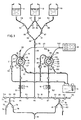
- the invention is shown therein comprising two cells, that is a measuring cell 10 and a control cell 110.
- the apparatus also comprises: a container 11 for the reactive solution to be mixed both with the water to be analyzed and with the control water; a container 12 for the washing water; a container 13 for a sterilizing substance, in this case sodium hypochloride, intended to reset the absolute sterile condition both of cell 10 and of cell 110; a thermostatic device 14 connected both with cell 10 and will cell 110 for keeping a predetermined temperature therein; a first peristaltic pump 15 intended to control the filling and emptying of cell 10 with the various liquids and reagents; a second peristaltic pump 16 intended to control the filling and emptying of cell 110 with the various liquids and reagents; an electric detector 18 connected both to a sensor 19 of cell 10 and to a sensor 119 of cell 110; a series of solenoid valves controlled by a processor, and a piping system having the solenoids valves fitted thereon for connecting the various members of the apparatus.
- cell 10 and cell 110 have the same structure, shape and size, each comprising: a substantially spherical outer body 25 having a flat wall 26 parallel to the vertical diameter thereof; a concentric smaller inner body 27 having a flat wall 28 parallel to wall 26; a lower passage 29 connected to cavity 30 formed between body 25 and body 27; an upper passage 31 also connected to cavity 30; a lower vertical passage 32 crossing cavity 30 and connected to inner cavity 33 of inner body 27; an upper vertical passage 34 also connected to cavity 33 of body 27; a cylindrical sensor housing 35 crossing cavity 30 and having a threaded portion 36 out of body 25 and an open end 37 connected to cavity 33 of inner body 27.
- cavity 33 of body 27 comprises an armature 38 magnetically operated by magnetic stirrer 39 placed in contact with wall 26 of cell 10 which is received within an opening 40 formed in the rear panel 41 of the apparatus supporting all the components thereof as a later described.
- cell 110 is identical with the described cell 10 and Figure 2 the components thereof are referred to by the same reference numbers increased by 100.
- Sensor housing 35 receives sensor 19 while sensor housing 135 receives sensor 119 (not shown in Figures 2 and 3), both sensor being connected to electric detector 18 through wires 42 and 142.
- cell 10 and 110 are supported side by side on supporting rear panel 41 and they are operatively connected to the other members of the apparatus, as later described.
- cavities 30 and 130 of cells 10 and 110 are connected to thermostatic device 14 through input pipes 50 and 150 and output pipes 51 and 151 also connected to passages 29 and 129 and 31 and 131, respectively.
- a flowmeter 52 is connected to pipe 51 while a similar flowmeter 152 is connected to pipe 151.
- Lower passage 32 of cell 10 is connected to pipe 53 having a peristaltic pump 15 fitted thereon, while a sterile breather pipe filter 55 is fitted on upper passage 34.
- lower passage 132 of cell 110 is connected to pipe 153 having a peristaltic pump 16 fitted thereof, while a sterile breather pipe filter 155 is fitted on upper passage 134.
- the solution container 11 the washing water container 12 and the sterilizing substance container 13 are connected to a piping referred to be references 56, 57, 58, 59, 60 and 61 controlled by solenoid valves 62, 63, 64, 65, 66 and 67 having an Y-shaped fitting 68 on the end thereof connected to a pipe 69 controlled by solenoid valve 70.
- pipe 69 is connected to pipe 72 also connected to pipes 53 and 153.
- Pipe 72 is also connected to a pipe 73 and a pipe 74.
- Pipe 73 is connected through an Y-shaped fitting 75 to a by pass 76 controlled by a solenoid valve 77 and to a discharge pipe 78 controlled by a solenoid valve 79.
- pipe 74 is connected through Y-shaped fitting 79 to pipes 80 and 82 controlled by solenoid valves 81 and 83.
- pipe 72 is also connected to other six solenoid valves and more precisely:
- the apparatus of the invention operates as follows: the sterilizing substance of container 13 is fed to cells 10 and 110 to eliminate any microorganisms therefrom (step I) by suitably controlling solenoid valves 65, 67.70,90, and 91 in the open position and the other valves in the close position and operating peristalting pumps 15 and 16. After the necessary sterilization time (usually 5′ + 25′) the cells are emptied through discharge pipe 96 by inversely operating peristaltic pumps 15 and 16, opening solenoid valves 89, 79, 92 and 81 and closing all other solenoid valves (step II).
- a first washing of cells 10 and 110 is carried out by the water of container 12 opening solenoid valves 64, 67,70,90 and 91 and closing all other solenoid valves (step III).
- a second washing is carried out opening solenoid valves 63, 66,70,90 and 91 and closing all other valves, after the discharge of the first washing water carried out as the discharge of the sterilizing substance (step II).
- the second washing water is discharged from cells 10 and 110 repeating the emptying operations (step II) and the apparatus is thus ready to carry out the test operations, cell 10 and 110 being completely sterile since the water of container 12 is sterile.
- the test operations are carried out as follows: a given quantity of the reactive solution of container 11 is fed to cells 10 and 110 opening solenoid valves 62, 66, 70, 90, and 91 and operating peristaltic pumps 15 and 16 for a suitable time. Then, the water to be tested and the control water are fed to cells 10 and 110, respectively, opening solenoid valves 71, 89 and 93, 92 closing all other valves and operating peristaltic pumps 15 and 16.
- stirring armatures 38 and 138 have been operated by magnetic stirren 39 within cells 10 and 110.
- inner cavities 33 and 133 of cells 10 and 110, respectively, will be kept at a constant temperature by circulating the water from thermostatic device 14 controlled by flowmeters 52 and 152 fitted on pipes 51 and 151 within outer cavities 30 and 130, respectively.
- the chemico-physical characteristics used for detecting the presence of microorganisms in cells 10 and 110 are the following:
- An optical reader based on the decrease of trasmittance fitted within the measurement cell carries out the reading of turbidity at 620 Nm.
- the turbidity of the sample is related to the number of the bacteria per 1 ml of the sample by the control system.
- a concentrated nutrient solution comprising the so called Mac Conkey's medium containing lactose, cresol bromine, peptone, oxgall, suitable for the development of Escherichia coli and inhibiting the development of gram positive bacteria is added to the liquid containing E.coli .
- the turbidity of the sample is measured by optical readers fitted in the measurement cells reading at 620 Nm.
- the charge in the turbidity of the sample is related to the number of E.coli per 1 ml of the sample by the control system.
- Detection of the quality of microorganisms and their partial characterization trough the detection of the modification in time of the color of a specific dying substance added to a suitable selective nutrient medium.
- the presence of bacteria of the kind of Streptococcus faecalis can be detected using a medium comprising peptone, dextrose, dipotassic,phosphate,monopotassic phosphate sodium azide,, cresol bromine red, pH 6.9.
- the charge in color due to the metabolic activity of the microorganisms is detected by a colorimeter and related to the number of E.coli or Streptococcus faecalis per 1 ml of the sample by the control system.
- Detection of the quantity of the microorganisms trough the detection of the modification in time of the medium pH due to the metabolic activity of the microorganisms in a suitable selective medium.
- the detection trough an electrode of the variation in the pH in a nutrient medium comprising lactose indicates the presence of bacteria the metabolism of which is controlled in time and related to the number of E.coli per 1 ml of the sample by the control system.
- the adenosinetriphosphate produced is continuously measured trough the well-known dosage of luciferin.
- the dosage of luciferin is related to the number of bacteria per 1 ml of the sample by the control system.
- a solution containing sodium ascorbate, thymidylic acid, glucose, sucrose, valinomycin is added to the liquid containing the microorganisms.
- the dissolved oxygen is detected by an oxygen electrode.
- the oxygen consumption due to the oxidation of the reagents caused by the metabolism of the bacteria is controlled in time and related to the number of bacteria per 1 ml of the sample by the control system.
- a solution containing peptone, dextrose, dipotassic phosphate, monopotassic phosphate, sodium azide is added to the liquid containing the microorganisms.
- the detection of the carbon dioxide content is carried out by means of a CO2 electrode and its modification in time is related to the number of bacteria per 1 ml of the sample by the control system.
- the apparatus of the invention can be adjusted by suitably operating on the control logic thereof to carry out the test operation in cell 10 and the control operation in cell 110 at different times repeating the operation on the test water after a time predetermined by the measurement carried out by cell 10.
- the apparatus can be used for example using cells 10 and 110 to control the water of an aqueduct in its "native" state and after chlorination and the like.
Landscapes
- Chemical & Material Sciences (AREA)
- Life Sciences & Earth Sciences (AREA)
- Health & Medical Sciences (AREA)
- Organic Chemistry (AREA)
- Engineering & Computer Science (AREA)
- Zoology (AREA)
- Wood Science & Technology (AREA)
- Proteomics, Peptides & Aminoacids (AREA)
- Analytical Chemistry (AREA)
- General Health & Medical Sciences (AREA)
- Bioinformatics & Cheminformatics (AREA)
- Microbiology (AREA)
- Biochemistry (AREA)
- General Engineering & Computer Science (AREA)
- Physics & Mathematics (AREA)
- Immunology (AREA)
- Biotechnology (AREA)
- Genetics & Genomics (AREA)
- Toxicology (AREA)
- Molecular Biology (AREA)
- Biophysics (AREA)
- Medicinal Chemistry (AREA)
- Food Science & Technology (AREA)
- General Physics & Mathematics (AREA)
- Pathology (AREA)
- Biomedical Technology (AREA)
- Sustainable Development (AREA)
- Apparatus Associated With Microorganisms And Enzymes (AREA)
- Measuring Or Testing Involving Enzymes Or Micro-Organisms (AREA)
- Automatic Analysis And Handling Materials Therefor (AREA)
Abstract
Description
- This invention refers to an apparatus for automatically counting the microorganisms possibly present in liquids, particularly in waters for human use.
- As it is known, bacteriologic pollution of waters nowadays is so serious that the systems and methods used at present for detecting and controlling the bacterial charge of water are absolutely insufficient.
- In fact, such systems and methods have many drawbacks, the temporal discontinuity of measurements and the delay existing between sampling, measurements and data analysis being particularly serious.
- It is also known that the bacterial pollution of waters potentially more dangerous to human health is caused by bacteria of animal nature. Thus the possibility of readily and precisely detecting the number of total coliforms and fecal coliforms present in the water under control is particularly important for the use of waters. In fact, total and fecal coliforms are a sure sign of recent fecal contamination, while detection of fecal Streptococcus indicates old fecal contamination.
- Accordingly, detection of these microorganisms is an essential parameter for defining the quality of waters. This is taken into account by the Italian Laws in force, such as Law n° 319 issued on 15.05.1976 "Control standard for protecting waters from pollution"; Law n°650 issued on 24.12.1979 "Integration and modifications to Laws n°17L/1973 and n°319/1976 concerning the protection of waters from pollution"; the Italian Decreto del Presidente del Consiglio dei Ministri (DPCM) issued on 04.02.1077 "General criteria, methods and technical standards according to art.2 letters b), d) and e) of Law n°318/1976"; the DPCM n°515 issued on 03.07.1982 "Enforcement of EEC directive n°75/440 concerning the quality of surface waters intended to be used for the production of drinkable water"; the DPCM issued on 08.02.1985 "Qualitative characteristics of water for human use".
- The devices and methods used at present detect the presence and count the number of the microorganisms by discontinuous sampling and microbiological analysis of the water, using traditional methods.
- These methods require a long time from the water sampling to the transport thereof to the laboratory where the microbiological analysis must be carried out and this may cause a modification in the original bacterial composition. On the other hand, an even longer time is normally required for culture and identification of microbic pollutants.
- Finally, it can be said that at present the data on water microbic pollution can be obtained only after a period of time varying from 48 to 72 hours after water sampling. Furthermore, this temporal delay makes it impossible to early operate for eliminating or correcting the pollution causes.
- Accordingly, it is an aim of the invention to overcome these drawbacks providing an apparatus intended to automatically analyze and measure the bacterial content of a liquids in a time varying from a few minutes to 12 hours, depending on the liquids bacterial charge, without involving a direct action of any operators.
- Automatic devices for measuring bacteria content in water have been already described:
- EP-A-0 184 273 to ERMA OPTICAL WORKS LIMITED (JP) discloses an apparatus for measuring impurities such as dust and bacteria in super-pure water by means of a sensor detecting voltage pulses caused by impurities passing trough a small hole.
- JP-A-58 37559 to HOTSUKAIDOU KAIHATSUKIYOKU DOBOKU SHIKEN SHO (JP) discloses a continuous and automatic measuring device of bacteria wherein the test water is seeded to a culture fluid in a fermentation vessel. Thereafter the cultured water is sampled at a measuring section where bacterial growth is recorded by means of a turbidimeter or a spectrophotometer. In this apparatus the diluting and controlling devices, the fermentation tube and the measuring device are separated and the analysis requires several sampling steps.
- The present invention is directed to an apparatus according to Claim 1.
- The invention as defined in claims 1-10 will be now described in detail with reference to the annexed drawings, wherein:
- Figure 1 is an overall view of the apparatus of the invention;
- Figure 2 is a diametral sectional view of one of apparatus cells; and
- Figure 3 is a 90 sectional view of the cells of Figure 2.
- Firstly referring to Figure 1, the invention is shown therein comprising two cells, that is a
measuring cell 10 and acontrol cell 110. - The apparatus also comprises:
acontainer 11 for the reactive solution to be mixed both with the water to be analyzed and with the control water;
acontainer 12 for the washing water;
acontainer 13 for a sterilizing substance, in this case sodium hypochloride, intended to reset the absolute sterile condition both ofcell 10 and ofcell 110;
athermostatic device 14 connected both withcell 10 and willcell 110 for keeping a predetermined temperature therein;
a firstperistaltic pump 15 intended to control the filling and emptying ofcell 10 with the various liquids and reagents;
a secondperistaltic pump 16 intended to control the filling and emptying ofcell 110 with the various liquids and reagents;
anelectric detector 18 connected both to a sensor 19 ofcell 10 and to asensor 119 ofcell 110;
a series of solenoid valves controlled by a processor, and a piping system having the solenoids valves fitted thereon for connecting the various members of the apparatus. - As is more clearly shown in Figures 1 and 2,
cell 10 andcell 110 have the same structure, shape and size, each comprising:
a substantially sphericalouter body 25 having aflat wall 26 parallel to the vertical diameter thereof; a concentric smallerinner body 27 having aflat wall 28 parallel towall 26; alower passage 29 connected tocavity 30 formed betweenbody 25 andbody 27; anupper passage 31 also connected tocavity 30; a lowervertical passage 32crossing cavity 30 and connected toinner cavity 33 ofinner body 27; an uppervertical passage 34 also connected tocavity 33 ofbody 27; acylindrical sensor housing 35crossing cavity 30 and having a threadedportion 36 out ofbody 25 and anopen end 37 connected tocavity 33 ofinner body 27. - Furthermore,
cavity 33 ofbody 27 comprises anarmature 38 magnetically operated bymagnetic stirrer 39 placed in contact withwall 26 ofcell 10 which is received within an opening 40 formed in therear panel 41 of the apparatus supporting all the components thereof as a later described. - As mentioned above
cell 110 is identical with the describedcell 10 and Figure 2 the components thereof are referred to by the same reference numbers increased by 100. -
Sensor housing 35 receives sensor 19 whilesensor housing 135 receives sensor 119 (not shown in Figures 2 and 3), both sensor being connected toelectric detector 18 throughwires - As shown Figure 1, in the embodiment of the invention comprising a single test cell and a single control cell,
cell rear panel 41 and they are operatively connected to the other members of the apparatus, as later described.cavities cells thermostatic device 14 throughinput pipes output pipes 51 and 151 also connected topassages - A
flowmeter 52 is connected to pipe 51 while asimilar flowmeter 152 is connected topipe 151. -
Lower passage 32 ofcell 10 is connected topipe 53 having aperistaltic pump 15 fitted thereon, while a sterilebreather pipe filter 55 is fitted onupper passage 34. - Similarly
lower passage 132 ofcell 110 is connected topipe 153 having aperistaltic pump 16 fitted thereof, while a sterilebreather pipe filter 155 is fitted onupper passage 134. - As it is shown the
solution container 11, thewashing water container 12 and the sterilizingsubstance container 13 are connected to a piping referred to bereferences solenoid valves shaped fitting 68 on the end thereof connected to apipe 69 controlled by solenoid valve 70. - The other end of
pipe 69 is connected topipe 72 also connected topipes - Pipe 72 is also connected to a pipe 73 and a
pipe 74. Pipe 73 is connected through an Y-shaped fitting 75 to a bypass 76 controlled by asolenoid valve 77 and to adischarge pipe 78 controlled by asolenoid valve 79. - Similarly,
pipe 74 is connected through Y-shapedfitting 79 topipes 80 and 82 controlled bysolenoid valves - The various couplings and connections are obtained through fitting 84,85,86,87,and 88, respectively.
- Finally,
pipe 72 is also connected to other six solenoid valves and more precisely: - a
solenoid valve 71 between fitting 84 and the testwater sampling point 94; - a
solenoid valve 89 between fittings84 and 85; - a
solenoid valve 90 betweenfittings - a
solenoid valve 91 betweenfittings - a
solenoid valve 92 betweenfittings - a
solenoid valve 93 between fitting 88 and the controlwater sampling point 95. - The apparatus of the invention operates as follows: the sterilizing substance of
container 13 is fed tocells solenoid valves 65, 67.70,90, and 91 in the open position and the other valves in the close position and operatingperistalting pumps discharge pipe 96 by inversely operatingperistaltic pumps solenoid valves - Then, a first washing of
cells container 12 openingsolenoid valves - A second washing is carried out opening
solenoid valves - Also the second washing water is discharged from
cells cell container 12 is sterile. The test operations are carried out as follows: a given quantity of the reactive solution ofcontainer 11 is fed tocells solenoid valves peristaltic pumps cells solenoid valves peristaltic pumps - It should be noted that during all the above-described sterilization, washing, test and control
operation stirring armatures magnetic stirren 39 withincells - Similarly, at the least during all the test and control operations
inner cavities cells thermostatic device 14 controlled byflowmeters pipes 51 and 151 withinouter cavities - The mixing of the water to be tested with the reactive solution will cause chemico-physical variations of the mixture within
cell 10 if any microorganisms are present, these variations detected by the sensor received withinsensor housing 35, which sensor will feed signals corresponding to the possibly detected variations toelectric detector 18. - All the sensor used in this invention are of a known type and, accordingly they will not be described herein.
- Furthermore, it should be noted that all the above-described operations are controlled and timed by a logic also of a known type which needs not be described and illustrated.
- The chemico-physical characteristics used for detecting the presence of microorganisms in
cells - a) the variation in the turbidity of the liquid due to the growth of microorganisms in suspension;
- b) the modifications in the color of the substances added to the liquid due to the metabolic activity of the microorganisms ;
- c) the alteration in the pH of the liquid due to the metabolic activity of the microorganisms ;
- d) the alteration in the redox potential of reagents due to the products of the microorganisms metabolism;
- e) the alteration in the quantity of the oxygen dissolved in the liquid due to the metabolic activity of the microorganisms;
- f) the alteration in the quantity of the carbon dioxide dissolved liquid due to the metabolic activity of the microorganisms.
- The known reagents and optical sensor or electrodes are indicated in the following examples:
- Detection of the total bacterial charge of animal nature through the detection of the modification in time of the turbidity of the medium due to the multiplication of the microorganisms.
- A concentrated nutrient solution containing glucose, yeast extract, peptone or any other nutrient adapted to the liquid containing the microorganisms.
- After 30′ of lag phase the microorganisms start multiplying and clouding the culture liquid.
- An optical reader based on the decrease of trasmittance fitted within the measurement cell, carries out the reading of turbidity at 620 Nm. The turbidity of the sample is related to the number of the bacteria per 1 ml of the sample by the control system.
- Detection of the bacterial charge of coliforms through the detection of the modification in time of the turbidity of the medium due to the selective multiplication of coliforms by using a suitable coliform selective nutrient medium.
- A concentrated nutrient solution comprising the so called Mac Conkey's medium containing lactose, cresol bromine, peptone, oxgall, suitable for the development of Escherichia coli and inhibiting the development of gram positive bacteria is added to the liquid containing E.coli.
- The turbidity of the sample is measured by optical readers fitted in the measurement cells reading at 620 Nm.
- The charge in the turbidity of the sample is related to the number of E.coli per 1 ml of the sample by the control system.
- Detection of the quality of microorganisms and their partial characterization trough the detection of the modification in time of the color of a specific dying substance added to a suitable selective nutrient medium.
- It is known that most strains of E.coli are able to ferment the lactose thus producing acids and gas. The use of the above-described Mac Conkey's medium reveals the presence of lactose fermenting bacteria trough the color charge due to the cresol bromine red.
- On the other hand, the presence of bacteria of the kind of Streptococcus faecalis can be detected using a medium comprising peptone, dextrose, dipotassic,phosphate,monopotassic phosphate sodium azide,, cresol bromine red, pH 6.9.
- The charge in color due to the metabolic activity of the microorganisms is detected by a colorimeter and related to the number of E.coli or Streptococcus faecalis per 1 ml of the sample by the control system.
- Detection of the quantity of the microorganisms trough the detection of the modification in time of the medium pH due to the metabolic activity of the microorganisms in a suitable selective medium.
- As a mentioned above in example n° 3 the growth of E.coli on a lactose causes the production of acids detected by a decrease in the pH.
- The detection trough an electrode of the variation in the pH in a nutrient medium comprising lactose indicates the presence of bacteria the metabolism of which is controlled in time and related to the number of E.coli per 1 ml of the sample by the control system.
- Detection of the quantity of microorganisms through the detection of the modification in time of the liquid redox potential by using redox mediators able to be metabolized by the bacteria.
- When the removal of a pair of electrodes or atoms of hydrogen from an organic substrate is accompanied by the reduction of oxygen to water, an exchange of free energy takes place a portion of which is transformed into adenosinetriphosphate.
- The adenosinetriphosphate produced is continuously measured trough the well-known dosage of luciferin. The dosage of luciferin is related to the number of bacteria per 1 ml of the sample by the control system.
-
- Detection of the quantity of microorganisms through the detection of the modification in time of the quantity of dissolved oxygen by using a specific electrode and reducing substances able to be metabolized by the microorganisms.
- A solution containing sodium ascorbate, thymidylic acid, glucose, sucrose, valinomycin is added to the liquid containing the microorganisms.
- The dissolved oxygen is detected by an oxygen electrode.
- The oxygen consumption due to the oxidation of the reagents caused by the metabolism of the bacteria is controlled in time and related to the number of bacteria per 1 ml of the sample by the control system.
- Detection of the quantity of microorganisms through the detection of the modification in time of the quantity of dissolved carbon dioxide by means of a specific electrode and substances able to be metabolized into carbon dioxide.
- A solution containing peptone, dextrose, dipotassic phosphate, monopotassic phosphate, sodium azide is added to the liquid containing the microorganisms.
- The detection of the carbon dioxide content is carried out by means of a CO₂ electrode and its modification in time is related to the number of bacteria per 1 ml of the sample by the control system.
- It is intended that the above mentioned and described reagents and sensors can be varied and/or modified according to the microbic strain to be detected the construction and operation of the apparatus of the invention being the same.
- Furthermore, it is intended that the invention which has been described and illustrated with reference to one particular embodiment thereof for testing waters for human use, can be used for detecting the presence, the number and the strain and/or the microbic kind of microorganisms in liquid solutions of any type.
- As far as the operation is concerned the apparatus of the invention can be adjusted by suitably operating on the control logic thereof to carry out the test operation in
cell 10 and the control operation incell 110 at different times repeating the operation on the test water after a time predetermined by the measurement carried out bycell 10. - Furthermore, the apparatus can be used for
example using cells - It should be noted that the whole apparatus is received within a conditioned container.
- As a further characteristic of the invention it should be noted that when it is used to control natural waters such as watercourses and the like it is possible to create a continuous circulation of the test water in
pipes solenoid valves
Claims (10)
- An apparatus for automatically counting the microorganisms possibly present in liquids, particularly but not exclusively in waters for human use, comprising: a means (94;95) for sampling the liquid to be tested; a means (53;153) for drawing said liquid into fermentation cells (10;110) each of said cells containing a sensor means (19;119) adapted to detect the chemico-physical modifications of the liquid to be tested-nutrient solution mixture due to the presence of microorganisms therein and to transmit signals corresponding to the intensity of said variations due to the presence of microorganisms; a plurality of pipes (53,56,57,58,59,60,61,69,72,74,76,78,82,94,95,96,153) and solenoid valves (62,63,64,65,66,67,70,71,77,79,81,83, 89, 90,91,92,93) fitted thereon for selectively connecting the various operative means; an electronic synchronization and control means (18) for operating said various operative means and controlling the operation thereof; and a control and storing means (18) adapted to receive the analytical signals; this apparatus being characterized in that it comprises in combination: at least two cells, one of which (10) is feeded with the liquid to be analyzed for The microorganisms content and the other (110) with control water, said cells being made of a suitable material, preferably glass, comprising an outer body (25) of a substantially spherical shape having a flat wall (26) parallel to the vertical diameter thereof, an inner body (27) also having a substantially spherical shape and concentrically positioned relative to said outer body (25) and having a flat wall (28) parallel to said flat wall (27) of said outer body (25), a lower passage (29) and an upper passage (31) connected to the cavity (30) formed between said two bodies (25,27), and upper vertical passage (34) and a lower vertical passage (32) crossing said cavity (30) and being connected to said inner body (27) and a cylindrical housing (35) crossing said cavity (30) and having one end (36) out of said outer body (25) and a second open end (37) within said inner body (27), said cylindrical housing (35) receiving one said sensor (19;119); a thermostatic means (14;50,51,52;150,151,152) adapted to keep the temperature of the said mixtures contained in said cells at a constant predetermined value; a stirring means (38,39;138,139) adapted to mix the liquids to be tested with the nutrient solutions within said cells; a means (11) for containing a nutrient solution, a means (12) for containing a washing liquid; a means (13) for containing a sterilizing substance; a means (56,57,58,59,60,61) for drawing the nutrient solution, the washing liquid and the sterilizing liquid; an analytical means (18) adapted to compare the said signal coming from the said cell (10) feeded with the liquid to be analyzed with the said signal coming from the said cell (110) feeded with control water and to correlate said signals with the number of microorganisms present in said cells (10;110).
- The apparatus according to claim 1, wherein a peristaltic pump (15;16) is used for drawing said nutrient solution, said washing liquid, said sterilizing substance and said liquid to be tested.
- The apparatus according to claim 2, wherein said peristaltic pump (15;16) is connected to said pipes (53, 56,57,58,59,60,61,69,72,74,76,78,82,94,95,96,153) so as to selectively feed said liquids to be tested, said nutrient solution , said sterilizing substance and said washing liquid to said cells (10;110), according to the opening and closing of said solenoid valves (62,63,64,65,66,67,70,71,77,79,81,83,89,90,91,92,93).
- The apparatus according to claim 1, wherein said sensor means (19;119) comprises optical readers.
- The apparatus according to claim 1, wherein said sensor means (19;119) comprises colorimeters.
- The apparatus according to claim 1, wherein said sensor means (19;119) comprises a pH measuring means.
- The apparatus according to claim 1, wherein said sensor means (19;119) comprises a turbidity measuring means.
- The apparatus according to claim 1, wherein said sensor means (19;119) is a means for measuring the modification of the redox potential.
- The apparatus according to claim 1, wherein said sensor means (19;119) comprises an oxygen electrode.
- The apparatus according to claim 1, wherein said sensor means (19;119) comprises a carbon dioxide electrode.
Applications Claiming Priority (2)
| Application Number | Priority Date | Filing Date | Title |
|---|---|---|---|
| IT4830587 | 1987-08-13 | ||
| IT8748305A IT1211721B (en) | 1987-08-13 | 1987-08-13 | EQUIPMENT FOR THE AUTOMATIC COUNTING OF MICROORGANISMS WHICH MAY BE PRESENT IN LIQUIDS, WITH PARTICULAR REFERENCE TO WATERS FOR HUMAN USE |
Publications (3)
| Publication Number | Publication Date |
|---|---|
| EP0304406A2 EP0304406A2 (en) | 1989-02-22 |
| EP0304406A3 EP0304406A3 (en) | 1990-04-18 |
| EP0304406B1 true EP0304406B1 (en) | 1995-06-28 |
Family
ID=11265780
Family Applications (1)
| Application Number | Title | Priority Date | Filing Date |
|---|---|---|---|
| EP88830340A Expired - Lifetime EP0304406B1 (en) | 1987-08-13 | 1988-08-11 | Apparatus for automatically counting the microorganisms possibly present in liquids, particularly in waters for human use |
Country Status (4)
| Country | Link |
|---|---|
| EP (1) | EP0304406B1 (en) |
| AT (1) | ATE124536T1 (en) |
| DE (1) | DE3854066D1 (en) |
| IT (1) | IT1211721B (en) |
Cited By (1)
| Publication number | Priority date | Publication date | Assignee | Title |
|---|---|---|---|---|
| EP4081488B1 (en) * | 2019-12-24 | 2024-09-11 | Ecole Nationale des Ponts et Chaussées | System and process for treating the greywater of a dwelling or of a block of dwellings |
Families Citing this family (8)
| Publication number | Priority date | Publication date | Assignee | Title |
|---|---|---|---|---|
| IT1242013B (en) * | 1990-11-15 | 1994-02-02 | Giovanni Antonini | DETECTION OF TOXIC SUBSTANCES PRESENT IN A WATER THROUGH THE MONITORING OF THE METABOLISM OF SELECTED MICROORGANISMS. |
| EP0976821B1 (en) | 1997-04-18 | 2009-02-18 | Centro Nacional De Investigaciones Cientificas | Equipment, kit and method for microbiological diagnosis |
| AT505306B1 (en) | 2007-07-09 | 2008-12-15 | Mbonline Gmbh | DEVICE FOR MONITORING WATER TO MICROBIAL CASES |
| DE102008014029A1 (en) | 2008-03-13 | 2009-09-17 | Verhülsdonk, Jürgen | Determining microbial contamination of water, comprises supplying sample in a reaction chamber, adding determined quantity of nutrient solution, which is a minimal medium, and intermixing the mixture of nutrient solution and water sample |
| ITVT20110012A1 (en) * | 2011-12-05 | 2013-06-06 | Greenertech S R L | INTEGRATED SYSTEM FOR THE MONITORING OF HYGIENE-HEALTH PROTOCOLS IN THE MANAGEMENT OF RECREATIONAL AND / OR THERMAL WATERS. |
| NO334066B1 (en) * | 2012-06-26 | 2013-12-02 | Colifast As | Apparatus for performing "at-line" analysis of coliform bacteria in a water sample |
| DE102014106891A1 (en) * | 2014-05-15 | 2015-11-19 | MJM GmbH | Apparatus for testing water pipes for contamination |
| CN113907820B (en) * | 2021-10-08 | 2023-05-30 | 巢湖市宾雄医疗器械有限公司 | Suture needle sleeve for intelligently and automatically detecting bacterial content and detection method thereof |
Family Cites Families (2)
| Publication number | Priority date | Publication date | Assignee | Title |
|---|---|---|---|---|
| US4517849A (en) * | 1983-06-20 | 1985-05-21 | Mitsubishi Denki Kabushiki Kaisha | Sampling system for water quality sensors |
| JPS61124850A (en) * | 1984-11-21 | 1986-06-12 | Eruma Kogaku Kk | Apparatus for measuring impurities in ultra-pure water |
-
1987
- 1987-08-13 IT IT8748305A patent/IT1211721B/en active
-
1988
- 1988-08-11 EP EP88830340A patent/EP0304406B1/en not_active Expired - Lifetime
- 1988-08-11 AT AT88830340T patent/ATE124536T1/en not_active IP Right Cessation
- 1988-08-11 DE DE3854066T patent/DE3854066D1/en not_active Expired - Lifetime
Cited By (1)
| Publication number | Priority date | Publication date | Assignee | Title |
|---|---|---|---|---|
| EP4081488B1 (en) * | 2019-12-24 | 2024-09-11 | Ecole Nationale des Ponts et Chaussées | System and process for treating the greywater of a dwelling or of a block of dwellings |
Also Published As
| Publication number | Publication date |
|---|---|
| DE3854066D1 (en) | 1995-08-03 |
| ATE124536T1 (en) | 1995-07-15 |
| IT1211721B (en) | 1989-11-03 |
| EP0304406A3 (en) | 1990-04-18 |
| IT8748305A0 (en) | 1987-08-13 |
| EP0304406A2 (en) | 1989-02-22 |
Similar Documents
| Publication | Publication Date | Title |
|---|---|---|
| US3676679A (en) | Apparatus for detecting biological activity | |
| US5441873A (en) | Apparatus for monitoring liquids | |
| EP0485474B1 (en) | A method and a system for quantitatively monitoring a chemical component dissolved in a liquid medium | |
| US5607565A (en) | Apparatus for measuring analytes in a fluid sample | |
| US3935073A (en) | Method for detecting bacteria | |
| CN101796410B (en) | Apparatus for monitoring water for microbial germs | |
| ITRM20120218A1 (en) | DEVICE AND METHOD FOR ANALYSIS AND MONITORING OF TOXICITY IN WATERS. | |
| CN113514601A (en) | A kind of online detection method and system of permanganate index | |
| CN105738359A (en) | Online detector for water hardness | |
| CN105004836A (en) | Method and device for online water quality detection | |
| US6723554B1 (en) | Apparatus and method for measuring optical properties by feedback control | |
| CN105806814B (en) | The automated monitor and its method of multi-cultur es water quality biological toxicity | |
| EP0304406A2 (en) | Apparatus for automatically counting the microorganisms possibly present in liquids, particularly in waters for human use | |
| EP0301699A2 (en) | Method and apparatus for determining the bioactivity of biological samples | |
| Nielsen et al. | FIA for on‐line monitoring of important lactic acid fermentation variables | |
| US3014848A (en) | Method of performing biological assays | |
| Watson | The present status and future prospects of the turbidostat | |
| JPH10123120A (en) | Inspection device of liquid | |
| CA2791211C (en) | Metabolic rate indicator for cellular populations | |
| CN213121886U (en) | Automatic water quality monitoring instrument | |
| Valero et al. | On-line monitoring of lipase production in fermentation processes | |
| US6143555A (en) | Infectious disease inspection method and apparatus therefor | |
| CN115184441B (en) | Multi-channel enzyme electrode on-line detection device and method in fermentation production process | |
| CN115931451B (en) | Sampling analysis unit suitable for surface water monitoring | |
| van Staden | Solving the problems of sequential injection systems as process analyzers |
Legal Events
| Date | Code | Title | Description |
|---|---|---|---|
| PUAI | Public reference made under article 153(3) epc to a published international application that has entered the european phase |
Free format text: ORIGINAL CODE: 0009012 |
|
| AK | Designated contracting states |
Kind code of ref document: A2 Designated state(s): AT BE CH DE ES FR GB LI LU NL SE |
|
| PUAL | Search report despatched |
Free format text: ORIGINAL CODE: 0009013 |
|
| AK | Designated contracting states |
Kind code of ref document: A3 Designated state(s): AT BE CH DE ES FR GB LI LU NL SE |
|
| 17P | Request for examination filed |
Effective date: 19901015 |
|
| 17Q | First examination report despatched |
Effective date: 19920925 |
|
| RAP1 | Party data changed (applicant data changed or rights of an application transferred) |
Owner name: MICROBO S.R.L. |
|
| GRAA | (expected) grant |
Free format text: ORIGINAL CODE: 0009210 |
|
| AK | Designated contracting states |
Kind code of ref document: B1 Designated state(s): AT BE CH DE ES FR GB LI LU NL SE |
|
| PG25 | Lapsed in a contracting state [announced via postgrant information from national office to epo] |
Ref country code: NL Free format text: LAPSE BECAUSE OF FAILURE TO SUBMIT A TRANSLATION OF THE DESCRIPTION OR TO PAY THE FEE WITHIN THE PRESCRIBED TIME-LIMIT Effective date: 19950628 Ref country code: LI Effective date: 19950628 Ref country code: FR Effective date: 19950628 Ref country code: ES Free format text: THE PATENT HAS BEEN ANNULLED BY A DECISION OF A NATIONAL AUTHORITY Effective date: 19950628 Ref country code: CH Effective date: 19950628 Ref country code: BE Effective date: 19950628 Ref country code: AT Effective date: 19950628 |
|
| REF | Corresponds to: |
Ref document number: 124536 Country of ref document: AT Date of ref document: 19950715 Kind code of ref document: T |
|
| REF | Corresponds to: |
Ref document number: 3854066 Country of ref document: DE Date of ref document: 19950803 |
|
| PG25 | Lapsed in a contracting state [announced via postgrant information from national office to epo] |
Ref country code: LU Free format text: LAPSE BECAUSE OF NON-PAYMENT OF DUE FEES Effective date: 19950831 |
|
| PG25 | Lapsed in a contracting state [announced via postgrant information from national office to epo] |
Ref country code: SE Effective date: 19950928 Ref country code: GB Effective date: 19950928 |
|
| PG25 | Lapsed in a contracting state [announced via postgrant information from national office to epo] |
Ref country code: DE Effective date: 19950929 |
|
| REG | Reference to a national code |
Ref country code: CH Ref legal event code: PL |
|
| EN | Fr: translation not filed | ||
| NLV1 | Nl: lapsed or annulled due to failure to fulfill the requirements of art. 29p and 29m of the patents act | ||
| PLBE | No opposition filed within time limit |
Free format text: ORIGINAL CODE: 0009261 |
|
| STAA | Information on the status of an ep patent application or granted ep patent |
Free format text: STATUS: NO OPPOSITION FILED WITHIN TIME LIMIT |
|
| GBPC | Gb: european patent ceased through non-payment of renewal fee |
Effective date: 19950928 |
|
| 26N | No opposition filed |