EP0303291A2 - Fluorinated benzoyl compounds - Google Patents
Fluorinated benzoyl compounds Download PDFInfo
- Publication number
- EP0303291A2 EP0303291A2 EP88113166A EP88113166A EP0303291A2 EP 0303291 A2 EP0303291 A2 EP 0303291A2 EP 88113166 A EP88113166 A EP 88113166A EP 88113166 A EP88113166 A EP 88113166A EP 0303291 A2 EP0303291 A2 EP 0303291A2
- Authority
- EP
- European Patent Office
- Prior art keywords
- chloro
- ppm
- difluorobenzoyl
- formula
- compound
- Prior art date
- Legal status (The legal status is an assumption and is not a legal conclusion. Google has not performed a legal analysis and makes no representation as to the accuracy of the status listed.)
- Granted
Links
- 0 CCOC(C(C(C(C*1)C(*)C(C2CCCCC2)C1Cl)=C)=CC)=O Chemical compound CCOC(C(C(C(C*1)C(*)C(C2CCCCC2)C1Cl)=C)=CC)=O 0.000 description 5
- BDJZCCWUSOZUQG-UHFFFAOYSA-N Fc(ccc(Cl)c1)c1Cl Chemical compound Fc(ccc(Cl)c1)c1Cl BDJZCCWUSOZUQG-UHFFFAOYSA-N 0.000 description 1
- YTFWVUAKGNESGE-UHFFFAOYSA-N OC(C(CC(C(C1C2CCCCC2)Cl)F)C1Cl)=O Chemical compound OC(C(CC(C(C1C2CCCCC2)Cl)F)C1Cl)=O YTFWVUAKGNESGE-UHFFFAOYSA-N 0.000 description 1
Classifications
-
- C—CHEMISTRY; METALLURGY
- C07—ORGANIC CHEMISTRY
- C07C—ACYCLIC OR CARBOCYCLIC COMPOUNDS
- C07C69/00—Esters of carboxylic acids; Esters of carbonic or haloformic acids
- C07C69/66—Esters of carboxylic acids having esterified carboxylic groups bound to acyclic carbon atoms and having any of the groups OH, O—metal, —CHO, keto, ether, acyloxy, groups, groups, or in the acid moiety
- C07C69/67—Esters of carboxylic acids having esterified carboxylic groups bound to acyclic carbon atoms and having any of the groups OH, O—metal, —CHO, keto, ether, acyloxy, groups, groups, or in the acid moiety of saturated acids
- C07C69/708—Ethers
- C07C69/712—Ethers the hydroxy group of the ester being etherified with a hydroxy compound having the hydroxy group bound to a carbon atom of a six-membered aromatic ring
-
- C—CHEMISTRY; METALLURGY
- C07—ORGANIC CHEMISTRY
- C07C—ACYCLIC OR CARBOCYCLIC COMPOUNDS
- C07C63/00—Compounds having carboxyl groups bound to a carbon atoms of six-membered aromatic rings
- C07C63/68—Compounds having carboxyl groups bound to a carbon atoms of six-membered aromatic rings containing halogen
- C07C63/70—Monocarboxylic acids
-
- C—CHEMISTRY; METALLURGY
- C07—ORGANIC CHEMISTRY
- C07C—ACYCLIC OR CARBOCYCLIC COMPOUNDS
- C07C45/00—Preparation of compounds having >C = O groups bound only to carbon or hydrogen atoms; Preparation of chelates of such compounds
- C07C45/45—Preparation of compounds having >C = O groups bound only to carbon or hydrogen atoms; Preparation of chelates of such compounds by condensation
- C07C45/46—Friedel-Crafts reactions
-
- C—CHEMISTRY; METALLURGY
- C07—ORGANIC CHEMISTRY
- C07C—ACYCLIC OR CARBOCYCLIC COMPOUNDS
- C07C49/00—Ketones; Ketenes; Dimeric ketenes; Ketonic chelates
- C07C49/76—Ketones containing a keto group bound to a six-membered aromatic ring
- C07C49/80—Ketones containing a keto group bound to a six-membered aromatic ring containing halogen
- C07C49/807—Ketones containing a keto group bound to a six-membered aromatic ring containing halogen all halogen atoms bound to the ring
-
- C—CHEMISTRY; METALLURGY
- C07—ORGANIC CHEMISTRY
- C07C—ACYCLIC OR CARBOCYCLIC COMPOUNDS
- C07C69/00—Esters of carboxylic acids; Esters of carbonic or haloformic acids
- C07C69/66—Esters of carboxylic acids having esterified carboxylic groups bound to acyclic carbon atoms and having any of the groups OH, O—metal, —CHO, keto, ether, acyloxy, groups, groups, or in the acid moiety
- C07C69/73—Esters of carboxylic acids having esterified carboxylic groups bound to acyclic carbon atoms and having any of the groups OH, O—metal, —CHO, keto, ether, acyloxy, groups, groups, or in the acid moiety of unsaturated acids
- C07C69/738—Esters of keto-carboxylic acids or aldehydo-carboxylic acids
Definitions
- the present invention relates to novel fluorinated benzoyl compounds useful as intermediates for medicines and agricultural chemicals, particularly as intermediates for fluorinated pyridone carboxylic acid type synthetic antibacterial agents.
- 1,4-dihydro-4-oxoquinoline derivatives having cyclopropyl or a substituted aryl group at the 1-position are useful as fluorine-containing synthetic antibacterial agents.
- quinolone compounds 1,4-dihydro-4-oxoquinoline derivatives having cyclopropyl or a substituted aryl group at the 1-position
- Japanese Unexamined Patent Publication No. 74638/1983 discloses a synthesis of a quinolone compound having a cyclopropyl group at the 1-position and the intermediates for the synthesis thereof.
- Japanese Unexamined Patent Publication No. 85350/1986 discloses a synthesis of a quinolone compound via 2,4-dichloro-5-fluorobenzoic acid from 1,3-dichloro-4-fluorobenzene as the starting material.
- Japanese Unexamined patent Publication No. 148484/1987 discloses a synthesis of a quinolone compound having a thienyl group at the 1-position from 2-bromo-4,5-difluorobenzoic acid.
- 7-chloroquinolone compounds are prepared via 2,4-dichloro-5-fluorobenzoic acid. Such 7-chloroquinolone compounds are reacted, usually after the hydrolysis, with a cyclic amine for conversion to various synthetic antibacterial agents, as shown below. wherein R2 is cyclopropyl, a substituted aryl group or a thienyl group.
- Japanese Unexamined Patent Publication No. 108839/1987 discloses a process represented by the following reaction as the only method for the production of 2-chloro-4,5-difluorobenzoic acid.
- novel compound of the present invention such as 2-chloro-4,5-difluoroacetophenone
- 2-chloro-4,5-difluorobenzoic acid can readily be produced by the following reaction without generation of such highly corrosive hydrogen fluoride.
- the process is advantageous for industrial operation.
- the fluorinated benzoyl compounds of the present invention are represented by the following formula: wherein Q is a lower alkyl group, a halogen atom, -CH2CO2R1 wherein R1 is a lower alkyl group, or wherein each of R2 and R3 is a lower alkyl group.
- the compound of the formula 1 wherein Q is a lower alkyl group may be represented by the following formula: wherein R4 is a lower alkyl group.
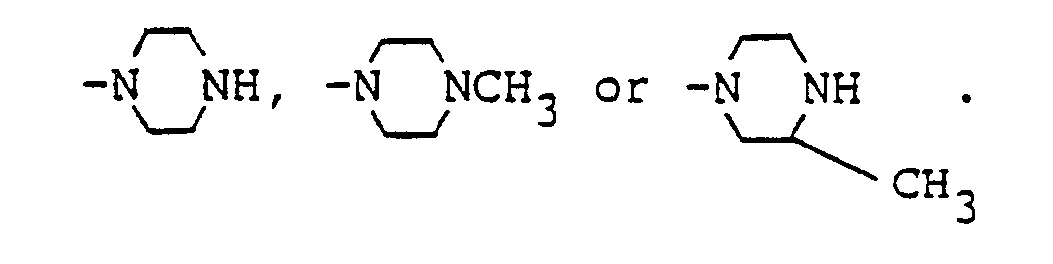
- R4 is preferably CH3, and R5 is preferably
- the compound of the formula 2 can readily be prepared by the following reaction.
- the compound of the formula 3, i.e. 1-chloro-3,4-difluorobenzene, is reacted with a carboxylic acid chloride such as acetyl chloride or with a carboxylic acid anhydride such as acetic anhydride in the presence of an acylating catalyst at a temperature of from 0 to 200°C, preferably from 10 to 150°C, followed by isolation by a usual method to obtain the compound of the formula 2 of the present invention.
- a carboxylic acid chloride such as acetyl chloride or with a carboxylic acid anhydride such as acetic anhydride
- an acylating catalyst at a temperature of from 0 to 200°C, preferably from 10 to 150°C
- the acylating catalyst may be a Lewis acid such as AlCl3, SbCl5, FeCl3, FeCl2, TiCl4, BF3, SnCl4, BiCl3, ZnCl2 or HgCl2 or a Bronstead acid such as HF, H2SO4, polyphosphoric acid, CH3SO3H, CF3SO3H, FSO3H, p-CH3-C6H4-SO3H, HClO2, CF3CO2H or HPOF2.
- the amount of the acylating catalyst is suitably selected within a range of from 0.1 to 500 mol%, preferably from 1 to 100 mol%, relative to 1-chloro-3,4-difluorobenzene.
- the carboxylic acid chloride or the carboxylic acid anhydride is used usually in an amount of from 1 to 10 times, preferably from 1 to 2 times the theoretical amount required for the acylation of 1-chloro-3,4-difluorobenzene.
- the reaction may be conducted in a solvent or without a solvent.
- the solvent is preferably nitrobenzene, carbon disulfide, dichloromethane, carbon tetrachloride or 1,2-dichloroethane.
- the reaction conditions such as the reaction temperature, the time and the pressure may suitably be selected.
- the reaction temperature is usually from 0 to 200°C, preferably from 10 to 150°C
- the reaction time is usually from 0.5 to 10 hours, preferably from 1 to 4 hours.
- the reaction pressure is usually from 1 to 30 kg/cm2, preferably from 1 to 5 kg/cm2.
- the compound of the formula 1 wherein Q is a halogen atom may be represented by the following formula 4, and the compound of the formula 1 wherein Q is -CH2CO2R1 may be represented by the following formula 5.
- X is a halogen atom.
- R1 is a lower alkyl group.
- the benzoyl halide compounds of the formula 4 can be readily prepared by the following reactions (a) and (b) from known 2-chloro-4,5-difluorobenzoic acid.
- benzoylacetate compound of the formula 5 can readily be prepared by e.g. the following reactions (c) and (d).
- Et may be not only the ethyl group but also other lower alkyl group.
- the benzoyl acetate compound of the formula 5 can be led to a quinolone carboxylic acid useful as a synthetic antibacterial agent by employing a few steps of known reactions.
- thionyl chloride sulfuryl chloride, phosphorus pentachloride or phosphorus oxychloride may be used as the chlorinating agents. Among them, thionyl chloride is preferred.
- the chlorination may be conducted by reacting 2-chloro-4,5-difluorobenzoic acid with the chlorinating agent at a reaction temperature of from 50 to 80°C in an aprotic polar solvent such as DMF, DMSO or dioxane, or without a solvent, followed by isolation by a usual method such as distillation to obtain 2-chloro-4,5-difluorobenzoyl chloride.
- potassium fluoride is usually employed as the fluorinating agent.
- the fluorination is conducted usually at a reaction temperature of from 80 to 150°C in the presence of an aprotic polar solvent such as sulforane, followed by isolation by a usual method such as distillation after the reaction to obtain 2-chloro-4,5-difluorobenzoyl fluoride.
- the ⁇ -keto acid ester of the reaction formula (c) can be obtained by two step reactions. Namely, 2-chloro-4,5-difluorobenzoyl halide and diethyl malonate are reacted in the presence of magnesium ethylate to obtain diethyl 2-chloro-4,5-difluorobenzoylmalonate, which is then subjected to partial hydrolysis and decarboxylation in an aqueous medium at a reaction temperature of from 80 to 100°C by using a catalytic amount of p-toluenesulfonic acid, to obtain the desired ⁇ -keto acid ester of ethyl 2-chloro-4,5-difluorobenzoyl acetate.
- magnesium ethylate is firstly prepared by the reaction of ethanol with magnesium metal. Further, a magnesium salt of diethyl malonate is formed in the system by reacting diethyl malonate and magnesium ethylate at a reaction temperature of from 30 to 60°C in the presence of an aprotic solvent such as diethyl ether or toluene. Then, it is reacted with a 2-chloro-4,5-difluorobenzoyl halide at a reaction temperature of from -10 to -5°C, followed by acid treatment, solvent extraction, two phase separation, solvent removal by distillation etc. to obtain the desired diethyl 2-chloro-4,5-difluorobenzoylmalonate.
- the ester exchange of the reaction formula (d) can readily be conducted by reacting a ⁇ -keto acid ethyl ester with an alcohol such as propanol or butanol at a reaction temperature of from 50 to 80°C in the presence of an acid catalyst such as a catalytic amount of sulfuric acid or p-toluene sulfonic acid.
- an alcohol such as propanol or butanol
- an acid catalyst such as a catalytic amount of sulfuric acid or p-toluene sulfonic acid.
- ester exchange may be conducted by hydrolyzing the ⁇ -keto acid ethyl ester with an alkali such as sodium hydroxide, followed by esterification with propanol or butanol in the presence of an acid such as sulfuric acid or hydrochloric acid.
- alkali such as sodium hydroxide
- the lower alkyl group for R2 or R3 includes methyl, ethyl, propyl and butyl.
- the compounds of the formula 6 includes methyl 2-(2-chloro-4,5-difluorobenzoyl)-3-methoxyacrylate, ethyl 2-(2-chloro-4,5-difluorobenzoyl)-3-ethoxyacrylate, propyl 2-(2-chloro-4,5-difluorobenzoyl)-3-propoxyacrylate and butyl 2-(2-chloro-4,5-difluorobenzoyl)-3-butoxyacrylate.
- the compounds of the formula 6 can be prepared by reacting a compound of the formula 5 with an alkyl ortho-formate such as ethyl ortho-formate at a reaction temperature of from 100 to 150°C in the presence of a reaction solvent such as acetic anhydride. After the reaction, acetic anhydride and unreacted ethyl ortho-formate are removed by distillation to obtain the compound of the formula 6 such as ethyl 2-(2-chloro-4,5-difluorobenzoyl)-3-ethoxyacrylate as the residue. Usually, the residue may be used directly for the subsequent step.
- the compounds of the formula 6 may be led to quinolone carboxylic acids useful as synthetic antibacterial agents by the following reactions.
- the obtained desired compound i.e. ethyl 2-(2-chloro-4,5-difluorobenzoyl)-3-ethoxyacrylate was analyzed, and the results were as follows. Further, as a result of the NMR analysis, this compound was found to be a mixture of an E-form and a Z-form.
- novel fluorinated benzoyl compounds of the present invention are useful as intermediates for medicines and agricultural chemicals, particularly as intermediates for fluorinated pyridone carboxylic acid type synthetic antibacterial agents.
- the intermediates of the present invention can be led to quinolone compounds having highly reactive fluorine at the 7-position. Accordingly, as compared with the conventional quinolone compounds having chlorine at the 7-position, the reactivity with a cyclic amine which is required to lead to a synthetic antibacterial agent, is high and it is thereby possible to obtain the desired synthetic antibacterial agent in good yield. Further, by virtue of this highly reactive fluorine, it is possible to obtain a synthetic antibacterial agent of the type which has not been obtained by the conventional method. Further, by using a novel compound of the formula 2 as the starting material, it is possible to obtain 2-chloro-4,5-difluorobenzoic acid more advantageously than the conventional methods.
Landscapes
- Chemical & Material Sciences (AREA)
- Organic Chemistry (AREA)
- Chemical Kinetics & Catalysis (AREA)
- Organic Low-Molecular-Weight Compounds And Preparation Thereof (AREA)
Abstract
Description
- The present invention relates to novel fluorinated benzoyl compounds useful as intermediates for medicines and agricultural chemicals, particularly as intermediates for fluorinated pyridone carboxylic acid type synthetic antibacterial agents.
- It is known that 1,4-dihydro-4-oxoquinoline derivatives having cyclopropyl or a substituted aryl group at the 1-position (hereinafter referred to as quinolone compounds) are useful as fluorine-containing synthetic antibacterial agents. As intermediates for the synthesis of such antibacterial agents, the following intermediates have been proposed.
- (1) Japanese Unexamined Patent Publication No. 74638/1983 discloses a synthesis of a quinolone compound having a cyclopropyl group at the 1-position and the intermediates for the synthesis thereof.

- (2) Japanese Unexamined Patent Publication No. 85350/1986 discloses a synthesis of a quinolone compound via 2,4-dichloro-5-fluorobenzoic acid from 1,3-dichloro-4-fluorobenzene as the starting material.

- (3) Japanese Unexamined patent Publication No. 148484/1987 discloses a synthesis of a quinolone compound having a thienyl group at the 1-position from 2-bromo-4,5-difluorobenzoic acid.

- In both processes disclosed in publications (1) and (2), 7-chloroquinolone compounds are prepared via 2,4-dichloro-5-fluorobenzoic acid. Such 7-chloroquinolone compounds are reacted, usually after the hydrolysis, with a cyclic amine for conversion to various synthetic antibacterial agents, as shown below.

- However, the reactivity of chlorine at the 7-position of this quinolone compound derived from the chlorine at the 4-position of 2,4-dichloro-5-fluorobenzoic acid is not high, and there is a drawback that the yield is inadequate, or the reaction condition is obliged to be severe even when the cyclic amine is a usual compound such as piperazine or a substituted piperazine.
- Further, in the case of an amine compound having a low reactivity such as a tricyclic diazabicyclo alkyl compound as disclosed in Japanese Unexamined Patent Publication No. 103083/1987, it is preferred to employ highly reactive 7-fluoroquinolone compounds instead of the 7-chloroquinolone compounds having low reactivities.
- The reactions of the 6,7-difluoroquinolone compound derived from 2-bromo-4,5-difluorobenzoic acid as shown in publication (3) with the cyclic amines proceed in good yield. However, this process has a drawback that 2-bromo-4,5-difluorobenzoic acid used as an intermediate in this process is difficult to synthesize. Namely, as a synthesis of 2-bromo-4,5-difluorobenzoic acid, Japanese Unexamined Patent Publication No. 108839/1987 discloses a hydrolysis method of 2-bromo-4,5-difluorobenzotrifluoride. However, by this method, 3,4-difluorobenzotrifluoride used as the starting material is hardly available and is difficult to synthesize. Further, this method has an additional disadvantage that an expensive corrosion-resistant material is required for the apparatus for the hydrolysis reaction.
- Further, it is possible to obtain 2-bromo-4,5-difluorobenzoic acid by using known reactions, as shown below.

- However, this method requires expensive 3,4-difluoroaniline as a starting material and employs highly toxic and dangerous copper cyanide. Therefore, it is difficult to practically operate this method on an industrial scale.
- On the other hand, Japanese Unexamined Patent Publication No. 108839/1987 discloses a process represented by the following reaction as the only method for the production of 2-chloro-4,5-difluorobenzoic acid.

- However, this process generates hydrogen fluoride, and accordingly has a drawback that the material of the reactor is obliged to be expensive such being disadvantageous for industrial operation.
- If the novel compound of the present invention such as 2-chloro-4,5-difluoroacetophenone is employed, 2-chloro-4,5-difluorobenzoic acid can readily be produced by the following reaction without generation of such highly corrosive hydrogen fluoride. The process is advantageous for industrial operation.

- It is an object of the present invention to overcome the above-mentioned problems and to provide novel fluorinated benzoyl compounds useful as intermediates for fluorinated pyridone carboxylic acid type synthetic antibacterial agents.
- The fluorinated benzoyl compounds of the present invention are represented by the following formula:


- The compound of the formula 1 wherein Q is a lower alkyl group may be represented by the following formula:

- Specifically, the compound of the formula 2 includes the following compounds:
2-chloro-4,5-difluoroacetophenone (R⁴ = CH₃),
2-chloro-4,5-difluoropropiophenone (R⁴ = C₂H₅),
2-chloro-4,5-difluorobutylophenone (R⁴ = C₃H₇),
2-chloro-4,5-difluorovalerophenone (R⁴ = C₄H₉), and
2-chloro-4,5-difluorocaprophenone (R⁴ = C₅H₁₁). - These compounds can readily be converted to the corresponding benzoic acids by the following reaction, and can be led to quinolonecarboxylic acids useful as synthetic antibacterial agents by further a few steps of known reactions.

- In the above formula, R⁴ is preferably CH₃, and R⁵ is preferably
- The compound of the formula 2, can readily be prepared by the following reaction.

- Namely, the compound of the formula 3, i.e. 1-chloro-3,4-difluorobenzene, is reacted with a carboxylic acid chloride such as acetyl chloride or with a carboxylic acid anhydride such as acetic anhydride in the presence of an acylating catalyst at a temperature of from 0 to 200°C, preferably from 10 to 150°C, followed by isolation by a usual method to obtain the compound of the formula 2 of the present invention.
- The acylating catalyst may be a Lewis acid such as AlCl₃, SbCl₅, FeCl₃, FeCl₂, TiCl₄, BF₃, SnCl₄, BiCl₃, ZnCl₂ or HgCl₂ or a Bronstead acid such as HF, H₂SO₄, polyphosphoric acid, CH₃SO₃H, CF₃SO₃H, FSO₃H, p-CH₃-C₆H₄-SO₃H, HClO₂, CF₃CO₂H or HPOF₂. The amount of the acylating catalyst is suitably selected within a range of from 0.1 to 500 mol%, preferably from 1 to 100 mol%, relative to 1-chloro-3,4-difluorobenzene.
- The carboxylic acid chloride or the carboxylic acid anhydride is used usually in an amount of from 1 to 10 times, preferably from 1 to 2 times the theoretical amount required for the acylation of 1-chloro-3,4-difluorobenzene.
- The reaction may be conducted in a solvent or without a solvent. The solvent is preferably nitrobenzene, carbon disulfide, dichloromethane, carbon tetrachloride or 1,2-dichloroethane. The reaction conditions such as the reaction temperature, the time and the pressure may suitably be selected. The reaction temperature is usually from 0 to 200°C, preferably from 10 to 150°C, the reaction time is usually from 0.5 to 10 hours, preferably from 1 to 4 hours. The reaction pressure is usually from 1 to 30 kg/cm², preferably from 1 to 5 kg/cm².
- The compound of the formula 1 wherein Q is a halogen atom may be represented by the following formula 4, and the compound of the formula 1 wherein Q is -CH₂CO₂R¹ may be represented by the following formula 5.


- Specifically, the compound of the formula 4 includes 2-chloro-4,5-difluorobenzoyl chloride (X = Cl) and 2-chloro-4,5-difluorobenzoyl fluoride (X = F). Likewise, the compound of the formula 5 includes methyl 2-chloro-4,5-difluorobenzoylacetate (R¹ = CH₃), ethyl 2-chloro-4,5-difluorobenzoylacetate (R¹ = C₂H₅), propyl 2-chloro-4,5-difluorobenzoylacetate (R¹ = C₃H₇) and butyl 2-chloro-4,5-difluorobenzoylacetate (R¹ = C₄H₉).
- The benzoyl halide compounds of the formula 4 can be readily prepared by the following reactions (a) and (b) from known 2-chloro-4,5-difluorobenzoic acid.

- Whereas, the benzoylacetate compound of the formula 5 can readily be prepared by e.g. the following reactions (c) and (d).


- In the above formulas, "Et" may be not only the ethyl group but also other lower alkyl group.
- The benzoyl acetate compound of the formula 5 can be led to a quinolone carboxylic acid useful as a synthetic antibacterial agent by employing a few steps of known reactions.


- In the chlorination of the reaction formula (a), thionyl chloride, sulfuryl chloride, phosphorus pentachloride or phosphorus oxychloride may be used as the chlorinating agents. Among them, thionyl chloride is preferred. The chlorination may be conducted by reacting 2-chloro-4,5-difluorobenzoic acid with the chlorinating agent at a reaction temperature of from 50 to 80°C in an aprotic polar solvent such as DMF, DMSO or dioxane, or without a solvent, followed by isolation by a usual method such as distillation to obtain 2-chloro-4,5-difluorobenzoyl chloride.
- In the fluorination of the reaction formula (b), potassium fluoride is usually employed as the fluorinating agent. The fluorination is conducted usually at a reaction temperature of from 80 to 150°C in the presence of an aprotic polar solvent such as sulforane, followed by isolation by a usual method such as distillation after the reaction to obtain 2-chloro-4,5-difluorobenzoyl fluoride.
- The β-keto acid ester of the reaction formula (c) can be obtained by two step reactions. Namely, 2-chloro-4,5-difluorobenzoyl halide and diethyl malonate are reacted in the presence of magnesium ethylate to obtain diethyl 2-chloro-4,5-difluorobenzoylmalonate, which is then subjected to partial hydrolysis and decarboxylation in an aqueous medium at a reaction temperature of from 80 to 100°C by using a catalytic amount of p-toluenesulfonic acid, to obtain the desired β-keto acid ester of ethyl 2-chloro-4,5-difluorobenzoyl acetate.
- The first step of the reaction (c) will be described in further detail. Usually, magnesium ethylate is firstly prepared by the reaction of ethanol with magnesium metal. Further, a magnesium salt of diethyl malonate is formed in the system by reacting diethyl malonate and magnesium ethylate at a reaction temperature of from 30 to 60°C in the presence of an aprotic solvent such as diethyl ether or toluene. Then, it is reacted with a 2-chloro-4,5-difluorobenzoyl halide at a reaction temperature of from -10 to -5°C, followed by acid treatment, solvent extraction, two phase separation, solvent removal by distillation etc. to obtain the desired diethyl 2-chloro-4,5-difluorobenzoylmalonate.
- The ester exchange of the reaction formula (d) can readily be conducted by reacting a β-keto acid ethyl ester with an alcohol such as propanol or butanol at a reaction temperature of from 50 to 80°C in the presence of an acid catalyst such as a catalytic amount of sulfuric acid or p-toluene sulfonic acid.
- Further, the ester exchange may be conducted by hydrolyzing the β-keto acid ethyl ester with an alkali such as sodium hydroxide, followed by esterification with propanol or butanol in the presence of an acid such as sulfuric acid or hydrochloric acid.
- The compounds of the formula 1 wherein Q is


- The lower alkyl group for R² or R³ includes methyl, ethyl, propyl and butyl.
- Specifically, the compounds of the formula 6 includes methyl 2-(2-chloro-4,5-difluorobenzoyl)-3-methoxyacrylate, ethyl 2-(2-chloro-4,5-difluorobenzoyl)-3-ethoxyacrylate, propyl 2-(2-chloro-4,5-difluorobenzoyl)-3-propoxyacrylate and butyl 2-(2-chloro-4,5-difluorobenzoyl)-3-butoxyacrylate.
- The compounds of the formula 6 can be prepared by reacting a compound of the formula 5 with an alkyl ortho-formate such as ethyl ortho-formate at a reaction temperature of from 100 to 150°C in the presence of a reaction solvent such as acetic anhydride. After the reaction, acetic anhydride and unreacted ethyl ortho-formate are removed by distillation to obtain the compound of the formula 6 such as ethyl 2-(2-chloro-4,5-difluorobenzoyl)-3-ethoxyacrylate as the residue. Usually, the residue may be used directly for the subsequent step. The compounds of the formula 6 may be led to quinolone carboxylic acids useful as synthetic antibacterial agents by the following reactions.

- Now, the present invention will be described in further details with reference to Examples. However, it should be understood that the present invention is by no means restricted to such specific Examples.
- 23.6 g (0.3 mol) of acetyl chloride was added to a mixture comprising 29.7 g (0.2 mol) of 1-chloro-3,4-difluorobenzene and 40.0 g (0.3 mol) of aluminum chloride at a temperature of from 20 to 40°C. Then, the mixture was stirred at 120°C for two hours. While still being hot, the mixture was poured on 250 g of ice, and the separated oil was extracted with ethylene chloride. The extract was neutralized and washed with water, and the solvent was distilled off under reduced pressure to obtain 31.2 g (yield: 82%) of 2-chloro-4,5-difluoroacetophenone. This compound was analyzed, and the analytical values were as follows.
Boiling point: 65-67°c/4-5 mmHg.
NMR analysis:
<¹⁹Fnmr> δ ppm from CFCl₃
δ -129.9 ppm (d,d,d, Jp-p=22.7Hz, JP-M=9.6 Hz, Jp-H=10.8Hz)
δ -137.3 ppm (d,d,d, Jp-p=22.7Hz, JF-H=7.3 Hz, Jp-H=10.3Hz
<¹Hnmr> δ ppm from TMS
δ7.11-1.58 ppm (2H,m)
δ2.56 ppm (3H,s)
<IR analysis>
16595 cm⁻¹ (C=0) - To 19.1 g (0.1 mol) of 2-chloro-4,5-difluoroacetophenone, 280.4 g (0.4 mol) of a 12% sodium hypochlorite aqueous solution was added, and the mixture was reacted under reflux for 4 hours. After cooling, concentrated hydrochloric acid was dropwise added thereto until the pH became 1. The formed white crystals were dissolved in methylene chloride and separated from the aqueous phase. The separated aqueous phase was extracted twice with methylene chloride, and the extracts were added to the oil phase. Then, the solvent was distilled off to obtain 16.4 g (yield: 85.1%) of 2-chloro-4,5-difluorobenzoic acid as white crystal.
- Into a 300 cc glass reactor, 100 g of 2-chloro-4,5-difluorobenzoic acid and 200 g of thionyl chloride were charged and stirred at about 60 to 70°C for 3 hours. Unreacted thionyl chloride was distilled off, and the residue was subjected to distillation under reduced pressure to obtain 101.8 g of 2-chloro-4,5-difluorobenzoyl chloride. The physical properties of the obtained 2-choloro-4,5-difluorobenzoyl chloride were as follows.
Boiling point: 93-96°C/12-13 mmHg
NMR analysis:
<¹⁹F-NMR> δ ppm, from CFCl₃
δ 125.1 ppm (d.d.d., JF-F=22.9Hz, JH-F=9.4Hz, JH-F=8.1Hz)
δ 136.1 ppm (d.d.d., JF-F=22.9Hz, JH-F=7.0Hz, JH-F=10.0Hz)
<¹H-NMR> δ ppm from TMS
δ 7.37 ppm, δ 8.03 ppm
<IR analysis>
1778 cm⁻¹ (C=0) - Into a 200 cc glass reactor equipped with a reflux condenser, 50 g of 2-chloro-4,5-difluorobenzoylchloride, 13.7 g of spray dried potassium fluoride and 100 g of sulforane were charged and reacted at 135°C for 4 hours under stirring. After cooling, the inorganic salts were filtered off, and the residue was subjected to distillation under reduced pressure to obtain 42 g of 2-chloro-4,5-difluorobenzoyl fluoride. The physical properties of the obtained 2-choloro-4,5-difluorobenzoyl fluoride were as follows.
Boiling point: 72-75°C/15 mmHg
NMR analysis:
<¹⁹F-NMR> δ ppm from CFCl₃
δ -32.1 ppm(s), δ 136.9 ppm (d.d.d., JF-F=23.4Hz, JH-F=9.6Hz, JH-F=9.0Hz),
δ 124.1 ppm (d.d.d., JF-F=23.4Hz, JH-F=8.1Hz, JH-F=8.7Hz)
<¹H-NMR> δ ppm from TMS
7.1 ppm(m) - To 6.34 g of magnesium turnings, 13 cc of absolute ethanol and 1.2 ml of carbon tetrachloride were added, and the mixture was stirred. After the initiation of the reaction, a solution comprising 39.9 g of diethyl malonate, 22 cc of absolute ethanol and 75 cc of toluene was dropwise added thereto at a temperature of from 50 to 70°C. After the dropwise addition, the mixture was stirred for two hours. Then, the reaction solution was cooled to -10 to -5°C, and a solution comprising 50 g of 2-chloro-4,5-difluorobenzoyl chloride and 15 ml of toluene was dropwise added thereto. Then, the mixture was stirred for two hours. A dilute sulfuric acid aqueous solution cooled with ice was added thereto, and the content was dissolved, subjected to phase separation and extracted three times with 60 cc of toluene. The organic phase was washed with water, then dried over anhydrous magnesium sulfate and concentrated to obtain 79.2 g of the desired product as a slightly yellow oily substance.
- The preparation of diethyl 2-chloro-4,5-difluorobenzoylmalonate was conducted in the same manner as in Example 5 except that 2-chloro-4,5-difluorobenzoyl fluoride was used as the starting material. As a result, 83.5 g of the desired compound was obtained from 50 g of 2-chloro-4,5-difluorobenzoyl fluoride.
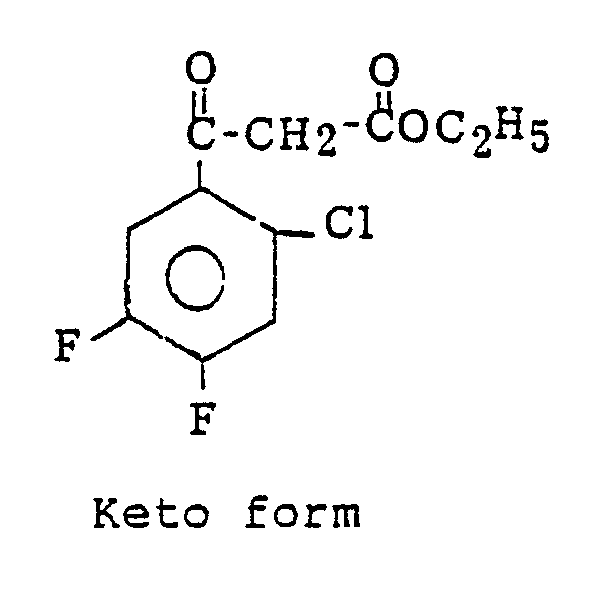
- To 70 g of diethyl 2-chloro-4,5-difluorobenzoylmalonate, 90 cc of water was added for emulsification. Then, 0.2 g of p-toluenesulfonic acid was added thereto, and the mixture was refluxed for three hours under vigorous stirring. After cooling, the reaction mixture was extracted three times with 150 cc of methylene chloride, and the extract was washed with a saturated sodium chloride aqueous solution, dried over anhydrous sodium sulfate, concentrated and then recrystallized from methylene chloride/n-hexane to obtain 32 g of the desired compound. The physical properties of obtained ethyl 2-chloro-4,5-difluorobenzoylacetate were as follows. From the results of the NMR analysis in chloroform-d₁, this compound was found to be a mixture of a keto form and an enol-form.

Mass spectrum: parent peak 262
IR analysis: 3060-3120 cm⁻¹, 2850-2990 cm⁻¹, 1714-1739 cm⁻¹, 1450-1500 cm⁻¹, 1130-1120 cm⁻¹
NMR analysis:
<¹⁹F-NMR> δ ppm from CFCl₃
Keto form δ 129.0 ppm, δ 132.3 ppm
Enol-form δ 137.5 ppm, δ 138.5 ppm
<¹H-NMR> δ ppm from TMS
Keto form:
δ 7.3 ppm
(JH-F=9.4Hz, JH-F=6.7Hz)
δ 7.6 ppm
(JH-F=8.3Hz, JH-F=10.0Hz)
δ 4.0 ppm(s)
δ 4.2 ppm
(JCH₂-CH₃=7.08 ppm)
δ 1.26 ppm
(JCH₂-CH₃=7.08 ppm)
Enol-form:
δ 7.3 ppm
(JH-F=9.4Hz, JH-F=6.7Hz)
δ 7.5 ppm
(JH-F=8.3Hz, JH-F=10.8Hz)
δ 5.62 ppm(s)
δ 4.3 ppm
(JCH₂-CH₃=7.1Hz)
δ 1.35 ppm
(JCH₂-CH₃=7.1Hz)
δ 12.5 ppm(OH) - Into a 200 cc glass reactor equipped with a stirrer, 26.3 g of ethyl 2-chloro-4,5-difluorobenzoylacetate, 23.7 g of ethyl ortho-formate and 40 ml of acetic anhydride were charged, and reacted at a reaction temperature of from 120 to 135°C. After completion of the reaction, the reaction mixture was concentrated by distillation under reduced pressure to obtain 31.5 g of the desired compound as the residue.
- The obtained desired compound i.e. ethyl 2-(2-chloro-4,5-difluorobenzoyl)-3-ethoxyacrylate was analyzed, and the results were as follows. Further, as a result of the NMR analysis, this compound was found to be a mixture of an E-form and a Z-form.
Mass spectrum: M/z: 147, 175, 227, 255, 283, 318
NMR analysis: chloroform-d₁ solvent
<¹⁹F-NMR> δ ppm from CFCl₃
δ 132.1 ppm(m), 139.0 ppm(m)
<¹H-NMR> δ ppm from TMS
δ 1.11 ppm(t), JCH₂-CH₃=7.20Hz
δ 1.15 ppm(t), JCH₂-CH₃=7.08Hz
δ 1.32 ppm(t), JCH₂-CH₃=7.08Hz
δ 1.45 ppm(t), JCH₂-CH₃=7.20Hz
δ 4.13 ppm(q), JCH₂-CH₃=7.08Hz
δ 4.14 ppm(q), JCH₂-CH₃=7.20Hz
δ 4.21 ppm(q), JCH₂-CH₃=7.08Hz
δ 4.33 ppm(q), JCH₂-CH₃=7.20Hz
δ 7.68 ppm(s)
δ 7.81 ppm(s)
IR analysis:
1713 cm⁻¹ (C-C=O, -O-)
1665 cm⁻¹ (-C=C-) - The novel fluorinated benzoyl compounds of the present invention are useful as intermediates for medicines and agricultural chemicals, particularly as intermediates for fluorinated pyridone carboxylic acid type synthetic antibacterial agents. The intermediates of the present invention can be led to quinolone compounds having highly reactive fluorine at the 7-position. Accordingly, as compared with the conventional quinolone compounds having chlorine at the 7-position, the reactivity with a cyclic amine which is required to lead to a synthetic antibacterial agent, is high and it is thereby possible to obtain the desired synthetic antibacterial agent in good yield. Further, by virtue of this highly reactive fluorine, it is possible to obtain a synthetic antibacterial agent of the type which has not been obtained by the conventional method. Further, by using a novel compound of the formula 2 as the starting material, it is possible to obtain 2-chloro-4,5-difluorobenzoic acid more advantageously than the conventional methods.
Claims (6)


Applications Claiming Priority (4)
| Application Number | Priority Date | Filing Date | Title |
|---|---|---|---|
| JP20186287A JPH0720908B2 (en) | 1987-08-14 | 1987-08-14 | Fluorine-containing phenone compounds |
| JP201862/87 | 1987-08-14 | ||
| JP9160988 | 1988-04-15 | ||
| JP91609/88 | 1988-04-15 |
Publications (3)
| Publication Number | Publication Date |
|---|---|
| EP0303291A2 true EP0303291A2 (en) | 1989-02-15 |
| EP0303291A3 EP0303291A3 (en) | 1990-08-29 |
| EP0303291B1 EP0303291B1 (en) | 1995-04-26 |
Family
ID=26433055
Family Applications (1)
| Application Number | Title | Priority Date | Filing Date |
|---|---|---|---|
| EP88113166A Expired - Lifetime EP0303291B1 (en) | 1987-08-14 | 1988-08-12 | Fluorinated benzoyl compounds |
Country Status (5)
| Country | Link |
|---|---|
| US (2) | US4994610A (en) |
| EP (1) | EP0303291B1 (en) |
| KR (1) | KR920010571B1 (en) |
| DE (1) | DE3853654T2 (en) |
| ES (1) | ES2074047T3 (en) |
Cited By (8)
| Publication number | Priority date | Publication date | Assignee | Title |
|---|---|---|---|---|
| DE3840371A1 (en) * | 1988-11-30 | 1990-05-31 | Lentia Gmbh | Process for the preparation of 2,4,5-trifluorobenzoic acid |
| EP0411252A1 (en) * | 1989-07-28 | 1991-02-06 | Riedel-De Haen Aktiengesellschaft | Process for the preparation of fluorobenzoic acids |
| FR2655648A1 (en) * | 1989-12-11 | 1991-06-14 | Isochem Sa | DICHLORO-2,4-FLUORO-5-BENZONITRILE AND PROCESSES FOR ITS PREPARATION, ITS APPLICATION TO THE PREPARATION OF CHLORO-2-DIFLUORO-4,5-BENZOUIC ACID AND A NEW PROCESS FOR PREPARATION |
| FR2658815A1 (en) * | 1990-02-23 | 1991-08-30 | Isochem Sa | 2,2'-Dichloro-4',5'-difluoroacetophenone and process for its preparation, its application to the preparation of 2-chloro-4,5-difluorobenzoic acid and new process for the preparation of the said acid |
| EP0431373A3 (en) * | 1989-11-17 | 1992-09-02 | Asahi Glass Company Ltd. | Processes for producing 5-fluorbenzoic acids and their intermediates |
| WO1993009077A3 (en) * | 1991-10-31 | 1993-06-10 | Abbott Lab | Process for the preparation of fluorinated benzoic acids |
| US5380860A (en) * | 1990-03-27 | 1995-01-10 | Pfizer Inc. | Preparation of beta-ketoesters useful in preparing quinolone antibiotics |
| WO2006090210A1 (en) * | 2005-02-22 | 2006-08-31 | Miteni S.P.A. | Process for the preparation of benzoic acid derivatives via a new intermediate of synthesis |
Families Citing this family (3)
| Publication number | Priority date | Publication date | Assignee | Title |
|---|---|---|---|---|
| US5532416A (en) * | 1994-07-20 | 1996-07-02 | Monsanto Company | Benzoyl derivatives and synthesis thereof |
| US5869688A (en) * | 1994-07-20 | 1999-02-09 | Monsanto Company | Preparation of substituted 3-aryl-5-haloalkyl-pyrazoles having herbicidal activity |
| US5698708A (en) * | 1996-06-20 | 1997-12-16 | Monsanto Company | Preparation of substituted 3-aryl-5-haloalkyl-pyrazoles having herbicidal activity |
Family Cites Families (7)
| Publication number | Priority date | Publication date | Assignee | Title |
|---|---|---|---|---|
| DE3420796A1 (en) * | 1984-06-04 | 1985-12-05 | Bayer Ag, 5090 Leverkusen | 2,4,5-TRIHALOGEN OR 2,3,4,5-TETRAHALOGENBENZENE DERIVATIVES AND METHOD FOR THE PRODUCTION THEREOF |
| DE3426483A1 (en) * | 1984-07-18 | 1986-01-30 | Bayer Ag, 5090 Leverkusen | METHOD FOR PRODUCING HALOGENATED CHINOLON CARBONIC ACIDS |
| DE3529259A1 (en) * | 1985-08-16 | 1987-02-26 | Bayer Ag | Process for the preparation of halogen-substituted benzoylacetonitriles, 1-chloro-2(2,4-dichloro-5-fluorophenyl)ethane-2-one and its preparation |
| JPH0633256B2 (en) * | 1985-12-20 | 1994-05-02 | 大塚製薬株式会社 | Quinolinecarboxylic acid derivative |
| WO1989005643A1 (en) * | 1987-12-18 | 1989-06-29 | Pfizer Inc. | Heterocyclic-substituted quinoline-carboxylic acids |
| US4833270A (en) * | 1987-12-21 | 1989-05-23 | American Cyanamid Company | Process for preparing 2-chloro-4,5-difluorobenzoic acid |
| EP0342849A3 (en) * | 1988-05-19 | 1990-03-14 | Pfizer Inc. | Intermediates for preparing 1,4-dihydro-4-oxo-quinoline-3-carboxylic acid esters |
-
1988
- 1988-08-12 DE DE3853654T patent/DE3853654T2/en not_active Expired - Fee Related
- 1988-08-12 EP EP88113166A patent/EP0303291B1/en not_active Expired - Lifetime
- 1988-08-12 ES ES88113166T patent/ES2074047T3/en not_active Expired - Lifetime
- 1988-08-13 KR KR1019880010362A patent/KR920010571B1/en not_active Expired
-
1989
- 1989-12-05 US US07/446,110 patent/US4994610A/en not_active Expired - Fee Related
-
1990
- 1990-02-07 US US07/476,578 patent/US5068449A/en not_active Expired - Fee Related
Cited By (12)
| Publication number | Priority date | Publication date | Assignee | Title |
|---|---|---|---|---|
| DE3840371A1 (en) * | 1988-11-30 | 1990-05-31 | Lentia Gmbh | Process for the preparation of 2,4,5-trifluorobenzoic acid |
| EP0411252A1 (en) * | 1989-07-28 | 1991-02-06 | Riedel-De Haen Aktiengesellschaft | Process for the preparation of fluorobenzoic acids |
| EP0431373A3 (en) * | 1989-11-17 | 1992-09-02 | Asahi Glass Company Ltd. | Processes for producing 5-fluorbenzoic acids and their intermediates |
| US5241111A (en) * | 1989-11-17 | 1993-08-31 | Asahi Glass Company Ltd. | Processes for producing 5-fluorobenzoic acids and their intermediates |
| FR2655648A1 (en) * | 1989-12-11 | 1991-06-14 | Isochem Sa | DICHLORO-2,4-FLUORO-5-BENZONITRILE AND PROCESSES FOR ITS PREPARATION, ITS APPLICATION TO THE PREPARATION OF CHLORO-2-DIFLUORO-4,5-BENZOUIC ACID AND A NEW PROCESS FOR PREPARATION |
| EP0433124A1 (en) * | 1989-12-11 | 1991-06-19 | Isochem | 2,4-Dichloro-5-fluorobenzonitrile and methods for its preparation, its use in the preparation of 2-chloro-4,5-difluorobenzoic acid and new method of preparation of this acid |
| FR2658815A1 (en) * | 1990-02-23 | 1991-08-30 | Isochem Sa | 2,2'-Dichloro-4',5'-difluoroacetophenone and process for its preparation, its application to the preparation of 2-chloro-4,5-difluorobenzoic acid and new process for the preparation of the said acid |
| US5380860A (en) * | 1990-03-27 | 1995-01-10 | Pfizer Inc. | Preparation of beta-ketoesters useful in preparing quinolone antibiotics |
| WO1993009077A3 (en) * | 1991-10-31 | 1993-06-10 | Abbott Lab | Process for the preparation of fluorinated benzoic acids |
| EP0781757A1 (en) | 1991-10-31 | 1997-07-02 | Abbott Laboratories | Process for the preparation of fluorinated benzoic acids |
| EP0610384B1 (en) * | 1991-10-31 | 1997-09-03 | Abbott Laboratories | Process for the preparation of fluorinated benzoic acids |
| WO2006090210A1 (en) * | 2005-02-22 | 2006-08-31 | Miteni S.P.A. | Process for the preparation of benzoic acid derivatives via a new intermediate of synthesis |
Also Published As
| Publication number | Publication date |
|---|---|
| EP0303291B1 (en) | 1995-04-26 |
| KR890003668A (en) | 1989-04-17 |
| US4994610A (en) | 1991-02-19 |
| DE3853654T2 (en) | 1996-01-18 |
| KR920010571B1 (en) | 1992-12-07 |
| US5068449A (en) | 1991-11-26 |
| DE3853654D1 (en) | 1995-06-01 |
| ES2074047T3 (en) | 1995-09-01 |
| EP0303291A3 (en) | 1990-08-29 |
Similar Documents
| Publication | Publication Date | Title |
|---|---|---|
| EP0021453B1 (en) | 2-chloro-5-trichloromethylpyridine | |
| US5068449A (en) | Fluorinated benzoyl compounds | |
| US4769493A (en) | Process for producing tetrafluorophthalic acid | |
| JP4272271B2 (en) | Method for producing halogeno-o-hydroxydiphenyl compound | |
| US5093515A (en) | Fluorinated benzoyl compounds | |
| EP1853548A1 (en) | Process for the preparation of benzoic acid derivatives via a new intermediate of synthesis | |
| EP0259663B1 (en) | Process for producing tetrafluorophihalic acid | |
| JP2801647B2 (en) | Method for producing 6-fluorochromone-2-carboxylic acid derivative | |
| JP2001048826A (en) | Method for producing 1-phenyl-1,3-butanedione derivative | |
| EP0887333B1 (en) | Process for the production of halogeno-o-hydroxydiphenyl compounds | |
| JP2004010527A (en) | Method for producing 2,4,5-trifluorobenzoylacetic acid alkyl ester | |
| EP0071833B1 (en) | Process for producing 4-benzoylpyrazoles | |
| JPH072679B2 (en) | 2-chloro-4,5-difluorobenzoic acid derivative | |
| JP3646223B2 (en) | Method for producing aromatic compound by electrophilic reaction and aromatic compound | |
| JPH05155846A (en) | Improved preparation of 4-methylsulfonylben- zoic acid derivative and intermediate thereof, and the intermediate | |
| JP3646225B2 (en) | Aromatic ester derivatives, intermediates thereof, and methods for producing them | |
| JPH04984B2 (en) | ||
| JPH0460453B2 (en) | ||
| JPH0759557B2 (en) | Method for producing 1,3-dialkylpyrazole-4-aldehyde derivative | |
| JP3225361B2 (en) | Method for producing aromatic fluorine compound and fluorine-containing benzenesulfinic acid derivative as raw material | |
| JP2003523951A (en) | Method for producing 2-chloro-5-chloromethyl-1,3-thiazole | |
| JPS6393748A (en) | Production of 2-(4-substituted phenyl)proponic acid derivative | |
| JPH0128013B2 (en) | ||
| JPH0713041B2 (en) | Halogenonitrobenzene derivative and method for producing the same | |
| JP2001172247A (en) | Method for producing 4-cyano-2-fluorobenzyl chloride |
Legal Events
| Date | Code | Title | Description |
|---|---|---|---|
| PUAI | Public reference made under article 153(3) epc to a published international application that has entered the european phase |
Free format text: ORIGINAL CODE: 0009012 |
|
| AK | Designated contracting states |
Kind code of ref document: A2 Designated state(s): CH DE ES FR GB IT LI |
|
| PUAL | Search report despatched |
Free format text: ORIGINAL CODE: 0009013 |
|
| AK | Designated contracting states |
Kind code of ref document: A3 Designated state(s): CH DE ES FR GB IT LI |
|
| 17P | Request for examination filed |
Effective date: 19901106 |
|
| 17Q | First examination report despatched |
Effective date: 19920817 |
|
| GRAA | (expected) grant |
Free format text: ORIGINAL CODE: 0009210 |
|
| AK | Designated contracting states |
Kind code of ref document: B1 Designated state(s): CH DE ES FR GB IT LI |
|
| ITF | It: translation for a ep patent filed | ||
| REF | Corresponds to: |
Ref document number: 3853654 Country of ref document: DE Date of ref document: 19950601 |
|
| ET | Fr: translation filed | ||
| REG | Reference to a national code |
Ref country code: ES Ref legal event code: FG2A Ref document number: 2074047 Country of ref document: ES Kind code of ref document: T3 |
|
| PLBE | No opposition filed within time limit |
Free format text: ORIGINAL CODE: 0009261 |
|
| STAA | Information on the status of an ep patent application or granted ep patent |
Free format text: STATUS: NO OPPOSITION FILED WITHIN TIME LIMIT |
|
| 26N | No opposition filed | ||
| REG | Reference to a national code |
Ref country code: CH Ref legal event code: PFA Free format text: ASAHI GLASS COMPANY LTD,1-2, 2-CH. MARUNOUCHI,CHIYODA-KU/TOKYO (JP) TRANSFER- ASAHI GLASS COMPANY LTD.,12-1, YURAKUCHO 1-CHOME, CHIYODA-KU,TOKYO 100-8405 (JP) |
|
| REG | Reference to a national code |
Ref country code: FR Ref legal event code: CA |
|
| PGFP | Annual fee paid to national office [announced via postgrant information from national office to epo] |
Ref country code: DE Payment date: 20010806 Year of fee payment: 14 |
|
| PGFP | Annual fee paid to national office [announced via postgrant information from national office to epo] |
Ref country code: GB Payment date: 20010808 Year of fee payment: 14 |
|
| PGFP | Annual fee paid to national office [announced via postgrant information from national office to epo] |
Ref country code: FR Payment date: 20010810 Year of fee payment: 14 |
|
| PGFP | Annual fee paid to national office [announced via postgrant information from national office to epo] |
Ref country code: CH Payment date: 20010815 Year of fee payment: 14 |
|
| PGFP | Annual fee paid to national office [announced via postgrant information from national office to epo] |
Ref country code: ES Payment date: 20010824 Year of fee payment: 14 |
|
| REG | Reference to a national code |
Ref country code: GB Ref legal event code: IF02 |
|
| PG25 | Lapsed in a contracting state [announced via postgrant information from national office to epo] |
Ref country code: GB Free format text: LAPSE BECAUSE OF NON-PAYMENT OF DUE FEES Effective date: 20020812 |
|
| PG25 | Lapsed in a contracting state [announced via postgrant information from national office to epo] |
Ref country code: ES Free format text: LAPSE BECAUSE OF NON-PAYMENT OF DUE FEES Effective date: 20020813 |
|
| PG25 | Lapsed in a contracting state [announced via postgrant information from national office to epo] |
Ref country code: LI Free format text: LAPSE BECAUSE OF NON-PAYMENT OF DUE FEES Effective date: 20020831 Ref country code: CH Free format text: LAPSE BECAUSE OF NON-PAYMENT OF DUE FEES Effective date: 20020831 |
|
| PG25 | Lapsed in a contracting state [announced via postgrant information from national office to epo] |
Ref country code: DE Free format text: LAPSE BECAUSE OF NON-PAYMENT OF DUE FEES Effective date: 20030301 |
|
| GBPC | Gb: european patent ceased through non-payment of renewal fee |
Effective date: 20020812 |
|
| REG | Reference to a national code |
Ref country code: CH Ref legal event code: PL |
|
| PG25 | Lapsed in a contracting state [announced via postgrant information from national office to epo] |
Ref country code: FR Free format text: LAPSE BECAUSE OF NON-PAYMENT OF DUE FEES Effective date: 20030430 |
|
| REG | Reference to a national code |
Ref country code: FR Ref legal event code: ST |
|
| REG | Reference to a national code |
Ref country code: ES Ref legal event code: FD2A Effective date: 20030912 |
|
| PG25 | Lapsed in a contracting state [announced via postgrant information from national office to epo] |
Ref country code: IT Free format text: LAPSE BECAUSE OF NON-PAYMENT OF DUE FEES Effective date: 20050812 |