EP0303203A2 - Maschine und Verfahren zum Organisieren von Publikationen zur Verteilung in einem Postsystem - Google Patents
Maschine und Verfahren zum Organisieren von Publikationen zur Verteilung in einem Postsystem Download PDFInfo
- Publication number
- EP0303203A2 EP0303203A2 EP88112807A EP88112807A EP0303203A2 EP 0303203 A2 EP0303203 A2 EP 0303203A2 EP 88112807 A EP88112807 A EP 88112807A EP 88112807 A EP88112807 A EP 88112807A EP 0303203 A2 EP0303203 A2 EP 0303203A2
- Authority
- EP
- European Patent Office
- Prior art keywords
- publication
- conveyor
- magazines
- insert
- mailing
- Prior art date
- Legal status (The legal status is an assumption and is not a legal conclusion. Google has not performed a legal analysis and makes no representation as to the accuracy of the status listed.)
- Withdrawn
Links
Images

Classifications
-
- B—PERFORMING OPERATIONS; TRANSPORTING
- B42—BOOKBINDING; ALBUMS; FILES; SPECIAL PRINTED MATTER
- B42C—BOOKBINDING
- B42C1/00—Collating or gathering sheets combined with processes for permanently attaching together sheets or signatures or for interposing inserts
- B42C1/10—Machines for both collating or gathering and interposing inserts
-
- B—PERFORMING OPERATIONS; TRANSPORTING
- B07—SEPARATING SOLIDS FROM SOLIDS; SORTING
- B07C—POSTAL SORTING; SORTING INDIVIDUAL ARTICLES, OR BULK MATERIAL FIT TO BE SORTED PIECE-MEAL, e.g. BY PICKING
- B07C1/00—Measures preceding sorting according to destination
-
- B—PERFORMING OPERATIONS; TRANSPORTING
- B07—SEPARATING SOLIDS FROM SOLIDS; SORTING
- B07C—POSTAL SORTING; SORTING INDIVIDUAL ARTICLES, OR BULK MATERIAL FIT TO BE SORTED PIECE-MEAL, e.g. BY PICKING
- B07C3/00—Sorting according to destination
-
- B—PERFORMING OPERATIONS; TRANSPORTING
- B65—CONVEYING; PACKING; STORING; HANDLING THIN OR FILAMENTARY MATERIAL
- B65H—HANDLING THIN OR FILAMENTARY MATERIAL, e.g. SHEETS, WEBS, CABLES
- B65H39/00—Associating, collating, or gathering articles or webs
- B65H39/02—Associating,collating or gathering articles from several sources
- B65H39/04—Associating,collating or gathering articles from several sources from piles
-
- B—PERFORMING OPERATIONS; TRANSPORTING
- B65—CONVEYING; PACKING; STORING; HANDLING THIN OR FILAMENTARY MATERIAL
- B65H—HANDLING THIN OR FILAMENTARY MATERIAL, e.g. SHEETS, WEBS, CABLES
- B65H2301/00—Handling processes for sheets or webs
- B65H2301/40—Type of handling process
- B65H2301/43—Gathering; Associating; Assembling
- B65H2301/431—Features with regard to the collection, nature, sequence and/or the making thereof
- B65H2301/4311—Making personalised books or mail packets according to personal, geographic or demographic data
Definitions
- This invention relates in general to the distribution of magazines and similar publications and more particularly to a machine and process for organizing magazines of different titles for the most economical distribution through the postal system.
- publishers of magazines on occasion provide supplementary materials with their magazines or with specific issues or perhaps with the issues that are addressed to selected subscribers. For example, if a subscription is about to expire, the publisher will often enclose a card in the last and next to last issue reminding the subscriber of the imminent expiration of the subscription and encouraging him to renew the subscription.
- some publishers distribute advertising material as inserts on a regional basis only. Irrespective of the nature of the insert, the magazine to which it is consigned is normally spread open a slight amount, and the insert is projected into its open pages so that it lodges between two of those pages.
- a principal object of the present invention is to combine or comingle magazines of different titles into common bundles to obtain enough magazines in each bundle to classify for the more favorable postal rate accorded for so-called carrier route sortation.
- the present invention provides a machine for organizing publications of different titles for distribution in a postal or similar system, said machine being characterized by a conveyor capable of moving the publications one after the other along a path; a plurality of publication dispensing units located along the path, with each holding identical publications of a specific title and being capable upon receipt of a command of dispensing onto the conveyor a publication of the specific title which it holds; a plurality of insert dispensing units located along the path downstream from the publication dispensing units, with each holding identical inserts and being capable upon receipt of a command of depositing an insert on a publication located on and being transported by the conveyor; means located along the path downstream from the insert dispensing units for enclosing the publication and any insert deposited on it in an envelope to create a mailing piece; an ink jet printing unit located along the path downstream from the insert dispensing units and being capable, upon receipt of a signal, of directing ink in the form of letters and numbers toward the portion of the mailing piece
- the present invention also provides a process for organizing publications by the postal carrier route of the addressees to whom such publications are to be sent, said process being characterized by depositing publications of varying titles required for the addresses one after the other on a conveyor with the addressees of such publications being of a specific carrier route in response to signals sent by an electronic computer, whereby the publications in a sequence will be directed to the same carrier route; tracking the publications with the electronic computer as they move one after the other along the conveyor; selecting with the electronic computer inserts that are appropriate to the publication and the addressee for the publication and depositing such inserts on the publications as they move along the conveyor; encasing each publication and any insert deposited on it in an envelope to create a mailing piece; applying by means of ink jet printing the addressee's address to a portion of the mailing piece; each address and the publication for that address being correlated by the electronic computer; and stacking successive mailing pieces from the conveyor to form bundles, such stacking being controlled by the electronic computer to insure that all mailing pieces of the bundle have
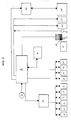
- a machine A ( Figure 1) organizes magazines B, or other publications of various titles into bundles C ( Figure 2), and in so doing applies inserts D to selected magazines B and wraps the magazines B as well as any inserts D which may be applied to them in transparent envelopes E.
- the machine A applies the subscribers' names and addresses to the envelopes E, or the inserts D or even the magazine B, this being effected by so-called ink jet printing.
- the machine A is controlled by its own main computer 2 ( Figure 3) which is operated from a console 4.
- the computer 2 which is a digital computer, holds the basic operating instructions for the machine A, and the instructions enable it to track the magazines B through the machine A and cause components of the machine A to perform various operations on the magazines B.
- the computer 2 reads a magnetic tape 3 which carries the names of subscribers for the several magazine titles assigned to the machine A, as well as the addresses of those subscribers and the titles to which they subscribe.
- the tape 3 also contains additional information that determines the type of insert D, if any, a particular magazine B will receive.
- the computer 2 possesses a limited memory and extracts the names and corresponding information from the tape 3 in groups, holding those names in its memory as the magazines B to which they pertain pass through the machine A.
- the main computer 2 is of the type supplied with ink jet printing systems. It is operated from a console 4.
- the machine A includes a conveyor 5 which may consist of several belts that move side-by-side over a smooth flat surface. Any magazine B which falls onto the moving belts will be transported at the velocity of those belts to that end of the conveyor toward which the belts move. Actually the belts move from the feed end of the conveyor 5 where the magazines B are deposited on the conveyor 5 to the discharge end of the conveyor 5 and thus establish a path that the magazines B follow as they move through the machine B.
- the conveyor 5 may consist of a single straight run, or two or more runs located at angles with respect to each other.
- each feed unit 6 upon receiving a signal drops one magazine B onto the belts of the conveyor 5 with either the back or front cover page of the magazine B presented downwardly so that the downwardly presented page will come against the moving belts of the conveyor 4, thus enabling the magazine B to be transported along the conveyor 2 in a flat condition.
- the signal is electronic in character and derives from a single programmable controller 8 ( Figure 3) to which all of the feed units 6 are connected.
- the controller 8 is in turn connected to the main computer 2. Indeed, the main computer 2, upon extracting names and other information from the magnetic tape 3, directs signals to the programmer 8, each signal calling for a specific magazine B. The controller 8 in turn converts that signal into another signal or command which is directed to the appropriate magazine feed unit 6, causing that unit to deposit a single magazine B on the conveyor 5, The controller 8 further insures that the magazines B are dispensed in the proper sequence and that a generally uniform spacing exists between successive magazines, notwithstanding the arrangement of the units 6 one after the other along the conveyor 5.
- the controller 8 insures that the magazine B dispensed from the upstream unit 6 clears the downstream unit 6 before the latter dispenses its magazine B, and that the latter further dispenses such that a prescribed spacing exists between the two magazines B.
- the magazine feed units 6 are conventional to the printing industry, and are often referred to as book pockets.
- insert feed units 10 Next along the conveyor 5 are several insert feed units 10, each of which has a hopper 11 which contains a stack of inserts D.
- These inserts D may take the form of relatively stiff cards or more flexible multipage brochures. While the inserts D within any feed unit 10 are identical, the inserts D may and usually will vary with the feed units 10, each containing a stack of different inserts D.
- the feed units 10 for the inserts D like the feed units 6 for the magazines B, are arranged one after the other along the conveyor 4. Each projects over the conveyor 5 and contains an actuating mechanism which when triggered, releases a single insert D so that it drops with one face presented downwardly. This mechanism is actuated by a singal from the main computer 2 to which the several feed units 10 are connected.
- the computer 2 selects the magazine B to which an insert D is to be applied and also selects what type of insert D is to be applied. It further delays the signal to the feeding device 10 for that insert D long enough to enable the insert D to drop directly onto the magazine B to which it is assigned as that magazine B passes beneath the feed unit 10 on the conveyor 5.
- the feed units 10 are conventional to the printing industry where they are often referred to as insert pockets.
- the wrapping machine 12 which directs a transparent polymer film 13 beneath each magazine B and any insert D that may be on that magazine and further folds it over the magazine B and insert D.
- the wrapping machine 12 forms transverse heat seals in the polymer film 13 at both ends of the magazine B as well as a longitudinal heat seal between the two transverse heat seals and further severs the polymer film 13 from the roll thus producing a clear polymer envelope E ( Figure 2) which totally encapsulates the magazine B and whatever insert D that is against it.
- the magazine B, its envelope E and any insert D on the magazine B constitute a mailing piece.
- the polymer film 13 of the envelope E should contain a region 14 of opacity or near opacity for accommodating the name and address of the subscriber to the magazine.
- the name and address are applied at the next station at which an ink jet printing unit 16 is located.
- That unit consists of several side-by-side heads 18 which are positioned over the conveyor 5 such that the opaque regions 14 of the envelope E pass directly under them.
- the heads 18 correspond in number to the number of lines in the address, name and supplemental lines included.
- the printing unit 16 is connected to the main computer 2 which causes the unit 16 to discharge ink in varying patterns which adhere to and dry on the opaque region 14 of the envelope E, producing the name and address of the subscriber as well as additional information if desired. While the name and address are for a time in the memory of the main computer 2, that computer derives them from the magnetic tape 3.
- a sensor 20 which is a photoelectric device designed to detect the presence of magazines B on the conveyor 5. Indeed, the sensor 20 produces an electrical signal for each magazine B that passes by it on the conveyor 5, and those signlas are transmitted to the main computer 2 which correlates the signals with the addresses applied at the printing unit 16. If the sensor 20 fails to detect a magazine B for any address previously applied at the printing unit 16, it reorders that magazine B, that is it causes the magazine feed unit 6 to dispense a magazine B of the proper title onto the conveyor 5 and likewise causes the insert feed to deposit the appropriate insert C on that magazine B and the printing unit 16 to apply the appropriate name and address.
- a reject gate 22 which diverts all magazines B that are not suitable for being wrapped into bundles C. For example, if for some reason the machine loses its power momentarily, it will be incapable of tracking the magazines B that are already on the conveyor 5, and these magazines B must be reordered. No addresses are applied to these magazines B and they are merely removed from the conveyor 5 at the reject gate 22. Similarly, if the magazine has a partial label or a wrong label or the wrong quality control label it may be removed from the conveyor at the reject gate 22.
- a divert gate 23 which deflects magazines B of the inappropriate carrier route from the conveyor 5 and into a separate bin to be delivered at the higher rate for single magazines.
- the magnetic tape 3 has names and addresses organized by carrier route and supplies the computer 2 with names and addresses organized in that manner.
- the magazine unit 6 fails to deliver a magazine B for a particular subscriber or the magazine B which is delivered is somehow displaced from the conveyor 5, the sensor 20 will detect the absence of that magazine B and generate a signal which is directed to the computer 2.
- the computer 2 in turn, reorders the magazine B.
- the feed units 6 may be dispensing magazines B for another carrier route, and if this is the case the computer 2 will actuate the divert gate 22 to deflect the reordered magazine B from the conveyor 5 so that it does not become commingled in a bundle C of magazines destined for a different carrier route.
- the diverted magazine B is introduced into the postal system as a separate mailing piece at a somewhat higher postal rate.
- the magazines B are organized strictly according to carrier route, that is to say, the magazines B for a particular carrier route follow one after the other until all of the magazines for that carrier route have passed, at which time the magazines B for the next carrier route proceed.
- the computer 2 also actuates the divert gate 22 when not enough magazines exist in succession to meet the minimum requirements for carrier route sortation.
- a stacking machine 24 which accepts the magazines B from the conveyor 5 and places them in stacks 25. Machines possessing this capability are old, having been sold by Harris Graphics, Inc., for one, but the machine heretofore employed could only produce stacks of a specific count.
- the stacking machine 24 is coupled with a mail control computer 26 which in turn is connected to the main computer 2.
- the mail control computer 26 allows the stacking machine 24 to place magazines B for a single carrier route one on top of each other until the stack 25 so formed reaches a prescribed maximum weight, which is also established by postal regulations, at which time the stack 25 is ejected.
- the computer 24 does not read or scan the addresses on the individual envelopes E which encapsulate the magazines B, but instead tracks the magazines B through the main computer 2 with which it is connected.
- the computer 24 where at all possible insures that each stack 25 has the minimum number of magazines B in it, notwithstanding that one or more of the stacks 25 may not approach the maximum weight specified by postal regulations.
- the computer 26 will cause the stacking machine 24 to place eight magazines in one stack 25 and the minimum of six in the next.
- the stacking machine 24 operates in conjunction with a binding machine 26 which places straps 28 around each stack 25 assembled by the stacking machine 24 to create the bundles C.
- the binding machine 28 operates on demand, placing the straps 30 around each stack 25 that enters it.
- the binding machine 28 is a conventional item of commerce in the printing industry.
- the machine A Before the machine A is set into operation, it must of course be loaded with the various magazines B, inserts D and polymer film for the envelopes E, all of which are to be combined and assembled into the bundles C.
- the magazines B are loaded one upon the other into the pockets 7 of the magazine feed units 6, the pocket 7 of each feed unit 6 holding magazines B of a different title.
- the hoppers 11 of the insert feeding units 10 are loaded with appropriate inserts D, and again each receives a different insert D, but the inserts D in the hopper 11 of each separate unit 10 are identical.
- the wrapping machine 12 is provided with a supply of transparent polymer film 13 suitable for conversion into envelopes E but having the opaque regions 14 already imprinted on it, while the binding machine 28 is provided with strapping for the straps 30.
- a magnetic tape 3 is prepared containing in a suitable code the names and addresses of subscribers to the magazines B of the several titles that are loaded into the magazine feed units 6.
- the code contains an identification of the title to which he subscribes and also a designation for any insert D that is to accompany the magazine B.
- the tape 3 carries the subscribers' names organized by carrier route, but this service is performed by a so-called fulfillment company which prepares the tape. In any event the tape 3 has the names and addresses organized such that addresses having like carrier routes are together irrespective of the title of the magazine to which they apply.
- the main computer 2 selects the first name and address and directs a signal to the programmable controller 8 calling for a magazine B of the title designated for that name and address.
- the controller 8 in turn selects the magazine feed unit 6 which holds the magazine B of that title, and directs s signal to that unit 6 to cause it to dispense one magazine B onto the conveyor 5.
- the main computer 2 directs successive signals to the controller 8, each calling for another magazine B, and for each signal the controller 8 energizes the appropriate magazine feed unit 6, causing it to dispense a single magazine B of the appropriate title onto the conveyor 5.
- the controller 8 insures the magazines B remain in the order in which it received the signals for such magazines from the main computer 2 and that the proper spacing exists between successive magazines B on the conveyor 5.
- the magazines B advance one after the other along conveyor 5, and while successive magazines B may have different titles, they will all have the designation for a single carrier route - at least until the main computer 2 exhausts all names and addresses of the same carrier route.
- the next succession of magazines B is likewise consigned for subscribers of a single carrier route, although the titles of such magazines B may likewise differ, that is to say such magazines B may come from different magazine feeding units 6.
- the main computer 2 tracks it along the full length of the conveyor 5 and indeed into the stacking machine 24. Thus, it knows when the magazine B passes beneath the insert feeding units 10, and if the magnetic tape 3 calls for a particular insert B for that magazine B, the main computer 2 will operate the appropriate insert feed unit 10 in time to cause that insert feed unit 10 to deposit an insert D on the magazine B.
- the magazine B proceeds on to the wrapping machine 12 where a transparent film 13 of a suitable polymer is folded about it and its insert D and sealed and severed to produce a detached envelope E which completely encloses the magazine B thus creating a separate mailing piece.
- the wrapping machine 12 operates independently of the computer 2, that is to say on demand, so that it places an envelope E around each magazine B that encounters it on the conveyor 2.
- the polymer film 13 which the wrapping machine 12 converts into envelopes E has the opaque regions 14 already imprinted on it, and the envelopes E leave the wrapping machine 12 each with its opaque region 14 presented upwardly and at a predetermined location on the magazine B.
- the main computer 2 continues tracking the magazine B, and at the printing unit 16 it energizes the printing heads 18 so that each applies a different line of the subscriber's name and address to the opaque region 14 of the envelope E.
- the first printing head 18 will normally project ink droplets which produce a succession of letters that constitute the subscriber's name, while the next two or three heads 18 will produce numbers and letters constituting the subscriber's address.
- the last one or two heads 18 may be reserved for supplemental information.
- the main computer 2 will in effect track a void along the conveyor 5, but the void will not go undetected. Indeed, the absence of a magazine B is detected by the sensor 20 which directs a signal to the main computer 2. Knowing what magazine B should have been at the void, the computer 2 will immediately reorder that magazine B by sending an appropriate signal to the programmable computer 8 which in turn actuates the appropriate magazine feeding unit 6. Ultimately, the magazine feeding units 6 are dispensing for the same carrier route at the time, but in any event the computer 2 tracks the redordered magazine along the conveyor 4 as any other magazine B.
- the magazine B Upon passing the sensor 20, the magazine B moves through the divert gate 23, unless the carrier route for which it is destined does not correspond to the carrier route or routes of those magazines B which are immediately ahead of or behind it on the conveyor 5, in which case the divert gate 23 will direct it into a nearby bin instead of allowing it to move on to the stacking machine 24.
- the divert gate 23 will direct it into a nearby bin instead of allowing it to move on to the stacking machine 24.
- the magazines B that qualify for carrier route sortation enter the stacking machine 25, and here the mail control computer 26 effects a count as the machine 24 arranges the magazines B in a stack 25 and further weighs the stack 25.
- the computer 26 correlates information from the main computer 2 and from counting and weighing devices on the stacking machine 24 to insure that each stack 25 has only magazines B that are destined for a single carrier route and that each stack 25 contains the minimum number of magazines B to qualify as a carrier route sortation, while at the same time remaining within the weight limitations for that sortation.
- the stacking machine 24 Upon completing a stack 25, the stacking machine 24 discharges it into the banding machine 28 where straps 30 are placed around it.
- the printing unit 16 may be installed immediately ahead of the machine 12, in which case the name and address will be printed on the inserts D or on the magazines B themselves. Indeed, two printing units 16 may be employed - one ahead of the wrapping machine 12 and the other beyond the machine 12. The former applies special messages to the magazines B or inserts D, while the latter applies the name and address to the polymer film envelope E.
Landscapes
- Engineering & Computer Science (AREA)
- Mechanical Engineering (AREA)
- Collation Of Sheets And Webs (AREA)
- Auxiliary Devices For And Details Of Packaging Control (AREA)
Applications Claiming Priority (2)
| Application Number | Priority Date | Filing Date | Title |
|---|---|---|---|
| US07/083,109 US4790119A (en) | 1987-08-10 | 1987-08-10 | Machine and process for organizing publications for distribution in a postal system |
| US83109 | 1987-08-10 |
Publications (2)
| Publication Number | Publication Date |
|---|---|
| EP0303203A2 true EP0303203A2 (de) | 1989-02-15 |
| EP0303203A3 EP0303203A3 (de) | 1989-11-29 |
Family
ID=22176232
Family Applications (1)
| Application Number | Title | Priority Date | Filing Date |
|---|---|---|---|
| EP88112807A Withdrawn EP0303203A3 (de) | 1987-08-10 | 1988-08-05 | Maschine und Verfahren zum Organisieren von Publikationen zur Verteilung in einem Postsystem |
Country Status (3)
| Country | Link |
|---|---|
| US (1) | US4790119A (de) |
| EP (1) | EP0303203A3 (de) |
| CA (1) | CA1280713C (de) |
Cited By (7)
| Publication number | Priority date | Publication date | Assignee | Title |
|---|---|---|---|---|
| FR2673859A1 (fr) * | 1991-01-10 | 1992-09-18 | Homery Bernard | Procede et machine pour le traitement automatique de documents personnalises a expedier par voie postale, ou par une voie analogue. |
| EP0527552A3 (en) * | 1991-07-15 | 1993-03-10 | Moore Business Forms, Inc. | Method and apparatus for forming books |
| NL1007334C2 (nl) * | 1997-10-23 | 1999-04-29 | Koninkl Kpn Nv | Methode voor het verzenden van poststukken. |
| NL1015273C2 (nl) * | 2000-05-23 | 2001-11-26 | Laurens Henri Oppers | Samenstel en werkwijze voor het verzenden van drukwerk. |
| DE10214452C1 (de) * | 2002-03-30 | 2003-10-09 | Siemens Ag | Verfahren zum Verarbeiten von Massensendungen und Vorrichtung zur Durchführung des Verfahrens |
| DE10303976A1 (de) * | 2003-01-31 | 2004-08-19 | Siemens Ag | Verfahren zum Sortieren von flachen Sendungen nach der Verteilreihenfolge |
| EP3064354A1 (de) * | 2015-03-02 | 2016-09-07 | Ferag AG | Verfahren und produktionsvorrichtung zum herstellen von personalisierten druckendprodukten |
Families Citing this family (44)
| Publication number | Priority date | Publication date | Assignee | Title |
|---|---|---|---|---|
| GB8902217D0 (en) * | 1989-02-01 | 1989-03-22 | Promotion Impressions Ltd | Process and machine for producing multiple layer enclosure wraps of sheet material |
| US4939888A (en) * | 1990-07-06 | 1990-07-10 | Webcraft Technologies, Inc. | Method for producing a mass distributable printed packet |
| US5013022A (en) * | 1989-08-18 | 1991-05-07 | Quad/Tech, Inc. | Apparatus and method for assembling signatures |
| US5025610A (en) * | 1989-12-20 | 1991-06-25 | Quad/Tech, Inc. | Apparatus and method for selectively packaging magazines |
| AU7212691A (en) * | 1990-07-09 | 1992-02-04 | Webcraft Technologies, Inc. | A system for producing an individualized packet |
| US5189863A (en) * | 1992-03-20 | 1993-03-02 | Brown Printing Company, A Division Of Gruner & Jahr Printing And Publishing Co. | Video imaging technique used in bagging assembly |
| US5459670A (en) * | 1992-05-15 | 1995-10-17 | Johnson & Hayward, Inc. | System and method for processing international mail |
| US5294100A (en) * | 1992-06-22 | 1994-03-15 | Brown Printing Company | Method and apparatus for securing plural printed material with peelable tabs |
| US5413321A (en) * | 1993-01-12 | 1995-05-09 | International Business Machines Corporation | System and method for operating a document assembly system |
| US5326087A (en) * | 1993-01-12 | 1994-07-05 | Internationaal Business Machines Corporation | System and method for calibrating a document assembly system having multiple asynchronously operated sections |
| US5316281A (en) * | 1993-01-12 | 1994-05-31 | International Business Machines Corporation | System and method for monitoring a document assembly system |
| US5547175A (en) * | 1993-03-29 | 1996-08-20 | Quad/Tech, Inc. | Apparatus and method for preparing mail products |
| NL9402096A (nl) * | 1994-12-09 | 1996-07-01 | Buhrs Zaandam Bv | Werkwijze voor het verkrijgen van een uitgaande stroom van onderling verschillende grafische produkten in een gewenste, bijvoorbeeld op adrescode gesorteerde volgorde, evenals een inrichting voor het toepassen van de werkwijze. |
| FR2733218B1 (fr) * | 1995-04-21 | 1997-07-11 | Planchard Christian | Installation pour le collage d'elements |
| US5838574A (en) * | 1995-10-11 | 1998-11-17 | R. R. Donnelley & Sons Company | System for controlling feeders of a package assembly apparatus |
| NL1004085C2 (nl) * | 1996-09-20 | 1998-03-23 | Buhrs Zaandam Bv | Inrichting voor het verwerken van documenten, zoals bijvoorbeeld brieven, brochures, tijdschriften. |
| ATE218074T1 (de) * | 1996-10-01 | 2002-06-15 | Siemens Ag | Vorrichtung und verfahren zum überführen von sortiergutstücken in eine geordnete reihe |
| US6090034A (en) * | 1998-07-02 | 2000-07-18 | Martin Yale Industries, Incorporated | Tabber apparatus with removable shaft and retaining member |
| US6953906B2 (en) | 1999-08-02 | 2005-10-11 | Rapistan Systems Advertising Corp. | Delivery point sequencing mail sorting system with flat mail capability |
| US6205373B1 (en) | 1999-08-30 | 2001-03-20 | Pitney Bowes Inc. | Method and system for tracking manually repaired mailpieces or the like |
| US6732011B1 (en) * | 1999-10-04 | 2004-05-04 | Pitney Bowes Inc. | Apparatus for preparation of mailpieces and method for downstream control of such apparatus |
| US6714835B1 (en) | 1999-10-04 | 2004-03-30 | Pitney Bowes Inc. | System and apparatus for preparation of mailpieces and method for file based setup of such apparatus |
| US6311103B1 (en) | 1999-12-10 | 2001-10-30 | Pitney Bowes Inc. | Method for run-time performance tuning of an inserter system |
| US6311104B1 (en) | 1999-12-29 | 2001-10-30 | Pitney Bowes Inc. | System and method for controlling the inserter chassis speed in an inserter system |
| US6327515B1 (en) | 1999-12-29 | 2001-12-04 | Pitney Bowes Inc. | Performance tuning of an inserter system based upon a rolling average of page counts for mailpieces to be processed |
| US6711555B1 (en) * | 2000-01-21 | 2004-03-23 | Intra-Mail Network, Inc. | Method and apparatus for delivering mail items to non-postal route locations |
| US7133851B1 (en) * | 2000-08-17 | 2006-11-07 | Donald B. Benson | System and method for combined mailing of a plurality of diverse publications |
| US7102095B2 (en) * | 2001-11-01 | 2006-09-05 | Quad/Graphics, Inc. | Co-mailing apparatus and method |
| WO2003095114A1 (en) * | 2002-05-07 | 2003-11-20 | Siemens Aktiengesellschaft | Single pass sequencing assembly and method |
| US6714834B1 (en) * | 2002-09-18 | 2004-03-30 | Lockheed Martin Corporation | Flats bundle processing system |
| WO2004044899A2 (en) * | 2002-11-13 | 2004-05-27 | Epco Llc | A process for optimal economic efficiency in postal operations |
| US7618032B2 (en) | 2004-03-15 | 2009-11-17 | Lehigh Press, Inc. | Spinning wheel format |
| US7658371B2 (en) * | 2004-03-15 | 2010-02-09 | Lehigh Press, Inc. | Magnetic strip removable portion format |
| US7017899B2 (en) * | 2004-03-15 | 2006-03-28 | Lehigh Press, Inc. | Removable portion format |
| US7325375B2 (en) * | 2004-06-23 | 2008-02-05 | Quad/Graphics, Inc. | Selective product inserter apparatus and process |
| US20060016738A1 (en) * | 2004-07-16 | 2006-01-26 | Norris Michael O | Addressing and printing apparatus and method |
| US20060037288A1 (en) * | 2004-08-18 | 2006-02-23 | Van Den Bosch Hendrik | Packaging |
| ITMI20052011A1 (it) * | 2005-10-21 | 2007-04-22 | Sitma Spa | Metodo per il confezionamento di prodotti editoriali in film plastico e relativa confezione |
| US20080097841A1 (en) * | 2006-10-20 | 2008-04-24 | David Lesniak | Mail advertising addressing system |
| US20100023391A1 (en) * | 2008-07-25 | 2010-01-28 | Hudetz Peter R | System and method for tracking commercial activity |
| US8528890B2 (en) * | 2009-03-27 | 2013-09-10 | Quad/Graphics, Inc. | In-line shell processing |
| GB201009899D0 (en) * | 2010-06-14 | 2010-07-21 | Cadbury Holdings Ltd | Packaging |
| JP5550498B2 (ja) * | 2010-09-02 | 2014-07-16 | 株式会社サム技研Ii | 教材用自動丁合装置 |
| US9607312B2 (en) * | 2013-03-14 | 2017-03-28 | Lsc Communications Us, Llc | Methods and apparatus for increasing co-mailing discounts |
Family Cites Families (8)
| Publication number | Priority date | Publication date | Assignee | Title |
|---|---|---|---|---|
| US3206043A (en) * | 1962-03-22 | 1965-09-14 | Donnelley & Sons Co | Apparatus for and method of handling packs of printed signatures |
| US3608888A (en) * | 1969-10-16 | 1971-09-28 | Mccain Mfg Co | Signature gathering |
| US3819173A (en) * | 1971-09-01 | 1974-06-25 | Harris Intertype Corp | Method and apparatus for producing magazines or the like |
| US3972521A (en) * | 1975-02-28 | 1976-08-03 | Harris Corporation | Bindery system capable of testing its own inspection and control devices |
| US4022455A (en) * | 1975-12-31 | 1977-05-10 | World Color Press, Inc. | Demographic assembling and addressing machine for magazines and the like |
| US4484733A (en) * | 1982-04-05 | 1984-11-27 | Hall Systems, Inc. | Programmable packaging grid including gripper conveyor monitoring system |
| US4639873A (en) * | 1984-02-03 | 1987-01-27 | Bell & Howell Company | Insertion machine with postage categorization and selective merchandising |
| FR2590505A1 (fr) * | 1985-11-28 | 1987-05-29 | Sadas Sarl | Procede de tri et de groupage d'objets selon leur destination et installation autorisant la mise en oeuvre dudit procede |
-
1987
- 1987-08-10 US US07/083,109 patent/US4790119A/en not_active Expired - Lifetime
-
1988
- 1988-08-05 EP EP88112807A patent/EP0303203A3/de not_active Withdrawn
- 1988-08-09 CA CA000574219A patent/CA1280713C/en not_active Expired - Lifetime
Cited By (8)
| Publication number | Priority date | Publication date | Assignee | Title |
|---|---|---|---|---|
| FR2673859A1 (fr) * | 1991-01-10 | 1992-09-18 | Homery Bernard | Procede et machine pour le traitement automatique de documents personnalises a expedier par voie postale, ou par une voie analogue. |
| EP0527552A3 (en) * | 1991-07-15 | 1993-03-10 | Moore Business Forms, Inc. | Method and apparatus for forming books |
| NL1007334C2 (nl) * | 1997-10-23 | 1999-04-29 | Koninkl Kpn Nv | Methode voor het verzenden van poststukken. |
| WO1999021138A3 (en) * | 1997-10-23 | 1999-06-24 | Koninkl Kpn Nv | Method for dispatching mail pieces |
| NL1015273C2 (nl) * | 2000-05-23 | 2001-11-26 | Laurens Henri Oppers | Samenstel en werkwijze voor het verzenden van drukwerk. |
| DE10214452C1 (de) * | 2002-03-30 | 2003-10-09 | Siemens Ag | Verfahren zum Verarbeiten von Massensendungen und Vorrichtung zur Durchführung des Verfahrens |
| DE10303976A1 (de) * | 2003-01-31 | 2004-08-19 | Siemens Ag | Verfahren zum Sortieren von flachen Sendungen nach der Verteilreihenfolge |
| EP3064354A1 (de) * | 2015-03-02 | 2016-09-07 | Ferag AG | Verfahren und produktionsvorrichtung zum herstellen von personalisierten druckendprodukten |
Also Published As
| Publication number | Publication date |
|---|---|
| US4790119A (en) | 1988-12-13 |
| CA1280713C (en) | 1991-02-26 |
| EP0303203A3 (de) | 1989-11-29 |
Similar Documents
| Publication | Publication Date | Title |
|---|---|---|
| US4790119A (en) | Machine and process for organizing publications for distribution in a postal system | |
| US5025610A (en) | Apparatus and method for selectively packaging magazines | |
| US6269609B2 (en) | Apparatus for selective wrapping of products and a method thereof | |
| US6347260B1 (en) | Multi-mailer | |
| US5838574A (en) | System for controlling feeders of a package assembly apparatus | |
| US4022455A (en) | Demographic assembling and addressing machine for magazines and the like | |
| US4484733A (en) | Programmable packaging grid including gripper conveyor monitoring system | |
| US5031891A (en) | Method and system for selectively collating subjectively different printed copy products, particularly different newspaper inserts for targeted distribution | |
| US5377120A (en) | Apparatus for commingling & addressing mail pieces | |
| US4552349A (en) | Programmable packaging grid for loop gripper product conveyor system | |
| CA2066058C (en) | Method and apparatus for producing groups from different printed products | |
| US5287976A (en) | System and method for co-mailing a plurality of diverse publications | |
| US5415518A (en) | Automated method and system for loading book mail bundles onto a pallet | |
| US5171005A (en) | Newspaper handling method and apparatus with misfeed inhibiting control | |
| US5029830A (en) | Apparatus and method for customizing magazines | |
| CA2222946A1 (en) | Apparatus and method for transposing sorted goods into an orderer sequence | |
| US4974824A (en) | Method of distributing a newspaper with inserts | |
| JPH0771864B2 (ja) | 印刷物の処理方法及び装置 | |
| US5013019A (en) | Collating system and signature feeder with embedded printer | |
| US6249716B1 (en) | Printing and finishing documents | |
| US8369984B2 (en) | Facility and method for processing printed materials | |
| US6445975B1 (en) | Carrier route optimization system | |
| JPH06511221A (ja) | 印刷物の加工のための装置 | |
| US20030183696A1 (en) | Method for processing printed products, printed products produced according to the method, and device for performing the method | |
| JPS591748Y2 (ja) | 紙葉類の把束区分装置 |
Legal Events
| Date | Code | Title | Description |
|---|---|---|---|
| PUAI | Public reference made under article 153(3) epc to a published international application that has entered the european phase |
Free format text: ORIGINAL CODE: 0009012 |
|
| AK | Designated contracting states |
Kind code of ref document: A2 Designated state(s): DE FR GB IT SE |
|
| PUAL | Search report despatched |
Free format text: ORIGINAL CODE: 0009013 |
|
| AK | Designated contracting states |
Kind code of ref document: A3 Designated state(s): DE FR GB IT SE |
|
| 17P | Request for examination filed |
Effective date: 19900515 |
|
| 17Q | First examination report despatched |
Effective date: 19920416 |
|
| STAA | Information on the status of an ep patent application or granted ep patent |
Free format text: STATUS: THE APPLICATION IS DEEMED TO BE WITHDRAWN |
|
| 18D | Application deemed to be withdrawn |
Effective date: 19930720 |