EP0301776B1 - Radial tire - Google Patents
Radial tire Download PDFInfo
- Publication number
- EP0301776B1 EP0301776B1 EP88306782A EP88306782A EP0301776B1 EP 0301776 B1 EP0301776 B1 EP 0301776B1 EP 88306782 A EP88306782 A EP 88306782A EP 88306782 A EP88306782 A EP 88306782A EP 0301776 B1 EP0301776 B1 EP 0301776B1
- Authority
- EP
- European Patent Office
- Prior art keywords
- filaments
- tire
- core
- cord
- steel cords
- Prior art date
- Legal status (The legal status is an assumption and is not a legal conclusion. Google has not performed a legal analysis and makes no representation as to the accuracy of the status listed.)
- Expired - Lifetime
Links
- 229910000831 Steel Inorganic materials 0.000 claims description 43
- 239000010959 steel Substances 0.000 claims description 43
- 230000035515 penetration Effects 0.000 description 18
- 230000014759 maintenance of location Effects 0.000 description 10
- 230000035699 permeability Effects 0.000 description 8
- 230000000052 comparative effect Effects 0.000 description 6
- 238000000926 separation method Methods 0.000 description 6
- 230000007547 defect Effects 0.000 description 5
- 238000010276 construction Methods 0.000 description 3
- 230000015572 biosynthetic process Effects 0.000 description 2
- JEIPFZHSYJVQDO-UHFFFAOYSA-N iron(III) oxide Inorganic materials O=[Fe]O[Fe]=O JEIPFZHSYJVQDO-UHFFFAOYSA-N 0.000 description 2
- 241000221535 Pucciniales Species 0.000 description 1
- 230000006866 deterioration Effects 0.000 description 1
- 230000003292 diminished effect Effects 0.000 description 1
- 230000000694 effects Effects 0.000 description 1
- 238000011835 investigation Methods 0.000 description 1
- 201000003152 motion sickness Diseases 0.000 description 1
- 230000003014 reinforcing effect Effects 0.000 description 1
- 230000007847 structural defect Effects 0.000 description 1
Images


Classifications
-
- D—TEXTILES; PAPER
- D07—ROPES; CABLES OTHER THAN ELECTRIC
- D07B—ROPES OR CABLES IN GENERAL
- D07B1/00—Constructional features of ropes or cables
- D07B1/06—Ropes or cables built-up from metal wires, e.g. of section wires around a hemp core
- D07B1/0606—Reinforcing cords for rubber or plastic articles
- D07B1/062—Reinforcing cords for rubber or plastic articles the reinforcing cords being characterised by the strand configuration
-
- B—PERFORMING OPERATIONS; TRANSPORTING
- B60—VEHICLES IN GENERAL
- B60C—VEHICLE TYRES; TYRE INFLATION; TYRE CHANGING; CONNECTING VALVES TO INFLATABLE ELASTIC BODIES IN GENERAL; DEVICES OR ARRANGEMENTS RELATED TO TYRES
- B60C9/00—Reinforcements or ply arrangement of pneumatic tyres
- B60C9/0007—Reinforcements made of metallic elements, e.g. cords, yarns, filaments or fibres made from metal
-
- D—TEXTILES; PAPER
- D07—ROPES; CABLES OTHER THAN ELECTRIC
- D07B—ROPES OR CABLES IN GENERAL
- D07B1/00—Constructional features of ropes or cables
- D07B1/06—Ropes or cables built-up from metal wires, e.g. of section wires around a hemp core
- D07B1/0606—Reinforcing cords for rubber or plastic articles
- D07B1/062—Reinforcing cords for rubber or plastic articles the reinforcing cords being characterised by the strand configuration
- D07B1/0626—Reinforcing cords for rubber or plastic articles the reinforcing cords being characterised by the strand configuration the reinforcing cords consisting of three core wires or filaments and at least one layer of outer wires or filaments, i.e. a 3+N configuration
-
- D—TEXTILES; PAPER
- D07—ROPES; CABLES OTHER THAN ELECTRIC
- D07B—ROPES OR CABLES IN GENERAL
- D07B2201/00—Ropes or cables
- D07B2201/20—Rope or cable components
- D07B2201/2015—Strands
- D07B2201/2016—Strands characterised by their cross-sectional shape
-
- D—TEXTILES; PAPER
- D07—ROPES; CABLES OTHER THAN ELECTRIC
- D07B—ROPES OR CABLES IN GENERAL
- D07B2201/00—Ropes or cables
- D07B2201/20—Rope or cable components
- D07B2201/2015—Strands
- D07B2201/2023—Strands with core
-
- D—TEXTILES; PAPER
- D07—ROPES; CABLES OTHER THAN ELECTRIC
- D07B—ROPES OR CABLES IN GENERAL
- D07B2201/00—Ropes or cables
- D07B2201/20—Rope or cable components
- D07B2201/2015—Strands
- D07B2201/2024—Strands twisted
- D07B2201/2029—Open winding
- D07B2201/2031—Different twist pitch
- D07B2201/2032—Different twist pitch compared with the core
-
- D—TEXTILES; PAPER
- D07—ROPES; CABLES OTHER THAN ELECTRIC
- D07B—ROPES OR CABLES IN GENERAL
- D07B2401/00—Aspects related to the problem to be solved or advantage
- D07B2401/20—Aspects related to the problem to be solved or advantage related to ropes or cables
- D07B2401/206—Improving radial flexibility
-
- Y—GENERAL TAGGING OF NEW TECHNOLOGICAL DEVELOPMENTS; GENERAL TAGGING OF CROSS-SECTIONAL TECHNOLOGIES SPANNING OVER SEVERAL SECTIONS OF THE IPC; TECHNICAL SUBJECTS COVERED BY FORMER USPC CROSS-REFERENCE ART COLLECTIONS [XRACs] AND DIGESTS
- Y10—TECHNICAL SUBJECTS COVERED BY FORMER USPC
- Y10S—TECHNICAL SUBJECTS COVERED BY FORMER USPC CROSS-REFERENCE ART COLLECTIONS [XRACs] AND DIGESTS
- Y10S57/00—Textiles: spinning, twisting, and twining
- Y10S57/902—Reinforcing or tyre cords
-
- Y—GENERAL TAGGING OF NEW TECHNOLOGICAL DEVELOPMENTS; GENERAL TAGGING OF CROSS-SECTIONAL TECHNOLOGIES SPANNING OVER SEVERAL SECTIONS OF THE IPC; TECHNICAL SUBJECTS COVERED BY FORMER USPC CROSS-REFERENCE ART COLLECTIONS [XRACs] AND DIGESTS
- Y10—TECHNICAL SUBJECTS COVERED BY FORMER USPC
- Y10T—TECHNICAL SUBJECTS COVERED BY FORMER US CLASSIFICATION
- Y10T152/00—Resilient tires and wheels
- Y10T152/10—Tires, resilient
- Y10T152/10495—Pneumatic tire or inner tube
- Y10T152/10855—Characterized by the carcass, carcass material, or physical arrangement of the carcass materials
Definitions
- the present invention relates to low profile radial tires, especially for trucks and buses, wherein steel cords are used for carcass plies as reinforcing elements for tires and more particularly to an improvement in the construction of the steel cords.
- outer filaments 5 which form an outer layer 7 are apt to close to a center over a circumscribed circle of the core 6 as shown in the figures by a solid line compared with a dotted line which illustrates an expected position. Accordingly, the difference of the flexural rigidity between the vertical alignment portions and the lateral alignment portions becomes larger, so there is a serious problem in the fatigue resistance.
- all filaments of said cords being covered by rubber, residual air which is caught during tire formation is hardly passed away to the outside through the inside of the cords. Then a tire is manufactured with remaining air in the cords, so that the tire manufactured is subjected to an early failure due to the residual air.
- Steel cords 3 of 1 x 12 as shown in Fig. 5 are composed of 12 filaments having a same diameter which are twisted in the same direction with the same pitch, so the outer filaments 5 fit in surface depressions of a core strand 6 and thereby the penetration of rubber is hindered. Consequently, core filaments 4 are apt to be drawn out during a tire service.
- U.S. Patent No. 4586324 proposes a radial tire reinforced with steel cords having a core composed of 2 or 3 filaments and an outer layer composed of a number of filaments at most 4 greater than the number of core filaments.
- the pitch of the core filaments is half the pitch of the filaments of the outer layer, the filaments being substantially equal in diameter.
- the sectional construction, twisting direction and twisting pitch of a steel cord are specified as set forth hereinafter to solve the problems in the prior art.
- a steel cord to be used for a low profile radial tire of the present invention is constructed as follows.
- All filaments used in a cord are substantially equal in diameter.
- the core and outer layer are twisted in the same direction but with a different pitch.
- the core is composed of 3 or 4 filaments and the outer layer is composed of a number of filaments 5 greater than the number of core filaments.
- Twisting both the core and the outer layer in the same direction can make a cross angle of the filaments small between the core and the outer layer, so contact pressure between the core and outer filaments is eliminated and thereby fatigue resistance is improved.
- Twisting with a different pitch prevents the insufficiency of rubber penetration due to a structural defect caused by twisting them in the same direction with a same pitch as shown in Fig. 5.
- the outer layer has a twisting pitch larger than that of the core.
- the most preferred ratio of the pitch of the outer layer to that of the core is 2 to 1, but a modified ratio of the pitch in the range of 50% is also employable. Then the ratio of 3 to 2 may also be used.
- Composing the core with 3 or 4 filaments retains proper air permeability.
- the difference of flexural rigidity occurs in the lengthwise direction and besides air is likely to remain due to the insufficiency of air permeability.
- a center space of the core becomes too large, as shown in Fig. 6, to be filled with rubber, so it shows excessive air permeability and easily rusts.
- Composing the outer layer with the number of filaments which is 5 greater than the number of the core filaments is based on the following reasons.
- the number of the die outer filaments has previously been one 6 greater than the number of the core filaments in view of the cord strength.
- the cord structure of 3 + 9 as shown in Fig. 4 is proper in this sense. But, as mentioned before, the penetration of rubber is insufficient. Accordingly, the present invention employs the cord structure wherein the upper limit of the additional number is 5 in order to promote the rubber penetration.
- cord structure in accordance with the present invention is 3 + 8, or 4 + 9.
- the rubber penetration into the steel cords is made just sufficient to eliminate the retention of residual air caused by the insufficiency of air permeability due to excessive rubber penetration as well as an early separation failure caused by said residual air.
- the defects caused by the insufficiency of rubber penetration such as fretting wear between filaments, fatigue and occurrence of rust due to excessive air permeability are eliminated.
- Contact pressure between the core filaments and the outer filaments is diminished by twisting in the same direction, so contact fatigue is also eliminated.
- Uniform flexural rigidity in the lengthwise direction of the cords eliminates the occurrence of a partial fatigue.
- a low profile radial tire produced with the steel cords in accordance with the present invention is free from the residual air defects, fatigue and rust and consequently enjoys high durability and a longlife.
- the above cord structure shows excellent effects when the aspect ratio of a tire i.e. tire section height divided by section width is at highest 0.85.
- the aspect ratio is higher than 0.85, steel cords used are fatigued remarkably during tire running even with an original inner pressure, so that cord filaments are broken.
- steel cords having a specific structure as defined above are used for carcass plies of a low profile radial tire having an aspect ratio at highest of 0.85 and besides a diameter of filaments is decided depending upon an outer diameter of tires, and thereby low profile radial tires for trucks and buses having excellent steering stability and residential amenity can be provided and then passengers on a bus hardly get carsick.
- Cord mark A is a steel cord in accordance with the present invention which is composed of a core 1 of three filaments and an outer layer 2 of eight filaments, that is, 3 + 8 structure as shown in Fig. 1.
- Cord marks B and C are prior art steel cords composed of a core 6 of three filaments and an outer layer 7 of nine filaments, i.e. 3 + 9 structure in Fig. 4 and a core 6 of two filaments and an outer layer 7 of seven filaments, i.e. 2 + 7 structure in Fig. 3.
- Cord mark D is a comparative cord composed of a core 6 of five filaments and an outer layer 7 of six filaments, i.e. 5 + 6 structure as shown in Fig6. .
- the steel cords of this embodiment (cord mark A) being preferable both in air permeability and rubber penetration
- the radial tire of this embodiment(tire mark TA) causes less defects of residual air and also shows better results both in the separation resistance and in the retention of strength.
- a highly durable tire is obtained by the present invention.
- comparison tires using the steel cords which are excessive or insufficient in the air permeability and the rubber penetration are inferior in durability.
- a chain line indicates a danger line drawn at 70% strength retention coefficient which means that a tire is likely to burst during running. It will be understood that fatigue resistance is improved when the aspect ratio does not exceed 0.85.
- Test conditions in Tables 5 and 6 are similar to those in Tables 1, 2 and 4. Index indication is made by setting the value of cord mark i and tire mark Ti to be 100.
- the tire Th in accordance with the present invention causes less defects of residual air and shows better results both in separation resistance and in the retention of strength. Further the occurrence of carsickness is nil. And besides running distance is superior even when running with a low inner pressure. Namely, the tire Th is well balanced in tire performances.
Landscapes
- Engineering & Computer Science (AREA)
- Mechanical Engineering (AREA)
- Tires In General (AREA)
- Ropes Or Cables (AREA)
Description
- The present invention relates to low profile radial tires, especially for trucks and buses, wherein steel cords are used for carcass plies as reinforcing elements for tires and more particularly to an improvement in the construction of the steel cords.
- Heretofore, there have been used the steel cords having the structure of 2 + 7 as shown in Fig. 3, 3 + 9 in Fig. 4 or 1 x 12 in Fig. 5.
-
Steel cords 3 or 2 + 7 in Fig. 3, however, having acore 6 composed of twofilaments 4 twisted together as shown in the figures, the alignment of the filaments becomes vertical at one position in the lengthwise direction of the cords as shown in Fig. 3(B), while the alignment becomes lateral at another position as shown in Fig. 3(A). These alignments appear at every 1/4 pitch. It results in that said cords are composed of different portions having a different flexural rigidity in the lengthwise direction of the cords. When said cords are applied to a tire, the portions in a lateral alignment having a lower flexural rigidity are subjected to a concentrated fatigue breakage. Furthermore,outer filaments 5 which form anouter layer 7 are apt to close to a center over a circumscribed circle of thecore 6 as shown in the figures by a solid line compared with a dotted line which illustrates an expected position. Accordingly, the difference of the flexural rigidity between the vertical alignment portions and the lateral alignment portions becomes larger, so there is a serious problem in the fatigue resistance. In addition, all filaments of said cords being covered by rubber, residual air which is caught during tire formation is hardly passed away to the outside through the inside of the cords. Then a tire is manufactured with remaining air in the cords, so that the tire manufactured is subjected to an early failure due to the residual air. -
Steel cords 3 of 3 + 9 as shown in Fig. 4 having a narrow space between adjacentouter filaments 5, the penetration of rubber into the cords is insufficient, so that theouter filaments 5 contact with each other and wear out. It results in the deterioration of fatigue resistance. -
Steel cords 3 of 1 x 12 as shown in Fig. 5 are composed of 12 filaments having a same diameter which are twisted in the same direction with the same pitch, so theouter filaments 5 fit in surface depressions of acore strand 6 and thereby the penetration of rubber is hindered. Consequently,core filaments 4 are apt to be drawn out during a tire service. - As mentioned above, prior art steel cords have not been provided with balanced properties between the uniform flexural rigidity and the rubber penetration property.
- In order to overcome the problem of, inter alia, poor rubber penetration and constructive stability, U.S. Patent No. 4586324 proposes a radial tire reinforced with steel cords having a core composed of 2 or 3 filaments and an outer layer composed of a number of filaments at most 4 greater than the number of core filaments. The pitch of the core filaments is half the pitch of the filaments of the outer layer, the filaments being substantially equal in diameter.
- It has been a recent trend, however, to use low profile tires having a low aspect ratio, namely wider tires with a flatter profile. The low profile tires are apt to cause a great deflection at a shoulder portion when they are operated at a reduced internal pressure, so that steel carcass cords deteriorate rapidly in fatigue resistance and there is a great probability or danger of a tire burst. U.S. Patent No. 4568324 does not address such problems of low profile tires.
- It is therefore an object of the present invention to provide a low profile radial tire reinforced with steel cords which have uniform flexural rigidity throughout the lengthwise direction of the cords and have a good rubber penetration property and further have a structure that eliminates the contact between outer filaments.
- It is another object of the present invention to provide a low profile radial tire which does not cause a burst even when a tire is operated at a reduced inner pressure.
- In accordance with the present invention, the sectional construction, twisting direction and twisting pitch of a steel cord are specified as set forth hereinafter to solve the problems in the prior art.
- As mentioned above, excessive penetration of rubber into a cord causes the retention of air which is caught during tire formation. A tire produced with such steel cords suffers an early separation failure. On the contrary, less penetration of rubber into a cord has filaments worn out due to the contact of filaments with each other, so the cord is likely fatigued and rusted. Therefore, it is important to construct a steel cord so that the penetration of rubber may be well controlled by preferable air permeability of steel cord whereby the retention of air is eliminated and an early separation failure is prevented.
- In accordance with the above, a steel cord to be used for a low profile radial tire of the present invention is constructed as follows.
- All filaments used in a cord are substantially equal in diameter. The core and outer layer are twisted in the same direction but with a different pitch. The core is composed of 3 or 4 filaments and the outer layer is composed of a number of
filaments 5 greater than the number of core filaments. - Twisting both the core and the outer layer in the same direction can make a cross angle of the filaments small between the core and the outer layer, so contact pressure between the core and outer filaments is eliminated and thereby fatigue resistance is improved.
- Twisting with a different pitch prevents the insufficiency of rubber penetration due to a structural defect caused by twisting them in the same direction with a same pitch as shown in Fig. 5. It is preferable that the outer layer has a twisting pitch larger than that of the core. The most preferred ratio of the pitch of the outer layer to that of the core is 2 to 1, but a modified ratio of the pitch in the range of 50% is also employable. Then the ratio of 3 to 2 may also be used.
- Composing the core with 3 or 4 filaments retains proper air permeability. In case of two filaments, the difference of flexural rigidity occurs in the lengthwise direction and besides air is likely to remain due to the insufficiency of air permeability. In case of 5 filaments, a center space of the core becomes too large, as shown in Fig. 6, to be filled with rubber, so it shows excessive air permeability and easily rusts.
- Composing the outer layer with the number of filaments which is 5 greater than the number of the core filaments is based on the following reasons.
- Generally, the number of the die outer filaments has previously been one 6 greater than the number of the core filaments in view of the cord strength. The cord structure of 3 + 9 as shown in Fig. 4 is proper in this sense. But, as mentioned before, the penetration of rubber is insufficient. Accordingly, the present invention employs the cord structure wherein the upper limit of the additional number is 5 in order to promote the rubber penetration.
- Consequently the cord structure in accordance with the present invention is 3 + 8, or 4 + 9.
- By employing such a construction, the rubber penetration into the steel cords is made just sufficient to eliminate the retention of residual air caused by the insufficiency of air permeability due to excessive rubber penetration as well as an early separation failure caused by said residual air. On the other hand, the defects caused by the insufficiency of rubber penetration such as fretting wear between filaments, fatigue and occurrence of rust due to excessive air permeability are eliminated. Contact pressure between the core filaments and the outer filaments is diminished by twisting in the same direction, so contact fatigue is also eliminated. Uniform flexural rigidity in the lengthwise direction of the cords eliminates the occurrence of a partial fatigue.
- Accordingly a low profile radial tire produced with the steel cords in accordance with the present invention is free from the residual air defects, fatigue and rust and consequently enjoys high durability and a longlife.
- Further investigation reveals that the above cord structure shows excellent effects when the aspect ratio of a tire i.e. tire section height divided by section width is at highest 0.85. When the aspect ratio is higher than 0.85, steel cords used are fatigued remarkably during tire running even with an original inner pressure, so that cord filaments are broken.
- Furthermore, we have reviewed the relation between the aspect ratio and a filament diameter of the steel cords used for carcass plies and consequently we preferably employ steel cords wherein the outer diameter of a tire is 3500 to 5500 times larger than the diameter of cord filaments. If the said value exceeds 5500, rigidity of a tire generally becomes insufficient. As a result, steering stability deteriorates so that passengers on a bus are likely to get carsick. On the other hand, if the value is less than 3500, steel cords may be fatigued to the extent that tire burst may be caused.
- Accordingly, in the present invention, steel cords having a specific structure as defined above are used for carcass plies of a low profile radial tire having an aspect ratio at highest of 0.85 and besides a diameter of filaments is decided depending upon an outer diameter of tires, and thereby low profile radial tires for trucks and buses having excellent steering stability and residential amenity can be provided and then passengers on a bus hardly get carsick.
-
- Fig. 1 is a cross-sectional view of one embodiment of the steel cords to be used for low profile radial tires for trucks and buses in accordance with the present invention;
- Fig. 2 is a cross-sectional view of another embodiment of the steel cords for low profile radial tires in accordance with the present invention;
- Fig. 3 to Fig. 5 are cross-sectional views showing examples of prior art steel cords;
- Fig. 6 is a cross-sectional view showing a comparative structure of a steel cord for comparison with the cord of the present invention;
- Fig. 7 is a relative representation of aspect ratios of tires and strength retention coefficient.
- The following embodiments illustrate the invention:
- Four types of steel cords are prepared. One is the steel cords in accordance with the present invention which have the cord structure shown in Fig. 1. Other three are prior art steel cords and comparative cords. Each structure is shown in Table 1. Cord mark A is a steel cord in accordance with the present invention which is composed of a core 1 of three filaments and an outer layer 2 of eight filaments, that is, 3 + 8 structure as shown in Fig. 1. Cord marks B and C are prior art steel cords composed of a
core 6 of three filaments and anouter layer 7 of nine filaments, i.e. 3 + 9 structure in Fig. 4 and acore 6 of two filaments and anouter layer 7 of seven filaments, i.e. 2 + 7 structure in Fig. 3. Cord mark D is a comparative cord composed of acore 6 of five filaments and anouter layer 7 of six filaments, i.e. 5 + 6 structure as shown in Fig6. .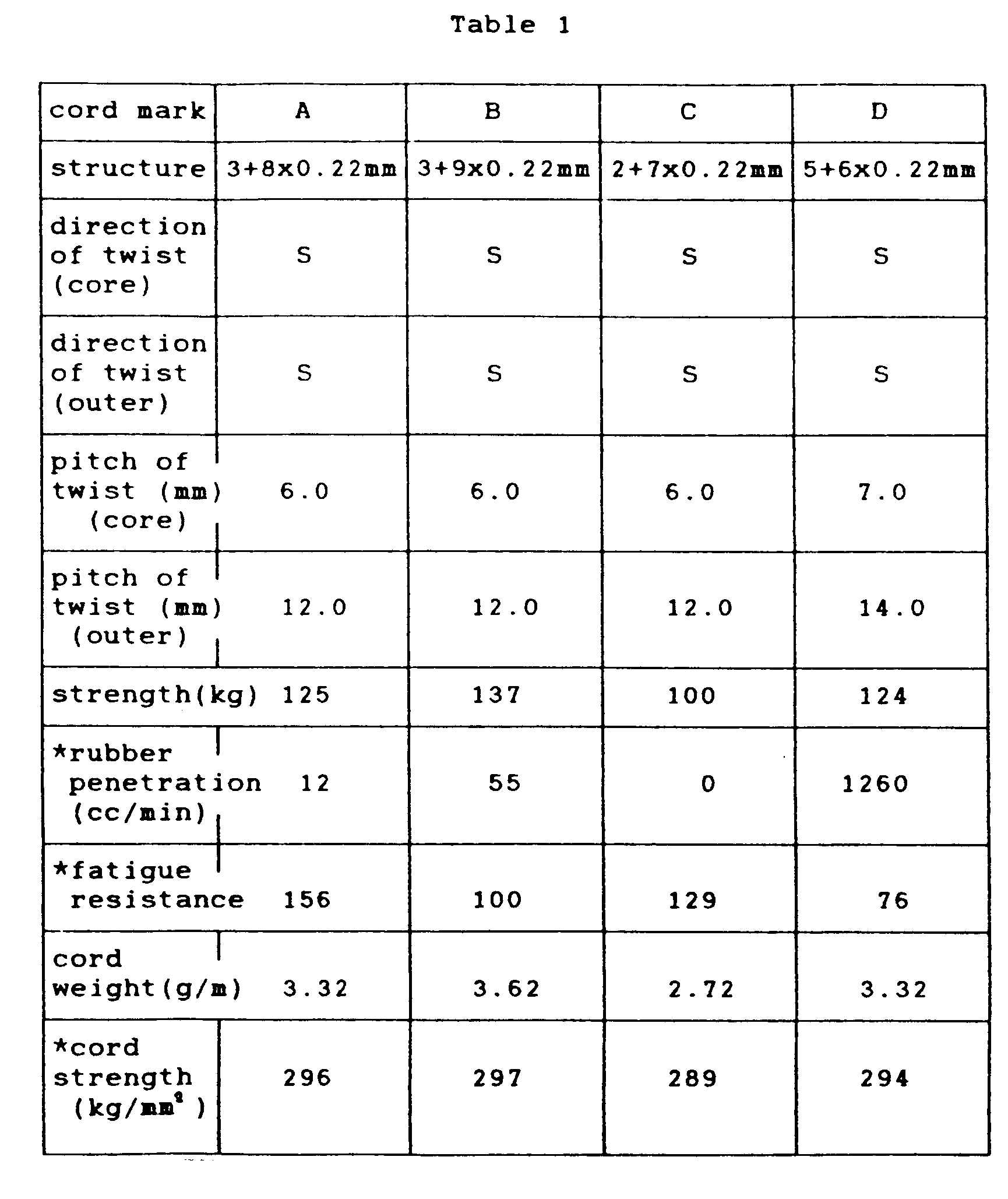

- Then low profile radial tires of 11R 22.5, aspect ratio of 0.80 were prepared using the above steel cords for carcass plies. Comparative tests were conducted upon radial tires TA of the embodiment of the present invention and tires TB, TC, TD for comparison. Test results are shown in Table 2 wherein the value is indicated in the form of an index by setting the value of a comparison TB to be 100.


- As apparent from Table 1 and Table 2, the steel cords of this embodiment (cord mark A) being preferable both in air permeability and rubber penetration, the radial tire of this embodiment(tire mark TA) causes less defects of residual air and also shows better results both in the separation resistance and in the retention of strength. Thus a highly durable tire is obtained by the present invention. On the contrary, comparison tires using the steel cords which are excessive or insufficient in the air permeability and the rubber penetration are inferior in durability.
- Radial tires having variation in aspect ratio and size were prepared using the steel cords of 3 + 8 x 0.22 for carcass plies. Comparative tests were conducted upon tires after running of 20,000 cycles in tire revolutions given by the following equation to elucidate the relation of tire aspect ratio and strength retention coefficient of steel cords. Strength retention coefficient is obtained by comparing the strength of detached steel cords after running with the strength before running.

- In Fig. 7, a chain line indicates a danger line drawn at 70% strength retention coefficient which means that a tire is likely to burst during running. It will be understood that fatigue resistance is improved when the aspect ratio does not exceed 0.85.
- Steel cords of 3 + 8 structure were prepared using filaments of different diameter as shown in Table 3.
Table 3 cord mark a b c d e structure 3+8 x 0.15 mm 3+8 x 0.22 mm 3+8 x 0.32 mm 3+8 x 0.19 mm 3+8 x 0.26mm direction of twist (core) S S S S S direction of twist (outer) S S S S S pitch of twist (mm) (core) 5.0 6.5 9.5 6.0 9.0 pitch of twist (mm) (outer) 10.0 13.0 19.0 12.0 18.0 breaking load (kg) 56 124 251 91 165 rubber penetration (cc/min) 6 10 2 7 5 fatigue resistance 520 100 3 380 95 cord weight (g/m) 1.50 3.33 7.05 2.41 4.58 cord strength (kg/mm²) 293 293 280 293 283 - Low profile radial tires of 285/75R24.5 were prepared using the above steel cords for carcass plies. Comparative test results are shown in Table 4.

- As apparent from Table 4, carsick percentage becomes high when the value of outer diameter of tire/filament diameter is high. Tires Tb, Tc and Te show preferred results. But the tire Tc shows earlier failure when running with a low inner pressure as shown in the result of running distance due to insufficiency of the value of outer diameter of tire/filament diameter. Accordingly, said value is preferred to be in the range of 3500 to 5500.
- Steel cords were prepared as shown in Table 5 and low profile tires of 215/75R17.5 were prepared as shown Table 6. Aspect ratio was 0.75.
Table 5 cord mark f g h i j structure 1+19 x 0.13mm 2+7 x 0.22 mm 4+9 x 0.175 mm 3+9 x 0.175mm 1+12 x 0.175mm direction of twist (core) S S S S S direction of twist (outer) S S S S S pitch of twist (mm) (core) 10 6 6 5 10 pitch of twist (mm) (outer) 10 12 12 10 10 breaking load (kg) 68 90 96 89 89 rubber penetration (cc/min) 92 0 13 45 87 fatigue resistance 120 56 157 100 72 cord weight (g/m) 1.70 2.72 2.41 2.22 2.23 cord strength (kg/mm²) 314 260 313 315 314 Table 6 tire mark Tf Tg Th Ti Tj ply cord f g h i j end counts(number/5cm) 33 26 24 26 26 defects of residual air 3 151 2 100 1 separation resistance 68 91 225 100 70 retention of strength 85 121 159 100 78 outer diameter of tire (mm) 760 760 760 759 760 outer diameter of tire/filament diameter (mm) 5846 3454 4343 4337 4343 carsick percentage 96 2 0 0 0 running distance 121 30 119 100 31 - Test conditions in Tables 5 and 6 are similar to those in Tables 1, 2 and 4. Index indication is made by setting the value of cord mark i and tire mark Ti to be 100.
- As shown in Table 6, the tire Th in accordance with the present invention causes less defects of residual air and shows better results both in separation resistance and in the retention of strength. Further the occurrence of carsickness is nil. And besides running distance is superior even when running with a low inner pressure. Namely, the tire Th is well balanced in tire performances.
Claims (4)
- A low profile radial tire reinforced with steel cords composed of two layers of a core and an outer layer, the core comprising 3 or 4 filaments and the outer layer comprising a number of filaments equal to 5 more than the number of core filaments, the core and outer layer filaments being substantially equal in diameter, the core filaments and the outer filaments having a twist of the same hand but a different pitch, the aspect ratio of the tire being at most 0.85.
- A low profile radial tire as claimed in claim 1, wherein the outer diameter of the tire is 3500 to 5500 times larger than the diameter of the cord filaments.
- A low profile radial tire as claimed in claim 1 or claim 2, wherein the steel cords have 3 + 8 structure.
- A low profile radial tire as claimed in claim 1, wherein the steel cords have cord strength at least of 285kg/mm², calculated according to the following formula:

Applications Claiming Priority (2)
| Application Number | Priority Date | Filing Date | Title |
|---|---|---|---|
| JP62185223A JPS6433288A (en) | 1987-07-23 | 1987-07-23 | Falt radial tire for truck bus |
| JP185223/87 | 1987-07-23 |
Publications (2)
| Publication Number | Publication Date |
|---|---|
| EP0301776A1 EP0301776A1 (en) | 1989-02-01 |
| EP0301776B1 true EP0301776B1 (en) | 1992-10-14 |
Family
ID=16167031
Family Applications (1)
| Application Number | Title | Priority Date | Filing Date |
|---|---|---|---|
| EP88306782A Expired - Lifetime EP0301776B1 (en) | 1987-07-23 | 1988-07-22 | Radial tire |
Country Status (4)
| Country | Link |
|---|---|
| US (1) | US4986327A (en) |
| EP (1) | EP0301776B1 (en) |
| JP (1) | JPS6433288A (en) |
| DE (1) | DE3875301T2 (en) |
Cited By (1)
| Publication number | Priority date | Publication date | Assignee | Title |
|---|---|---|---|---|
| US8359823B2 (en) | 2009-01-09 | 2013-01-29 | Nv Bekaert Sa | Steel cord for reinforcing tire |
Families Citing this family (22)
| Publication number | Priority date | Publication date | Assignee | Title |
|---|---|---|---|---|
| WO1991004370A1 (en) * | 1989-09-18 | 1991-04-04 | B.V. Bekaert S.A. | Open cord structure |
| US5323596A (en) * | 1990-11-05 | 1994-06-28 | The Goodyear Tire & Rubber Company | Open metallic cord for penetration by elastomer |
| JPH0519394U (en) * | 1991-07-29 | 1993-03-09 | 東京製綱株式会社 | Steel cord |
| JP3538205B2 (en) * | 1992-03-09 | 2004-06-14 | 住友ゴム工業株式会社 | Steel cord for tire carcass, steel cord for tire filler, and tire using the same |
| US5609014A (en) * | 1992-04-20 | 1997-03-11 | Tokyo Rope Manufacturing Co., Ltd. | Rubber reinforcing steel cord |
| JP3204579B2 (en) * | 1993-10-14 | 2001-09-04 | 株式会社ブリヂストン | Steel cord and pneumatic radial tire |
| EP0709236A1 (en) * | 1994-10-28 | 1996-05-01 | Sumitomo Rubber Industries Limited | Tyre cord |
| US6247514B1 (en) | 1994-12-20 | 2001-06-19 | The Goodyear Tire & Rubber Company | Tires with high strength reinforcement |
| US5806296A (en) * | 1995-05-26 | 1998-09-15 | Bridgestone Metalpha Corporation | Corrosion resistant spiral steel filament and steel cord made therefrom |
| US5779829A (en) * | 1995-08-24 | 1998-07-14 | The Goodyear Tire & Rubber Company | Pneumatic tire having a single carcass ply reinforced with metallic cords, a high ending ply, turnup and locked bead construction |
| US5709760A (en) * | 1995-10-18 | 1998-01-20 | The Goodyear Tire & Rubber Company | Thin gauge, fine diameter steel cord reinforced tire ply fabric which is lap spliced |
| DE69718738T2 (en) * | 1996-04-18 | 2003-10-23 | Bridgestone Corp., Tokio/Tokyo | STEEL ROPE FOR REINFORCING RUBBER ITEMS AND TIRES |
| US6041839A (en) * | 1998-01-19 | 2000-03-28 | The Goodyear Tire & Rubber Company | Metallic 4+3 cord for the reinforcement of elastomers |
| CA2280993A1 (en) * | 1998-09-14 | 2000-03-14 | The Goodyear Tire & Rubber Company | Tires with high strength reinforcement in the carcass |
| AU6695500A (en) * | 1999-08-04 | 2001-03-05 | Pirelli Pneumatici S.P.A. | Metallic cord for reinforcing rubber articles, in particular tyres |
| US20020053386A1 (en) * | 2000-09-11 | 2002-05-09 | The Yokohama Rubber Co., Ltd. | Steel cord for tire and radial tire |
| FR2870264B1 (en) * | 2004-05-12 | 2006-07-14 | Michelin Soc Tech | METAL CABLE FOR TIRES |
| FR2870164B1 (en) * | 2004-05-12 | 2006-07-14 | Michelin Soc Tech | PNEUMATIC AND COMPOSITE METAL / RUBBER FOR PNEUMATIC |
| CN102066652B (en) * | 2008-04-21 | 2012-07-25 | 倍耐力轮胎股份公司 | Metallic cord comprising preformed and non-preformed wires |
| FR2954219A1 (en) | 2009-11-17 | 2011-06-24 | Michelin Soc Tech | PNEUMATIC COMPRISING CARCASS FRAME CABLES WITH DIFFERENT PERMEABILITIES |
| FR2953450B1 (en) * | 2009-12-04 | 2011-11-18 | Michelin Soc Tech | PNEUMATIC COMPRISING CARCASS FRAME CABLES WITH DIFFERENT PERMEABILITIES |
| FR2953452B1 (en) * | 2009-12-04 | 2011-12-09 | Michelin Soc Tech | PNEUMATIC COMPRISING CARCASS FREQUENCY REINFORCING CABLES |
Family Cites Families (13)
| Publication number | Priority date | Publication date | Assignee | Title |
|---|---|---|---|---|
| JPS5243204A (en) * | 1975-10-02 | 1977-04-05 | Bridgestone Corp | Flat air radial tire for heavy vehicle |
| GB1582647A (en) * | 1977-07-07 | 1981-01-14 | Bekaert Sa Nv | Metal cord |
| US4328850A (en) * | 1978-08-07 | 1982-05-11 | The Toyo Rubber Industry Co., Ltd. | Radial tire for truck and bus having specified tread to tire width ratio |
| JPS59124404A (en) * | 1982-12-29 | 1984-07-18 | Bridgestone Corp | Pneumatic radial tire |
| JPS59199304A (en) * | 1983-04-27 | 1984-11-12 | Bridgestone Corp | Radial tire improved durability in running on bad road |
| JPS59223503A (en) * | 1983-06-01 | 1984-12-15 | Toyo Tire & Rubber Co Ltd | Pneumatic tire |
| JPS60119286A (en) * | 1983-11-26 | 1985-06-26 | 東京製綱株式会社 | steel cord |
| JPS60178204U (en) * | 1984-05-08 | 1985-11-27 | 株式会社ブリヂストン | radial tires |
| EP0169588B1 (en) * | 1984-07-09 | 1987-12-09 | N.V. Bekaert S.A. | Steel cord twisting structure |
| US4690191A (en) * | 1984-12-21 | 1987-09-01 | Bridgestone Corporation | Radial tire with reinforcing steel cord |
| US4586324A (en) * | 1984-12-31 | 1986-05-06 | Tokyo Rope Mfg. Co., Ltd. | Metal cord for reinforcing rubber products |
| JPS61252385A (en) * | 1985-04-30 | 1986-11-10 | 金井 宏之 | Steel cord |
| JPS63256782A (en) * | 1987-04-10 | 1988-10-24 | 東洋ゴム工業株式会社 | Radial tire |
-
1987
- 1987-07-23 JP JP62185223A patent/JPS6433288A/en active Granted
-
1988
- 1988-07-22 DE DE8888306782T patent/DE3875301T2/en not_active Expired - Lifetime
- 1988-07-22 EP EP88306782A patent/EP0301776B1/en not_active Expired - Lifetime
- 1988-07-25 US US07/224,013 patent/US4986327A/en not_active Expired - Lifetime
Cited By (1)
| Publication number | Priority date | Publication date | Assignee | Title |
|---|---|---|---|---|
| US8359823B2 (en) | 2009-01-09 | 2013-01-29 | Nv Bekaert Sa | Steel cord for reinforcing tire |
Also Published As
| Publication number | Publication date |
|---|---|
| JPS6433288A (en) | 1989-02-03 |
| EP0301776A1 (en) | 1989-02-01 |
| US4986327A (en) | 1991-01-22 |
| DE3875301D1 (en) | 1992-11-19 |
| JPH0325556B2 (en) | 1991-04-08 |
| DE3875301T2 (en) | 1993-03-25 |
Similar Documents
| Publication | Publication Date | Title |
|---|---|---|
| EP0301776A1 (en) | Radial tire | |
| US4836262A (en) | Metal cords and pneumatic tires using the same | |
| EP0560564B1 (en) | Tyre cord and tyre | |
| EP0269036B1 (en) | Pneumatic radial-ply tire for heavy load | |
| US5746853A (en) | Radial heavy-duty truck tire with crown reinforcement having a multipartite ply | |
| EP0143651B1 (en) | Pneumatic radial tire | |
| EP0251145B1 (en) | Heavy-duty pneumatic radial tire | |
| EP0373595A1 (en) | Steel cord fo reinforcing rubber | |
| EP1010548B1 (en) | Pneumatic radial tire | |
| EP0399795A1 (en) | Pneumatic radial tires | |
| EP0395039A2 (en) | Pneumatic radial tire | |
| EP0752325A1 (en) | Pneumatic radial tire | |
| US8381505B2 (en) | Metallic cord comprising preformed and non-preformed wires, rubber sheet comprising said cord and tyre comprising at least one layer derived from said rubber sheet | |
| EP1344864B1 (en) | Steel cord, method of making the same and pneumatic tire including the same | |
| EP1066992A2 (en) | Pneumatic tires | |
| EP0558037B1 (en) | Pneumatic radial tire for passenger cars | |
| US4520857A (en) | High-durable pneumatic radial tires | |
| DE112020001785T5 (en) | tires | |
| US4872497A (en) | Pneumatic radial tire and rim combination for passenger car | |
| US20010013385A1 (en) | Pneumatic tire | |
| JP2904688B2 (en) | Pneumatic radial tire for heavy loads | |
| GB2203392A (en) | Radial tire reinforcement | |
| EP0893282B1 (en) | Steel cords for the reinforcement of rubber articles and pneumatic radial tires using the same | |
| EP0425155A2 (en) | Radial tyre | |
| JPH0665877A (en) | Steel cord for reinforcing belt part of pneumatic tire for middle or heavy load |
Legal Events
| Date | Code | Title | Description |
|---|---|---|---|
| PUAI | Public reference made under article 153(3) epc to a published international application that has entered the european phase |
Free format text: ORIGINAL CODE: 0009012 |
|
| AK | Designated contracting states |
Kind code of ref document: A1 Designated state(s): DE FR GB |
|
| 17P | Request for examination filed |
Effective date: 19890606 |
|
| 17Q | First examination report despatched |
Effective date: 19901204 |
|
| GRAA | (expected) grant |
Free format text: ORIGINAL CODE: 0009210 |
|
| AK | Designated contracting states |
Kind code of ref document: B1 Designated state(s): DE FR GB |
|
| REF | Corresponds to: |
Ref document number: 3875301 Country of ref document: DE Date of ref document: 19921119 |
|
| ET | Fr: translation filed | ||
| PLBE | No opposition filed within time limit |
Free format text: ORIGINAL CODE: 0009261 |
|
| STAA | Information on the status of an ep patent application or granted ep patent |
Free format text: STATUS: NO OPPOSITION FILED WITHIN TIME LIMIT |
|
| 26N | No opposition filed | ||
| REG | Reference to a national code |
Ref country code: GB Ref legal event code: IF02 |
|
| PGFP | Annual fee paid to national office [announced via postgrant information from national office to epo] |
Ref country code: DE Payment date: 20070719 Year of fee payment: 20 |
|
| PGFP | Annual fee paid to national office [announced via postgrant information from national office to epo] |
Ref country code: GB Payment date: 20070718 Year of fee payment: 20 |
|
| PGFP | Annual fee paid to national office [announced via postgrant information from national office to epo] |
Ref country code: FR Payment date: 20070710 Year of fee payment: 20 |
|
| REG | Reference to a national code |
Ref country code: GB Ref legal event code: PE20 Expiry date: 20080721 |
|
| PG25 | Lapsed in a contracting state [announced via postgrant information from national office to epo] |
Ref country code: GB Free format text: LAPSE BECAUSE OF EXPIRATION OF PROTECTION Effective date: 20080721 |