EP0301552B1 - Dome-like speaker system - Google Patents
Dome-like speaker system Download PDFInfo
- Publication number
- EP0301552B1 EP0301552B1 EP19880112256 EP88112256A EP0301552B1 EP 0301552 B1 EP0301552 B1 EP 0301552B1 EP 19880112256 EP19880112256 EP 19880112256 EP 88112256 A EP88112256 A EP 88112256A EP 0301552 B1 EP0301552 B1 EP 0301552B1
- Authority
- EP
- European Patent Office
- Prior art keywords
- dome
- baffle
- horn
- vibrating plate
- speaker
- Prior art date
- Legal status (The legal status is an assumption and is not a legal conclusion. Google has not performed a legal analysis and makes no representation as to the accuracy of the status listed.)
- Expired - Lifetime
Links
Images




Classifications
-
- H—ELECTRICITY
- H04—ELECTRIC COMMUNICATION TECHNIQUE
- H04R—LOUDSPEAKERS, MICROPHONES, GRAMOPHONE PICK-UPS OR LIKE ACOUSTIC ELECTROMECHANICAL TRANSDUCERS; ELECTRIC HEARING AIDS; PUBLIC ADDRESS SYSTEMS
- H04R1/00—Details of transducers, loudspeakers or microphones
- H04R1/20—Arrangements for obtaining desired frequency or directional characteristics
- H04R1/22—Arrangements for obtaining desired frequency or directional characteristics for obtaining desired frequency characteristic only
- H04R1/30—Combinations of transducers with horns, e.g. with mechanical matching means, i.e. front-loaded horns
-
- H—ELECTRICITY
- H04—ELECTRIC COMMUNICATION TECHNIQUE
- H04R—LOUDSPEAKERS, MICROPHONES, GRAMOPHONE PICK-UPS OR LIKE ACOUSTIC ELECTROMECHANICAL TRANSDUCERS; ELECTRIC HEARING AIDS; PUBLIC ADDRESS SYSTEMS
- H04R1/00—Details of transducers, loudspeakers or microphones
- H04R1/20—Arrangements for obtaining desired frequency or directional characteristics
- H04R1/32—Arrangements for obtaining desired frequency or directional characteristics for obtaining desired directional characteristic only
- H04R1/34—Arrangements for obtaining desired frequency or directional characteristics for obtaining desired directional characteristic only by using a single transducer with sound reflecting, diffracting, directing or guiding means
- H04R1/345—Arrangements for obtaining desired frequency or directional characteristics for obtaining desired directional characteristic only by using a single transducer with sound reflecting, diffracting, directing or guiding means for loudspeakers
Definitions
- This invention relates to a dome-like speaker and, more particularly, to a dome-like speaker which has a spherical wave horn baffle to diffuse into an acoustic field space, acoustic waves from a dome-like vibrating plate so as not to cause reflection and/or refraction, on the basis of the fact that the acoustic waves from the vibrating plate are similar to spherical waves.
- the acoustic waves radiated from the vibrating plate 1 may be handled as spherical waves and that disturbances in the wave front is due to reflection, interference or refraction of acoustic waves caused by an improper shape of the baffle 2. Therefore, in order to flatten the characteristics of the dome-like speaker, it is necessary to take the shape of the baffle into account.
- the wave front of acoustic waves generated due to the shape of the vibrating plate 1 may be handled as spherical waves, so that in order to provide flat characteristics, it is necessary to expand those spherical waves into an acoustic field space so as to avoid reflection or refraction.
- the horn is formed so as to prevent rapid expansion of acoustic waves from the vibrating plate into the acoustic field space and that the cross sectional area of the horn is gradually expanded relative to the surface of the vibrating plate.
- the cross sectional area of the horn is calculated by handling the wave front in the horn as plane waves while in the applicant's speaker the horn is formed by calculating the cross sectional area of the horn by handling the wave front in the horn as spherical waves.
- This horn is used as a dome-like speaker baffle to be defined as a spherical wave horn baffle.
- the problem is where the center of the spherical waves is.
- the initial wave front as the origin of spherical waves substantially coincides with the surface shape of the dome-like vibrating plate.
- the dome-like vibrating plate is handled as a part of a spherical surface and the center of the sphere is handled as the center of the spherical waves.
- the horn wall 21a extends behind the vibrating plate 1 and is closed.
- the resulting wave front may be regarded as being equivalent to that generated by a breathing sphere.
- the characteristics provided by the spherical wave horn baffle 21 may be replaced theoretically by those generated by a breathing sphere. It is to be noted that the breathing sphere does not theoretically exhibit directionality, but as the wave front propagates actually behind the vibrating plate 1, the acoustic pressure attenuates, so that the breathing sphere will have directionality.
- baffle varies as the cut off frequency fc is changed. It is to be noted that when the baffle is employed in an actual dome-like speaker, it is necessary to specifically take into account how the characteristics to be desired should be and to determine the size of the baffle.
- Fig. 9 shows an example of a dome-like speaker SP for reproduction of a high frequency band, employing a spherical wave horn baffle 21.
- Fig. 10 shows the frequency and directionality characteristics of the horn baffle.
- the characteristics have no crests and valleys and that acoustic waves radiated from the dome-like vibrating plate causes neither reflection nor refraction.
- the features of the directionality are that the 30° characteristic exhibits substantially the same curve as the 0° characteristic and that the level difference is 3 - 4 dB, which is large on average compared to that between the characteristics obtained when the flat baffle 2 shown in Fig. 4 is used. This tendency is applicable to the 60° characteristics.
- the spherical wave horn baffle is an excellent one which satisfies both opposing matters of irrelevance to the hearing position and excellent location or positioning of an acoustic image.
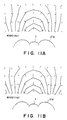
- Figs. 11A and 11B show the results using acoustic intensities in order to see the state of acoustic waves in the vicinity of a dome-like vibrating plate. Comparison of Figs. 11A and 11B and Figs. 6A and 6B exhibits that disturbances in the wave front of Figs. 11A and 11B are extremely small even at a position remote from the dome-like vibrating plate 1 compared to Figs. 6A and 6B.
- the dome-like speaker provides the flat characteristics, and improves the directional characteristic, and the location of an acoustic image by employing the new spherical wave horn baffle in the speaker.
- the horn baffle of Figs. 7 and 9 has a very excellent shape for a dome-like speaker to radiate acoustic waves without causing reflection, interference and refraction.
- Such structure of Fig. 13 serves to decrease disturbances in the acoustic waves due to reflection and refraction in the frequency characteristic.
- the object of this invention is to solve the above problems, and to provide a dome-like speaker in which the horn wall of the spherical wave horn baffle and the flat baffle surface of the cabinet are joined to each other without any discontinuity portion therebetween to thereby improve the frequency characteristic and acoustic quality.
- a dome-like speaker according to this invention solves the problems by forming a slope on a spherical wave horn baffle provided on the outer periphery of the dome-like vibrating plate and joining the slope to the flat baffle surface of the cabinet so as not to produce any discontinuity portions with the flat baffle surface.
- the baffle By the slope continuous to the horn wall of the spherical wave horn baffle provided on the dome-like speaker, the baffle can be joined to the flat baffle surface with no or little discontinuity portions to make it difficult to cause reflection and refraction of acoustic waves and provide a smooth frequency characteristic.
- Figs. 1 - 3 show embodiments of a dome-like speaker according to this invention.
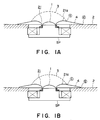
- Fig. 1A is a cross section view of the essential portion of a first embodiment
- Fig. 1B is cross section view of the essential portion of a second embodiment
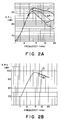
- Figs. 2A and 2B show frequency characteristics
- Figs. 3A and 3B show characteristics illustrating the state of acoustic waves in the vicinity of the dome-like vibrating plate.
- Figs. 4 - 13 show a conventional speaker.
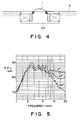
- Fig. 4 is a cross section view of the essential portion of a structure in which the dome-like speaker is mounted on the flat baffle of the cabinet
- Fig. 5 is a frequency characteristic diagram
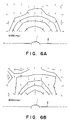
- FIGS. 6A and 6B are characteristic diagrams showing the state of acoustic waves in the vicinity of the dome-like vibrating plate
- Fig. 7 illustrates the principle of a spherical wave horn baffle
- Fig. 8 illustrates a change in the size of a baffle required when the cut off frequency of the dome-like vibrating plate varies
- Fig. 9 is a cross section view of the essential portion of a high-frequency band reproducing dome-like speaker which employs a spherical wave horn baffle
- Fig. 10 is a frequency characteristic diagram
- Figs. 11A and 11B are characteristic diagrams showing the state of acoustic waves in the vicinity of the dome-like vibrating plate of Fig. 9, Fig.
- Fig. 12 is a cross section view of the essential portion of a dome-like speaker having a spherical wave horn baffle mounted on the flat baffle of the cabinet
- Fig. 13 is a cross section view of the essential portion of an example which a spherical wave horn baffle is joined to the flat baffle surface of the cabinet.
- Fig. 1A is a cross section view of the essential portion of a first embodiment of this invention and Fig. 1B is a cross section view of the essential portion of a second embodiment.
- Figs. 2A and 2B are frequency characteristic diagrams and Figs. 3A and 3B show the state of acoustic waves in the vicinity of the dome-like vibrating plate using acoustic intensities at 6320 and 8000 Hz.
- a spherical horn baffle 21 provided on the dome-like speaker SP is mounted on the surface of a flat baffle 2 of the cabinet, they are not simply joined as shown in Fig. 12, but the baffle 2 surface and the horn wall 21a are continuously joined through a slope 4.
- the slope 4 is formed such that the tangent line at an end point c on the spherical wave horn baffle is smoothly connected to the surface of the flat baffle 2 at a point d without discontinuity.
- Reference numeral 3 inFigs. 1A and 1B denotes the front surface of the opening in the horn 21.
- the frequency and directional characteristics of the speaker do not substantially show disturbances, as shown in Fig. 2A.
- the relationship between the 30° and 60° characteristics and the 0° level is substantially similar to that of Fig. 10 and sufficiently maintains the closed characteristic of Fig. 7.
- This embodiment shows a structure in which the slope 4 which comprises an extension of a tangent line to the horn wall 21a of the spherical wave horn baffle 21 mounted on the dome-like speaker SP and the surface of the flat baffle 2 of the cabinet on which a dome-like speaker SP is mounted are joined with a discontinuity portion or a step at g therebetween.
- the rise or discontinuity portion at the junction g is formed to be sufficiently small compared to the wavelengths in the frequency band used of the speaker SP.
- the influence of reflection and refraction of acoustic waves by a discontinuity portion at the junction where the spherical wave horn baffle mounted on the dome-like speaker is joined to the flat baffle surface of the cabinet in which the speaker is mounted is reduced, so that disturbances in the frequency characteristic are greatly reduced and the acoustic quality is improved.
- the horn length can be increased compared to that of Fig. 13, so that the effect of the spherical wave horn baffle is improved.
- the dome-like vibrating plate can be disposed further forwardly compared to that of Fig. 13, so that the inventive structure is very preferable in acoustic characteristic.
- dome-like speaker having the spherical wave horn baffle can be easily mounted on the flat baffle surface of the cabinet to thereby improve greatly the characteristic of the speaker.
Landscapes
- Health & Medical Sciences (AREA)
- Otolaryngology (AREA)
- Physics & Mathematics (AREA)
- Engineering & Computer Science (AREA)
- Acoustics & Sound (AREA)
- Signal Processing (AREA)
- Obtaining Desirable Characteristics In Audible-Bandwidth Transducers (AREA)
Description
- This invention relates to a dome-like speaker and, more particularly, to a dome-like speaker which has a spherical wave horn baffle to diffuse into an acoustic field space, acoustic waves from a dome-like vibrating plate so as not to cause reflection and/or refraction, on the basis of the fact that the acoustic waves from the vibrating plate are similar to spherical waves.
- Many of recent speaker systems employ a dome-like vibrating plate in a tweeter and/or a midrange.
- As shown in Fig. 4, when such a dome-like speaker is mounted on a
flat baffle 2, disturbances in the frequency characteristic of the speaker are often encountered. This is due to the reflection caused by rapid expansion of acoustic waves into the acoustic field space and the interference of acoustic waves between the baffle surface and vibratingplate 1. - When acoustic radiation by the
vibrating plate 1 placed in theflat baffle 2 as shown in Fig. 4 is measured, it is understood that as shown in Fig. 5, the frequency characteristic and directional characteristic of the vibrating plate exhibit many crests and valleys therein and it is hence presumed that reflection, interference and refraction have occurred. - When the state of acoustic waves in the vicinity of the
vibrating plate 1 is observed using acoustic intensities diagram at 6320 and 8000 Hz, it is seen that as shown in Figs. 6A and 6B, the acoustic waves exhibit a wave front close to that of a spherical wave at a place near the dome-likevibrating plate 1 while the wave front is disturbed at a place remoter slightly from thevibrating plate 1. - It is confirmed from this fact that, basically, the acoustic waves radiated from the vibrating
plate 1 may be handled as spherical waves and that disturbances in the wave front is due to reflection, interference or refraction of acoustic waves caused by an improper shape of thebaffle 2. Therefore, in order to flatten the characteristics of the dome-like speaker, it is necessary to take the shape of the baffle into account. - As just described above, it is confirmed in the dome-like vibrating
plate 1 that the wave front of acoustic waves generated due to the shape of the vibratingplate 1 may be handled as spherical waves, so that in order to provide flat characteristics, it is necessary to expand those spherical waves into an acoustic field space so as to avoid reflection or refraction. - Thus the applicant has previously proposed as a new baffle shape through Japanese U.M. application 59-189547 filed December 15, 1984, the "spherical wave horn baffle" which introduces the concept of a horn thereinto.
- The reason why the concept of such spherical wave horn baffle is basically introduced is that the horn is conventionally used as means for diffusing acoustic waves into an acoustic field space without causing reflection or refraction.
- It is designed that when the dome-like vibrating plate is constituted as a part of a spherical surface, the horn is formed so as to prevent rapid expansion of acoustic waves from the vibrating plate into the acoustic field space and that the cross sectional area of the horn is gradually expanded relative to the surface of the vibrating plate. In the conventional horn, the cross sectional area of the horn is calculated by handling the wave front in the horn as plane waves while in the applicant's speaker the horn is formed by calculating the cross sectional area of the horn by handling the wave front in the horn as spherical waves. This horn is used as a dome-like speaker baffle to be defined as a spherical wave horn baffle. In that case, the problem is where the center of the spherical waves is. In this respect, it is assumed that the initial wave front as the origin of spherical waves substantially coincides with the surface shape of the dome-like vibrating plate. Here, the dome-like vibrating plate is handled as a part of a spherical surface and the center of the sphere is handled as the center of the spherical waves.
- The spherical wave baffle horn proposed previously by the applicant takes the form of a horn such as that shown in Fig. 7 by giving partial surfaces of the horn using the following formulas,


The shape of this horn varies as shown in Fig. 8 by changing the cut off frequency fc. - As will be seen in Fig. 7, in the spherical
wave horn baffle 21 defined here, thehorn wall 21a extends behind thevibrating plate 1 and is closed. Thus the resulting wave front may be regarded as being equivalent to that generated by a breathing sphere. - Therefore, the characteristics provided by the spherical
wave horn baffle 21 may be replaced theoretically by those generated by a breathing sphere. It is to be noted that the breathing sphere does not theoretically exhibit directionality, but as the wave front propagates actually behind the vibratingplate 1, the acoustic pressure attenuates, so that the breathing sphere will have directionality. - As shown in Fig. 8, even at the same dome-like vibrating plate, the size of baffle varies as the cut off frequency fc is changed. It is to be noted that when the baffle is employed in an actual dome-like speaker, it is necessary to specifically take into account how the characteristics to be desired should be and to determine the size of the baffle.
- Fig. 9 shows an example of a dome-like speaker SP for reproduction of a high frequency band, employing a spherical
wave horn baffle 21. - Fig. 10 shows the frequency and directionality characteristics of the horn baffle.
- It will be seen in Fig. 10 that the characteristics have no crests and valleys and that acoustic waves radiated from the dome-like vibrating plate causes neither reflection nor refraction. Particularly, the features of the directionality are that the 30° characteristic exhibits substantially the same curve as the 0° characteristic and that the level difference is 3 - 4 dB, which is large on average compared to that between the characteristics obtained when the
flat baffle 2 shown in Fig. 4 is used. This tendency is applicable to the 60° characteristics. This implies that the frequency characteristic of a direct sound is substantially the same in a range of about 30° right and left relative to the central axis irrespective of the position where the sound is heard, and that the acoustic energy reflected by side walls, etc., is small to thereby improve the location or positioning of an acoustic image. Therefore, the spherical wave horn baffle is an excellent one which satisfies both opposing matters of irrelevance to the hearing position and excellent location or positioning of an acoustic image. - Figs. 11A and 11B show the results using acoustic intensities in order to see the state of acoustic waves in the vicinity of a dome-like vibrating plate. Comparison of Figs. 11A and 11B and Figs. 6A and 6B exhibits that disturbances in the wave front of Figs. 11A and 11B are extremely small even at a position remote from the dome-like
vibrating plate 1 compared to Figs. 6A and 6B. - The dome-like speaker provides the flat characteristics, and improves the directional characteristic, and the location of an acoustic image by employing the new spherical wave horn baffle in the speaker.
- It is now obvious from the foregoing that the horn baffle of Figs. 7 and 9 has a very excellent shape for a dome-like speaker to radiate acoustic waves without causing reflection, interference and refraction.
- However, with such shape, it is difficult to mount such horn baffle onto the
flat baffle 2 of the cabinet although it is possible to mount such horn baffle on a conventional speaker cabinet. - There is the problem that when a dome-like speaker SP with a spherical
wave horn baffle 21 is mounted on theflat baffle 2 of the cabinet by performing required processing, as shown in Fig. 12 and in Fig. 12 of Preprint no. 2450 (E-7) of the 82nd Convention of the Audio Engineering Society, London, 10th March 1987, pages 1-22; J. Hayakawa et al.: "Improvement in dome speaker characteristics by using a spherical wave front horn baffle", a discontinuity portion ⓐ is produced at the junction of thehorn wall 21a of thebaffle 21 and theflat baffle 2 to cause disturbances in the acoustic waves to thereby adversely influence the frequency characteristic and acoustic quality. - In order to solve this problem, it is necessary to join the
horn wall 21a of thebaffle 21 and theflat baffle 2 surface of the cabinet so as not to produce a discontinuity portion therebetween. - Thus the applicant previously proposed a structure in which the
horn wall 21a was joined to theflat baffle 2 surface at a junction ⓑ without forming any discontinuity portion therebetween, as shown in Fig. 13 and in Fig. 16 of Preprint no. 2450 (E-7) of the 82nd Convention of the Audio Engineering Society, London, 10th March 1987, pages 1-22; J. Hayakawa et al.: "Improvement in dome speaker characteristics by using a spherical wave front horn baffle". - Such structure of Fig. 13 serves to decrease disturbances in the acoustic waves due to reflection and refraction in the frequency characteristic. However, with such structure of Fig. 13, it is impossible to use a long horn, and the dome-like vibrating plate adversely influence the acoustic quality because the dome-like vibrating
plate 1 is disposed considerably deeply within the cabinet rather than at the surface of theflat baffle 2. - This invention derives from contemplation of the above problems. The object of this invention is to solve the above problems, and to provide a dome-like speaker in which the horn wall of the spherical wave horn baffle and the flat baffle surface of the cabinet are joined to each other without any discontinuity portion therebetween to thereby improve the frequency characteristic and acoustic quality.
- A dome-like speaker according to this invention solves the problems by forming a slope on a spherical wave horn baffle provided on the outer periphery of the dome-like vibrating plate and joining the slope to the flat baffle surface of the cabinet so as not to produce any discontinuity portions with the flat baffle surface.
- By the slope continuous to the horn wall of the spherical wave horn baffle provided on the dome-like speaker, the baffle can be joined to the flat baffle surface with no or little discontinuity portions to make it difficult to cause reflection and refraction of acoustic waves and provide a smooth frequency characteristic.
- Figs. 1 - 3 show embodiments of a dome-like speaker according to this invention. Fig. 1A is a cross section view of the essential portion of a first embodiment, Fig. 1B is cross section view of the essential portion of a second embodiment, Figs. 2A and 2B show frequency characteristics, Figs. 3A and 3B show characteristics illustrating the state of acoustic waves in the vicinity of the dome-like vibrating plate. Figs. 4 - 13 show a conventional speaker. Fig. 4 is a cross section view of the essential portion of a structure in which the dome-like speaker is mounted on the flat baffle of the cabinet, Fig. 5 is a frequency characteristic diagram, Figs. 6A and 6B are characteristic diagrams showing the state of acoustic waves in the vicinity of the dome-like vibrating plate, Fig. 7 illustrates the principle of a spherical wave horn baffle, Fig. 8 illustrates a change in the size of a baffle required when the cut off frequency of the dome-like vibrating plate varies, Fig. 9 is a cross section view of the essential portion of a high-frequency band reproducing dome-like speaker which employs a spherical wave horn baffle, Fig. 10 is a frequency characteristic diagram, Figs. 11A and 11B are characteristic diagrams showing the state of acoustic waves in the vicinity of the dome-like vibrating plate of Fig. 9, Fig. 12 is a cross section view of the essential portion of a dome-like speaker having a spherical wave horn baffle mounted on the flat baffle of the cabinet, Fig. 13 is a cross section view of the essential portion of an example which a spherical wave horn baffle is joined to the flat baffle surface of the cabinet.
- An embodiment of a dome-like speaker according to this invention will now be described with reference to Figs. 1A, 1B to Figs. 3A, 3B.
- Fig. 1A is a cross section view of the essential portion of a first embodiment of this invention and Fig. 1B is a cross section view of the essential portion of a second embodiment.
- Figs. 2A and 2B are frequency characteristic diagrams and Figs. 3A and 3B show the state of acoustic waves in the vicinity of the dome-like vibrating plate using acoustic intensities at 6320 and 8000 Hz.
- The first embodiment of this invention will now be described with reference to Fig. 1A.
- When a
spherical horn baffle 21 provided on the dome-like speaker SP is mounted on the surface of aflat baffle 2 of the cabinet, they are not simply joined as shown in Fig. 12, but thebaffle 2 surface and thehorn wall 21a are continuously joined through aslope 4. - The
slope 4 is formed such that the tangent line at an end point ⓒ on the spherical wave horn baffle is smoothly connected to the surface of theflat baffle 2 at a point ⓓ without discontinuity. -
Reference numeral 3 inFigs. 1A and 1B denotes the front surface of the opening in thehorn 21. - By such structure, the frequency and directional characteristics of the speaker do not substantially show disturbances, as shown in Fig. 2A. The relationship between the 30° and 60° characteristics and the 0° level is substantially similar to that of Fig. 10 and sufficiently maintains the closed characteristic of Fig. 7.
- By use of the acoustic intensity diagrams in the vicinity of the vibrating
plate 1, the characteristics of Figs. 3A and 3B exhibit significantly reduced disturbances compared to those of Figs. 6A and 6B. - As shown in Fig. 2B, comparison with the characteristic ⓔ of Fig. 12 having a discontinuity portion ⓐ at the junction exhibits that the speaker of Fig. 1A having the
slope 4 considerably suppresses the reflection and refraction of acoustic waves to thereby provide smoothed characteristics, as shown by ⓕ in Fig. 2B. - A second embodiment of this invention will now be described with reference to Fig. 1B.
- This embodiment shows a structure in which the
slope 4 which comprises an extension of a tangent line to thehorn wall 21a of the sphericalwave horn baffle 21 mounted on the dome-like speaker SP and the surface of theflat baffle 2 of the cabinet on which a dome-like speaker SP is mounted are joined with a discontinuity portion or a step at ⓖ therebetween. - In the particular embodiment, the rise or discontinuity portion at the junction ⓖ is formed to be sufficiently small compared to the wavelengths in the frequency band used of the speaker SP.
- Thus, the influence of the discontinuity portion on acoustic waves is substantially negligible and an effect similar to that of the first embodiment is obtained.
- According to the inventive dome-like speaker, the influence of reflection and refraction of acoustic waves by a discontinuity portion at the junction where the spherical wave horn baffle mounted on the dome-like speaker is joined to the flat baffle surface of the cabinet in which the speaker is mounted is reduced, so that disturbances in the frequency characteristic are greatly reduced and the acoustic quality is improved. The horn length can be increased compared to that of Fig. 13, so that the effect of the spherical wave horn baffle is improved. Furthermore, the dome-like vibrating plate can be disposed further forwardly compared to that of Fig. 13, so that the inventive structure is very preferable in acoustic characteristic.
- Thus the dome-like speaker having the spherical wave horn baffle can be easily mounted on the flat baffle surface of the cabinet to thereby improve greatly the characteristic of the speaker.
Claims (2)
- A dome-like speaker comprising a spherical wave horn baffle (21) formed so as to diffuse into an acoustic field space acoustic waves from a dome-like vibrating plate (1) without disturbing the spherical wave on the basis of the fact that acoustic waves from the dome-like vibrating plate (1) are similar to spherical waves,
characterized in that
the spherical wave horn baffle (21) includes a slope (4) a portion of which is flat and inclined the slope (4) being joined to a flat baffle surface (2) of a cabinet and the slope (4) being joined to the baffle surface (2) as as to have no discontinuity portion. - A dome-like speaker comprising a spherical wave horn baffle (21) formed so as to diffuse into an acoustic field space acoustic waves from a dome-like vibrating plate (1) without disturbing the spherical wave on the basis of the fact that acoustic waves from the dome-like vibrating plate (1) are similar to spherical waves,
characterized in that
the spherical wave horn baffle (21) includes a flat and inclined slope (4) the slope (4) being joined to a flat baffle surface (2) of a cabinet and that a discontinuity portion (g) formed at the junction of the slope (4) and the baffle surface (2) is formed sufficiently small compared to wavelengths in a reproduction zone of the dome-like vibrating plate (1).
Applications Claiming Priority (2)
| Application Number | Priority Date | Filing Date | Title |
|---|---|---|---|
| JP62190171A JP2588205B2 (en) | 1987-07-31 | 1987-07-31 | Dome type speaker |
| JP190171/87 | 1987-07-31 |
Publications (3)
| Publication Number | Publication Date |
|---|---|
| EP0301552A2 EP0301552A2 (en) | 1989-02-01 |
| EP0301552A3 EP0301552A3 (en) | 1990-12-12 |
| EP0301552B1 true EP0301552B1 (en) | 1994-06-01 |
Family
ID=16253616
Family Applications (1)
| Application Number | Title | Priority Date | Filing Date |
|---|---|---|---|
| EP19880112256 Expired - Lifetime EP0301552B1 (en) | 1987-07-31 | 1988-07-28 | Dome-like speaker system |
Country Status (3)
| Country | Link |
|---|---|
| EP (1) | EP0301552B1 (en) |
| JP (1) | JP2588205B2 (en) |
| DE (2) | DE3889798T2 (en) |
Families Citing this family (1)
| Publication number | Priority date | Publication date | Assignee | Title |
|---|---|---|---|---|
| KR101011087B1 (en) * | 2008-08-14 | 2011-01-27 | 배익건 | Writing instrument with earpick |
Family Cites Families (1)
| Publication number | Priority date | Publication date | Assignee | Title |
|---|---|---|---|---|
| DE2143539B2 (en) * | 1971-08-31 | 1974-12-19 | Gottlob Widmann + Soehne Gmbh, 7914 Pfuhl | Electrodynamic loudspeaker for medium and high frequencies |
-
1987
- 1987-07-31 JP JP62190171A patent/JP2588205B2/en not_active Expired - Fee Related
-
1988
- 1988-07-28 DE DE19883889798 patent/DE3889798T2/en not_active Expired - Fee Related
- 1988-07-28 EP EP19880112256 patent/EP0301552B1/en not_active Expired - Lifetime
- 1988-07-28 DE DE1988112256 patent/DE301552T1/en active Pending
Also Published As
| Publication number | Publication date |
|---|---|
| EP0301552A3 (en) | 1990-12-12 |
| EP0301552A2 (en) | 1989-02-01 |
| DE301552T1 (en) | 1989-06-01 |
| JPS6436193A (en) | 1989-02-07 |
| DE3889798T2 (en) | 1995-01-05 |
| JP2588205B2 (en) | 1997-03-05 |
| DE3889798D1 (en) | 1994-07-07 |
Similar Documents
| Publication | Publication Date | Title |
|---|---|---|
| US5446792A (en) | Reflection-type speaker apparatus | |
| US6118883A (en) | System for controlling low frequency acoustical directivity patterns and minimizing directivity discontinuities during frequency transitions | |
| KR0132198B1 (en) | Speaker system of television set | |
| US8175311B2 (en) | Electroacoustic waveguide transducing | |
| US7236606B2 (en) | Sound system having a HF horn coaxially aligned in the mouth of a midrange horn | |
| JPS6081999A (en) | Horn loudspeaker | |
| US5115883A (en) | Loudspeaker | |
| US4469921A (en) | Horn type loudspeaker | |
| JPH05268690A (en) | Speaker device having wide-angle directivity | |
| JP4123046B2 (en) | Speaker device | |
| US6585077B2 (en) | Sound-producing device with acoustic waveguide | |
| JPH09149487A (en) | Electroacoustic conversion system | |
| JP2713080B2 (en) | Directional speaker device | |
| EP1292170B1 (en) | Structure for preventing the generation of standing waves in a wireless telephone set | |
| EP0301552A2 (en) | Dome-like speaker system | |
| JP2973677B2 (en) | Reflective directional speaker | |
| CN221381162U (en) | A tweeter waveguide and a tweeter horn and a sound box containing the same | |
| CN101283622A (en) | waveguide unit | |
| JPS6121917Y2 (en) | ||
| JPH07177443A (en) | Speaker set speaker system | |
| JPH04167697A (en) | Speaker system | |
| US8254614B2 (en) | Horn speaker with hyperbolic paraboloid lens | |
| CN117202051B (en) | A dual-source wavefront non-co-cavity horizontally coupled high-frequency waveguide | |
| JPH05236585A (en) | Speaker system | |
| JPH0779494A (en) | Sound reproduction method |
Legal Events
| Date | Code | Title | Description |
|---|---|---|---|
| PUAI | Public reference made under article 153(3) epc to a published international application that has entered the european phase |
Free format text: ORIGINAL CODE: 0009012 |
|
| AK | Designated contracting states |
Kind code of ref document: A2 Designated state(s): DE FR GB |
|
| EL | Fr: translation of claims filed | ||
| DET | De: translation of patent claims | ||
| PUAL | Search report despatched |
Free format text: ORIGINAL CODE: 0009013 |
|
| AK | Designated contracting states |
Kind code of ref document: A3 Designated state(s): DE FR GB |
|
| 17P | Request for examination filed |
Effective date: 19910610 |
|
| RAP1 | Party data changed (applicant data changed or rights of an application transferred) |
Owner name: KABUSHIKI KAISHA KENWOOD |
|
| 17Q | First examination report despatched |
Effective date: 19930415 |
|
| GRAA | (expected) grant |
Free format text: ORIGINAL CODE: 0009210 |
|
| AK | Designated contracting states |
Kind code of ref document: B1 Designated state(s): DE FR GB |
|
| REF | Corresponds to: |
Ref document number: 3889798 Country of ref document: DE Date of ref document: 19940707 |
|
| ET | Fr: translation filed | ||
| RAP4 | Party data changed (patent owner data changed or rights of a patent transferred) |
Owner name: KABUSHIKI KAISHA KENWOOD |
|
| PLBE | No opposition filed within time limit |
Free format text: ORIGINAL CODE: 0009261 |
|
| STAA | Information on the status of an ep patent application or granted ep patent |
Free format text: STATUS: NO OPPOSITION FILED WITHIN TIME LIMIT |
|
| 26N | No opposition filed | ||
| REG | Reference to a national code |
Ref country code: GB Ref legal event code: IF02 |
|
| PGFP | Annual fee paid to national office [announced via postgrant information from national office to epo] |
Ref country code: GB Payment date: 20040716 Year of fee payment: 17 |
|
| PGFP | Annual fee paid to national office [announced via postgrant information from national office to epo] |
Ref country code: FR Payment date: 20040726 Year of fee payment: 17 |
|
| PGFP | Annual fee paid to national office [announced via postgrant information from national office to epo] |
Ref country code: DE Payment date: 20040930 Year of fee payment: 17 |
|
| PG25 | Lapsed in a contracting state [announced via postgrant information from national office to epo] |
Ref country code: GB Free format text: LAPSE BECAUSE OF NON-PAYMENT OF DUE FEES Effective date: 20050728 |
|
| PG25 | Lapsed in a contracting state [announced via postgrant information from national office to epo] |
Ref country code: DE Free format text: LAPSE BECAUSE OF NON-PAYMENT OF DUE FEES Effective date: 20060201 |
|
| GBPC | Gb: european patent ceased through non-payment of renewal fee |
Effective date: 20050728 |
|
| PG25 | Lapsed in a contracting state [announced via postgrant information from national office to epo] |
Ref country code: FR Free format text: LAPSE BECAUSE OF NON-PAYMENT OF DUE FEES Effective date: 20060331 |
|
| REG | Reference to a national code |
Ref country code: FR Ref legal event code: ST Effective date: 20060331 |