EP0296495B1 - Verfahren zur Herstellung von Diaminen - Google Patents
Verfahren zur Herstellung von Diaminen Download PDFInfo
- Publication number
- EP0296495B1 EP0296495B1 EP88109641A EP88109641A EP0296495B1 EP 0296495 B1 EP0296495 B1 EP 0296495B1 EP 88109641 A EP88109641 A EP 88109641A EP 88109641 A EP88109641 A EP 88109641A EP 0296495 B1 EP0296495 B1 EP 0296495B1
- Authority
- EP
- European Patent Office
- Prior art keywords
- zeolite
- catalyst
- zeolites
- formula
- catalyst used
- Prior art date
- Legal status (The legal status is an assumption and is not a legal conclusion. Google has not performed a legal analysis and makes no representation as to the accuracy of the status listed.)
- Expired - Lifetime
Links
- 238000000034 method Methods 0.000 title claims description 25
- 150000004985 diamines Chemical class 0.000 title claims description 17
- 238000002360 preparation method Methods 0.000 title claims description 3
- 239000010457 zeolite Substances 0.000 claims description 63
- 239000003054 catalyst Substances 0.000 claims description 35
- HNPSIPDUKPIQMN-UHFFFAOYSA-N dioxosilane;oxo(oxoalumanyloxy)alumane Chemical compound O=[Si]=O.O=[Al]O[Al]=O HNPSIPDUKPIQMN-UHFFFAOYSA-N 0.000 claims description 30
- 229910021536 Zeolite Inorganic materials 0.000 claims description 23
- XEEYBQQBJWHFJM-UHFFFAOYSA-N Iron Chemical compound [Fe] XEEYBQQBJWHFJM-UHFFFAOYSA-N 0.000 claims description 13
- 150000001336 alkenes Chemical class 0.000 claims description 11
- 229910000323 aluminium silicate Inorganic materials 0.000 claims description 7
- 150000001412 amines Chemical class 0.000 claims description 7
- 229910052742 iron Inorganic materials 0.000 claims description 7
- 229910052784 alkaline earth metal Inorganic materials 0.000 claims description 6
- 229910052739 hydrogen Inorganic materials 0.000 claims description 6
- 239000001257 hydrogen Substances 0.000 claims description 6
- UFHFLCQGNIYNRP-UHFFFAOYSA-N Hydrogen Chemical compound [H][H] UFHFLCQGNIYNRP-UHFFFAOYSA-N 0.000 claims description 4
- 150000001342 alkaline earth metals Chemical class 0.000 claims description 4
- 239000012013 faujasite Substances 0.000 claims description 4
- JRZJOMJEPLMPRA-UHFFFAOYSA-N olefin Natural products CCCCCCCC=C JRZJOMJEPLMPRA-UHFFFAOYSA-N 0.000 claims description 4
- PIICEJLVQHRZGT-UHFFFAOYSA-N Ethylenediamine Chemical compound NCCN PIICEJLVQHRZGT-UHFFFAOYSA-N 0.000 claims description 3
- 125000000217 alkyl group Chemical group 0.000 claims description 3
- 229910052783 alkali metal Inorganic materials 0.000 claims description 2
- 150000001340 alkali metals Chemical class 0.000 claims description 2
- 125000003545 alkoxy group Chemical group 0.000 claims description 2
- 125000003710 aryl alkyl group Chemical group 0.000 claims description 2
- 125000003118 aryl group Chemical group 0.000 claims description 2
- 125000000753 cycloalkyl group Chemical group 0.000 claims description 2
- 229910052675 erionite Inorganic materials 0.000 claims description 2
- 150000002431 hydrogen Chemical class 0.000 claims description 2
- AOHJOMMDDJHIJH-UHFFFAOYSA-N propylenediamine Chemical compound CC(N)CN AOHJOMMDDJHIJH-UHFFFAOYSA-N 0.000 claims description 2
- 229910052761 rare earth metal Inorganic materials 0.000 claims description 2
- 150000002910 rare earth metals Chemical class 0.000 claims description 2
- BPQQTUXANYXVAA-UHFFFAOYSA-N Orthosilicate Chemical compound [O-][Si]([O-])([O-])[O-] BPQQTUXANYXVAA-UHFFFAOYSA-N 0.000 claims 1
- 229910000510 noble metal Inorganic materials 0.000 claims 1
- 229910052723 transition metal Inorganic materials 0.000 claims 1
- 150000003624 transition metals Chemical class 0.000 claims 1
- VYPSYNLAJGMNEJ-UHFFFAOYSA-N Silicium dioxide Chemical compound O=[Si]=O VYPSYNLAJGMNEJ-UHFFFAOYSA-N 0.000 description 24
- 239000000243 solution Substances 0.000 description 19
- 229910002651 NO3 Inorganic materials 0.000 description 16
- NHNBFGGVMKEFGY-UHFFFAOYSA-N Nitrate Chemical compound [O-][N+]([O-])=O NHNBFGGVMKEFGY-UHFFFAOYSA-N 0.000 description 16
- 239000000377 silicon dioxide Substances 0.000 description 12
- 235000012239 silicon dioxide Nutrition 0.000 description 12
- XLYOFNOQVPJJNP-UHFFFAOYSA-N water Substances O XLYOFNOQVPJJNP-UHFFFAOYSA-N 0.000 description 12
- 238000006243 chemical reaction Methods 0.000 description 10
- 229910052751 metal Inorganic materials 0.000 description 9
- 239000002184 metal Substances 0.000 description 9
- 239000007858 starting material Substances 0.000 description 9
- 229910052681 coesite Inorganic materials 0.000 description 8
- 229910052906 cristobalite Inorganic materials 0.000 description 8
- 239000000463 material Substances 0.000 description 8
- 239000000203 mixture Substances 0.000 description 8
- 229910052682 stishovite Inorganic materials 0.000 description 8
- 229910052905 tridymite Inorganic materials 0.000 description 8
- VEXZGXHMUGYJMC-UHFFFAOYSA-N Hydrochloric acid Chemical compound Cl VEXZGXHMUGYJMC-UHFFFAOYSA-N 0.000 description 7
- 238000001354 calcination Methods 0.000 description 7
- 239000011651 chromium Substances 0.000 description 7
- -1 e.g. HJ Substances 0.000 description 7
- QGZKDVFQNNGYKY-UHFFFAOYSA-N Ammonia Chemical compound N QGZKDVFQNNGYKY-UHFFFAOYSA-N 0.000 description 6
- KRHYYFGTRYWZRS-UHFFFAOYSA-N Fluorane Chemical compound F KRHYYFGTRYWZRS-UHFFFAOYSA-N 0.000 description 6
- 239000003513 alkali Substances 0.000 description 6
- 229910052782 aluminium Inorganic materials 0.000 description 6
- PNEYBMLMFCGWSK-UHFFFAOYSA-N aluminium oxide Inorganic materials [O-2].[O-2].[O-2].[Al+3].[Al+3] PNEYBMLMFCGWSK-UHFFFAOYSA-N 0.000 description 6
- 239000011230 binding agent Substances 0.000 description 6
- 238000001035 drying Methods 0.000 description 6
- NAQMVNRVTILPCV-UHFFFAOYSA-N hexane-1,6-diamine Chemical compound NCCCCCCN NAQMVNRVTILPCV-UHFFFAOYSA-N 0.000 description 6
- 238000005342 ion exchange Methods 0.000 description 6
- XFNJVJPLKCPIBV-UHFFFAOYSA-N trimethylenediamine Chemical compound NCCCN XFNJVJPLKCPIBV-UHFFFAOYSA-N 0.000 description 6
- 229910052593 corundum Inorganic materials 0.000 description 5
- 150000002739 metals Chemical class 0.000 description 5
- 229910001845 yogo sapphire Inorganic materials 0.000 description 5
- VQTUBCCKSQIDNK-UHFFFAOYSA-N Isobutene Chemical compound CC(C)=C VQTUBCCKSQIDNK-UHFFFAOYSA-N 0.000 description 4
- NBIIXXVUZAFLBC-UHFFFAOYSA-N Phosphoric acid Chemical compound OP(O)(O)=O NBIIXXVUZAFLBC-UHFFFAOYSA-N 0.000 description 4
- 239000007795 chemical reaction product Substances 0.000 description 4
- 229910052733 gallium Inorganic materials 0.000 description 4
- 238000005470 impregnation Methods 0.000 description 4
- 239000000047 product Substances 0.000 description 4
- 229910052710 silicon Inorganic materials 0.000 description 4
- QTBSBXVTEAMEQO-UHFFFAOYSA-N Acetic acid Chemical compound CC(O)=O QTBSBXVTEAMEQO-UHFFFAOYSA-N 0.000 description 3
- OKKJLVBELUTLKV-UHFFFAOYSA-N Methanol Chemical compound OC OKKJLVBELUTLKV-UHFFFAOYSA-N 0.000 description 3
- MUBZPKHOEPUJKR-UHFFFAOYSA-N Oxalic acid Chemical compound OC(=O)C(O)=O MUBZPKHOEPUJKR-UHFFFAOYSA-N 0.000 description 3
- XUIMIQQOPSSXEZ-UHFFFAOYSA-N Silicon Chemical compound [Si] XUIMIQQOPSSXEZ-UHFFFAOYSA-N 0.000 description 3
- YXFVVABEGXRONW-UHFFFAOYSA-N Toluene Chemical compound CC1=CC=CC=C1 YXFVVABEGXRONW-UHFFFAOYSA-N 0.000 description 3
- 239000002253 acid Substances 0.000 description 3
- 230000002378 acidificating effect Effects 0.000 description 3
- 150000007513 acids Chemical class 0.000 description 3
- 239000000571 coke Substances 0.000 description 3
- IJKVHSBPTUYDLN-UHFFFAOYSA-N dihydroxy(oxo)silane Chemical compound O[Si](O)=O IJKVHSBPTUYDLN-UHFFFAOYSA-N 0.000 description 3
- 238000001914 filtration Methods 0.000 description 3
- 230000004048 modification Effects 0.000 description 3
- 238000012986 modification Methods 0.000 description 3
- 229910052757 nitrogen Inorganic materials 0.000 description 3
- 239000011148 porous material Substances 0.000 description 3
- 238000007493 shaping process Methods 0.000 description 3
- 239000010703 silicon Substances 0.000 description 3
- AJPJDKMHJJGVTQ-UHFFFAOYSA-M sodium dihydrogen phosphate Chemical compound [Na+].OP(O)([O-])=O AJPJDKMHJJGVTQ-UHFFFAOYSA-M 0.000 description 3
- 238000006467 substitution reaction Methods 0.000 description 3
- LIKMAJRDDDTEIG-UHFFFAOYSA-N 1-hexene Chemical compound CCCCC=C LIKMAJRDDDTEIG-UHFFFAOYSA-N 0.000 description 2
- CTMHWPIWNRWQEG-UHFFFAOYSA-N 1-methylcyclohexene Chemical compound CC1=CCCCC1 CTMHWPIWNRWQEG-UHFFFAOYSA-N 0.000 description 2
- VILCJCGEZXAXTO-UHFFFAOYSA-N 2,2,2-tetramine Chemical compound NCCNCCNCCN VILCJCGEZXAXTO-UHFFFAOYSA-N 0.000 description 2
- QGZKDVFQNNGYKY-UHFFFAOYSA-O Ammonium Chemical group [NH4+] QGZKDVFQNNGYKY-UHFFFAOYSA-O 0.000 description 2
- IJGRMHOSHXDMSA-UHFFFAOYSA-N Atomic nitrogen Chemical compound N#N IJGRMHOSHXDMSA-UHFFFAOYSA-N 0.000 description 2
- ZOXJGFHDIHLPTG-UHFFFAOYSA-N Boron Chemical group [B] ZOXJGFHDIHLPTG-UHFFFAOYSA-N 0.000 description 2
- RTZKZFJDLAIYFH-UHFFFAOYSA-N Diethyl ether Chemical compound CCOCC RTZKZFJDLAIYFH-UHFFFAOYSA-N 0.000 description 2
- GYHNNYVSQQEPJS-UHFFFAOYSA-N Gallium Chemical compound [Ga] GYHNNYVSQQEPJS-UHFFFAOYSA-N 0.000 description 2
- GWEVSGVZZGPLCZ-UHFFFAOYSA-N Titan oxide Chemical compound O=[Ti]=O GWEVSGVZZGPLCZ-UHFFFAOYSA-N 0.000 description 2
- MCMNRKCIXSYSNV-UHFFFAOYSA-N Zirconium dioxide Chemical compound O=[Zr]=O MCMNRKCIXSYSNV-UHFFFAOYSA-N 0.000 description 2
- 238000010306 acid treatment Methods 0.000 description 2
- 230000001476 alcoholic effect Effects 0.000 description 2
- XAGFODPZIPBFFR-UHFFFAOYSA-N aluminium Chemical compound [Al] XAGFODPZIPBFFR-UHFFFAOYSA-N 0.000 description 2
- 229910000147 aluminium phosphate Inorganic materials 0.000 description 2
- 229910021529 ammonia Inorganic materials 0.000 description 2
- 150000003863 ammonium salts Chemical class 0.000 description 2
- 229910052787 antimony Inorganic materials 0.000 description 2
- 239000007864 aqueous solution Substances 0.000 description 2
- 229910052785 arsenic Inorganic materials 0.000 description 2
- 229910052790 beryllium Inorganic materials 0.000 description 2
- 229910052797 bismuth Inorganic materials 0.000 description 2
- 229910001593 boehmite Inorganic materials 0.000 description 2
- KGBXLFKZBHKPEV-UHFFFAOYSA-N boric acid Chemical compound OB(O)O KGBXLFKZBHKPEV-UHFFFAOYSA-N 0.000 description 2
- 229910052796 boron Inorganic materials 0.000 description 2
- 229910052804 chromium Inorganic materials 0.000 description 2
- HGCIXCUEYOPUTN-UHFFFAOYSA-N cyclohexene Chemical compound C1CCC=CC1 HGCIXCUEYOPUTN-UHFFFAOYSA-N 0.000 description 2
- LPIQUOYDBNQMRZ-UHFFFAOYSA-N cyclopentene Chemical compound C1CC=CC1 LPIQUOYDBNQMRZ-UHFFFAOYSA-N 0.000 description 2
- 229910052732 germanium Inorganic materials 0.000 description 2
- 150000004820 halides Chemical class 0.000 description 2
- FAHBNUUHRFUEAI-UHFFFAOYSA-M hydroxidooxidoaluminium Chemical compound O[Al]=O FAHBNUUHRFUEAI-UHFFFAOYSA-M 0.000 description 2
- 229910052909 inorganic silicate Inorganic materials 0.000 description 2
- 238000002955 isolation Methods 0.000 description 2
- BDAGIHXWWSANSR-UHFFFAOYSA-N methanoic acid Natural products OC=O BDAGIHXWWSANSR-UHFFFAOYSA-N 0.000 description 2
- 229910052680 mordenite Inorganic materials 0.000 description 2
- 125000004433 nitrogen atom Chemical group N* 0.000 description 2
- 239000008188 pellet Substances 0.000 description 2
- 229920000768 polyamine Polymers 0.000 description 2
- KIDHWZJUCRJVML-UHFFFAOYSA-N putrescine Chemical compound NCCCCN KIDHWZJUCRJVML-UHFFFAOYSA-N 0.000 description 2
- 238000000926 separation method Methods 0.000 description 2
- 150000003377 silicon compounds Chemical class 0.000 description 2
- 239000000126 substance Substances 0.000 description 2
- 238000005406 washing Methods 0.000 description 2
- VXNZUUAINFGPBY-UHFFFAOYSA-N 1-Butene Chemical compound CCC=C VXNZUUAINFGPBY-UHFFFAOYSA-N 0.000 description 1
- ATQUFXWBVZUTKO-UHFFFAOYSA-N 1-methylcyclopentene Chemical compound CC1=CCCC1 ATQUFXWBVZUTKO-UHFFFAOYSA-N 0.000 description 1
- KWKAKUADMBZCLK-UHFFFAOYSA-N 1-octene Chemical compound CCCCCCC=C KWKAKUADMBZCLK-UHFFFAOYSA-N 0.000 description 1
- DDHUNHGZUHZNKB-UHFFFAOYSA-N 2,2-dimethylpropane-1,3-diamine Chemical compound NCC(C)(C)CN DDHUNHGZUHZNKB-UHFFFAOYSA-N 0.000 description 1
- MHNNAWXXUZQSNM-UHFFFAOYSA-N 2-methylbut-1-ene Chemical class CCC(C)=C MHNNAWXXUZQSNM-UHFFFAOYSA-N 0.000 description 1
- XZJZVNABSFJYOK-UHFFFAOYSA-N 3-methylidenenonane Chemical compound CCCCCCC(=C)CC XZJZVNABSFJYOK-UHFFFAOYSA-N 0.000 description 1
- RYKZRKKEYSRDNF-UHFFFAOYSA-N 3-methylidenepentane Chemical class CCC(=C)CC RYKZRKKEYSRDNF-UHFFFAOYSA-N 0.000 description 1
- LDTAOIUHUHHCMU-UHFFFAOYSA-N 3-methylpent-1-ene Chemical class CCC(C)C=C LDTAOIUHUHHCMU-UHFFFAOYSA-N 0.000 description 1
- WECDUOXQLAIPQW-UHFFFAOYSA-N 4,4'-Methylene bis(2-methylaniline) Chemical compound C1=C(N)C(C)=CC(CC=2C=C(C)C(N)=CC=2)=C1 WECDUOXQLAIPQW-UHFFFAOYSA-N 0.000 description 1
- OSWFIVFLDKOXQC-UHFFFAOYSA-N 4-(3-methoxyphenyl)aniline Chemical compound COC1=CC=CC(C=2C=CC(N)=CC=2)=C1 OSWFIVFLDKOXQC-UHFFFAOYSA-N 0.000 description 1
- DZIHTWJGPDVSGE-UHFFFAOYSA-N 4-[(4-aminocyclohexyl)methyl]cyclohexan-1-amine Chemical compound C1CC(N)CCC1CC1CCC(N)CC1 DZIHTWJGPDVSGE-UHFFFAOYSA-N 0.000 description 1
- OKTJSMMVPCPJKN-UHFFFAOYSA-N Carbon Chemical compound [C] OKTJSMMVPCPJKN-UHFFFAOYSA-N 0.000 description 1
- 229910052684 Cerium Inorganic materials 0.000 description 1
- VYZAMTAEIAYCRO-UHFFFAOYSA-N Chromium Chemical compound [Cr] VYZAMTAEIAYCRO-UHFFFAOYSA-N 0.000 description 1
- 229910052691 Erbium Inorganic materials 0.000 description 1
- VGGSQFUCUMXWEO-UHFFFAOYSA-N Ethene Chemical compound C=C VGGSQFUCUMXWEO-UHFFFAOYSA-N 0.000 description 1
- 239000001856 Ethyl cellulose Substances 0.000 description 1
- ZZSNKZQZMQGXPY-UHFFFAOYSA-N Ethyl cellulose Chemical compound CCOCC1OC(OC)C(OCC)C(OCC)C1OC1C(O)C(O)C(OC)C(CO)O1 ZZSNKZQZMQGXPY-UHFFFAOYSA-N 0.000 description 1
- 229910052779 Neodymium Inorganic materials 0.000 description 1
- GRYLNZFGIOXLOG-UHFFFAOYSA-N Nitric acid Chemical compound O[N+]([O-])=O GRYLNZFGIOXLOG-UHFFFAOYSA-N 0.000 description 1
- 229910052777 Praseodymium Inorganic materials 0.000 description 1
- QQONPFPTGQHPMA-UHFFFAOYSA-N Propene Chemical compound CC=C QQONPFPTGQHPMA-UHFFFAOYSA-N 0.000 description 1
- 239000005700 Putrescine Substances 0.000 description 1
- 235000021355 Stearic acid Nutrition 0.000 description 1
- 229910052770 Uranium Inorganic materials 0.000 description 1
- 229910052769 Ytterbium Inorganic materials 0.000 description 1
- 235000011054 acetic acid Nutrition 0.000 description 1
- 150000001350 alkyl halides Chemical class 0.000 description 1
- WATWJIUSRGPENY-UHFFFAOYSA-N antimony atom Chemical compound [Sb] WATWJIUSRGPENY-UHFFFAOYSA-N 0.000 description 1
- RQNWIZPPADIBDY-UHFFFAOYSA-N arsenic atom Chemical compound [As] RQNWIZPPADIBDY-UHFFFAOYSA-N 0.000 description 1
- 125000004429 atom Chemical group 0.000 description 1
- QVGXLLKOCUKJST-UHFFFAOYSA-N atomic oxygen Chemical compound [O] QVGXLLKOCUKJST-UHFFFAOYSA-N 0.000 description 1
- 229910052788 barium Inorganic materials 0.000 description 1
- ATBAMAFKBVZNFJ-UHFFFAOYSA-N beryllium atom Chemical compound [Be] ATBAMAFKBVZNFJ-UHFFFAOYSA-N 0.000 description 1
- 150000001639 boron compounds Chemical class 0.000 description 1
- 229910052791 calcium Inorganic materials 0.000 description 1
- 229910052799 carbon Inorganic materials 0.000 description 1
- 150000001728 carbonyl compounds Chemical class 0.000 description 1
- 238000005341 cation exchange Methods 0.000 description 1
- 150000001768 cations Chemical class 0.000 description 1
- 238000004939 coking Methods 0.000 description 1
- 150000001875 compounds Chemical class 0.000 description 1
- 230000007797 corrosion Effects 0.000 description 1
- 238000005260 corrosion Methods 0.000 description 1
- 239000013078 crystal Substances 0.000 description 1
- URYYVOIYTNXXBN-UPHRSURJSA-N cyclooctene Chemical compound C1CCC\C=C/CC1 URYYVOIYTNXXBN-UPHRSURJSA-N 0.000 description 1
- 239000004913 cyclooctene Substances 0.000 description 1
- 230000009849 deactivation Effects 0.000 description 1
- 230000018044 dehydration Effects 0.000 description 1
- 238000006297 dehydration reaction Methods 0.000 description 1
- DQUIAMCJEJUUJC-UHFFFAOYSA-N dibismuth;dioxido(oxo)silane Chemical compound [Bi+3].[Bi+3].[O-][Si]([O-])=O.[O-][Si]([O-])=O.[O-][Si]([O-])=O DQUIAMCJEJUUJC-UHFFFAOYSA-N 0.000 description 1
- SBZXBUIDTXKZTM-UHFFFAOYSA-N diglyme Chemical compound COCCOCCOC SBZXBUIDTXKZTM-UHFFFAOYSA-N 0.000 description 1
- BNIILDVGGAEEIG-UHFFFAOYSA-L disodium hydrogen phosphate Chemical compound [Na+].[Na+].OP([O-])([O-])=O BNIILDVGGAEEIG-UHFFFAOYSA-L 0.000 description 1
- 238000004821 distillation Methods 0.000 description 1
- 230000000694 effects Effects 0.000 description 1
- 230000007613 environmental effect Effects 0.000 description 1
- 229920001249 ethyl cellulose Polymers 0.000 description 1
- 235000019325 ethyl cellulose Nutrition 0.000 description 1
- 238000000605 extraction Methods 0.000 description 1
- 229910001657 ferrierite group Inorganic materials 0.000 description 1
- 235000019253 formic acid Nutrition 0.000 description 1
- 238000004817 gas chromatography Methods 0.000 description 1
- 239000010439 graphite Substances 0.000 description 1
- 229910002804 graphite Inorganic materials 0.000 description 1
- 229910052735 hafnium Inorganic materials 0.000 description 1
- 229910052736 halogen Inorganic materials 0.000 description 1
- 150000002367 halogens Chemical class 0.000 description 1
- 238000010438 heat treatment Methods 0.000 description 1
- XXMIOPMDWAUFGU-UHFFFAOYSA-N hexane-1,6-diol Chemical compound OCCCCCCO XXMIOPMDWAUFGU-UHFFFAOYSA-N 0.000 description 1
- GPRLSGONYQIRFK-UHFFFAOYSA-N hydron Chemical compound [H+] GPRLSGONYQIRFK-UHFFFAOYSA-N 0.000 description 1
- 238000001027 hydrothermal synthesis Methods 0.000 description 1
- 230000000977 initiatory effect Effects 0.000 description 1
- 229910001387 inorganic aluminate Inorganic materials 0.000 description 1
- 150000002500 ions Chemical class 0.000 description 1
- 150000002506 iron compounds Chemical class 0.000 description 1
- 229910052746 lanthanum Inorganic materials 0.000 description 1
- 229910052745 lead Inorganic materials 0.000 description 1
- 229910052749 magnesium Inorganic materials 0.000 description 1
- GDOPTJXRTPNYNR-UHFFFAOYSA-N methyl-cyclopentane Natural products CC1CCCC1 GDOPTJXRTPNYNR-UHFFFAOYSA-N 0.000 description 1
- 235000019799 monosodium phosphate Nutrition 0.000 description 1
- ITZPOSYADVYECJ-UHFFFAOYSA-N n'-cyclohexylpropane-1,3-diamine Chemical compound NCCCNC1CCCCC1 ITZPOSYADVYECJ-UHFFFAOYSA-N 0.000 description 1
- SCZVXVGZMZRGRU-UHFFFAOYSA-N n'-ethylethane-1,2-diamine Chemical compound CCNCCN SCZVXVGZMZRGRU-UHFFFAOYSA-N 0.000 description 1
- QHJABUZHRJTCAR-UHFFFAOYSA-N n'-methylpropane-1,3-diamine Chemical compound CNCCCN QHJABUZHRJTCAR-UHFFFAOYSA-N 0.000 description 1
- JYXKYKIDIKVWNY-UHFFFAOYSA-N n'-tert-butylethane-1,2-diamine Chemical compound CC(C)(C)NCCN JYXKYKIDIKVWNY-UHFFFAOYSA-N 0.000 description 1
- 229910017604 nitric acid Inorganic materials 0.000 description 1
- 229910000069 nitrogen hydride Inorganic materials 0.000 description 1
- QIQXTHQIDYTFRH-UHFFFAOYSA-N octadecanoic acid Chemical compound CCCCCCCCCCCCCCCCCC(O)=O QIQXTHQIDYTFRH-UHFFFAOYSA-N 0.000 description 1
- OQCDKBAXFALNLD-UHFFFAOYSA-N octadecanoic acid Natural products CCCCCCCC(C)CCCCCCCCC(O)=O OQCDKBAXFALNLD-UHFFFAOYSA-N 0.000 description 1
- 235000006408 oxalic acid Nutrition 0.000 description 1
- 229910052760 oxygen Inorganic materials 0.000 description 1
- 239000001301 oxygen Substances 0.000 description 1
- 125000004430 oxygen atom Chemical group O* 0.000 description 1
- 239000002245 particle Substances 0.000 description 1
- RGSFGYAAUTVSQA-UHFFFAOYSA-N pentamethylene Natural products C1CCCC1 RGSFGYAAUTVSQA-UHFFFAOYSA-N 0.000 description 1
- YWAKXRMUMFPDSH-UHFFFAOYSA-N pentene Chemical compound CCCC=C YWAKXRMUMFPDSH-UHFFFAOYSA-N 0.000 description 1
- 239000003208 petroleum Substances 0.000 description 1
- 150000003018 phosphorus compounds Chemical class 0.000 description 1
- 229910052700 potassium Inorganic materials 0.000 description 1
- 229920001592 potato starch Polymers 0.000 description 1
- 239000000843 powder Substances 0.000 description 1
- 150000003141 primary amines Chemical class 0.000 description 1
- 125000002924 primary amino group Chemical group [H]N([H])* 0.000 description 1
- 150000003254 radicals Chemical class 0.000 description 1
- 239000011541 reaction mixture Substances 0.000 description 1
- 238000010992 reflux Methods 0.000 description 1
- 150000003839 salts Chemical class 0.000 description 1
- 238000007789 sealing Methods 0.000 description 1
- 125000000467 secondary amino group Chemical group [H]N([*:1])[*:2] 0.000 description 1
- 150000003376 silicon Chemical class 0.000 description 1
- 239000002002 slurry Substances 0.000 description 1
- 239000011734 sodium Substances 0.000 description 1
- 229910000162 sodium phosphate Inorganic materials 0.000 description 1
- 239000007787 solid Substances 0.000 description 1
- 239000002904 solvent Substances 0.000 description 1
- 239000008117 stearic acid Substances 0.000 description 1
- 238000003756 stirring Methods 0.000 description 1
- 229910052712 strontium Inorganic materials 0.000 description 1
- WYURNTSHIVDZCO-UHFFFAOYSA-N tetrahydrofuran Substances C1CCOC1 WYURNTSHIVDZCO-UHFFFAOYSA-N 0.000 description 1
- 229910052718 tin Inorganic materials 0.000 description 1
- 229910052719 titanium Inorganic materials 0.000 description 1
- 230000001988 toxicity Effects 0.000 description 1
- 231100000419 toxicity Toxicity 0.000 description 1
- 229960001124 trientine Drugs 0.000 description 1
- ISDBYDBAKGWSCA-UHFFFAOYSA-N trimethoxy phosphate Chemical compound COOP(=O)(OOC)OOC ISDBYDBAKGWSCA-UHFFFAOYSA-N 0.000 description 1
- CYTQBVOFDCPGCX-UHFFFAOYSA-N trimethyl phosphite Chemical compound COP(OC)OC CYTQBVOFDCPGCX-UHFFFAOYSA-N 0.000 description 1
- RYFMWSXOAZQYPI-UHFFFAOYSA-K trisodium phosphate Chemical compound [Na+].[Na+].[Na+].[O-]P([O-])([O-])=O RYFMWSXOAZQYPI-UHFFFAOYSA-K 0.000 description 1
- 229910052720 vanadium Inorganic materials 0.000 description 1
- 229910052726 zirconium Inorganic materials 0.000 description 1
Classifications
-
- C—CHEMISTRY; METALLURGY
- C07—ORGANIC CHEMISTRY
- C07C—ACYCLIC OR CARBOCYCLIC COMPOUNDS
- C07C209/00—Preparation of compounds containing amino groups bound to a carbon skeleton
- C07C209/60—Preparation of compounds containing amino groups bound to a carbon skeleton by condensation or addition reactions, e.g. Mannich reaction, addition of ammonia or amines to alkenes or to alkynes or addition of compounds containing an active hydrogen atom to Schiff's bases, quinone imines, or aziranes
-
- Y—GENERAL TAGGING OF NEW TECHNOLOGICAL DEVELOPMENTS; GENERAL TAGGING OF CROSS-SECTIONAL TECHNOLOGIES SPANNING OVER SEVERAL SECTIONS OF THE IPC; TECHNICAL SUBJECTS COVERED BY FORMER USPC CROSS-REFERENCE ART COLLECTIONS [XRACs] AND DIGESTS
- Y02—TECHNOLOGIES OR APPLICATIONS FOR MITIGATION OR ADAPTATION AGAINST CLIMATE CHANGE
- Y02P—CLIMATE CHANGE MITIGATION TECHNOLOGIES IN THE PRODUCTION OR PROCESSING OF GOODS
- Y02P20/00—Technologies relating to chemical industry
- Y02P20/50—Improvements relating to the production of bulk chemicals
- Y02P20/582—Recycling of unreacted starting or intermediate materials
Definitions
- the present invention relates to a process for the preparation of diamines by reacting diamines with olefins in the presence of zeolites as catalysts.
- N-substitution of diamines with two primary or secondary amino groups is known and can e.g. by reacting the diamine with alkyl halides, with carbonyl compounds under reducing conditions or by reacting ⁇ , ⁇ -halogenamines with primary amines or ammonia.
- N, N'-disubstitution products also occur to a high degree.
- the starting materials are difficult to access. This makes it difficult to produce certain mono-N-alkylated diamines.
- the task now is to develop a method for selectively substituting diamines with the possibility of substitution on both N atoms using readily accessible, less corrosive starting materials and catalysts.
- N-substituted diamines of the general formula (I) are obtained in which R1, R2 and R3 can represent hydrogen or an alkyl, aryl, alkoxy, aralkyl or cycloalkyl group and X describes a group of the formula (II), (CR4R5) m (II) where R4 and R5 can have the same meaning as R1, and m can have the values between 1 and 12, from diamines of the formula (III) wherein R1, R2 and X represent the above groups, as described in formula (I), with olefins of the formula (IV) in which the radicals R6 to R9 represent hydrogen or an unbranched alkyl radical in the ⁇ -position, in the presence of zeolites as catalysts.
- Olefins of the formula (IV) which can preferably be reacted according to the invention as starting materials are, for example, ethene, n-propene, n-butene, isobutene, n-pentene, 2-methylbutenes, n-hexene, 2-ethylbutenes, 3-ethylbutenes, n Octene, 2-ethyloctene, nonenes, docenes, cyclopentene, cyclohexene, 1-methylcyclopentene, 1-methylcyclohexene and cyclooctene.
- Examples of the di- and polyamines implemented according to the invention are e.g. Ethyl diamine, 1,3-diaminopropane, 1,4-diaminobutane, 1,2-propylenediamine, 2-ethylaminoethylamine, 3-amino-1-methylaminopropane, 3-amino-1-cyclohexylaminopropane, neopentanediamine, hexamethylenediamine, 4,4'-diaminodicyclohexylmethane , 3,3'-Dimethyl-4,4'-diaminodiphenylmethane.
- Ethyl diamine 1,3-diaminopropane, 1,4-diaminobutane
- 1,2-propylenediamine 2-ethylaminoethylamine
- 3-amino-1-methylaminopropane 3-amino-1-cyclohexylaminopropane
- Zeolites are used as catalysts for the process according to the invention, expediently in the acidic form.
- Zeolites are crystalline aluminum silicates which have a highly ordered structure with a rigid three-dimensional network of SiO4 and AlO4 tetrahedra which are connected by common oxygen atoms.
- the ratio of the Si and Al atoms to oxygen is 1: 2.
- the electrovalence of the tetrahedra containing aluminum can be determined by including cations in the crystal, e.g. of an alkali or hydrogen ion balanced. A cation exchange is possible.
- the spaces between the tetrahedra are occupied by drying or calcining water molecules before dehydration.
- zeolites are divided into different groups.
- the mordenite group chains or in the case of the chabasite group, layers of tetrahedra form the zeolite structure, while in the faujasite group the tetrahedra are arranged in polyhedra, e.g. in the form of a cubo-octahedron made up of four or six rings.
- the cubo-octahedra which creates voids and pores of different sizes, a distinction is made in type A, L, X or Y zeolites.
- Catalysts suitable for the process according to the invention are zeolites from the mordenite group or narrow-pore zeolites of the erionite or chabasite type or zeolites of the faujasite type, e.g. Y, X or L zeolites.
- zeolites of the faujasite type ie dealuminated zeolites
- Methods for producing such zeolites have been described in many different ways.
- Zeolites of the pentasil type are particularly advantageous. As a basic building block, they share a five-membered ring made of SiO4 tetrahedra. They are characterized by a high SiO2 / Al2O3 ratio and by pore sizes between those of type A zeolites and those of type X or Y.
- zeolites can have different chemical compositions. These are alumino, boro, iron, beryllium, gallium, chromium, arsenic, antimony and bismuth silicate zeolites or their mixtures, as well as alumino, boro, gallium and iron germanate zeolites or their mixtures.
- the alumino, borosilicate and iron silicate zeolites of the pentasil type are particularly suitable for the process according to the invention.
- the aluminosilicate zeolite is e.g.
- an aluminum compound preferably Al (OH) 3 or Al2 (SO4) 3 and a silicon component, preferably highly disperse silicon dioxide in aqueous amine solution, in particular in polyamines such as 1,6-hexanediamine or 1,3-propanediamine or triethylene tetramine solution with or especially produced without addition of alkali or alkaline earth at 100 to 220 ° C under autogenous pressure.
- This also includes the isotactic zeolites according to EP 34 727 and EP 46 504.
- the aluminosilicate zeolites obtained contain an SiO2 / Al2O3 ratio of 10 to 40,000, depending on the amounts of the starting materials used such as methanol or 1,4-butanol or be synthesized in water.
- the silicon-rich zeolites (SiO2 / Al2O3 ⁇ 10) which can be used according to the invention also include the various ZSM types, ferrierite, Nu-1 and Silicalit®.
- Borosilicate zeolites can e.g. Synthesize at 90 to 200 ° C under autogenous pressure by using a boron compound e.g. H3BO3, with a silicon compound, preferably highly disperse silicon dioxide in aqueous amine solution, in particular in 1,6-hexanediamine or 1,3-propanediamine or triethylenetetraamine solution with and in particular without addition of alkali or alkaline earth metal to react.
- This also includes the isotactic zeolites according to EP 34 727 and EP 46 504.
- Such borosilicate zeolites can also be prepared if the reaction is carried out in an ethereal solution, e.g. Diethylene glycol dimethyl ether or in alcoholic solution, e.g. 1,6-hexanediol.
- the iron silicate zeolite is obtained, for example, from an iron compound, preferably Fe2 (SO4) 3 and a silicon compound, preferably highly disperse silicon dioxide in aqueous amine solution, in particular 1,6-hexanediamine, with or without addition of alkali or alkaline earth metal at 100 to 200 ° C. under autogenous pressure.
- an iron compound preferably Fe2 (SO4) 3
- a silicon compound preferably highly disperse silicon dioxide in aqueous amine solution, in particular 1,6-hexanediamine, with or without addition of alkali or alkaline earth metal at 100 to 200 ° C. under autogenous pressure.
- the alumino, borosilicate and iron silicate zeolites thus produced can, after their isolation, drying at 100 to 160 ° C., preferably 110 ° C. and calcination at 450 to 550 ° C., preferably 500 ° C., with a binder in a ratio of 90:10 to 40: 60% by weight to be shaped into strands or tablets.
- Various aluminum oxides preferably boehmite, amorphous aluminosilicates with an SiO2 / Al2O3 ratio of 25:75 to 90: 5, preferably 75:25, silicon dioxide, preferably highly disperse SiO2, mixtures of highly disperse SiO2 and highly disperse Al2O3, TiO2, ZrO2 are suitable as binders as well as sound.
- the extrudates or compacts are dried at 110 ° C / 16 h and calcined at 500 ° C / 16 h.
- Advantageous catalysts are also obtained if the isolated aluminosilicate or borosilicate zeolite is deformed directly after drying and is only subjected to calcination after the deformation.
- the alumino and borosilicate zeolites produced can be used in pure form, without binders, as strands or tablets, with extruding or peptizing aids, e.g. Ethyl cellulose, stearic acid, potato starch, formic acid, oxalic acid, acetic acid, nitric acid, ammonia, amines, silicon esters and graphite or mixtures thereof can be used.
- the zeolite is not in the catalytically active, acidic H form, but is e.g. in the Na form, then this can be achieved by ion exchange, e.g. with ammonium ions and subsequent calcination or by treatment with acids completely or partially converted into the desired H form.
- a suitable modification of the catalysts is e.g. in that the undeformed or deformed zeolite is doped with metal salts by ion exchange or by impregnation.
- metal salts e.g. alkali metals such as Li, Cs, K, alkaline earth metals such as Mg, Ca, Sr, Ba, metals of the 3rd, 4th and 5th main groups such as B, Al, Ga, Ge, Sn, Pb, Bi, rare earth metals such as La, Ce, Pr, Nd, Er, Yb and U used. Modification with these metals can be done by ion exchange or impregnation.
- This doping is expediently carried out by placing the deformed zeolite in a riser tube and passing an aqueous or ammoniacal solution of a halide or a nitrate of the above-described metals at 20 to 100 ° C.
- Such an ion exchange can on the hydrogen, ammonium and alkali form of the zeolite.
- a further possibility of applying metal to the zeolite is given by impregnating the zeolitic material, for example with a halide, a nitrate or an oxide of the metals described above, in aqueous, alcoholic or ammoniacal solution. Both an ion exchange and an impregnation are followed by at least one drying step, optionally a further calcination.
- One possible embodiment is e.g. in that Cu (NO3) 2 x 3 H2O or Ni (NO3) 2 x 6 H2O or Ce (NO3) 3 x 6 H2O or Cr (NO3) 3 x 6 H2O or Pd (NO3) 2 is dissolved in water and with this solution the deformed or undeformed zeolite for a certain time, e.g. 30 minutes, soak. Any excess solution is freed of water in a rotary evaporator. The impregnated zeolite is then dried at approximately 150 ° C. and calcined at approximately 550 ° C. This impregnation process can be carried out several times in succession in order to set the desired metal content.
- zeolitic material obtained in this way can be processed further with strands, pellets or fluidized material with or without a binder.
- Ion exchange of the zeolites present in the H form or ammonium form or alkali form can be carried out by introducing the zeolites in strands or pellets in a column and adding an aqueous Ni (NO3) 2 solution or ammoniacal Pd ( NO3) 2 solution at a slightly elevated temperature between 30 and 80 ° C in the circuit for 15 to 20 h. It is then washed out with water, dried at approximately 150 ° C. and calcined at approximately 550 ° C.
- Some metal doped zeolites e.g. Pd-, Cu-, Ni-doped zeolites, an aftertreatment with hydrogen is advantageous.
- Another possibility of modification consists in subjecting the zeolitic material - deformed or undeformed - to treatment with acids such as hydrochloric acid, hydrofluoric acid and phosphoric acid and / or water vapor.
- zeolites in powder form with 1N phosphoric acid at 80 ° C. for 1 hour. After treatment is washed with water, dried at 110 ° C / 16 hours and calcined at 500 ° C / 20 hours.
- zeolites are treated with binder before or after their shaping, for example 1 to 3 hours at temperatures from 60 to 80 ° C. with a 3 to 25% by weight, in particular 12 to 20% by weight, aqueous hydrochloric acid .
- the zeolite treated in this way is then washed with water, dried and calcined at 400 ° C. to 500 ° C.
- a special embodiment for the acid treatment consists in treating the zeolitic material with hydrofluoric acid, which is generally used as 0.001 n to 2 n, preferably 0.05 n to 0.5 n, of hydrofluoric acid, for example before it is deformed at elevated temperature by heating under reflux for a period of 0.5 to 5, preferably 1 to 3 hours. After isolation, by filtering off and washing out the zeolitic material, it is expedient to dry it at temperatures from 100 to 160 ° C. and to calcine it at temperatures from 450 ° C. to 600 ° C.
- the zeolitic material after being shaped with a binder, is heated at an elevated temperature, advantageously at from 50 to 90 ° C., preferably from 60 to 80 ° C., for a period of from 0.5 to 5 hours. preferably treated with 12 to 20 wt .-% hydrochloric acid.
- the zeolitic material can then be washed out, dried at temperatures from 100 to 160 ° C and calcined at temperatures from 450 to 600 ° C.
- HF treatment can also be followed by HCl treatment.
- zeolites can be modified by applying phosphorus compounds, such as trimethoxy phosphate, trimethoxy phosphine, primary, secondary or tertiary sodium phosphate. Treatment with primary sodium phosphate has proven to be particularly advantageous.
- the zeolites are soaked in strand, tablet or fluidized form with aqueous NaH2PO4 solution, dried at 110 ° C and calcined at 500 ° C.
- pre-coke By partial coking (pre-coke) it is possible to adjust the activity of the catalyst for an optimal selectivity of the desired reaction product.
- the catalysts described here can be used either as 2 to 4 mm strands or as tablets with 3 to 5 mm diameter or as grit with particle sizes of 0.1 to 0.5 mm or as vortex contact.
- the reaction conditions usually chosen for the reaction according to the invention are 50 to 500 ° C, e.g. 150 to 450 ° C and in particular 200 to 400 ° C and a catalyst load WHSV of 0.1 to 20 h ⁇ 1, in particular from 1.0 to 10.0 h ⁇ 1 g of starting material per g of catalyst and hour.
- the reaction is generally carried out at a pressure between 50 and 500 bar, in particular between 150 and 350 bar.
- the molar ratio of the diamine / olefin feedstocks is generally between 10: 1 and 1:10, preferably between 3: 1 and 1: 2.
- the process is generally carried out batchwise, preferably continuously.
- Semi-volatile or solid starting materials can be dissolved, e.g. Use in THF, toluene or petroleum ether solution. It is also possible to dilute the starting material with such solvents.
- the products formed are isolated from the reaction mixture by customary processes, for example by distillation or extraction, and, if necessary, brought to the desired purity by means of further separation operations; unreacted starting materials can be returned to the reactor.
- a borosilicate zeolite of the pentasil type is in a hydrothermal synthesis from 640 g of highly disperse SiO2, 122 g of H3BO3, 8000 g of an aqueous 1,6-hexanediamine solution (mixture 50: 50 wt .-%) at 170 ° C under autogenous pressure in a stirred autoclave. After filtering off and washing out, the crystalline reaction product is dried at 100 ° C./24 h and calcined at 500 ° C./24 h.
- This borosilicate zeolite is composed of 94.2 wt .-% SiO2 and 2.3 wt .-% B2O3. From this, 2 mm strands are produced by shaping with boehmite in a weight ratio of 60:40, which are dried at 110 ° C./16 h and calcined at 500 ° C./24 h.
- Catalyst B is obtained by impregnating catalyst A with an aqueous Cr (NO3) 3 solution, then drying at 130 ° C / 2 h and calcining at 500 ° C / 24 h.
- the Cr content is 3.2% by weight.
- Catalyst C is produced like catalyst B, but soaked with an aqueous solution of Ce nitrate instead of Cr nitrate.
- the Ce content is 7.1% by weight.
- Catalyst D is prepared in the same way as catalyst B, but soaked with an aqueous solution of Pb nitrate instead of Cr nitrate.
- the Pb content is 1.2% by weight.
- the reaction is carried out under isothermal conditions in a tubular reactor (spiral, 0.6 cm inside diameter, 90 cm length) for at least 6 hours.
- the reaction products are separated and characterized by customary methods.
- the quantitative determination of the reaction products and the starting materials is carried out by gas chromatography.
- Table 1 example catalyst Temperature (° C) Pressure (bar) Mol ratio EDA / IBU ** Yield of TBDA * in% of th. (Based on EDA) 1 C. 300 300 1/2 8.6 2nd C.
Landscapes
- Chemical & Material Sciences (AREA)
- Organic Chemistry (AREA)
- Chemical Kinetics & Catalysis (AREA)
- Organic Low-Molecular-Weight Compounds And Preparation Thereof (AREA)
- Catalysts (AREA)
Description
- Die vorliegende Erfindung betrifft ein Verfahren zur Herstellung von Diaminen durch Umsetzung von Diaminen mit Olefinen in Gegenwart von Zeolithen als Katalysatoren.
- Die N-Substitution von Diaminen mit zwei primären oder sekundären Aminogruppen, speziell von Ethylendiamin,ist bekannt und kann z.B. durch Umsetzung des Diamins mit Alkylhalogeniden, mit Carbonylverbindungen unter reduzierenden Bedingungen oder durch Umsetzung von α,ω-Halogenaminen mit primären Aminen oder Ammoniak erfolgen. Es treten jedoch auch in hohem Maße N,N′-Disubstitutionsprodukte auf. Die Ausgangsstoffe sind wie im Fall der Halogenamine schwer zugänglich. Die Herstellung bestimmter mono-N-alkylierter Diamine ist dadurch erschwert.
- Die bei den oben genannten Verfahren z. T. anfallenden starken Säuren und ihre Ammoniumsalze werfen starke Korrosionsprobleme auf. Auch ist die Verwendung von halogenhaltigen Verbindungen aus Gründen des Umweltschutzes ob ihrer Giftigkeit und der Korrosivität der freiwerdenden Stoffe, z.B. HJ, HBr oder deren Ammoniumsalze problematisch.
- Es ist bekannt, Amine mit Olefinen, vorzugsweise mit an der Doppelbindung substituierten Olefinen, an sauren Ionenaustauschern (US 4 536 602) und an Zeolithen zu substituierten Aminen umzusetzen (DE 33 26 579, DE 33 27 000 und US 4 375 002, EP 39 918, EP 77 016, EP 101 921). Die so beschriebenen Verfahren erwähnen aber nur die Addition von NH₃ oder Monoaminen, hingegen sind Umsetzungen mit Diaminen nicht beschrieben.
- Dabei ergibt sich nun die Aufgabe, ein Verfahren zu entwickeln, nach dem Diamine, bei denen die Möglichkeit einer Substitution an beiden N-Atomen besteht, selektiv zu substituieren, unter Verwendung von gut zugänglichen, wenig korrosiven Ausgangsstoffen und Katalysatoren.
- Es wurde nun überraschend gefunden, daß man bei der Umsetzung von Diaminen mit Olefinen in Gegenwart von Zeolithen als Katalysatoren in guten Ausbeuten Diamine erhält, bei denen nur an einem N-Atom im Rahmen der Reaktion Substitution stattfindet.
- Man erhält die o.g. N-substituierten Diamine der allgemeinen Formel (I)

in der R¹, R² und R³ für Wasserstoff oder eine Alkyl-, Aryl-, Alkoxy-, Aralkyl- oder Cycloalkylgruppe stehen kann und X eine Gruppierung der Formel (II) beschreibt,
(CR⁴R⁵)m (II)
wobei R⁴ und R⁵ obige Bedeutung annehmen können wie R¹, und m die Werte zwischen 1 und 12 annehmen kann, aus Diaminen der Formel (III)
wobei R¹, R² und X obige Gruppen darstellen, wie in Formel (I) beschrieben, mit Olefinen der Formel (IV)
in der die Reste R⁶ bis R⁹ Wasserstoff oder einen in α-Stellung unverzweigten Alkylrest darstellen, in Gegenwart von Zeolithen als Katalysatoren. - Dies ist umso überraschender, als Disubstitutionsprodukte nicht nachweisbar sind und dies trotz eines Überschusses an Olefin gilt.
- Olefine der Formel (IV), die erfindungsgemäß als Ausgangsstoffe bevorzugt umgesetzt werden können sind z.B. Ethen, n-Propen, n-Buten, Isobuten, n-Penten, 2-Methylbutene, n-Hexen, 2-Ethylbutene, 3-Ethylbutene, n-Octen, 2-Ethylocten, Nonene, Docene, Cyclopenten, Cyclohexen, 1-Methylcyclopenten, 1-Methylcyclohexen und Cycloocten.
- Beispiele für die erfindungsgemäß umgesetzten Di- und Polyamine sind z.B. Ethyldiamin, 1,3-Diaminopropan, 1,4-Diaminobutan, 1,2-Propylendiamin, 2-Ethylaminoethylamin, 3-Amino-1-methylaminopropan, 3-Amino-1-cyclohexylaminopropan, Neopentandiamin, Hexamethylendiamin, 4,4′-Diaminodicyclohexylmethan, 3,3′-Dimethyl-4,4′-diaminodiphenylmethan.
- Als Katalysatoren für das erfindungsgemäße Verfahren verwendet man Zeolithe, zweckmäßig in der aciden Form, Zeolithe sind kristalline Aluminiumsilikate, die eine hochgeordnete Struktur mit einem starren dreidimensionalen Netzwerk von SiO₄- und AlO₄-Tetraedern besitzen, die durch gemeinsame Sauerstoffatome verbunden sind. Das Verhältnis der Si-und Al-Atome zu Sauerstoff beträgt 1 : 2. Die Elektrovalenz der Aluminium enthaltenden Tetraeder ist durch Einschluß von Kationen in den Kristall, z.B. eines Alkali- oder Wasserstoffions ausgeglichen. Ein Kationenaustausch ist möglich. Die Räume zwischen den Tetraedern sind vor der Dehydration durch Trocknen bzw. Calcinieren von Wassermolekülen besetzt.
- In den Zeolithen können anstelle von Aluminium auch andere Elemente wie B, Ga, Fe, Cr, V, As, Sb, Bi oder Be oder deren Gemische in das Gitter eingebaut werden, oder das Silicium kann durch ein vierwertiges Element wie Ge, Ti, Zr, Hf ersetzt werden.
- Entsprechend ihrer Struktur werden Zeolithe in verschiedene Gruppen unterteilt. So bilden bei der Mordenit-Gruppe Ketten oder bei der Chabasit-Gruppe Schichten aus Tetraedern die Zeolith-Struktur, während sich bei der Faujasit-Gruppe die Tetraeder zu Polyedern ordnen, z.B. in Form eines Kubooktaeders, der aus Vierringen bzw. Sechsringen aufgebaut ist. Je nach Verknüpfung der Kubooktaeder, wodurch unterschiedlich große Hohlräume und Poren entstehen, unterscheidet man in Zeolithe vom Typ A, L, X oder Y.
- Für das erfindungsgemäße Verfahren in Betracht kommende Katalysatoren sind Zeolithe aus der Mordenit-Gruppe oder engporige Zeolithe vom Erionit-bzw.- Chabasit-Typ oder Zeolithe vom Faujasit-Typ, z.B. Y-, X- oder L-Zeolithe.
- In diese Gruppe von Zeolithen gehören auch die sogenannten "ultrastabilen" Zeolithe des Faujasittyps, d.h. dealuminierte Zeolithe. Verfahren zur Herstellung solcher Zeolithe sind mannigfach beschrieben.
- Besonders vorteilhaft sind Zeolithe vom Pentasiltyp. Diese haben als Grundbaustein einen aus SiO₄-Tetraedern aufgebauten Fünfring gemeinsam. Sie sind durch ein hohes SiO₂/Al₂O₃-Verhältnis gekennzeichnet sowie durch Porengrößen, die zwischen denen derZeolithe vom Typ A und denen vom Typ X oder Y liegen.
- Diese Zeolithe können unterschiedliche chemische Zusammensetzung aufweisen. Es handelt sich hierbei um Alumino-, Boro-, Eisen-, Beryllium, Gallium-, Chrom-, Arsen-, Antimon- und Wismutsilikatzeolithe oder deren Gemische sowie Alumino-, Boro-, Gallium- und Eisengermanatzeolithe oder deren Gemische. Insbesondere eignen sich die Alumino-, Boro- und Eisensilikatzeolithe des Pentasiltyps für das erfindungsgemäße Verfahren. Der Aluminosilikatzeolith wird z.B. aus einer Aluminiumverbindung, vorzugsweise Al(OH)₃ oder Al₂(SO₄)₃ und einer Siliciumkomponente, vorzugsweise hochdispersem Siliciumdioxid in wäßriger Aminlösung, insbesondere in Polyaminen wie 1,6-Hexandiamin- oder 1,3-Propandiamin-oder Triethylentetramin-Lösung mit oder insbesondere ohne Alkali- oder Erdalkalizusatz bei 100 bis 220°C unter autogenem Druck hergestellt. Hierzu gehören auch die isotaktischen Zeolithe nach EP 34 727 und EP 46 504. Die erhaltenen Aluminosilikatzeolithe enthalten je nach Wahl der Einsatzstoffmengen ein SiO₂/Al₂O₃-Verhältnis von 10 bis 40 000. Aluminosilikatzeolithe des Pentasiltyps können auch in etherischem Medium wie Diethylenglykoldimethylether, in alkoholischem Medium wie Methanol bzw. 1,4-Butanol oder in Wasser synthetisiert werden.
- Zu den erfindungsgemäß verwendbaren siliciumreichen Zeolithen (SiO₂/Al₂O₃≧ 10) gehören auch die verschiedenen ZSM-Typen, Ferrierit, Nu-1 und Silicalit®.
- Borosilikatzeolithe kann man z.B. bei 90 bis 200°C unter autogenem Druck synthetisieren, indem man eine Borverbindung, z.B. H₃BO₃, mit einer Siliciumverbindung, vorzugsweise hochdispersem Siliciumdioxid in wäßriger Aminlösung, insbesondere in 1,6-Hexandiamin- oder 1,3-Propandiamin- oder Triethylentetraamin-Lösung mit und insbesondere ohne Alkali- oder Erdalkalizusatz zur Reaktion bringt. Hierzu gehören auch die isotaktischen Zeolithe nach EP 34 727 und EP 46 504. Solche Borosilikatzeolithe können ebenfalls hergestellt werden, wenn man die Reaktion statt in wäßriger Aminlösung in etherischer Lösung, z.B. Diethylenglykoldimethylether oder in alkoholischer Lösung, z.B. 1,6-Hexandiol durchführt.
- Den Eisensilikatzeolith erhält man z.B. aus einer Eisenverbindung, vorzugsweise Fe₂(SO₄)₃ und einer Siliciumverbindung, vorzugsweise hochdispersem Siliciumdioxid in wäßriger Aminlösung, insbesondere 1,6-Hexandiamin, mit oder ohne Alkali- oder Erdalkalizusatz bei 100 bis 200°C unter autogenem Druck.
- Die so hergestellten Alumino-, Boro- und Eisensilikatzeolithe können nach ihrer Isolierung, Trocknung bei 100 bis 160°C, vorzugsweise 110°C und Calcinierung bei 450 bis 550°C, vorzugsweise 500°C, mit einem Bindemittel im Verhältnis 90 : 10 bis 40 : 60 Gew.-% zu Strängen oder Tabletten verformt werden. Als Bindemittel eignen sich diverse Aluminiumoxide, bevorzugt Boehmit, amorphe Aluminosilikate mit einem SiO₂/Al₂O₃-Verhältnis von 25 : 75 bis 90 : 5, bevorzugt 75 : 25, Siliciumdioxid, bevorzugt hochdisperses SiO₂, Gemische aus hochdispersem SiO₂ und hochdispersem Al₂O₃, TiO₂, ZrO₂ sowie Ton. Nach der Verformung werden die Extrudate oder Preßlinge bei 110°C/16 h getrocknet und bei 500°C/16 h calciniert.
- Man erhält auch vorteilhafte Katalysatoren, wenn der isolierte Alumino- bzw. Borosilikatzeolith direkt nach der Trocknung verformt wird und erst nach der Verformung einer Calcinierung unterworfen wird. Die hergestellten Alumino- und Borosilikatzeolithe können in reiner Form, ohne Binder, als Stränge oder Tabletten eingesetzt werden, wobei als Verstrangungs- oder Peptisierungshilfsmittel, z.B. Ethylcellulose, Stearinsäure, Kartoffelstärke, Ameisensäure, Oxalsäure, Essigsäure, Salpetersäure, Ammoniak, Amine, Silikoester und Graphit oder deren Gemische verwendet werden. Liegt der Zeolith aufgrund der Art seiner Herstellung nicht in der katalytisch aktiven, aciden H-Form vor, sondern z.B. in der Na-Form, dann kann diese durch Ionenaustausch, z.B. mit Ammoniumionen und anschließende Calcinierung oder durch Behandlung mit Säuren vollkommen oder partiell in die gewünschte H-Form überführt werden.
- Um eine möglichst hohe Selektivität, hohe Umsätze sowie lange Standzeiten zu erreichen, ist es vorteilhaft, die Zeolithe zu modifizieren. Eine geeignete Modifizierung der Katalysatoren besteht z.B. darin, daß man den unverformten oder verformten Zeolithen mit Metallsalzen durch einen Ionenaustausch oder durch Imprägnierung dotiert. Als Metalle werden Alkalimetalle wie Li, Cs, K, Erdalkalimetall wie Mg, Ca, Sr, Ba, Metalle der 3., 4. und 5. Hauptgruppe wie B, Al, Ga, Ge, Sn, Pb, Bi, seltene Erdmetalle wie La, Ce, Pr, Nd, Er, Yb und U eingesetzt. Die Modifizierung mit diesen Metallen kann durch Ionenaustausch oder Imprägnierung erfolgen.
- Zweckmäßigerweise führt man diese Dotierung so durch, daß man den verformten Zeolithen in einem Steigrohr vorlegt und bei 20 bis 100°C eine wäßrige oder ammoniakalische Lösung eines Halogenids oder eines Nitrats der voranbeschriebenen Metalle überleitet. Ein derartiger Ionenaustausch kann an der Wasserstoff-, Ammonium- und Alkaliform des Zeolithen vorgenommen werden. Eine weitere Möglichkeit der Metallaufbringung auf den Zeolithen ist gegeben, indem man das zeolithische Material, z.B. mit einem Halogenid, einem Nitrat oder einem Oxid der voranbeschriebenen Metalle in wäßriger, alkoholischer oder ammoniakalischer Lösung imprägniert. Sowohl an einen Ionenaustausch als auch an eine Imprägnierung schließt sich zumindest eine Trocknung, wahlweise eine abermalige Calcinierung an.
- Eine mögliche Ausführungsform besteht z.B. darin, daß man Cu(NO₃)₂ x 3 H₂O oder Ni(NO₃)₂ x 6 H₂O oder Ce(NO₃)₃ x 6 H₂O oder Cr(NO₃)₃ x 6 H₂O oder Pd(NO₃)₂ in Wasser löst und mit dieser Lösung den verformten oder unverformten Zeolith eine gewisse Zeit, z.B. 30 Minuten, tränkt. Die eventuell überstehende Lösung wird im Rotationsverdampfer von Wasser befreit. Danach wird der getränkte Zeolith bei etwa 150°C getrocknet und bei etwa 550°C calciniert. Dieser Tränkvorgang kann mehrmals hintereinander vorgenommen werden, um den gewünschten Metallgehalt einzustellen.
- Es ist auch möglich, eine wäßrige Ni(NO₃)₂-Lösung oder ammoniakalische Pd(NO₃)₂-Lösung herzustellen und darin den reinen pulverförmigen Zeolithen bei 40 bis 100°C unter Rühren etwa 24 h aufzuschlämmen. Nach Abfiltrieren, Trocknen bei etwa 150°C und Calcinierung bei etwa 500°C kann das so gewonnene zeolithische Material mit oder ohne Bindemittel zu Strängen, Pellets oder Wirbelgut weiterverarbeitet werden.
- Ein Ionenaustausch des in der H-Form oder Ammonium-Form oder Alkali-Form vorliegenden Zeolithen kann so vorgenommen werden, daß man den Zeolithen in Strängen oder Pellets in einer Kolonne vorlegt und darüber eine wäßrige Ni(NO₃)₂-Lösung oder ammoniakalische Pd(NO₃)₂-Lösung bei leicht erhöhter Temperatur zwischen 30 und 80°C im Kreislauf 15 bis 20 h leitet. Danach wird mit Wasser ausgewaschen, bei etwa 150°C getrocknet und bei etwa 550°C calciniert.
- Bei manchen metalldotierten Zeolithen, z.B. Pd-, Cu-, Ni-dotierten Zeolithen ist eine Nachbehandlung mit Wasserstoff vorteilhaft.
- Eine weitere Möglichkeit der Modifizierung besteht darin, daß man das zeolithische Material - verformt oder unverformt - einer Behandlung mit Säuren wie Salzsäure, Flußsäure und Phosphorsäure und/oder Wasserdampf unterwirft.
- Im einzelnen geht man vorteilhaft so vor, daß man Zeolithe in Pulverform mit 1 n Phosphorsäure 1 Stunde bei 80°C behandelt. Nach der Behandlung wird mit Wasser gewaschen, bei 110°C/16 Stunden getrocknet und bei 500°C/20 Stunden calciniert. Nach einer anderen Arbeitsweise behandelt man Zeolithe vor oder nach ihrer Verformung mit Bindemittel, z.B. 1 bis 3 Stunden bei Temperaturen von 60 bis 80°C mit einer 3 bis 25 Gew.-%igen, insbesondere 12 bis 20 Gew.-%igen wäßrigen Salzsäure. Anschließend wird der so behandelte Zeolith mit Wasser gewaschen, getrocknet und bei 400°C bis 500°C calciniert.
- Eine besondere Ausführungsform für die Säurebehandlung besteht darin, daß man das zeolithische Material vor seiner Verformung bei erhöhter Temperatur mit Flußsäure, die im allgemeinen als 0,001 n bis 2 n, vorzugsweise 0,05 n bis 0,5 n Flußsäure eingesetzt wird, behandelt, beispielsweise durch Erhitzen unter Rückfluß über einen Zeitraum von 0,5 bis 5, vorzugsweise 1 bis 3 h. Nach Isolierung, durch Abfiltrieren und Auswaschen des zeolithischen Materials, wird dieses zweckmäßig, bei Temperaturen von 100 bis 160°C, getrocknet und bei Temperaturen von 450°C bis 600°C calciniert. Gemäß einer weiteren bevorzugten Ausführungsform für die Säurebehandlung, wird das zeolithische Material nach einer Verformung mit Bindemittel bei erhöhter Temperatur, zweckmäßig bei Temperaturen von 50 bis 90°C, vorzugsweise 60 bis 80°C, über einen Zeitraum von 0,5 bis 5 h, vorzugsweise mit 12 bis 20 Gew.-%iger Salzsäure, behandelt. Das zeolithische Material kann anschließend ausgewaschen, bei Temperaturen von 100 bis 160°C getrocknet und bei Temperaturen von 450 bis 600°C calciniert werden. Einer HF-Behandlung kann sich auch eine HCl-Behandlung anschließen.
- Nach einer anderen Arbeitsweise kann man Zeolithe durch Aufbringen von Phosphorverbindungen, wie Trimethoxiphosphat, Trimethoxiphosphin, primärem, sekundärem oder tertiärem Natriumphosphat modifizieren. Besonders vorteilhaft hat sich die Behandlung mit primärem Natriumphosphat erwiesen. Hierbei werden die Zeolithe in Strang-, Tabletten- oder Wirbelgut-Form mit wäßriger NaH₂PO₄-Lösung getränkt, bei 110°C getrocknet und bei 500°C calciniert.
- Wenn bei der erfindungsgemäßen Verwendung der zeolithischen Katalysatoren eine durch Koksabscheidung bedingte Desaktivierung eintritt, empfiehlt es sich, diese durch Abbrennen der Koksablagerung mit Luft oder mit einem Luft/N₂-Gemisch bei 400 bis 550°C, bevorzugt 500°C, zu regenerieren. Die Zeolithe erhalten dadurch ihre Anfangsaktivität zurück.
- Durch partielle Verkokung (pre-coke) ist es möglich, die Aktivität des Katalysators für ein Selektivitätsoptimum des gewünschten Reaktionsproduktes einzustellen.
- Die hier beschriebenen Katalysatoren können wahlweise als 2- bis 4-mm-Stränge oder als Tabletten mit 3 bis 5 mm Durchmesser oder als Splitt mit Teilchengrößen von 0,1 bis 0,5 mm oder als Wirbelkontakt eingesetzt werden.
- Die für die erfindungsgemäße Umsetzung in der Regel gewählten Reaktionsbedingungen sind 50 bis 500°C, z.B. 150 bis 450°C und insbesondere 200 bis 400°C und eine Katalysatorbelastung WHSV von 0,1 bis 20 h⁻¹, insbesondere von 1,0 bis 10,0 h⁻¹ g Edukt je g Katalysator und Stunde.
- Die Umsetzung wird im allgemeinen bei einem Druck zwischen 50 und 500 bar durchgeführt, insbesondere zwischen 150 und 350 bar.
- Das Molverhältnis der Einsatzstoffe Diamin/Olefin liegt in der Regel zwischen 10 : 1 und 1 : 10, vorzugsweise zwischen 3 : 1 und 1 : 2.
- Das Verfahren wird im allgemeinen diskontinuierlich, vorzugsweise kontinuierlich durchgeführt.
- Schwerflüchtige oder feste Ausgangsstoffe kann man in gelöster Form, z.B. in THF-, Toluol- oder Petrolether-Lösung einsetzen. Es ist auch eine Verdünnung des Ausgangsstoffes mit derartigen Lösungsmitteln möglich.
- Nach der Umsetzung werden die entstandenen Produkte durch übliche Verfahren, z.B. durch Destillation oder Extraktion, aus dem Reaktionsgemisch isoliert und nötigenfalls mittels weiterer Trennoperationen auf die gewünschte Reinheit gebracht; nichtumgesetzte Ausgangsstoffe können in den Reaktor zurückgeführt werden.
- Für die Beispiele werden folgende Katalysatoren eingesetzt:
- Ein Borosilikatzeolith des Pentasil-Typs wird in einer hydrothermalen Synthese aus 640 g hochdispersem SiO₂, 122 g H₃BO₃, 8000 g einer wäßrigen 1,6-Hexandiamin-Lösung (Mischung 50 : 50 Gew.-%) bei 170°C unter autogenem Druck in einem Rührautoklaven hergestellt. Nach Abfiltrieren und Auswaschen wird das kristalline Reaktionsprodukt bei 100°C/24 h getrocknet und bei 500°C/24 h calciniert. Dieser Borosilikatzeolith setzt sich zusammen aus 94,2 Gew.-% SiO₂ und 2,3 Gew.-% B₂O₃. Daraus werden durch Verformen mit Boehmit im Gewichtsverhältnis 60 : 40 2 mm-Stränge hergestellt, die bei 110°C/16 h getrocknet und bei 500°C/24 h calciniert werden.
- Katalysator B erhält man, indem man Katalysator A mit einer wäßrigen Cr(NO₃)₃-Lösung imprägniert danach bei 130°C/2 h trocknet und bei 500°C/24 h calciniert. Der Cr-Gehalt beträgt 3,2 Gew.-%.
- Katalysator C wird wie Katalysator B hergestellt, jedoch mit einer wäßrigen Lösung aus Ce-Nitrat statt Cr-Nitrat getränkt. Der Ce-Gehalt beträgt 7,1 Gew.-%.
- Katalysator D wird entsprechend Katalysator B hergestellt, jedoch mit einer wäßrigen Lösung aus Pb-Nitrat statt Cr-Nitrat getränkt. Der Pb-Gehalt beträgt 1,2 Gew.-%.
- In einem 0,3 l-Rührautoklaven werden jeweils 10 ml des oben beschriebenen Katalysators A gegeben und das Diamin eingefüllt. Nach dem Verschließen werden die Olefine soweit gasförmig, aufgedrückt, ansonsten werden sie zusammen mit dem Diamin eingefüllt. Die Menge an Einsatzprodukt wird so bemessen, daß bei der gewählten Reaktionstemperatur der gewünschte Druck als Eigendruck erreicht wird. Ist das nicht möglich, wird mit Stickstoff der gewünschte Druck eingestellt.
- Die Reaktion wird unter isothermen Bedingungen in einem Rohrreaktor (Wendel, 0,6 cm Innendurchmesser, 90 cm Länge) mindestens 6 Stunden lang durchgeführt. Die Reaktionsprodukte werden durch übliche Methoden abgetrennt und charakterisiert. Die quantitative Bestimmung der Reaktionsprodukte und der Ausgangsstoffe erfolgt gaschromatographisch.
Tabelle 1 Beispiel Katalysator Temperatur (°C) Druck (bar) Mol-Verhältnis EDA/IBU** Ausbeute an TBDA* in % der Th. (bez. auf EDA) 1 C 300 300 1/2 8,6 2 C 300 300 1/3 9,3 3 A 300 300 1/2 14,0 4 A 300 300 1/5 5,9 5 B 300 300 1/2 11,2 6 B 300 300 1/5 20,5 7 D 300 300 1/2 11,1 * TBEDA = N-tert.-Butylethylendiamin ** IBU = Isobuten; EDA = Ethylendiamin
Claims (11)
- Verfahren zur Herstellung von Diaminen der allgemeinen Formel (I)
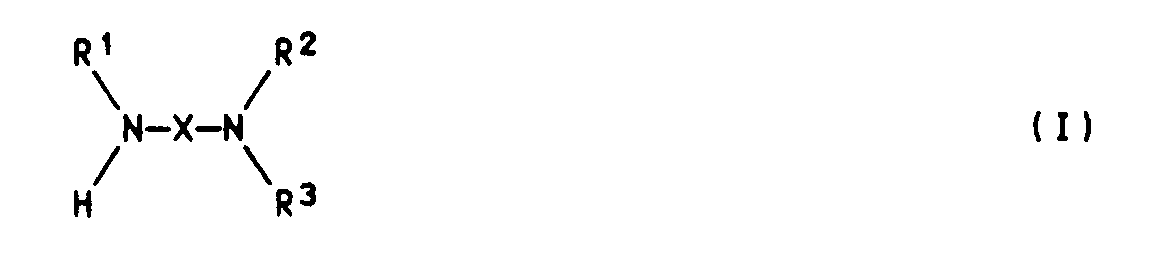
(CR⁴R⁵)m (II)
wobei R⁴ und R⁵ obige Bedeutung annehmen können wie R¹, und m die Werte zwischen 1 und 12 annehmen kann, dadurch gekennzeichnet, daß man Diamine der Formel (III)

- Verfahren nach Anspruch 1, dadurch gekennzeichnet, daß man Ethylendiamin oder Propylendiamin umsetzt.
- Verfahren nach den Ansprüchen 1 und 2, dadurch gekennzeichnet, daß man als Katalysatoren Zeolithe des Pentasiltyps verwendet.
- Verfahren nach Ansprüchen 1 bis 3, dadurch gekennzeichnet, daß man als Katalysatoren Aluminosilikatzeolithe des Pentasiltyps verwendet.
- Verfahren nach den Ansprüchen 1 bis 3, dadurch gekennzeichnet, daß man als Katalysatoren Borsilikatzeolithe des Pentasiltyps verwendet.
- Verfahren nach den Ansprüchen 1 bis 3, dadurch gekennzeichnet, daß man als Katalysatoren Eisensilikatzeolithe des Pentasiltyps verwendet.
- Verfahren nach den Ansprüchen 1 und 2, dadurch gekennzeichnet, daß man als Katalysatoren Aluminiumsilikatzeolithe des Faujasittyps verwendet.
- Verfahren nach den Ansprüchen 1 und 2, dadurch gekennzeichnet, daß man als Katalysatoren Aluminiumsilikatzeolithe des Erionit- und Offretittyps verwendet.
- Verfahren nach den Ansprüchen 1 bis 8, dadurch gekennzeichnet, daß man Zeolithkatalysatoren verwendet, die mit einem Übergangsmetall und/oder Edelmetall und/oder mit seltenen Erden dotiert sind.
- Verfahren nach den Ansprüchen 1 bis 8, dadurch gekennzeichnet, daß man Katalysatoren verwendet, die mit Alkalimetallen und/oder Erdalkalimetallen dotiert sind.
- Verfahren nach den Ansprüchen 1 bis 10, dadurch gekennzeichnet, daß pro mol Amin 0,05 bis 7 mol Olefin eingesetzt werden.
Applications Claiming Priority (2)
| Application Number | Priority Date | Filing Date | Title |
|---|---|---|---|
| DE19873720676 DE3720676A1 (de) | 1987-06-23 | 1987-06-23 | Verfahren zur herstellung von diaminen |
| DE3720676 | 1987-06-23 |
Publications (3)
| Publication Number | Publication Date |
|---|---|
| EP0296495A2 EP0296495A2 (de) | 1988-12-28 |
| EP0296495A3 EP0296495A3 (en) | 1989-12-20 |
| EP0296495B1 true EP0296495B1 (de) | 1992-03-04 |
Family
ID=6330100
Family Applications (1)
| Application Number | Title | Priority Date | Filing Date |
|---|---|---|---|
| EP88109641A Expired - Lifetime EP0296495B1 (de) | 1987-06-23 | 1988-06-16 | Verfahren zur Herstellung von Diaminen |
Country Status (3)
| Country | Link |
|---|---|
| US (1) | US4914241A (de) |
| EP (1) | EP0296495B1 (de) |
| DE (2) | DE3720676A1 (de) |
Families Citing this family (3)
| Publication number | Priority date | Publication date | Assignee | Title |
|---|---|---|---|---|
| US5075099A (en) * | 1988-05-31 | 1991-12-24 | Neorx Corporation | Metal radionuclide chelating compounds for improved chelation kinetics |
| KR100442111B1 (ko) * | 1996-07-31 | 2004-10-08 | 삼성정밀화학 주식회사 | 1,2-디아미노프로판의제조방법 |
| DE10261195A1 (de) * | 2002-12-20 | 2004-07-01 | Basf Ag | Verfahren zur Herstellung eines symmetrischen sekundären Amins |
Family Cites Families (9)
| Publication number | Priority date | Publication date | Assignee | Title |
|---|---|---|---|---|
| US2501509A (en) * | 1945-05-05 | 1950-03-21 | Du Pont | Preparation of amines |
| US4322530A (en) * | 1980-02-22 | 1982-03-30 | W. R. Grace & Co. | Alkylation of polyamines |
| US4375002A (en) * | 1980-05-09 | 1983-02-22 | Air Products And Chemicals, Inc. | Amines via the amination of olefins |
| ATE13878T1 (de) * | 1981-10-07 | 1985-07-15 | Air Prod & Chem | Amine durch aminierung von olefinen unter verwendung von ausgewaehlten zeolithen. |
| US4430391A (en) * | 1982-07-19 | 1984-02-07 | Energy Conversion Devices, Inc. | Fuel cell cathode |
| DE3326579A1 (de) * | 1983-07-23 | 1985-01-31 | Basf Ag, 6700 Ludwigshafen | Verfahren zur herstellung von aminen |
| DE3327000A1 (de) * | 1983-07-27 | 1985-02-07 | Basf Ag, 6700 Ludwigshafen | Verfahren zur herstellung von aminen |
| US4536602A (en) * | 1984-06-01 | 1985-08-20 | Air Products And Chemicals, Inc. | Amination of olefins using organic acid catalysts |
| DE3634247C1 (de) * | 1986-10-08 | 1987-07-23 | Basf Ag | Verfahren zur Herstellung von Aminen |
-
1987
- 1987-06-23 DE DE19873720676 patent/DE3720676A1/de not_active Withdrawn
-
1988
- 1988-06-15 US US07/206,755 patent/US4914241A/en not_active Expired - Fee Related
- 1988-06-16 DE DE8888109641T patent/DE3868710D1/de not_active Expired - Lifetime
- 1988-06-16 EP EP88109641A patent/EP0296495B1/de not_active Expired - Lifetime
Non-Patent Citations (2)
| Title |
|---|
| PATENT ABSTRACTS OF JAPAN, Band 3, Nr. 50 (C-44), 27.4.1979; & JP-A-54 024836 * |
| PATENT ABSTRACTS OF JAPAN, Band 5, Nr. 71, (C-54)(743), 13.5.1981; & JP-A-56 020552 * |
Also Published As
| Publication number | Publication date |
|---|---|
| EP0296495A3 (en) | 1989-12-20 |
| US4914241A (en) | 1990-04-03 |
| DE3868710D1 (de) | 1992-04-09 |
| DE3720676A1 (de) | 1989-01-05 |
| EP0296495A2 (de) | 1988-12-28 |
Similar Documents
| Publication | Publication Date | Title |
|---|---|---|
| EP0296488B1 (de) | Verfahren zur Herstellung von ungesättigten und gesättigten Ketonen | |
| EP0263464B1 (de) | Verfahren zur Herstellung von substituierten Pyridinen | |
| EP0262532B1 (de) | Verfahren zur Herstellung von Aldehyden und/oder Ketonen durch Umsetzung von Epoxiden | |
| DE3903622A1 (de) | Verfahren zur herstellung von 1,4-diazabicyclo-2,2,2-octan | |
| EP0266687B1 (de) | Verfahren zur Herstellung von Cyclopentanon | |
| EP0266689B1 (de) | Verfahren zur Herstellung von 4-Pentensäureestern | |
| EP0267438B1 (de) | Verfahren zur Herstellung von ungesättigten Nitrilen | |
| EP0249976B1 (de) | Verfahren zur Herstellung von Carbonsäuren | |
| EP0318845B1 (de) | Verfahren zur Herstellung von substituierten Pyridinen | |
| EP0325141B1 (de) | Verfahren zur Herstellung von Phenylethanolen | |
| EP0276767B1 (de) | Verfahren zur Herstellung von Ketonen | |
| EP0542039B1 (de) | Verfahren zur Herstellung von Aminen durch reduktive Aminierung | |
| EP0296495A2 (de) | Verfahren zur Herstellung von Diaminen | |
| EP0382056B1 (de) | Verfahren zur Herstellung von cyclischen Amidinen | |
| EP0300324B1 (de) | Verfahren zur Herstellung von acylierten Imidazolen und Pyrazolen | |
| EP0289924B1 (de) | Verfahren zur Herstellung von Pyridinen | |
| EP0297446B1 (de) | Verfahren zur Herstellung von N-Heterocyclen | |
| DE3843389A1 (de) | Verfahren zur herstellung von ascorbinsaeure | |
| EP0309906A1 (de) | Verfahren zur Herstellung von Dihydrofuranen und alpha, beta-ungesättigten Aldehyden/Ketonen | |
| EP0310689A1 (de) | Verfahren zur Herstellung von 1,4-Diazabicyclo(2,2,2)-octanen | |
| EP0318847B1 (de) | Verfahren zur Herstellung von Cyano-Pyridinen | |
| EP0303206A2 (de) | Verfahren zur Herstellung von Pyrrolen | |
| DE3726126A1 (de) | Verfahren zur herstellung von 1.2-dialoxyethenen | |
| DE3808512A1 (de) | Verfahren zur herstellung von (alpha)-ketocarbonsaeureestern | |
| EP0390021A2 (de) | Verfahren zur Herstellung von Benzylketonen |
Legal Events
| Date | Code | Title | Description |
|---|---|---|---|
| PUAI | Public reference made under article 153(3) epc to a published international application that has entered the european phase |
Free format text: ORIGINAL CODE: 0009012 |
|
| AK | Designated contracting states |
Kind code of ref document: A2 Designated state(s): BE CH DE FR GB LI NL |
|
| PUAL | Search report despatched |
Free format text: ORIGINAL CODE: 0009013 |
|
| AK | Designated contracting states |
Kind code of ref document: A3 Designated state(s): BE CH DE FR GB LI NL |
|
| 17P | Request for examination filed |
Effective date: 19891110 |
|
| 17Q | First examination report despatched |
Effective date: 19910718 |
|
| GRAA | (expected) grant |
Free format text: ORIGINAL CODE: 0009210 |
|
| AK | Designated contracting states |
Kind code of ref document: B1 Designated state(s): BE CH DE FR GB LI NL |
|
| REF | Corresponds to: |
Ref document number: 3868710 Country of ref document: DE Date of ref document: 19920409 |
|
| GBT | Gb: translation of ep patent filed (gb section 77(6)(a)/1977) | ||
| ET | Fr: translation filed | ||
| PLBE | No opposition filed within time limit |
Free format text: ORIGINAL CODE: 0009261 |
|
| STAA | Information on the status of an ep patent application or granted ep patent |
Free format text: STATUS: NO OPPOSITION FILED WITHIN TIME LIMIT |
|
| 26N | No opposition filed | ||
| PGFP | Annual fee paid to national office [announced via postgrant information from national office to epo] |
Ref country code: FR Payment date: 19960528 Year of fee payment: 9 |
|
| PGFP | Annual fee paid to national office [announced via postgrant information from national office to epo] |
Ref country code: NL Payment date: 19960531 Year of fee payment: 9 |
|
| PGFP | Annual fee paid to national office [announced via postgrant information from national office to epo] |
Ref country code: CH Payment date: 19960607 Year of fee payment: 9 |
|
| PGFP | Annual fee paid to national office [announced via postgrant information from national office to epo] |
Ref country code: BE Payment date: 19960613 Year of fee payment: 9 |
|
| PGFP | Annual fee paid to national office [announced via postgrant information from national office to epo] |
Ref country code: GB Payment date: 19960617 Year of fee payment: 9 Ref country code: DE Payment date: 19960617 Year of fee payment: 9 |
|
| PG25 | Lapsed in a contracting state [announced via postgrant information from national office to epo] |
Ref country code: GB Free format text: LAPSE BECAUSE OF NON-PAYMENT OF DUE FEES Effective date: 19970616 |
|
| PG25 | Lapsed in a contracting state [announced via postgrant information from national office to epo] |
Ref country code: DE Effective date: 19970623 |
|
| PG25 | Lapsed in a contracting state [announced via postgrant information from national office to epo] |
Ref country code: LI Free format text: LAPSE BECAUSE OF NON-PAYMENT OF DUE FEES Effective date: 19970630 Ref country code: CH Free format text: LAPSE BECAUSE OF NON-PAYMENT OF DUE FEES Effective date: 19970630 Ref country code: BE Effective date: 19970630 |
|
| BERE | Be: lapsed |
Owner name: BASF A.G. Effective date: 19970630 |
|
| PG25 | Lapsed in a contracting state [announced via postgrant information from national office to epo] |
Ref country code: NL Effective date: 19980101 |
|
| GBPC | Gb: european patent ceased through non-payment of renewal fee |
Effective date: 19970616 |
|
| REG | Reference to a national code |
Ref country code: CH Ref legal event code: PL |
|
| PG25 | Lapsed in a contracting state [announced via postgrant information from national office to epo] |
Ref country code: FR Free format text: LAPSE BECAUSE OF NON-PAYMENT OF DUE FEES Effective date: 19980227 |
|
| NLV4 | Nl: lapsed or anulled due to non-payment of the annual fee |
Effective date: 19980101 |
|
| REG | Reference to a national code |
Ref country code: FR Ref legal event code: ST |
|
| REG | Reference to a national code |
Ref country code: FR Ref legal event code: ST |