EP0296316B1 - 1,4-Dihydropyridin-Enantiomere - Google Patents
1,4-Dihydropyridin-Enantiomere Download PDFInfo
- Publication number
- EP0296316B1 EP0296316B1 EP88104691A EP88104691A EP0296316B1 EP 0296316 B1 EP0296316 B1 EP 0296316B1 EP 88104691 A EP88104691 A EP 88104691A EP 88104691 A EP88104691 A EP 88104691A EP 0296316 B1 EP0296316 B1 EP 0296316B1
- Authority
- EP
- European Patent Office
- Prior art keywords
- denotes
- methyl
- ethyl
- nitrophenyl
- formula
- Prior art date
- Legal status (The legal status is an assumption and is not a legal conclusion. Google has not performed a legal analysis and makes no representation as to the accuracy of the status listed.)
- Expired - Lifetime
Links
- YNGDWRXWKFWCJY-UHFFFAOYSA-N 1,4-Dihydropyridine Chemical class C1C=CNC=C1 YNGDWRXWKFWCJY-UHFFFAOYSA-N 0.000 title description 11
- -1 (+)-1-ethoxymethyl-1,4-dihydro-5-methoxycarbonyl-2,6-dimethyl-4-(3-nitrophenyl)-pyridine-3-carboxylic acid cinchonine salt Chemical class 0.000 claims description 78
- 150000001875 compounds Chemical class 0.000 claims description 56
- 150000003839 salts Chemical class 0.000 claims description 52
- 125000002496 methyl group Chemical group [H]C([H])([H])* 0.000 claims description 46
- 125000001495 ethyl group Chemical group [H]C([H])([H])C([H])([H])* 0.000 claims description 38
- 125000001997 phenyl group Chemical group [H]C1=C([H])C([H])=C(*)C([H])=C1[H] 0.000 claims description 32
- 238000000034 method Methods 0.000 claims description 28
- HEDRZPFGACZZDS-UHFFFAOYSA-N Chloroform Chemical compound ClC(Cl)Cl HEDRZPFGACZZDS-UHFFFAOYSA-N 0.000 claims description 20
- VGGSQFUCUMXWEO-UHFFFAOYSA-N Ethene Chemical compound C=C VGGSQFUCUMXWEO-UHFFFAOYSA-N 0.000 claims description 18
- QQONPFPTGQHPMA-UHFFFAOYSA-N propylene Natural products CC=C QQONPFPTGQHPMA-UHFFFAOYSA-N 0.000 claims description 18
- 125000006239 protecting group Chemical group 0.000 claims description 15
- 239000005977 Ethylene Substances 0.000 claims description 11
- 125000004805 propylene group Chemical group [H]C([H])([H])C([H])([*:1])C([H])([H])[*:2] 0.000 claims description 11
- UFHFLCQGNIYNRP-UHFFFAOYSA-N Hydrogen Chemical compound [H][H] UFHFLCQGNIYNRP-UHFFFAOYSA-N 0.000 claims description 10
- 125000003118 aryl group Chemical group 0.000 claims description 10
- 239000002585 base Substances 0.000 claims description 10
- ZZVUWRFHKOJYTH-UHFFFAOYSA-N diphenhydramine Chemical group C=1C=CC=CC=1C(OCCN(C)C)C1=CC=CC=C1 ZZVUWRFHKOJYTH-UHFFFAOYSA-N 0.000 claims description 10
- 125000004204 2-methoxyphenyl group Chemical group [H]C1=C([H])C(*)=C(OC([H])([H])[H])C([H])=C1[H] 0.000 claims description 9
- 229910052736 halogen Inorganic materials 0.000 claims description 8
- 150000002367 halogens Chemical class 0.000 claims description 8
- 239000001257 hydrogen Substances 0.000 claims description 8
- 229910052739 hydrogen Inorganic materials 0.000 claims description 8
- 125000004925 dihydropyridyl group Chemical class N1(CC=CC=C1)* 0.000 claims description 6
- VEFLKXRACNJHOV-UHFFFAOYSA-N 1,3-dibromopropane Chemical compound BrCCCBr VEFLKXRACNJHOV-UHFFFAOYSA-N 0.000 claims description 5
- 125000004207 3-methoxyphenyl group Chemical group [H]C1=C([H])C(*)=C([H])C(OC([H])([H])[H])=C1[H] 0.000 claims description 5
- 150000001412 amines Chemical class 0.000 claims description 5
- 238000002360 preparation method Methods 0.000 claims description 5
- 125000000229 (C1-C4)alkoxy group Chemical group 0.000 claims description 4
- 125000004849 alkoxymethyl group Chemical group 0.000 claims description 3
- 239000012458 free base Substances 0.000 claims description 3
- 150000002431 hydrogen Chemical class 0.000 claims description 3
- 239000002243 precursor Substances 0.000 claims description 3
- BTVVEKSXUOEVAY-UHFFFAOYSA-N 4,4-diphenylpiperidine Chemical compound C1CNCCC1(C=1C=CC=CC=1)C1=CC=CC=C1 BTVVEKSXUOEVAY-UHFFFAOYSA-N 0.000 claims description 2
- 230000008030 elimination Effects 0.000 claims 2
- 238000003379 elimination reaction Methods 0.000 claims 2
- SVJMLYUFVDMUHP-UHFFFAOYSA-N Niguldipine Chemical compound COC(=O)C1=C(C)NC(C)=C(C(=O)OCCCN2CCC(CC2)(C=2C=CC=CC=2)C=2C=CC=CC=2)C1C1=CC=CC([N+]([O-])=O)=C1 SVJMLYUFVDMUHP-UHFFFAOYSA-N 0.000 claims 1
- LFQSCWFLJHTTHZ-UHFFFAOYSA-N Ethanol Chemical compound CCO LFQSCWFLJHTTHZ-UHFFFAOYSA-N 0.000 description 33
- YMWUJEATGCHHMB-UHFFFAOYSA-N Dichloromethane Chemical compound ClCCl YMWUJEATGCHHMB-UHFFFAOYSA-N 0.000 description 27
- XLYOFNOQVPJJNP-UHFFFAOYSA-N water Substances O XLYOFNOQVPJJNP-UHFFFAOYSA-N 0.000 description 20
- 238000006243 chemical reaction Methods 0.000 description 19
- CSCPPACGZOOCGX-UHFFFAOYSA-N Acetone Chemical compound CC(C)=O CSCPPACGZOOCGX-UHFFFAOYSA-N 0.000 description 18
- VEXZGXHMUGYJMC-UHFFFAOYSA-N Hydrochloric acid Chemical compound Cl VEXZGXHMUGYJMC-UHFFFAOYSA-N 0.000 description 17
- 150000002148 esters Chemical class 0.000 description 17
- 239000002904 solvent Substances 0.000 description 17
- 239000000243 solution Substances 0.000 description 16
- ZMXDDKWLCZADIW-UHFFFAOYSA-N N,N-Dimethylformamide Chemical compound CN(C)C=O ZMXDDKWLCZADIW-UHFFFAOYSA-N 0.000 description 15
- 239000000203 mixture Substances 0.000 description 15
- RTZKZFJDLAIYFH-UHFFFAOYSA-N Diethyl ether Chemical compound CCOCC RTZKZFJDLAIYFH-UHFFFAOYSA-N 0.000 description 13
- OKKJLVBELUTLKV-UHFFFAOYSA-N Methanol Chemical compound OC OKKJLVBELUTLKV-UHFFFAOYSA-N 0.000 description 12
- 239000002253 acid Substances 0.000 description 11
- WYURNTSHIVDZCO-UHFFFAOYSA-N Tetrahydrofuran Chemical compound C1CCOC1 WYURNTSHIVDZCO-UHFFFAOYSA-N 0.000 description 10
- KMPWYEUPVWOPIM-KODHJQJWSA-N cinchonidine Chemical class C1=CC=C2C([C@H]([C@H]3[N@]4CC[C@H]([C@H](C4)C=C)C3)O)=CC=NC2=C1 KMPWYEUPVWOPIM-KODHJQJWSA-N 0.000 description 10
- 239000000047 product Substances 0.000 description 10
- 238000003756 stirring Methods 0.000 description 10
- YXFVVABEGXRONW-UHFFFAOYSA-N Toluene Chemical compound CC1=CC=CC=C1 YXFVVABEGXRONW-UHFFFAOYSA-N 0.000 description 9
- 239000003814 drug Substances 0.000 description 9
- HBAQYPYDRFILMT-UHFFFAOYSA-N 8-[3-(1-cyclopropylpyrazol-4-yl)-1H-pyrazolo[4,3-d]pyrimidin-5-yl]-3-methyl-3,8-diazabicyclo[3.2.1]octan-2-one Chemical class C1(CC1)N1N=CC(=C1)C1=NNC2=C1N=C(N=C2)N1C2C(N(CC1CC2)C)=O HBAQYPYDRFILMT-UHFFFAOYSA-N 0.000 description 8
- KFZMGEQAYNKOFK-UHFFFAOYSA-N Isopropanol Chemical compound CC(C)O KFZMGEQAYNKOFK-UHFFFAOYSA-N 0.000 description 8
- 208000037265 diseases, disorders, signs and symptoms Diseases 0.000 description 8
- BWHMMNNQKKPAPP-UHFFFAOYSA-L potassium carbonate Chemical compound [K+].[K+].[O-]C([O-])=O BWHMMNNQKKPAPP-UHFFFAOYSA-L 0.000 description 8
- HEMHJVSKTPXQMS-UHFFFAOYSA-M sodium hydroxide Inorganic materials [OH-].[Na+] HEMHJVSKTPXQMS-UHFFFAOYSA-M 0.000 description 8
- RYHBNJHYFVUHQT-UHFFFAOYSA-N 1,4-Dioxane Chemical compound C1COCCO1 RYHBNJHYFVUHQT-UHFFFAOYSA-N 0.000 description 7
- 125000001436 propyl group Chemical group [H]C([*])([H])C([H])([H])C([H])([H])[H] 0.000 description 7
- QTBSBXVTEAMEQO-UHFFFAOYSA-N Acetic acid Chemical compound CC(O)=O QTBSBXVTEAMEQO-UHFFFAOYSA-N 0.000 description 6
- HTZCNXWZYVXIMZ-UHFFFAOYSA-M benzyl(triethyl)azanium;chloride Chemical compound [Cl-].CC[N+](CC)(CC)CC1=CC=CC=C1 HTZCNXWZYVXIMZ-UHFFFAOYSA-M 0.000 description 6
- KMPWYEUPVWOPIM-UHFFFAOYSA-N cinchonidine Natural products C1=CC=C2C(C(C3N4CCC(C(C4)C=C)C3)O)=CC=NC2=C1 KMPWYEUPVWOPIM-UHFFFAOYSA-N 0.000 description 6
- 238000001816 cooling Methods 0.000 description 6
- 201000010099 disease Diseases 0.000 description 6
- BDAGIHXWWSANSR-UHFFFAOYSA-N methanoic acid Natural products OC=O BDAGIHXWWSANSR-UHFFFAOYSA-N 0.000 description 6
- 125000001424 substituent group Chemical group 0.000 description 6
- MFNFLRNYARCUKB-UHFFFAOYSA-N 1-(ethoxymethyl)-5-methoxycarbonyl-2,6-dimethyl-4-(3-nitrophenyl)-4h-pyridine-3-carboxylic acid Chemical compound COC(=O)C1=C(C)N(COCC)C(C)=C(C(O)=O)C1C1=CC=CC([N+]([O-])=O)=C1 MFNFLRNYARCUKB-UHFFFAOYSA-N 0.000 description 5
- TZDPJNSHSWMCPN-UHFFFAOYSA-N 2,6-dimethyl-4-(3-nitrophenyl)-1,4-dihydropyridine-3,5-dicarboxylic acid Chemical compound OC(=O)C1=C(C)NC(C)=C(C(O)=O)C1C1=CC=CC([N+]([O-])=O)=C1 TZDPJNSHSWMCPN-UHFFFAOYSA-N 0.000 description 5
- 238000009835 boiling Methods 0.000 description 5
- YLQBMQCUIZJEEH-UHFFFAOYSA-N tetrahydrofuran Natural products C=1C=COC=1 YLQBMQCUIZJEEH-UHFFFAOYSA-N 0.000 description 5
- XEZNGIUYQVAUSS-UHFFFAOYSA-N 18-crown-6 Chemical compound C1COCCOCCOCCOCCOCCO1 XEZNGIUYQVAUSS-UHFFFAOYSA-N 0.000 description 4
- ZAFNJMIOTHYJRJ-UHFFFAOYSA-N Diisopropyl ether Chemical compound CC(C)OC(C)C ZAFNJMIOTHYJRJ-UHFFFAOYSA-N 0.000 description 4
- IAZDPXIOMUYVGZ-UHFFFAOYSA-N Dimethylsulphoxide Chemical compound CS(C)=O IAZDPXIOMUYVGZ-UHFFFAOYSA-N 0.000 description 4
- 244000309464 bull Species 0.000 description 4
- VYFYYTLLBUKUHU-UHFFFAOYSA-N dopamine Chemical compound NCCC1=CC=C(O)C(O)=C1 VYFYYTLLBUKUHU-UHFFFAOYSA-N 0.000 description 4
- 230000000694 effects Effects 0.000 description 4
- 238000004519 manufacturing process Methods 0.000 description 4
- 239000012074 organic phase Substances 0.000 description 4
- 239000003444 phase transfer catalyst Substances 0.000 description 4
- 229910000027 potassium carbonate Inorganic materials 0.000 description 4
- 0 *C1C(**N2CCN(*)CC2)=C(*)NC(*)=C1* Chemical compound *C1C(**N2CCN(*)CC2)=C(*)NC(*)=C1* 0.000 description 3
- HTSGKJQDMSTCGS-UHFFFAOYSA-N 1,4-bis(4-chlorophenyl)-2-(4-methylphenyl)sulfonylbutane-1,4-dione Chemical compound C1=CC(C)=CC=C1S(=O)(=O)C(C(=O)C=1C=CC(Cl)=CC=1)CC(=O)C1=CC=C(Cl)C=C1 HTSGKJQDMSTCGS-UHFFFAOYSA-N 0.000 description 3
- ZDWMCEKIYFONGG-UHFFFAOYSA-N 1-(ethoxymethyl)-2,6-dimethyl-4-(3-nitrophenyl)-4h-pyridine-3,5-dicarboxylic acid Chemical compound OC(=O)C1=C(C)N(COCC)C(C)=C(C(O)=O)C1C1=CC=CC([N+]([O-])=O)=C1 ZDWMCEKIYFONGG-UHFFFAOYSA-N 0.000 description 3
- OSWFIVFLDKOXQC-UHFFFAOYSA-N 4-(3-methoxyphenyl)aniline Chemical compound COC1=CC=CC(C=2C=CC(N)=CC=2)=C1 OSWFIVFLDKOXQC-UHFFFAOYSA-N 0.000 description 3
- WEVYAHXRMPXWCK-UHFFFAOYSA-N Acetonitrile Chemical compound CC#N WEVYAHXRMPXWCK-UHFFFAOYSA-N 0.000 description 3
- UHOVQNZJYSORNB-UHFFFAOYSA-N Benzene Chemical compound C1=CC=CC=C1 UHOVQNZJYSORNB-UHFFFAOYSA-N 0.000 description 3
- XEKOWRVHYACXOJ-UHFFFAOYSA-N Ethyl acetate Chemical compound CCOC(C)=O XEKOWRVHYACXOJ-UHFFFAOYSA-N 0.000 description 3
- KWYUFKZDYYNOTN-UHFFFAOYSA-M Potassium hydroxide Chemical compound [OH-].[K+] KWYUFKZDYYNOTN-UHFFFAOYSA-M 0.000 description 3
- PMZURENOXWZQFD-UHFFFAOYSA-L Sodium Sulfate Chemical compound [Na+].[Na+].[O-]S([O-])(=O)=O PMZURENOXWZQFD-UHFFFAOYSA-L 0.000 description 3
- 239000004480 active ingredient Substances 0.000 description 3
- 239000013543 active substance Substances 0.000 description 3
- 230000002490 cerebral effect Effects 0.000 description 3
- 239000003795 chemical substances by application Substances 0.000 description 3
- 229910052801 chlorine Inorganic materials 0.000 description 3
- LOUPRKONTZGTKE-UHFFFAOYSA-N cinchonine Natural products C1C(C(C2)C=C)CCN2C1C(O)C1=CC=NC2=CC=C(OC)C=C21 LOUPRKONTZGTKE-UHFFFAOYSA-N 0.000 description 3
- 235000019253 formic acid Nutrition 0.000 description 3
- 239000003960 organic solvent Substances 0.000 description 3
- 229910052938 sodium sulfate Inorganic materials 0.000 description 3
- 235000011152 sodium sulphate Nutrition 0.000 description 3
- 239000000021 stimulant Substances 0.000 description 3
- 230000001225 therapeutic effect Effects 0.000 description 3
- ZWEHNKRNPOVVGH-UHFFFAOYSA-N 2-Butanone Chemical compound CCC(C)=O ZWEHNKRNPOVVGH-UHFFFAOYSA-N 0.000 description 2
- APTMRLLOXPDHNL-UHFFFAOYSA-N 2-bromoethyl 3-oxobutanoate Chemical compound CC(=O)CC(=O)OCCBr APTMRLLOXPDHNL-UHFFFAOYSA-N 0.000 description 2
- ALKYHXVLJMQRLQ-UHFFFAOYSA-N 3-Hydroxy-2-naphthoate Chemical compound C1=CC=C2C=C(O)C(C(=O)O)=CC2=C1 ALKYHXVLJMQRLQ-UHFFFAOYSA-N 0.000 description 2
- VHYFNPMBLIVWCW-UHFFFAOYSA-N 4-Dimethylaminopyridine Chemical compound CN(C)C1=CC=NC=C1 VHYFNPMBLIVWCW-UHFFFAOYSA-N 0.000 description 2
- IJGRMHOSHXDMSA-UHFFFAOYSA-N Atomic nitrogen Chemical compound N#N IJGRMHOSHXDMSA-UHFFFAOYSA-N 0.000 description 2
- WKBOTKDWSSQWDR-UHFFFAOYSA-N Bromine atom Chemical compound [Br] WKBOTKDWSSQWDR-UHFFFAOYSA-N 0.000 description 2
- ZAMOUSCENKQFHK-UHFFFAOYSA-N Chlorine atom Chemical compound [Cl] ZAMOUSCENKQFHK-UHFFFAOYSA-N 0.000 description 2
- RPTUSVTUFVMDQK-UHFFFAOYSA-N Hidralazin Chemical compound C1=CC=C2C(NN)=NN=CC2=C1 RPTUSVTUFVMDQK-UHFFFAOYSA-N 0.000 description 2
- DGAQECJNVWCQMB-PUAWFVPOSA-M Ilexoside XXIX Chemical compound C[C@@H]1CC[C@@]2(CC[C@@]3(C(=CC[C@H]4[C@]3(CC[C@@H]5[C@@]4(CC[C@@H](C5(C)C)OS(=O)(=O)[O-])C)C)[C@@H]2[C@]1(C)O)C)C(=O)O[C@H]6[C@@H]([C@H]([C@@H]([C@H](O6)CO)O)O)O.[Na+] DGAQECJNVWCQMB-PUAWFVPOSA-M 0.000 description 2
- MZRVEZGGRBJDDB-UHFFFAOYSA-N N-Butyllithium Chemical compound [Li]CCCC MZRVEZGGRBJDDB-UHFFFAOYSA-N 0.000 description 2
- NQRYJNQNLNOLGT-UHFFFAOYSA-N Piperidine Chemical compound C1CCNCC1 NQRYJNQNLNOLGT-UHFFFAOYSA-N 0.000 description 2
- KEAYESYHFKHZAL-UHFFFAOYSA-N Sodium Chemical compound [Na] KEAYESYHFKHZAL-UHFFFAOYSA-N 0.000 description 2
- UIIMBOGNXHQVGW-UHFFFAOYSA-M Sodium bicarbonate Chemical compound [Na+].OC([O-])=O UIIMBOGNXHQVGW-UHFFFAOYSA-M 0.000 description 2
- 229930013930 alkaloid Natural products 0.000 description 2
- 150000001450 anions Chemical class 0.000 description 2
- 239000003146 anticoagulant agent Substances 0.000 description 2
- GDTBXPJZTBHREO-UHFFFAOYSA-N bromine Substances BrBr GDTBXPJZTBHREO-UHFFFAOYSA-N 0.000 description 2
- 229910052794 bromium Inorganic materials 0.000 description 2
- 230000009460 calcium influx Effects 0.000 description 2
- KXZJHVJKXJLBKO-UHFFFAOYSA-N chembl1408157 Chemical compound N=1C2=CC=CC=C2C(C(=O)O)=CC=1C1=CC=C(O)C=C1 KXZJHVJKXJLBKO-UHFFFAOYSA-N 0.000 description 2
- 239000007795 chemical reaction product Substances 0.000 description 2
- 150000008280 chlorinated hydrocarbons Chemical class 0.000 description 2
- 239000000460 chlorine Substances 0.000 description 2
- 239000012043 crude product Substances 0.000 description 2
- 150000004292 cyclic ethers Chemical class 0.000 description 2
- 238000000354 decomposition reaction Methods 0.000 description 2
- 208000035475 disorder Diseases 0.000 description 2
- 229960003638 dopamine Drugs 0.000 description 2
- 238000001704 evaporation Methods 0.000 description 2
- 229960003883 furosemide Drugs 0.000 description 2
- ZZUFCTLCJUWOSV-UHFFFAOYSA-N furosemide Chemical compound C1=C(Cl)C(S(=O)(=O)N)=CC(C(O)=O)=C1NCC1=CC=CO1 ZZUFCTLCJUWOSV-UHFFFAOYSA-N 0.000 description 2
- 239000000499 gel Substances 0.000 description 2
- 238000011081 inoculation Methods 0.000 description 2
- 238000002844 melting Methods 0.000 description 2
- 230000008018 melting Effects 0.000 description 2
- 239000012452 mother liquor Substances 0.000 description 2
- 230000007935 neutral effect Effects 0.000 description 2
- PVNIIMVLHYAWGP-UHFFFAOYSA-N nicotinic acid Natural products OC(=O)C1=CC=CN=C1 PVNIIMVLHYAWGP-UHFFFAOYSA-N 0.000 description 2
- 235000001968 nicotinic acid Nutrition 0.000 description 2
- 239000011664 nicotinic acid Substances 0.000 description 2
- 239000012299 nitrogen atmosphere Substances 0.000 description 2
- 230000002093 peripheral effect Effects 0.000 description 2
- 230000000144 pharmacologic effect Effects 0.000 description 2
- 239000012071 phase Substances 0.000 description 2
- 238000005191 phase separation Methods 0.000 description 2
- 239000002244 precipitate Substances 0.000 description 2
- 238000000746 purification Methods 0.000 description 2
- 239000012312 sodium hydride Substances 0.000 description 2
- 229910000104 sodium hydride Inorganic materials 0.000 description 2
- 239000011877 solvent mixture Substances 0.000 description 2
- 239000007858 starting material Substances 0.000 description 2
- 239000000725 suspension Substances 0.000 description 2
- 239000003826 tablet Substances 0.000 description 2
- KRRBFUJMQBDDPR-UHFFFAOYSA-N tetrabutylazanium;cyanide Chemical compound N#[C-].CCCC[N+](CCCC)(CCCC)CCCC KRRBFUJMQBDDPR-UHFFFAOYSA-N 0.000 description 2
- ZFXYFBGIUFBOJW-UHFFFAOYSA-N theophylline Chemical compound O=C1N(C)C(=O)N(C)C2=C1NC=N2 ZFXYFBGIUFBOJW-UHFFFAOYSA-N 0.000 description 2
- VZCYOOQTPOCHFL-UHFFFAOYSA-N trans-butenedioic acid Natural products OC(=O)C=CC(O)=O VZCYOOQTPOCHFL-UHFFFAOYSA-N 0.000 description 2
- 229940124549 vasodilator Drugs 0.000 description 2
- 239000003071 vasodilator agent Substances 0.000 description 2
- DNXIKVLOVZVMQF-UHFFFAOYSA-N (3beta,16beta,17alpha,18beta,20alpha)-17-hydroxy-11-methoxy-18-[(3,4,5-trimethoxybenzoyl)oxy]-yohimban-16-carboxylic acid, methyl ester Natural products C1C2CN3CCC(C4=CC=C(OC)C=C4N4)=C4C3CC2C(C(=O)OC)C(O)C1OC(=O)C1=CC(OC)=C(OC)C(OC)=C1 DNXIKVLOVZVMQF-UHFFFAOYSA-N 0.000 description 1
- DNIAPMSPPWPWGF-GSVOUGTGSA-N (R)-(-)-Propylene glycol Chemical compound C[C@@H](O)CO DNIAPMSPPWPWGF-GSVOUGTGSA-N 0.000 description 1
- METKIMKYRPQLGS-GFCCVEGCSA-N (R)-atenolol Chemical compound CC(C)NC[C@@H](O)COC1=CC=C(CC(N)=O)C=C1 METKIMKYRPQLGS-GFCCVEGCSA-N 0.000 description 1
- SCYULBFZEHDVBN-UHFFFAOYSA-N 1,1-Dichloroethane Chemical compound CC(Cl)Cl SCYULBFZEHDVBN-UHFFFAOYSA-N 0.000 description 1
- PAAZPARNPHGIKF-UHFFFAOYSA-N 1,2-dibromoethane Chemical compound BrCCBr PAAZPARNPHGIKF-UHFFFAOYSA-N 0.000 description 1
- SZLZWPPUNLXJEA-UHFFFAOYSA-N 11,17-dimethoxy-18-[3-(3,4,5-trimethoxy-phenyl)-acryloyloxy]-yohimbane-16-carboxylic acid methyl ester Natural products C1C2CN3CCC(C4=CC=C(OC)C=C4N4)=C4C3CC2C(C(=O)OC)C(OC)C1OC(=O)C=CC1=CC(OC)=C(OC)C(OC)=C1 SZLZWPPUNLXJEA-UHFFFAOYSA-N 0.000 description 1
- PKHPZNKXOBWFCX-UHFFFAOYSA-N 2-(4-hydroxy-3-phenylbenzoyl)benzoic acid Chemical compound OC(=O)C1=CC=CC=C1C(=O)C1=CC=C(O)C(C=2C=CC=CC=2)=C1 PKHPZNKXOBWFCX-UHFFFAOYSA-N 0.000 description 1
- YGTUPRIZNBMOFV-UHFFFAOYSA-N 2-(4-hydroxybenzoyl)benzoic acid Chemical compound OC(=O)C1=CC=CC=C1C(=O)C1=CC=C(O)C=C1 YGTUPRIZNBMOFV-UHFFFAOYSA-N 0.000 description 1
- QXLGUWJCTSGSDB-UHFFFAOYSA-N 2-[(3-nitrophenyl)methylidene]-3-oxobutanoic acid Chemical compound CC(=O)C(C(O)=O)=CC1=CC=CC([N+]([O-])=O)=C1 QXLGUWJCTSGSDB-UHFFFAOYSA-N 0.000 description 1
- LDLCZOVUSADOIV-UHFFFAOYSA-N 2-bromoethanol Chemical compound OCCBr LDLCZOVUSADOIV-UHFFFAOYSA-N 0.000 description 1
- ULQCHAAOZNBCBL-UHFFFAOYSA-N 2-bromoethyl 2-[(3-nitrophenyl)methylidene]-3-oxobutanoate Chemical compound BrCCOC(=O)C(C(=O)C)=CC1=CC=CC([N+]([O-])=O)=C1 ULQCHAAOZNBCBL-UHFFFAOYSA-N 0.000 description 1
- JIVPVXMEBJLZRO-CQSZACIVSA-N 2-chloro-5-[(1r)-1-hydroxy-3-oxo-2h-isoindol-1-yl]benzenesulfonamide Chemical compound C1=C(Cl)C(S(=O)(=O)N)=CC([C@@]2(O)C3=CC=CC=C3C(=O)N2)=C1 JIVPVXMEBJLZRO-CQSZACIVSA-N 0.000 description 1
- ZNQVEEAIQZEUHB-UHFFFAOYSA-N 2-ethoxyethanol Chemical compound CCOCCO ZNQVEEAIQZEUHB-UHFFFAOYSA-N 0.000 description 1
- SGUAFYQXFOLMHL-UHFFFAOYSA-N 2-hydroxy-5-{1-hydroxy-2-[(4-phenylbutan-2-yl)amino]ethyl}benzamide Chemical compound C=1C=C(O)C(C(N)=O)=CC=1C(O)CNC(C)CCC1=CC=CC=C1 SGUAFYQXFOLMHL-UHFFFAOYSA-N 0.000 description 1
- ZETIVVHRRQLWFW-UHFFFAOYSA-N 3-nitrobenzaldehyde Chemical compound [O-][N+](=O)C1=CC=CC(C=O)=C1 ZETIVVHRRQLWFW-UHFFFAOYSA-N 0.000 description 1
- VHBVKKWTZYRNHX-UHFFFAOYSA-N 4,4-diphenylpiperidine;hydrochloride Chemical compound Cl.C1CNCCC1(C=1C=CC=CC=1)C1=CC=CC=C1 VHBVKKWTZYRNHX-UHFFFAOYSA-N 0.000 description 1
- VCPBYLUDWGYFIQ-UHFFFAOYSA-N 4-benzyl-3-(butylamino)-5-sulfamoylbenzoic acid Chemical compound CCCCNC1=CC(C(O)=O)=CC(S(N)(=O)=O)=C1CC1=CC=CC=C1 VCPBYLUDWGYFIQ-UHFFFAOYSA-N 0.000 description 1
- UJRFKPXGAPWRBG-UHFFFAOYSA-N 4-chloro-2-sulfamoylbenzoic acid Chemical compound NS(=O)(=O)C1=CC(Cl)=CC=C1C(O)=O UJRFKPXGAPWRBG-UHFFFAOYSA-N 0.000 description 1
- LBXHRAWDUMTPSE-AOOOYVTPSA-N 4-chloro-N-[(2S,6R)-2,6-dimethyl-1-piperidinyl]-3-sulfamoylbenzamide Chemical compound C[C@H]1CCC[C@@H](C)N1NC(=O)C1=CC=C(Cl)C(S(N)(=O)=O)=C1 LBXHRAWDUMTPSE-AOOOYVTPSA-N 0.000 description 1
- LSLYOANBFKQKPT-DIFFPNOSSA-N 5-[(1r)-1-hydroxy-2-[[(2r)-1-(4-hydroxyphenyl)propan-2-yl]amino]ethyl]benzene-1,3-diol Chemical compound C([C@@H](C)NC[C@H](O)C=1C=C(O)C=C(O)C=1)C1=CC=C(O)C=C1 LSLYOANBFKQKPT-DIFFPNOSSA-N 0.000 description 1
- UJFBVNPYHVIYBF-UHFFFAOYSA-N 5-o-(2-bromoethyl) 3-o-methyl 2,6-dimethyl-4-(3-nitrophenyl)-1,4-dihydropyridine-3,5-dicarboxylate Chemical compound COC(=O)C1=C(C)NC(C)=C(C(=O)OCCBr)C1C1=CC=CC([N+]([O-])=O)=C1 UJFBVNPYHVIYBF-UHFFFAOYSA-N 0.000 description 1
- RTAPDZBZLSXHQQ-UHFFFAOYSA-N 8-methyl-3,7-dihydropurine-2,6-dione Chemical class N1C(=O)NC(=O)C2=C1N=C(C)N2 RTAPDZBZLSXHQQ-UHFFFAOYSA-N 0.000 description 1
- 239000005541 ACE inhibitor Substances 0.000 description 1
- QTBSBXVTEAMEQO-UHFFFAOYSA-M Acetate Chemical compound CC([O-])=O QTBSBXVTEAMEQO-UHFFFAOYSA-M 0.000 description 1
- NLXLAEXVIDQMFP-UHFFFAOYSA-N Ammonium chloride Substances [NH4+].[Cl-] NLXLAEXVIDQMFP-UHFFFAOYSA-N 0.000 description 1
- VHUUQVKOLVNVRT-UHFFFAOYSA-N Ammonium hydroxide Chemical compound [NH4+].[OH-] VHUUQVKOLVNVRT-UHFFFAOYSA-N 0.000 description 1
- 206010002383 Angina Pectoris Diseases 0.000 description 1
- 206010003210 Arteriosclerosis Diseases 0.000 description 1
- BSYNRYMUTXBXSQ-UHFFFAOYSA-N Aspirin Chemical compound CC(=O)OC1=CC=CC=C1C(O)=O BSYNRYMUTXBXSQ-UHFFFAOYSA-N 0.000 description 1
- 229930003347 Atropine Natural products 0.000 description 1
- FERIUCNNQQJTOY-UHFFFAOYSA-M Butyrate Chemical compound CCCC([O-])=O FERIUCNNQQJTOY-UHFFFAOYSA-M 0.000 description 1
- FERIUCNNQQJTOY-UHFFFAOYSA-N Butyric acid Natural products CCCC(O)=O FERIUCNNQQJTOY-UHFFFAOYSA-N 0.000 description 1
- JZUFKLXOESDKRF-UHFFFAOYSA-N Chlorothiazide Chemical compound C1=C(Cl)C(S(=O)(=O)N)=CC2=C1NCNS2(=O)=O JZUFKLXOESDKRF-UHFFFAOYSA-N 0.000 description 1
- KRKNYBCHXYNGOX-UHFFFAOYSA-K Citrate Chemical compound [O-]C(=O)CC(O)(CC([O-])=O)C([O-])=O KRKNYBCHXYNGOX-UHFFFAOYSA-K 0.000 description 1
- GJSURZIOUXUGAL-UHFFFAOYSA-N Clonidine Chemical compound ClC1=CC=CC(Cl)=C1NC1=NCCN1 GJSURZIOUXUGAL-UHFFFAOYSA-N 0.000 description 1
- 206010052895 Coronary artery insufficiency Diseases 0.000 description 1
- 229920000858 Cyclodextrin Polymers 0.000 description 1
- RGHNJXZEOKUKBD-SQOUGZDYSA-M D-gluconate Chemical compound OC[C@@H](O)[C@@H](O)[C@H](O)[C@@H](O)C([O-])=O RGHNJXZEOKUKBD-SQOUGZDYSA-M 0.000 description 1
- FEWJPZIEWOKRBE-JCYAYHJZSA-N Dextrotartaric acid Chemical compound OC(=O)[C@H](O)[C@@H](O)C(O)=O FEWJPZIEWOKRBE-JCYAYHJZSA-N 0.000 description 1
- LTMHDMANZUZIPE-AMTYYWEZSA-N Digoxin Natural products O([C@H]1[C@H](C)O[C@H](O[C@@H]2C[C@@H]3[C@@](C)([C@@H]4[C@H]([C@]5(O)[C@](C)([C@H](O)C4)[C@H](C4=CC(=O)OC4)CC5)CC3)CC2)C[C@@H]1O)[C@H]1O[C@H](C)[C@@H](O[C@H]2O[C@@H](C)[C@H](O)[C@@H](O)C2)[C@@H](O)C1 LTMHDMANZUZIPE-AMTYYWEZSA-N 0.000 description 1
- XTHFKEDIFFGKHM-UHFFFAOYSA-N Dimethoxyethane Chemical compound COCCOC XTHFKEDIFFGKHM-UHFFFAOYSA-N 0.000 description 1
- PXGOKWXKJXAPGV-UHFFFAOYSA-N Fluorine Chemical compound FF PXGOKWXKJXAPGV-UHFFFAOYSA-N 0.000 description 1
- VZCYOOQTPOCHFL-OWOJBTEDSA-N Fumaric acid Chemical compound OC(=O)\C=C\C(O)=O VZCYOOQTPOCHFL-OWOJBTEDSA-N 0.000 description 1
- 206010019280 Heart failures Diseases 0.000 description 1
- 241000282412 Homo Species 0.000 description 1
- CPELXLSAUQHCOX-UHFFFAOYSA-N Hydrogen bromide Chemical compound Br CPELXLSAUQHCOX-UHFFFAOYSA-N 0.000 description 1
- RKUNBYITZUJHSG-UHFFFAOYSA-N Hyosciamin-hydrochlorid Natural products CN1C(C2)CCC1CC2OC(=O)C(CO)C1=CC=CC=C1 RKUNBYITZUJHSG-UHFFFAOYSA-N 0.000 description 1
- 206010021143 Hypoxia Diseases 0.000 description 1
- NNJVILVZKWQKPM-UHFFFAOYSA-N Lidocaine Chemical compound CCN(CC)CC(=O)NC1=C(C)C=CC=C1C NNJVILVZKWQKPM-UHFFFAOYSA-N 0.000 description 1
- 241000124008 Mammalia Species 0.000 description 1
- SMNOERSLNYGGOU-UHFFFAOYSA-N Mefruside Chemical compound C=1C=C(Cl)C(S(N)(=O)=O)=CC=1S(=O)(=O)N(C)CC1(C)CCCO1 SMNOERSLNYGGOU-UHFFFAOYSA-N 0.000 description 1
- AFVFQIVMOAPDHO-UHFFFAOYSA-M Methanesulfonate Chemical compound CS([O-])(=O)=O AFVFQIVMOAPDHO-UHFFFAOYSA-M 0.000 description 1
- 208000019695 Migraine disease Diseases 0.000 description 1
- 208000007101 Muscle Cramp Diseases 0.000 description 1
- 229910002651 NO3 Inorganic materials 0.000 description 1
- NHNBFGGVMKEFGY-UHFFFAOYSA-N Nitrate Chemical compound [O-][N+]([O-])=O NHNBFGGVMKEFGY-UHFFFAOYSA-N 0.000 description 1
- CTQNGGLPUBDAKN-UHFFFAOYSA-N O-Xylene Chemical compound CC1=CC=CC=C1C CTQNGGLPUBDAKN-UHFFFAOYSA-N 0.000 description 1
- 229910019142 PO4 Inorganic materials 0.000 description 1
- 239000005662 Paraffin oil Substances 0.000 description 1
- CYTYCFOTNPOANT-UHFFFAOYSA-N Perchloroethylene Chemical group ClC(Cl)=C(Cl)Cl CYTYCFOTNPOANT-UHFFFAOYSA-N 0.000 description 1
- UJEWTUDSLQGTOA-UHFFFAOYSA-N Piretanide Chemical compound C=1C=CC=CC=1OC=1C(S(=O)(=O)N)=CC(C(O)=O)=CC=1N1CCCC1 UJEWTUDSLQGTOA-UHFFFAOYSA-N 0.000 description 1
- CYLWJCABXYDINA-UHFFFAOYSA-N Polythiazide Polymers ClC1=C(S(N)(=O)=O)C=C2S(=O)(=O)N(C)C(CSCC(F)(F)F)NC2=C1 CYLWJCABXYDINA-UHFFFAOYSA-N 0.000 description 1
- ZLMJMSJWJFRBEC-UHFFFAOYSA-N Potassium Chemical compound [K] ZLMJMSJWJFRBEC-UHFFFAOYSA-N 0.000 description 1
- 241000208332 Rauvolfia Species 0.000 description 1
- SZLZWPPUNLXJEA-FMCDHCOASA-N Rescinnamine Natural products O=C(O[C@H]1[C@@H](OC)[C@@H](C(=O)OC)[C@@H]2[C@H](C1)CN1[C@@H](c3[nH]c4c(c3CC1)ccc(OC)c4)C2)/C=C/c1cc(OC)c(OC)c(OC)c1 SZLZWPPUNLXJEA-FMCDHCOASA-N 0.000 description 1
- LCQMZZCPPSWADO-UHFFFAOYSA-N Reserpilin Natural products COC(=O)C1COCC2CN3CCc4c([nH]c5cc(OC)c(OC)cc45)C3CC12 LCQMZZCPPSWADO-UHFFFAOYSA-N 0.000 description 1
- QEVHRUUCFGRFIF-SFWBKIHZSA-N Reserpine Natural products O=C(OC)[C@@H]1[C@H](OC)[C@H](OC(=O)c2cc(OC)c(OC)c(OC)c2)C[C@H]2[C@@H]1C[C@H]1N(C2)CCc2c3c([nH]c12)cc(OC)cc3 QEVHRUUCFGRFIF-SFWBKIHZSA-N 0.000 description 1
- 206010041277 Sodium retention Diseases 0.000 description 1
- 208000005392 Spasm Diseases 0.000 description 1
- QAOWNCQODCNURD-UHFFFAOYSA-L Sulfate Chemical compound [O-]S([O-])(=O)=O QAOWNCQODCNURD-UHFFFAOYSA-L 0.000 description 1
- 229940022663 acetate Drugs 0.000 description 1
- 229960001138 acetylsalicylic acid Drugs 0.000 description 1
- 230000002378 acidificating effect Effects 0.000 description 1
- 150000007513 acids Chemical class 0.000 description 1
- 239000000443 aerosol Substances 0.000 description 1
- 229910052783 alkali metal Inorganic materials 0.000 description 1
- 229910000288 alkali metal carbonate Inorganic materials 0.000 description 1
- 150000008041 alkali metal carbonates Chemical class 0.000 description 1
- 150000008044 alkali metal hydroxides Chemical class 0.000 description 1
- 150000001340 alkali metals Chemical class 0.000 description 1
- 150000001350 alkyl halides Chemical class 0.000 description 1
- QGZKDVFQNNGYKY-UHFFFAOYSA-N ammonia Natural products N QGZKDVFQNNGYKY-UHFFFAOYSA-N 0.000 description 1
- 235000011114 ammonium hydroxide Nutrition 0.000 description 1
- 229950003153 amsonate Drugs 0.000 description 1
- 229940035676 analgesics Drugs 0.000 description 1
- 229940044094 angiotensin-converting-enzyme inhibitor Drugs 0.000 description 1
- 239000000730 antalgic agent Substances 0.000 description 1
- 230000003288 anthiarrhythmic effect Effects 0.000 description 1
- 230000002785 anti-thrombosis Effects 0.000 description 1
- 239000003416 antiarrhythmic agent Substances 0.000 description 1
- 229940065524 anticholinergics inhalants for obstructive airway diseases Drugs 0.000 description 1
- 229940127219 anticoagulant drug Drugs 0.000 description 1
- 229940125715 antihistaminic agent Drugs 0.000 description 1
- 239000000739 antihistaminic agent Substances 0.000 description 1
- 229940030600 antihypertensive agent Drugs 0.000 description 1
- 239000002220 antihypertensive agent Substances 0.000 description 1
- 239000003524 antilipemic agent Substances 0.000 description 1
- 239000003963 antioxidant agent Substances 0.000 description 1
- 239000008346 aqueous phase Substances 0.000 description 1
- 150000004945 aromatic hydrocarbons Chemical class 0.000 description 1
- 206010003119 arrhythmia Diseases 0.000 description 1
- 230000006793 arrhythmia Effects 0.000 description 1
- 208000011775 arteriosclerosis disease Diseases 0.000 description 1
- GXDALQBWZGODGZ-UHFFFAOYSA-N astemizole Chemical compound C1=CC(OC)=CC=C1CCN1CCC(NC=2N(C3=CC=CC=C3N=2)CC=2C=CC(F)=CC=2)CC1 GXDALQBWZGODGZ-UHFFFAOYSA-N 0.000 description 1
- 229960002274 atenolol Drugs 0.000 description 1
- RKUNBYITZUJHSG-SPUOUPEWSA-N atropine Chemical compound O([C@H]1C[C@H]2CC[C@@H](C1)N2C)C(=O)C(CO)C1=CC=CC=C1 RKUNBYITZUJHSG-SPUOUPEWSA-N 0.000 description 1
- 229960000396 atropine Drugs 0.000 description 1
- 125000000852 azido group Chemical group *N=[N+]=[N-] 0.000 description 1
- IIOPLILENRZKRV-UHFFFAOYSA-N azosemide Chemical compound C=1C=CSC=1CNC=1C=C(Cl)C(S(=O)(=O)N)=CC=1C1=NN=N[N]1 IIOPLILENRZKRV-UHFFFAOYSA-N 0.000 description 1
- 229960004988 azosemide Drugs 0.000 description 1
- 229940050390 benzoate Drugs 0.000 description 1
- WPYMKLBDIGXBTP-UHFFFAOYSA-N benzoic acid Chemical compound OC(=O)C1=CC=CC=C1 WPYMKLBDIGXBTP-UHFFFAOYSA-N 0.000 description 1
- 229950000523 besunide Drugs 0.000 description 1
- IIBYAHWJQTYFKB-UHFFFAOYSA-N bezafibrate Chemical compound C1=CC(OC(C)(C)C(O)=O)=CC=C1CCNC(=O)C1=CC=C(Cl)C=C1 IIBYAHWJQTYFKB-UHFFFAOYSA-N 0.000 description 1
- 229960000516 bezafibrate Drugs 0.000 description 1
- 230000015572 biosynthetic process Effects 0.000 description 1
- 230000037396 body weight Effects 0.000 description 1
- 210000004556 brain Anatomy 0.000 description 1
- 229960004064 bumetanide Drugs 0.000 description 1
- MAEIEVLCKWDQJH-UHFFFAOYSA-N bumetanide Chemical compound CCCCNC1=CC(C(O)=O)=CC(S(N)(=O)=O)=C1OC1=CC=CC=C1 MAEIEVLCKWDQJH-UHFFFAOYSA-N 0.000 description 1
- LGBHQFWRSMFRJF-UHFFFAOYSA-N butanedioic acid;oxalic acid Chemical compound OC(=O)C(O)=O.OC(=O)CCC(O)=O LGBHQFWRSMFRJF-UHFFFAOYSA-N 0.000 description 1
- 125000000484 butyl group Chemical group [H]C([*])([H])C([H])([H])C([H])([H])C([H])([H])[H] 0.000 description 1
- 239000002775 capsule Substances 0.000 description 1
- FAKRSMQSSFJEIM-RQJHMYQMSA-N captopril Chemical compound SC[C@@H](C)C(=O)N1CCC[C@H]1C(O)=O FAKRSMQSSFJEIM-RQJHMYQMSA-N 0.000 description 1
- 229960000830 captopril Drugs 0.000 description 1
- 150000004649 carbonic acid derivatives Chemical class 0.000 description 1
- 239000000496 cardiotonic agent Substances 0.000 description 1
- 230000003177 cardiotonic effect Effects 0.000 description 1
- 230000003197 catalytic effect Effects 0.000 description 1
- 230000005779 cell damage Effects 0.000 description 1
- 208000037887 cell injury Diseases 0.000 description 1
- 125000001309 chloro group Chemical group Cl* 0.000 description 1
- FCYRSDMGOLYDHL-UHFFFAOYSA-N chloromethoxyethane Chemical compound CCOCCl FCYRSDMGOLYDHL-UHFFFAOYSA-N 0.000 description 1
- 229960001523 chlortalidone Drugs 0.000 description 1
- 239000000812 cholinergic antagonist Substances 0.000 description 1
- 229940001468 citrate Drugs 0.000 description 1
- 238000004140 cleaning Methods 0.000 description 1
- 238000003776 cleavage reaction Methods 0.000 description 1
- 229960002896 clonidine Drugs 0.000 description 1
- 229960004070 clopamide Drugs 0.000 description 1
- 238000004440 column chromatography Methods 0.000 description 1
- 239000008139 complexing agent Substances 0.000 description 1
- 239000000470 constituent Substances 0.000 description 1
- 208000029078 coronary artery disease Diseases 0.000 description 1
- 239000006071 cream Substances 0.000 description 1
- 150000003983 crown ethers Chemical class 0.000 description 1
- 239000013078 crystal Substances 0.000 description 1
- 238000002425 crystallisation Methods 0.000 description 1
- 230000008025 crystallization Effects 0.000 description 1
- 229940097362 cyclodextrins Drugs 0.000 description 1
- 230000005595 deprotonation Effects 0.000 description 1
- 238000010537 deprotonation reaction Methods 0.000 description 1
- LTMHDMANZUZIPE-PUGKRICDSA-N digoxin Chemical compound C1[C@H](O)[C@H](O)[C@@H](C)O[C@H]1O[C@@H]1[C@@H](C)O[C@@H](O[C@@H]2[C@H](O[C@@H](O[C@@H]3C[C@@H]4[C@]([C@@H]5[C@H]([C@]6(CC[C@@H]([C@@]6(C)[C@H](O)C5)C=5COC(=O)C=5)O)CC4)(C)CC3)C[C@@H]2O)C)C[C@@H]1O LTMHDMANZUZIPE-PUGKRICDSA-N 0.000 description 1
- 229960005156 digoxin Drugs 0.000 description 1
- LTMHDMANZUZIPE-UHFFFAOYSA-N digoxine Natural products C1C(O)C(O)C(C)OC1OC1C(C)OC(OC2C(OC(OC3CC4C(C5C(C6(CCC(C6(C)C(O)C5)C=5COC(=O)C=5)O)CC4)(C)CC3)CC2O)C)CC1O LTMHDMANZUZIPE-UHFFFAOYSA-N 0.000 description 1
- LIMAOLZSWRJOMG-HJPBWRTMSA-N dihydroergocristine Chemical compound C([C@H]1C(=O)N2CCC[C@H]2[C@]2(O)O[C@](C(N21)=O)(NC(=O)[C@H]1CN(C)[C@H]2[C@@H](C3=CC=CC4=NC=C([C]34)C2)C1)C(C)C)C1=CC=CC=C1 LIMAOLZSWRJOMG-HJPBWRTMSA-N 0.000 description 1
- 229960004318 dihydroergocristine Drugs 0.000 description 1
- WASQWSOJHCZDFK-UHFFFAOYSA-N diketene Chemical compound C=C1CC(=O)O1 WASQWSOJHCZDFK-UHFFFAOYSA-N 0.000 description 1
- 239000002270 dispersing agent Substances 0.000 description 1
- 239000002934 diuretic Substances 0.000 description 1
- 229940030606 diuretics Drugs 0.000 description 1
- 208000002173 dizziness Diseases 0.000 description 1
- POULHZVOKOAJMA-UHFFFAOYSA-M dodecanoate Chemical compound CCCCCCCCCCCC([O-])=O POULHZVOKOAJMA-UHFFFAOYSA-M 0.000 description 1
- 239000008298 dragée Substances 0.000 description 1
- 239000000975 dye Substances 0.000 description 1
- 239000003995 emulsifying agent Substances 0.000 description 1
- 239000000839 emulsion Substances 0.000 description 1
- AVOLMBLBETYQHX-UHFFFAOYSA-N etacrynic acid Chemical compound CCC(=C)C(=O)C1=CC=C(OCC(O)=O)C(Cl)=C1Cl AVOLMBLBETYQHX-UHFFFAOYSA-N 0.000 description 1
- 229960003199 etacrynic acid Drugs 0.000 description 1
- 150000002170 ethers Chemical class 0.000 description 1
- 125000005745 ethoxymethyl group Chemical group [H]C([H])([H])C([H])([H])OC([H])([H])* 0.000 description 1
- 125000004494 ethyl ester group Chemical group 0.000 description 1
- 230000008020 evaporation Effects 0.000 description 1
- 230000002349 favourable effect Effects 0.000 description 1
- 229950002281 fendizoate Drugs 0.000 description 1
- 229960001022 fenoterol Drugs 0.000 description 1
- 239000012065 filter cake Substances 0.000 description 1
- 239000000706 filtrate Substances 0.000 description 1
- 238000001914 filtration Methods 0.000 description 1
- 239000012467 final product Substances 0.000 description 1
- 229910052731 fluorine Inorganic materials 0.000 description 1
- 239000011737 fluorine Substances 0.000 description 1
- 229940050411 fumarate Drugs 0.000 description 1
- 229950001564 galosemide Drugs 0.000 description 1
- 210000001035 gastrointestinal tract Anatomy 0.000 description 1
- 229940050410 gluconate Drugs 0.000 description 1
- 125000001188 haloalkyl group Chemical group 0.000 description 1
- 125000004969 haloethyl group Chemical group 0.000 description 1
- 125000005843 halogen group Chemical group 0.000 description 1
- 238000010438 heat treatment Methods 0.000 description 1
- 229950000177 hibenzate Drugs 0.000 description 1
- 229960002474 hydralazine Drugs 0.000 description 1
- 229960002003 hydrochlorothiazide Drugs 0.000 description 1
- XMBWDFGMSWQBCA-UHFFFAOYSA-N hydrogen iodide Chemical compound I XMBWDFGMSWQBCA-UHFFFAOYSA-N 0.000 description 1
- 150000004679 hydroxides Chemical class 0.000 description 1
- 206010020871 hypertrophic cardiomyopathy Diseases 0.000 description 1
- 230000007954 hypoxia Effects 0.000 description 1
- 239000005457 ice water Substances 0.000 description 1
- 230000002401 inhibitory effect Effects 0.000 description 1
- 150000007529 inorganic bases Chemical class 0.000 description 1
- 229910052806 inorganic carbonate Inorganic materials 0.000 description 1
- 125000000959 isobutyl group Chemical group [H]C([H])([H])C([H])(C([H])([H])[H])C([H])([H])* 0.000 description 1
- 238000002955 isolation Methods 0.000 description 1
- 125000001449 isopropyl group Chemical group [H]C([H])([H])C([H])(*)C([H])([H])[H] 0.000 description 1
- MOYKHGMNXAOIAT-JGWLITMVSA-N isosorbide dinitrate Chemical compound [O-][N+](=O)O[C@H]1CO[C@@H]2[C@H](O[N+](=O)[O-])CO[C@@H]21 MOYKHGMNXAOIAT-JGWLITMVSA-N 0.000 description 1
- 229960000201 isosorbide dinitrate Drugs 0.000 description 1
- FPCCSQOGAWCVBH-UHFFFAOYSA-N ketanserin Chemical compound C1=CC(F)=CC=C1C(=O)C1CCN(CCN2C(C3=CC=CC=C3NC2=O)=O)CC1 FPCCSQOGAWCVBH-UHFFFAOYSA-N 0.000 description 1
- 229960005417 ketanserin Drugs 0.000 description 1
- 150000002576 ketones Chemical class 0.000 description 1
- 229960001632 labetalol Drugs 0.000 description 1
- 229940070765 laurate Drugs 0.000 description 1
- 229960004194 lidocaine Drugs 0.000 description 1
- 229940049920 malate Drugs 0.000 description 1
- VZCYOOQTPOCHFL-UPHRSURJSA-N maleic acid Chemical compound OC(=O)\C=C/C(O)=O VZCYOOQTPOCHFL-UPHRSURJSA-N 0.000 description 1
- BJEPYKJPYRNKOW-UHFFFAOYSA-N malic acid Chemical compound OC(=O)C(O)CC(O)=O BJEPYKJPYRNKOW-UHFFFAOYSA-N 0.000 description 1
- 239000000463 material Substances 0.000 description 1
- 229960004678 mefruside Drugs 0.000 description 1
- 229950002475 mesilate Drugs 0.000 description 1
- 229910052987 metal hydride Inorganic materials 0.000 description 1
- 150000004681 metal hydrides Chemical class 0.000 description 1
- 229950001506 metembonate Drugs 0.000 description 1
- 125000000956 methoxy group Chemical group [H]C([H])([H])O* 0.000 description 1
- WCYWZMWISLQXQU-UHFFFAOYSA-N methyl Chemical compound [CH3] WCYWZMWISLQXQU-UHFFFAOYSA-N 0.000 description 1
- XKORCTIIRYKLLG-ARJAWSKDSA-N methyl (z)-3-aminobut-2-enoate Chemical compound COC(=O)\C=C(\C)N XKORCTIIRYKLLG-ARJAWSKDSA-N 0.000 description 1
- PZRHRDRVRGEVNW-UHFFFAOYSA-N milrinone Chemical compound N1C(=O)C(C#N)=CC(C=2C=CN=CC=2)=C1C PZRHRDRVRGEVNW-UHFFFAOYSA-N 0.000 description 1
- 229960003574 milrinone Drugs 0.000 description 1
- 150000007522 mineralic acids Chemical class 0.000 description 1
- 230000003387 muscular Effects 0.000 description 1
- 208000010125 myocardial infarction Diseases 0.000 description 1
- GNWHIAXZYUDAFX-UHFFFAOYSA-N n-[4-[3-(trifluoromethyl)anilino]pyridin-3-yl]sulfonylpropanamide Chemical compound CCC(=O)NS(=O)(=O)C1=CN=CC=C1NC1=CC=CC(C(F)(F)F)=C1 GNWHIAXZYUDAFX-UHFFFAOYSA-N 0.000 description 1
- HYIMSNHJOBLJNT-UHFFFAOYSA-N nifedipine Chemical compound COC(=O)C1=C(C)NC(C)=C(C(=O)OC)C1C1=CC=CC=C1[N+]([O-])=O HYIMSNHJOBLJNT-UHFFFAOYSA-N 0.000 description 1
- 229960001597 nifedipine Drugs 0.000 description 1
- 125000002560 nitrile group Chemical group 0.000 description 1
- 150000002825 nitriles Chemical class 0.000 description 1
- 150000002828 nitro derivatives Chemical class 0.000 description 1
- 125000000449 nitro group Chemical group [O-][N+](*)=O 0.000 description 1
- 229910052757 nitrogen Inorganic materials 0.000 description 1
- 238000010899 nucleation Methods 0.000 description 1
- 239000012038 nucleophile Substances 0.000 description 1
- QIQXTHQIDYTFRH-UHFFFAOYSA-N octadecanoic acid Chemical compound CCCCCCCCCCCCCCCCCC(O)=O QIQXTHQIDYTFRH-UHFFFAOYSA-N 0.000 description 1
- 239000002674 ointment Substances 0.000 description 1
- 210000000056 organ Anatomy 0.000 description 1
- 150000007524 organic acids Chemical class 0.000 description 1
- 235000005985 organic acids Nutrition 0.000 description 1
- 150000002902 organometallic compounds Chemical class 0.000 description 1
- 125000004430 oxygen atom Chemical group O* 0.000 description 1
- 239000008194 pharmaceutical composition Substances 0.000 description 1
- 239000000546 pharmaceutical excipient Substances 0.000 description 1
- 239000000825 pharmaceutical preparation Substances 0.000 description 1
- NBIIXXVUZAFLBC-UHFFFAOYSA-K phosphate Chemical compound [O-]P([O-])([O-])=O NBIIXXVUZAFLBC-UHFFFAOYSA-K 0.000 description 1
- 239000010452 phosphate Substances 0.000 description 1
- 229960001085 piretanide Drugs 0.000 description 1
- 239000003880 polar aprotic solvent Substances 0.000 description 1
- 239000002798 polar solvent Substances 0.000 description 1
- 229960005483 polythiazide Drugs 0.000 description 1
- 229920000046 polythiazide Polymers 0.000 description 1
- 229910052700 potassium Inorganic materials 0.000 description 1
- 239000011591 potassium Substances 0.000 description 1
- NNFCIKHAZHQZJG-UHFFFAOYSA-N potassium cyanide Chemical compound [K+].N#[C-] NNFCIKHAZHQZJG-UHFFFAOYSA-N 0.000 description 1
- IENZQIKPVFGBNW-UHFFFAOYSA-N prazosin Chemical compound N=1C(N)=C2C=C(OC)C(OC)=CC2=NC=1N(CC1)CCN1C(=O)C1=CC=CO1 IENZQIKPVFGBNW-UHFFFAOYSA-N 0.000 description 1
- 229960001289 prazosin Drugs 0.000 description 1
- 230000001376 precipitating effect Effects 0.000 description 1
- 238000001556 precipitation Methods 0.000 description 1
- 239000003755 preservative agent Substances 0.000 description 1
- 230000001737 promoting effect Effects 0.000 description 1
- 150000003242 quaternary ammonium salts Chemical class 0.000 description 1
- 150000003254 radicals Chemical class 0.000 description 1
- 230000009257 reactivity Effects 0.000 description 1
- 238000001953 recrystallisation Methods 0.000 description 1
- 210000002254 renal artery Anatomy 0.000 description 1
- 229940124550 renal vasodilator Drugs 0.000 description 1
- 238000001226 reprecipitation Methods 0.000 description 1
- SMSAPZICLFYVJS-QEGASFHISA-N rescinnamine Chemical compound O([C@H]1[C@@H]([C@H]([C@H]2C[C@@H]3C4=C([C]5C=CC(OC)=CC5=N4)CCN3C[C@H]2C1)C(=O)OC)OC)C(=O)\C=C\C1=CC(OC)=C(OC)C(OC)=C1 SMSAPZICLFYVJS-QEGASFHISA-N 0.000 description 1
- 229960001965 rescinnamine Drugs 0.000 description 1
- BJOIZNZVOZKDIG-MDEJGZGSSA-N reserpine Chemical compound O([C@H]1[C@@H]([C@H]([C@H]2C[C@@H]3C4=C([C]5C=CC(OC)=CC5=N4)CCN3C[C@H]2C1)C(=O)OC)OC)C(=O)C1=CC(OC)=C(OC)C(OC)=C1 BJOIZNZVOZKDIG-MDEJGZGSSA-N 0.000 description 1
- 229960003147 reserpine Drugs 0.000 description 1
- 210000002345 respiratory system Anatomy 0.000 description 1
- MDMGHDFNKNZPAU-UHFFFAOYSA-N roserpine Natural products C1C2CN3CCC(C4=CC=C(OC)C=C4N4)=C4C3CC2C(OC(C)=O)C(OC)C1OC(=O)C1=CC(OC)=C(OC)C(OC)=C1 MDMGHDFNKNZPAU-UHFFFAOYSA-N 0.000 description 1
- MOODSJOROWROTO-UHFFFAOYSA-N salicylsulfuric acid Chemical compound OC(=O)C1=CC=CC=C1OS(O)(=O)=O MOODSJOROWROTO-UHFFFAOYSA-N 0.000 description 1
- 230000000054 salidiuretic effect Effects 0.000 description 1
- 230000000894 saliuretic effect Effects 0.000 description 1
- 230000007017 scission Effects 0.000 description 1
- 125000002914 sec-butyl group Chemical group [H]C([H])([H])C([H])([H])C([H])(*)C([H])([H])[H] 0.000 description 1
- 150000003335 secondary amines Chemical class 0.000 description 1
- 238000007086 side reaction Methods 0.000 description 1
- 238000010583 slow cooling Methods 0.000 description 1
- 210000000329 smooth muscle myocyte Anatomy 0.000 description 1
- 239000000050 smooth muscle relaxant Substances 0.000 description 1
- 239000011734 sodium Substances 0.000 description 1
- 229910052708 sodium Inorganic materials 0.000 description 1
- 229910000030 sodium bicarbonate Inorganic materials 0.000 description 1
- 235000017557 sodium bicarbonate Nutrition 0.000 description 1
- KFZUDNZQQCWGKF-UHFFFAOYSA-M sodium;4-methylbenzenesulfinate Chemical compound [Na+].CC1=CC=C(S([O-])=O)C=C1 KFZUDNZQQCWGKF-UHFFFAOYSA-M 0.000 description 1
- 239000007787 solid Substances 0.000 description 1
- LXMSZDCAJNLERA-ZHYRCANASA-N spironolactone Chemical compound C([C@@H]1[C@]2(C)CC[C@@H]3[C@@]4(C)CCC(=O)C=C4C[C@H]([C@@H]13)SC(=O)C)C[C@@]21CCC(=O)O1 LXMSZDCAJNLERA-ZHYRCANASA-N 0.000 description 1
- 229960002256 spironolactone Drugs 0.000 description 1
- 239000007921 spray Substances 0.000 description 1
- 229940114926 stearate Drugs 0.000 description 1
- 239000000126 substance Substances 0.000 description 1
- 125000000472 sulfonyl group Chemical group *S(*)(=O)=O 0.000 description 1
- 229940071103 sulfosalicylate Drugs 0.000 description 1
- 239000000829 suppository Substances 0.000 description 1
- 239000002511 suppository base Substances 0.000 description 1
- 229940095064 tartrate Drugs 0.000 description 1
- 125000000999 tert-butyl group Chemical group [H]C([H])([H])C(*)(C([H])([H])[H])C([H])([H])[H] 0.000 description 1
- JRMUNVKIHCOMHV-UHFFFAOYSA-M tetrabutylammonium bromide Chemical compound [Br-].CCCC[N+](CCCC)(CCCC)CCCC JRMUNVKIHCOMHV-UHFFFAOYSA-M 0.000 description 1
- 229950011008 tetrachloroethylene Drugs 0.000 description 1
- 229960000278 theophylline Drugs 0.000 description 1
- 238000004809 thin layer chromatography Methods 0.000 description 1
- JOXIMZWYDAKGHI-UHFFFAOYSA-N toluene-4-sulfonic acid Chemical compound CC1=CC=C(S(O)(=O)=O)C=C1 JOXIMZWYDAKGHI-UHFFFAOYSA-N 0.000 description 1
- 229950004288 tosilate Drugs 0.000 description 1
- 239000008096 xylene Substances 0.000 description 1
Classifications
-
- C—CHEMISTRY; METALLURGY
- C07—ORGANIC CHEMISTRY
- C07D—HETEROCYCLIC COMPOUNDS
- C07D405/00—Heterocyclic compounds containing both one or more hetero rings having oxygen atoms as the only ring hetero atoms, and one or more rings having nitrogen as the only ring hetero atom
- C07D405/02—Heterocyclic compounds containing both one or more hetero rings having oxygen atoms as the only ring hetero atoms, and one or more rings having nitrogen as the only ring hetero atom containing two hetero rings
- C07D405/12—Heterocyclic compounds containing both one or more hetero rings having oxygen atoms as the only ring hetero atoms, and one or more rings having nitrogen as the only ring hetero atom containing two hetero rings linked by a chain containing hetero atoms as chain links
-
- A—HUMAN NECESSITIES
- A61—MEDICAL OR VETERINARY SCIENCE; HYGIENE
- A61P—SPECIFIC THERAPEUTIC ACTIVITY OF CHEMICAL COMPOUNDS OR MEDICINAL PREPARATIONS
- A61P9/00—Drugs for disorders of the cardiovascular system
- A61P9/08—Vasodilators for multiple indications
-
- A—HUMAN NECESSITIES
- A61—MEDICAL OR VETERINARY SCIENCE; HYGIENE
- A61P—SPECIFIC THERAPEUTIC ACTIVITY OF CHEMICAL COMPOUNDS OR MEDICINAL PREPARATIONS
- A61P9/00—Drugs for disorders of the cardiovascular system
- A61P9/12—Antihypertensives
-
- C—CHEMISTRY; METALLURGY
- C07—ORGANIC CHEMISTRY
- C07D—HETEROCYCLIC COMPOUNDS
- C07D211/00—Heterocyclic compounds containing hydrogenated pyridine rings, not condensed with other rings
- C07D211/04—Heterocyclic compounds containing hydrogenated pyridine rings, not condensed with other rings with only hydrogen or carbon atoms directly attached to the ring nitrogen atom
- C07D211/80—Heterocyclic compounds containing hydrogenated pyridine rings, not condensed with other rings with only hydrogen or carbon atoms directly attached to the ring nitrogen atom having two double bonds between ring members or between ring members and non-ring members
- C07D211/84—Heterocyclic compounds containing hydrogenated pyridine rings, not condensed with other rings with only hydrogen or carbon atoms directly attached to the ring nitrogen atom having two double bonds between ring members or between ring members and non-ring members with hetero atoms or with carbon atoms having three bonds to hetero atoms, with at the most one bond to halogen directly attached to ring carbon atoms
- C07D211/90—Carbon atoms having three bonds to hetero atoms with at the most one bond to halogen
-
- C—CHEMISTRY; METALLURGY
- C07—ORGANIC CHEMISTRY
- C07D—HETEROCYCLIC COMPOUNDS
- C07D401/00—Heterocyclic compounds containing two or more hetero rings, having nitrogen atoms as the only ring hetero atoms, at least one ring being a six-membered ring with only one nitrogen atom
- C07D401/02—Heterocyclic compounds containing two or more hetero rings, having nitrogen atoms as the only ring hetero atoms, at least one ring being a six-membered ring with only one nitrogen atom containing two hetero rings
- C07D401/12—Heterocyclic compounds containing two or more hetero rings, having nitrogen atoms as the only ring hetero atoms, at least one ring being a six-membered ring with only one nitrogen atom containing two hetero rings linked by a chain containing hetero atoms as chain links
-
- C—CHEMISTRY; METALLURGY
- C07—ORGANIC CHEMISTRY
- C07D—HETEROCYCLIC COMPOUNDS
- C07D405/00—Heterocyclic compounds containing both one or more hetero rings having oxygen atoms as the only ring hetero atoms, and one or more rings having nitrogen as the only ring hetero atom
- C07D405/02—Heterocyclic compounds containing both one or more hetero rings having oxygen atoms as the only ring hetero atoms, and one or more rings having nitrogen as the only ring hetero atom containing two hetero rings
- C07D405/04—Heterocyclic compounds containing both one or more hetero rings having oxygen atoms as the only ring hetero atoms, and one or more rings having nitrogen as the only ring hetero atom containing two hetero rings directly linked by a ring-member-to-ring-member bond
-
- C—CHEMISTRY; METALLURGY
- C07—ORGANIC CHEMISTRY
- C07D—HETEROCYCLIC COMPOUNDS
- C07D409/00—Heterocyclic compounds containing two or more hetero rings, at least one ring having sulfur atoms as the only ring hetero atoms
- C07D409/02—Heterocyclic compounds containing two or more hetero rings, at least one ring having sulfur atoms as the only ring hetero atoms containing two hetero rings
- C07D409/04—Heterocyclic compounds containing two or more hetero rings, at least one ring having sulfur atoms as the only ring hetero atoms containing two hetero rings directly linked by a ring-member-to-ring-member bond
-
- C—CHEMISTRY; METALLURGY
- C07—ORGANIC CHEMISTRY
- C07D—HETEROCYCLIC COMPOUNDS
- C07D413/00—Heterocyclic compounds containing two or more hetero rings, at least one ring having nitrogen and oxygen atoms as the only ring hetero atoms
- C07D413/02—Heterocyclic compounds containing two or more hetero rings, at least one ring having nitrogen and oxygen atoms as the only ring hetero atoms containing two hetero rings
- C07D413/04—Heterocyclic compounds containing two or more hetero rings, at least one ring having nitrogen and oxygen atoms as the only ring hetero atoms containing two hetero rings directly linked by a ring-member-to-ring-member bond
-
- C—CHEMISTRY; METALLURGY
- C07—ORGANIC CHEMISTRY
- C07D—HETEROCYCLIC COMPOUNDS
- C07D417/00—Heterocyclic compounds containing two or more hetero rings, at least one ring having nitrogen and sulfur atoms as the only ring hetero atoms, not provided for by group C07D415/00
- C07D417/02—Heterocyclic compounds containing two or more hetero rings, at least one ring having nitrogen and sulfur atoms as the only ring hetero atoms, not provided for by group C07D415/00 containing two hetero rings
- C07D417/04—Heterocyclic compounds containing two or more hetero rings, at least one ring having nitrogen and sulfur atoms as the only ring hetero atoms, not provided for by group C07D415/00 containing two hetero rings directly linked by a ring-member-to-ring-member bond
Definitions
- the invention relates to new enantiomers, processes for their preparation, their use and medicaments containing them.
- the compounds according to the invention are used in the pharmaceutical industry for the production of medicaments.
- 1,4-dihydropyridine derivatives substituted in the 4-position have pharmacologically useful properties. It is also known that these 1,4-dihydropyridine derivatives - provided they are substituted differently (asymmetrically) in positions 2 and 6 and / or in positions 3 and 5 - have a chiral center in position 4. It is also known that the pharmacological properties of 1,4-dihydropyridines can be influenced by the absolute configuration in the 4-position [see also and for general structure / activity considerations R. Mannhold et al., Progr. Pharmacol. 5, 25 (1982)].
- Halogen in the sense of the invention means bromine, fluorine and especially chlorine.
- 1-4C-alkyl is straight-chain or branched and means, for example, a butyl, i-butyl, sec-butyl, t-butyl, propyl, isopropyl, ethyl or in particular methyl radical.
- 1-4C-alkoxy contains one of the 1-4C-alkyl radicals mentioned above.
- the methoxy and ethoxy radicals are preferred.
- Suitable as such are, for example, water-soluble and water-insoluble acid addition salts, such as the hydrochloride, hydrobromide, hydroiodide, phosphate, nitrate, sulfate, acetate, citrate, gluconate, benzoate, hibenzate, fendizoate, butyrate, sulfosalicylate, maleate, laurate, malate, fumarate, succinate Oxalate, tartrate, amsonate, metembonate, stearate, tosilate, 2-hydroxy-3-naphthoate, 3-hydroxy-2-naphthoate or mesilate, but also salts with bumetanide, furosemide, azosemide, galosemide, besunide, piretanide, etacrynic acid or tetracrynic acid, tetrailic acid, or tetraic acid 4-chloro-sulfamoyl-benzoic
- the invention thus relates to new, for the first time isolated or isolatable enantiomerically pure 1,4-dihydropyridines of the formula I.
- the configuration a can be characterized by the following formula Ia wherein the substituents and symbols have the meanings given for the configuration a.
- the configuration b can be characterized by the following formula Ib wherein the substituents and symbols have the meanings given for configuration b.
- the configuration c can be characterized by the following formula Ic wherein the substituents and symbols have the meanings given for the configuration c.
- the invention further relates to a process for the preparation of the compounds of the formula I and their salts.
- the reaction of II with omega-dihaloalkanes is preferably carried out under basic conditions in the presence of a phase transfer catalyst.
- omega-dihaloalkanes preference is given to mentioning 1,2-dihaloethanes and 1,3-dihalopropanes, in particular 1,2-dibromoethane and 1,3-dibromopropane.
- crown ethers such as dibenzo [18] crown-6, dicyclohexyl [18] crown-6 and in particular [18] crown-6 mentioned.
- Suitable bases which are used at least in a molar ratio, preferably in excess, are inorganic bases, such as alkali metal hydroxides (e.g. sodium or potassium hydroxide), or in particular alkali metal carbonates (e.g. sodium or preferably potassium carbonate).
- alkali metal hydroxides e.g. sodium or potassium hydroxide
- alkali metal carbonates e.g. sodium or preferably potassium carbonate
- the hydroxides or carbonates used are preferably used in finely powdered form.
- the reaction takes place (depending on the type of phase transfer catalyst and the base used) in water-containing or anhydrous organic solvents, or in a mixture of water and an organic solvent which is immiscible or hardly miscible with water.
- water / solvent mixtures are the mixtures of water with chloroform, dichloromethane or benzene.
- water-containing or water-free solvents are dichloromethane, acetonitrile or acetone.
- protective groups SG are, in particular, those groups which can be introduced easily and in high yields into the precursor on which compound II is based, and which do not occur when II is reacted with dihaloalkanes Enter into side reactions that can be split off smoothly at the end.
- Preferred protective groups SG are, for example, alkoxymethyl groups or benzyloxymethyl groups, in particular the ethoxymethyl group.
- the protective group is split off in an acidic medium, for example in 1N hydrochloric acid or preferably in anhydrous formic acid, under reaction conditions as are known to the person skilled in the art. According to the invention, the protective group can also be split off after the reaction with the amine IV.
- the reaction is carried out in suitable, preferably inert, organic solvents in the presence of water or without water.
- suitable, preferably inert, organic solvents include ethers such as dioxane, diethyl ether, tetrahydrofuran, glycol monoethyl ether or glycol dimethyl ether; Ketones such as acetone or ethyl methyl ketone; aromatic hydrocarbons such as xylene or toluene; or chlorinated hydrocarbons such as methylene chloride, chloroform, tetrachlorethylene or dichloroethane; or polar aprotic solvents such as dimethylformamide or dimethyl sulfoxide.
- reaction temperatures can vary within a wide range. In general, the reaction is carried out at temperatures between 20 ° C. and 150 ° C., preferably between 20 ° C. and 100 ° C., in particular at the boiling point of the solvent used.
- the process can be carried out at normal pressure or at elevated pressure, with working at normal pressure being the rule.
- the reaction is carried out in the presence of a base (e.g. an inorganic carbonate such as potassium carbonate) or using an excess of amine IV.
- a base e.g. an inorganic carbonate such as potassium carbonate
- amine IV an excess of amine IV.
- the isolation and purification of the compounds I according to the invention obtained is carried out in a manner known per se, for. B. in such a way that the solvent is distilled off in vacuo and the residue obtained is recrystallized from a suitable solvent or subjected to one of the customary purification methods, such as, for example, column chromatography on a suitable support material.
- Acid addition salts are obtained by dissolving the free base in a suitable one Solvents, for example in a chlorinated hydrocarbon, such as methylene chloride or chloroform, or a low molecular weight aliphatic alcohol (ethanol, isopropanol), or an open-chain or cyclic ether, such as dioxane or tetrahydrofuran, which contains the desired acid or to which the desired acid is subsequently added .
- a chlorinated hydrocarbon such as methylene chloride or chloroform
- a low molecular weight aliphatic alcohol ethanol, isopropanol
- an open-chain or cyclic ether such as dioxane or tetrahydrofuran
- the salts are obtained by filtration, reprecipitation, precipitation with a non-solvent for the addition salt or by evaporation of the solvent.
- Salts obtained can be obtained by alkalization, e.g. with aqueous ammonia solution, are converted into the free bases, which in turn can be converted into acid addition salts. In this way, pharmacologically unacceptable acid addition salts can be converted into pharmacologically unacceptable acid addition salts.
- Refinements of the method are those in which the substituents and symbols have the meanings given for the compounds of refinements a, b and c. Processes to be emphasized, preferred and particularly preferred are those in which the substituents and symbols have the meanings given for the preferred and particularly preferred compounds to be emphasized.
- the process is characterized in that an N-protected dihydropyridinecarboxylic acid of the formula II * reacted with 1,3-dibromopropane and after splitting off the protective group SG the bromopropyl ester III * obtained with diphenylpiperidine or a salt thereof to give the final product I * and, if desired, subsequently converting a salt of the compound I * obtained into the free base or the compound I * into a salt.
- the procedure is expediently such that the haloethyl ester V is deprotonated in the 1-position and then reacted with a compound SG-X, where X stands for a suitable escape group.
- the escape group X of the compound SG-X is a group which is easily split off when SG-X is reacted with the deprotonated V. If the protective group SG is an alkoxymethyl group, X is preferably a halogen atom, in particular a chlorine atom.
- the deprotonation and subsequent introduction of the protective group is carried out in inert, anhydrous solvents, as are suitable for working with strong deprotonating agents.
- inert, anhydrous solvents examples include open-chain or cyclic ethers such as diethyl ether, dioxane or tetrahydrofuran.
- the reaction is preferably carried out under mild reaction conditions at temperatures around or below 0 ° C.
- Residues that can have a mesomeric electron-attracting effect are particularly suitable as acceptor residues in the further implementation.
- examples include the nitro group or the azido group, preferably the nitrile group or a substituted sulfonyl group.
- the halogen exchange in the N-protected haloethyl ester of the formula VI is preferably carried out by reaction with salts whose anions are suitable for acting as covalently bound acceptor substituents.
- Tetrabutylammonium cyanide or benzyltriethylammonium chloride in inert, preferably aprotic, polar solvents such as acetone, dimethyl sulfoxide or dimethylformamide, at temperatures which are preferably between 0 ° C and 50 ° C.
- the cleavage of the acceptor ethyl residue under basic conditions following the halogen exchange is a reaction familiar to the person skilled in the art, as is described, for example, in DE-OS 2847237.
- the compound II which is initially obtained as a racemate, can be separated with the aid of enantiomerically pure, optically active bases in a customary manner via the diastereomeric salts into the enantiomers (+) - II and (-) - II [see, for example, Chem. Pharm. Bull. 28 , 2809 (1980)] [1].
- Cinchonidine and cinchonine in particular may be mentioned as enantiomerically pure optically active bases.
- haloethyl esters V used as starting compounds are e.g. known from DE-OS 2847237.
- Mp Means melting point, h stands for hours, Kp. Stands for boiling point, dec. means decomposition.
- Ether is understood to mean diethyl ether.
- a stable pH of 2 is set in the aqueous phase by adding 2N hydrochloric acid solution. After phase separation, the organic phase is washed four more times with hydrochloric acid solution of pH 2 and then with water, dried over sodium sulfate and concentrated. The oily residue is dissolved in 1.1 l of acetone and 375 g of finely ground potassium carbonate, 375 ml of 1,3-dibromopropane and 1.2 g of [18] crown-6 are added. The mixture is stirred vigorously at room temperature for 24 h, then the product is filtered off with suction and the filter cake is washed with acetone.
- the filtrate is concentrated on a rotary evaporator under a weak vacuum and then the excess 1,3-dibromopropane is distilled off at 0.02 mbar (bath temperature up to 45 ° C.). 690 ml of concentrated formic acid are poured over the oily residue while cooling with ice, and the mixture is then stirred at room temperature until a clear solution has formed (about 15 minutes). The formic acid is distilled off in vacuo. After twice adding and distilling off 200 ml of toluene, the residue is dissolved in 900 ml of dichloromethane. The solution is stirred with sodium bicarbonate solution, washed with water, dried over sodium sulfate and concentrated in vacuo.
- the corresponding (+) enantiomer can be obtained by working up the mother liquor from the first crystallization:
- the mother liquor is evaporated to dryness in vacuo, the residue is dissolved in 2 l of chloroform and, after adding 1 l of water, vigorously stirred by adding 2N hydrochloric acid, a stable pH of 2 to 3 is established.
- the phases are separated, the organic phase is shaken with 0.01N hydrochloric acid until cinchonidine is no longer detectable (thin layer chromatography), washed with water and dried. After the solvent has been distilled off under reduced pressure, the residue is dried under high vacuum and 85.6 g of it is dissolved together with 54.5 g of cinchonine in about 2.4 l of boiling ethanol.
- the enantiomerically pure compounds of the formula I and their salts produced by the process according to the invention have valuable properties which make them commercially usable. They represent, for example, effective vasodilators with coronary therapeutic properties.
- the compounds according to the invention have an inhibitory effect on calcium influx and a promotional effect on potassium outflow from cells, smooth muscle relaxant and peripheral, coronary, cerebral and renal vasodilator, and salidiuretic, antithrombotic, antiarteriosclerotic and favorable hemorheological properties .
- the enantiomers which are particularly effective in the main action on the one hand the load due to their less effective stereoisomers, which in some cases can even have opposite effects or increased side effects, is significantly reduced.
- the enantiomers, which are weaker in the main action mentioned above can be used for other therapeutic purposes which were not previously accessible to this class of substances, owing to the main action predominating in the racemates.
- the excellent effectiveness of the compounds of the formula I and their salts according to the invention permits their use in human medicine, the indication being, for example, coronary heart diseases (coronary insufficiency, angina pectoris, myocardial infarction, etc.), peripheral and cerebral circulatory disorders (brain stroke, temporary cerebral circulatory disorders, migraines, dizziness , renal artery narrowing etc.), hypertrophic cardiomyopathy, heart failure, diseases based on increased water and sodium retention and diseases based on increased calcium influx, such as Spasms of smooth muscular organs (respiratory tract, gastrointestinal tract, urogenital tract, etc.) as well as arrhythmia, arteriosclerosis and cell damage of various origins (e.g. hypoxia) can be considered.
- coronary heart diseases coronary insufficiency, angina pectoris, myocardial infarction, etc.
- peripheral and cerebral circulatory disorders brain stroke, temporary cerebral circulatory disorders, migraines, dizziness , renal artery narrowing etc.
- the invention therefore furthermore relates to a method for the treatment of mammals, in particular humans, who are suffering from one of the abovementioned diseases.
- the method is characterized in that the diseased individual is administered a therapeutically effective and pharmacologically tolerable amount of one or more compounds of the formula I.
- the invention also relates to the compounds of the formula I for use in the treatment of the diseases mentioned.
- the invention also encompasses the use of compounds of the formula I in the production of medicaments which are used to combat the diseases mentioned.
- the invention further relates to medicaments which contain one or more compounds of the general formula I.
- the pharmaceuticals are produced by methods known per se and familiar to the person skilled in the art.
- auxiliaries which are suitable for the desired pharmaceutical formulations on the basis of his specialist knowledge.
- solvents gel formers, suppository bases, tablet excipients and other active ingredients, antioxidants, dispersants, emulsifiers, defoamers, taste correctors, preservatives, solubilizers, dyes or, in particular, permeation promoters and complexing agents (e.g. cyclodextrins) can be used.
- the active substances can be administered orally, rectally, by inhalation or parenterally (in particular perlingually, intravenously or percutaneously).
- the active ingredient (s) when administered orally in a daily dose of about 0.01 to about 10, preferably 0.05 to 5 mg / kg body weight, if desired in the form of several, preferably 1 to 4 individual doses to achieve the desired result.
- similar or generally lower doses in particular when the active compounds are administered intravenously can be used. If the dose creeps in, a lower dose is given at the start of treatment, then slowly switched to a higher dose. After the desired therapeutic success has been reached, the dose is reduced again.
- the pharmaceutical preparations can also contain one or more other pharmacologically active constituents of other groups of medicaments, such as other vasodilators, antihypertensives, alpha-1 receptor blockers, alpha-2 receptor stimulators , beta-1-receptor blockers, beta-2-receptor stimulators, ACE inhibitors, nitro compounds, cardiotonics, diuretics, saluretics, alkaloids, analgesics, lipid-lowering agents, anticoagulants, anticholinergics, methylxanthines, antiarrhythmics, antihistamines, dopamine stimulants, such as seropotinin stimulants, such as dopamine stimulants nifedipine, hydralazine, prazosin, clonidine, atenolol, labetalol, fenoterol, captopril, isosorbide dinitrate, digoxin, milrin
Landscapes
- Organic Chemistry (AREA)
- Chemical & Material Sciences (AREA)
- Health & Medical Sciences (AREA)
- Engineering & Computer Science (AREA)
- Bioinformatics & Cheminformatics (AREA)
- Cardiology (AREA)
- Chemical Kinetics & Catalysis (AREA)
- General Chemical & Material Sciences (AREA)
- Nuclear Medicine, Radiotherapy & Molecular Imaging (AREA)
- Medicinal Chemistry (AREA)
- Life Sciences & Earth Sciences (AREA)
- Pharmacology & Pharmacy (AREA)
- Heart & Thoracic Surgery (AREA)
- Animal Behavior & Ethology (AREA)
- General Health & Medical Sciences (AREA)
- Public Health (AREA)
- Veterinary Medicine (AREA)
- Hydrogenated Pyridines (AREA)
- Pharmaceuticals Containing Other Organic And Inorganic Compounds (AREA)
- Plural Heterocyclic Compounds (AREA)
Description
- Die Erfindung betrifft neue Enantiomere, Verfahren zu ihrer Herstellung, ihre Verwendung und sie enthaltende Arzneimittel. Die erfindungsgemäßen Verbindungen werden in der pharmazeutischen Industrie zur Herstellung von Arzneimitteln eingesetzt.
- Es ist bekannt, daß bestimmte, in 4-Position substituierte 1,4-Dihydropyridinderivate pharmakologisch nützliche Eigenschaften aufweisen. Ferner ist bekannt, daß diese 1,4-Dihydropyridinderivate - sofern sie in den Positionen 2 und 6 und/oder in den Positionen 3 und 5 unterschiedlich (unsymmetrisch) substituiert sind - in der Position 4 ein Chiralitätszentrum aufweisen. Außerdem ist bekannt, daß die pharmakologischen Eigenschaften der 1,4-Dihydropyridine von der absoluten Konfiguration in der 4-Position beeinflußt werden können [siehe hierzu sowie zu allgemeinen Struktur-/Wirkungsbetrachtungen R. Mannhold et al., Progr. Pharmacol. 5, 25 (1982)]. Aufgrund dieser unterschiedlichen pharmakologischen Eigenschaften wurde schon verschiedentlich versucht, enantiomer reine 1,4-Dihydropyridine herzustellen [siehe z.B. DE-OS 2935451, DE-OS 3320616, EP-A2 0166296, EP-A 172 509, Shibaruma et al. Chem. Pharm.Bull. 28, 2809 (1980)]. Mit den bisher bekannten Verfahren lassen sich jedoch entweder nicht alle denkbaren Enantiomeren bekannter 1,4-Dihydropyridine herstellen, oder diese Verfahren liefern die enantiomer reinen 1,4-Dihydropyridine nur in geringen Ausbeuten oder in einer ungenügenden Reinheit.
- Überraschenderweise wurde nun ein neues Verfahren zur Herstellung enantiomer reiner, optisch aktiver 1,4-Dihydropyridinen gefunden, das die gewünschten Enantiomere in guter Ausbeute und hoher Reinheit liefert. Mit diesem Verfahren lassen sich neue Enantiomere bekannter 1,4-Dihydropyridine herstellen.
- Gegenstand der Erfindung sind somit in einem ersten Aspekt enantiomer reine Dihydropyridine der Formel I

die in der 4-Position des Dihydropyridins die gleiche Konfiguration aufweisen, wie das als Vorprodukt einsetzbare (+)-1-Ethoxymethyl-1,4-dihydro-5-methoxycarbonyl-2,6-dimethyl-4-(3-nitrophenyl)-pyridin-3-carbonsäure/Cinchoninsalz, das das linear polarisierte Licht der Wellenlänge 589 nm mit [α]
und worin - Cy
- 3-Nitrophenyl oder 2,3-Dichlorphenyl bedeutet,
- R1 und R2
- gleich oder verschieden sind und 1-4C-Alkyl bedeuten,
- R3
- 1-4C-Alkyl bedeutet,
- E
- Ethylen oder Propylen bedeutet,
- A
- -CH₂-C(R6)R7-CH₂- oder -CH₂-NR8-CH₂- bedeutet,
- R6
- Wasserstoff (H) oder Phenyl bedeutet,
- R7
- Phenyl bedeutet,
- R8
- Aryl oder Benzhydryl bedeutet, wobei
- Halogen im Sinne der Erfindung bedeutet Brom, Fluor und insbesondere Chlor. 1-4C-Alkyl ist geradkettig oder verzweigt und bedeutet beispielsweise einen Butyl-, i-Butyl-, sec.-Butyl-, t-Butyl-, Propyl-, Isopropyl-, Ethyl-oder insbesondere Methylrest.
- 1-4C-Alkoxy enthält neben dem Sauerstoffatom einen der vorstehend genannten 1-4C-Alkylreste. Bevorzugt sind der Methoxy- und der Ethoxyrest.
- Als Salze kommen alle Salze mit Säuren in Betracht. Besonders erwähnt seien die pharmakologisch verträglichen Salze der in der pharmazeutischen Industrie üblicherweise verwendeten anorganischen und organischen Säuren. Pharmakologisch unverträgliche Salze, die beispielsweise bei der Herstellung der erfindungsgemäßen Verbindungen im industriellen Maßstab als Verfahrensprodukte zunächst anfallen können, werden durch dem Fachmann bekannte Verfahren in pharmakologisch verträgliche Salze übergeführt. Als solche eignen sich beispielsweise wasserlösliche und wasserunlösliche Säureadditionssalze, wie das Hydrochlorid, Hydrobromid, Hydroiodid, Phosphat, Nitrat, Sulfat, Acetat, Citrat, Gluconat, Benzoat, Hibenzat, Fendizoat, Butyrat, Sulfosalicylat, Maleat, Laurat, Malat, Fumarat, Succinat, Oxalat, Tartrat, Amsonat, Metembonat, Stearat, Tosilat, 2-Hydroxy-3-naphthoat, 3-Hydroxy-2-naphthoat oder Mesilat, aber auch Salze mit Bumetanid, Furosemid, Azosemid, Galosemid, Besunid, Piretanid, Etacrynsäure, Tienilinsäure oder 4-Chlor-sulfamoyl-benzoesäure.
- Gegenstand der Erfindung sind somit in einem ersten Aspekt neue, erstmals isolierte bzw. isolierbare enantiomerenreine 1,4-Dihydropyridine der Formel I.
- Eine Ausgestaltung (Ausgestaltung a) der Erfindung sind enantiomer reine Verbindungen der Formel I, worin Cy, R1, R2, R3 und E die eingangs genannten Bedeutungen haben,
- A
- -CH₂-C(R6)R7-CH₂- bedeutet,
- R6
- Wasserstoff (H) bedeutet und
- R7
- Phenyl bedeutet,
- Die Ausgestaltung a kann charakterisiert werden durch die folgende Formel Ia

worin die Substituenten und Symbole die für die Ausgestaltung a genannten Bedeutungen haben. - Hervorzuhebende Verbindungen der Ausgestaltung a sind solche der Formel Ia, worin
- Cy
- 3-Nitrophenyl oder 2,3-Dichlorphenyl bedeutet,
- R1
- Methyl oder Ethyl bedeutet,
- R2
- Methyl oder Ethyl bedeutet,
- R3
- Methyl oder Ethyl bedeutet,
- E
- Ethylen oder Propylen bedeutet,
- R6
- Wasserstoff bedeutet und
- R7
- Phenyl bedeutet,
- Besonders bevorzugte Verbindungen der Ausgestaltung a sind solche der Formel Ia, worin
- Cy
- 3-Nitrophenyl bedeutet,
- R1
- Methyl bedeutet,
- R2
- Methyl bedeutet,
- R3
- Methyl bedeutet,
- E
- Ethylen oder Propylen bedeutet,
- R6
- Wasserstoff bedeutet und
- R7
- Phenyl bedeutet,
- Als beispielhafte, besonders erwähnenswerte Verbindungen der Ausgestaltung a seien genannt:
(R)-1,4-Dihydro-2,6-dimethyl-4-(2,3-dichlorphenyl)-pyridin-3,5-dicarbonsäure-3-methyl-5-[2-(4-phenylpiperidyl-1)-ethyl]-ester,
(R)-1,4-Dihydro-2,6-dimethyl-4-(2,3-dichlorphenyl)-pyridin-3,5-dicarbonsäure-3-methyl-5-[3-(4-phenylpiperidyl-1)-propyl]-ester,
(R)-1,4-Dihydro-2,6-dimethyl-4-(3-nitrophenyl)-pyridin-3,5-dicarbonsäure-3-methyl-5-[2-(4-phenylpiperidyl-1)-ethyl]-ester,
(R)-1,4-Dihydro-2,6-dimethyl-4-(3-nitrophenyl)-pyridin-3,5-dicarbonsäure-3-methyl-5-[3-(4-phenylpiperidyl-1)-propyl]-ester,
und ihre Salze. - Eine weitere Ausgestaltung (Ausgestaltung b) der Erfindung sind enantiomer reine Verbindungen der Formel I, worin Cy, R1, R2, R3 und E die eingangs genannten Bedeutungen haben,
- A
- -CH₂-NR8-CH₂- bedeutet,
- R8
- Aryl oder Benzhydryl bedeutet, wobei Aryl die eingangs angegebenen Bedeutungen hat,
- Die Ausgestaltung b kann charakterisiert werden durch die folgende Formel Ib

worin die Substituenten und Symbole die für die Ausgestaltung b genannten Bedeutungen haben. - Hervorzuhebende Verbindungen der Ausgestaltung b sind solche der Formel Ib, worin
- Cy
- 3-Nitrophenyl oder 2,3-Dichlorphenyl bedeutet,
- R1
- Methyl oder Ethyl bedeutet,
- R2
- Methyl oder Ethyl bedeutet,
- R3
- Methyl oder Ethyl bedeutet,
- E
- Ethylen oder Propylen bedeutet und
- R8
- Phenyl, 2-Methoxyphenyl, 2-Ethoxyphenyl, 2-Ethoxy-4-fluorphenyl, 3-Methoxyphenyl oder Benzhydryl bedeutet,
- Besonders bevorzugte Verbindungen der Ausgestaltung b sind solche der Formel Ib, worin
- Cy
- 3-Nitrophenyl bedeutet,
- R1
- Methyl bedeutet,
- R2
- Methyl bedeutet,
- R3
- Methyl bedeutet,
- E
- Ethylen oder Propylen bedeutet und
- R8
- Phenyl, 2-Methoxyphenyl, 2-Ethoxyphenyl, 2-Ethoxy-4-fluorphenyl oder Benzhydryl bedeutet,
- Als beispielhafte, besonders erwähnenswerte Verbindungen der Ausgestaltung b seien genannt:
(R)-1,4-Dihydro-2,6-dimethyl-4-(2,3-dichlorphenyl)-pyridin-3,5-dicarbonsäure-3-methyl-5-{2-[4-(2-methoxyphenyl)-1-piperazinyl]-ethyl}-ester,
(R)-1,4-Dihydro-2,6-dimethyl-4-(2,3-dichlorphenyl)-pyridin-3,5-dicarbonsäure-3-methyl-5-{3-[4-(2-methoxyphenyl)-1-piperazinyl]-propyl}-ester,
(R)-1,4-Dihydro-2,6-dimethyl-4-(2,3-dichlorphenyl)-pyridin-3,5-dicarbonsäure-3-methyl-5-[2-(4-benzhydryl-1-piperazinyl)-ethyl]-ester,
(R)-1,4-Dihydro-2,6-dimethyl-4-(2,3-dichlorphenyl)-pyridin-3,5-dicarbonsäure-3-methyl-5-[3-(4-benzhydryl-1-piperazinyl)-propyl]-ester,
(R)-1,4-Dihydro-2,6-dimethyl-4-(3-nitrophenyl)-pyridin-3,5-dicarbonsäure-3-methyl-5-{2-[4-(2-methoxyphenyl)-1-piperazinyl]-ethyl}-ester,
(R)-1,4-Dihydro-2,6-dimethyl-4-(3-nitrophenyl)-pyridin-3,5-dicarbonsäure-3-methyl-5-{3-[4-(2-methoxyphenyl)-1-piperazinyl]-propyl}-ester,
(R)-1,4-Dihydro-2,6-dimethyl-4-(3-nitrophenyl)-pyridin-3,5-dicarbonsäure-3-methyl-5-[2-(4-phenyl-1-piperazinyl)-ethyl]-ester,
(R)-1,4-Dihydro-2,6-dimethyl-4-(3-nitrophenyl)-pyridin-3,5-dicarbonsäure-3-methyl-5-[3-(4-phenyl-1-piperazinyl)-propyl]-ester,
(R)-1,4-Dihydro-2,6-dimethyl-4-(3-nitrophenyl)-pyridin-3,5-dicarbonsäure-3-methyl-5-[2-(4-benzhydryl-1-piperazinyl)-ethyl]-ester,
(R)-1,4-Dihydro-2,6-dimethyl-4-(3-nitrophenyl)-pyridin-3,5-dicarbonsäure-3-methyl-5-[3-(4-benzhydryl-1-piperazinyl)-propyl]-ester
(R)-1,4-Dihydro-2,6-dimethyl-4-(3-nitrophenyl)-pyridin-3,5-dicarbonsäure-3-methyl-5-{3-[4-(2-ethoxyphenyl)-1-piperazinyl]-propyl}-ester,
(R)-1,4-Dihydro-2,6-dimethyl-4-(3-nitrophenyl)-pyridin-3,5-dicarbonsäure-3-methyl-5-{2-[4-(2-ethoxyphenyl)-1-piperazinyl]-ethyl}-ester
(R)-1,4-Dihydro-2,6-dimethyl-4-(3-nitrophenyl)-pyridin-3,5-dicarbonsäure-3-methy-5-{3-[4-(3-methoxyphenyl)-1-piperazinyl]-propyl}-ester
(R)-1,4-Dihydro-2,6-dimethyl-4-(3-nitrophenyl)-pyridin-3,5-dicarbonsäure-3-methy-5-{2-[4-(3-methoxyphenyl)-1-piperazinyl]-ethyl}-ester
und ihre Salze. - Eine weitere Ausgestaltung (Ausgestaltung c) der Erfindung sind enantiomer reine Verbindungen der Formel I, worin
- Cy, R1, R2, R3 und E
- die eingangs genannten Bedeutungen haben,
- A
- -CH₂-C(R6)R7-CH₂- bedeutet,
- R6
- Phenyl bedeutet und
- R7
- Phenyl bedeutet,
- Die Ausgestaltung c kann charakterisiert werden durch die folgende Formel Ic

worin die Substituenten und Symbole die für die Ausgestaltung c genannten Bedeutungen haben. - Hervorzuhebende Verbindungen der Ausgestaltung c sind solche der Formel Ic, worin
- Cy
- 3-Nitrophenyl oder 2,3-Dichlorphenyl bedeutet,
- R1
- Methyl oder Ethyl bedeutet,
- R2
- Methyl oder Ethyl bedeutet,
- R3
- Methyl oder Ethyl bedeutet,
- E
- Ethylen oder Propylen bedeutet,
- R6
- Phenyl bedeutet und
- R7
- Phenyl bedeutet,
- Besonders bevorzugte Verbindungen der Ausgestaltung c sind solche der Formel Ic, worin
- Cy
- 3-Nitrophenyl bedeutet,
- R1
- Methyl bedeutet,
- R2
- Methyl bedeutet,
- R3
- Methyl oder Ethyl bedeutet,
- E
- Ethylen oder Propylen bedeutet,
- R6
- Phenyl und
- R7
- Phenyl bedeutet,
- Als beispielhafte, besonders erwähnenswerte Verbindungen der Ausgestaltung c seien genannt:
(R)-1,4-Dihydro-2,6-dimethyl-4-(2,3-dichlorphenyl)-pyridin-3,5-dicarbonsäure-3-methyl-5-[2-(4,4-diphenylpiperidyl-1)-ethyl]-ester,
(R)-1,4-Dihydro-2,6-dimethyl-4-(2,3-dichlorphenyl)-pyridin-3,5-dicarbonsäure-3-methyl-5-[3-(4,4-diphenylpiperidyl-1)-propyl]-ester,
(R)-1,4-Dihydro-2,6-dimethyl-4-(3-nitrophenyl)-pyridin-3,5-dicarbonsäure-3-methyl-5-[2-(4,4-diphenylpiperidyl-1)-ethyl]-ester,
(R)-(+)-1,4-Dihydro-2,6-dimethyl-4-(3-nitrophenyl)-pyridin-3,5-dicarbonsäure-3-methyl-5-[3-(4,4-diphenyl-1-piperidinyl-1)-propyl]ester,
und ihre Salze. - Weiterer Gegenstand der Erfindung ist ein Verfahren zur Herstellung der Verbindungen der Formel I und ihrer Salze.
- Das Verfahren ist dadurch gekennzeichnet, daß man enantiomer reine N-geschützte Dihydropyridincarbonsäuren der Formel II,

die in der 4-Position des Dihydropyridins die gleiche Konfiguration aufweisen, wie das als Vorprodukt einsetzbare (+)-1-Ethoxymethyl-1,4-dihydro-5-methoxycarbonyl-2,6-dimethyl-4-(3-nitrophenyl)-pyridin-3-carbonsäure/Cinchoninsalz, das das linear polarisierte Licht der Wellenlänge 589 nm mit [α]
mit einem omega-Dihalogenalkan Hal-E-Hal, worin Hal Halogen bedeutet und E die vorstehend angegebene Bedeutung hat, umsetzt und nach Abspaltung der Schutzgruppe SG den erhaltenen Halogenalkylester III
mit einem Amin der Formel IV oder einem Salz davon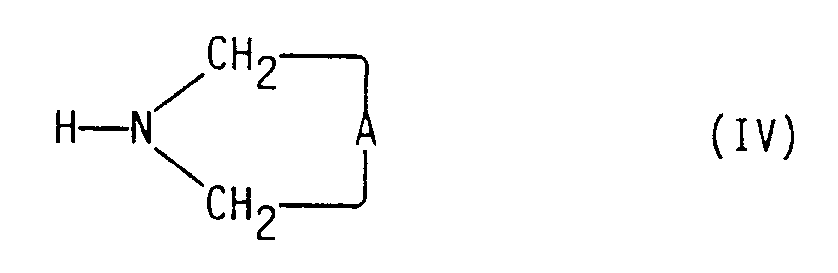
zum Endprodukt I umsetzt und gewünschtenfalls anschließend erhaltene Salze der Verbindung I in die freien Basen oder die Verbindungen I in ihre Salze überführt. - Die Umsetzung von II mit omega-Dihalogenalkanen erfolgt bevorzugt unter basischen Bedingungen in Gegenwart eines Phasentransferkatalysators.
- Als omega-Dihalogenalkane sind bevorzugt 1,2-Dihalogenethane und 1,3-Dihalogenpropane, insbesondere 1,2-Dibromethan und 1,3-Dibrompropan zu nennen.
- Als Phasentransferkatalysatoren seien neben Oniumsalzen, wie z.B. Tetrabutylammoniumbromid oder Benzyltriethylammoniumchlorid, vor allem Kronenether, wie Dibenzo-[18]krone-6, Dicyclohexyl-[18]krone-6 und insbesondere [18]Krone-6 erwähnt.
- Als eingesetzte Basen, die wenigstens im molaren Verhältnis, vorzugsweise im Überschuß eingesetzt werden, kommen anorganische Basen, wie Alkalimetallhydroxide (z.B. Natrium- oder Kaliumhydroxid), oder insbesondere Alkalimetallcarbonate (z.B. Natrium- oder vorzugsweise Kaliumcarbonat) in Frage. Beim Arbeiten in einem wasserfreien Lösungsmittel werden die verwendeten Hydroxide bzw. Carbonate vorzugsweise in feingepulverter Form eingesetzt.
- Die Umsetzung erfolgt (je nach Art des Phasentransferkatalysators und der eingesetzten Base) in wasserhaltigen oder wasserfreien organischen Lösungsmitteln, oder in einem Gemisch aus Wasser und einem mit Waser nicht oder kaum mischbaren organischen Lösungsmittel. Als Wasser/Lösungsmittelmischungen seien beispielsweise die Mischungen von Wasser mit Chloroform, Dichlormethan oder Benzol genannt. Als wasserhaltige oder wasserfreie Lösungsmittel seien beispielsweise Dichlormethan, Acetonitril oder Aceton genannt.
- Die in den Beispielen genannten Lösungsmittel, Basen und Phasentransferkatalysatoren stellen nur eine exemplarische Auswahl dar. Welche weiteren Kombinationen von Lösungsmitteln, Basen und Phasentransferkatalysatoren noch geeignet sind, ist dem Fachmann aufgrund seines Fachwissens geläufig.
- Die Wahl der Reaktionstemperatur bei der Umsetzung von II mit Dihalogenalkanen hängt von den übrigen Reaktionsbedingungen ab, wobei in der Regel Temperaturen zwischen 20°C und der Siedetemperatur des eingesetzten Lösungsmittels bevorzugt sind.
Als Schutzgruppen SG kommen vor allem solche Gruppen in Frage, die in das der Verbindung II zugrundeliegende Vorprodukt leicht und in hohen Ausbeuten eingeführt werden können, die bei der Umsetzung von II mit Dihalogenalkanen keine Nebenreaktionen eingehen und die am Ende glatt wieder abgespalten werden können. Als bevorzugte Schutzgruppen SG seien beispielsweise Alkoxymethylgruppen oder Benzyloxymethylgruppen, insbesondere die Ethoxymethylgruppe genannt. Die Abspaltung der Schutzgruppe erfolgt in saurem Medium, beispielsweise in 1N Salzsäure oder vorzugsweise in wasserfreier Ameisensäure, unter Reaktionsbedingungen, wie sie dem Fachmann geläufig sind. Erfindungsgemäß kann die Abspaltung der Schutzgruppe auch nach der Umsetzung mit dem Amin IV erfolgen. - Die Umsetzung der Halogenalkylester III mit Aminen IV erfolgt auf eine Weise, wie sie für die Umsetzung von Alkylhalogeniden mit sekundären Aminen dem Fachmann vertraut ist.
- Die Umsetzung wird in geeigneten, vorzugsweise inerten organischen Lösungsmitteln in Gegenwart von Wasser oder ohne Wasser durchgeführt. Beispielsweise seien genannt Ether, wie Dioxan, Diethylether, Tetrahydrofuran, Glykolmonoethylether oder Glykoldimethylether; Ketone, wie Aceton oder Ethylmethylketon; aromatische Kohlenwasserstoffe, wie Xylol oder Toluol; oder chlorierte Kohlenwasserstoffe, wie Methylenchlorid, Chloroform, Tetrachlorethylen oder Dichlorethan; oder polare aprotische Lösungsmittel wie Dimethylformamid oder Dimethylsulfoxid.
- Die Reaktionstemperaturen können - je nach Reaktivität der Edukte - in einem weiten Bereich variieren. Im allgemeinen wird die Umsetzung bei Temperaturen zwischen 20°C und 150°C, vorzugsweise zwischen 20°C und 100°C, insbesondere bei der Siedetemperatur des verwendeten Lösungsmittels durchgeführt.
- Das Verfahren kann bei Normaldruck oder bei erhöhtem Druck durchgeführt werden, wobei das Arbeiten bei Normaldruck die Regel ist. Die Reaktion wird in Gegenwart einer Base (z.B. eines anorganischen Carbonates, wie Kaliumcarbonat) oder unter Einsetzung eines Überschusses an Amin IV durchgeführt.
- Die Isolierung und Reinigung der erhaltenen erfindungsgemäßen Verbindungen I erfolgt in an sich bekannter Weise z. B. derart, daß man das Lösungsmittel im Vakuum abdestilliert und den erhaltenen Rückstand aus einem geeigneten Lösungsmittel umkristallisiert oder einer der üblichen Reinigungsmethoden, wie beispielsweise der Säulenchromatographie an geeignetem Trägermaterial, unterwirft. Säureadditionssalze erhält man durch Auflösen der freien Base in einem geeigneten Lösungsmittel, z.B. in einem chlorierten Kohlenwasserstoff, wie Methylenchlorid oder Chloroform, oder einem niedermolekularen aliphatischen Alkohol (Ethanol, Isopropanol), oder einem offenkettigen oder cyclischen Ether, wie Dioxan oder Tetrahydrofuran, das die gewünschte Säure enthält, oder dem die gewünschte Säure anschließend zugegeben wird.
- Die Salze werden durch Filtrieren, Umfällen, Ausfällen mit einem Nichtlösungsmittel für das Anlagerungssalz oder durch Verdampfen des Lösungsmittels gewonnen.
- Erhaltene Salze können durch Alkalisierung, z.B. mit wäßriger Ammoniaklösung, in die freien Basen umgewandelt werden, welche wiederum in Säureadditionssalze übergeführt werden können. Auf diese Weise lassen sich pharmakologisch nicht verträgliche Säureadditionssalze in pharmakologisch verträgliche Säureadditionssalze umwandeln.
- Ausgestaltungen des Verfahrens sind solche, bei denen die Substituenten und Symbole die für die Verbindungen der Ausgestaltungen a, b und c genannten Bedeutungen haben. Hervorzuhebende, bevorzugte und besonders bevorzugte Verfahren sind solche, bei denen die Substituenten und Symbole die für die hervorzuhebenden, bevorzugten und besonders bevorzugten Verbindungen genannten Bedeutungen haben.
- Von besonderer Bedeutung ist in diesem Zusammenhang die Anwendung des erfindungsgemäßen Verfahrens zur Herstellung des das linear polarisierte Licht der Wellenlänge 589 nm in (+)-Richtung drehenden Enantiomers des 1,4-Dihydro-2,6-dimethyl-4-(3-nitrophenyl)-pyridin-3,5-dicarbonsäure-3-methyl-5-[3-(4,4-diphenylpiperidyl-1)propyl]-esters, also des (+)-1,4-Dihydro-2,6-dimethyl-4-(3-nitrophenyl)-pyridin-3,5-dicarbonsäure-3-methyl-5-[3-(4,4-diphenylpiperidyl-1)-propyl]-esters, und seiner Salze.
- Ohne Berücksichtigung der absoluten Konfiguration in der 4-Position des 1,4-Dihydropyridins wird die erfindungsgemäß hergestellte Verbindung durch die folgende Formel I* beschrieben:

- Das Verfahren ist in diesem Fall dadurch gekennzeichnet, daß man eine N-geschützte Dihydropyridincarbonsäure der Formel II*

mit 1,3-Dibrompropan umsetzt und nach Abspaltung der Schutzgruppe SG den erhaltenen Brompropylester III*
mit Diphenylpiperidin oder einem Salz davon zum Endprodukt I* umsetzt und gewünschtenfalls anschließend ein erhaltenes Salz der Verbindung I* in die freie Base oder die Verbindung I* in ein Salz überführt. - Die enantiomer reinen Verbindungen der Formel II bzw. II* sind teils bekannt [Chem. Pharm. Bull. 28(9) 2809-2812 (1980)], teils neu. Sie können auf bekannte Weise [Chem. Pharm. Bull. 28(9) 2809-2812 (1980)] oder nach einem neuen Verfahren hergestellt werden.
- Das neue Verfahren ist dadurch gekennzeichnet, daß man in Haloethylester der Formel V (Hal = Chlor, insbesondere Brom)

die Schutzgruppe SG einführt, in dem so erhaltenen, N-geschützten Haloethylester der Formel VI
Hal gegen ein als Akzeptor (= Akz) fungierendes Nucleophil austauscht, aus dem erhaltenen Akzeptorethylester der Formel VII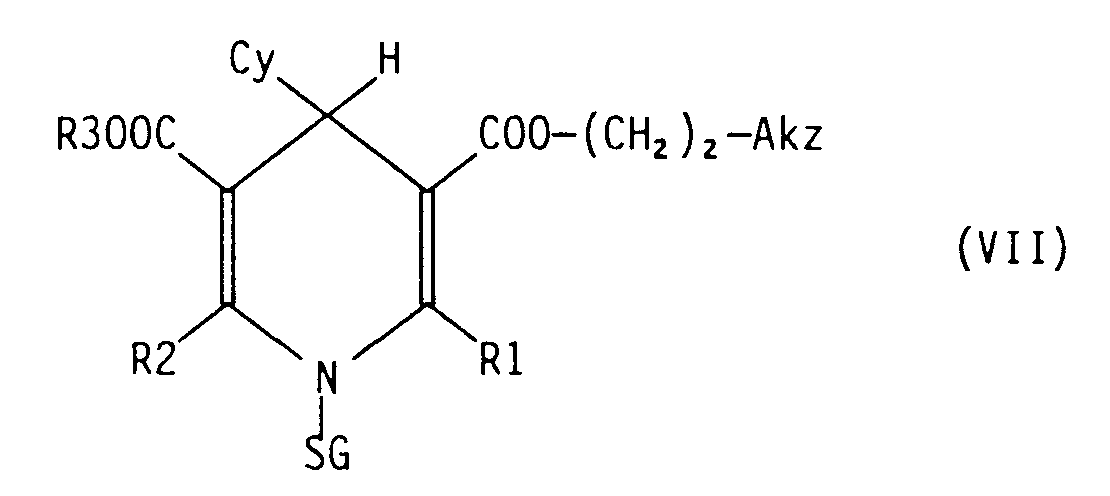
unter basischen Bedingungen den Akzeptorethylrest abspaltet und das so erhaltene Racemat der Verbindung II in die Enantiomeren spaltet. - Zur Einführung der Schutzgruppe SG wird zweckmäßigerweise so vorgegangen, daß der Haloethylester V in 1-Stellung deprotoniert und anschließend mit einer Verbindung SG-X umgesetzt wird, wobei X für eine geeignete Fluchtgruppe steht.
- Als Deprotonierungsmittel kommen vor allem solche Agenzien in Frage, für die die Acidität des Protons am Stickstoff groß genug ist um eine Anionbildung zu erzielen. Neben metallorganischen Verbindungen, wie z.B. Butyllithium, seien vorzugsweise Metallhydride, insbesondere das Natriumhydrid erwähnt. Die Fluchtgruppe X der Verbindung SG-X ist eine Gruppe, die bei der Umsetzung von SG-X mit dem deprotonierten V leicht abgespalten wird. Falls die Schutzgruppe SG eine Alkoxymethylgruppe ist, ist X vorzugsweise ein Halogenatom, insbesondere ein Chloratom.
- Die Deprotonierung und anschließende Einführung der Schutzgruppe wird in inerten, wasserfreien Lösungsmitteln vorgenommen, wie sie für das Arbeiten mit starken Deprotonierungsmitteln geeignet sind. Beispielsweise seien offenkettige oder cyclische Ether, wie Diethylether, Dioxan oder Tetrahydrofuran genannt. Die Umsetzung erfolgt bevorzugt unter schonenden Reaktionsbedingungen bei Temperaturen um oder unter 0°C.
- Als Akzeptorreste bei der weiteren Umsetzung kommen insbesondere solche Reste in Frage, die einen mesomer elektronenanziehenden Effekt ausüben können. Beispielsweise seien die Nitrogruppe oder die Azidogruppe, bevorzugt die Nitrilgruppe oder eine substituierte Sulfonylgruppe genannt.
- Der Halogenaustausch im N-geschützten Haloethylester der Formel VI erfolgt vorzugsweise durch Umsetzung mit Salzen deren Anionen geeignet sind, als kovalent gebundene Akzeptorsubstituenten zu fungieren. Bevorzugt ist die Umsetzung mit anorganischen Cyaniden, insbesondere mit Kaliumcyanid oder Natriumcyanid, oder die Umsetzung mit Alkalisulfinaten, insbesondere mit Natrium-4-toluolsulfinat, gewünschtenfalls unter Zusatz katalytischer Mengen eines quartären Ammoniumsalzes, wie z.B. Tetrabutylammoniumcyanid oder Benzyltriethylammoniumchlorid, in inerten, vorzugsweise aprotischen, polaren Lösungsmitteln wie beispielsweise Aceton, Dimethylsulfoxid oder Dimethylformamid, bei Temperaturen, die bevorzugt zwischen 0°C und 50°C liegen.
- Die sich an den Halogenaustausch anschließende Abspaltung des Akzeptor-ethylrestes unter basischen Bedingungen ist eine dem Fachmann geläufige Reaktion, wie sie z.B. in der DE-OS 2847237 beschrieben ist. Die zunächst als Racemat anfallende Verbindung II kann mit Hilfe enantiomer reiner, optisch aktiver Basen in üblicher Weise über die diastereomeren Salze in die Enantiomeren (+)-II und (-)-II getrennt werden [siehe z.B. Chem. Pharm. Bull. 28, 2809 (1980)] [1]. Als enantiomer reine optisch aktive Basen seien insbesondere Cinchonidin und Cinchonin genannt.
- Die als Ausgangsverbindungen eingesetzten Haloethylester V sind z.B. aus der DE-OS 2847237 bekannt.
- Die folgenden Herstellungsbeispiele sollen die Erfindung näher erläutern. Schmp. bedeutet Schmelzpunkt, h steht für Stunden, Kp. steht für Siedepunkt, Zers. bedeutet Zersetzung. Unter Ether wird Diethylether verstanden.
- 86,6 g (-)-1,4-Dihydro-2,6-dimethyl-4-(3-nitrophenyl)-pyridin-3,5-dicarbonsäure-3-methyl-5-(3-brompropyl)-ester, 50 g 4,4-Diphenylpiperidin-hydrochlorid und 69 g feingemahlenes Kaliumcarbonat werden zusammen in 300 ml Dimethylformamid unter kräftigem Rühren und unter einer Stickstoffathmosphäre 5 h auf 100°C erhitzt. Nach Abkühlen werden nacheinander 500 ml Ethylacetat und 1 l Wasser zugegeben und kräftig ausgerührt. Nach Phasentrennung wird die organische Phase noch viermal mit Wasser gewaschen, über Natriumsulfat getrocknet und im Vakuum eingeengt. Der Rückstand wird in 1 l Dioxan gelöst und die Lösung unter Kühlen mit 15,2 ml konzentrierter Salzsäurelösung (12,5 M, d = 1,19) versetzt; dann werden im Vakuum ca. 200 ml des Lösungsmittelgemisches abdestilliert. Beim Stehen bei Raumtemperatur kristallisiert das Produkt spontan oder nach Animpfen oder Anreiben; es wird nach 16 h abgesaugt, mit Dioxan und Diisopropylether gewaschen und im Vakuum bei 80-100°C getrocknet. Zur Reinigung wird das Rohprodukt in Dichlormethan gelöst. Nach Zugabe von 800 ml Dioxan wird das Dichlormethan wieder abdestilliert. Das nach Animpfen und 16-stündigem Stehen bei Raumtemperatur auskristallisierte Produkt wird abgesaugt, mit Dioxan und Diisopropylether gewaschen und bei 100°C getrocknet. Man erhält 97 g der Titelverbindung vom Schmp. 158-160°C mit

(c = 1, Methanol) bzw. [α]
- 168,5 g (+)-1-Ethoxymethyl-1,4-dihydro-5-methoxycarbonyl-2,6-dimethyl-4(3-nitrophenyl)-pyridin-3-carbonsäure-Cinchoninsalz {[α]


-
- 229,7 g (±)-1-Ethoxymethyl-1,4-dihydro-5-methoxycarbonyl-2,6-dimethyl-4--(3-nitrophenyl)-pyridin-3-carbonsäure und 173,2 g Cinchonidin werden in 2,4 l Ethanol in der Hitze gelöst. Bei langsamer Abkühlung kristallisiert die Titelverbindung aus und wird nach 2-tägigem Stehen bei Raumtemperatur abgesaugt und mit Ethanol gewaschen. Nach zweimaligem Umkristallisieren aus Ethanol erhält man 148 g der Titelverbindung vom Schmp. 185-185,5°C und [α]

Die Mutterlauge wird im Vakuum zur Trockne eingedampft, der Rückstand in 2 l Chloroform gelöst und nach Zugabe von 1 l Wasser unter kräftigem Rühren durch Zutropfen von 2N Salzsäure ein stabiler pH von 2 bis 3 eingestellt. Die Phasen werden getrennt, die organische Phase noch so lange mit 0,01N Salzsäure ausgeschüttelt bis kein Cinchonidin mehr nachweisbar ist (Dünnschichtchromatographie), mit Wasser gewaschen und getrocknet. Nach Abdestillierer des Lösungsmittels mit Vakuum wird der Rückstand im Hochvakuum getrocknet und 85,6 g davon zusammen mit 54,5 g Cinchonin in ca. 2,4 l siedendem Ethanol gelöst. Das nach 3-tägigem Stehen bei Raumtemperatur auskristallisierte Produkt wird abgesaugt, mit Ethanol gewaschen und nochmals aus Ethanol umkristallisiert. Man erhält 88,5 g (+)-1-Ethoxymethyl-1,4-dihydro-5-methoxycarbonyl-2,6-dimethyl-4-(3-nitrophenyl)-pyridin-3-carbonsäure/Cinchoninsalz vom Schmp. 197 - 198°C und [α]
-
- a) 195,5 g (±)-1-Ethoxymethyl-1,4-dihydro-2,6-dimethyl-4-(3-nitrophenyl)-pyridin-3,5-dicarbonsäure-3-methyl-5-(2-bromethyl)-ester werden in 900 ml Dimethylformamid gelöst und mit 40,6 g gepulvertem Natriumcyanid und 0,5 g Tetrabutylammoniumcyanid versetzt. Das Gemisch wird 26 h bei Raumtemperatur gerührt, wobei nach ca. 4 h ein dicker Niederschlag ausfällt, dann werden 200 ml 2N Natriumhydroxid-Lösung zugetropft und 5 h bei Raumtemperatur weitergerührt. Das Gemisch wird in 4,5 l Wasser eingerührt und unter Kühlung und starkem Rühren mit 2N Salzsäurelösung bis pH 2,5 tropfenweise versetzt. Das dabei ausgefallene Produkt wird scharf abgesaugt, mit Wasser neutral gewaschen, über Nacht luftgetrocknet und dann in 400 ml Ethanol auf dem Dampfbad erhitzt (keine Lösung). Es wird 12 h bei Raumtemperatur stehengelassen, dann gekühlt, abgesaugt und getrocknet. Man erhält 142 g der Titelverbindung vom Schmp. 176-176,5°C (Zersetzung).
- b) 5 g (±)-1-Ethoxymethyl-1,4-dihydro-2,6-dimethyl-4-(3-nitrophenyl)-pyridin-3,5-dicarbonsäure-3-methyl-5-(2-bromethyl)-ester werden in 35 ml Dimethylformamid gelöst, 3,55 g (20 mMol) 4-Toluolsulfinsäure-Natrium-Salz und 0,1 g Benzyltriethylammoniumchlorid zugesetzt und 20 h bei 20°C gerührt. Man gibt 11 ml 2N Natronlauge zu, rührt 5 h bei 20°C, weitere 3 h bei 80°C und gießt nach Abkühlung auf 120 ml Eiswasser. Nach Zugabe von Essigsäure bis pH 3,8 wird 3 h im Eisbad gerührt, vom ausgefallenen Feststoff filtriert, mit Wasser neutral gewaschen und getrocknet. Das Rohprodukt wird in 10 ml Ethanol ausgekocht, abgekühlt, filtriert und getrocknet. Man erhält 3,31 g der Titelverbindung vom Schmp. 176-176,5°C (Zers.).
- 10,65 g einer 80 %igen Suspension von Natriumhydrid in Paraffinöl werden in 300 ml wasserfreiem Tetrahydrofuran aufgeschlämmt. Bei -5 bis -7°C wird unter Rühren eine Lösung von 120 g (±)-1,4-Dihydro-2,6-dimethyl-4-(3-nitrophenyl)-pyridin-3,5-dicarbonsäure-3-methyl-5-(2-bromethyl)-ester und 28,4 g Chlormethylethylether in 300 ml wasserfreiem Tetrahydrofuran langsam innerhalb von 4 h zugetropft. Nach einer weiteren Stunde Rühren bei 0°C werden nacheinander 600 ml Toluol und 210 ml Wasser zugegeben. Die Phasen werden getrennt, die organische Phase wird mit Wasser gewaschen, über Nacht getrocknet und im Vakuum eingeengt. Der Rückstand wird in 390 ml warmem Ethanol gelöst, dann wird unter Rühren abgekühlt. Dabei kristallisiert das Produkt aus. Es wird auf 0°C gekühlt, abgesaugt, mit eiskaltem Ethanol gewaschen und getrocknet. Man erhält 98,5 g der Titelverbindung vom Schmp. 72,5-74°C.
- 494 g 2-(3-Nitrobenzyliden)-acetessigsäure-(2-bromethyl)-ester und 173,5 g 3-Aminocrotonsäuremethylester werden unter Rühren und unter einer Stickstoffatmosphäre in 1750 ml Isopropanol bei 75-80°C gelöst. Das Gemisch wird danach sehr langsam im Heizbad abgekühlt. Nach Animpfen mit der Titelverbindung wird 16 h bei Raumtemperatur gerührt, dann gekühlt, abgesaugt, mit eiskaltem Ether gewaschen und getrocknet. Man erhält 481 g der Titelverbindung vom Schmp. 139-141°C.
- 405 g Acetessigsäure-2-bromethylester werden in 1500 ml Isopropanol gelöst. Unter Rühren werden 293 g 3-Nitrobenzaldehyd, 4,6 g Essigsäure und 6,8 g Piperidin zugegeben. Das Gemisch wird bei 40°C so lange gerührt bis eine klare Lösung entstanden ist. Man läßt langsam abkühlen, impft mit einigen Kristallen der Titelverbindung an und rührt bei Raumtemperatur 48 h lang, dann wird gekühlt, abgesaugt, mit kaltem Isopropanol gewaschen und im Vakuum bei 50°C getrocknet. Man erhält 495 g der Titelverbindung vom Schmp. 94,5-95,5°C.
- 250 g 2-Bromethanol werden in 1,3 l Dichlormethan gelöst und mit 1,2 g 4-Dimethylaminopyridin versetzt. Unter kräftigem Rühren werden 400 ml einer 50%igen Diketenlösung in Aceton so zugetropft, daß das Lösungsmittel mäßig siedet. Nach dem Zutropfen wird noch 1 h bei Siedetemperatur gerührt und dann über Nacht stehengelassen. Nach Abdampfen des Lösungsmittels am Rotationsverdampfer im Vakuum wird der Rückstand destilliert. Man erhält 402 g der Titelverbindung mit Kp. 80-83°C/0,04 mbar.
- Die durch das erfindungsgemäße Verfahren hergestellten enantiomer reinen Verbindungen der Formel I und ihre Salze besitzen wertvolle Eigenschaften, die sie gewerblich verwertbar machen. Sie stellen beispielsweise wirksame Vasodilatoren mit coronartherapeutischen Eigenschaften dar. Darüberhinaus besitzen die erfindungsgemäßen Verbindungen hemmende Wirkung auf den Calciumeinstrom sowie fördernde Wirkung auf den Kaliumausstrom von Zellen, glattmuskulär relaxierende und peripher, coronar, cerebral und renal gefäßerweiternde sowie salidiuretische, antithrombotische, antiarteriosklerotische und günstige hämorheologische Eigenschaften.
- Durch Bereitstellung der in der Hauptwirkung besonders wirksamen Enantiomeren wird einerseits die Belastung durch ihre weniger wirksamen Stereoisomeren, die teilweise sogar entgegengesetzte Wirkung oder verstärkte Nebenwirkungen zeigen können, deutlich herabgemindert. Andererseits können die in der obengenannten Hauptwirkung schwächer wirksamen Enantiomeren für andere Therapiezwecke eingesetzt werden, die bisher für diese Stoffklasse - aufgrund der in den Racematen überwiegenden Hauptwirkung - nicht zugänglich waren.
- Die ausgezeichnete Wirksamkeit der erfindungsgemäßen Verbindungen der Formel I und ihrer Salze gestattet ihren Einsatz in der Humanmedizin, wobei als Indikation beispielsweise koronare Herzkrankheiten (Koronarinsuffizienz, Angina Pectoris, Myocardinfarkt etc.), periphere und cerebrale Zirkulationsstörungen (Gehirnschlag, temporäre cerebrale Durchblutungsstörungen, Migräne, Schwindel, renale Arterienverengung etc.), hypertrophe Kardiomyopathie, Herzinsuffizienz, Krankheiten, die auf einer erhöhten Wasser- und Natriumretention beruhen und Krankheiten, die auf einem erhöhten Calciumeinstrom beruhen, wie z.B. Spasmen glattmuskulärer Organe (Atemwege, Gastrointestinaltrakt, Urogenitaltrakt etc.) sowie Arrhythmie, Arteriosklerose und Zellschädigungen verschiedener Genese (z.B. Hypoxie) in Betracht kommen.
- Ein weiterer Gegenstand der Erfindung ist daher ein Verfahren zur Behandlung von Säugetieren, insbesondere Menschen, die an einer der obengenannten Krankheiten erkrankt sind. Das Verfahren ist dadurch gekennzeichnet, daß man dem erkrankten Individuum eine therapeutisch wirksame und pharmakologisch verträgliche Menge einer oder mehrerer Verbindungen der Formel I verabreicht.
- Gegenstand der Erfindung sind außerdem die Verbindungen der Formel I zur Anwendung bei der Behandlung der genannten Krankheiten.
- Ebenso umfaßt die Erfindung die Verwendung von Verbindungen der Formel I bei der Herstellung von Arzneimitteln, die zur Bekämpfung der genannten Krankheiten eingesetzt werden.
- Ein weiterer Gegenstand der Erfindung sind Arzneimittel, die eine oder mehrere Verbindungen der allgemeinen Formel I enthalten.
- Die Arzneimittel werden nach an sich bekannten, dem Fachmann geläufigen Verfahren hergestellt. Als Arzneimittel werden die erfindungsgemäßen pharmakologisch wirksamen Verbindungen (=Wirkstoffe) entweder als solche, oder vorzugsweise in Kombination mit geeigneten pharmazeutischen Hilfsstoffen in Form von Tabletten, Dragees, Kapseln, Suppositorien, Pflastern (z.B. als TTS), Emulsionen, Suspensionen, Aerosolen, Sprays, Salben, Cremes, Gelen oder Lösungen eingesetzt, wobei der Wirkstoffgehalt vorteilhafterweise zwischen 0,1 und 95% beträgt.
- Welche Hilfsstoffe für die gewünschten Arzneimittelformulierungen geeignet sind, ist dem Fachmann aufgrund seines Fachwissens geläufig. Neben Lösemitteln, Gelbildnern, Suppositoriengrundlagen, Tablettenhilfsstoffen und anderen Wirkstoffträgern können beispielsweise Antioxidantien, Dispergiermittel, Emulgatoren, Entschäumer, Geschmackskorrigentien, Konservierungsmittel, Lösungsvermittler, Farbstoffe oder insbesondere Permeationspromotoren und Komplexbildner (z.B. Cyclodextrine) verwendet werden.
- Die Wirkstoffe können oral, rektal, per inhalationem oder parenteral (insbesondere perlingual, intravenös oder percutan) appliziert werden.
- Im allgemeinen hat es sich in der Humanmedizin als vorteilhaft erwiesen, den oder die Wirkstoffe bei oraler Gabe in einer Tagesdosis von etwa 0,01 bis etwa 10, vorzugsweise 0,05 bis 5 mg/kg Körpergewicht, gewünschtenfalls in Form mehrerer, vorzugsweise 1 bis 4 Einzelgaben zur Erzielung des gewünschten Ergebnisses zu verabreichen. Bei einer parenteralen Behandlung können ähnliche bzw. (insbesondere bei der intravenösen Verabreichung der Wirkstoffe) in der Regel niedrigere Dosierungen zur Anwendung kommen. Bei einschleichender Dosierung wird zu Beginn der Behandlung eine geringere Dosis verabreicht, dann langsam auf eine höhere Dosis übergegangen. Nach Erreichen des gewünschten Therapieerfolges wird wieder auf eine niedrigere Dosis zurückgegangen.
- Die Festlegung der jeweils erforderlichen optimalen Dosierung und Applikationsart der Wirkstoffe kann durch jeden Fachmann aufgrund seines Fachwissens leicht erfolgen.
- Sollen die erfindungsgemäßen Verbindungen und/oder ihre Salze zur Behandlung der genannten Krankheiten eingesetzt werden, so können die pharmazeutischen Zubereitungen auch einen oder mehrere andere pharmakologisch aktive Bestandteile anderer Arzneimittelgruppen, wie andere Vasodilatoren, Antihypertensiva, alpha-1-Rezeptorenblocker, alpha-2-Rezeptorstimulatoren, beta-1-Rezeptorenblokker, beta-2-Rezeptorstimulatoren, ACE-Hemmstoffe, Nitroverbindungen, Cardiotonika, Diuretika, Saluretika, Alkaloide, Analgetika, Lipidsenker, Antikoagulantien, Anticholinergika, Methylxanthine, Antiarrhythmika, Antihistaminika, Dopaminstimulatoren, Serotonin-Rezeptorenblocker etc., wie Nifedipin, Dihydralazin, Prazosin, Clonidin, Atenolol, Labetalol, Fenoterol, Captopril, Isosorbiddinitrat, Digoxin, Milrinon, Mefrusid, Clopamid, Spironolacton, Chlorthalidon, Furosemid, Polythiazid, Hydrochlorothiazid, Reserpin, Dihydroergocristin, Rescinnamin, Rauwolfia-Gesamtalkaloide, Acetylsalicylsäure, Bezafibrat, Warfarin, Atropin, Theophyllin, Lidocain, Astemizol, Bromocryptin, Ketanserin etc. enthalten.

steht, worin R9 und R10 gleich oder verschieden sind und die Bedeutung Wasserstoff (H), 1-4C-Alkoxy oder Halogen haben,
und die Salze dieser Verbindungen.
Claims (10)
- Verfahren zur Herstellung von enantiomer reinen Dihydropyridinen der Formel I,


und worinCy 3-Nitrophenyl oder 2,3-Dichlorphenyl bedeutet,R1 und R2 gleich oder verschieden sind und 1-4C-Alkyl bedeuten,R3 1-4C-Alkyl bedeutet,E Ethylen oder Propylen bedeutet,A -CH₂-C(R6)R7-CH₂- oder -CH₂-NR8-CH₂- bedeutet,R6 Wasserstoff (H) oder Phenyl bedeutet,R7 Phenyl bedeutet,R8 Aryl oder Benzhydryl bedeutet, wobeiAryl für einen Ring der Formel
und ihren Salzen, dadurch gekennzeichnet, daß man enantiomer reine N-geschützte Dihydropyridincarbonsäuren der Formel II,


- Verfahren nach Anspruch 1, dadurch gekennzeichnet, daß Verbindungen der Formel Ia
 Cy 3-Nitrophenyl oder 2,3-Dichlorphenyl bedeutet,R1 Methyl oder Ethyl bedeutet,R2 Methyl oder Ethyl bedeutet,R3 Methyl oder Ethyl bedeutet,E Ethylen oder Propylen bedeutet,R6 Wasserstoff bedeutet undR7 Phenyl bedeutet,und ihre Salze hergestellt werden.
 - Verfahren nach Anspruch 1, dadurch gekennzeichnet, daß Verbindungen der Formel Ib
 Cy 3-Nitrophenyl oder 2,3-Dichlorphenyl bedeutet,R1 Methyl oder Ethyl bedeutet,R2 Methyl oder Ethyl bedeutet,R3 Methyl oder Ethyl bedeutet,E Ethylen oder Propylen bedeutet undR8 Phenyl, 2-Methoxyphenyl, 2-Ethoxyphenyl, 2-Ethoxy-4-fluorphenyl, 3-Methoxyphenyl oder Benzhydryl bedeutet,und ihre Salze hergestellt werden.
 - Verfahren nach Anspruch 1, dadurch gekennzeichnet, daß Verbindungen der Formel Ic
 Cy 3-Nitrophenyl oder 2,3-Dichlorphenyl bedeutet,R1 Methyl oder Ethyl bedeutet,R2 Methyl oder Ethyl bedeutet,R3 Methyl oder Ethyl bedeutet,E Ethylen oder Propylen bedeutet,R6 Phenyl bedeutet undR7 Phenyl bedeutet,und ihre Salze hergestellt werden.
 - Verfahren nach Anspruch 1 zur Herstellung des (-)-1,4-Dihydro-2,6-dimethyl-4-(3-nitrophenyl)-pyridin-3,5-dicarbonsäure-3-methyl-5-[3-(4,4-diphenylpiperidyl-1)-propyl]-esters der Formel I* und seiner Salze,


- Verfahren nach Anspruch 1 oder 5, dadurch gekennzeichnet, daß die Schutzgruppe SG eine Alkoxymethylgruppe oder Benzyloxymethylgruppe ist.
Priority Applications (1)
| Application Number | Priority Date | Filing Date | Title |
|---|---|---|---|
| AT88104691T ATE93851T1 (de) | 1987-03-27 | 1988-03-24 | 1,4-dihydropyridin-enantiomere. |
Applications Claiming Priority (4)
| Application Number | Priority Date | Filing Date | Title |
|---|---|---|---|
| CH119087 | 1987-03-27 | ||
| CH1184/87 | 1987-03-27 | ||
| CH1190/87 | 1987-03-27 | ||
| CH118487 | 1987-03-27 |
Publications (2)
| Publication Number | Publication Date |
|---|---|
| EP0296316A1 EP0296316A1 (de) | 1988-12-28 |
| EP0296316B1 true EP0296316B1 (de) | 1993-09-01 |
Family
ID=25686924
Family Applications (2)
| Application Number | Title | Priority Date | Filing Date |
|---|---|---|---|
| EP88903212A Pending EP0343193A1 (de) | 1987-03-27 | 1988-03-24 | 1,4-dihydropyridine-enantiomere |
| EP88104691A Expired - Lifetime EP0296316B1 (de) | 1987-03-27 | 1988-03-24 | 1,4-Dihydropyridin-Enantiomere |
Family Applications Before (1)
| Application Number | Title | Priority Date | Filing Date |
|---|---|---|---|
| EP88903212A Pending EP0343193A1 (de) | 1987-03-27 | 1988-03-24 | 1,4-dihydropyridine-enantiomere |
Country Status (8)
| Country | Link |
|---|---|
| US (1) | US4994461A (de) |
| EP (2) | EP0343193A1 (de) |
| JP (1) | JP2625190B2 (de) |
| AU (1) | AU1626488A (de) |
| CZ (1) | CZ281597B6 (de) |
| DE (1) | DE3883627D1 (de) |
| ES (1) | ES2059416T3 (de) |
| WO (1) | WO1988007525A1 (de) |
Families Citing this family (19)
| Publication number | Priority date | Publication date | Assignee | Title |
|---|---|---|---|---|
| US5326772A (en) * | 1984-09-28 | 1994-07-05 | Byk Gulden Lomberg Chemische Fabrik Gmbh | Diaryl compounds for their use |
| IT1230752B (it) * | 1989-02-17 | 1991-10-29 | Boehringer Biochemia Srl | Processo per la preparazione di 1,4 diidropiridine polisostituite in forma enantiomericamente pura. |
| JPH03141257A (ja) * | 1989-10-26 | 1991-06-17 | Green Cross Corp:The | ジヒドロピリジン誘導体 |
| US5100892A (en) * | 1990-11-13 | 1992-03-31 | Glaxo Inc. | Dihydropyridine vasodilator agents |
| DE4041814A1 (de) * | 1990-12-24 | 1992-07-02 | Byk Gulden Lomberg Chem Fab | Verfahren zur herstellung von dihydrophyridincarbonsaeuren |
| US5470860A (en) * | 1991-12-13 | 1995-11-28 | Byk Gulden Lomberg Chemische Fabrik Gmbh | 1,4-dihydropyridines for use in the treatment of dermatoses |
| US5578611A (en) * | 1992-11-13 | 1996-11-26 | Synaptic Pharmaceutical Corporation | Use of α-1C specific compounds to treat benign prostatic hyperplasia |
| US6015819A (en) | 1992-11-13 | 2000-01-18 | Synaptic Pharmaceutical Corporation | Use of alpha-1C specific compounds to treat benign prostatic hyperplasia |
| US5403847A (en) * | 1992-11-13 | 1995-04-04 | Synaptic Pharmaceutical Corporation | Use of α1C specific compounds to treat benign prostatic hyperlasia |
| US5767131A (en) * | 1993-04-05 | 1998-06-16 | Synaptic Pharmaceutical Corporation | Dihydropyridines and new uses thereof |
| US6211198B1 (en) | 1993-04-05 | 2001-04-03 | Synaptic Pharmaceutical Corporation | Dihydropyridines and new uses thereof |
| CN1812983A (zh) * | 2003-05-30 | 2006-08-02 | 兰贝克赛实验室有限公司 | 取代的吡咯衍生物及其作为hmg-co抑制剂的用途 |
| SG166829A1 (en) * | 2005-11-08 | 2010-12-29 | Ranbaxy Lab Ltd | Process for (3r, 5r)-7-[2-(4-fluorophenyl)-5-isopropyl-3-phenyl-4- [(4-hydroxy methyl phenyl amino) carbonyl]-pyrrol-1-yl]-3, 5-dihydroxy-heptanoic acid hemi calcium salt |
| WO2008020314A2 (en) * | 2006-03-14 | 2008-02-21 | Ranbaxy Laboratories Limited | Statin stabilizing dosage formulations |
| WO2008010087A2 (en) * | 2006-07-14 | 2008-01-24 | Ranbaxy Laboratories Limited | Polymorphic forms of an hmg-coa reductase inhibitor and uses thereof |
| CN101215258A (zh) * | 2008-01-21 | 2008-07-09 | 中国药科大学 | 二氢吡啶类钙拮抗剂化合物及其制备方法与医药用途 |
| NZ598718A (en) * | 2009-08-27 | 2014-10-31 | Cipla Ltd | Polymorphic forms of manidipine |
| CN106083698B (zh) * | 2016-06-20 | 2018-08-03 | 扬子江药业集团北京海燕药业有限公司 | S-马尼地平盐酸盐多晶型及其制备方法 |
| CN105924382B (zh) * | 2016-06-20 | 2018-08-03 | 扬子江药业集团北京海燕药业有限公司 | S-马尼地平盐酸盐i晶型及其制备方法 |
Citations (1)
| Publication number | Priority date | Publication date | Assignee | Title |
|---|---|---|---|---|
| EP0172509A2 (de) * | 1984-08-24 | 1986-02-26 | CASSELLA Aktiengesellschaft | Verfahren zur Herstellung optisch aktiver, substituierter 1,4-Dihydropyridine und ihre Verwendung als Arzneimittel |
Family Cites Families (17)
| Publication number | Priority date | Publication date | Assignee | Title |
|---|---|---|---|---|
| US4031104A (en) * | 1972-04-18 | 1977-06-21 | Bayer Aktiengesellschaft | 1,4-Dihydropyridine carboxylic acid esters |
| GB1552911A (en) * | 1975-07-02 | 1979-09-19 | Fujisawa Pharmaceutical Co | 1,4 dihydropyridine derivatives and the preparation thereof |
| DE2935451A1 (de) * | 1979-09-01 | 1981-03-19 | Bayer Ag, 5090 Leverkusen | Optisch aktive 1,4-dihydropyridine, verfahren zu ihrer herstellung und ihre verwendung als arneimittel |
| DE3022030A1 (de) * | 1980-06-12 | 1981-12-17 | Bayer Ag, 5090 Leverkusen | 4-thiazol- bzw. 4-imidazol-substituierte, 1,4-dihydropyridine, verfahren zu deren herstellung sowie diese enthaltende arzneimittel |
| US4497808A (en) * | 1981-12-30 | 1985-02-05 | Ciba-Geigy Corporation | N-Oxide compounds useful in the treatment of cardiovascular ailments |
| DE3247118A1 (de) * | 1982-12-20 | 1984-06-20 | Cassella Ag, 6000 Frankfurt | Neue substituierte 1,4-dihydropyridine, verfahren zu ihrer herstellung und ihre verwendung als arzneimittel |
| US4505920A (en) * | 1983-03-03 | 1985-03-19 | Usv Pharmaceutical Corporation | Certain N-substituted-4-aryl-3,5-pyridine dicarboxylates and their antihypertensive use |
| US4491582A (en) * | 1983-03-03 | 1985-01-01 | Usv Pharmaceutical Corporation | N-(substituted piperazino)-1,4-dihydropyridine-3,5-carboxylic acid |
| CH663616A5 (de) * | 1983-06-21 | 1987-12-31 | Sandoz Ag | 1,4-dihydropyridin-derivate und sie enthaltende pharmazeutische zubereitungen. |
| US4603135A (en) * | 1983-10-17 | 1986-07-29 | Takeda Chemical Industries, Ltd. | Substituted piperazinyl alkyl esters of 2-amino-4-aryl-1,4-dihydro-6-alkyl-3,5-pyridinedicarboxylates |
| FI853477A7 (fi) * | 1984-09-14 | 1986-03-15 | Ciba Geigy Ag | Menetelmä karbonyyliyhdisteiden valmistamiseksi. |
| ATE107284T1 (de) * | 1984-09-28 | 1994-07-15 | Byk Gulden Lomberg Chem Fab | Neue diarylverbindungen. |
| EP0205511A1 (de) * | 1984-12-21 | 1986-12-30 | Byk Gulden Lomberg Chemische Fabrik GmbH | Neue piperazinderivate |
| DE3627742A1 (de) * | 1985-08-20 | 1987-02-26 | Byk Gulden Lomberg Chem Fab | Substituierte 1,4-dihydropyridin-3-carbonsaeurederivate |
| DK114587A (da) * | 1986-03-12 | 1987-09-13 | Byk Gulden Lomberg Chem Fab | Monocycliske esterderivater |
| DK142287A (da) * | 1986-03-27 | 1987-09-28 | Byk Gulden Lomberg Chem Fab | Optisk aktive 1,4-dihydropyridinderivater |
| NZ220022A (en) * | 1986-04-22 | 1990-04-26 | Byk Gulden Lomberg Chem Fab | 1,4-dihydropyridine derivatives and pharmaceutical compositions |
-
1988
- 1988-03-24 US US07/401,453 patent/US4994461A/en not_active Expired - Fee Related
- 1988-03-24 JP JP63503484A patent/JP2625190B2/ja not_active Expired - Lifetime
- 1988-03-24 EP EP88903212A patent/EP0343193A1/de active Pending
- 1988-03-24 EP EP88104691A patent/EP0296316B1/de not_active Expired - Lifetime
- 1988-03-24 WO PCT/EP1988/000239 patent/WO1988007525A1/de not_active Ceased
- 1988-03-24 AU AU16264/88A patent/AU1626488A/en not_active Abandoned
- 1988-03-24 DE DE88104691T patent/DE3883627D1/de not_active Expired - Fee Related
- 1988-03-24 ES ES88104691T patent/ES2059416T3/es not_active Expired - Lifetime
-
1991
- 1991-12-20 CZ CS913965A patent/CZ281597B6/cs unknown
Patent Citations (1)
| Publication number | Priority date | Publication date | Assignee | Title |
|---|---|---|---|---|
| EP0172509A2 (de) * | 1984-08-24 | 1986-02-26 | CASSELLA Aktiengesellschaft | Verfahren zur Herstellung optisch aktiver, substituierter 1,4-Dihydropyridine und ihre Verwendung als Arzneimittel |
Non-Patent Citations (1)
| Title |
|---|
| Progress in Pharmacology, vol. 5/1, 1982, Seite 25 * |
Also Published As
| Publication number | Publication date |
|---|---|
| CZ281597B6 (cs) | 1996-11-13 |
| EP0296316A1 (de) | 1988-12-28 |
| CZ396591A3 (en) | 1996-06-12 |
| DE3883627D1 (de) | 1993-10-07 |
| US4994461A (en) | 1991-02-19 |
| WO1988007525A1 (fr) | 1988-10-06 |
| EP0343193A1 (de) | 1989-11-29 |
| AU1626488A (en) | 1988-11-02 |
| JPH02502823A (ja) | 1990-09-06 |
| JP2625190B2 (ja) | 1997-07-02 |
| ES2059416T3 (es) | 1994-11-16 |
Similar Documents
| Publication | Publication Date | Title |
|---|---|---|
| EP0071819B2 (de) | Dihydropyridine mit positiv inotroper Wirkung, neue Verbindungen, ihre Verwendung in Arzneimitteln und Verfahren zu ihrer Herstellung | |
| EP0026317B1 (de) | Optisch aktive 1,4-Dihydropyridine, Verfahren zu ihrer Herstellung und ihre Verwendung als Arzneimittel | |
| EP0176956B1 (de) | Neue Diarylverbindungen | |
| EP0296316A1 (de) | 1,4-Dihydropyridin-Enantiomere | |
| EP0179386B1 (de) | 1,4-Dihydropyridin-hydroxyamine, Verfahren zu ihrer Herstellung sowie ihre Verwendung in Arzneimitteln | |
| EP0127826A2 (de) | 1,4-Dihydropyridine, Verfahren zu ihrer Herstellung sowie ihre Verwendung in Arzneimitteln | |
| EP0234196A1 (de) | Substituierte 1,4-Dihydropyridin-3-carbonsäurepiperazide, Verfahren zu ihrer Herstellung und ihre Verwendung in Arzneimitteln | |
| EP0627427A1 (de) | 3-Chinolyl substituierte Dihydropyridine, Verfahren zu ihrer Herstellung und ihre Verwendung in Arzneimitteln | |
| EP0242829A1 (de) | Dihydropyridine, Verfahren zu ihrer Herstellung und ihre Verwendung als Arzneimittel | |
| EP0218068A1 (de) | Dihydropyridin-2-hydroxyamine, Verfahren zur Herstellung und ihre Verwendung in Arzneimitteln | |
| EP0287828A1 (de) | Neue Zwischenprodukte und Verfahren | |
| DE3709796C2 (de) | Verfahren zur Herstellung von Diarylpiperidyl-1,4-dihydropyridin-dicarbon-säurederivaten | |
| EP0362632A2 (de) | Basische 4-Aryl-DHP-amide, Verfahren zu ihrer Herstellung und ihre Verwendung in Arzneimitteln | |
| EP0244595A2 (de) | Dihydropyridinderivate, Verfahren zu ihrer Herstellung und ihre Verwendung als Arzneimittel | |
| WO1988007531A1 (fr) | Nouveaux composes optiquement actifs | |
| EP0595164B1 (de) | 4-Heterocyclophenyl substituierte Dihydropyridine | |
| EP0240828A1 (de) | Optisch aktive 1,4-Dihydropyridinverbindung | |
| DE4134760A1 (de) | Aryl-chinolyl-substituierte 1,4-dihydropyridin-dicarbonsaeurederivate, verfahren zu ihrer herstellung und ihre verwendung in arzneimitteln | |
| EP0314038A1 (de) | Neue Pyrrolidine | |
| EP0205511A1 (de) | Neue piperazinderivate | |
| EP0160256B1 (de) | Annellierte Furanone, Verfahren zu ihrer Herstellung und ihre Verwendung in Arzneimitteln | |
| DE3620632A1 (de) | 1,4-dihydropyridinsulfon-derivate, verfahren zu ihrer herstellung und sie enthaltende pharmazeutische mittel | |
| DE3816360A1 (de) | 2-amino-1,4-dihydropyridindicarbonsaeure-(-)-menthylester | |
| WO1988001266A1 (fr) | Piperidines nouvelles | |
| DE3235221A1 (de) | Ringverbrueckte 1,4-dihydropyridine, verfahren zu ihrer herstellung und ihre verwendung als arzneimittel |
Legal Events
| Date | Code | Title | Description |
|---|---|---|---|
| PUAI | Public reference made under article 153(3) epc to a published international application that has entered the european phase |
Free format text: ORIGINAL CODE: 0009012 |
|
| AK | Designated contracting states |
Kind code of ref document: A1 Designated state(s): ES GR |
|
| 17P | Request for examination filed |
Effective date: 19890608 |
|
| RBV | Designated contracting states (corrected) |
Designated state(s): AT BE CH DE ES FR GB GR IT LI LU NL SE |
|
| XX | Miscellaneous (additional remarks) |
Free format text: VERBUNDEN MIT 88903212.4/0343193 (EUROPAEISCHE ANMELDENUMMER/VEROEFFENTLICHUNGSNUMMER) DURCH ENTSCHEIDUNG VOM 18.07.90. |
|
| 17Q | First examination report despatched |
Effective date: 19900925 |
|
| GRAA | (expected) grant |
Free format text: ORIGINAL CODE: 0009210 |
|
| AK | Designated contracting states |
Kind code of ref document: B1 Designated state(s): AT BE CH DE ES FR GB GR IT LI LU NL SE |
|
| REF | Corresponds to: |
Ref document number: 93851 Country of ref document: AT Date of ref document: 19930915 Kind code of ref document: T |
|
| XX | Miscellaneous (additional remarks) |
Free format text: VERBUNDEN MIT 88903212.4/0343193 (EUROPAEISCHE ANMELDENUMMER/VEROEFFENTLICHUNGSNUMMER) DURCH ENTSCHEIDUNG VOM 18.07.90. |
|
| REF | Corresponds to: |
Ref document number: 3883627 Country of ref document: DE Date of ref document: 19931007 |
|
| ITF | It: translation for a ep patent filed | ||
| ET | Fr: translation filed | ||
| GBT | Gb: translation of ep patent filed (gb section 77(6)(a)/1977) |
Effective date: 19931129 |
|
| REG | Reference to a national code |
Ref country code: GR Ref legal event code: FG4A Free format text: 3009814 |
|
| EPTA | Lu: last paid annual fee | ||
| PLBE | No opposition filed within time limit |
Free format text: ORIGINAL CODE: 0009261 |
|
| STAA | Information on the status of an ep patent application or granted ep patent |
Free format text: STATUS: NO OPPOSITION FILED WITHIN TIME LIMIT |
|
| 26N | No opposition filed | ||
| REG | Reference to a national code |
Ref country code: ES Ref legal event code: FG2A Ref document number: 2059416 Country of ref document: ES Kind code of ref document: T3 |
|
| EAL | Se: european patent in force in sweden |
Ref document number: 88104691.6 |
|
| PGFP | Annual fee paid to national office [announced via postgrant information from national office to epo] |
Ref country code: FR Payment date: 19970210 Year of fee payment: 10 |
|
| PGFP | Annual fee paid to national office [announced via postgrant information from national office to epo] |
Ref country code: AT Payment date: 19970213 Year of fee payment: 10 |
|
| PGFP | Annual fee paid to national office [announced via postgrant information from national office to epo] |
Ref country code: SE Payment date: 19970217 Year of fee payment: 10 |
|
| PGFP | Annual fee paid to national office [announced via postgrant information from national office to epo] |
Ref country code: GB Payment date: 19970220 Year of fee payment: 10 |
|
| PGFP | Annual fee paid to national office [announced via postgrant information from national office to epo] |
Ref country code: GR Payment date: 19970224 Year of fee payment: 10 Ref country code: DE Payment date: 19970224 Year of fee payment: 10 Ref country code: BE Payment date: 19970224 Year of fee payment: 10 |
|
| PGFP | Annual fee paid to national office [announced via postgrant information from national office to epo] |
Ref country code: NL Payment date: 19970225 Year of fee payment: 10 |
|
| PGFP | Annual fee paid to national office [announced via postgrant information from national office to epo] |
Ref country code: CH Payment date: 19970227 Year of fee payment: 10 |
|
| PGFP | Annual fee paid to national office [announced via postgrant information from national office to epo] |
Ref country code: ES Payment date: 19970313 Year of fee payment: 10 |
|
| PGFP | Annual fee paid to national office [announced via postgrant information from national office to epo] |
Ref country code: LU Payment date: 19970408 Year of fee payment: 10 |
|
| PG25 | Lapsed in a contracting state [announced via postgrant information from national office to epo] |
Ref country code: LU Free format text: LAPSE BECAUSE OF NON-PAYMENT OF DUE FEES Effective date: 19980324 Ref country code: GB Free format text: LAPSE BECAUSE OF NON-PAYMENT OF DUE FEES Effective date: 19980324 Ref country code: AT Free format text: LAPSE BECAUSE OF NON-PAYMENT OF DUE FEES Effective date: 19980324 |
|
| PG25 | Lapsed in a contracting state [announced via postgrant information from national office to epo] |
Ref country code: SE Free format text: LAPSE BECAUSE OF NON-PAYMENT OF DUE FEES Effective date: 19980325 Ref country code: ES Free format text: LAPSE BECAUSE OF NON-PAYMENT OF DUE FEES Effective date: 19980325 |
|
| PG25 | Lapsed in a contracting state [announced via postgrant information from national office to epo] |
Ref country code: LI Free format text: LAPSE BECAUSE OF NON-PAYMENT OF DUE FEES Effective date: 19980331 Ref country code: GR Free format text: LAPSE BECAUSE OF NON-PAYMENT OF DUE FEES Effective date: 19980331 Ref country code: FR Free format text: THE PATENT HAS BEEN ANNULLED BY A DECISION OF A NATIONAL AUTHORITY Effective date: 19980331 Ref country code: CH Free format text: LAPSE BECAUSE OF NON-PAYMENT OF DUE FEES Effective date: 19980331 Ref country code: BE Free format text: LAPSE BECAUSE OF NON-PAYMENT OF DUE FEES Effective date: 19980331 |
|
| BERE | Be: lapsed |
Owner name: BYK GULDEN LOMBERG CHEMISCHE FABRIK G.M.B.H. Effective date: 19980331 |
|
| PG25 | Lapsed in a contracting state [announced via postgrant information from national office to epo] |
Ref country code: NL Free format text: LAPSE BECAUSE OF NON-PAYMENT OF DUE FEES Effective date: 19981001 |
|
| GBPC | Gb: european patent ceased through non-payment of renewal fee |
Effective date: 19980324 |
|
| REG | Reference to a national code |
Ref country code: CH Ref legal event code: PL |
|
| NLV4 | Nl: lapsed or anulled due to non-payment of the annual fee |
Effective date: 19981001 |
|
| PG25 | Lapsed in a contracting state [announced via postgrant information from national office to epo] |
Ref country code: DE Free format text: LAPSE BECAUSE OF NON-PAYMENT OF DUE FEES Effective date: 19981201 |
|
| EUG | Se: european patent has lapsed |
Ref document number: 88104691.6 |
|
| REG | Reference to a national code |
Ref country code: FR Ref legal event code: ST |
|
| REG | Reference to a national code |
Ref country code: ES Ref legal event code: FD2A Effective date: 20000503 |
|
| PG25 | Lapsed in a contracting state [announced via postgrant information from national office to epo] |
Ref country code: IT Free format text: LAPSE BECAUSE OF NON-PAYMENT OF DUE FEES Effective date: 20050324 |