EP0296057A2 - Fungal herbicide for control of lamb's quarters and other chenopodium weeds - Google Patents
Fungal herbicide for control of lamb's quarters and other chenopodium weeds Download PDFInfo
- Publication number
- EP0296057A2 EP0296057A2 EP88401472A EP88401472A EP0296057A2 EP 0296057 A2 EP0296057 A2 EP 0296057A2 EP 88401472 A EP88401472 A EP 88401472A EP 88401472 A EP88401472 A EP 88401472A EP 0296057 A2 EP0296057 A2 EP 0296057A2
- Authority
- EP
- European Patent Office
- Prior art keywords
- plants
- ascochyta
- lamb
- hyalospora
- growth
- Prior art date
- Legal status (The legal status is an assumption and is not a legal conclusion. Google has not performed a legal analysis and makes no representation as to the accuracy of the status listed.)
- Withdrawn
Links
- 241000219312 Chenopodium Species 0.000 title claims abstract description 7
- 240000006122 Chenopodium album Species 0.000 title claims description 24
- 235000009344 Chenopodium album Nutrition 0.000 title claims description 19
- 230000002538 fungal effect Effects 0.000 title claims description 3
- 239000004009 herbicide Substances 0.000 title description 4
- 230000002363 herbicidal effect Effects 0.000 title 1
- 241000196324 Embryophyta Species 0.000 claims abstract description 50
- 238000000034 method Methods 0.000 claims abstract description 23
- 241000222195 Ascochyta Species 0.000 claims abstract description 19
- 230000012010 growth Effects 0.000 claims abstract description 16
- 230000000694 effects Effects 0.000 claims abstract description 6
- 230000003902 lesion Effects 0.000 claims abstract description 4
- 230000008635 plant growth Effects 0.000 claims abstract 3
- 241000233866 Fungi Species 0.000 claims description 7
- 239000000203 mixture Substances 0.000 claims description 5
- 230000001276 controlling effect Effects 0.000 claims 2
- 244000005700 microbiome Species 0.000 claims 2
- 239000007921 spray Substances 0.000 claims 2
- 230000001105 regulatory effect Effects 0.000 claims 1
- 238000005507 spraying Methods 0.000 description 12
- 244000052769 pathogen Species 0.000 description 11
- 238000004519 manufacturing process Methods 0.000 description 10
- 230000001717 pathogenic effect Effects 0.000 description 10
- JYEUMXHLPRZUAT-UHFFFAOYSA-N 1,2,3-triazine Chemical compound C1=CN=NN=C1 JYEUMXHLPRZUAT-UHFFFAOYSA-N 0.000 description 8
- MXWJVTOOROXGIU-UHFFFAOYSA-N atrazine Chemical compound CCNC1=NC(Cl)=NC(NC(C)C)=N1 MXWJVTOOROXGIU-UHFFFAOYSA-N 0.000 description 7
- 238000002474 experimental method Methods 0.000 description 7
- 241000894007 species Species 0.000 description 6
- 238000012360 testing method Methods 0.000 description 6
- 238000011282 treatment Methods 0.000 description 6
- XLYOFNOQVPJJNP-UHFFFAOYSA-N water Chemical compound O XLYOFNOQVPJJNP-UHFFFAOYSA-N 0.000 description 6
- 229920001817 Agar Polymers 0.000 description 5
- 239000008272 agar Substances 0.000 description 5
- 201000010099 disease Diseases 0.000 description 5
- 208000037265 diseases, disorders, signs and symptoms Diseases 0.000 description 5
- 239000002054 inoculum Substances 0.000 description 5
- 239000001965 potato dextrose agar Substances 0.000 description 5
- 240000004808 Saccharomyces cerevisiae Species 0.000 description 4
- 241000006364 Torula Species 0.000 description 4
- 238000011284 combination treatment Methods 0.000 description 4
- 238000003860 storage Methods 0.000 description 4
- 239000000126 substance Substances 0.000 description 4
- 244000035395 Chenopodium ficifolium Species 0.000 description 3
- 244000068988 Glycine max Species 0.000 description 3
- 235000010469 Glycine max Nutrition 0.000 description 3
- 208000015181 infectious disease Diseases 0.000 description 3
- 238000011218 seed culture Methods 0.000 description 3
- LFQSCWFLJHTTHZ-UHFFFAOYSA-N Ethanol Chemical compound CCO LFQSCWFLJHTTHZ-UHFFFAOYSA-N 0.000 description 2
- 206010020751 Hypersensitivity Diseases 0.000 description 2
- 240000008042 Zea mays Species 0.000 description 2
- 235000005824 Zea mays ssp. parviglumis Nutrition 0.000 description 2
- 235000002017 Zea mays subsp mays Nutrition 0.000 description 2
- 235000005822 corn Nutrition 0.000 description 2
- 238000003967 crop rotation Methods 0.000 description 2
- 230000007423 decrease Effects 0.000 description 2
- 238000011161 development Methods 0.000 description 2
- 230000018109 developmental process Effects 0.000 description 2
- ZPWVASYFFYYZEW-UHFFFAOYSA-L dipotassium hydrogen phosphate Chemical compound [K+].[K+].OP([O-])([O-])=O ZPWVASYFFYYZEW-UHFFFAOYSA-L 0.000 description 2
- 229910000396 dipotassium phosphate Inorganic materials 0.000 description 2
- 235000019797 dipotassium phosphate Nutrition 0.000 description 2
- 239000012153 distilled water Substances 0.000 description 2
- 244000053095 fungal pathogen Species 0.000 description 2
- WRUGWIBCXHJTDG-UHFFFAOYSA-L magnesium sulfate heptahydrate Chemical compound O.O.O.O.O.O.O.[Mg+2].[O-]S([O-])(=O)=O WRUGWIBCXHJTDG-UHFFFAOYSA-L 0.000 description 2
- 239000000463 material Substances 0.000 description 2
- 239000002609 medium Substances 0.000 description 2
- 239000006877 oatmeal agar Substances 0.000 description 2
- 244000000003 plant pathogen Species 0.000 description 2
- 238000002360 preparation method Methods 0.000 description 2
- 230000010076 replication Effects 0.000 description 2
- 230000004044 response Effects 0.000 description 2
- 239000002689 soil Substances 0.000 description 2
- 239000007858 starting material Substances 0.000 description 2
- 239000000725 suspension Substances 0.000 description 2
- 238000012546 transfer Methods 0.000 description 2
- FYADHXFMURLYQI-UHFFFAOYSA-N 1,2,4-triazine Chemical compound C1=CN=NC=N1 FYADHXFMURLYQI-UHFFFAOYSA-N 0.000 description 1
- 241000223600 Alternaria Species 0.000 description 1
- 235000016068 Berberis vulgaris Nutrition 0.000 description 1
- 241000335053 Beta vulgaris Species 0.000 description 1
- 241000219310 Beta vulgaris subsp. vulgaris Species 0.000 description 1
- 241000871189 Chenopodiaceae Species 0.000 description 1
- 241000692267 Chenopodium oahuense Species 0.000 description 1
- 241000222199 Colletotrichum Species 0.000 description 1
- 241000223218 Fusarium Species 0.000 description 1
- 206010021033 Hypomenorrhoea Diseases 0.000 description 1
- 241000058193 Lipandra polysperma Species 0.000 description 1
- YJQPYGGHQPGBLI-UHFFFAOYSA-N Novobiocin Natural products O1C(C)(C)C(OC)C(OC(N)=O)C(O)C1OC1=CC=C(C(O)=C(NC(=O)C=2C=C(CC=C(C)C)C(O)=CC=2)C(=O)O2)C2=C1C YJQPYGGHQPGBLI-UHFFFAOYSA-N 0.000 description 1
- 244000046052 Phaseolus vulgaris Species 0.000 description 1
- 235000010627 Phaseolus vulgaris Nutrition 0.000 description 1
- 239000005708 Sodium hypochlorite Substances 0.000 description 1
- 244000300264 Spinacia oleracea Species 0.000 description 1
- 235000009337 Spinacia oleracea Nutrition 0.000 description 1
- 235000021536 Sugar beet Nutrition 0.000 description 1
- 241000607479 Yersinia pestis Species 0.000 description 1
- 230000006578 abscission Effects 0.000 description 1
- 230000007815 allergy Effects 0.000 description 1
- 235000013339 cereals Nutrition 0.000 description 1
- 230000002860 competitive effect Effects 0.000 description 1
- 238000011109 contamination Methods 0.000 description 1
- 244000038559 crop plants Species 0.000 description 1
- 238000009826 distribution Methods 0.000 description 1
- 238000001035 drying Methods 0.000 description 1
- 239000011521 glass Substances 0.000 description 1
- 239000001963 growth medium Substances 0.000 description 1
- 238000003306 harvesting Methods 0.000 description 1
- 239000012535 impurity Substances 0.000 description 1
- 238000002955 isolation Methods 0.000 description 1
- 238000009533 lab test Methods 0.000 description 1
- 244000144972 livestock Species 0.000 description 1
- 238000005259 measurement Methods 0.000 description 1
- 229910052751 metal Inorganic materials 0.000 description 1
- 239000002184 metal Substances 0.000 description 1
- 239000002480 mineral oil Substances 0.000 description 1
- 235000010446 mineral oil Nutrition 0.000 description 1
- 230000000877 morphologic effect Effects 0.000 description 1
- YJQPYGGHQPGBLI-KGSXXDOSSA-N novobiocin Chemical compound O1C(C)(C)[C@H](OC)[C@@H](OC(N)=O)[C@@H](O)[C@@H]1OC1=CC=C(C(O)=C(NC(=O)C=2C=C(CC=C(C)C)C(O)=CC=2)C(=O)O2)C2=C1C YJQPYGGHQPGBLI-KGSXXDOSSA-N 0.000 description 1
- 229960002950 novobiocin Drugs 0.000 description 1
- 238000005580 one pot reaction Methods 0.000 description 1
- 239000000575 pesticide Substances 0.000 description 1
- 231100000614 poison Toxicity 0.000 description 1
- 230000007096 poisonous effect Effects 0.000 description 1
- 238000011160 research Methods 0.000 description 1
- SUKJFIGYRHOWBL-UHFFFAOYSA-N sodium hypochlorite Chemical compound [Na+].Cl[O-] SUKJFIGYRHOWBL-UHFFFAOYSA-N 0.000 description 1
- 239000012257 stirred material Substances 0.000 description 1
- 238000003971 tillage Methods 0.000 description 1
Classifications
-
- A—HUMAN NECESSITIES
- A01—AGRICULTURE; FORESTRY; ANIMAL HUSBANDRY; HUNTING; TRAPPING; FISHING
- A01N—PRESERVATION OF BODIES OF HUMANS OR ANIMALS OR PLANTS OR PARTS THEREOF; BIOCIDES, e.g. AS DISINFECTANTS, AS PESTICIDES OR AS HERBICIDES; PEST REPELLANTS OR ATTRACTANTS; PLANT GROWTH REGULATORS
- A01N63/00—Biocides, pest repellants or attractants, or plant growth regulators containing microorganisms, viruses, microbial fungi, animals or substances produced by, or obtained from, microorganisms, viruses, microbial fungi or animals, e.g. enzymes or fermentates
- A01N63/30—Microbial fungi; Substances produced thereby or obtained therefrom
-
- Y—GENERAL TAGGING OF NEW TECHNOLOGICAL DEVELOPMENTS; GENERAL TAGGING OF CROSS-SECTIONAL TECHNOLOGIES SPANNING OVER SEVERAL SECTIONS OF THE IPC; TECHNICAL SUBJECTS COVERED BY FORMER USPC CROSS-REFERENCE ART COLLECTIONS [XRACs] AND DIGESTS
- Y10—TECHNICAL SUBJECTS COVERED BY FORMER USPC
- Y10S—TECHNICAL SUBJECTS COVERED BY FORMER USPC CROSS-REFERENCE ART COLLECTIONS [XRACs] AND DIGESTS
- Y10S435/00—Chemistry: molecular biology and microbiology
- Y10S435/8215—Microorganisms
- Y10S435/911—Microorganisms using fungi
Definitions
- This invention relates to a method for the biological control of weeds and, more particularly, to such a method using a fungal pathogen.
- Lamb's-quarters ( Chenopodium album L.) is an annual weedy plane with a wide distribution throughout the world. It can be found growing from lat 70°N to lat 50°S and is one of the five most widely distributed plants in the world. The plant is a very successful colonizer of disturbed soil and is a serious weed problem in cultivated crops such as sugar beets, corn, soybeans, and cereal crops.
- the morphological features of the plant are quite variable.
- the plant is an erect annual herb that grows up to 2.5 metres in height.
- the ridged, branching stems often have reddish parallel stripes arranged length-wise.
- the simple, alternate leaves have shapes that range from ovate-lanceolate to rhombic-lanceolate. Although there are no distinct lobes, the leaves can have up to 10 shallow lobes.
- the leaf surface is glabrous with a mealy, farinose texture. No stipules are present.
- the inflorescence, a spike pannicle has green perfect flowers with 5 sepals and no petals.
- the plants are wind-pollinated, with large plants producing up to 500,000 seeds.
- lamb's-quarters forms a large proportion of the residual seedbank in the soil.
- the plane has no special method of dispersal other than shedding of seeds around the parent plant. Therefore, lamb's-quarters is normally found in patches that are often dense and uniform. If not controlled, the weed can very quickly become troublesome and competitive in the crop. Apart from the competition that it offers the crop, the weed can be poisonous to some livestock if large quantities are consumed. The seed is also found as impurities in crop seeds and the pollen can cause allergies.
- lamb's-quarters is easily controlled through cultural and chemical methods. For example, preplant incorporated, pre-emergence, and post-emergence applications of atrazine provide excellent control of lamb's-quarters in corn. Shallow mechanical cultivations are also used to assist in the control of small seedlings.
- problems with some of the control methods Apart from the general concern with chemical pesticide contamination of the environment, there are more specific concerns with triazine resistant lamb's-quarters plants. These resistant plants have become a problem in North America and western Europe. In western Europe triazine resistance has also been reported in the related species, C. polyspermum and C. ficifolium . When this resistance appears, other control measures are necessary such as alternative herbicides, greater use of crop rotation, and mechanical cultivation. However, these other control measures are not always possible or desirable. With the increased use of minimum tillage techniques, less reliance is placed on mechanical cultivation and crop rotation is not as easy to use. Therefore, greater use of chemical herbicides is often necessary for weed control.
- the pathogen can also be used to control other Chemopodium weed species that are susceptible to the pathogen.
- the pathogen can also be used in combination with chemical herbicides and/or other pathogens to enhance the control of lamb's-quarters and/or other weeds.
- the fungal pathogen, Ascochyta hyalospora was discovered on the research station of Macdonald College in Ste-Anne-de-Bellevue, Quebec in September, 1985.
- the original isolate was obtained from diseased leaf tissue and labelled ChA 02A.
- the isolation technique was a commonly used method in which pieces of diseased leaf tissue are immersed in 70% ethanol for 30 seconds, transferred to 2% sodium hypochlorite for approximately 60 seconds, and rinsed twice with sterile distilled water. After drying on filter paper, the leaf pieces are placed on Potato Dextrose Agar (PDA) medium. For storage, the isolated strain was grown on PDA in a glass storage vial.
- PDA Potato Dextrose Agar
- ChA 02H is a combination of three single conidia isolates of ChA 02A.
- ChA 02W has a mycelial transfer from the advancing edge of an Ascochyta colony growing from a piece of leaf tissue infected with the ChA 02A strain.
- ChA 02FF and ChA 02EE are single conidial strains isolated from ChA 02W. All strains are subcultures of the original isolate, ChA 02A.
- the pathogen When used in laboratory tests, the pathogen was found to damage or kill lamb's-quarters without harming common agricultural crop plants.
- the fungus has been shown in the tests to be capable of heavy defoliating a lamb's-quarters plant of any age as well as infecting the stems of young seedlings.
- Foliar infection with the appropriate amount of inoculum results in coalescing lesions on the leaf with the ultimate abscission of that leaf.
- Colonies of ChA 02W and ChA 02FF attained a diameter of 39-40 mm on oatmeal agar after 8 days at 27°C.
- Colonies of the same fungal strains attained diameters of 27-29 mm on malt extract agar.
- the fungus appeared as a dark mat of appressed mycelium with dark pycnidia scattered about the central portion of the colony.
- the upper side of the colony had an olivaceous colour while the reverse side was greenish-glaucus to olivaceous in colour.
- the pycnidia On inoculated lamb's-quarters stems the pycnidia attained a diameter of approximately 200-275 ⁇ m.
- the conidia were usually 20-25 ⁇ m X 7.5-10 ⁇ m.
- This example illustrates the production and preparation of inoculum for spraying onto lamb's-quarters.
- strains were stored in a refrigerator as oil-covered vials.
- starter or seed cultures were begun by placing a small piece of mycelium from the storage culture onto the centre of a petri plate.
- the medium used for the starter culture was either Torula Yeast Agar [15 g/L torula yeast, 1 g/L K2HPO4, 0.5g/L MgSO4.7H2O, 20 g/L agar, and 100 mg/L novobiocin] or a mixture of 1/2 strength Torula Yeast Agar and 1/2 strength Potato Dextrose Agar [19.5 g/L potato dextrose agar, 7.5 g/L torula yeast, 0.5 g/L K2HPO4, 0.25 g/L MgSO4.7H2O, 10 g/L agar, and 100 mg/L].
- Torula Yeast Agar 15 g/L torula yeast, 1 g/L K2HPO4, 0.5g/L MgSO4.7H2O, 20 g/L agar, and 100 mg/L novobiocin
- Potato Dextrose Agar [19.5
- a needle was used to transfer a mixture of pycnidia and conidia from the seed culture to the production plate. To facilitate better coverage of the plane, separate colonies were begun at three locations on the plate.
- the production plates were harvested after two to three weeks of growth in a cabinet set for 12 hours of darkness followed by 12 hours of fluorescent and near-U.V. light. Temperature was 24°C during the light period and 22°C during the dark period. The following procedure was developed for harvesting the conidia:
- conidia production ranged from 3.7 X 10⁶ to 1.2 X 10⁷ conidia/plate.
- This example illustrates the effect of plant age and inoculum concentration on disease development.
- transplants of age 5 days, 10 days, and 15 days were sprayed at rates of 1.6 X 10⁷ conidia/m2,3.1 X 107/m2, 6.3 X 10⁷/m2, 1.3 X 10⁸/m2, 2.5 X 10⁸/m2,5 X 108/m2, 1 X 10⁹/m2, and no conidia/m2.
- Each treatment consisted of a 12.5 cm pot containing 5 plants. Each treatment was replicated six times. After spraying, the plants were subjected to leaf wetness period of 20 hours at 22°C. The plants were then placed in a growth cabinet set at 22°C day/16°C night with a 14 hour photoperiod. Height and dry matter production were measured 14 days after spraying.
- This example illustrates the effect of leaf wetness duration and air temperature during the first 24 hours of the infection process on disease development.
- Transplanted lamb's-quarters at the 4-leaf stage were sprayed at a rate of 1 X 10⁸ conidia/m2.
- the plants were placed in one of four dark growth cabinets.
- the growth cabinet temperatures were set at 12°C, 18°C, 24°C and 30°C.
- Leaf wetness was maintained by placing plants in moistened plastic bags for the duration of their leaf wetness periods of 0, 6, 12, 18 and 24 hours. Therefore, the experiment was a 5 X 4 factorial.
- Each treatment combination consisted of 5 transplants per pot, and was replicatred four times. Twenty-four hours after spraying, the plants were transferred to a growth cabinet at 22°C day/16°C night with a 14-hour photoperiod.
- the percentage leaf area affected 16°C night with a 14-hour photoperiod The percentage leaf area affected by disease was evaluated 8 days after spraying. Height and dry matter were measured 14 days after spraying. The means of each treatment combination, averaged over 4 replications, are presented in Tables 7, 8 & 9.
- This example illustrates the effect on triazine resistant and triazine susceptible lamb's-quarters plants when the Ascochyta pathogen is used in conjunction with atrazine.
- Each treatment combination was used on triazine susceptible and triazine resistant plants. There were 3 replications. After spraying, the plants were placed in a 22°C leaf wetness chamber for 20 hours. They were then placed in growth cabinets set at 22°C day/16°C night with a 14 hour photoperiod. Observations were made 8 days after treatment (Table 10).
- This example illustrates the host specificity of the pathogen, by spraying test species in the genus Chenopodium , economic species in the family Chenopodiaceae, and common unrelated crop species in which Chenopodium album can be found as a weed pest.
- test plants were placed in a 12.5 cm pot. One pot of the test species was sprayed with the pathogen while a second pot containing the same species was sprayed with water. A lamb's-quarters plant was included to check for the efficacy of the inoculum. Test plants were sprayed with the pathogen at a rate of 108 conidia/m2. After spraying, all plants were subjected to a leaf wetness period of 20-24 hrs. After this period, the plants were placed in either a growth chamber or the greenhouse. One to 2 weeks after treatment, plants were checked and compared with their controls to determine if they were susceptible to the pathogen. Plant response to the pathogen was rated as susceptible (S), resistant (R) or immune (I).
- S susceptible
- R resistant
- I immune
Landscapes
- Life Sciences & Earth Sciences (AREA)
- General Health & Medical Sciences (AREA)
- Microbiology (AREA)
- Zoology (AREA)
- Health & Medical Sciences (AREA)
- Engineering & Computer Science (AREA)
- Pest Control & Pesticides (AREA)
- Biotechnology (AREA)
- Agronomy & Crop Science (AREA)
- Plant Pathology (AREA)
- Virology (AREA)
- Mycology (AREA)
- Dentistry (AREA)
- Wood Science & Technology (AREA)
- Environmental Sciences (AREA)
- Agricultural Chemicals And Associated Chemicals (AREA)
- Breeding Of Plants And Reproduction By Means Of Culturing (AREA)
Abstract
Description
- This invention relates to a method for the biological control of weeds and, more particularly, to such a method using a fungal pathogen.
- Lamb's-quarters (Chenopodium album L.) is an annual weedy plane with a wide distribution throughout the world. It can be found growing from lat 70°N to lat 50°S and is one of the five most widely distributed plants in the world. The plant is a very successful colonizer of disturbed soil and is a serious weed problem in cultivated crops such as sugar beets, corn, soybeans, and cereal crops.
- The morphological features of the plant are quite variable. The plant is an erect annual herb that grows up to 2.5 metres in height. The ridged, branching stems often have reddish parallel stripes arranged length-wise. The simple, alternate leaves have shapes that range from ovate-lanceolate to rhombic-lanceolate. Although there are no distinct lobes, the leaves can have up to 10 shallow lobes. The leaf surface is glabrous with a mealy, farinose texture. No stipules are present. The inflorescence, a spike pannicle, has green perfect flowers with 5 sepals and no petals. The plants are wind-pollinated, with large plants producing up to 500,000 seeds.
- Because of its plentiful seed production and prevalence, lamb's-quarters forms a large proportion of the residual seedbank in the soil. The plane has no special method of dispersal other than shedding of seeds around the parent plant. Therefore, lamb's-quarters is normally found in patches that are often dense and uniform. If not controlled, the weed can very quickly become troublesome and competitive in the crop. Apart from the competition that it offers the crop, the weed can be poisonous to some livestock if large quantities are consumed. The seed is also found as impurities in crop seeds and the pollen can cause allergies.
- Normally, lamb's-quarters is easily controlled through cultural and chemical methods. For example, preplant incorporated, pre-emergence, and post-emergence applications of atrazine provide excellent control of lamb's-quarters in corn. Shallow mechanical cultivations are also used to assist in the control of small seedlings. However, there are problems with some of the control methods. Apart from the general concern with chemical pesticide contamination of the environment, there are more specific concerns with triazine resistant lamb's-quarters plants. These resistant plants have become a problem in North America and western Europe. In western Europe triazine resistance has also been reported in the related species, C. polyspermum and C. ficifolium. When this resistance appears, other control measures are necessary such as alternative herbicides, greater use of crop rotation, and mechanical cultivation. However, these other control measures are not always possible or desirable. With the increased use of minimum tillage techniques, less reliance is placed on mechanical cultivation and crop rotation is not as easy to use. Therefore, greater use of chemical herbicides is often necessary for weed control.
- Although the merits of using plant pathogens to control weeds in annual crops have been discussed previously for Colletotrichum species (U.S. Patent No. 3,849,104 and No. 3,999,973), Fusarium species (U.S. Patent No. 4,419,120) and Alternaria species (U.S. Patent No. 4,390,360), no plant pathogens have been used to date to control the problem of lamb's-quarters and triazine resistant lamb's-quarters.
- It is the object of this invention to provide a biological control method for lamb's-quarters in agricultural crops. The pathogen can also be used to control other Chemopodium weed species that are susceptible to the pathogen. The pathogen can also be used in combination with chemical herbicides and/or other pathogens to enhance the control of lamb's-quarters and/or other weeds.
- The fungal pathogen, Ascochyta hyalospora, described in this invention, was discovered on the research station of Macdonald College in Ste-Anne-de-Bellevue, Quebec in September, 1985. The original isolate was obtained from diseased leaf tissue and labelled ChA 02A. The isolation technique was a commonly used method in which pieces of diseased leaf tissue are immersed in 70% ethanol for 30 seconds, transferred to 2% sodium hypochlorite for approximately 60 seconds, and rinsed twice with sterile distilled water. After drying on filter paper, the leaf pieces are placed on Potato Dextrose Agar (PDA) medium. For storage, the isolated strain was grown on PDA in a glass storage vial. When the desired amount of growth was obtained, mineral oil was added and the storage vials were placed in a refrigerator. Four other strains -- ChA 02H, ChA 02W, ChA 02EE, and ChA 02FF -- were used in the studies along with ChA 02A. The strain, ChA 02H, is a combination of three single conidia isolates of ChA 02A. ChA 02W has a mycelial transfer from the advancing edge of an Ascochyta colony growing from a piece of leaf tissue infected with the ChA 02A strain. ChA 02FF and ChA 02EE are single conidial strains isolated from ChA 02W. All strains are subcultures of the original isolate, ChA 02A.
- When used in laboratory tests, the pathogen was found to damage or kill lamb's-quarters without harming common agricultural crop plants. The fungus has been shown in the tests to be capable of heavy defoliating a lamb's-quarters plant of any age as well as infecting the stems of young seedlings. Foliar infection with the appropriate amount of inoculum results in coalescing lesions on the leaf with the ultimate abscission of that leaf. Stem infection of a young seedling, under suitable conditions, results in death of the plant.
- Growth on culture media and measurements of conidial and pycnidial characteristics of our isolate are similar to the descriptions provided by Boerema et al (1977) and van der Aa & van Kesteren (1979). Colonies of ChA 02W and ChA 02FF attained a diameter of 39-40 mm on oatmeal agar after 8 days at 27°C. Colonies of the same fungal strains attained diameters of 27-29 mm on malt extract agar. On oatmeal agar, the fungus appeared as a dark mat of appressed mycelium with dark pycnidia scattered about the central portion of the colony. The upper side of the colony had an olivaceous colour while the reverse side was greenish-glaucus to olivaceous in colour. On inoculated lamb's-quarters stems the pycnidia attained a diameter of approximately 200-275 µm. The conidia were usually 20-25 µm X 7.5-10 µm. the pycnidia on inoculated leaves commonly ranged from 175-230 µm in diameter.
- Ascochyta hyalospora (Cooke & Ellis) Boerema et al. is on deposit with the Department of Plant Science, Macdonald College of McGill University in Ste.Anne-de-Bellevue, Quebec. It is also deposited at the Commonwealth Mycological Institute in Kew. England, and has been assigned the accession number IMI 302770.
- This example illustrates the production and preparation of inoculum for spraying onto lamb's-quarters.
- Regardless of the strain that was used, production and preparation of inoculum was similar for each experiment. The strains were stored in a refrigerator as oil-covered vials. For each experiment, starter or seed cultures were begun by placing a small piece of mycelium from the storage culture onto the centre of a petri plate. The medium used for the starter culture was either Torula Yeast Agar [15 g/L torula yeast, 1 g/L K₂HPO₄, 0.5g/L MgSO₄.7H₂O, 20 g/L agar, and 100 mg/L novobiocin] or a mixture of 1/2 strength Torula Yeast Agar and 1/2 strength Potato Dextrose Agar [19.5 g/L potato dextrose agar, 7.5 g/L torula yeast, 0.5 g/L K₂HPO₄, 0.25 g/L MgSO₄.7H₂O, 10 g/L agar, and 100 mg/L]. One to three week old seed cultures were used to begin production plates. A needle was used to transfer a mixture of pycnidia and conidia from the seed culture to the production plate. To facilitate better coverage of the plane, separate colonies were begun at three locations on the plate. The production plates were harvested after two to three weeks of growth in a cabinet set for 12 hours of darkness followed by 12 hours of fluorescent and near-U.V. light. Temperature was 24°C during the light period and 22°C during the dark period. The following procedure was developed for harvesting the conidia:
- 1) Plates were scraped using a spatula. The scraped pycnidia and mycelium were placed in a beaker of water. After all plates had been scraped, the beaker containing the scraped material was placed on a magnetic stirrer for 15 to 30 minutes.
- 2) The stirred material was strained through several layers of cheesecloth. When a large amount of material was harvested, a 250 m metal sieve was also used along with the cheesecloth.
- 3) The filtered conidia were centrifuged once at 5000 rpm, resuspended in distilled water and centrifuged a second time at 3000 rpm.
- 4) Water was added to adjust the suspension to the required concentration for the experiment.
- When the above methods were used, conidia production ranged from 3.7 X 10⁶ to 1.2 X 10⁷ conidia/plate.
- Another method for conidia production, using soybeans in 250-ml flasks, was also devised. Soybeans were boiled for approximately 15 minutes to soften and moisten the seeds. One hundred bean seeds were placed in each 250-ml flask. The flasks were autoclaved for 20 minutes and then allowed to cool at room temperature. Three days later, the flasks were autoclaved once more. When the flasks were cool, 3 ml of a dilute suspension of Ascochyta conidia were pipetted into the flask. The fungus grew in the flasks which were kept on a laboratory bench at room temperature. After 6 days, mycelium had grown over the surface of the seeds, and pycnidial initials were visible. At this time, the flasks were transferred to a near U.V. light chamber (constant near U.V., 27°C). Yields of up to 4 X 10⁷ conidia/flask were obtained when flasks were harvested after 11 days.
- This example illustrates the effect of plant age and inoculum concentration on disease development.
- The results of two separate experiments are shown in the accompanying tables. In the first experiment (Tables 1, 2 & 3), transplants of age 3 days, 13 days, and 23 days were sprayed at rates of 1 X 10⁵ conidia/m², 1 X 10⁶/m², 1 X 10⁷, 1 X 10⁸/m², and no conidia/m². Each treatment consisted of a 7.5 cm pot containing 1 plant. Each treatment was replicated ten times. After spraying, the plants were subjected to a leaf wetness period of 20 hours at 22°C. The plants were then placed in a growth cabinet set at 22 day/16 night with a 14-hour photoperiod. Height and dry matter production were measured 22 days after spraying.


- In the second experiment (Tables 4, 5 & 6), transplants of age 5 days, 10 days, and 15 days were sprayed at rates of 1.6 X 10⁷ conidia/m²,3.1 X 10⁷/m², 6.3 X 10⁷/m², 1.3 X 10⁸/m², 2.5 X 10⁸/m²,5 X 10⁸/m², 1 X 10⁹/m², and no conidia/m². Each treatment consisted of a 12.5 cm pot containing 5 plants. Each treatment was replicated six times. After spraying, the plants were subjected to leaf wetness period of 20 hours at 22°C. The plants were then placed in a growth cabinet set at 22°C day/16°C night with a 14 hour photoperiod. Height and dry matter production were measured 14 days after spraying.


- This example illustrates the effect of leaf wetness duration and air temperature during the first 24 hours of the infection process on disease development.
- Transplanted lamb's-quarters at the 4-leaf stage were sprayed at a rate of 1 X 10⁸ conidia/m². After spraying, the plants were placed in one of four dark growth cabinets. The growth cabinet temperatures were set at 12°C, 18°C, 24°C and 30°C. Leaf wetness was maintained by placing plants in moistened plastic bags for the duration of their leaf wetness periods of 0, 6, 12, 18 and 24 hours. Therefore, the experiment was a 5 X 4 factorial. Each treatment combination consisted of 5 transplants per pot, and was replicatred four times. Twenty-four hours after spraying, the plants were transferred to a growth cabinet at 22°C day/16°C night with a 14-hour photoperiod. The percentage leaf area affected 16°C night with a 14-hour photoperiod. The percentage leaf area affected by disease was evaluated 8 days after spraying. Height and dry matter were measured 14 days after spraying. The means of each treatment combination, averaged over 4 replications, are presented in Tables 7, 8 & 9.


- Across all temperatures tested, there is a consistent decline in height and dry weight and an increase in disease as leaf wetness duration is increased from 0 to 24 hours. The most severe decrease in growth occurred at 24°C with 12 to 24 hours of leaf wetness.
- This example illustrates the effect on triazine resistant and triazine susceptible lamb's-quarters plants when the Ascochyta pathogen is used in conjunction with atrazine.
- A test was conducted using atrazine and Ascochyta (ChA 02W) in various combinations. Four treatment combinations were used: control (water only), Ascochyta (ChA 02W), atrazine (500 g/l), and Ascochyta + atrazine (tank mix). The Ascochyta was applied at a rate of 1 X 10⁸ conidia/m², and the atrazine was applied at a rate of 2.24 kg/ha. Each treatment combination was used on triazine susceptible and triazine resistant plants. There were 3 replications. After spraying, the plants were placed in a 22°C leaf wetness chamber for 20 hours. They were then placed in growth cabinets set at 22°C day/16°C night with a 14 hour photoperiod. Observations were made 8 days after treatment (Table 10).

- The observations indicate that Ascochyta causes disease on triazine resistant lamb's-quarters as well as triazine susceptible plants and that atrazine can be used in conjunction with Ascochyta.
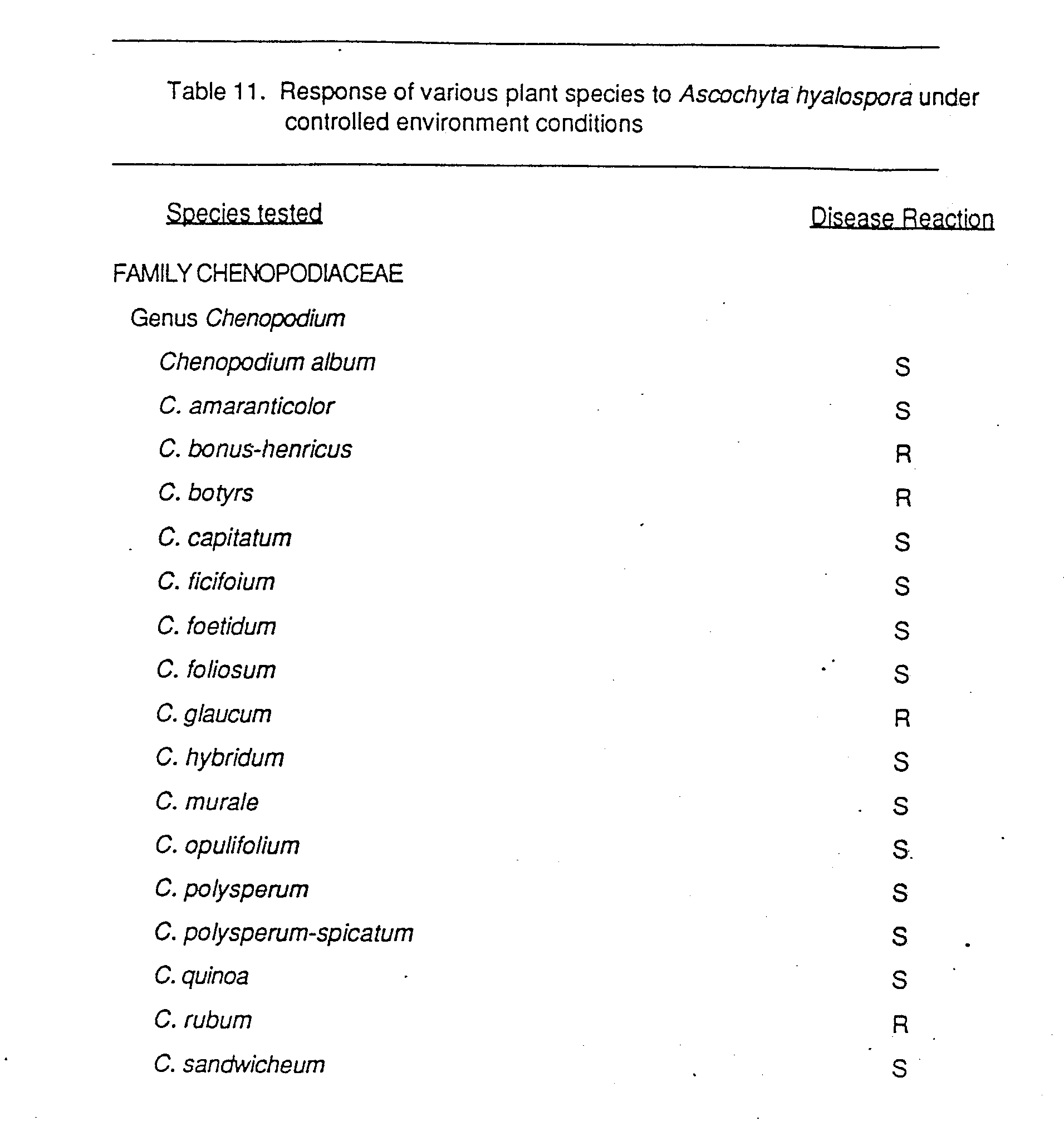
- This example illustrates the host specificity of the pathogen, by spraying test species in the genus Chenopodium, economic species in the family Chenopodiaceae, and common unrelated crop species in which Chenopodium album can be found as a weed pest.
- For each test, 3 plants were placed in a 12.5 cm pot. One pot of the test species was sprayed with the pathogen while a second pot containing the same species was sprayed with water. A lamb's-quarters plant was included to check for the efficacy of the inoculum. Test plants were sprayed with the pathogen at a rate of 10⁸ conidia/m². After spraying, all plants were subjected to a leaf wetness period of 20-24 hrs. After this period, the plants were placed in either a growth chamber or the greenhouse. One to 2 weeks after treatment, plants were checked and compared with their controls to determine if they were susceptible to the pathogen. Plant response to the pathogen was rated as susceptible (S), resistant (R) or immune (I).
- Lamb's-quarters and most Chenopodium species are susceptible to Ascochyta hyalospora (Table 11). Of the Chenopodium species C. ficifolium, C. hybridium, C. sandwicheum, and C album were the most susceptible. C. ficifolium was readily killed even at advanced stages of growth. Most cultivars of beets and spinach produced a hypersensitive response while all other plants tested were immune.


Claims (9)
Applications Claiming Priority (2)
| Application Number | Priority Date | Filing Date | Title |
|---|---|---|---|
| CA539789 | 1987-06-16 | ||
| CA000539789A CA1324775C (en) | 1987-06-16 | 1987-06-16 | Fungal herbicide for control of lamb's quarters and other chenopodium weeds |
Publications (2)
| Publication Number | Publication Date |
|---|---|
| EP0296057A2 true EP0296057A2 (en) | 1988-12-21 |
| EP0296057A3 EP0296057A3 (en) | 1990-03-14 |
Family
ID=4135911
Family Applications (1)
| Application Number | Title | Priority Date | Filing Date |
|---|---|---|---|
| EP88401472A Withdrawn EP0296057A3 (en) | 1987-06-16 | 1988-06-14 | Fungal herbicide for control of lamb's quarters and other chenopodium weeds |
Country Status (3)
| Country | Link |
|---|---|
| US (1) | US4915724A (en) |
| EP (1) | EP0296057A3 (en) |
| CA (1) | CA1324775C (en) |
Cited By (3)
| Publication number | Priority date | Publication date | Assignee | Title |
|---|---|---|---|---|
| WO1996024250A1 (en) * | 1995-02-08 | 1996-08-15 | Novartis Ag | Biocontrol of weeds |
| WO1997011158A1 (en) * | 1995-09-18 | 1997-03-27 | Japan Tobacco Inc. | Microorganism belonging to the genus ascochyta and use of the same |
| EP3342289A1 (en) | 2016-12-28 | 2018-07-04 | UPL Limited | Herbicidal combination and weed control method |
Families Citing this family (2)
| Publication number | Priority date | Publication date | Assignee | Title |
|---|---|---|---|---|
| US5244659A (en) * | 1990-02-06 | 1993-09-14 | The Royal Institution For The Advancement Of Learning (Mcgill University) | Composition for biocontrol of fireweed |
| US5409951A (en) * | 1990-06-15 | 1995-04-25 | Novo Nordisk A/S | Fungicidally active compounds |
Family Cites Families (6)
| Publication number | Priority date | Publication date | Assignee | Title |
|---|---|---|---|---|
| US3999973A (en) * | 1975-06-19 | 1976-12-28 | The Board Of Trustees Of The University Of Arkansas | C. malvarum spore concentrate, formulation, and agricultural process |
| US4419120A (en) * | 1982-03-10 | 1983-12-06 | The United States Of America As Represented By The Secretary Of Agriculture | Control of prickly sida, velvetleaf, and spurred anoda with fungal pathogens |
| US4606751A (en) * | 1984-12-07 | 1986-08-19 | North Carolina State University | Biological method of controlling johnson grass and similar weeds in agricultural crops |
| US4775405A (en) * | 1985-06-21 | 1988-10-04 | Mycogen Corporation | Synergistic herbicidal compositions comprising colletotrichum truncatum and chemical herbicides |
| CA1286121C (en) * | 1985-06-21 | 1991-07-16 | Jerry D. Caulder | Synergistic herbicidal compositions comprising microbial herbicides and chemical herbicides or plant growth regulators |
| US4776873A (en) * | 1985-06-21 | 1988-10-11 | Mycogen Corporation | Synergistic herbicidal compositions comprising alternaria cassiae and chemical herbicides |
-
1987
- 1987-06-16 CA CA000539789A patent/CA1324775C/en not_active Expired - Fee Related
-
1988
- 1988-06-02 US US07/201,211 patent/US4915724A/en not_active Expired - Fee Related
- 1988-06-14 EP EP88401472A patent/EP0296057A3/en not_active Withdrawn
Cited By (4)
| Publication number | Priority date | Publication date | Assignee | Title |
|---|---|---|---|---|
| WO1996024250A1 (en) * | 1995-02-08 | 1996-08-15 | Novartis Ag | Biocontrol of weeds |
| WO1997011158A1 (en) * | 1995-09-18 | 1997-03-27 | Japan Tobacco Inc. | Microorganism belonging to the genus ascochyta and use of the same |
| US5902580A (en) * | 1995-09-18 | 1999-05-11 | Japan Tobacco Inc. | Controlling Cyperus weeds with Ascochyta sp. FERM BP-5176 |
| EP3342289A1 (en) | 2016-12-28 | 2018-07-04 | UPL Limited | Herbicidal combination and weed control method |
Also Published As
| Publication number | Publication date |
|---|---|
| US4915724A (en) | 1990-04-10 |
| EP0296057A3 (en) | 1990-03-14 |
| CA1324775C (en) | 1993-11-30 |
Similar Documents
| Publication | Publication Date | Title |
|---|---|---|
| CA1189716A (en) | Control of prickly sida, velvetleaf, and spurred anoda with fungal pathogens | |
| EP0706321B1 (en) | Use of streptomyces wyec 108 to control plant pathogens | |
| KR20110084516A (en) | Insect pathogenic fungi and uses thereof | |
| Hildebrand et al. | Potential for the biological control of St. John's-wort (Hypericum perforatum) with an endemic strain of Colletotrichum gloeosporioides | |
| CA1316699C (en) | Physiologically active agent for agricultural use | |
| CA2448890C (en) | Fungal isolates and biological control compositions for the control of weeds | |
| US4915724A (en) | Fungal herbicide for control of lamb's quarters and other chenopodium weeds | |
| US4715881A (en) | Control of eastern black nightshade with a fungal pathogen | |
| AU608182B2 (en) | Weed control compositions containing drechslera spp. or metabolite thereof and weed control methods using dreschslera spp. or metabolite thereof | |
| KR101773339B1 (en) | Composition for simultaneous control of both aphid, and Pythium ultimum, or Colletotrichum acutatum using Isaria fumosorosea Pf212 and its culture media | |
| CA2141413A1 (en) | A microorganism of the genus colletotrichum and its uses | |
| US5185023A (en) | Process for the production of mellein and 4-hydroxymellein | |
| US4643756A (en) | Bioherbicide for Florida beggarweed | |
| US5208026A (en) | Composition for biocontrol of plantain | |
| JP2962748B2 (en) | Weed-controlling agent containing Dorexrela or metabolite thereof and method for controlling weeds using the same | |
| US5190754A (en) | Ampelomyces quisqualis AQ10, CNCM I-807, for biological control of powdery mildew | |
| US5945378A (en) | Control of cyperus spp. with a fungal pathogen | |
| WO1991001642A1 (en) | Biocontrol compositions | |
| US5028253A (en) | Process for controlling undesirable vegetation with Colletotrichum coccodes spores | |
| US6277786B1 (en) | Herbicide comprising phytotoxins of Lasiodiplodia theobromae (LT) fungus, a process of producing the herbicide and a method of using the same | |
| CN120349903B (en) | Chaetomium globosum NCCG-2 and its application | |
| US4871386A (en) | Biological control of wild poinsettia and other weedy spurges with a fungal pathogen | |
| US5698491A (en) | Control of Cyperus spp. with a fungal pathogen | |
| JP3073263B2 (en) | New strains of the genus Dorexrela and weed control agents containing them | |
| US5434120A (en) | Ustilago trichophora mycoherbicidal compositions and methods of use |
Legal Events
| Date | Code | Title | Description |
|---|---|---|---|
| PUAI | Public reference made under article 153(3) epc to a published international application that has entered the european phase |
Free format text: ORIGINAL CODE: 0009012 |
|
| AK | Designated contracting states |
Kind code of ref document: A2 Designated state(s): DE FR GB IT NL |
|
| PUAL | Search report despatched |
Free format text: ORIGINAL CODE: 0009013 |
|
| AK | Designated contracting states |
Kind code of ref document: A3 Designated state(s): DE FR GB IT NL |
|
| 17P | Request for examination filed |
Effective date: 19900907 |
|
| 17Q | First examination report despatched |
Effective date: 19910723 |
|
| STAA | Information on the status of an ep patent application or granted ep patent |
Free format text: STATUS: THE APPLICATION IS DEEMED TO BE WITHDRAWN |
|
| 18D | Application deemed to be withdrawn |
Effective date: 19921014 |