EP0295486A2 - Polymer-fraction sensor - Google Patents
Polymer-fraction sensor Download PDFInfo
- Publication number
- EP0295486A2 EP0295486A2 EP88108617A EP88108617A EP0295486A2 EP 0295486 A2 EP0295486 A2 EP 0295486A2 EP 88108617 A EP88108617 A EP 88108617A EP 88108617 A EP88108617 A EP 88108617A EP 0295486 A2 EP0295486 A2 EP 0295486A2
- Authority
- EP
- European Patent Office
- Prior art keywords
- polymer
- mixture
- microns
- cellulose
- response
- Prior art date
- Legal status (The legal status is an assumption and is not a legal conclusion. Google has not performed a legal analysis and makes no representation as to the accuracy of the status listed.)
- Withdrawn
Links
Images


Classifications
-
- G—PHYSICS
- G01—MEASURING; TESTING
- G01N—INVESTIGATING OR ANALYSING MATERIALS BY DETERMINING THEIR CHEMICAL OR PHYSICAL PROPERTIES
- G01N21/00—Investigating or analysing materials by the use of optical means, i.e. using sub-millimetre waves, infrared, visible or ultraviolet light
- G01N21/17—Systems in which incident light is modified in accordance with the properties of the material investigated
- G01N21/25—Colour; Spectral properties, i.e. comparison of effect of material on the light at two or more different wavelengths or wavelength bands
- G01N21/31—Investigating relative effect of material at wavelengths characteristic of specific elements or molecules, e.g. atomic absorption spectrometry
- G01N21/35—Investigating relative effect of material at wavelengths characteristic of specific elements or molecules, e.g. atomic absorption spectrometry using infrared light
-
- G—PHYSICS
- G01—MEASURING; TESTING
- G01N—INVESTIGATING OR ANALYSING MATERIALS BY DETERMINING THEIR CHEMICAL OR PHYSICAL PROPERTIES
- G01N33/00—Investigating or analysing materials by specific methods not covered by groups G01N1/00 - G01N31/00
- G01N33/34—Paper
- G01N33/346—Paper sheets
-
- G—PHYSICS
- G01—MEASURING; TESTING
- G01N—INVESTIGATING OR ANALYSING MATERIALS BY DETERMINING THEIR CHEMICAL OR PHYSICAL PROPERTIES
- G01N21/00—Investigating or analysing materials by the use of optical means, i.e. using sub-millimetre waves, infrared, visible or ultraviolet light
- G01N21/17—Systems in which incident light is modified in accordance with the properties of the material investigated
- G01N21/25—Colour; Spectral properties, i.e. comparison of effect of material on the light at two or more different wavelengths or wavelength bands
- G01N21/31—Investigating relative effect of material at wavelengths characteristic of specific elements or molecules, e.g. atomic absorption spectrometry
- G01N21/35—Investigating relative effect of material at wavelengths characteristic of specific elements or molecules, e.g. atomic absorption spectrometry using infrared light
- G01N21/3563—Investigating relative effect of material at wavelengths characteristic of specific elements or molecules, e.g. atomic absorption spectrometry using infrared light for analysing solids; Preparation of samples therefor
Definitions
- This invention relates generally to measuring the polymer content of a material which has both polymer and cellulose components. More particularly, the invention relates to apparatus and associated methods for measuring the polymer fraction of the polymer and cellulose components by infrared absorption means.
- Specialty papers for use in producing such items as teabags, non-woven cloth, and other products are predominately composed of a fibrous polymer/cellulose mixture.
- the polymers are added to produce qualities, such as strength, that are inadequate in other papers. Accurately measuring the polymer content of these specialty papers is an important step in controlling product quality and cost.
- the polymer weight (Hereinafter, the word "weight”, as applied to polymer, cellulose, or both, is intended to mean weight per unit area.) by itself cannot effectively serve as a measurement of strength since it does not take into account the weight of cellulose with which the polymer is combined. Accordingly, an on-line measurement of the polymer fraction of combined polymer and cellulose weights would correlate better with laboratory tests of the physical quality than would an on-line measurement of mere polymer weight.
- This invention provides apparatus and associated processes for measuring the polymer fraction of the polymer and cellulose components of a mixture. Typically, the measurement is made during continuous production of the mixture, and the mixture is in the form of a fibrous sheet.
- Infrared radiation is directed from a source onto a portion of the mixture.
- Two sets of infrared radiation wavelengths are detected after the radiation has interacted with the mixture.
- a first set includes wavelengths having about the same absorption coefficient for the cellulose component of the mixture, but having substantially different absorption coefficients for the polymer component.
- a second set includes wavelengths having about the same absorption coefficient for the polymer component, but having substantially different absorption coefficients for the cellulose component.
- the detection system produces responses to the radiation corresponding to the two sets. These responses are processed to produce a measurement of that fraction of the combined polymer and cellulose components which is accounted for by the polymer.
- the resulting polymer-fraction measurement correlates better than existing measurements of polymer content with the results of standard strength tests for specialty papers.
- the numeral 2 designates a sheet of material, typically a specialty paper having both polymer and cellulose components, that is under inspection during continuous production thereof.
- the illustrated portion of the sheet 2 can be viewed as moving in the direction indicated by the arrow 4.
- the fraction of the combined weights of polymer and cellulose components which is accounted for by the polymer (herein termed the "polymer fraction") is measured by an infrared radiation gauging apparatus comprising a source means 6 for directing infrared radiation (as indicated at 8) onto a portion of the sheet 2, and a detector means 10 for detecting two sets 12, 14 of infrared radiation wavelengths transmitted through the sheet.
- the first set 12 may include wavelengths 16 at about 2.10 microns and wavelengths 18 at about 2.38 microns.
- the second set 14 may include wavelengths 20 at about 2.10 microns and wavelengths 22 at about 1.80 microns.
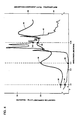
- the curve 24 shows the absorption coefficient of polyethylene (in square centimeters per gram) as a function of infrared wavelength in microns.
- Curve 26 shows the same relation for cellulose.
- the first set 12 of wavelengths 16, 18 is selected, as at points 28 and 30, to have about the same absorption coefficient for cellulose, but to have, as indicated at points 32 and 34, substantially different absorption coefficients for polyethylene.
- the second set 14 of wavelengths 20, 22 is selected, as at points 36 and 32, to have about the same absorption coefficients for polyethylene, but to have, as indicated at points 38 and 28, substantially different absorption coefficients for cellulose.
- Figs. 3 and 4 show (as curves 40 and 42) the absorption coefficients for polyester and polypropylene, respectively, as functions of infrared wavelength, and also show curve 26 for cellulose.
- the first set 12 of wavelengths 16, 18 is indicated as points 28 and 30 on curve 26. These correspond to points 44 and 46 on curve 40 or to points 48 and 50 on curve 42.
- the second set 14 of wavelengths 20, 22 is indicated as points 38 and 28 on curve 26. These correspond to points 52 and 44 on curve 40 or to points 54 and 48 on curve 42.
- the above-prescribed wavelengths for the first and second sets 12, 14 corresponding to each polymer are of course not exclusive, since many combinations of wavelengths will satisfy the requirements that the first set include wavelengths that have about the same absorption coefficient for the cellulose component but have substantially different absorption coefficients for the polymer component, and that the second set of wavelengths have about the same absorption coefficient for the polymer component but have substantially different absorption coefficients for the cellulose component. Although these requirements are satisfied by the selection of three different wavelengths for the above illustrated cases, one may employ four different wavelengths where necessary or desirable, as exemplified in Fig. 2 of U.S. Pat. No. 4,577,104.
- a similar wavelength selection process may be used for other polymers where it is desired to measure the weight of the polymer as a fraction of the combined weight of polymer and cellulose. It will be recognized that the wavelengths should be selected so that, for the mixture in question, none of the wavelengths is subject to significant absorption by components other than the polymer and cellulose. For example, where the mixture is in the form of a sheet of specialty paper as mentioned above, it will typically have some water content, and it will therefore be best not to select wavelengths around 1.92 microns so as to avoid the necessity of correcting for the effect of absorption by water.
- wavelengths 16, 18, 20 and 22 are shown to be detected by the detector 10.
- the detection of selected wavelengths may be accomplished, for example, by mounting appropriate filters in a modulating wheel (not shown) as exemplified in U.S. Pat. No. 4,300,049, or by employing a four-channel detector with separate filters for wavelengths 16, 18, 20, and 22, as described in pending application serial number 06/885,017.
- the detector 10 is part of a data acquisition system 55, and produces detector responses (not shown) --- typically in the form of analog signals -- that can be processed to produce measurements of polymer fraction for the sheet 2.
- System 55 which may be similar to apparatus described in U.S. Pat. No.
- Each transmittance value represents the ratio of the radiation intensity transmitted to the detector 10 with the sheet 2 in position, to the radiation intensity transmitted to the detector in the absence of the sheet.
- the transmittance values expressed by responses 56, 58, 60, and 62 are communicated to first and second ratio forming operations 64 and 66, respectively.
- a function of the transmittances of radiation wavelengths in the first set 12 is formed to produce a first response 68 to the polymer contained in the sheet 2.
- a function of the transmittances of radiation in the second set 14 is formed to produce a second response 70 to the cellulose contained in the sheet 2.
- the multiplier "h" is included because, even though the best possible selection of wavelengths may have been made to provide polymer independence in the cellulose measurement, it may not be possible in every case to balance the effect of the polymer. In Fig. 3, for example, small variations in the band picked at 28 and 44 will cause polymer dependence in the cellulose measurement.
- a third ratio forming operation 72 forms a function of the ratio of the first and second responses 68, 70 to produce a third response 74 having a magnitude T that is substantially independent of the first error function f(C), but is dependent on the second error function hP.
- the combined weight of the polymer and cellulose components of the sheet 2 is equal to the sum P + C.
- T (a/b)* [(%P+j*%C)/(%C+h*%P)], (4) where %P is the polymer fraction or percent polymer, and %C is the cellulose fraction or percent cellulose.
- the calculation of polymer fraction is implemented at 76 where the third response 74 is used in conjunction with calibration data a, b, j, and h to produce a measurement response 78 expressive of the polymer fraction of the sheet 2, and substantially independent of the first error function f(S).
- an iterative digital computer program is typically used to determine the values for the calibration data a, b, j and h which make equation 6 best fit laboratory-determined polymer fraction values for a number of actual samples of the material being measured.
- Measurement responses 78 may be delivered to a comparator 80 wherein the responses are compared to a target polymer fraction value (indicated as 81).
- adjustment signals 82 may be communicated to a process control unit 84, which may be any conventional unit for controlling the rate at which cellulose or polymer is delivered for formation of the sheet 2.
Landscapes
- Physics & Mathematics (AREA)
- Life Sciences & Earth Sciences (AREA)
- Chemical & Material Sciences (AREA)
- Health & Medical Sciences (AREA)
- General Health & Medical Sciences (AREA)
- Analytical Chemistry (AREA)
- Biochemistry (AREA)
- General Physics & Mathematics (AREA)
- Immunology (AREA)
- Pathology (AREA)
- Spectroscopy & Molecular Physics (AREA)
- Medicinal Chemistry (AREA)
- Food Science & Technology (AREA)
- Engineering & Computer Science (AREA)
- Investigating Or Analysing Materials By Optical Means (AREA)
Abstract
Description
- This invention relates generally to measuring the polymer content of a material which has both polymer and cellulose components. More particularly, the invention relates to apparatus and associated methods for measuring the polymer fraction of the polymer and cellulose components by infrared absorption means.
- Specialty papers for use in producing such items as teabags, non-woven cloth, and other products are predominately composed of a fibrous polymer/cellulose mixture. The polymers are added to produce qualities, such as strength, that are inadequate in other papers. Accurately measuring the polymer content of these specialty papers is an important step in controlling product quality and cost.
- Previous attempts at on-line measurement of polymer content have employed radiation absorption methods wherein the absorptances of two radiation wavelengths, one of which is sensitive to the polymer, are gauged and electronically quantified, and the corresponding electronic signals appropriately processed, to measure polymer weight per unit area directly. However, these systems sometimes can provide only a crude indication of whether the polymer content of the mixture is consistent with the desired physical quality of the paper sheet. Such is the case, for example, when the primary purpose of the polymer is to bind the cellulose fibers to produce a desired degree of strength in a paper. In that case, the polymer weight (Hereinafter, the word "weight", as applied to polymer, cellulose, or both, is intended to mean weight per unit area.) by itself cannot effectively serve as a measurement of strength since it does not take into account the weight of cellulose with which the polymer is combined. Accordingly, an on-line measurement of the polymer fraction of combined polymer and cellulose weights would correlate better with laboratory tests of the physical quality than would an on-line measurement of mere polymer weight.
- This invention provides apparatus and associated processes for measuring the polymer fraction of the polymer and cellulose components of a mixture. Typically, the measurement is made during continuous production of the mixture, and the mixture is in the form of a fibrous sheet.
- Infrared radiation is directed from a source onto a portion of the mixture. Two sets of infrared radiation wavelengths are detected after the radiation has interacted with the mixture. A first set includes wavelengths having about the same absorption coefficient for the cellulose component of the mixture, but having substantially different absorption coefficients for the polymer component. A second set includes wavelengths having about the same absorption coefficient for the polymer component, but having substantially different absorption coefficients for the cellulose component. The detection system produces responses to the radiation corresponding to the two sets. These responses are processed to produce a measurement of that fraction of the combined polymer and cellulose components which is accounted for by the polymer. The resulting polymer-fraction measurement correlates better than existing measurements of polymer content with the results of standard strength tests for specialty papers.
-
- Fig. 1 is a schematic illustration of an embodiment of the invention, combining both representations of typical structural elements and representations of typical information handling procedures.
- Figs. 2 through 4 are plots of infrared absorption coefficients for polymers and cellulose, as functions of wavelength, illustrating the selection of wavelengths in accordance with the preferred embodiment.
- Referring to Fig. 1, the numeral 2 designates a sheet of material, typically a specialty paper having both polymer and cellulose components, that is under inspection during continuous production thereof. The illustrated portion of the sheet 2 can be viewed as moving in the direction indicated by the arrow 4.
- The fraction of the combined weights of polymer and cellulose components which is accounted for by the polymer (herein termed the "polymer fraction") is measured by an infrared radiation gauging apparatus comprising a source means 6 for directing infrared radiation (as indicated at 8) onto a portion of the sheet 2, and a detector means 10 for detecting two
sets - The
first set 12 may includewavelengths 16 at about 2.10 microns andwavelengths 18 at about 2.38 microns. Thesecond set 14 may includewavelengths 20 at about 2.10 microns andwavelengths 22 at about 1.80 microns. - In Fig. 2, the
curve 24 shows the absorption coefficient of polyethylene (in square centimeters per gram) as a function of infrared wavelength in microns.Curve 26 shows the same relation for cellulose. Thefirst set 12 ofwavelengths points points second set 14 ofwavelengths points points - In similar fashion, Figs. 3 and 4 show (as
curves 40 and 42) the absorption coefficients for polyester and polypropylene, respectively, as functions of infrared wavelength, and also showcurve 26 for cellulose. Thefirst set 12 ofwavelengths points curve 26. These correspond topoints curve 40 or topoints curve 42. Thesecond set 14 ofwavelengths points curve 26. These correspond topoints curve 40 or topoints curve 42. - The above-prescribed wavelengths for the first and
second sets - A similar wavelength selection process may be used for other polymers where it is desired to measure the weight of the polymer as a fraction of the combined weight of polymer and cellulose. It will be recognized that the wavelengths should be selected so that, for the mixture in question, none of the wavelengths is subject to significant absorption by components other than the polymer and cellulose. For example, where the mixture is in the form of a sheet of specialty paper as mentioned above, it will typically have some water content, and it will therefore be best not to select wavelengths around 1.92 microns so as to avoid the necessity of correcting for the effect of absorption by water.
- Referring again to Fig. 1,
wavelengths detector 10. The detection of selected wavelengths may be accomplished, for example, by mounting appropriate filters in a modulating wheel (not shown) as exemplified in U.S. Pat. No. 4,300,049, or by employing a four-channel detector with separate filters forwavelengths detector 10 is part of adata acquisition system 55, and produces detector responses (not shown) --- typically in the form of analog signals -- that can be processed to produce measurements of polymer fraction for the sheet 2.System 55, which may be similar to apparatus described in U.S. Pat. No. 4,300,049, producesresponses wavelengths detector 10 with the sheet 2 in position, to the radiation intensity transmitted to the detector in the absence of the sheet. The transmittance values expressed byresponses ratio forming operations - At 64, a function of the transmittances of radiation wavelengths in the
first set 12 is formed to produce afirst response 68 to the polymer contained in the sheet 2. The first response is typically represented mathematically as follows (For purpose of description, it is assumed that polypropylene is the polymer of interest.):
(X/Y) - 1 = a*(P+jC)*f(S), (1)
where X is the transmittance at the polymer reference wavelength of 2.1 microns; Y is the transmittance at the polymer absorption wavelength of 2.38 microns; "a" is a constant determined during calibration; P is the weight of the polymer contained in the sheet 2; C is the weight of the cellulose contained in the sheet; "j" is a multiplier accounting for partial sensitivity to cellulose; (The multiplier "j" is present because, even though the best selection of wavelengths may have been made to provide cellulose independence in the polymer measurement, it may not be possible in every case to balance the effect of the cellulose.); and f(S) is a first error function that is dependent upon physical properties of the polymer and cellulose fibers (such as diameter and length) which will affect their optical scattering capabilities. This error is attributable to the change in path length resulting from the scattering media, as described by the Kubelka-Munk theory. - At 66, a function of the transmittances of radiation in the
second set 14 is formed to produce asecond response 70 to the cellulose contained in the sheet 2. Thesecond response 70 is typically represented mathematically as follows:
(V/Z) - 1 = b*(C+hP)*f(S), (2)
where V is the transmittance at wavelength 1.80 microns; Z is the transmittance at wavelength 2.10 microns; "b" is a constant determined during calibration; f(S) is the first error function as inequation 1; and "h" is a multiplier accounting for partial sensitivity to the polymer. The multiplier "h" is included because, even though the best possible selection of wavelengths may have been made to provide polymer independence in the cellulose measurement, it may not be possible in every case to balance the effect of the polymer. In Fig. 3, for example, small variations in the band picked at 28 and 44 will cause polymer dependence in the cellulose measurement. - A third
ratio forming operation 72 forms a function of the ratio of the first andsecond responses third response 74 having a magnitude T that is substantially independent of the first error function f(C), but is dependent on the second error function hP. Thethird response 74 may be represented mathematically as follows:
T = [a*(P+jC)]/[(b*(C+hP)]. (3)
It should be noted that this is the ratio of thefirst response 68 to thesecond response 70. The combined weight of the polymer and cellulose components of the sheet 2 is equal to the sum P + C. Therefore, expression 3 may be rewritten as follows:
T = (a/b)* [(%P+j*%C)/(%C+h*%P)], (4)
where %P is the polymer fraction or percent polymer, and %C is the cellulose fraction or percent cellulose. - Since %C = 1 - %P,
T = (a/b)*[(%P+j - j*%P)/(h*%P+1 - %P)]. (5) - Letting (a/b) equal d,
%P = (dj-T)/[T(h-1) - d(1-j)]. (6) - As illustrated in Fig. 1, the calculation of polymer fraction is implemented at 76 where the
third response 74 is used in conjunction with calibration data a, b, j, and h to produce ameasurement response 78 expressive of the polymer fraction of the sheet 2, and substantially independent of the first error function f(S). - In calibrating the apparatus, an iterative digital computer program is typically used to determine the values for the calibration data a, b, j and h which make equation 6 best fit laboratory-determined polymer fraction values for a number of actual samples of the material being measured.
-
Measurement responses 78 may be delivered to acomparator 80 wherein the responses are compared to a target polymer fraction value (indicated as 81). In response to a deviation from thetarget value 81, adjustment signals 82 may be communicated to aprocess control unit 84, which may be any conventional unit for controlling the rate at which cellulose or polymer is delivered for formation of the sheet 2. - While the invention has been described in terms of the preferred embodiment, the description is not intended to restrict the scope of the invention beyond that defined by the following claims and their equivalents.
Claims (11)
Applications Claiming Priority (2)
| Application Number | Priority Date | Filing Date | Title |
|---|---|---|---|
| US07/062,992 US4837438A (en) | 1987-06-17 | 1987-06-17 | Direct infrared measurement of homogenous mixtures |
| US62992 | 1987-06-17 |
Publications (2)
| Publication Number | Publication Date |
|---|---|
| EP0295486A2 true EP0295486A2 (en) | 1988-12-21 |
| EP0295486A3 EP0295486A3 (en) | 1990-05-16 |
Family
ID=22046179
Family Applications (1)
| Application Number | Title | Priority Date | Filing Date |
|---|---|---|---|
| EP88108617A Withdrawn EP0295486A3 (en) | 1987-06-17 | 1988-05-30 | Polymer-fraction sensor |
Country Status (3)
| Country | Link |
|---|---|
| US (1) | US4837438A (en) |
| EP (1) | EP0295486A3 (en) |
| FI (1) | FI882892L (en) |
Cited By (6)
| Publication number | Priority date | Publication date | Assignee | Title |
|---|---|---|---|---|
| EP0485836A3 (en) * | 1990-11-14 | 1993-01-20 | Bayer Ag | Spectroscopic method for the analysis of plastics mixtures |
| DE4238781A1 (en) * | 1992-11-17 | 1994-05-19 | Kulicke Werner Michael Prof Dr | Measurement of molecular weight etc. of polymers etc. using light scatter method - whereby sample is passed to photometer via micro-capillary so that there is delay between the arrival of large and small molecules at detector |
| EP0658757A1 (en) * | 1993-12-16 | 1995-06-21 | Shell Internationale Researchmaatschappij B.V. | A method and apparatus for non-intrusive in situ chemical analysis of a lubricant film in running reciprocating machinery |
| US5619038A (en) * | 1995-02-21 | 1997-04-08 | Temple-Inland Forest Products Corporation | Method and apparatus for determining the polymer content of a cellulose/polymer mixture and associated calibration |
| RU2170419C2 (en) * | 1995-09-25 | 2001-07-10 | Солвей (Сосьете Аноним) | Technique and device testing quality of latex based on vinyl halogen-carrying polymers |
| EP1233261A1 (en) * | 2001-02-15 | 2002-08-21 | Hitachi, Ltd. | Method and apparatus for paper material discrimination |
Families Citing this family (2)
| Publication number | Priority date | Publication date | Assignee | Title |
|---|---|---|---|---|
| JPH03292780A (en) * | 1990-04-11 | 1991-12-24 | Fujitsu Ltd | Characteristic evaluation of superconductor and method and device for growing superconductor thin film used therefor |
| US5406378A (en) * | 1992-04-29 | 1995-04-11 | Mpb Technologies Inc. | Method and apparatus for non-contact and rapid identification of wood species |
Family Cites Families (10)
| Publication number | Priority date | Publication date | Assignee | Title |
|---|---|---|---|---|
| US3076723A (en) * | 1958-05-26 | 1963-02-05 | Du Pont | Coating weight determination by means of ultraviolet light |
| US3405268A (en) * | 1965-03-12 | 1968-10-08 | Brun Sensor Systems Inc | Radiant energy absorption gage for measuring the weight of a base material and the content of a material sorbed by the base material |
| US3448268A (en) * | 1966-02-10 | 1969-06-03 | American Mach & Foundry | Coating inspection method and apparatus using infrared radiation |
| US4363968A (en) * | 1979-07-19 | 1982-12-14 | Owens-Corning Fiberglas Corporation | Method and apparatus for determining the binder content in a fibrous mat |
| US4300049A (en) * | 1980-02-27 | 1981-11-10 | Accuray Corporation | Dynamically standardized radiant energy method and apparatus for plural channel gain independent material property measurement |
| WO1984001430A1 (en) * | 1982-09-30 | 1984-04-12 | Accuray Corp | Methods and apparatus for measuring and controlling curing of polymeric materials |
| US4582520A (en) * | 1982-09-30 | 1986-04-15 | Owens-Corning Fiberglas Corporation | Methods and apparatus for measuring and controlling curing of polymeric materials |
| US4602160A (en) * | 1983-09-28 | 1986-07-22 | Sentrol Systems Ltd. | Infrared constituent analyzer and control system |
| US4577104A (en) * | 1984-01-20 | 1986-03-18 | Accuray Corporation | Measuring the percentage or fractional moisture content of paper having a variable infrared radiation scattering characteristic and containing a variable amount of a broadband infrared radiation absorber |
| US4755678A (en) * | 1985-05-06 | 1988-07-05 | The University Of Alabama | Simultaneous measurement of moisture content and basis weight of paper sheet with a submillimeter laser |
-
1987
- 1987-06-17 US US07/062,992 patent/US4837438A/en not_active Expired - Fee Related
-
1988
- 1988-05-30 EP EP88108617A patent/EP0295486A3/en not_active Withdrawn
- 1988-06-16 FI FI882892A patent/FI882892L/en not_active Application Discontinuation
Cited By (8)
| Publication number | Priority date | Publication date | Assignee | Title |
|---|---|---|---|---|
| EP0485836A3 (en) * | 1990-11-14 | 1993-01-20 | Bayer Ag | Spectroscopic method for the analysis of plastics mixtures |
| US5206510A (en) * | 1990-11-14 | 1993-04-27 | Bayer Aktiengesellschaft | Spectroscopic analysis process for plastic mixtures |
| DE4238781A1 (en) * | 1992-11-17 | 1994-05-19 | Kulicke Werner Michael Prof Dr | Measurement of molecular weight etc. of polymers etc. using light scatter method - whereby sample is passed to photometer via micro-capillary so that there is delay between the arrival of large and small molecules at detector |
| EP0658757A1 (en) * | 1993-12-16 | 1995-06-21 | Shell Internationale Researchmaatschappij B.V. | A method and apparatus for non-intrusive in situ chemical analysis of a lubricant film in running reciprocating machinery |
| US5619038A (en) * | 1995-02-21 | 1997-04-08 | Temple-Inland Forest Products Corporation | Method and apparatus for determining the polymer content of a cellulose/polymer mixture and associated calibration |
| RU2170419C2 (en) * | 1995-09-25 | 2001-07-10 | Солвей (Сосьете Аноним) | Technique and device testing quality of latex based on vinyl halogen-carrying polymers |
| EP1233261A1 (en) * | 2001-02-15 | 2002-08-21 | Hitachi, Ltd. | Method and apparatus for paper material discrimination |
| US6730911B2 (en) | 2001-02-15 | 2004-05-04 | Hitachi, Ltd. | Method and apparatus for paper material discrimination with two near-infrared lights |
Also Published As
| Publication number | Publication date |
|---|---|
| US4837438A (en) | 1989-06-06 |
| FI882892A7 (en) | 1988-12-18 |
| FI882892L (en) | 1988-12-18 |
| EP0295486A3 (en) | 1990-05-16 |
| FI882892A0 (en) | 1988-06-16 |
Similar Documents
| Publication | Publication Date | Title |
|---|---|---|
| US4577104A (en) | Measuring the percentage or fractional moisture content of paper having a variable infrared radiation scattering characteristic and containing a variable amount of a broadband infrared radiation absorber | |
| CA1252645A (en) | Method and apparatus for measuring water content | |
| US4602160A (en) | Infrared constituent analyzer and control system | |
| DE3854164T2 (en) | Humidity sensor with temperature compensation. | |
| JP2578944B2 (en) | How to determine paper sheet strength | |
| EP0062620A1 (en) | Method of measuring the content of fibrillary particles in a pulp | |
| GB2044443A (en) | A method of measuring the content of a substance in a film comprising at least one other substance | |
| EP0569477A1 (en) | Temperature insensitivite web moisture sensore and method | |
| US4837438A (en) | Direct infrared measurement of homogenous mixtures | |
| US6717148B2 (en) | Method and apparatus for measuring coating | |
| US4363968A (en) | Method and apparatus for determining the binder content in a fibrous mat | |
| US4942363A (en) | Apparatus and method for measuring two properties of an object using scattered electromagnetic radiation | |
| US4085326A (en) | Radiation reflection method and apparatus particularly for gauging materials exhibiting broadband absorption or scattering, or similar effects | |
| JP6985461B2 (en) | Working grade selection for weighting of composite sheets | |
| CA1319273C (en) | Clay sensor | |
| CA2346480C (en) | Measuring amount of silicone coating on paper web | |
| GB1604747A (en) | Method of and an apparatus for measuring a physical property of a thin body | |
| US3207901A (en) | Apparatus for measuring basis weight of paper and the like | |
| CN111122489B (en) | Method for measuring coating weight of coating composite material by infrared quantitative moisture sensor | |
| JP3205084B2 (en) | Method and apparatus for measuring film thickness of coating material | |
| US20030132387A1 (en) | Method and device for measuring the amount of coating on a moving substrate | |
| CN113970522B (en) | A method for online analysis of composite products in a machine for producing absorbent hygiene products | |
| JPS6243127B2 (en) | ||
| JPS6123498B2 (en) | ||
| JPS6123500B2 (en) |
Legal Events
| Date | Code | Title | Description |
|---|---|---|---|
| PUAI | Public reference made under article 153(3) epc to a published international application that has entered the european phase |
Free format text: ORIGINAL CODE: 0009012 |
|
| AK | Designated contracting states |
Kind code of ref document: A2 Designated state(s): DE FR GB IT SE |
|
| PUAL | Search report despatched |
Free format text: ORIGINAL CODE: 0009013 |
|
| AK | Designated contracting states |
Kind code of ref document: A3 Designated state(s): DE FR GB IT SE |
|
| 17P | Request for examination filed |
Effective date: 19901025 |
|
| RAP1 | Party data changed (applicant data changed or rights of an application transferred) |
Owner name: ABB PROCESS AUTOMATION INC. |
|
| 17Q | First examination report despatched |
Effective date: 19920109 |
|
| STAA | Information on the status of an ep patent application or granted ep patent |
Free format text: STATUS: THE APPLICATION IS DEEMED TO BE WITHDRAWN |
|
| 18D | Application deemed to be withdrawn |
Effective date: 19930615 |