EP0282944B1 - Pyrazole derivative and herbicide containing it - Google Patents
Pyrazole derivative and herbicide containing it Download PDFInfo
- Publication number
- EP0282944B1 EP0282944B1 EP88103999A EP88103999A EP0282944B1 EP 0282944 B1 EP0282944 B1 EP 0282944B1 EP 88103999 A EP88103999 A EP 88103999A EP 88103999 A EP88103999 A EP 88103999A EP 0282944 B1 EP0282944 B1 EP 0282944B1
- Authority
- EP
- European Patent Office
- Prior art keywords
- group
- carbon atoms
- cooch
- defined above
- och
- Prior art date
- Legal status (The legal status is an assumption and is not a legal conclusion. Google has not performed a legal analysis and makes no representation as to the accuracy of the status listed.)
- Expired - Lifetime
Links
- 230000002363 herbicidal effect Effects 0.000 title claims abstract description 38
- 150000003217 pyrazoles Chemical class 0.000 title claims abstract description 8
- 239000004009 herbicide Substances 0.000 title abstract description 29
- 125000004432 carbon atom Chemical group C* 0.000 claims abstract description 180
- 125000000217 alkyl group Chemical group 0.000 claims abstract description 76
- 125000004435 hydrogen atom Chemical group [H]* 0.000 claims abstract description 41
- 125000003545 alkoxy group Chemical group 0.000 claims abstract description 33
- -1 cyanomethyl Chemical group 0.000 claims abstract description 29
- 125000000449 nitro group Chemical group [O-][N+](*)=O 0.000 claims abstract description 22
- 125000005843 halogen group Chemical group 0.000 claims abstract description 20
- 229910052736 halogen Inorganic materials 0.000 claims abstract description 19
- 125000004093 cyano group Chemical group *C#N 0.000 claims abstract description 18
- 125000001188 haloalkyl group Chemical group 0.000 claims abstract description 18
- 125000002023 trifluoromethyl group Chemical group FC(F)(F)* 0.000 claims abstract description 17
- 125000003342 alkenyl group Chemical group 0.000 claims abstract description 15
- 150000002367 halogens Chemical group 0.000 claims abstract description 15
- 125000001997 phenyl group Chemical group [H]C1=C([H])C([H])=C(*)C([H])=C1[H] 0.000 claims abstract description 14
- 125000000304 alkynyl group Chemical group 0.000 claims abstract description 12
- 229910052739 hydrogen Inorganic materials 0.000 claims abstract description 11
- 239000001257 hydrogen Substances 0.000 claims abstract description 11
- 125000004453 alkoxycarbonyl group Chemical group 0.000 claims abstract description 10
- 125000004183 alkoxy alkyl group Chemical group 0.000 claims abstract description 9
- 150000003839 salts Chemical class 0.000 claims abstract description 9
- 125000001797 benzyl group Chemical group [H]C1=C([H])C([H])=C(C([H])=C1[H])C([H])([H])* 0.000 claims abstract description 8
- 125000006350 alkyl thio alkyl group Chemical group 0.000 claims abstract description 6
- 125000004414 alkyl thio group Chemical group 0.000 claims abstract description 6
- 125000004438 haloalkoxy group Chemical group 0.000 claims abstract description 6
- 125000002887 hydroxy group Chemical group [H]O* 0.000 claims abstract description 6
- 229910052717 sulfur Inorganic materials 0.000 claims abstract description 6
- 125000004430 oxygen atom Chemical group O* 0.000 claims abstract description 5
- NINIDFKCEFEMDL-UHFFFAOYSA-N Sulfur Chemical compound [S] NINIDFKCEFEMDL-UHFFFAOYSA-N 0.000 claims abstract description 4
- 239000011593 sulfur Substances 0.000 claims abstract description 4
- 125000002723 alicyclic group Chemical group 0.000 claims abstract description 3
- 125000004448 alkyl carbonyl group Chemical group 0.000 claims abstract description 3
- 125000002947 alkylene group Chemical group 0.000 claims abstract description 3
- 125000003917 carbamoyl group Chemical group [H]N([H])C(*)=O 0.000 claims abstract description 3
- 239000000203 mixture Substances 0.000 claims description 93
- 150000001875 compounds Chemical class 0.000 claims description 71
- 241000196324 Embryophyta Species 0.000 claims description 27
- 229910052799 carbon Inorganic materials 0.000 claims description 18
- 239000003795 chemical substances by application Substances 0.000 claims description 16
- 229910052794 bromium Inorganic materials 0.000 claims description 13
- 125000001449 isopropyl group Chemical group [H]C([H])([H])C([H])(*)C([H])([H])[H] 0.000 claims description 12
- 125000001424 substituent group Chemical group 0.000 claims description 12
- 125000001160 methoxycarbonyl group Chemical group [H]C([H])([H])OC(*)=O 0.000 claims description 11
- XSXHWVKGUXMUQE-UHFFFAOYSA-N osmium dioxide Inorganic materials O=[Os]=O XSXHWVKGUXMUQE-UHFFFAOYSA-N 0.000 claims description 11
- RMRFFCXPLWYOOY-UHFFFAOYSA-N allyl radical Chemical compound [CH2]C=C RMRFFCXPLWYOOY-UHFFFAOYSA-N 0.000 claims description 10
- 238000000034 method Methods 0.000 claims description 10
- 125000004123 n-propyl group Chemical group [H]C([H])([H])C([H])([H])C([H])([H])* 0.000 claims description 10
- 229910052720 vanadium Inorganic materials 0.000 claims description 9
- WTKZEGDFNFYCGP-UHFFFAOYSA-N Pyrazole Chemical compound C=1C=NNC=1 WTKZEGDFNFYCGP-UHFFFAOYSA-N 0.000 claims description 8
- 235000010233 benzoic acid Nutrition 0.000 claims description 8
- 229910052801 chlorine Inorganic materials 0.000 claims description 8
- 229910052731 fluorine Inorganic materials 0.000 claims description 8
- 229910052740 iodine Inorganic materials 0.000 claims description 8
- JCXJVPUVTGWSNB-UHFFFAOYSA-N nitrogen dioxide Inorganic materials O=[N]=O JCXJVPUVTGWSNB-UHFFFAOYSA-N 0.000 claims description 8
- WBLIXGSTEMXDSM-UHFFFAOYSA-N chloromethane Chemical compound Cl[CH2] WBLIXGSTEMXDSM-UHFFFAOYSA-N 0.000 claims description 7
- 125000003754 ethoxycarbonyl group Chemical group C(=O)(OCC)* 0.000 claims description 7
- 125000006351 ethylthiomethyl group Chemical group [H]C([H])([H])C([H])([H])SC([H])([H])* 0.000 claims description 7
- WPYMKLBDIGXBTP-UHFFFAOYSA-N benzoic acid Chemical compound OC(=O)C1=CC=CC=C1 WPYMKLBDIGXBTP-UHFFFAOYSA-N 0.000 claims description 6
- 125000006260 ethylaminocarbonyl group Chemical group [H]N(C(*)=O)C([H])([H])C([H])([H])[H] 0.000 claims description 6
- 125000000262 haloalkenyl group Chemical group 0.000 claims description 6
- 125000000232 haloalkynyl group Chemical group 0.000 claims description 6
- 125000004458 methylaminocarbonyl group Chemical group [H]N(C(*)=O)C([H])([H])[H] 0.000 claims description 6
- 125000004170 methylsulfonyl group Chemical group [H]C([H])([H])S(*)(=O)=O 0.000 claims description 6
- 125000001889 triflyl group Chemical group FC(F)(F)S(*)(=O)=O 0.000 claims description 6
- 125000006222 dimethylaminomethyl group Chemical group [H]C([H])([H])N(C([H])([H])[H])C([H])([H])* 0.000 claims description 5
- 125000004793 2,2,2-trifluoroethoxy group Chemical group FC(CO*)(F)F 0.000 claims description 4
- 125000004206 2,2,2-trifluoroethyl group Chemical group [H]C([H])(*)C(F)(F)F 0.000 claims description 4
- XPNHHPXSCYDOKL-UHFFFAOYSA-N 4-benzoyl-1,2-dihydropyrazol-3-one Chemical compound N1N=CC(C(=O)C=2C=CC=CC=2)=C1O XPNHHPXSCYDOKL-UHFFFAOYSA-N 0.000 claims description 4
- 125000001316 cycloalkyl alkyl group Chemical group 0.000 claims description 4
- 125000000753 cycloalkyl group Chemical group 0.000 claims description 4
- 125000004786 difluoromethoxy group Chemical group [H]C(F)(F)O* 0.000 claims description 4
- 125000004672 ethylcarbonyl group Chemical group [H]C([H])([H])C([H])([H])C(*)=O 0.000 claims description 4
- 125000005347 halocycloalkyl group Chemical group 0.000 claims description 4
- CBOIHMRHGLHBPB-UHFFFAOYSA-N hydroxymethyl Chemical compound O[CH2] CBOIHMRHGLHBPB-UHFFFAOYSA-N 0.000 claims description 4
- 125000000959 isobutyl group Chemical group [H]C([H])([H])C([H])(C([H])([H])[H])C([H])([H])* 0.000 claims description 4
- 125000000956 methoxy group Chemical group [H]C([H])([H])O* 0.000 claims description 4
- 125000006217 methyl sulfide group Chemical group [H]C([H])([H])S* 0.000 claims description 4
- 125000004108 n-butyl group Chemical group [H]C([H])([H])C([H])([H])C([H])([H])C([H])([H])* 0.000 claims description 4
- 125000002914 sec-butyl group Chemical group [H]C([H])([H])C([H])([H])C([H])(*)C([H])([H])[H] 0.000 claims description 4
- 125000000999 tert-butyl group Chemical group [H]C([H])([H])C(*)(C([H])([H])[H])C([H])([H])[H] 0.000 claims description 4
- 125000000876 trifluoromethoxy group Chemical group FC(F)(F)O* 0.000 claims description 4
- XBYRMPXUBGMOJC-UHFFFAOYSA-N 1,2-dihydropyrazol-3-one Chemical compound OC=1C=CNN=1 XBYRMPXUBGMOJC-UHFFFAOYSA-N 0.000 claims description 3
- 239000005711 Benzoic acid Substances 0.000 claims description 3
- 125000003236 benzoyl group Chemical group [H]C1=C([H])C([H])=C(C([H])=C1[H])C(*)=O 0.000 claims description 3
- 125000000654 isopropylidene group Chemical group C(C)(C)=* 0.000 claims description 3
- 125000001570 methylene group Chemical group [H]C([H])([*:1])[*:2] 0.000 claims description 3
- 125000006345 2,2,2-trifluoroethoxymethyl group Chemical group [H]C([H])(*)OC([H])([H])C(F)(F)F 0.000 claims description 2
- NRILGXBMLMSQAC-UHFFFAOYSA-N CCN1N=CC(C(=O)C=2C(=C(C(=O)OC)C(Cl)=CC=2)Cl)=C1O Chemical compound CCN1N=CC(C(=O)C=2C(=C(C(=O)OC)C(Cl)=CC=2)Cl)=C1O NRILGXBMLMSQAC-UHFFFAOYSA-N 0.000 claims description 2
- GGAMATHKPQXHKP-UHFFFAOYSA-N CCSCc1c(Cl)c(ccc1S(C)(=O)=O)C(=O)c1cnn(CC)c1O Chemical compound CCSCc1c(Cl)c(ccc1S(C)(=O)=O)C(=O)c1cnn(CC)c1O GGAMATHKPQXHKP-UHFFFAOYSA-N 0.000 claims description 2
- IMWVTPTZIRQZDL-UHFFFAOYSA-N CCn1ncc(C(=O)c2ccc(c(CO)c2Cl)S(C)(=O)=O)c1O Chemical compound CCn1ncc(C(=O)c2ccc(c(CO)c2Cl)S(C)(=O)=O)c1O IMWVTPTZIRQZDL-UHFFFAOYSA-N 0.000 claims description 2
- JNCMHMUGTWEVOZ-UHFFFAOYSA-N F[CH]F Chemical compound F[CH]F JNCMHMUGTWEVOZ-UHFFFAOYSA-N 0.000 claims description 2
- UFHFLCQGNIYNRP-UHFFFAOYSA-N Hydrogen Chemical compound [H][H] UFHFLCQGNIYNRP-UHFFFAOYSA-N 0.000 claims description 2
- AFVFQIVMOAPDHO-UHFFFAOYSA-N Methanesulfonic acid Chemical group CS(O)(=O)=O AFVFQIVMOAPDHO-UHFFFAOYSA-N 0.000 claims description 2
- AOJDZKCUAATBGE-UHFFFAOYSA-N bromomethane Chemical compound Br[CH2] AOJDZKCUAATBGE-UHFFFAOYSA-N 0.000 claims description 2
- 125000003178 carboxy group Chemical group [H]OC(*)=O 0.000 claims description 2
- 125000006264 diethylaminomethyl group Chemical group [H]C([H])([H])C([H])([H])N(C([H])([H])*)C([H])([H])C([H])([H])[H] 0.000 claims description 2
- 239000003085 diluting agent Substances 0.000 claims description 2
- 125000006534 ethyl amino methyl group Chemical group [H]N(C([H])([H])*)C([H])([H])C([H])([H])[H] 0.000 claims description 2
- 125000000219 ethylidene group Chemical group [H]C(=[*])C([H])([H])[H] 0.000 claims description 2
- VUWZPRWSIVNGKG-UHFFFAOYSA-N fluoromethane Chemical compound F[CH2] VUWZPRWSIVNGKG-UHFFFAOYSA-N 0.000 claims description 2
- 125000006352 iso-propylthiomethyl group Chemical group [H]C([H])([H])C([H])(SC([H])([H])*)C([H])([H])[H] 0.000 claims description 2
- AHADNBSYXIWYPL-UHFFFAOYSA-N methyl 2,6-dichloro-3-(1-ethyl-5-phenylmethoxypyrazole-4-carbonyl)benzoate Chemical compound C=1C=CC=CC=1COC=1N(CC)N=CC=1C(=O)C1=CC=C(Cl)C(C(=O)OC)=C1Cl AHADNBSYXIWYPL-UHFFFAOYSA-N 0.000 claims description 2
- 125000003170 phenylsulfonyl group Chemical group C1(=CC=CC=C1)S(=O)(=O)* 0.000 claims description 2
- 125000006412 propinylene group Chemical group [H]C#CC([H])([H])* 0.000 claims description 2
- 125000004434 sulfur atom Chemical group 0.000 claims description 2
- ZBZJXHCVGLJWFG-UHFFFAOYSA-N trichloromethyl(.) Chemical compound Cl[C](Cl)Cl ZBZJXHCVGLJWFG-UHFFFAOYSA-N 0.000 claims description 2
- CCGKOQOJPYTBIH-UHFFFAOYSA-N ethenone Chemical compound C=C=O CCGKOQOJPYTBIH-UHFFFAOYSA-N 0.000 claims 2
- 125000002496 methyl group Chemical group [H]C([H])([H])* 0.000 claims 2
- KATVVEGJZPKCQH-UHFFFAOYSA-N (5-chloro-1h-pyrazol-4-yl)-phenylmethanone Chemical compound N1N=CC(C(=O)C=2C=CC=CC=2)=C1Cl KATVVEGJZPKCQH-UHFFFAOYSA-N 0.000 claims 1
- CCYHFXPXTUONJX-UHFFFAOYSA-N C1=C(S(C)(=O)=O)C(C(=O)OC)=C(C)C(C(=O)C2=C(N(C(C)C)N=C2)O)=C1 Chemical compound C1=C(S(C)(=O)=O)C(C(=O)OC)=C(C)C(C(=O)C2=C(N(C(C)C)N=C2)O)=C1 CCYHFXPXTUONJX-UHFFFAOYSA-N 0.000 claims 1
- UPUACPZJHKLJNZ-UHFFFAOYSA-N C1=C(S(C)(=O)=O)C(C(=O)OC)=C(OC)C(C(=O)C2=C(N(C)N=C2)O)=C1 Chemical compound C1=C(S(C)(=O)=O)C(C(=O)OC)=C(OC)C(C(=O)C2=C(N(C)N=C2)O)=C1 UPUACPZJHKLJNZ-UHFFFAOYSA-N 0.000 claims 1
- KWWDBHVFUOVZRE-UHFFFAOYSA-N C1=C(S(C)(=O)=O)C(C(=O)OCC)=C(Cl)C(C(=O)C2=C(N(C(C)C)N=C2)O)=C1 Chemical compound C1=C(S(C)(=O)=O)C(C(=O)OCC)=C(Cl)C(C(=O)C2=C(N(C(C)C)N=C2)O)=C1 KWWDBHVFUOVZRE-UHFFFAOYSA-N 0.000 claims 1
- LKHRTPASVNTTEH-UHFFFAOYSA-N C1=C(S(C)(=O)=O)C(C(=O)OCCC)=C(C)C(C(=O)C2=C(N(CC)N=C2)O)=C1 Chemical compound C1=C(S(C)(=O)=O)C(C(=O)OCCC)=C(C)C(C(=O)C2=C(N(CC)N=C2)O)=C1 LKHRTPASVNTTEH-UHFFFAOYSA-N 0.000 claims 1
- FQPJOHLYFSOITJ-UHFFFAOYSA-N CC(C)OC(=O)c1c(Cl)c(ccc1S(C)(=O)=O)C(=O)c1cnn(C)c1O Chemical compound CC(C)OC(=O)c1c(Cl)c(ccc1S(C)(=O)=O)C(=O)c1cnn(C)c1O FQPJOHLYFSOITJ-UHFFFAOYSA-N 0.000 claims 1
- WULNASNYYWELOO-UHFFFAOYSA-N CCN1N=CC(C(=O)C=2C(=C(C(=O)OCCCl)C(=CC=2)S(C)(=O)=O)C)=C1O Chemical compound CCN1N=CC(C(=O)C=2C(=C(C(=O)OCCCl)C(=CC=2)S(C)(=O)=O)C)=C1O WULNASNYYWELOO-UHFFFAOYSA-N 0.000 claims 1
- SMBPYJJXQWMIQP-UHFFFAOYSA-N CCN1N=CC(C(=O)C=2C(=C(COC)C(Cl)=CC=2)Cl)=C1O Chemical compound CCN1N=CC(C(=O)C=2C(=C(COC)C(Cl)=CC=2)Cl)=C1O SMBPYJJXQWMIQP-UHFFFAOYSA-N 0.000 claims 1
- GLXRSVCCEXWTAI-UHFFFAOYSA-N CCOC(=O)c1c(Cl)c(ccc1S(C)(=O)=O)C(=O)c1cnn(C)c1O Chemical compound CCOC(=O)c1c(Cl)c(ccc1S(C)(=O)=O)C(=O)c1cnn(C)c1O GLXRSVCCEXWTAI-UHFFFAOYSA-N 0.000 claims 1
- ZHHLDGOIGUTYSJ-UHFFFAOYSA-N CCOC(=O)c1c(Cl)c(ccc1S(C)(=O)=O)C(=O)c1cnn(CC)c1O Chemical compound CCOC(=O)c1c(Cl)c(ccc1S(C)(=O)=O)C(=O)c1cnn(CC)c1O ZHHLDGOIGUTYSJ-UHFFFAOYSA-N 0.000 claims 1
- FFYGDQJYEVHRLQ-UHFFFAOYSA-N CCn1ncc(C(=O)c2ccc(c(C(=O)OC(C)C)c2Cl)S(C)(=O)=O)c1O Chemical compound CCn1ncc(C(=O)c2ccc(c(C(=O)OC(C)C)c2Cl)S(C)(=O)=O)c1O FFYGDQJYEVHRLQ-UHFFFAOYSA-N 0.000 claims 1
- WQGZWDVVHGLHBF-UHFFFAOYSA-N CCn1ncc(C(=O)c2ccc(c(C(=O)OC)c2Cl)S(C)(=O)=O)c1O Chemical compound CCn1ncc(C(=O)c2ccc(c(C(=O)OC)c2Cl)S(C)(=O)=O)c1O WQGZWDVVHGLHBF-UHFFFAOYSA-N 0.000 claims 1
- CKMSHYXLXSECHO-UHFFFAOYSA-N CCn1ncc(C(=O)c2ccc(c(C(=O)OC)c2OC)S(C)(=O)=O)c1O Chemical compound CCn1ncc(C(=O)c2ccc(c(C(=O)OC)c2OC)S(C)(=O)=O)c1O CKMSHYXLXSECHO-UHFFFAOYSA-N 0.000 claims 1
- LSCSIZAQXUZDCC-UHFFFAOYSA-N CCn1ncc(C(=O)c2ccc(c(CC#N)c2Cl)S(C)(=O)=O)c1O Chemical compound CCn1ncc(C(=O)c2ccc(c(CC#N)c2Cl)S(C)(=O)=O)c1O LSCSIZAQXUZDCC-UHFFFAOYSA-N 0.000 claims 1
- CAXBWLIIUVXOMZ-UHFFFAOYSA-N CCn1ncc(C(=O)c2ccc(c(c2Cl)S(=O)(=O)CC)S(C)(=O)=O)c1O Chemical compound CCn1ncc(C(=O)c2ccc(c(c2Cl)S(=O)(=O)CC)S(C)(=O)=O)c1O CAXBWLIIUVXOMZ-UHFFFAOYSA-N 0.000 claims 1
- HNUSWWXAACYOHJ-UHFFFAOYSA-N COC(=O)C1=C(Cl)C=CC(C(=O)C2=C(N(C(C)C)N=C2)O)=C1Cl Chemical compound COC(=O)C1=C(Cl)C=CC(C(=O)C2=C(N(C(C)C)N=C2)O)=C1Cl HNUSWWXAACYOHJ-UHFFFAOYSA-N 0.000 claims 1
- DNCWZHAPYGLZLU-UHFFFAOYSA-N COC(=O)c1c(Cl)c(ccc1S(C)(=O)=O)C(=O)c1cnn(C(C)C)c1O Chemical compound COC(=O)c1c(Cl)c(ccc1S(C)(=O)=O)C(=O)c1cnn(C(C)C)c1O DNCWZHAPYGLZLU-UHFFFAOYSA-N 0.000 claims 1
- LKSYDUPUEHKLPV-UHFFFAOYSA-N COC(=O)c1c(Cl)c(ccc1S(C)(=O)=O)C(=O)c1cnn(C)c1O Chemical compound COC(=O)c1c(Cl)c(ccc1S(C)(=O)=O)C(=O)c1cnn(C)c1O LKSYDUPUEHKLPV-UHFFFAOYSA-N 0.000 claims 1
- DXDVESQTNLBRRM-UHFFFAOYSA-N COCC1=C(Cl)C=CC(C(=O)C2=C(N(C)N=C2)O)=C1Cl Chemical compound COCC1=C(Cl)C=CC(C(=O)C2=C(N(C)N=C2)O)=C1Cl DXDVESQTNLBRRM-UHFFFAOYSA-N 0.000 claims 1
- LZKSINOHUHBLQA-UHFFFAOYSA-N COCc1c(OC)c(ccc1S(C)(=O)=O)C(=O)c1cnn(C)c1O Chemical compound COCc1c(OC)c(ccc1S(C)(=O)=O)C(=O)c1cnn(C)c1O LZKSINOHUHBLQA-UHFFFAOYSA-N 0.000 claims 1
- ZKQXENDOYMFXIX-UHFFFAOYSA-N ClC1=C(C(=O)C=2C=NN(C=2O)C)C=CC(=C1COCC(F)(F)F)S(=O)(=O)C Chemical compound ClC1=C(C(=O)C=2C=NN(C=2O)C)C=CC(=C1COCC(F)(F)F)S(=O)(=O)C ZKQXENDOYMFXIX-UHFFFAOYSA-N 0.000 claims 1
- RDZYQSLLIUDRHK-UHFFFAOYSA-N ClC1=C(C(=O)C=2C=NN(C=2O)CC)C=CC(=C1C=COC)S(=O)(=O)C Chemical compound ClC1=C(C(=O)C=2C=NN(C=2O)CC)C=CC(=C1C=COC)S(=O)(=O)C RDZYQSLLIUDRHK-UHFFFAOYSA-N 0.000 claims 1
- 238000004519 manufacturing process Methods 0.000 claims 1
- CALJSOZZKSQHBQ-UHFFFAOYSA-N methyl 2,6-dichloro-3-(5-phenylmethoxy-1-propan-2-ylpyrazole-4-carbonyl)benzoate Chemical compound COC(=O)C1=C(Cl)C=CC(C(=O)C2=C(N(C(C)C)N=C2)OCC=2C=CC=CC=2)=C1Cl CALJSOZZKSQHBQ-UHFFFAOYSA-N 0.000 claims 1
- 125000005489 p-toluenesulfonic acid group Chemical group 0.000 claims 1
- 125000002088 tosyl group Chemical group [H]C1=C([H])C(=C([H])C([H])=C1C([H])([H])[H])S(*)(=O)=O 0.000 claims 1
- WSFSSNUMVMOOMR-UHFFFAOYSA-N Formaldehyde Chemical compound O=C WSFSSNUMVMOOMR-UHFFFAOYSA-N 0.000 abstract 1
- SYGWYBOJXOGMRU-UHFFFAOYSA-N chembl233051 Chemical compound C1=CC=C2C3=CC(C(N(CCN(C)C)C4=O)=O)=C5C4=CC=CC5=C3SC2=C1 SYGWYBOJXOGMRU-UHFFFAOYSA-N 0.000 abstract 1
- HEDRZPFGACZZDS-UHFFFAOYSA-N Chloroform Chemical compound ClC(Cl)Cl HEDRZPFGACZZDS-UHFFFAOYSA-N 0.000 description 86
- OKKJLVBELUTLKV-UHFFFAOYSA-N Methanol Chemical compound OC OKKJLVBELUTLKV-UHFFFAOYSA-N 0.000 description 67
- 239000000243 solution Substances 0.000 description 67
- XLYOFNOQVPJJNP-UHFFFAOYSA-N water Substances O XLYOFNOQVPJJNP-UHFFFAOYSA-N 0.000 description 65
- 239000002904 solvent Substances 0.000 description 49
- 238000006243 chemical reaction Methods 0.000 description 44
- 238000002844 melting Methods 0.000 description 44
- 230000008018 melting Effects 0.000 description 44
- 239000000047 product Substances 0.000 description 43
- HEMHJVSKTPXQMS-UHFFFAOYSA-M Sodium hydroxide Chemical compound [OH-].[Na+] HEMHJVSKTPXQMS-UHFFFAOYSA-M 0.000 description 42
- 239000000126 substance Substances 0.000 description 39
- UHOVQNZJYSORNB-UHFFFAOYSA-N Benzene Chemical compound C1=CC=CC=C1 UHOVQNZJYSORNB-UHFFFAOYSA-N 0.000 description 36
- VEXZGXHMUGYJMC-UHFFFAOYSA-N Hydrochloric acid Chemical compound Cl VEXZGXHMUGYJMC-UHFFFAOYSA-N 0.000 description 36
- LFQSCWFLJHTTHZ-UHFFFAOYSA-N Ethanol Chemical compound CCO LFQSCWFLJHTTHZ-UHFFFAOYSA-N 0.000 description 34
- 239000007864 aqueous solution Substances 0.000 description 34
- RTZKZFJDLAIYFH-UHFFFAOYSA-N Diethyl ether Chemical compound CCOCC RTZKZFJDLAIYFH-UHFFFAOYSA-N 0.000 description 30
- 238000002360 preparation method Methods 0.000 description 28
- NCYXQFZVTNQLGD-UHFFFAOYSA-N COCC1=NN(C)C(O)=C1C(=O)C1=CC=C(S(C)(=O)=O)C(COC)=C1C Chemical compound COCC1=NN(C)C(O)=C1C(=O)C1=CC=C(S(C)(=O)=O)C(COC)=C1C NCYXQFZVTNQLGD-UHFFFAOYSA-N 0.000 description 21
- XEKOWRVHYACXOJ-UHFFFAOYSA-N Ethyl acetate Chemical compound CCOC(C)=O XEKOWRVHYACXOJ-UHFFFAOYSA-N 0.000 description 21
- 239000012043 crude product Substances 0.000 description 20
- BWHMMNNQKKPAPP-UHFFFAOYSA-L potassium carbonate Chemical compound [K+].[K+].[O-]C([O-])=O BWHMMNNQKKPAPP-UHFFFAOYSA-L 0.000 description 20
- ZMXDDKWLCZADIW-UHFFFAOYSA-N dimethylformamide Substances CN(C)C=O ZMXDDKWLCZADIW-UHFFFAOYSA-N 0.000 description 19
- 238000009472 formulation Methods 0.000 description 19
- VYPSYNLAJGMNEJ-UHFFFAOYSA-N Silicium dioxide Chemical compound O=[Si]=O VYPSYNLAJGMNEJ-UHFFFAOYSA-N 0.000 description 17
- PMZURENOXWZQFD-UHFFFAOYSA-L Sodium Sulfate Chemical compound [Na+].[Na+].[O-]S([O-])(=O)=O PMZURENOXWZQFD-UHFFFAOYSA-L 0.000 description 17
- CDBYLPFSWZWCQE-UHFFFAOYSA-L Sodium Carbonate Chemical compound [Na+].[Na+].[O-]C([O-])=O CDBYLPFSWZWCQE-UHFFFAOYSA-L 0.000 description 16
- 229910002092 carbon dioxide Inorganic materials 0.000 description 15
- 239000002689 soil Substances 0.000 description 15
- FYSNRJHAOHDILO-UHFFFAOYSA-N thionyl chloride Chemical compound ClS(Cl)=O FYSNRJHAOHDILO-UHFFFAOYSA-N 0.000 description 14
- 239000002736 nonionic surfactant Substances 0.000 description 13
- KWYUFKZDYYNOTN-UHFFFAOYSA-M Potassium hydroxide Chemical compound [OH-].[K+] KWYUFKZDYYNOTN-UHFFFAOYSA-M 0.000 description 12
- FAPWRFPIFSIZLT-UHFFFAOYSA-M Sodium chloride Chemical class [Na+].[Cl-] FAPWRFPIFSIZLT-UHFFFAOYSA-M 0.000 description 12
- ZMANZCXQSJIPKH-UHFFFAOYSA-N Triethylamine Chemical compound CCN(CC)CC ZMANZCXQSJIPKH-UHFFFAOYSA-N 0.000 description 12
- 244000038559 crop plants Species 0.000 description 12
- 0 *OC1CCCC1 Chemical compound *OC1CCCC1 0.000 description 11
- 238000001914 filtration Methods 0.000 description 11
- 235000005853 Cyperus esculentus Nutrition 0.000 description 10
- 238000001816 cooling Methods 0.000 description 10
- 239000012669 liquid formulation Substances 0.000 description 10
- 229910000027 potassium carbonate Inorganic materials 0.000 description 10
- 239000004563 wettable powder Substances 0.000 description 10
- MSXVEPNJUHWQHW-UHFFFAOYSA-N 2-methylbutan-2-ol Chemical compound CCC(C)(C)O MSXVEPNJUHWQHW-UHFFFAOYSA-N 0.000 description 9
- QTBSBXVTEAMEQO-UHFFFAOYSA-N Acetic acid Chemical compound CC(O)=O QTBSBXVTEAMEQO-UHFFFAOYSA-N 0.000 description 9
- WEVYAHXRMPXWCK-UHFFFAOYSA-N Acetonitrile Chemical compound CC#N WEVYAHXRMPXWCK-UHFFFAOYSA-N 0.000 description 9
- 240000008042 Zea mays Species 0.000 description 9
- 239000003945 anionic surfactant Substances 0.000 description 9
- 238000010438 heat treatment Methods 0.000 description 9
- 239000010410 layer Substances 0.000 description 9
- 239000011541 reaction mixture Substances 0.000 description 9
- 244000285774 Cyperus esculentus Species 0.000 description 8
- 244000058871 Echinochloa crus-galli Species 0.000 description 8
- JUJWROOIHBZHMG-UHFFFAOYSA-N Pyridine Chemical compound C1=CC=NC=C1 JUJWROOIHBZHMG-UHFFFAOYSA-N 0.000 description 8
- WYURNTSHIVDZCO-UHFFFAOYSA-N Tetrahydrofuran Chemical compound C1CCOC1 WYURNTSHIVDZCO-UHFFFAOYSA-N 0.000 description 8
- 229910000029 sodium carbonate Inorganic materials 0.000 description 8
- 235000007244 Zea mays Nutrition 0.000 description 7
- 239000004480 active ingredient Substances 0.000 description 7
- 239000002585 base Substances 0.000 description 7
- 230000000694 effects Effects 0.000 description 7
- 239000004495 emulsifiable concentrate Substances 0.000 description 7
- 230000009969 flowable effect Effects 0.000 description 7
- 239000005457 ice water Substances 0.000 description 7
- 239000000543 intermediate Substances 0.000 description 7
- 230000000704 physical effect Effects 0.000 description 7
- 238000010992 reflux Methods 0.000 description 7
- 238000012360 testing method Methods 0.000 description 7
- NPRXQXFTKCBAAY-UHFFFAOYSA-N 4-benzoylpyrazole Chemical class C=1C=CC=CC=1C(=O)C=1C=NNC=1 NPRXQXFTKCBAAY-UHFFFAOYSA-N 0.000 description 6
- 240000006995 Abutilon theophrasti Species 0.000 description 6
- CURLTUGMZLYLDI-UHFFFAOYSA-N Carbon dioxide Chemical compound O=C=O CURLTUGMZLYLDI-UHFFFAOYSA-N 0.000 description 6
- 244000245600 Persicaria longiseta Species 0.000 description 6
- 240000003461 Setaria viridis Species 0.000 description 6
- 235000002248 Setaria viridis Nutrition 0.000 description 6
- 239000004927 clay Substances 0.000 description 6
- MZZBPDKVEFVLFF-UHFFFAOYSA-N cyanazine Chemical compound CCNC1=NC(Cl)=NC(NC(C)(C)C#N)=N1 MZZBPDKVEFVLFF-UHFFFAOYSA-N 0.000 description 6
- 239000012044 organic layer Substances 0.000 description 6
- NLKNQRATVPKPDG-UHFFFAOYSA-M potassium iodide Chemical compound [K+].[I-] NLKNQRATVPKPDG-UHFFFAOYSA-M 0.000 description 6
- 239000000843 powder Substances 0.000 description 6
- 238000010898 silica gel chromatography Methods 0.000 description 6
- LPXPTNMVRIOKMN-UHFFFAOYSA-M sodium nitrite Chemical compound [Na+].[O-]N=O LPXPTNMVRIOKMN-UHFFFAOYSA-M 0.000 description 6
- 239000007787 solid Substances 0.000 description 6
- 238000003756 stirring Methods 0.000 description 6
- LCGLNKUTAGEVQW-UHFFFAOYSA-N Dimethyl ether Chemical compound COC LCGLNKUTAGEVQW-UHFFFAOYSA-N 0.000 description 5
- 235000011999 Panicum crusgalli Nutrition 0.000 description 5
- 240000006394 Sorghum bicolor Species 0.000 description 5
- 235000007230 Sorghum bicolor Nutrition 0.000 description 5
- QAOWNCQODCNURD-UHFFFAOYSA-N Sulfuric acid Chemical compound OS(O)(=O)=O QAOWNCQODCNURD-UHFFFAOYSA-N 0.000 description 5
- DKGAVHZHDRPRBM-UHFFFAOYSA-N Tert-Butanol Chemical compound CC(C)(C)O DKGAVHZHDRPRBM-UHFFFAOYSA-N 0.000 description 5
- 150000001559 benzoic acids Chemical class 0.000 description 5
- 239000012954 diazonium Substances 0.000 description 5
- 150000001989 diazonium salts Chemical class 0.000 description 5
- 239000004615 ingredient Substances 0.000 description 5
- YQYVOGFWLVVXMM-UHFFFAOYSA-N methyl 3-(bromomethyl)-2-chloro-4-methylsulfonylbenzoate Chemical compound COC(=O)C1=CC=C(S(C)(=O)=O)C(CBr)=C1Cl YQYVOGFWLVVXMM-UHFFFAOYSA-N 0.000 description 5
- 239000012264 purified product Substances 0.000 description 5
- 230000035484 reaction time Effects 0.000 description 5
- 239000000377 silicon dioxide Substances 0.000 description 5
- 239000004094 surface-active agent Substances 0.000 description 5
- QZVRXWBKQJFSLP-UHFFFAOYSA-N 2-ethyl-1h-pyrazol-3-one Chemical compound CCN1NC=CC1=O QZVRXWBKQJFSLP-UHFFFAOYSA-N 0.000 description 4
- XDEJVQWBRNOEJU-UHFFFAOYSA-N 3-methoxycarbonyl-2-methyl-4-methylsulfonylbenzoic acid Chemical compound COC(=O)C1=C(C)C(C(O)=O)=CC=C1S(C)(=O)=O XDEJVQWBRNOEJU-UHFFFAOYSA-N 0.000 description 4
- 235000013478 Amaranthus oleraceus Nutrition 0.000 description 4
- 244000237960 Amaranthus oleraceus Species 0.000 description 4
- IJGRMHOSHXDMSA-UHFFFAOYSA-N Atomic nitrogen Chemical compound N#N IJGRMHOSHXDMSA-UHFFFAOYSA-N 0.000 description 4
- IAZDPXIOMUYVGZ-UHFFFAOYSA-N Dimethylsulphoxide Chemical compound CS(C)=O IAZDPXIOMUYVGZ-UHFFFAOYSA-N 0.000 description 4
- 244000025670 Eleusine indica Species 0.000 description 4
- 235000014716 Eleusine indica Nutrition 0.000 description 4
- 240000005979 Hordeum vulgare Species 0.000 description 4
- 235000007340 Hordeum vulgare Nutrition 0.000 description 4
- MHAJPDPJQMAIIY-UHFFFAOYSA-N Hydrogen peroxide Chemical compound OO MHAJPDPJQMAIIY-UHFFFAOYSA-N 0.000 description 4
- XEEYBQQBJWHFJM-UHFFFAOYSA-N Iron Chemical compound [Fe] XEEYBQQBJWHFJM-UHFFFAOYSA-N 0.000 description 4
- MZRVEZGGRBJDDB-UHFFFAOYSA-N N-Butyllithium Chemical compound [Li]CCCC MZRVEZGGRBJDDB-UHFFFAOYSA-N 0.000 description 4
- 241001148659 Panicum dichotomiflorum Species 0.000 description 4
- 231100000674 Phytotoxicity Toxicity 0.000 description 4
- UIIMBOGNXHQVGW-UHFFFAOYSA-M Sodium bicarbonate Chemical compound [Na+].OC([O-])=O UIIMBOGNXHQVGW-UHFFFAOYSA-M 0.000 description 4
- DWAQJAXMDSEUJJ-UHFFFAOYSA-M Sodium bisulfite Chemical class [Na+].OS([O-])=O DWAQJAXMDSEUJJ-UHFFFAOYSA-M 0.000 description 4
- 241000209140 Triticum Species 0.000 description 4
- 235000021307 Triticum Nutrition 0.000 description 4
- XCSGPAVHZFQHGE-UHFFFAOYSA-N alachlor Chemical compound CCC1=CC=CC(CC)=C1N(COC)C(=O)CCl XCSGPAVHZFQHGE-UHFFFAOYSA-N 0.000 description 4
- 150000004945 aromatic hydrocarbons Chemical class 0.000 description 4
- MXWJVTOOROXGIU-UHFFFAOYSA-N atrazine Chemical compound CCNC1=NC(Cl)=NC(NC(C)C)=N1 MXWJVTOOROXGIU-UHFFFAOYSA-N 0.000 description 4
- PASDCCFISLVPSO-UHFFFAOYSA-N benzoyl chloride Chemical compound ClC(=O)C1=CC=CC=C1 PASDCCFISLVPSO-UHFFFAOYSA-N 0.000 description 4
- 238000009835 boiling Methods 0.000 description 4
- 230000001276 controlling effect Effects 0.000 description 4
- 239000013078 crystal Substances 0.000 description 4
- UAOMVDZJSHZZME-UHFFFAOYSA-N diisopropylamine Chemical compound CC(C)NC(C)C UAOMVDZJSHZZME-UHFFFAOYSA-N 0.000 description 4
- 238000001035 drying Methods 0.000 description 4
- 239000003480 eluent Substances 0.000 description 4
- 239000000706 filtrate Substances 0.000 description 4
- VLKZOEOYAKHREP-UHFFFAOYSA-N n-Hexane Chemical compound CCCCCC VLKZOEOYAKHREP-UHFFFAOYSA-N 0.000 description 4
- 150000007530 organic bases Chemical class 0.000 description 4
- BDERNNFJNOPAEC-UHFFFAOYSA-N propan-1-ol Chemical compound CCCO BDERNNFJNOPAEC-UHFFFAOYSA-N 0.000 description 4
- UMJSCPRVCHMLSP-UHFFFAOYSA-N pyridine Natural products COC1=CC=CN=C1 UMJSCPRVCHMLSP-UHFFFAOYSA-N 0.000 description 4
- VZGDMQKNWNREIO-UHFFFAOYSA-N tetrachloromethane Chemical compound ClC(Cl)(Cl)Cl VZGDMQKNWNREIO-UHFFFAOYSA-N 0.000 description 4
- QJANIQCEDPJNLO-UHFFFAOYSA-N (2-methyl-3-nitrophenyl)methanol Chemical compound CC1=C(CO)C=CC=C1[N+]([O-])=O QJANIQCEDPJNLO-UHFFFAOYSA-N 0.000 description 3
- RYHBNJHYFVUHQT-UHFFFAOYSA-N 1,4-Dioxane Chemical compound C1COCCO1 RYHBNJHYFVUHQT-UHFFFAOYSA-N 0.000 description 3
- KIIFEJMXDNIUCL-UHFFFAOYSA-N 1-(methoxymethyl)-2-methyl-3-nitrobenzene Chemical compound COCC1=CC=CC([N+]([O-])=O)=C1C KIIFEJMXDNIUCL-UHFFFAOYSA-N 0.000 description 3
- NVTQRAAPOGWFBV-UHFFFAOYSA-N 2-chloro-3-(ethylsulfanylmethyl)-4-methylsulfonylbenzoic acid Chemical compound CCSCC1=C(Cl)C(C(O)=O)=CC=C1S(C)(=O)=O NVTQRAAPOGWFBV-UHFFFAOYSA-N 0.000 description 3
- FSFINGMGYNHSOR-UHFFFAOYSA-N 2-chloro-3-(methoxymethyl)-4-methylsulfonylbenzoic acid Chemical compound COCC1=C(Cl)C(C(O)=O)=CC=C1S(C)(=O)=O FSFINGMGYNHSOR-UHFFFAOYSA-N 0.000 description 3
- WVQBLGZPHOPPFO-UHFFFAOYSA-N 2-chloro-N-(2-ethyl-6-methylphenyl)-N-(1-methoxypropan-2-yl)acetamide Chemical compound CCC1=CC=CC(C)=C1N(C(C)COC)C(=O)CCl WVQBLGZPHOPPFO-UHFFFAOYSA-N 0.000 description 3
- IEVPCBCJYSROHS-UHFFFAOYSA-N 3-(methoxymethyl)-2,4-dimethylbenzenecarbothioic s-acid Chemical compound COCC1=C(C)C=CC(C(O)=S)=C1C IEVPCBCJYSROHS-UHFFFAOYSA-N 0.000 description 3
- YRHVZOVGYXVTKG-UHFFFAOYSA-N 3-(methoxymethyl)-2-methyl-4-methylsulfonylbenzoic acid Chemical compound COCC1=C(C)C(C(O)=O)=CC=C1S(C)(=O)=O YRHVZOVGYXVTKG-UHFFFAOYSA-N 0.000 description 3
- UBPOEWHLSICXAF-UHFFFAOYSA-N 3-(methoxymethyl)-2-methylaniline Chemical compound COCC1=CC=CC(N)=C1C UBPOEWHLSICXAF-UHFFFAOYSA-N 0.000 description 3
- MPOFBXJIUOBKTH-UHFFFAOYSA-N 3-bromo-2,6-dimethylbenzenecarbothioic s-acid Chemical compound CC1=CC=C(Br)C(C)=C1C(O)=S MPOFBXJIUOBKTH-UHFFFAOYSA-N 0.000 description 3
- IUZNNWVVZZBKBL-UHFFFAOYSA-N 3-methoxycarbonyl-2,4-dimethylbenzenecarbothioic s-acid Chemical compound COC(=O)C1=C(C)C=CC(C(O)=S)=C1C IUZNNWVVZZBKBL-UHFFFAOYSA-N 0.000 description 3
- WFDIJRYMOXRFFG-UHFFFAOYSA-N Acetic anhydride Chemical compound CC(=O)OC(C)=O WFDIJRYMOXRFFG-UHFFFAOYSA-N 0.000 description 3
- WKBOTKDWSSQWDR-UHFFFAOYSA-N Bromine atom Chemical compound [Br] WKBOTKDWSSQWDR-UHFFFAOYSA-N 0.000 description 3
- QOSSAOTZNIDXMA-UHFFFAOYSA-N Dicylcohexylcarbodiimide Chemical compound C1CCCCC1N=C=NC1CCCCC1 QOSSAOTZNIDXMA-UHFFFAOYSA-N 0.000 description 3
- 235000017898 Digitaria ciliaris Nutrition 0.000 description 3
- 240000003176 Digitaria ciliaris Species 0.000 description 3
- KFZMGEQAYNKOFK-UHFFFAOYSA-N Isopropanol Chemical compound CC(C)O KFZMGEQAYNKOFK-UHFFFAOYSA-N 0.000 description 3
- CTQNGGLPUBDAKN-UHFFFAOYSA-N O-Xylene Chemical compound CC1=CC=CC=C1C CTQNGGLPUBDAKN-UHFFFAOYSA-N 0.000 description 3
- RWRDLPDLKQPQOW-UHFFFAOYSA-N Pyrrolidine Chemical compound C1CCNC1 RWRDLPDLKQPQOW-UHFFFAOYSA-N 0.000 description 3
- YXFVVABEGXRONW-UHFFFAOYSA-N Toluene Chemical compound CC1=CC=CC=C1 YXFVVABEGXRONW-UHFFFAOYSA-N 0.000 description 3
- 244000067505 Xanthium strumarium Species 0.000 description 3
- 239000002253 acid Substances 0.000 description 3
- GDTBXPJZTBHREO-UHFFFAOYSA-N bromine Substances BrBr GDTBXPJZTBHREO-UHFFFAOYSA-N 0.000 description 3
- 239000001569 carbon dioxide Substances 0.000 description 3
- 239000012320 chlorinating reagent Substances 0.000 description 3
- 230000000052 comparative effect Effects 0.000 description 3
- 239000007789 gas Substances 0.000 description 3
- 238000010348 incorporation Methods 0.000 description 3
- 150000002576 ketones Chemical class 0.000 description 3
- 229910052751 metal Inorganic materials 0.000 description 3
- 239000002184 metal Substances 0.000 description 3
- FUDKAJZSVHJLHV-UHFFFAOYSA-N methyl 2-chloro-3-(ethylsulfanylmethyl)-4-methylsulfonylbenzoate Chemical compound CCSCC1=C(Cl)C(C(=O)OC)=CC=C1S(C)(=O)=O FUDKAJZSVHJLHV-UHFFFAOYSA-N 0.000 description 3
- 239000011734 sodium Substances 0.000 description 3
- 229910052708 sodium Inorganic materials 0.000 description 3
- 229940079827 sodium hydrogen sulfite Drugs 0.000 description 3
- 235000010267 sodium hydrogen sulphite Nutrition 0.000 description 3
- 235000010288 sodium nitrite Nutrition 0.000 description 3
- 238000003786 synthesis reaction Methods 0.000 description 3
- YLQBMQCUIZJEEH-UHFFFAOYSA-N tetrahydrofuran Natural products C=1C=COC=1 YLQBMQCUIZJEEH-UHFFFAOYSA-N 0.000 description 3
- 238000005406 washing Methods 0.000 description 3
- 239000008096 xylene Substances 0.000 description 3
- VOLRWDMWBJIQDG-UHFFFAOYSA-N 2,4-dichloro-3-methoxycarbonylbenzoic acid Chemical compound COC(=O)C1=C(Cl)C=CC(C(O)=O)=C1Cl VOLRWDMWBJIQDG-UHFFFAOYSA-N 0.000 description 2
- KBQPYERMRVPJDC-UHFFFAOYSA-N 2,4-dichloro-3-nitrobenzoic acid Chemical compound OC(=O)C1=CC=C(Cl)C([N+]([O-])=O)=C1Cl KBQPYERMRVPJDC-UHFFFAOYSA-N 0.000 description 2
- ATCRIUVQKHMXSH-UHFFFAOYSA-N 2,4-dichlorobenzoic acid Chemical compound OC(=O)C1=CC=C(Cl)C=C1Cl ATCRIUVQKHMXSH-UHFFFAOYSA-N 0.000 description 2
- CMZBRKBDAUTMSH-UHFFFAOYSA-N 2-chloro-3-(cyanomethyl)-4-methylsulfonylbenzoic acid Chemical compound CS(=O)(=O)C1=CC=C(C(O)=O)C(Cl)=C1CC#N CMZBRKBDAUTMSH-UHFFFAOYSA-N 0.000 description 2
- QTKTXHBKGBSIGF-UHFFFAOYSA-N 2-chloro-3-(hydroxymethyl)-4-methylsulfonylbenzoic acid Chemical compound CS(=O)(=O)C1=CC=C(C(O)=O)C(Cl)=C1CO QTKTXHBKGBSIGF-UHFFFAOYSA-N 0.000 description 2
- URECBMBKTXUWEN-UHFFFAOYSA-N 3-(1-methoxyethyl)-2,4-dimethylbenzenecarbothioic s-acid Chemical compound COC(C)C1=C(C)C=CC(C(O)=S)=C1C URECBMBKTXUWEN-UHFFFAOYSA-N 0.000 description 2
- DIAHXVWADUASAE-UHFFFAOYSA-N 3-(1-methoxyethyl)-2-methyl-4-methylsulfonylbenzoic acid Chemical compound COC(C)C1=C(C)C(C(O)=O)=CC=C1S(C)(=O)=O DIAHXVWADUASAE-UHFFFAOYSA-N 0.000 description 2
- NYRDVNKPHHYHPF-UHFFFAOYSA-N 3-(acetyloxymethyl)-2-chloro-4-methylsulfonylbenzoic acid Chemical compound CC(=O)OCC1=C(Cl)C(C(O)=O)=CC=C1S(C)(=O)=O NYRDVNKPHHYHPF-UHFFFAOYSA-N 0.000 description 2
- ZVSDSBIRXCOCPD-UHFFFAOYSA-N 3-(methoxymethyl)-2-methyl-4-methylsulfanylaniline Chemical compound COCC1=C(C)C(N)=CC=C1SC ZVSDSBIRXCOCPD-UHFFFAOYSA-N 0.000 description 2
- BMYNFMYTOJXKLE-UHFFFAOYSA-N 3-azaniumyl-2-hydroxypropanoate Chemical compound NCC(O)C(O)=O BMYNFMYTOJXKLE-UHFFFAOYSA-N 0.000 description 2
- 244000036890 Amaranthus blitum Species 0.000 description 2
- SHAXSNVUUIIKIS-UHFFFAOYSA-N C(C)O[Mg]C(C(=O)OCC)C(=O)OCC Chemical compound C(C)O[Mg]C(C(=O)OCC)C(=O)OCC SHAXSNVUUIIKIS-UHFFFAOYSA-N 0.000 description 2
- 240000001505 Cyperus odoratus Species 0.000 description 2
- ROSDSFDQCJNGOL-UHFFFAOYSA-N Dimethylamine Chemical compound CNC ROSDSFDQCJNGOL-UHFFFAOYSA-N 0.000 description 2
- QUSNBJAOOMFDIB-UHFFFAOYSA-N Ethylamine Chemical compound CCN QUSNBJAOOMFDIB-UHFFFAOYSA-N 0.000 description 2
- 244000068988 Glycine max Species 0.000 description 2
- 235000010469 Glycine max Nutrition 0.000 description 2
- 241000219146 Gossypium Species 0.000 description 2
- 239000002841 Lewis acid Substances 0.000 description 2
- 235000003403 Limnocharis flava Nutrition 0.000 description 2
- FYYHWMGAXLPEAU-UHFFFAOYSA-N Magnesium Chemical compound [Mg] FYYHWMGAXLPEAU-UHFFFAOYSA-N 0.000 description 2
- BAVYZALUXZFZLV-UHFFFAOYSA-N Methylamine Chemical compound NC BAVYZALUXZFZLV-UHFFFAOYSA-N 0.000 description 2
- YNAVUWVOSKDBBP-UHFFFAOYSA-N Morpholine Chemical compound C1COCCN1 YNAVUWVOSKDBBP-UHFFFAOYSA-N 0.000 description 2
- JLTDJTHDQAWBAV-UHFFFAOYSA-N N,N-dimethylaniline Chemical compound CN(C)C1=CC=CC=C1 JLTDJTHDQAWBAV-UHFFFAOYSA-N 0.000 description 2
- PXHVJJICTQNCMI-UHFFFAOYSA-N Nickel Chemical compound [Ni] PXHVJJICTQNCMI-UHFFFAOYSA-N 0.000 description 2
- 240000007594 Oryza sativa Species 0.000 description 2
- 235000007164 Oryza sativa Nutrition 0.000 description 2
- NQRYJNQNLNOLGT-UHFFFAOYSA-N Piperidine Chemical compound C1CCNCC1 NQRYJNQNLNOLGT-UHFFFAOYSA-N 0.000 description 2
- 235000010086 Setaria viridis var. viridis Nutrition 0.000 description 2
- WQDUMFSSJAZKTM-UHFFFAOYSA-N Sodium methoxide Chemical compound [Na+].[O-]C WQDUMFSSJAZKTM-UHFFFAOYSA-N 0.000 description 2
- 241001506766 Xanthium Species 0.000 description 2
- 235000005824 Zea mays ssp. parviglumis Nutrition 0.000 description 2
- 235000002017 Zea mays subsp mays Nutrition 0.000 description 2
- JHINUXWJKCFXLQ-UHFFFAOYSA-N [4-amino-2-(methoxymethyl)-3-methylphenyl] thiocyanate Chemical compound COCC1=C(C)C(N)=CC=C1SC#N JHINUXWJKCFXLQ-UHFFFAOYSA-N 0.000 description 2
- VSCWAEJMTAWNJL-UHFFFAOYSA-K aluminium trichloride Chemical compound Cl[Al](Cl)Cl VSCWAEJMTAWNJL-UHFFFAOYSA-K 0.000 description 2
- 230000015572 biosynthetic process Effects 0.000 description 2
- 238000004440 column chromatography Methods 0.000 description 2
- 235000005822 corn Nutrition 0.000 description 2
- 235000014113 dietary fatty acids Nutrition 0.000 description 2
- 238000007865 diluting Methods 0.000 description 2
- DNJIEGIFACGWOD-UHFFFAOYSA-N ethanethiol Chemical compound CCS DNJIEGIFACGWOD-UHFFFAOYSA-N 0.000 description 2
- 239000000194 fatty acid Substances 0.000 description 2
- 229930195729 fatty acid Natural products 0.000 description 2
- 150000008282 halocarbons Chemical class 0.000 description 2
- 230000020169 heat generation Effects 0.000 description 2
- 239000012442 inert solvent Substances 0.000 description 2
- 150000007529 inorganic bases Chemical class 0.000 description 2
- INQOMBQAUSQDDS-UHFFFAOYSA-N iodomethane Chemical compound IC INQOMBQAUSQDDS-UHFFFAOYSA-N 0.000 description 2
- 150000007517 lewis acids Chemical class 0.000 description 2
- 239000007788 liquid Substances 0.000 description 2
- 229910052749 magnesium Inorganic materials 0.000 description 2
- 239000011777 magnesium Substances 0.000 description 2
- IPARXULNDNLHDS-UHFFFAOYSA-N methyl 2-chloro-3-(cyanomethyl)-4-methylsulfonylbenzoate Chemical compound COC(=O)C1=CC=C(S(C)(=O)=O)C(CC#N)=C1Cl IPARXULNDNLHDS-UHFFFAOYSA-N 0.000 description 2
- PNOXXBWWIPCGNA-UHFFFAOYSA-N methyl 2-chloro-3-(methoxymethyl)-4-methylsulfonylbenzoate Chemical compound COCC1=C(Cl)C(C(=O)OC)=CC=C1S(C)(=O)=O PNOXXBWWIPCGNA-UHFFFAOYSA-N 0.000 description 2
- CRZGFIMLHZTLGT-UHFFFAOYSA-N methyl 2-methyl-3-nitrobenzoate Chemical compound COC(=O)C1=CC=CC([N+]([O-])=O)=C1C CRZGFIMLHZTLGT-UHFFFAOYSA-N 0.000 description 2
- RILJJWRXFAQZLB-UHFFFAOYSA-N methyl 3-(acetyloxymethyl)-2-chloro-4-methylsulfonylbenzoate Chemical compound COC(=O)C1=CC=C(S(C)(=O)=O)C(COC(C)=O)=C1Cl RILJJWRXFAQZLB-UHFFFAOYSA-N 0.000 description 2
- ONCOTTQGYSGTKV-UHFFFAOYSA-N methyl 3-amino-2-methyl-6-thiocyanatobenzoate Chemical compound COC(=O)C1=C(C)C(N)=CC=C1SC#N ONCOTTQGYSGTKV-UHFFFAOYSA-N 0.000 description 2
- ZOOQFAUFPWXUMI-UHFFFAOYSA-N methyl 3-amino-2-methylbenzoate Chemical compound COC(=O)C1=CC=CC(N)=C1C ZOOQFAUFPWXUMI-UHFFFAOYSA-N 0.000 description 2
- 229910052757 nitrogen Inorganic materials 0.000 description 2
- VHDXNZRKWAYASH-UHFFFAOYSA-N o-methyl 3-amino-2,6-dimethylbenzenecarbothioate Chemical compound COC(=S)C1=C(C)C=CC(N)=C1C VHDXNZRKWAYASH-UHFFFAOYSA-N 0.000 description 2
- JXRBMTRVCHRTLC-UHFFFAOYSA-N o-methyl 3-bromo-2,6-dimethylbenzenecarbothioate Chemical compound COC(=S)C1=C(C)C=CC(Br)=C1C JXRBMTRVCHRTLC-UHFFFAOYSA-N 0.000 description 2
- MNLMMUGGMLFXRM-UHFFFAOYSA-N o-methyl 3-iodo-2,6-dimethylbenzenecarbothioate Chemical compound COC(=S)C1=C(C)C=CC(I)=C1C MNLMMUGGMLFXRM-UHFFFAOYSA-N 0.000 description 2
- UHZYTMXLRWXGPK-UHFFFAOYSA-N phosphorus pentachloride Chemical compound ClP(Cl)(Cl)(Cl)Cl UHZYTMXLRWXGPK-UHFFFAOYSA-N 0.000 description 2
- XHXFXVLFKHQFAL-UHFFFAOYSA-N phosphoryl trichloride Chemical compound ClP(Cl)(Cl)=O XHXFXVLFKHQFAL-UHFFFAOYSA-N 0.000 description 2
- 239000004033 plastic Substances 0.000 description 2
- WGYKZJWCGVVSQN-UHFFFAOYSA-N propylamine Chemical compound CCCN WGYKZJWCGVVSQN-UHFFFAOYSA-N 0.000 description 2
- ASRAWSBMDXVNLX-UHFFFAOYSA-N pyrazolynate Chemical compound C=1C=C(Cl)C=C(Cl)C=1C(=O)C=1C(C)=NN(C)C=1OS(=O)(=O)C1=CC=C(C)C=C1 ASRAWSBMDXVNLX-UHFFFAOYSA-N 0.000 description 2
- 238000011160 research Methods 0.000 description 2
- 229910000030 sodium bicarbonate Inorganic materials 0.000 description 2
- 235000017557 sodium bicarbonate Nutrition 0.000 description 2
- 229910000033 sodium borohydride Inorganic materials 0.000 description 2
- 239000012279 sodium borohydride Substances 0.000 description 2
- JHJLBTNAGRQEKS-UHFFFAOYSA-M sodium bromide Chemical compound [Na+].[Br-] JHJLBTNAGRQEKS-UHFFFAOYSA-M 0.000 description 2
- 229940048181 sodium sulfide nonahydrate Drugs 0.000 description 2
- VGTPCRGMBIAPIM-UHFFFAOYSA-M sodium thiocyanate Chemical compound [Na+].[S-]C#N VGTPCRGMBIAPIM-UHFFFAOYSA-M 0.000 description 2
- WMDLZMCDBSJMTM-UHFFFAOYSA-M sodium;sulfanide;nonahydrate Chemical compound O.O.O.O.O.O.O.O.O.[Na+].[SH-] WMDLZMCDBSJMTM-UHFFFAOYSA-M 0.000 description 2
- 239000007921 spray Substances 0.000 description 2
- 239000002562 thickening agent Substances 0.000 description 2
- GETQZCLCWQTVFV-UHFFFAOYSA-N trimethylamine Chemical compound CN(C)C GETQZCLCWQTVFV-UHFFFAOYSA-N 0.000 description 2
- MOCPJIDJALBRIX-UHFFFAOYSA-N (2-chloro-3-nitrophenyl)methanol Chemical compound OCC1=CC=CC([N+]([O-])=O)=C1Cl MOCPJIDJALBRIX-UHFFFAOYSA-N 0.000 description 1
- XEZNGIUYQVAUSS-UHFFFAOYSA-N 18-crown-6 Chemical compound C1COCCOCCOCCOCCOCCO1 XEZNGIUYQVAUSS-UHFFFAOYSA-N 0.000 description 1
- YPQAFWHSMWWPLX-UHFFFAOYSA-N 1975-50-4 Chemical compound CC1=C(C(O)=O)C=CC=C1[N+]([O-])=O YPQAFWHSMWWPLX-UHFFFAOYSA-N 0.000 description 1
- LTMRRSWNXVJMBA-UHFFFAOYSA-L 2,2-diethylpropanedioate Chemical compound CCC(CC)(C([O-])=O)C([O-])=O LTMRRSWNXVJMBA-UHFFFAOYSA-L 0.000 description 1
- 239000005631 2,4-Dichlorophenoxyacetic acid Substances 0.000 description 1
- QDIVQEKBXCLRIS-UHFFFAOYSA-N 2,4-dichloro-3-(methoxymethyl)benzoic acid Chemical compound COCC1=C(Cl)C=CC(C(O)=O)=C1Cl QDIVQEKBXCLRIS-UHFFFAOYSA-N 0.000 description 1
- AIUBHJLBXIFMOG-UHFFFAOYSA-N 2,4-dichloro-3-nitrobenzoyl chloride Chemical compound [O-][N+](=O)C1=C(Cl)C=CC(C(Cl)=O)=C1Cl AIUBHJLBXIFMOG-UHFFFAOYSA-N 0.000 description 1
- QANIOUDYTLAUJT-UHFFFAOYSA-N 2-chloro-3-(methoxymethyl)-4-methylsulfanylaniline Chemical compound COCC1=C(Cl)C(N)=CC=C1SC QANIOUDYTLAUJT-UHFFFAOYSA-N 0.000 description 1
- ZXXRCLVKHHPXOQ-UHFFFAOYSA-N 2-chloro-3-(methoxymethyl)aniline Chemical compound COCC1=CC=CC(N)=C1Cl ZXXRCLVKHHPXOQ-UHFFFAOYSA-N 0.000 description 1
- QUZBJOFGAVXZAJ-UHFFFAOYSA-N 2-chloro-3-iodo-6-methylbenzenecarbothioic s-acid Chemical compound CC1=CC=C(I)C(Cl)=C1C(O)=S QUZBJOFGAVXZAJ-UHFFFAOYSA-N 0.000 description 1
- LSOJIQAUEDCVHU-UHFFFAOYSA-N 2-chloro-3-methoxycarbonyl-4-methylbenzenecarbothioic s-acid Chemical compound COC(=O)C1=C(C)C=CC(C(O)=S)=C1Cl LSOJIQAUEDCVHU-UHFFFAOYSA-N 0.000 description 1
- BGMRHOSKVCZNIY-UHFFFAOYSA-N 2-chloro-3-methoxycarbonyl-4-methylsulfonylbenzoic acid Chemical compound COC(=O)C1=C(Cl)C(C(O)=O)=CC=C1S(C)(=O)=O BGMRHOSKVCZNIY-UHFFFAOYSA-N 0.000 description 1
- AXGWPYSZUCEBEW-UHFFFAOYSA-N 2-chloro-4-methyl-3-propan-2-yloxycarbonylbenzenecarbothioic s-acid Chemical compound CC(C)OC(=O)C1=C(C)C=CC(C(O)=S)=C1Cl AXGWPYSZUCEBEW-UHFFFAOYSA-N 0.000 description 1
- KBQVHTMARHJGBD-UHFFFAOYSA-N 2-chloro-4-methylsulfonyl-3-propan-2-yloxycarbonylbenzoic acid Chemical compound CC(C)OC(=O)C1=C(Cl)C(C(O)=O)=CC=C1S(C)(=O)=O KBQVHTMARHJGBD-UHFFFAOYSA-N 0.000 description 1
- RNGLJEJFMXHGFX-UHFFFAOYSA-N 2-methoxyethyl 3-amino-2-methyl-6-thiocyanatobenzoate Chemical compound COCCOC(=O)C1=C(C)C(N)=CC=C1SC#N RNGLJEJFMXHGFX-UHFFFAOYSA-N 0.000 description 1
- FZMYFUWCWBPYDE-UHFFFAOYSA-N 2-methoxyethyl 3-amino-2-methylbenzoate Chemical compound COCCOC(=O)C1=CC=CC(N)=C1C FZMYFUWCWBPYDE-UHFFFAOYSA-N 0.000 description 1
- JMARSTSWTFXHMC-UHFFFAOYSA-N 2-methyl-1h-pyrazol-3-one Chemical compound CN1NC=CC1=O JMARSTSWTFXHMC-UHFFFAOYSA-N 0.000 description 1
- UENLNPJRTOHQIC-UHFFFAOYSA-N 2-methyl-3-nitrobenzoyl chloride Chemical compound CC1=C(C(Cl)=O)C=CC=C1[N+]([O-])=O UENLNPJRTOHQIC-UHFFFAOYSA-N 0.000 description 1
- HDKUFKLZQLGHMY-UHFFFAOYSA-N 2-methyl-4-methylsulfanyl-3-propoxycarbonylbenzoic acid Chemical compound CCCOC(=O)C1=C(C)C(C(O)=O)=CC=C1SC HDKUFKLZQLGHMY-UHFFFAOYSA-N 0.000 description 1
- CYVNVAHHBAQUGB-UHFFFAOYSA-N 2-methyl-4-methylsulfonyl-3-propan-2-yloxycarbonylbenzoic acid Chemical compound CC(C)OC(=O)C1=C(C)C(C(O)=O)=CC=C1S(C)(=O)=O CYVNVAHHBAQUGB-UHFFFAOYSA-N 0.000 description 1
- XNWBCFOXDOYRSC-UHFFFAOYSA-N 2-methyl-4-methylsulfonyl-3-propoxycarbonylbenzoic acid Chemical compound CCCOC(=O)C1=C(C)C(C(O)=O)=CC=C1S(C)(=O)=O XNWBCFOXDOYRSC-UHFFFAOYSA-N 0.000 description 1
- UPMXNNIRAGDFEH-UHFFFAOYSA-N 3,5-dibromo-4-hydroxybenzonitrile Chemical compound OC1=C(Br)C=C(C#N)C=C1Br UPMXNNIRAGDFEH-UHFFFAOYSA-N 0.000 description 1
- XCSIGJOYVCAZTC-UHFFFAOYSA-N 3-(2-methoxyethoxycarbonyl)-2,4-dimethylbenzenecarbothioic s-acid Chemical compound COCCOC(=O)C1=C(C)C=CC(C(O)=S)=C1C XCSIGJOYVCAZTC-UHFFFAOYSA-N 0.000 description 1
- ZRPHSFFDIBTZMZ-UHFFFAOYSA-N 3-(2-methoxyethoxycarbonyl)-2-methyl-4-methylsulfonylbenzoic acid Chemical compound COCCOC(=O)C1=C(C)C(C(O)=O)=CC=C1S(C)(=O)=O ZRPHSFFDIBTZMZ-UHFFFAOYSA-N 0.000 description 1
- LQNQQSZMIDGCTF-UHFFFAOYSA-N 3-(methoxymethyl)-2-methyl-4-methylsulfonylbenzoyl chloride Chemical compound COCC1=C(C)C(C(Cl)=O)=CC=C1S(C)(=O)=O LQNQQSZMIDGCTF-UHFFFAOYSA-N 0.000 description 1
- RWMSEIBFYMSQPE-UHFFFAOYSA-N 3-bromo-2-methyl-6-methylsulfonylbenzoic acid Chemical compound CC1=C(Br)C=CC(S(C)(=O)=O)=C1C(O)=O RWMSEIBFYMSQPE-UHFFFAOYSA-N 0.000 description 1
- NHQDETIJWKXCTC-UHFFFAOYSA-N 3-chloroperbenzoic acid Chemical compound OOC(=O)C1=CC=CC(Cl)=C1 NHQDETIJWKXCTC-UHFFFAOYSA-N 0.000 description 1
- CJIPHLPKQMKKIT-UHFFFAOYSA-N 5-(methoxymethyl)-1,2-dihydropyrazol-3-one Chemical compound COCC1=CC(=O)NN1 CJIPHLPKQMKKIT-UHFFFAOYSA-N 0.000 description 1
- 239000004342 Benzoyl peroxide Substances 0.000 description 1
- OMPJBNCRMGITSC-UHFFFAOYSA-N Benzoylperoxide Chemical compound C=1C=CC=CC=1C(=O)OOC(=O)C1=CC=CC=C1 OMPJBNCRMGITSC-UHFFFAOYSA-N 0.000 description 1
- 235000021533 Beta vulgaris Nutrition 0.000 description 1
- 241000335053 Beta vulgaris Species 0.000 description 1
- 239000005489 Bromoxynil Substances 0.000 description 1
- BMTAFVWTTFSTOG-UHFFFAOYSA-N Butylate Chemical compound CCSC(=O)N(CC(C)C)CC(C)C BMTAFVWTTFSTOG-UHFFFAOYSA-N 0.000 description 1
- RGHNMKRSKOJAQZ-UHFFFAOYSA-N C(C)(=O)OCC=1C(=C(C(=O)C=2C=NN(C2O)CC)C=CC1S(=O)(=O)C)Cl Chemical compound C(C)(=O)OCC=1C(=C(C(=O)C=2C=NN(C2O)CC)C=CC1S(=O)(=O)C)Cl RGHNMKRSKOJAQZ-UHFFFAOYSA-N 0.000 description 1
- NPHLDKLPGLWNPR-UHFFFAOYSA-N CCN1N=CC(C(=O)C=2C(=C(C(=O)OC)C(=CC=2)S(C)(=O)=O)C)=C1O Chemical compound CCN1N=CC(C(=O)C=2C(=C(C(=O)OC)C(=CC=2)S(C)(=O)=O)C)=C1O NPHLDKLPGLWNPR-UHFFFAOYSA-N 0.000 description 1
- AVORKEASPWTAGX-UHFFFAOYSA-N CCN1N=CC(C(=O)C=2C(=CC(=C(CS(=O)(=O)CC)C=2)S(C)(=O)=O)Cl)=C1O Chemical compound CCN1N=CC(C(=O)C=2C(=CC(=C(CS(=O)(=O)CC)C=2)S(C)(=O)=O)Cl)=C1O AVORKEASPWTAGX-UHFFFAOYSA-N 0.000 description 1
- ZJOYFBBSLKEVJA-UHFFFAOYSA-N CCn1ncc(C(=O)c2ccc(c(COC)c2C)S(C)(=O)=O)c1O Chemical compound CCn1ncc(C(=O)c2ccc(c(COC)c2C)S(C)(=O)=O)c1O ZJOYFBBSLKEVJA-UHFFFAOYSA-N 0.000 description 1
- XLADIVJAMJAXAW-UHFFFAOYSA-N CCn1ncc(C(=O)c2ccc(c(c2Cl)S(=O)CC)S(C)(=O)=O)c1O Chemical compound CCn1ncc(C(=O)c2ccc(c(c2Cl)S(=O)CC)S(C)(=O)=O)c1O XLADIVJAMJAXAW-UHFFFAOYSA-N 0.000 description 1
- OYPRJOBELJOOCE-UHFFFAOYSA-N Calcium Chemical compound [Ca] OYPRJOBELJOOCE-UHFFFAOYSA-N 0.000 description 1
- 229940126062 Compound A Drugs 0.000 description 1
- RYGMFSIKBFXOCR-UHFFFAOYSA-N Copper Chemical compound [Cu] RYGMFSIKBFXOCR-UHFFFAOYSA-N 0.000 description 1
- 229910021589 Copper(I) bromide Inorganic materials 0.000 description 1
- 229920000742 Cotton Polymers 0.000 description 1
- 239000005504 Dicamba Substances 0.000 description 1
- 244000152970 Digitaria sanguinalis Species 0.000 description 1
- 235000010823 Digitaria sanguinalis Nutrition 0.000 description 1
- GUVLYNGULCJVDO-UHFFFAOYSA-N EPTC Chemical compound CCCN(CCC)C(=O)SCC GUVLYNGULCJVDO-UHFFFAOYSA-N 0.000 description 1
- 235000014820 Galium aparine Nutrition 0.000 description 1
- 235000009438 Gossypium Nutrition 0.000 description 1
- FMGZEUWROYGLAY-UHFFFAOYSA-N Halosulfuron-methyl Chemical compound ClC1=NN(C)C(S(=O)(=O)NC(=O)NC=2N=C(OC)C=C(OC)N=2)=C1C(=O)OC FMGZEUWROYGLAY-UHFFFAOYSA-N 0.000 description 1
- NLDMNSXOCDLTTB-UHFFFAOYSA-N Heterophylliin A Natural products O1C2COC(=O)C3=CC(O)=C(O)C(O)=C3C3=C(O)C(O)=C(O)C=C3C(=O)OC2C(OC(=O)C=2C=C(O)C(O)=C(O)C=2)C(O)C1OC(=O)C1=CC(O)=C(O)C(O)=C1 NLDMNSXOCDLTTB-UHFFFAOYSA-N 0.000 description 1
- CPELXLSAUQHCOX-UHFFFAOYSA-N Hydrogen bromide Chemical compound Br CPELXLSAUQHCOX-UHFFFAOYSA-N 0.000 description 1
- DGAQECJNVWCQMB-PUAWFVPOSA-M Ilexoside XXIX Chemical compound C[C@@H]1CC[C@@]2(CC[C@@]3(C(=CC[C@H]4[C@]3(CC[C@@H]5[C@@]4(CC[C@@H](C5(C)C)OS(=O)(=O)[O-])C)C)[C@@H]2[C@]1(C)O)C)C(=O)O[C@H]6[C@@H]([C@H]([C@@H]([C@H](O6)CO)O)O)O.[Na+] DGAQECJNVWCQMB-PUAWFVPOSA-M 0.000 description 1
- 239000005909 Kieselgur Substances 0.000 description 1
- 239000002879 Lewis base Substances 0.000 description 1
- WHXSMMKQMYFTQS-UHFFFAOYSA-N Lithium Chemical compound [Li] WHXSMMKQMYFTQS-UHFFFAOYSA-N 0.000 description 1
- PWHULOQIROXLJO-UHFFFAOYSA-N Manganese Chemical compound [Mn] PWHULOQIROXLJO-UHFFFAOYSA-N 0.000 description 1
- 101150037717 Mavs gene Proteins 0.000 description 1
- GRYLNZFGIOXLOG-UHFFFAOYSA-N Nitric acid Chemical compound O[N+]([O-])=O GRYLNZFGIOXLOG-UHFFFAOYSA-N 0.000 description 1
- GNGLBXQGSBRQJH-UHFFFAOYSA-N O=NC1CCOCC1 Chemical compound O=NC1CCOCC1 GNGLBXQGSBRQJH-UHFFFAOYSA-N 0.000 description 1
- XKSLYJYLOWPFAB-UHFFFAOYSA-N O=NC1OCCCC1 Chemical compound O=NC1OCCCC1 XKSLYJYLOWPFAB-UHFFFAOYSA-N 0.000 description 1
- GLPRAMKHFWWUDW-UHFFFAOYSA-N OC1=CC(=NN1C)C(C1=C(C(=C(C=C1)S(=O)(=O)C)C(=O)OC(C)C)C)=O Chemical compound OC1=CC(=NN1C)C(C1=C(C(=C(C=C1)S(=O)(=O)C)C(=O)OC(C)C)C)=O GLPRAMKHFWWUDW-UHFFFAOYSA-N 0.000 description 1
- ZLMJMSJWJFRBEC-UHFFFAOYSA-N Potassium Chemical compound [K] ZLMJMSJWJFRBEC-UHFFFAOYSA-N 0.000 description 1
- KEAYESYHFKHZAL-UHFFFAOYSA-N Sodium Chemical compound [Na] KEAYESYHFKHZAL-UHFFFAOYSA-N 0.000 description 1
- VMHLLURERBWHNL-UHFFFAOYSA-M Sodium acetate Chemical compound [Na+].CC([O-])=O VMHLLURERBWHNL-UHFFFAOYSA-M 0.000 description 1
- IBZHOAONZVJLOB-UHFFFAOYSA-N Tridiphane Chemical compound ClC1=CC(Cl)=CC(C2(CC(Cl)(Cl)Cl)OC2)=C1 IBZHOAONZVJLOB-UHFFFAOYSA-N 0.000 description 1
- 241000209149 Zea Species 0.000 description 1
- OQRLIQWXLUJCAL-UHFFFAOYSA-N [4-amino-3-chloro-2-(methoxymethyl)phenyl] thiocyanate Chemical compound COCC1=C(Cl)C(N)=CC=C1SC#N OQRLIQWXLUJCAL-UHFFFAOYSA-N 0.000 description 1
- QCZRSSCYLPCSRY-UHFFFAOYSA-N [5-(methoxymethyl)-2-methylpyrazol-3-yl] 3-(methoxymethyl)-2-methyl-4-methylsulfonylbenzoate Chemical compound CN1N=C(COC)C=C1OC(=O)C1=CC=C(S(C)(=O)=O)C(COC)=C1C QCZRSSCYLPCSRY-UHFFFAOYSA-N 0.000 description 1
- 238000003916 acid precipitation Methods 0.000 description 1
- 230000002411 adverse Effects 0.000 description 1
- 150000001338 aliphatic hydrocarbons Chemical class 0.000 description 1
- 150000001408 amides Chemical class 0.000 description 1
- MMCPOSDMTGQNKG-UHFFFAOYSA-N anilinium chloride Chemical compound Cl.NC1=CC=CC=C1 MMCPOSDMTGQNKG-UHFFFAOYSA-N 0.000 description 1
- 230000000386 athletic effect Effects 0.000 description 1
- 239000003899 bactericide agent Substances 0.000 description 1
- 229910052788 barium Inorganic materials 0.000 description 1
- DSAJWYNOEDNPEQ-UHFFFAOYSA-N barium atom Chemical compound [Ba] DSAJWYNOEDNPEQ-UHFFFAOYSA-N 0.000 description 1
- 239000000440 bentonite Substances 0.000 description 1
- 229910000278 bentonite Inorganic materials 0.000 description 1
- SVPXDRXYRYOSEX-UHFFFAOYSA-N bentoquatam Chemical compound O.O=[Si]=O.O=[Al]O[Al]=O SVPXDRXYRYOSEX-UHFFFAOYSA-N 0.000 description 1
- 235000019400 benzoyl peroxide Nutrition 0.000 description 1
- HQABUPZFAYXKJW-UHFFFAOYSA-N butan-1-amine Chemical compound CCCCN HQABUPZFAYXKJW-UHFFFAOYSA-N 0.000 description 1
- 229910052791 calcium Inorganic materials 0.000 description 1
- 239000011575 calcium Substances 0.000 description 1
- AXCZMVOFGPJBDE-UHFFFAOYSA-L calcium dihydroxide Chemical compound [OH-].[OH-].[Ca+2] AXCZMVOFGPJBDE-UHFFFAOYSA-L 0.000 description 1
- 239000000920 calcium hydroxide Substances 0.000 description 1
- 229910001861 calcium hydroxide Inorganic materials 0.000 description 1
- 150000008280 chlorinated hydrocarbons Chemical class 0.000 description 1
- OEYIOHPDSNJKLS-UHFFFAOYSA-N choline Chemical compound C[N+](C)(C)CCO OEYIOHPDSNJKLS-UHFFFAOYSA-N 0.000 description 1
- 229960001231 choline Drugs 0.000 description 1
- 229910052570 clay Inorganic materials 0.000 description 1
- 238000009833 condensation Methods 0.000 description 1
- 230000005494 condensation Effects 0.000 description 1
- 238000006482 condensation reaction Methods 0.000 description 1
- 229910052802 copper Inorganic materials 0.000 description 1
- 239000010949 copper Substances 0.000 description 1
- NKNDPYCGAZPOFS-UHFFFAOYSA-M copper(i) bromide Chemical compound Br[Cu] NKNDPYCGAZPOFS-UHFFFAOYSA-M 0.000 description 1
- 238000006193 diazotization reaction Methods 0.000 description 1
- IWEDIXLBFLAXBO-UHFFFAOYSA-N dicamba Chemical compound COC1=C(Cl)C=CC(Cl)=C1C(O)=O IWEDIXLBFLAXBO-UHFFFAOYSA-N 0.000 description 1
- ICKWRNNAJNRFQF-UHFFFAOYSA-N diethyl 2-(2-methyl-3-nitrobenzoyl)propanedioate Chemical compound CCOC(=O)C(C(=O)OCC)C(=O)C1=CC=CC([N+]([O-])=O)=C1C ICKWRNNAJNRFQF-UHFFFAOYSA-N 0.000 description 1
- HPNMFZURTQLUMO-UHFFFAOYSA-N diethylamine Chemical compound CCNCC HPNMFZURTQLUMO-UHFFFAOYSA-N 0.000 description 1
- SBZXBUIDTXKZTM-UHFFFAOYSA-N diglyme Chemical compound COCCOCCOC SBZXBUIDTXKZTM-UHFFFAOYSA-N 0.000 description 1
- 229940043279 diisopropylamine Drugs 0.000 description 1
- VAYGXNSJCAHWJZ-UHFFFAOYSA-N dimethyl sulfate Chemical compound COS(=O)(=O)OC VAYGXNSJCAHWJZ-UHFFFAOYSA-N 0.000 description 1
- WEHWNAOGRSTTBQ-UHFFFAOYSA-N dipropylamine Chemical compound CCCNCCC WEHWNAOGRSTTBQ-UHFFFAOYSA-N 0.000 description 1
- 239000002270 dispersing agent Substances 0.000 description 1
- 239000000428 dust Substances 0.000 description 1
- 239000003995 emulsifying agent Substances 0.000 description 1
- 230000032050 esterification Effects 0.000 description 1
- 238000005886 esterification reaction Methods 0.000 description 1
- 150000002148 esters Chemical class 0.000 description 1
- DQYBDCGIPTYXML-UHFFFAOYSA-N ethoxyethane;hydrate Chemical compound O.CCOCC DQYBDCGIPTYXML-UHFFFAOYSA-N 0.000 description 1
- 230000001747 exhibiting effect Effects 0.000 description 1
- 239000008187 granular material Substances 0.000 description 1
- 150000004820 halides Chemical class 0.000 description 1
- 230000007062 hydrolysis Effects 0.000 description 1
- 238000006460 hydrolysis reaction Methods 0.000 description 1
- 239000002917 insecticide Substances 0.000 description 1
- 229910052742 iron Inorganic materials 0.000 description 1
- KDSNLYIMUZNERS-UHFFFAOYSA-N isobutyl amine Natural products CC(C)CN KDSNLYIMUZNERS-UHFFFAOYSA-N 0.000 description 1
- JJWLVOIRVHMVIS-UHFFFAOYSA-N isopropylamine Chemical compound CC(C)N JJWLVOIRVHMVIS-UHFFFAOYSA-N 0.000 description 1
- 150000007527 lewis bases Chemical class 0.000 description 1
- 229910052744 lithium Inorganic materials 0.000 description 1
- 229910052748 manganese Inorganic materials 0.000 description 1
- 239000011572 manganese Substances 0.000 description 1
- 229940098779 methanesulfonic acid Drugs 0.000 description 1
- 125000005948 methanesulfonyloxy group Chemical group 0.000 description 1
- YCMMZMRLBHIVRX-UHFFFAOYSA-N methyl 2,4-dichloro-3-(methoxymethyl)benzoate Chemical compound COCC1=C(Cl)C=CC(C(=O)OC)=C1Cl YCMMZMRLBHIVRX-UHFFFAOYSA-N 0.000 description 1
- LXPUCUXCPMANGW-UHFFFAOYSA-N methyl 2,4-dichloro-3-iodobenzoate Chemical compound COC(=O)C1=CC=C(Cl)C(I)=C1Cl LXPUCUXCPMANGW-UHFFFAOYSA-N 0.000 description 1
- SYOLBVIJSYGAHR-UHFFFAOYSA-N methyl 2,4-dichloro-3-nitrobenzoate Chemical compound COC(=O)C1=CC=C(Cl)C([N+]([O-])=O)=C1Cl SYOLBVIJSYGAHR-UHFFFAOYSA-N 0.000 description 1
- BBWCBPYXCNCYAT-UHFFFAOYSA-N methyl 2-chloro-3-methyl-4-methylsulfonylbenzoate Chemical compound COC(=O)C1=CC=C(S(C)(=O)=O)C(C)=C1Cl BBWCBPYXCNCYAT-UHFFFAOYSA-N 0.000 description 1
- DSYBYAOEKDFWGJ-UHFFFAOYSA-N methyl 3-(bromomethyl)-2,4-dichlorobenzoate Chemical compound COC(=O)C1=CC=C(Cl)C(CBr)=C1Cl DSYBYAOEKDFWGJ-UHFFFAOYSA-N 0.000 description 1
- YPEMWWHAEVJGIS-UHFFFAOYSA-N methyl 3-amino-2,4-dichlorobenzoate Chemical compound COC(=O)C1=CC=C(Cl)C(N)=C1Cl YPEMWWHAEVJGIS-UHFFFAOYSA-N 0.000 description 1
- PNHWKCZSAFZSNL-UHFFFAOYSA-N methyl 3-amino-2-chloro-6-thiocyanatobenzoate Chemical compound COC(=O)C1=C(Cl)C(N)=CC=C1SC#N PNHWKCZSAFZSNL-UHFFFAOYSA-N 0.000 description 1
- NKBQKMXNIWIFAE-UHFFFAOYSA-N methyl 3-amino-2-chlorobenzoate Chemical compound COC(=O)C1=CC=CC(N)=C1Cl NKBQKMXNIWIFAE-UHFFFAOYSA-N 0.000 description 1
- DJUMDLDURBDBJJ-UHFFFAOYSA-N methyl 3-bromo-5-[(4,6-dimethoxypyrimidin-2-yl)carbamoylsulfamoyl]-1-methylpyrazole-4-carboxylate Chemical compound BrC1=NN(C)C(S(=O)(=O)NC(=O)NC=2N=C(OC)C=C(OC)N=2)=C1C(=O)OC DJUMDLDURBDBJJ-UHFFFAOYSA-N 0.000 description 1
- 229910052759 nickel Inorganic materials 0.000 description 1
- 239000012299 nitrogen atmosphere Substances 0.000 description 1
- 230000001473 noxious effect Effects 0.000 description 1
- HWQXVOFSTYHEQB-UHFFFAOYSA-N o-(2-methoxyethyl) 3-amino-2,6-dimethylbenzenecarbothioate Chemical compound COCCOC(=S)C1=C(C)C=CC(N)=C1C HWQXVOFSTYHEQB-UHFFFAOYSA-N 0.000 description 1
- FEIUZHPZRCSVRT-UHFFFAOYSA-N o-(2-methoxyethyl) 3-iodo-2,6-dimethylbenzenecarbothioate Chemical compound COCCOC(=S)C1=C(C)C=CC(I)=C1C FEIUZHPZRCSVRT-UHFFFAOYSA-N 0.000 description 1
- YKEYYVVEACWAPU-UHFFFAOYSA-N o-methyl 2-chloro-3-iodo-6-methylbenzenecarbothioate Chemical compound COC(=S)C1=C(C)C=CC(I)=C1Cl YKEYYVVEACWAPU-UHFFFAOYSA-N 0.000 description 1
- QMXAYWJHAVELKI-UHFFFAOYSA-N o-methyl 3-amino-2-chloro-6-methylbenzenecarbothioate Chemical compound COC(=S)C1=C(C)C=CC(N)=C1Cl QMXAYWJHAVELKI-UHFFFAOYSA-N 0.000 description 1
- OVUPQAIBTONLFP-UHFFFAOYSA-N o-propan-2-yl 2-chloro-3-iodo-6-methylbenzenecarbothioate Chemical compound CC(C)OC(=S)C1=C(C)C=CC(I)=C1Cl OVUPQAIBTONLFP-UHFFFAOYSA-N 0.000 description 1
- KEBDKXCVWUVREQ-UHFFFAOYSA-N o-propyl 3-bromo-2,6-dimethylbenzenecarbothioate Chemical compound CCCOC(=S)C1=C(C)C=CC(Br)=C1C KEBDKXCVWUVREQ-UHFFFAOYSA-N 0.000 description 1
- 239000002420 orchard Substances 0.000 description 1
- 150000002894 organic compounds Chemical class 0.000 description 1
- JOXIMZWYDAKGHI-UHFFFAOYSA-N p-toluenesulfonic acid Substances CC1=CC=C(S(O)(=O)=O)C=C1 JOXIMZWYDAKGHI-UHFFFAOYSA-N 0.000 description 1
- 230000000149 penetrating effect Effects 0.000 description 1
- 229910052700 potassium Inorganic materials 0.000 description 1
- 239000011591 potassium Substances 0.000 description 1
- NNFCIKHAZHQZJG-UHFFFAOYSA-N potassium cyanide Chemical compound [K+].N#[C-] NNFCIKHAZHQZJG-UHFFFAOYSA-N 0.000 description 1
- 238000010926 purge Methods 0.000 description 1
- FKERUJTUOYLBKB-UHFFFAOYSA-N pyrazoxyfen Chemical compound C=1C=C(Cl)C=C(Cl)C=1C(=O)C=1C(C)=NN(C)C=1OCC(=O)C1=CC=CC=C1 FKERUJTUOYLBKB-UHFFFAOYSA-N 0.000 description 1
- 238000006462 rearrangement reaction Methods 0.000 description 1
- 230000001105 regulatory effect Effects 0.000 description 1
- 238000012827 research and development Methods 0.000 description 1
- 235000009566 rice Nutrition 0.000 description 1
- BHRZNVHARXXAHW-UHFFFAOYSA-N sec-butylamine Chemical compound CCC(C)N BHRZNVHARXXAHW-UHFFFAOYSA-N 0.000 description 1
- 238000000926 separation method Methods 0.000 description 1
- 239000000741 silica gel Substances 0.000 description 1
- 229910002027 silica gel Inorganic materials 0.000 description 1
- 239000002002 slurry Substances 0.000 description 1
- 239000001632 sodium acetate Substances 0.000 description 1
- 235000017281 sodium acetate Nutrition 0.000 description 1
- 239000011780 sodium chloride Substances 0.000 description 1
- 239000012312 sodium hydride Substances 0.000 description 1
- 229910000104 sodium hydride Inorganic materials 0.000 description 1
- FRAKPAVZKUGWSR-UHFFFAOYSA-M sodium;bromite;trihydrate Chemical compound O.O.O.[Na+].[O-]Br=O FRAKPAVZKUGWSR-UHFFFAOYSA-M 0.000 description 1
- 239000003381 stabilizer Substances 0.000 description 1
- 239000007858 starting material Substances 0.000 description 1
- YBBRCQOCSYXUOC-UHFFFAOYSA-N sulfuryl dichloride Chemical compound ClS(Cl)(=O)=O YBBRCQOCSYXUOC-UHFFFAOYSA-N 0.000 description 1
- 239000000375 suspending agent Substances 0.000 description 1
- 239000000454 talc Substances 0.000 description 1
- 229910052623 talc Inorganic materials 0.000 description 1
- YBRBMKDOPFTVDT-UHFFFAOYSA-N tert-butylamine Chemical compound CC(C)(C)N YBRBMKDOPFTVDT-UHFFFAOYSA-N 0.000 description 1
- JRMUNVKIHCOMHV-UHFFFAOYSA-M tetrabutylammonium bromide Chemical compound [Br-].CCCC[N+](CCCC)(CCCC)CCCC JRMUNVKIHCOMHV-UHFFFAOYSA-M 0.000 description 1
- 229910052727 yttrium Inorganic materials 0.000 description 1
Classifications
-
- C—CHEMISTRY; METALLURGY
- C07—ORGANIC CHEMISTRY
- C07D—HETEROCYCLIC COMPOUNDS
- C07D231/00—Heterocyclic compounds containing 1,2-diazole or hydrogenated 1,2-diazole rings
- C07D231/02—Heterocyclic compounds containing 1,2-diazole or hydrogenated 1,2-diazole rings not condensed with other rings
- C07D231/10—Heterocyclic compounds containing 1,2-diazole or hydrogenated 1,2-diazole rings not condensed with other rings having two or three double bonds between ring members or between ring members and non-ring members
- C07D231/14—Heterocyclic compounds containing 1,2-diazole or hydrogenated 1,2-diazole rings not condensed with other rings having two or three double bonds between ring members or between ring members and non-ring members with hetero atoms or with carbon atoms having three bonds to hetero atoms with at the most one bond to halogen, e.g. ester or nitrile radicals, directly attached to ring carbon atoms
- C07D231/18—One oxygen or sulfur atom
- C07D231/20—One oxygen atom attached in position 3 or 5
-
- C—CHEMISTRY; METALLURGY
- C07—ORGANIC CHEMISTRY
- C07D—HETEROCYCLIC COMPOUNDS
- C07D231/00—Heterocyclic compounds containing 1,2-diazole or hydrogenated 1,2-diazole rings
- C07D231/02—Heterocyclic compounds containing 1,2-diazole or hydrogenated 1,2-diazole rings not condensed with other rings
- C07D231/10—Heterocyclic compounds containing 1,2-diazole or hydrogenated 1,2-diazole rings not condensed with other rings having two or three double bonds between ring members or between ring members and non-ring members
- C07D231/14—Heterocyclic compounds containing 1,2-diazole or hydrogenated 1,2-diazole rings not condensed with other rings having two or three double bonds between ring members or between ring members and non-ring members with hetero atoms or with carbon atoms having three bonds to hetero atoms with at the most one bond to halogen, e.g. ester or nitrile radicals, directly attached to ring carbon atoms
- C07D231/18—One oxygen or sulfur atom
- C07D231/20—One oxygen atom attached in position 3 or 5
- C07D231/22—One oxygen atom attached in position 3 or 5 with aryl radicals attached to ring nitrogen atoms
-
- A—HUMAN NECESSITIES
- A01—AGRICULTURE; FORESTRY; ANIMAL HUSBANDRY; HUNTING; TRAPPING; FISHING
- A01N—PRESERVATION OF BODIES OF HUMANS OR ANIMALS OR PLANTS OR PARTS THEREOF; BIOCIDES, e.g. AS DISINFECTANTS, AS PESTICIDES OR AS HERBICIDES; PEST REPELLANTS OR ATTRACTANTS; PLANT GROWTH REGULATORS
- A01N43/00—Biocides, pest repellants or attractants, or plant growth regulators containing heterocyclic compounds
- A01N43/48—Biocides, pest repellants or attractants, or plant growth regulators containing heterocyclic compounds having rings with two nitrogen atoms as the only ring hetero atoms
- A01N43/56—1,2-Diazoles; Hydrogenated 1,2-diazoles
-
- C—CHEMISTRY; METALLURGY
- C07—ORGANIC CHEMISTRY
- C07D—HETEROCYCLIC COMPOUNDS
- C07D231/00—Heterocyclic compounds containing 1,2-diazole or hydrogenated 1,2-diazole rings
- C07D231/02—Heterocyclic compounds containing 1,2-diazole or hydrogenated 1,2-diazole rings not condensed with other rings
- C07D231/10—Heterocyclic compounds containing 1,2-diazole or hydrogenated 1,2-diazole rings not condensed with other rings having two or three double bonds between ring members or between ring members and non-ring members
- C07D231/14—Heterocyclic compounds containing 1,2-diazole or hydrogenated 1,2-diazole rings not condensed with other rings having two or three double bonds between ring members or between ring members and non-ring members with hetero atoms or with carbon atoms having three bonds to hetero atoms with at the most one bond to halogen, e.g. ester or nitrile radicals, directly attached to ring carbon atoms
- C07D231/18—One oxygen or sulfur atom
- C07D231/20—One oxygen atom attached in position 3 or 5
- C07D231/22—One oxygen atom attached in position 3 or 5 with aryl radicals attached to ring nitrogen atoms
- C07D231/24—One oxygen atom attached in position 3 or 5 with aryl radicals attached to ring nitrogen atoms having sulfone or sulfonic acid radicals in the molecule
Definitions
- the present invention relates to novel 4-benzoylpyrazole derivatives and selective herbicides containing such derivatives as active ingredients, which are useful particularly as upland field herbicides.
- the present invention provides a pyrazole derivative having the formula: wherein A is an alkyl group having from 1 to 3 carbon atoms, an alkenyl group having from 2 to 4 carbon atoms or an alkynyl group having from 2 to 4 carbon atoms; B is a hydrogen atom, an alkyl group having from 1 to 3 carbon atoms, a halogen atom, a haloalkyl group having from 1 to 3 carbon atoms, an alkoxy group having from 1 to 3 carbon atoms, an alkylthio group having from 1 to 3 carbon atoms, an alkoxyalkyl group having from 2 to 4 carbon atoms, an alkylthioalkyl group having from 2 to 4 carbon atoms or an alkoxycarbonyl group having from 2 to 4 carbon atoms; X is an alkyl group having from 1 to 6 carbon atoms, an alkoxy group having from 1 to 6 carbon atoms, a halogen atom, a nitro group, a
- the present invention also provides a selective herbicidal composition
- a selective herbicidal composition comprising a herbicidally effective amount of at least one pyrazole derivative of the formula I as defined above or its salt and an agricultural carrier or diluent.
- the present invention provides a method for selectively controlling weeds, which comprises applying the pyrazole derivative of the formula I as defined above or its salt to the locus to be protected.
- A, B, X, Y, Z and Q are preferably selected from the following substituents, respectively:
- the compound may readily form a salt with a metal or with an organic base.
- sodium, potassium, calcium, lithium, barium, magnesium, iron, copper, nickel or manganese may be mentioned.
- methylamine, dimethylamine, trimethylamine, ethylamine, diethylamine, triethylamine, n-propylamine, di-n-propylamine, i-propylamine, di-i-propylamine, n-butylamine, i-butylamine, sec-butylamine, tert-butylamine, piperidine, pyrrolidine, morpholine, pyridine, N,N-dimethylaniline or choline may be mentioned.
- the present inventors have found that the above-mentioned compound of the present invention exhibits excellent herbicidal activities against narrow leaf weeds (gramineous and cyperaceous weeds) and against broad leaf weeds and no substantial phytotoxicity against useful plants e.g. crop plants such as Zea mays (corn), Sorghum bicolor (sorgo), Triticum spp (wheat) and Hordeum vulgare (barley).
- crop plants such as Zea mays (corn), Sorghum bicolor (sorgo), Triticum spp (wheat) and Hordeum vulgare (barley).
- the present invention has been accomplished on the basis of this discovery.
- the compound of the present invention exhibits strong herbicidal activities in each of soil treatment, soil incorporation treatment and foliage treatment. On the other hand, it exhibits no phytotoxicity against crop plants such as Zea mays , Sorghum bicolor , Triticum spp and Hordeum vulgare in a practical application in any of soil treatment, soil incorporation treatment and foliage treatment. Thus, the compound of the present invention has high selectivity and it is extremely effective for controlling weeds during the cultivation of these crop plants.
- the compound of the present invention exhibits strong herbicidal activities against noxious weeds such as Setaria viridis (green foxtail), Echinochloa crus-galli (barnyardgrass), Amaranthus lividus (livid amaranth), Polygonum longisetum (persicaria blumei gross), Xanthium strumarium (cocklebur), Abutilon theophrasti (velvet leaf) and Cyperus esculentus (yellow nutsedge), which develop during the cultivation of Zea mays or Sorghum bicolor .
- the herbicidal activities against gramineous weeds and Cyperus esculentus are remarkably high and extremely unique.
- Atrazine or cyanazine as a triazine-type herbicide, or alachlor or metolachlor as an acid anilide-type herbicide.
- atrazine and cyanazine have poor herbicidal activities against gramineous weeds although they show high activities against broad leaf weeds, and their activities against Cyperus esculentus are very low.
- alachlor and metolachlor have poor activities against broad leaf weeds although their activities against gramineous weeds are high, and their activities against Cyperus esculentus are very poor.
- the compound of the present invention which exhibits excellent herbicidal effects against a wide range of weeds, and the present invention has been accomplished on the basis of this discovery.
- the compound of the present invention also has a feature that it exhibits no phytotoxicity against crop plants such as Zea mays , Sorghum bicolor , Triticum spp and Hordeum vulgare and thus can safely be applied to the fields for such crop plants.
- the compound of the present invention includes a compound which shows selectivity between Oryza sativa (rice) and Echinochloa crus-galli (barnyardgrass), and it also includes a compound having selectivity for a useful plant such as Gossypium spp (cotton), Beta vulgaris (sugar beat) or Glycine max (soybean).
- 4-benzoylpyrazole derivatives have excellent herbicidal activities.
- pyrazolate common name
- conventional herbicides are restricted in their application to paddy fields, and their activities are very poor in their application to upland fields.
- the present inventors have finally found that the compound of the present invention which simultaneously satisfies the various conditions for substituents in the structure as specified above, exhibits strong herbicidal activities in the application to upland fields in each of soil treatment, soil incorporation and foliage treatment. It has been found that the compound of the present invention exhibits particularly high activities against gramineous weeds and Cyperus esculentus .
- the compound of the present invention can readily be prepared by any one of the following reactions.
- A, B, X, Y, Z, Q, V and W are as defined above, E is a halogen atom, a methanesulfonyloxy group or a p-toluenesulfonyloxy group. Further, and may be represented by either formula.
- DCC is N,N ⁇ -dicyclohexylcarbodiimide.
- Reaction scheme (1) represents a reaction wherein benzoic acid having suitable substituents and 5-hydroxypyrazole are reacted in an inert solvent in the presence of DCC and a base to obtain 4-benzoyl-5-hydroxypyrazole.
- DCC is used in an amount of from 1.0 to 1.5 mols per mol of the benzoic acid and pyrazole.
- the solvent may be any solvent so long as it is inert to the reaction. Particularly preferred is tert-butyl alcohol, tert-amyl alcohol or isopropyl alcohol.
- the base may not necessarily be required. However, in general, the yield can be improved by using a base. There is no particular restriction as to the base, but potassium carbonate or sodium carbonate may preferably be employed.
- the reaction temperature may range from room temperature to the boiling point of the solvent, but is preferably from 50 to 100°C.
- the reaction time is usually from 0.5 to 20 hours.
- Reaction scheme (2) shows a reaction wherein benzoyl chloride having suitable substituents and 5-hydroxypyrazole are reacted to form a benzoyl ester, which is then rearranged to a 4-benzoyl compound.
- the benzoyl esterification can be accomplished in an inert solvent (such as an aromatic hydrocarbon, a fatty acid ester, a halogenated hydrocarbon, an ether, acetonitrile, dimethylsulfoxide or N,N ⁇ -dimethylformamide) or in a two phase system with such a solvent and water or in a mixture of such solvents in the presence of a suitable dehydrochlorinating agent (e.g. an inorganic base such as sodium hydroxide, potassium hydroxide or sodium hydrogencarbonate, or an organic base such as pyridine or triethylamine) at a temperature of from room temperature to 100°C for from 10 minutes to 5 hours.
- a suitable dehydrochlorinating agent e.g. an inorganic base such as sodium hydroxide, potassium hydroxide or sodium hydrogencarbonate, or an organic base such as pyridine or triethylamine
- the rearrangement reaction can be accomplished by means of a Lewis acid such as anhydrous aluminum chloride or a base.
- a Lewis acid such as anhydrous aluminum chloride or a base.
- potassium carbonate, calcium hydroxide or sodium carbonate may be used.
- the Lewis acid or base is used usually in an amount of from 1 to 10 mol times.
- the reaction temperature is usually from 50 to 150°C, and the reaction time is usually from 15 minutes to 10 hours.
- Reaction scheme (3) shows a reaction wherein 4-benzoyl-5-hydroxypyrazole is condensed with a halide, a methanesulfonic acid ester or a p-toluenesulfonic acid ester.
- a dehydrohalogenating agent for this reaction, it is preferred to employ from 1 to 3 mol times of a dehydrohalogenating agent.
- a dehydrohalogenating agent an inorganic base such as sodium hydroxide, potassium hydroxide, sodium carbonate, sodium hydrogencarbonate or potassium carbonate, or an organic base such as pyridine or triethylamine, may be mentioned.
- solvent there is no particular restriction as to the solvent so long as it is inert to the reaction.
- a wide range of solvents including an aromatic hydrocarbon, a fatty acid ester, a halogenated hydrocarbon, an ether, a ketone, an aliphatic hydrocarbon, acetonitrile, dimethylsulfoxide and dimethylformamide may be used.
- the reaction temperature may be optionally selected within a range of from room temperature to the boiling point of the solvent.
- the reaction time is usualy from 30 minutes to 30 hours.
- Reaction scheme (4) shows a reaction wherein 4-benzoyl-5-hydroxypyrazole is converted to a 5-chloro compound by a chlorinating agent, followed by condensation with a suitable alcohol or acid.
- chlorinating agent phosphorus oxychloride, phosphorus pentachloride or thionyl chloride may be mentioned.
- the solvent a wide range of solvents inert to the reaction, such as dimethylformamide, may be employed. However, the reaction can be conducted without any solvent.
- the reaction temperature is preferably from 30 to 150°C, and the reaction time is usually from 30 minutes to 10 hours. In some cases, the reaction time may be shortened or the yield may be improved by an addition of a dehydrohalogenating agent.
- the condensation reaction with an alcohol or acid is conducted by an addition of a dehydrohalogenating agent.
- a base such as sodium hydroxide, potassium hydroxide, sodium carbonate, potassium carbonate, sodium alkoxide or sodium hydride may be employed.
- the solvent may be any solvent which is inert to the reaction (such as an aromatic hydrocarbon, an ether, a ketone or N,N ⁇ -dimethylformamide).
- the reaction temperature may be selected within a range of from room temperature to the boiling point of the solvent.
- benzoic acids or benzoyl chlorides used as the starting materials for the compounds of the present invention may readily be prepared by a proper combination of various known syntheses.
- compounds wherein the substituent Z in the benzene ring is -S(O) n CH 3 can be prepared in accordance with the following reaction schemes.
- X, Y, V and W are as defined above, and Hal is a halogen atom.
- Chloroform was added to extract the oily substance.
- the chloroform layer was washed with water and a saturated sodium chloride aqueous solution and dried over anhydrous sodium sulfate. Then, the solvent was distilled off under reduced pressure to obtain 29.6 g of the desired product.
- the reaction solution was stirred further for 1 hour at 70°C and then left to cool.
- the oil component was extracted with benzene.
- the benzene layer was washed sequentially with water, a saturated sodium hydrogensulfite aqueous solution, water and a saturated sodium chloride aqueous solution. Then, the solvent was distilled off under reduced pressure, and the residue was purified by column chromatography (eluent: benzene) to obtain 30.0 g of the desired product. Melting point: 56.0 - 59.0°C.
- the desired product was prepared in the same manner as in Reference Example 1. Melting point: 137 - 141°C
- the desired product was prepared in the same manner as in Reference Example 2. Melting point 160 - 162°C
- the desired compound was prepared in the same manner as in Reference Example 2. Melting point: 118 - 121°C
- the extract was washed with an aqueous sodium hydrogensulfite solution and water and then dried over anhydrous sodium sulfate.
- the solvent was distilled off to obtain 19.2 g of the desired product as a crude product.
- the crude product was purified by silica gel column chromatography (eluted with benzene) to obtain 17.1 g of a purified product as an oily substance.
- Thionyl chloride was added to 15.8 g of 3-bromo-2-methyl-6-methylthiobenzoic acid, and the mixture was refluxed for 4 hours under heating. Thionyl chloride was distilled off, and 70 ml of n-propanol was added to the residue under cooling with ice. Then, a solution comprising 7.3 g of pyridine and 20 ml of n-propanol was dropwise added thereto. The mixture was stirred at room temperature overnight and then concentrated under reduced pressure. Then, ethyl acetate was added thereto, and the mixture was washed sequentially with a 5% sodium carbonate aqueous solution, 10% hydrochloric acid and water and then dried over anhydrous sodium sulfate.
- the solvent was distilled off under reduced pressure to obtain 18 g of the desired product as a crude product.
- the crude product was purified by silica gel column chromatography (eluted with benzene) to obtain 16.6 g of a purified product as an oily substance.
- This compound was prepared from the compound of Reference Example 6(4) in the same manner as in Reference Example 8(2)-(5). Melting point: 146 - 148°C
- diethyl ethoxymagnesiomalonate To the solution of diethyl ethoxymagnesiomalonate thus obtained, 150 ml of a diethyl ether solution of 40.0 g of 2-methyl-3-nitrobenzoic acid chloride prepared from 2-methyl-3-nitrobenzoic acid and thionyl chloride, was dropwise added over a period of 20 minutes under refluxing, and the reaction was continued for 2 hours. After cooling, dilute sulfuric acid was added thereto for hydrolysis. The diethyl ether layer was washed sequentially with water and a saturated sodium chloride aqueous solution. Then, the solvent was distilled off under reduced pressure, and the residue was dried to obtain a crude product of diethyl 2-(2-methyl-3-nitrobenzoyl)malonate.
- benzoic acids prepared in accordance with the preceding Reference Examples will be given in Tables 1 and 2 including those of the preceding Reference Examples.
- benzoic acids can readily be led to benzoyl chlorides by chlorinating agents such as phosphorus pentachloride, thionyl chloride and sulfuryl chloride.
- Example 2 The operation and treatment were conducted in the same manner as in Example 1 except that 1.12 g of 1-ethyl-5-hydroxypyrazole was changed to 0.98 g of 5-hydroxy-1-methylpyrazole, and 2.72 g of 4-methanesulfonyl-3-methoxycarbonyl-2-methylbenzoic acid was changed to 3.00 g of 3-isopropoxycarbonyl-4-methanesulfonyl-2-methylbenzoic acid, to obtain 1.71 g of the desired product. (Yield: 45%, melting point: 192 - 194°C)
- Example 4 0.5 g of the compound obtained in Example 4 was dissolved in a solution comprising 30 ml of CHCl 3 and 30 ml of THF at room temperature, and 2.2 equivalent of m-chloroperbenzoic acid was added thereto under cooling in ice bath. The mixture was gradually returned to room temperature and stirred for 1 day. The solvent was distilled off, and crystals thus obtained were collected by filtration and washed with ethyl ether to obtain 2.2 g of the desired product. (Melting poing: 133 - 135°C)
- Example 4 0.45 g of the compound obtained in Example 4 was dissolved in 30 ml of dioxane, and 0.21 g of sodium bromite trihydrate was added thereto. The mixture was stirred at room temperature for 30 minutes, and then water was added thereto. The mixture was extracted with chloroform. The extract was dried, and the solvent was distilled off to obtain a crude product. The crude product was purified by column chromatography (eluted with chloroform/ethanol) to obtain 0.2 g of the desired product as an oily substance.
- This compound was prepared in the same manner as in Example 2. Melting point: 167-170°C.
- the compound of the present invention When the compound of the present invention is to be used as an agricultural or horticultural herbicide, it is usually mixed with a suitable carrier, for instance, a solid carrier such as clay, talc, bentonite or diatomaceous earth, or a liquid carrier such as water, an alcohol (such as methanol or ethanol), an aromatic hydrocarbon (such as benzene, toluene or xylene), a chlorinated hydrocarbon, an ether, a ketone, an ester (such as ethyl acetate) or an acid amide (such as dimethylformamide).
- a suitable carrier for instance, a solid carrier such as clay, talc, bentonite or diatomaceous earth, or a liquid carrier such as water, an alcohol (such as methanol or ethanol), an aromatic hydrocarbon (such as benzene, toluene or xylene), a chlorinated hydrocarbon, an ether, a ketone, an ester (such as
- an emulsifier a dispersing agent, a suspending agent, a penetrating agent, a spreader or a stabilizer may be added to prepare an optional formulation such as a liquid formulation, an emulsifiable concentrate, a wettable powder, a dust, a granule or a flowable.
- herbicides various insecticides, bacteriocides, plant regulating agents or synergism agents may be combined at the time of the preparation of the formulations or at a time of the application of the herbicides.
- herbicides to be combined with the herbicide of the present invention there may be mentioned, for instance, compounds disclosed in Farm Chemicals Handbook, the 73rd Edition (1987). Among them, there may be mentioned, for example, atrazine, cyanazine, alachlor, metolachlor, EPTC, 2,4-D, butylate, dicamba, bromoxynil and tridiphane.
- N-[(4,6-dimethoxypyrimidin-2-yl)-aminocarbonyl]-3-chloro-4-methoxycarbonyl-1-methylpyrazole-5-sulfonamide or N-[(4,6-dimethoxypyrimidin-2-yl)aminocarbonyl]-3-bromo-4-methoxycarbonyl-1-methylpyrazole-5-sulfonamide as disclosed in U.S. Patent 4,668,277 may also be combined with the herbicide of the present invention.
- the dose varies depending upon the application site, the season for application, the method for application, the type of the crop plant, etc. In general, however, the dose is usually within a range of from 0.001 to 10 kg per hectare as the amount of the active ingredient.
- Compound No. 3 of the present invention 60 parts Zeeklite PFP (tradename for a kaolin-type clay, manufactured by Zeeklite Industries, Co., Ltd.) 33 parts Sorpol 5039 (tradename for a mixture of a nonionic surfactant and an anionic surfactant, manufactured by Toho Chemical Co., Ltd.) 5 parts Carplex (tradename for a coagulation-preventing agent composed of a mixture of a surfactant and fine silica powder, manufactured by Shionogi Pharmaceutical Co., Ltd.) 2 parts
- the above ingredients are homogeneously pulverized and mixed to form a wettable powder.
- Compound No. 7 of the present invention 60 parts Zeeklite PFP (tradename for a kaolin-type clay, manufactured by Zeeklite Industries, Co., Ltd.) 33 parts Sorpol 5039 (tradename for a mixture of a nonionic surfactant and an anionic surfactant, manufactured by Toho Chemical Co., Ltd.) 5 parts Carplex (tradename for a coagulation-preventing agent composed of a mixture of a surfactant and fine silica powder, manufactured by Shionogi Pharmaceutical Co., Ltd.) 2 parts
- Compound No. 15 of the present invention 60 parts Zeeklite PFP (tradename for a kaolin-type clay, manufactured by Zeeklite Industries, Co., Ltd.) 33 parts Sorpol 5039 (tradename for a mixture of a nonionic surfactant and an anionic surfactant, manufactured by Toho Chemical Co., Ltd.) 5 parts Carplex (tradename for a coagulation-preventing agent composed of a mixture of a surfactant and fine silica powder, manufactured by Shionogi Pharmaceutical Co., Ltd.) 2 parts
- Compound No. 25 of the present invention 60 parts Zeeklite PFP (tradename for a kaolin-type clay, manufactured by Zeeklite Industries, Co., Ltd.) 33 parts Sorpol 5039 (tradename for a mixture of a nonionic surfactant and an anionic surfactant, manufactured by Toho Chemical Co., Ltd.) 5 parts Carplex (tradename for a coagulation-preventing agent composed of a mixture of a surfactant and fine silica powder, manufactured by Shionogi Pharmaceutical Co., Ltd.) 2 parts
- Compound No. 35 of the present invention 60 parts Zeeklite PFP (tradename for a kaolin-type clay, manufactured by Zeeklite Industries, Co., Ltd.) 33 parts Sorpol 5039 (tradename for a mixture of a nonionic surfactant and an anionic surfactant, manufactured by Toho Chemical Co., Ltd.) 5 parts Carplex (tradename for a coagulation-preventing agent composed of a mixture of a surfactant and fine silica powder, manufactured by Shionogi Pharmaceutical Co., Ltd.) 2 parts
- Compound No. 3 of the present invention 1.5 parts Xylene 78.5 parts N,N-dimethylformamide 15 parts Sorpol 2680 (tradename for a mixture of a nonionic surfactant and an anionic surfactant, manufactured by Toho Chemical Co., Ltd.) 5 parts
- the above ingredients are homogeneously mixed to obtain an emulsifiable concentrate.
- Compound No. 11 of the present invention 1.5 parts Xylene 78.5 parts N,N-dimethylformamide 15 parts Sorpol 2680 (tradename for a mixture of a nonionic surfactant and an anionic surfactant, manufactured by Toho Chemical Co., Ltd.) 5 parts
- Compound No. 3 of the present invention 40 parts Agrizole B-710 (tradename for a nonionic surfactant, manufactured by Kao Corporation) 10 parts Runox 1000C (tradename for an anionic surfactant, manufactured by Toho Chemical Co., Ltd.) 0.5 part 1% Rodopol water (tradename for a thickener, manufactured by Rhone-Poulenc) 20 parts Water 29.5 parts
- the above ingredients are homogeneously mixed to form a flowable.
- Compound No. 10 of the present invention 40 parts Agrizole B-710 (tradename for a nonionic surfactant, manufactured by Kao Corporation) 10 parts Runox 1000C (tradename for an anionic surfactant, manufactured by Toho Chemical Co., Ltd.) 0.5 part 1% Rodopol water (tradename for a thickener, manufactured by Rhone-Poulenc) 20 parts Water 29.5 parts
- the above ingredients are homogeneously mixed to obtain a liquid formulation.
- Compound No. 40 of the present invention 30 parts Nippol (tradename for a nonionic surfactant, manufactured by Nissan Chemical Industries, Ltd.) 10 parts Water 60 parts
- Compound No. 46 of the present invention 30 parts Nippol (tradename for a nonionic surfactant, manufactured by Nissan Chemical Industries, Ltd.) 10 parts Water 60 parts
- Compound No. 41 of the present invention 10 parts Sorpol W-150 (tradename for a nonionic surfactant, manufactured by Toho Chemical Co., Ltd.) 10 parts Water 80 parts
- the above ingredients are homogeneously mixed to form a liquid formulation.
- the above wettable powders, emulsifiable concentrates, flowables or liquid formulations are diluted with water from 50 to 1,000 times and applied so that the respective active ingredients will be from 0.001 to 5 kg per hectare.
- the compounds of the present invention are applicable not only to agricultural and horticultural fields such as upland fields, paddy fields and orchards, but to non-agricultural fields such as athletic fields, vacant fields and railway sides for the control of various weeds.
- the dose in their application varies depending upon the application site, the season for application, the type of crop plants, etc. However, it is usually within a range of from 0.001 to 5 kg per hectare.
- a plastic box having a length of 15 cm, a width of 22 cm and a depth of 6 cm was filled with a sterilized diluvium soil, and seeds Echinochloa crus-galli , Setaria viridis , Eleusine indica , Digitaria adscendens , Panicum dichotomiflorum , Abutilon theophrasti, Amaranthus lividus, Polygonum longisetum and Zea mays were sown, and tubers of Cyperus esculentus were further planted.
- the soil was covered thereon in the thickness of about 1.5 cm, and then a herbicide solution was applied onto the surface of the soil uniformly so that the active ingredient is distributed at a predetermined concentration.
- the herbicide solution was prepared by diluting a wettable powder, an emulsifiable concentrate, a liquid formulation or a flowable with water and applied onto the entire soil surface by means of a small spray. Three weeks after the application of the herbicidal solution, the herbicidal effects against each weed were determined on the basis of the following standard ratings. The results thereby obtained are shown in Table 6.
- the Compound Nos. correspond to the Compound Nos. in Table 3.
- a plastic box having a length of 15 cm, a width of 22 cm and a depth of 6 cm was filled with a sterilized diluvium soil, and seeds of Echinochloa crus-galli, Setaria viridis, Eleusine indica, Digitaria adscendens, Panicum dichotomiflorum, Xanthium strumarium, Abutilon theophrasti, Amaranthus lividus, Polygonum longisetum and Zea mavs were spot-wisely sown, and tubers of Cyperus esculentus were further planted. Then, the soil was covered thereon in a thickness of about 1.5 cm. When the various weeds and crops grew to the 2 or 3 leaf stage, a herbicidal solution was uniformly sprayed on the foliages so that the active ingredient is applied in a predetermined concentration.
- the herbicidal solution was prepared by diluting the wettable powder, the emulsifiable concentrate, the liquid formulation or the flowable as described in the above Formulation Examples with water and applied onto the entire surface of the foliages of the weeds and the crop plants by a small spray. Two weeks after the application of the herbicide solution, the herbicidal effects against each weed were determined on the basis of the standard ratings described in Test Example 1, and the phytotoxicity against each crop plant was determined on the basis of the standard ratings in Test Example 1. The results are shown in Table 7. The Compound Nos. in Table 7 correspond to the Compound Nos. in Table 3.
Landscapes
- Chemical & Material Sciences (AREA)
- Organic Chemistry (AREA)
- Life Sciences & Earth Sciences (AREA)
- Dentistry (AREA)
- Wood Science & Technology (AREA)
- Plant Pathology (AREA)
- Health & Medical Sciences (AREA)
- Engineering & Computer Science (AREA)
- Agronomy & Crop Science (AREA)
- General Health & Medical Sciences (AREA)
- Pest Control & Pesticides (AREA)
- Zoology (AREA)
- Environmental Sciences (AREA)
- Agricultural Chemicals And Associated Chemicals (AREA)
- Plural Heterocyclic Compounds (AREA)
- Pharmaceuticals Containing Other Organic And Inorganic Compounds (AREA)
- Organic Low-Molecular-Weight Compounds And Preparation Thereof (AREA)
- Secondary Cells (AREA)
Abstract
Description
- The present invention relates to novel 4-benzoylpyrazole derivatives and selective herbicides containing such derivatives as active ingredients, which are useful particularly as upland field herbicides.
- Other herbicidal 4-benzoylpyrazole derivatives are known from EP-A-0 203 428, GB-A-2 122 188, DE-A-2 513 750 and PAJ 6, 24(C-91)(902).
- Various herbicides have been developed for practical use from extensive research and development of herbicides for many years, and such herbicides have contributed to a reduction of the labor force required for controlling weeds or to improvement of the productivity of agricultural or horticultural plants.
- Even now, it is still desired to develop a new herbicide having superior herbicidal properties. In particular, it is desired to develop an agricultural or horticultural herbicide which is capable of selectively controlling weeds without adversely affecting the crop plant and at a low dose. However, conventional herbicides do not necessarily provide such desired herbicidal properties.
- On the other hand, certain compounds of 4-benzoylpyrazole derivatives are known to have herbicidal activities. For example, pyrazolate (common name) and pyrazoxyfen (common name) are practically used as herbicides for paddy fields. While exhibiting excellent herbicidal activities as paddy field herbicides, these compounds are not suitable as upland herbicides since their herbicidal activities are weak against weeds of upland fields. Among 4-benzoylpyrazole derivatives, it is desired to develop a superior compound useful as an upland field herbicide.
- The present invention provides a pyrazole derivative having the formula:


- The present invention also provides a selective herbicidal composition comprising a herbicidally effective amount of at least one pyrazole derivative of the formula I as defined above or its salt and an agricultural carrier or diluent.
- Further, the present invention provides a method for selectively controlling weeds, which comprises applying the pyrazole derivative of the formula I as defined above or its salt to the locus to be protected.
- Now, the present invention will be described in detail with reference to the preferred embodiments.
- In the compound of the formula I of the present invention, A, B, X, Y, Z and Q are preferably selected from the following substituents, respectively:
- A :
- Me, Et, n-Pr, i-Pr, CH2CH=CH2, CH2C ≡ CH
- B :
- H, Me, Et, n-Pr, i-Pr, Cℓ, Br, CH2Cℓ, CF3, OMe, OEt, OPr-i, SMe, CH2OMe, CH2SMe, CO2Me, CO2Et
- X :
- Me, Et, n-Pr, i-Pr, n-Bu, i-Bu, s-Bu, t-Bu, OMe, OEt, OPr-n, OPr-i, OBu-n, OBu-i, OBu-s, OBu-t, F, Cℓ, Br, I, NO2, CN, CH2F, CHF2, CF3, CH2CF3, CH2Cℓ, CCℓ3, CHCℓ Me, CH2CH2Cℓ, CHCℓ CH2 Cℓ, CH2Br, CHBrMe, CH2CH2Br, CH2OMe, CH2OEt, CH2OPr-n, CH2OPr-i, CH2OBu-n, CH2OBu-i, CH2OBu-s, CH2OBu-t, CHMeOMe, CHMeOEt, CHMeOPr-n, CHMeOPr-i. CHMeOBu-n, CHMeOBu-i, CHMeOBu-s, CHMeOBu-t, CH2CH2OMe, CH2CH2OEt, CH2CH2OPr-i, Ac, COEt, COPr-n, COPr-i, COOMe, COOEt, COOPr-i, CONHMe, CONHEt, CONMe2, CONEt2, CONEtMe, OCHF2, OCF3, OCH2CF3, SMe, SEt, CH2SMe, CH2SEt, CHMeSMe, CHMeSEt
- Y :
- CH2OH, CH2OMe, CH2OEt, CH2OPr-n, CH2OPr-i, CH2OBu-n, CH2OBu-i, CH2OBu-s, CH2OBu-t, CH2OAm-n, CH2OAm-i, CH2OAm-t, CH2OC6H13-n,



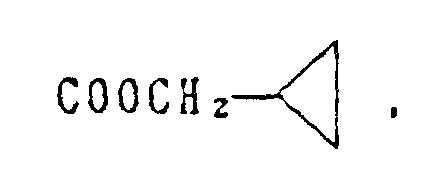


- Z :
- F, Cℓ,Br, I, NO2, OMe, OEt, OPr-n, OPr-i, CF3, CN, SMe, SOMe, SO2Me, SCF3, SOCF3, SO2CF3
- Q :
- H, Me, Et, n-Pr, i-Pr, n-Bu, i-Bu, s-Bu, t-Bu, CH2CH2Cℓ, CH2CF3, CHCℓ Me, CH2CH2Br, CHCℓ CH2Cℓ, CH2CH=CH2, CH2CMe=CH2, CH2CH=CHMe, CH2C≡CH, CH2CCℓ=CH2, CH2CN, CH2Ph, CH2Ph-Cℓ-2, CH2Ph-Cℓ-3, CH2Ph-Me-2,
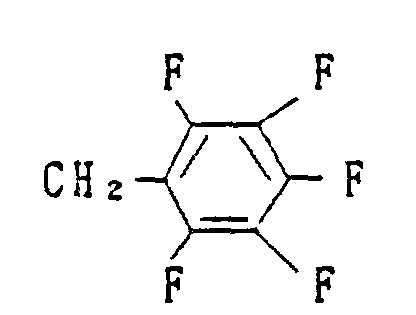

- When Q is a hydrogen atom, the compound may readily form a salt with a metal or with an organic base.
- As such a metal, sodium, potassium, calcium, lithium, barium, magnesium, iron, copper, nickel or manganese may be mentioned.
- As such an organic base, methylamine, dimethylamine, trimethylamine, ethylamine, diethylamine, triethylamine, n-propylamine, di-n-propylamine, i-propylamine, di-i-propylamine, n-butylamine, i-butylamine, sec-butylamine, tert-butylamine, piperidine, pyrrolidine, morpholine, pyridine, N,N-dimethylaniline or choline may be mentioned.
- In the course of researches on the herbicidal properties of various organic compounds with an aim to develop useful herbicides, the present inventors have found that the above-mentioned compound of the present invention exhibits excellent herbicidal activities against narrow leaf weeds (gramineous and cyperaceous weeds) and against broad leaf weeds and no substantial phytotoxicity against useful plants e.g. crop plants such as Zea mays (corn), Sorghum bicolor (sorgo), Triticum spp (wheat) and Hordeum vulgare (barley). The present invention has been accomplished on the basis of this discovery.
- The compound of the present invention exhibits strong herbicidal activities in each of soil treatment, soil incorporation treatment and foliage treatment. On the other hand, it exhibits no phytotoxicity against crop plants such as Zea mays, Sorghum bicolor, Triticum spp and Hordeum vulgare in a practical application in any of soil treatment, soil incorporation treatment and foliage treatment. Thus, the compound of the present invention has high selectivity and it is extremely effective for controlling weeds during the cultivation of these crop plants. Namely, the compound of the present invention exhibits strong herbicidal activities against noxious weeds such as Setaria viridis (green foxtail), Echinochloa crus-galli (barnyardgrass), Amaranthus lividus (livid amaranth), Polygonum longisetum (persicaria blumei gross), Xanthium strumarium (cocklebur), Abutilon theophrasti (velvet leaf) and Cyperus esculentus (yellow nutsedge), which develop during the cultivation of Zea mays or Sorghum bicolor. The herbicidal activities against gramineous weeds and Cyperus esculentus are remarkably high and extremely unique. Heretofore, during the cultivation of Zea mays or Sorghum bicolor, it has been common to employ atrazine or cyanazine as a triazine-type herbicide, or alachlor or metolachlor as an acid anilide-type herbicide. However, atrazine and cyanazine have poor herbicidal activities against gramineous weeds although they show high activities against broad leaf weeds, and their activities against Cyperus esculentus are very low. On the other hand, alachlor and metolachlor have poor activities against broad leaf weeds although their activities against gramineous weeds are high, and their activities against Cyperus esculentus are very poor. Thus, it has been difficult to eradicate all the weed species by a single application of such herbicides.
- As a result of various studies, the present inventors have found the compound of the present invention which exhibits excellent herbicidal effects against a wide range of weeds, and the present invention has been accomplished on the basis of this discovery. The compound of the present invention also has a feature that it exhibits no phytotoxicity against crop plants such as Zea mays, Sorghum bicolor, Triticum spp and Hordeum vulgare and thus can safely be applied to the fields for such crop plants.
- Further, the compound of the present invention includes a compound which shows selectivity between Oryza sativa (rice) and Echinochloa crus-galli (barnyardgrass), and it also includes a compound having selectivity for a useful plant such as Gossypium spp (cotton), Beta vulgaris (sugar beat) or Glycine max (soybean).
- Heretofore, it has been known that 4-benzoylpyrazole derivatives have excellent herbicidal activities. For example, pyrazolate (common name) is commercially available and widely used for practical application. However, such conventional herbicides are restricted in their application to paddy fields, and their activities are very poor in their application to upland fields. Whereas, as a result of extensive research for many years on 4-benzoylpyrazole derivatives, the present inventors have finally found that the compound of the present invention which simultaneously satisfies the various conditions for substituents in the structure as specified above, exhibits strong herbicidal activities in the application to upland fields in each of soil treatment, soil incorporation and foliage treatment. It has been found that the compound of the present invention exhibits particularly high activities against gramineous weeds and Cyperus esculentus.
- The compound of the present invention can readily be prepared by any one of the following reactions.
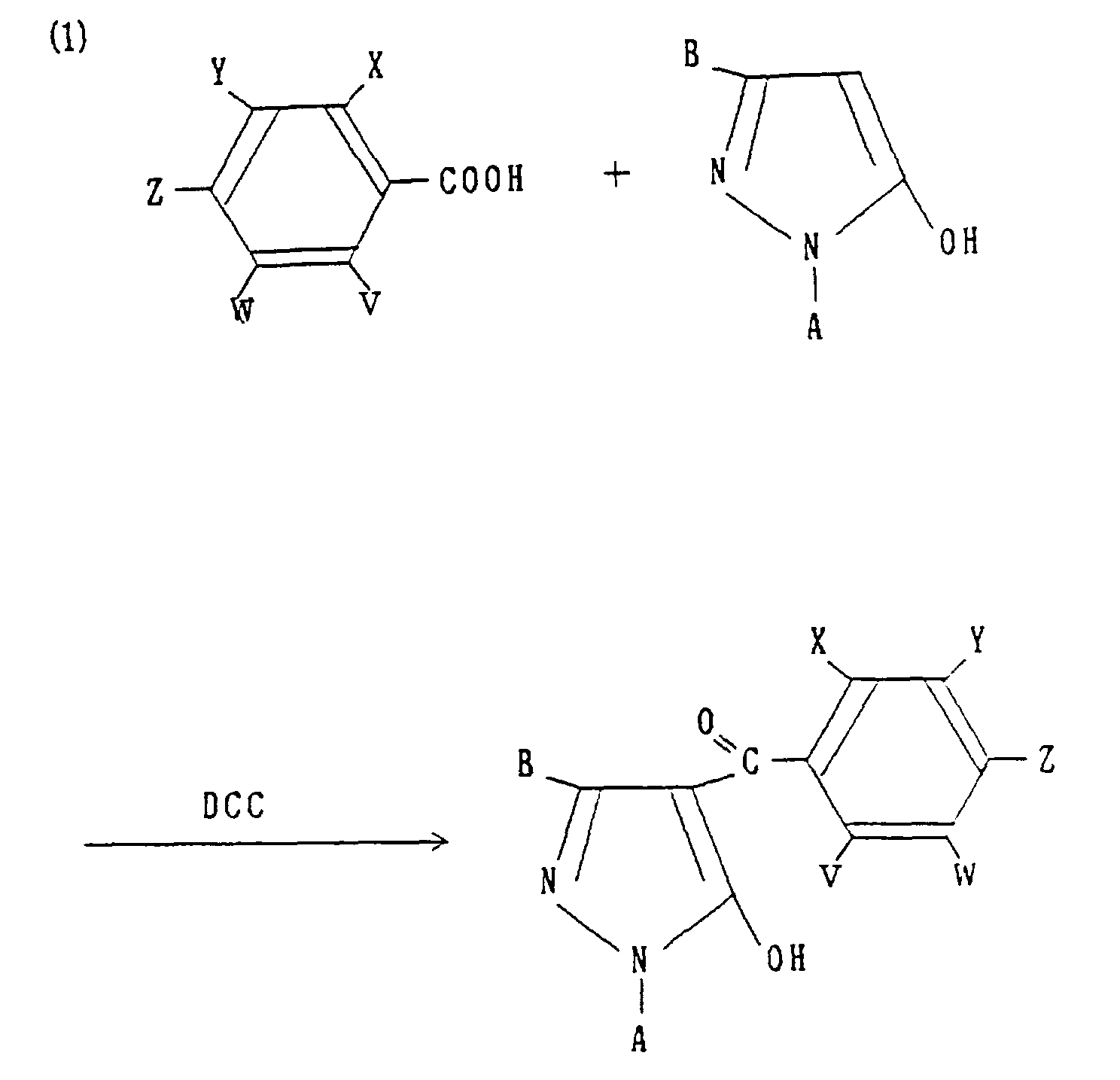


- In the above formulas, A, B, X, Y, Z, Q, V and W are as defined above, E is a halogen atom, a methanesulfonyloxy group or a p-toluenesulfonyloxy group. Further,

- Reaction scheme (1) represents a reaction wherein benzoic acid having suitable substituents and 5-hydroxypyrazole are reacted in an inert solvent in the presence of DCC and a base to obtain 4-benzoyl-5-hydroxypyrazole. DCC is used in an amount of from 1.0 to 1.5 mols per mol of the benzoic acid and pyrazole. The solvent may be any solvent so long as it is inert to the reaction. Particularly preferred is tert-butyl alcohol, tert-amyl alcohol or isopropyl alcohol. The base may not necessarily be required. However, in general, the yield can be improved by using a base. There is no particular restriction as to the base, but potassium carbonate or sodium carbonate may preferably be employed. The reaction temperature may range from room temperature to the boiling point of the solvent, but is preferably from 50 to 100°C.
- The reaction time is usually from 0.5 to 20 hours.
- Reaction scheme (2) shows a reaction wherein benzoyl chloride having suitable substituents and 5-hydroxypyrazole are reacted to form a benzoyl ester, which is then rearranged to a 4-benzoyl compound.
- The benzoyl esterification can be accomplished in an inert solvent (such as an aromatic hydrocarbon, a fatty acid ester, a halogenated hydrocarbon, an ether, acetonitrile, dimethylsulfoxide or N,Nʹ-dimethylformamide) or in a two phase system with such a solvent and water or in a mixture of such solvents in the presence of a suitable dehydrochlorinating agent (e.g. an inorganic base such as sodium hydroxide, potassium hydroxide or sodium hydrogencarbonate, or an organic base such as pyridine or triethylamine) at a temperature of from room temperature to 100°C for from 10 minutes to 5 hours.
- The rearrangement reaction can be accomplished by means of a Lewis acid such as anhydrous aluminum chloride or a base. As the base, potassium carbonate, calcium hydroxide or sodium carbonate may be used. The Lewis acid or base is used usually in an amount of from 1 to 10 mol times.
- No solvent is required. However, in some cases, it is advantageous to use a solvent having a suitable boiling point to improve the operation efficiency or the yield. As such an advantageous example, use of dioxane or diglyme may be mentioned.
- The reaction temperature is usually from 50 to 150°C, and the reaction time is usually from 15 minutes to 10 hours.
- Reaction scheme (3) shows a reaction wherein 4-benzoyl-5-hydroxypyrazole is condensed with a halide, a methanesulfonic acid ester or a p-toluenesulfonic acid ester.
- For this reaction, it is preferred to employ from 1 to 3 mol times of a dehydrohalogenating agent. As such a dehydrohalogenating agent, an inorganic base such as sodium hydroxide, potassium hydroxide, sodium carbonate, sodium hydrogencarbonate or potassium carbonate, or an organic base such as pyridine or triethylamine, may be mentioned.
- There is no particular restriction as to the solvent so long as it is inert to the reaction. A wide range of solvents including an aromatic hydrocarbon, a fatty acid ester, a halogenated hydrocarbon, an ether, a ketone, an aliphatic hydrocarbon, acetonitrile, dimethylsulfoxide and dimethylformamide may be used.
- The reaction temperature may be optionally selected within a range of from room temperature to the boiling point of the solvent. The reaction time is usualy from 30 minutes to 30 hours.
- Reaction scheme (4) shows a reaction wherein 4-benzoyl-5-hydroxypyrazole is converted to a 5-chloro compound by a chlorinating agent, followed by condensation with a suitable alcohol or acid.
- As the chlorinating agent, phosphorus oxychloride, phosphorus pentachloride or thionyl chloride may be mentioned.
- As the solvent, a wide range of solvents inert to the reaction, such as dimethylformamide, may be employed. However, the reaction can be conducted without any solvent.
- The reaction temperature is preferably from 30 to 150°C, and the reaction time is usually from 30 minutes to 10 hours. In some cases, the reaction time may be shortened or the yield may be improved by an addition of a dehydrohalogenating agent.
- The condensation reaction with an alcohol or acid is conducted by an addition of a dehydrohalogenating agent.
- As such a dehydrohalogenating agent, a base such as sodium hydroxide, potassium hydroxide, sodium carbonate, potassium carbonate, sodium alkoxide or sodium hydride may be employed.
- The solvent may be any solvent which is inert to the reaction (such as an aromatic hydrocarbon, an ether, a ketone or N,Nʹ-dimethylformamide). The reaction temperature may be selected within a range of from room temperature to the boiling point of the solvent.
- The benzoic acids or benzoyl chlorides used as the starting materials for the compounds of the present invention may readily be prepared by a proper combination of various known syntheses. For instance, compounds wherein the substituent Z in the benzene ring is -S(O)nCH3 can be prepared in accordance with the following reaction schemes.


- In the above formulas, X, Y, V and W are as defined above, and Hal is a halogen atom.
- Now, the preparation of benzoic acids will be described in detail with reference to Reference Examples. However, it should be understood that the present invention is by no means restricted by such specific Examples.
- 39.0 g (0.2 mol) of methyl 2-methyl-3-nitrobenzoate was dissolved in 600 ml of tert-butanol, and 19.0 g of sodium borohydride was added thereto. Under refluxing, 150 ml of methanol was dropwise added thereto over a period of 1 hour. The refluxing was continued further for 1 hour to complete the reaction. The reaction mixture was left to cool, and then water was added thereto. The solvent was distilled off under reduced pressure. To the residue, water and chloroform were added, and the organic layer was separated and dried over anhydrous sodium sulfate. Then, the solvent was distilled off to obtain 30.7 g of 2-methyl-3-nitrobenzyl alcohol.
- 30.1 g (0.18 mol) of 2-methyl-3-nitrobenzyl alcohol obtained in the preceding step was dissolved in 200 ml of benzene, and 0.2 g of tetra-n-butylammonium bromide and a 50% aqueous solution of 20.1 g of sodium hydroxide were added thereto sequentially. Then, 27.2 g of dimethyl sulfate was dropwise added thereto at room temperature. Further, the reaction was conducted for 3 hours under stirring. Water was added to the reaction solution, and the organic layer was separated and washed sequentially with water, a 2% hydrochloric acid aqueous solution, water and a saturated sodium chloride aqueous solution. Then, the solvent was distilled off to obtain 30.9 g of 2-methyl-3-nitrobenzyl methyl ether as an oily substance.
- To 30.7 g (0.17 mol) of the above-mentioned 2-methyl-3-nitrobenzyl methyl ether, 200 ml of methanol was added. After the compound was dissolved in methanol, 92 ml of concentrated hydrochloric acid was gradually added thereto. Then, 30.4 g of iron powder was gradually added so that the reaction temperature became at a level of not higher than 60°C, and the reaction was continued further for 1 hour.
- To the reaction solution, 300 ml of water was added, and sodium hydroxide was added until the pH became higher than 8. To the slurry thus obtained, chloroform was added, and the mixture was thoroughly stirred. Then, the solid was separated by filtration, and an organic layer was separated from the filtrate.
- This organic layer was washed sequentially with water and a saturated sodium chloride aqueous solution and then dried over anhydrous sodium sulfate. Further, the solvent was distilled off under reduced pressure to obtain 23.1 g of 3-methoxymethyl-2-methylaniline as an oily substance.
- 22.6 g (0.15 mol) of 3-methoxymethyl-2-methylaniline was dissolved in 300 ml of methanol. Then, 36.5 g of sodium thiocyanate was added thereto to obtain a uniform solution. This solution was cooled to 0°C, and 100 ml of a saturated methanol solution of sodium bromide with 25.2 g of bromine was dropwise added thereto so that the reaction temperature did not exceed 5°C. After the dropwise addition, the mixture was stirred at a temperature of not higher than 5°C for 1 hour and at room temperature for 1 hour to complete the reaction. The reaction solution was poured into 1 liter of water and neutralized with a 5% sodium carbonate aqueous solution. Chloroform was added to extract the oily substance. The chloroform layer was washed with water and a saturated sodium chloride aqueous solution and dried over anhydrous sodium sulfate. Then, the solvent was distilled off under reduced pressure to obtain 29.6 g of the desired product.
- 29.1 g (0.14 mol) of 3-methoxymethyl-2-methyl-4-thiocyanoaniline was dissolved in 200 ml of ethanol and mixed with 100 ml of an aqueous solution containing 33.6 g of sodium sulfide nonahydrate at room temperature. Then, 21.9 g of methyl iodide was dropwise added thereto, and the mixture was reacted at room temperature for 3 hours. After completion of the reaction, the solvent was distilled off under reduced pressure, and water and chloroform were added to the residue. Then, the organic layer was separated and washed sequentially with water and a saturated sodium chloride aqueous solution and then dried over anhydrous sodium sulfate. The solvent was distilled off under reduced pressure to obtain 25.6 g of the desired product as an oily substance.
- To 25.6 g (0.13 mol) of 3-methoxymethyl-2-methyl-4-methylthioaniline, 100 ml of water and 33 ml of concentrated hydrochloric acid were added to convert it to an aniline hydrochloride. This solution was cooled to 0°C, and 30 ml of an aqueous solution containing 9.3 g of sodium nitrite was dropwise added thereto so that the reaction temperature did not exceed 5°C. After completion of dropwise addition, stirring was continued further for 30 minutes to complete diazotization. 100 ml of an aqueous solution containing 33 g of potassium iodide was heated to 70°C, and the aqueous solution of the diazonium salt obtained above was gradually added thereto and decomposed. The reaction solution was stirred further for 1 hour at 70°C and then left to cool. The oil component was extracted with benzene. The benzene layer was washed sequentially with water, a saturated sodium hydrogensulfite aqueous solution, water and a saturated sodium chloride aqueous solution. Then, the solvent was distilled off under reduced pressure, and the residue was purified by column chromatography (eluent: benzene) to obtain 30.0 g of the desired product. Melting point: 56.0 - 59.0°C.
- 27.7 g (0.09 mol) of 3ʹ-iodo-2ʹ-methyl-6ʹ-methylthiobenzyl methyl ether was dissolved in 100 ml of dried tetrahydrofuran, and 63 ml of a 1.5 M n-butyllithium n-hexane solution was dropwise added thereto at -70°C. After the dropwise addition, the mixture was stirred for 15 minutes at the same temperature, and then dried carbon dioxide gas was thoroughly blown into the reaction solution until the heat generation of the reaction solution stopped. After the reaction, the temperature of the solution was returned to room temperature, and water and diethyl ether were added for liquid separation. The aqueous layer thus obtained was further washed twice with diethyl ether, and then concentrated hydrochloric acid was added to bring the pH<1. Precipitated crystals were collected by filtration, thoroughly washed with water and dried to obtain 14.4 g of the desired product. Melting point: 192.0 - 194.0°C
- To 11.3 g (0.05 mol) of 3-methoxymethyl-2-methyl-4-methylthiobenzoic acid, 120 ml of acetic acid and 120 ml of a 35% hydrogen peroxide aqueous solution were added, and the mixture was reacted at 80°C for 1 hour. After cooling, the reaction solution was poured into ice water, whereupon precipitated crystals were collected by filtration, then washed with water and dried to obtain 12.3 g of the desired product. Melting point: 129.0 - 131.0°C.
- 40 g of methyl 2-methyl-3-nitrobenzoate was dissolved in 120 ml of methanol, and 157 g of concentrated hydrochloric acid was added thereto. Then, 36.8 g of iron powder was gradually added while maintaining the mixture at a temperature of not higher than 60°C. The mixture was stirred at room temperature for 4 hours and then poured into 1 liter of ice water. The solution was neutralized with sodium carbonate and extracted with chloroform (after filtering off insolubles). The extract was washed with a saturated sodium chloride aqueous solution and dried over anhydrous sodium sulfate. Then, the solvent was distilled off to obtain 27.8 g of the desired product as an oily substance.
- While maintaining a solution comprising 27.7 g of methyl 3-amino-2-methylbenzoate, 41.5 g of sodium thiocyanate and 250 ml of methanol at a temperature of not higher than 0°C, 100 ml of sodium bromide-saturated methanol with 28.1 g of bromine was slowly dropwise added thereto. The mixture was stirred at room temperature for 3 hours and then poured into 1 liter of ice water. The solution was neutralized with sodium carbonate and then extracted with chloroform. The extract was washed with a saturated sodium chloride aqueous solution and dried over anhydrous sodium sulfate. Then, the solvent was distilled off to obtain 34.0 g of the desired product as an oily substance.
- To a solution comprising 39.5 g of sodium sulfide nonahydrate and 110 ml of water, a solution comprising 32.9 g of methyl 3-amino-2-methyl-6-thiocyanobenzoate and 300 ml of ethanol was dropwise added. The mixture was stirred at room temperature for 1.5 hours, and 24.0 g of methyl iodide was dropwise added under cooling with ice. The mixture was stirred further at room temperature for 2 hours and then concentrated under reduced pressure. A saturated sodium chloride aqueous solution was added thereto, and the mixture was extracted with chloroform. The extract was dried over anhydrous sodium sulfate. Then, the solvent was distilled off to obtain 30.1 g of the desired product as an oily substance.
- 28 g of methyl 3-amino-2-methyl-6-methylthiobenzoate was stirred in 150 ml of concentrated hydrochloric acid at room temperature for 2 hours to convert it to a hydrochloride. Then, while maintaining the mixture at a temperature of not higher than 0°C, a solution comprising 11.9 g of sodium nitrite and 20 ml of water was dropwise added thereto to obtain a diazonium salt solution. The diazonium salt solution was dropwise added to a solution comprising 28.4 g of potassium iodide and 90 ml of water while maintaining the solution at 80°C. After completion of the dropwise addition, the mixture was stirred at 80°C for 15 minutes and left to cool. Water was added thereto, and the mixture was extracted with chloroform. The extract was washed with an aqueous sodium hydrogensulfite solution and water and then dried over anhydrous sodium sulfate. The solvent was distilled off to obtain 40 g of the desired product as a crude product. The crude product was purified by silica gel column chromatography (eluted with benzene) to obtain 36.0 g of a purified product as an oily substance.
- While maintaining a solution comprising 20.0 g of methyl 3-iodo-2-methyl-6-methylthiobenzoate and 70 ml of dried tetrahydrofuran at a temperature of not higher than -60°C under a nitrogen atmosphere, 42 ml of a 1.5 M n-butyllithium n-hexane solution was dropwise added thereto. Fifteen minutes later, dried carbon dioxide gas was thoroughly blown into the mixture while maintaining it at a temperature of not higher than -50°C. After purging carbon dioxide gas with nitrogen, 12.7 g of diisopropylamine was dropwise added thereto, and the mixture was stirred until the temperature reached room temperature. The mixture was concentrated under reduced pressure. Water was added thereto and the mixture was washed with chloroform. The aqueous solution was acidified with concentrated hydrochloric acid and then extracted with chloroform. The extract was dried over anhydrous sodium sulfate. The solvent was distilled off to obtain 7.5 g of the desired product. Melting point: 178 - 178.5°C.
- A solution comprising 5.0 g of 3-methoxycarbonyl-2-methyl-4-methylthiobenzoic acid, 25 ml of acetic acid and 25 ml of hydrogen peroxide (35%) was stirred at 80°C for 3 hours. After cooling, the mixture was poured into ice water and extracted with chloroform. The extract was dried over anhydrous sodium sulfate. Then, the solvent was distilled off to obtain 5.1 g of the desired product. Melting point: 151 - 152°C
- 12.1 g of methyl 2-chloro-4-methanesulfonyl-3-methylbenzoate was dissolved in 250 ml of carbon tetrachloride, and the solution was refluxed under stirring. Then, 7.5 g of bromine and 1 g of benzoyl peroxide were gradually added thereto over a period of 30 minutes, and the solution was further refluxed for 4 hours under heating. After cooling, 200 ml of chloroform was added thereto, and the mixture was washed with a 5% sodium hydrogensulfite aqueous solution. The organic layer was separated and dried over anhydrous sodium sulfate. The solvent was distilled off under reduced pressure to obtain a crude product. The crude product was washed with ethyl ether to obtain 13.2 g of crystals of the desired product. Melting point: 77 - 78°C
- To 100 ml of tetrahydrofuran, 1.3 g of ethanethiol and 1.5 g of potassium carbonate and then 4.4 g of methyl 3-bromomethyl-2-chloro-4-methanesulfonylbenzoate were added, and the mixture was stirred for 1 day at room temperature. Then, the mixture was stirred further for 1 hour at a temperature of from 50 to 60°C. After cooling, chloroform was added thereto, and the mixture was washed with a dilute potassium carbonate aqueous solution. The chloroform layer was separated and dried. Then, the solvent was distilled off to obtain 4.1 g of methyl 2-chloro-3-ethylthiomethyl-4-methanesulfonylbenzoate as an oily substance.
- To a solution mixture comprising 50 ml of a 10% sodium hydroxide aqueous solution and 150 ml of methanol, 3.9 g of methyl 2-chloro-3-ethylthiomethyl-4-methanesulfonylbenzoate was added, and the mixture was stirred at room temperature for 30 minutes. Methanol was distilled off under reduced pressure, and a dilute hydrochloric acid was added to the residue for acid precipitation. The mixture was extracted with ethyl acetate, and the extract was dried. Then, the solvent was distilled off to obtain 3.5 g of the desired product. Melting point: 172 - 174°C.
- To a solution comprising 12.0 g of methyl 3-bromomethyl-2-chloro-4-methanesulfonylbenzoate prepared in Reference Example 3(1) and 100 ml of methanol, 50 ml of a methanol solution containing 1.7 g of sodium methoxide was added, and the mixture was stirred at room temperature overnight. The solvent was distilled off under reduced pressure. Then, dilute hydrochloric acid was added to the residue, and the mixture was extracted with chloroform. The extract was washed with water and dried over anhydrous sodium sulfate. Then, the solvent was distilled off to obtain 9.5 g of the desired product as a crude product. The crude product was purified by silica gel column chromatography (eluted with benzene) to obtain 7.5 g of a purified product as an oily substance.
- To a solution comprising 3.0 g of methyl 2-chloro-4-methanesulfonyl-3-methoxymethylbenzoate and 20 ml of methanol, a solution comprising 0.57 g of sodium hydroxide (93%) and 2 ml of water was added, and the mixture was stirred at room temperature for 30 minutes. After an addition of 10 ml of water, the mixture was concentrated under reduced pressure. Then, dilute hydrochloric acid was added thereto, and the mixture was extracted with chloroform. The extract was dried over anhydrous sodium sulfate. Then, the solvent was distilled off to obtain 2.6 g of the desired product. Melting point: 137 - 141°C.
- The desired product was prepared in the same manner as in Reference Example 1. Melting point: 137 - 141°C
- The physical properties of the intermediates were as follows:
- (1) 2-Chloro-3-nitrobenzyl alcohol: Oily substance
- (2) 2ʹ-Chloro-3ʹ-nitrobenzyl methyl ether: Oily substance
- (3) 2-Chloro-3-methoxymethylaniline: Oily substance
- (4) 2-Chloro-3-methoxymethyl-4-thiocyanoaniline: Melting point: 90 - 96°C
- (5) 2-Chloro-3-methoxymethyl-4-methylthioaniline: Oily substance
- (6)2ʹ-Chloro-3ʹ-iodo-6ʹ-methylthiobenzyl methyl ether: Melting point: 53 - 56°C
- The desired product was prepared in the same manner as in Reference Example 2. Melting point 160 - 162°C
- The physical properties of the intermediates were as follows:
- (1) Methyl 3-amino-2-chlorobenzoate: Oily substance
- (2) Methyl 3-amino-2-chloro-6-thiocyanobenzoate: Melting point: 80 - 83°C
- (3) Methyl 3-amino-2-chloro-6-methylthiobenzoate: Melting point: 70 - 72°C
- (4) Methyl 2-chloro-3-iodo-6-methylthiobenzoate: Oily substance
- (5) 2-Chloro-3-methoxycarbonyl-4-methylthiobenzoic acid: Melting point: 176 - 179°C
- The desired compound was prepared in the same manner as in Reference Example 2. Melting point: 118 - 121°C
- The physical properties of the intermediates were as follows:
- (1) 2-Methoxyethyl 3-amino-2-methylbenzoate: Oily substance
- (2) 2-Methoxyethyl 3-amino-2-methyl-6-thiocyanobenzoate: Melting point: 79 - 81°C
- (3) 2-Methoxyethyl 3-amino-2-methyl-6-methylthiobenzoate: Oily substance
- (4) 2-Methoxyethyl 3-iodo-2-methyl-6-methylthiobenzoate: Oily substance
- (5) 3-[(2-methoxyethyl)oxycarbonyl]-2-methyl-4-methylthiobenzoic acid: Melting point: 90 - 93°C
- 16.1 g of the compound of Reference Example 2(3) was stirred in 150 ml of hydrobromic acid (48%) to convert it into a hydrobromide. While maintaining the solution at a temperature of not higher than 0°C, a solution comprising 7.2 g of sodium nitrite and 20 ml of water was dropwise added to obtain a diazonium salt solution. The diazonium salt solution was dropwise added to a solution comprising 6.0 g of cuprous bromide and 7.7 g of hydrobromic acid (48%) while refluxing the solution under heating. After completion of the dropwise addition, the mixture was further refluxed for 1 hour under heating and then left to cool. Ice water was added thereto, and the mixture was extracted with chloroform. The extract was washed with an aqueous sodium hydrogensulfite solution and water and then dried over anhydrous sodium sulfate. The solvent was distilled off to obtain 19.2 g of the desired product as a crude product. The crude product was purified by silica gel column chromatography (eluted with benzene) to obtain 17.1 g of a purified product as an oily substance.
- To 100 ml of an ethanol solution containing 17.0 g of methyl 3-bromo-2-methyl-6-methylthiobenzoate, 16 g of a 50% sodium hydroxide aqueous solution was added, and the mixture was refluxed for 3 hours under heating. The reaction mixture was concentrated under reduced pressure. Then, water was added thereto, and the mixture was washed with chloroform. The aqueous layer was acidified with concentrated hydrochloric acid and extracted with chloroform. The extract was dried over anhydrous sodium sulfate. The solvent was distilled off to obtain 15.9 g of the desired product. Melting point: 98 - 103°C
- Thionyl chloride was added to 15.8 g of 3-bromo-2-methyl-6-methylthiobenzoic acid, and the mixture was refluxed for 4 hours under heating. Thionyl chloride was distilled off, and 70 ml of n-propanol was added to the residue under cooling with ice. Then, a solution comprising 7.3 g of pyridine and 20 ml of n-propanol was dropwise added thereto. The mixture was stirred at room temperature overnight and then concentrated under reduced pressure. Then, ethyl acetate was added thereto, and the mixture was washed sequentially with a 5% sodium carbonate aqueous solution, 10% hydrochloric acid and water and then dried over anhydrous sodium sulfate. Then, the solvent was distilled off under reduced pressure to obtain 18 g of the desired product as a crude product. The crude product was purified by silica gel column chromatography (eluted with benzene) to obtain 16.6 g of a purified product as an oily substance.
- This product was prepared in the same manner as in Reference Example 2(5). Melting point: 138 - 142°C
- This compound was prepared in the same manner as in Reference Example 2(6). Melting point: 142 - 146°C
- This compound was prepared from the compound of Reference Example 6(4) in the same manner as in Reference Example 8(2)-(5). Melting point: 146 - 148°C
- The physical properties of the intermediates were as follows:
- (1) 2-Chloro-3-iodo-6-methylthiobenzoic acid: Melting point: 155 - 159°C
- (2) Isopropyl 2-chloro-3-iodo-6-methylthiobenzoate: Oily substance
- (3) 2-Chloro-3-isopropoxycarbonyl-4-methylthiobenzoic acid: Melting point: 114 - 118°C
- To 5.4 g of metal magnesium, 5 ml of absolute ethanol and 0.5 ml of carbon tetrachloride were dropwise added under a dry nitrogen stream. Further, 130 ml of dried diethyl ether was added under refluxing, and then a solution comprising 25 ml of a diethyl ether, 35.2 g of diethyl malonate and 20 ml of ethanol was dropwise added at a rate to maintain the refluxing. After completion of the dropwise addition, refluxing was continued for 3 hours to prepare diethyl ethoxymagnesiomalonate. To the solution of diethyl ethoxymagnesiomalonate thus obtained, 150 ml of a diethyl ether solution of 40.0 g of 2-methyl-3-nitrobenzoic acid chloride prepared from 2-methyl-3-nitrobenzoic acid and thionyl chloride, was dropwise added over a period of 20 minutes under refluxing, and the reaction was continued for 2 hours. After cooling, dilute sulfuric acid was added thereto for hydrolysis. The diethyl ether layer was washed sequentially with water and a saturated sodium chloride aqueous solution. Then, the solvent was distilled off under reduced pressure, and the residue was dried to obtain a crude product of diethyl 2-(2-methyl-3-nitrobenzoyl)malonate. To this crude product, a mixture comprising 7.5 ml of concentrated sulfuric acid, 60 ml of acetic acid and 40 ml of water was added, and the mixture was refluxed for 6 hours under heating. Then, the mixture was adjusted to pH 10 with a 20% sodium hydroxide aqueous solution. Precipitated oil component was extracted with chloroform. This chloroform layer was washed sequentially with water and a sodium chloride aqueous solution. Then, the solvent was distilled off under reduced pressure to obtain 34.0 g of the desired product. (Yield: 95%) Melting point: 53.0 -54.0°C
- To 50 ml of a methanol solution of 0.5 g of sodium hydroxide, 0.9 g of sodium borohydride was added at 0°C, and then 100 ml of a methanol solution of 14.3 g of 2ʹ-methyl-3ʹ-nitroacetophenone was dropwise added thereto. The temperature of the mixture was returned to room temperature and reacted for 1 hour. After the reaction, the reaction mixture was poured into water and extracted with benzene. The subsequent operation was conducted in a usual manner to obtain 14.3 g of the desired product as an oily substance. (Yield: 99%)
- Subsequently, the synthesis was conducted in the same manner as in Reference Example 1 to obtain intermediates (3) to (9).
- (3) 1-Methyl-2ʹ-methyl-3ʹ-nitrobenzyl methyl ether: Oily substance
- (4) 1-Methyl-3ʹ-amino-2ʹ-methylbenzyl methyl ether: Oily substance
- (5) 1-Methyl-3ʹ-amino-2ʹ-methyl-6ʹ-thiocyanobenzyl methyl ether: Solid
- (6) 1-Methyl-3ʹ-amino-2ʹ-methyl-6ʹ-methylthiobenzyl methyl ether: Oily substance
- (7) 1-Methyl-3ʹ-iodo-2ʹ-methyl-6ʹ-methylthiobenzyl: Oily substance
- (8) 3-(1-Methoxyethyl)-2-methyl-4-methylthiobenzoic acid: Oily substance
- (9) 4-Methanesulfonyl-3-(1-methoxyethyl)-2-methylbenzoic acid: Melting point: 106 - 109°C
- To a solution of 25 ml of fuming nitric acid and 20 ml of sulfuric acid, 25 g of 2,4-dichlorobenzoic acid was gradually added. After completion of the heat generation, the reaction mixture was poured into ice water. Precipitated solid was washed with water and dried to obtain 23.0 g of the desired product.
- 23.0 g of 2,4-dichloro-3-nitrobenzoic acid and 150 ml of thionyl chloride were refluxed for 6 hours under heating. Then, thionyl chloride was distilled off to obtain crude 2,4-dichloro-3-nitrobenzoyl chloride. 200 ml of methanol was added to the crude compound and refluxed under heating. Methanol was distilled off, and then ethyl acetate was added thereto to obtain an ethyl acetate solution. The solution was washed sequentially with a 5% sodium hydroxide aqueous solution, diluted hydrochloric acid and water. After drying, the solvent was distilled off to obtain 21.8 g of the desired product. Melting point: 72-74°C.
- Subsequently, the synthesis was conducted in the same manner as in Reference Example 1 to obtain intermediates (3) and (4), and the desired product (5).
- (3) Methyl 3-amino-2,4-dichlorobenzoate: Oily substance
- (4) Methyl 2,4-dichloro-3-iodobenzoate: Oily substance
- (5) 2,4-dichloro-3-methoxycarbonylbenzoic acid: Melting point: 183-185°C
- 5.0 g of methyl 3-bromomethyl-2-chloro-4-methanesulfonylbenzoate was added to a solution of 0.4 g of 18-crown-6 and 1.9 g of potassium cyanide in 50 ml of acetonitrile. The mixture was stirred for 72 hours at room temperature. After filtering off the solid, water was added to the filtrate, and the mixture was extracted with chloroform. After washing the extract with water and drying it, the solvent was distilled off to obtain a crude product. The crude product was purified by short silica gel column chlomatography (eluent: chloroform) to obtain 4.1 g of the desired product. Melting point: 151-155°C.
- To 4.0 g of methyl 2-chloro-3-cyanomethyl-4-methanesulfonylbenzoate and 50 ml of methanol, 5 ml of an aqueous solution containing 0.72 g of sodium hydroxide (93%) was gradually added. The mixture was stirred for 15 minutes at room temperature. Then, the reaction mixture was neutralized with diluted hydrochloric acid, methanol was distilled off under reduced pressure and the concentrated solution was extracted with chloroform. After washing the extract with water and drying it, chloroform was distilled off to obtain 0.9 g of the desired product. Melting point: 169-172°C
- 50 ml of a DMF solution containing 5.0 g of methyl 3-bromomethyl-2-chloro-4-methanesulfonylbenzoate and 1.2 g of sodium acetate, was stirred for 2 hours at 100°C. After cooling, the reaction mixture was poured into ice water and extracted with chloroform. After washing the extract with water and drying it, the solvent was distilled off to obtain 4.2 g of the desired product. Melting point: 165-168°C
- 6 ml of an aqueous solution containing 1.3 g of sodium hydroxide (93%), was added to 3.9 g of methyl 3-acetoxymethyl-2-chloro-4-methanesulfonylbenzoate and 100 ml of methanol. The mixture was stirred for 30 minutes at room temperature. 50 ml of water was added thereto, and methanol was distilled off under reduced pressure. Then, the reaction mixture was acidified with hydrochloric acid and extracted with chloroform. The extract was concentrated to dryness to obtain 1.3 g of the desired product. Melting point: 240-245°C.
- 1.3 g of 2-chloro-3-hydroxymethyl-4-methanesulfonyl benzoic acid and 30 ml of acetic anhydride, was refluxed for 3 hours under heating. The reaction mixture was concentrated under reduced pressure. Then, 50 ml of water was added thereto and warmed for 1 hour. Precipitated solid was collected by filtration, washed with water and dried to obtain 1.35 g of the desired product. Melting point: 219-223°C.
- This compound was prepared in the same manner as in Reference Examples 3(1) and 4. Melting point: 130-136°C.
- The physical properties of the intermediates were as follows:
- (1) Methyl 3-bromomethyl-2,4-dichlorobenzoate: Melting point: 55-58°C
- (2) Methyl 2,4-dichloro-3-methoxymethylbenzoate: Oily substance
- The physical properties of benzoic acids prepared in accordance with the preceding Reference Examples will be given in Tables 1 and 2 including those of the preceding Reference Examples.


- By using such benzoic acids or benzoyl chlorides, compounds of the present invention can be readily prepared in accordance with reaction schemes (1) to (4).
- The present invention will be described in further detail with reference to Examples. However, it should be understood that the present invention is by no means restricted to such specific Examples.
- 1.12 g (0.01 mol) of 1-ethyl-5-hydroxypyrazole is dissolved in 30 ml of t-amyl alcohol, and then 2.59 g (0.01 mol) of 4-methanesulfonyl-3-methoxymethyl-2-methylbenzoic acid, 2.06 g (0.01 mol) of N,Nʹ-dicyclohexylcarbodiimide and 0.69 g (0.005 mol) of anhydrous potassium carbonate were sequentially added thereto. The mixture was reacted at a temperature of from 80 to 90°C for 8 hours under stirring. After completion of the reaction, t-amyl alcohol was distilled off under reduced pressure, and 30 ml of water was added to the residue to dissolve the soluble components. The mixture was subjected to filtration to separate out the insolubles. The aqueous solution thus obtained was washed with chloroform, and concentrated hydrochloric acid was added to adjust pH<1. The precipitated oil component was extracted with chloroform. The solvent was distilled off under reduced pressure, and the residue was purified with silica gel column chromatography (eluent: ethyl acetate/ethanol = 9/1) to obtain 2.3 g of the desired product. (Yield: 66%, melting point: 116 - 118°C)
- 1.12 g (0.01 mol) of 1-ethyl-5-hydroxypyrazole was dissolved in 30 ml of t-amyl alcohol, and 2.72 g (0.01 mol) of 4-methanesulfonyl-3-methoxycarbonyl-2-methylbenzoic acid, 2.27 g (0.011 mol) of N,Nʹ-dicyclohexylcarbodiimide and 0.76 g (0.0055 mol) of anhydrous potassium carbonate were sequentially added thereto. The mixture was reacted at 80°C for 6 hours under stirring. After completion of the reaction, t-amyl alcohol was distilled off under reduced pressure, and then water was added to the residue to dissolve the soluble component. The mixture was subjected to filtration to separate out the insolubles. The aqueous solution thus obtained was washed twice with chloroform, and then concentrated hydrochloric acid was added to adjust pH<1. The precipitated oil component was extracted with chloroform. The chloroform layer was washed sequentially with water and a saturated sodium chloride aqueous solution and then dried over anhydrous sodium sulfate. Then, the solvent was distilled off under reduced pressure, and the residue thus obtained was recrystallized from water/ethanol to obtain 2.26 g of the desired product. (Yield: 62%, melting point: 150 - 152°C)
- The operation and treatment were conducted in the same manner as in Example 1 except that 1.12 g of 1-ethyl-5-hydroxypyrazole was changed to 0.98 g of 5-hydroxy-1-methylpyrazole, and 2.72 g of 4-methanesulfonyl-3-methoxycarbonyl-2-methylbenzoic acid was changed to 3.00 g of 3-isopropoxycarbonyl-4-methanesulfonyl-2-methylbenzoic acid, to obtain 1.71 g of the desired product. (Yield: 45%, melting point: 192 - 194°C)
- 3 g of 2-chloro-3-ethylthiomethyl-4-methanesulfonylbenzoic acid, 0.72 g of potassium carbonate, 50 ml of t-amyl alcohol, 1.95 g of N,Nʹ-dicyclohexylcarbodiimide and 4.5 g of a 25% t-amyl alcohol solution of 1-ethyl-5-pyrazolone were mixed and heated under stirring for 4 hours at a temperature of from 70 to 80°C. After cooling, the mixture was distilled under reduced pressure, and 200 ml of water was added to the residue. After filtering off the insolubles, the filtrate was washed with chloroform. Hydrochloric acid was added to the aqueous layer, and the mixture was extracted with chloroform. The extract was dried, and the solvent was distilled off to obtain the desired product as a crude product. The crude product was recrystallized from ethanol to obtain 1.88 g of the purified product. (Melting pont: 142 - 145°C)
- 0.5 g of the compound obtained in Example 4 was dissolved in a solution comprising 30 ml of CHCl3 and 30 ml of THF at room temperature, and 2.2 equivalent of m-chloroperbenzoic acid was added thereto under cooling in ice bath. The mixture was gradually returned to room temperature and stirred for 1 day. The solvent was distilled off, and crystals thus obtained were collected by filtration and washed with ethyl ether to obtain 2.2 g of the desired product. (Melting poing: 133 - 135°C)
- 0.45 g of the compound obtained in Example 4 was dissolved in 30 ml of dioxane, and 0.21 g of sodium bromite trihydrate was added thereto. The mixture was stirred at room temperature for 30 minutes, and then water was added thereto. The mixture was extracted with chloroform. The extract was dried, and the solvent was distilled off to obtain a crude product. The crude product was purified by column chromatography (eluted with chloroform/ethanol) to obtain 0.2 g of the desired product as an oily substance.
- This compound was prepared in the same manner as in Example 2. Melting point: 167-170°C.
- A solution prepared by dissoving 0.3 g of the compound prepared in Example 7 and 0.1 g of triethylamine in 13 ml of benzene, was stirred at room temperature for 30 minutes, and then at 50°C for 3 hours. Insoluble substances were filtered off, and then the filtrate was concentrated under reduced pressure. The concentrated product was purified by silica gel column chromatography (eluent: benzene/ethyl acetate) to obtain 0.15 g of the desired product as an oily substance.
- 1.9 g of 5-hydroxy-3-methoxymethylpyrazol was added to a mixture consisting of 8 ml of an aqueous solution containing 0.5 g of potassium hydroxide (85%) and 12 ml of chloroform, and then 4-methanesulfonyl-3-methoxymethyl-2-methylbenzoyl chloride was added thereto. The mixture was stirred for 3 hours at room temperature. Then, the reaction mixture was extracted with chloroform. The chloroform solution was washed with water and dried to obtain the desired product substantially quantitatively as an oily substance.
- 3.0 g of the compound obtained in step (1), 2.7 g of potassium carbonate and 8 ml of dioxane, were stirred at 120°C for 3.5 hours. 20 ml of water was added thereto and then the mixture was left to cool. The reaction solution was washed with chloroform and acidified with hydrochloric acid. The reaction solution was extracted with chloroform, washed with water and dried to obtain 1.8 g of a crude product. The crude product was recrystallized from ethanol to obtain 1.2 g of the desired product. Melting point: 100-104°C.
- This compound was prepared in the same manner as in Example 2. Melting point: 140-144°C
- To 30 ml of a methanol solution containing 0.3 g of the compound prepared in Example 10, 5 ml of an aqueous solution containing 0.1 g of sodium hydroxide (93%) was added, and the mixture was stirred for 2 hours at room temperature. Methanol was distilled off under reduced pressure. Then, hydrochloric acid was added to the residue. The precipitated product was collected by filtration to obtain 0.2 g of the desired product. Melting point: 70-76°C.
- The physical properties of the compounds prepared in the same manner as the preceding Examples will be given in Tables 3 and 4 including those of the preceding Examples.


- The compounds represented by the Compound Nos. in the following Table are the same as represented by the corresponding Compound Nos. in Table 3.


- Compounds which can be prepared in the same manner as the preceding Examples will be given in Table 5 including those of the preceding Examples. However, the present invention is not restricted to such compounds.
- Various symbols used in Table 5 has the following meanings.


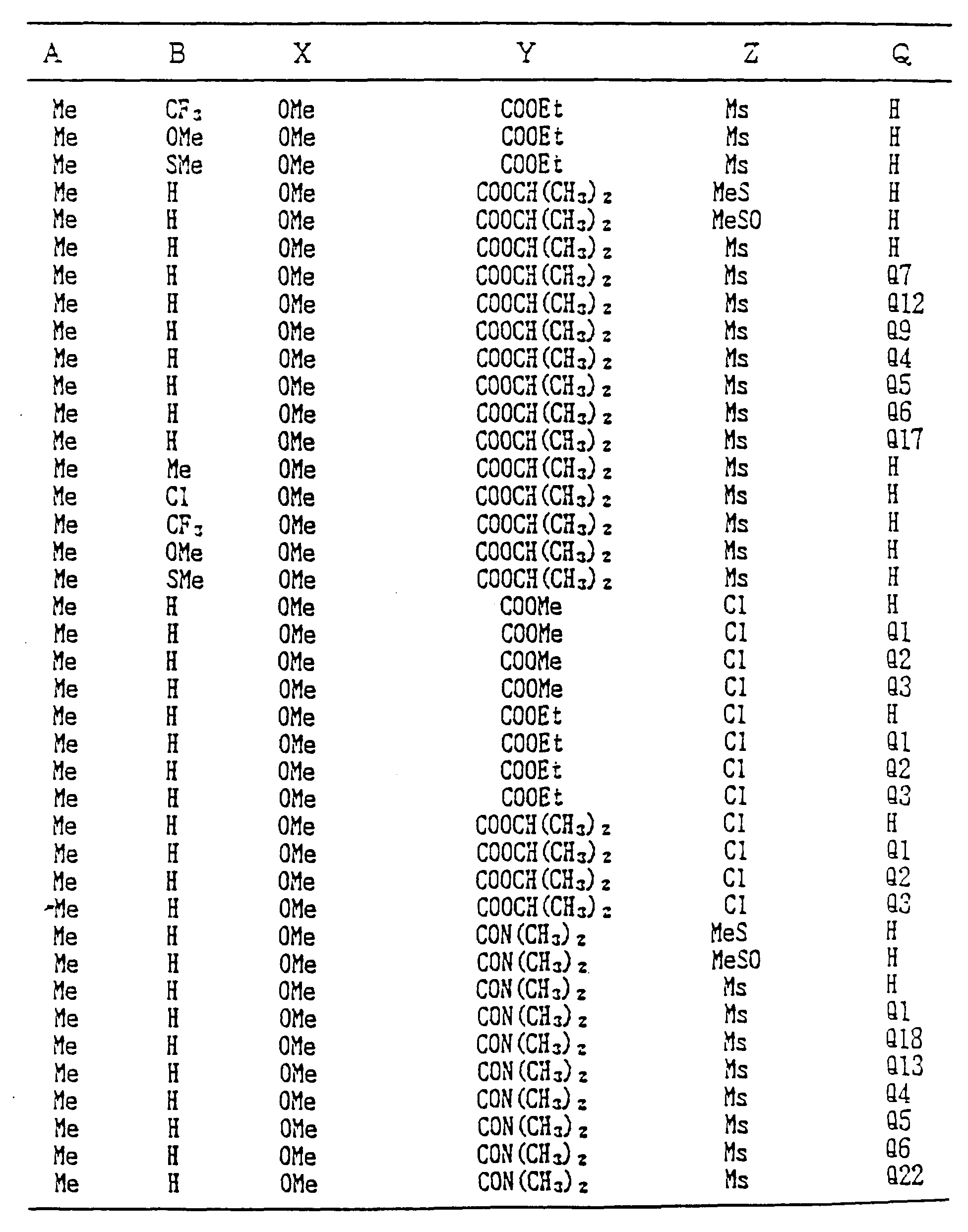


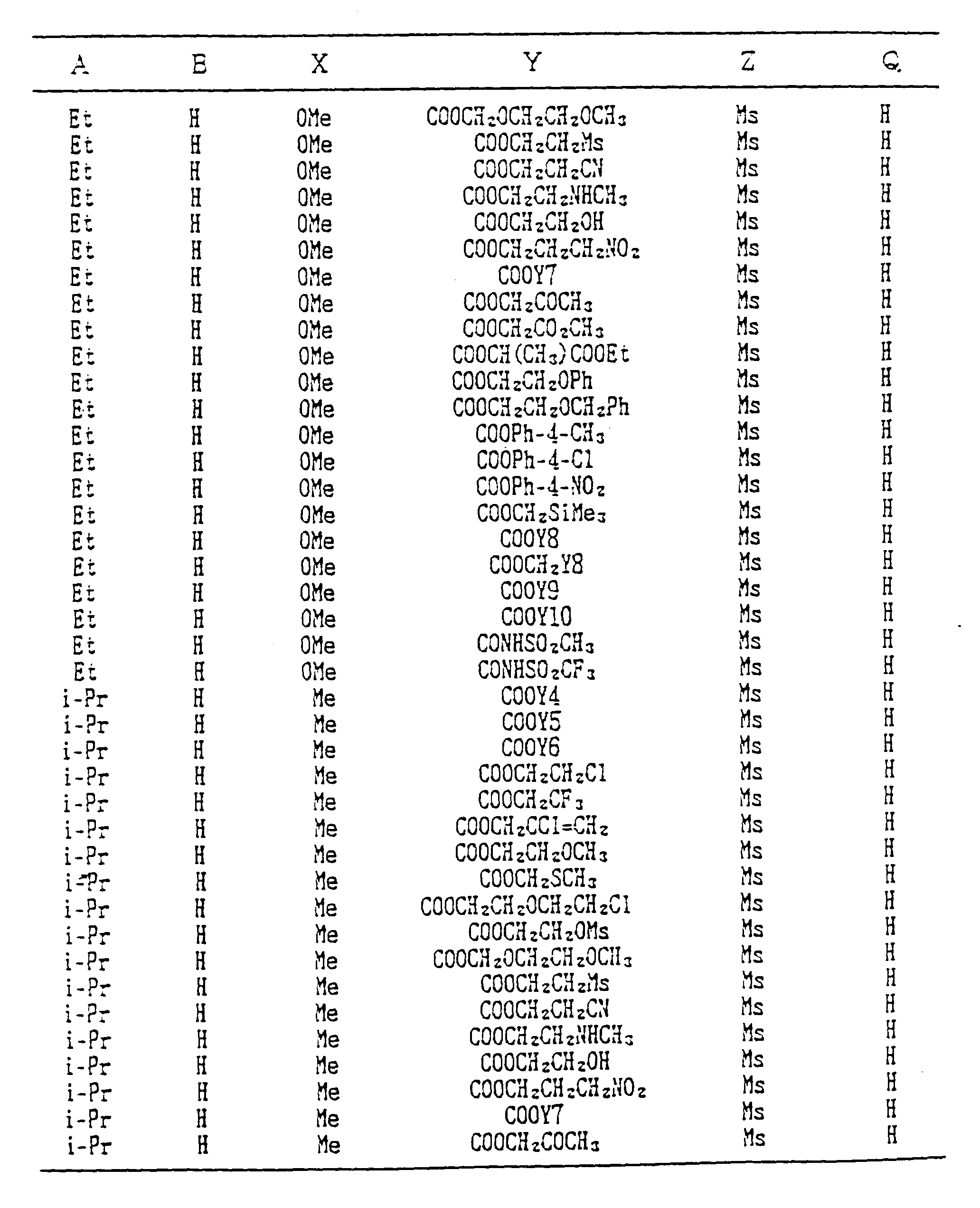


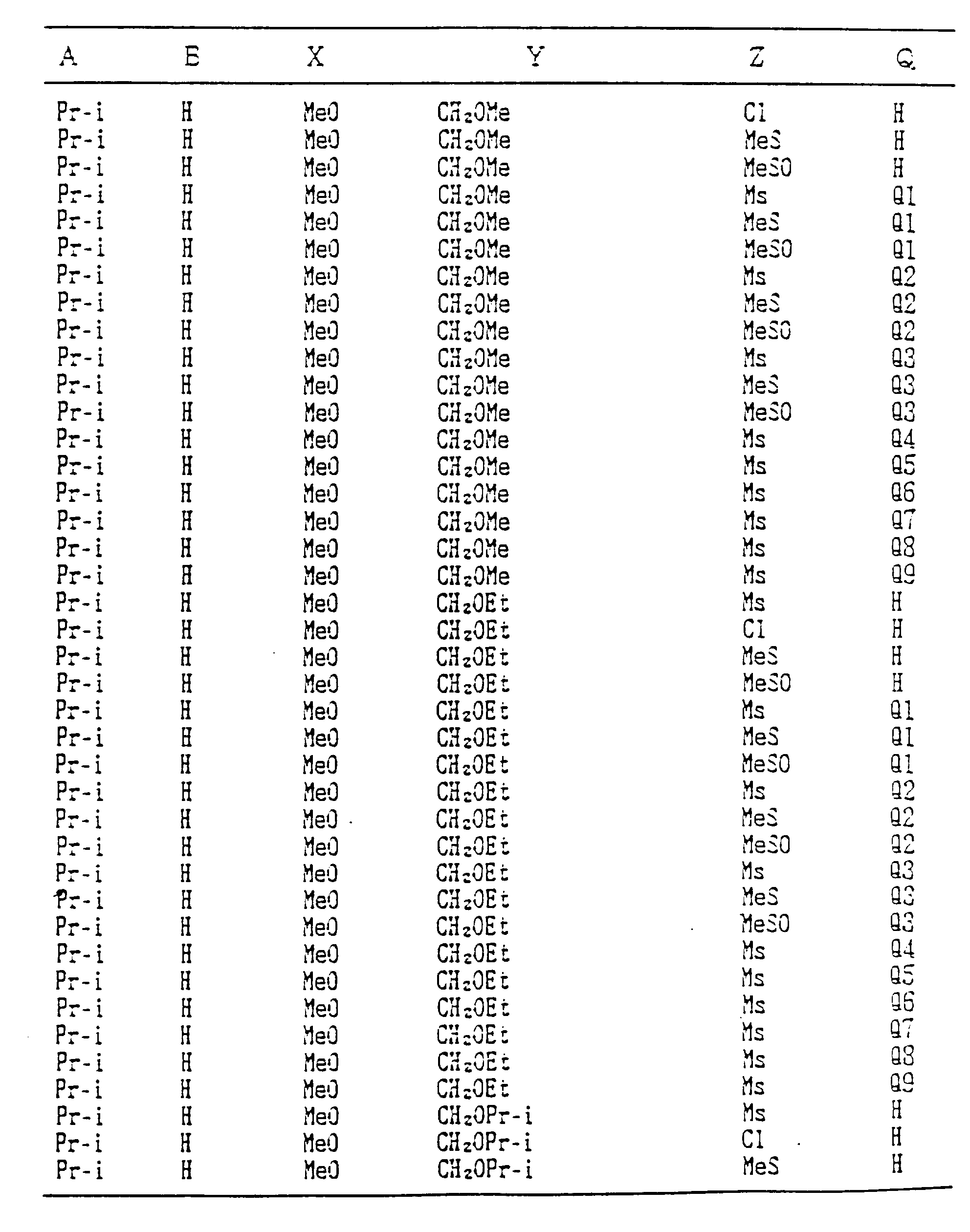


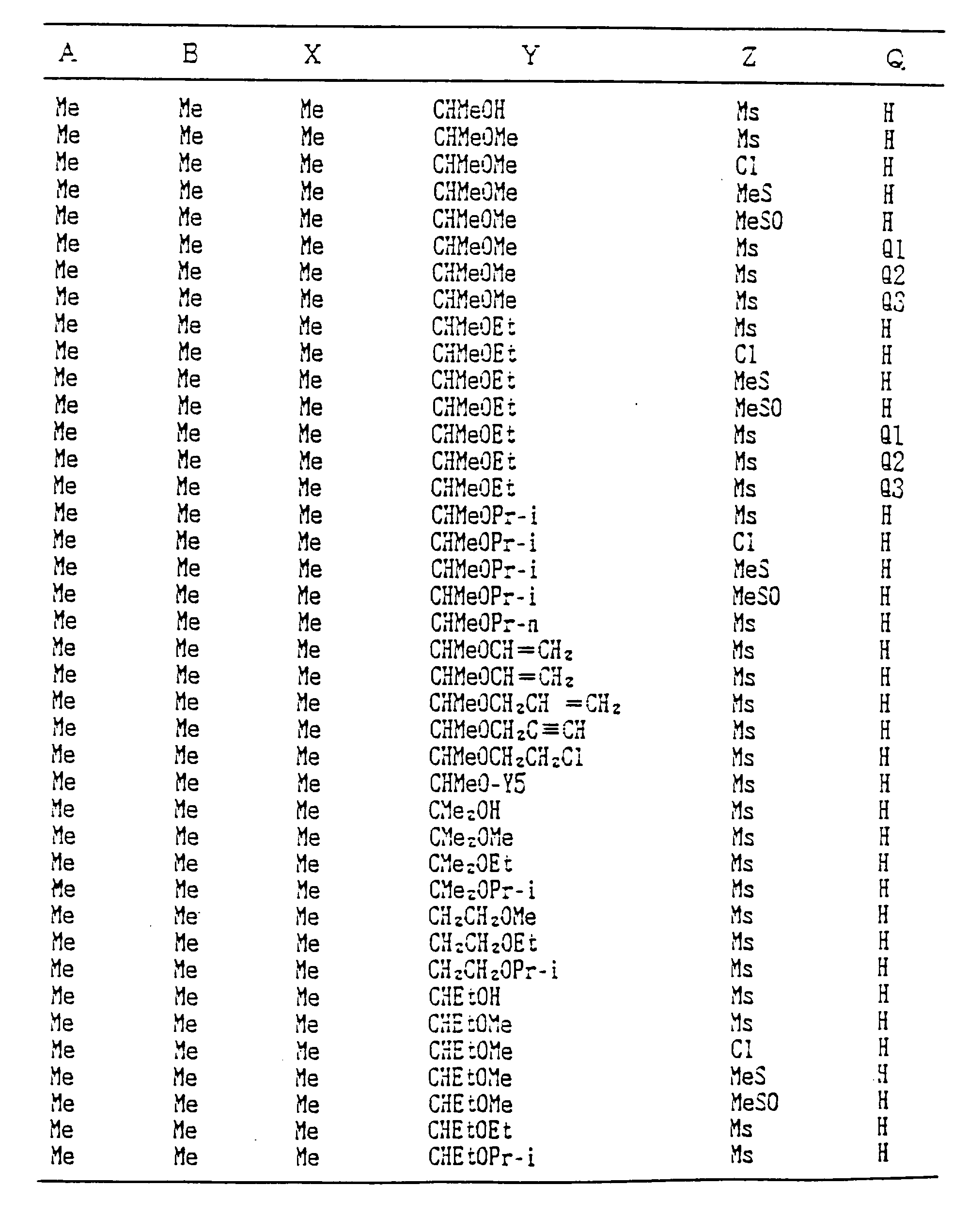


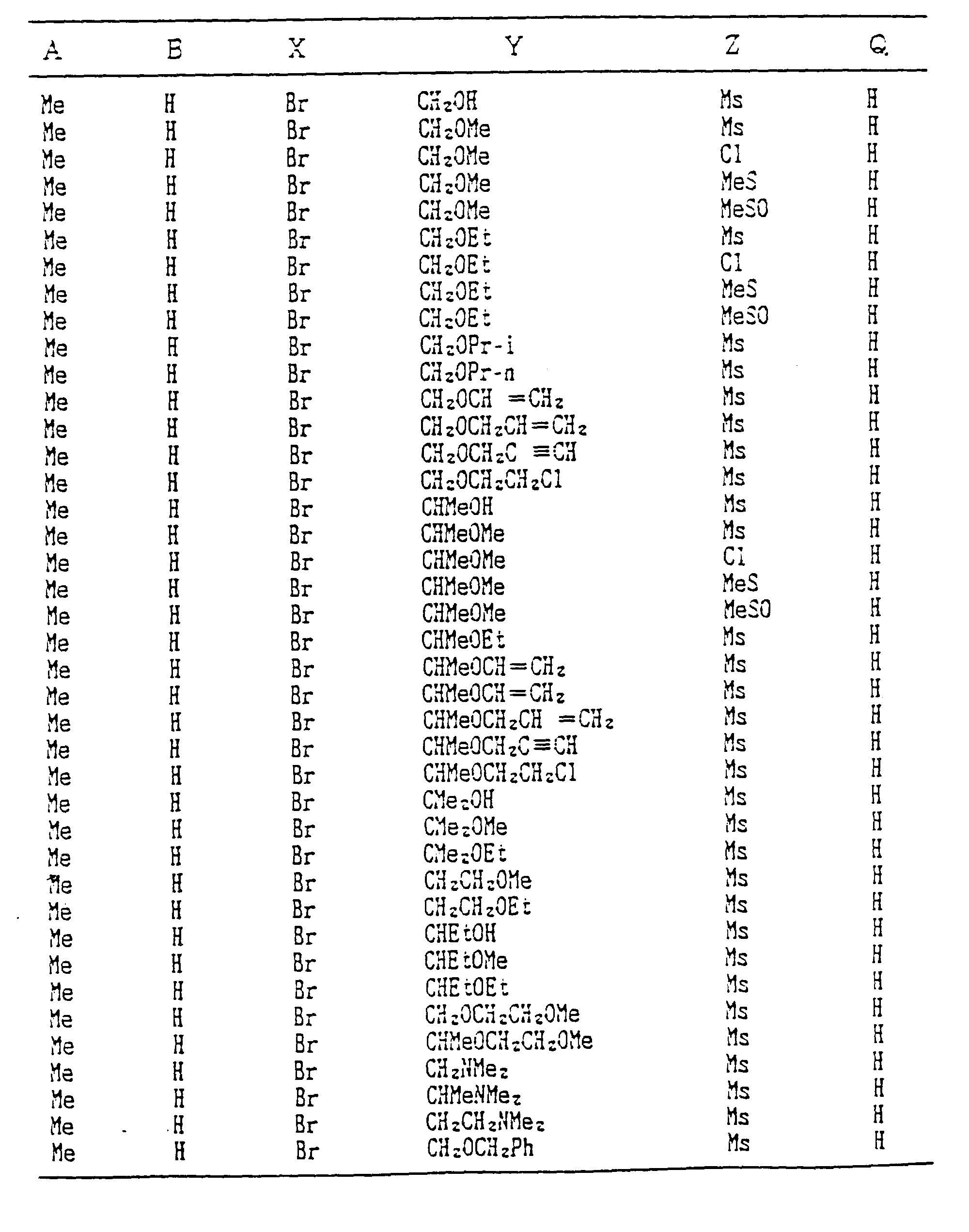


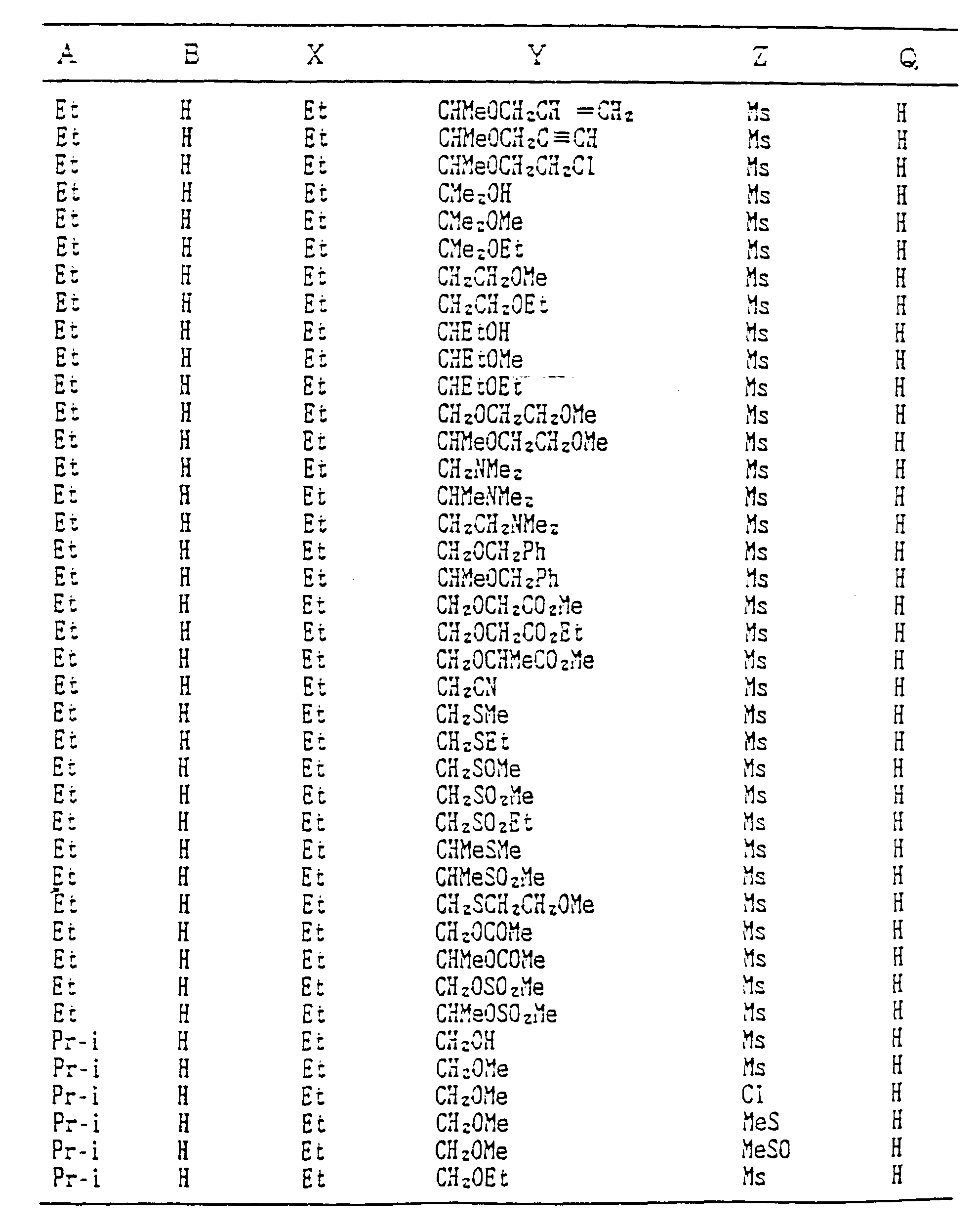


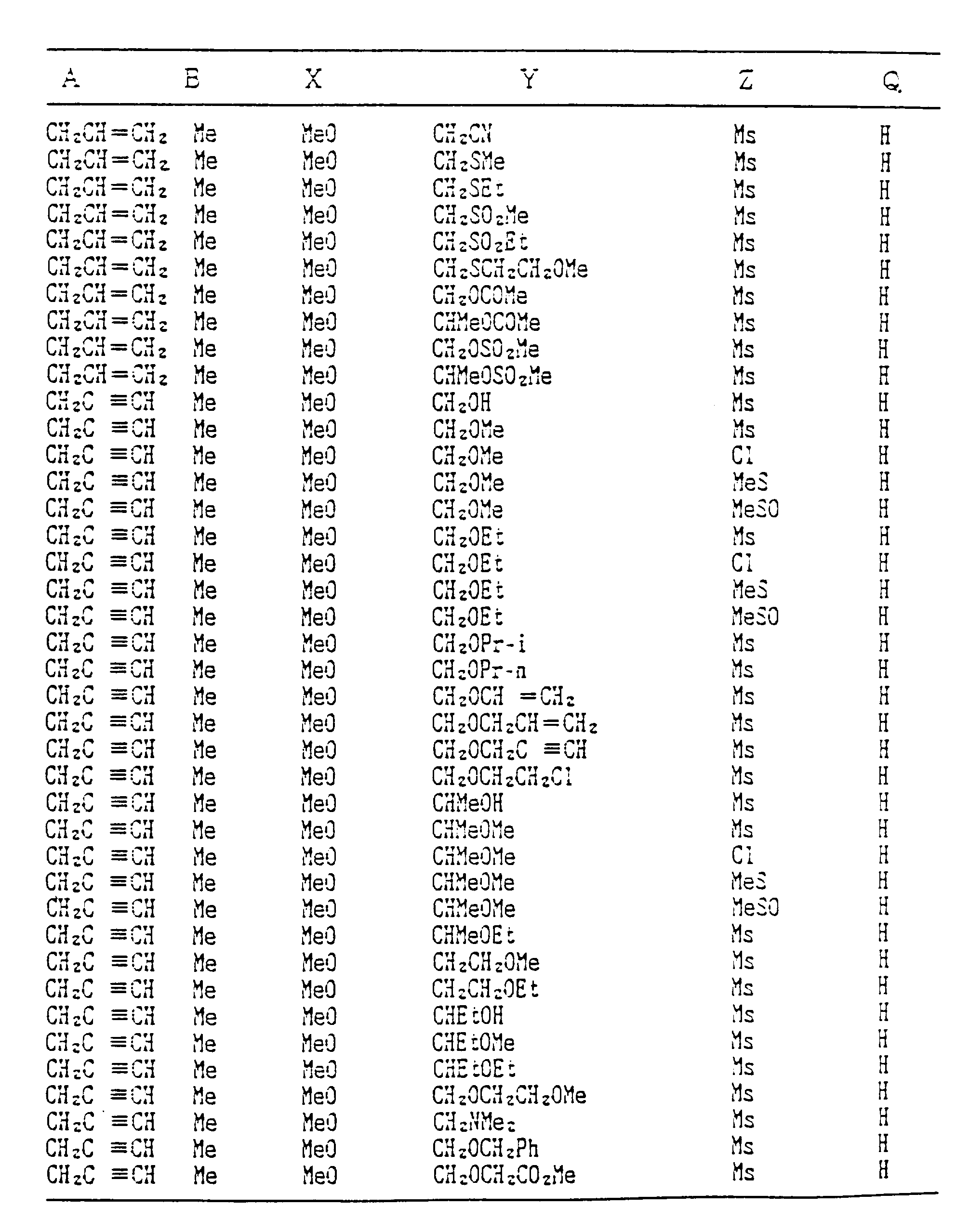


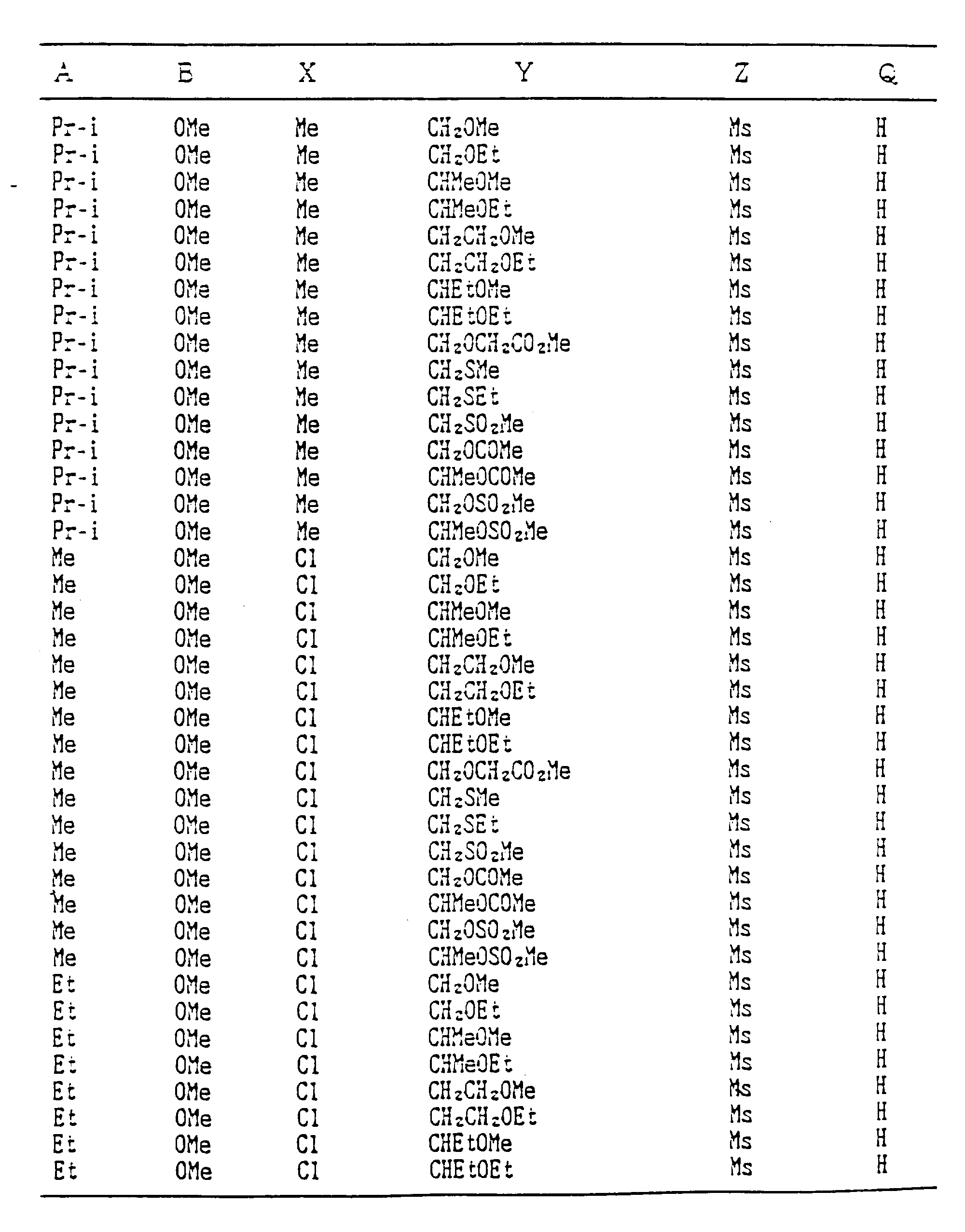


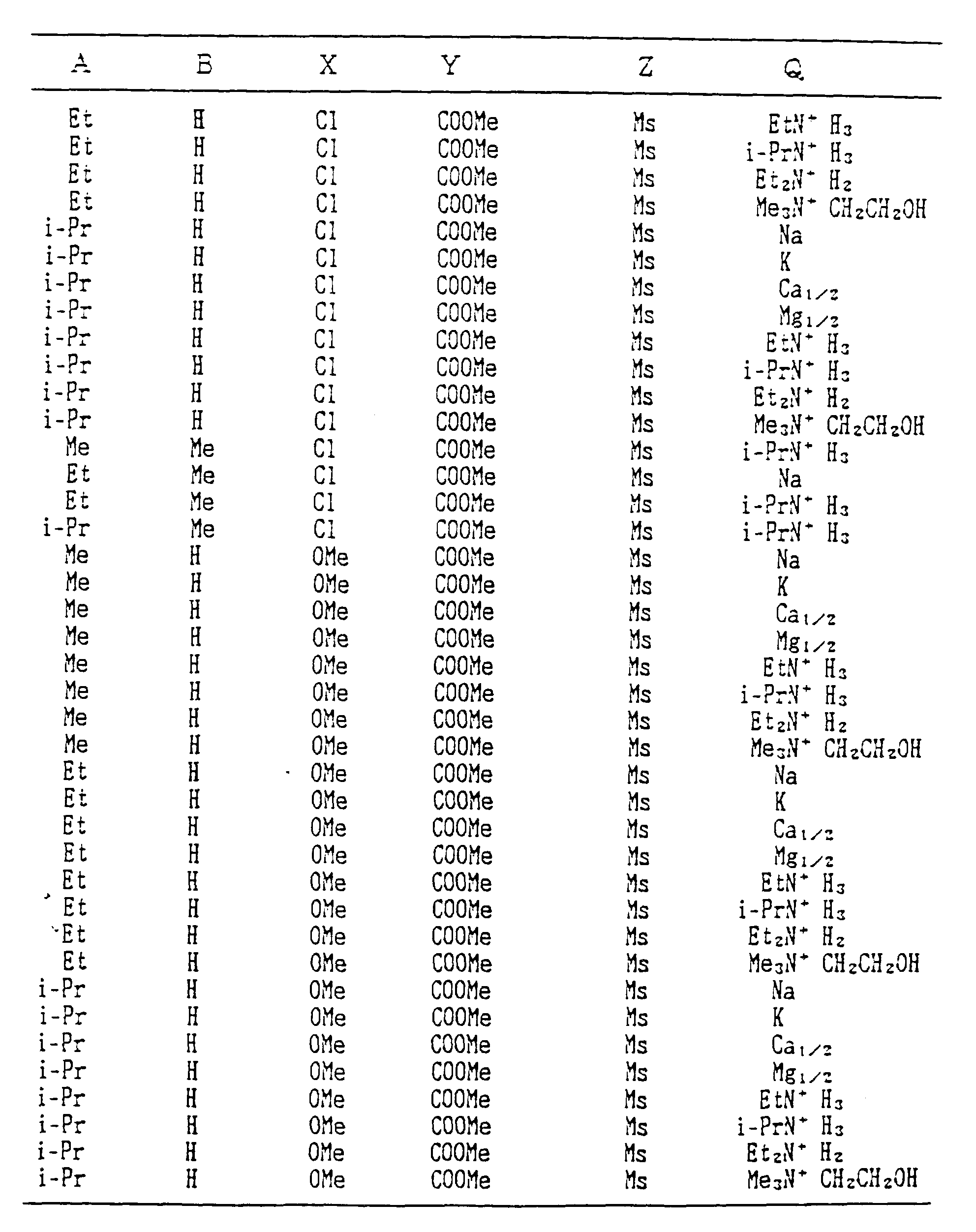


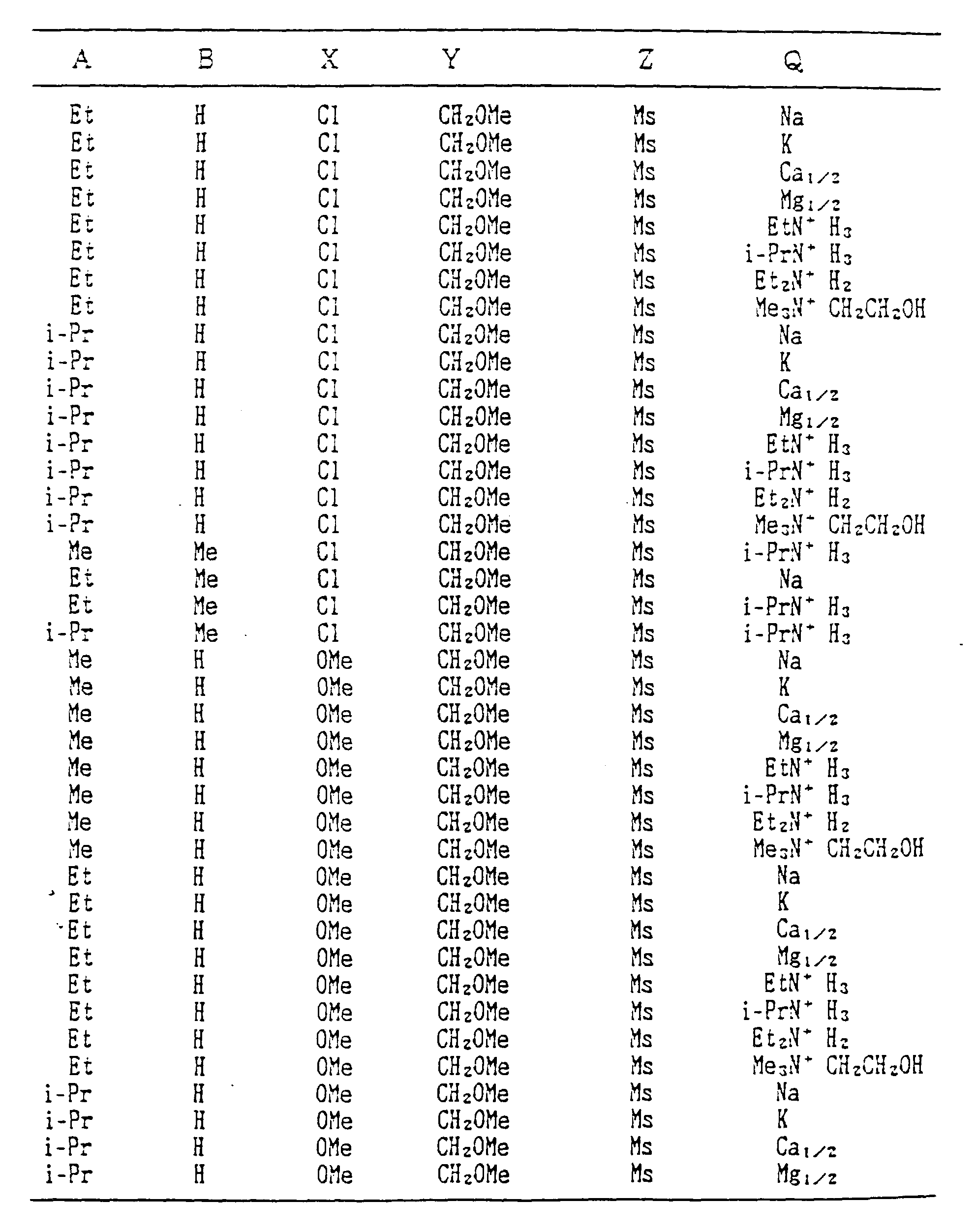


- When the compound of the present invention is to be used as an agricultural or horticultural herbicide, it is usually mixed with a suitable carrier, for instance, a solid carrier such as clay, talc, bentonite or diatomaceous earth, or a liquid carrier such as water, an alcohol (such as methanol or ethanol), an aromatic hydrocarbon (such as benzene, toluene or xylene), a chlorinated hydrocarbon, an ether, a ketone, an ester (such as ethyl acetate) or an acid amide (such as dimethylformamide). If desired, an emulsifier, a dispersing agent, a suspending agent, a penetrating agent, a spreader or a stabilizer may be added to prepare an optional formulation such as a liquid formulation, an emulsifiable concentrate, a wettable powder, a dust, a granule or a flowable.
- Further, if desired, other herbicides, various insecticides, bacteriocides, plant regulating agents or synergism agents may be combined at the time of the preparation of the formulations or at a time of the application of the herbicides.
- As other herbicides to be combined with the herbicide of the present invention, there may be mentioned, for instance, compounds disclosed in Farm Chemicals Handbook, the 73rd Edition (1987). Among them, there may be mentioned, for example, atrazine, cyanazine, alachlor, metolachlor, EPTC, 2,4-D, butylate, dicamba, bromoxynil and tridiphane. Further,
N-[(4,6-dimethoxypyrimidin-2-yl)-aminocarbonyl]-3-chloro-4-methoxycarbonyl-1-methylpyrazole-5-sulfonamide or N-[(4,6-dimethoxypyrimidin-2-yl)aminocarbonyl]-3-bromo-4-methoxycarbonyl-1-methylpyrazole-5-sulfonamide as disclosed in U.S. Patent 4,668,277 may also be combined with the herbicide of the present invention. - The dose varies depending upon the application site, the season for application, the method for application, the type of the crop plant, etc. In general, however, the dose is usually within a range of from 0.001 to 10 kg per hectare as the amount of the active ingredient.
- Now, Formulation Examples of the herbicides containing the compounds of the present invention as active ingredients, will be given. However, it should be understood that the present invention is by no means restricted to such specific Examples. In the following Formulation Examples, "parts" means "parts by weight".
-
Compound No. 3 of the present invention 60 parts Zeeklite PFP (tradename for a kaolin-type clay, manufactured by Zeeklite Industries, Co., Ltd.) 33 parts Sorpol 5039 (tradename for a mixture of a nonionic surfactant and an anionic surfactant, manufactured by Toho Chemical Co., Ltd.) 5 parts Carplex (tradename for a coagulation-preventing agent composed of a mixture of a surfactant and fine silica powder, manufactured by Shionogi Pharmaceutical Co., Ltd.) 2 parts - The above ingredients are homogeneously pulverized and mixed to form a wettable powder.
-
Compound No. 7 of the present invention 60 parts Zeeklite PFP (tradename for a kaolin-type clay, manufactured by Zeeklite Industries, Co., Ltd.) 33 parts Sorpol 5039 (tradename for a mixture of a nonionic surfactant and an anionic surfactant, manufactured by Toho Chemical Co., Ltd.) 5 parts Carplex (tradename for a coagulation-preventing agent composed of a mixture of a surfactant and fine silica powder, manufactured by Shionogi Pharmaceutical Co., Ltd.) 2 parts -
Compound No. 15 of the present invention 60 parts Zeeklite PFP (tradename for a kaolin-type clay, manufactured by Zeeklite Industries, Co., Ltd.) 33 parts Sorpol 5039 (tradename for a mixture of a nonionic surfactant and an anionic surfactant, manufactured by Toho Chemical Co., Ltd.) 5 parts Carplex (tradename for a coagulation-preventing agent composed of a mixture of a surfactant and fine silica powder, manufactured by Shionogi Pharmaceutical Co., Ltd.) 2 parts -


-
Compound No. 25 of the present invention 60 parts Zeeklite PFP (tradename for a kaolin-type clay, manufactured by Zeeklite Industries, Co., Ltd.) 33 parts Sorpol 5039 (tradename for a mixture of a nonionic surfactant and an anionic surfactant, manufactured by Toho Chemical Co., Ltd.) 5 parts Carplex (tradename for a coagulation-preventing agent composed of a mixture of a surfactant and fine silica powder, manufactured by Shionogi Pharmaceutical Co., Ltd.) 2 parts -
Compound No. 35 of the present invention 60 parts Zeeklite PFP (tradename for a kaolin-type clay, manufactured by Zeeklite Industries, Co., Ltd.) 33 parts Sorpol 5039 (tradename for a mixture of a nonionic surfactant and an anionic surfactant, manufactured by Toho Chemical Co., Ltd.) 5 parts Carplex (tradename for a coagulation-preventing agent composed of a mixture of a surfactant and fine silica powder, manufactured by Shionogi Pharmaceutical Co., Ltd.) 2 parts -
Compound No. 3 of the present invention 1.5 parts Xylene 78.5 parts N,N-dimethylformamide 15 parts Sorpol 2680 (tradename for a mixture of a nonionic surfactant and an anionic surfactant, manufactured by Toho Chemical Co., Ltd.) 5 parts - The above ingredients are homogeneously mixed to obtain an emulsifiable concentrate.
-
Compound No. 11 of the present invention 1.5 parts Xylene 78.5 parts N,N-dimethylformamide 15 parts Sorpol 2680 (tradename for a mixture of a nonionic surfactant and an anionic surfactant, manufactured by Toho Chemical Co., Ltd.) 5 parts -
Compound No. 3 of the present invention 40 parts Agrizole B-710 (tradename for a nonionic surfactant, manufactured by Kao Corporation) 10 parts Runox 1000C (tradename for an anionic surfactant, manufactured by Toho Chemical Co., Ltd.) 0.5 part 1% Rodopol water (tradename for a thickener, manufactured by Rhone-Poulenc) 20 parts Water 29.5 parts - The above ingredients are homogeneously mixed to form a flowable.
-
Compound No. 10 of the present invention 40 parts Agrizole B-710 (tradename for a nonionic surfactant, manufactured by Kao Corporation) 10 parts Runox 1000C (tradename for an anionic surfactant, manufactured by Toho Chemical Co., Ltd.) 0.5 part 1% Rodopol water (tradename for a thickener, manufactured by Rhone-Poulenc) 20 parts Water 29.5 parts -
Compound No. 39 of the present invention 30 parts Nippol (tradename for a nonionic surfactant, manufactured by Nissan Chemical Industries, Ltd.) 10 parts Water 60 parts - The above ingredients are homogeneously mixed to obtain a liquid formulation.
-
Compound No. 40 of the present invention 30 parts Nippol (tradename for a nonionic surfactant, manufactured by Nissan Chemical Industries, Ltd.) 10 parts Water 60 parts -
Compound No. 46 of the present invention 30 parts Nippol (tradename for a nonionic surfactant, manufactured by Nissan Chemical Industries, Ltd.) 10 parts Water 60 parts -
Compound No. 41 of the present invention 10 parts Sorpol W-150 (tradename for a nonionic surfactant, manufactured by Toho Chemical Co., Ltd.) 10 parts Water 80 parts - The above ingredients are homogeneously mixed to form a liquid formulation.
- In their use, the above wettable powders, emulsifiable concentrates, flowables or liquid formulations are diluted with water from 50 to 1,000 times and applied so that the respective active ingredients will be from 0.001 to 5 kg per hectare.
- The compounds of the present invention are applicable not only to agricultural and horticultural fields such as upland fields, paddy fields and orchards, but to non-agricultural fields such as athletic fields, vacant fields and railway sides for the control of various weeds. The dose in their application varies depending upon the application site, the season for application, the type of crop plants, etc. However, it is usually within a range of from 0.001 to 5 kg per hectare.
- Now, the herbicidal activities of the compounds of the present invention will be described with respect to specific Test Examples.
- A plastic box having a length of 15 cm, a width of 22 cm and a depth of 6 cm was filled with a sterilized diluvium soil, and seeds Echinochloa crus-galli, Setaria viridis, Eleusine indica, Digitaria adscendens, Panicum dichotomiflorum, Abutilon theophrasti, Amaranthus lividus, Polygonum longisetum and Zea mays were sown, and tubers of Cyperus esculentus were further planted. The soil was covered thereon in the thickness of about 1.5 cm, and then a herbicide solution was applied onto the surface of the soil uniformly so that the active ingredient is distributed at a predetermined concentration. The herbicide solution was prepared by diluting a wettable powder, an emulsifiable concentrate, a liquid formulation or a flowable with water and applied onto the entire soil surface by means of a small spray. Three weeks after the application of the herbicidal solution, the herbicidal effects against each weed were determined on the basis of the following standard ratings. The results thereby obtained are shown in Table 6. The Compound Nos. correspond to the Compound Nos. in Table 3.
-
- 5:
- Growth control rate of more than 90% (almost completely withered)
- 4:
- Growth control rate of from 70 to 90%
- 3:
- Growth control rate of from 40 to 70%
- 2:
- Growth control rate of from 20 to 40%
- 1:
- Growth control rate of from 5 to 20%
- 0:
- Growth control rate of less than 5% (almost non-effective)
- The above growth control rates were calculated by the following equation:

- T:
- Weight of the weed growth above the soil surface of the treated area
- N:
- Weight of the weed grown above the soil surface of the non-treated area
- A plastic box having a length of 15 cm, a width of 22 cm and a depth of 6 cm was filled with a sterilized diluvium soil, and seeds of Echinochloa crus-galli, Setaria viridis, Eleusine indica, Digitaria adscendens, Panicum dichotomiflorum, Xanthium strumarium, Abutilon theophrasti, Amaranthus lividus, Polygonum longisetum and Zea mavs were spot-wisely sown, and tubers of Cyperus esculentus were further planted. Then, the soil was covered thereon in a thickness of about 1.5 cm. When the various weeds and crops grew to the 2 or 3 leaf stage, a herbicidal solution was uniformly sprayed on the foliages so that the active ingredient is applied in a predetermined concentration.
- The herbicidal solution was prepared by diluting the wettable powder, the emulsifiable concentrate, the liquid formulation or the flowable as described in the above Formulation Examples with water and applied onto the entire surface of the foliages of the weeds and the crop plants by a small spray. Two weeks after the application of the herbicide solution, the herbicidal effects against each weed were determined on the basis of the standard ratings described in Test Example 1, and the phytotoxicity against each crop plant was determined on the basis of the standard ratings in Test Example 1. The results are shown in Table 7. The Compound Nos. in Table 7 correspond to the Compound Nos. in Table 3.
- In Tables 6 and 7, the following abbreviations are used:
- Dose:
- Dose of active ingredient (g/are)
- EC:
- Echinochloa crus-galli (barnyardgrass)
- SE:
- Setaria viridis (green foxtail)
- EL:
- Eleusine indica (goosegrass)
- DI:
- Digitaria adscendens (large crabgrass)
- PA:
- Panicum dichotomiflorum (fall panicum)
- AB:
- Abutilon theophrasti (velvet leaf)
- AM:
- Amaranthus lividus (livid amaranth)
- PC:
- Polygonum longisetum (persicaria blumei gross)
- XA:
- Xanthium strumarium (cocklebur)
- CY:
- Cyperus esculentus (yellow nutsedge)
- ZE:
- Zea mays (corn)
- In Tables 6 and 7, the Comparative Compounds are as follows:
-

-


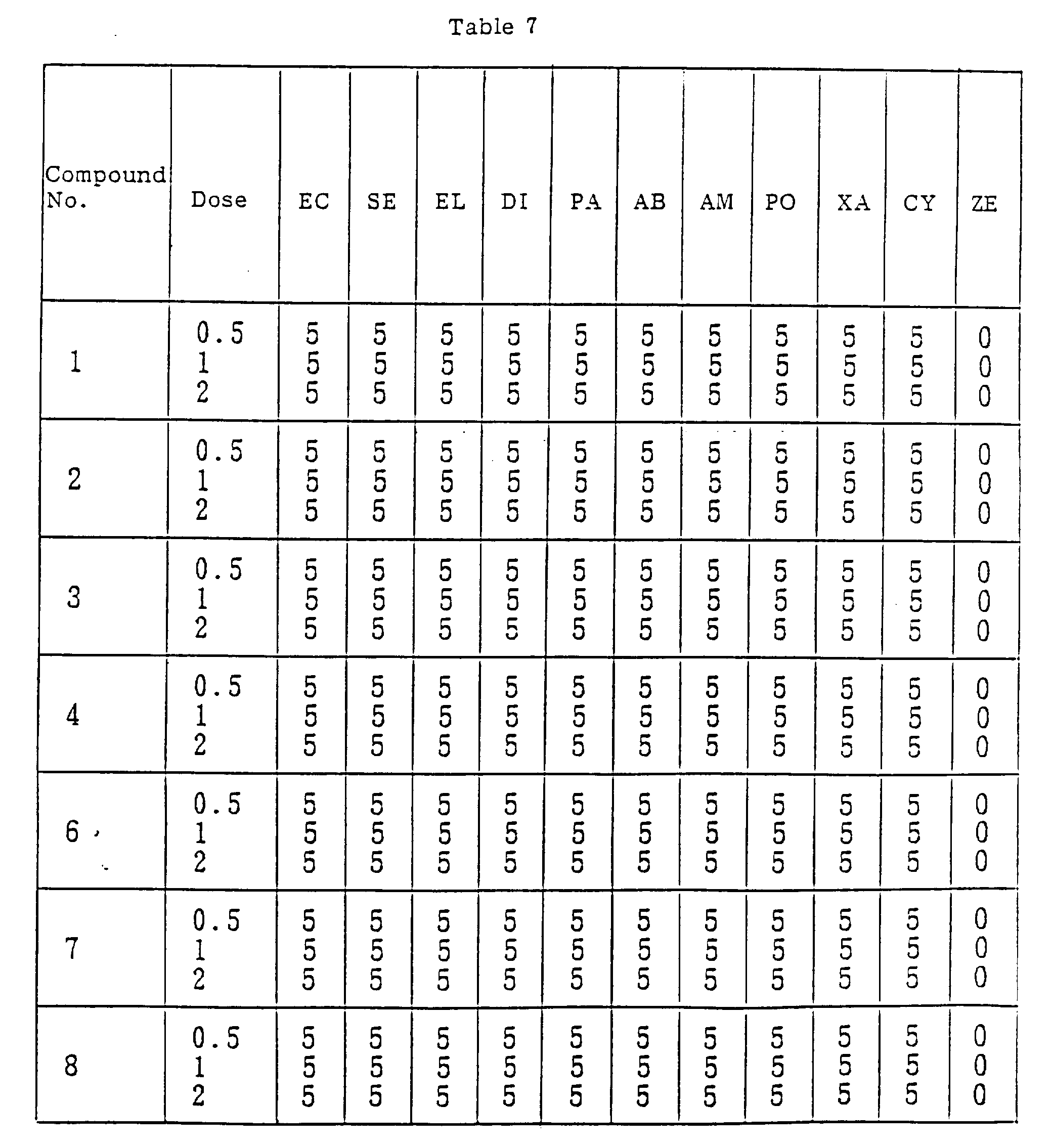


Claims (9)
- A process for producing a pyrazole derivative having the formula


 (a) reacting a benzoic acid of the formula:
 (b) rearranging a compound of the formula:
 (c) condensing a 4-benzoyl-5-hydroxypyrazole of the formula:
 (d) condensing a 4-benzoyl-5-chloropyrazole of the formula:
- The process according to Claim 1, wherein A, B, X, Y, Z and Q in the formula I are respectively selected from the following substituents:A : Me, Et, n-Pr, i-Pr, CH2CH=CH2, CH2C ≡ CHB : H, Me, Et, n-Pr, i-Pr, Cℓ, Br, CH2Cℓ, CF3, OMe, OEt, OPr-i, SMe, CH2OMe, CH2SMe, CO2Me, CO2EtX : Me, Et, n-Pr, i-Pr, n-Bu, i-Bu, s-Bu, t-Bu, OMe, OEt, OPr-n, OPr-i, OBu-n, OBu-i, OBu-s, OBu-t, F, Cℓ, Br, I, NO2, CN, CH2F, CHF2, CF3, CH2CF3, CH2Cℓ, CCℓ3, CHCℓ Me, CH2CH2Cℓ, CHCℓ CH2Cℓ, CH2Br, CHBrMe, CH2CH2Br, CH2OMe, CH2OEt, CH2OPr-n, CH2OPr-i, CH2OBu-n, CH2OBu-i, CH2OBu-s, CH2OBu-t, CHMeOMe, CHMeOEt, CHMeOPr-n, CHMeOPr-i, CHMeOBu-n, CHMeOBu-i, CHMeOBu-s, CHMeOBu-t, CH2CH2OMe, CH2CH2OEt, CH2CH2OPr-i, Ac, COEt, COPr-n, COPr-i, COOMe, COOEt, COOPr-i, CONHMe, CONHEt, CONMe2, CONEt2, CONEtMe, OCHF2, OCF3, OCH2CF3, SMe, SEt, CH2SMe, CH2SEt, CHMeSMe, CHMeSEtY : CH2OH, CH2OMe, CH2OEt, CH2OPr-n, CH2OPr-i, CH2OBu-n, CH2OBu-i, CH2OBu-s, CH2OBu-t, CH2OAm-n, CH2OAm-i, CH2OAm-t, CH2OC6H13-n,


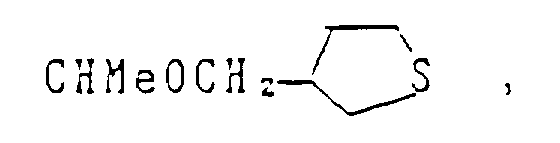


 Z : F, Cℓ,Br, I, NO2, OMe, OEt, OPr-n, OPr-i, CF3, CN, SMe, SOMe, SO2Me, SCF3, SOCF3, SO2CF3Q : H, Me, Et, n-Pr, i-Pr, n-Bu, i-Bu, s-Bu, t-Bu, CH2CH2Cℓ, CH2CF3, CHCℓ Me, CH2CH2Br, CHCℓ CH2Cℓ, CH2CH=CH2, CH2CMe=CH2, CH2CH=CHMe, CH2C≡CH, CH2CCℓ=CH2, CH2CN, CH2Ph, CH2Ph-Cℓ -2, CH2Ph-Cℓ-3, CH2Ph-Me-2,

- The process according to Claim 1, wherein V and W are hydrogen atoms, and A, B, X, Y, Z and Q in the formula I are respectively selected from the following substituents:A : Me, Et, n-Pr, i-Pr, CH2CH=CH2, CH2C ≡ CHB : H, Me,X : Me, Et, i-Pr, OMe, OEt, OPr-i F, Cℓ, Br, I, NO2, CN, OBu-t, CF3, CH2OMe, Ac, COOMe, COOEt, COOPr-i, OCHF2, OCF3, OCH2CF3, SMe, CH2SMe,Y : CH2OMe, CH2OEt, CH2OPr-n, CH2OPr-i, CH2OBu-t, CH2OAm-n, CH2OCH=CH2, CH2OCH2CH=CH2, CH2OCH2C ≡ CH, CH2OCH2CH3, CH2OCH2CH2Cℓ, CH2OCH2CH2OMe, CH2NMe2, CH2SMe, CH2SEt, CH2SOMe, CH2SOEt, CH2SO2Me, CH2SO2Et, CH2OAc, CH2OSO2Me, CH2OCH2CH2CN, CH2OCH2COOBu-t, CHMeOMe, CHMeOEt, CHMeOAc, CHMeOSO2Me, CMe2OMe, CMe2OEt, CH2CO2Me, CH2CO2Et, CH=CHOMe, CH=CHOEt, CH2CH2COOMe, CH2CH2COOEtZ : F, Cℓ,Br, I, NO2, OMe, CF3, CN, SMe, SOMe, SO2Me, SCF3, SOCF3, SO2CF3Q : H, -CH2Ph, CH2COPh, SO2(4-Me-phenyl) CH2OC(O)Bu-t, CH2COMe, CH2OMe, CH2CO(4-Me-phenyl), CH2COOH
- The process according to Claim 1, wherein V and W are hydrogen atoms, and A, B, X, Y, Z and Q in the formula I are respectively selected from the following substituents:A : Me, Et, n-Pr, i-Pr, CH2CH=CH2, CH2C ≡CHB : H, Me,X : Me, Et, i-Pr, OMe, OEt, OPr-i F, Cℓ, Br, I, NO2, CN, OBu-t, CF3, CH2OMe, Ac, COOMe, COOEt, COOPr-i, OCHF2, OCF3, OCH2CF3, SMe, CH2SMe,Y : COOMe, COOEt, COOPr-n, COOPr-i, COOBu-t, COOAm-i, COOCH2CH=CH2, COOCH2C≡CH, COOCH2CH2 Cℓ COOCH2CF3, COOCH2CH2OMe, COOCH2CH2CN COOCH2COOMe, COOCH2COOEt, COOCH2COOPr-i, COOCH2COOBu-t, CONMe2, COON=CMe2, CH2COOMe, CH2COOEt, CH2CH2COOMe, CH2CH2COOEt, CH=CHOMe, CH=CHOEtZ : F, Cℓ,Br, I, NO2, OMe, CF3, CN, SMe, SOMe, SO2Me, SCF3, SOCF3, SO2CF3Q : H, -CH2Ph, CH2COPh, SO2(4-Me-Phenyl) CH2OC(O)Bu-t, CH2COMe, CH2OMe, CH2CO(4-Me-Phenyl), CH2COOH
- The process according to Claim 1, which produces a compound having the formula

- The process according to Claim 1, whichproduces5-hydroxy-4-(4-methanesulfonyl-3-methoxymethyl-2-methylbenzoyl)-1-methylpyrazole,1-ethyl-5-hydroxy-4-(4-methanesulfonyl-3-methoxymethyl-2-methylbenzoyl)pyrazole,5-hydroxy-1-isopropyl-4-(4-methanesulfonyl-3-methoxymethyl-2-methylbenzoyl)pyrazole,5-hydroxy-4-(4-methanesulfonyl-3-methoxycarbonyl-2-methylbenzoyl)-1-methylpyrazole,1-ethyl-5-hydroxy-4-(4-methanesulfonyl-3-methoxycarbonyl-2-methylbenzoyl)pyrazole,4-(3-ethoxycarbonyl-4-methanesulfonyl-2-methylbenzoyl)-5-hydroxy-1-methylpyrazole,4-(3-ethoxycarbonyl-4-methanesulfonyl-2-methylbenzoyl) -1-ethyl-5-hydroxypyrazole,5-hydroxy-4-(3-isopropoxycarbonyl-4-methanesulfonyl-2-methylbenzoyl)-1-methylpyrazole,1-ethyl-5-hydroxy-4-(3-isopropoxycarbonyl-4-methanesulfonyl-2-methylbenzoyl)pyrazole,4-(2,4-dichloro-3-methoxycarbonyIbenzoyI)-5-hydroxy-1-methylpyrazole,4-(3-ethoxymethyl-4-methanesulfonyl-2-methylbenzoyl)-5-hydroxy-1-methylpyrazole,4-(3-ethoxymethyl-4-methanesulfonyl-2-methylbenzoyl) -1-ethyl-5-hydroxypyrazole,4-(3-ethoxymethyl-4-methanesulfonyl-2-methylbenzoyl)-5-hydroxy-1-isopropylpyrazole,1,3-dimethyl-4-(3-ethoxymethyl-4-methanesulfonyl-2-methylbenzoyl)-5-hydroxypyrazole,5-hydroxy-4-[4-methanesulfonyl-3-(1-methoxyethyl)-2-methylbenzoyl]-1-methylpyrazole,1-ethyl-5-hydroxy-4-[4-methanesulfonyl-3-(1-methoxyethyl)-2-methylbenzoyl]pyrazole,4-(2-chloro-4-methanesulfonyl-3-methoxymethylbenzoyl)-5-hydroxy-1-methylpyrazole,4-(2-chloro-4-methanesulfonyl-1-methoxymethyIbenzoyI)-1-ethyl-5-hydroxypyrazole,4-(2-chloro-4-methanesulfonyl-1-methoxymethylbenzoyl)-5-hydroxy-1-isopropylpyrazole,1-ethyl-5-hydroxy-4-(3-isopropoxymethyl-4-methanesulfonyl-2-methylbenzoyl)pyrazole,5-hydroxy-4-[4-methanesulfonyl-3-(2-methoxyethyl) oxycarbonyl-2-methylbenzoyl] -1-methylpyrazole,1-ethyl-5-hydroxy-4-[4-methanesulfonyl-3-(2-methoxyethyl)oxycarbonyl-2-methylbenzoyl]pyrazole,4-[2-chloro-4-methanesulfonyl-3-(2-methoxyethyl)oxymethylbenzoyl)-5-hydroxy-1-methylpyrazole,4-(2-chloro-3-ethylthiomethyl-4-methanesulfonylbenzoyl)-1-ethyl-5-hydroxypyrazole,4-(2-chloro-3-ethanesulfinyl-4-methanesulfonylbenzoyll-1-ethyl-5-hydroxypyrazole,4-(2-chloro-3-ethanesulfonyl-4-methanesulfonylbenzoyl)-1-ethyl-5-hydroxypyrazole,1-ethyl-5-hydroxy-4-(3-n-propoxycarbonyl-4-methanesulfonyl-2-methylbenzoyl)pyrazole,4-(2-chloro-4-methanesulfonyl-3-methoxycarbonylbenzoyl)-5-hydroxy-1-methylpyrazole,4-(2-chloro-4-methanesulfonyl-3-methoxycarbonylbenzoyl)-1-ethyl-5-hydroxypyrazole,4-(2-chloro-4-methanesulfonyl-3-methoxycarbonylbenzoyl)-5-hydroxy-1-isopropylpyrazole,4-[2-chloro-4-methanesulfonyl-3-(3-propargyl)oxymethylbenzoyl]-1-ethyl-5-hydroxypyrazole,5-hydroxy-4-(4-methanesulfonyl-2-methoxy-3-methoxycarbonylbenzoyl) -1-methylpyrazole,4-(2-chloro-4-methanesulfonyl-3-isopropoxycarbonylbenzoyl)-5-hydroxy-1-methylpyrazole,4-(2-chloro-4-methanesulfonyl-3-isopropoxycarbonylbenzoyl)-1-ethyl-5-hydroxypyrazole,4-[2-chloro-4-methanesulfonyl-3-(2,2,2-trifluoroethyl)oxymethylbenzoyl]-5-hydroxy-1-methylpyrazole,5-hydroxy-1-isopropyl-4-(4-methanesulfonyl-3-methoxycarbonyl-2-methylbenzoyl)pyrazole,5-hydroxy-4-(4-methanesulfonyl-2-methoxy-3-methoxymethylbenzoyl)-1-methylpyrazole,4-[3-(2-chloroethyl)oxycarbonyl-4-methanesulfonyl-2-methylbenzoyl]-1-ethyl-5-hydroxypyrazole,1-ethyl-5-hydroxy-4-(4-methanesulfonyl-2-methoxy-3-methoxycarbonylbenzoyl)pyrazole,4-(2,4-dichloro-3-methoxycarbonylbenzoyl)-1-ethyl-5-hydroxypyrazole,4-(2,4-dichloro-3-methoxycarbonylbenzoyl)-5-hydroxy-1-isopropylpyrazole,4-(2-chloro-3-cyanomethyl-4-methanesulfonylbenzoyl)-1-ethyl-5-hydroxypyrazole,4-(2-chloro-3-hydroxymethyl-4-methanesulfonylbenzoyl)-1-ethyl-5-hydroxypyrazole,4-(2,4-dichloro-3-methoxymethylbenzoyl)-1-ethyl-5-hydroxypyrazole,4-(2,4-dichloro-3-methoxymethylbenzoyl)-5-hydroxy-1-methylpyrazole,4-[2-chloro-4-methanesulfonyl-3-(2-methoxyvinyl)benzoyl]-1-ethyl-5-hydroxypyrazole,5-benzyloxy-4-(2,4-dichloro-3-methoxycarbonylbenzoyl)-1-ethylpyrazole,5-benzyloxy-4-(2,4-dichloro-3-methoxycarbonylbenzoyl)-1-isopropylpyrazole,4-(2-chloro-3-ethoxycarbonyl-4-methanesulfonylbenzoyl)-1-ethyl-5-hydroxypyrazole,4-(2-chloro-3-ethoxycarbonyl-4-methanesulfonylbenzoyl)-5-hydroxy-1-isopropylpyrazole or4-(2-chloro-3-ethoxycarbonyl-4-methanesulfonylbenzoyl)-5-hydroxy-1-methylpyrazole.
- A process for preparing a selective herbicidal composition which comprises mixing a herbicidally effective amount of a pyrazole derivative of the formula I as defined in Claim 1 or its salt and an agricultural carrier or diluent.
- A method for controlling weeds, which comprises applying a herbicidally effective amount of a pyrazole derivative of the formula I as defined in Claim 1 or its salt to a locus to be protected.
Applications Claiming Priority (8)
| Application Number | Priority Date | Filing Date | Title |
|---|---|---|---|
| JP61937/87 | 1987-03-17 | ||
| JP6193787 | 1987-03-17 | ||
| JP179797/87 | 1987-07-17 | ||
| JP17979787 | 1987-07-17 | ||
| JP24760187 | 1987-09-30 | ||
| JP247601/87 | 1987-09-30 | ||
| JP5449/88 | 1988-01-13 | ||
| JP544988 | 1988-01-13 |
Publications (3)
| Publication Number | Publication Date |
|---|---|
| EP0282944A2 EP0282944A2 (en) | 1988-09-21 |
| EP0282944A3 EP0282944A3 (en) | 1991-10-09 |
| EP0282944B1 true EP0282944B1 (en) | 1996-09-11 |
Family
ID=27454297
Family Applications (1)
| Application Number | Title | Priority Date | Filing Date |
|---|---|---|---|
| EP88103999A Expired - Lifetime EP0282944B1 (en) | 1987-03-17 | 1988-03-14 | Pyrazole derivative and herbicide containing it |
Country Status (17)
| Country | Link |
|---|---|
| US (1) | US4948887A (en) |
| EP (1) | EP0282944B1 (en) |
| JP (2) | JP2725274B2 (en) |
| KR (1) | KR960004862B1 (en) |
| CN (1) | CN1023011C (en) |
| AT (1) | ATE142624T1 (en) |
| AU (1) | AU599468B2 (en) |
| BR (1) | BR8801218A (en) |
| CA (1) | CA1328260C (en) |
| DE (1) | DE3855518T2 (en) |
| DK (1) | DK170668B1 (en) |
| ES (1) | ES2094719T3 (en) |
| GR (1) | GR3021596T3 (en) |
| HU (1) | HU204513B (en) |
| IL (1) | IL85659A (en) |
| RU (2) | RU1836018C (en) |
| YU (2) | YU46497B (en) |
Cited By (1)
| Publication number | Priority date | Publication date | Assignee | Title |
|---|---|---|---|---|
| US7041851B2 (en) | 2002-03-14 | 2006-05-09 | The Trustees Of The University Of Pennsylvania | Fluorinated phenyl thiophenyl derivatives and their use for imaging serotonin transporters |
Families Citing this family (80)
| Publication number | Priority date | Publication date | Assignee | Title |
|---|---|---|---|---|
| AU611014B2 (en) * | 1988-05-06 | 1991-05-30 | Sumitomo Chemical Company, Limited | A pyrazole compound and its production and use |
| US4986845A (en) * | 1988-07-15 | 1991-01-22 | Nissan Chemical Industries Ltd. | Pyrazole derivatives and herbicides containing them |
| US5339466A (en) * | 1992-01-09 | 1994-08-23 | Mcmullen Donald J | Cold weather sleeping hood |
| CA2131191A1 (en) * | 1992-03-03 | 1993-09-04 | Mitsuru Shibata | Pyrazole derivatives |
| US5506194A (en) * | 1992-07-13 | 1996-04-09 | Idemitsu Kosan Co., Ltd. | Pyrazole derivatives and herbicidal compositions |
| US5607898A (en) * | 1993-08-02 | 1997-03-04 | Idemitsu Kosan Company, Ltd. | Pyrazole derivatives |
| DK0712853T3 (en) * | 1993-08-02 | 2001-04-17 | Idemitsu Kosan Co | pyrazole |
| AU685868B2 (en) * | 1993-11-09 | 1998-01-29 | Idemitsu Kosan Co. Ltd | Pyrazole derivatives and herbicide containing the same |
| CA2213078A1 (en) * | 1995-02-15 | 1996-08-22 | Kazufumi Nakamura | Isoxazole derivatives |
| TR199700844T1 (en) * | 1995-02-24 | 1998-01-21 | Basf Aktiengesellschaft | Pyrazolyl-Benzoil T�revleri. |
| EA001515B1 (en) * | 1996-02-24 | 2001-04-23 | Басф Акциенгезельшафт | Pyrazole-4-yl-hetaroyl derivatives as herbicides |
| WO1997041116A1 (en) * | 1996-04-26 | 1997-11-06 | Nippon Soda Co., Ltd. | Benzene derivatives substituted by heterocycles and herbicides |
| AU1670997A (en) * | 1996-04-26 | 1997-11-19 | Nippon Soda Co., Ltd. | Novel benzene derivatives substituted by heterocycles and herbicides |
| ATE264856T1 (en) * | 1996-04-26 | 2004-05-15 | Nippon Soda Co | HETEROCYCLIC SUBSTITUTED BENZENE DERIVATIVES AND HERBICIDES |
| CN1216534A (en) * | 1996-04-26 | 1999-05-12 | 日本曹达株式会社 | Novel Benzene Derivatives and Herbicides Substituted by Heterocycles |
| WO1998021187A1 (en) * | 1996-11-13 | 1998-05-22 | Nippon Soda Co., Ltd. | Novel heterocycle substituted benzene derivatives and herbicide |
| RU2162849C2 (en) * | 1996-12-27 | 2001-02-10 | Ниппон Сода Ко., Лтд | Benzene derivative substituted by heterocycle, and herbicide |
| DE19700096A1 (en) * | 1997-01-03 | 1998-07-09 | Basf Ag | Substituted 4-benzoyl-pyrazoles |
| ES2318868T3 (en) * | 1997-01-17 | 2009-05-01 | Basf Se | DERIVATIVES OF BENZOIL SUBSTITUTED BY 3-HETEROCICLYL. |
| US6165944A (en) * | 1997-01-17 | 2000-12-26 | Basf Aktiengesellschaft | 4-(3-heterocyclyl-1-benzoyl) pyrazoles and their use as herbicides |
| AR012142A1 (en) * | 1997-03-24 | 2000-09-27 | Dow Agrosciences Llc | 1-ALKYL-4-BENZOIL-5-HYROXYPYRAZOLE COMPOUNDS, HERBICIDE COMPOSITIONS CONTAINING THEM; METHOD FOR CONTROLLING UNWANTED VEGETATION AND USEFUL INTERMEDIATE COMPOUNDS TO PREPARE SUCH COMPOUNDS |
| AU6523498A (en) * | 1997-04-08 | 1998-10-30 | Nippon Soda Co., Ltd. | 4-benzoylpyrazole derivatives and herbicides |
| IL132340A0 (en) * | 1997-05-07 | 2001-03-19 | Basf Ag | Substituted 4-(3-alkenyl-benzoyl) pyrazoles |
| CA2289003A1 (en) * | 1997-05-07 | 1998-11-12 | Basf Aktiengesellschaft | Substituted 4-benzoyl-pyrazoles |
| US6010981A (en) | 1997-05-23 | 2000-01-04 | Dow Agrosciences Llc | 1-alkyl-4-benzoyl-5-hydroxypyrazole compounds and their use as herbicides |
| US5807806A (en) * | 1997-06-12 | 1998-09-15 | Nippon Soda Co., Ltd. | Benzoylpyrazole derivatives having specific substituents and herbicide |
| ES2221986T3 (en) * | 1997-06-12 | 2005-01-16 | Nippon Soda Co., Ltd. | BENZOILPIRAZOL DERIVATIVES THAT HAVE DETERMINED SUBSTITUTES AND HERBICIDES THAT CONTAIN THEM. |
| US5939360A (en) * | 1997-07-08 | 1999-08-17 | Nippon Soda Co., Ltd. | Compound and herbicidal composition for weed control |
| AU8863798A (en) * | 1997-07-18 | 1999-02-10 | Rhone-Poulenc Agriculture Limited | 4-benzoyl-isoxazole- and -pyrazole derivatives and 2-cyano 1,3-dione derivativesas herbicides |
| US6207618B1 (en) | 1997-08-07 | 2001-03-27 | Basf Aktiengesellschaft | Heterocyclic substituted 4-benzoyl-pyrazole as herbicides |
| US6156702A (en) * | 1997-08-07 | 2000-12-05 | Basf Aktiengesellschaft | Substituted 4-benzoylpyrazoles |
| EP1031573B2 (en) * | 1997-10-30 | 2015-05-27 | Nippon Soda Co., Ltd. | Use of a benzoylpyrazole compound as herbicide |
| CN1283191A (en) | 1997-11-21 | 2001-02-07 | 巴斯福股份公司 | Benzylidene pyrazolones and its preparation and use |
| EP1077972A1 (en) * | 1998-05-22 | 2001-02-28 | Dow AgroSciences LLC | 1-alkyl-4-[(3-oxetanyl-)benzoyl]-5-hydroxypyrazole compounds and their use as herbicides |
| BR9916396A (en) | 1998-12-21 | 2001-09-11 | Syngenta Participations Ag | Herbicides |
| DE19914140A1 (en) * | 1999-03-27 | 2000-09-28 | Bayer Ag | Substituted benzoylpyrazoles |
| AU5685600A (en) | 1999-07-09 | 2001-01-30 | Basf Aktiengesellschaft | Alpha-alpha'-substituted n-alkyl-3-alkenylbenzoyl-pyrazol-derivatives |
| EP1194407A2 (en) | 1999-07-09 | 2002-04-10 | Basf Aktiengesellschaft | N-cycloalkyl-3-alkenylbenzoyl-pyrazole derivatives |
| CA2381532A1 (en) * | 1999-08-10 | 2001-02-15 | Akihiko Yanagi | Herbicidal tetrazolinone derivatives |
| RS50437B (en) * | 2000-03-31 | 2009-12-31 | Bayer Cropscience Ag., | BENZOYLPYRAZOLES AND THEIR APPLICATION IN HERBICIDES |
| JP2002080460A (en) | 2000-07-06 | 2002-03-19 | Nippon Bayer Agrochem Co Ltd | Herbicidal tetrazole derivative |
| DE10138577A1 (en) * | 2001-05-21 | 2002-11-28 | Bayer Ag | New 4-benzoyl-5-oxy-pyrazole derivatives, useful as herbicides, especially pre- and post-emergence selective herbicides |
| JP2003238540A (en) * | 2002-02-08 | 2003-08-27 | Bayer Ag | Tetrazole derivative and herbicide |
| DE10209645A1 (en) * | 2002-03-05 | 2003-09-18 | Bayer Cropscience Ag | Substituted aryl ketones |
| EP1541561B1 (en) * | 2002-08-01 | 2014-07-23 | Ihara Chemical Industry Co., Ltd. | Pyrazole derivatives and process for the production thereof |
| DE10235945A1 (en) | 2002-08-06 | 2004-02-19 | Bayer Cropscience Gmbh | New 4-(3-substituted benzoyl)-pyrazol-5-one derivatives, useful as broad-spectrum, pre- and post-emergence herbicides especially for selective weed control in crops e.g. wheat, maize and rice |
| AR056889A1 (en) | 2005-12-15 | 2007-10-31 | Ishihara Sangyo Kaisha | BENZOILPIRAZOL AND HERBICIDE COMPOUNDS CONTAINING THEM |
| UA94003C2 (en) | 2006-11-28 | 2011-03-25 | Ишихара Санджай Кайша, Лтд. | Benzoylpyrazole compounds, an herbicide based thereon and a method for controlling undesired plants |
| JP5420169B2 (en) * | 2006-12-27 | 2014-02-19 | 石原産業株式会社 | Herbicides containing benzoylpyrazole compounds |
| JP5416354B2 (en) * | 2007-02-02 | 2014-02-12 | 石原産業株式会社 | Herbicidal composition containing a benzoylpyrazole compound |
| JP5449855B2 (en) * | 2008-05-20 | 2014-03-19 | 石原産業株式会社 | Pyrazole compounds, methods for producing them, and herbicides containing them |
| JP2010006798A (en) * | 2008-05-27 | 2010-01-14 | Ishihara Sangyo Kaisha Ltd | Benzoylpyrazole-based compound, method for producing the same, and herbicide containing the same |
| EP2127521A1 (en) * | 2008-05-29 | 2009-12-02 | Bayer CropScience Aktiengesellschaft | 4-(3-Alkylsulfinylbenzoyl)pyrazoles as herbicides |
| WO2011067184A1 (en) | 2009-12-01 | 2011-06-09 | Basf Se | 3- (4, 5 -dihydroisoxazol- 5 -yl) benzoylpyrazole compounds and mixtures thereof with safeners |
| CN102464630B (en) * | 2010-11-19 | 2015-05-13 | 中国中化股份有限公司 | Nitrogen heterocyclic substituent-containing benzoyl compound and application thereof |
| CN103626704B (en) * | 2013-11-10 | 2015-09-09 | 上海师范大学 | 1-substituted alkenyl pyrazole compound and preparation method |
| CN105794796B (en) * | 2014-12-30 | 2019-01-04 | 沈阳中化农药化工研发有限公司 | A kind of herbicidal composition and application |
| CN105218449B (en) * | 2015-11-06 | 2017-08-11 | 青岛清原化合物有限公司 | Pyrazolone compound or its salt, preparation method, herbicide composition and use |
| CN105503728B (en) | 2015-12-31 | 2017-03-22 | 青岛清原化合物有限公司 | Pyrazole compounds or salts thereof and preparation method thereof, and weedicide composition and application thereof |
| CN105399674B (en) * | 2015-12-31 | 2017-02-15 | 青岛清原化合物有限公司 | Pyrazole compound or salt thereof, and preparation method, herbicide composition and application thereof |
| CN106106474A (en) * | 2016-06-21 | 2016-11-16 | 泰安市农业科学研究院 | A kind of cornfield weeding composition and application thereof |
| CN106135220A (en) * | 2016-06-22 | 2016-11-23 | 泰安市农业科学研究院 | A kind of cornfield weeding composition |
| CN106106506B (en) * | 2016-06-24 | 2018-09-14 | 青岛清原抗性杂草防治有限公司 | Herbicidal combinations containing pyrazolone compound and its application |
| CN106259401A (en) * | 2016-08-02 | 2017-01-04 | 泰安市农业科学研究院 | A kind of cornfield weeding composition and application thereof |
| CN106259352A (en) * | 2016-08-12 | 2017-01-04 | 泰安市农业科学研究院 | A kind of cornfield weeding composition and application thereof |
| CN106942234A (en) * | 2016-09-29 | 2017-07-14 | 泰安市农业科学研究院 | A kind of herbicidal composition and application containing benzene azoles fluorine humulone and benzene flumetsulam |
| CN106665599A (en) * | 2016-10-11 | 2017-05-17 | 泰安市农业科学研究院 | Herbicide composition containing fenbuconazol fluridon and isoxaflutole and application of herbicide composition |
| CN110903279B (en) * | 2018-09-17 | 2023-05-16 | 潍坊中农联合化工有限公司 | Pyrazole compound, salt and application thereof |
| KR102177462B1 (en) * | 2019-04-30 | 2020-11-11 | 포항공과대학교 산학협력단 | Method, apparatus and system for 3C acylation of 2H-indazole derivative using visible light photocatalyst |
| CN112142671B (en) * | 2019-06-27 | 2024-01-16 | 东莞市东阳光农药研发有限公司 | Substituted benzoyl-pyrazoles and their applications in agriculture |
| CN112174889B (en) * | 2019-07-03 | 2024-01-16 | 东莞市东阳光农药研发有限公司 | Substituted benzoyl compounds and their applications in agriculture |
| WO2021018135A1 (en) * | 2019-07-31 | 2021-02-04 | 东莞市东阳光农药研发有限公司 | Heterocyclyl alkyl substituted dichlorobenzoyl compounds and applications thereof |
| CN112409263B (en) * | 2019-08-23 | 2024-04-05 | 东莞市东阳光农药研发有限公司 | Substituted benzoyl compounds and application thereof |
| WO2021204669A1 (en) | 2020-04-07 | 2021-10-14 | Bayer Aktiengesellschaft | Substituted isophthalic acid diamides |
| AU2021253460A1 (en) | 2020-04-07 | 2022-11-03 | Bayer Aktiengesellschaft | Substituted isophthalic acid diamides and their use as herbicides |
| WO2021204665A1 (en) | 2020-04-07 | 2021-10-14 | Bayer Aktiengesellschaft | Substituted isophthalic acid diamides |
| EP4132917B1 (en) | 2020-04-07 | 2024-01-24 | Bayer Aktiengesellschaft | Substituted isophtalic acid diamides |
| CN116947775B (en) * | 2023-08-11 | 2025-10-28 | 绍兴贝斯美化工股份有限公司 | A preparation method of methyl 3-(4,5-dihydro-3-isoxazolyl)-2-methyl-4-methylsulfonylbenzoate |
| CN116947716B (en) * | 2023-08-11 | 2025-10-28 | 绍兴贝斯美化工股份有限公司 | A preparation method of methyl 2,3-dimethyl-4-methanesulfonylbenzoate |
| CN117326949A (en) * | 2023-09-28 | 2024-01-02 | 清源创新实验室 | Preparation method of 2, 4-dichloro-3-nitrobenzoic acid |
Family Cites Families (18)
| Publication number | Priority date | Publication date | Assignee | Title |
|---|---|---|---|---|
| JPS5436648B2 (en) * | 1974-03-28 | 1979-11-10 | ||
| US4146726A (en) * | 1974-03-28 | 1979-03-27 | Sankyo Company Limited | Pyrazole sulfonates |
| JPS5835189B2 (en) * | 1975-08-14 | 1983-08-01 | 三共株式会社 | Production method of pyrazole derivatives |
| JPS5223675A (en) * | 1975-08-18 | 1977-02-22 | Nippon Telegr & Teleph Corp <Ntt> | Abrasion-proof armored cable |
| US4230481A (en) * | 1977-08-12 | 1980-10-28 | Ishihara Sangyo Kaisha Limited | Pyrazole derivatives useful as a herbicidal component |
| JPS6022713B2 (en) * | 1978-09-01 | 1985-06-03 | 三共株式会社 | Pyrazole derivative |
| JPS5772903A (en) * | 1980-10-27 | 1982-05-07 | Mitsubishi Petrochem Co Ltd | Pyrazole herbicide |
| JPS58185568A (en) * | 1982-04-24 | 1983-10-29 | Nissan Chem Ind Ltd | Pyrazole derivative, its preparation and selective herbicide containing said derivative |
| JPS58206568A (en) * | 1982-05-25 | 1983-12-01 | Sankyo Co Ltd | Pyrazole derivative and herbicide |
| JPS59181259A (en) * | 1983-03-29 | 1984-10-15 | Nippon Nohyaku Co Ltd | Pyrazole derivative, insecticide, fungicide, and herbicide |
| JPS6041668A (en) * | 1983-08-15 | 1985-03-05 | Nippon Nohyaku Co Ltd | Production of pyrazole derivative |
| JPS6041667A (en) * | 1983-08-15 | 1985-03-05 | Nippon Nohyaku Co Ltd | Production of pyrazole derivative |
| JPS6051175A (en) * | 1983-08-30 | 1985-03-22 | Nissan Chem Ind Ltd | Pyrazole derivative and selective herbicide |
| JPS61257974A (en) * | 1985-05-11 | 1986-11-15 | Nissan Chem Ind Ltd | Pyrazole derivative, production thereof, and selective herbicide |
| JPH0625133B2 (en) * | 1985-09-03 | 1994-04-06 | 日産化学工業株式会社 | Pyrazole derivative, its production method and selective herbicide |
| US4744815A (en) * | 1985-05-11 | 1988-05-17 | Nissan Chemical Industries, Ltd. | 4-benzoyl-1-alkyl (alkenyl) - pyrazoles, composition containing them, herbicidal method of using them, and intermediate in their preparation |
| US4643757A (en) * | 1985-05-20 | 1987-02-17 | Nissan Chemical Industries, Ltd. | Herbicidal 4-benzoyl-1-methyl-5-hydroxypyrazoles |
| JP2943778B2 (en) | 1987-03-17 | 1999-08-30 | 日産化学工業株式会社 | Substituted benzene derivatives |
-
1988
- 1988-03-07 IL IL85659A patent/IL85659A/en not_active IP Right Cessation
- 1988-03-11 AU AU13099/88A patent/AU599468B2/en not_active Ceased
- 1988-03-14 DE DE3855518T patent/DE3855518T2/en not_active Expired - Fee Related
- 1988-03-14 EP EP88103999A patent/EP0282944B1/en not_active Expired - Lifetime
- 1988-03-14 US US07/168,139 patent/US4948887A/en not_active Expired - Lifetime
- 1988-03-14 ES ES88103999T patent/ES2094719T3/en not_active Expired - Lifetime
- 1988-03-14 CA CA000561419A patent/CA1328260C/en not_active Expired - Fee Related
- 1988-03-14 AT AT88103999T patent/ATE142624T1/en not_active IP Right Cessation
- 1988-03-15 HU HU881213A patent/HU204513B/en not_active IP Right Cessation
- 1988-03-15 JP JP63061349A patent/JP2725274B2/en not_active Expired - Fee Related
- 1988-03-16 CN CN88101455A patent/CN1023011C/en not_active Expired - Fee Related
- 1988-03-16 YU YU53688A patent/YU46497B/en unknown
- 1988-03-16 RU SU884355524A patent/RU1836018C/en active
- 1988-03-17 KR KR1019880002832A patent/KR960004862B1/en not_active Expired - Fee Related
- 1988-03-17 BR BR8801218A patent/BR8801218A/en not_active IP Right Cessation
- 1988-03-17 DK DK146488A patent/DK170668B1/en not_active IP Right Cessation
-
1989
- 1989-10-13 YU YU199189A patent/YU46637B/en unknown
-
1992
- 1992-05-21 RU SU925011738A patent/RU2055836C1/en not_active IP Right Cessation
-
1996
- 1996-11-11 GR GR960402974T patent/GR3021596T3/en unknown
-
1998
- 1998-09-02 JP JP10248300A patent/JP3008398B2/en not_active Expired - Fee Related
Cited By (1)
| Publication number | Priority date | Publication date | Assignee | Title |
|---|---|---|---|---|
| US7041851B2 (en) | 2002-03-14 | 2006-05-09 | The Trustees Of The University Of Pennsylvania | Fluorinated phenyl thiophenyl derivatives and their use for imaging serotonin transporters |
Also Published As
| Publication number | Publication date |
|---|---|
| EP0282944A3 (en) | 1991-10-09 |
| AU1309988A (en) | 1988-09-15 |
| DK146488D0 (en) | 1988-03-17 |
| DK170668B1 (en) | 1995-11-27 |
| IL85659A0 (en) | 1988-08-31 |
| YU199189A (en) | 1990-06-30 |
| HU204513B (en) | 1992-01-28 |
| JP2725274B2 (en) | 1998-03-11 |
| AU599468B2 (en) | 1990-07-19 |
| RU1836018C (en) | 1993-08-23 |
| US4948887A (en) | 1990-08-14 |
| IL85659A (en) | 1992-03-29 |
| JPH11171828A (en) | 1999-06-29 |
| BR8801218A (en) | 1988-10-25 |
| ATE142624T1 (en) | 1996-09-15 |
| KR880011113A (en) | 1988-10-26 |
| YU46497B (en) | 1993-10-20 |
| HUT45847A (en) | 1988-09-28 |
| GR3021596T3 (en) | 1997-02-28 |
| YU46637B (en) | 1994-01-20 |
| KR960004862B1 (en) | 1996-04-16 |
| RU2055836C1 (en) | 1996-03-10 |
| ES2094719T3 (en) | 1997-02-01 |
| EP0282944A2 (en) | 1988-09-21 |
| YU53688A (en) | 1990-04-30 |
| DK146488A (en) | 1988-09-18 |
| JPH02173A (en) | 1990-01-05 |
| CN88101455A (en) | 1988-09-28 |
| DE3855518T2 (en) | 1997-02-20 |
| CA1328260C (en) | 1994-04-05 |
| JP3008398B2 (en) | 2000-02-14 |
| CN1023011C (en) | 1993-12-08 |
| DE3855518D1 (en) | 1996-10-17 |
Similar Documents
| Publication | Publication Date | Title |
|---|---|---|
| US4948887A (en) | Pyrazole derivative and herbicide containing it | |
| US4986845A (en) | Pyrazole derivatives and herbicides containing them | |
| US4744815A (en) | 4-benzoyl-1-alkyl (alkenyl) - pyrazoles, composition containing them, herbicidal method of using them, and intermediate in their preparation | |
| CA2252543C (en) | Benzene derivatives substituted by heterocycles and herbicides | |
| US4885022A (en) | Herbicidal pyrazole derivatives | |
| JP3478830B2 (en) | Pyrazole derivatives | |
| JPWO1993018031A1 (en) | Pyrazole derivatives | |
| US5094685A (en) | Substituted benzoyl derivatives and selective herbicides | |
| JPWO1995004054A1 (en) | Pyrazole derivatives | |
| CZ282051B6 (en) | 4-bonzoylisoxazole derivative, process of its preparation, herbicidal agent contained therein and method of controlling weed | |
| SI9300485A (en) | Herbicides containing 4-hetroaroylisoxazole derivates | |
| US5175299A (en) | Benzoic acid derivatives useful as intermediates for the preparation of herbicidal 4-benzoylpyrazoles | |
| JP2738010B2 (en) | Pyrazole inducers and selective herbicides | |
| EA001810B1 (en) | Thiochromanpyrazole derivatives and herbicide composition based thereon | |
| JPH10287659A (en) | 1,2,3-thiadiazole compounds, their preparation and pesticides for agricultural and horticultural use | |
| JPH0366684A (en) | Substituted 4-heteroaloylpyrazole, its preparation, pharmaceutical agent containing same and having herbicidal action and method of preparation thereof | |
| KR100300219B1 (en) | Benzene derivatives and herbicides substituted by heterocycles | |
| JP2943778B2 (en) | Substituted benzene derivatives | |
| WO1999054328A1 (en) | Novel benzoylpyrazole compounds and herbicide | |
| CA1340959C (en) | Intermediates for pyrazole derivative herbicides | |
| CA2309210A1 (en) | 1-methyl-5-alkylsulfonyl-, 1-methyl-5-alkylsulfinyl- and 1-methyl-5-alkylthiosubstituted pyrazolylpyrazoles, processes for their preparation and their use as herbicides | |
| JPH11236376A (en) | New benzoylpyrazole compound and herbicide | |
| JP2907333B2 (en) | Substituted benzenes | |
| JPWO1999018098A1 (en) | Pyrazole derivatives | |
| JPWO1998056766A1 (en) | Benzoylpyrazole derivatives having specific substituents and herbicides |
Legal Events
| Date | Code | Title | Description |
|---|---|---|---|
| PUAI | Public reference made under article 153(3) epc to a published international application that has entered the european phase |
Free format text: ORIGINAL CODE: 0009012 |
|
| AK | Designated contracting states |
Kind code of ref document: A2 Designated state(s): AT BE CH DE ES FR GB GR IT LI LU NL SE |
|
| RHK1 | Main classification (correction) |
Ipc: C07D231/24 |
|
| PUAL | Search report despatched |
Free format text: ORIGINAL CODE: 0009013 |
|
| RHK1 | Main classification (correction) |
Ipc: C07D231/24 |
|
| AK | Designated contracting states |
Kind code of ref document: A3 Designated state(s): AT BE CH DE ES FR GB GR IT LI LU NL SE |
|
| 17P | Request for examination filed |
Effective date: 19920310 |
|
| 17Q | First examination report despatched |
Effective date: 19940627 |
|
| GRAH | Despatch of communication of intention to grant a patent |
Free format text: ORIGINAL CODE: EPIDOS IGRA |
|
| GRAH | Despatch of communication of intention to grant a patent |
Free format text: ORIGINAL CODE: EPIDOS IGRA |
|
| GRAA | (expected) grant |
Free format text: ORIGINAL CODE: 0009210 |
|
| AK | Designated contracting states |
Kind code of ref document: B1 Designated state(s): AT BE CH DE ES FR GB GR IT LI LU NL SE |
|
| REF | Corresponds to: |
Ref document number: 142624 Country of ref document: AT Date of ref document: 19960915 Kind code of ref document: T |
|
| ITF | It: translation for a ep patent filed | ||
| REG | Reference to a national code |
Ref country code: CH Ref legal event code: NV Representative=s name: A. BRAUN, BRAUN, HERITIER, ESCHMANN AG PATENTANWAE |
|
| REF | Corresponds to: |
Ref document number: 3855518 Country of ref document: DE Date of ref document: 19961017 |
|
| ET | Fr: translation filed | ||
| REG | Reference to a national code |
Ref country code: GR Ref legal event code: FG4A Free format text: 3021596 |
|
| REG | Reference to a national code |
Ref country code: ES Ref legal event code: FG2A Ref document number: 2094719 Country of ref document: ES Kind code of ref document: T3 |
|
| PLBE | No opposition filed within time limit |
Free format text: ORIGINAL CODE: 0009261 |
|
| STAA | Information on the status of an ep patent application or granted ep patent |
Free format text: STATUS: NO OPPOSITION FILED WITHIN TIME LIMIT |
|
| 26N | No opposition filed | ||
| REG | Reference to a national code |
Ref country code: GB Ref legal event code: IF02 |
|
| PGFP | Annual fee paid to national office [announced via postgrant information from national office to epo] |
Ref country code: SE Payment date: 20030306 Year of fee payment: 16 |
|
| PGFP | Annual fee paid to national office [announced via postgrant information from national office to epo] |
Ref country code: FR Payment date: 20030310 Year of fee payment: 16 |
|
| PGFP | Annual fee paid to national office [announced via postgrant information from national office to epo] |
Ref country code: GB Payment date: 20030312 Year of fee payment: 16 Ref country code: AT Payment date: 20030312 Year of fee payment: 16 |
|
| PGFP | Annual fee paid to national office [announced via postgrant information from national office to epo] |
Ref country code: CH Payment date: 20030314 Year of fee payment: 16 |
|
| PGFP | Annual fee paid to national office [announced via postgrant information from national office to epo] |
Ref country code: LU Payment date: 20030317 Year of fee payment: 16 |
|
| PGFP | Annual fee paid to national office [announced via postgrant information from national office to epo] |
Ref country code: NL Payment date: 20030327 Year of fee payment: 16 Ref country code: GR Payment date: 20030327 Year of fee payment: 16 Ref country code: DE Payment date: 20030327 Year of fee payment: 16 |
|
| PGFP | Annual fee paid to national office [announced via postgrant information from national office to epo] |
Ref country code: ES Payment date: 20030328 Year of fee payment: 16 |
|
| PGFP | Annual fee paid to national office [announced via postgrant information from national office to epo] |
Ref country code: BE Payment date: 20030514 Year of fee payment: 16 |
|
| PG25 | Lapsed in a contracting state [announced via postgrant information from national office to epo] |
Ref country code: LU Free format text: LAPSE BECAUSE OF NON-PAYMENT OF DUE FEES Effective date: 20040314 Ref country code: GB Free format text: LAPSE BECAUSE OF NON-PAYMENT OF DUE FEES Effective date: 20040314 Ref country code: AT Free format text: LAPSE BECAUSE OF NON-PAYMENT OF DUE FEES Effective date: 20040314 |
|
| PG25 | Lapsed in a contracting state [announced via postgrant information from national office to epo] |
Ref country code: SE Free format text: LAPSE BECAUSE OF NON-PAYMENT OF DUE FEES Effective date: 20040315 Ref country code: ES Free format text: LAPSE BECAUSE OF NON-PAYMENT OF DUE FEES Effective date: 20040315 |
|
| PG25 | Lapsed in a contracting state [announced via postgrant information from national office to epo] |
Ref country code: LI Free format text: LAPSE BECAUSE OF NON-PAYMENT OF DUE FEES Effective date: 20040331 Ref country code: CH Free format text: LAPSE BECAUSE OF NON-PAYMENT OF DUE FEES Effective date: 20040331 Ref country code: BE Free format text: LAPSE BECAUSE OF NON-PAYMENT OF DUE FEES Effective date: 20040331 |
|
| BERE | Be: lapsed |
Owner name: *NISSAN CHEMICAL INDUSTRIES LTD Effective date: 20040331 |
|
| PG25 | Lapsed in a contracting state [announced via postgrant information from national office to epo] |
Ref country code: NL Free format text: LAPSE BECAUSE OF NON-PAYMENT OF DUE FEES Effective date: 20041001 Ref country code: DE Free format text: LAPSE BECAUSE OF NON-PAYMENT OF DUE FEES Effective date: 20041001 |
|
| PG25 | Lapsed in a contracting state [announced via postgrant information from national office to epo] |
Ref country code: GR Free format text: LAPSE BECAUSE OF NON-PAYMENT OF DUE FEES Effective date: 20041006 |
|
| EUG | Se: european patent has lapsed | ||
| GBPC | Gb: european patent ceased through non-payment of renewal fee |
Effective date: 20040314 |
|
| REG | Reference to a national code |
Ref country code: CH Ref legal event code: PL |
|
| PG25 | Lapsed in a contracting state [announced via postgrant information from national office to epo] |
Ref country code: FR Free format text: LAPSE BECAUSE OF NON-PAYMENT OF DUE FEES Effective date: 20041130 |
|
| NLV4 | Nl: lapsed or anulled due to non-payment of the annual fee |
Effective date: 20041001 |
|
| REG | Reference to a national code |
Ref country code: FR Ref legal event code: ST |
|
| PG25 | Lapsed in a contracting state [announced via postgrant information from national office to epo] |
Ref country code: IT Free format text: LAPSE BECAUSE OF NON-PAYMENT OF DUE FEES Effective date: 20050314 |
|
| REG | Reference to a national code |
Ref country code: ES Ref legal event code: FD2A Effective date: 20040315 |